

A Cascade xDAWN EEGNet Structure for Unified Visual-Evoked Related Potential Detection
Open accessThe DOI matches its Crossref record; 52 of the 53 references it cites were found in a registry or an index; 24 of the 47 sources its claims cite were checked for support.
Abstract
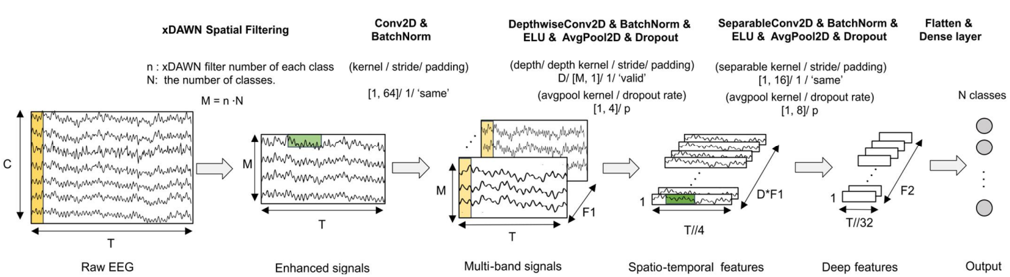
Visual-based brain-computer interface (BCI) enables people to communicate with others by spelling words from the brain and helps professionals recognize targets in large numbers of images. P300 signals evoked by different types of stimuli, such as words or images, may vary significantly in terms of both amplitude and latency. A unified approach is required to detect variable P300 signals, which facilitates BCI applications, as well as deepens the understanding of the P300 generation mechanism. In this study, our proposed approach involves a cascade network structure that combines xDAWN and classical EEGNet techniques. This network is designed to classify target and non-target stimuli in both P300 speller and rapid serial visual presentation (RSVP) paradigms. The proposed approach is capable of recognizing more symbols with fewer repetitions (up to 5 rounds) compared to other models while possessing a better information transfer rate (ITR) as demonstrated on Dataset II (17.22 bits/min in the second repetition round) of BCI Competition III. Additionally, our approach has the highest unweighted average recall (UAR) performance for both 5 Hz ( 0.8134±0.0259 ) and 20 Hz ( 0.6527±0.0321 ) RSVP. The results show that the cascade network structure has better performance between both the P300 Speller and RSVP paradigms, manifesting that such a cascade structure is robust enough for dealing with P300-related signals (source code is available at https://github.com/embneural/Cascade-xDAWN-EEGNet-for-ERP-Detection).
Overview
CoChat Summary
TL;DR
The paper proposes a cascade xDAWN-EEGNet model for unified detection of visual-evoked related potentials in P300 speller and RSVP paradigms. It reports improved ITR and symbol recognition on BCI Competition III dataset II and the highest UAR on 5 Hz and 20 Hz RSVP compared with several baselines.
Key findings
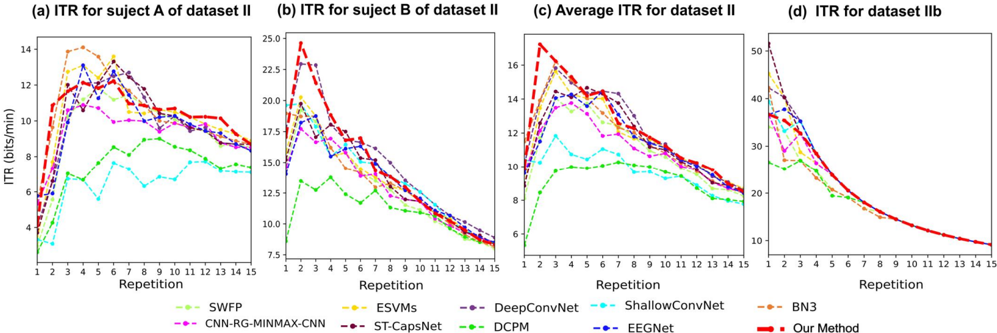
- On BCI Competition III dataset II, the proposed model reached an ITR of 17.22 bits/min in the second repetition round and recognized more symbols with fewer repetitions (up to 5 rounds) than other models; paired tests showed better symbol recognition than most models (p<0.05) except DeepConvNet (p>0.05) on dataset II.
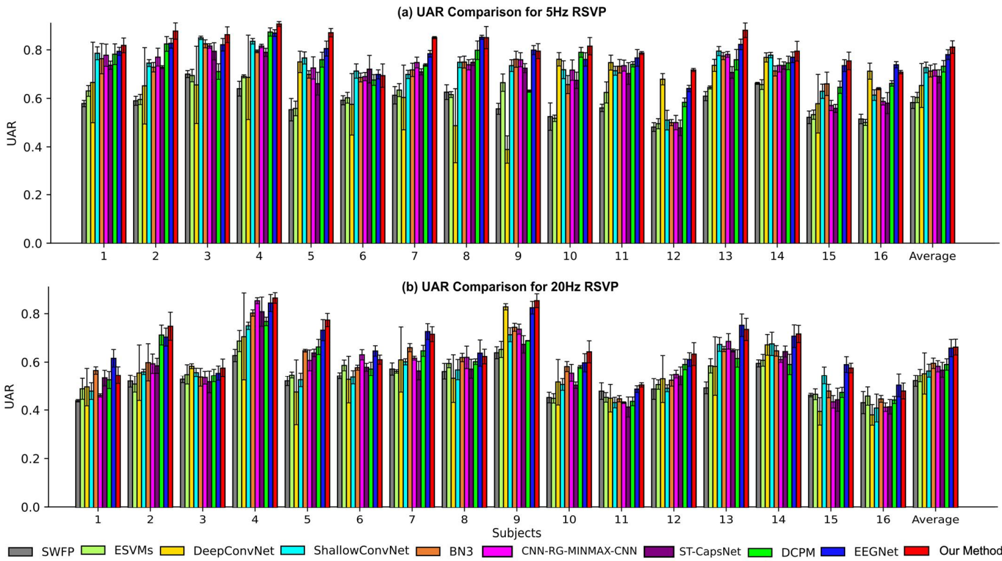
- On RSVP, the proposed method achieved the highest UAR: 0.8134±0.0259 at 5 Hz and 0.6527±0.0321 at 20 Hz; at 5 Hz, EEGNet reached 0.7823±0.0201 (p<0.05), and improvements over other models were p<0.0001 for both 5 Hz and 20 Hz.
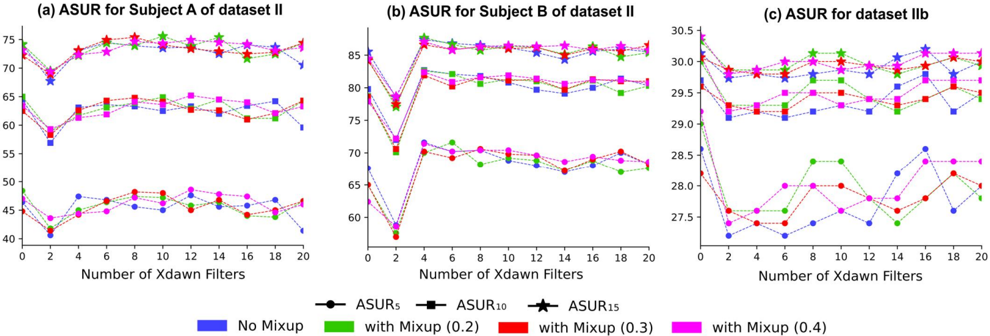
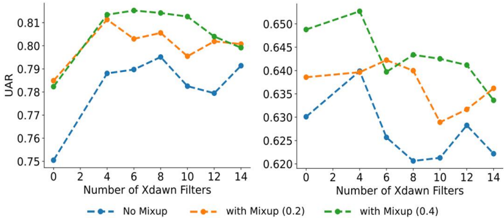
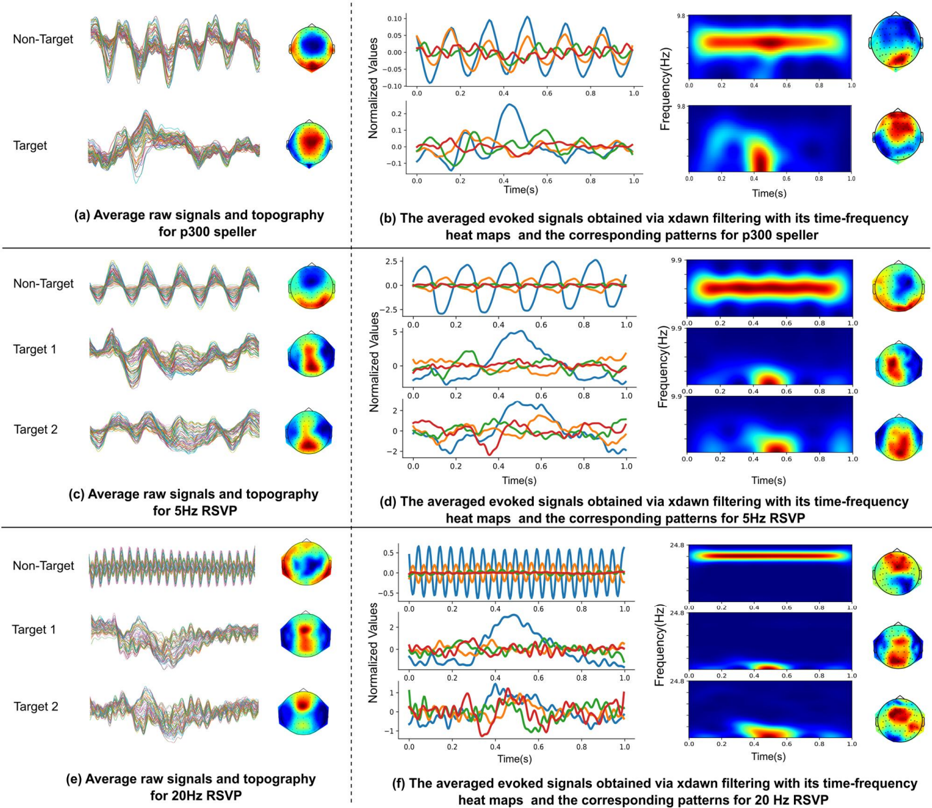
- xDAWN spatial filtering enhanced the P300 pattern; optimal settings were 8 xDAWN filters and Mixup alpha 0.3 for the P300 speller, and 4 xDAWN filters and Mixup alpha 0.4 for RSVP. For dataset II, 8 filters improved both subjects; for dataset IIb, xDAWN filters decreased the symbol recognition rate.
- For RSVP, increasing xDAWN filters improved 5 Hz detection accuracy and larger Mixup alpha led to larger UAR; for 20 Hz, only 4 xDAWN filters gave a slight improvement over EEGNet, otherwise performance decreased, though Mixup still significantly improved UAR.
Methods
- Datasets: P300 speller data from BCI Competition II dataset IIb (one participant) and BCI Competition III dataset II (subjects A and B), recorded with BCI2000 using 64 electrodes at 240 Hz; RSVP data with 200 visual objects from 16 adults (5 females; age 18–38 years), 5 Hz and 20 Hz sessions, 64 electrodes, recorded at 1000 Hz and downsampled to 250 Hz.
- Preprocessing and model: P300 trials were cropped 800 ms after stimulus onset, detrended, filtered with a 30 Hz low-pass Chebyshev zero-phase filter, and downsampled by half to 96 time samples; RSVP trials used 0–1000 ms, detrending, the same filter, and 250 time samples. xDAWN spatial filters were applied before EEGNet, followed by z-score normalization.
- Training and evaluation: PyTorch on a GeForce RTX 2080 Ti, batch size 64, Adam with initial learning rate 0.001 and exponential decay 0.96, focal loss with weights and gamma=2, and Mixup augmentation; P300 trained for 80 epochs, RSVP evaluated with 3-fold cross-validation. Metrics were symbol recognition accuracy and ITR for P300, and UAR for RSVP; paired t-tests used 30 pairs for dataset II, 15 pairs for IIb, and n=16 for RSVP comparisons against SWFP, ESVMs, DeepConvNet, ShallowConvNet, BN3, CNN-RG-MINMAX-CNN, ST-CapsNet, DCPM, and EEGNet.
Limitations
- Stated: for dataset IIb, xDAWN filters decreased the symbol recognition rate, so the number of xDAWN filters must be carefully selected according to the specific dataset and task.
- Stated: DeepConvNet showed significant variance across subjects, attributed to its large model parameters and sensitivity to hyperparameters such as the gamma value in focal loss, leading to convergence difficulty; SWFP performed worst among all models.
- Evident from the text: P300 speller evaluation relies on very few subjects (dataset II: two subjects; IIb: one subject), and the RSVP task had no dedicated test set, using 3-fold cross-validation, which may limit generalizability.
Model-written summary. Check it against the paper before relying on it.
Integrity signals
Registry
Cites
Statistics
Figures
Verification
Claims the paper makes
23 Valid · 0 Not valid · 11 Not checked · 71 Own results and interpretations
Every source the paper cites for this claim was checked and supports it.
In the paper
“However, deep learning models often require a large number of samples for better learning, as they lack domain knowledge about the data[25].”
What the sources say
- Supportedcites [25] [25] S. Roychowdhury, M. Diligenti, and M. Gori, 'Regularizing deep networks with prior knowledge: A constraint-based approach[Formula presented],' Knowl Based Syst , vol. 222, 2021, doi: 10.1016/j.knosys.2021.106989. - source
The Introduction (page not provided) describes deep networks as heavily dependent on large amounts of labeled data and says incorporating prior knowledge can enable learning with fewer labeled examples. The Discussion adds that networks do not always infer and generalize domain knowledge from training data. (LLM, conf=0.91)
plainstates a cause- Asserted: passes — The authors put it forward as true.
- Checkable: passes — It can be checked against evidence.
- Load-bearing: passes — The paper’s conclusions depend on it.
- Based: passes — The paper gives a reason why it holds.
- Supported
Every source the paper cites for this claim was checked and supports it.
In the paper
“However, this averaging method is time-consuming and inefficient [14].”
What the sources say
- Supportedcites [14] [14] P. Du, P. Li, L. Cheng, X. Li, and J. Su, 'Single-trial P300 classification algorithm based on centralized multi-person data fusion CNN,' Front Neurosci , vol. 17, 2023, doi: 10.3389/fnins.2023.1132290. - source
The Introduction (page not available in our copy) explicitly says that collecting, aggregating, and averaging P300 data from multiple trials is time-consuming and inefficient. (LLM, conf=0.95)
plainstates a cause- Asserted: passes — The authors put it forward as true.
- Checkable: passes — It can be checked against evidence.
- Load-bearing: passes — The paper’s conclusions depend on it.
- Based: passes — The paper gives a reason why it holds.
- Supported
Every source the paper cites for this claim was checked and supports it.
In the paper
“Moreover, a multi-feature predictor that includes multiple RSVP features has demonstrated that it can accurately predict P300 speller performance, outperforming single-feature predictors [21].”
What the sources say
- Supportedcites [21] [21] K. Won, M. Kwon, S. Jang, M. Ahn, and S. C. Jun, 'P300 Speller Performance Predictor Based on RSVP Multi-feature,' Front Hum Neurosci , vol. 13, 2019, doi: 10.3389/fnhum.2019.00261. - source
The Methods section describes a predictor combining multiple RSVP features. The Conclusion reports that these multi-feature predictors predicted offline P300 speller performance better than any single-feature predictor. (LLM, conf=0.93)
boostedstates a cause- Asserted: passes — The authors put it forward as true.
- Checkable: passes — It can be checked against evidence.
- Load-bearing: passes — The paper’s conclusions depend on it.
- Based: passes — The paper gives a reason why it holds.
- Supported
A result the paper reports from its own data — it cites no other source for it, so there is none to check. The quote shows it is in the paper.
In the paper
“Additionally, our method has the highest unweighted average recall (UAR) performance for both 5 Hz (0.8134±0.0259) and 20 Hz (0.6527±0.0321) RSVP.”
plain- Asserted: passes — The authors put it forward as true.
- Checkable: passes — It can be checked against evidence.
- Load-bearing: passes — The paper’s conclusions depend on it.
- Based: passes — The paper gives a reason why it holds.
A result the paper reports from its own data — it cites no other source for it, so there is none to check. The quote shows it is in the paper.
In the paper
“The proposed method is capable of recognizing more symbols with fewer repetitions (up to 5 rounds) compared to other models while demonstrating a better information transfer rate (ITR) on dataset II (achieved 17.22 bits/min in the second repetition round) of BCI Competition III.”
boostedstates a cause- Asserted: passes — The authors put it forward as true.
- Checkable: passes — It can be checked against evidence.
- Load-bearing: passes — The paper’s conclusions depend on it.
- Based: passes — The paper gives a reason why it holds.
35 more claims
Create a free account to see all 105 claims and to verify the 5 references still open.
- Probably not a substantial claim. 35
- It may state two separate claims as one. 29
- The quote only partly states this claim. 15
Self-check
Percentages, sums and reported differences re-computed from the paper’s own numbers.
Each contradiction between two passages listed here was confirmed by an independent check.
Rated minor: it would not touch a result — a value no result rests on, a p-value that stays on the same side of the significance level, or a conflict that is clerical, resolved elsewhere in the paper, or outside its own findings.
In the paper
§ A. Dataset Description
“the RSVP dataset [35] employed a stimulus set of 200 visual objects”
§ REFERENCES
“- [35] A. G. Howard et al. , 'MobileNets,' arXiv preprint arXiv:1704.04861 , 2017.”
Rated minor: it would not touch a result — a value no result rests on, a p-value that stays on the same side of the significance level, or a conflict that is clerical, resolved elsewhere in the paper, or outside its own findings.
In the paper
§ C. Performance of ITR For P300 Speller
“The ITRs of each model on datasets II and IIb were plotted in Fig. 3 to visually compare the speed of symbol spelling.”
§ A. Performance of Symbol Recognition For P300 Speller
“Fig. 3 Effect of different number of xDAWN filters on the symbol recognition rate. Subplots (a), (b), and (c) represent the symbol recognition rates of subjects A and B in dataset II and dataset IIb, respectively.”
Citations
Cites
PyTorch: An Imperative Style, High-Performance Deep Learning Library
Paszke, A., Gross, S., Massa, F., Lerer, A., Bradbury, J., Chanan, G., Killeen, T., Lin, Z., Gimelshein, N., Antiga, L., et al. (2019) · arXiv · doi:10.48550/arxiv.1912.01703 · Cited by 31,473
MobileNets: Efficient Convolutional Neural Networks for Mobile Vision Applications
Howard, A. G., Zhu, M., Chen, B., Kalenichenko, D., Wang, W., Weyand, T., Andreetto, M., & Adam, H. (2017) · arXiv · doi:10.48550/arxiv.1704.04861 · Cited by 19,015
Focal Loss for Dense Object Detection
Lin, T.-Y., Goyal, P., Girshick, R., He, K., & Dollar, P. (2020) · IEEE Transactions on Pattern Analysis and Machine Intelligence · doi:10.1109/tpami.2018.2858826 · Cited by 9,556
Brain–computer interfaces for communication and control
Wolpaw, J. R., Birbaumer, N., McFarland, D. J., Pfurtscheller, G., & Vaughan, T. M. (2002) · Clinical Neurophysiology · doi:10.1016/s1388-2457(02)00057-3 · Cited by 7,927 · cited 1×
“B CIs are systems that enable people to communicate with their surroundings using brain waves [1], [2].”
Backgroundmixup: Beyond Empirical Risk Minimization
Zhang, H., Cisse, M., Dauphin, Y. N., & Lopez-Paz, D. (2017) · arXiv · doi:10.48550/arxiv.1710.09412 · Cited by 5,831
EEGNet: a compact convolutional neural network for EEG-based brain-computer interfaces
Lawhern, V. J., Solon, A. J., Waytowich, N. R., Gordon, S. M., Hung, C. P., & Lance, B. J. (2018) · Journal of Neural Engineering · doi:10.1088/1741-2552/aace8c · Cited by 5,115 · cited 2×
“Several convolutional neural networks (CNN), such as EEGNet, DeepConvNet, Shallow-ConvNet, and BN3, have been developed for detecting ERP signals [5], [13], [23], [24].”
BackgroundMethodEEGNet: A Compact Convolutional Network for EEG-based Brain-Computer Interfaces
Lawhern, V. J., Solon, A. J., Waytowich, N. R., Gordon, S. M., Hung, C. P., & Lance, B. J. (2016) · arXiv · doi:10.48550/arxiv.1611.08024 · Cited by 5,105
Deep learning with convolutional neural networks for EEG decoding and visualization
Schirrmeister, R. T., Springenberg, J. T., Fiederer, L. D. J., Glasstetter, M., Eggensperger, K., Tangermann, M., Hutter, F., Burgard, W., & Ball, T. (2017) · Human Brain Mapping · doi:10.1002/hbm.23730 · Cited by 3,751
A spelling device for the paralysed
Birbaumer, N., Ghanayim, N., Hinterberger, T., Iversen, I., Kotchoubey, B., Kübler, A., Perelmouter, J., Taub, E., & Flor, H. (1999) · Nature · doi:10.1038/18581 · Cited by 1,577 · cited 1×
“They are particularly helpful for individuals with disabilities, such as those with amyotrophic lateral sclerosis (ALS), who may rely on a BCI to interact with others [3], [4].”
BackgroundSingle-trial analysis and classification of ERP components — A tutorial
Blankertz, B., Lemm, S., Treder, M., Haufe, S., & Müller, K.-R. (2011) · NeuroImage · doi:10.1016/j.neuroimage.2010.06.048 · Cited by 1,138 · cited 2×
“Traditional machine learning methods, such as support vector machines (SVM), discriminant analysis, and common spatial pattern algorithms, were first applied [42], [43], [46], [49], [50].”
MethodBrain–computer interfaces for communication and rehabilitation
Chaudhary, U., Birbaumer, N., & Ramos-Murguialday, A. (2016) · Nature Reviews Neurology · doi:10.1038/nrneurol.2016.113 · Cited by 928 · cited 1×
“B CIs are systems that enable people to communicate with their surroundings using brain waves [1], [2].”
BackgroundMulticlass Brain–Computer Interface Classification by Riemannian Geometry
Barachant, A., Bonnet, S., Congedo, M., & Jutten, C. (2012) · IEEE Transactions on Biomedical Engineering · doi:10.1109/tbme.2011.2172210 · Cited by 878 · cited 1×
“In a similar vein, the xDAWN-based algorithm emerged victorious in the Kaggle BCI competition NER 2015, leveraging Riemannian geometry, channel subset selection, L1 regularization, and elastic net regression [30], [31].”
MethodAn efficient P300-based brain–computer interface for disabled subjects
Hoffmann, U., Vesin, J.-M., Ebrahimi, T., & Diserens, K. (2008) · Journal of Neuroscience Methods · doi:10.1016/j.jneumeth.2007.03.005 · Cited by 859 · cited 2×
“Traditional machine learning methods, such as support vector machines (SVM), discriminant analysis, and common spatial pattern algorithms, were first applied [42], [43], [46], [49], [50].”
MethodCharacterization of N200 and P300: selected studies of the Event-Related Potential
Patel, S. H., & Azzam, P. N. (2005) · International Journal of Medical Sciences · doi:10.7150/ijms.2.147 · Cited by 794 · cited 1×
“Specifically, ERP, which is known as electrical potentials time-locked to events, has gained attention in BCI studies because ERPs relevant to different modalities like visual, auditory, or tactile events provide the best results for the control of a BCI system [8], [9], [10].”
BackgroundConvolutional Neural Networks for P300 Detection with Application to Brain-Computer Interfaces
Cecotti, H., & Graser, A. (2011) · IEEE Transactions on Pattern Analysis and Machine Intelligence · doi:10.1109/tpami.2010.125 · Cited by 778
Brain–computer interfaces: communication and restoration of movement in paralysis
Birbaumer, N., & Cohen, L. G. (2007) · The Journal of Physiology · doi:10.1113/jphysiol.2006.125633 · Cited by 754
Transfer Learning for Brain–Computer Interfaces: A Euclidean Space Data Alignment Approach
He, H., & Wu, D. (2020) · IEEE Transactions on Biomedical Engineering · doi:10.1109/tbme.2019.2913914 · Cited by 569 · cited 1×
“Moreover, Wu et al. achieved remarkable progress by aligning ERP data with Euclidean alignment and enriching features with xDAWN and tangent space mapping which secured the top spot in the RSVP detection competition at the World Robot Contest 2021 [32], [33].”
BackgroundxDAWN Algorithm to Enhance Evoked Potentials: Application to Brain–Computer Interface
Rivet, B., Souloumiac, A., Attina, V., & Gibert, G. (2009) · IEEE Transactions on Biomedical Engineering · doi:10.1109/tbme.2009.2012869 · Cited by 537 · cited 1×
“…of the domain information, it might be more suitable to process the ERP signals by xDAWN spatial filtering before sent to neural networks, as the xDAWN estimates the spatial filters by maximizing the difference between the averaged signals of the corresponding category and the whole EEG data [28].”
MethodThe attentional blink: Resource depletion or temporary loss of control?
Di Lollo, V., Kawahara, J.-I., Shahab Ghorashi, S. M., & Enns, J. T. (2005) · Psychological Research · doi:10.1007/s00426-004-0173-x · Cited by 448 · cited 1×
“The training strategy (refer to Section E Training for details) was kept consistent across all models (except for SWFP, ESVMs, and DCPM which are traditional machine learning algorithms).”
MethodA Comprehensive Survey of Brain Interface Technology Designs
Mason, S. G., Bashashati, A., Fatourechi, M., Navarro, K. F., & Birch, G. E. (2007) · Annals of Biomedical Engineering · doi:10.1007/s10439-006-9170-0 · Cited by 299
Deep learning based on Batch Normalization for P300 signal detection
Liu, M., Wu, W., Gu, Z., Yu, Z., Qi, F., & Li, Y. (2018) · Neurocomputing · doi:10.1016/j.neucom.2017.08.039 · Cited by 230
Electroencephalography: Basic Principles, Clinical Applications, and Related Fields, Fifth Edition
Henry, J. C. (2006) · Neurology · doi:10.1212/01.wnl.0000243257.85592.9a · Cited by 190 · cited 1×
“Because the EEG collection for the P300 speller is non-invasive, the resulting signal-to-noise ratio (SNR) is low [12].”
BackgroundThe representational dynamics of visual objects in rapid serial visual processing streams
Grootswagers, T., Robinson, A. K., & Carlson, T. A. (2018) · NeuroImage · doi:10.1016/j.neuroimage.2018.12.046 · Cited by 172 · cited 1×
“On the other hand, the RSVP dataset [35] employed a stimulus set of 200 visual objects from different categories, presented to 16 adult participants (5 females; age range 18– 38 years) who were instructed to count target stimuli (boats or geometric star shapes) randomly inserted into the sequence,…”
MethodAttention and P300-based BCI performance in people with amyotrophic lateral sclerosis
Riccio, A., Simione, L., Schettini, F., Pizzimenti, A., Inghilleri, M., Belardinelli, M. O., Mattia, D., & Cincotti, F. (2013) · Frontiers in Human Neuroscience · doi:10.3389/fnhum.2013.00732 · Cited by 162 · cited 2×
“Selective attention, as measured by accuracy in an RSVP task, is closely linked to an individual’s ability to update changing information over time and may also be connected to performance in P300 speller tasks [20], [47], [48].”
MethodP300 and the word frequency effect
Polich, J. M., & Donchin, E. (1988) · Electroencephalography and Clinical Neurophysiology · doi:10.1016/0013-4694(88)90192-7 · Cited by 153 · cited 1×
“P300, which is a response that occurs about 300-600 milliseconds after the onset of a stimulus, has been extensively investigated in ERP-based BCIs [11].”
BackgroundA review of rapid serial visual presentation-based brain–computer interfaces
Lees, S., Dayan, N., Cecotti, H., McCullagh, P., Maguire, L., Lotte, F., & Coyle, D. (2018) · Journal of Neural Engineering · doi:10.1088/1741-2552/aa9817 · Cited by 149 · cited 2×
“In the RSVP-based P300 experiment, the participants need to distinguish between target and non-target stimuli where the target should be odd stimuli and account for 5%-10% of all stimuli [15].”
BackgroundMethodTemporal dynamics of access to consciousness in the attentional blink
Kranczioch, C., Debener, S., Maye, A., & Engel, A. K. (2007) · NeuroImage · doi:10.1016/j.neuroimage.2007.05.044 · Cited by 143 · cited 5×
“In Dataset IIb, our model exhibits superior performance compared to SWFP, BN3 and DCPM, achieving statistically significant results ( p 0.05).”
MethodInfluentialDiscriminative Canonical Pattern Matching for Single-Trial Classification of ERP Components
Xiao, X., Xu, M., Jin, J., Wang, Y., Jung, T.-P., & Ming, D. (2020) · IEEE Transactions on Biomedical Engineering · doi:10.1109/tbme.2019.2958641 · Cited by 113 · cited 1×
“Compared with other methods like DeepConvNet or mere EEGNet, the proposed method achieved better ITR with fewer repetition rounds for the P300 speller and gained high UAR performance in the RSVP paradigm.”
MethodCecotti, H., Eckstein, M. P., & Giesbrecht, B. (2014) · IEEE Transactions on Neural Networks and Learning Systems · doi:10.1109/tnnls.2014.2302898 · Cited by 109 · cited 1×
“For instance, Cecotti et al. successfully integrated xDAWN with MLP, BLDA, and linear SVM, resulting in performance enhancement [29].”
MethodCortical origins of response time variability during rapid discrimination of visual objects
Gerson, A. D., Parra, L. C., & Sajda, P. (2005) · NeuroImage · doi:10.1016/j.neuroimage.2005.06.026 · Cited by 103 · cited 1×
“Different from the P300 speller, the RSVP-based BCI can be beneficial to more applications where a large number of images need to be reviewed by professionals but are unable to be well analyzed by computers [15], [16], [17].”
Method30+ years of P300 brain–computer interfaces
Allison, B. Z., Kübler, A., & Jin, J. (2020) · Psychophysiology · doi:10.1111/psyp.13569 · Cited by 89 · cited 1×
“Specifically, ERP, which is known as electrical potentials time-locked to events, has gained attention in BCI studies because ERPs relevant to different modalities like visual, auditory, or tactile events provide the best results for the control of a BCI system [8], [9], [10].”
BackgroundWang, Z., Chen, C., Li, J., Wan, F., Sun, Y., & Wang, H. (2023) · IEEE Transactions on Neural Systems and Rehabilitation Engineering · doi:10.1109/tnsre.2023.3237319 · Cited by 75 · cited 2×
“The averaged symbols under repetitions (ASUR) metric [40] was used to compare the performance of models with different numbers of xDAWN filters more intuitively.”
MethodSelf-citationFuhrmann Alpert, G., Manor, R., Spanier, A. B., Deouell, L. Y., & Geva, A. B. (2014) · IEEE Transactions on Biomedical Engineering · doi:10.1109/tbme.2013.2289898 · Cited by 74 · cited 3×
“Traditional machine learning methods, such as support vector machines (SVM), discriminant analysis, and common spatial pattern algorithms, were first applied [42], [43], [46], [49], [50].”
MethodEEG Dataset for RSVP and P300 Speller Brain-Computer Interfaces
Won, K., Kwon, M., Ahn, M., & Jun, S. C. (2022) · Scientific Data · doi:10.1038/s41597-022-01509-w · Cited by 68 · cited 2×
“Secondly, the stimulus frequency is different for the two paradigms - the RSVP usually displays with a refresh rate of 5-10 Hz, while the P300 speller flashes for 125 ms and turns off for 62.5 ms until the next sequence flashes [18].”
BackgroundInfluentialVerleger, R., Śmigasiewicz, K., & Möller, F. (2011) · Psychophysiology · doi:10.1111/j.1469-8986.2011.01176.x · Cited by 58 · cited 1×
“As mentioned in [19] and [20], an experimental protocol consisted of two sessions performed on two days, day one of which is the first session for the P300 speller experiment and day two of which is the second session for the RSVP experiment.”
MethodCapsule Network for ERP Detection in Brain-Computer Interface
Ma, R., Yu, T., Zhong, X., Yu, Z. L., Li, Y., & Gu, Z. (2021) · IEEE Transactions on Neural Systems and Rehabilitation Engineering · doi:10.1109/tnsre.2021.3070327 · Cited by 47
Regularizing deep networks with prior knowledge: A constraint-based approach
Roychowdhury, S., Diligenti, M., & Gori, M. (2021) · Knowledge-Based Systems · doi:10.1016/j.knosys.2021.106989 · Cited by 46 · cited 2×
“An important domain knowledge regarding ERP signals is that the SNR can be enhanced through trial averaging [26], [27].”
BackgroundSorted averaging—application to auditory event-related responses
Rahne, T., von Specht, H., & Mühler, R. (2008) · Journal of Neuroscience Methods · doi:10.1016/j.jneumeth.2008.04.006 · Cited by 38 · cited 2×
“An important domain knowledge regarding ERP signals is that the SNR can be enhanced through trial averaging [26], [27].”
BackgroundLeoni, J., Strada, S. C., Tanelli, M., Brusa, A., & Proverbio, A. M. (2022) · Machine Learning with Applications · doi:10.1016/j.mlwa.2022.100393 · Cited by 36
Performance Enhancement of P300 Detection by Multiscale-CNN
Wang, H., Pei, Z., Xu, L., Xu, T., Bezerianos, A., Sun, Y., & Li, J. (2021) · IEEE Transactions on Instrumentation and Measurement · doi:10.1109/tim.2021.3067943 · Cited by 35 · cited 1×
“An important domain knowledge regarding ERP signals is that the SNR can be enhanced through trial averaging [26], [27].”
BackgroundSelf-citationP300 Speller Performance Predictor Based on RSVP Multi-feature
Won, K., Kwon, M., Jang, S., Ahn, M., & Jun, S. C. (2019) · Frontiers in Human Neuroscience · doi:10.3389/fnhum.2019.00261 · Cited by 34 · cited 3×
“Moreover, a multi-feature predictor that includes multiple RSVP features has demonstrated that it can accurately predict P300 speller performance, outperforming single-feature predictors [21].”
BackgroundInfluentialAn improved EEGNet for single-trial EEG classification in rapid serial visual presentation task
Zhang, H., Wang, Z., Yu, Y., Yin, H., Chen, C., & Wang, H. (2022) · Brain Science Advances · doi:10.26599/bsa.2022.9050007 · Cited by 30 · cited 4×
“Building upon our previous study [34], which utilized the combination of xDAWN with EEGNet and achieved the second place in the RSVP competition at the BCI Controlled Robot Contest during the 2021 World Robot Contest, we have further extended our previous work [34].”
BackgroundMethodResultInfluentialSelf-citationRapid image analysis using neural signals
Mathan, S., Erdogmus, D., Huang, Y., Pavel, M., Ververs, P., Carciofini, J., Dorneich, M., & Whitlow, S. (2008) · CHI '08 Extended Abstracts on Human Factors in Computing Systems · doi:10.1145/1358628.1358849 · Cited by 28 · cited 1×
“Different from the P300 speller, the RSVP-based BCI can be beneficial to more applications where a large number of images need to be reviewed by professionals but are unable to be well analyzed by computers [15], [16], [17].”
MethodEffect of Stimulus Size in a Visual ERP-Based BCI under RSVP
Fernández-Rodríguez, Á., Darves‐Bornoz, A., Velasco-Álvarez, F., & Ron-Angevín, R. (2022) · Sensors · doi:10.3390/s22239505 · Cited by 20 · cited 1×
“Specifically, ERP, which is known as electrical potentials time-locked to events, has gained attention in BCI studies because ERPs relevant to different modalities like visual, auditory, or tactile events provide the best results for the control of a BCI system [8], [9], [10].”
BackgroundSingle-trial P300 classification algorithm based on centralized multi-person data fusion CNN
Du, P., Li, P., Cheng, L., Li, X., & Su, J. (2023) · Frontiers in Neuroscience · doi:10.3389/fnins.2023.1132290 · Cited by 17 · cited 1×
“However, this averaging method is time-consuming and inefficient [14], and may negatively impact BCI real-time performance by incorporating past information.”
BackgroundAghili, S. N., & Erfanian, A. (2023) · IEEE Access · doi:10.1109/access.2023.3313260 · Cited by 12
Tang, C., Li, Y., & Chen, B. (2022) · Brain Science Advances · doi:10.26599/bsa.2022.9050013 · Cited by 10 · cited 1×
“Compared with other methods like DeepConvNet or mere EEGNet, the proposed method achieved better ITR with fewer repetition rounds for the P300 speller and gained high UAR performance in the RSVP paradigm.”
MethodWang, Z., Zhang, H., Ji, Z., Yang, Y., & Wang, H. (2023) · Brain Science Advances · doi:10.26599/bsa.2023.9050013 · Cited by 9 · cited 2×
“Furthermore, EEGNet has been proven its effectiveness in BCI competitions [41], [51], [52].”
BackgroundMethodInfluentialSelf-citationP300 Detection Using Ensemble of SVM for Brain-Computer Interface Application
Kundu, S., & Ari, S. (2018) · 2018 9th International Conference on Computing, Communication and Networking Technologies (ICCCNT) · doi:10.1109/icccnt.2018.8493903 · Cited by 8 · cited 2×
“Traditional machine learning methods, such as support vector machines (SVM), discriminant analysis, and common spatial pattern algorithms, were first applied [42], [43], [46], [49], [50].”
MethodWu, H., & Wu, D. (2022) · Brain Science Advances · doi:10.26599/bsa.2022.9050001 · Cited by 7 · cited 1×
“Moreover, Wu et al. achieved remarkable progress by aligning ERP data with Euclidean alignment and enriching features with xDAWN and tangent space mapping which secured the top spot in the RSVP detection competition at the World Robot Contest 2021 [32], [33].”
BackgroundAdvances in Computational Intelligence
(2019) · Lecture notes in computer science · doi:10.1007/978-3-030-20521-8 · Cited by 7
Fernández-Rodríguez, Á., Medina-Juliá, M. T., Velasco-Álvarez, F., & Ron-Angevin, R. (2019) · Lecture Notes in Computer Science · doi:10.1007/978-3-030-20521-8_31 · Cited by 5 · cited 2×
“While the ERPs obtained from these two paradigms exhibit similarities, a unified decoding approach is necessary to develop a BCI system that can be tailored to different users [22].”
BackgroundMethodLuo, J., Mao, Q., Wang, Y., Shi, Z., & Hei, X. (2022) · Brain Science Advances · doi:10.26599/bsa.2022.9050011 · Cited by 4 · cited 1×
“Furthermore, EEGNet has been proven its effectiveness in BCI competitions [41], [51], [52].”
Background
Research works printed but not linked: 1
- [37] A. Paszke et al. , 'PyTorch: An imperative style, highperformance deep learning library,' in Advances in Neural Information Processing Systems , 2019. -
Cited by
Ji, Z., Li, S., Zhang, H., Chen, C., Xu, Q., Li, J., & Wang, H. (2025) · Brain-Apparatus Communication A Journal of Bacomics · doi:10.1080/27706710.2025.2489396 · Cited by 24
Self-citationChen, H., Chan, I. Y. S., Dong, Z., & Samuel, T.-A. (2025) · Advanced Engineering Informatics · doi:10.1016/j.aei.2025.103555 · Cited by 17
A framework for Interpretable deep learning in cross-subject detection of event-related potentials
Jalilpour, S., & Müller-Putz, G. (2024) · Engineering Applications of Artificial Intelligence · doi:10.1016/j.engappai.2024.109642 · Cited by 12
Lightweight deep learning models for EEG decoding: a review
Li, Y., Chen, E., Xiao, X., Xu, M., & Ming, D. (2025) · Journal of Neural Engineering · doi:10.1088/1741-2552/ae2717 · Cited by 13
“In 2024, Wang et al [78] introduced a cascaded architecture that integrates the xDAWN spatial filtering algorithm with the EEGNet framework for classification tasks in P300 and rapid serial visual presentation (RSVP) paradigms.”
InfluentialPark, S., Ha, J., & Kim, L. (2024) · Frontiers in Physiology · doi:10.3389/fphys.2024.1325784 · Cited by 6
“…number of stimuli in a short time, can elicit strong EPs caused by a stimulus paradigm consisting of targets and nontargets (Acqualagna and Blankertz, 2013), and has been utilized in many visual-based brain-computer interface studies (Zhang H. et al., 2022; Wang et al., 2023b; Wang et al., 2024).”
Method
Metadata
- Authors
- Wang, H., Wang, Z., Sun, Y., Yuan, Z., Xu, T., & Li, J.
- Affiliations
- University of Essex (GB)
- Corresponding author
- Wang, Hongtao
- Venue
- IEEE Transactions on Neural Systems and Rehabilitation Engineering
- Published
- 2024
- Volume
- 32
- Pages
- 2270-2280
- ISSN
- 1534-4320 (ISSN-L)
- 1558-0210
- OpenAlex
- W4399727965
- Cited by
- 20
- References
- 51
- Citations by year
- 2026: 6 · 2025: 11 · 2024: 3
- FWCI
- 4.84
- Type
- journal article
- Language
- en
- Open access
- gold
- doi.org
- Locations
- IEEE Transactions on Neural Systems and Rehabilitation Engineering (publishedVersion, cc-by)
- PubMed (publishedVersion)
- Open Access at Essex (University of Essex) (submittedVersion, cc-by)
- DOAJ (DOAJ: Directory of Open Access Journals) (submittedVersion, cc-by-sa)
- Funders
- Special Projects in Key Fields Supported by the Technology Development Project of Guangdong Province (2020ZDZX3018)
- Wuyi University and Hong Kong and Macao Joint Research Project (2019WGALH16)
- Projects for International Scientific and Technological Cooperation of Guangdong Province (2023A0505050144)
- Topics
- Life Sciences › Neuroscience › Cognitive Neuroscience › EEG and Brain-Computer Interfaces
- Physical Sciences › Computer Science › Human-Computer Interaction › Gaze Tracking and Assistive Technology
- Physical Sciences › Computer Science › Artificial Intelligence › Emotion and Mood Recognition
- Keywords
- P300 detection, visual evoked potentials, cascaded neural networks, EEGNet, P300 speller, rapid serial visual presentation, information transfer rate
- MeSH terms
- Algorithms, Communication Devices for People with Disabilities, Electroencephalography, Evoked Potentials, Visual, Humans, Male, Photic Stimulation, Reproducibility of Results, Neural Networks, Computer, Event-Related Potentials, P300, Brain-Computer Interfaces
About these checks
Registry, retraction, Cites and statistics results are computed, not judged, with one exception: a printed reference that no index lists is read once by a model before it counts as a citation error. Claims are extracted by a model and kept only when their quote appears verbatim in the text; each cited source is then checked, with a model’s help, for whether it says what the claim relies on. Those verdicts can be wrong — read the claim’s quote and the cited source before relying on one.
The claim verdicts this report counts are experimental: their accuracy is not yet measured.
A language model drew the claims from the paper on 2026-10-07, under version 3 of the claim definition (model deepseek-v4.1-flash, prompt extract-v3).
A second model labelled each claim on 2026-10-07 (model jev-1.13-20260917, definition revision gold-guideline-v0.2).
Cited sources are checked with a language model’s help (gpt-6-sol).
Statistics and arithmetic are recomputed, not judged.
Confidence bands are shown only for fields calibrated on our annotated test set. None is calibrated yet, so no band is shown.
What counts as a claim ›How we measure confidence ›How we check this ›
Are you an author, or do you see a problem with this page? Request a review
Data sources
Bibliographic data: Semantic Scholar, OpenAlex, Crossref.
Contains information from the Semantic Scholar Academic Graph Datasets, made available under the ODC Attribution License (ODC-BY 1.0).
Semantic Scholar’s data is described in: Kinney, R., et al. (2023). The Semantic Scholar Open Data Platform. arXiv:2301.10140.
