

The DOI matches its Crossref record; 71 of the 72 references it cites were found in a registry or an index.
Context conditioning and extinction in humans: differential contribution of the hippocampus, amygdala and prefrontal cortex
Open accessAbstract
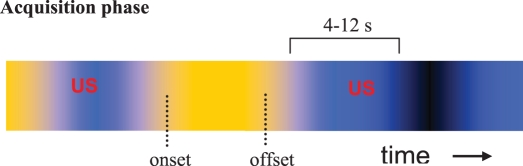
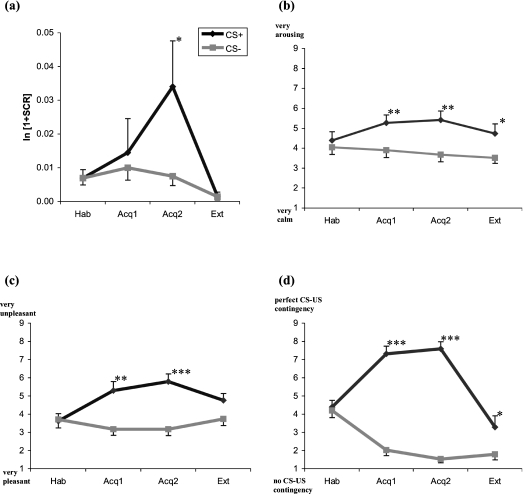
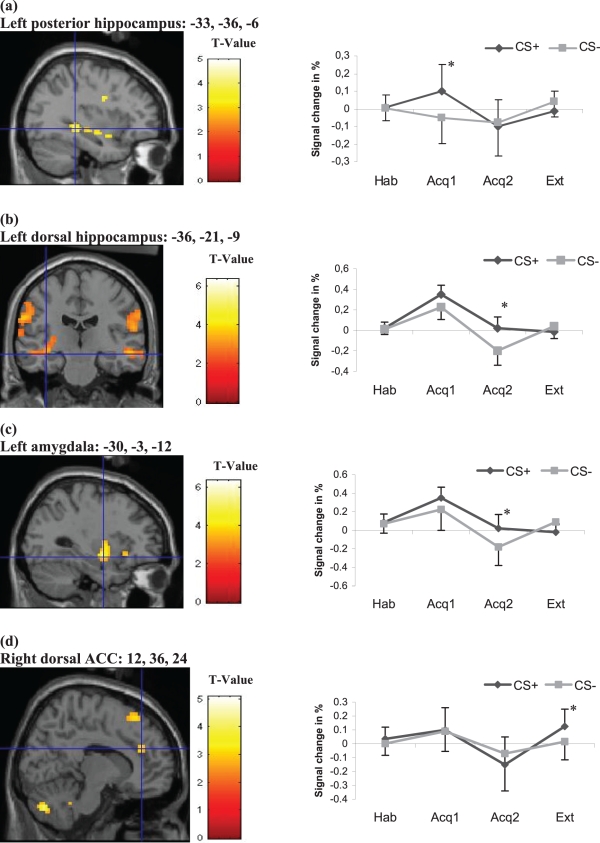
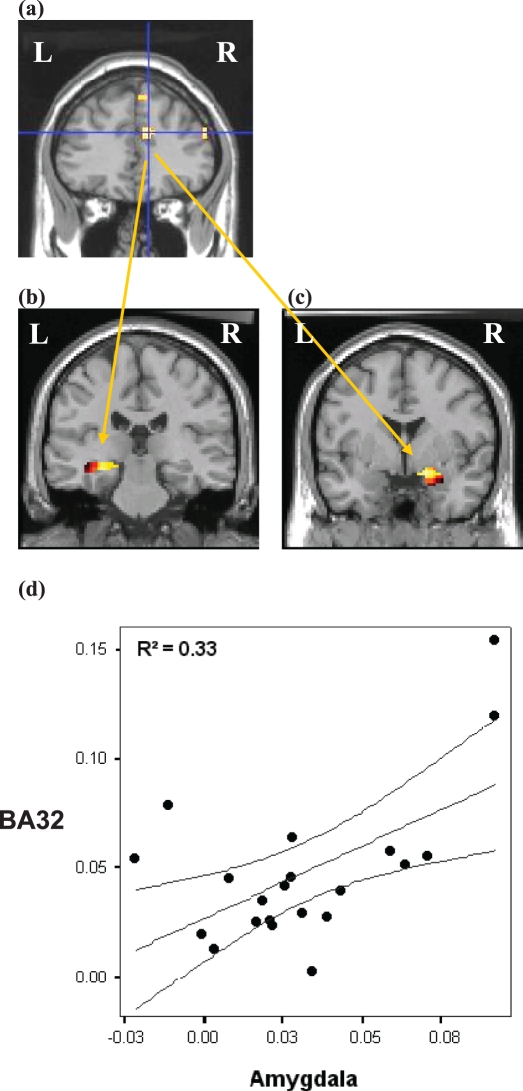
Functional magnetic resonance imaging was used to investigate the role of the hippocampus, amygdala and medial prefrontal cortex (mPFC) in a contextual conditioning and extinction paradigm provoking anxiety. Twenty-one healthy persons participated in a differential context conditioning procedure with two different background colours as contexts. During acquisition increased activity to the conditioned stimulus (CS+) relative to the CS- was found in the left hippocampus and anterior cingulate cortex (ACC). The amygdala, insula and inferior frontal cortex were differentially active during late acquisition. Extinction was accompanied by enhanced activation to CS+ vs. CS- in the dorsal anterior cingulate cortex (dACC). The results are in accordance with animal studies and provide evidence for the important role of the hippocampus in contextual learning in humans. Connectivity analyses revealed correlated activity between the left posterior hippocampus and dACC (BA32) during early acquisition and the dACC, left posterior hippocampus and right amygdala during extinction. These data are consistent with theoretical models that propose an inhibitory effect of the mPFC on the amygdala. The interaction of the mPFC with the hippocampus may reflect the context-specificity of extinction learning.
Overview
The claims and statistics of this paper haven’t been checked yet.
Run the check — free, no account needed. It reads the open-access text and checks the sources it cites.
Integrity signals
Registry
Cites
Statistics
Figures
Verification
Claims the paper makes
The claims and statistics of this paper haven’t been checked yet.
Run the check — free, no account needed. It reads the open-access text and checks the sources it cites.
Claims other papers make about this one
Each is checked against this paper’s own text: does it say what the citing paper says it does?
The cited source says what the claim attributes to it.
In the citing paper
“Connectivity analyses have demonstrated functional coupling between the mPFC and amygdala during extinction learning [107], and vmPFC and amygdala during extinction recall [89, 108].”
From Prefrontal cortex, amygdala, and threat processing: implications for PTSD (2022) · cites this paper as [107]
The cited source says what the claim attributes to it.
In the citing paper
“Importantly, functional connectivity analyses also suggest coupling of the PFC and hippocampus during contextual extinction learning [107] and recall [89].”
From Prefrontal cortex, amygdala, and threat processing: implications for PTSD (2022) · cites this paper as [107]
The cited source says what the claim attributes to it.
In the citing paper
“The dACC is a region previously identified as important for both extinction learning (Lang et al., 2009; Maier et al., 2012) and emotion regulation through cognitive reappraisal (Ochsner et al., 2002, 2004), and a region previously shown to be hypoactivated during emotion regulation in GAD (Blair et al., 2012).”
From Neural correlates of emotion acceptance vs worry or suppression in generalized anxiety disorder (2017) · cites this paper as Lang et al., 2009
The cited source says what the claim attributes to it.
In the citing paper
“Increased late-phase dACC activation in the acceptance condition was found in regions that directly overlap with those reported in the extinction of contextual fear, and in particular the early stages of within-session extinction (Lang et al., 2009; Etkin et al., 2011).”
From Neural correlates of emotion acceptance vs worry or suppression in generalized anxiety disorder (2017) · cites this paper as Lang et al., 2009
The cited source says what the claim attributes to it.
In the citing paper
“Although an emphasis has been placed on the role of subgenual and rostral ACC in the modulation of amygdala activation during extinction of cue conditioned fear in studies of human fear conditioning (Delgado et al., 2008; Milad et al., 2007; Phelps et al., 2004), studies examining the extinction of contextual fear have implicated a larger role for the dACC (Lang et al., 2009; Sehlmeyer et al., 201”
From Neural correlates of emotion acceptance vs worry or suppression in generalized anxiety disorder (2017) · cites this paper as Lang et al., 2009
Self-check
Percentages, sums and reported differences re-computed from the paper’s own numbers.
The self-check needs the paper’s full text.
Citations
Cites
Controlling the False Discovery Rate: A Practical and Powerful Approach to Multiple Testing
Benjamini, Y., & Hochberg, Y. (1995) · Journal of the Royal Statistical Society Series B: Statistical Methodology · doi:10.1111/j.2517-6161.1995.tb02031.x · Cited by 109,482
Tzourio-Mazoyer, N., Landeau, B., Papathanassiou, D., Crivello, F., Etard, O., Delcroix, N., Mazoyer, B., & Joliot, M. (2002) · NeuroImage · doi:10.1006/nimg.2001.0978 · Cited by 16,319
LeDoux, J. E. (2000) · Annual Review of Neuroscience · doi:10.1146/annurev.neuro.23.1.155 · Cited by 8,444
Rescorla, R. A. (1972) · Medical Entomology and Zoology · Cited by 7,268
Differential contribution of amygdala and hippocampus to cued and contextual fear conditioning.
Phillips, R. G., & LeDoux, J. E. (1992) · Behavioral Neuroscience · doi:10.1037/0735-7044.106.2.274 · Cited by 3,292
Interoception: the sense of the physiological condition of the body
(Bud) Craig, A. (2003) · Current Opinion in Neurobiology · doi:10.1016/s0959-4388(03)00090-4 · Cited by 2,556
Modality-Specific Retrograde Amnesia of Fear
Kim, J. J., & Fanselow, M. S. (1992) · Science · doi:10.1126/science.1585183 · Cited by 2,483
Neurons in medial prefrontal cortex signal memory for fear extinction
Milad, M. R., & Quirk, G. J. (2002) · Nature · doi:10.1038/nature01138 · Cited by 1,836 · cited 1×
“Our data are in line with animal data and human neuroimaging studies providing evidence that the mPFC regulates the expression of fear and anxiety by inhibiting the amygdala (Milad & Quirk, 2002; Maren & Quirk, 2004; Sotres-Bayon et al., 2004; Milad et al., 2006).”
Phelps, E. A., Delgado, M. R., Nearing, K. I., & LeDoux, J. E. (2004) · Neuron · doi:10.1016/j.neuron.2004.08.042 · Cited by 1,753
Publication Recommendations for Electrodermal Measurements
Fowles, D. C., Christie, M. J., Edelberg, R., Grings, W. W., Lykken, D. T., & Venables, P. H. (1981) · Psychophysiology · doi:10.1111/j.1469-8986.1981.tb03024.x · Cited by 1,700
Neuronal signalling of fear memory
Maren, S., & Quirk, G. J. (2004) · Nature Reviews Neuroscience · doi:10.1038/nrn1535 · Cited by 1,428
LaBar, K. S., Gatenby, J. C., Gore, J. C., LeDoux, J. E., & Phelps, E. A. (1998) · Neuron · doi:10.1016/s0896-6273(00)80475-4 · Cited by 1,402
Myers, K. M., & Davis, M. (2007) · Molecular Psychiatry · doi:10.1038/sj.mp.4001939 · Cited by 1,277
Milad, M. R., Wright, C. I., Orr, S. P., Pitman, R. K., Quirk, G. J., & Rauch, S. L. (2007) · Biological Psychiatry · doi:10.1016/j.biopsych.2006.10.011 · Cited by 1,197
A modern learning theory perspective on the etiology of panic disorder.
Bouton, M. E., Mineka, S., & Barlow, D. H. (2001) · Psychological Review · doi:10.1037/0033-295x.108.1.4 · Cited by 1,017
Marks, I. M. (1987) · Cited by 978
Brain systems mediating aversive conditioning: an event-related fMRI study
Büchel, C., Morris, J., Dolan, R. J., & Friston, K. J. (1998) · Neuron · doi:10.1016/s0896-6273(00)80476-6 · Cited by 951
Behavioral and Neural Analysis of Extinction
Myers, K. M., & Davis, M. (2002) · Neuron · doi:10.1016/s0896-6273(02)01064-4 · Cited by 918
Increased Amygdala and Insula Activation During Emotion Processing in Anxiety-Prone Subjects
Stein, M. B., Simmons, A. N., Feinstein, J. S., & Paulus, M. P. (2007) · American Journal of Psychiatry · doi:10.1176/ajp.2007.164.2.318 · Cited by 851
Exacerbation of Pain by Anxiety Is Associated with Activity in a Hippocampal Network
Ploghaus, A., Narain, C., Beckmann, C. F., Clare, S., Bantick, S., Wise, R., Matthews, P. M., Rawlins, J. N. P., & Tracey, I. (2001) · The Journal of Neuroscience · doi:10.1523/jneurosci.21-24-09896.2001 · Cited by 822
Quirk, G. J., Repa, J. C., & LeDoux, J. E. (1995) · Neuron · doi:10.1016/0896-6273(95)90092-6 · Cited by 808
Foa, E. B., Dancu, C. V., Hembree, E. A., Jaycox, L. H., Meadows, E. A., & Street, G. P. (1999) · Journal of Consulting and Clinical Psychology · doi:10.1037/0022-006x.67.2.194 · Cited by 808
Neurotoxic lesions of the dorsal hippocampus and Pavlovian fear conditioning in rats
Maren, S., Aharonov, G., & Fanselow, M. S. (1997) · Behavioural Brain Research · doi:10.1016/s0166-4328(97)00088-0 · Cited by 765
Contextual fear, gestalt memories, and the hippocampus
Fanselow, M. S. (2000) · Behavioural Brain Research · doi:10.1016/s0166-4328(99)00186-2 · Cited by 752
Deficient Fear Conditioning in Psychopathy
Birbaumer, N., Veit, R., Lotze, M., Erb, M., Hermann, C., Grodd, W., & Flor, H. (2005) · Archives of General Psychiatry · doi:10.1001/archpsyc.62.7.799 · Cited by 706
Anagnostaras, S., Maren, S., & Fanselow, M. S. (1999) · Journal of Neuroscience · doi:10.1523/jneurosci.19-03-01106.1999 · Cited by 675
De novo conditioning in trauma-exposed individuals with and without posttraumatic stress disorder.
Orr, S. P., Metzger, L. J., Lasko, N. B., Macklin, M. L., Peri, T., & Pitman, R. K. (2000) · Journal of Abnormal Psychology · doi:10.1037/0021-843x.109.2.290 · Cited by 653
Fear extinction in rats: Implications for human brain imaging and anxiety disorders
Milad, M. R., Rauch, S. L., Pitman, R. K., & Quirk, G. J. (2006) · Biological Psychology · doi:10.1016/j.biopsycho.2006.01.008 · Cited by 597 · cited 3×
“Our data are in line with animal data and human neuroimaging studies providing evidence that the mPFC regulates the expression of fear and anxiety by inhibiting the amygdala (Milad & Quirk, 2002; Maren & Quirk, 2004; Sotres-Bayon et al., 2004; Milad et al., 2006).”
Startle reactivity and anxiety disorders: aversive conditioning, context, and neurobiology
Grillon, C. (2002) · Biological Psychiatry · doi:10.1016/s0006-3223(02)01665-7 · Cited by 514
Neuroimaging studies of autobiographical event memory
Maguire, E. A. (2001) · Philosophical Transactions of the Royal Society of London. Series B: Biological Sciences · doi:10.1098/rstb.2001.0944 · Cited by 513
Kalisch, R., Korenfeld, E., Stephan, K. E., Weiskopf, N., Seymour, B., & Dolan, R. J. (2006) · The Journal of Neuroscience · doi:10.1523/jneurosci.2021-06.2006 · Cited by 493
Understanding contextual fear conditioning: insights from a two-process model.
Rudy, J., Huff, N., & Matus-Amat, P. (2004) · Neuroscience and Biobehavioral Reviews · doi:10.1016/j.neubiorev.2004.09.004 · Cited by 476
Recognition memory and the human hippocampus.
Manns, J., Hopkins, R., Reed, J. M., Kitchener, E. G., & Squire, L. (2003) · Neuron · doi:10.1016/s0896-6273(02)01147-9 · Cited by 472
Processing of the arousal of subliminal and supraliminal emotional stimuli by the human amygdala
Gläscher, J., & Adolphs, R. (2003) · The Journal of Neuroscience · doi:10.1523/jneurosci.23-32-10274.2003 · Cited by 457
Sotres-Bayon, F., Cain, C. K., & LeDoux, J. E. (2006) · Biological Psychiatry · doi:10.1016/j.biopsych.2005.10.012 · Cited by 433
Emotional Perseveration: An Update on Prefrontal-Amygdala Interactions in Fear ExtinctionPreprint
Sotres-Bayón, F., Bush, D. E. A., & LeDoux, J. E. (2004) · Learning & Memory · doi:10.1101/lm.79504 · Cited by 419
Büchel, C., Dolan, R. J., Armony, J. L., & Friston, K. J. (1999) · Journal of Neuroscience · doi:10.1523/jneurosci.19-24-10869.1999 · Cited by 409
Heinz, A., Siessmeier, T., Wrase, J., Hermann, D., Klein, S., Grüsser-Sinopoli, S. M., Flor, H., Braus, D. F., Buchholz, H. G., Gründer, G., et al. (2004) · American Journal of Psychiatry · doi:10.1176/ajp.161.10.1783 · Cited by 408
Hippocampal Inactivation Disrupts the Acquisition and Contextual Encoding of Fear Extinction
Corcoran, K., Desmond, T., Frey, K., & Maren, S. (2005) · Journal of Neuroscience · doi:10.1523/jneurosci.2246-05.2005 · Cited by 390
Classical fear conditioning in functional neuroimaging
Büchel, C. (2000) · Current Opinion in Neurobiology · doi:10.1016/s0959-4388(00)00078-7 · Cited by 360
Gottfried, J. A., & Dolan, R. J. (2004) · Nature Neuroscience · doi:10.1038/nn1314 · Cited by 353
Brain structures mediating cardiovascular arousal and interoceptive awareness
Pollatos, O., Schandry, R., Auer, D. P., & Kaufmann, C. (2007) · Brain Research · doi:10.1016/j.brainres.2007.01.026 · Cited by 351
Anxious Responses to Predictable and Unpredictable Aversive Events.
Grillon, C., Baas, J. P., Lissek, S., Smith, K., & Milstein, J. (2004) · Behavioral Neuroscience · doi:10.1037/0735-7044.118.5.916 · Cited by 349
Brain activity underlying emotional valence and arousal: a response-related fMRI study
Anders, S., Lotze, M., Erb, M., Grodd, W., & Birbaumer, N. (2004) · Human Brain Mapping · doi:10.1002/hbm.20048 · Cited by 341
Contextual fear conditioning in humans: cortical–hippocampal and amygdala contributions
Alvarez, R. P., Biggs, A., Chen, G., Pine, D. S., & Grillon, C. (2008) · Journal of Neuroscience · doi:10.1523/jneurosci.1246-08.2008 · Cited by 325
Wessa, M., & Flor, H. (2007) · American Journal of Psychiatry · doi:10.1176/appi.ajp.2007.07030525 · Cited by 323
Hippocampal involvement in contextual modulation of fear extinction
Ji, J., & Maren, S. (2007) · Hippocampus · doi:10.1002/hipo.20331 · Cited by 297
Hippocampal formation supports conditioning to memory of a context.
Rudy, J., Barrientos, R., & O'Reilly, R. (2002) · Behavioral Neuroscience · doi:10.1037//0735-7044.116.4.530 · Cited by 292
Greenberg, D. L., Rice, H. J., Cooper, J. J., Cabeza, R., Rubin, D. C., & LaBar, K. S. (2005) · Neuropsychologia · doi:10.1016/j.neuropsychologia.2004.09.002 · Cited by 273
Autonomic and Respiratory Characteristics of Posttraumatic Stress Disorder and Panic Disorder
Blechert, J., Michael, T., Grossman, P., Lajtman, M., & Wilhelm, F. H. (2007) · Psychosomatic Medicine · doi:10.1097/psy.0b013e31815a8f6b · Cited by 270 · cited 1×
“Delayed extinction or the failure to extinguish acquired fear and anxiety responses may also be crucial for anxiety disorders (Milad et al., 2006; Blechert et al., 2007).”
Task and Content Modulate Amygdala-Hippocampal Connectivity in Emotional Retrieval
Smith, A. P. R., Stephan, K. E., Rugg, M. D., & Dolan, R. J. (2006) · Neuron · doi:10.1016/j.neuron.2005.12.025 · Cited by 252
Effects of lesions to the dorsal and ventral hippocampus on defensive behaviors in rats
Pentkowski, N. S., Blanchard, D. C., Lever, C., Litvin, Y., & Blanchard, R. J. (2006) · European Journal of Neuroscience · doi:10.1111/j.1460-9568.2006.04754.x · Cited by 244
Hippocampal formation supports conditioning to memory of a context.
Rudy, J. W., Barrientos, R. M., & O’Reilly, R. C. (2002) · Behavioral Neuroscience · doi:10.1037/0735-7044.116.4.530 · Cited by 242
Marschner, A., Kalisch, R., Vervliet, B., Vansteenwegen, D., & Büchel, C. (2008) · The Journal of Neuroscience · doi:10.1523/jneurosci.1651-08.2008 · Cited by 235
Grillon, C., & Davis, M. E. (1997) · Psychophysiology · doi:10.1111/j.1469-8986.1997.tb02389.x · Cited by 220
Grillon, C., Baas, J. M. P., Cornwell, B., & Johnson, L. (2006) · Biological Psychiatry · doi:10.1016/j.biopsych.2006.03.072 · Cited by 209
Vansteenwegen, D., Hermans, D., Vervliet, B., Francken, G., Beckers, T., Baeyens, F., & Eelen, P. (2005) · Behaviour Research and Therapy · doi:10.1016/j.brat.2004.01.001 · Cited by 188
Hobin, J. A., Goosens, K. A., & Maren, S. (2003) · Journal of Neuroscience · doi:10.1523/jneurosci.23-23-08410.2003 · Cited by 185
Cerebral blood flow in immediate and sustained anxiety
Hasler, G., Fromm, S., Alvarez, R. P., Luckenbaugh, D. A., Drevets, W. C., & Grillon, C. (2007) · Journal of Neuroscience · doi:10.1523/jneurosci.5369-06.2007 · Cited by 163 · cited 2×
“In a positron emission tomography study, Hasler et al. (2007) used a cue and context to induce predictable fear or unpredictable anxiety.”
Endogenous opioid peptides and the control of pain
Kosterlitz, H. (1979) · Psychological Medicine · doi:10.1017/s0033291700021498 · Cited by 142
Contextual control of human fear associations in a renewal paradigm
Effting, M., & Kindt, M. (2007) · Behaviour Research and Therapy · doi:10.1016/j.brat.2007.02.011 · Cited by 128
Morgan, M. A., & LeDoux, J. E. (1999) · Neurobiology of Learning and Memory · doi:10.1006/nlme.1999.3907 · Cited by 123
Fear conditioning in virtual reality contexts: a new tool for the study of anxiety
Baas, J. M., Nugent, M., Lissek, S., Pine, D. S., & Grillon, C. (2004) · Biological Psychiatry · doi:10.1016/j.biopsych.2004.02.024 · Cited by 111
Corcoran, K. A., & Quirk, G. J. (2007) · CNS Spectrums · doi:10.1017/s1092852900020915 · Cited by 111
Barrett, J., & Armony, J. L. (2008) · Psychological Medicine · doi:10.1017/s0033291708003516 · Cited by 93
Modulation of retrieval processing reflects accuracy of emotional source memoryPreprint
Smith, A. P. R., Henson, R. N., Rugg, M. D., & Dolan, R. J. (2005) · Learning & Memory · doi:10.1101/lm.84305 · Cited by 92
Neumann, D. L., Lipp, O. V., & Cory, S. E. (2006) · Behaviour Research and Therapy · doi:10.1016/j.brat.2006.02.001 · Cited by 90
Vansteenwegen, D., Iberico, C., Vervliet, B., Marescau, V., & Hermans, D. (2008) · Biological Psychology · doi:10.1016/j.biopsycho.2007.08.012 · Cited by 89
Brett, C., Johns, L., PETERS, E. R., & McGuire, P. K. (2008) · Psychological Medicine · doi:10.1017/s0033291708004650 · Cited by 87
Modulation of auditory neural responses by a visual context in human fear conditioning
Armony, J. L., & Dolan, R. J. (2001) · Neuroreport · doi:10.1097/00001756-200110290-00051 · Cited by 56
Cortico-hippocampal communication by way of parallel parahippocampal-subicular pathways.
Lavenex (2000) · Pure Amsterdam UMC · doi:10.1002/1098-1063(2000)10:4 · Cited by 1
Research works printed but not linked: 1
- Rescorla R.A., 1972, Classical conditioning II: current theory and research, 64
Cited by
Sorted by citations
The Neurocircuitry of Fear, Stress, and Anxiety Disorders
Shin, L. M., & Liberzon, I. (2010) · Neuropsychopharmacology · doi:10.1038/npp.2009.83 · Cited by 2,083
The contextual brain: implications for fear conditioning, extinction and psychopathology
Maren, S., Phan, K. L., & Liberzon, I. (2013) · Nature Reviews Neuroscience · doi:10.1038/nrn3492 · Cited by 1,547
Fear Extinction as a Model for Translational Neuroscience: Ten Years of Progress
Milad, M. R., & Quirk, G. J. (2012) · Annual Review of Psychology · doi:10.1146/annurev.psych.121208.131631 · Cited by 1,466
Long-axis specialization of the human hippocampus
Poppenk, J., Evensmoen, H. R., Moscovitch, M., & Nadel, L. (2013) · Trends in Cognitive Sciences · doi:10.1016/j.tics.2013.03.005 · Cited by 1,100
Post-Traumatic Stress Disorder
Shalev, A. Y., Liberzon, I., & Marmar, C. R. (2017) · New England Journal of Medicine · doi:10.1056/nejmra1612499 · Cited by 852
Metadata
- Authors
- Lang, S., Kroll, A., Lipinski, S. J., Wessa, M., Ridder, S., Christmann, C., Schad, L. R., & Flor, H.
- Affiliations
- Heidelberg University (DE)
- Venue
- European Journal of Neuroscience
- Publisher
- Wiley
- Published
- 2009-02
- Volume
- 29
- Issue
- 4
- Pages
- 823-832
- ISSN
- 0953-816X (ISSN-L)
- 1460-9568
- PMC
- PMC2695154
- OpenAlex
- W1991878909
- Cited by
- 171
- References
- 72
- Citations by year
- 2026: 2 · 2025: 1 · 2024: 8 · 2023: 3 · 2022: 7 · 2021: 8 · 2020: 10 · 2019: 11 · 2018: 18 · 2017: 12 · 2016: 15 · 2015: 11 · 2014: 16 · 2013: 16 · 2012: 10
- FWCI
- 5.32
- Type
- journal article
- Language
- en
- Open access
- green
- www.ncbi.nlm.nih.gov
- Locations
- European Journal of Neuroscience (publishedVersion)
- PubMed Central (publishedVersion)
- PubMed (publishedVersion)
- Funders
- Deutsche Forschungsgemeinschaft
- Topics
- Life Sciences › Neuroscience › Cognitive Neuroscience › Memory and Neural Mechanisms
- Life Sciences › Neuroscience › Cognitive Neuroscience › Neural and Behavioral Psychology Studies
- Life Sciences › Neuroscience › Cognitive Neuroscience › Memory Processes and Influences
- Keywords
- contextual conditioning, extinction learning, hippocampus, amygdala, medial prefrontal cortex, anterior cingulate cortex, anxiety, contextual learning, hippocampal-amygdala interaction, neuronal connectivity
- MeSH terms
- Adult, Amygdala, Cerebral Cortex, Conditioning, Psychological, Cues, Electric Stimulation, Extinction, Psychological, Female, Galvanic Skin Response, Hippocampus, Humans, Magnetic Resonance Imaging, Male, Neural Pathways, Photic Stimulation, Regression Analysis, Prefrontal Cortex, Young Adult
About these checks
Registry, retraction, Cites and statistics results are computed, not judged, with one exception: a printed reference that no index lists is read once by a model before it counts as a citation error. Claims are extracted by a model and kept only when their quote appears verbatim in the text; each cited source is then checked, with a model’s help, for whether it says what the claim relies on. Those verdicts can be wrong — read the claim’s quote and the cited source before relying on one.
Statistics and arithmetic are recomputed, not judged.
Confidence bands are shown only for fields calibrated on our annotated test set. None is calibrated yet, so no band is shown.
What counts as a claim ›How we measure confidence ›How we check this ›
Are you an author, or do you see a problem with this page? Request a review
