

The DOI matches its Crossref record; 86 of the 86 references it cites were found in a registry or an index; 23 of the 43 sources its claims cite were checked for support.
What if eye...? Computationally recreating vision evolution
Open accessAbstract
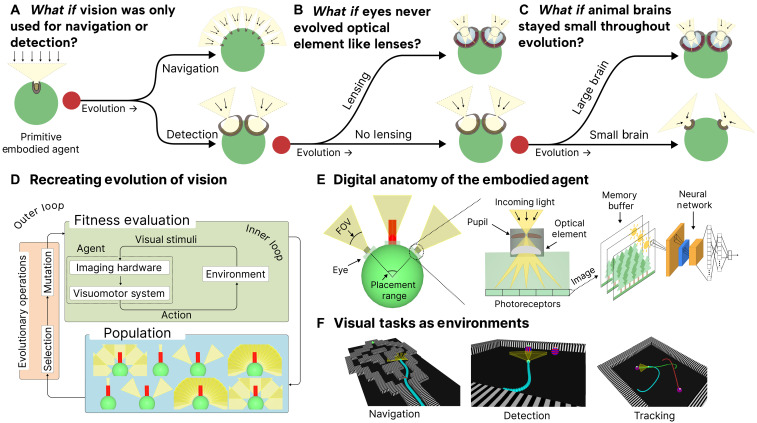
Natural selection has produced diverse vision systems, from simple patches of photoreceptors to complex camera eyes, representing just one set of evolutionary outcomes. Computational evolution offers a way to systematically test hypotheses, isolate individual factors, and ask the “why” questions behind vision. We recreate vision evolution by coevolving eyes and behaviors in embodied agents and use this to illuminate principles shaping vision across different levels of the Marr’s hierarchy. This leads to three key findings: First, we provide computational evidence that task-specific selection drives bifurcation in eye evolution. Second, we reveal how optical innovations naturally emerge to resolve fundamental trade-offs between light collection and spatial precision. Third, we uncover scaling laws between visual acuity and neural processing that provide insights into long-standing hypothesis behind eye and brain size. Our work introduces a paradigm that uses embodied artificial intelligence (AI) as hypothesis-testing machines that can help accelerate discoveries in vision science.
Overview
CoChat Summary
TL;DR
The paper introduces an embodied-AI framework that coevolves eyes and behavior via CMA-ES and PPO to test “what-if” scenarios in vision evolution. It reports task-specific eye bifurcation, lens emergence resolving light-vs-acuity trade-offs, and power-law scaling between visual acuity and neural capacity.
Key findings
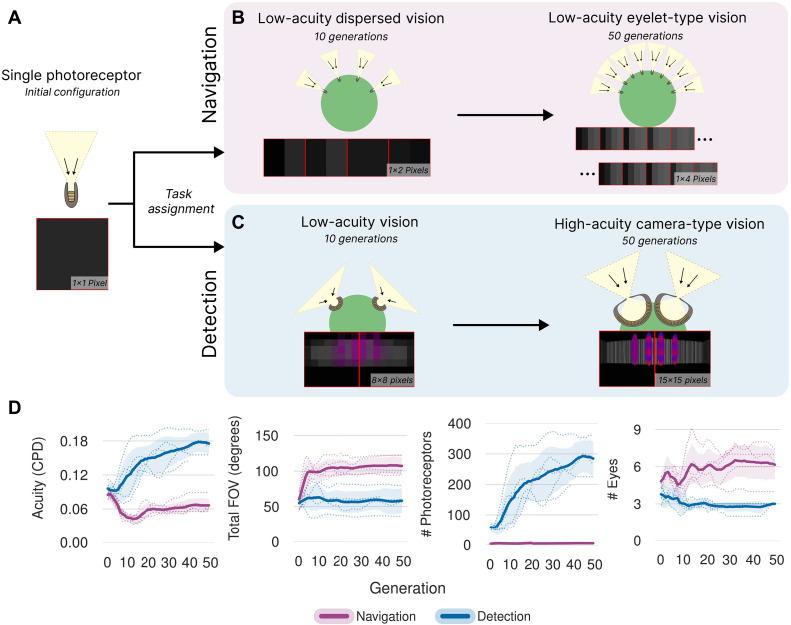
- Task-specific selection drives divergent eye morphologies from the same initial single-eye, one-photoreceptor agent: Navigation evolves distributed eyelet-type vision with seven eyes of four photoreceptors each (1×4) and a 135° total FOV, while Detection evolves two forward-facing camera-type eyes with 225 photoreceptors each (15×15).
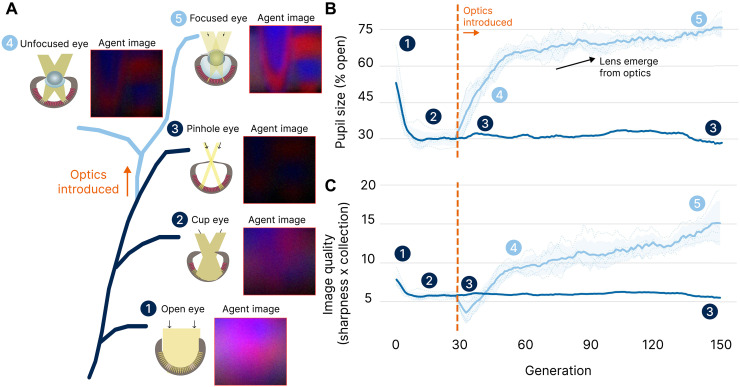
- Optical innovation resolves the light-collection vs spatial-precision trade-off: without optics, agents progress from open pupil to cup to near-pinhole eyes and plateau; introducing optics at generation 30 leads to lens-like structures by generation 50 and well-defined lenses beyond, with larger pupils and reliable detection by generation 130. Image Quality (MTF spatial precision × maximum light collection) separates high performers (F > 24.4) from poor performers (F < 3.4).
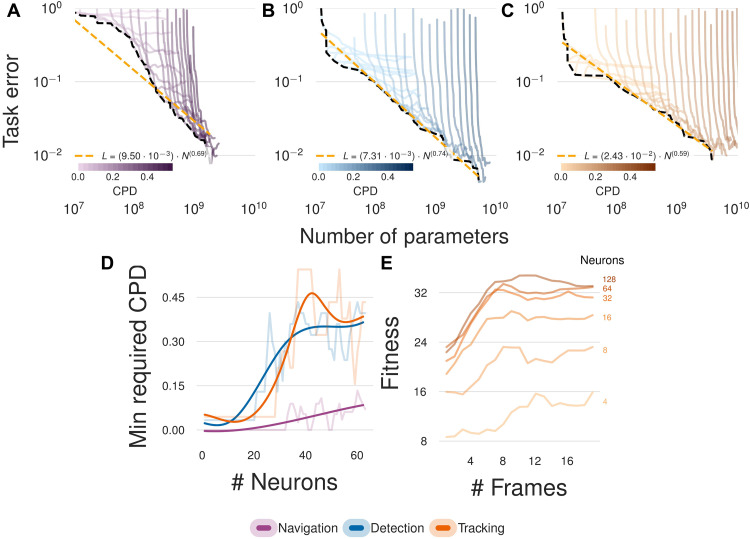
- Task error scales as a power law with neural parameters: L = (9.50×10⁻³)·N⁰·⁶⁹ for navigation, L = (7.31×10⁻³)·N⁰·⁷⁴ for detection, and L = (2.43×10⁻²)·N⁰·⁵⁹ for tracking; limited visual acuity imposes a performance ceiling that neural scaling alone cannot overcome, and temporal memory can partially compensate for reduced neural capacity.
- The genetic encoding can represent ~10²⁰ unique configurations, and the framework independently evolved distributed eyelet-type architectures without being explicitly designed to do so.
Methods
- Coevolution framework: outer loop uses CMA-ES with population size 16 over 50–100 generations; inner loop trains each agent with PPO up to 1 million steps, scoring fitness as average reward over six evaluation episodes. Experiments use five seeds (0, 42, 420, 1337, 4002) and evaluate upward of ~3200 independent agent morphologies.
- Embodied agents are point-mass spheres of radius 0.2 units in MuJoCo/gymnasium environments, solving three tasks: Navigation (maze orientation/obstacle avoidance), Detection (food vs poison object discrimination), and Tracking (moving objects).
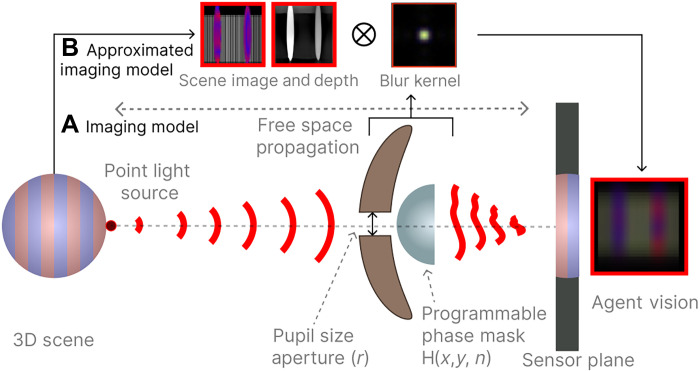
- Genetic encoding has morphological genes (eye number, placement, FOV), optical genes (4×4 programmable phase mask/DOE upsampled to 51×51, refractive index in [1.0, 2.0], pupil radius in [0,1]), and neural genes (hidden-layer neurons 1–512, temporal memory). Imaging uses a PSF convolution model with Gaussian sensor noise; analyses use CPD, MTF, PSNR/SSIM, and Image Quality.
Limitations
- Stated: the work recreates the system-level process of vision evolution rather than its historical timeline; complex biological phenomena such as eye genomics, development, biophysical models, and mechanistic neural circuits are poorly understood; evolutionary dynamics are often chaotic; experiments use isolated single-task settings; the phenotype-to-performance mapping is simplified; and the imaging model assumes depth-independent PSFs, a circular amplitude mask, and a 4×4 phase mask for tractability, while abstracting away fluid-dynamics details of lens emergence.
- Stated: the framework does not yet include multitask or multiagent settings, richer light properties such as spectral, polarization, or temporal sampling, or mechanistic circuits; neural network weights are not encoded in the genome.
- Evident from the text: the tasks and environments are simplified simulations, so the causal claims about natural vision evolution remain computational hypotheses rather than direct biological tests; the paper itself notes that isolated scenarios help understand extreme cases but do not capture the joint demands animals face.
Model-written summary. Check it against the paper before relying on it.
Integrity signals
Registry
Cites
Statistics
Figures

Verification
Claims the paper makes
13 Valid · 2 Not valid · 4 Not checked · 89 Own results and interpretations
The cited sources support only part of this claim — read each source’s verdict below.
In the paper
“our framework suggests plausible causal links between specific visual functions (26–28) and solutions”
§ What if eye...? Computationally recreating vision evolution > INTRODUCTION
What the sources say
- Supportedcites [26] D.-E. Nilsson, The evolution of eyes and visually guided behaviour. Philos. Trans. R. Soc. Lond. B. Biol. Sci. 364, 2833– 2847 (2009). 19720648 PMC2781862 source
The citation is attached to “specific visual functions,” while the causal-link framework is the citing authors’ own. In “Early sensory tasks and their functional requirements,” the source identifies distinct light-sensing tasks and explains how their requirements drive the evolution of photoreceptor structures. (LLM, conf=0.89)
- Not matchedcites [27] E. Warrant, D.-E. Nilsson, Invertebrate Vision (Cambridge Univ. Press, 2006).
Couldn’t be matched to a paper in Crossref, so it can’t be checked.
- Supportedcites [28] D.-E. Nilsson, The evolution of visual roles—Ancient vision versus object vision. Front. Neuroanat. 16, 789375 (2022). 35221931 PMC8863595 source
The paper’s Discussion distinguishes ancient from object vision and active tasks from assessment tasks, supporting the citation’s reference to specific visual functions. The proposed causal links belong to the citing authors’ own framework, so they are not a claim attributed to this source. (LLM, conf=0.87)
hedgedstates a possible cause- Asserted: passes — The authors put it forward as true.
- Checkable: passes — It can be checked against evidence.
- Load-bearing: passes — The paper’s conclusions depend on it.
- Based: passes — The paper gives a reason why it holds.
- Supported
The cited sources support only part of this claim — read each source’s verdict below.
In the paper
“our approach uniquely evolves embodied agents with both eyes and behaviors together”
§ What if eye...? Computationally recreating vision evolution > RESULTS
What the sources say
- Not checked — no full text of the sourcecites [38] D. C. O’Shea, “Monochromatic quartet: a search for the global optimum” in 1990 Intl Lens Design Conf, G. N. Lawrence, Ed. (International Society for Optics; Photonics; SPIE, 1991), vol. 1354, pp. 548–554; 10.1117/12.47896. source
- Not checked — no full text of the sourcecites [39] C. Gagné, J. Beaulieu, M. Parizeau, S. Thibault, Human-competitive lens system design with evolution strategies. Appl. Soft Comput. 8, 1439– 1452 (2008). source
- Not checked — no full text of the sourcecites [7] S. Nolfi, J. Bongard, P. Husbands, D. Floreano, Evolutionary Robotics (Springer International Publishing, 2016); 10.1007/978-3-319-32552-1_76. source
- Partly supportedcites [40] A. Gupta, S. Savarese, S. Ganguli, L. Fei-Fei, Embodied intelligence via learning and evolution. Nat. Commun. 12, 5721 (2021). 34615862 PMC8494941 sourceExperimental — accuracy not yet measured
The Methods (Distributed asynchronous evolution; page unavailable) describe evolving agent morphologies while learning their controllers, which supports the general idea of developing bodies and behaviors together. But the Methods (Observations; page unavailable) describe nonvisual sensory inputs and say the simulations avoid image input; they do not support evolving eyes. The paper also does not establish that this combination is unique. (LLM, conf=0.88)
- Not checked — no full text of the sourcecites [41] K. Sims, “Artificial evolution for computer graphics,” in Proceedings of the 18th Annual Conference on Computer Graphics and Interactive Techniques (Association for Computing Machinery, 1991), pp. 319–328; 10.1145/122718.122752. source
- Not checked — no full text of the sourcecites [42] D. Floreano, T. Kato, D. Marocco, E. Sauser, Coevolution of active vision and feature selection. Biol. Cybern. 90, 218– 228 (2004). 15052484 source
plainstates a cause- Asserted: passes — The authors put it forward as true.
- Checkable: passes — It can be checked against evidence.
- Load-bearing: passes — The paper’s conclusions depend on it.
- Based: passes — The paper gives a reason why it holds.
The sources with a verdict support this claim; the rest weren’t checked yet, have no full text we could read, or their verdicts aren’t rated yet.
In the paper
“validates aspects of eye evolution as trade-offs between light collection and spatial precision (26, 29)”
§ What if eye...? Computationally recreating vision evolution > INTRODUCTION
What the sources say
- Supportedcites [26] D.-E. Nilsson, The evolution of eyes and visually guided behaviour. Philos. Trans. R. Soc. Lond. B. Biol. Sci. 364, 2833– 2847 (2009). 19720648 PMC2781862 source
In “Imaging tasks,” the paper explains that narrowing a receptor’s field of view improves spatial resolution but sharply reduces photon detection, creating a sensitivity obstacle in eye evolution. It also describes how focusing optics increase photon catch while permitting high resolution. These passages support the trade-off attributed to the source. (LLM, conf=0.88)
- Not checked — no full text of the sourcecites [29] D.-E. Nilsson, S. Pelger, A pessimistic estimate of the time required for an eye to evolve. Proc. Roy. Soc. London Ser. B. Biol. Sci. 256, 53– 58 (1994). 8008757 source
plainstates an association- Asserted: passes — The authors put it forward as true.
- Checkable: passes — It can be checked against evidence.
- Load-bearing: passes — The paper’s conclusions depend on it.
- Based: passes — The paper gives a reason why it holds.
- Supported
The cited sources support only part of this claim — read each source’s verdict below.
In the paper
“Vision in nature has coevolved as a function of sensing and the underlying neural circuitry, subsequently constraining behavior that an animal learns during its lifetime (26, 43, 45).”
§ What if eye...? Computationally recreating vision evolution > RESULTS > Genetic encoding for vision
What the sources say
- Partly supportedcites [26] D.-E. Nilsson, The evolution of eyes and visually guided behaviour. Philos. Trans. R. Soc. Lond. B. Biol. Sci. 364, 2833– 2847 (2009). 19720648 PMC2781862 sourceExperimental — accuracy not yet measured
The Introduction (page unavailable) links the evolution of sensory systems to behaviour and describes sensory tasks as involving receptor–effector circuits and varying degrees of neural processing. It does not say that these evolved systems constrain behaviour an animal learns during its lifetime; its account concerns evolutionary changes in sensory tasks, not individual learning. (LLM, conf=0.86)
- Not checked — no full text of the sourcecites [43] D.-E. Nilsson, The diversity of eyes and vision. Annu. Rev. Vis. Sci. 7, 19– 41 (2021). 34086478 source
- Partly supportedcites [45] T. Baden, From water to land: Evolution of photoreceptor circuits for vision in air. PLOS Biol. 22, e3002422 (2024). 38252616 PMC10802956 sourceExperimental — accuracy not yet measured
The Introduction describes photoreceptors as sensory channels wired to circuits that drive or regulate distinct behavioural programmes, and discusses how changing visual environments favoured circuit reorganisation. It does not address whether those circuits constrain behaviours an animal learns during its lifetime (searched: learning, learned behaviour). (LLM, conf=0.87)
plainstates a cause- Asserted: passes — The authors put it forward as true.
- Checkable: passes — It can be checked against evidence.
- Load-bearing: passes — The paper’s conclusions depend on it.
- Based: passes — The paper gives a reason why it holds.
- Partly supported
Every source the paper cites for this claim was checked and supports it.
In the paper
“Much like natural and artificial evolution (79), our framework also demonstrates remarkable creativity in discovering solutions, for instance, it independently evolved distributed eyelet-type architectures without being explicitly designed to do so.”
§ What if eye...? Computationally recreating vision evolution > DISCUSSION
What the sources say
- Supportedcites [79] J. Lehman, J. Clune, D. Misevic, C. Adami, L. Altenberg, J. Beaulieu, P. J. Bentley, S. Bernard, G. Beslon, D. M. Bryson, P. Chrabaszcz, N. Cheney, A. Cully, S. Doncieux, F. C. Dyer, K. O. Ellefsen, R. Feldt, S. Fischer, S. Forrest, A. Frénoy, C. Gagné, L. L. Goff, L. M. Grabowski, B. Hodjat, F. Hutter, L. Keller, C. Knibbe, P. Krcah, R. E. Lenski, H. Lipson, R. MacCurdy, C. Maestre, R. Miikkulainen, S. Mitri, D. E. Moriarty, J.-B. Mouret, A. Nguyen, C. Ofria, M. Parizeau, D. Parsons, R. T. Pennock, W. F. Punch, T. S. Ray, M. Schoenauer, E. Shulte, K. Sims, K. O. Stanley, F. Taddei, D. Tarapor source
The Introduction (p. 2) says biological evolution produces surprising, complex solutions and that digital evolution often produces creative results investigators did not anticipate. The Conclusion (p. 27) likewise describes biological and computational evolution as inherently creative. The citation supports the comparison to evolution; the eyelet-type architecture is presented as a result of the citing authors’ own framework, not as a finding from this source. (LLM, conf=0.92)
boostedstates a cause- Asserted: passes — The authors put it forward as true.
- Checkable: passes — It can be checked against evidence.
- Load-bearing: unclear — It is unclear whether the paper’s conclusions depend on it.
- Based: passes — The paper gives a reason why it holds.
- Supported
60 more claims · 4 with their cited sources checked
Create a free account to see all 108 claims and every source verdict.
- Probably not a substantial claim. 20
- It may state two separate claims as one. 30
- The quote only partly states this claim. 1
Self-check
Percentages, sums and reported differences re-computed from the paper’s own numbers.
Each contradiction between two passages listed here was confirmed by an independent check.
Rated minor: it would not touch a result — a value no result rests on, a p-value that stays on the same side of the significance level, or a conflict that is clerical, resolved elsewhere in the paper, or outside its own findings.
In the paper
§ What if eye...? Computationally recreating vision evolution > MATERIALS AND METHODS > Reward function
“RDETECTION=λ (∥xt−xf∥−∥xt−1−xf∥)+wg+wa+wc(2)”
§ What if eye...? Computationally recreating vision evolution > MATERIALS AND METHODS > Reward function
“In the Detection and Tracking tasks, the agent is incentivized to navigate to the goal as quickly as it can.”
Rated minor: it would not touch a result — a value no result rests on, a p-value that stays on the same side of the significance level, or a conflict that is clerical, resolved elsewhere in the paper, or outside its own findings.
In the paper
§ What if eye...? Computationally recreating vision evolution > MATERIALS AND METHODS > Neural genes
“a memory size of five means the agent’s visual stimulus is a flattened vector each composed of the current frame and the previous five frames.”
§ What if eye...? Computationally recreating vision evolution > MATERIALS AND METHODS > Observations
“If the memory buffer is of size 10, then a tensor of size 10 by 5 by 4 by 1 by 3 is provided to the underlying agent network.”
Citations
Cites
Proximal Policy Optimization Algorithms
Schulman, J., Wolski, F., Dhariwal, P., Radford, A., & Klimov, O. (2017) · arXiv · doi:10.48550/arxiv.1707.06347 · Cited by 10,625
Scaling Laws for Neural Language Models
Kaplan, J., McCandlish, S., Henighan, T., Brown, T. B., Chess, B., Child, R., Gray, S., Radford, A., Wu, J., & Amodei, D. (2020) · arXiv · doi:10.48550/arxiv.2001.08361 · Cited by 9,550 · cited 2×
“…improvement in both dimensions—a pattern consistent with observations made in animal vision and, more recently, deep learning models used in AI ( 30 , 31 ), suggesting that this relationship may be a general principle of scaling across a broad scope of various types of morphologies and…”
MuJoCo: A physics engine for model-based control
Todorov, E., Erez, T., & Tassa, Y. (2012) · 2012 IEEE/RSJ International Conference on Intelligent Robots and Systems · doi:10.1109/iros.2012.6386109 · Cited by 4,767 · cited 3×
“We create these tasks in a MuJoCo simulation environment ( 33 , 44 ) with added support for physics-based imaging through programmable lenses and aperture-controlled retinal models, enabling complex imaging and evolutionary search.”
Completely Derandomized Self-Adaptation in Evolution Strategies
Hansen, N., & Ostermeier, A. (2001) · Evolutionary Computation · doi:10.1162/106365601750190398 · Cited by 4,397 · cited 1×
“The specific ES algorithm we use is the CMA-ES ( 84 ).”
A general reinforcement learning algorithm that masters chess, shogi, and Go through self-play
Silver, D., Hubert, T., Schrittwieser, J., Antonoglou, I., Lai, M., Guez, A., Lanctot, M., Sifre, L., Kumaran, D., Graepel, T., et al. (2018) · Science · doi:10.1126/science.aar6404 · Cited by 3,562
Evolving Neural Networks through Augmenting Topologies
Stanley, K. O., & Miikkulainen, R. (2002) · Evolutionary Computation · doi:10.1162/106365602320169811 · Cited by 3,258 · cited 1×
“Rather than incorporating neural network weights directly in the genomic encoding ( 47 – 49 ), we train each agent from scratch to learn behaviors specific to the mutated eye design.”
The contrast sensitivity of retinal ganglion cells of the cat
Enroth-Cugell, C., & Robson, J. G. (1966) · The Journal of Physiology · doi:10.1113/jphysiol.1966.sp008107 · Cited by 2,625 · cited 1×
“In nature, early-stage retinal processing has also been observed, such as temporal filtering and motion-opponent channels ( 71 – 73 ), which compress information before being processed by the brain.”
DISCHARGE PATTERNS AND FUNCTIONAL ORGANIZATION OF MAMMALIAN RETINA
Kuffler, S. W. (1953) · Journal of Neurophysiology · doi:10.1152/jn.1953.16.1.37 · Cited by 2,609
Baldwin, J. M. (1896) · The American Naturalist · doi:10.1086/276408 · Cited by 1,781 · cited 1×
“At a population scale, this continuous feedback loop between evolution and learning is similar in nature to the Baldwin effect ( 46 ), where the ability to learn specific behaviors increases the likelihood of a selection of ge-netic traits for future generations.”
The human brain in numbers: a linearly scaled-up primate brain
Herculano-Houzel, S. (2009) · Frontiers in Human Neuroscience · doi:10.3389/neuro.09.031.2009 · Cited by 1,778 · cited 1×
“Our neural network parameters represent a computational analog to biological neural capacity, directly reflecting the studies showing strong correlations between brain volume and total neuron count across species, humans, and mice brains ( 68 – 70 ).”
Deep Reinforcement Learning That Matters
Henderson, P., Islam, R., Bachman, P., Pineau, J., Precup, D., & Meger, D. (2018) · Proceedings of the AAAI Conference on Artificial Intelligence · doi:10.1609/aaai.v32i1.11694 · Cited by 1,685 · cited 1×
“Reinforcement learning algorithms have been shown to have a strong dependence on the random seed used to initialize the environment ( 83 ).”
Gymnasium: A Standard Interface for Reinforcement Learning EnvironmentsPreprint
Towers, M., Kwiatkowski, A., Terry, J., Balis, J. U., De Cola, G., Deleu, T., Goulão, M., Kallinteris, A., Krimmel, M., Arjun, K. G., et al. (2024) · arXiv (Cornell University) · doi:10.48550/arxiv.2407.17032 · Cited by 1,298
Mastering Chess and Shogi by Self-Play with a General Reinforcement Learning Algorithm
Silver, D., Hubert, T., Schrittwieser, J., Antonoglou, I., Lai, M., Guez, A., Lanctot, M., Sifre, L., Kumaran, D., Graepel, T., et al. (2017) · arXiv · doi:10.48550/arxiv.1712.01815 · Cited by 1,102
Evolution Strategies as a Scalable Alternative to Reinforcement Learning
Salimans, T., Ho, J., Chen, X., Sidor, S., & Sutskever, I. (2017) · arXiv · doi:10.48550/arxiv.1703.03864 · Cited by 1,027 · cited 1×
“We accomplish this intelligent search mechanism through the integration of ES ( 48 ).”
Training Compute-Optimal Large Language Models
Hoffmann, J., Borgeaud, S., Mensch, A., Buchatskaya, E., Cai, T., Rutherford, E., Casas, D. D. L., Hendricks, L. A., Welbl, J., Clark, A., et al. (2022) · Advances in Neural Information Processing Systems 35 · doi:10.52202/068431-2176 · Cited by 932 · cited 1×
“While AI systems focus on scaling neural, data, and computation capacity ( 30 , 31 , 74 – 77 ), our findings suggest that evolution of embodied intelligent behavior (biological or artificial) may require coordinated scaling of visual acuity and processing.”
Training Compute-Optimal Large Language Models
Hoffmann, J., Borgeaud, S., Mensch, A., Buchatskaya, E., Cai, T., Rutherford, E., Casas, D. D. L., Hendricks, L. A., Welbl, J., Clark, A., et al. (2022) · arXiv · doi:10.48550/arxiv.2203.15556 · Cited by 929
Zhai, X., Kolesnikov, A., Houlsby, N., & Beyer, L. (2022) · 2022 IEEE/CVF Conference on Computer Vision and Pattern Recognition (CVPR) · doi:10.1109/cvpr52688.2022.01179 · Cited by 891
Automatic design and manufacture of robotic lifeforms
Lipson, H., & Pollack, J. B. (2000) · Nature · doi:10.1038/35023115 · Cited by 883
Eye Smarter than Scientists Believed: Neural Computations in Circuits of the Retina
Gollisch, T., & Meister, M. (2010) · Neuron · doi:10.1016/j.neuron.2009.12.009 · Cited by 795 · cited 1×
“In nature, early-stage retinal processing has also been observed, such as temporal filtering and motion-opponent channels ( 71 – 73 ), which compress information before being processed by the brain.”
Pax 6: mastering eye morphogenesis and eye evolution
Gehring, W. J., & Ikeo, K. (1999) · Trends in Genetics · doi:10.1016/s0168-9525(99)01776-x · Cited by 758 · cited 1×
“For example, complex biological phenomena are poorly understood, such as eye genomics and development ( 34 , 35 ), biophysical models ( 36 ), or mechanistic neural circuits ( 11 ).”
Artificial evolution for computer graphics
Sims, K. (1991) · Proceedings of the 18th annual conference on Computer graphics and interactive techniques · doi:10.1145/122718.122752 · Cited by 741 · cited 1×
“While previous work has used evolutionary algorithms to independently design optical systems ( 38 , 39 ), embodied agent morphologies ( 7 , 40 , 41 ), or visually guided behaviors ( 42 ), our approach uniquely evolves embodied agents with both eyes and behaviors together.”
Herculano-Houzel, S. (2012) · Proceedings of the National Academy of Sciences · doi:10.1073/pnas.1201895109 · Cited by 726 · cited 1×
“Our neural network parameters represent a computational analog to biological neural capacity, directly reflecting the studies showing strong correlations between brain volume and total neuron count across species, humans, and mice brains ( 68 – 70 ).”
Honeybee Navigation En Route to the Goal: Visual Flight Control and Odometry
Srinivasan, M. V., Zhang, S. W., Lehrer, M., & Collett, T. S. (1996) · Journal of Experimental Biology · doi:10.1242/jeb.199.1.237 · Cited by 600
Desert ant navigation: how miniature brains solve complex tasks
Wehner, R. (2003) · Journal of Comparative Physiology A: Sensory, Neural, and Behavioral Physiology · doi:10.1007/s00359-003-0431-1 · Cited by 574 · cited 1×
“Our computational isolation of visual tasks reveals fundamental patterns that parallel natural evolution ( 1 , 50 , 56 – 58 ).”
Sitzmann, V., Diamond, S., Peng, Y., Dun, X., Boyd, S., Heidrich, W., Heide, F., & Wetzstein, G. (2018) · ACM Transactions on Graphics · doi:10.1145/3197517.3201333 · Cited by 478 · cited 1×
“The optical element is represented as a 2D array that can be programmed into lenses of different shapes [modeled as a diffractive optical element (DOE)] ( 61 – 63 ).”
Discovering faster matrix multiplication algorithms with reinforcement learning
Fawzi, A., Balog, M., Huang, A., Hubert, T., Romera-Paredes, B., Barekatain, M., Novikov, A., R. Ruiz, F. J., Schrittwieser, J., Swirszcz, G., et al. (2022) · Nature · doi:10.1038/s41586-022-05172-4 · Cited by 478
Deep Learning Scaling is Predictable, Empirically
Hestness, J., Narang, S., Ardalani, N., Diamos, G., Jun, H., Kianinejad, H., Patwary, M. M. A., Yang, Y., & Zhou, Y. (2017) · arXiv · doi:10.48550/arxiv.1712.00409 · Cited by 427
A pessimistic estimate of the time required for an eye to evolve
(1994) · Proceedings of the Royal Society of London. Series B: Biological Sciences · doi:10.1098/rspb.1994.0048 · Cited by 425 · cited 3×
“While the exact physical processes that led to biological lens emergence remain unclear, one hypothesis is that lenses emerged through gradual increase in optical densities of vit-reous humor present inside chambered eyes ( 29 ).”
Self-citationLand, M. F. (1969) · Journal of Experimental Biology · doi:10.1242/jeb.51.2.443 · Cited by 358
Embodied intelligence via learning and evolution
Gupta, A., Savarese, S., Ganguli, S., & Fei-Fei, L. (2021) · Nature Communications · doi:10.1038/s41467-021-25874-z · Cited by 352 · cited 1×
“While previous work has used evolutionary algorithms to independently design optical systems ( 38 , 39 ), embodied agent morphologies ( 7 , 40 , 41 ), or visually guided behaviors ( 42 ), our approach uniquely evolves embodied agents with both eyes and behaviors together.”
Cronin, T. W., Johnsen, S., Marshall, N. J., & Warrant, E. J. (2014) · Princeton University Press eBooks · doi:10.23943/princeton/9780691151847.001.0001 · Cited by 331
Visual Acuity and the Evolution of Signals
Caves, E. M., Brandley, N. C., & Johnsen, S. (2018) · Trends in Ecology & Evolution · doi:10.1016/j.tree.2018.03.001 · Cited by 298 · cited 5×
“…in both dimensions—a pattern consistent with observations made in animal vision and, more recently, deep learning models used in AI ( 30 , 31 ), suggesting that this relationship may be a general principle of scaling across a broad scope of various types of morphologies and architectures.”
InfluentialRegressive Evolution in Astyanax Cavefish
Jeffery, W. R. (2009) · Annual Review of Genetics · doi:10.1146/annurev-genet-102108-134216 · Cited by 298
Eye evolution and its functional basis
NILSSON, D.-E. (2013) · Visual Neuroscience · doi:10.1017/s0952523813000035 · Cited by 267 · cited 2×
“This also aligns with proposed explanations that suggest that lens development coincided with an increase in eye size ( 59 , 60 ).”
Self-citationBongard, J. C. (2013) · Communications of the ACM · doi:10.1145/2492007.2493883 · Cited by 260
The evolution of eyes and visually guided behaviour
Nilsson, D.-E. (2009) · Philosophical Transactions of the Royal Society B: Biological Sciences · doi:10.1098/rstb.2009.0083 · Cited by 258 · cited 5×
“Through targeted computational experiments, our framework suggests plausible causal links between specific visual functions ( 26 – 28 ) and solutions, validates aspects of eye evolution as trade-offs between light collection and spatial precision ( 26 , 29 ), and studies relationships between eyes…”
InfluentialSelf-citationCoevolving avian eye size and brain size in relation to prey capture and nocturnality
Garamszegi, L. Z., Møller, A. P., & Erritzøe, J. (2002) · Proceedings of the Royal Society of London. Series B: Biological Sciences · doi:10.1098/rspb.2002.1967 · Cited by 232
Interactive robots in experimental biology
Krause, J., Winfield, A. F. T., & Deneubourg, J.-L. (2011) · Trends in Ecology & Evolution · doi:10.1016/j.tree.2011.03.015 · Cited by 230
Casting a Genetic Light on the Evolution of Eyes
Fernald, R. D. (2006) · Science · doi:10.1126/science.1127889 · Cited by 193 · cited 1×
“We use this framework to study the emergence of visual capabilities documented across animal phylogeny ( 2 , 26 ).”
The scaling of eye size with body mass in birds
Brooke, M. D. L., Hanley, S., & Laughlin, S. B. (1999) · Proceedings of the Royal Society of London. Series B: Biological Sciences · doi:10.1098/rspb.1999.0652 · Cited by 190 · cited 2×
“We compare the resulting imaging systems of the optimized agents using cycles per degree (CPD) ( 31 , 53 , 54 ), which is a measure of the spatial frequencies observable to the agent; a higher CPD value corresponds to a better ability to resolve fine spatial details in a scene ( 31 ) (we describe…”
Using artificial neural networks to ask ‘why’ questions of minds and brains
Kanwisher, N., Khosla, M., & Dobs, K. (2023) · Trends in Neurosciences · doi:10.1016/j.tins.2022.12.008 · Cited by 182 · cited 1×
“…agents and a computational model for biological phenomena, we can study predator-prey dynamics ( 12 ), brain-body coevolution ( 13 ), environmental adaptation ( 14 – 18 ), or “why” questions in neuroscience ( 19 ) such as the emergence of foveal image sampling ( 20 ) or peripheral vision ( 21 ).”
Lehman, J., Clune, J., Misevic, D., Adami, C., Altenberg, L., Beaulieu, J., Bentley, P. J., Bernard, S., Beslon, G., Bryson, D. M., et al. (2020) · Artificial Life · doi:10.1162/artl_a_00319 · Cited by 181
PhaseCam3D — Learning Phase Masks for Passive Single View Depth Estimation
Wu, Y., Boominathan, V., Chen, H., Sankaranarayanan, A. C., & Veeraraghavan, A. (2019) · IEEE International Conference on Computational Photography (ICCP) · doi:10.1109/iccphot.2019.8747330 · Cited by 180
Deep Optics for Monocular Depth Estimation and 3D Object Detection
Chang, J., & Wetzstein, G. (2019) · 2019 IEEE/CVF International Conference on Computer Vision (ICCV) · doi:10.1109/iccv.2019.01029 · Cited by 178
Faster sorting algorithms discovered using deep reinforcement learning
Mankowitz, D. J., Michi, A., Zhernov, A., Gelmi, M., Selvi, M., Paduraru, C., Leurent, E., Iqbal, S., Lespiau, J.-B., Ahern, A., et al. (2023) · Nature · doi:10.1038/s41586-023-06004-9 · Cited by 177 · cited 1×
“Second, our work builds on the emergence of deep reinforcement learning (DRL) as a powerful tool for discovery in domains that can be formulated as reward-driven games ( 22 – 25 ).”
Neuronal factors determining high intelligence
Dicke, U., & Roth, G. (2016) · Philosophical Transactions of the Royal Society B: Biological Sciences · doi:10.1098/rstb.2015.0180 · Cited by 175
Walter, W. G. (1951) · Scientific American · doi:10.1038/scientificamerican0851-60 · Cited by 169
Gehring, W. J. (2012) · Wiley Interdisciplinary Reviews Developmental Biology · doi:10.1002/wdev.96 · Cited by 154 · cited 1×
“For example, complex biological phenomena are poorly understood, such as eye genomics and development ( 34 , 35 ), biophysical models ( 36 ), or mechanistic neural circuits ( 11 ).”
A unique colour and polarization vision system in mantis shrimps
Marshall, N. J. (1988) · Nature · doi:10.1038/333557a0 · Cited by 145
Connectome-constrained networks predict neural activity across the fly visual system
Lappalainen, J. K., Tschopp, F. D., Prakhya, S., McGill, M., Nern, A., Shinomiya, K., Takemura, S.-Y., Gruntman, E., Macke, J. H., & Turaga, S. C. (2024) · Nature · doi:10.1038/s41586-024-07939-3 · Cited by 128 · cited 3×
“For example, complex biological phenomena are poorly understood, such as eye genomics and development ( 34 , 35 ), biophysical models ( 36 ), or mechanistic neural circuits ( 11 ).”
Genetic Team Composition and Level of Selection in the Evolution of Cooperation
Waibel, M., Keller, L., & Floreano, D. (2009) · IEEE Transactions on Evolutionary Computation · doi:10.1109/tevc.2008.2011741 · Cited by 126
Evolution of Self-Organized Task Specialization in Robot Swarms
Ferrante, E., Turgut, A. E., Duéñez-Guzmán, E., Dorigo, M., & Wenseleers, T. (2015) · PLOS Computational Biology · doi:10.1371/journal.pcbi.1004273 · Cited by 123
Martel, J., Müller, L. K., Carey, S. J., Dudek, P., & Wetzstein, G. (2020) · IEEE Transactions on Pattern Analysis and Machine Intelligence · doi:10.1109/tpami.2020.2986944 · Cited by 107 · cited 1×
“The optical element is represented as a 2D array that can be programmed into lenses of different shapes [modeled as a diffractive optical element (DOE)] ( 61 – 63 ).”
Coevolution of active vision and feature selection
Floreano, D., Kato, T., Marocco, D., & Sauser, E. (2004) · Biological Cybernetics · doi:10.1007/s00422-004-0467-5 · Cited by 97 · cited 1×
“While previous work has used evolutionary algorithms to independently design optical systems ( 38 , 39 ), embodied agent morphologies ( 7 , 40 , 41 ), or visually guided behaviors ( 42 ), our approach uniquely evolves embodied agents with both eyes and behaviors together.”
CHAOS AND UNPREDICTABILITY IN EVOLUTION
Doebeli, M., & Ispolatov, Y. (2014) · Evolution · doi:10.1111/evo.12354 · Cited by 80 · cited 1×
“Moreover, modeling evolutionary dynamics is often akin to modeling a chaotic system ( 37 ) as eye adaptations are often a result of many interdependent pressures.”
Chunk Versus Point Sampling: Visual Imaging in a Small Insect
Buschbeck, E. K., Ehmer, B., & Hoy, R. (1999) · Science · doi:10.1126/science.286.5442.1178 · Cited by 80
A Quantitative Test of Hamilton's Rule for the Evolution of Altruism
Waibel, M., Floreano, D., & Keller, L. (2011) · PLoS Biology · doi:10.1371/journal.pbio.1000615 · Cited by 77
The Diversity of Eyes and Vision
Nilsson, D.-E. (2021) · Annual Review of Vision Science · doi:10.1146/annurev-vision-121820-074736 · Cited by 71 · cited 4×
“Concurrent work with comparative studies of real animals synthesizing anatomical, behavioral, and evolutionary data also show that species with high-resolution vision devote substantially more neural resources to visual processing ( 43 ).”
InfluentialSelf-citationArctic reindeer extend their visual range into the ultraviolet
Hogg, C. R., Neveu, M. M., Stokkan, K., Folkow, L. P., Cottrill, P. B., Douglas, R. H., Hunt, D. M., & Jeffery, G. (2011) · Journal of Experimental Biology · doi:10.1242/jeb.053553 · Cited by 69 · cited 1×
“Our computational isolation of visual tasks reveals fundamental patterns that parallel natural evolution ( 1 , 50 , 56 – 58 ).”
Nolfi, S., Bongard, J., Husbands, P., & Floreano, D. (2016) · Springer Handbooks · doi:10.1007/978-3-319-32552-1_76 · Cited by 68
The manoeuvrability hypothesis to explain the maintenance of bilateral symmetry in animal evolution
Holló, G., & Novák, M. (2012) · Biology Direct · doi:10.1186/1745-6150-7-22 · Cited by 67
Co-evolutionary dynamics of mammalian brain and body size
Venditti, C., Baker, J., & Barton, R. A. (2024) · Nature Ecology & Evolution · doi:10.1038/s41559-024-02451-3 · Cited by 65
Neuronal circuits integrating visual motion information in Drosophila melanogaster
Shinomiya, K., Nern, A., Meinertzhagen, I. A., Plaza, S. M., & Reiser, M. B. (2022) · Current Biology · doi:10.1016/j.cub.2022.06.061 · Cited by 64
The scaling of eye size in adult birds: Relationship to brain, head and body sizes
Burton, R. F. (2008) · Vision Research · doi:10.1016/j.visres.2008.08.001 · Cited by 63 · cited 4×
“We compare the resulting imaging systems of the optimized agents using cycles per degree (CPD) ( 31 , 53 , 54 ), which is a measure of the spatial frequencies observable to the agent; a higher CPD value corresponds to a better ability to resolve fine spatial details in a scene ( 31 ) (we describe…”
InfluentialOn the role of body size, brain size, and eye size in visual acuity
Corral-López, A., Garate-Olaizola, M., Buechel, S. D., Kolm, N., & Kotrschal, A. (2017) · Behavioral Ecology and Sociobiology · doi:10.1007/s00265-017-2408-z · Cited by 48
Evolutionary Robotics: Model or Design?
Trianni, V. (2014) · Frontiers in Robotics and AI · doi:10.3389/frobt.2014.00013 · Cited by 47
Environmental influences on evolvable robots
Miras, K., Ferrante, E., & Eiben, A. E. (2020) · PLoS ONE · doi:10.1371/journal.pone.0233848 · Cited by 45 · cited 1×
“…agents and a computational model for biological phenomena, we can study predator-prey dynamics ( 12 ), brain-body coevolution ( 13 ), environmental adaptation ( 14 – 18 ), or “why” questions in neuroscience ( 19 ) such as the emergence of foveal image sampling ( 20 ) or peripheral vision ( 21 ).”
The evolution of eyes: major steps. The Keeler lecture 2017: centenary of Keeler Ltd
Schwab, I. R. (2018) · Eye · doi:10.1038/eye.2017.226 · Cited by 44 · cited 2×
“This also aligns with proposed explanations that suggest that lens development coincided with an increase in eye size ( 59 , 60 ).”
Revisiting neural scaling laws in language and vision
Alabdulmohsin, I., Neyshabur, B., & Zhai, X. (2022) · Advances in Neural Information Processing Systems 35 · doi:10.52202/068431-1620 · Cited by 41
A model of the entrance pupil of the human eye
Aguirre, G. K. (2019) · Scientific Reports · doi:10.1038/s41598-019-45827-3 · Cited by 39 · cited 2×
“For example, complex biological phenomena are poorly understood, such as eye genomics and development ( 34 , 35 ), biophysical models ( 36 ), or mechanistic neural circuits ( 11 ).”
Human-competitive lens system design with evolution strategies
Gagné, C., Beaulieu, J., Parizeau, M., & Thibault, S. (2008) · Applied Soft Computing · doi:10.1016/j.asoc.2007.10.018 · Cited by 37 · cited 1×
“While previous work has used evolutionary algorithms to independently design optical systems ( 38 , 39 ), embodied agent morphologies ( 7 , 40 , 41 ), or visually guided behaviors ( 42 ), our approach uniquely evolves embodied agents with both eyes and behaviors together.”
Emergence of foveal image sampling from learning to attend in visual scenesPreprint
Cheung, B., Weiss, E., & Olshausen, B. A. (2016) · arXiv (Cornell University) · doi:10.48550/arxiv.1611.09430 · Cited by 37
Self-citationThe first biologically inspired robots
Holland, O. E. (2003) · Robotica · doi:10.1017/s0263574703004971 · Cited by 36
Data and Parameter Scaling Laws for Neural Machine Translation
Gordon, M. A., Duh, K., & Kaplan, J. (2021) · Proceedings of the 2021 Conference on Empirical Methods in Natural Language Processing · doi:10.18653/v1/2021.emnlp-main.478 · Cited by 31
A new look at the scaling of size in mammalian eyes
Burton, R. F. (2006) · Journal of Zoology · doi:10.1111/j.1469-7998.2006.00111.x · Cited by 28 · cited 2×
“Natural studies extensively document correlations between brain size and eye size across various species, yet they are limited to observational analysis and can only hypothesize underlying causes without definitive testing ( 53 , 64 – 67 ).”
Investigating the role of body size, ecology, and behavior in anuran eye size evolution
Huang, C. H., Zhong, M. J., Liao, W. B., & Kotrschal, A. (2019) · Evolutionary Ecology · doi:10.1007/s10682-019-09993-0 · Cited by 27 · cited 1×
“Natural studies extensively document correlations between brain size and eye size across various species, yet they are limited to observational analysis and can only hypothesize underlying causes without definitive testing ( 53 , 64 – 67 ).”
Monochromatic quartet: a search for the global optimum
O'Shea, D. C. (1991) · SPIE Proceedings · doi:10.1117/12.47896 · Cited by 27 · cited 1×
“While previous work has used evolutionary algorithms to independently design optical systems ( 38 , 39 ), embodied agent morphologies ( 7 , 40 , 41 ), or visually guided behaviors ( 42 ), our approach uniquely evolves embodied agents with both eyes and behaviors together.”
Human peripheral blur is optimal for object recognition
Pramod, R. T., Katti, H., & Arun, S. P. (2022) · Vision Research · doi:10.1016/j.visres.2022.108083 · Cited by 24 · cited 1×
“…agents and a computational model for biological phenomena, we can study predator-prey dynamics ( 12 ), brain-body coevolution ( 13 ), environmental adaptation ( 14 – 18 ), or “why” questions in neuroscience ( 19 ) such as the emergence of foveal image sampling ( 20 ) or peripheral vision ( 21 ).”
The Evolution of Visual Roles – Ancient Vision Versus Object Vision
Nilsson, D.-E. (2022) · Frontiers in Neuroanatomy · doi:10.3389/fnana.2022.789375 · Cited by 21 · cited 5×
“Through targeted computational experiments, our framework suggests plausible causal links between specific visual functions ( 26 – 28 ) and solutions, validates aspects of eye evolution as trade-offs between light collection and spatial precision ( 26 , 29 ), and studies relationships between eyes…”
InfluentialSelf-citationFrom water to land: Evolution of photoreceptor circuits for vision in air
Baden, T. (2024) · PLOS Biology · doi:10.1371/journal.pbio.3002422 · Cited by 21 · cited 1×
“Vision in nature has coevolved as a function of sensing and the underlying neural circuitry, subsequently constraining behavior that an animal learns during its lifetime ( 26 , 43 , 45 ).”
Learning Phase Mask for Privacy-Preserving Passive Depth Estimation
Tasneem, Z., Milione, G., Tsai, Y., Yu, X., Veeraraghavan, A., Chandraker, M. K., & Pittaluga, F. (2022) · Lecture notes in computer science · doi:10.1007/978-3-031-20071-7_30 · Cited by 17 · cited 1×
“We follow the wave propagation model described in ( 86 – 88 ) to estimate the PSF.”
Self-citationDeep Optics for Monocular Depth Estimation and 3D Object DetectionPreprint
Chang, J., & Wetzstein, G. (2019) · arXiv (Cornell University) · doi:10.48550/arxiv.1904.08601 · Cited by 17
Evolutionary robotics as a modelling tool in evolutionary biology
Winfield, A. F. T. (2024) · Frontiers in Robotics and AI · doi:10.3389/frobt.2024.1278983 · Cited by 6 · cited 1×
“…agents and a computational model for biological phenomena, we can study predator-prey dynamics ( 12 ), brain-body coevolution ( 13 ), environmental adaptation ( 14 – 18 ), or “why” questions in neuroscience ( 19 ) such as the emergence of foveal image sampling ( 20 ) or peripheral vision ( 21 ).”
DISeR: Designing Imaging Systems with Reinforcement Learning
Klinghoffer, T., Tiwary, K., Behari, N., Agrawalla, B., & Raskar, R. (2023) · IEEE/CVF International Conference on Computer Vision (ICCV) · doi:10.1109/iccv51070.2023.02160 · Cited by 5 · cited 1×
“For engineers, these evolutionary simulations reveal design principles for artificial vision systems, particularly valuable when optimizing for practical constraints like energy efficiency and man-ufacturability ( 13 , 80 , 81 ).”
Self-citationA Roadmap for Generative Design of Visual IntelligencePreprint
Tiwary, K., Klinghoffer, T., Young, A., et al. (2024) · doi:10.21428/e4baedd9.d2a03144 · Cited by 1
Self-citationCronin, T. W., Johnsen, S., Marshall, N. J., et al. (2014) · doi:10.1515/9781400853021
Research works printed but not linked: 9
- M. Land D.-E. Nilsson Animal Eyes (Oxford Univ. Press 2002).
- D. Floreano S. Nolfi “Adaptive behavior in competing co-evolving species” in 4th European Conference on Artificial Life (1997) pp. 378–387.
- E. Warrant D.-E. Nilsson Invertebrate Vision (Cambridge Univ. Press 2006).
- E. Conti V. Madhavan F. P. Such J. Lehman K. O. Stanley J. Clune Improving exploration in evolution strategies for deep reinforcement learning via a population of novelty-seeking agents. arXiv:171206560 (2018).
- N. Hansen A. Ostermeier “Adapting arbitrary normal mutation” in Proceedings of the 1996 IEEE International Conference on Evolutionary Computation (1996) pp. 312–317.
- A. Raffin, A. Hill, A. Gleave, A. Kanervisto, M. Ernestus, N. Dormann, Stable-baselines3: Reliable reinforcement learning implementations. J. Mach. Learn. Res. 22, 1–8 (2021).
- M. Woo J. Neider T. Davis D. Shreiner OpenGL Programming Guide: The Official Guide to Learning OpenGL Version 1.2 (Addison-Wesley Longman Publishing Co. Inc. 1999).
- E. Adelson J. Bergen “The plenoptic function and the elements of early vision” (1997); https://www.researchgate.net/publication/2684713_The_Plenoptic_Function_and_the_Elements_of_Early_Vision.
- “Allometry: The study of biological scaling” (2018); https://api.semanticscholar.org/CorpusID:199531454.
Cited by
JOCA: Task-Driven Joint Optimisation of Camera Hardware and Adaptive Camera Control Algorithms
Yan, C., Bryson, M., & Dansereau, D. G. (2026) · IEEE Winter Conference on Applications of Computer Vision · doi:10.1109/wacv61042.2026.00383 · Cited by 1
“More recently, Yan et al. [53] and Tiwary et al. [45] employed evolutionary algorithms to directly optimise camera and vision system parameters, by-passing large neural networks and enabling faster optimisation with less data.”
Tuning Diversity Improves Discrimination and Detection Performance under Metabolic ConstraintsPreprint
Ringach, D. L. (2026) · bioRxiv (Cold Spring Harbor Laboratory) · doi:10.64898/2026.06.29.735317 · Cited by 1
“Recent work has demonstrated that sensory morphology, neural processing, and behavior can be co-evolved in embodied agents, with different task demands producing distinct visual solutions [23].”
The geometry of vision, set in motion
Otero‐Millan, J. (2026) · Proceedings of the National Academy of Sciences · doi:10.1073/pnas.2614199123
The nativist–empiricist debate is broken
Quilty‐Dunn, J., & Wood, J. N. (2026) · Trends in Cognitive Sciences · doi:10.1016/j.tics.2026.08.004 · Cited by 1
Metadata
- Authors
- Tiwary, K., Young, A., Tasneem, Z., Klinghoffer, T., Dave, A., Poggio, T., Nilsson, D.-E., Cheung, B., & Raskar, R.
- Affiliations
- MIT Media Lab (US)
- Rice University (US)
- Draper Laboratory (US)
- Massachusetts Institute of Technology (US)
- Lund University (SE)
- MIT Computer Science and Artificial Intelligence Laboratory (US)
- Corresponding author
- Tiwary, Kushagra
- Young, Aaron
- Cheung, Brian
- Raskar, Ramesh
- ORCID
- Venue
- Science Advances
- Published
- 2025-12-19
- Volume
- 11
- Issue
- 51
- Pages
- eady2888-eady2888
- ISSN
- 2375-2548 (ISSN-L)
- PMC
- PMC12710701
- OpenAlex
- W4417439479
- Semantic Scholar
- 40637111f695995baac9a86cd10462658821c53a
- Cited by
- 10
- References
- 74
- Citations by year
- 2026: 6 · 2025: 4
- FWCI
- 2.57
- Type
- journal article
- Language
- en
- Open access
- gold
- doi.org
- Locations
- Science Advances (publishedVersion, cc-by-nc)
- PubMed (publishedVersion)
- PubMed Central (publishedVersion, cc-by)
- arXiv (Cornell University) (submittedVersion, cc-by-nc-sa)
- Lund University Publications (Lund University) (submittedVersion)
- arXiv (Cornell University)
- Funders
- National Defense Science and Engineering Graduate
- Qualcomm Innovation Fellowship
- National Science Foundation GRPF (2022339767)
- Charles Stark Draper Laboratory Scholarship
- MIT GenAI Impact Grant
- Topics
- Physical Sciences › Computer Science › Artificial Intelligence › Evolutionary Algorithms and Applications
- Life Sciences › Neuroscience › Cognitive Neuroscience › Visual perception and processing mechanisms
- Life Sciences › Biochemistry, Genetics and Molecular Biology › Genetics › Evolution and Genetic Dynamics
- Keywords
- evolution of vision, eye evolution, embodied agents, brain size, photoreceptors, camera eye, computational evolution
- MeSH terms
- Animals, Artificial Intelligence, Biological Evolution, Eye, Humans, Vision, Ocular
About these checks
Registry, retraction, Cites and statistics results are computed, not judged, with one exception: a printed reference that no index lists is read once by a model before it counts as a citation error. Claims are extracted by a model and kept only when their quote appears verbatim in the text; each cited source is then checked, with a model’s help, for whether it says what the claim relies on. Those verdicts can be wrong — read the claim’s quote and the cited source before relying on one.
The claim verdicts this report counts are experimental: their accuracy is not yet measured.
A language model drew the claims from the paper on 2026-10-01, under version 3 of the claim definition (model deepseek-v4.1-flash, prompt extract-v3).
A second model labelled each claim on 2026-10-01 (model jev-1.13-20260917, definition revision gold-guideline-v0.2).
Cited sources are checked with a language model’s help (gpt-6-sol).
Statistics and arithmetic are recomputed, not judged.
Confidence bands are shown only for fields calibrated on our annotated test set. None is calibrated yet, so no band is shown.
What counts as a claim ›How we measure confidence ›How we check this ›
Are you an author, or do you see a problem with this page? Request a review
Data sources
Bibliographic data: Semantic Scholar, OpenAlex, Crossref.
Contains information from the Semantic Scholar Academic Graph Datasets, made available under the ODC Attribution License (ODC-BY 1.0).
Semantic Scholar’s data is described in: Kinney, R., et al. (2023). The Semantic Scholar Open Data Platform. arXiv:2301.10140.
