

Scaffolding protein functional sites using deep learning
Open accessPublished version of a preprint
The DOI matches its Crossref record; 104 of the 106 references it cites were found in a registry or an index, and 2 are not checked yet; 21 of the 39 sources its claims cite were checked for support.
Abstract
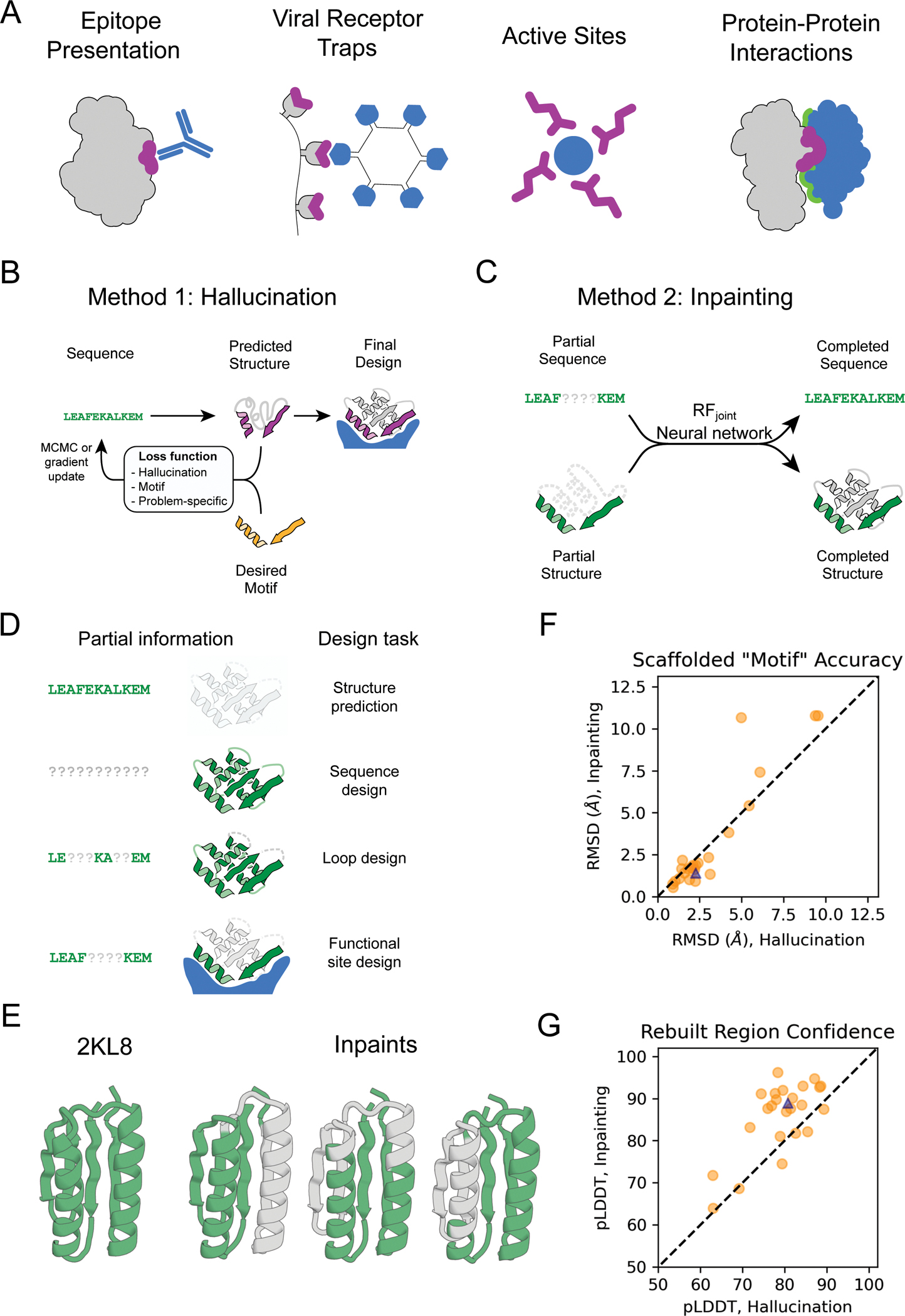
The binding and catalytic functions of proteins are generally mediated by a small number of functional residues held in place by the overall protein structure. Here, we describe deep learning approaches for scaffolding such functional sites without needing to prespecify the fold or secondary structure of the scaffold. The first approach, “constrained hallucination,” optimizes sequences such that their predicted structures contain the desired functional site. The second approach, “inpainting,” starts from the functional site and fills in additional sequence and structure to create a viable protein scaffold in a single forward pass through a specifically trained RoseTTAFold network. We use these two methods to design candidate immunogens, receptor traps, metalloproteins, enzymes, and protein-binding proteins and validate the designs using a combination of in silico and experimental tests.
Verified 2026-10-05 · 2 references not checked yet
Overview
CoChat Summary
TL;DR
The paper introduces two deep learning methods, constrained hallucination and inpainting, for scaffolding functional sites into de novo protein structures without pre-specifying scaffold fold or secondary structure. It validates designs in silico and experimentally across immunogens, receptor traps, metalloproteins, enzymes, and protein binders.
Key findings
- AlphaFold recapitulated designed structures with overall and motif RMSD typically <2 Å and <1 Å, respectively, and pLDDT >80; inpainting was much faster (1–10 s/design on an NVIDIA RTX2080 GPU) than hallucination (5–20 min/design).
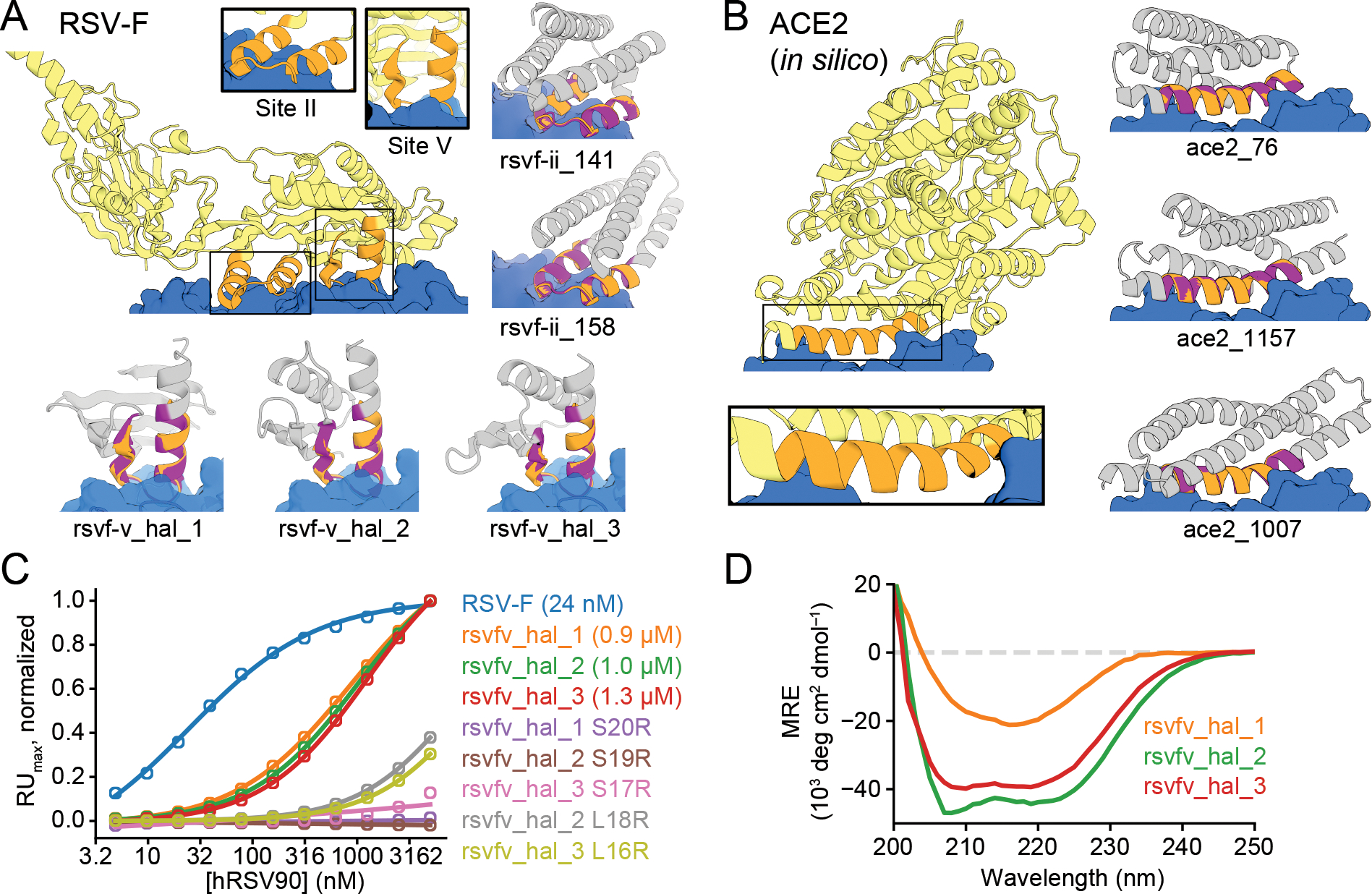
- For RSV-F site V, 37 hallucinated scaffolds were expressed in E. coli and three bound hRSV90 with Kd’s of 0.9–1.3 μM; four inpainted designs bound by yeast display but were poorly expressed in E. coli.
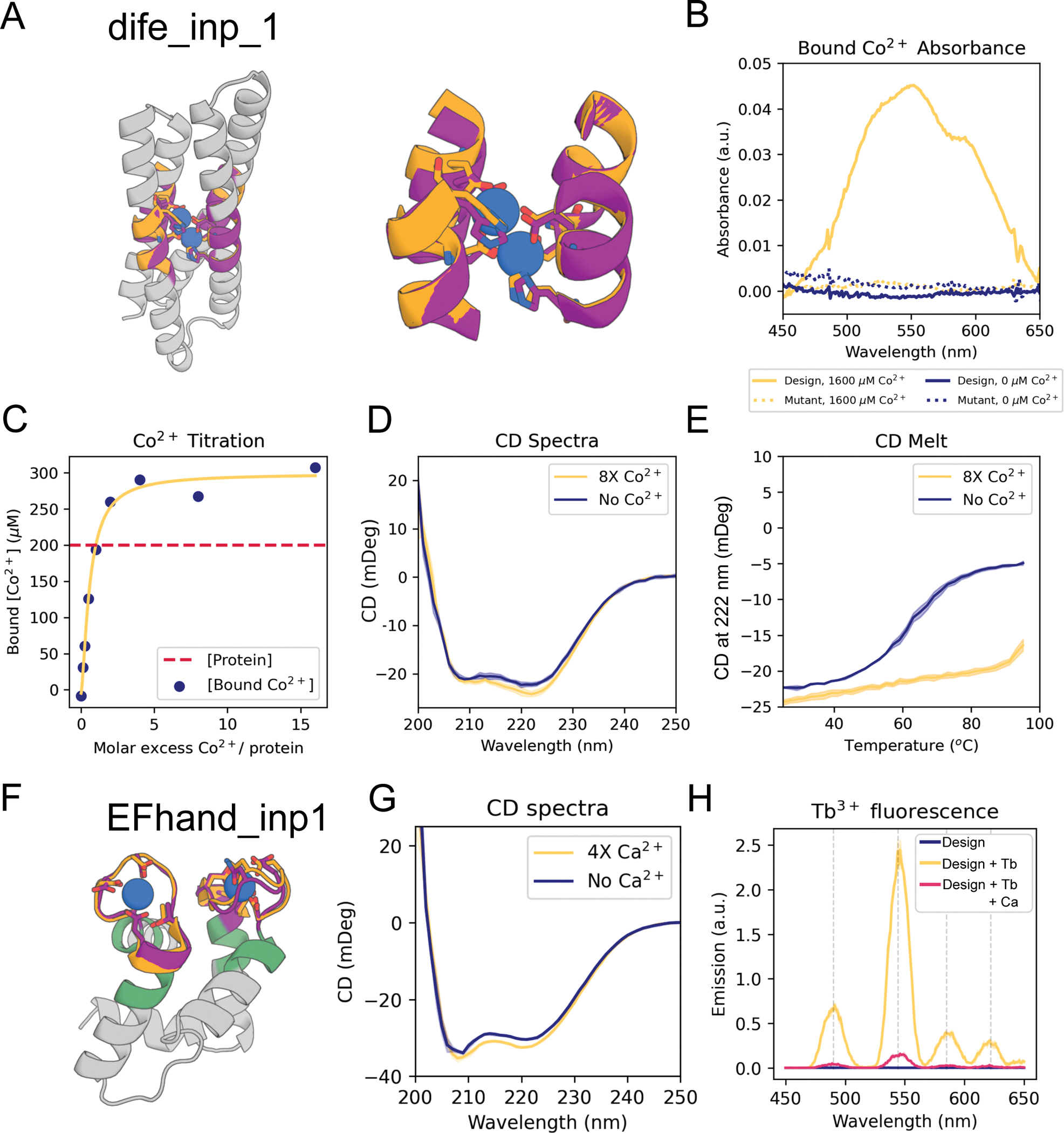
- For the E. coli bacterioferritin di-iron site, 96 inpainted designs were tested: 76 had soluble expression, at least 8 showed a Co2+-binding spectroscopic shift, and 3 had CD spectra consistent with the designed fold and were stabilized by metal binding; mutation of metal-binding residues abolished binding.
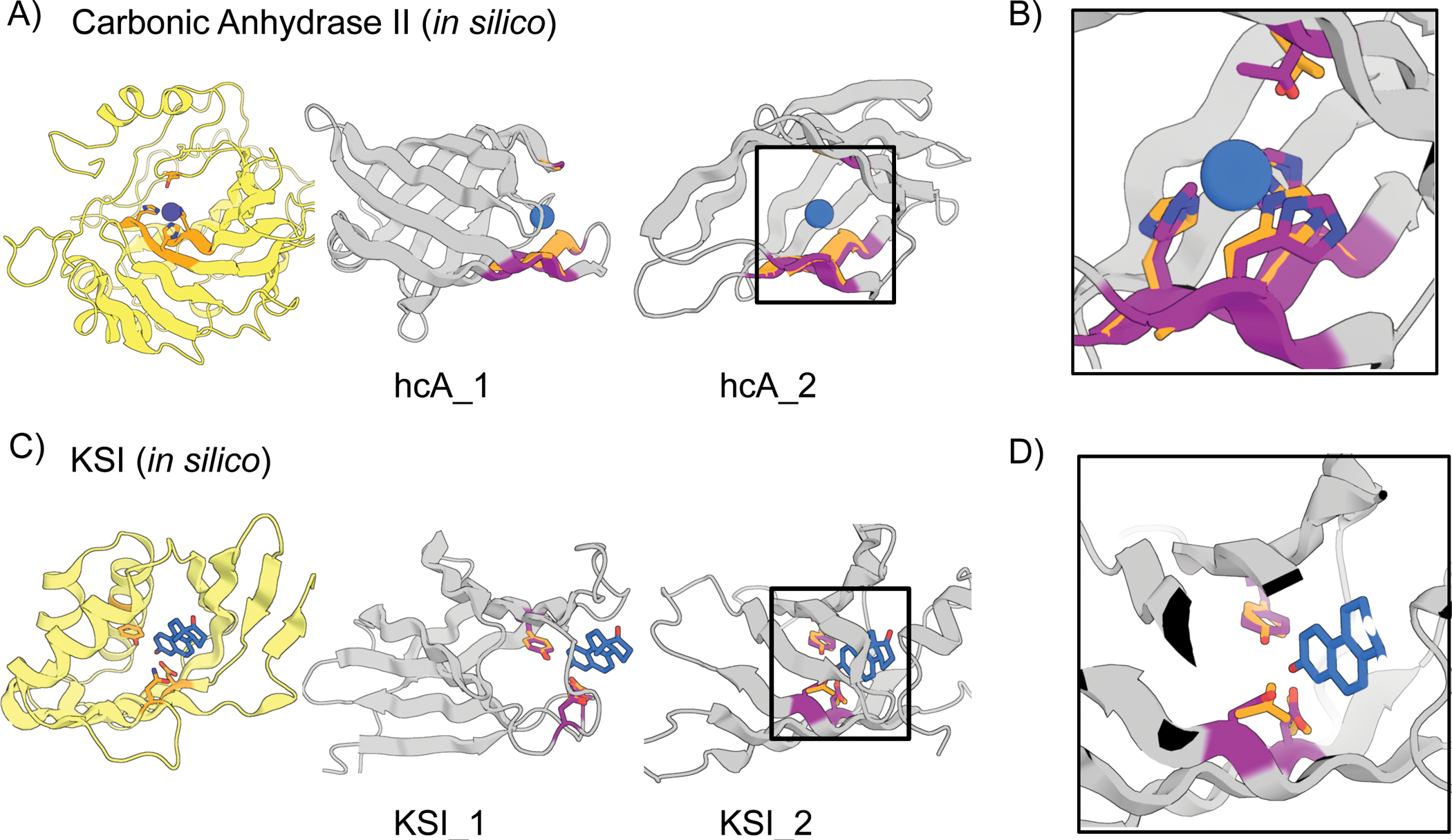
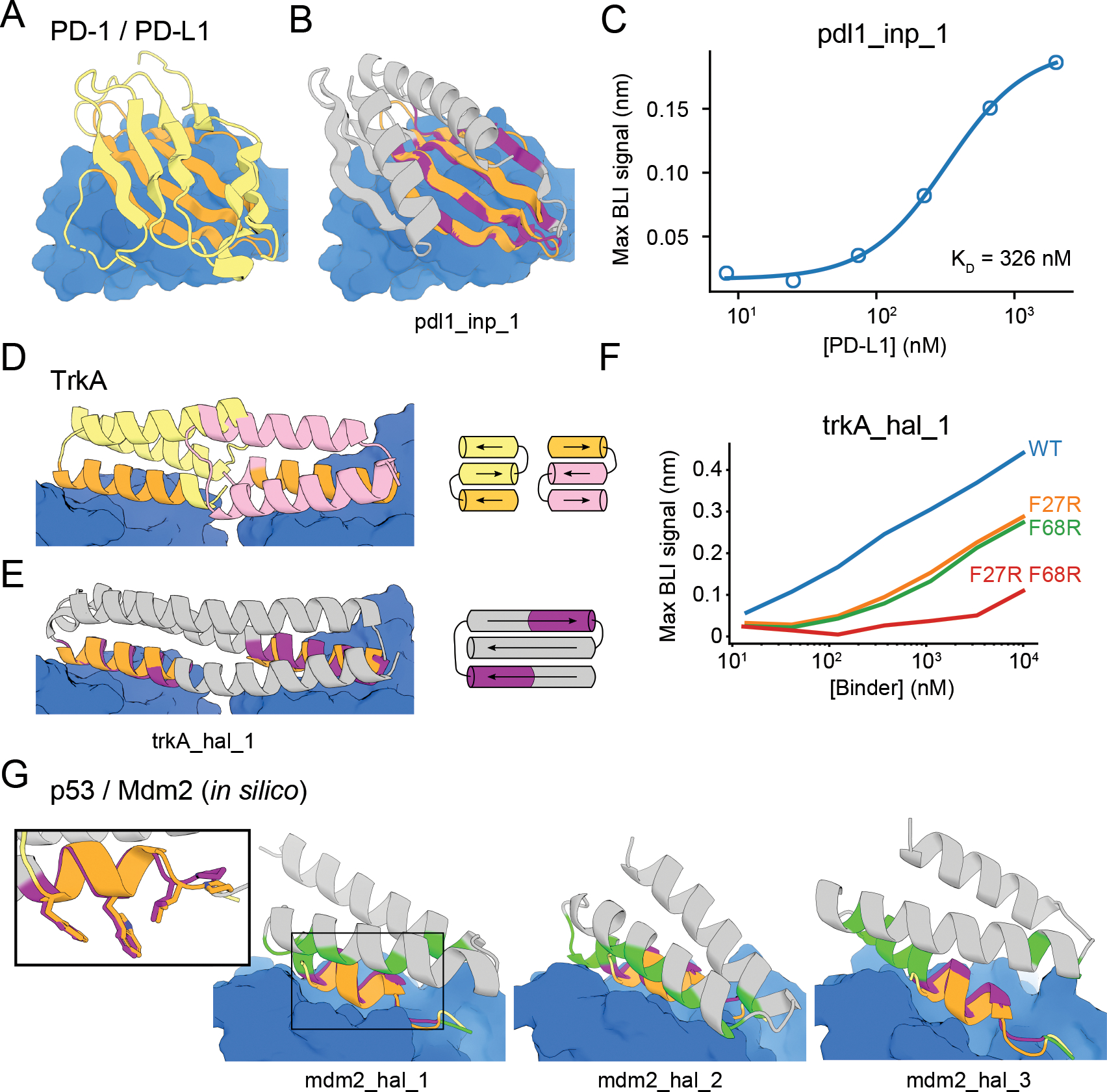
- For PD-L1, of 31 designs tested, pdl1_inp_1 bound PD-L1 with KD = 326 nM, compared with HAC PD-1 KD = 110 pM and WT PD-1 KD = 3.9 μM; carbonic anhydrase II active-site designs were <100 residues versus the 261-residue native protein.
Methods
- Constrained hallucination optimized sequences with a composite loss combining a hallucination loss and a motif reconstruction loss using trRosetta and later RosettaFold; inpainting used RFjoint, trained on masked/inpainting sequence and structure recovery, to complete missing sequence and structure in a single forward pass.
- In silico validation used AlphaFold; experimental validation for selected designs included E. coli expression, yeast display, binding assays (Kd, BLI), circular dichroism, metal/terbium fluorescence, and mutagenesis.
- Functional motifs were derived from native proteins including RSV-F sites II and V, hACE2, bacterioferritin di-iron, EF-hand, carbonic anhydrase II, Δ5-3-ketosteroid isomerase, PD-1/PD-L1, p53/Mdm2, and TrkA-NGF.
Limitations
- Stated in the paper: AlphaFold has limited ability to predict protein stability or mutational effects; hallucination is compute-intensive; inpainting usually requires larger input motifs and underperforms hallucination when the missing region is large; some inpainted RSV-F site V designs were poorly expressed in E. coli; di-iron hallucination designs were not tested due to buried polar residues; and side-chain placement for ketosteroid isomerase was difficult, requiring a two-stage approach.
- Evident from the text: many designs were validated only in silico (e.g., receptor traps, enzyme active sites, some Mdm2 binders), and experimental hit rates were often low (e.g., 3/37 RSV-F site V binders, 3/96 di-iron designs with CD/stabilization, 1/31 PD-L1 binders); inpainting also generated less structural diversity than hallucination.
Model-written summary. Check it against the paper before relying on it.
Integrity signals
Registry
Cites
Statistics
Figures
Verification
Claims the paper makes
9 Valid · 0 Not valid · 12 Not checked · 71 Own results and interpretations
Every source the paper cites for this claim was checked and supports it.
In the paper
“trRosetta can also be used to design sequences that fold into a target backbone structure by carrying out sequence optimization using a structure recapitulation loss function that rewards similarity of the predicted structure to the target structure (13).”
§ Scaffolding protein functional sites using deep learning > Abstract
What the sources say
- Supportedcites [13] Norn C, Wicky BIM, Juergens D, Liu S, Kim D, Tischer D, Koepnick B, Anishchenko I, Players F, Baker D, Ovchinnikov S, Protein sequence design by conformational landscape optimization. Proc. Natl. Acad. Sci. 118 (2021), doi: 10.1073/pnas.2017228118. PMC7980421 33712545 source
The Results and Discussions section, “Sequence Design by Gradient Backpropagation” (page not provided), describes optimizing amino acid sequences with a loss function based on the probabilities of the target structure’s observed interresidue distances and orientations. This supports the claim’s description of a structure-recapitulation loss that rewards agreement with the target backbone. (LLM, conf=0.91)
plainstates a cause- Asserted: passes — The authors put it forward as true.
- Checkable: passes — It can be checked against evidence.
- Load-bearing: passes — The paper’s conclusions depend on it.
- Based: passes — The paper gives a reason why it holds.
- Supported
The cited sources support only part of this claim — read each source’s verdict below.
In the paper
“We previously demonstrated that the trRosetta structure-prediction neural network (11) can be used to generate new proteins by maximizing the trRosetta output probability that a sequence folds to some (unspecified) three dimensional structure during Monte Carlo sampling in sequence space (12).”
§ Scaffolding protein functional sites using deep learning > Abstract
What the sources say
- Not checked yetcites [11] Yang J, Anishchenko I, Park H, Peng Z, Ovchinnikov S, Baker D, Improved protein structure prediction using predicted interresidue orientations. Proc. Natl. Acad. Sci. (2020), doi: 10.1073/pnas.1914677117. PMC6983395 31896580 source
- Partly supportedcites [12] Anishchenko I, Pellock SJ, Chidyausiku TM, Ramelot TA, Ovchinnikov S, Hao J, Bafna K, Norn C, Kang A, Bera AK, DiMaio F, Carter L, Chow CM, Montelione GT, Baker D, De novo protein design by deep network hallucination. Nature. 600, 547– 552 (2021). 34853475 PMC9293396 sourceExperimental — accuracy not yet measured
Split into 2 atoms — 1 confirmed, 1 partially supported, 0 disputed, 0 misattributed, 0 unverifiable. Expand the claim to see per-atom verdicts.
boostedstates a cause- Asserted: passes — The authors put it forward as true.
- Checkable: passes — It can be checked against evidence.
- Load-bearing: passes — The paper’s conclusions depend on it.
- Based: passes — The paper gives a reason why it holds.
The cited sources support only part of this claim — read each source’s verdict below.
In the paper
“Previous methods can scaffold functional sites made up of one or two contiguous chain segments (6–10), but with the exception of helical bundles (8) these do not extend readily to more complex sites composed of three or more chain segments, and the generated backbones are not guaranteed to be designable (encodable by some amino acid sequence).”
§ Scaffolding protein functional sites using deep learning > Abstract
What the sources say
- Supportedcites [6] Procko E, Berguig GY, Shen BW, Song Y, Frayo S, Convertine AJ, Margineantu D, Booth G, Correia BE, Cheng Y, Schief WR, Hockenbery DM, Press OW, Stoddard BL, Stayton PS, Baker D, A Computationally Designed Inhibitor of an Epstein-Barr Viral Bcl-2 Protein Induces Apoptosis in Infected Cells. Cell. 157, 1644– 1656 (2014). 24949974 PMC4079535 source
The citation to this paper is attached to the helical-bundle exception, rather than to the general claim about the limits of previous methods. In the Results sections on grafting and de novo design (page not provided), the paper describes using 3- and 4-helix bundles to build a binding interface with contacts beyond the grafted BH3 helix. (LLM, conf=0.86)
- Could not verifycites [7] Correia BE, Bates JT, Loomis RJ, Baneyx G, Carrico C, Jardine JG, Rupert P, Correnti C, Kalyuzhniy O, Vittal V, Connell MJ, Stevens E, Schroeter A, Chen M, MacPherson S, Serra AM, Adachi Y, Holmes MA, Li Y, Klevit RE, Graham BS, Wyatt RT, Baker D, Strong RK, Crowe JE, Johnson PR, Schief WR, Proof of principle for epitope-focused vaccine design. Nature. 507, 201– 206 (2014). 24499818 PMC4260937 sourceExperimental — accuracy not yet measured
The Design of Epitope-Scaffolds section describes a helix-turn-helix epitope and a three-helix-bundle template, while Computational Method describes the paper’s Fold from Loops approach. Neither passage assesses whether previous methods extend to functional sites made of three or more chain segments; searches for that limit and the helical-bundle exception found no supporting passage in our copy. (LLM, conf=0.72)
- Supportedcites [8] Silva D-A, Yu S, Ulge UY, Spangler JB, Jude KM, Labão-Almeida C, Ali LR, Quijano-Rubio A, Ruterbusch M, Leung I, Biary T, Crowley SJ, Marcos E, Walkey CD, Weitzner BD, Pardo-Avila F, Castellanos J, Carter L, Stewart L, Riddell SR, Pepper M, Bernardes GJL, Dougan M, Garcia KC, Baker D, De novo design of potent and selective mimics of IL-2 and IL-15. Nature. 565, 186– 191 (2019). 30626941 PMC6521699 source
The citation is attached to the helical-bundle exception. In “Computational design of IL-2/IL-15 mimics that bind and activate IL-2Rβγc” (page unavailable), the paper describes building a connected protein around the three helices H1, H3 and H4 that form the receptor-binding interface, supporting that exception. (LLM, conf=0.91)
- Partly supportedcites [9] Sesterhenn F, Yang C, Bonet J, Cramer JT, Wen X, Wang Y, Chiang C-I, Abriata LA, Kucharska I, Castoro G, Vollers SS, Galloux M, Dheilly E, Rosset S, Corthésy P, Georgeon S, Villard M, Richard C-A, Descamps D, Delgado T, Oricchio E, Rameix-Welti M-A, Más V, Ervin S, Eléouët J-F, Riffault S, Bates JT, Julien J-P, Li Y, Jardetzky T, Krey T, Correia BE, De novo protein design enables the precise induction of RSV-neutralizing antibodies. Science. 368 (2020), doi: 10.1126/science.aay5051. PMC7391827 32409444 sourceExperimental — accuracy not yet measured
The Introduction (page not provided) says earlier grafting work largely used simple motifs such as linear helical segments and identifies irregular, multi-segment functional sites as a challenge. The Discussion & Conclusions (page not provided) also describes limitations of template-based design. Neither passage establishes the specific three-or-more-segment threshold or identifies helical bundles as an exception. (LLM, conf=0.82)
- Not checked yetcites [10] Yang C, Sesterhenn F, Bonet J, van Aalen EA, Scheller L, Abriata LA, Cramer JT, Wen X, Rosset S, Georgeon S, Jardetzky T, Krey T, Fussenegger M, Merkx M, Correia BE, Bottom-up de novo design of functional proteins with complex structural features. Nat. Chem. Biol, 1– 9 (2021). 33398169 source
plain- Asserted: passes — The authors put it forward as true.
- Checkable: passes — It can be checked against evidence.
- Load-bearing: passes — The paper’s conclusions depend on it.
- Based: passes — The paper gives a reason why it holds.
- Supported
The cited sources support only part of this claim — read each source’s verdict below.
In the paper
“Previous methods can scaffold functional sites made up of one or two contiguous chain segments (6–10), but with the exception of helical bundles (8) these do not extend readily to more complex sites composed of three or more chain segments, and the generated backbones are not guaranteed to be designable (encodable by some amino acid sequence).”
§ Scaffolding protein functional sites using deep learning > Abstract
What the sources say
- Partly supportedcites [6] Procko E, Berguig GY, Shen BW, Song Y, Frayo S, Convertine AJ, Margineantu D, Booth G, Correia BE, Cheng Y, Schief WR, Hockenbery DM, Press OW, Stoddard BL, Stayton PS, Baker D, A Computationally Designed Inhibitor of an Epstein-Barr Viral Bcl-2 Protein Induces Apoptosis in Infected Cells. Cell. 157, 1644– 1656 (2014). 24949974 PMC4079535 sourceExperimental — accuracy not yet measured
The Results section, under “BHRF1-binding proteins created by grafting Bim-BH3 side chains to a helical scaffold” (page unavailable), describes grafting the interacting residues of a single BH3 helix onto protein scaffolds. This supports the one-contiguous-segment example, but our copy does not establish that previous methods scaffold functional sites made up of two contiguous chain segments. (LLM, conf=0.82)
- Supportedcites [7] Correia BE, Bates JT, Loomis RJ, Baneyx G, Carrico C, Jardine JG, Rupert P, Correnti C, Kalyuzhniy O, Vittal V, Connell MJ, Stevens E, Schroeter A, Chen M, MacPherson S, Serra AM, Adachi Y, Holmes MA, Li Y, Klevit RE, Graham BS, Wyatt RT, Baker D, Strong RK, Crowe JE, Johnson PR, Schief WR, Proof of principle for epitope-focused vaccine design. Nature. 507, 201– 206 (2014). 24499818 PMC4260937 source
The Abstract (page not available) says that previously developed side-chain and backbone grafting methods transplanted continuous or discontinuous epitopes onto scaffold proteins. This supports the attributed point that previous methods could scaffold functional sites comprising contiguous chain segments; the claim does not attribute a limitation to exactly two segments to this paper. (LLM, conf=0.86)
- Could not verifycites [8] Silva D-A, Yu S, Ulge UY, Spangler JB, Jude KM, Labão-Almeida C, Ali LR, Quijano-Rubio A, Ruterbusch M, Leung I, Biary T, Crowley SJ, Marcos E, Walkey CD, Weitzner BD, Pardo-Avila F, Castellanos J, Carter L, Stewart L, Riddell SR, Pepper M, Bernardes GJL, Dougan M, Garcia KC, Baker D, De novo design of potent and selective mimics of IL-2 and IL-15. Nature. 565, 186– 191 (2019). 30626941 PMC6521699 sourceExperimental — accuracy not yet measured
The computational-design section describes this paper’s method for scaffolding an IL-2 binding interface formed by three helices (H1, H3 and H4). It does not address whether previous methods could scaffold functional sites made up of one or two contiguous chain segments; searches for prior scaffolding methods found no passage establishing that point. The paper does, however, fit the helical-bundle exception separately identified in the full citing sentence. (LLM, conf=0.76)
- Supportedcites [9] Sesterhenn F, Yang C, Bonet J, Cramer JT, Wen X, Wang Y, Chiang C-I, Abriata LA, Kucharska I, Castoro G, Vollers SS, Galloux M, Dheilly E, Rosset S, Corthésy P, Georgeon S, Villard M, Richard C-A, Descamps D, Delgado T, Oricchio E, Rameix-Welti M-A, Más V, Ervin S, Eléouët J-F, Riffault S, Bates JT, Julien J-P, Li Y, Jardetzky T, Krey T, Correia BE, De novo protein design enables the precise induction of RSV-neutralizing antibodies. Science. 368 (2020), doi: 10.1126/science.aay5051. PMC7391827 32409444 source
The Introduction (page unavailable) describes earlier grafting methods using linear helical segments. The Results section, ‘De novo design of immunogens presenting structurally complex epitopes’ (page unavailable), adds that one earlier study grafted a discontinuous HIV epitope into a scaffold. Together, these support the claim that previous methods could scaffold sites comprising a single segment or more than one segment. (LLM, conf=0.85)
- Not checked yetcites [10] Yang C, Sesterhenn F, Bonet J, van Aalen EA, Scheller L, Abriata LA, Cramer JT, Wen X, Rosset S, Georgeon S, Jardetzky T, Krey T, Fussenegger M, Merkx M, Correia BE, Bottom-up de novo design of functional proteins with complex structural features. Nat. Chem. Biol, 1– 9 (2021). 33398169 source
plain- Asserted: passes — The authors put it forward as true.
- Checkable: passes — It can be checked against evidence.
- Load-bearing: passes — The paper’s conclusions depend on it.
- Based: passes — The paper gives a reason why it holds.
- Partly supported
The cited sources support only part of this claim — read each source’s verdict below.
In the paper
“Previous methods can scaffold functional sites made up of one or two contiguous chain segments (6–10), but with the exception of helical bundles (8) these do not extend readily to more complex sites composed of three or more chain segments, and the generated backbones are not guaranteed to be designable (encodable by some amino acid sequence).”
§ Scaffolding protein functional sites using deep learning > Abstract
What the sources say
- Partly supportedcites [6] Procko E, Berguig GY, Shen BW, Song Y, Frayo S, Convertine AJ, Margineantu D, Booth G, Correia BE, Cheng Y, Schief WR, Hockenbery DM, Press OW, Stoddard BL, Stayton PS, Baker D, A Computationally Designed Inhibitor of an Epstein-Barr Viral Bcl-2 Protein Induces Apoptosis in Infected Cells. Cell. 157, 1644– 1656 (2014). 24949974 PMC4079535 sourceExperimental — accuracy not yet measured
The Results section, under “In silico folding probability correlates with binding activity” (page unavailable), says that functional protein design has a low success rate and that inactive designs may fold improperly or have unstable designed states. This supports the general point that a generated design is not guaranteed to work, but it does not establish the more specific claim that a generated backbone cannot be encoded by any amino acid sequence. (LLM, conf=0.79)
- Could not verifycites [7] Correia BE, Bates JT, Loomis RJ, Baneyx G, Carrico C, Jardine JG, Rupert P, Correnti C, Kalyuzhniy O, Vittal V, Connell MJ, Stevens E, Schroeter A, Chen M, MacPherson S, Serra AM, Adachi Y, Holmes MA, Li Y, Klevit RE, Graham BS, Wyatt RT, Baker D, Strong RK, Crowe JE, Johnson PR, Schief WR, Proof of principle for epitope-focused vaccine design. Nature. 507, 201– 206 (2014). 24499818 PMC4260937 sourceExperimental — accuracy not yet measured
The Abstract (page unavailable) says the earlier grafting methods used scaffold proteins of known structure, but does not say whether their generated backbones were guaranteed to be designable. The Computational Method and Methods > Fold From Loops sections describe sequence design and filtering for the new method; a search for designability of backbones from previous methods found no passage addressing that point. (LLM, conf=0.72)
- Could not verifycites [8] Silva D-A, Yu S, Ulge UY, Spangler JB, Jude KM, Labão-Almeida C, Ali LR, Quijano-Rubio A, Ruterbusch M, Leung I, Biary T, Crowley SJ, Marcos E, Walkey CD, Weitzner BD, Pardo-Avila F, Castellanos J, Carter L, Stewart L, Riddell SR, Pepper M, Bernardes GJL, Dougan M, Garcia KC, Baker D, De novo design of potent and selective mimics of IL-2 and IL-15. Nature. 565, 186– 191 (2019). 30626941 PMC6521699 sourceExperimental — accuracy not yet measured
The Methods section (page unavailable) describes how this paper generated backbones and then performed sequence design and filtering. Searches for prior scaffolding methods and backbone designability found no passage saying that backbones generated by previous methods are not guaranteed to be designable. (LLM, conf=0.72)
- Could not verifycites [9] Sesterhenn F, Yang C, Bonet J, Cramer JT, Wen X, Wang Y, Chiang C-I, Abriata LA, Kucharska I, Castoro G, Vollers SS, Galloux M, Dheilly E, Rosset S, Corthésy P, Georgeon S, Villard M, Richard C-A, Descamps D, Delgado T, Oricchio E, Rameix-Welti M-A, Más V, Ervin S, Eléouët J-F, Riffault S, Bates JT, Julien J-P, Li Y, Jardetzky T, Krey T, Correia BE, De novo protein design enables the precise induction of RSV-neutralizing antibodies. Science. 368 (2020), doi: 10.1126/science.aay5051. PMC7391827 32409444 sourceExperimental — accuracy not yet measured
The Introduction and Discussion & Conclusions describe limitations of earlier scaffolding approaches, including destabilization and the need for extensive optimization. Neither passage says whether the generated backbones are guaranteed to be encodable by an amino acid sequence; a search for backbone designability found no such statement in our copy. (LLM, conf=0.72)
- Not checked yetcites [10] Yang C, Sesterhenn F, Bonet J, van Aalen EA, Scheller L, Abriata LA, Cramer JT, Wen X, Rosset S, Georgeon S, Jardetzky T, Krey T, Fussenegger M, Merkx M, Correia BE, Bottom-up de novo design of functional proteins with complex structural features. Nat. Chem. Biol, 1– 9 (2021). 33398169 source
plain- Asserted: passes — The authors put it forward as true.
- Checkable: passes — It can be checked against evidence.
- Load-bearing: passes — The paper’s conclusions depend on it.
- Based: passes — The paper gives a reason why it holds.
- Partly supported
59 more claims · 3 with their cited sources checked
Create a free account to see all 92 claims and to verify the 16 references still open.
- Probably not a substantial claim. 5
- It may state two separate claims as one. 23
Claims other papers make about this one
Each is checked against this paper’s own text: does it say what the citing paper says it does?
The source backs part of the claim, not all of it — or backs it for a different population, condition or comparison.
In the citing paper
“Experimental characterization showed that the method can scaffold a wide range of protein functional motifs with atomic accuracy19”
From De novo design of protein structure and function with RFdiffusion (2023) · cites this paper as [4]
Experimental — accuracy not yet measuredThe source backs part of the claim, not all of it — or backs it for a different population, condition or comparison.
In the citing paper
“but the approach fails on minimalist site descriptions that do not sufficiently constrain the overall fold and, because it is deterministic, can produce only a limited diversity of designs for a given problem.”
From De novo design of protein structure and function with RFdiffusion (2023) · cites this paper as [4]
Experimental — accuracy not yet measuredThe source backs part of the claim, not all of it — or backs it for a different population, condition or comparison.
In the citing paper
“Experimental characterization showed that the method can scaffold a wide range of protein functional motifs with atomic accuracy19”
From De novo design of protein structure and function with RFdiffusion (2023) · cites this paper as [19]
Experimental — accuracy not yet measuredThe source backs part of the claim, not all of it — or backs it for a different population, condition or comparison.
In the citing paper
“This measure of in silico success has been found to correlate with experimental success4,7,26 and is significantly more stringent than template modelling (TM)-score-based metrics used elsewhere5,16,27–29”
From De novo design of protein structure and function with RFdiffusion (2023) · cites this paper as [4]
Experimental — accuracy not yet measuredThe check wasn’t confident either way, so it gives no verdict — never disputed.
In the citing paper
“we established an in silico benchmark test (Supplementary Table 9) comprising 25 motif-scaffolding design problems addressed in six recent publications encompassing several design methodologies4,5,29,38–40”
From De novo design of protein structure and function with RFdiffusion (2023) · cites this paper as [4]
Experimental — accuracy not yet measured
Citations
Cites
Adam: A Method for Stochastic Optimization
Kingma, D. P., & Ba, J. (2014) · arXiv · doi:10.48550/arxiv.1412.6980 · Cited by 98,946
Basic local alignment search tool
Altschul, S. F., Gish, W., Miller, W., Myers, E. W., & Lipman, D. J. (1990) · Journal of Molecular Biology · doi:10.1006/jmbi.1990.9999 · Cited by 98,669
BERT: Pre-training of Deep Bidirectional Transformers for Language Understanding
Devlin, J., Chang, M.-W., Lee, K., & Toutanova, K. (2018) · arXiv · doi:10.48550/arxiv.1810.04805 · Cited by 73,173
BERT: Pre-training of Deep Bidirectional Transformers for Language Understanding
Devlin, J., Chang, M.-W., Lee, K., & Toutanova, K. (2019) · Proceedings of the 2019 Conference of the North American Chapter of the Association for Computational Linguistics: Human Language Technologies, Volume 1 (Long and Short Papers) · doi:10.18653/v1/n19-1423 · Cited by 54,325
Highly accurate protein structure prediction with AlphaFold
Jumper, J., Evans, R., Pritzel, A., Green, T., Figurnov, M., Ronneberger, O., Tunyasuvunakool, K., Bates, R., Žídek, A., Potapenko, A., et al. (2021) · Nature · doi:10.1038/s41586-021-03819-2 · Cited by 43,764
Berman, H. M. (2000) · Nucleic Acids Research · doi:10.1093/nar/28.1.235 · Cited by 40,196
Comparison of multiple Amber force fields and development of improved protein backbone parameters
Hornak, V., Abel, R., Okur, A., Strockbine, B., Roitberg, A., & Simmerling, C. (2006) · Proteins: Structure, Function, and Bioinformatics · doi:10.1002/prot.21123 · Cited by 6,914
Protein production by auto-induction in high-density shaking cultures
Studier, F. W. (2005) · Protein Expression and Purification · doi:10.1016/j.pep.2005.01.016 · Cited by 5,931
Accurate prediction of protein structures and interactions using a 3-track network
Baek, M., DiMaio, F., Anishchenko, I., Dauparas, J., Ovchinnikov, S., Lee, G. R., Wang, J., Cong, Q., Kinch, L. N., Schaeffer, R. D., et al. (2021) · doi:10.1101/2021.06.14.448402 · Cited by 5,549 · cited 3×
“Following the development of RosettaFold (RF) (16) we found that it performed better than trRosetta in guiding protein design by functional-site-constrained hallucination (Fig.”
BackgroundMethodInfluentialSelf-citationMMseqs2 enables sensitive protein sequence searching for the analysis of massive data sets
Steinegger, M., & Söding, J. (2017) · Nature Biotechnology · doi:10.1038/nbt.3988 · Cited by 4,840
Research works printed but not linked: 1
- Z. Lin T. Sercu Y. LeCun A. Rives “Deep generative models create new and diverse protein structures ” 35th Conference on Neural Information Processing Systems (NeurIPS 2021) 6 to 14 December 2021.
Cited by
Items 201–300 of 492
Protein Design Using Physics Informed Neural Networks
Omar, S. I., Keasar, C., Ben‐Sasson, A. J., & Haber, E. (2023) · Biomolecules · doi:10.3390/biom13030457 · Cited by 20
“This structure may be fully known, or alternatively, only a portion of the region involved in the interaction might be defined (protein in painting [25,26]).”
BackgroundCrystal Structure of de Novo Designed Coiled-Coil Protein Origami Triangle
Satler, T., Hadži, S., & Jerala, R. (2023) · Journal of the American Chemical Society · doi:10.1021/jacs.3c05531 · Cited by 16
Ranking Peptide Binders by Affinity with AlphaFold**
Chang, L., & Perez, A. (2023) · Angewandte Chemie · doi:10.1002/ange.202213362 · Cited by 14
Zhang, C., Wang, W., Zhu, N., Cao, Z., Wu, Y., Mao, Q., Zhu, C., Zhang, C., Guo, J., & Duan, H. (2025) · Journal of Chemical Information and Modeling · doi:10.1021/acs.jcim.5c01393 · Cited by 18
Unsupervisedly Prompting AlphaFold2 for Accurate Few-Shot Protein Structure Prediction
Zhang, J., Liu, S., Chen, M., Chu, H., Wang, M., Wang, Z., Yu, J., Ni, N., Fan, Y., Chen, D., et al. (2023) · Journal of Chemical Theory and Computation · doi:10.1021/acs.jctc.3c00528 · Cited by 19
Zhang, X., Yin, H., Ling, F., Zhan, J., & Zhou, Y. (2023) · PLOS Computational Biology · doi:10.1371/journal.pcbi.1011330 · Cited by 15
Machine learning for predicting protein properties: A comprehensive review
Wang, Y., Zhang, Y., Zhan, X., He, Y., Yang, Y., Cheng, L., & Alghazzawi, D. (2024) · Neurocomputing · doi:10.1016/j.neucom.2024.128103 · Cited by 18
De novo luciferases enable multiplexed bioluminescence imaging
Chen, J. Y.-H., Shi, Q., Peng, X., Habimana, J. D. D., Wang, J., Sobolewski, W., & Yeh, A. H.-W. (2024) · Chem · doi:10.1016/j.chempr.2024.10.013 · Cited by 19
Self-citationDistinct Electric Fields Enable Common Catalytic Function in Structurally Diverse Enzymes
Chaturvedi, S. S., Goswami, A., Qian, J., Petersen, A., Ajmera, P., & Alexandrova, A. N. (2025) · Journal of the American Chemical Society · doi:10.1021/jacs.5c11931 · Cited by 16
De novo design of RNA and nucleoprotein complexesPreprint
Favor, A., Quijano, R. N., Chernova, E., Kubaney, A., Weidle, C., Esler, M. A., McHugh, R., Carr, A., Hsia, Y., Juergens, D., et al. (2025) · bioRxiv (Cold Spring Harbor Laboratory) · doi:10.1101/2025.10.01.679929 · Cited by 17
“Generative models such as RFdiffusion have shown considerable success in structure-oriented protein design 12,13,14 , and the RoseTTAfold framework has been adapted for nucleic acid structure prediction 15,16 .”
Self-citation(2023) · doi:10.1101/2023.07.07.548080 · Cited by 15
Generative AI for controllable protein sequence design: A survey
Zhu, Y., Kong, Z., Wu, J., Yin, M., Liu, W., Han, Y., Xu, H., Hsieh, C., Hou, T., & Wu, J. (2026) · npj Drug Discovery. · doi:10.1038/s44386-026-00054-5 · Cited by 17
“Given the structure (optionally including the sequence) of the functional motif, Wang et al. 193 introduced constrained hallucination and inpainting approaches to design amino acid sequences that folds up to a 3D structure matching the geometry of the speci fi ed site.”
Machine learning in biological physics: From biomolecular prediction to design
Martin, J., Mateos, M., Onuchic, J. N., Coluzza, I., & Morcos, F. (2024) · Proceedings of the National Academy of Sciences · doi:10.1073/pnas.2311807121 · Cited by 18
Artificial intelligence in de novo protein design
Yao, J., & Wang, X. (2025) · Medicine in Novel Technology and Devices · doi:10.1016/j.medntd.2025.100366 · Cited by 16
Accurate single-domain scaffolding of three nonoverlapping protein epitopes using deep learning
Castro, K. M., Watson, J. L., Wang, J., Southern, J., Ayardulabi, R., Georgeon, S., Rosset, S., Baker, D., & Correia, B. E. (2026) · Nature Chemical Biology · doi:10.1038/s41589-025-02083-z · Cited by 13
“4) and 20-fold better than the best previous RSVFV design (0.9 μM) 9,21 .”
InfluentialSelf-citationHUH Endonuclease: A Sequence-specific Fusion Protein Tag for Precise DNA-Protein Conjugation
Du, J., Kong, Y., Wen, Y., Shen, E., & Xing, H. (2024) · Bioorganic Chemistry · doi:10.1016/j.bioorg.2024.107118 · Cited by 13
Epigenetics behind CD8+ T cell activation and exhaustion
Zu, H., & Chen, X. (2024) · Genes and Immunity · doi:10.1038/s41435-024-00307-1 · Cited by 14
“Furthermore, combining point mutations with machine learning algorithms such as Alpha-Fold2 [116, 117] or Alpha-Fold3 [118], RosettaFold [119, 120], etc., to design motifs and sequences that are connected to speci fi c intracellular epigenetic modi fi cation enzymes and identify motif combinations…”
Mészáros, B., Park, E., Malinverni, D., Sejdiu, B. I., Immadisetty, K., Sandhu, M., Lang, B., & Babu, M. M. (2023) · Current Opinion in Structural Biology · doi:10.1016/j.sbi.2023.102608 · Cited by 13
Computational protein design with data‐driven approaches: Recent developments and perspectives
Liu, H., & Chen, Q. (2022) · Wiley Interdisciplinary Reviews Computational Molecular Science · doi:10.1002/wcms.1646 · Cited by 14
“” 37,39 In this process, sequence and structures are generated jointly by starting from a random sequence and performing Monte Carlo optimization of the sequences according to “ losses ” computed according to the prediction results (Figure 4b).”
MethodDe novo designed ice-binding proteins from twist-constrained helices
de Haas, R. J., Tas, R. P., van den Broek, D., Zheng, C., Nguyen, H., Kang, A., Bera, A. K., King, N. P., Voets, I. K., & de Vries, R. (2023) · Proceedings of the National Academy of Sciences · doi:10.1073/pnas.2220380120 · Cited by 12
RoseTTAFold diffusion-guided short peptide design: a case study of binders against Keap1/Nrf2
Morena, F., Cencini, C., Emiliani, C., & Martino, S. (2025) · Computational and Structural Biotechnology Journal · doi:10.1016/j.csbj.2025.02.032 · Cited by 13
Nucleases in gene-editing technologies: past and prologue
Li, D., Li, L.-Q., & Liu, J. (2023) · National Science Open · doi:10.1360/nso/20220067 · Cited by 13
“Recent studies have shown that new machine-learning algorithms could design proteins faster and more accurately than before [238–240].”
BackgroundEnzymes for consumer products to achieve climate neutrality
Molina‐Espeja, P., Sanz‐Aparicio, J., Golyshin, P. N., Robles‐Martín, A., Guallar, V., Beltrametti, F., Müller, M., Yakimov, M. M., Modregger, J., van Logchem, M., et al. (2023) · Oxford Open Climate Change · doi:10.1093/oxfclm/kgad003 · Cited by 16
Growing ecosystem of deep learning methods for modeling protein–protein interactions
Rogers, J. R., Nikolényi, G., & AlQuraishi, M. (2023) · Protein Engineering Design and Selection · doi:10.1093/protein/gzad023 · Cited by 15
Deep learning approaches for conformational flexibility and switching properties in protein design
Rudden, L. S. P., Hijazi, M., & Barth, P. (2022) · Frontiers in Molecular Biosciences · doi:10.3389/fmolb.2022.928534 · Cited by 14
Multi-Modal Large Language Model Enables Protein Function PredictionPreprint
Huo, M., Guo, H. W., Cheng, X., Singh, D., Rahmani, H., Li, S., Gerlof, P., Ideker, T., Grotjahn, D. A., Villa, E., et al. (2024) · bioRxiv (Cold Spring Harbor Laboratory) · doi:10.1101/2024.08.19.608729 · Cited by 12
“By leveraging extensive datasets of protein sequences, structures, and annotated functions, deep learning models can discern intricate patterns and relationships that often elude traditional computational methods.”
Li, Y., Li, F., Duan, Z., Liu, R., Jiao, W., Wu, H., Zhu, F., & Xue, W. (2024) · Nucleic Acids Research · doi:10.1093/nar/gkae893 · Cited by 11
Design of Stiff, Tough, and Fast‐Recovery Protein Hydrogels
Wang, R., Gao, Y., Wang, W., Xue, B., & Cao, Y. (2025) · Chinese Journal of Chemistry · doi:10.1002/cjoc.70210 · Cited by 12
Foldy: An open-source web application for interactive protein structure analysis
Roberts, J. B., Nava, A. A., Pearson, A. N., Incha, M. R., Valencia, L. E., Ma, M., Rao, A., & Keasling, J. D. (2024) · PLoS Computational Biology · doi:10.1371/journal.pcbi.1011171 · Cited by 12
“These methods have produced impressive results in numerous applications including de novo protein design [5] and protein-protein interaction screening [6].”
Scientists are using AI to dream up revolutionary new proteins
Callaway, E. (2022) · Nature · doi:10.1038/d41586-022-02947-7 · Cited by 14
Statistical design of a synthetic microbiome that suppresses diverse gut pathogensPreprint
Oliveira, R. A., McSpadden, E., Pandey, B., Lee, K. K., Yousef, M., Chen, R. Y., Triebold, C., Haro, F., Aksianiuk, V., Patel, R., et al. (2024) · bioRxiv (Cold Spring Harbor Laboratory) · doi:10.1101/2024.02.28.582635 · Cited by 11
Efficient protein structure generation with sparse denoising models
Jendrusch, M., & Korbel, J. O. (2025) · Nature Machine Intelligence · doi:10.1038/s42256-025-01100-z · Cited by 10
“1b and Supplementary Algorithm 3).”
InfluentialA probabilistic view of protein stability, conformational specificity, and design
Stern, J. A., Free, T. J., Stern, K. L., Gardiner, S., Dalley, N. A., Bundy, B. C., Price, J. L., Wingate, D., & Della Corte, D. (2023) · Scientific Reports · doi:10.1038/s41598-023-42032-1 · Cited by 10
Nagarathinam, K., Scheck, A., Labuhn, M., Stroh, L. J., Herold, E., Veselková, B., Tune, S., Cramer, J., Rosset, S., Vollers, S. S., et al. (2024) · Science Advances · doi:10.1126/sciadv.ado2600 · Cited by 11
Self-citationMachine learning-driven innovation design of clustered tensegrity continuum robot
Shi, X., Yang, Q., Hu, K., Lian, B., Song, Y., Kang, R., & Sun, T. (2025) · Mechanism and Machine Theory · doi:10.1016/j.mechmachtheory.2025.106155 · Cited by 11
Hoffnagle, A. M., Herold, R. A., Tsai, C.-Y., Shiau, A. A., Britt, R. D., & Tezcan, F. A. (2025) · Journal of the American Chemical Society · doi:10.1021/jacs.5c13813 · Cited by 10
Designing novel solenoid proteins with in silico evolution
(2025) · doi:10.1038/s42004-025-01817-3 · Cited by 10
Self-citationSequence and structural determinants of efficacious de novo chimaeric antigen receptors
Chow, A., Chu, H., Li, R., Nalbant, B. N., Dozic, A. V., Kida, L. C., Tang, Z., Palmeri, J. R., & Lareau, C. A. (2026) · Nature Biomedical Engineering · doi:10.1038/s41551-026-01790-9 · Cited by 12
“AI-designed proteins offer several theoretical advantages over traditional antibody-derived domains, including rapid generation in silico 7–9 , enhanced stability through optimized folding 10–12 , small size (~60 amino acids) and prospective identification of the binding epitope 7,8,13 .”
Hansen, A. L., Theisen, F. F., Crehuet, R., Marcos, E., Aghajari, N., & Willemoës, M. (2024) · ACS Synthetic Biology · doi:10.1021/acssynbio.3c00674 · Cited by 11
Intelligent Protein Design and Molecular Characterization Techniques: A Comprehensive Review
Wang, J., Chen, C., Yao, G., Ding, J., Wang, L., & Jiang, H. (2023) · Molecules · doi:10.3390/molecules28237865 · Cited by 11
“The following year, Wang et al. [13] from the same group developed a deep learning method based on hallucination and inpainting to enable the construction of protein binding and catalytic functional sites without pre-specifying backbone folding or secondary structure.”
Self-citationArtificial structural proteins: Synthesis, assembly and material applications
Li, M., Liu, K., Liu, K., & Zhang, H. (2024) · Bioorganic Chemistry · doi:10.1016/j.bioorg.2024.107162 · Cited by 10
Sidechain conditioning and modeling for full-atom protein sequence design with FAMPNNPreprint
Shuai, R. W., Widatalla, T., Huang, P., & Hie, B. (2025) · bioRxiv (Cold Spring Harbor Laboratory) · doi:10.1101/2025.02.13.637498 · Cited by 11
Designing Novel Solenoid Proteins with In Silico Evolution
Pretorius, D., Nikov, G. I., Washio, K., Florent, S.-W., Taunt, H. N., Ovchinnikov, S., & Murray, J. W. (2025) · doi:10.1101/2025.04.23.646631 · Cited by 10
Self-citationDiversifying de novo TIM barrels by hallucination
Beck, J., Shanmugaratnam, S., & Höcker, B. (2024) · Protein Science · doi:10.1002/pro.5001 · Cited by 9
“For the modeling and analysis of the extensions into sTIM11-SB (PDB-ID: 7OSU), the constrained hallucination method from Wang et al. (2022) was used.”
BackgroundMethodInfluentialYang, W., Wang, Y., & Wang, Y. (2026) · Biophysics Reviews · doi:10.1063/5.0273394 · Cited by 10
Self-citationSearching similar local 3D micro-environments in protein structure databases with MicroMiner
Sieg, J., & Rarey, M. (2023) · Briefings in Bioinformatics · doi:10.1093/bib/bbad357 · Cited by 9
Multi-indicator comparative evaluation for deep learning-based protein sequence design methods
Yu, J., Mu, J., Wei, T., & Chen, H. (2024) · Bioinformatics · doi:10.1093/bioinformatics/btae037 · Cited by 12
“And based on existing research (Wang et al. 2022), Nonpolar loss was designed to reflect the rationality of amino acid types in the structure.”
MethodComputational tools for plant genomics and breeding
Wang, H., Chen, M., Wei, X., Xia, R., Pei, D., Huang, X., & Han, B. (2024) · Science China Life Sciences · doi:10.1007/s11427-024-2578-6 · Cited by 9
“Similarly, constrained hallucination and protein inpainting were used to design proteins that match predefined functional residues (Wang et al., 2022).”
Harnessing Deep Learning Methods for Voltage-Gated Ion Channel Drug Discovery
Mateos, D. L., Harris, B. J., González, A. H., Narang, K., & Yarov-Yarovoy, V. M. (2024) · Physiology · doi:10.1152/physiol.00029.2024 · Cited by 9
Identification, characterization, and design of plant genome sequences using deep learning
Wang, Z., Yuan, H., Yan, J., & Liu, J. (2024) · The Plant Journal · doi:10.1111/tpj.17190 · Cited by 12
FrameDiPT: SE(3) Diffusion Model for Protein Structure InpaintingPreprint
Zhang, C., Leach, A., Makkink, T., Arbesú, M., Kadri, I., Luo, D., Mizrahi, L., Krichen, S., Lang, M., Tovchigrechko, A., et al. (2023) · bioRxiv (Cold Spring Harbor Laboratory) · doi:10.1101/2023.11.21.568057 · Cited by 11
Enzyme miniaturization: Revolutionizing future biocatalysts
Ding, N., Jiang, Y., Lee, S., Cheng, Z., Ran, X., Ding, Y., Ge, R., Zhang, Y., & Yang, Z. J. (2025) · Biotechnology Advances · doi:10.1016/j.biotechadv.2025.108598 · Cited by 9
Wang, H., Xiang, Y., Liu, Z., Yin, W., Li, B., Qian, L., Wang, X., & Lou, C. (2025) · Nucleic Acids Research · doi:10.1093/nar/gkaf611 · Cited by 9
“Advances in deep learning algorithms have enable de novo structural predictions of transcription factors from their sequences [ 4–7 ].”
State-Specific Peptide Design Targeting G Protein-Coupled Receptors
Yang, X. W., Wang, H., Li, J., Hu, J., Chen, Z., Zheng, Z., Liu, L., Zhu, K., He, J., Gong, H., et al. (2025) · Journal of Chemical Information and Modeling · doi:10.1021/acs.jcim.5c00884 · Cited by 9
De Novo Design of Peptide Masks Enables Rapid Generation of Conditionally-Active Miniprotein Binders
Escobar-Rosales, M., Montaner, C., Expòsit, M., Lucchi, R., Díaz‐Perlas, C., Baker, D. A., & Oller‐Salvia, B. (2025) · Journal of the American Chemical Society · doi:10.1021/jacs.5c16108 · Cited by 8
Self-citationInside-Out Design of Zinc-Binding Proteins with Non-Native Backbones
Guffy, S. L., Pulavarti, S. V. S. R. K., Harrison, J. S., Fleming, D., Szyperski, T., & Kuhlman, B. A. (2023) · Biochemistry · doi:10.1021/acs.biochem.2c00595 · Cited by 8
The structural landscape of the immunoglobulin fold by large‐scale de novo design
Roel‐Touris, J., Carcelén, L., & Marcos, E. (2024) · Protein Science · doi:10.1002/pro.4936 · Cited by 8
ProBID-Net: a deep learning model for protein–protein binding interface design
Chen, Z., Ji, M., Qian, J., Zhang, Z., Zhang, X., Gao, H., Wang, H., Wang, R., & Qi, Y. (2024) · Chemical Science · doi:10.1039/d4sc02233e · Cited by 8
Applications of technology in the assessment and treatment of cannabis use disorder
Brezing, C., & LEVIN, F. R. (2022) · Frontiers in Psychiatry · doi:10.3389/fpsyt.2022.1035345 · Cited by 10
“folding process of 200+ million proteins based on their amino acid sequencing (58).”
BackgroundSelection pressures on evolution of ribonuclease H explored with rigorous free–energy–based design
Hayes, R. L., Nixon, C. F., Marqusee, S., & Brooks, C. L. (2024) · Proceedings of the National Academy of Sciences · doi:10.1073/pnas.2312029121 · Cited by 8
Protein design and optimization for synthetic cells
Frohn, B. P., Kohyama, S., & Schwille, P. (2025) · Nature Reviews Bioengineering · doi:10.1038/s44222-025-00318-1 · Cited by 8
“For example, if the function is assumed to result from a specific structural motif, such as an active site or binding interface, this motif can be provided as input, forcing the models to include this structural feature in the design 15,88,99,100 .”
Customizing the structure of minimal TIM barrels to craft efficient de novo enzymes
Beck, J., Smith, B. J., Kriegel, M., Zarifi, N., Freund, E., Harsha, A. G., Hartmann, J., Chica, R. A., & Höcker, B. (2026) · Nature Chemical Biology · doi:10.1038/s41589-026-02250-w · Cited by 10
Deep Learning Approaches for the Prediction of Protein Functional Sites
Pitarch, B., & Pazos, F. (2025) · Molecules · doi:10.3390/molecules30020214 · Cited by 9
Why cellular computations challenge our design principles
Grozinger, L., Cuevas-Zuviría, B., & Goñi‐Moreno, Á. (2025) · Seminars in Cell and Developmental Biology · doi:10.1016/j.semcdb.2025.103616 · Cited by 12
Generative Artificial Intelligence-Assisted Protein Design Must Consider Repurposing Potential
Ekins, S., Brackmann, M., Invernizzi, C. F., & Lentzos, F. (2023) · GEN Biotechnology · doi:10.1089/genbio.2023.0025 · Cited by 9
MetalHawk: Enhanced Classification of Metal Coordination Geometries by Artificial Neural Networks
Sgueglia, G., Vrettas, M. D., Chino, M., Simone, A. D., & Lombardi, A. (2023) · Journal of Chemical Information and Modeling · doi:10.1021/acs.jcim.3c00873 · Cited by 8
Structures, dynamics, complexes, and functions: From classic computation to artificial intelligence
Frasnetti, E., Magni, A., Castelli, M., Serapian, S. A., Moroni, E., & Colombo, G. (2024) · Current Opinion in Structural Biology · doi:10.1016/j.sbi.2024.102835 · Cited by 8
Current Computational Methods for Protein-peptide Complex Structure Prediction
Yang, C., Xu, X., & Xiang, C. (2023) · Current Medicinal Chemistry · doi:10.2174/0109298673263447230920151524 · Cited by 7
Saharkhiz, S., Mostafavi, M., Birashk, A., Karimian, S., Khalilollah, S., Jaferian, S., Yazdani, Y., Alipourfard, I., Huh, Y. S., Farani, M. R., et al. (2024) · Topics in Current Chemistry · doi:10.1007/s41061-024-00469-6 · Cited by 7
“Deep-learning mediated protein design is also useful when immune regulatory and anti-inflammatory properties are desired; this goal is achievable by sampling and adding the mutations in motifs that are deemed favorable substrates for major histocompatibility complexes in target molecules [37].”
BackgroundPoxvirus targeted by RFdiffusion peptide-bindersPreprint
Coll, J. M. (2025) · bioRxiv (Cold Spring Harbor Laboratory) · doi:10.1101/2025.05.14.654163 · Cited by 7
A Generative Foundation Model for Antibody DesignPreprint
Wang, R., Wu, F., Shi, J., Song, Y., Kong, Y., Ma, J., He, B., Yan, Q., Ying, T., Zhao, P., et al. (2025) · bioRxiv (Cold Spring Harbor Laboratory) · doi:10.1101/2025.09.12.675771 · Cited by 14
Ding, K., Li, Z., Tu, T., Luo, J., & Luo, Y. (2026) · bioRxiv (Cold Spring Harbor Laboratory) · doi:10.64898/2026.02.03.703560 · Cited by 8
“Beyond annotation, functional residues prioritized by DETANGO provide a rationale starting point for protein engineering, enabling the de-sign of sequences that scaffold key functional sites to recapitulate or modify target functions 86;87 .”
Ovo, an open-source ecosystem for de novo protein design
Příhoda, D., Ancona, M., Calounova, T., Kral, A., Polak, L., Hrbáň, H., Dickens, N. J., & Bitton, D. A. (2026) · Communications Biology · doi:10.1038/s42003-026-10497-1 · Cited by 6
“BindCraft 18 is a three-step work fl ow that uses AlphaFold2 backpropagation via ColabDesign 15 to iteratively hal-lucinate binder sequences and poses from randomly initialized starting points, followed by surface sequence redesign with SolubleMPNN 45 or ProteinMPNN, PyRosetta scoring, and advanced fi ltering.”
InfluentialThe effects of instructional scaffolding for writing skill of English majored students
Phuong, V. T. (2023) · Perspectives of science and education · doi:10.32744/pse.2023.4.10 · Cited by 7
Design of solubly expressed miniaturized SMART MHCs
White, W. L., Bai, H., Kim, C., Jude, K. M., Sun, R., Guerrero, L., Han, X., Chen, X. T., Chaudhuri, A., Bonzanini, J. E., et al. (2026) · Proceedings of the National Academy of Sciences · doi:10.1073/pnas.2505932123 · Cited by 6
Self-citationWho Binds Better? Let Alphafold2 Decide!
Varga, J. K., & Schueler‐Furman, O. (2023) · Angewandte Chemie International Edition · doi:10.1002/anie.202303526 · Cited by 7
Bochtler, M. (2024) · BioEssays · doi:10.1002/bies.202400155 · Cited by 6
PeTriBERT : Augmenting BERT with tridimensional encoding for inverse protein folding and designPreprint
Dumortier, B., Liutkus, A., Carré, C., & Krouk, G. (2022) · bioRxiv (Cold Spring Harbor Laboratory) · doi:10.1101/2022.08.10.503344 · Cited by 9
Tiwari, D. D., Hoffmann, N., Didi, K., Deshpande, S., Ghosh, S., Nguyen, T. V. N., Raman, K., Hermjakob, H., & Malik‐Sheriff, R. S. (2023) · bioRxiv (Cold Spring Harbor Laboratory) · doi:10.1101/2023.05.22.540599 · Cited by 6
Controllable All-Atom Protein Generation with Latent DiffusionPreprint
Lu, A. X., Yang, J., Long, Y., Lambert, T., Yan, W., Robinson, S. A., Yang, K., Gligorijević, V., Cho, K., Bonneau, R., et al. (2024) · Research Square · doi:10.1101/2024.12.02.626353 · Cited by 8
Molecular Display of the Animal Meta-Venome for Discovery of Novel Therapeutic Peptides
Hsiao, M.-H., Miao, Y., Liu, Z., Schütze, K., Limjunyawong, N., Chien, D. C.-C., Monteiro, W. D., Chu, L.-S., Morgenlander, W., Jayaraman, S., et al. (2025) · Molecular & Cellular Proteomics · doi:10.1016/j.mcpro.2024.100901 · Cited by 5
Limitations of the refolding pipeline for de novo protein design
Korbeld, K. T., Viliuga, V., & Fürst, M. J. L. J. (2026) · Protein Science · doi:10.1002/pro.70613 · Cited by 5
“…seeing dramatic improvements in experimental success rates, with designs that successfully express in cellular hosts now often displaying remarkable structural similarity to computational models, highlighting the accuracy of state-of-the-art modeling tools (Wang et al., 2022; Wicky et al., 2022).”
Alissa, M., Alghamdi, A. A., Alghamdi, S. A., Alshehri, M. A., Aloraini, G. S., Albelasi, A., & Alshammari, M. S. (2025) · International Journal of Biological Macromolecules · doi:10.1016/j.ijbiomac.2025.144881 · Cited by 7
A Complementarity‐Based Approach to De Novo Binder Design
Maksymenko, K., Hatskovska, V., Coles, M. P., Aghaallaei, N., Pashkovskaia, N., Borbarán‐Bravo, N., Pilz, M., Bucher, P., Volz, M., Pereira, J., et al. (2025) · Advanced Science · doi:10.1002/advs.202502015 · Cited by 6
Generative AI for synthetic biology: Designing biological parts, circuits, and genomes
Kim, N., Carluccio, G. D., Zhang, K., & Collins, J. J. (2026) · Cell Systems · doi:10.1016/j.cels.2026.101533 · Cited by 13
De Novo Design and Synthesis of Polypeptide Immunomodulators for Resetting Macrophage Polarization
Kong, N., Ma, H., Pu, Z., Wan, F., Li, D., Huang, L., Lian, J., Huang, X., Ling, S., Yu, H., et al. (2023) · BioDesign Research · doi:10.34133/bdr.0006 · Cited by 6
“In particular, the emergence of de novo protein design and synthesis technologies provides the possibility to design the structure, properties [26–30], and functions of nanomaterials at the molecular level [31–33].”
BackgroundVenkataraman, S. (2025) · American Journal of Cancer Research · doi:10.62347/djma8500 · Cited by 5
Programmable Proteins: Target Specificity, Programmability and Future Directions
Yamagata, M. (2022) · SynBio · doi:10.3390/synbio1010005 · Cited by 5
Thermodynamic Stabilization of Human FrataxinPreprint
Núñez‐Franco, R., Torres-Mozas, Á., Navo, C. D., Schedlbauer, A., Azkargorta, M., Iloro, I., Elortza, F., Ortega, G., Millet, Ó., Peccati, F., et al. (2023) · bioRxiv (Cold Spring Harbor Laboratory) · doi:10.1101/2023.09.08.556816 · Cited by 5
Protein Language Model Supervised Precise and Efficient Protein Backbone Design MethodPreprint
Zhang, B., Liu, K., Zheng, Z., Liu, Y., Mu, J., Wei, T., & Chen, H. (2023) · bioRxiv (Cold Spring Harbor Laboratory) · doi:10.1101/2023.10.26.564121 · Cited by 6
Designing symmetrical multi-component proteins using a hybrid generative AI approachPreprint
Dessaux, D., Buchet, S., Barthe, L., Defresne, M., Cioci, G., de Givry, S., Garcia-Alles, L. F., Schiex, T., & Barbe, S. (2024) · bioRxiv (Cold Spring Harbor Laboratory) · doi:10.1101/2024.06.13.598662 · Cited by 5
Generating functional and multistate proteins with a multimodal diffusion transformerPreprint
Jing, B., Sappington, A., Bafna, M., Shah, R., Tang, A., Krishna, R., Klivans, A. R., Diaz, D. J., & Berger, B. (2025) · bioRxiv (Cold Spring Harbor Laboratory) · doi:10.1101/2025.09.03.672144 · Cited by 13
Heterogeneous brain distribution of bumetanide following systemic administration in rats
Löscher, W., Gramer, M., & Römermann, K. (2024) · Biopharmaceutics & Drug Disposition · doi:10.1002/bdd.2390 · Cited by 4
“However, as pointed out by Kurki et al. (2023), the recent break-throughs in the de novo design of protein ‐ binding proteins (Cao et al., 2022; Wang et al., 2022) provide much hope for the next generation of neuron ‐ selective NKCC1 ‐ blockers.”
BackgroundZhou, W., Strmšek, Ž., Snoj, J., Škarabot, M., & Jerala, R. (2025) · Small · doi:10.1002/smll.202502060 · Cited by 4
Multimodal diffusion for joint design of protein sequence and structure
Zhu, S., Gulati, S., Liu, Y., Kotnis, S., Sun, Q. H., & Shen, Y. (2025) · Protein Science · doi:10.1002/pro.70340 · Cited by 5
Artificial intelligence-assisted mining of polyethylene terephthalate hydrolases
Xiong, Q., Liu, G., Gao, S., Hao, Y., Li, C., Liu, J., Huang, J., Sinskey, A. J., Zhang, Y. X., Chen, X. H., et al. (2026) · New Biotechnology · doi:10.1016/j.nbt.2026.03.010 · Cited by 4
Synergizing genome editing and artificial intelligence for predictive crop design
Gao, Z., Zhu, J., & Xie, C. (2026) · Molecular Plant · doi:10.1016/j.molp.2026.04.007 · Cited by 4
Sampling protein language models for functional protein design
Darmawan, J. T., Gal, Y., & Notin, P. (2026) · Cell Systems · doi:10.1016/j.cels.2026.101714 · Cited by 6
Atomic functional site scaffolding in biopolymers with RFdiffusion3
Butcher, J., Krishna, R., Mitra, R., Woodbury, S. M., Kim, D., Brent, R. I., Li, Y., Corley, N., Favor, A., Chen, A., et al. (2026) · Science · doi:10.1126/science.aeh2982 · Cited by 10
Self-citationA De Novo‐Designed Type 3 Copper Protein Tunes Catechol Substrate Recognition and Reactivity
Pirro, F., Gatta, S. L., Arrigoni, F., Famulari, A., Maglio, O., Vecchio, P. D., Chiesa, M., GIOIA, L. D., Bertini, L., Chino, M., et al. (2022) · Angewandte Chemie · doi:10.1002/ange.202211552 · Cited by 4
Metadata
- Authors
- Wang, J., Lisanza, S., Juergens, D., Tischer, D., Watson, J. L., Castro, K. M., Ragotte, R., Saragovi, A., Milles, L. F., Baek, M., Anishchenko, I., Yang, W., Hicks, D. R., Expòsit, M., Schlichthaerle, T., Chun, J.-H., Dauparas, J., Bennett, N., Wicky, B. I. M., Muenks, A., DiMaio, F., Correia, B., Ovchinnikov, S., & Baker, D.
- Affiliations
- University of Washington (US)
- École Polytechnique Fédérale de Lausanne (CH)
- Harvard University (US)
- Howard Hughes Medical Institute (US)
- Corresponding author
- Wang, Jue
- Lisanza, Sidney
- Juergens, David
- Tischer, Doug
- Watson, Joseph L.
- Ovchinnikov, Sergey
- Baker, David
- ORCID
- Wang, Jue
- Lisanza, Sidney
- Juergens, David
- Tischer, Doug
- Watson, Joseph L.
- Castro, Karla M.
- Ragotte, Robert
- Saragovi, Amijai
- Milles, Lukas F.
- Baek, Minkyung
- Anishchenko, Ivan
- Yang, Wei
- Hicks, Derrick R.
- Expòsit, Marc
- Schlichthaerle, Thomas
- Chun, Jung-Ho
- Dauparas, Justas
- Bennett, Nathaniel
- Wicky, Basile I. M.
- Muenks, Andrew
- DiMaio, Frank
- Correia, Bruno
- Ovchinnikov, Sergey
- Baker, David
- Venue
- Science
- Published
- 2022-07-22
- Volume
- 377
- Issue
- 6604
- Pages
- 387-394
- ISSN
- 0036-8075 (ISSN-L)
- 1095-9203
- PMC
- PMC9621694
- OpenAlex
- W4286488966
- Cited by
- 487
- References
- 94
- Citations by year
- 2026: 84 · 2025: 107 · 2024: 124 · 2023: 121 · 2022: 49
- FWCI
- 32.74
- Type
- journal article
- Language
- en
- Open access
- green
- doi.org
- Licence
- cc-by-nc-nd
- Locations
- Science (publishedVersion)
- bioRxiv (Cold Spring Harbor Laboratory) (acceptedVersion, cc-by-nc-nd)
- PubMed (publishedVersion)
- PubMed Central (acceptedVersion, cc-by)
- Infoscience (Ecole Polytechnique Fédérale de Lausanne) (submittedVersion, cc-by-nc-nd)
- MPG.PuRe (Max Planck Society) (submittedVersion)
- Seoul National University Open Repository (Seoul National University) (submittedVersion)
- Funders
- Howard Hughes Medical Institute
- Washington Research Foundation
- Amgen
- Open Philanthropy Project
- Fundación Bancaria Caixa d'Estalvis i Pensions de Barcelona
- National Institutes of Health (DP5OD026389, HHSN272201700059C)
- National Institute on Aging (U19AG065156)
- National Cancer Institute (R01CA240339)
- National Institute of Allergy and Infectious Diseases (HHSN272201700059C)
- Topics
- Life Sciences › Biochemistry, Genetics and Molecular Biology › Molecular Biology › Protein Structure and Dynamics
- Life Sciences › Biochemistry, Genetics and Molecular Biology › Molecular Biology › Machine Learning in Bioinformatics
- Life Sciences › Pharmacology, Toxicology and Pharmaceutics › Drug Discovery › Computational Drug Discovery Methods
- Keywords
- protein scaffolding, protein design, deep learning, inpainting, RoseTTAFold, immunogen, metalloproteins, enzyme design, protein structure prediction
- MeSH terms
- Deep Learning, Binding Sites, Catalysis, Protein Binding, Proteins, Protein Engineering, Protein Structure, Secondary, Protein Folding
About these checks
Registry, retraction, Cites and statistics results are computed, not judged, with one exception: a printed reference that no index lists is read once by a model before it counts as a citation error. Claims are extracted by a model and kept only when their quote appears verbatim in the text; each cited source is then checked, with a model’s help, for whether it says what the claim relies on. Those verdicts can be wrong — read the claim’s quote and the cited source before relying on one.
The claim verdicts this report counts are experimental: their accuracy is not yet measured.
A language model drew the claims from the paper on 2026-10-05, under version 3 of the claim definition (model deepseek-v4.1-flash, prompt extract-v3).
A second model labelled each claim on 2026-10-05 (model jev-1.13-20260917, definition revision gold-guideline-v0.2).
Cited sources are checked with a language model’s help (gpt-6-sol).
Statistics and arithmetic are recomputed, not judged.
Confidence bands are shown only for fields calibrated on our annotated test set. None is calibrated yet, so no band is shown.
What counts as a claim ›How we measure confidence ›How we check this ›
Are you an author, or do you see a problem with this page? Request a review
Data sources
Bibliographic data: Semantic Scholar, OpenAlex, Crossref.
Contains information from the Semantic Scholar Academic Graph Datasets, made available under the ODC Attribution License (ODC-BY 1.0).
Semantic Scholar’s data is described in: Kinney, R., et al. (2023). The Semantic Scholar Open Data Platform. arXiv:2301.10140.
