

Scaffolding protein functional sites using deep learning
Open accessPublished version of a preprint
The DOI matches its Crossref record; 104 of the 106 references it cites were found in a registry or an index, and 2 are not checked yet; 21 of the 39 sources its claims cite were checked for support.
Abstract
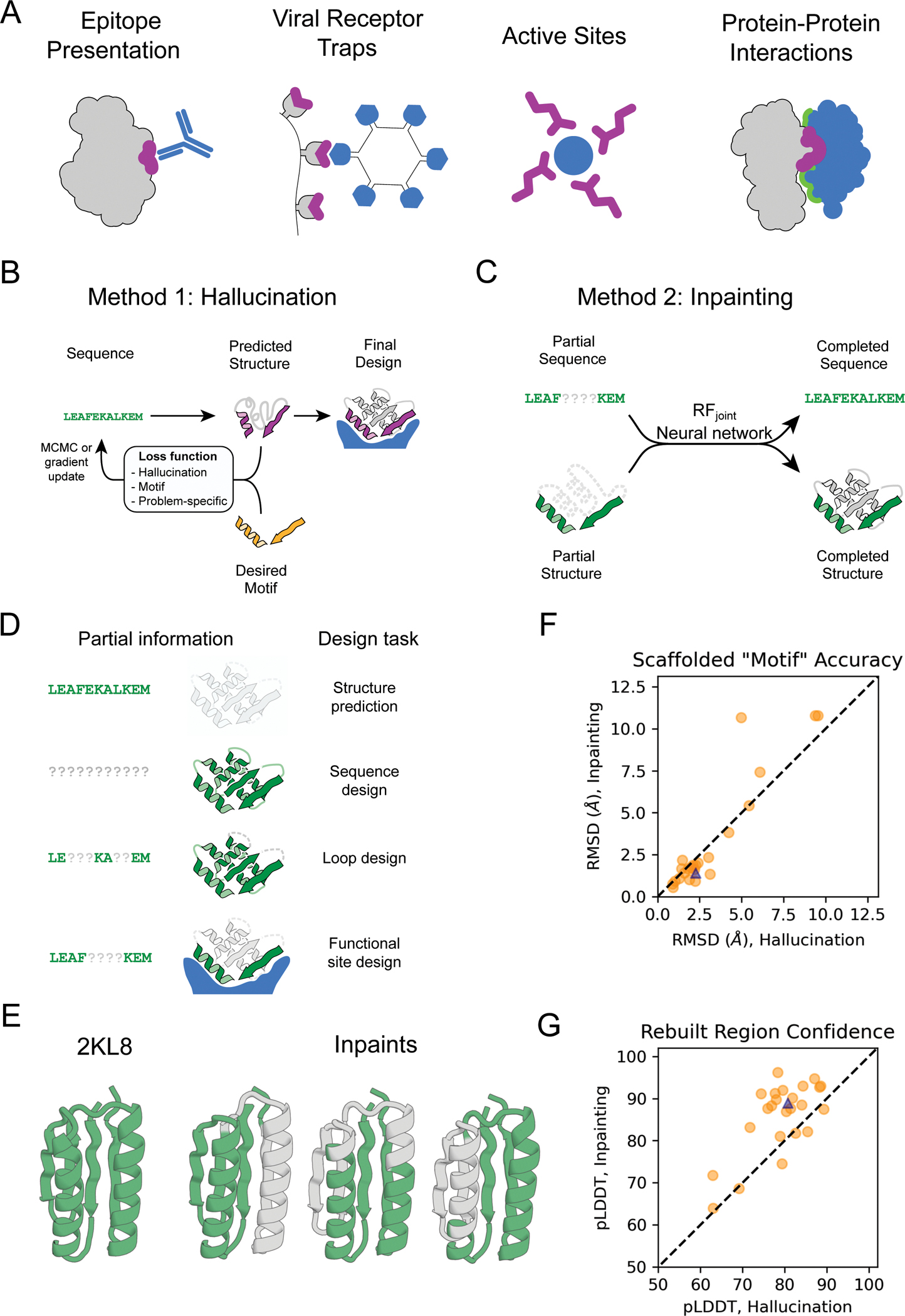
The binding and catalytic functions of proteins are generally mediated by a small number of functional residues held in place by the overall protein structure. Here, we describe deep learning approaches for scaffolding such functional sites without needing to prespecify the fold or secondary structure of the scaffold. The first approach, “constrained hallucination,” optimizes sequences such that their predicted structures contain the desired functional site. The second approach, “inpainting,” starts from the functional site and fills in additional sequence and structure to create a viable protein scaffold in a single forward pass through a specifically trained RoseTTAFold network. We use these two methods to design candidate immunogens, receptor traps, metalloproteins, enzymes, and protein-binding proteins and validate the designs using a combination of in silico and experimental tests.
Verified 2026-10-05 · 2 references not checked yet
Overview
CoChat Summary
TL;DR
The paper introduces two deep learning methods, constrained hallucination and inpainting, for scaffolding functional sites into de novo protein structures without pre-specifying scaffold fold or secondary structure. It validates designs in silico and experimentally across immunogens, receptor traps, metalloproteins, enzymes, and protein binders.
Key findings
- AlphaFold recapitulated designed structures with overall and motif RMSD typically <2 Å and <1 Å, respectively, and pLDDT >80; inpainting was much faster (1–10 s/design on an NVIDIA RTX2080 GPU) than hallucination (5–20 min/design).
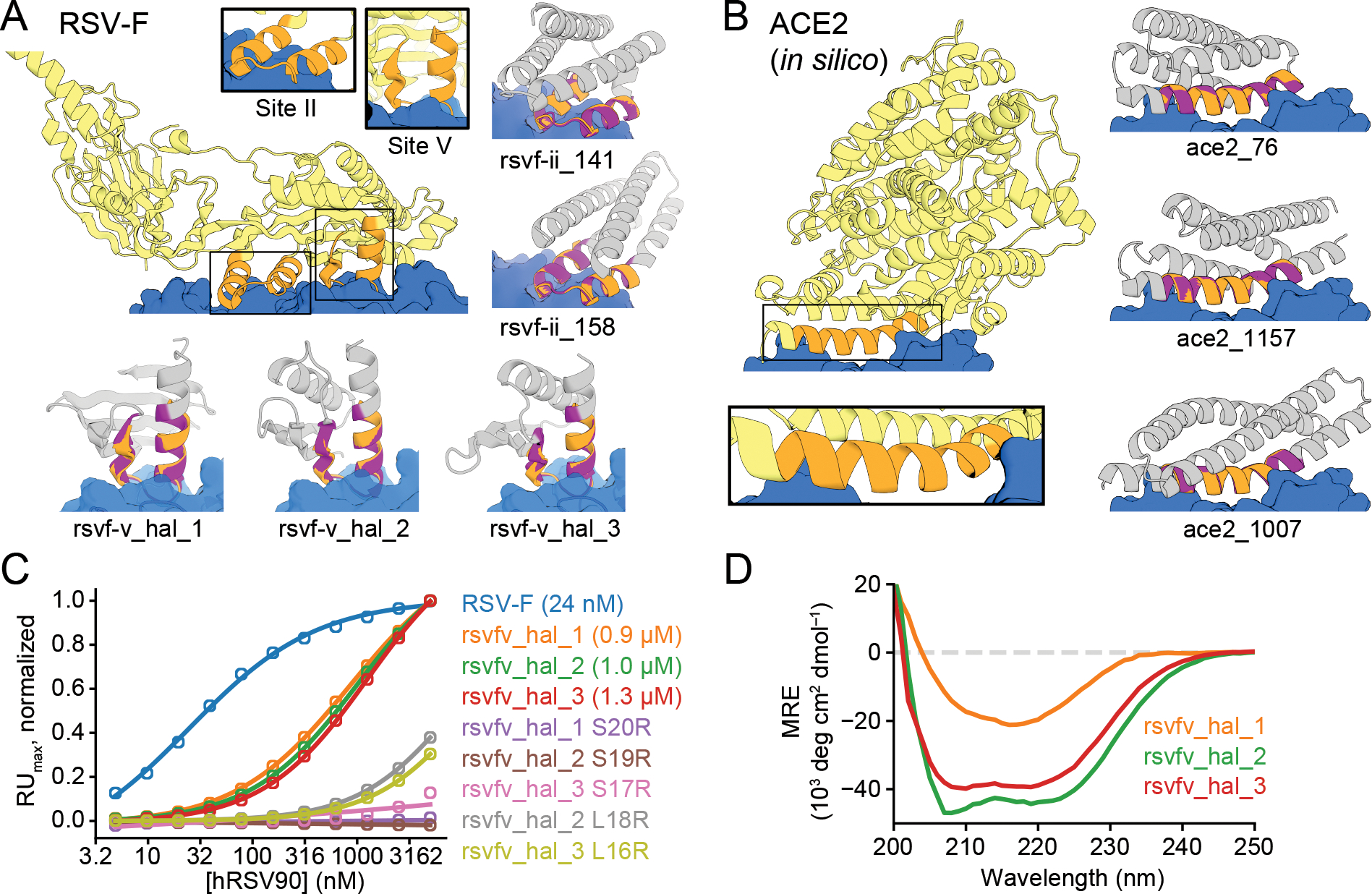
- For RSV-F site V, 37 hallucinated scaffolds were expressed in E. coli and three bound hRSV90 with Kd’s of 0.9–1.3 μM; four inpainted designs bound by yeast display but were poorly expressed in E. coli.
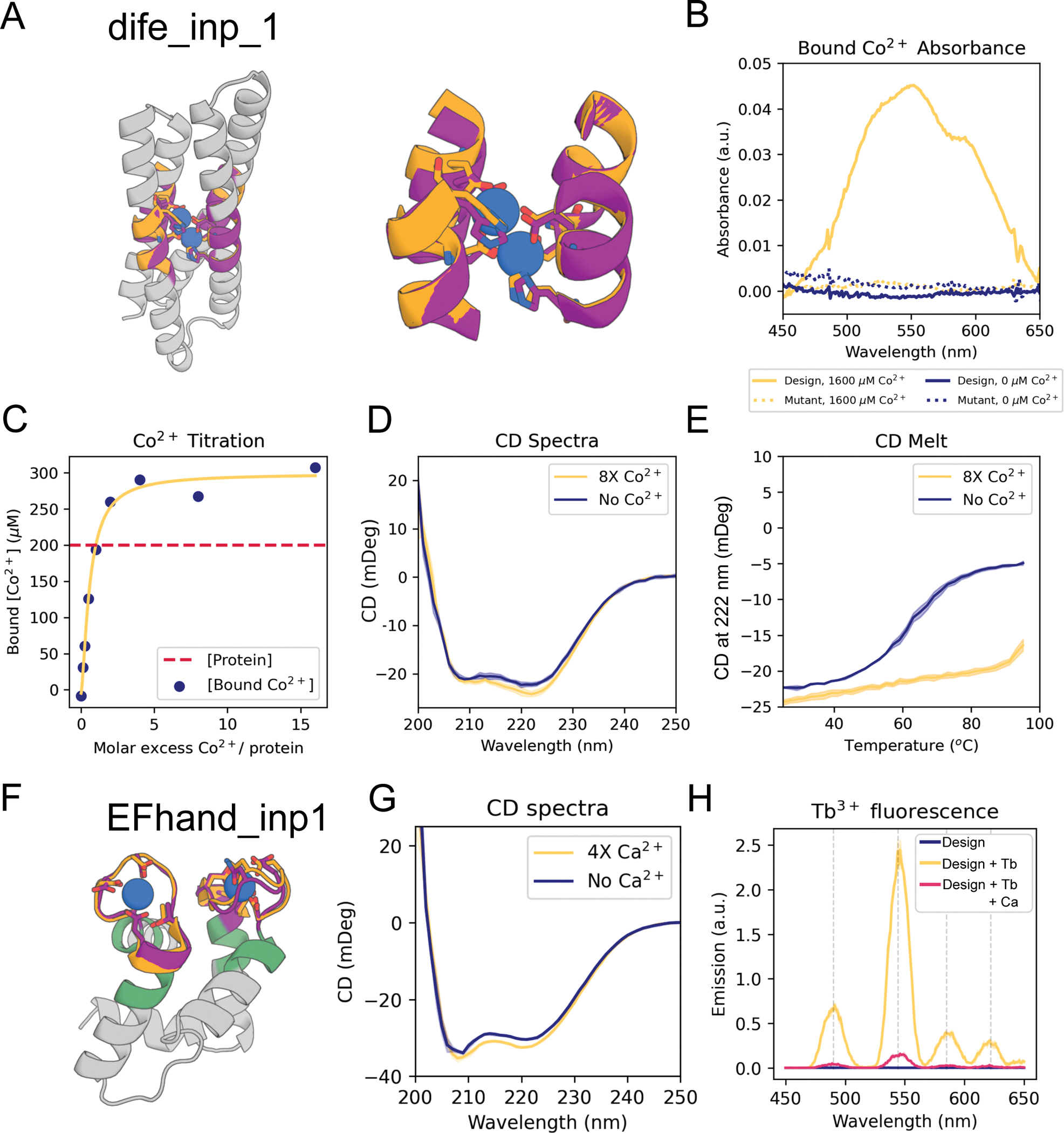
- For the E. coli bacterioferritin di-iron site, 96 inpainted designs were tested: 76 had soluble expression, at least 8 showed a Co2+-binding spectroscopic shift, and 3 had CD spectra consistent with the designed fold and were stabilized by metal binding; mutation of metal-binding residues abolished binding.
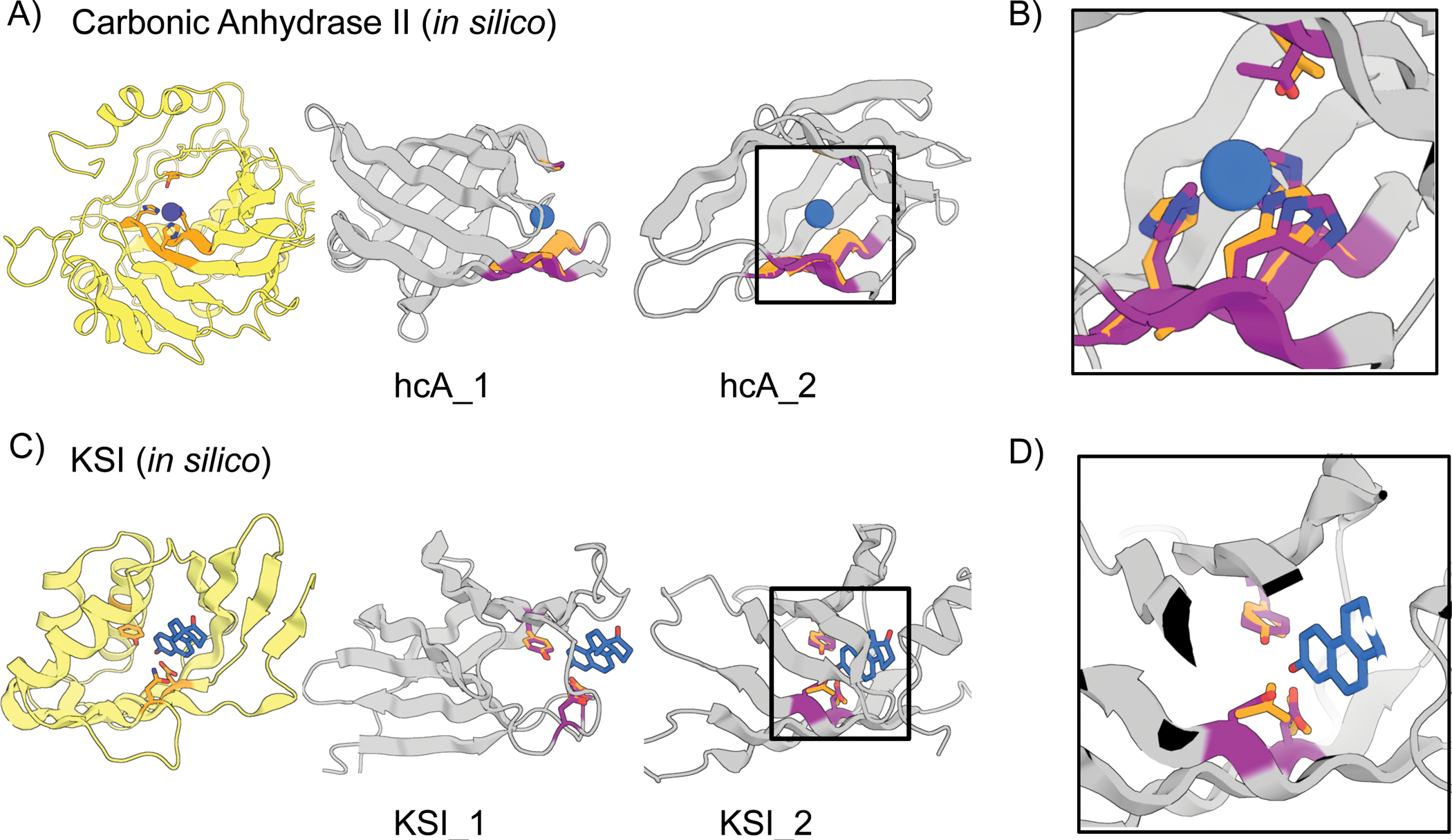
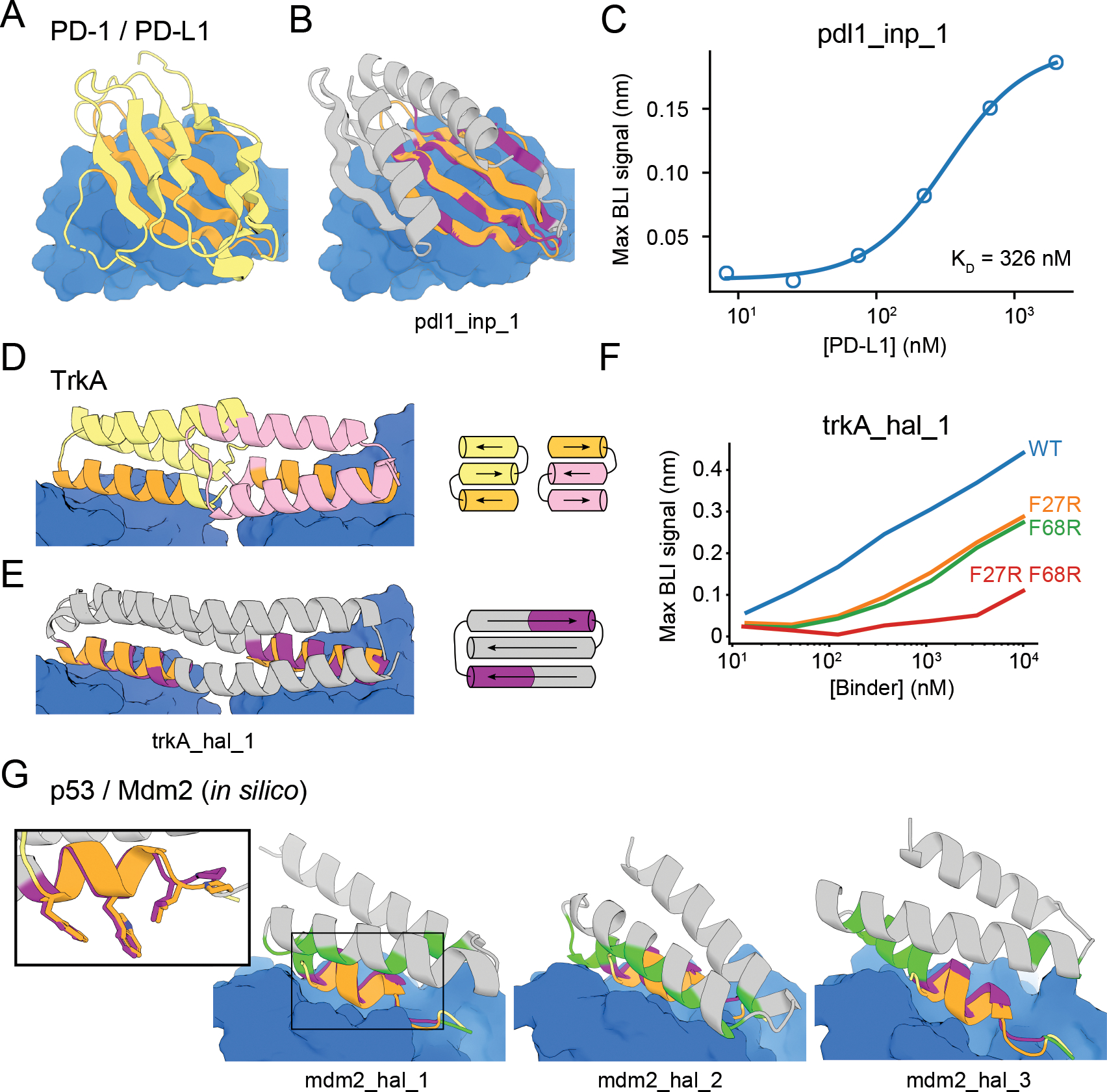
- For PD-L1, of 31 designs tested, pdl1_inp_1 bound PD-L1 with KD = 326 nM, compared with HAC PD-1 KD = 110 pM and WT PD-1 KD = 3.9 μM; carbonic anhydrase II active-site designs were <100 residues versus the 261-residue native protein.
Methods
- Constrained hallucination optimized sequences with a composite loss combining a hallucination loss and a motif reconstruction loss using trRosetta and later RosettaFold; inpainting used RFjoint, trained on masked/inpainting sequence and structure recovery, to complete missing sequence and structure in a single forward pass.
- In silico validation used AlphaFold; experimental validation for selected designs included E. coli expression, yeast display, binding assays (Kd, BLI), circular dichroism, metal/terbium fluorescence, and mutagenesis.
- Functional motifs were derived from native proteins including RSV-F sites II and V, hACE2, bacterioferritin di-iron, EF-hand, carbonic anhydrase II, Δ5-3-ketosteroid isomerase, PD-1/PD-L1, p53/Mdm2, and TrkA-NGF.
Limitations
- Stated in the paper: AlphaFold has limited ability to predict protein stability or mutational effects; hallucination is compute-intensive; inpainting usually requires larger input motifs and underperforms hallucination when the missing region is large; some inpainted RSV-F site V designs were poorly expressed in E. coli; di-iron hallucination designs were not tested due to buried polar residues; and side-chain placement for ketosteroid isomerase was difficult, requiring a two-stage approach.
- Evident from the text: many designs were validated only in silico (e.g., receptor traps, enzyme active sites, some Mdm2 binders), and experimental hit rates were often low (e.g., 3/37 RSV-F site V binders, 3/96 di-iron designs with CD/stabilization, 1/31 PD-L1 binders); inpainting also generated less structural diversity than hallucination.
Model-written summary. Check it against the paper before relying on it.
Integrity signals
Registry
Cites
Statistics
Figures
Verification
Claims the paper makes
9 Valid · 0 Not valid · 12 Not checked · 71 Own results and interpretations
Every source the paper cites for this claim was checked and supports it.
In the paper
“trRosetta can also be used to design sequences that fold into a target backbone structure by carrying out sequence optimization using a structure recapitulation loss function that rewards similarity of the predicted structure to the target structure (13).”
§ Scaffolding protein functional sites using deep learning > Abstract
What the sources say
- Supportedcites [13] Norn C, Wicky BIM, Juergens D, Liu S, Kim D, Tischer D, Koepnick B, Anishchenko I, Players F, Baker D, Ovchinnikov S, Protein sequence design by conformational landscape optimization. Proc. Natl. Acad. Sci. 118 (2021), doi: 10.1073/pnas.2017228118. PMC7980421 33712545 source
The Results and Discussions section, “Sequence Design by Gradient Backpropagation” (page not provided), describes optimizing amino acid sequences with a loss function based on the probabilities of the target structure’s observed interresidue distances and orientations. This supports the claim’s description of a structure-recapitulation loss that rewards agreement with the target backbone. (LLM, conf=0.91)
plainstates a cause- Asserted: passes — The authors put it forward as true.
- Checkable: passes — It can be checked against evidence.
- Load-bearing: passes — The paper’s conclusions depend on it.
- Based: passes — The paper gives a reason why it holds.
- Supported
The cited sources support only part of this claim — read each source’s verdict below.
In the paper
“We previously demonstrated that the trRosetta structure-prediction neural network (11) can be used to generate new proteins by maximizing the trRosetta output probability that a sequence folds to some (unspecified) three dimensional structure during Monte Carlo sampling in sequence space (12).”
§ Scaffolding protein functional sites using deep learning > Abstract
What the sources say
- Not checked yetcites [11] Yang J, Anishchenko I, Park H, Peng Z, Ovchinnikov S, Baker D, Improved protein structure prediction using predicted interresidue orientations. Proc. Natl. Acad. Sci. (2020), doi: 10.1073/pnas.1914677117. PMC6983395 31896580 source
- Partly supportedcites [12] Anishchenko I, Pellock SJ, Chidyausiku TM, Ramelot TA, Ovchinnikov S, Hao J, Bafna K, Norn C, Kang A, Bera AK, DiMaio F, Carter L, Chow CM, Montelione GT, Baker D, De novo protein design by deep network hallucination. Nature. 600, 547– 552 (2021). 34853475 PMC9293396 sourceExperimental — accuracy not yet measured
Split into 2 atoms — 1 confirmed, 1 partially supported, 0 disputed, 0 misattributed, 0 unverifiable. Expand the claim to see per-atom verdicts.
boostedstates a cause- Asserted: passes — The authors put it forward as true.
- Checkable: passes — It can be checked against evidence.
- Load-bearing: passes — The paper’s conclusions depend on it.
- Based: passes — The paper gives a reason why it holds.
The cited sources support only part of this claim — read each source’s verdict below.
In the paper
“Previous methods can scaffold functional sites made up of one or two contiguous chain segments (6–10), but with the exception of helical bundles (8) these do not extend readily to more complex sites composed of three or more chain segments, and the generated backbones are not guaranteed to be designable (encodable by some amino acid sequence).”
§ Scaffolding protein functional sites using deep learning > Abstract
What the sources say
- Supportedcites [6] Procko E, Berguig GY, Shen BW, Song Y, Frayo S, Convertine AJ, Margineantu D, Booth G, Correia BE, Cheng Y, Schief WR, Hockenbery DM, Press OW, Stoddard BL, Stayton PS, Baker D, A Computationally Designed Inhibitor of an Epstein-Barr Viral Bcl-2 Protein Induces Apoptosis in Infected Cells. Cell. 157, 1644– 1656 (2014). 24949974 PMC4079535 source
The citation to this paper is attached to the helical-bundle exception, rather than to the general claim about the limits of previous methods. In the Results sections on grafting and de novo design (page not provided), the paper describes using 3- and 4-helix bundles to build a binding interface with contacts beyond the grafted BH3 helix. (LLM, conf=0.86)
- Could not verifycites [7] Correia BE, Bates JT, Loomis RJ, Baneyx G, Carrico C, Jardine JG, Rupert P, Correnti C, Kalyuzhniy O, Vittal V, Connell MJ, Stevens E, Schroeter A, Chen M, MacPherson S, Serra AM, Adachi Y, Holmes MA, Li Y, Klevit RE, Graham BS, Wyatt RT, Baker D, Strong RK, Crowe JE, Johnson PR, Schief WR, Proof of principle for epitope-focused vaccine design. Nature. 507, 201– 206 (2014). 24499818 PMC4260937 sourceExperimental — accuracy not yet measured
The Design of Epitope-Scaffolds section describes a helix-turn-helix epitope and a three-helix-bundle template, while Computational Method describes the paper’s Fold from Loops approach. Neither passage assesses whether previous methods extend to functional sites made of three or more chain segments; searches for that limit and the helical-bundle exception found no supporting passage in our copy. (LLM, conf=0.72)
- Supportedcites [8] Silva D-A, Yu S, Ulge UY, Spangler JB, Jude KM, Labão-Almeida C, Ali LR, Quijano-Rubio A, Ruterbusch M, Leung I, Biary T, Crowley SJ, Marcos E, Walkey CD, Weitzner BD, Pardo-Avila F, Castellanos J, Carter L, Stewart L, Riddell SR, Pepper M, Bernardes GJL, Dougan M, Garcia KC, Baker D, De novo design of potent and selective mimics of IL-2 and IL-15. Nature. 565, 186– 191 (2019). 30626941 PMC6521699 source
The citation is attached to the helical-bundle exception. In “Computational design of IL-2/IL-15 mimics that bind and activate IL-2Rβγc” (page unavailable), the paper describes building a connected protein around the three helices H1, H3 and H4 that form the receptor-binding interface, supporting that exception. (LLM, conf=0.91)
- Partly supportedcites [9] Sesterhenn F, Yang C, Bonet J, Cramer JT, Wen X, Wang Y, Chiang C-I, Abriata LA, Kucharska I, Castoro G, Vollers SS, Galloux M, Dheilly E, Rosset S, Corthésy P, Georgeon S, Villard M, Richard C-A, Descamps D, Delgado T, Oricchio E, Rameix-Welti M-A, Más V, Ervin S, Eléouët J-F, Riffault S, Bates JT, Julien J-P, Li Y, Jardetzky T, Krey T, Correia BE, De novo protein design enables the precise induction of RSV-neutralizing antibodies. Science. 368 (2020), doi: 10.1126/science.aay5051. PMC7391827 32409444 sourceExperimental — accuracy not yet measured
The Introduction (page not provided) says earlier grafting work largely used simple motifs such as linear helical segments and identifies irregular, multi-segment functional sites as a challenge. The Discussion & Conclusions (page not provided) also describes limitations of template-based design. Neither passage establishes the specific three-or-more-segment threshold or identifies helical bundles as an exception. (LLM, conf=0.82)
- Not checked yetcites [10] Yang C, Sesterhenn F, Bonet J, van Aalen EA, Scheller L, Abriata LA, Cramer JT, Wen X, Rosset S, Georgeon S, Jardetzky T, Krey T, Fussenegger M, Merkx M, Correia BE, Bottom-up de novo design of functional proteins with complex structural features. Nat. Chem. Biol, 1– 9 (2021). 33398169 source
plain- Asserted: passes — The authors put it forward as true.
- Checkable: passes — It can be checked against evidence.
- Load-bearing: passes — The paper’s conclusions depend on it.
- Based: passes — The paper gives a reason why it holds.
- Supported
The cited sources support only part of this claim — read each source’s verdict below.
In the paper
“Previous methods can scaffold functional sites made up of one or two contiguous chain segments (6–10), but with the exception of helical bundles (8) these do not extend readily to more complex sites composed of three or more chain segments, and the generated backbones are not guaranteed to be designable (encodable by some amino acid sequence).”
§ Scaffolding protein functional sites using deep learning > Abstract
What the sources say
- Partly supportedcites [6] Procko E, Berguig GY, Shen BW, Song Y, Frayo S, Convertine AJ, Margineantu D, Booth G, Correia BE, Cheng Y, Schief WR, Hockenbery DM, Press OW, Stoddard BL, Stayton PS, Baker D, A Computationally Designed Inhibitor of an Epstein-Barr Viral Bcl-2 Protein Induces Apoptosis in Infected Cells. Cell. 157, 1644– 1656 (2014). 24949974 PMC4079535 sourceExperimental — accuracy not yet measured
The Results section, under “BHRF1-binding proteins created by grafting Bim-BH3 side chains to a helical scaffold” (page unavailable), describes grafting the interacting residues of a single BH3 helix onto protein scaffolds. This supports the one-contiguous-segment example, but our copy does not establish that previous methods scaffold functional sites made up of two contiguous chain segments. (LLM, conf=0.82)
- Supportedcites [7] Correia BE, Bates JT, Loomis RJ, Baneyx G, Carrico C, Jardine JG, Rupert P, Correnti C, Kalyuzhniy O, Vittal V, Connell MJ, Stevens E, Schroeter A, Chen M, MacPherson S, Serra AM, Adachi Y, Holmes MA, Li Y, Klevit RE, Graham BS, Wyatt RT, Baker D, Strong RK, Crowe JE, Johnson PR, Schief WR, Proof of principle for epitope-focused vaccine design. Nature. 507, 201– 206 (2014). 24499818 PMC4260937 source
The Abstract (page not available) says that previously developed side-chain and backbone grafting methods transplanted continuous or discontinuous epitopes onto scaffold proteins. This supports the attributed point that previous methods could scaffold functional sites comprising contiguous chain segments; the claim does not attribute a limitation to exactly two segments to this paper. (LLM, conf=0.86)
- Could not verifycites [8] Silva D-A, Yu S, Ulge UY, Spangler JB, Jude KM, Labão-Almeida C, Ali LR, Quijano-Rubio A, Ruterbusch M, Leung I, Biary T, Crowley SJ, Marcos E, Walkey CD, Weitzner BD, Pardo-Avila F, Castellanos J, Carter L, Stewart L, Riddell SR, Pepper M, Bernardes GJL, Dougan M, Garcia KC, Baker D, De novo design of potent and selective mimics of IL-2 and IL-15. Nature. 565, 186– 191 (2019). 30626941 PMC6521699 sourceExperimental — accuracy not yet measured
The computational-design section describes this paper’s method for scaffolding an IL-2 binding interface formed by three helices (H1, H3 and H4). It does not address whether previous methods could scaffold functional sites made up of one or two contiguous chain segments; searches for prior scaffolding methods found no passage establishing that point. The paper does, however, fit the helical-bundle exception separately identified in the full citing sentence. (LLM, conf=0.76)
- Supportedcites [9] Sesterhenn F, Yang C, Bonet J, Cramer JT, Wen X, Wang Y, Chiang C-I, Abriata LA, Kucharska I, Castoro G, Vollers SS, Galloux M, Dheilly E, Rosset S, Corthésy P, Georgeon S, Villard M, Richard C-A, Descamps D, Delgado T, Oricchio E, Rameix-Welti M-A, Más V, Ervin S, Eléouët J-F, Riffault S, Bates JT, Julien J-P, Li Y, Jardetzky T, Krey T, Correia BE, De novo protein design enables the precise induction of RSV-neutralizing antibodies. Science. 368 (2020), doi: 10.1126/science.aay5051. PMC7391827 32409444 source
The Introduction (page unavailable) describes earlier grafting methods using linear helical segments. The Results section, ‘De novo design of immunogens presenting structurally complex epitopes’ (page unavailable), adds that one earlier study grafted a discontinuous HIV epitope into a scaffold. Together, these support the claim that previous methods could scaffold sites comprising a single segment or more than one segment. (LLM, conf=0.85)
- Not checked yetcites [10] Yang C, Sesterhenn F, Bonet J, van Aalen EA, Scheller L, Abriata LA, Cramer JT, Wen X, Rosset S, Georgeon S, Jardetzky T, Krey T, Fussenegger M, Merkx M, Correia BE, Bottom-up de novo design of functional proteins with complex structural features. Nat. Chem. Biol, 1– 9 (2021). 33398169 source
plain- Asserted: passes — The authors put it forward as true.
- Checkable: passes — It can be checked against evidence.
- Load-bearing: passes — The paper’s conclusions depend on it.
- Based: passes — The paper gives a reason why it holds.
- Partly supported
The cited sources support only part of this claim — read each source’s verdict below.
In the paper
“Previous methods can scaffold functional sites made up of one or two contiguous chain segments (6–10), but with the exception of helical bundles (8) these do not extend readily to more complex sites composed of three or more chain segments, and the generated backbones are not guaranteed to be designable (encodable by some amino acid sequence).”
§ Scaffolding protein functional sites using deep learning > Abstract
What the sources say
- Partly supportedcites [6] Procko E, Berguig GY, Shen BW, Song Y, Frayo S, Convertine AJ, Margineantu D, Booth G, Correia BE, Cheng Y, Schief WR, Hockenbery DM, Press OW, Stoddard BL, Stayton PS, Baker D, A Computationally Designed Inhibitor of an Epstein-Barr Viral Bcl-2 Protein Induces Apoptosis in Infected Cells. Cell. 157, 1644– 1656 (2014). 24949974 PMC4079535 sourceExperimental — accuracy not yet measured
The Results section, under “In silico folding probability correlates with binding activity” (page unavailable), says that functional protein design has a low success rate and that inactive designs may fold improperly or have unstable designed states. This supports the general point that a generated design is not guaranteed to work, but it does not establish the more specific claim that a generated backbone cannot be encoded by any amino acid sequence. (LLM, conf=0.79)
- Could not verifycites [7] Correia BE, Bates JT, Loomis RJ, Baneyx G, Carrico C, Jardine JG, Rupert P, Correnti C, Kalyuzhniy O, Vittal V, Connell MJ, Stevens E, Schroeter A, Chen M, MacPherson S, Serra AM, Adachi Y, Holmes MA, Li Y, Klevit RE, Graham BS, Wyatt RT, Baker D, Strong RK, Crowe JE, Johnson PR, Schief WR, Proof of principle for epitope-focused vaccine design. Nature. 507, 201– 206 (2014). 24499818 PMC4260937 sourceExperimental — accuracy not yet measured
The Abstract (page unavailable) says the earlier grafting methods used scaffold proteins of known structure, but does not say whether their generated backbones were guaranteed to be designable. The Computational Method and Methods > Fold From Loops sections describe sequence design and filtering for the new method; a search for designability of backbones from previous methods found no passage addressing that point. (LLM, conf=0.72)
- Could not verifycites [8] Silva D-A, Yu S, Ulge UY, Spangler JB, Jude KM, Labão-Almeida C, Ali LR, Quijano-Rubio A, Ruterbusch M, Leung I, Biary T, Crowley SJ, Marcos E, Walkey CD, Weitzner BD, Pardo-Avila F, Castellanos J, Carter L, Stewart L, Riddell SR, Pepper M, Bernardes GJL, Dougan M, Garcia KC, Baker D, De novo design of potent and selective mimics of IL-2 and IL-15. Nature. 565, 186– 191 (2019). 30626941 PMC6521699 sourceExperimental — accuracy not yet measured
The Methods section (page unavailable) describes how this paper generated backbones and then performed sequence design and filtering. Searches for prior scaffolding methods and backbone designability found no passage saying that backbones generated by previous methods are not guaranteed to be designable. (LLM, conf=0.72)
- Could not verifycites [9] Sesterhenn F, Yang C, Bonet J, Cramer JT, Wen X, Wang Y, Chiang C-I, Abriata LA, Kucharska I, Castoro G, Vollers SS, Galloux M, Dheilly E, Rosset S, Corthésy P, Georgeon S, Villard M, Richard C-A, Descamps D, Delgado T, Oricchio E, Rameix-Welti M-A, Más V, Ervin S, Eléouët J-F, Riffault S, Bates JT, Julien J-P, Li Y, Jardetzky T, Krey T, Correia BE, De novo protein design enables the precise induction of RSV-neutralizing antibodies. Science. 368 (2020), doi: 10.1126/science.aay5051. PMC7391827 32409444 sourceExperimental — accuracy not yet measured
The Introduction and Discussion & Conclusions describe limitations of earlier scaffolding approaches, including destabilization and the need for extensive optimization. Neither passage says whether the generated backbones are guaranteed to be encodable by an amino acid sequence; a search for backbone designability found no such statement in our copy. (LLM, conf=0.72)
- Not checked yetcites [10] Yang C, Sesterhenn F, Bonet J, van Aalen EA, Scheller L, Abriata LA, Cramer JT, Wen X, Rosset S, Georgeon S, Jardetzky T, Krey T, Fussenegger M, Merkx M, Correia BE, Bottom-up de novo design of functional proteins with complex structural features. Nat. Chem. Biol, 1– 9 (2021). 33398169 source
plain- Asserted: passes — The authors put it forward as true.
- Checkable: passes — It can be checked against evidence.
- Load-bearing: passes — The paper’s conclusions depend on it.
- Based: passes — The paper gives a reason why it holds.
- Partly supported
59 more claims · 3 with their cited sources checked
Create a free account to see all 92 claims and to verify the 16 references still open.
- Probably not a substantial claim. 5
- It may state two separate claims as one. 23
Claims other papers make about this one
Each is checked against this paper’s own text: does it say what the citing paper says it does?
The source backs part of the claim, not all of it — or backs it for a different population, condition or comparison.
In the citing paper
“Experimental characterization showed that the method can scaffold a wide range of protein functional motifs with atomic accuracy19”
From De novo design of protein structure and function with RFdiffusion (2023) · cites this paper as [4]
Experimental — accuracy not yet measuredThe source backs part of the claim, not all of it — or backs it for a different population, condition or comparison.
In the citing paper
“but the approach fails on minimalist site descriptions that do not sufficiently constrain the overall fold and, because it is deterministic, can produce only a limited diversity of designs for a given problem.”
From De novo design of protein structure and function with RFdiffusion (2023) · cites this paper as [4]
Experimental — accuracy not yet measuredThe source backs part of the claim, not all of it — or backs it for a different population, condition or comparison.
In the citing paper
“Experimental characterization showed that the method can scaffold a wide range of protein functional motifs with atomic accuracy19”
From De novo design of protein structure and function with RFdiffusion (2023) · cites this paper as [19]
Experimental — accuracy not yet measuredThe source backs part of the claim, not all of it — or backs it for a different population, condition or comparison.
In the citing paper
“This measure of in silico success has been found to correlate with experimental success4,7,26 and is significantly more stringent than template modelling (TM)-score-based metrics used elsewhere5,16,27–29”
From De novo design of protein structure and function with RFdiffusion (2023) · cites this paper as [4]
Experimental — accuracy not yet measuredThe check wasn’t confident either way, so it gives no verdict — never disputed.
In the citing paper
“we established an in silico benchmark test (Supplementary Table 9) comprising 25 motif-scaffolding design problems addressed in six recent publications encompassing several design methodologies4,5,29,38–40”
From De novo design of protein structure and function with RFdiffusion (2023) · cites this paper as [4]
Experimental — accuracy not yet measured
Citations
Cites
Adam: A Method for Stochastic Optimization
Kingma, D. P., & Ba, J. (2014) · arXiv · doi:10.48550/arxiv.1412.6980 · Cited by 98,946
Basic local alignment search tool
Altschul, S. F., Gish, W., Miller, W., Myers, E. W., & Lipman, D. J. (1990) · Journal of Molecular Biology · doi:10.1006/jmbi.1990.9999 · Cited by 98,669
BERT: Pre-training of Deep Bidirectional Transformers for Language Understanding
Devlin, J., Chang, M.-W., Lee, K., & Toutanova, K. (2018) · arXiv · doi:10.48550/arxiv.1810.04805 · Cited by 73,173
BERT: Pre-training of Deep Bidirectional Transformers for Language Understanding
Devlin, J., Chang, M.-W., Lee, K., & Toutanova, K. (2019) · Proceedings of the 2019 Conference of the North American Chapter of the Association for Computational Linguistics: Human Language Technologies, Volume 1 (Long and Short Papers) · doi:10.18653/v1/n19-1423 · Cited by 54,325
Highly accurate protein structure prediction with AlphaFold
Jumper, J., Evans, R., Pritzel, A., Green, T., Figurnov, M., Ronneberger, O., Tunyasuvunakool, K., Bates, R., Žídek, A., Potapenko, A., et al. (2021) · Nature · doi:10.1038/s41586-021-03819-2 · Cited by 43,764
Berman, H. M. (2000) · Nucleic Acids Research · doi:10.1093/nar/28.1.235 · Cited by 40,196
Comparison of multiple Amber force fields and development of improved protein backbone parameters
Hornak, V., Abel, R., Okur, A., Strockbine, B., Roitberg, A., & Simmerling, C. (2006) · Proteins: Structure, Function, and Bioinformatics · doi:10.1002/prot.21123 · Cited by 6,914
Protein production by auto-induction in high-density shaking cultures
Studier, F. W. (2005) · Protein Expression and Purification · doi:10.1016/j.pep.2005.01.016 · Cited by 5,931
Accurate prediction of protein structures and interactions using a 3-track network
Baek, M., DiMaio, F., Anishchenko, I., Dauparas, J., Ovchinnikov, S., Lee, G. R., Wang, J., Cong, Q., Kinch, L. N., Schaeffer, R. D., et al. (2021) · doi:10.1101/2021.06.14.448402 · Cited by 5,549 · cited 3×
“Following the development of RosettaFold (RF) (16) we found that it performed better than trRosetta in guiding protein design by functional-site-constrained hallucination (Fig.”
BackgroundMethodInfluentialSelf-citationMMseqs2 enables sensitive protein sequence searching for the analysis of massive data sets
Steinegger, M., & Söding, J. (2017) · Nature Biotechnology · doi:10.1038/nbt.3988 · Cited by 4,840
Research works printed but not linked: 1
- Z. Lin T. Sercu Y. LeCun A. Rives “Deep generative models create new and diverse protein structures ” 35th Conference on Neural Information Processing Systems (NeurIPS 2021) 6 to 14 December 2021.
Cited by
Evolutionary-scale prediction of atomic level protein structure with a language model
Lin, Z., Akin, H., Rao, R., Hie, B., Zhu, Z., Lu, W., Smetanin, N., Verkuil, R., Kabeli, O., Shmueli, Y., et al. (2022) · doi:10.1101/2022.07.20.500902 · Cited by 5,990
Watson, J. L., Juergens, D., Bennett, N. R., Trippe, B. L., Yim, J., Eisenach, H. E., Ahern, W., Borst, A. J., Ragotte, R. J., Milles, L. F., et al. (2022) · doi:10.1101/2022.12.09.519842 · Cited by 2,369
“generative modeling of images when predicting the noise added in the forward process (rather than ), we reasoned that by predicting we could better leverage the inductive biases of x 0 x 0 RoseTTAFold pre-trained for structure prediction to produce realistic structures (as in [4]).”
Self-citationDe novo design of protein structure and function with RFdiffusion
Watson, J. L., Juergens, D., Bennett, N. R., Trippe, B. L., Yim, J., Eisenach, H. E., Ahern, W., Borst, A. J., Ragotte, R. J., Milles, L. F., et al. (2023) · Nature · doi:10.1038/s41586-023-06415-8 · Cited by 2,325
“From left to right: (1) symmetric design model, (2) AF2 prediction of design following sequence design with ProteinMPNN, (3) 2D class averages showing both top and side views (scale bar, 60 Å for all class averages) and (4) 3D reconstructions from class averages with the design model fit into the density map.”
Self-citationGeneralized biomolecular modeling and design with RoseTTAFold All-Atom
Krishna, R., Wang, J., Ahern, W., Sturmfels, P., Venkatesh, P., Kalvet, I., Lee, G. R., Morey-Burrows, F. S., Anishchenko, I., Humphreys, I. R., et al. (2024) · Science · doi:10.1126/science.adl2528 · Cited by 978
Self-citationFrom nature to industry: Harnessing enzymes for biocatalysis
Buller, R., Lutz, S., Kazlauskas, R. J., Snajdrova, R., Moore, J. C., & Bornscheuer, U. T. (2023) · Science · doi:10.1126/science.adh8615 · Cited by 706
AlphaFold2 and its applications in the fields of biology and medicine
Yang, Z., Zeng, X., Zhao, Y., & Chen, R. (2023) · Signal Transduction and Targeted Therapy · doi:10.1038/s41392-023-01381-z · Cited by 577
“120 Target prediction .”
De novo protein design by deep network hallucination
Anishchenko, I., Chidyausiku, T. M., Ovchinnikov, S., Pellock, S. J., & Baker, D. (2020) · doi:10.1101/2020.07.22.211482 · Cited by 629
Self-citationStructure-based drug design with equivariant diffusion models
Schneuing, A., Harris, C., Du, Y., Didi, K., Jamasb, A., Igashov, I., Du, W., Gomes, C., Blundell, T. L., Lio, P., et al. (2024) · Nature Computational Science · doi:10.1038/s43588-024-00737-x · Cited by 316
“Generating compounds, or parts thereof, conditioned on a given molecular context is reminiscent of inpainting, a technique originally introduced for completing missing parts of images 32,33 but also adopted in other domains, including biomolecular structures 34 .”
Self-citationLearning inverse folding from millions of predicted structures
Hsu, C., Verkuil, R., Liu, J., Lin, Z., Hie, B., Sercu, T., Lerer, A., & Rives, A. (2022) · bioRxiv (Cold Spring Harbor Laboratory) · doi:10.1101/2022.04.10.487779 · Cited by 416
De novo design of luciferases using deep learning
Yeh, A. H.-W., Norn, C., Kipnis, Y., Tischer, D., Pellock, S. J., Evans, D., Ma, P., Lee, G. R., Zhang, J. Z., Anishchenko, I., et al. (2023) · Nature · doi:10.1038/s41586-023-05696-3 · Cited by 441
“The family-wide hallucination approach used the de novo sequence and structure discovery capability of unconstrained protein hallucination 17,18 for loop and variable regions, and structure-guided sequence optimization for core regions.”
BackgroundMethodSelf-citationOne-shot design of functional protein binders with BindCraft
Pacesa, M., Nickel, L., Schellhaas, C., Schmidt, J., Pyatova, E., Kissling, L., Barendse, P., Choudhury, J., Kapoor, S., Alcaraz-Serna, A., et al. (2025) · Nature · doi:10.1038/s41586-025-09429-6 · Cited by 236
“Here we introduce a robust pipeline based on backpropagation through the AF2 network, an approach that has been explored in previous studies 7–10, 44 , We demonstrate BindCraft’s performance across a diverse set of 12 challenging targets.”
Self-citationImproving de novo protein binder design with deep learning
Bennett, N. R., Coventry, B., Goreshnik, I., Huang, B., Allen, A., Vafeados, D., Peng, Y. P., Dauparas, J., Baek, M., Stewart, L., et al. (2023) · Nature Communications · doi:10.1038/s41467-023-38328-5 · Cited by 402
“…multiple sequence alignments (which contain rich co-evolutionary information on residues likely to be in contact, etc), but for de novo designedsequences,whicharegenerallymorestableandmoreregular than naturally occurring proteins, accurate predictions can be obtained from single sequences 18, 19 .”
Self-citationThe road to fully programmable protein catalysis
Lovelock, S. L., Crawshaw, R., Basler, S., Levy, C., Baker, D., Hilvert, D., & Green, A. P. (2022) · Nature · doi:10.1038/s41586-022-04456-z · Cited by 343
Self-citationDe novo protein design—From new structures to programmable functions
Kortemme, T. (2024) · Cell · doi:10.1016/j.cell.2023.12.028 · Cited by 344
“For example, given a motif geometry as input, both protein hallucination 67 and diffusion 53 can in principle generate a suitable scaffold around that motif for a range of scaffolding problems (Fig.”
Fast, accurate antibody structure prediction from deep learning on massive set of natural antibodies
Ruffolo, J. A., Chu, L.-S., Mahajan, S. P., & Gray, J. J. (2023) · Nature Communications · doi:10.1038/s41467-023-38063-x · Cited by 316
“Meanwhile, methods like AlphaFold and RoseTTAFold have been adapted for gradient-based design of novel protein structures and even scaffolding binding loops 56,57 .”
MethodImproving Protein Expression, Stability, and Function with ProteinMPNN
(2024) · doi:10.1021/jacs.3c10941 · Cited by 344
Self-citationAtomic context-conditioned protein sequence design using LigandMPNN
Dauparas, J., Lee, G. R., Pecoraro, R., An, L., Anishchenko, I., Glasscock, C., & Baker, D. (2025) · Nature Methods · doi:10.1038/s41592-025-02626-1 · Cited by 279
Self-citationAtomically accurate de novo design of antibodies with RFdiffusion
Bennett, N. R., Watson, J. L., Ragotte, R. J., Borst, A. J., See, D. L., Weidle, C., Biswas, R., Yu, Y., Shrock, E. L., Ault, R., et al. (2024) · doi:10.1101/2024.03.14.585103 · Cited by 324
“…way to filter designed proteins and interfaces is based on the similarity of the design model structure to the AlphaFold2 predicted structure for the designed sequence (this is often referred to as "self-consistency"), which has been shown to correlate well with experimental success 16,17 .”
Self-citationAtomically accurate de novo design of antibodies with RFdiffusion
(2025) · doi:10.1038/s41586-025-09721-5 · Cited by 324
Self-citationMachine learning for functional protein design
Notin, P., Rollins, N., Gal, Y., Sander, C., & Marks, D. (2024) · Nature Biotechnology · doi:10.1038/s41587-024-02127-0 · Cited by 270
“These meth-ods have already been applied to create new scaffolds for a luciferase functional site by templating on an existing small-molecule-binding family 44 and to customize de novo folds to accommodate functional motifs 23,45,46,48,77–79 .”
InfluentialDe novo design of high-affinity binders of bioactive helical peptides
Vázquez Torres, S., Leung, P. J. Y., Venkatesh, P., Lutz, I. D., Hink, F., Huynh, H.-H., Becker, J., Yeh, A. H.-W., Juergens, D., Bennett, N. R., et al. (2024) · Nature · doi:10.1038/s41586-023-06953-1 · Cited by 239
“This approach has been used to generate new monomers 30 , functional-site scaffolds 23 and cyclic oligomers 31 .”
Self-citationOpportunities and Challenges for Machine Learning-Assisted Enzyme Engineering
Yang, J., Li, F.-Z., & Arnold, F. H. (2024) · ACS Central Science · doi:10.1021/acscentsci.3c01275 · Cited by 246
De novo design of protein interactions with learned surface fingerprints
Gainza, P., Wehrle, S., Van Hall-Beauvais, A., Marchand, A., Scheck, A., Harteveld, Z., Buckley, S., Ni, D., Tan, S., Sverrisson, F., et al. (2023) · Nature · doi:10.1038/s41586-023-05993-x · Cited by 236
Self-citationHallucinating symmetric protein assemblies
Wicky, B. I. M., Milles, L. F., Courbet, A., Ragotte, R. J., Dauparas, J., Kinfu, E., Tipps, S., Kibler, R. D., Baek, M., DiMaio, F., et al. (2022) · Science · doi:10.1126/science.add1964 · Cited by 240
Self-citationOpportunities and challenges in design and optimization of protein function
Listov, D., Goverde, C. A., Correia, B. E., & Fleishman, S. J. (2024) · Nature Reviews Molecular Cell Biology · doi:10.1038/s41580-024-00718-y · Cited by 180
“Once sequences are generated, their quality is typically assessed by verifying that AlphaFold2 predicts a model structure that closely matches the designed one 24,119,136–142 .”
Self-citationMultistate and functional protein design using RoseTTAFold sequence space diffusion
Lisanza, S. L., Gershon, J. M., Tipps, S. W. K., Sims, J. N., Arnoldt, L., Hendel, S. J., Simma, M. K., Liu, G., Yase, M., Wu, H., et al. (2025) · Nature Biotechnology · doi:10.1038/s41587-024-02395-w · Cited by 118
“Hallu-cination approaches that apply activation maximization to structure prediction networks 13,14 can generate sequence–structure pairs without additional training, but these solutions can be adversarial and require a large number of steps to converge, and robust experimental success requires…”
Self-citationRational design of enzyme activity and enantioselectivity
Song, Z., Zhang, Q., Wu, W., Pu, Z., & Yu, H. (2023) · Frontiers in Bioengineering and Biotechnology · doi:10.3389/fbioe.2023.1129149 · Cited by 165
Computational design of soluble and functional membrane protein analogues
Goverde, C. A., Pacesa, M., Goldbach, N., Dornfeld, L. J., Balbi, P. E. M., Georgeon, S., Rosset, S., Kapoor, S., Choudhury, J., Dauparas, J., et al. (2024) · Nature · doi:10.1038/s41586-024-07601-y · Cited by 137
“Interest to the broader readership of Nature would be increased by better describing potential applications of this technology in particular with regards to generating soluble membrane proteins.”
Self-citationLanguage models generalize beyond natural proteins
Verkuil, R., Kabeli, O., Du, Y., Wicky, B. I. M., Milles, L. F., Dauparas, J., Baker, D., Ovchinnikov, S., Sercu, T., & Rives, A. (2022) · doi:10.1101/2022.12.21.521521 · Cited by 181
Self-citationArtificial Intelligence in Point-of-Care Biosensing: Challenges and Opportunities
Flynn, C. D., & Chang, D. (2024) · Diagnostics · doi:10.3390/diagnostics14111100 · Cited by 194
“…RoseTTAFold (RF), a three-track neural network that simultaneously considers the patterns in protein sequences, interactions among protein amino acids, and potential three-dimensional protein structures, achieving structure predictions with accuracies comparable to those of DeepMind [127,128].”
ResultComputational and artificial intelligence-based methods for antibody development
Kim, J., McFee, M., Fang, Q., Abdin, O., & Kim, P. M. (2023) · Trends in Pharmacological Sciences · doi:10.1016/j.tips.2022.12.005 · Cited by 178
Designed endocytosis-inducing proteins degrade targets and amplify signals
Huang, B., Abedi, M., Ahn, G., Coventry, B., Sappington, I., Tang, C., Wang, R., Schlichthaerle, T., Zhang, J. Z., Wang, Y., et al. (2025) · Nature · doi:10.1038/s41586-024-07948-2 · Cited by 146
“3) on the basis of their binding modes to IGF2R, sampled the rigid-body orientation between the domain 11-and domain 6-binding elements to explore a range of induced receptor conformations, and connected the two chains were using RFInpainting 24 .”
Self-citationCyclic peptide structure prediction and design using AlphaFold2
Rettie, S. A., Campbell, K. V., Bera, A. K., Kang, A., Kozlov, S., Bueso, Y. F., De La Cruz, J., Ahlrichs, M., Cheng, S., Gerben, S. R., et al. (2025) · Nature Communications · doi:10.1038/s41467-025-59940-7 · Cited by 102
“These structure prediction networks have also spurred the development of DL methods for designing proteins with diverse shapes, sizes, and functions 5 – 11 .”
Self-citationEfficient and accurate prediction of protein structure using RoseTTAFold2
Baek, M., Anishchenko, I., Humphreys, I. R., Cong, Q., Baker, D., & DiMaio, F. (2023) · bioRxiv (Cold Spring Harbor Laboratory) · doi:10.1101/2023.05.24.542179 · Cited by 155
“We have found that RF can be readily extended to protein design by fine-tuning for inpainting 15 and diffusion tasks 16 .”
BackgroundSelf-citationThe JAK-STAT pathway: from structural biology to cytokine engineering
Lv, Y., Qi, J., Babon, J. J., Cao, L., Fan, G.-H., Lang, J., Zhang, J., Mi, P., Kobe, B., & Wang, F. (2024) · Signal Transduction and Targeted Therapy · doi:10.1038/s41392-024-01934-w · Cited by 177
Atom-level enzyme active site scaffolding using RFdiffusion2
Ahern, W., Yim, J., Tischer, D., Salike, S., Woodbury, S. M., Kim, D., Kalvet, I., Kipnis, Y., Coventry, B., Altae-Tran, H., et al. (2025) · Nature Methods · doi:10.1038/s41592-025-02975-x · Cited by 197
Self-citationIntegrated biotechnological and AI innovations for crop improvement
Li, G., An, L., Yang, W., Yang, L., Wei, T., Shi, J., Wang, J., Doonan, J. H., Xie, K., Fernie, A. R., et al. (2025) · Nature · doi:10.1038/s41586-025-09122-8 · Cited by 165
“Aided by recently developed protein design methods 110,121 , design of metal-binding proteins would enable the development of biosensors for metals, such as cadmium (a toxic heavy metal), facilitating development of crop cultivars with reduced grain cadmium content.”
Self-citationProtein generation with evolutionary diffusion: sequence is all you need
Alamdari, S., Thakkar, N., van den Berg, R., Tenenholtz, N., Strome, R., Moses, A. M., Lu, A. X., Fusi, N., Amini, A. P., & Yang, K. K. (2023) · doi:10.1101/2023.09.11.556673 · Cited by 154
“…the primary application of deep generative models of protein structure is their ability to scaffold binding and catalytic motifs: given 3D motif coordinates, these models can often generate a structural scaffold that holds the motif in precisely the 3D geometry needed for function [10, 14, 32].”
BackgroundTop-down design of protein architectures with reinforcement learning
Lutz, I. D., Wang, S., Norn, C., Courbet, A., Borst, A. J., Zhao, Y. T., Dosey, A., Cao, L., Xu, J., Leaf, E. M., et al. (2023) · Science · doi:10.1126/science.adf6591 · Cited by 124
Self-citationDeep learning and protein structure modeling
Baek, M., & Baker, D. A. (2022) · Nature Methods · doi:10.1038/s41592-021-01360-8 · Cited by 149
Self-citationSparks of function by de novo protein design
Chu, A. E., Lu, T., & Huang, P.-S. (2024) · Nature Biotechnology · doi:10.1038/s41587-024-02133-2 · Cited by 114
“Other successes with this approach include scaffolding peptide-binding motifs, metal-binding sites and ligand-binding motifs to accomplish the relevant functional task 55,56 .”
BackgroundMethodInfluentialCurrent and future directions in network biology
Žitnik, M., Li, M. M., Wells, A., Glass, K., Gysi, D. M., Krishnan, A., Murali, T. M., Radivojac, P., Roy, S., Baudot, A., et al. (2024) · Bioinformatics Advances · doi:10.1093/bioadv/vbae099 · Cited by 157
Machine learning-enabled retrobiosynthesis of molecules
Yu, T., Boob, A. G., Volk, M., Liu, X., Cui, H., & Zhao, H. (2023) · Nature Catalysis · doi:10.1038/s41929-022-00909-w · Cited by 132
“Recent work by Wang et al. further constrained the loss function to generate candidates tailored with desired functional sites 72 .”
MethodFrom sequence to function through structure: Deep learning for protein design
(2022) · doi:10.1016/j.csbj.2022.11.014 · Cited by 124
“was extensively evaluated experimentally [106].”
BackgroundMethodInfluentialNoncanonical Amino Acids in Biocatalysis
Birch-Price, Z., Hardy, F. J., Lister, T. M., Kohn, A. R., & Green, A. P. (2024) · Chemical Reviews · doi:10.1021/acs.chemrev.4c00120 · Cited by 123
De novo Design of All-atom Biomolecular Interactions with RFdiffusion3Preprint
Butcher, J., Krishna, R., Mitra, R., Brent, R. I., Li, Y., Corley, N., Kim, P. T., Funk, J., Mathis, S. V., Salike, S., et al. (2025) · bioRxiv (Cold Spring Harbor Laboratory) · doi:10.1101/2025.09.18.676967 · Cited by 149
“There has been considerable recent progress in de novo design of proteins with new functions using generative deep learning methods [1, 2, 3, 4, 5, 6, 7, 8, 9, 10].”
Self-citationA new age in protein design empowered by deep learning
Khakzad, H., Igashov, I., Schneuing, A., Goverde, C., Bronstein, M., & Correia, B. (2023) · Cell Systems · doi:10.1016/j.cels.2023.10.006 · Cited by 109
Self-citationLarge language models for drug discovery and development
Zheng, Y., Koh, H. Y., Ju, J., Yang, M., May, L. T., Webb, G. I., Li, L., Pan, S., & Church, G. M. (2025) · Patterns · doi:10.1016/j.patter.2025.101346 · Cited by 133
Koh, H. Y., Zheng, Y., Yang, M., Arora, R., Webb, G. I., Pan, S., Li, L., & Church, G. M. (2025) · Nature Reviews Bioengineering · doi:10.1038/s44222-025-00349-8 · Cited by 147
“98), further enhanced performance by using transformer-based language-model embeddings.”
Binding and sensing diverse small molecules using shape-complementary pseudocycles
An, L., Said, M., Tran, L., Majumder, S., Goreshnik, I., Lee, G. R., Juergens, D., Dauparas, J., Anishchenko, I., Coventry, B., et al. (2024) · Science · doi:10.1126/science.adn3780 · Cited by 94
Self-citationMasked inverse folding with sequence transfer for protein representation learning
(2022) · doi:10.1093/protein/gzad015 · Cited by 110
Enhanced active-site electric field accelerates enzyme catalysis
Zheng, C., Ji, Z., Mathews, I. I., & Boxer, S. G. (2023) · Nature Chemistry · doi:10.1038/s41557-023-01287-x · Cited by 109
A Transformer-Based Ensemble Framework for the Prediction of Protein–Protein Interaction Sites
Mou, M., Pan, Z., Zhou, Z., Zheng, L., Zhang, H., Shi, S., Li, F., Sun, X., & Zhu, F. (2023) · Research · doi:10.34133/research.0240 · Cited by 117
Albanese, K. I., Barbe, S., Tagami, S., Woolfson, D. N., & Schiex, T. (2025) · Nature Reviews Methods Primers · doi:10.1038/s43586-025-00383-1 · Cited by 114
“Finally, newer deep-learning methods are being applied to backbone and loop design 26,28,121,122 .”
An all-atom protein generative model
Chu, A. E., Kim, J., Cheng, L., El Nesr, G., Xu, M., Shuai, R. W., & Huang, P.-S. (2024) · Proceedings of the National Academy of Sciences · doi:10.1073/pnas.2311500121 · Cited by 88
De novo protein design by inversion of the AlphaFold structure prediction network
Goverde, C. A., Wolf, B., Khakzad, H., Rosset, S., & Correia, B. E. (2023) · Protein Science · doi:10.1002/pro.4653 · Cited by 103
“This method successfully designed de novo proteins with active sites, epitopes, and protein binding sites (Wang et al., 2022).”
BackgroundMethodSelf-citationKalvet, I., Ortmayer, M., Zhao, J., Crawshaw, R., Ennist, N. M., Levy, C., Roy, A., Green, A. P., & Baker, D. (2023) · Journal of the American Chemical Society · doi:10.1021/jacs.3c02742 · Cited by 96
Self-citationQiu, X., Li, H., Steeg, G. V., & Godzik, A. (2024) · Biomolecules · doi:10.3390/biom14030339 · Cited by 117
Generative artificial intelligence for de novo protein design
Winnifrith, A., Outeiral, C., & Hie, B. (2024) · Current Opinion in Structural Biology · doi:10.1016/j.sbi.2024.102794 · Cited by 113
Building Enzymes through Design and Evolution
Hossack, E. J., Hardy, F. J., & Green, A. P. (2023) · ACS Catalysis · doi:10.1021/acscatal.3c02746 · Cited by 109
Ranking Peptide Binders by Affinity with AlphaFold**
Chang, L., & Perez, A. (2023) · Angewandte Chemie International Edition · doi:10.1002/anie.202213362 · Cited by 100
Protein folds vs. protein folding: Differing questions, different challenges
Chen, S.-J., Hassan, M., Jernigan, R. L., Jia, K., Kihara, D., Kloczkowski, A., Kotelnikov, S., Kozakov, D., Liang, J., Liwo, A., et al. (2023) · Proceedings of the National Academy of Sciences · doi:10.1073/pnas.2214423119 · Cited by 93
“Thus, most of the entropic cost is prepaid on forming the hydrogen-bonded backbone scaffold, an inescapable thermodynamic requirement in both natural proteins and designed proteins (10, 24).”
Unlocking the potential of enzyme engineering via rational computational design strategies
Zhou, L., Tao, C., Shen, X., Sun, X., Wang, J., & Yuan, Q. (2024) · Biotechnology Advances · doi:10.1016/j.biotechadv.2024.108376 · Cited by 102
Self-citationVornholt, T., Leiss-Maier, F., Jeong, W. J., Zeymer, C., Song, W. J., Roelfes, G., & Ward, T. R. (2024) · Nature Reviews Methods Primers · doi:10.1038/s43586-024-00356-w · Cited by 97
“Deep learning has been applied to ‘hallucinate’ a protein scaffold around a pre-specified active site 140,141 , and the RFdiffusion algorithm enables the reliable generative modelling of protein backbones for various purposes with impressive accuracy 16 .”
Fei, H., Li, Y., Liu, Y., Wei, J., Chen, A. A., & Gao, C. (2025) · Cell · doi:10.1016/j.cell.2025.06.014 · Cited by 105
ProteinSGM: Score-based generative modeling for de novo protein design
Lee, J. S., Kim, J., & Kim, P. M. (2022) · doi:10.1101/2022.07.13.499967 · Cited by 94
Score-based generative modeling for de novo protein design
Lee, J. S., Kim, J., & Kim, P. M. (2023) · Nature Computational Science · doi:10.1038/s43588-023-00440-3 · Cited by 94
Design of stimulus-responsive two-state hinge proteins
Praetorius, F., Leung, P. J. Y., Tessmer, M. H., Broerman, A., Demakis, C., Dishman, A. F., Pillai, A., Idris, A., Juergens, D., Dauparas, J., et al. (2023) · Science · doi:10.1126/science.adg7731 · Cited by 90
“We used inpainting(33) with RoseTTAFold(34) to rigidly connect one end of hinge cs221 to a previously validated homotrimer(35, 36) and the other end of the hinge to a previously validated monomeric protein(37).”
MethodSelf-citationScalable protein design using optimization in a relaxed sequence space
Frank, C., Khoshouei, A., Fuβ, L., Schiwietz, D., Putz, D., Weber, L., Zhao, Z., Hattori, M., Feng, S., de Stigter, Y., et al. (2024) · Science · doi:10.1126/science.adq1741 · Cited by 82
Self-citationDiffusion models in protein structure and docking
Yim, J., Stärk, H., Corso, G., Jing, B., Barzilay, R., & Jaakkola, T. (2024) · Wiley Interdisciplinary Reviews Computational Molecular Science · doi:10.1002/wcms.1711 · Cited by 107
“57 Prior to DMs, success rate were low and diverse scaffolds were difficult to design.”
BackgroundRappuoli, R., Alter, G., & Pulendran, B. (2024) · Cell · doi:10.1016/j.cell.2024.07.021 · Cited by 92
Unlocking de novo antibody design with generative artificial intelligence
Shanehsazzadeh, A., McPartlon, M., Kasun, G., Steiger, A. K., Sutton, J. M., Yassine, E., McCloskey, C., Haile, R., Shuai, R., Alverio, J., et al. (2023) · bioRxiv (Cold Spring Harbor Laboratory) · doi:10.1101/2023.01.08.523187 · Cited by 82
Strengthening nucleic acid biosecurity screening against generative protein design tools
Wittmann, B. J., Alexanian, T., Bartling, C. M., Beal, J., Clore, A. J., Diggans, J., Flyangolts, K., Gemler, B. T., Mitchell, T., Murphy, S. T., et al. (2025) · Science · doi:10.1126/science.adu8578 · Cited by 100
Contextual AI models for single-cell protein biology
Li, M. M., Huang, Y., Sumathipala, M. G., Liang, M. Q., Valdeolivas, A., Ananthakrishnan, A. N., Liao, K. P., Marbach, D., & Žitnik, M. (2024) · Nature Methods · doi:10.1038/s41592-024-02341-3 · Cited by 98
“Leveraging these protein interaction networks, computational methods 1,2 have been developed to improve the understanding of protein structure 3 , accurately predict functional annotations 4,5 and inform the design of therapeutic targets 6,7 .”
Enzymatic polyethylene biorecycling: Confronting challenges and shaping the future
Jin, J., Arciszewski, J., Auclair, K., & Jia, Z. (2023) · Journal of Hazardous Materials · doi:10.1016/j.jhazmat.2023.132449 · Cited by 91
Recent advances in predicting and modeling protein–protein interactions
Durham, J., Zhang, J., Humphreys, I. R., Pei, J., & Cong, Q. (2023) · Trends in Biochemical Sciences · doi:10.1016/j.tibs.2023.03.003 · Cited by 88
Chen, S., Xu, Z., Ding, B., Zhang, Y., Liu, S., Cai, C., Li, M., Dale, B. E., & Jin, M. (2023) · Science Advances · doi:10.1126/sciadv.add8835 · Cited by 79
The role and future prospects of artificial intelligence algorithms in peptide drug development
Chen, Z., Wang, R., Guo, J., & Wang, X. (2024) · Biomedicine & Pharmacotherapy · doi:10.1016/j.biopha.2024.116709 · Cited by 87
Self-play reinforcement learning guides protein engineering
Wang, Y., Tang, H., Huang, L., Pan, L., Yang, L., Yang, H., Mu, F., & Yang, M. (2023) · Nature Machine Intelligence · doi:10.1038/s42256-023-00691-9 · Cited by 104
“Energy interaction terms and motif RMSD constraints, as in RFDesign 77 , can be integrated to hal-lucinate scaffolds.”
BackgroundCasadevall, G., Duran, C., & Osuna, S. (2023) · JACS Au · doi:10.1021/jacsau.3c00188 · Cited by 65
Programmable synthetic receptors: the next-generation of cell and gene therapies
Teng, F., Cui, T., Zhou, L., Gao, Q., Zhou, Q., & Li, W. (2024) · Signal Transduction and Targeted Therapy · doi:10.1038/s41392-023-01680-5 · Cited by 88
Modelling peptide–protein complexes: docking, simulations and machine learning
Mondal, A., Chang, L., & Pérez, A. (2022) · QRB Discovery · doi:10.1017/qrd.2022.14 · Cited by 73
Protein dynamics: The future is bright and complicated!
Nam, K., & Wolf‐Watz, M. (2023) · Structural Dynamics · doi:10.1063/4.0000179 · Cited by 73
Alcohol acyltransferases for the biosynthesis of esters
Liu, G., Huang, L., & Lian, J. (2023) · Biotechnology for Biofuels and Bioproducts · doi:10.1186/s13068-023-02343-x · Cited by 74
Artificial intelligence in peptide-based drug design
Zhai, S., Liu, T., Lin, S., Li, D., Liu, H., Yao, X., & Hou, T. (2025) · Drug Discovery Today · doi:10.1016/j.drudis.2025.104300 · Cited by 73
Zhang, H., He, Q., Zhang, F., Duan, Y., Qin, M., & Feng, W. (2025) · Advanced Materials · doi:10.1002/adma.202503140 · Cited by 83
Code to complex: AI-driven de novo binder design
Fox, D., Taveneau, C., Clement, J., Grinter, R., & Knott, G. J. (2025) · Structure · doi:10.1016/j.str.2025.08.007 · Cited by 71
A high-level programming language for generative protein design
Hie, B., Candido, S., Lin, Z., Kabeli, O., Rao, R., Smetanin, N., Sercu, T., & Rives, A. (2022) · bioRxiv (Cold Spring Harbor Laboratory) · doi:10.1101/2022.12.21.521526 · Cited by 57
“[20] Jue Wang, Sidney Lisanza, David Juergens, Doug Tischer, Joseph L Watson, Karla M Castro, Robert Ragotte, Amijai Saragovi, Lukas F Milles, Minkyung Baek, Ivan Anishchenko, Wei Yang, Derrick R Hicks, Marc Expòsit, Thomas Schlichthaerle, Jung-Ho Chun, Justas Dauparas, Nathaniel Bennett, Basile I M Wicky, Andrew Muen…”
BackgroundProT-VAE: Protein Transformer Variational AutoEncoder for functional protein design
Sevgen, E., Moller, J., Lange, A., Parker, J., Quigley, S., Mayer, J., Srivastava, P., Gayatri, S., Hosfield, D., Dilks, C., et al. (2025) · Proceedings of the National Academy of Sciences · doi:10.1073/pnas.2408737122 · Cited by 52
Computational design of sequence-specific DNA-binding proteins
Glasscock, C. J., Pecoraro, R. J., McHugh, R., Doyle, L. A., Chen, W., Boivin, O., Lonnquist, B., Na, E., Politanska, Y., Haddox, H. K., et al. (2025) · Nature Structural & Molecular Biology · doi:10.1038/s41594-025-01669-4 · Cited by 58
“We also diversified the best designs using RoseTTAFold Inpainting 33 , focusing on the resampling of scaffold loops, followed by sequence design (Fig.”
Self-citationPerspectives on Computational Enzyme Modeling: From Mechanisms to Design and Drug Development
Nam, K., Shao, Y., Major, D. T., & Wolf‐Watz, M. (2024) · ACS Omega · doi:10.1021/acsomega.3c09084 · Cited by 85
EquiFold: Protein Structure Prediction with a Novel Coarse-Grained Structure Representation
Lee, J. H., Yadollahpour, P., Watkins, A., Frey, N. C., Leaver-Fay, A., Ra, S., Cho, K., Gligorijević, V., Regev, A., & Bonneau, R. (2022) · bioRxiv (Cold Spring Harbor Laboratory) · doi:10.1101/2022.10.07.511322 · Cited by 44
“These strategies can increase computational efficiency for predictive tasks, such as interacting residue predictions [18] and functional residue prediction [19], and are appropriate for certain generative modeling tasks, such as generating backbone scaffolds [20, 21].”
BackgroundRevolutionizing peptide‐based drug discovery: Advances in the post‐AlphaFold era
Chang, L., Mondal, A., Singh, B., Martínez‐Noa, Y., & Perez, A. (2024) · WIREs Computational Molecular Science · doi:10.1002/wcms.1693 · Cited by 56
“26,65”
Zero-shot antibody design in a 24-well platePreprint
Chai Discovery Team, Boitreaud, J., Dent, J., Geisz, D., McPartlon, M., Meier, J., Qiao, Z., Rogozhnikov, A., Rollins, N., Wollenhaupt, P., et al. (2025) · bioRxiv (Cold Spring Harbor Laboratory) · doi:10.1101/2025.07.05.663018 · Cited by 99
Liu, Y., Wang, S., Dong, J., Chen, L.-H., Wang, X., Wang, L., Li, F., Wang, C., Zhang, J., Wang, Y., et al. (2024) · Nature Methods · doi:10.1038/s41592-024-02437-w · Cited by 61
“An important application of de novo protein backbone design is to generate scaffolds that can precisely maintain the three-dimensional geometry of a group of residues predefined to form a functional site for specific interactions with other molecules 20,37 .”
Unmasking AlphaFold to integrate experiments and predictions in multimeric complexes
Mirabello, C., Wallner, B., Nystedt, B., Azinas, S., & Carroni, M. (2024) · Nature Communications · doi:10.1038/s41467-024-52951-w · Cited by 46
“The idea was later generalised to directly fi lling in gaps in 3D structures in RF joint 51 , a modi fi ed version of RoseTTAFold 52 weremaskingfragmentsofproteinsequence/structure pairs allows to predict native-like structures while generating novel sequences in the masked regions.”
BackgroundSequence- and stereo-defined macromolecules: Properties and emerging functionalities
Szweda, R. (2023) · Progress in Polymer Science · doi:10.1016/j.progpolymsci.2023.101737 · Cited by 52
Wu, X., Lin, H., Bai, R., & Duan, H. (2024) · European Journal of Medicinal Chemistry · doi:10.1016/j.ejmech.2024.116262 · Cited by 58
Harnessing the power of artificial intelligence to advance cell therapy
Capponi, S., & Daniels, K. G. (2023) · Immunological Reviews · doi:10.1111/imr.13236 · Cited by 54
De novo design of transmembrane fluorescence-activating proteins
Zhu, J., Liang, M., Sun, K., Yu, W., Guo, R., Zhang, L., Shi, J., Ma, D., Hu, Q., Huang, G., et al. (2025) · Nature · doi:10.1038/s41586-025-08598-8 · Cited by 54
“Furthermore, substantial progress has been made in adapting deep networks for protein design, leading to improved success rates in various design tasks, such as sequence design, backbone generation and functional site scaffolding 20–24 .”
Metadata
- Authors
- Wang, J., Lisanza, S., Juergens, D., Tischer, D., Watson, J. L., Castro, K. M., Ragotte, R., Saragovi, A., Milles, L. F., Baek, M., Anishchenko, I., Yang, W., Hicks, D. R., Expòsit, M., Schlichthaerle, T., Chun, J.-H., Dauparas, J., Bennett, N., Wicky, B. I. M., Muenks, A., DiMaio, F., Correia, B., Ovchinnikov, S., & Baker, D.
- Affiliations
- University of Washington (US)
- École Polytechnique Fédérale de Lausanne (CH)
- Harvard University (US)
- Howard Hughes Medical Institute (US)
- Corresponding author
- Wang, Jue
- Lisanza, Sidney
- Juergens, David
- Tischer, Doug
- Watson, Joseph L.
- Ovchinnikov, Sergey
- Baker, David
- ORCID
- Wang, Jue
- Lisanza, Sidney
- Juergens, David
- Tischer, Doug
- Watson, Joseph L.
- Castro, Karla M.
- Ragotte, Robert
- Saragovi, Amijai
- Milles, Lukas F.
- Baek, Minkyung
- Anishchenko, Ivan
- Yang, Wei
- Hicks, Derrick R.
- Expòsit, Marc
- Schlichthaerle, Thomas
- Chun, Jung-Ho
- Dauparas, Justas
- Bennett, Nathaniel
- Wicky, Basile I. M.
- Muenks, Andrew
- DiMaio, Frank
- Correia, Bruno
- Ovchinnikov, Sergey
- Baker, David
- Venue
- Science
- Published
- 2022-07-22
- Volume
- 377
- Issue
- 6604
- Pages
- 387-394
- ISSN
- 0036-8075 (ISSN-L)
- 1095-9203
- PMC
- PMC9621694
- OpenAlex
- W4286488966
- Cited by
- 487
- References
- 94
- Citations by year
- 2026: 84 · 2025: 107 · 2024: 124 · 2023: 121 · 2022: 49
- FWCI
- 32.74
- Type
- journal article
- Language
- en
- Open access
- green
- doi.org
- Licence
- cc-by-nc-nd
- Locations
- Science (publishedVersion)
- bioRxiv (Cold Spring Harbor Laboratory) (acceptedVersion, cc-by-nc-nd)
- PubMed (publishedVersion)
- PubMed Central (acceptedVersion, cc-by)
- Infoscience (Ecole Polytechnique Fédérale de Lausanne) (submittedVersion, cc-by-nc-nd)
- MPG.PuRe (Max Planck Society) (submittedVersion)
- Seoul National University Open Repository (Seoul National University) (submittedVersion)
- Funders
- Howard Hughes Medical Institute
- Washington Research Foundation
- Amgen
- Open Philanthropy Project
- Fundación Bancaria Caixa d'Estalvis i Pensions de Barcelona
- National Institutes of Health (DP5OD026389, HHSN272201700059C)
- National Institute on Aging (U19AG065156)
- National Cancer Institute (R01CA240339)
- National Institute of Allergy and Infectious Diseases (HHSN272201700059C)
- Topics
- Life Sciences › Biochemistry, Genetics and Molecular Biology › Molecular Biology › Protein Structure and Dynamics
- Life Sciences › Biochemistry, Genetics and Molecular Biology › Molecular Biology › Machine Learning in Bioinformatics
- Life Sciences › Pharmacology, Toxicology and Pharmaceutics › Drug Discovery › Computational Drug Discovery Methods
- Keywords
- protein scaffolding, protein design, deep learning, inpainting, RoseTTAFold, immunogen, metalloproteins, enzyme design, protein structure prediction
- MeSH terms
- Deep Learning, Binding Sites, Catalysis, Protein Binding, Proteins, Protein Engineering, Protein Structure, Secondary, Protein Folding
About these checks
Registry, retraction, Cites and statistics results are computed, not judged, with one exception: a printed reference that no index lists is read once by a model before it counts as a citation error. Claims are extracted by a model and kept only when their quote appears verbatim in the text; each cited source is then checked, with a model’s help, for whether it says what the claim relies on. Those verdicts can be wrong — read the claim’s quote and the cited source before relying on one.
The claim verdicts this report counts are experimental: their accuracy is not yet measured.
A language model drew the claims from the paper on 2026-10-05, under version 3 of the claim definition (model deepseek-v4.1-flash, prompt extract-v3).
A second model labelled each claim on 2026-10-05 (model jev-1.13-20260917, definition revision gold-guideline-v0.2).
Cited sources are checked with a language model’s help (gpt-6-sol).
Statistics and arithmetic are recomputed, not judged.
Confidence bands are shown only for fields calibrated on our annotated test set. None is calibrated yet, so no band is shown.
What counts as a claim ›How we measure confidence ›How we check this ›
Are you an author, or do you see a problem with this page? Request a review
Data sources
Bibliographic data: Semantic Scholar, OpenAlex, Crossref.
Contains information from the Semantic Scholar Academic Graph Datasets, made available under the ODC Attribution License (ODC-BY 1.0).
Semantic Scholar’s data is described in: Kinney, R., et al. (2023). The Semantic Scholar Open Data Platform. arXiv:2301.10140.
