

Effectiveness of physical activity interventions for improving depression, anxiety and distress: an overview of systematic reviews
Open accessThe DOI matches its Crossref record; 140 of the 141 references it cites were found in a registry or an index.
Abstract
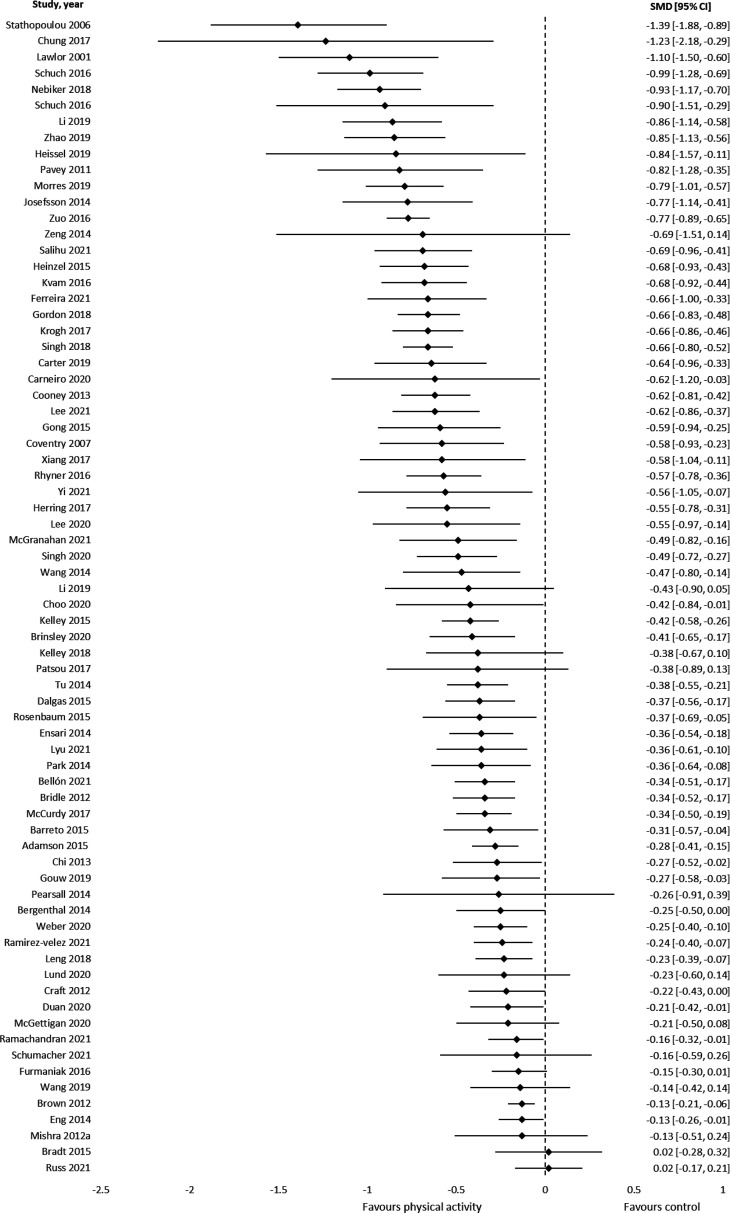
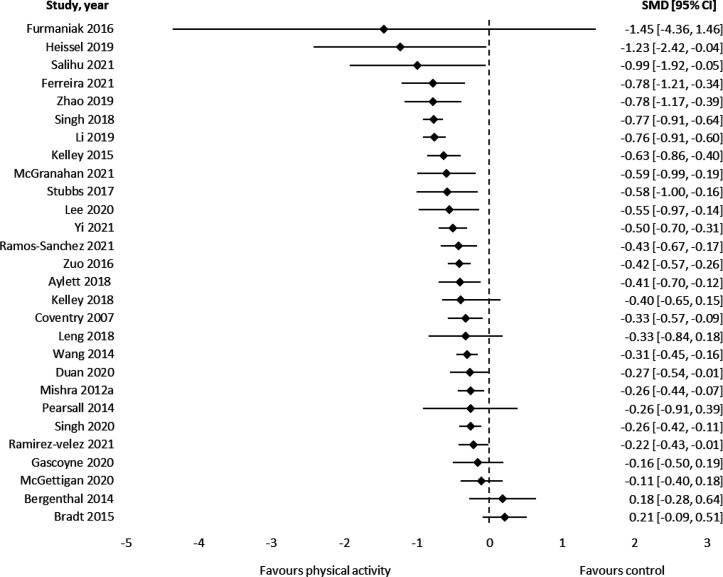
Objective: To synthesise the evidence on the effects of physical activity on symptoms of depression, anxiety and psychological distress in adult populations. Design: Umbrella review. Data sources: Twelve electronic databases were searched for eligible studies published from inception to 1 January 2022. Eligibility criteria for selecting studies: Systematic reviews with meta-analyses of randomised controlled trials designed to increase physical activity in an adult population and that assessed depression, anxiety or psychological distress were eligible. Study selection was undertaken in duplicate by two independent reviewers. Results: Ninety-seven reviews (1039 trials and 128 119 participants) were included. Populations included healthy adults, people with mental health disorders and people with various chronic diseases. Most reviews (n=77) had a critically low A MeaSurement Tool to Assess systematic Reviews score. Physical activity had medium effects on depression (median effect size=−0.43, IQR=−0.66 to –0.27), anxiety (median effect size=−0.42, IQR=−0.66 to –0.26) and psychological distress (effect size=−0.60, 95% CI −0.78 to –0.42), compared with usual care across all populations. The largest benefits were seen in people with depression, HIV and kidney disease, in pregnant and postpartum women, and in healthy individuals. Higher intensity physical activity was associated with greater improvements in symptoms. Effectiveness of physical activity interventions diminished with longer duration interventions. Conclusion and relevance: Physical activity is highly beneficial for improving symptoms of depression, anxiety and distress across a wide range of adult populations, including the general population, people with diagnosed mental health disorders and people with chronic disease. Physical activity should be a mainstay approach in the management of depression, anxiety and psychological distress. PROSPERO registration number: CRD42021292710.
Overview
The claims and statistics of this paper haven’t been checked yet.
Free: it reads the open-access text and checks the first 5 claims that cite a source we can check. Create a free account to check every claim.
Integrity signals
Registry
Cites
Statistics
Figures
Verification
Claims the paper makes
The claims and statistics of this paper haven’t been checked yet.
Free: it reads the open-access text and checks the first 5 claims that cite a source we can check. Create a free account to check every claim.
Claims other papers make about this one
Each is checked against this paper’s own text: does it say what the citing paper says it does?
The cited source doesn’t support the claim as written.
In the citing paper
“Because we simultaneously assessed more than 200 studies, credible intervals were narrower than those in most existing meta-analyses.13”
From Effect of exercise for depression: systematic review and network meta-analysis of randomised controlled trials (2024) · cites this paper as [13]
Checked by a reasoning model — may be wrong.
Experimental — accuracy not yet measuredThe source backs part of the claim, not all of it — or backs it for a different population, condition or comparison.
In the citing paper
“challenges remain regarding how to optimise exercise design to improve adherence rates 28 .”
From Effect of exercise on depression and anxiety symptoms: systematic umbrella review with meta-meta-analysis (2026) · cites this paper as [28]
Experimental — accuracy not yet measuredThe source backs part of the claim, not all of it — or backs it for a different population, condition or comparison.
In the citing paper
“physical activity is known to boost mood and reduce symptoms of depression and anxiety, which are often associated with loneliness.71”
From A Longitudinal Study of Loneliness Before the End of the COVID-19 Pandemic: Trajectories, Predictors, and Impact on Chinese Adolescent Mental Health (2024) · cites this paper as [71]
Experimental — accuracy not yet measuredThe source backs part of the claim, not all of it — or backs it for a different population, condition or comparison.
In the citing paper
“Our review included more studies than many existing reviews on exercise for depression.13 22 27 28”
From Effect of exercise for depression: systematic review and network meta-analysis of randomised controlled trials (2024) · cites this paper as [13]
Experimental — accuracy not yet measuredThe source backs part of the claim, not all of it — or backs it for a different population, condition or comparison.
In the citing paper
“our study and the study by Singh et al13 both found that effects were stronger with vigorous intensity exercise compared with light and moderate exercise.”
From Effect of exercise for depression: systematic review and network meta-analysis of randomised controlled trials (2024) · cites this paper as [13]
Experimental — accuracy not yet measured
5 more claims about this paper
Create a free account to see every claim other papers make about this one.
Self-check
Percentages, sums and reported differences re-computed from the paper’s own numbers.
The self-check needs the paper’s full text.
Citations
Cites
The PRISMA 2020 statement: An updated guideline for reporting systematic reviews
Page, M. J., McKenzie, J. E., Bossuyt, P. M., Boutron, I., Hoffmann, T. C., Mulrow, C. D., Shamseer, L., Tetzlaff, J. M., Akl, E. A., Brennan, S. E., et al. (2021) · BMJ · doi:10.1136/bmj.n71 · Cited by 108,283
Bias in meta-analysis detected by a simple, graphical test
Egger, M., Smith, G. D., Schneider, M., & Minder, C. (1997) · BMJ · doi:10.1136/bmj.315.7109.629 · Cited by 56,722
Shea, B. J., Reeves, B. C., Wells, G., Thuku, M., Hamel, C., Moran, J., Moher, D., Tugwell, P., Welch, V., Kristjansson, E., et al. (2017) · BMJ · doi:10.1136/bmj.j4008 · Cited by 10,636 · cited 2×
“29”
Background(1985) · Europe PMC (PubMed Central) · Cited by 9,143
The PRISMA 2020 statement: an updated guideline for reporting systematic reviews
Page, M. J., McKenzie, J., Bossuyt, P., Boutron, I., Hoffmann, T., mulrow, C., Shamseer, L., Tetzlaff, J., Akl, E., Brennan, S. E., et al. (2020) · doi:10.31222/osf.io/v7gm2_v1 · Cited by 8,090
Santomauro, D. F., Mantilla Herrera, A. M., Shadid, J., Zheng, P., Ashbaugh, C., Pigott, D. M., Abbafati, C., Adolph, C., Amlag, J. O., Aravkin, A. Y., et al. (2021) · The Lancet · doi:10.1016/s0140-6736(21)02143-7 · Cited by 5,444
The PRISMA 2020 statement: an updated guideline for reporting systematic reviews
Page, M. J., McKenzie, J., Bossuyt, P., Boutron, I., Hoffmann, T., mulrow, C., Shamseer, L., Tetzlaff, J., Akl, E., Brennan, S. E., et al. (2020) · doi:10.31222/osf.io/v7gm2 · Cited by 5,177
Qiu, J., Shen, B., Zhao, M., Wang, Z., Xie, B., & Xu, Y. (2020) · General Psychiatry · doi:10.1136/gpsych-2020-100213 · Cited by 4,307
Cipriani, A., Furukawa, T. A., Salanti, G., Chaimani, A., Atkinson, L. Z., Ogawa, Y., Leucht, S., Ruhe, H. G., Turner, E. H., Higgins, J. P. T., et al. (2018) · The Lancet · doi:10.1016/s0140-6736(17)32802-7 · Cited by 3,541
Cooney, G. M., Dwan, K., Greig, C. A., Lawlor, D. A., Rimer, J., Waugh, F. R., McMurdo, M., & Mead, G. E. (2013) · Cochrane Database of Systematic Reviews · doi:10.1002/14651858.cd004366.pub6 · Cited by 1,834
Research works printed but not linked: 2
- Oxford Centre for Evidence-Based Medicine. Levels of evidence (March 2009). University of Oxford, 2022.
- Ramírez-Vélez R, Zambom-Ferraresi F, García-Hermoso A, et al. Evidence-based exercise recommendations to improve mental wellbeing in women with breast cancer during active treatment: a systematic review and meta-analysis. Cancers (Basel) 2021; 13: 264. 10.3390/cancers13020264 33445739 PMC7828164 · DOI
Cited by
Items 101–200 of 999
A complex systems view on physical activity with actionable insights for behaviour change
Schüler, J., Heino, M. T. J., Balagué, N., Chater, A., Grüber, M., Kanning, M. K., Keim, D. A., Mier, D. U., Moreno‐Villanueva, M., Nußbeck, F. W., et al. (2025) · Nature Human Behaviour · doi:10.1038/s41562-025-02279-2 · Cited by 14
“By contrast, the health benefits of PA are well established; it is widely recognized as a core intervention for preventing non-communicable diseases 8 and mitigating mental health issues 9,10 .”
Cheng, T., Formolo, D. A., Yu, J., Zhong, Y., Ma, Z., Hussain, A., Silveira, F. N. P., Zhang, L., Cheng, K. K. Y., Kranz, G. S., et al. (2025) · Molecular Psychiatry · doi:10.1038/s41380-025-03317-1 · Cited by 15
Todorova, Y., Wellings, I., Thompson, H., Barutcu, A., James, L. J., BISHOP, N. C., O’Donnell, E., Shaw, C. N., & Longman, D. P. (2023) · Urban Science · doi:10.3390/urbansci7030085 · Cited by 17
“The stress-relieving effects of physical activity are well documented [17,18] and positively influence both physical and mental health.”
BackgroundJung, A., Geidl, W., Matting, L., Hoessel, L.-M., Siemens, W., Sudeck, G., & Pfeifer, K. (2024) · Physical Therapy · doi:10.1093/ptj/pzae053 · Cited by 14
Karhu, J., Veijola, J., & Hintsanen, M. (2024) · Journal of Affective Disorders · doi:10.1016/j.jad.2024.07.049 · Cited by 17
Tian, S., Liang, Z., Tian, M., Qiu, F., Yu, Y., Mou, H., & Gao, Y. (2024) · Age and Ageing · doi:10.1093/ageing/afae211 · Cited by 20
A dual-continuum framework to evaluate climate change impacts on mental health
Vergunst, F., Smith, R. W., Massazza, A., Berry, H. L., & Olff, M. (2024) · Nature Mental Health · doi:10.1038/s44220-024-00326-x · Cited by 19
“For example, increasing physical activity has positive effects on psychological wellbeing and symptoms for many common disorders 92–94 , so infrastructure and policy efforts that facilitate this goal should have salutogenic effects on population mental health 95,96 .”
Remskar, M., Ainsworth, B., Maynard, O., Malkowski, O. S., Birch, A., Burd, A., Caretu, T.-C., Assaad, L. E., Christodoulou-Tsiaoukkas, A., Menon, A., et al. (2025) · Mental health and physical activity · doi:10.1016/j.mhpa.2025.100680 · Cited by 13
Lindvall, M. A., Lidström-Holmqvist, K., Svedell, L. A., Philipson, A., Cao, Y., & Msghina, M. (2023) · BMC Psychiatry · doi:10.1186/s12888-023-05181-1 · Cited by 18
“In general, moderate to vigorous exercising for at least 150 min a week greatly reduces the risk of cardiovascular disease, diabetes and premature death and has major effects on the mental state and illnesses such as depression and anxiety [15, 16, 22].”
BackgroundXu, L., Ji, Y., & Xu, W. (2025) · BMC Public Health · doi:10.1186/s12889-025-24528-9 · Cited by 19
“A systematic review by Singh et al. showed that regular PA is associated with better mental health outcomes, such as reduced symptoms of depression (MES = −0.43) and anxiety (MES = −0.42) [8].”
InfluentialExercise as a therapeutic intervention for long-lasting and chronic diseases
Febbraio, M. A., & Pedersen, B. K. (2026) · Cell Metabolism · doi:10.1016/j.cmet.2026.02.017 · Cited by 12
Dashputre, A., Agho, K., Piya, M. K., Glenister, K., Bourke, L., Hannah, S., Bhat, R. S., Osuagwu, U. L., & Simmons, D. S. (2023) · BMC Psychiatry · doi:10.1186/s12888-023-04931-5 · Cited by 20
“In a recent review study [45], physical activity was about 1.”
BackgroundYoga and Mental Well-being: A Qualitative Exploration of the Lived Experiences of Yoga Practitioners
Vogler, S., Salyer, R., & Giacobbi, P. R. (2023) · International Journal of Yoga · doi:10.4103/ijoy.ijoy_191_23 · Cited by 20
“[2] Furthermore, a meta‑analysis focusing on PA and the risk of depression found an inverse dose‑response suggesting that PA, even at levels below public health recommendations, significantly reduced the risk of depression.”
BackgroundCoronado, R. A., Pennings, J. S., Master, H., Brintz, C., Cole, K. R., Helmy, J., Oleisky, E. R., Davidson, C. A., Abtahi, A. M., Stephens, B. F., et al. (2024) · Spine · doi:10.1097/brs.0000000000005000 · Cited by 11
“65,66 Preliminary work indicates that a coach-led telehealth physical activity intervention using wearable technology is”
Nawrin, S. S., Inada, H., Momma, H., & Nagatomi, R. (2024) · BMC Public Health · doi:10.1186/s12889-024-18759-5 · Cited by 18
“…have demonstrated that all modes of physical activity effectively reduce depressive symptoms, although high-intensity physical activity shows more significant improvements in reducing mild to moderate symptoms of depression, anxiety, and psychological distress in diverse adult populations [17].”
BackgroundWang, Y., Yang, X., Zhou, Y., Ruan, W., Li, H., Han, Y., & Wang, H. (2024) · Journal of Affective Disorders · doi:10.1016/j.jad.2024.05.057 · Cited by 11
Luttenberger, K., Baggenstos, B., Najem, C., Sifri, C., Lewczuk, P., Radegast, A., & Rosenbaum, S. (2024) · Conflict and Health · doi:10.1186/s13031-024-00615-3 · Cited by 18
“Numerous meta-analyses [14–16] and Mendelian randomization studies have shown causal relationships between PA and the reduction of depression [5, 17, 18].”
BackgroundRosa, C. D., Larson, L. R., Collado, S., Geiger, S. J., Profice, C. C., & Menuchi, M. R. T. P. (2024) · Journal of Environmental Psychology · doi:10.1016/j.jenvp.2024.102438 · Cited by 15
Huang, Z., Chen, B., Dong, X., He, J., Liu, Y., Li, J., & Zhou, Y. (2024) · Journal of Affective Disorders · doi:10.1016/j.jad.2024.10.039 · Cited by 13
Tadsuan, J., Lai, Y., Lee, Y., & Chen, M.-R. (2024) · Journal of Cancer Survivorship · doi:10.1007/s11764-024-01696-y · Cited by 17
Zhang, Y., Tian, M., Yang, J., Xi, Y., Li, Z., & Wang, L. (2024) · Frontiers in Psychology · doi:10.3389/fpsyg.2024.1433880 · Cited by 16
Nayak, S. S., Amini‐Salehi, E., Ulrich, M. T., Sahli, Y., Fleischman, M., Patel, M., Naeiji, M., Maghsoodifar, H., Douki, S. A. H. S., Alotaibi, A., et al. (2025) · Annals of Medicine and Surgery · doi:10.1097/ms9.0000000000003034 · Cited by 14
“A study by Singh et al that was published in the British Journal of Sports Medicine in 2023 was the second study with the greatest 180-day usage count [ 42 ] .”
Dang, K., Ritvo, P., Katz, J. D., Gratzer, D., Knyahnytska, Y., Ortiz, A., Walters, C., Attia, M., Gonzalez‐Torres, C., Lustig, A., et al. (2023) · Interactive Journal of Medical Research · doi:10.2196/46419 · Cited by 15
“…evidence supports increased physical activity (PA) and its exercise subsets [6,7] as an adjunctive treatment for major depressive disorder (MDD) or as a single-modality treatment [8-12] with small to moderate antidepressant effects [13,14] and protective benefits against future depression [15].”
BackgroundGriffiths, C., Walker, K., Jiang, H., Noel-Johnson, A., & Zafar, A. (2023) · Open Journal of Depression · doi:10.4236/ojd.2023.124007 · Cited by 11
“Engaging in increased physical activity where depression is present may be particularly valuable, as evidence shows that aerobic exercise can be as effective as taking antidepressant medication or undergoing psychotherapy (Babyak et al., 2000; Singh et al., 2023).”
BackgroundHanna, C., Yao, R., Sajjad, M., Gold, M. S., Blum, K., & Thanos, P. K. (2023) · Brain Sciences · doi:10.3390/brainsci13121705 · Cited by 11
“Exercise itself is an effective psychiatric treatment when prescribed for depression and anxiety [47].”
BackgroundThe effects of exercise training interventions on depression in hemodialysis patients
Yu, H., Huang, M. H., Tao, Y., Li, S., Wang, J., Li, P., Lv, H., & Ni, C. (2024) · Frontiers in Psychiatry · doi:10.3389/fpsyt.2023.1321413 · Cited by 15
Park, J., Nam, H.-K., & Cho, S. (2024) · BMJ Open · doi:10.1136/bmjopen-2023-078199 · Cited by 11
“42”
Yang, H., Chang, Q., Ji, C., Zheng, G., Ma, Z., Chen, L., Xia, Y., & Zhao, Y. (2024) · International Journal of Behavioral Nutrition and Physical Activity · doi:10.1186/s12966-024-01617-3 · Cited by 10
Bai, L., Wen, Z., Zhu, Y., Jama, H. A., Sawmadal, J. D., & Chen, J. (2024) · Frontiers in Public Health · doi:10.3389/fpubh.2024.1402715 · Cited by 12
Zhang, R., Schwandt, M. L., Vines, L., & Volkow, N. D. (2024) · Journal of the American Academy of Child & Adolescent Psychiatry · doi:10.1016/j.jaac.2024.11.005 · Cited by 13
Zhou, H., Jiang, F., Liu, H., Wu, Y., & Tang, Y. (2025) · iScience · doi:10.1016/j.isci.2025.111866 · Cited by 14
“5,6 Consequently, exploring the associations between health behaviors and mental health can inform future interventions.”
Conformal Depression Prediction
Li, Y., Qu, S., & Zhou, X. (2025) · IEEE Transactions on Affective Computing · doi:10.1109/taffc.2025.3542023 · Cited by 18
“Over the past decade, continuous efforts have been made to explore effective biomarkers and methods for automated depression prediction.”
Marques, L. M., & Battistella, L. R. (2025) · Global Health Journal · doi:10.1016/j.glohj.2025.02.004 · Cited by 18
Wu, P., Qian, M., Chen, X., Zhu, M., & Liu, J. (2025) · Journal of Psychosomatic Research · doi:10.1016/j.jpsychores.2025.112107 · Cited by 12
Radiologist and Radiology Practice Wellbeing: A Report of the 2023 ARRS Wellness Summit
Azour, L., Goldin, J. G., & Kruskal, J. B. (2023) · Academic Radiology · doi:10.1016/j.acra.2023.08.025 · Cited by 10
Influence of CrossFit and Deep End Fitness training on mental health and coping in athletes
Cansler, R., Heidrich, J., Whiting, A., Tran, D., Hall, P., & Tyler, W. J. (2023) · Frontiers in Sports and Active Living · doi:10.3389/fspor.2023.1061492 · Cited by 10
Liu, S., Mei, Y., Huang, L. Y., Liu, X., & Xi, Y. (2024) · BMJ Open · doi:10.1136/bmjopen-2023-076095 · Cited by 16
Lodin, K., Espinosa‐Ortega, F., Lundberg, I. E., & Alexanderson, H. (2024) · Journal of Inflammation Research · doi:10.2147/jir.s377102 · Cited by 10
“Solid scientific evidence supports physical activity and exercise as effective to treat mild to moderate depression regardless of diagnosis, 113 and thus could be assumed to be effective also in individuals with myositis.”
BackgroundEffects of exergames on rehabilitation outcomes in patients with osteoarthritis. A systematic review
Guede-Rojas, F., Andrades-Torres, B., Aedo-Díaz, N., González-Koppen, C., Muñoz-Fuentes, M., Enríquez-Enríquez, D., Carvajal-Parodi, C., Mendoza, C., Álvarez, C., & Fuentes, J. (2024) · Disability and Rehabilitation · doi:10.1080/09638288.2024.2368057 · Cited by 13
“Physical activity and exercise improve symptoms of depression and anxiety in the adult population, including the general population, people with mental health disorders, and those with chronic diseases [100].”
Association between depression, anemia and physical activity using isotemporal substitution analysis
Nam, H.-K., Park, J., & Cho, S. (2023) · BMC Public Health · doi:10.1186/s12889-023-17117-1 · Cited by 15
“Scientific evidence has supported the health benefits of engaging in physical activity for addressing depression [26, 27] with underlying biological and psychological mechanisms.”
BackgroundHeidarianpour, A., Shokri, E., Sadeghian, E., Cheraghi, F., & Razavi, Z. (2023) · Frontiers in Pediatrics · doi:10.3389/fped.2023.1241744 · Cited by 9
Luo, C.-Y., Jiao, P., Tu, S.-M., Shen, L., & Sun, Y.-M. (2023) · World Journal of Psychiatry · doi:10.5498/wjp.v13.i12.1096 · Cited by 10
Yan, L., Wang, W., Cheng, T., Yang, D.-R., Wang, Y., Wang, Y., Yang, F., So, K., & Zhang, L. (2024) · Acta Pharmacologica Sinica · doi:10.1038/s41401-024-01302-y · Cited by 9
Brown, C. E. B., Richardson, K. E., Pizzirani, B., Hughes, S. D., Atkins, L., Perowne, R., Pitt, J., Yücel, M., & Segrave, R. A. (2024) · BMC Public Health · doi:10.1186/s12889-024-19385-x · Cited by 12
“Harnessing the well-established mental and cognitive health benefits of exercise [8, 9, 40] offers a solution to address this unmet need.”
BackgroundUp for Debate: Does Regular Physical Activity Really Improve Mental Health?
Bustamante, E. E., Brellenthin, A. G., BROWN, D. R., & O’Connor, P. J. (2024) · Medicine & Science in Sports & Exercise · doi:10.1249/mss.0000000000003636 · Cited by 11
“…of mental health (i.e., healthy adults, people with various chronic diseases and people with mental health disorders) and found that exercise was associated with an approximately 0.40 effect size improvement of depression and anxiety using de- pression-and anxiety-specific outcome measures (60).”
InfluentialYoga and chronic diseases: an umbrella review of systematic reviews and meta-analyses
Wang, F., Yang, W., Wang, C., Wang, K., Yu, Z., Ke, D., Sun, L., & Gao, X. (2025) · Medical Review · doi:10.1515/mr-2024-0078 · Cited by 19
Fen, Y., Jia, S., Liu, Q., Guo, Z., Li, S., Wang, X., & Pan, L. (2025) · Brain and Behavior · doi:10.1002/brb3.70285 · Cited by 11
Høeg, B. L., Løppenthin, K. B., Savard, J., Johansen, C., Christensen, J. F., Svendsen, M. N., Holländer, N. H., & Bidstrup, P. E. (2025) · Acta Oncologica · doi:10.2340/1651-226x.2025.42246 · Cited by 12
Baumann, H., Singh, B., Staiano, A. E., Gough, C., Ahmed, M., Fiedler, J., Timm, I., Wunsch, K., Button, A., Yin, Z., et al. (2025) · Frontiers in Digital Health · doi:10.3389/fdgth.2025.1593677 · Cited by 18
Self-citationSahni, A., & McCabe, C. (2025) · JMIR Mental Health · doi:10.2196/74427 · Cited by 14
Chao, Y., Huang, W., Hu, C., Zhang, W. W., Chen, B., Zhou, C., Zhu, D. H., & Xu, B. (2026) · Frontiers in Public Health · doi:10.3389/fpubh.2025.1704120 · Cited by 13
Physical Activity and Exercise as a Tool to Cure Anxiety and Posttraumatic Stress Disorder
Sabri, S., Rashid, N., & Mao, Z. (2023) · Mental Illness · doi:10.1155/2023/4294753 · Cited by 12
Self-Reported Physical Activity and Mental Health Among Asylum Seekers in a Refugee Camp
Filippou, K., Knappe, F., Hatzigeorgiadis, A., Morres, I. D., Tzormpatzakis, E., Havas, E., Pühse, U., Theodorakis, Y., & Gerber, M. (2024) · Journal of Physical Activity and Health · doi:10.1123/jpah.2023-0325 · Cited by 17
Zhu, J.-H., Shen, Z., Liu, B.-P., & Jia, C.-X. (2024) · Social Psychiatry and Psychiatric Epidemiology · doi:10.1007/s00127-024-02708-z · Cited by 11
Anker, E. A., Sture, S. E. B., Hystad, S. W., & Kodal, A. (2024) · Frontiers in Psychiatry · doi:10.3389/fpsyt.2024.1254050 · Cited by 12
Smith, J. J., Beauchamp, M. R., Puterman, E. M., Leahy, A. A., Valkenborghs, S. R., Wade, L., Chen, F. S., & Lubans, D. R. (2024) · Psychology of sport and exercise · doi:10.1016/j.psychsport.2024.102754 · Cited by 11
Mohamed, N. A., Mohamed, Y. A., Ali, T. A., Gabow, A. A., & Hilowle, F. M. (2024) · Risk Management and Healthcare Policy · doi:10.2147/rmhp.s488303 · Cited by 11
Duan, T., Cao, Z., Wang, X., Min, J., Sun, T., Hong, L., & Xu, C. (2024) · The British Journal of Psychiatry · doi:10.1192/bjp.2024.227 · Cited by 8
Pre-operative impact of multimodal prehabilitation in gynecologic oncology patients
Miralpeix, E., Rodriguez-Cosmen, C., Fabregó, B., Solé‐Sedeño, J., Carazo, J., Sadurní, M., Corcoy, M., & Mancebo, G. (2024) · International Journal of Gynecological Cancer · doi:10.1016/j.ijgc.2024.100062 · Cited by 8
VaezMousavi, M., Carneiro, L. S. R. D. S. F., Shams, A., Abbasi, H., Dehkordi, P. S., Bayati, M., & Nobarı, H. (2025) · PLoS ONE · doi:10.1371/journal.pone.0314202 · Cited by 9
Chen, Z., Xin, J., Jia, J., Tu, J., & Li, X. (2025) · BMC Psychiatry · doi:10.1186/s12888-025-06612-x · Cited by 10
“Physical activity (PA) interventions have emerged as a viable and evidence-based therapeutic strategy for mitigating the symptoms of anxiety disorders [10, 11].”
Liu, X., Du, Z., Wang, L., Tian, J., Zhang, L., & Li, Y. (2025) · Mental health and physical activity · doi:10.1016/j.mhpa.2025.100677 · Cited by 11
Zhang, S. (2025) · Frontiers in Psychology · doi:10.3389/fpsyg.2025.1572974 · Cited by 9
Du, X., Jiang, F., & Yuan, S. (2025) · Frontiers in Psychology · doi:10.3389/fpsyg.2025.1616970 · Cited by 11
Liu, M. (2026) · Frontiers in Psychology · doi:10.3389/fpsyg.2026.1775139 · Cited by 9
“Previous studies have linked regular PA with fewer depressive and anxiety symptoms, reduced stress reactivity, and better sleep quality, all of which are relevant to SI (Singh et al., 2023; Samsudin et al., 2024; Recchia et al., 2023).”
Delbari, A., Ghavidel, F., Bidkhori, M., Saatchi, M., Momtaz, Y. A., Efati, S., & Hooshmand, E. (2023) · Journal of Research in Health Sciences · doi:10.34172/jrhs.2023.126 · Cited by 9
“…related factors in community-dwelling adults could have potentially led to the development of mental health issues such as depression and anxiety, which are known to negatively impact SQ. 34,35 On the other hand, the majority of participants reported being in the middle or lowest financial level.”
BackgroundGlavaš, D., & Banai, I. P. (2024) · International Journal of Environmental Research and Public Health · doi:10.3390/ijerph21070854 · Cited by 12
“Similarly, the present results are in line with previous studies indicating negative relationships between PA levels (moderate and high) and self-reported anxiety and depression symptoms [15], as well as stress [14].”
BackgroundResultInfluentialEvaluating the impact of rock climbing on mental health and emotional well-being in adolescents
Gürer, H., Akçınar, F., Arslan, S. C., AKÇINAR, S., Güllü, M., Eken, Ö., Kurtoğlu, A., Ilkım, M., Alotaibi, M. H., & Elkholi, S. M. A. (2024) · Frontiers in Psychology · doi:10.3389/fpsyg.2024.1426654 · Cited by 19
Dong, J., Huang, J., Parisi, J. M., Zhou, Z. E., Li, M., Calderon, R., & Li, J. (2025) · Sleep Health · doi:10.1016/j.sleh.2024.12.004 · Cited by 9
Bell, E. C., Pazzinatto, M. F., Wallis, J. A., Kemp, J. L., Skou, S. T., O’Halloran, P., Crossley, K. M., Silva, D. D. O., Semciw, A. I., Dundules, K., et al. (2023) · Musculoskeletal Care · doi:10.1002/msc.1828 · Cited by 10
Phan, A., Askim, T., Lydersen, S., Indredavik, B., & Wethal, T. (2023) · Journal of Rehabilitation Medicine · doi:10.2340/jrm.v55.12309 · Cited by 9
“In healthy subjects and different patient populations, several studies have established that PA is effective in improving depression and anxiety (8).”
BackgroundAnxiety, Academic Performance, and Physical Activity in University Students: A Scoping Review
Vinueza-Fernández, I., Esparza, W., Martín-Rodríguez, A., & Sánchez-Cajas, E. (2025) · European Journal of Investigation in Health, Psychology and Education · doi:10.3390/ejihpe15110231 · Cited by 7
“This focus reflects growing evidence suggesting PA may serve as both a protective factor against anxiety/academic stress and a potential enhancer of cognitive performance (Rodriguez-Ayllon et al., 2019; Singh et al., 2023).”
Kiadaliri, A., Hörder, H., Lohmander, S. L., & Dahlberg, L. (2023) · Pain Medicine · doi:10.1093/pm/pnad167 · Cited by 8
Østergaard, E. B., Sparre, P. W., & Dahlgaard, J. (2024) · Healthcare · doi:10.3390/healthcare12101004 · Cited by 11
“This aspect could be interesting to explore in another investigation, as a review also highlights the need for a more detailed evaluation of the design and delivery of blue space interventions [1].”
BackgroundSore, K., Franic, F., Androja, L., Kokić, I. B., Marčinko, D., Drmić, S., Markser, V. Z., & Franić, T. (2024) · Sports · doi:10.3390/sports12080228 · Cited by 11
“Singh et al.’s systematic review assessed physical activity’s efficacy in reducing depression and anxiety symptoms, concluding that various adult populations, including those with mental or chronic illnesses, benefit significantly from physical activity [17].”
Moran, R., Sperandei, S., Peel, N., Gray, T. L., & Reis, A. C. (2024) · Mental health and physical activity · doi:10.1016/j.mhpa.2024.100629 · Cited by 8
Adolescent resilience in the face of COVID-19 stressors: the role of trauma and protective factors
Zhang, L., Cropley, V., Whittle, S., & Rakesh, D. (2024) · Psychological Medicine · doi:10.1017/s0033291724001806 · Cited by 12
“The use of the frequency measure is supported by evidence indicating that the frequency of participation in physical activity is associated with a reduction in both depression and anxiety symptoms (Singh et al., 2023).”
BackgroundThe Role of Psychological Factors and Resilience in Mediating Sports Passion in Triathletes
Ancarani, F., Gavín-Chocano, Ó., López-Barajas, D. M., & Vicente‐Rodríguez, G. (2024) · European Journal of Investigation in Health Psychology and Education · doi:10.3390/ejihpe14120193 · Cited by 9
“Specifically, the association of sports practice with significant psychological and social benefits for health has been demonstrated in numerous studies, the most relevant being well-being, anxiety, and stress reduction [2].”
Gong, C., Li, Y., & Chen, G. (2024) · Risk Management and Healthcare Policy · doi:10.2147/rmhp.s499489 · Cited by 11
Levinger, P., Mcconaghy, R., Dreher, B. L., James, L., Fearn, M., McKenna, T., Hallissey, M., & Hill, K. (2025) · Journal of Population Ageing · doi:10.1007/s12062-024-09472-7 · Cited by 8
“Importantly, increasing physical activity has been shown to be safe and effective in improving physical and mental health outcomes in older people, including those with substantial health problems (Blondell et al. 2014; Cunha et al. 2024; Lachman et al. 2018; Singh et al. 2023).”
Abernethy, D., Bennie, J. A., & Pavey, T. (2025) · PLoS ONE · doi:10.1371/journal.pone.0316051 · Cited by 9
Liu, Y., Huang, C., Wei, K., Lin, R., Yao, Y., Qin, G., & Yu, Y. (2025) · Journal of Affective Disorders · doi:10.1016/j.jad.2025.03.110 · Cited by 11
Chalimourdas, A., Hansen, D., Verboven, K., & Michiels, S. (2025) · Ear and Hearing · doi:10.1097/aud.0000000000001682 · Cited by 7
Zhao, C., Tao, X., Lei, B., Zhang, Y., Li, G., Lv, Y., & Yu, L. (2025) · Current Oncology · doi:10.3390/curroncol32060304 · Cited by 9
“A meta-analysis by Singh et al. [46] showed that physical activity is particularly effective in alleviating symptoms of depression and anxiety in adults.”
Lederman, O., Chapman, J., Fibbins, H., Haywood, D., Hart, N. H., Furzer, B. J., Wright, K. E., McKeon, G., Brinsley, J., Mastrogiovanni, C., et al. (2026) · British Journal of Sports Medicine · doi:10.1136/bjsports-2025-110879 · Cited by 11
Yue, Y., Zhu, D., Zeng, Q., Hu, C., & Xu, B. (2026) · Frontiers in Psychology · doi:10.3389/fpsyg.2026.1881725 · Cited by 8
“This finding is generally consistent with previous evidence suggesting that physical activity contributes to better mental health and lower symptoms of depression and anxiety (Singh et al., 2023; Rebar et al., 2015).”
Sher, C., & Wu, C. (2023) · Mental health and physical activity · doi:10.1016/j.mhpa.2023.100546 · Cited by 9
Gehris, J. S., Oyeyemi, A. L., Baishya, M. L., Roth, S. C., & Stoutenberg, M. (2023) · Preventive Medicine Reports · doi:10.1016/j.pmedr.2023.102509 · Cited by 11
Tang, J., Chen, L., Zhang, H., Wei, P., & Miao, F. (2024) · Frontiers in Public Health · doi:10.3389/fpubh.2024.1330521 · Cited by 7
Research status and trends of physical activity on depression or anxiety: a bibliometric analysis
Zhang, X., Ye, F., Yin, Z., Li, Y., Bao, Q.-N., Xia, M., Chen, Z., Zhong, W., Wu, K., Yao, J., et al. (2024) · Frontiers in Neuroscience · doi:10.3389/fnins.2024.1337739 · Cited by 12
Mental training strategies in improving sport performance: A literature review
Ihsan, F., Nasrulloh, A., Nugroho, S., & Yuniana, R. (2024) · doi:10.56984/8zg020atip · Cited by 16
A Call for the Implementation of Physical Activity as a Vital Sign (PAVS) During Pregnancy
Sparks, J. R., Ruiz‐Ramie, J. J., Kishman, E. E., & Wang, X. (2024) · American Journal of Lifestyle Medicine · doi:10.1177/15598276241295993 · Cited by 7
Nature, activity, and social drivers of mental resilience: a test with mid-life women surfers
Buckley, R., & Cooper, M. (2025) · Tourism Recreation Research · doi:10.1080/02508281.2024.2437716 · Cited by 8
“Benefits increase with: exercise (Singh et al., 2023); nature connectedness (Barragan-Jason et al., 2022; Chang et al., 2024; Huynh et al., 2022; Rozario et al., 2024a, 2024b; Swami et al., 2024); sensory engagement (Zhong et al., 2024); and higher biodiversity (Fisher et al., 2023; Gillerot et…”
Physical activity among pregnant inpatients and outpatients and associations with anxiety
Panelli, D. M., Miller, H. E., Simpson, S. L., Hurtado, J., Shu, C.-H., Boncompagni, A. C., Chueh, J. T., Carvalho, B., Sultan, P., Aghaeepour, N., et al. (2024) · European Journal of Obstetrics & Gynecology and Reproductive Biology · doi:10.1016/j.ejogrb.2024.03.033 · Cited by 8
Beltrán, J., Jacob, Y., Mehta, M., Hossain, M. T., Adams, A., Fontaine, S., Torous, J. B., McDonough, C., Johnson, M., Delgado, A. D., et al. (2024) · medRxiv · doi:10.1101/2024.08.06.24311477 · Cited by 10
Exploring exercise adherence and quality of life among veteran, novice, and dropout trainees
Gabay, M., Levi, O., Petracovschi, S., Negrea, C., Matichescu, M., & Oravitan, M. (2023) · Frontiers in Sports and Active Living · doi:10.3389/fspor.2023.1293535 · Cited by 6
New parents’ sleep, movement, health, and well-being across the postpartum period
Kracht, C. L., Blanchard, C. M., Downs, D. S., Beauchamp, M. R., & Rhodes, R. E. (2024) · Behavioral Sleep Medicine · doi:10.1080/15402002.2024.2339815 · Cited by 8
“For our second aim to examine bi-directional relationships, in contrast to prior research findings (Singh et al., 2023), we found support for physical health and well-being predicting later PA, but not the other way around.”
Petzold, M. B., Betzler, F., Plag, J., Ströhle, A., & Bendau, A. (2024) · European Archives of Psychiatry and Clinical Neuroscience · doi:10.1007/s00406-024-01819-7 · Cited by 9
Hautala, A. J., Shavazipour, B., Afşar, B., Tulppo, M. P., & Miettinen, K. (2024) · Frontiers in Public Health · doi:10.3389/fpubh.2024.1378349 · Cited by 8
“Therefore, it should be offered as an evidence-based treatment option to individuals with a diagnosis of a major depressive disorder or those with depressive symptoms (29) and similarly with cardiovascular disease patients suffering from mental health disorders (30).”
BackgroundSleep Disturbances and Depression Levels among General Indonesian Population: A National Survey
Alfian, S. D., Thurfah, J. N., Griselda, M., & Puspitasari, I. M. (2024) · Clinical Practice and Epidemiology in Mental Health · doi:10.2174/0117450179326359240903045716 · Cited by 11
Metadata
- Authors
- Singh, B., Olds, T., Curtis, R., Dumuid, D., Virgara, R., Watson, A., Szeto, K., O'Connor, E., Ferguson, T., Eglitis, E., Miatke, A., Simpson, C. E., & Maher, C.
- Affiliations
- University of South Australia (AU)
- Corresponding author
- Singh, Ben
- ORCID
- Venue
- British Journal of Sports Medicine
- Publisher
- BMJ
- Published
- 2023-02-16
- Volume
- 57
- Issue
- 18
- Pages
- 1203-1209
- ISSN
- 0306-3674 (ISSN-L)
- 1473-0480
- PMC
- PMC10579187
- OpenAlex
- W4321054304
- Semantic Scholar
- e1ee60d02a701d40ce44367f24240e1deee861ec
- Cited by
- 1,049
- References
- 141
- Citations by year
- 2026: 347 · 2025: 331 · 2024: 295 · 2023: 75
- FWCI
- 37.39
- Type
- journal article
- Language
- en
- Open access
- hybrid
- doi.org
- Licence
- Locations
- British Journal of Sports Medicine (publishedVersion, cc-by-nc)
- PubMed Central (publishedVersion, cc-by-nc-sa)
- PubMed (publishedVersion)
- UniSA Research Outputs Repository (University of South Australia) (submittedVersion, other-oa)
- Adelaide Research & Scholarship (AR&S) (University of Adelaide) (submittedVersion, cc-by-nc)
- HighWire Press Open Archive (submittedVersion)
- Funders
- Australian National Health and Medical Research Council (APP1162166)
- Medical Research Future Fund Emerging Leader Grant (GNT1193862)
- NHMRC (APP1171981)
- Topics
- Health Sciences › Medicine › Public Health, Environmental and Occupational Health › Physical Activity and Health
- Social Sciences › Psychology › Experimental and Cognitive Psychology › Anxiety, Depression, Psychometrics, Treatment, Cognitive Processes
- Health Sciences › Medicine › Oncology › Cancer survivorship and care
- Keywords
- physical activity interventions, depression, anxiety, psychological distress, mental health, chronic disease, HIV, kidney disease, pregnancy, postpartum women, exercise intensity, intervention duration, adults
- MeSH terms
- Systematic Reviews as Topic, Adult, Anxiety, Mental Disorders, Chronic Disease, Depression, Female, Health Status, Humans, Pregnancy, Quality of Life
About these checks
Registry, retraction, Cites and statistics results are computed, not judged, with one exception: a printed reference that no index lists is read once by a model before it counts as a citation error. Claims are extracted by a model and kept only when their quote appears verbatim in the text; each cited source is then checked, with a model’s help, for whether it says what the claim relies on. Those verdicts can be wrong — read the claim’s quote and the cited source before relying on one.
Statistics and arithmetic are recomputed, not judged.
Confidence bands are shown only for fields calibrated on our annotated test set. None is calibrated yet, so no band is shown.
What counts as a claim ›How we measure confidence ›How we check this ›
Are you an author, or do you see a problem with this page? Request a review
Data sources
Bibliographic data: Semantic Scholar, OpenAlex, Crossref.
Contains information from the Semantic Scholar Academic Graph Datasets, made available under the ODC Attribution License (ODC-BY 1.0).
Semantic Scholar’s data is described in: Kinney, R., et al. (2023). The Semantic Scholar Open Data Platform. arXiv:2301.10140.
