

Effectiveness of physical activity interventions for improving depression, anxiety and distress: an overview of systematic reviews
Open accessThe DOI matches its Crossref record; 140 of the 141 references it cites were found in a registry or an index.
Abstract
Objective: To synthesise the evidence on the effects of physical activity on symptoms of depression, anxiety and psychological distress in adult populations. Design: Umbrella review. Data sources: Twelve electronic databases were searched for eligible studies published from inception to 1 January 2022. Eligibility criteria for selecting studies: Systematic reviews with meta-analyses of randomised controlled trials designed to increase physical activity in an adult population and that assessed depression, anxiety or psychological distress were eligible. Study selection was undertaken in duplicate by two independent reviewers. Results: Ninety-seven reviews (1039 trials and 128 119 participants) were included. Populations included healthy adults, people with mental health disorders and people with various chronic diseases. Most reviews (n=77) had a critically low A MeaSurement Tool to Assess systematic Reviews score. Physical activity had medium effects on depression (median effect size=−0.43, IQR=−0.66 to –0.27), anxiety (median effect size=−0.42, IQR=−0.66 to –0.26) and psychological distress (effect size=−0.60, 95% CI −0.78 to –0.42), compared with usual care across all populations. The largest benefits were seen in people with depression, HIV and kidney disease, in pregnant and postpartum women, and in healthy individuals. Higher intensity physical activity was associated with greater improvements in symptoms. Effectiveness of physical activity interventions diminished with longer duration interventions. Conclusion and relevance: Physical activity is highly beneficial for improving symptoms of depression, anxiety and distress across a wide range of adult populations, including the general population, people with diagnosed mental health disorders and people with chronic disease. Physical activity should be a mainstay approach in the management of depression, anxiety and psychological distress. PROSPERO registration number: CRD42021292710.
Overview
The claims and statistics of this paper haven’t been checked yet.
Free: it reads the open-access text and checks the first 5 claims that cite a source we can check. Create a free account to check every claim.
Integrity signals
Registry
Cites
Statistics
Figures
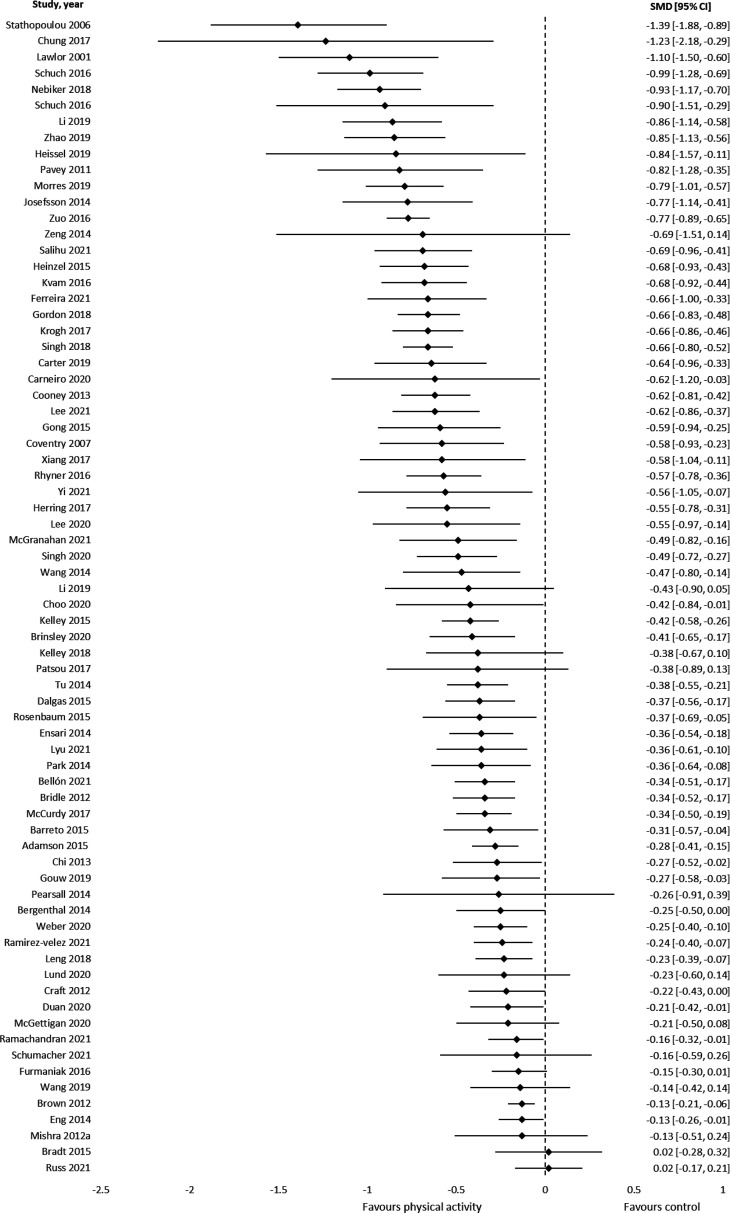
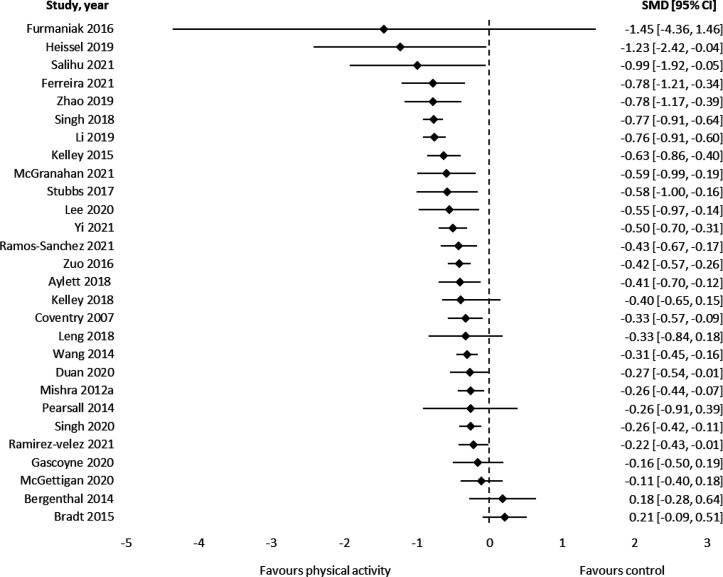
Verification
Claims the paper makes
The claims and statistics of this paper haven’t been checked yet.
Free: it reads the open-access text and checks the first 5 claims that cite a source we can check. Create a free account to check every claim.
Claims other papers make about this one
Each is checked against this paper’s own text: does it say what the citing paper says it does?
The cited source doesn’t support the claim as written.
In the citing paper
“Because we simultaneously assessed more than 200 studies, credible intervals were narrower than those in most existing meta-analyses.13”
From Effect of exercise for depression: systematic review and network meta-analysis of randomised controlled trials (2024) · cites this paper as [13]
Checked by a reasoning model — may be wrong.
Experimental — accuracy not yet measuredThe source backs part of the claim, not all of it — or backs it for a different population, condition or comparison.
In the citing paper
“challenges remain regarding how to optimise exercise design to improve adherence rates 28 .”
From Effect of exercise on depression and anxiety symptoms: systematic umbrella review with meta-meta-analysis (2026) · cites this paper as [28]
Experimental — accuracy not yet measuredThe source backs part of the claim, not all of it — or backs it for a different population, condition or comparison.
In the citing paper
“physical activity is known to boost mood and reduce symptoms of depression and anxiety, which are often associated with loneliness.71”
From A Longitudinal Study of Loneliness Before the End of the COVID-19 Pandemic: Trajectories, Predictors, and Impact on Chinese Adolescent Mental Health (2024) · cites this paper as [71]
Experimental — accuracy not yet measuredThe source backs part of the claim, not all of it — or backs it for a different population, condition or comparison.
In the citing paper
“Our review included more studies than many existing reviews on exercise for depression.13 22 27 28”
From Effect of exercise for depression: systematic review and network meta-analysis of randomised controlled trials (2024) · cites this paper as [13]
Experimental — accuracy not yet measuredThe source backs part of the claim, not all of it — or backs it for a different population, condition or comparison.
In the citing paper
“our study and the study by Singh et al13 both found that effects were stronger with vigorous intensity exercise compared with light and moderate exercise.”
From Effect of exercise for depression: systematic review and network meta-analysis of randomised controlled trials (2024) · cites this paper as [13]
Experimental — accuracy not yet measured
5 more claims about this paper
Create a free account to see every claim other papers make about this one.
Self-check
Percentages, sums and reported differences re-computed from the paper’s own numbers.
The self-check needs the paper’s full text.
Citations
Cites
The PRISMA 2020 statement: An updated guideline for reporting systematic reviews
Page, M. J., McKenzie, J. E., Bossuyt, P. M., Boutron, I., Hoffmann, T. C., Mulrow, C. D., Shamseer, L., Tetzlaff, J. M., Akl, E. A., Brennan, S. E., et al. (2021) · BMJ · doi:10.1136/bmj.n71 · Cited by 108,283
Bias in meta-analysis detected by a simple, graphical test
Egger, M., Smith, G. D., Schneider, M., & Minder, C. (1997) · BMJ · doi:10.1136/bmj.315.7109.629 · Cited by 56,722
Shea, B. J., Reeves, B. C., Wells, G., Thuku, M., Hamel, C., Moran, J., Moher, D., Tugwell, P., Welch, V., Kristjansson, E., et al. (2017) · BMJ · doi:10.1136/bmj.j4008 · Cited by 10,636 · cited 2×
“29”
Background(1985) · Europe PMC (PubMed Central) · Cited by 9,143
The PRISMA 2020 statement: an updated guideline for reporting systematic reviews
Page, M. J., McKenzie, J., Bossuyt, P., Boutron, I., Hoffmann, T., mulrow, C., Shamseer, L., Tetzlaff, J., Akl, E., Brennan, S. E., et al. (2020) · doi:10.31222/osf.io/v7gm2_v1 · Cited by 8,090
Santomauro, D. F., Mantilla Herrera, A. M., Shadid, J., Zheng, P., Ashbaugh, C., Pigott, D. M., Abbafati, C., Adolph, C., Amlag, J. O., Aravkin, A. Y., et al. (2021) · The Lancet · doi:10.1016/s0140-6736(21)02143-7 · Cited by 5,444
The PRISMA 2020 statement: an updated guideline for reporting systematic reviews
Page, M. J., McKenzie, J., Bossuyt, P., Boutron, I., Hoffmann, T., mulrow, C., Shamseer, L., Tetzlaff, J., Akl, E., Brennan, S. E., et al. (2020) · doi:10.31222/osf.io/v7gm2 · Cited by 5,177
Qiu, J., Shen, B., Zhao, M., Wang, Z., Xie, B., & Xu, Y. (2020) · General Psychiatry · doi:10.1136/gpsych-2020-100213 · Cited by 4,307
Cipriani, A., Furukawa, T. A., Salanti, G., Chaimani, A., Atkinson, L. Z., Ogawa, Y., Leucht, S., Ruhe, H. G., Turner, E. H., Higgins, J. P. T., et al. (2018) · The Lancet · doi:10.1016/s0140-6736(17)32802-7 · Cited by 3,541
Cooney, G. M., Dwan, K., Greig, C. A., Lawlor, D. A., Rimer, J., Waugh, F. R., McMurdo, M., & Mead, G. E. (2013) · Cochrane Database of Systematic Reviews · doi:10.1002/14651858.cd004366.pub6 · Cited by 1,834
Research works printed but not linked: 2
- Oxford Centre for Evidence-Based Medicine. Levels of evidence (March 2009). University of Oxford, 2022.
- Ramírez-Vélez R, Zambom-Ferraresi F, García-Hermoso A, et al. Evidence-based exercise recommendations to improve mental wellbeing in women with breast cancer during active treatment: a systematic review and meta-analysis. Cancers (Basel) 2021; 13: 264. 10.3390/cancers13020264 33445739 PMC7828164 · DOI
Cited by
Items 301–400 of 999
Tang, Y., Gierc, M. S. H., La, H., Kim, J., Liu, S., Lam, R. W. M., Puterman, E. M., & Faulkner, G. (2025) · Digital Health · doi:10.1177/20552076251317756 · Cited by 7
Luhaste, V., Travis, F. T., Gorini, C. A., Marković, G., & Schneider, R. H. (2025) · Journal of Integrative and Complementary Medicine · doi:10.1089/jicm.2024.0489 · Cited by 5
Zhu, D., Mahmud, A. A., & Liu, W. (2025) · JMIR Human Factors · doi:10.2196/70177 · Cited by 5
“This suggests that incorporating structured outdoor activities into rehabilitation or wellness programs can have a notable impact on improving both physical endurance and quality of life for people with MCI [62].”
Nabutovsky, I., Sabah, R., Moreno, M., Epstein, Y., Klempfner, R., & Scheinowitz, M. (2024) · Journal of Clinical Medicine · doi:10.3390/jcm13051445 · Cited by 8
“Regular physical activity has consistently demonstrated a positive impact on individuals’ mental health in numerous studies [43–45], manifesting in significant reductions in symptoms of depression and anxiety [46–48].”
BackgroundThe Importance of Sports Participation on Lithuanian Adolescents’ Social and Emotional Health
Lochbaum, M. R., Lisinskienė, A., Sisneros, C., Cooper, S., Paulauskas, R., & Majauskienė, D. (2024) · Physical Culture and Sport Studies and Research · doi:10.2478/pcssr-2024-0013 · Cited by 7
Wu, C., Liu, Y., Hong, F., & Korivi, M. (2024) · Heliyon · doi:10.1016/j.heliyon.2024.e36285 · Cited by 6
“Physical activity (PA) is a beneficial lifestyle behavior that considered as a “ complementary and alternative therapy ” to promote health and overall well-being of individuals [17].”
BackgroundCirculating microRNAs and physical activity: Impact in diabetes
Li, X., & Hallajzadeh, J. (2025) · Clinica Chimica Acta · doi:10.1016/j.cca.2025.120178 · Cited by 4
Peralta, M., Nascimento, M. D. M., Ferrari, G., Gouveia, É. R., & Marques, A. (2025) · British Journal of Sports Medicine · doi:10.1136/bjsports-2024-108780 · Cited by 5
Sinimeri, D., Childs, C. E., & Golm, D. (2025) · Nutrition Bulletin · doi:10.1111/nbu.12734 · Cited by 4
“High-quality evidence from a meta- meta-analysis (Rebar et al. 2015) and a recent umbrella review (Singh et al. 2023) of randomised controlled trials reported medium antidepressant effects of PA. Dietary intake is also important to consider when thinking about depression.”
da Silva, W. F., Viana, R. B., Costa, T. G., Morais, N. S., Andrade, M. S., Vancini, R. L., & de Lira, C. A. B. (2025) · The Journal of Sports Medicine and Physical Fitness · doi:10.23736/s0022-4707.24.16272-x · Cited by 5
de Andrade, M. L., Monte, A. L., Gerage, A. M., Galliano, L. M., Costa, E. C., Ritti‐Dias, R. M., & Corrêa, F. I. (2025) · Journal of Cardiopulmonary Rehabilitation and Prevention · doi:10.1097/hcr.0000000000000950 · Cited by 5
Doğan, M., & Gürbüz, B. (2025) · Australian Journal on Ageing · doi:10.1111/ajag.70051 · Cited by 6
“14,15 Given this evidence, leisure involvement in physical activities plays a crucial role in enhancing psychological resilience.”
Zhang, J., Wu, J., Zhao, S., He, R., Xu, R., & Feng, X. (2025) · Scientific Reports · doi:10.1038/s41598-025-05247-y · Cited by 5
Bai, M., Miao, Y., Wei, J., Shen, Z., Zhu, D., Zhang, J., Bai, J., Ren, R., Guo, D., Tarimo, C. S., et al. (2025) · Frontiers in Public Health · doi:10.3389/fpubh.2025.1576697 · Cited by 3
Dou, X., Cai, E., Liu, Y., Chen, T., Tan, T. C., Gu, Q., & Huang, T. (2025) · BMC Public Health · doi:10.1186/s12889-025-23673-5 · Cited by 4
“Physical activity has been recognized as an effective non-pharmacological intervention for alleviating depressive symptoms [12–14].”
Rostami, S., Bermudo-Gallaguet, A., Camins-Vila, N., Ferrer-Uris, B., Busquets, A., Ribera, M., Coll‐Planas, L., Vila, J. G., Martínez, R. O., Slater, M., et al. (2025) · PLoS ONE · doi:10.1371/journal.pone.0328538 · Cited by 5
“Physical exercise has been shown to have positive effects on psychological well-being and cognitive functions, particularly in older adults and children [8,9].”
Lu, L., Chen, M., Ren, J., Ni, M., Zhou, Y., & Li, X. (2025) · General Hospital Psychiatry · doi:10.1016/j.genhosppsych.2025.08.002 · Cited by 4
The four pathways of assertiveness: a multidimensional framework for enhancing individual well-being
Yoshinaga, N., & Cooper, S. (2025) · Frontiers in Psychology · doi:10.3389/fpsyg.2025.1610807 · Cited by 16
Li, L., Li, Q., Wang, J., Fu, Q., & Chi, M. (2025) · BMC Psychiatry · doi:10.1186/s12888-025-07227-y · Cited by 8
“Several studies support this, also high-lighting the benefits of PE in terms of cost, side effects, and additional health advantages [108].”
Tzeng, H., Chang, C.-C., Chen, S.-J., Hueng, D., Chu, C., & Chiang, H. (2025) · Archives of Physical Medicine and Rehabilitation · doi:10.1016/j.apmr.2025.08.014 · Cited by 5
Impact of Neighborhood Factors on Heart Failure Outcomes
Bober, T., Guhl, E., Rothenberger, S. D., Jeong, K., Abebe, K. Z., Holber, J. P., Anderson, A. M., Magnani, J. W., Johnson, A. E., & Rollman, B. L. (2025) · JACC Advances · doi:10.1016/j.jacadv.2025.102146 · Cited by 3
Wang, M., Lu, S., Hao, L., Chen, N., & Xia, Y. (2025) · Journal of Multidisciplinary Healthcare · doi:10.2147/jmdh.s529339 · Cited by 3
Ryu, S., Lee, E., & Gao, Z. (2025) · BMC Public Health · doi:10.1186/s12889-025-24215-9 · Cited by 3
“However, even light-intensity PA like yoga can alleviate anxiety symptoms [38, 39], and any amount of exercise is better than none [38], especially with growing evidence supporting the positive effects of mindfulness-based exercises on mental health.”
Resistance training for people with stroke
Saunders, D. H., Baker, G., Cheyne, J. D., Cooper, K., Fini, N. A., Kilgour, A. H. M., Swinton, P. A., Williams, G. P., & Mead, G. E. (2025) · Cochrane Database of Systematic Reviews · doi:10.1002/14651858.cd016001 · Cited by 15
Study on the mental health of women practicing mountain sports and climbing: elite vs. non-elite
López-Barajas, D. M., España‐Romero, V., & Vicente‐Rodríguez, G. (2025) · Journal of Outdoor Recreation and Tourism · doi:10.1016/j.jort.2025.100961 · Cited by 3
Lyon-Monk, O., Arnold, R., Williams, S., Cleave, L. J., Cumming, S., Currie, A., Wass, J., & Moore, L. J. (2025) · Journal of science and medicine in sport · doi:10.1016/j.jsams.2025.10.002 · Cited by 5
Yin, M., Xu, Z., Zheng, X., Jiao, R., & Li, K. (2025) · Frontiers in Psychology · doi:10.3389/fpsyg.2025.1648144 · Cited by 3
Ajiye, O. T., OLAJIDE, F. O., Ologunja, Y. S., Bamidele, S. O., Badmus, Y. K., & Appah, O. H. (2025) · Journal of Education Learning and Management · doi:10.69739/jelm.v2i2.1209 · Cited by 3
“For instance, Singh et al. (2023) reported that physical activity interventions significantly improved symptoms of distress, anxiety, and depression in adult populations.”
Horváth-Sarródi, A., Berényi, K., Gács, B., Gerencsér, G., Tisza, B. B., Pozsgai, É., & Kiss, I. (2025) · Journal of Clinical Medicine · doi:10.3390/jcm14238447 · Cited by 4
Targeted exercise interventions on stress, anxiety, depression, and sleep disorders in PhD students
Wu, F., Yang, Q., Jiang, J., Yu, J., & Jin, Y. (2025) · World Journal of Psychiatry · doi:10.5498/wjp.v15.i12.109558 · Cited by 3
Association of longitudinal changes in physical activity with allostatic load in midlife
Korpisaari, M., Leinonen, A., Ikäheimo, T. M., Tulppo, M. P., Seppänen, M., Keinänen-Kiukaanniemi, S., Korpelainen, R., Farrahi, V., & Lankila, T. (2025) · Psychoneuroendocrinology · doi:10.1016/j.psyneuen.2025.107725 · Cited by 3
Buková, A., Krzepota, J., Sadowska, D., Kimáková, T., & Melicharová, P. (2025) · Healthcare · doi:10.3390/healthcare13243274 · Cited by 4
“These findings align with observational research reporting similar associations between PA and psychological well-being in university populations [21–23].”
Ramos‐Jiménez, A., Hernández‐Torres, R. P., Ramos-Hernández, J. A., Trejo-Trejo, M., & Chávez-Guevara, I. A. (2025) · Journal of Functional Morphology and Kinesiology · doi:10.3390/jfmk11010009 · Cited by 5
“In addition, the notable heterogeneity identified in this review is not unique; earlier meta-analyses have similarly documented substantial between-study variability, often attributed to differences in exercise modality, intensity, duration, supervision, and participant characteristics [12,44,47].”
InfluentialLi, C., BaiQuan, Y., Yang, X., Qiu, Y., Zhang, M., & Luo, J. (2026) · Journal of Affective Disorders · doi:10.1016/j.jad.2025.121109 · Cited by 4
The relationship between physical activity and social anxiety in adolescents: a cross-lagged study
Zhou, S., & Yang, W. (2026) · Frontiers in Public Health · doi:10.3389/fpubh.2025.1752588 · Cited by 5
Kreppke, J.-N., Brupbacher, G., Rupf, K., Hohberg, V., Cody, R., Gerber, M., & Faude, O. (2026) · Sports Medicine · doi:10.1007/s40279-025-02365-5 · Cited by 5
“This is consistent with other literature [18, 43, 143, 144].”
InfluentialWang, Y., Wu, C.-C., Lin, L., & Su, C.-H. (2026) · Frontiers in Public Health · doi:10.3389/fpubh.2026.1737783 · Cited by 5
Effects of green exercise on mental health: a systematic review and meta-analysis
Liu, X., Sun, Z., Wang, X. Y., Dong, D., & Samsudin, S. (2026) · Frontiers in Psychology · doi:10.3389/fpsyg.2026.1802759 · Cited by 5
“…activity, such as mood improvement, enhanced self-esteem, and reductions in anxiety and depression, are well-established (Hale et al., 2021; Singh et al., 2023), primarily attributed to physiological responses such as endorphin release and neurochemical changes during exercise…”
Yan, C., Wang, N., Yang, L. I. U., & Zhang, T. (2026) · Psychiatry · doi:10.1080/00332747.2026.2649710 · Cited by 7
“Although exercise has been associated with long-term benefits for emotional regulation and self-efficacy (Frayn et al., 2018; Singh et al., 2023), the limited effect observed in this study suggests that short-term depressive symptoms may attenuate exercise-related associations with eating behaviors.”
Qin, P., Li, F., Li, X., & Feng, X. (2026) · Frontiers in Psychiatry · doi:10.3389/fpsyt.2026.1772542 · Cited by 4
“Furthermore, the communal aspect of dance directly combats social isolation, a primary psychosocial driver of late-life psychological distress (114).”
Zhong, K., Ma, X., He, F., Xu, Y., Ren, Y., Fu, L., Chen, Z., & Shen, G. (2026) · Frontiers in Public Health · doi:10.3389/fpubh.2026.1830203 · Cited by 6
Yaman, M. S., ÇAKIR, Z., Çatıkkaş, F., Türkmen, M., Şengönül, A., GÖNEN, M., Öktem, T., Güzel, S., & Yel, K. (2026) · SAGE Open · doi:10.1177/21582440261482059 · Cited by 3
Anger, Å., Wallerblad, A., Kaaman, L., Broman, R., Holmberg, J., Lundgren, T., Salomonsson, S., Sundberg, C. J., & Martinsson, L. (2023) · BMC Psychiatry · doi:10.1186/s12888-023-05053-8 · Cited by 7
“Regular physical activity can reduce symptoms in people with anxiety symptoms or anxiety disorders [18, 24, 45].”
BackgroundHealth Behaviors and Health Status in Couples Experiencing Pandemic Stress
Meyer, D. D., Ferber, M. F., Chen, S., Keyvani, S., Samanta, J., Stratman, H., & Wang, W. (2024) · The Family Journal · doi:10.1177/10664807241226697 · Cited by 5
“A host of research supports sleep (Scott et al., 2021), exercise (Singh et al., 2023), and diet (Firth et al., 2020) improves mental health.”
BackgroundKim, S.-W., Hwang, D., Kyun, S., Jang, I., Kim, T., Kim, J.-W., Shin, I., & Lim, K. (2024) · Physical Activity and Nutrition · doi:10.20463/pan.2024.0005 · Cited by 4
“Moreover, a sedentary lifestyle can adversely affect mental health and contribute to stress, anxiety, and depression 8,9 .”
BackgroundRedesigning the Care of Musculoskeletal Conditions With Lifestyle Medicine
Artz, K., Phillips, T. D., Moore, J. M., & Tibbe, K. E. (2024) · Mayo Clinic Proceedings Innovations Quality & Outcomes · doi:10.1016/j.mayocpiqo.2024.07.001 · Cited by 4
“23,24 In a narrative review, Prather and Cheng 25 evaluated the role of LM interventions to reduce systemic in fl am-mation associated with metabolic OA or OA in the presence of diagnostic criteria of the metabolic syndrome.”
BackgroundValidation de la version francophone de l’Échelle d’Effort Physique
St-Denis, B., Beaudry, S. G., Boisgontier, M. P., Cheval, B., & Maltagliati, S. (2024) · Movement & Sport Sciences - Science & Motricité · doi:10.1051/sm/2024019 · Cited by 3
Veličković, K., Möller, U., Rydén, L., Bendahl, P., & Malmström, M. (2024) · Cancer Management and Research · doi:10.2147/cmar.s467542 · Cited by 7
“32 It is possible this is due to the specific time frame in which the data were collected, ie right after diagnosis.”
BackgroundEsposito, E., Lemes, Í. R., Salimei, P. S., Morelhao, P. K., Marques, L. B. F., Martins, M. D. D. S., Cynthia, G., Franco, M. R., & Pinto, R. Z. (2024) · Experimental Aging Research · doi:10.1080/0361073x.2024.2397322 · Cited by 6
“In addition, there is compelling evidence showing that physical activity is inversely associated with depressive symptoms and chronic musculoskeletal pain (Singh et al., 2023).”
Monacis, D., Annoscia, S., Colella, D., & Limone, P. (2024) · Frontiers in Education · doi:10.3389/feduc.2024.1414126 · Cited by 4
Rosa, C. D., Chaves, T. S., Collado, S., Larson, L. R., Lee, K. J., & Profice, C. C. (2024) · People and Nature · doi:10.1002/pan3.10764 · Cited by 3
Zhang, H., Yue, Y., Mei, Y., Zhang, Y., Lu, Q., Chen, Q., Lei, X., Yu, L., Zhou, M., & Fan, Y. (2025) · Social Science & Medicine · doi:10.1016/j.socscimed.2025.117745 · Cited by 3
Yang, F., Xiaoling, B., Li, H., Yaping, G., Binying, Z., Wang, M., Juan, W., & Xinyu, L. (2025) · Frontiers in Physiology · doi:10.3389/fphys.2024.1513746 · Cited by 4
Chen, Y., Song, J., Qu, W., Zhao, Y., Xu, J., Xu, H., Tan, Y., Wang, Z., Liu, D., & Tan, S. (2025) · Asian Journal of Psychiatry · doi:10.1016/j.ajp.2025.104391 · Cited by 3
Cho, K.-H., & Chang, J. S. (2025) · Healthcare · doi:10.3390/healthcare13040399 · Cited by 5
“Numerous studies have demonstrated that physical activity plays a pivotal role in reducing depression and anxiety while simultaneously enhancing self-esteem [30].”
Hösl, B., Niedermeier, M., Burtscher, J., & Kopp, M. (2025) · Gerontology · doi:10.1159/000546367 · Cited by 8
“PA not only has positive acute effects on mental health parameters, but also has therapeutic potential and can counteract such conditions [11, 12].”
Sapuppo, W., Giacconi, D., Monda, A., Messina, A., Saccenti, D., Mineo, C. M., Casillo, M., Allocca, S., Michelini, G., Grgič, R. G., et al. (2025) · Frontiers in Physiology · doi:10.3389/fphys.2025.1626037 · Cited by 3
Depressive symptoms in individuals with overweight and obesity. Results from the LIFE-adult-study
Jung, F. U. C. E., Bleck, F., Pabst, A., Schladitz, K., Luppa, M., Hussenoeder, F. S., Engel, C., Loeffler, M., Hinz, A., Glaesmer, H., et al. (2025) · Journal of Affective Disorders · doi:10.1016/j.jad.2025.119792 · Cited by 6
Bourke, M., Judge-Mears, B., Guo, B., & Fortnum, K. (2025) · Health Psychology Review · doi:10.1080/17437199.2025.2590489 · Cited by 5
“These results also support previous meta-analytic evidence of physical activity interventions for mental health which found that more frequent sessions (i.e., at least 4–5 times a week) might be more beneficial for improving symptoms of depression (Rethorst et al., 2009; Singh et al., 2023).”
The potential role of physical activity in the management of male sexual dysfunction
Wilson, J. J., Trott, M., Ilie, C. P., Pratsides, L., Shah, S., Tully, M. A., & Smith, L. (2023) · Trends in Urology & Men s Health · doi:10.1002/tre.917 · Cited by 3
Griffiths, C., da Silva, K. M., Jugon, S., Jiang, H., Rogers, R., Althorpe, T., Davis, J., Morris, A., Redding, N., Walker, K., et al. (2023) · Open Journal of Psychiatry · doi:10.4236/ojpsych.2023.134020 · Cited by 3
Tatta, J. (2023) · Physical Therapy · doi:10.1093/ptj/pzad147 · Cited by 4
Cheng, A. L., Dwivedi, M. E., Martin, A., Leslie, C. G., Fulkerson, D. E., Bonner, K., Huecker, J. B., Salerno, E. A., Steger-May, K., & Hunt, D. M. (2023) · American Journal of Lifestyle Medicine · doi:10.1177/15598276231222868 · Cited by 3
Ibrahim, S., Djurtoft, C., Mellor, R., Thorborg, K., & Lysdal, F. G. (2024) · The Foot · doi:10.1016/j.foot.2024.102068 · Cited by 3
Walker, K., Griffiths, C., Yates, J., Birkett-Swan, L., Hina, F., & Ang, C. S. (2024) · Advances in Aging Research · doi:10.4236/aar.2024.133004 · Cited by 3
Melguizo-Ibáñez, E., Caracuel-Cáliz, R. F., Alonso-Vargas, J. M., & Puertas-Molero, P. (2024) · Retos · doi:10.47197/retos.v59.105834 · Cited by 5
Shin, J., Fischer, I. C., Na, P. J., Jeste, D. V., & Pietrzak, R. H. (2024) · American Journal of Geriatric Psychiatry · doi:10.1016/j.jagp.2024.07.018 · Cited by 3
Cavour-Więcławek, N., & Rogowska, A. M. (2024) · Behavioral Sciences · doi:10.3390/bs14090772 · Cited by 6
“Physical activity can be an effective intervention for reducing depression, anxiety, and the levels of perceived stress [29].”
BackgroundObjectively measured physical activity and mental health among asylum seekers residing in a camp
Filippou, K., Knappe, F., Morres, I. D., Tzormpatzakis, E., Proskinitopoulos, T., Theodorakis, Y., Gerber, M., & Hatzigeorgiadis, A. (2024) · Psychology of sport and exercise · doi:10.1016/j.psychsport.2024.102794 · Cited by 7
Physical Activity Advice, Attitudes, and Participation in Women Following a Miscarriage
Lee, V. Y., Edwards, K. M., & Keep, M. (2024) · Journal of Clinical Exercise Physiology · doi:10.31189/2165-6193-13.4.123 · Cited by 3
Xu, Z., Marini, S., Bragonzoni, L., Dallolio, L., Pinelli, E., Zinno, R., Astorino, G., Prosperi, G., Latessa, P. M., Mauro, M., et al. (2025) · Journal of Public Health · doi:10.1007/s10389-024-02394-w · Cited by 4
“…studies have shown that increasing PA and reducing sedentary behaviour are connected to a decrease in the risk of a range of mental health issues, including depression, anxiety disorders, bipolar disorder, etc. (Firth et al. 2020; Gianfredi et al. 2020; Kazem-inia et al. 2020; Singh et al. 2023).”
Monacis, D., Sannicandro, I., & Colella, D. (2025) · Children · doi:10.3390/children12020204 · Cited by 8
“Moreover, they also lower the risk of several types of cancer (e.g., colon, stomach, lung, bladder, etc.) [9], as well as the onset of anxiety, stress, and depression [10].”
Kang, S. J., Guo, W., Zipunnikov, V. M., Glaus, J., Lamers, F., Strippoli, M. F., Marques-Vidal, P. M., Vaucher, J., Harpe, R. D. L., Vollenweider, P., et al. (2025) · Journal of Affective Disorders · doi:10.1016/j.jad.2025.02.065 · Cited by 3
Wang, W., & Liu, H. (2025) · Scientific Reports · doi:10.1038/s41598-025-01499-w · Cited by 4
“Evidence suggests that physical activity effectively promotes mental health, offering benefits such as high adherence, minimal side effects, and lasting results 14,15 .”
Association of ‘weekend warrior’ physical activity pattern and depressive symptoms
de Victo, E. R., Pitta, R. M., Ferrari, G., Schuch, F. B., Queiroga, L. D. L., Kaufmann, O. G., & Wolosker, N. (2025) · Journal of Affective Disorders · doi:10.1016/j.jad.2025.119911 · Cited by 4
Karakullukçu, Ö. F., Ayhan, C., Güder, F., Talaghir, L.-G., Cosoreanu, D. M., & Benţea, C. C. (2025) · Frontiers in Public Health · doi:10.3389/fpubh.2025.1679353 · Cited by 11
Physical activity and depressive symptoms in youth
Spring, K. E., & Staiano, A. E. (2024) · Translational Pediatrics · doi:10.21037/tp-24-44 · Cited by 3
“The effect of physical activity on mental health is emerging, with a systematic review indicating that adults who are regularly physically active experience improvements in depression, anxiety, and psychological distress (3).”
Physical Fitness as a Predictor of Disability Retirement: A 9-Year Register Linked Follow-Up Study
Kuusela, M., Pohjola, V., Sarttila, K., Munukka, M., Holopainen, R., Laaksonen, M., Lundqvist, A., & Lahti, J. (2024) · Journal of Physical Activity and Health · doi:10.1123/jpah.2024-0004 · Cited by 2
‘I can’t imagine me without a bike’ The lived experience of deaf countryside cyclists
Beale, J. T., & Brickell, W. H. (2024) · Speech Language and Hearing · doi:10.1080/2050571x.2024.2388970 · Cited by 3
Association of Accelerometer-Measured Physical Activity With College Student Success and Retention
Bloom, M. J., Chen, G. Y. X., Gomes, V. R. C., Jost, S. R., Lang, A. S. I. D., Mankin, N. V., Merheb, J. A., Mok, J., Nelson, P. P., Skinstad, D., et al. (2024) · Journal of Physical Activity and Health · doi:10.1123/jpah.2023-0148 · Cited by 2
Chaves, A. R. D. A., Cuda, J., Shim, S., Drodge, J., Nasr, Y., Brender, R., Antochi, R. M., McMurray, L., Pilutti, L. A., & Tremblay, S. (2024) · Journal of Affective Disorders · doi:10.1016/j.jad.2024.09.024 · Cited by 4
Liu, S., Hu, X., Jiang, M., Huang, N., Liang, H., Zheng, R., Wang, S., Qin, J., Zhang, Z., Huang, T., et al. (2024) · npj Cardiovascular Health · doi:10.1038/s44325-024-00023-9 · Cited by 9
“The extensive body of epidemiologic evidence that cardiovascular diseases (CVDs) are closely related to anxiety and depression, and a bidirectional relationship may exist 4 .”
de Camargo, É. M., Chen, S., López‐Bueno, R., Mesas, A. E., Bizzozero‐Peroni, B., Martín‐Calvo, N., Jiménez‐López, E., & López‐Gil, J. F. (2024) · BMJ Open Sport & Exercise Medicine · doi:10.1136/bmjsem-2024-002069 · Cited by 4
Ramos, P. G. F., Júdice, P. B., Valadas, G., Bento, A., Nobre, I., Rodrigues, B., & Carraça, E. V. (2025) · Rehabilitation Oncology · doi:10.1097/01.reo.0000000000000382 · Cited by 4
Ojukwu, C. P., Ozioko, C. A., & Ebulum, G. C. (2025) · International Journal of Medicine and Health Development · doi:10.4103/ijmh.ijmh_48_24 · Cited by 2
Jin, Y., Kim, T., & Cho, J. (2025) · Clinical Psychopharmacology and Neuroscience · doi:10.9758/cpn.24.1237 · Cited by 3
“These factors exacerbate depression and accelerate cognitive decline [36,37].”
Factors Influencing Frequency of Depressive Experiences Among Married Working Women in South Korea
Jeong, S. H., Kang, C. M., & Kang, K. I. (2025) · Healthcare · doi:10.3390/healthcare13050453 · Cited by 3
Burse, N. R., Woodard, N., Coffman, E. M., Schwartz, T. A., Kneipp, S. M., & Bryant, A. L. (2025) · Journal of Racial and Ethnic Health Disparities · doi:10.1007/s40615-025-02303-1 · Cited by 2
CrossFit beyond the barbell: Exploring the psychological benefits for individuals and organizations
Carter, J. W., Imbrogno, J. P., Kang, C., & Lyons, S. (2025) · Psychology of sport and exercise · doi:10.1016/j.psychsport.2025.102830 · Cited by 3
Yoga Asana Increases Prefrontal Cortex Activity and Reduces Resting-State Functional Connectivity
Goodrick, M., Kolosovas‐Machuca, E. S., & Guevara, E. (2025) · Complementary Medicine Research · doi:10.1159/000545381 · Cited by 3
“A recent metanalysis reviewing exercise in the treatment of depression and anxiety concluded that pharmaceutical and talk therapy interventions are more effective when combined with physical activity [2].”
Nguyen, T., Behrens, M., Broscheid, K., Bielitzki, R., Rohkohl, K., Rudolph, I., Meiler, K. J. C., Franke, J., & Schega, L. (2025) · BMC Musculoskeletal Disorders · doi:10.1186/s12891-025-08494-2 · Cited by 4
“It is thought that the beneficial effects of exercise interventions on depression and anxiety are related to various psychological, neurophysiological, and social mechanisms [45].”
Peer Violence in Youth Sport: Do Age, Year of Training, and Type of Sport Affect Outcomes?
Banjac, B., Milovanović, I., Matic, R. M., Popovic, S. R., Bojanić, Ž., Isidori, E., & Drid, P. (2025) · Sports · doi:10.3390/sports13040127 · Cited by 2
“Additionally, sports are associated with enjoyment and fun [3], and they can be useful in reducing anxiety, stress, and aggression [4,5] in a socially acceptable way.”
Chen, C., Liu, M., Liu, S., Yang, Y., & Wang, X. (2025) · Nutrition in Clinical Practice · doi:10.1002/ncp.11315 · Cited by 3
Future anxiety and belongingness in young and older adults: An empirical study
Saraç, E., & Yıldız, E. (2025) · World Journal of Psychiatry · doi:10.5498/wjp.v15.i6.106227 · Cited by 4
Werneck, A. O., Rezende, L. F. M., & Stubbs, B. (2025) · Journal of Affective Disorders · doi:10.1016/j.jad.2025.119633 · Cited by 2
Stewart, C., Nada‐Raja, S., Sanders-Garrick, H., & Garbett, P. (2025) · Leisure Sciences · doi:10.1080/01490400.2025.2520511 · Cited by 4
Kotarska, K., Wunsch, E., Przedlacki, J., Wójcicki, M., Raszeja‐Wyszomirska, J., Małyszko, J., & Milkiewicz, P. (2025) · Journal of Clinical Medicine · doi:10.3390/jcm14134507 · Cited by 2
“This finding is in line with observations in liver transplant patients [5,22] and in non-transplant settings [26–28].”
Physical Activity in Mental Health Treatment: Clinician Perspectives and Practices
Crichton, M. C., & Fenesi, B. (2025) · Clinics and Practice · doi:10.3390/clinpract15070129 · Cited by 5
“This is consistent with the literature [30,55,56] and indicates that clinicians are aware of the positive impact of physical activity on mood.”
Qiu, K., Liu, Y., Zhang, Y., Gu, J., & Huang, Y. (2025) · BMC Psychiatry · doi:10.1186/s12888-025-07095-6 · Cited by 2
“Studies indicate that engaging in regular exercise reduces the risk of depression [7], whereas physical inactivity is associated with an increased likelihood of depressive symptoms [8].”
Chen, L., Li, A., Zhou, J., Chen, W., & Kou, Y. (2025) · Frontiers in Psychiatry · doi:10.3389/fpsyt.2025.1573557 · Cited by 3
Metadata
- Authors
- Singh, B., Olds, T., Curtis, R., Dumuid, D., Virgara, R., Watson, A., Szeto, K., O'Connor, E., Ferguson, T., Eglitis, E., Miatke, A., Simpson, C. E., & Maher, C.
- Affiliations
- University of South Australia (AU)
- Corresponding author
- Singh, Ben
- ORCID
- Venue
- British Journal of Sports Medicine
- Publisher
- BMJ
- Published
- 2023-02-16
- Volume
- 57
- Issue
- 18
- Pages
- 1203-1209
- ISSN
- 0306-3674 (ISSN-L)
- 1473-0480
- PMC
- PMC10579187
- OpenAlex
- W4321054304
- Semantic Scholar
- e1ee60d02a701d40ce44367f24240e1deee861ec
- Cited by
- 1,049
- References
- 141
- Citations by year
- 2026: 347 · 2025: 331 · 2024: 295 · 2023: 75
- FWCI
- 37.39
- Type
- journal article
- Language
- en
- Open access
- hybrid
- doi.org
- Licence
- Locations
- British Journal of Sports Medicine (publishedVersion, cc-by-nc)
- PubMed Central (publishedVersion, cc-by-nc-sa)
- PubMed (publishedVersion)
- UniSA Research Outputs Repository (University of South Australia) (submittedVersion, other-oa)
- Adelaide Research & Scholarship (AR&S) (University of Adelaide) (submittedVersion, cc-by-nc)
- HighWire Press Open Archive (submittedVersion)
- Funders
- Australian National Health and Medical Research Council (APP1162166)
- Medical Research Future Fund Emerging Leader Grant (GNT1193862)
- NHMRC (APP1171981)
- Topics
- Health Sciences › Medicine › Public Health, Environmental and Occupational Health › Physical Activity and Health
- Social Sciences › Psychology › Experimental and Cognitive Psychology › Anxiety, Depression, Psychometrics, Treatment, Cognitive Processes
- Health Sciences › Medicine › Oncology › Cancer survivorship and care
- Keywords
- physical activity interventions, depression, anxiety, psychological distress, mental health, chronic disease, HIV, kidney disease, pregnancy, postpartum women, exercise intensity, intervention duration, adults
- MeSH terms
- Systematic Reviews as Topic, Adult, Anxiety, Mental Disorders, Chronic Disease, Depression, Female, Health Status, Humans, Pregnancy, Quality of Life
About these checks
Registry, retraction, Cites and statistics results are computed, not judged, with one exception: a printed reference that no index lists is read once by a model before it counts as a citation error. Claims are extracted by a model and kept only when their quote appears verbatim in the text; each cited source is then checked, with a model’s help, for whether it says what the claim relies on. Those verdicts can be wrong — read the claim’s quote and the cited source before relying on one.
Statistics and arithmetic are recomputed, not judged.
Confidence bands are shown only for fields calibrated on our annotated test set. None is calibrated yet, so no band is shown.
What counts as a claim ›How we measure confidence ›How we check this ›
Are you an author, or do you see a problem with this page? Request a review
Data sources
Bibliographic data: Semantic Scholar, OpenAlex, Crossref.
Contains information from the Semantic Scholar Academic Graph Datasets, made available under the ODC Attribution License (ODC-BY 1.0).
Semantic Scholar’s data is described in: Kinney, R., et al. (2023). The Semantic Scholar Open Data Platform. arXiv:2301.10140.
