

Effectiveness of physical activity interventions for improving depression, anxiety and distress: an overview of systematic reviews
Open accessThe DOI matches its Crossref record; 140 of the 141 references it cites were found in a registry or an index.
Abstract
Objective: To synthesise the evidence on the effects of physical activity on symptoms of depression, anxiety and psychological distress in adult populations. Design: Umbrella review. Data sources: Twelve electronic databases were searched for eligible studies published from inception to 1 January 2022. Eligibility criteria for selecting studies: Systematic reviews with meta-analyses of randomised controlled trials designed to increase physical activity in an adult population and that assessed depression, anxiety or psychological distress were eligible. Study selection was undertaken in duplicate by two independent reviewers. Results: Ninety-seven reviews (1039 trials and 128 119 participants) were included. Populations included healthy adults, people with mental health disorders and people with various chronic diseases. Most reviews (n=77) had a critically low A MeaSurement Tool to Assess systematic Reviews score. Physical activity had medium effects on depression (median effect size=−0.43, IQR=−0.66 to –0.27), anxiety (median effect size=−0.42, IQR=−0.66 to –0.26) and psychological distress (effect size=−0.60, 95% CI −0.78 to –0.42), compared with usual care across all populations. The largest benefits were seen in people with depression, HIV and kidney disease, in pregnant and postpartum women, and in healthy individuals. Higher intensity physical activity was associated with greater improvements in symptoms. Effectiveness of physical activity interventions diminished with longer duration interventions. Conclusion and relevance: Physical activity is highly beneficial for improving symptoms of depression, anxiety and distress across a wide range of adult populations, including the general population, people with diagnosed mental health disorders and people with chronic disease. Physical activity should be a mainstay approach in the management of depression, anxiety and psychological distress. PROSPERO registration number: CRD42021292710.
Overview
The claims and statistics of this paper haven’t been checked yet.
Free: it reads the open-access text and checks the first 5 claims that cite a source we can check. Create a free account to check every claim.
Integrity signals
Registry
Cites
Statistics
Figures
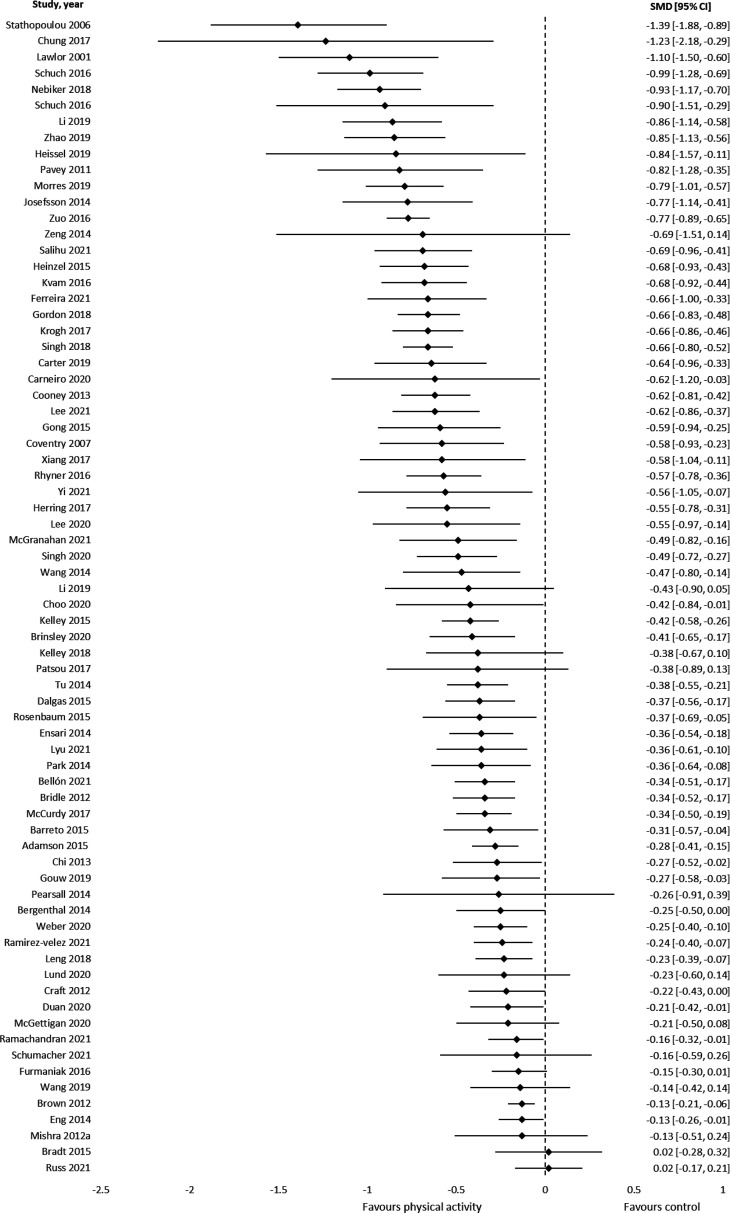
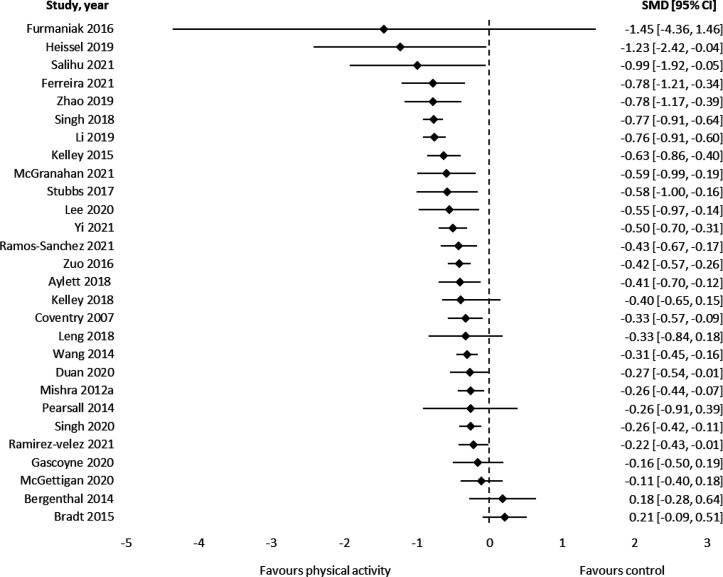
Verification
Claims the paper makes
The claims and statistics of this paper haven’t been checked yet.
Free: it reads the open-access text and checks the first 5 claims that cite a source we can check. Create a free account to check every claim.
Claims other papers make about this one
Each is checked against this paper’s own text: does it say what the citing paper says it does?
The cited source doesn’t support the claim as written.
In the citing paper
“Because we simultaneously assessed more than 200 studies, credible intervals were narrower than those in most existing meta-analyses.13”
From Effect of exercise for depression: systematic review and network meta-analysis of randomised controlled trials (2024) · cites this paper as [13]
Checked by a reasoning model — may be wrong.
Experimental — accuracy not yet measuredThe source backs part of the claim, not all of it — or backs it for a different population, condition or comparison.
In the citing paper
“challenges remain regarding how to optimise exercise design to improve adherence rates 28 .”
From Effect of exercise on depression and anxiety symptoms: systematic umbrella review with meta-meta-analysis (2026) · cites this paper as [28]
Experimental — accuracy not yet measuredThe source backs part of the claim, not all of it — or backs it for a different population, condition or comparison.
In the citing paper
“physical activity is known to boost mood and reduce symptoms of depression and anxiety, which are often associated with loneliness.71”
From A Longitudinal Study of Loneliness Before the End of the COVID-19 Pandemic: Trajectories, Predictors, and Impact on Chinese Adolescent Mental Health (2024) · cites this paper as [71]
Experimental — accuracy not yet measuredThe source backs part of the claim, not all of it — or backs it for a different population, condition or comparison.
In the citing paper
“Our review included more studies than many existing reviews on exercise for depression.13 22 27 28”
From Effect of exercise for depression: systematic review and network meta-analysis of randomised controlled trials (2024) · cites this paper as [13]
Experimental — accuracy not yet measuredThe source backs part of the claim, not all of it — or backs it for a different population, condition or comparison.
In the citing paper
“our study and the study by Singh et al13 both found that effects were stronger with vigorous intensity exercise compared with light and moderate exercise.”
From Effect of exercise for depression: systematic review and network meta-analysis of randomised controlled trials (2024) · cites this paper as [13]
Experimental — accuracy not yet measured
5 more claims about this paper
Create a free account to see every claim other papers make about this one.
Self-check
Percentages, sums and reported differences re-computed from the paper’s own numbers.
The self-check needs the paper’s full text.
Citations
Cites
The PRISMA 2020 statement: An updated guideline for reporting systematic reviews
Page, M. J., McKenzie, J. E., Bossuyt, P. M., Boutron, I., Hoffmann, T. C., Mulrow, C. D., Shamseer, L., Tetzlaff, J. M., Akl, E. A., Brennan, S. E., et al. (2021) · BMJ · doi:10.1136/bmj.n71 · Cited by 108,283
Bias in meta-analysis detected by a simple, graphical test
Egger, M., Smith, G. D., Schneider, M., & Minder, C. (1997) · BMJ · doi:10.1136/bmj.315.7109.629 · Cited by 56,722
Shea, B. J., Reeves, B. C., Wells, G., Thuku, M., Hamel, C., Moran, J., Moher, D., Tugwell, P., Welch, V., Kristjansson, E., et al. (2017) · BMJ · doi:10.1136/bmj.j4008 · Cited by 10,636 · cited 2×
“29”
Background(1985) · Europe PMC (PubMed Central) · Cited by 9,143
The PRISMA 2020 statement: an updated guideline for reporting systematic reviews
Page, M. J., McKenzie, J., Bossuyt, P., Boutron, I., Hoffmann, T., mulrow, C., Shamseer, L., Tetzlaff, J., Akl, E., Brennan, S. E., et al. (2020) · doi:10.31222/osf.io/v7gm2_v1 · Cited by 8,090
Santomauro, D. F., Mantilla Herrera, A. M., Shadid, J., Zheng, P., Ashbaugh, C., Pigott, D. M., Abbafati, C., Adolph, C., Amlag, J. O., Aravkin, A. Y., et al. (2021) · The Lancet · doi:10.1016/s0140-6736(21)02143-7 · Cited by 5,444
The PRISMA 2020 statement: an updated guideline for reporting systematic reviews
Page, M. J., McKenzie, J., Bossuyt, P., Boutron, I., Hoffmann, T., mulrow, C., Shamseer, L., Tetzlaff, J., Akl, E., Brennan, S. E., et al. (2020) · doi:10.31222/osf.io/v7gm2 · Cited by 5,177
Qiu, J., Shen, B., Zhao, M., Wang, Z., Xie, B., & Xu, Y. (2020) · General Psychiatry · doi:10.1136/gpsych-2020-100213 · Cited by 4,307
Cipriani, A., Furukawa, T. A., Salanti, G., Chaimani, A., Atkinson, L. Z., Ogawa, Y., Leucht, S., Ruhe, H. G., Turner, E. H., Higgins, J. P. T., et al. (2018) · The Lancet · doi:10.1016/s0140-6736(17)32802-7 · Cited by 3,541
Cooney, G. M., Dwan, K., Greig, C. A., Lawlor, D. A., Rimer, J., Waugh, F. R., McMurdo, M., & Mead, G. E. (2013) · Cochrane Database of Systematic Reviews · doi:10.1002/14651858.cd004366.pub6 · Cited by 1,834
Research works printed but not linked: 2
- Oxford Centre for Evidence-Based Medicine. Levels of evidence (March 2009). University of Oxford, 2022.
- Ramírez-Vélez R, Zambom-Ferraresi F, García-Hermoso A, et al. Evidence-based exercise recommendations to improve mental wellbeing in women with breast cancer during active treatment: a systematic review and meta-analysis. Cancers (Basel) 2021; 13: 264. 10.3390/cancers13020264 33445739 PMC7828164 · DOI
Cited by
Noetel, M., Sanders, T., Gallardo-Gómez, D., Taylor, P., del Pozo Cruz, B., van den Hoek, D., Smith, J. J., Mahoney, J., Spathis, J., Moresi, M., et al. (2024) · BMJ · doi:10.1136/bmj-2023-075847 · Cited by 707
“13 22 27 28 As a result, we were able to combine the strengths of various approaches to exercise and to make more nuanced and precise conclusions.”
BackgroundResultInfluentialStress and cardiovascular disease: an update
Vaccarino, V., & Bremner, J. D. (2024) · Nature Reviews Cardiology · doi:10.1038/s41569-024-01024-y · Cited by 237
“Physical activity training 189 , yoga 190 and bio-feedback 191,192 can also be useful, as can collaborative care approaches that incorporate psychological management 193 .”
Singh, B., Bennett, H., Miatke, A., Dumuid, D., Curtis, R., Ferguson, T., Brinsley, J., Szeto, K., Petersen, J. M., Gough, C., et al. (2025) · British Journal of Sports Medicine · doi:10.1136/bjsports-2024-108589 · Cited by 157
“9 One plausible explanation for this is the higher attrition and lower adherence rates commonly associated with lengthier interventions.”
Self-citationThe impact of exercise on depression: how moving makes your brain and body feel better
Hossain, M. N., Lee, J., Choi, H., Kwak, Y.-S., & Kim, J. (2024) · Physical Activity and Nutrition · doi:10.20463/pan.2024.0015 · Cited by 137
“The impact of exercise on depression: how moving makes your brain and body feel better ical activity was associated with a lower risk of depression over time 28 .”
BackgroundPhysical activity and prevention of mental health complications: An umbrella review
Rahmati, M., Lee, S., Yon, D. K., Lee, S. W., Udeh, R., McEvoy, M., Oh, H. Y., Butler, L. T., Keyes, H., Barnett, Y., et al. (2024) · Neuroscience & Biobehavioral Reviews · doi:10.1016/j.neubiorev.2024.105641 · Cited by 135
Li, Z., Li, J., Kong, J., Li, Z., Wang, R., & Jiang, F. (2024) · Frontiers in Psychology · doi:10.3389/fpsyg.2024.1433698 · Cited by 144
Hird, E. J., Slanina-Davies, A., Lewis, G., Hamer, M., & Roiser, J. P. (2024) · Translational Psychiatry · doi:10.1038/s41398-024-02922-y · Cited by 79
“…meta-analyses of randomised controlled trials of aerobic exercise interventions estimate a substantial effect on overall depressive symptoms [149, 150], in both adults (ES ~ 0.8) [21] and young people (ES ~ 0.8) [22], although a lower effect size was reported in a meta-analysis including…”
BackgroundInfluentialWearable Devices to Improve Physical Activity and Reduce Sedentary Behaviour: An Umbrella Review
Longhini, J., Marzaro, C., Bargeri, S., Palese, A., Dell’Isola, A., Turolla, A., Pillastrini, P., Battista, S., Castellini, G., Cook, C. E., et al. (2024) · Sports Medicine - Open · doi:10.1186/s40798-024-00678-9 · Cited by 110
“It provides health benefits, including prevention and treatment of many conditions such as osteoarthritis, low back pain, hypertension, stroke, obesity, diabetes, and mental health disorders (i.e., distress, anxiety and symptoms of depression both in healthy and ill adults) [1, 2].”
BackgroundGreenwood, S. A., Young, H. M. L., Briggs, J., Castle, E. M., Walklin, C., Haggis, L., Balkin, C., Asgari, E., Bhandari, S., Burton, J. O., et al. (2023) · The Lancet Digital Health · doi:10.1016/s2589-7500(23)00204-2 · Cited by 96
“Improvements to mental health despite only modest increases in physical activity have been observed previously, 33 and have been suggested to be due to shorter periods of weekly physical activity being less burdensome for patients and, consequently, having less negative psychological impact.”
BackgroundInfluentialThe impact of Exergames on emotional experience: a systematic review
Marques, L., Uchida, P. M., & Barbosa, S. P. (2023) · Frontiers in Public Health · doi:10.3389/fpubh.2023.1209520 · Cited by 61
“These findings are both reasonable and expected, given that physical activity has been proven to have highly beneficial effects on the symptoms of depression (52).”
BackgroundExercise and gait/movement analyses in treatment and diagnosis of Parkinson’s Disease
Burtscher, J., Moraud, E. M., Malatesta, D., Millet, G. P., Bally, J. F., & Patoz, A. (2023) · Ageing Research Reviews · doi:10.1016/j.arr.2023.102147 · Cited by 82
“Results from animal models of PD further suggest that endurance exercise and walking training reduce PD-related pathologies at the cellular level, including oxidative stress, neuroinflammation and α -synuclein pathology, while increasing neurotrophic support, together attenuating neurodegeneration…”
BackgroundBourke, M., Wang, H., McNaughton, S. A., Thomas, G., Firth, J., Trott, M., & Cairney, J. (2025) · Clinical Psychology Review · doi:10.1016/j.cpr.2025.102585 · Cited by 78
Remskar, M., Western, M. J., Osborne, E. L., Maynard, O., & Ainsworth, B. (2023) · Mental health and physical activity · doi:10.1016/j.mhpa.2023.100575 · Cited by 70
“These effects are comparable to, and in some cases greater than, current front-line pharmacological and cognitive-behavioural treatments (Singh et al., 2023).”
InfluentialHeart rate variability in mental disorders: an umbrella review of meta-analyses
Wang, Z., Zou, Y., Liu, J., Peng, W., Li, M., & Zou, Z. (2025) · Translational Psychiatry · doi:10.1038/s41398-025-03339-x · Cited by 80
“…con fi dence of published meta-analyses, including non-signi fi cant p -values of the largest study, random effects p value > 10-6, small sample sizes ( 1000 cases), high between-study heterogeneity, prediction intervals encompassing the null value, and biases due to small-study effects [24, 50, 51].”
Singh, B., Bennett, H., Miatke, A., Dumuid, D., Curtis, R., Ferguson, T., Brinsley, J., Szeto, K., Eglitis, E., Zhou, M., et al. (2025) · Journal of the American Academy of Child & Adolescent Psychiatry · doi:10.1016/j.jaac.2025.04.007 · Cited by 78
Self-citationTeychenne, M. J., de Sousa, G. M., Baker, T., Liddelow, C., Babic, M., Chauntry, A. J., France‐Ratcliffe, M., Guagliano, J. M., Christie, H. E., Tremaine, E. M., et al. (2025) · British Journal of Sports Medicine · doi:10.1136/bjsports-2025-109806 · Cited by 80
The Role of Behavioral Factors on Chronic Diseases—Practice and Knowledge Gaps
Rahelić, V., Perković, T., Romić, L., Perković, P., Majanović, S. K., Pavić, E., & Rahelić, D. (2024) · Healthcare · doi:10.3390/healthcare12242520 · Cited by 90
Daily Step Count and Depression in Adults: A Systematic Review and Meta-Analysis
Bizzozero‐Peroni, B., Goñi, V. D., Jiménez‐López, E., Rodríguez‐Gutiérrez, E., Sequí‐Domínguez, I., de Arenas‐Arroyo, S. N., López‐Gil, J. F., Martínez‐Vizcaíno, V., & Mesas, A. E. (2024) · JAMA Network Open · doi:10.1001/jamanetworkopen.2024.51208 · Cited by 83
Bucciarelli, V., Mattioli, A. V., Sciomer, S., Moscucci, F., Renda, G., & Gallina, S. (2023) · Journal of Clinical Medicine · doi:10.3390/jcm12134347 · Cited by 64
Iob, E., Pingault, J., Munafo, M. R., Stubbs, B., Gilthorpe, M. S., Maihofer, A. X., & Danese, A. (2023) · Molecular Psychiatry · doi:10.1038/s41380-023-02133-9 · Cited by 63
“…suggest that physical activity, measured through either self-report or objective methods, can reduce the risk of depression across the population and ameliorate depressive symptoms not only among depressed patients, but also in patients with other mental and physical health conditions [16, 44].”
BackgroundSabag, A., Patten, R. K., Moreno‐Asso, A., Colombo, G. E., Bouzo, X. D., Moran, L., Harrison, C. L., Kazemi, M., Mousa, A., Tay, C. T., et al. (2024) · Journal of science and medicine in sport · doi:10.1016/j.jsams.2024.05.015 · Cited by 68
Li, B., Han, S.-S., Ye, Y.-P., Li, Y.-X., Meng, S., Feng, S., Li, H., Cui, Z.-L., Zhang, Y.-S., Zhang, Y., et al. (2024) · Scientific Reports · doi:10.1038/s41598-024-80034-9 · Cited by 51
“Ample consensus exists regarding the effectiveness of PA promotion, including leisure time activities and regular exercise, in improving MH outcomes, such as depression and anxiety 63–70 .”
Timm, I., Giurgiu, M., Ebner‐Priemer, U., & Reichert, M. (2024) · Sports Medicine · doi:10.1007/s40279-024-02016-1 · Cited by 57
“This association is critically involved in both physical and mental health processes for motivating, maintaining, and reinforcing physical activity and affective well-being [5–7].”
BackgroundAdams, S. C., Rivera-Theurel, F., Scott, J. M., Nadler, M. B., Foulkes, S., Leong, D. P., Nilsen, T. S., Porter, C., Haykowsky, M. J., Abdel-Qadir, H. M., et al. (2025) · European Heart Journal · doi:10.1093/eurheartj/ehaf100 · Cited by 48
Pereira, A. M., Bolling, C. S., Birch, P. D. J., Figueiredo, P., Verhagen, E. A. L. M., & Brito, J. (2023) · Sports Medicine - Open · doi:10.1186/s40798-023-00617-0 · Cited by 48
“Indeed, physical activity is known to be beneficial in people with symptoms of mental health problems, such as distress, anxiety, and depression, especially in healthy individuals, like our participants, showing medium effects when compared with the care normally given [78].”
BackgroundThe Economics of Treatment for Depression
Stecher, C. D., Cloonan, S., & Domino, M. E. (2023) · Annual Review of Public Health · doi:10.1146/annurev-publhealth-061022-040533 · Cited by 51
Mental health disorders and their impact on cardiovascular health disparities
Vaccarino, V., Prescott, E., Shah, A. J., Bremner, J. D., Raggi, P., Dobilienė, O., Gale, C. P., & Bugiardini, R. (2025) · The Lancet Regional Health - Europe · doi:10.1016/j.lanepe.2025.101373 · Cited by 57
“68 Thus, exercise should be considered alongside psychotherapy and antidepressants as core treatment for depression.”
Han, X., Li, H., Xiao, C., Wang, W., Gao, K., Yan, S., & Niu, L. (2025) · Scientific Reports · doi:10.1038/s41598-025-07791-z · Cited by 34
“Numerous studies have shown that regular physical activity not only helps release psychological stress but also effectively alleviates negative emotions such as depression, anxiety, and loneliness 20,21 .”
Brinsley, J., O'Connor, E. J., Singh, B., McKeon, G., Curtis, R., Ferguson, T., Gosse, G., Willems, I., Marent, P.-J., Szeto, K., et al. (2025) · Journal of Medical Internet Research · doi:10.2196/56975 · Cited by 47
Self-citationTranslational models of stress and resilience: An applied neuroscience methodology review
Albayrak, Z. S., Vaz, A., Bordes, J., Ünlü, S., Sep, M. S. C., Vinkers, C. H., Pinto, L., & Eser, H. Y. (2024) · Neuroscience Applied · doi:10.1016/j.nsa.2024.104064 · Cited by 48
Remskar, M., Western, M. J., & Ainsworth, B. (2024) · British Journal of Health Psychology · doi:10.1111/bjhp.12745 · Cited by 51
Understanding the Relationships Between Physical Activity and Climate Change: An Umbrella Review
Silva, M. F., Leão, A. L. F., O’Connor, Á., Hallal, P. C., Ding, D., Hinckson, E. A., Benmarhnia, T., & Reis, R. S. (2024) · Journal of Physical Activity and Health · doi:10.1123/jpah.2024-0284 · Cited by 40
Beyond “just” fun: The role of exergames in advancing health promotion and disease prevention
Manser, P., de Bruin, E. D., Temprado, J.-J., Bherer, L., & Herold, F. (2025) · Neuroscience & Biobehavioral Reviews · doi:10.1016/j.neubiorev.2025.106260 · Cited by 43
“…diseases [135, 136], cancer [136], frailty [136], mental health disorders (including depression, anxiety and psychological distress) [136, 137], metabolic disorders (including obesity and diabetes) [136, 138, 139]), neurodegenerative and neurological disorders [136, 140-149] (including…”
Xue, P., Du, X., & Kong, J. (2025) · Frontiers in Psychology · doi:10.3389/fpsyg.2025.1562434 · Cited by 51
Gao, Y., Yu, Q., Schuch, F. B., Herold, F., Hossain, M. M., Ludyga, S., Gerber, M., Mullen, S. P., Yeung, A., Kramer, A. F., et al. (2024) · Journal of Affective Disorders · doi:10.1016/j.jad.2024.01.017 · Cited by 36
Self-citationManole, A., Cârciumaru, R., Brînzaș, R., & Manole, F. (2024) · Information · doi:10.3390/info16010011 · Cited by 44
Hu, C., Zhang, W., Huang, W., & Jin, C. (2025) · Frontiers in Psychology · doi:10.3389/fpsyg.2025.1652984 · Cited by 41
Chao, W.-C., Huang, J.-C., Young, S.-L., Wu, C.-L., Shih, J.-C., Liao, L., & Cheng, B. (2024) · Complementary Therapies in Clinical Practice · doi:10.1016/j.ctcp.2024.101892 · Cited by 38
Kou, R., Li, Z., Li, M., Zhou, R., Zhu, F., Ruan, W., & Zhang, J. (2024) · BMC Psychology · doi:10.1186/s40359-024-02210-w · Cited by 55
“Psychotherapy and medications may be supplemented or replaced by exercise [19].”
Yue, H., Yang, Y., Xie, F., Cui, J., Li, Y., Si, M., Li, S., & Yao, F. (2025) · International Journal of Behavioral Nutrition and Physical Activity · doi:10.1186/s12966-025-01712-z · Cited by 28
“The results of our study are consistent with previous systematic review and meta-analyses, indicating that participation in PA may result in decreased depression and anxiety levels in adults, regardless of exercise intensity [46].”
Malagodi, F., Dommett, E. J., Findon, J. L., & Gardner, B. (2023) · Mental health and physical activity · doi:10.1016/j.mhpa.2023.100563 · Cited by 50
Richardson, K. E., Petukhova, R., Hughes, S. D., Pitt, J., Yücel, M., & Segrave, R. A. (2024) · BMC Public Health · doi:10.1186/s12889-024-17683-y · Cited by 31
“For example, physical exercise and mindfulness-based interventions have been shown to be as effective as pharmacotherapy in the treatment of Major Depressive Disorder [14–17] and Generalised Anxiety Disorder [18], respectively.”
Yu, M., Cai, C.-C., Huang, Y., Zhu, Y., Luo, X.-Y., Kong, X., Zhang, W., Li, H.-J., Fang, J.-X., & Zou, Z. (2024) · Carbohydrate Polymers · doi:10.1016/j.carbpol.2024.122527 · Cited by 28
Assessing the impact of physical activity on reducing depressive symptoms: a rapid review
Samsudin, N., Bailey, R. P., Ríes, F., Hashim, S. N. A., & Fernandez, J. A. (2024) · BMC Sports Science Medicine and Rehabilitation · doi:10.1186/s13102-024-00895-5 · Cited by 39
Manser, P., Poikonen, H., & de Bruin, E. D. (2023) · Frontiers in Aging Neuroscience · doi:10.3389/fnagi.2023.1163388 · Cited by 33
“, 2021) and improving depression (Singh et al., 2023) across a very wide range of populations, including mNCD (Leng et al.”
Microbiota–gut–brain axis: the mediator of exercise and brain health
Kang, P., & Wang, A. (2024) · Psychoradiology · doi:10.1093/psyrad/kkae007 · Cited by 34
Prudente, T. P., Mezaiko, E., Silveira, É. A., & Nogueira, T. E. (2024) · Behavioral Sciences · doi:10.3390/bs14010043 · Cited by 57
“A recent umbrella review has shown that shorter-duration exercises (less than 12 weeks) more significantly improved mood scores compared to longer interventions, likely due to higher compliance to interventions in shorter periods [71].”
BackgroundEpigenetic Echoes: Bridging Nature, Nurture, and Healing Across Generations
Banushi, B., Collova, J. R., & Milroy, H. (2025) · International Journal of Molecular Sciences · doi:10.3390/ijms26073075 · Cited by 33
“Numerous systematic reviews confirm that exercise interventions can significantly reduce symptoms of depression and anxiety [250,251].”
Roberts, C. J., Ryan, D. J., Campbell, J. A., & Hardwicke, J. (2024) · Critical Public Health · doi:10.1080/09581596.2024.2338182 · Cited by 35
“…notable publishing of the World Health review across adult populations suggested physical activity was beneficial for improving symptoms of depression, anxiety and distress and should be a mainstay approach in the management of depression, anxiety, and psychological distress (Singh et al., 2023).”
Li, S., Liu, Y., Li, R., Xiao, W., Ou, J., Tao, F., & Wan, Y. (2024) · Environment International · doi:10.1016/j.envint.2024.108796 · Cited by 26
Simpson, A., Teague, S. J., Kramer, B., Lin, A. P., Thornton, A., Budden, T., Furzer, B. J., Jeftic, I., Dimmock, J. A., Rosenberg, M., et al. (2024) · Health Psychology Review · doi:10.1080/17437199.2024.2391787 · Cited by 34
Li, H., Sang, D., Gong, L., Wang, B., Wang, Y., Jia, X. P., Yu, J., Kong, Z., Liu, H., & Zhang, Y. (2024) · Frontiers in Public Health · doi:10.3389/fpubh.2024.1451101 · Cited by 39
Jiang, Y., Liu, T.-H., Qin, D., Wang, Z., He, X., & Chen, Y.-N. (2024) · Frontiers in Psychiatry · doi:10.3389/fpsyt.2023.1327200 · Cited by 35
Nascimento, M. D. M., Lampraki, C., Marques, A., Gouveia, É. R., Adsuar, J. C., & Ihle, A. (2024) · BMC Public Health · doi:10.1186/s12889-024-19463-0 · Cited by 31
“PA was included as a control variable because both moderate to vigorous levels of PA and a low level of PA can influence the mental health status of older adults [41].”
BackgroundGiloteaux, L., Glass, K. A., Germain, A., Franconi, C. J., Zhang, S., & Hanson, M. R. (2024) · Journal of Extracellular Vesicles · doi:10.1002/jev2.12403 · Cited by 28
“In healthy individuals, physical exercise improves cardiovascular health and muscle strength, alleviates fatigue, anxiety and depression, and reduces the risk of chronic diseases (Nystoriak & Bhatnagar, 2018; Singh et al., 2023).”
BackgroundGu, Q., Zhao, X., Lin, L., Teo, W., Liu, L., & Yuan, S. (2024) · International Journal of Clinical and Health Psychology · doi:10.1016/j.ijchp.2024.100512 · Cited by 24
The influence of physical exercise on negative emotions in adolescents: a meta-analysis
Wang, T., Li, W., Deng, J., Zhang, Q., & Liu, Y. (2024) · Frontiers in Psychiatry · doi:10.3389/fpsyt.2024.1457931 · Cited by 33
Han, X., Li, H., & Niu, L. (2025) · Frontiers in Psychology · doi:10.3389/fpsyg.2025.1457165 · Cited by 34
Zhang, W., Huang, W., Hu, C., Yuan, Y., & Chen, X. (2025) · Frontiers in Public Health · doi:10.3389/fpubh.2025.1683468 · Cited by 35
Munro, N. R., Teague, S., Somoray, K., Simpson, A., Budden, T., Jackson, B., Rebar, A., & Dimmock, J. (2026) · British Journal of Sports Medicine · doi:10.1136/bjsports-2025-110301 · Cited by 23
“Previous meta- meta-analyses have been limited to adult populations 23 28 or included populations with confounding factors, such as chronic diseases.”
Zhu, L., Shen, X., Shi, X., & Ouyang, X. (2024) · BMC Geriatrics · doi:10.1186/s12877-024-05093-z · Cited by 25
“…PA have been proven in numerous empirical studies, including improving physical and mental capacities (e.g.,cognitive function, mobility, anxiety and depression) [47–49] and preventing and managing many chronic diseases (e.g.,hypertension, diabetes, COPD, cancer, osteoporosis, sarcopenia) [50, 51].”
BackgroundRecreational screen time and obesity risk in Korean children: a 3-year prospective cohort study
Jang, H., Cho, Y., & Oh, H. (2024) · International Journal of Behavioral Nutrition and Physical Activity · doi:10.1186/s12966-024-01660-0 · Cited by 27
“Physical activity also provides additional health benefits such as improving cardiometabolic profile [48] and reducing depression and anxiety [49].”
BackgroundImpact of Internet Usage on Depression Among Older Adults: Comprehensive Study
Guo, L., Li, Y., Cheng, K., Zhao, Y., Yin, W., & Liu, Y. (2025) · Journal of Medical Internet Research · doi:10.2196/65399 · Cited by 24
“Research indicates that physical activity enhances subjective well-being [18], effectively treats depression, and reduces anxiety [19].”
Gender comparison of perceptual-cognitive learning in young athletes
Legault, I., & Faubert, J. (2024) · Scientific Reports · doi:10.1038/s41598-024-59486-6 · Cited by 29
“…that practising sport is important for maintaining good physical health, but also essential for maintaining good mental and cognitive health 39–42 The practice of sports, particularly through involvement in sports teams, appears to be particularly beneficial for improving cognitive capacity.”
BackgroundZhang, X., Qu, G., Chen, X., & Luo, Y. (2024) · Journal of Adolescence · doi:10.1002/jad.12415 · Cited by 24
Li, J., Zhou, Z., Hao, S., & Zang, L. (2024) · European Journal of Applied Physiology · doi:10.1007/s00421-024-05688-9 · Cited by 30
“This result also supports the findings of Singh et al. (Singh et al. 2023), which suggest that a moderate dose of exercise is the optimal intervention, rather than a higher volume of exercise.”
Effects of urban green exercise on mental health: a systematic review and meta-analysis
Hu, G., Luo, Q., Zhang, P., Zeng, H., & Ma, X. (2025) · Frontiers in Public Health · doi:10.3389/fpubh.2025.1677223 · Cited by 19
“” First, the initial phase of an intervention often elicits the greatest levels of participant enthusiasm and adherence, primarily driven by novelty and initial motivation (63, 64).”
Physical Activity in Natural Settings: An Opportunity for Lifestyle Medicine
Maddock, J. E., & Frumkin, H. (2024) · American Journal of Lifestyle Medicine · doi:10.1177/15598276241253211 · Cited by 31
The contribution of being physically active to successful aging
Piccardi, L., Pecchinenda, A., Palmiero, M., Giancola, M., Boccia, M., Giannini, A. M., & Guariglia, C. (2023) · Frontiers in Human Neuroscience · doi:10.3389/fnhum.2023.1274151 · Cited by 22
Prydz, M. B., Czajkowski, N. O., Eilertsen, M., Røysamb, E., & Nes, R. B. (2024) · JMIR Mental Health · doi:10.2196/49050 · Cited by 22
“Physical activity has been shown to be effective in alleviating symptoms of depression, anxiety, and psychological distress, both in the general population and in groups with compromised health [57].”
BackgroundXinbo, W., Liang, J., Chen, J., Dong, W., & Lü, C. (2024) · Frontiers in Psychology · doi:10.3389/fpsyg.2024.1376233 · Cited by 24
“Additionally, physical activities possess the capacity to alleviate stress, anxiety, and depression (Singh et al., 2023), with neurotransmitters like endorphins released during exercise contributing to mood improvement and overall well-being (Pahlavani, 2023).”
BackgroundSu, J. J., Winnige, P., Chamradova, K., Dosbaba, F., Batalikova, K., Lin, R., Antoniou, V., Pepera, G., & Baťalík, L. (2025) · Journal of Cancer Survivorship · doi:10.1007/s11764-025-01778-5 · Cited by 22
“Exercise training, particularly in home-based and unsupervised settings, is increasingly recognized as a valuable adjunct therapy in oncology, offering significant potential benefits for individuals living with cancer [1–4].”
Buckley, R., Cooper, M., & Zhong, L. (2024) · People and Nature · doi:10.1002/pan3.10723 · Cited by 20
Poon, E. T., Sum, W. M.-K., Lubans, D. R., Wong, S. H., & Ho, R. S. T. (2024) · Journal of Sports Sciences · doi:10.1080/02640414.2024.2425910 · Cited by 33
“Aggregated results were summarized using medians and interquartile ranges (IQRs), as performed previously (Singh et al., 2023).”
Brañas, F., Díaz-Álvarez, J., Fernández-Luna, J., Brolen, B. V., Molina, R. G., Moreno, E., Ryan, P., Martínez‐Sanz, J., Luna, L., Martínez, M., et al. (2024) · Frontiers in Public Health · doi:10.3389/fpubh.2024.1373910 · Cited by 20
Finnish Retirement and Aging Study: a prospective cohort study
Stenholm, S., Suorsa, K., Leskinen, T., Myllyntausta, S., Pulakka, A., Pentti, J., & Vahtera, J. (2023) · BMJ Open · doi:10.1136/bmjopen-2023-076976 · Cited by 26
“44 Health and mental well-being In addition to movement behaviours, we have also been interested in retirement-induced changes in various health and well-being indicators.”
BackgroundHuang, H., Huang, S., Chen, S., Gao, X., Cai, J., Feng, Y., Liu, J., Su, X., Qiu, J., Zhang, S., et al. (2024) · International Journal of Clinical and Health Psychology · doi:10.1016/j.ijchp.2023.100431 · Cited by 26
“The results of this review were in agreement with the previously published review suggesting that physical activity is one of the mainstay effective approaches in the management of depression, anxiety, and other mental health problems (Gao, 2022; Liu et al., 2021; Singh et al., 2023).”
ResultWhy friendship and loneliness affect our health
Dunbar, R. (2025) · Annals of the New York Academy of Sciences · doi:10.1111/nyas.15309 · Cited by 21
Huang, X., Chen, Z., Xu, Z. N., Liu, X., Lv, Y., & Yu, L. (2025) · Brain Sciences · doi:10.3390/brainsci15080875 · Cited by 22
“Previous meta-analyses have predominantly focused on general population [1,22,23], children [24–26], pregnant women [27,28], and older adults [29], with limited evidence synthesis for college students, a population undergoing critical psychological development marked by academic stress, identity…”
Sánchez-Alcalá, M., Aibar‐Almazán, A., Hita‐Contreras, F., Castellote‐Caballero, Y., Carcelén‐Fraile, M. D. C., Infante-Guedes, A., & González-Martín, A. M. (2024) · Journal of Personalized Medicine · doi:10.3390/jpm14080844 · Cited by 19
“Additionally, sleep quality tends to diminish with age, with a large proportion of older adults reporting sleep problems due to changes in sleep patterns, which negatively impact their quality of life [12].”
BackgroundLi, S., Zhang, J., Yang, Y., & Yang, Y. (2024) · Frontiers in Public Health · doi:10.3389/fpubh.2024.1462570 · Cited by 16
Schwefel, M., Kaufmann, C., Gutmann, G., Henze, R., Fydrich, T., Rapp, M. A., Ströhle, A., Heißel, A., & Heinzel, S. (2024) · Journal of Affective Disorders · doi:10.1016/j.jad.2024.12.016 · Cited by 16
Yang, S., Jing, L., He, Q., & Wang, H. (2024) · Frontiers in Psychology · doi:10.3389/fpsyg.2024.1408022 · Cited by 38
Li, C., Palka, J. M., Abdullah, N., Adler-Neal, A. L., Banner, B., Efseroff, B., Jones, C., Clark, I., Munoz-Puga, M., Boswell, N., et al. (2023) · Journal of Affective Disorders · doi:10.1016/j.jad.2023.10.062 · Cited by 14
Kaplánová, A. (2024) · Heliyon · doi:10.1016/j.heliyon.2024.e27608 · Cited by 32
Brinsley, J., Schmidt, M., Curtis, R., Simpson, C. E. M., Edwards, J. K., Eglitis, E., Gosse, G., Broad, M., Jardine, B., Taddeo, E., et al. (2025) · Scientific Reports · doi:10.1038/s41598-025-01053-8 · Cited by 25
Self-citationNewby, J. M., Gupta, S., Hoon, L., Zheng, W. Y., Whitton, A. E., Huckvale, K., Stech, E. P., Mackinnon, A. J., Senadeera, M., Shvetcov, A., et al. (2025) · JAMA Network Open · doi:10.1001/jamanetworkopen.2025.40502 · Cited by 19
Montgomery, T. R., & Grant, D. (2026) · Journal of Psychiatric Research · doi:10.1016/j.jpsychires.2026.01.043 · Cited by 23
Stamatis, A., Morgan, G. B., Boolani, A., & Papadakis, Z. (2024) · Psych · doi:10.3390/psych6010014 · Cited by 18
Loch, M. R., Augusto, N. A., Souza, B. L. S., Rufino, J. V., & de Carvalho, F. F. B. (2024) · Cadernos de Saúde Pública · doi:10.1590/0102-311xpt095723 · Cited by 39
From London buses to activity trackers: A reflection of 70 years of physical activity research
Ding, D., & Ekelund, U. (2024) · Journal of sport and health science/Journal of Sport and Health Science · doi:10.1016/j.jshs.2024.06.001 · Cited by 16
“For example, physical activity is consistently linked to better mental health outcomes 21 and emotional well-being of individuals, 22 as well as the economic outcomes of societies.”
BackgroundGuan, J., Sun, Y., Fan, Y., Liang, J., Liu, C., Yu, H., & Liu, J. (2024) · Frontiers in Human Neuroscience · doi:10.3389/fnhum.2024.1406670 · Cited by 18
de Menezes-Júnior, L. A. A., Barbosa, B. C. R., de Paula, W., Sales, A. D. F., Cardoso, C. S., de Freitas, E. D., Vidigal, F. D. C., Ferreira, L. G., Nobre, L. N., da Silva, L. S., et al. (2024) · BMC Public Health · doi:10.1186/s12889-024-19995-5 · Cited by 14
“Exercise also helps to reduce stress and anxiety, factors that improve sleep quality [39].”
BackgroundThe Impact of Physical Activity and Lifestyle on Mental Health: A Network Analysis
Martinez, V. M. L., Martins, M. D. S., Capra, F., Schuch, F. B., Wearick‐Silva, L. E., & Feóli, A. M. P. (2024) · Journal of Physical Activity and Health · doi:10.1123/jpah.2024-0198 · Cited by 24
Queiroga, L. D. L., Kaufmann, O. G., Ritti‐Dias, R. M., Cunha, P. M., Minanni, C. A., Pitta, R. M., & Wolosker, N. (2024) · Journal of Affective Disorders · doi:10.1016/j.jad.2024.09.158 · Cited by 14
Yu, K., Yang, Q., Wang, J., & Zeng, B. (2024) · American Journal of Geriatric Psychiatry · doi:10.1016/j.jagp.2024.10.015 · Cited by 14
Fabiano, N., Puder, D., & Stubbs, B. (2024) · Journal of Physical Activity and Health · doi:10.1123/jpah.2024-0743 · Cited by 16
Rojas, I. A. S., Cuchimba, J. A., Pineda, M. C., Argüello, Y. P., Kočí, J., Kreider, R. B., Petro, J. L., & Bonilla, D. A. (2023) · International Journal of Environmental Research and Public Health · doi:10.3390/ijerph20075298 · Cited by 24
Exercise and mental health: a vital connection
Holland, C. J., Cole, M., & Owens, J. (2024) · British Journal of Sports Medicine · doi:10.1136/bjsports-2024-108562 · Cited by 12
Lim, Y. (2025) · Journal of Affective Disorders · doi:10.1016/j.jad.2025.03.048 · Cited by 13
Metadata
- Authors
- Singh, B., Olds, T., Curtis, R., Dumuid, D., Virgara, R., Watson, A., Szeto, K., O'Connor, E., Ferguson, T., Eglitis, E., Miatke, A., Simpson, C. E., & Maher, C.
- Affiliations
- University of South Australia (AU)
- Corresponding author
- Singh, Ben
- ORCID
- Venue
- British Journal of Sports Medicine
- Publisher
- BMJ
- Published
- 2023-02-16
- Volume
- 57
- Issue
- 18
- Pages
- 1203-1209
- ISSN
- 0306-3674 (ISSN-L)
- 1473-0480
- PMC
- PMC10579187
- OpenAlex
- W4321054304
- Semantic Scholar
- e1ee60d02a701d40ce44367f24240e1deee861ec
- Cited by
- 1,049
- References
- 141
- Citations by year
- 2026: 347 · 2025: 331 · 2024: 295 · 2023: 75
- FWCI
- 37.39
- Type
- journal article
- Language
- en
- Open access
- hybrid
- doi.org
- Licence
- Locations
- British Journal of Sports Medicine (publishedVersion, cc-by-nc)
- PubMed Central (publishedVersion, cc-by-nc-sa)
- PubMed (publishedVersion)
- UniSA Research Outputs Repository (University of South Australia) (submittedVersion, other-oa)
- Adelaide Research & Scholarship (AR&S) (University of Adelaide) (submittedVersion, cc-by-nc)
- HighWire Press Open Archive (submittedVersion)
- Funders
- Australian National Health and Medical Research Council (APP1162166)
- Medical Research Future Fund Emerging Leader Grant (GNT1193862)
- NHMRC (APP1171981)
- Topics
- Health Sciences › Medicine › Public Health, Environmental and Occupational Health › Physical Activity and Health
- Social Sciences › Psychology › Experimental and Cognitive Psychology › Anxiety, Depression, Psychometrics, Treatment, Cognitive Processes
- Health Sciences › Medicine › Oncology › Cancer survivorship and care
- Keywords
- physical activity interventions, depression, anxiety, psychological distress, mental health, chronic disease, HIV, kidney disease, pregnancy, postpartum women, exercise intensity, intervention duration, adults
- MeSH terms
- Systematic Reviews as Topic, Adult, Anxiety, Mental Disorders, Chronic Disease, Depression, Female, Health Status, Humans, Pregnancy, Quality of Life
About these checks
Registry, retraction, Cites and statistics results are computed, not judged, with one exception: a printed reference that no index lists is read once by a model before it counts as a citation error. Claims are extracted by a model and kept only when their quote appears verbatim in the text; each cited source is then checked, with a model’s help, for whether it says what the claim relies on. Those verdicts can be wrong — read the claim’s quote and the cited source before relying on one.
Statistics and arithmetic are recomputed, not judged.
Confidence bands are shown only for fields calibrated on our annotated test set. None is calibrated yet, so no band is shown.
What counts as a claim ›How we measure confidence ›How we check this ›
Are you an author, or do you see a problem with this page? Request a review
Data sources
Bibliographic data: Semantic Scholar, OpenAlex, Crossref.
Contains information from the Semantic Scholar Academic Graph Datasets, made available under the ODC Attribution License (ODC-BY 1.0).
Semantic Scholar’s data is described in: Kinney, R., et al. (2023). The Semantic Scholar Open Data Platform. arXiv:2301.10140.
