

Effectiveness of physical activity interventions for improving depression, anxiety and distress: an overview of systematic reviews
Open accessThe DOI matches its Crossref record; 140 of the 141 references it cites were found in a registry or an index.
Abstract
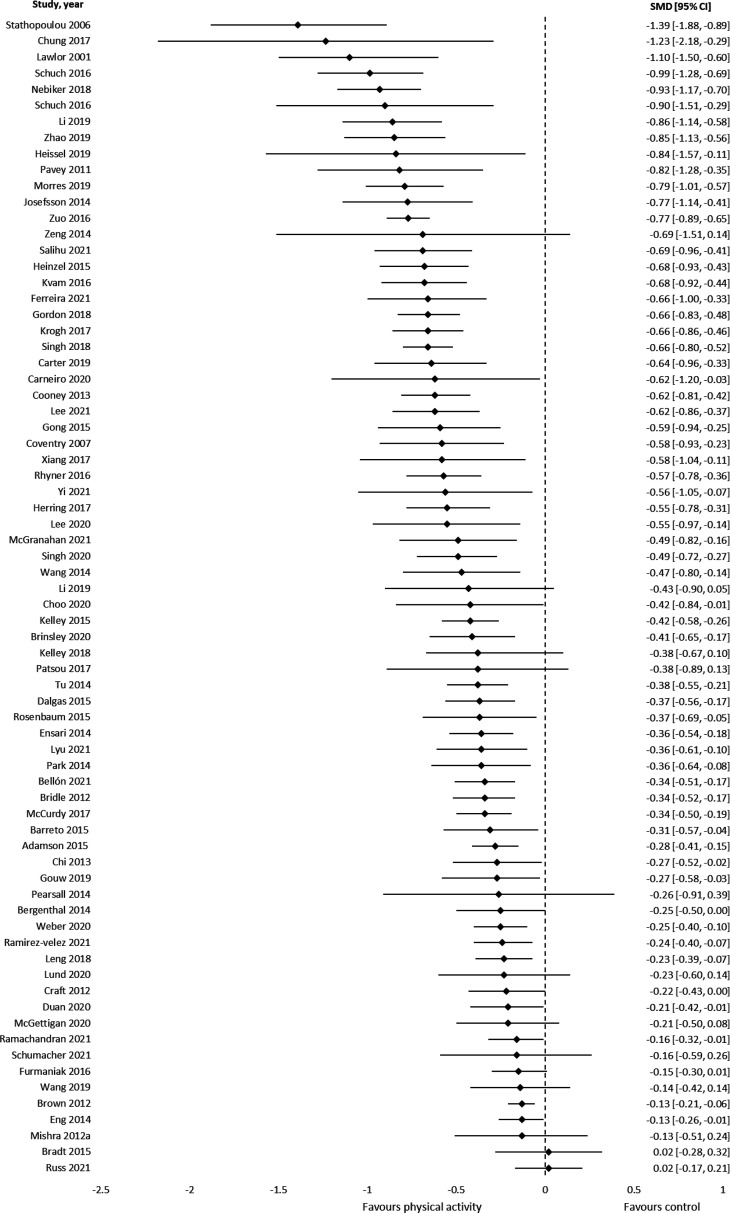
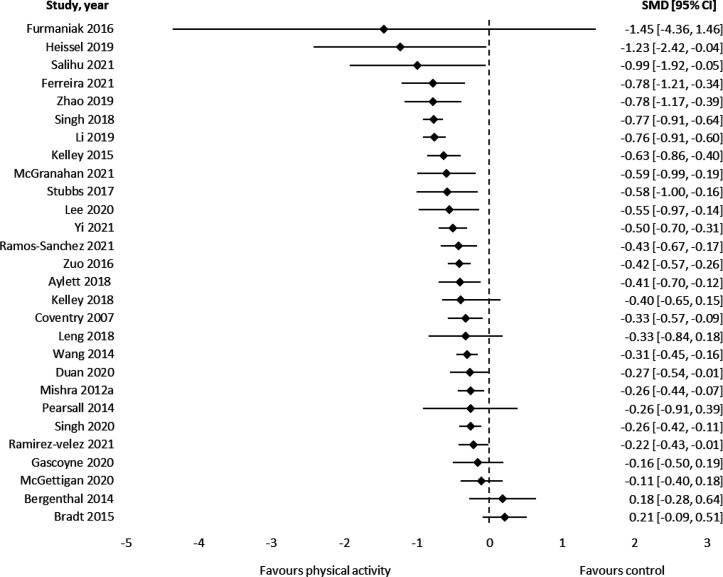
Objective: To synthesise the evidence on the effects of physical activity on symptoms of depression, anxiety and psychological distress in adult populations. Design: Umbrella review. Data sources: Twelve electronic databases were searched for eligible studies published from inception to 1 January 2022. Eligibility criteria for selecting studies: Systematic reviews with meta-analyses of randomised controlled trials designed to increase physical activity in an adult population and that assessed depression, anxiety or psychological distress were eligible. Study selection was undertaken in duplicate by two independent reviewers. Results: Ninety-seven reviews (1039 trials and 128 119 participants) were included. Populations included healthy adults, people with mental health disorders and people with various chronic diseases. Most reviews (n=77) had a critically low A MeaSurement Tool to Assess systematic Reviews score. Physical activity had medium effects on depression (median effect size=−0.43, IQR=−0.66 to –0.27), anxiety (median effect size=−0.42, IQR=−0.66 to –0.26) and psychological distress (effect size=−0.60, 95% CI −0.78 to –0.42), compared with usual care across all populations. The largest benefits were seen in people with depression, HIV and kidney disease, in pregnant and postpartum women, and in healthy individuals. Higher intensity physical activity was associated with greater improvements in symptoms. Effectiveness of physical activity interventions diminished with longer duration interventions. Conclusion and relevance: Physical activity is highly beneficial for improving symptoms of depression, anxiety and distress across a wide range of adult populations, including the general population, people with diagnosed mental health disorders and people with chronic disease. Physical activity should be a mainstay approach in the management of depression, anxiety and psychological distress. PROSPERO registration number: CRD42021292710.
Overview
The claims and statistics of this paper haven’t been checked yet.
Free: it reads the open-access text and checks the first 5 claims that cite a source we can check. Create a free account to check every claim.
Integrity signals
Registry
Cites
Statistics
Figures
Verification
Claims the paper makes
The claims and statistics of this paper haven’t been checked yet.
Free: it reads the open-access text and checks the first 5 claims that cite a source we can check. Create a free account to check every claim.
Claims other papers make about this one
Each is checked against this paper’s own text: does it say what the citing paper says it does?
The cited source doesn’t support the claim as written.
In the citing paper
“Because we simultaneously assessed more than 200 studies, credible intervals were narrower than those in most existing meta-analyses.13”
From Effect of exercise for depression: systematic review and network meta-analysis of randomised controlled trials (2024) · cites this paper as [13]
Checked by a reasoning model — may be wrong.
Experimental — accuracy not yet measuredThe source backs part of the claim, not all of it — or backs it for a different population, condition or comparison.
In the citing paper
“challenges remain regarding how to optimise exercise design to improve adherence rates 28 .”
From Effect of exercise on depression and anxiety symptoms: systematic umbrella review with meta-meta-analysis (2026) · cites this paper as [28]
Experimental — accuracy not yet measuredThe source backs part of the claim, not all of it — or backs it for a different population, condition or comparison.
In the citing paper
“physical activity is known to boost mood and reduce symptoms of depression and anxiety, which are often associated with loneliness.71”
From A Longitudinal Study of Loneliness Before the End of the COVID-19 Pandemic: Trajectories, Predictors, and Impact on Chinese Adolescent Mental Health (2024) · cites this paper as [71]
Experimental — accuracy not yet measuredThe source backs part of the claim, not all of it — or backs it for a different population, condition or comparison.
In the citing paper
“Our review included more studies than many existing reviews on exercise for depression.13 22 27 28”
From Effect of exercise for depression: systematic review and network meta-analysis of randomised controlled trials (2024) · cites this paper as [13]
Experimental — accuracy not yet measuredThe source backs part of the claim, not all of it — or backs it for a different population, condition or comparison.
In the citing paper
“our study and the study by Singh et al13 both found that effects were stronger with vigorous intensity exercise compared with light and moderate exercise.”
From Effect of exercise for depression: systematic review and network meta-analysis of randomised controlled trials (2024) · cites this paper as [13]
Experimental — accuracy not yet measured
5 more claims about this paper
Create a free account to see every claim other papers make about this one.
Self-check
Percentages, sums and reported differences re-computed from the paper’s own numbers.
The self-check needs the paper’s full text.
Citations
Cites
The PRISMA 2020 statement: An updated guideline for reporting systematic reviews
Page, M. J., McKenzie, J. E., Bossuyt, P. M., Boutron, I., Hoffmann, T. C., Mulrow, C. D., Shamseer, L., Tetzlaff, J. M., Akl, E. A., Brennan, S. E., et al. (2021) · BMJ · doi:10.1136/bmj.n71 · Cited by 108,283
Bias in meta-analysis detected by a simple, graphical test
Egger, M., Smith, G. D., Schneider, M., & Minder, C. (1997) · BMJ · doi:10.1136/bmj.315.7109.629 · Cited by 56,722
Shea, B. J., Reeves, B. C., Wells, G., Thuku, M., Hamel, C., Moran, J., Moher, D., Tugwell, P., Welch, V., Kristjansson, E., et al. (2017) · BMJ · doi:10.1136/bmj.j4008 · Cited by 10,636 · cited 2×
“29”
Background(1985) · Europe PMC (PubMed Central) · Cited by 9,143
The PRISMA 2020 statement: an updated guideline for reporting systematic reviews
Page, M. J., McKenzie, J., Bossuyt, P., Boutron, I., Hoffmann, T., mulrow, C., Shamseer, L., Tetzlaff, J., Akl, E., Brennan, S. E., et al. (2020) · doi:10.31222/osf.io/v7gm2_v1 · Cited by 8,090
Santomauro, D. F., Mantilla Herrera, A. M., Shadid, J., Zheng, P., Ashbaugh, C., Pigott, D. M., Abbafati, C., Adolph, C., Amlag, J. O., Aravkin, A. Y., et al. (2021) · The Lancet · doi:10.1016/s0140-6736(21)02143-7 · Cited by 5,444
The PRISMA 2020 statement: an updated guideline for reporting systematic reviews
Page, M. J., McKenzie, J., Bossuyt, P., Boutron, I., Hoffmann, T., mulrow, C., Shamseer, L., Tetzlaff, J., Akl, E., Brennan, S. E., et al. (2020) · doi:10.31222/osf.io/v7gm2 · Cited by 5,177
Qiu, J., Shen, B., Zhao, M., Wang, Z., Xie, B., & Xu, Y. (2020) · General Psychiatry · doi:10.1136/gpsych-2020-100213 · Cited by 4,307
Cipriani, A., Furukawa, T. A., Salanti, G., Chaimani, A., Atkinson, L. Z., Ogawa, Y., Leucht, S., Ruhe, H. G., Turner, E. H., Higgins, J. P. T., et al. (2018) · The Lancet · doi:10.1016/s0140-6736(17)32802-7 · Cited by 3,541
Cooney, G. M., Dwan, K., Greig, C. A., Lawlor, D. A., Rimer, J., Waugh, F. R., McMurdo, M., & Mead, G. E. (2013) · Cochrane Database of Systematic Reviews · doi:10.1002/14651858.cd004366.pub6 · Cited by 1,834
Research works printed but not linked: 2
- Oxford Centre for Evidence-Based Medicine. Levels of evidence (March 2009). University of Oxford, 2022.
- Ramírez-Vélez R, Zambom-Ferraresi F, García-Hermoso A, et al. Evidence-based exercise recommendations to improve mental wellbeing in women with breast cancer during active treatment: a systematic review and meta-analysis. Cancers (Basel) 2021; 13: 264. 10.3390/cancers13020264 33445739 PMC7828164 · DOI
Cited by
Items 401–500 of 999
Folwarski, M., Maciejewska-Cebulak, M., Sumlet, M., Kwella, B., Balul, G., Matras, P., Bartoszewska, L., Frankiewicz, M., Pęksa, R., Schneider, S. M., et al. (2025) · Clinical Nutrition · doi:10.1016/j.clnu.2025.07.022 · Cited by 3
Jahre, H., Guddal, M. H., Grasaas, E., Smedbråten, K., Riiser, K., Pripp, A. H., Grotle, M., & Øiestad, B. E. (2025) · European Journal of Pain · doi:10.1002/ejp.70101 · Cited by 2
Stratakis, K., Todorović, J., Mirković, M., Nešić, D., & Terzić-Šupić, Z. (2025) · Frontiers in Sports and Active Living · doi:10.3389/fspor.2025.1606002 · Cited by 4
Preisig, M., Häberling, I. S., Smigielski, L., Emery, S., Baumgartner, N., Albermann, M., Strumberger, M. A., Schmeck, K., Wöckel, L., Erb, S., et al. (2025) · Frontiers in Child and Adolescent Psychiatry · doi:10.3389/frcha.2025.1567387 · Cited by 2
Jokovich, S., Atherton, C., Joy, E., Mullen, G., McVeigh, J., Jenkinson, S., Hatton, J., Rogers, P., Shah, A., Mergelsberg, E. L. P., et al. (2025) · Behavioral Sciences · doi:10.3390/bs15101299 · Cited by 3
“The benefits of regular PA are well established and include improvements in mental health (Singh et al., 2023), physical health (Posadzki et al., 2020), and cognitive functioning (Mandolesi et al., 2018).”
Zhai, L., Yang, Z., Yang, X., & Chen, S. (2025) · BMC Public Health · doi:10.1186/s12889-025-23663-7 · Cited by 2
Lopes, J. M., Bertuccio, P., Vecchio, R., Vigezzi, G. P., Blandi, L., & Odone, A. (2025) · Neurology International · doi:10.3390/neurolint17100172 · Cited by 2
“These benefits are likely mediated by neuroprotective [39] and psychoactive [40,41] mechanisms, as well as by improvements in other modifiable risk factors such as diabetes, hypercholesterolemia, and functional limitations [42,43].”
Alrahma, A. M., Habib, M. A., Masuadi, E., Loney, T., Boillat, T., Shah, S. M. A., Ahmed, L. A., & Nauman, J. (2025) · BMC Public Health · doi:10.1186/s12889-025-24815-5 · Cited by 3
Ramnawaz, S., Lavigne, É., Augustinavicius, J., & Weichenthal, S. (2025) · Environmental Epidemiology · doi:10.1097/ee9.0000000000000431 · Cited by 2
“44,52,53 While not as apparent, a small increase or stabilization in risk is observed in the nonlinear association shown in Supplemental Figure 16; https://links.lww.com/EE/A380, which would be more consistent with other literature suggesting increased risk of ED visits for mood disorders at higher…”
Tang, Y.-J., Wang, J.-L., & Jiang, Y. (2025) · Heart & lung : the journal of critical care · doi:10.1016/j.hrtlng.2025.10.014 · Cited by 3
Alageel, S., Alsukait, R. F., Alharbi, A., Bilal, L., Aldakhil, H., & Altwaijri, Y. A. (2025) · International Journal for Equity in Health · doi:10.1186/s12939-025-02654-5 · Cited by 3
“Observed improvements in physical activity may have benefited in reducing depression, anxiety, and distress [56].”
Liu, X., Wang, Q., Qiu, T., Huang, W., Wang, K., Xiao, Y., & Liu, Y. (2025) · Annals of Vascular Surgery · doi:10.1016/j.avsg.2025.10.022 · Cited by 2
Svensén, S., Bolstad, I., Ødbehr, L. S., & Larsson, G. (2025) · European Journal of Psychotraumatology · doi:10.1080/20008066.2025.2582354 · Cited by 2
“Treatment programmes for anxiety and depression have increasingly been complemented by physical activity (Andersson et al., 2022; Merom et al., 2008; Singh et al., 2023), healthy nutrition (Lai et al., 2014; Li et al., 2017) and social support (Harandi et al., 2017).”
Umamichi, K., Furukawa, T., Sato, C., Miura, H., Hatakenaka, K., Nunomura, T., Mikami, M., Koeda, S., & Yamada, J. (2025) · Physiology & Behavior · doi:10.1016/j.physbeh.2025.115176 · Cited by 4
Xu, P., Guo, R. Z., Yang, L., & Ding, J. (2025) · Frontiers in Psychology · doi:10.3389/fpsyg.2025.1743949 · Cited by 3
Xiang, H.-C., Tan, C., Long, M., Zhang, J., Zou, X., Cai, G., & Li, J. (2025) · Phytomedicine · doi:10.1016/j.phymed.2025.157705 · Cited by 3
Zhu, Y., Yang, W., Li, N., Yang, J., Yang, J., Zheng, Y., Chen, W., Yang, Y., Liu, Y., & Zhao, Y. (2025) · Neuropsychiatric Disease and Treatment · doi:10.2147/ndt.s549504 · Cited by 3
“…approaches offer several benefits: they generally have fewer side effects, making them especially suitable for breastfeeding mothers; 15 psychotherapy aids in improving negative emotions and fosters sustained psychological resilience; 16 physical activities like yoga and walking…”
Tello, M., Ibort, E. G., Torres, J. M. D., & Boraita, R. J. (2025) · BMC Public Health · doi:10.1186/s12889-025-26059-9 · Cited by 4
“These results are consistent with previous research highlighting that PA is associated with an improvement in symptoms related to depression and anxiety [51, 52].”
Soutukorva, S., Kähkönen, O., Voutilainen, A., Suikkanen, S. A., & Saaranen, T. K. (2025) · BMC Public Health · doi:10.1186/s12889-025-26104-7 · Cited by 3
“Leisure-time physical activity (LTPA) can be one way to promote occupational well-being [17, 18], mental health [19–24], and recovery from work [11, 13, 25–27].”
Liu, C., Zhai, F., Li, M., Wang, H., Zhang, J., Ji, Z., & Li, H. (2026) · Frontiers in Psychiatry · doi:10.3389/fpsyt.2026.1650334 · Cited by 2
Cardiorespiratory fitness is associated with lower anger and anxiety and higher emotional resilience
Costa, T. G., do Amaral, L. C., Morais, N. S., da Silva, W. F., Santos, D. A. T., Vancini, R. L., Vieira, C. A., Campos, M. H., Andrade, M. R., Knechtle, B., et al. (2026) · Acta Psychologica · doi:10.1016/j.actpsy.2026.106371 · Cited by 2
Tornóczky, G. J., Nagy, H., Karsai, I., Conceição, A. T., Podstawski, R., & Szabó, A. (2026) · Complementary Therapies in Medicine · doi:10.1016/j.ctim.2026.103330 · Cited by 3
Effects of Aquatic Exercise on Sleep Quality in Patients with Chronic Diseases: A Meta-Analysis
Zhou, S., Fang, M., So, B. C. L., So, H. W., Lee, P. H., & Man, S. S. (2026) · Healthcare · doi:10.3390/healthcare14050661 · Cited by 2
“Consequently, extending the duration beyond 12 weeks or increasing frequency beyond three times weekly may not necessarily guarantee incremental benefits in this specific population [125].”
Dunn, P. J., Charbonneau, R., Ozemek, C., Arena, R. A., & Wisløff, U. (2026) · Progress in Cardiovascular Diseases · doi:10.1016/j.pcad.2026.04.002 · Cited by 3
Sweeney, K., Gilarova, M., Ng, L., Baker, J., Maxwell, S. S., MacRae, C., Mercer, S. W., Anand, A., Guthrie, B., & Stirland, L. (2026) · BMJ Medicine · doi:10.1136/bmjmed-2025-002400 · Cited by 4
“Physical activity interventions are known to be beneficial across a range of populations, including older adults with depression, 103 and can be combined with other components, such as self-management support.”
Weber, M., Raab, A. M., Schmitt, K., Büsching, G., Marcin, T., Riegler, T. F., Spielmanns, M., Spielmanns, S., Lauber, E., Gioutsos, K., et al. (2026) · Lung Cancer · doi:10.1016/j.lungcan.2026.109433 · Cited by 2
Leese, C. J., Cross, R., Mann, R., Cockcroft, E., & Mayaud, J. (2026) · BMC Public Health · doi:10.1186/s12889-026-27560-5 · Cited by 2
“For example, PA has been shown to improve symptoms of depression, anxiety, and distress, which are commonly encountered in primary care settings [1–3] Because of these benefits, PA is recognised by the World Health Organisation (WHO) as a key factor in both the prevention and management of…”
Zhang, W., & Yang, J. (2026) · Frontiers in Psychology · doi:10.3389/fpsyg.2026.1752242 · Cited by 3
“Accounting for an anticipated attrition rate of 20% based on similar interventions in university settings (Singh et al., 2023), we plan to recruit a total of 120 participants (40 per group).”
Lafer, B., Neves, L. M., Vancampfort, D., Stubbs, B., Gonzalez-Pinto, A., Nierenberg, A. A., Olagunju, A. T., Goldstein, B. I., Vieta, E., Koning, E., et al. (2026) · Bipolar Disorders · doi:10.1111/bdi.70164 · Cited by 2
Karpov, M. V., Bartholmae, M. M., Levy, B. L., Roess, A., Renshaw, K. D., Sill, J. M., & Dodani, S. (2023) · BMC Public Health · doi:10.1186/s12889-023-16614-7 · Cited by 2
Ζαγοριανάκου, Ν., Mantzoukas, S., Tatsis, F., Tsiloni, E., Georgakis, S., Nakou, A., Gouva, M., & Dragioti, E. (2023) · F1000Research · doi:10.12688/f1000research.139857.1 · Cited by 3
Physical activity following discharge from inpatient adult mental health settings
Hodgson, P., Haywood, J., & Benham, A. E. (2023) · Mental health and physical activity · doi:10.1016/j.mhpa.2023.100574 · Cited by 2
Bonilla, Y. C. E., Bautista, J. C. T., Millán, J. M. V., González, D. E. G., & Delgado, J. C. S. (2024) · Retos · doi:10.47197/retos.v52.103408 · Cited by 7
Liu, C., Lv, X., Meng, L., Li, J., & Cao, G. (2024) · Journal of Affective Disorders · doi:10.1016/j.jad.2024.03.158 · Cited by 3
Greenway, T. S., Ming, M. S., Ratchford, J. L., Glanzer, P. L., Dougherty, K. D., & Schnitker, S. A. (2024) · Journal of College and Character · doi:10.1080/2194587x.2024.2326228 · Cited by 3
“Although numerous evidence-based interventions, medications, and therapies show various ranges of effectiveness for treating anxiety and depression (Ballenger, 2000; Singh et al., 2023), college student mental health in the United States continues to decline (Meeks et al., 2021).”
BackgroundLee, Y. H., Park, Y.-H., & Kim, H. (2024) · International Journal of Mental Health Promotion · doi:10.32604/ijmhp.2024.051773 · Cited by 4
Does chewing impact performance in sports activities?
Zhou, Q., Tsukamoto, M., Kubo, K., Kizaki, K., & Azuma, K. (2024) · Scientific Journal of Sport and Performance · doi:10.55860/pcwg3559 · Cited by 2
“Moreover, endorphins released during exercise act as natural mood enhancers, alleviate depression and anxiety, lead to feelings of euphoria, and promote mental well-being (Singh et al., 2023).”
BackgroundKim, Y.-M., Chae, S., Sim, I., & Kim, B. (2024) · BMC Sports Science Medicine and Rehabilitation · doi:10.1186/s13102-024-00949-8 · Cited by 5
“The rising popularity of such exercises underscores a growing recognition of their benefits, which extend beyond physical health to include mental and emotional well-being [5, 6].”
BackgroundVISION-PF: A Computer Vision Approach to Injury Prevention in Physical Fitness
Ouf, M. A., Amin, R. M., Sabry, M. M., Ali, A. H., Hamdan, Y. A., & Saleh, S. N. (2024) · International Telecommunications Conference (ITC-Egypt) · doi:10.1109/itc-egypt61547.2024.10620528 · Cited by 2
Molecular Docking Insights into Gatifloxacin Derivatives as Prospective Antidepressant Agents
Majalekar, P., & Shirote, P. J. (2024) · Biosciences Biotechnology Research Asia · doi:10.13005/bbra/3301 · Cited by 2
Szabo‐Reed, A. N., Watts, A. S., Vidoni, E. D., Mahnken, J. D., Sciver, A. R. V., Finley, K., Clutton, J. E., Holden, R., Key, M. N., & Burns, J. M. (2024) · Contemporary Clinical Trials · doi:10.1016/j.cct.2024.107729 · Cited by 4
Taousani, E., Savvaki, D., Grammatikopoulou, M. G., Mintziori, G., Theodoridou, A., Koukou, Z., & Goulis, D. G. (2024) · HORMONES · doi:10.1007/s42000-024-00605-3 · Cited by 3
Feather, J., Liverpool, S., Allen, E., Owen, M. B., Relph, N., Roocroft, L., Patel, T., McKenzie, H., Murphy, C., & Howarth, M. L. (2024) · PLoS ONE · doi:10.1371/journal.pone.0310644 · Cited by 2
Schüler, J., & Bieleke, M. (2024) · Current Psychology · doi:10.1007/s12144-024-06899-1 · Cited by 2
“Michie, 2008, p.283), and items of the SE-BCT-questionnaire (column 3) Singh et al., 2023; NUT: Taylor et al., 2023, Xu et al., 2021).”
Impact of Physical Activity on Digestive System Diseases
Zabawa, B., Sadowski, J., Mól, P., Papież, Ł. S., Dołęga, J., Krzykawski, K., Maciejczyk, T., Sieńko, A., Łabuś, M., & Hudzińska, P. (2024) · Quality in Sport · doi:10.12775/qs.2024.34.56112 · Cited by 2
Exercise capacity and the psychosocial effect in preterm born infants – Should we do more?
Fitzgerald, H. T., Halvorsen, T., Engan, M., Li, S., & Selvadurai, H. C. (2025) · Paediatric Respiratory Reviews · doi:10.1016/j.prrv.2025.01.001 · Cited by 5
Audiologists' Awareness and Use of Resilience-Building Strategies
O'Brien, J., Emanuel, D. C., Brewer, K. C., & Imtiaz, F. (2025) · Perspectives of the ASHA Special Interest Groups · doi:10.1044/2024_persp-24-00178 · Cited by 2
Ziółkowska, A., Wojtaszek, S., & Fels, B. (2024) · Prospects in Pharmaceutical Sciences · doi:10.56782/pps.234 · Cited by 2
Bozdarov, J., Jones, B. D. M., Umer, M., Blumberger, D. M., & Husain, M. I. (2025) · PLoS ONE · doi:10.1371/journal.pone.0318364 · Cited by 4
“There is replicated evidence for the mental health benefits of all modes of physical activity to address mild-to-moderate symptoms of major depressive disorder (MDD), anxiety, and psychological distress, alongside improvements in quality of life in these populations [14–17].”
Lee, Y. H., & Hwang, J.-H. (2025) · International Journal of Mental Health Promotion · doi:10.32604/ijmhp.2025.060685 · Cited by 6
“While numerous studies have demonstrated that physical activity can enhance positive emotions and overall mood [48–50], the intensity and duration of the walking intervention in this study were likely insufficient to stimulate the neurochemical changes required for a measurable increase in positive…”
Wang, W., & Liu, H. (2025) · Scientific Reports · doi:10.1038/s41598-025-91294-4 · Cited by 9
Potenzial der Nachhaltigkeitswissenschaft für das Gesundheitswesen
Fischer, M., Holzinger, D., Schlesinger, S., & Petry, S. F. (2025) · Die Diabetologie · doi:10.1007/s11428-025-01296-z · Cited by 2
Wang, Y., Qi, Y., Fang, W., Li, X., Zhou, Q., Ning, J., Du, J., Zhang, B., & Du, X. (2025) · Brain Imaging and Behavior · doi:10.1007/s11682-025-00987-x · Cited by 2
“Many studies indicate that physical activity positively affects interventions for mental and other illnesses(Hale et al., 2021; Singh et al., 2023).”
Physical Activity as a Mediator between Sleep, Mental Health, and Well-Being in Active Individuals
Haddad, M. (2025) · IntechOpen eBooks · doi:10.5772/intechopen.1009111 · Cited by 4
Yeast hydrolysate and exercise ameliorate high-fat diet-induced obesity in C57BL/6 mice
Kim, N., Ahn, Y., Jung, E.-J., Choi, H., Suh, H. J., & Chang, Y. B. (2025) · BMC Complementary Medicine and Therapies · doi:10.1186/s12906-025-04856-4 · Cited by 3
Grande, G. H. D., Hernández, P. A. F., de Oliveira, L. R., Ramos, V. M., Palma, M. R., Vidal, R., Oishi, A., Ferrari, G., & Christófaro, D. G. D. (2025) · Biomedicines · doi:10.3390/biomedicines13051089 · Cited by 3
“It is widely recognized that physical activity contributes to improving symptoms of anxiety and depression and reducing musculoskeletal pain [31].”
The Association of Exposure to Urban Greenspace and Depression in Women
Taheri, E. S., Faramarzinia, A., Khosrorad, R., Najafi, M. L., Joveini, H., Khamirchi, M., Heydari, H., Kaffash, L. H., Ghorbani, A., Niko, F., et al. (2025) · Journal of Urban Health · doi:10.1007/s11524-025-00987-8 · Cited by 3
AI-Driven Stress Monitoring for Older Adults: A Wearable IOT Solution
Mishra, K., Bhushan, G., Ahuja, A. K., Mishra, B. P., & Dubey, T. P. (2025) · Journal of Artificial Intelligence and Autonomous Intelligence · doi:10.54364/jaiai.2024.1116 · Cited by 2
Zheng, C., Zhong, C.-X., Tang, Q., Xie, H., Gao, X., Li, B., Yin, J., & Wei, L. (2025) · Frontiers in Public Health · doi:10.3389/fpubh.2025.1535916 · Cited by 4
“In chronic disease life (32, 33).”
SantaBarbara, N. J., Checko, E. R., Pebole, M. M., & Whitworth, J. W. (2025) · Frontiers in Psychology · doi:10.3389/fpsyg.2025.1445144 · Cited by 2
Mińko, A., Turoń-Skrzypińska, A., Rył, A., & Rotter, I. (2025) · Scientific Reports · doi:10.1038/s41598-025-11389-w · Cited by 3
Chen, Y., Ali, S. K. S., Zulnaidi, H., & Basar, A. (2025) · SAGE Open · doi:10.1177/21582440251343940 · Cited by 4
“Existing studies indicate that physical activity can effectively alleviate anxiety and depression (Singh et al., 2023), enhance self-esteem and self-efficacy (G. Zhang et al., 2024), and improve psychological resilience and stress coping abilities (Gonza´lez-Valero et al., 2023).”
Strawson, A., Francis, J., Brander, F., Kelly, K., Haddad, M., & Ward, N. (2025) · Clinical Rehabilitation · doi:10.1177/02692155251363439 · Cited by 2
“26,27 The initial improvement in self-rated emotion may also partly be attributed to the attention received during treatment, 28 the enriched environment 29 and therapeutic relationship 30 developed during the programme.”
Saavedra, J. M., Friðgeirsdóttir, K. Ý., Murphy, C. J., Hrubos‐Strøm, H., & Arnardóttir, E. S. (2025) · Journal of Functional Morphology and Kinesiology · doi:10.3390/jfmk10030311 · Cited by 4
“Additionally, exercise can help reduce symptoms of anxiety and depression [9] and enhance health-related quality of life.”
Learmonth, Y. C., Hawkins, M., Karahalios, A., Skeffington, P., Wood, E. J., & Marck, C. H. (2025) · Multiple Sclerosis and Related Disorders · doi:10.1016/j.msard.2025.106709 · Cited by 3
Longuechaud, C., VILLENEUVE, F. V., BULTEAU, F., VALOT, I., Douet, M., Bulteau, S., Deschamps, T., & Sauvaget, A. (2026) · Minerva Psychiatry · doi:10.23736/s2724-6612.26.02669-2 · Cited by 2
de Camargo, É. M., López‐Gil, J. F., Piola, T. S., dos Santos, L. P., de Borba, E. F., de Campos, W., & da Silva, S. G. (2023) · Nutrients · doi:10.3390/nu15081926 · Cited by 3
“The largest benefits were seen in people with depression, HIV, and kidney disease, in pregnant and postpartum women, and in healthy individuals [33].”
BackgroundInfluentialTsai, J. (2023) · Administration and Policy in Mental Health and Mental Health Services Research · doi:10.1007/s10488-023-01313-7 · Cited by 2
“The mind-body connection has been studied for decades and some of the interventions that have shown some of the greatest effects on mental health have been physical exercise interventions (Singh et al., 2023).”
Aerobic training effect on mental health and biological indicators in Post-COVID-19 patients
Olivares, L. A. F., Villa-García, E. N., Sánchez-Márquez, Y., Salazar-Enríquez, V. M., Salais-Chaparro, A. D. J., & del Castillo, L. A. E. (2024) · Retos · doi:10.47197/retos.v52.101983 · Cited by 4
Harrison, L. T., Marenus, M. W., & Chen, W. (2024) · Healthcare · doi:10.3390/healthcare12030374 · Cited by 7
“This effect was notable in a variety of adult populations, including the general population and people diagnosed with mental health disorders, suggesting generalizability to college-aged adults as reported by Singh et al. [36].”
BackgroundCassuriaga, J., Feter, N., da Silva, L. S., Feter, J. S., Delpino, F. M., Rocha, J. Q. S., Vieira, Y. P., Caputo, E. L., Reichert, F. F., da Silva, M. C., et al. (2024) · Journal of Psychiatric Research · doi:10.1016/j.jpsychires.2024.05.031 · Cited by 2
Hu, Z. Y., Tang, L., Xu, X., & Zhan, Y. (2024) · Epilepsy & Behavior · doi:10.1016/j.yebeh.2024.109836 · Cited by 4
Khalfan, A. F., Campisi, S. C., Lo, R. F., McCrindle, B. W., & Korczak, D. J. (2024) · JAACAP Open · doi:10.1016/j.jaacop.2024.04.004 · Cited by 3
“50,51 The current study has many strengths, including the use of semistructured diagnostic interviews to determine the diagnosis of MDD; objective and standardized measurement of cardiovascular risk factors, including anthropometrics; and analyses that provide holistic insight to adolescent MDD.”
Bertuol, C., Alves, D. K., & Duca, G. F. D. (2024) · Research Square · doi:10.21203/rs.3.rs-3888972/v1 · Cited by 2
Den neglisjerte vidundermedisinen
Kjerpeset, Ø. (2024) · Tidsskrift for Den norske legeforening · doi:10.4045/tidsskr.24.0240 · Cited by 2
de Almeida, R. S., Soutelo, A. P., Portugal, P., & Marques, A. J. (2023) · Advances in Rehabilitation · doi:10.5114/areh.2023.133146 · Cited by 3
Haran, M., Killeen, D., Smyth, J., & McNicholas, F. (2024) · Irish Journal of Medical Science (1971 -) · doi:10.1007/s11845-024-03607-7 · Cited by 1
Peters, S., Baldus, A., & Huber, G. (2024) · Ärztliche Psychotherapie · doi:10.21706/aep-19-1-28 · Cited by 1
Visões Contemporâneas sobre Tratamentos para a Depressão: Uma Análise da Literatura Recente
Levada, L. P., Cruz, T. P., Barbosa, J. L. D. S., FRANÇA, C. D. A., Santos, A. F., de Oliveira, S. S., BARROS, M. V. D., da Costa, L. F., Lopes, J. S. C., de Castro, A. C. C., et al. (2024) · Brazilian Journal of Implantology and Health Sciences · doi:10.36557/2674-8169.2024v6n4p1034-1044 · Cited by 1
Moffat, P. (2024) · Journal of Prescribing Practice · doi:10.12968/jprp.2024.6.5.181 · Cited by 1
Strategien für eine bewegungsfreundliche Kommune – Von der Planung bis zur Evaluation
Bußkamp, A., Vonstein, C., Bock, F. D., Bosle, C., Halbach, S. M., & Aluttis, C. (2024) · Public Health Forum · doi:10.1515/pubhef-2024-0069 · Cited by 1
Sports Data on Prepubescent Athletes: A Developmental Challenge
JF, J., Pullen, D., Bown, A., Dowden, T., Opoku, M. P., & Reck, S. G. (2024) · Springer eBooks · doi:10.1007/978-3-031-63573-1_2 · Cited by 2
Alzilfi, Y. A., Almalki, R. H., Almuntashiri, A. H., & Almathami, J. (2024) · Cureus · doi:10.7759/cureus.73905 · Cited by 4
“For instance, physical activity interventions have shown medium to large effects on depression symptoms [6].”
Plotnikoff, R. C., Murphy, M., Wilczynska, M., Courneya, K. S., Brown, W. J., Sigal, R. J., & Lubans, D. R. (2024) · Journal of Physical Activity and Health · doi:10.1123/jpah.2024-0195 · Cited by 1
Sjöwall, D., Stålhand, F., Schettini, G., Gustavsson, P. J., & Hirvikoski, T. (2024) · PLoS ONE · doi:10.1371/journal.pone.0315565 · Cited by 1
Zhang, G., Liu, Y. J., Zhang, R., Zhang, X., Xiong, W., Cui, J., Cheng, Y. X., Liu, Q., Wang, X. Q., Yang, B. X., et al. (2025) · Journal of Advanced Nursing · doi:10.1111/jan.16690 · Cited by 2
Jung, J., Lee, S.-Y., Lee, J. H., & Lee, D. (2025) · BJPsych Open · doi:10.1192/bjo.2024.845 · Cited by 2
Pearson, L. T., Pönitzová, A., Stelling, M., Duffy, D., Keenan, A., Behm, D. G., Stuart, S., Goodall, S., & Barry, G. (2025) · Advanced Exercise and Health Science · doi:10.1016/j.aehs.2025.03.001 · Cited by 2
Zhang, L. (2025) · Applied Mathematics and Nonlinear Sciences · doi:10.2478/amns-2025-0549 · Cited by 2
Gerson, J., Gracia, L., & Riva, E. (2025) · European Journal of Education · doi:10.1111/ejed.70067 · Cited by 4
Soto, C., Orihuela, L. P., Apostol, G., & Vivar, C. (2025) · European Journal of Neuroscience · doi:10.1111/ejn.70084 · Cited by 2
The unseen struggle: prevalence of mental health issues among a sample of Indian collegiate athletes
Saju, A., Roy, J., Kantipudi, S. J., Ravindran, G. C., Alwar, T., & Sivaraman, A. (2025) · Sport Sciences for Health · doi:10.1007/s11332-025-01395-w · Cited by 2
Puentes, D. M. Q., Ortega, M. S., Mamani, P. G. R., Saintila, J., & Huancahuire‐Vega, S. (2025) · Journal of Nutrition and Metabolism · doi:10.1155/jnme/1907455 · Cited by 3
Ciucurel, C., Ciucurel, M. M., Georgescu, L., Tudor, M., Olaru, G. A., & Iconaru, E. I. (2025) · Journal of Clinical Medicine · doi:10.3390/jcm14093210 · Cited by 1
“Thus, given the importance of evaluating the effectiveness of PA interventions in cases of depression [13], the instrument could provide a robust framework for quantifying integrated data on affective states and PA, enabling more precise and evidence-based assessments.”
Sarı, F., Akbulut, F., & Arıbaş, Z. (2025) · Ergoterapi ve Rehabilitasyon Dergisi · doi:10.30720/ered.1524818 · Cited by 1
“Physical activity plays a crucial role in reducing symptoms of depression, as demonstrated by studies highlighting its significant effects and antidepressant benefits (Singh, Olds, Curtis et al., 2023; Sari, Bayram, Oskay et al., 2023).”
Meregi, A. D., Mulibana, P. K., & Mukoma, G. (2025) · International Journal of Environmental Research and Public Health · doi:10.3390/ijerph22060893 · Cited by 4
“The emphasis on psychological well-being further supports research indicating that regular participation in adapted physical activity helps mitigate anxiety and improve mood [39,40].”
EL‐Awad, U., Hachenberger, J., Schneider, U., & Lemola, S. (2025) · Mental health and physical activity · doi:10.1016/j.mhpa.2025.100700 · Cited by 1
Judge, L. W., Thaller, J., Gray, J., Dolon, R., & Razón, S. (2025) · Human Services Organizations Management Leadership & Governance · doi:10.1080/23303131.2025.2522125 · Cited by 1
“Research highlights its physiological benefits, such as endorphin release, and psychological effects, including enhanced feelings of mastery and well-being (Sharon-David & Tenenbaum, 2017a; Singh et al., 2023; Tamminga et al., 2023; Van Der Zwan et al., 2015; Yin & Feng, 2022).”
Gillespie, K. M., White, M. J., Kemps, E., & Bartlett, S. E. (2025) · International Journal of Environmental Research and Public Health · doi:10.3390/ijerph22071037 · Cited by 2
“An umbrella review of systematic reviews found that all forms of physical activity intervention were beneficial for depression and anxiety [33].”
Music Therapy and Music-Based Intervention in Psychiatry
Fusar‐Poli, L., & Politi, P. (2025) · Neurocultural health and wellbeing · doi:10.1007/978-3-031-88578-5_13 · Cited by 2
Metadata
- Authors
- Singh, B., Olds, T., Curtis, R., Dumuid, D., Virgara, R., Watson, A., Szeto, K., O'Connor, E., Ferguson, T., Eglitis, E., Miatke, A., Simpson, C. E., & Maher, C.
- Affiliations
- University of South Australia (AU)
- Corresponding author
- Singh, Ben
- ORCID
- Venue
- British Journal of Sports Medicine
- Publisher
- BMJ
- Published
- 2023-02-16
- Volume
- 57
- Issue
- 18
- Pages
- 1203-1209
- ISSN
- 0306-3674 (ISSN-L)
- 1473-0480
- PMC
- PMC10579187
- OpenAlex
- W4321054304
- Semantic Scholar
- e1ee60d02a701d40ce44367f24240e1deee861ec
- Cited by
- 1,049
- References
- 141
- Citations by year
- 2026: 347 · 2025: 331 · 2024: 295 · 2023: 75
- FWCI
- 37.39
- Type
- journal article
- Language
- en
- Open access
- hybrid
- doi.org
- Licence
- Locations
- British Journal of Sports Medicine (publishedVersion, cc-by-nc)
- PubMed Central (publishedVersion, cc-by-nc-sa)
- PubMed (publishedVersion)
- UniSA Research Outputs Repository (University of South Australia) (submittedVersion, other-oa)
- Adelaide Research & Scholarship (AR&S) (University of Adelaide) (submittedVersion, cc-by-nc)
- HighWire Press Open Archive (submittedVersion)
- Funders
- Australian National Health and Medical Research Council (APP1162166)
- Medical Research Future Fund Emerging Leader Grant (GNT1193862)
- NHMRC (APP1171981)
- Topics
- Health Sciences › Medicine › Public Health, Environmental and Occupational Health › Physical Activity and Health
- Social Sciences › Psychology › Experimental and Cognitive Psychology › Anxiety, Depression, Psychometrics, Treatment, Cognitive Processes
- Health Sciences › Medicine › Oncology › Cancer survivorship and care
- Keywords
- physical activity interventions, depression, anxiety, psychological distress, mental health, chronic disease, HIV, kidney disease, pregnancy, postpartum women, exercise intensity, intervention duration, adults
- MeSH terms
- Systematic Reviews as Topic, Adult, Anxiety, Mental Disorders, Chronic Disease, Depression, Female, Health Status, Humans, Pregnancy, Quality of Life
About these checks
Registry, retraction, Cites and statistics results are computed, not judged, with one exception: a printed reference that no index lists is read once by a model before it counts as a citation error. Claims are extracted by a model and kept only when their quote appears verbatim in the text; each cited source is then checked, with a model’s help, for whether it says what the claim relies on. Those verdicts can be wrong — read the claim’s quote and the cited source before relying on one.
Statistics and arithmetic are recomputed, not judged.
Confidence bands are shown only for fields calibrated on our annotated test set. None is calibrated yet, so no band is shown.
What counts as a claim ›How we measure confidence ›How we check this ›
Are you an author, or do you see a problem with this page? Request a review
Data sources
Bibliographic data: Semantic Scholar, OpenAlex, Crossref.
Contains information from the Semantic Scholar Academic Graph Datasets, made available under the ODC Attribution License (ODC-BY 1.0).
Semantic Scholar’s data is described in: Kinney, R., et al. (2023). The Semantic Scholar Open Data Platform. arXiv:2301.10140.
