

Effectiveness of physical activity interventions for improving depression, anxiety and distress: an overview of systematic reviews
Open accessThe DOI matches its Crossref record; 140 of the 141 references it cites were found in a registry or an index.
Abstract
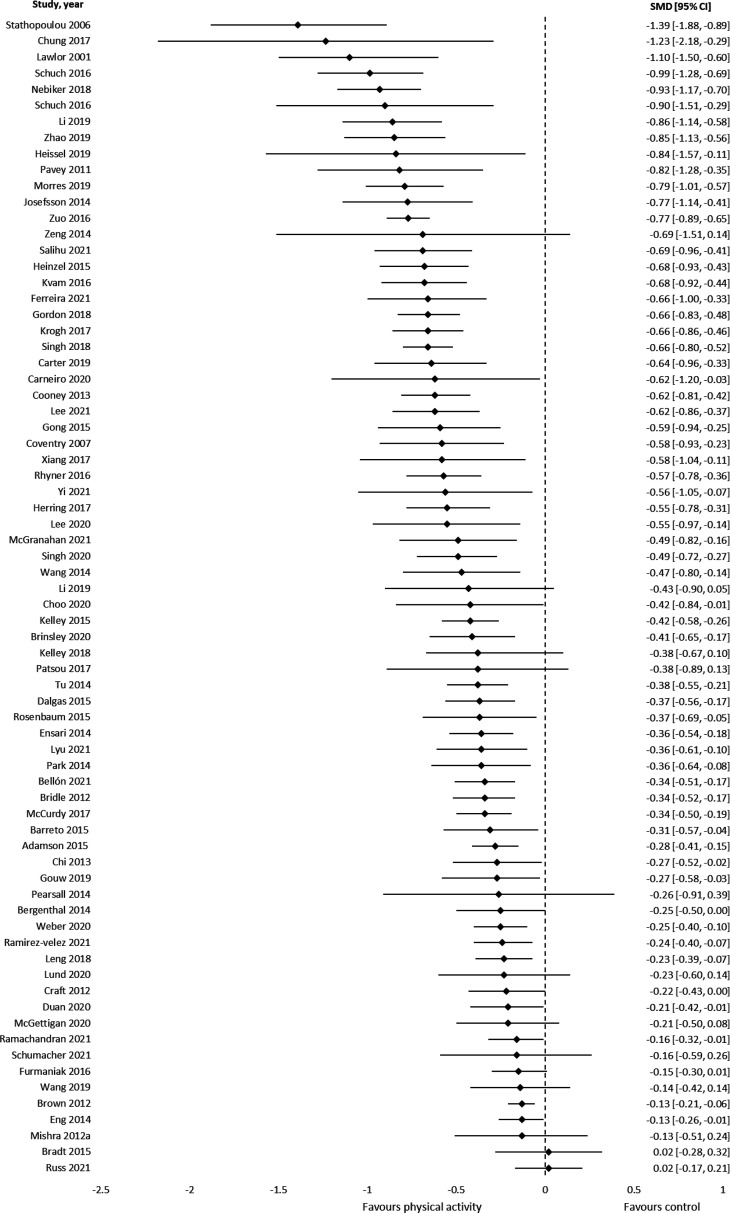
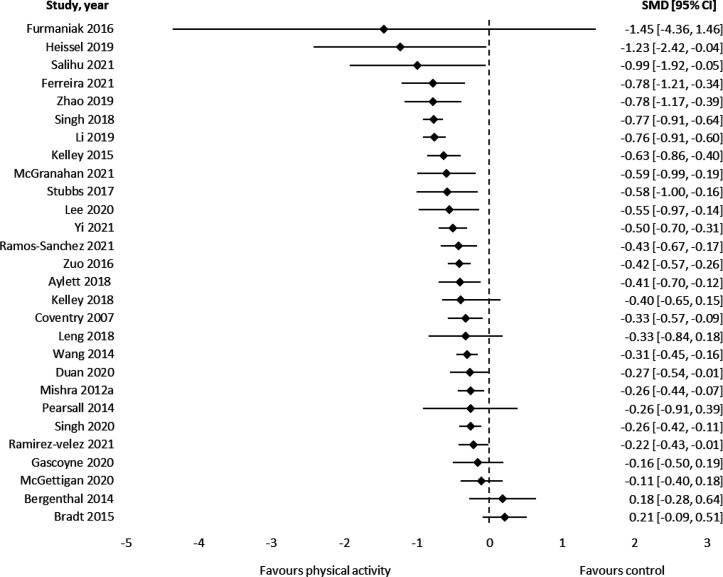
Objective: To synthesise the evidence on the effects of physical activity on symptoms of depression, anxiety and psychological distress in adult populations. Design: Umbrella review. Data sources: Twelve electronic databases were searched for eligible studies published from inception to 1 January 2022. Eligibility criteria for selecting studies: Systematic reviews with meta-analyses of randomised controlled trials designed to increase physical activity in an adult population and that assessed depression, anxiety or psychological distress were eligible. Study selection was undertaken in duplicate by two independent reviewers. Results: Ninety-seven reviews (1039 trials and 128 119 participants) were included. Populations included healthy adults, people with mental health disorders and people with various chronic diseases. Most reviews (n=77) had a critically low A MeaSurement Tool to Assess systematic Reviews score. Physical activity had medium effects on depression (median effect size=−0.43, IQR=−0.66 to –0.27), anxiety (median effect size=−0.42, IQR=−0.66 to –0.26) and psychological distress (effect size=−0.60, 95% CI −0.78 to –0.42), compared with usual care across all populations. The largest benefits were seen in people with depression, HIV and kidney disease, in pregnant and postpartum women, and in healthy individuals. Higher intensity physical activity was associated with greater improvements in symptoms. Effectiveness of physical activity interventions diminished with longer duration interventions. Conclusion and relevance: Physical activity is highly beneficial for improving symptoms of depression, anxiety and distress across a wide range of adult populations, including the general population, people with diagnosed mental health disorders and people with chronic disease. Physical activity should be a mainstay approach in the management of depression, anxiety and psychological distress. PROSPERO registration number: CRD42021292710.
Overview
The claims and statistics of this paper haven’t been checked yet.
Free: it reads the open-access text and checks the first 5 claims that cite a source we can check. Create a free account to check every claim.
Integrity signals
Registry
Cites
Statistics
Figures
Verification
Claims the paper makes
The claims and statistics of this paper haven’t been checked yet.
Free: it reads the open-access text and checks the first 5 claims that cite a source we can check. Create a free account to check every claim.
Claims other papers make about this one
Each is checked against this paper’s own text: does it say what the citing paper says it does?
The cited source doesn’t support the claim as written.
In the citing paper
“Because we simultaneously assessed more than 200 studies, credible intervals were narrower than those in most existing meta-analyses.13”
From Effect of exercise for depression: systematic review and network meta-analysis of randomised controlled trials (2024) · cites this paper as [13]
Checked by a reasoning model — may be wrong.
Experimental — accuracy not yet measuredThe source backs part of the claim, not all of it — or backs it for a different population, condition or comparison.
In the citing paper
“challenges remain regarding how to optimise exercise design to improve adherence rates 28 .”
From Effect of exercise on depression and anxiety symptoms: systematic umbrella review with meta-meta-analysis (2026) · cites this paper as [28]
Experimental — accuracy not yet measuredThe source backs part of the claim, not all of it — or backs it for a different population, condition or comparison.
In the citing paper
“physical activity is known to boost mood and reduce symptoms of depression and anxiety, which are often associated with loneliness.71”
From A Longitudinal Study of Loneliness Before the End of the COVID-19 Pandemic: Trajectories, Predictors, and Impact on Chinese Adolescent Mental Health (2024) · cites this paper as [71]
Experimental — accuracy not yet measuredThe source backs part of the claim, not all of it — or backs it for a different population, condition or comparison.
In the citing paper
“Our review included more studies than many existing reviews on exercise for depression.13 22 27 28”
From Effect of exercise for depression: systematic review and network meta-analysis of randomised controlled trials (2024) · cites this paper as [13]
Experimental — accuracy not yet measuredThe source backs part of the claim, not all of it — or backs it for a different population, condition or comparison.
In the citing paper
“our study and the study by Singh et al13 both found that effects were stronger with vigorous intensity exercise compared with light and moderate exercise.”
From Effect of exercise for depression: systematic review and network meta-analysis of randomised controlled trials (2024) · cites this paper as [13]
Experimental — accuracy not yet measured
5 more claims about this paper
Create a free account to see every claim other papers make about this one.
Self-check
Percentages, sums and reported differences re-computed from the paper’s own numbers.
The self-check needs the paper’s full text.
Citations
Cites
The PRISMA 2020 statement: An updated guideline for reporting systematic reviews
Page, M. J., McKenzie, J. E., Bossuyt, P. M., Boutron, I., Hoffmann, T. C., Mulrow, C. D., Shamseer, L., Tetzlaff, J. M., Akl, E. A., Brennan, S. E., et al. (2021) · BMJ · doi:10.1136/bmj.n71 · Cited by 108,283
Bias in meta-analysis detected by a simple, graphical test
Egger, M., Smith, G. D., Schneider, M., & Minder, C. (1997) · BMJ · doi:10.1136/bmj.315.7109.629 · Cited by 56,722
Shea, B. J., Reeves, B. C., Wells, G., Thuku, M., Hamel, C., Moran, J., Moher, D., Tugwell, P., Welch, V., Kristjansson, E., et al. (2017) · BMJ · doi:10.1136/bmj.j4008 · Cited by 10,636 · cited 2×
“29”
Background(1985) · Europe PMC (PubMed Central) · Cited by 9,143
The PRISMA 2020 statement: an updated guideline for reporting systematic reviews
Page, M. J., McKenzie, J., Bossuyt, P., Boutron, I., Hoffmann, T., mulrow, C., Shamseer, L., Tetzlaff, J., Akl, E., Brennan, S. E., et al. (2020) · doi:10.31222/osf.io/v7gm2_v1 · Cited by 8,090
Santomauro, D. F., Mantilla Herrera, A. M., Shadid, J., Zheng, P., Ashbaugh, C., Pigott, D. M., Abbafati, C., Adolph, C., Amlag, J. O., Aravkin, A. Y., et al. (2021) · The Lancet · doi:10.1016/s0140-6736(21)02143-7 · Cited by 5,444
The PRISMA 2020 statement: an updated guideline for reporting systematic reviews
Page, M. J., McKenzie, J., Bossuyt, P., Boutron, I., Hoffmann, T., mulrow, C., Shamseer, L., Tetzlaff, J., Akl, E., Brennan, S. E., et al. (2020) · doi:10.31222/osf.io/v7gm2 · Cited by 5,177
Qiu, J., Shen, B., Zhao, M., Wang, Z., Xie, B., & Xu, Y. (2020) · General Psychiatry · doi:10.1136/gpsych-2020-100213 · Cited by 4,307
Cipriani, A., Furukawa, T. A., Salanti, G., Chaimani, A., Atkinson, L. Z., Ogawa, Y., Leucht, S., Ruhe, H. G., Turner, E. H., Higgins, J. P. T., et al. (2018) · The Lancet · doi:10.1016/s0140-6736(17)32802-7 · Cited by 3,541
Cooney, G. M., Dwan, K., Greig, C. A., Lawlor, D. A., Rimer, J., Waugh, F. R., McMurdo, M., & Mead, G. E. (2013) · Cochrane Database of Systematic Reviews · doi:10.1002/14651858.cd004366.pub6 · Cited by 1,834
Research works printed but not linked: 2
- Oxford Centre for Evidence-Based Medicine. Levels of evidence (March 2009). University of Oxford, 2022.
- Ramírez-Vélez R, Zambom-Ferraresi F, García-Hermoso A, et al. Evidence-based exercise recommendations to improve mental wellbeing in women with breast cancer during active treatment: a systematic review and meta-analysis. Cancers (Basel) 2021; 13: 264. 10.3390/cancers13020264 33445739 PMC7828164 · DOI
Cited by
Items 201–300 of 999
Juesas, Á., Saez-Berlanga, Á., Gené‐Morales, J., Jiménez‐Martínez, P., Alix‐Fages, C., Garrido, J. F., Caballero, O., Janicijevic, D. N., Zarza, V., & Colado, J. C. (2025) · Healthcare · doi:10.3390/healthcare13091055 · Cited by 7
“Moreover, several studies have reported positive effects of regular physical activity in patients suffering from depression [17,18].”
Bhundoo, A. K., Pillay, J. D., & Wilke, J. (2025) · Journal of Medical Internet Research · doi:10.2196/64856 · Cited by 14
“While the sizable effects of OE on most psychological outcomes are in line with studies examining face-to-face exercise [58,59], the lack of a change in anxiety is a bit surprising because anxiety had been reported to improve in response to conventional exercise [60].”
Takuma, S., Hozumi, H., Miyashita, K., Inoue, Y., Yasui, H., Suzuki, Y., Karayama, M., Furuhashi, K., Enomoto, N., Fujisawa, T., et al. (2025) · Respiratory Medicine · doi:10.1016/j.rmed.2025.108185 · Cited by 6
Wang, B., & Zhou, H. (2025) · International Journal of Mental Health Nursing · doi:10.1111/inm.70126 · Cited by 10
Tache-Codreanu, D.-L., Morcov, M.-V., Tache-Codreanu, A.-M., Sporea, C., Tache-Codreanu, A., Cioca, I. E., & Potecă, T. D. (2025) · Balneo and PRM Research Journal · doi:10.12680/balneo.2025.868 · Cited by 6
Pleșea-Condratovici, C., Pleșea-Condratovici, A., Negoita, S. I., Stoian, V.-I., Moroianu, L.-A., & Baroiu, L. (2025) · Journal of Clinical Medicine · doi:10.3390/jcm14197121 · Cited by 7
Burns, R. D., Kim, Y., Fu, Y., Byun, W., & Bai, Y. (2023) · Preventive Medicine · doi:10.1016/j.ypmed.2023.107750 · Cited by 8
Wang, Z., Cao, Z., Min, J., Duan, T., & Xu, C. (2024) · BMJ Evidence-Based Medicine · doi:10.1136/bmjebm-2024-112933 · Cited by 10
Life Satisfaction, Anxiety, Stress, Depression, and Resilience: A Multigroup Latent Class Analysis
Kyriazos, T. A., & Poga, M. (2024) · Trends in Psychology · doi:10.1007/s43076-024-00396-x · Cited by 10
Yuan, W., Yang, T., Chen, L., Zhang, Y., Liu, J., Song, X., Jiang, J., Yang, Q., Wang, R., Guo, T., et al. (2024) · Journal of Affective Disorders · doi:10.1016/j.jad.2024.08.026 · Cited by 7
Accurate locomotor activity profiles of group-housed mice derived from home cage monitoring data
Sun, R., Gaerz, M.-C., Oeing, C. U., Mai, K., & Brachs, S. (2024) · Frontiers in Neuroscience · doi:10.3389/fnins.2024.1456307 · Cited by 6
Chen, X., Lu, P., Yi, X., Zeng, X., Shen, Z., Wen-xiu, L., & Yin, R. (2024) · BMJ Open · doi:10.1136/bmjopen-2023-078488 · Cited by 12
Physical activity, health, and life satisfaction: Four panel studies demonstrate reciprocal effects
Groß, D., & Kohlmann, C. (2025) · Applied Psychology Health and Well-Being · doi:10.1111/aphw.70027 · Cited by 10
“For mental illness, moderate-to-vigorous physical activity is particularly effective, often yielding greater benefits than lighter activity (Singh et al., 2023).”
Juul, L., Bonde, E. H., & Fjorback, L. O. (2023) · Frontiers in Psychology · doi:10.3389/fpsyg.2023.1154277 · Cited by 6
“An overview of systematic reviews on the effectiveness of physical activity interventions on mental health recently concluded positive effects (Singh et al., 2023).”
BackgroundFraming substance use as “recreational” is neither accurate nor helpful for prevention purposes
Sanchez, Z. M., Folgar, M. I., Matias, J. P., Pimentel, M. P., & Burkhart, G. (2023) · Journal of Prevention · doi:10.1007/s10935-023-00745-z · Cited by 9
Tsai, K., Liu, P., Lin, Y., Chu, C., Huang, W., Sui, X., Lavie, C. J., & Lin, G. (2023) · Frontiers in Psychiatry · doi:10.3389/fpsyt.2023.1255516 · Cited by 7
Kok, A., Passchier, E., May, A. M., Jager‐Wittenaar, H., Veenhof, C., de Bree, R., Stuiver, M. M., & Speksnijder, C. M. (2024) · Current Oncology · doi:10.3390/curroncol31020066 · Cited by 7
“The beneficial effects of exercise on depression, anxiety and distress have been well established [8,29], as some interviewees said that they experienced a positive mental effect of participation in this exercise intervention.”
BackgroundOrhan, B. E., Karadağ, B., Astuti, Y., & Aydın, Y. (2024) · International journal of human movement and sports sciences · doi:10.13189/saj.2024.120303 · Cited by 12
“Physical activity positively affects physical, mental, and emotional health [13].”
Exercise for the Prevention and Treatment of Depression
Alderman, B. L., Perdue, H. M., & Sarwani, A. H. (2024) · Current topics in behavioral neurosciences · doi:10.1007/7854_2024_496 · Cited by 8
The role of fiscal policy on poverty reduction in South Africa
Mokoena, M., & Mazenda, A. (2023) · Future Business Journal · doi:10.1186/s43093-023-00256-7 · Cited by 6
“[43], recommendations, principal components and ridge regression can improve the robustness of the model.”
BackgroundCowan, B. A., Olivier, K. M., TOMBAL, B. F., & Wefel, J. S. (2023) · Advances in Therapy · doi:10.1007/s12325-023-02721-9 · Cited by 8
“Physical activity, in particular, has demonstrated an ability to balance oncologic benefit with a reduction in long-term adverse effects in previous studies [49–51 , 57].”
BackgroundWeber, M., Raab, A. M., Schmitt, K., Büsching, G., Marcin, T., Spielmanns, M., Puhan, M. A., & Frei, A. L. (2024) · BMJ Open · doi:10.1136/bmjopen-2023-081397 · Cited by 7
Sun, Y., Ho, S. Y., Chan, C. S., Wang, M. P., Wan, A., Xu, Y., Lai, A. Y. K., & Lam, T. H. (2024) · Journal of Primary Care & Community Health · doi:10.1177/21501319241281567 · Cited by 8
“23,43 However, the long-term effect is yet to be confirmed.”
BackgroundWang, Y., & Deng, A. (2025) · American Journal of Health Promotion · doi:10.1177/08901171251340390 · Cited by 5
Is Exercise During Androgen Deprivation Therapy Effective and Safe? A Randomized Controlled Trial
Rantaniemi, L., Jussila, I., Siltari, A., Ahtiainen, J. P., Hakulinen, A., Harju, E., Sormunen, J., Nordstrom, T., Tammela, T. L. J., & Murtola, T. J. (2025) · Scandinavian Journal of Medicine and Science in Sports · doi:10.1111/sms.70084 · Cited by 7
“The emotional functioning improvements may be attributed to the psychological benefits of regular exercise, such as reduced anxiety and depression [29, 30], which are common in PCa patients undergoing ADT [31, 32].”
Kanamori, S., Imamura, K., Inagawa, Y., Yamauchi, T., Ikeda, H., Okuyama, T., Muto, G., Kato, R., Iida, M., Asaoka, H., et al. (2025) · Journal of Occupational Health · doi:10.1093/joccuh/uiaf035 · Cited by 6
Bodily maps of exercise-induced feelings
Saanijoki, T., & Nummenmaa, L. (2025) · Scientific Reports · doi:10.1038/s41598-025-07246-5 · Cited by 4
Harrison, V., Jones, K. E., & Hyde, C. A. C. (2025) · JMIR Cancer · doi:10.2196/70510 · Cited by 7
“…physical activity (4/4) interventions were also found to be consistent in their positive effects, supporting previous work that has found physical activity to be linked to well-being outcomes in the general population [5,105] and reduced depression symptoms in wider cancer populations [106].”
Zhu, H., & Wen, Y. (2025) · Frontiers in Psychology · doi:10.3389/fpsyg.2025.1593420 · Cited by 8
Combined cardiorespiratory and resistance training for people with stroke
Saunders, D. H., Carstairs, S. A., Cheyne, J. D., Fileman, M., Morris, J. H., Morton, S., Wylie, G., & Mead, G. E. (2025) · Cochrane Database of Systematic Reviews · doi:10.1002/14651858.cd016002 · Cited by 14
Ēvelis, K., Koļesovs, A., Rostoka, E., & Plakane, L. (2025) · Scientific Reports · doi:10.1038/s41598-025-22209-6 · Cited by 7
“Recent studies emphasize exercise promotion for mental and cognitive health across various age groups and health condition 9,10 .”
Yang, B., Yang, X., Fan, Z., Liu, C., & Zheng, Z. (2026) · PeerJ · doi:10.7717/peerj.20511 · Cited by 7
Mental health and kidney disease
Chilcot, J., Cogley, C., Carswell, C., Hudson, J. L., Greenwood, S. A., Sharma, S., Bramham, K., Lunn, A. J., & Farrington, K. (2026) · Nature Reviews Nephrology · doi:10.1038/s41581-026-01055-3 · Cited by 6
Chen, P. (2023) · Psychology · doi:10.4236/psych.2023.148065 · Cited by 5
Frederiksen, K. S., Morató, X., Zetterberg, H., Gauthier, S. G., Boada, M., Pytel, V., & Mattke, S. (2024) · Alzheimer Disease & Associated Disorders · doi:10.1097/wad.0000000000000600 · Cited by 7
“7,21,22 Studies of multi-domain interventions, including diet, exercise, cognitive training, and vascular risk monitoring, have reported positive outcomes in the prevention of cognitive decline in at-risk older people.”
BackgroundCuesta‐López, I., Secades‐Villa, R., & González‐Roz, A. (2024) · Current Addiction Reports · doi:10.1007/s40429-024-00573-z · Cited by 5
Huang, L., Ge, Y., Fu, Y., Zhao, Y., Ou, Y., Zhang, Y., Ma, L., Chen, S.-D., Guo, Z., Feng, J., et al. (2024) · GeroScience · doi:10.1007/s11357-024-01224-x · Cited by 5
Measuring 24‐h use of time in people with a diabetes‐related foot ulcer: A feasibility study
Murphy, A., Graham, K., Olds, T., Loughry, C., Fraysse, F., Dumuid, D., Stanford, T., & Matricciani, L. (2024) · Journal of Foot and Ankle Research · doi:10.1002/jfa2.12045 · Cited by 7
Self-citationValdesalici, A., Cerea, S., Pecunioso, A., Paoli, A., Grigolin, G., Nardelli, R., Armenti, A., & Ghisi, M. (2024) · Frontiers in Psychology · doi:10.3389/fpsyg.2024.1502426 · Cited by 12
Danielsen, K. K., Cabral, D., & Sveaas, S. H. (2023) · International Journal of Environmental Research and Public Health · doi:10.3390/ijerph20176639 · Cited by 10
“Furthermore, studies indicate that the effect appears to be greater for exercise with moderate and high intensity compared to low intensity [12,14,16,63].”
BackgroundParker, J. S., Shook, B. L., Washington, D., English, B., & Tatum, C. (2024) · Psychology · doi:10.4236/psych.2024.151006 · Cited by 6
Baillot, A., Asselin, M., Bernard, P., Lapointe, J., Bond, D. S., Romain, A. J., Garneau, P. Y., Biertho, L. D., Tchernof, A., Blackburn, P., et al. (2024) · Obesity Surgery · doi:10.1007/s11695-024-07161-0 · Cited by 7
“This finding is in line with previous meta-analyses showing positive effects of PA increases on mental health among adults with obesity or chronic diseases [73, 74].”
Jia, H., & Lubetkin, E. I. (2024) · Quality of Life Research · doi:10.1007/s11136-024-03632-0 · Cited by 6
“…of systematic reviews highlighted the benefits of physical activity for improving symptoms of depression, anxiety, and psychological distress among diverse adult populations, including the general population as well as persons with mental health disorders and persons with chronic disease [44].”
Noeske, K. E., Snowdon, D. A., Ekegren, C. L., Harding, K. E., Prendergast, L. A., Peiris, C. L., Shields, N., O’Halloran, P., Porter, J. A., Watts, J. J., et al. (2024) · Disability and Rehabilitation · doi:10.1080/09638288.2024.2338195 · Cited by 8
“It is also possible interventions to increase daily steps could positively influence walking self-confidence and anxiety [41].”
Brown, C. E. B., Richardson, K. E., Pizzirani, B., Hughes, S. D., Atkins, L., Pitt, J., Yücel, M., & Segrave, R. A. (2024) · Frontiers in Psychiatry · doi:10.3389/fpsyt.2024.1379396 · Cited by 10
Jayawardena, R., Weerasinghe, K., Gamage, M. K. W., & Hills, A. P. (2024) · BMC Geriatrics · doi:10.1186/s12877-024-05164-1 · Cited by 8
“Better physical health often leads to improved mental health, with reductions in symptoms of depression and anxiety, which are common among older adults [45].”
BackgroundSantos, P. C., Bernardo, D. F. S., Abdalla, P. P., Leirós‐Rodríguez, R., da Silva, L. S. L., Mesquita, C., Mota, J. A. P. S., & Machado, D. R. L. (2024) · Women · doi:10.3390/women4040026 · Cited by 11
Cognitive Behavioral Therapy for Paroxysmal Atrial Fibrillation
Skúladóttir, H., Särnholm, J., Ólafsdóttir, E., Arnardóttir, E. S., Hoppe, K., Bottai, M., Ljótsson, B., & Braunschweig, F. (2024) · JACC Advances · doi:10.1016/j.jacadv.2024.101289 · Cited by 7
Xu, S., Zhao, C., & Hu, L. (2025) · Journal of Affective Disorders · doi:10.1016/j.jad.2025.04.016 · Cited by 7
Le, F., Mattern, V., Johansson, P. J., Hettiarachchi, P., Ebner‐Priemer, U., Wiley, J. F., Dumuid, D., & Giurgiu, M. (2025) · Scientific Reports · doi:10.1038/s41598-025-99266-4 · Cited by 6
Self-citation“Ready-to-use” two-week home exercise program targeting depressive symptoms: pilot study
Sandra, D. A., Olson, J. A., Pageaux, B., & Roy, M. (2023) · Frontiers in Psychiatry · doi:10.3389/fpsyt.2023.1202955 · Cited by 6
“Physical exercise is one of the widely accepted effective interventions to treat mild to moderate depressive symptoms (4).”
BackgroundChirino, T. Y. W., Rangel‐López, E., Luna‐Angulo, A. B., Carrillo‐Mora, P., Landa‐Solís, C., Samudio-Cruz, M. A., Fuentes-Bello, A. C., Paniagua‐Pérez, R., Martínez, J. R., & Sánchez‐Chapul, L. (2023) · Pharmaceuticals · doi:10.3390/ph16101421 · Cited by 5
“Physical exercise is an effective therapy that improves depressive symptoms [64].”
BackgroundLiu, T. T., Pascal, L. E., Bauer, S. R., Miles, H. N., Panksepp, J. B., Lloyd, G. L., Li, L., DeFranco, D. B., & Ricke, W. A. (2024) · The Journals of Gerontology Series A · doi:10.1093/gerona/glae007 · Cited by 6
Psychopharmacological Treatment of Depression and Anxiety and their Different Drug Delivery Targets
Sharma, A., Alam, M. A., Kaur, A., Sharma, S., & Yadav, S. (2024) · Current Psychiatry Research and Reviews · doi:10.2174/2666082219666230822140902 · Cited by 3
Wang, J., Zhang, W., Song, P., Wang, T., Yao, Y., Chen, Y., Lin, H., Yang, X., Chen, X., & Fu, C. (2024) · Psychology Research and Behavior Management · doi:10.2147/prbm.s484113 · Cited by 6
“71 Exercise triggers the release of endorphins, which can enhance emotional well-being, leading to a more positive outlook and reduced feelings of social isolation.”
Unpacking the temporal dynamics of physical activity and loneliness: a 1-year interval analysis
Groß, D., & Haffa, J. (2025) · American Journal of Epidemiology · doi:10.1093/aje/kwaf077 · Cited by 4
García-Pérez, L., Ruz, R. P., Cepero-González, M., & Ubago-Jiménez, J. L. (2025) · Behavioral Sciences · doi:10.3390/bs15040549 · Cited by 7
Prydz, M. B., Bjørndal, L. D., Czajkowski, N. O., Røysamb, E., & Nes, R. B. (2025) · Behaviour Research and Therapy · doi:10.1016/j.brat.2025.104781 · Cited by 6
Zhong, L., Ma, X., Li, S., & Ling, Y. (2025) · Frontiers in Psychiatry · doi:10.3389/fpsyt.2025.1563237 · Cited by 8
Moving as We Age: Effects of Physical Activity Programmes on Older Adults—An Umbrella Review
Neill, R. D., Bradley, L., & O’Sullivan, R. (2025) · Geriatrics · doi:10.3390/geriatrics10040098 · Cited by 10
Almaged, S., Zeyad, L., Sharaf, A., & Yasir, S. (2025) · Biomedical Human Kinetics · doi:10.2478/bhk-2025-0025 · Cited by 6
“However, the link between exercise and a reduced risk of mental illness has not been thoroughly explored in research (Singh et al., 2023).”
Hu, Y. S., Zeng, Y., Dong, H., & Li, H. (2025) · Frontiers in Psychology · doi:10.3389/fpsyg.2025.1648594 · Cited by 8
Ma, M., Sui, T., Shi, L., & Lau, W. C. (2025) · Journal of Affective Disorders · doi:10.1016/j.jad.2025.120512 · Cited by 4
Shang, X., Lu, J., Tao, M., Fei, C., & Fei, J. (2025) · Frontiers in Psychology · doi:10.3389/fpsyg.2025.1670804 · Cited by 8
Effects of exercise during pregnancy on maternal and newborn outcomes
Shen, Y., Wang, Y., & Huang, P. F. (2025) · BMC Pregnancy and Childbirth · doi:10.1186/s12884-025-08285-6 · Cited by 12
“This correlation has been confirmed in numerous studies [82–85].”
Association of ANKK1 and DRD2 gene polymorphisms with exercise addiction among elite athletes
Yıldız, Y. A., Kasakolu, A., Bulğay, C., Bıyıklı, T., Kazan, H. H., Koncagül, S., Bayraktar, I., Ahmetov, I. I., Griffiths, M. D., Ergün, M. A., et al. (2025) · International Journal of Sport and Exercise Psychology · doi:10.1080/1612197x.2025.2584537 · Cited by 4
Adams, W. M., Anderson, T., Post, E. G., Christopher, S. M., McKay, A. K. A., Donaldson, A. T., Galán-López, N., Finnoff, J. T., Carter, S., & Taylor, L. K. (2025) · International Journal of Sports Physiology and Performance · doi:10.1123/ijspp.2024-0461 · Cited by 5
Awareness of exercise addiction and exercise motivation attitudes: a cross-sectional study
Orhan, B. E., Alkasasbeh, W. J., Karaçam, A., Canlı, U., & Amawi, A. T. (2025) · Frontiers in Sports and Active Living · doi:10.3389/fspor.2025.1691151 · Cited by 6
Nilsson, H., Gottvall, M., Gustavsson, C., Nissen, A., & Saboonchi, F. (2026) · Mental health and physical activity · doi:10.1016/j.mhpa.2026.100752 · Cited by 6
“…PA guidelines are well defined, and substantial evidence exists in clinical populations with symptoms overlapping those of PTSD (Bull et al., 2020; Singh et al., 2023), research on PA interventions specifically for individuals with PTSD has expanded in recent years (Bj ¨ orkman & Ekblom, 2022;…”
Tang, D., Liu, C., Liu, J., Liu, T., Ma, R., & Sum, R. K. W. (2026) · npj Digital Medicine · doi:10.1038/s41746-026-02479-8 · Cited by 8
Xie, J., Zhang, J., Zhang, L., & Chen, X. (2026) · Frontiers in Microbiology · doi:10.3389/fmicb.2026.1740680 · Cited by 5
Ammar, A., Salem, A., Trabelsi, K., Montalván, M., Bouaziz, B., Boujelbane, M. A., Kerkeni, M., Masmoudi, L., Ghazzawi, H., Amawi, A. T., et al. (2026) · Sports · doi:10.3390/sports14050186 · Cited by 5
Lu, S. Y., McVeigh, J. A., Becerra, R., Bucks, R. S., Hunter, M. L., & Naragon‐Gainey, K. (2024) · Journal of Affective Disorders Reports · doi:10.1016/j.jadr.2024.100748 · Cited by 6
Feng, C., Shi, Z., Tian, Y., Ma, C., & Liu, J. (2024) · Current Psychology · doi:10.1007/s12144-024-05990-x · Cited by 5
“Research has demonstrated that leisure-time physical activity effectively alleviates residents’ depression (Singh et al., 2023).”
Age, Education and Depression Among Older Adults: The Mediating Role of Physical Activity
Cheah, Y. K., Anera, S. N. S., Omar, M. A., Manaf, N. H. A., & Idris, Z. Z. (2024) · Clinical Gerontologist · doi:10.1080/07317115.2024.2371612 · Cited by 7
“Researchers conducted systematic reviews with the aim of examining the effects of physical activity on mental health disorders (Singh et al., 2023).”
Koa, A. J. A. F., Chou, C.-C., Lindayani, L., & Wang, C. (2024) · Belitung Nursing Journal · doi:10.33546/bnj.3370 · Cited by 13
“Reduced physical activity negatively affects physical health (Warburton & Bredin, 2017) and mental well-being (Singh et al., 2023), as well as academic performance (Deliens et al., 2015).”
BackgroundWorking hours influence preferences of residents for micro features of small urban green spaces
Wang, L., Shen, L., & Liu, H. (2024) · Scientific Reports · doi:10.1038/s41598-024-74607-x · Cited by 5
“The interest in physical activities might be due to their potential positive effects on reducing fatigue 50 , with findings supporting the effectiveness of physical activities in improving mental health conditions 51 .”
BackgroundLi, C., Qu, S., & Ren, K. (2024) · Psychology Research and Behavior Management · doi:10.2147/prbm.s477659 · Cited by 8
“Depression is a common mental disorder that inversely relates to physical activity, 23–26 indicating that physical activity can alleviate depressive symptoms.”
BackgroundQin, Y., Hamana, K., & Gale, N. (2024) · Disability and Rehabilitation · doi:10.1080/09638288.2024.2420832 · Cited by 5
“Exercise can also maintain and improve the quality of life (QoL) and has significant psychological effects (e.g., improving confidence and symptoms of depression, anxiety, and distress) in PwCF [5–7].”
Päivärinne, V., Lahti, J., Salmela, J., Kouvonen, A. M., Lallukka, T. M., & Rahkonen, O. (2025) · Journal of Physical Activity and Health · doi:10.1123/jpah.2024-0224 · Cited by 6
Yu, L., Li, J., Zou, L., Chen, Y., Werneck, A. O., Herold, F., Taylor, A., & Tari, B. (2025) · International Journal of Mental Health Promotion · doi:10.32604/ijmhp.2025.061237 · Cited by 6
“Furthermore, recent reviews also provide evidence that PA intervention programs as an alternative or adjunct treatment for anxiety and depressive symptoms can effectively alleviate internalizing problems in youths [16,19,20].”
Seppänen, M., Lankila, T., Niemelä, M., Rautio, N., Korpisaari, M., Timonen, M., Korpelainen, R., & Farrahi, V. (2025) · BMC Medicine · doi:10.1186/s12916-025-04051-9 · Cited by 5
“Similar findings were reported in an umbrella review [6], which provided compelling evidence of an association between PA and lower levels of depression and highlighted the importance of engaging in multi-modal, moderate-to-vigorous-intensity PA (MVPA).”
Wang, Y., Sun, J., Zhang, Y., Wang, J., & Lu, S. (2025) · Frontiers in Psychology · doi:10.3389/fpsyg.2025.1505061 · Cited by 11
Han, S.-S., Chen, Q.-H., Mu, F. Z., Li, B., Lou, H., Zhao, L., Li, Y.-X., & Yang, C. (2025) · BMC Public Health · doi:10.1186/s12889-025-24725-6 · Cited by 5
“This finding may be associated with mental health status and stress management factors [62].”
Shangguan, Y., Lin, Z., Huang, K., Sim, Y.-J., Hou, Y., Yan, L., Wu, K., & Li, H. (2025) · Journal of Affective Disorders · doi:10.1016/j.jad.2025.120555 · Cited by 6
Osuka, Y., Kojima, N., Daimaru, K., Ono, R., Sugie, M., Omura, T., Motokawa, K., Ueda, T., Maruo, K., Aoyama, T., et al. (2024) · Journal of Epidemiology · doi:10.2188/jea.je20230317 · Cited by 8
Rupp, L. H., Schindler‐Gmelch, L., Rogge, L., & Berking, M. (2024) · Mental health and physical activity · doi:10.1016/j.mhpa.2024.100600 · Cited by 5
Social value framing of physical activity in European Member State policies: a content analysis
Ritchie, I., Nieto, I., Brunn, M., Mayo, X., & Jiménez, A. (2024) · Frontiers in Sports and Active Living · doi:10.3389/fspor.2024.1415007 · Cited by 6
Kamandulis, S., Lukonaitienė, I., Sniečkus, A., Brazaitis, M., Mickevičius, M., Černych, M., Ruas, J. L., Schwieler, L., Louvrou, V., Erhardt, S., et al. (2024) · Medicine & Science in Sports & Exercise · doi:10.1249/mss.0000000000003488 · Cited by 5
“…evidence overwhelmingly substantiates the substantial therapeutic advantages of PA in mitigating depression, anxiety, and distress across a wide spectrum of populations, including healthy adults, individuals suffering from mental health disorders, and those living with chronic diseases (6).”
Association of Life’s Essential 8 with depression among adults: A cross-sectional study of NHANES
Bai, Y., & Guo, S. (2024) · Journal of Investigative Medicine · doi:10.1177/10815589241261286 · Cited by 6
“33 Healthy dietary patterns, like Mediterranean diet, have protection against the development of depression.”
Rausch, L. K., Birklbauer, A., Federolf, P., Hecksteden, A., Hofmann, P., Niebauer, J., Reich, B., Rieder, F., Ruin, S., Scharhag, J., et al. (2024) · Current Issues in Sport Science (CISS) · doi:10.36950/2024.9ciss001 · Cited by 4
“These effects have been particularly evident in psychosomatic conditions, especially anxiety and depression disorders (Björkman & Ekblom, 2022; Blumenthal & Rozanski, 2023; Heissel et al., 2023; Singh et al., 2023; Wanjau et al., 2023).”
BackgroundPhysical Exercise in Kidney Renal Recipients: Where Have We Come?
Mosconi, G., Totti, V., Sella, G., Roi, G. S., Costa, A. N., Bellis, L., & Cardillo, M. (2024) · Kidney & Blood Pressure Research · doi:10.1159/000539996 · Cited by 6
“A large body of literature reports an improvement in patients ’ self-perceptions recorded through speci fi c questionnaires, including functional capabilities and QoL perception after personalized exercise programs [34].”
Svensén, S., Bolstad, I., Ødbehr, L. S., & Larsson, G. (2024) · Frontiers in Psychology · doi:10.3389/fpsyg.2024.1456282 · Cited by 5
Effects of an acute maximal exercise bout on serum insulin-like growth factor-1 in adults with MDD
Kelly, S. J. E., Meyer, J., Stielow, C., Heinzel, S., & Heißel, A. (2024) · Psychoneuroendocrinology · doi:10.1016/j.psyneuen.2024.107215 · Cited by 4
Lambert, J. D., Dean, S. G., Terry, R. H., Charles, N., Greaves, C. J., Campbell, J. L., & Taylor, A. H. (2024) · BMJ Open · doi:10.1136/bmjopen-2023-080472 · Cited by 6
Oliveira, A. B., Peres, M. F. P., Mercante, J. P. P., Brunoni, A. R., Wang, Y., Molina, M. D. C. B., UCHIYAMA, L. K., Lotufo, P. A., Benseñor, I. M., & Goulart, A. C. (2024) · Headache The Journal of Head and Face Pain · doi:10.1111/head.14868 · Cited by 4
“53,59 Data from systematic reviews and meta-analyses of randomized controlled trials suggest preventive effects of an ample array of modalities/intensities of exercise on depression and/or depressive symptoms 53,59,60 and migraine.”
Hernández, P. A. F., Farías‐Valenzuela, C., Rezende, L. F. M., Nascimento, M. D. M., Marques, A., de Victo, E. R., & Ferrari, G. (2024) · Scientific Reports · doi:10.1038/s41598-024-82396-6 · Cited by 6
Wang, Y., Chen, J., Zou, Y., Yang, M., Kong, X., Wang, L., Xue, J., & Dong, C. (2025) · Journal of Rehabilitation Medicine · doi:10.2340/jrm.v57.41272 · Cited by 4
“Additionally, moderate physical activity may prevent depression onset (8, 13).”
Qiu, P., Dong, B., Cao, R., Hu, J., Yang, J., Yu, R., & Fan, Z. (2025) · Risk Management and Healthcare Policy · doi:10.2147/rmhp.s498108 · Cited by 4
“7 According to the recommendations of the WHO, adults aged 18 to 64 should engage in at least 150 minutes of moderate-intensity physical activity per week or 75 minutes of vigorous-intensity physical activity.”
Kling, J., Asplund, R. P., Ekblom, Ö. B., & Blom, V. (2025) · BMC Psychiatry · doi:10.1186/s12888-025-06484-1 · Cited by 9
“A recent umbrella review showed that regular exercise is effective in symptom reduction of depression, anxiety, and distress both across multiple populations and specifically for patients with depression and different anxiety-and stress disorders [8].”
Metadata
- Authors
- Singh, B., Olds, T., Curtis, R., Dumuid, D., Virgara, R., Watson, A., Szeto, K., O'Connor, E., Ferguson, T., Eglitis, E., Miatke, A., Simpson, C. E., & Maher, C.
- Affiliations
- University of South Australia (AU)
- Corresponding author
- Singh, Ben
- ORCID
- Venue
- British Journal of Sports Medicine
- Publisher
- BMJ
- Published
- 2023-02-16
- Volume
- 57
- Issue
- 18
- Pages
- 1203-1209
- ISSN
- 0306-3674 (ISSN-L)
- 1473-0480
- PMC
- PMC10579187
- OpenAlex
- W4321054304
- Semantic Scholar
- e1ee60d02a701d40ce44367f24240e1deee861ec
- Cited by
- 1,049
- References
- 141
- Citations by year
- 2026: 347 · 2025: 331 · 2024: 295 · 2023: 75
- FWCI
- 37.39
- Type
- journal article
- Language
- en
- Open access
- hybrid
- doi.org
- Licence
- Locations
- British Journal of Sports Medicine (publishedVersion, cc-by-nc)
- PubMed Central (publishedVersion, cc-by-nc-sa)
- PubMed (publishedVersion)
- UniSA Research Outputs Repository (University of South Australia) (submittedVersion, other-oa)
- Adelaide Research & Scholarship (AR&S) (University of Adelaide) (submittedVersion, cc-by-nc)
- HighWire Press Open Archive (submittedVersion)
- Funders
- Australian National Health and Medical Research Council (APP1162166)
- Medical Research Future Fund Emerging Leader Grant (GNT1193862)
- NHMRC (APP1171981)
- Topics
- Health Sciences › Medicine › Public Health, Environmental and Occupational Health › Physical Activity and Health
- Social Sciences › Psychology › Experimental and Cognitive Psychology › Anxiety, Depression, Psychometrics, Treatment, Cognitive Processes
- Health Sciences › Medicine › Oncology › Cancer survivorship and care
- Keywords
- physical activity interventions, depression, anxiety, psychological distress, mental health, chronic disease, HIV, kidney disease, pregnancy, postpartum women, exercise intensity, intervention duration, adults
- MeSH terms
- Systematic Reviews as Topic, Adult, Anxiety, Mental Disorders, Chronic Disease, Depression, Female, Health Status, Humans, Pregnancy, Quality of Life
About these checks
Registry, retraction, Cites and statistics results are computed, not judged, with one exception: a printed reference that no index lists is read once by a model before it counts as a citation error. Claims are extracted by a model and kept only when their quote appears verbatim in the text; each cited source is then checked, with a model’s help, for whether it says what the claim relies on. Those verdicts can be wrong — read the claim’s quote and the cited source before relying on one.
Statistics and arithmetic are recomputed, not judged.
Confidence bands are shown only for fields calibrated on our annotated test set. None is calibrated yet, so no band is shown.
What counts as a claim ›How we measure confidence ›How we check this ›
Are you an author, or do you see a problem with this page? Request a review
Data sources
Bibliographic data: Semantic Scholar, OpenAlex, Crossref.
Contains information from the Semantic Scholar Academic Graph Datasets, made available under the ODC Attribution License (ODC-BY 1.0).
Semantic Scholar’s data is described in: Kinney, R., et al. (2023). The Semantic Scholar Open Data Platform. arXiv:2301.10140.
