

Effectiveness of physical activity interventions for improving depression, anxiety and distress: an overview of systematic reviews
Open accessThe DOI matches its Crossref record; 140 of the 141 references it cites were found in a registry or an index.
Abstract
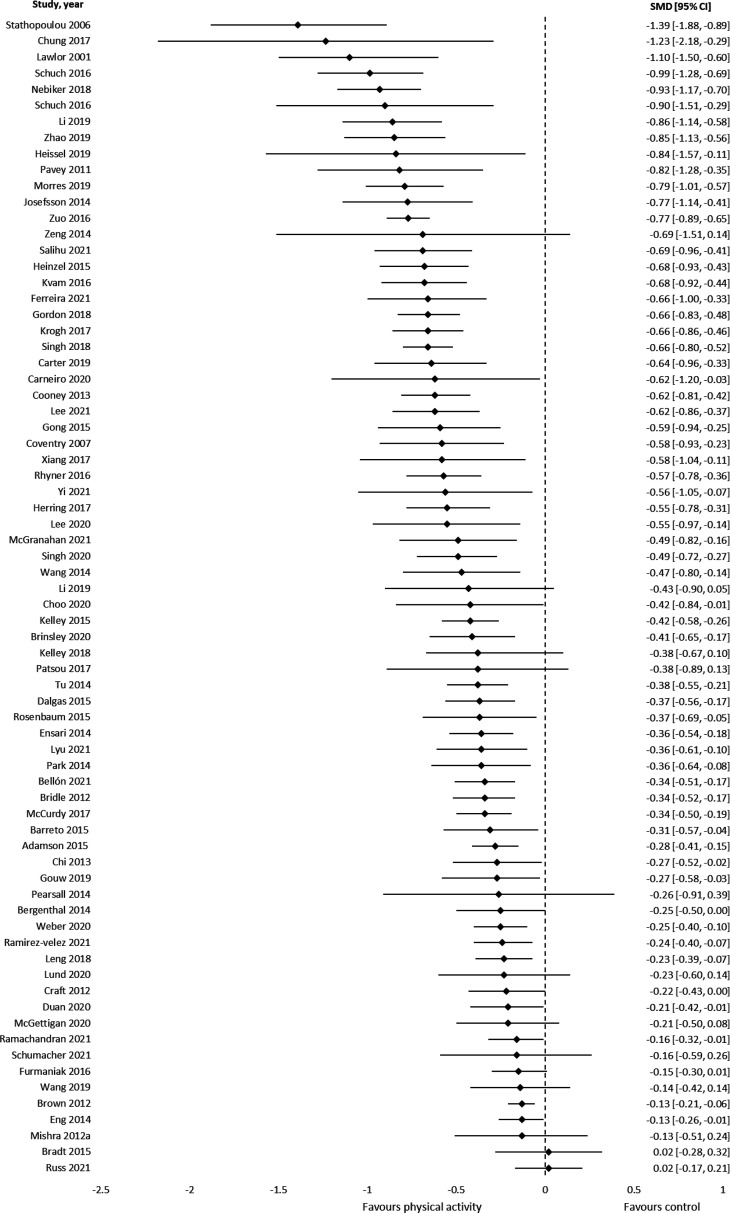
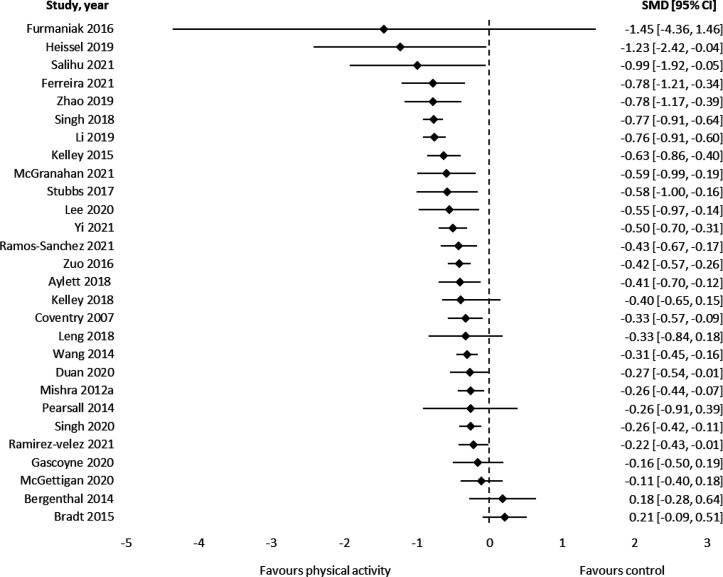
Objective: To synthesise the evidence on the effects of physical activity on symptoms of depression, anxiety and psychological distress in adult populations. Design: Umbrella review. Data sources: Twelve electronic databases were searched for eligible studies published from inception to 1 January 2022. Eligibility criteria for selecting studies: Systematic reviews with meta-analyses of randomised controlled trials designed to increase physical activity in an adult population and that assessed depression, anxiety or psychological distress were eligible. Study selection was undertaken in duplicate by two independent reviewers. Results: Ninety-seven reviews (1039 trials and 128 119 participants) were included. Populations included healthy adults, people with mental health disorders and people with various chronic diseases. Most reviews (n=77) had a critically low A MeaSurement Tool to Assess systematic Reviews score. Physical activity had medium effects on depression (median effect size=−0.43, IQR=−0.66 to –0.27), anxiety (median effect size=−0.42, IQR=−0.66 to –0.26) and psychological distress (effect size=−0.60, 95% CI −0.78 to –0.42), compared with usual care across all populations. The largest benefits were seen in people with depression, HIV and kidney disease, in pregnant and postpartum women, and in healthy individuals. Higher intensity physical activity was associated with greater improvements in symptoms. Effectiveness of physical activity interventions diminished with longer duration interventions. Conclusion and relevance: Physical activity is highly beneficial for improving symptoms of depression, anxiety and distress across a wide range of adult populations, including the general population, people with diagnosed mental health disorders and people with chronic disease. Physical activity should be a mainstay approach in the management of depression, anxiety and psychological distress. PROSPERO registration number: CRD42021292710.
Overview
The claims and statistics of this paper haven’t been checked yet.
Free: it reads the open-access text and checks the first 5 claims that cite a source we can check. Create a free account to check every claim.
Integrity signals
Registry
Cites
Statistics
Figures
Verification
Claims the paper makes
The claims and statistics of this paper haven’t been checked yet.
Free: it reads the open-access text and checks the first 5 claims that cite a source we can check. Create a free account to check every claim.
Claims other papers make about this one
Each is checked against this paper’s own text: does it say what the citing paper says it does?
The cited source doesn’t support the claim as written.
In the citing paper
“Because we simultaneously assessed more than 200 studies, credible intervals were narrower than those in most existing meta-analyses.13”
From Effect of exercise for depression: systematic review and network meta-analysis of randomised controlled trials (2024) · cites this paper as [13]
Checked by a reasoning model — may be wrong.
Experimental — accuracy not yet measuredThe source backs part of the claim, not all of it — or backs it for a different population, condition or comparison.
In the citing paper
“challenges remain regarding how to optimise exercise design to improve adherence rates 28 .”
From Effect of exercise on depression and anxiety symptoms: systematic umbrella review with meta-meta-analysis (2026) · cites this paper as [28]
Experimental — accuracy not yet measuredThe source backs part of the claim, not all of it — or backs it for a different population, condition or comparison.
In the citing paper
“physical activity is known to boost mood and reduce symptoms of depression and anxiety, which are often associated with loneliness.71”
From A Longitudinal Study of Loneliness Before the End of the COVID-19 Pandemic: Trajectories, Predictors, and Impact on Chinese Adolescent Mental Health (2024) · cites this paper as [71]
Experimental — accuracy not yet measuredThe source backs part of the claim, not all of it — or backs it for a different population, condition or comparison.
In the citing paper
“Our review included more studies than many existing reviews on exercise for depression.13 22 27 28”
From Effect of exercise for depression: systematic review and network meta-analysis of randomised controlled trials (2024) · cites this paper as [13]
Experimental — accuracy not yet measuredThe source backs part of the claim, not all of it — or backs it for a different population, condition or comparison.
In the citing paper
“our study and the study by Singh et al13 both found that effects were stronger with vigorous intensity exercise compared with light and moderate exercise.”
From Effect of exercise for depression: systematic review and network meta-analysis of randomised controlled trials (2024) · cites this paper as [13]
Experimental — accuracy not yet measured
5 more claims about this paper
Create a free account to see every claim other papers make about this one.
Self-check
Percentages, sums and reported differences re-computed from the paper’s own numbers.
The self-check needs the paper’s full text.
Citations
Cites
The PRISMA 2020 statement: An updated guideline for reporting systematic reviews
Page, M. J., McKenzie, J. E., Bossuyt, P. M., Boutron, I., Hoffmann, T. C., Mulrow, C. D., Shamseer, L., Tetzlaff, J. M., Akl, E. A., Brennan, S. E., et al. (2021) · BMJ · doi:10.1136/bmj.n71 · Cited by 108,283
Bias in meta-analysis detected by a simple, graphical test
Egger, M., Smith, G. D., Schneider, M., & Minder, C. (1997) · BMJ · doi:10.1136/bmj.315.7109.629 · Cited by 56,722
Shea, B. J., Reeves, B. C., Wells, G., Thuku, M., Hamel, C., Moran, J., Moher, D., Tugwell, P., Welch, V., Kristjansson, E., et al. (2017) · BMJ · doi:10.1136/bmj.j4008 · Cited by 10,636 · cited 2×
“29”
Background(1985) · Europe PMC (PubMed Central) · Cited by 9,143
The PRISMA 2020 statement: an updated guideline for reporting systematic reviews
Page, M. J., McKenzie, J., Bossuyt, P., Boutron, I., Hoffmann, T., mulrow, C., Shamseer, L., Tetzlaff, J., Akl, E., Brennan, S. E., et al. (2020) · doi:10.31222/osf.io/v7gm2_v1 · Cited by 8,090
Santomauro, D. F., Mantilla Herrera, A. M., Shadid, J., Zheng, P., Ashbaugh, C., Pigott, D. M., Abbafati, C., Adolph, C., Amlag, J. O., Aravkin, A. Y., et al. (2021) · The Lancet · doi:10.1016/s0140-6736(21)02143-7 · Cited by 5,444
The PRISMA 2020 statement: an updated guideline for reporting systematic reviews
Page, M. J., McKenzie, J., Bossuyt, P., Boutron, I., Hoffmann, T., mulrow, C., Shamseer, L., Tetzlaff, J., Akl, E., Brennan, S. E., et al. (2020) · doi:10.31222/osf.io/v7gm2 · Cited by 5,177
Qiu, J., Shen, B., Zhao, M., Wang, Z., Xie, B., & Xu, Y. (2020) · General Psychiatry · doi:10.1136/gpsych-2020-100213 · Cited by 4,307
Cipriani, A., Furukawa, T. A., Salanti, G., Chaimani, A., Atkinson, L. Z., Ogawa, Y., Leucht, S., Ruhe, H. G., Turner, E. H., Higgins, J. P. T., et al. (2018) · The Lancet · doi:10.1016/s0140-6736(17)32802-7 · Cited by 3,541
Cooney, G. M., Dwan, K., Greig, C. A., Lawlor, D. A., Rimer, J., Waugh, F. R., McMurdo, M., & Mead, G. E. (2013) · Cochrane Database of Systematic Reviews · doi:10.1002/14651858.cd004366.pub6 · Cited by 1,834
Research works printed but not linked: 2
- Oxford Centre for Evidence-Based Medicine. Levels of evidence (March 2009). University of Oxford, 2022.
- Ramírez-Vélez R, Zambom-Ferraresi F, García-Hermoso A, et al. Evidence-based exercise recommendations to improve mental wellbeing in women with breast cancer during active treatment: a systematic review and meta-analysis. Cancers (Basel) 2021; 13: 264. 10.3390/cancers13020264 33445739 PMC7828164 · DOI
Cited by
Items 501–600 of 999
Hodgson, P., Glascott, M., Hope, W., Aston, L., Clibbens, N., Fleming, L., Innerd, A. L., & Graham, M. (2025) · Mental health and physical activity · doi:10.1016/j.mhpa.2025.100707 · Cited by 3
Hooyberg, A., der Heyden, L. D. W. V., Severin, M. I., Henauw, S. D., & Everaert, G. (2025) · Healthcare · doi:10.3390/healthcare13131599 · Cited by 1
“Despite the enormous evidence showing the strong effects of physical activity on health and well-being and the repeated recommendations for prescribing this to patients [63–66], this does not seem enough to convince many GPs to prescribe exercise.”
Kik, J., Alma, M., Hofman, M. S., Panjer, J. A., Berger, M. Y., Burger, H., & Cath, D. C. (2025) · Journal of Affective Disorders Reports · doi:10.1016/j.jadr.2025.100948 · Cited by 1
Jin, L., & Jing, F. (2025) · Current Psychology · doi:10.1007/s12144-025-08247-3 · Cited by 1
Santos, A. C., Long, S., Moreno, C. P., & Bycura, D. K. (2025) · International Journal of Environmental Research and Public Health · doi:10.3390/ijerph22081227 · Cited by 4
“More specific to firefighters, strong evidence exists supporting exercise as both a preventative measure and adjunct treatment for commonly experienced mental disorders (i.e., depression, anxiety, and PTSD) that also provides various ancillary physical health benefits [24,28,35].”
Vieira, E., Manent-Boutaud, M., Daphniet, F., & Cugerone, A. (2025) · Science & Sports · doi:10.1016/j.scispo.2025.07.003 · Cited by 1
Mezza, F., Lemmo, D., Freda, M. F., Tischler, V., Stephan, B. C. M., Mataró, M., & Sabatini, S. (2025) · Healthcare · doi:10.3390/healthcare13162071 · Cited by 1
Tsai, K., Lin, K.-H., Hung, A.-H., Chang, Y., Sui, X., Lavie, C. J., & Lin, G. (2025) · Frontiers in Cardiovascular Medicine · doi:10.3389/fcvm.2025.1432464 · Cited by 1
College students' depression and body image: Unraveling the Link
Cheng, Z.-J., Tao, H., Huan, H.-G., Wu, C., Wang, Q., & Hao, M. (2025) · World Journal of Psychiatry · doi:10.5498/wjp.v15.i9.109611 · Cited by 2
Gresele, B. S., Pereira, J. L., Rosa, A. D. S., Lyrio-Carvalho, H. C., Ulisses, S. M. V., & da Silva, A. R. S. (2025) · Veterinary Sciences · doi:10.3390/vetsci12090835 · Cited by 1
“Recent systematic reviews further confirm that regular physical activity is consistently linked to lower risk of depression, anxiety, and burnout across health professionals and the general population [47,48].”
Tassone, V. K., Quesnel, D. A., Parkington, K. B., Rueda, A., Martin, J., Lee, G. H., Teixeira, A., deJonge, M. L., Lou, W. Y. W., Wiljer, D., et al. (2025) · PLoS ONE · doi:10.1371/journal.pone.0330848 · Cited by 2
“This might contribute to improved adherence and effectiveness [33].”
Manger, H., Beck-Doßler, K., Hoos, O., Reusch, A., & Szczesny, A. (2025) · Frontiers in Public Health · doi:10.3389/fpubh.2025.1648761 · Cited by 1
The mental health impact of physical inactivity: A study on UAE adolescents
Diab, F. M. A., Al-Sharbatti, S., Eltanbadawy, A. T., Alfahad, R. A., & Elgarawany, G. E. (2025) · PLoS ONE · doi:10.1371/journal.pone.0333346 · Cited by 5
“This is documented in a previous systematic review among patients with chronic diseases [36].”
da Cunha, R. A., de Lira, C. A. B., Vancini, R. L., Weiss, K., Knechtle, B., & Andrade, M. S. (2025) · Clinics · doi:10.1016/j.clinsp.2025.100782 · Cited by 1
“An overview of systematic reviews concluded that vigorous exercise has been shown to be associated with greater improvements in depression and anxiety than moderate exercise 7 .”
Williams, A. L., Gray, K. E., Gunnink, E. J., Mooney, S. J., Saelens, B. E., Nelson, K. M., Simpson, T. L., & Hoerster, K. D. (2025) · Acta Psychologica · doi:10.1016/j.actpsy.2025.105786 · Cited by 1
Du, Z., Shi, L., Zhou, Q., Lu, R., Zhou, Z., & Zhu, H. (2025) · European Archives of Psychiatry and Clinical Neuroscience · doi:10.1007/s00406-025-02133-6 · Cited by 2
Chow, A. F., McWhinney, H. L., Alexis, T., & Humbert, M. L. (2025) · International Journal of Circumpolar Health · doi:10.1080/22423982.2025.2582912 · Cited by 4
Garcia, J. B., Kerr, Z. Y., Kyaw, E. M., & Courtney, J. B. (2025) · Psychology of sport and exercise · doi:10.1016/j.psychsport.2025.103027 · Cited by 2
Bertuol, C., Schuch, F. B., Tozetto, W. R., Alves, D. K., & Duca, G. F. D. (2025) · International Journal of Sport and Exercise Psychology · doi:10.1080/1612197x.2025.2590493 · Cited by 1
Karhu, J., Veijola, J. M., Leinonen, A., Niemelä, M., Tammelin, T., & Hintsanen, M. (2025) · Psychology and Health · doi:10.1080/08870446.2025.2587629 · Cited by 3
Montiel, C., Comtois-Cabana, D., Bélanger, M. F., & Doré, I. (2025) · Journal of Physical Activity and Health · doi:10.1123/jpah.2025-0349 · Cited by 1
de Sousa, S. M., Bertuol, C., Schopf, E. F., Santos, L., Bertoli, J., & Duca, G. F. D. (2025) · Mental health and physical activity · doi:10.1016/j.mhpa.2025.100732 · Cited by 1
Vuuregge, A. H., Zhang, Y., Meulmeester, W. M., Bockting, C., Lucassen, P. J., Heininga, V. E., Schrantee, A., & Mul, J. D. (2025) · Applied Psychology Health and Well-Being · doi:10.1111/aphw.70086 · Cited by 3
“…of physical activity can lead to acute improvements in mood in depressed individuals (Knapen et al., 2015; Noetel et al., 2024; Oswald et al., 2020; Singh et al., 2023; Verhoeven et al., 2023), likely mediated by short-term elevations in neurochemical substrates involved in mood regulation,…”
Pio-Soria, A., Zahran, D., & Roldán‐Ruiz, A. (2025) · Healthcare · doi:10.3390/healthcare13233113 · Cited by 1
“These results are consistent with Azima et al. (2015) [46], but contradict the ones obtained by Singh et al. (2023) [47], who found that physical exercise significantly reduces depression, anxiety, and stress symptoms.”
Espin, A., Rodriguez‐Larrad, A., Ruiz-Fernández, A., Martín-Pérez, A., Fernández-Gutiérrez, N., Andersen, L. L., & Irazusta, J. (2025) · Musculoskeletal Science and Practice · doi:10.1016/j.msksp.2025.103465 · Cited by 2
Potential of sustainability science for the healthcare sector
Fischer, M., Holzinger, D., Schlesinger, S., & Petry, S. F. (2025) · Die Diabetologie · doi:10.1007/s11428-025-01400-3 · Cited by 1
Exercise Participation and Rehabilitation in Cardiomyopathies: An Updated Review
Russo, D., Gambardella, C., Volterrani, M., Lillo, R., Volpe, M., & Autore, C. (2025) · Journal of Clinical Medicine · doi:10.3390/jcm14248683 · Cited by 1
“Physical activity also has a favorable impact on mood, alleviating anxiety and depression and thereby supporting both physical and psychological well-being [5].”
Wu, M., Zhang, S., Zhang, H., Yin, Y., Wang, S., Li, W., Xiao, J., & Tang, Z. (2025) · Frontiers in Oncology · doi:10.3389/fonc.2025.1716583 · Cited by 1
Tanwar, E., Kalpana, K., Khanna, G. L., Rao, B. D., & Saifi, A. (2025) · Scientific Reports · doi:10.1038/s41598-025-30523-2 · Cited by 1
“Physical activity improves the effectiveness and responsiveness of dietary intervention especially in improving mental health parameters 60–62 .”
Manomenidis, G., Kosmidis, D., Bellali, T., Karavasileiadou, S., Mavrogiannakis, G., & Georgousopoulou, V. (2025) · BMC Nursing · doi:10.1186/s12912-025-04168-5 · Cited by 2
“Similarly, when physical activity is seen as enjoyable and health-focused, it can promote a functional appreciation of the body (i.e., strength, endurance) rather than self-critical appearance-based comparisons [12, 19].”
Impact of mountain biking on adolescent well-being: a scoping review
Zarbiv, G., Perlman, S., Slobodin, O., Duek, O. A., & Ellen, M. (2025) · BMJ Open Sport & Exercise Medicine · doi:10.1136/bmjsem-2025-002688 · Cited by 2
Physical Activity and Sleep as Predictors of Well-Being in Young Adults
Vanderford, C., Dlugonski, D., Potter, D., & Hoch, J. M. (2025) · American Journal of Health Promotion · doi:10.1177/08901171251409404 · Cited by 3
The impact of non-motor symptoms on physical activity in Parkinson’s disease
Conklin, S. J., Vaikutis, L., Loux, T. M., & Longhurst, J. K. (2025) · Neurodegenerative Disease Management · doi:10.1080/17582024.2025.2607694 · Cited by 2
Self-efficacy in exercise behaviour in persons with a diagnosed condition: a systematic evidence map
Bill, V., Sonsmann, F. K., Rottschäfer, J. R., & Wilke, A. (2026) · BMJ Open · doi:10.1136/bmjopen-2025-100029 · Cited by 1
“19 20 The same has been shown for anxiety disorders like panic disorder and agoraphobia, 21–23 although the effects seem to be limited to aerobic exercise.”
Chen, A., Tian, X., & Ma, X. (2026) · Frontiers in Sports and Active Living · doi:10.3389/fspor.2025.1735531 · Cited by 3
Bryl, K., Silverwood, S., Desai, K., Schobert, K., Li, X., Chimonas, S. C., Mao, J. J. J., & Gillespie, E. F. (2026) · JMIR Cancer · doi:10.2196/80075 · Cited by 1
“Exercise and mind-body therapies are well-documented for managing cancer-related symptoms [7,40,49-53] and for improving quality of life during treatment [40,54-60].”
Scoping review of preventive interventions for postpartum depression to inform policy and planning
Alizadeh-Dibazari, Z., Nourizadeh, R., Mirghafourvand, M., Doshmangir, L., & Najmi, L. A. (2026) · Discover Mental Health · doi:10.1007/s44192-026-00371-1 · Cited by 1
Ward, J. M. (2026) · Journal of Veterans Studies · doi:10.21061/jvs.v12i1.814 · Cited by 4
Wallwork, S. B., Hechler, T., Feneberg, A. C., Hood, A., Mychasiuk, R., Madden, V. J., Berryman, C. F., Noel, M. E., & Moseley, G. L. (2026) · Clinical Psychology Review · doi:10.1016/j.cpr.2026.102723 · Cited by 2
Tholl, C., Krampe, L., & Wollesen, B. (2026) · German Journal of Exercise and Sport Research · doi:10.1007/s12662-026-01098-5 · Cited by 1
“Consequently, such programs can enhance physical and mental performance and maintain health (O’Donoghue, Blake, Cunningham, Lennon, & Perrotta, 2021; Singh et al., 2023).”
Li, Q., Li, J., Cheng, S., Guo, X., Liu, J., Dai, H., & Wang, J. (2026) · Journal of Trace Elements in Medicine and Biology · doi:10.1016/j.jtemb.2026.127855 · Cited by 1
Qi, K., Xu, Y., Xu, Q., Bojarczuk, A., & Wang, Z. (2026) · BMC Surgery · doi:10.1186/s12893-026-03666-w · Cited by 1
“PA has been widely demonstrated to enhance cardiovascular function [33], alleviate psychological stress [34], and improve musculoskeletal health [35], playing a vital role in promoting overall health.”
Outline: The Long-Term Impact of Exercise on Adolescent Growth and Development
Millán-Domingo, F., González, A. D. L. R., & Villa, M. A. C. (2026) · Advances in experimental medicine and biology · doi:10.1007/978-981-95-7000-3_16 · Cited by 1
Andersen, L. L., Calatayud, J., Núñez-Cortés, R., Polo‐López, A., Suso‐Martí, L., López-Bueno, L., & López‐Bueno, R. (2026) · Mechanisms of Ageing and Development · doi:10.1016/j.mad.2026.112181 · Cited by 2
Snani, H., Snani, H., Tannoubi, A., Znazen, H., Alliheibi, A. H., Hagan, J. E., & Azaiez, F. (2026) · Frontiers in Sports and Active Living · doi:10.3389/fspor.2026.1782014 · Cited by 1
Predictors of mood change during COVID-19 lockdown in Italy: a web-based survey study
Pesce, G., & Sanna, F. (2026) · Academia Global and Public Health · doi:10.20935/acadphealth8258 · Cited by 1
Shen, Y., Wang, K., & Wang, Y. (2026) · Frontiers in Psychology · doi:10.3389/fpsyg.2026.1818145 · Cited by 1
“…regular physical activity reduces the risk of chronic diseases (e.g., cardiovascular diseases and type 2 diabetes) and alleviates symptoms of anxiety, depression, and other negative emotional states (Pinckard et al., 2019; John-Henderson et al., 2020; Singh et al., 2023; Mahindru et al., 2023).”
Peles, I., Sharvit, S., Novack, V., & Ifergane, G. (2026) · Cephalalgia · doi:10.1177/03331024261426569 · Cited by 1
Tan, C., Niemelä, M., Seppänen, M., Leinonen, A., & Farrahi, V. (2026) · Depression and Anxiety · doi:10.1155/da/6881070 · Cited by 1
“Physical activity is also effective for reducing depressive and anxiety symptoms [10], especially among adults who meet the World Health Organization ’ s current guidelines of at least 150 min of moderate-intensity physical activity per week [11].”
Tang, Y., Gierc, M. S. H., Liu, S., Lam, R. W. M., Puterman, E. M., & Faulkner, G. (2026) · JMIR Formative Research · doi:10.2196/79033 · Cited by 1
“Physical activity (PA) is widely recognized as a modifiable health behavior that can help prevent and manage depression [12-14].”
Siebers, M. J., Canales-Romero, D., & Fuß, J. (2026) · The Neuroscientist · doi:10.1177/10738584261440907 · Cited by 3
“Notably, moderate-to high-intensity exercise was associated with greater reductions in depressive symptoms than low-intensity exercise—an effect that may be partially mediated by BDNF (Singh et al 2023).”
Reflections on a Lifestyle Medicine Community Program for People With HIV
Enichen, E. J. (2026) · American Journal of Lifestyle Medicine · doi:10.1177/15598276261448453 · Cited by 1
Bertuol, C., Alves, D. K., & Duca, G. F. D. (2026) · Trials · doi:10.1186/s13063-026-09771-8 · Cited by 3
“Although psychotherapy and pharmacotherapy are the most recognized treatments for depressive symptoms and depression [7, 8], recent evidence highlights that regular physical activity can be considered an additional, effective, and independent option [9–12].”
Grattidge, L., Haywood, D., Hart, N., Hamilton, B. E., Fossey, E. M., Petrakis, M., & Castle, D. J. (2026) · Journal of Multidisciplinary Healthcare · doi:10.2147/jmdh.s600579 · Cited by 2
Ouerghi, N., Abassi, W., Jebabli, N., Hammami, M. B., Bouassida, A., Weiss, K., Rosemann, T. J., Feki, M., & Knechtle, B. (2026) · Sports · doi:10.3390/sports14050209 · Cited by 1
“…that all types of physical activity are effective, and higher intensity exercise is linked to greater improvements in depression, anxiety, and psychological distress across various adult groups, including the general population and patients with mental health disorders or chronic diseases [44].”
Liang, Y., Wei, D.-Y., & Min, S. (2026) · Frontiers in Public Health · doi:10.3389/fpubh.2026.1831073 · Cited by 1
Zhao, Z., Li, T., Lai, H., & Yang, R. (2026) · Frontiers in Public Health · doi:10.3389/fpubh.2026.1795525 · Cited by 3
Orhan, B. E., Karadağ, B., Alkasasbeh, W. J., & Amawi, A. T. (2026) · Frontiers in Nutrition · doi:10.3389/fnut.2026.1854577 · Cited by 1
“…and addictive behaviours, with regular exercise conferring neurobiological adaptations, including enhanced prefrontal cortical function, modulation of dopaminergic tone, and attenuation of stress-induced HPA-axis reactivity, that may broadly reduce vulnerability to addictive engagement (25, 26).”
Association Between Physical Activity and Anxiety in A Rural Chinese Middle-Aged and Older Cohort
Ding, Z., Liu, Z., Liu, C., Yan, Z., & Yan, J. (2026) · Journal of Multidisciplinary Healthcare · doi:10.2147/jmdh.s613184 · Cited by 1
An, X., Cao, Y., Fan, J., Gao, M., & Du, S. (2026) · Journal of Health Psychology · doi:10.1177/13591053261457620 · Cited by 2
He, J., Tan, D. S., Huang, S., Dong, B., & Wang, X. (2026) · BMC Public Health · doi:10.1186/s12889-026-28073-x · Cited by 1
Sun, J., Yao, G., Zhou, N., Liu, Y., Li, X., Zhang, R., Lu, N., Wang, G., Zhang, B., Guo, Y., et al. (2026) · Computers in Human Behavior Reports · doi:10.1016/j.chbr.2026.101173 · Cited by 1
Chang, T., Ma, H., Chen, H., Yan, Z., & Cao, M. (2026) · Journal of Human Sport and Exercise · doi:10.55860/9b157f33 · Cited by 1
“Current studies focused only on the minority who participated in physical activities (Fleshman & Kaplanidou, 2023; Haslam et al., 2020, Singh et al., 2023), neglecting the peripheral majority.”
Khalifeh, A. H., Rayan, A., Masa’Deh, R., Zein, O. E., Omari, O. A., Hammad, B. M., Alhalaiqa, F., & Othman, M. I. (2026) · International Health · doi:10.1093/inthealth/ihag065 · Cited by 1
Xia, F., Mao, S., Wang, J., Chen, B., Li, Y., & Zheng, M. (2026) · Frontiers in Psychology · doi:10.3389/fpsyg.2026.1817598 · Cited by 1
“However, these studies (Singh et al., 2023; Veronese et al., 2024; Gisina and Yarygin, 2025) did not clearly propose specific exercise prescriptions for this population, such as the appropriate type, frequency, and duration of activity.”
Indriani, Qadrijati, I., Kristiyanto, A., Prasetyawati, A. E., & Nasrullah, A. (2026) · Atención Primaria · doi:10.1016/j.aprim.2026.103558 · Cited by 2
Lu, X., Zhu, L., Chen, L., Wen, M., & Yao, L. (2026) · PeerJ · doi:10.7717/peerj.21498 · Cited by 1
Zhang, Z., Zhang, X., Liu, W., Zhou, Z., & Yao, X. (2026) · Current Psychology · doi:10.1007/s12144-026-09722-1 · Cited by 1
“Beyond its physical health benefits, PA plays a crucial role in mental well-being, such as reduced levels of anxiety and depression (Singh et al., 2023).”
García-Miralles, N., Martínez‐García, I., Marcilla-Toribio, I., Herreros-Solano, A., Fernández‐Bravo‐Rodrigo, J., Patiño‐Cardona, S., Moreno-Charco, E., Ortega-Armiñana, A. M., Gregori-Navarro, M., & Pascual‐Morena, C. (2026) · Healthcare · doi:10.3390/healthcare14131998 · Cited by 1
“This finding may be explained by the high level of vigorous physical activity assessed, which is consistent with the dose–response effect of physical activity described elsewhere [44,60,61].”
Yu, M., Chang, Y., Kang, H., & 毛武杨 (2026) · Addiction Biology · doi:10.1111/adb.70172 · Cited by 1
“Moreover, the greater the exercise intensity, the more pronounced the improvement [77].”
Chandrasekaran, M., Zhang, Q., Padmapriya, N., Aishworiya, R., Chong, S. C., Kembhavi, G., McLeod, B. D., McCrickerd, K., Chow, J. C., & Fogel, A. M. (2026) · Obesity Reviews · doi:10.1111/obr.70185 · Cited by 2
Zhai, B. (2026) · Frontiers in Psychology · doi:10.3389/fpsyg.2026.1893211 · Cited by 3
“First, prior studies suggest that physical activity may be associated with lower stress, stronger self-efficacy, more positive emotions, and greater psychological resilience (Singh et al., 2023; Qiu et al., 2025).”
Physical Activity in Patients with Celiac Disease: A Systematic Review
Zapata, I., Herrador‐López, M., Navas‐López, V. M., Bossini‐Castillo, L., Nestares, T., & Martín‐Masot, R. (2026) · Nutrients · doi:10.3390/nu18142400 · Cited by 1
“These studies have shown a significantly lower severity of these disorders and more favorable scores depending on the type and intensity of the exercise [77,78].”
Jiang, T., Wang, Y., Wang, C., & Zhou, Z. (2026) · Frontiers in Psychology · doi:10.3389/fpsyg.2026.1858405 · Cited by 2
Kong, J. (2026) · Exploration of neuroscience · doi:10.37349/en.2026.1006142 · Cited by 1
Song, X., & Tian, Z. (2026) · Frontiers in Psychology · doi:10.3389/fpsyg.2026.1850780 · Cited by 1
Ammar, A., Salem, A., Trabelsi, K., Montalván, M., Bouaziz, B., Boujelbane, M. A., Kerkeni, M., Masmoudi, L., Ghazzawi, H., Amawi, A. T., et al. (2026) · Nutrients · doi:10.3390/nu18162708 · Cited by 1
“Higher physical activity was consistently associated with lower depression, anxiety, and stress, consistent with recent evidence supporting the mental-health benefits of physical activity [47].”
Mallardo, M., Messina, A., Monda, V., Marra, M. L., Monda, A., Allocca, S., Casillo, M., Maio, G. D., Perrone, P., Daniele, A., et al. (2026) · Nutrients · doi:10.3390/nu18172748 · Cited by 1
Cardiorespiratory training for people with stroke
Kramer, S. F., Cheyne, J. D., Fawkner, S. G., Hassett, L. M., Johnson, L. G., Mead, G. E., Rackoll, T., Smith, J., Wagner, V., & Saunders, D. H. (2026) · Cochrane Database of Systematic Reviews · doi:10.1002/14651858.cd016000 · Cited by 4
Teno, S. C., Silva, H., & Júdice, P. B. (2023) · Cities & Health · doi:10.1080/23748834.2023.2280354 · Cited by 1
Correlation of sarcopenia and depression: common risk factors and pathogenetic mechanisms
Mamutova, E. M., Yafarova, A. A., Sheptulina, A. F., Yakovleva, P. O., & Drapkina, O. M. (2023) · Russian Journal of Preventive Medicine · doi:10.17116/profmed20232611157 · Cited by 2
Kaharina, A., Wiriawan, O., Wibowo, S., & Fajar, M. K. (2024) · PROMOTIF Jurnal Pengabdian Kepada Masyarakat · doi:10.17977/um075v3i22023p86-94 · Cited by 7
A Comprehensive Review on the State of the Art of Breast Cancers in Italy
Iacopetta, D., Ceramella, J., Catalano, A. A., Rosano, C., Mariconda, A., Giuzio, F., Bonofiglio, D., Saturnino, C., Longo, P., & Sinicropi, M. S. (2024) · Current Medicinal Chemistry · doi:10.2174/0109298673283289231214095230 · Cited by 1
Bewegung und Sport als Antidepressiva
Kerbl, R., & Jarnig, G. (2024) · Monatsschrift Kinderheilkunde · doi:10.1007/s00112-024-01929-5 · Cited by 1
Proactivity: The Key to Personal and Professional Success
Safer, D. A. (2024) · Eye on Psi Chi Magazine · doi:10.24839/2164-9812.eye28.3.10 · Cited by 1
Glazer, S. A., & Vallis, M. (2024) · Clinical Obesity · doi:10.1111/cob.12646 · Cited by 1
Fernandes, J. S. A., de Paula, R., Camilo, M. L. A., Sordi, A. F., Ferreira, W. C., Westphal, G., Nardo, N., & Branco, B. H. M. (2024) · Ciencias de la actividad física · doi:10.29035/rcaf.25.1.4 · Cited by 1
“…exercise to have a reliable protective effect; thus, moderate to high-intensity exercise is more strongly associated with reducing anxiety than low-intensity exercise; this occurs due to the neurological and hormonal stimuli that are related to anxiety and physical exercise (Singh et al., 2023).”
BackgroundYu, R., Brown, W. J., Burton, N. W., & Mielke, G. I. (2024) · Scandinavian Journal of Medicine and Science in Sports · doi:10.1111/sms.14680 · Cited by 1
An Assessment of the Efficacy of an Online Pain Management Programme During the Covid‐19 Pandemic
Thompson, D. P., Ramshead, M., & Antcliff, D. (2024) · Musculoskeletal Care · doi:10.1002/msc.1929 · Cited by 2
Won, S., Cotter, V. T., & Regier, N. G. (2024) · Journal of Applied Gerontology · doi:10.1177/07334648241275817 · Cited by 6
“Although the bene fi ts of physical activity for mental health are well-documented (Mahindru et al., 2023; Pearce et al., 2022; Singh et al., 2023), the results of our review were inconsistent.”
Harianja, S. J., Nasution, S. S., & Daulay, W. (2024) · Jurnal Kesehatan · doi:10.26630/jk.v15i2.4502 · Cited by 1
Zeiger, J. S., & Conner, B. T. (2024) · International Journal of Mental Health and Addiction · doi:10.1007/s11469-024-01384-z · Cited by 1
“Additionally, there is ample evidence that suggests that engaging in PA can improve mental health both in terms of the effects PA has on symptoms and overall psychological distress (Singh et al., 2023).”
Cognitive Behavioral Therapy in Cardiovascular Disease
Manolis, T. A., Manolis, A. S., & Manolis, A. S. (2024) · Current Vascular Pharmacology · doi:10.2174/0115701611302479241010104240 · Cited by 2
Hattori, A., & Otsuka, Y. (2024) · Discover Psychology · doi:10.1007/s44202-024-00285-5 · Cited by 1
Nascimento, M. D. M., Marques, A., Ferrari, G., Gouveia, É. R., & Ihle, A. (2024) · Journal of Clinical Medicine · doi:10.3390/jcm13226760 · Cited by 3
“In old age, MVPA levels also help maintain body weight, reduce blood pressure, improve insulin resistance, mitigating risks to physical and mental health [66].”
Hösl, B., Niedermeier, M., & Kopp, M. (2024) · Cogent Psychology · doi:10.1080/23311908.2024.2429896 · Cited by 1
“the stress‑reducing effect of regular Pa is well docu‑ mented and appears to be largely sample‑independent (churchill et al., 2022; Herbert et al., 2020; singh et al., 2023; yoon et al., 2023).”
InfluentialDong, W. K., Mau, M., Soule, S., Sato, E. H., Thorne, T. J., Higgins, T. F., Rothberg, D. L., Marchand, L. S., & Haller, J. M. (2024) · Journal of Orthopaedic Trauma · doi:10.1097/bot.0000000000002940 · Cited by 3
Physical Exercise Time and Depression Among Adolescents: A Nonlinear Dose–Response Association
Ge, M., Shen, L.-T., Hu, F., Jia, Y., Tang, W. H., Zhang, W., Chen, H., & Yu, D.-J. (2025) · Pediatric Exercise Science · doi:10.1123/pes.2024-0096 · Cited by 1
HUANG, J. C., Lu, J., Wang, S., & Rao, W. (2025) · Current Psychology · doi:10.1007/s12144-025-07717-y · Cited by 1
“Additionally, some studies have found that physical exercise could help to reduce the depressive symptoms (Maier et al., 2021; Xu et al., 2022; Singh et al., 2023).”
Dedal, R. M. A., Moncada, K. M. M., Compendio, J. A., Corpin, J. P. M., Lisondra, A. L., Bui, R. C., Millan, M. S. R., Angoy, R. D., Alcisto, J. D. A., Niñal, C. D., et al. (2025) · Sportis Scientific Journal of School Sport Physical Education and Psychomotricity · doi:10.17979/sportis.2025.11.2.11283 · Cited by 2
Metadata
- Authors
- Singh, B., Olds, T., Curtis, R., Dumuid, D., Virgara, R., Watson, A., Szeto, K., O'Connor, E., Ferguson, T., Eglitis, E., Miatke, A., Simpson, C. E., & Maher, C.
- Affiliations
- University of South Australia (AU)
- Corresponding author
- Singh, Ben
- ORCID
- Venue
- British Journal of Sports Medicine
- Publisher
- BMJ
- Published
- 2023-02-16
- Volume
- 57
- Issue
- 18
- Pages
- 1203-1209
- ISSN
- 0306-3674 (ISSN-L)
- 1473-0480
- PMC
- PMC10579187
- OpenAlex
- W4321054304
- Semantic Scholar
- e1ee60d02a701d40ce44367f24240e1deee861ec
- Cited by
- 1,049
- References
- 141
- Citations by year
- 2026: 347 · 2025: 331 · 2024: 295 · 2023: 75
- FWCI
- 37.39
- Type
- journal article
- Language
- en
- Open access
- hybrid
- doi.org
- Licence
- Locations
- British Journal of Sports Medicine (publishedVersion, cc-by-nc)
- PubMed Central (publishedVersion, cc-by-nc-sa)
- PubMed (publishedVersion)
- UniSA Research Outputs Repository (University of South Australia) (submittedVersion, other-oa)
- Adelaide Research & Scholarship (AR&S) (University of Adelaide) (submittedVersion, cc-by-nc)
- HighWire Press Open Archive (submittedVersion)
- Funders
- Australian National Health and Medical Research Council (APP1162166)
- Medical Research Future Fund Emerging Leader Grant (GNT1193862)
- NHMRC (APP1171981)
- Topics
- Health Sciences › Medicine › Public Health, Environmental and Occupational Health › Physical Activity and Health
- Social Sciences › Psychology › Experimental and Cognitive Psychology › Anxiety, Depression, Psychometrics, Treatment, Cognitive Processes
- Health Sciences › Medicine › Oncology › Cancer survivorship and care
- Keywords
- physical activity interventions, depression, anxiety, psychological distress, mental health, chronic disease, HIV, kidney disease, pregnancy, postpartum women, exercise intensity, intervention duration, adults
- MeSH terms
- Systematic Reviews as Topic, Adult, Anxiety, Mental Disorders, Chronic Disease, Depression, Female, Health Status, Humans, Pregnancy, Quality of Life
About these checks
Registry, retraction, Cites and statistics results are computed, not judged, with one exception: a printed reference that no index lists is read once by a model before it counts as a citation error. Claims are extracted by a model and kept only when their quote appears verbatim in the text; each cited source is then checked, with a model’s help, for whether it says what the claim relies on. Those verdicts can be wrong — read the claim’s quote and the cited source before relying on one.
Statistics and arithmetic are recomputed, not judged.
Confidence bands are shown only for fields calibrated on our annotated test set. None is calibrated yet, so no band is shown.
What counts as a claim ›How we measure confidence ›How we check this ›
Are you an author, or do you see a problem with this page? Request a review
Data sources
Bibliographic data: Semantic Scholar, OpenAlex, Crossref.
Contains information from the Semantic Scholar Academic Graph Datasets, made available under the ODC Attribution License (ODC-BY 1.0).
Semantic Scholar’s data is described in: Kinney, R., et al. (2023). The Semantic Scholar Open Data Platform. arXiv:2301.10140.
