

Real-world weight change, adherence, and discontinuation among patients with type 2 diabetes initiating glucagon-like peptide-1 receptor agonists in the UK
Open accessThe DOI matches its Crossref record; 31 of the 32 references it cites were found in a registry or an index; 22 of the 33 sources its claims cite were checked for support.
Abstract
This retrospective UK cohort study assessed weight change, adherence, and discontinuation among patients with T2D initiating injectable GLP-1 RAs.
Overview
CoChat Summary
## TL;DR
This retrospective cohort study of 589 UK patients with type 2 diabetes starting injectable GLP-1 receptor agonists found that real-world weight loss was modest and adherence was only moderate. By 24 months, 43.5% of patients with weight data lost at least 5% of baseline weight, while 59.2% were adherent and 64.7% had discontinued therapy.
## Key findings
- Among patients with weight measures available, 33.4% achieved clinically meaningful weight loss (≥5% of baseline weight) at 12 months and 43.5% at 24 months; mean weight change was −4.6 kg at 12 months and −5.2 kg at 24 months.
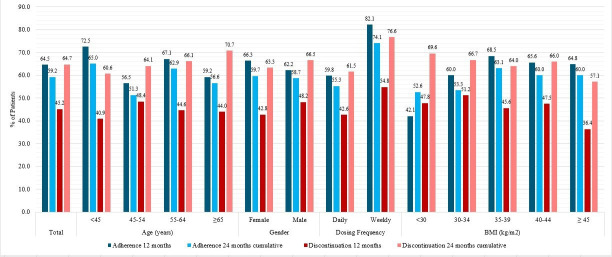
- Adherence declined from 64.5% at 12 months to 59.2% at 24 months (PDC ≥0.80 among patients with at least two fills).
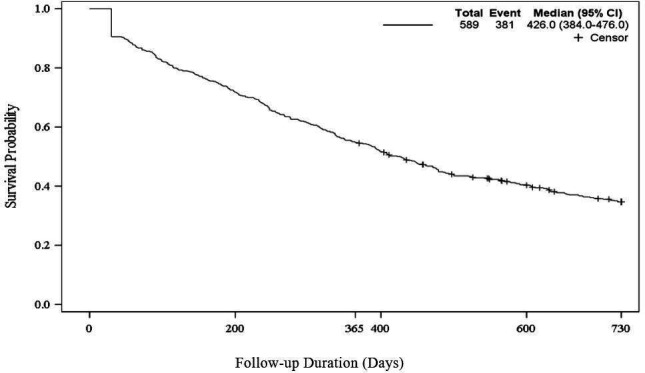
- Discontinuation was common: 45.2% at 12 months and 64.7% at 24 months, with a median time to discontinuation of 426 days (95% CI 384 to 476).
- Weekly dosing was associated with higher adherence but also higher discontinuation in adjusted models; at 24 months, 74.1% of weekly-dose patients were adherent versus 55.3% of daily-dose patients, while 76.6% of weekly-dose patients discontinued versus 61.5% of daily-dose patients.
## Methods
- Retrospective cohort study using the UK Clinical Practice Research Datalink (CPRD), spanning January 1, 2009 to December 31, 2017.
- Included 589 adults (≥18 years) with type 2 diabetes who initiated injectable GLP-1 RA monotherapy or GLP-1 RA plus metformin after a 12-month baseline period; weight analysis used patients with available weight measures, and adherence analysis required at least two GLP-1 RA fills.
- Main analyses were descriptive summaries plus bivariate and multivariable logistic regression for adherence/discontinuation, and Kaplan-Meier analysis for time to discontinuation; adherence was defined as PDC ≥0.80 and discontinuation as a >90-day gap between prescriptions.
## Limitations
- The paper states sample sizes were relatively small (589 total; 530 for adherence), and eligibility restrictions to avoid other antihyperglycemic agents reduced generalizability to the broader T2DM population.
- Weight data were available for only a fraction of the cohort, and the authors note the impact of lifestyle modifications on weight could not be ascertained.
- The paper says observational confounding may have influenced results; additionally, baseline comorbidities may be under-reported because they depended on Read codes, and findings may not apply to oral GLP-1 RAs or other populations.
Model-written summary. Check it against the paper before relying on it.
Integrity signals
Registry
Cites
Statistics
Figures
Verification
Claims the paper makes
12 Valid · 3 Not valid · 4 Not checked · 41 Own results and interpretations
Some cited sources support this claim and some don’t — read each source’s verdict below.
In the paper
“The results for discontinuation by dosing schedule (weekly vs daily) diverge from other real-world studies for reasons that are unclear.”
§ Real-world weight change, adherence, and discontinuation among patients with type 2 diabetes initiating glucagon-like peptide-1 receptor agonists in the UK > Discussion
What the sources say
- Partly supportedcites [23] Wilke T, Mueller S, Groth A, et al. Non-Persistence and Non-Adherence of patients with type 2 diabetes mellitus in therapy with GLP-1 receptor agonists: a retrospective analysis. Diabetes Ther 2016; 7: 105– 24. 10.1007/s13300-015-0149-4 26695499 PMC4801815 sourceExperimental — accuracy not yet measured
The Discussion (Study Objectives and Main Results; page unavailable) reports an earlier real-world study in which once-weekly treatment had higher adherence than once-daily treatment. But this paper’s own discontinuation analysis compares once-daily with twice-daily treatment, not weekly with daily treatment; it does not establish that weekly-versus-daily discontinuation results diverge from other studies. (LLM, conf=0.78)
- Disputedcites [25] Federici MO, McQuillan J, Biricolti G, et al. Utilization patterns of glucagon-like peptide-1 receptor agonists in patients with type 2 diabetes mellitus in Italy: a retrospective cohort study. Diabetes Ther 2018; 9: 789– 801. 10.1007/s13300-018-0396-2 29525885 PMC6104260 sourceExperimental — accuracy not yet measured
The Conclusions state that this study’s results are aligned with those from other countries, not that they diverge from other real-world studies. The paper reports lower persistence with twice-daily exenatide than with the weekly or other daily treatments. (LLM, conf=0.88)
Checked by a reasoning model — may be wrong.
- Not checked — no full text of the sourcecites [27] Malmenäs M, Bouchard JR, Langer J. Retrospective real-world adherence in patients with type 2 diabetes initiating once-daily liraglutide 1.8 Mg or twice-daily exenatide 10 μg. Clin Ther 2013; 35: 795– 807. 10.1016/j.clinthera.2013.03.021 23642290 source
plainstates an associationn = 589- Asserted: passes — The authors put it forward as true.
- Checkable: passes — It can be checked against evidence.
- Load-bearing: unclear — It is unclear whether the paper’s conclusions depend on it.
- Based: passes — The paper gives a reason why it holds.
- Partly supported
The cited sources support only part of this claim — read each source’s verdict below.
In the paper
“The few studies that have evaluated real-world effectiveness of GLP-1 RAs have yielded inconsistent results.”
§ Real-world weight change, adherence, and discontinuation among patients with type 2 diabetes initiating glucagon-like peptide-1 receptor agonists in the UK > Discussion
What the sources say
- Partly supportedcites [8] Guerci B, Charbonnel B, Gourdy P, et al. Efficacy and adherence of glucagon-like peptide-1 receptor agonist treatment in patients with type 2 diabetes mellitus in real-life settings. Diabetes Metab 2019; 45: 528– 35. 10.1016/j.diabet.2019.01.006 30677504 sourceExperimental — accuracy not yet measured
The Introduction (page unavailable) reports a gap between randomized-trial and real-world results, and Effectiveness and tolerability (page unavailable) reviews several real-world effectiveness studies. Neither passage establishes that the real-world studies themselves yielded inconsistent results; the reported discrepancy is between trial and real-world findings. (LLM, conf=0.83)
- Not checked yetcites [20] Nyeland ME, Ploug UJ, Richards A, et al. Evaluation of the effectiveness of liraglutide and sitagliptin in type 2 diabetes: a retrospective study in UK primary care. Int J Clin Pract 2015; 69: 281– 91. 10.1111/ijcp.12575 25302822 source
Checked before — its earlier verdict is held back until a new check runs.
- Partly supportedcites [28] Dhesi B, Chauhan H, Basu A. Audit of clinical practice in the use of incretin mimetic agents for the management of patients with type 2 diabetes. Practical Diabetes 2013; 30: 159– 62. 10.1002/pdi.1767 sourceExperimental — accuracy not yet measured
The Patients and methods section describes a clinical-practice audit of GLP-1 receptor agonists, so this paper is an example of a real-world effectiveness study. But it does not establish that such studies were few or that their results were inconsistent. Instead, the Discussion says its findings were in line with clinical trials, and the limitations passage says the direction of change was similar to published audits. (LLM, conf=0.80)
- Not checked — no full text of the sourcecites [29] Coleman CI, Pandya S, Wang L, et al. Treatment patterns, glycemic control and bodyweight with canagliflozin 300 mg versus GLP1RAs in Type II diabetes patients. J Comp Eff Res 2019; 8: 889– 905. 10.2217/cer-2019-0002 31167554 source
- Partly supportedcites [30] Thomsen RW, Baggesen LM, Søgaard M, et al. Early glycaemic control in metformin users receiving their first add-on therapy: a population-based study of 4,734 people with type 2 diabetes. Diabetologia 2015; 58: 2247– 53. 10.1007/s00125-015-3698-1 26277380 sourceExperimental — accuracy not yet measured
The Methods and Discussion describe a population-based study of real-world GLP-1 receptor agonist effectiveness, so this paper is an example of the kind of study mentioned. Our copy does not establish that there were few such studies or that their results were inconsistent; its Discussion instead says its observed glucose-lowering effects were comparable with those in randomised trials. No page numbers were provided for these passages. (LLM, conf=0.82)
plain- Asserted: passes — The authors put it forward as true.
- Checkable: passes — It can be checked against evidence.
- Load-bearing: unclear — It is unclear whether the paper’s conclusions depend on it.
- Based: passes — The paper gives a reason why it holds.
- Partly supported
Every source the paper cites for this claim was checked and supports it.
In the paper
“Participants in clinical trials tend to be more motivated and have resources and support to comply with the treatment regimens under investigation.”
§ Real-world weight change, adherence, and discontinuation among patients with type 2 diabetes initiating glucagon-like peptide-1 receptor agonists in the UK > Introduction
What the sources say
- Supportedcites [8] Guerci B, Charbonnel B, Gourdy P, et al. Efficacy and adherence of glucagon-like peptide-1 receptor agonist treatment in patients with type 2 diabetes mellitus in real-life settings. Diabetes Metab 2019; 45: 528– 35. 10.1016/j.diabet.2019.01.006 30677504 source
The Introduction (page not provided) says RCT participants tend to be more compliant, more motivated, and better supported financially and administratively. This supports the citing sentence's comparison of trial participants with real-world patients. (LLM, conf=0.93)
plainstates an association- Asserted: passes — The authors put it forward as true.
- Checkable: passes — It can be checked against evidence.
- Load-bearing: passes — The paper’s conclusions depend on it.
- Based: passes — The paper gives a reason why it holds.
- Supported
The cited sources support only part of this claim — read each source’s verdict below.
In the paper
“The finding that patients on weekly dosing regimens are more adherent than those on daily dosing regimens is also consistent with other studies using administrative and electronic medical records datasets across Europe and the USA.”
§ Real-world weight change, adherence, and discontinuation among patients with type 2 diabetes initiating glucagon-like peptide-1 receptor agonists in the UK > Discussion
What the sources say
- Supportedcites [8] Guerci B, Charbonnel B, Gourdy P, et al. Efficacy and adherence of glucagon-like peptide-1 receptor agonist treatment in patients with type 2 diabetes mellitus in real-life settings. Diabetes Metab 2019; 45: 528– 35. 10.1016/j.diabet.2019.01.006 30677504 source
In “Persistence and prescription patterns” (page unavailable), the review reports higher adherence for once-weekly dulaglutide than once-daily liraglutide (51.2% versus 38.2%). It also describes real-world adherence studies using claims databases and electronic medical records, with studies represented from Germany and the US. (LLM, conf=0.88)
- Partly supportedcites [24] Qiao Q, Ouwens MJ, Grandy S, et al. Adherence to GLP-1 receptor agonist therapy administered by once-daily or once-weekly injection in patients with type 2 diabetes in Germany. Diabetes Metab Syndr Obes 2016; 9: 201-5. 10.2147/DMSO.S99732 27418849 PMC4934555 sourceExperimental — accuracy not yet measured
The Conclusion reports better adherence with once-weekly than once-daily GLP-1 receptor agonist treatment, and the Discussion describes a consistent US administrative-claims study. The Methods identify this paper’s German data as a prescription-reimbursement database, not electronic medical records, so that dataset description is not supported for this study. (LLM, conf=0.82)
plainstates an association- Asserted: passes — The authors put it forward as true.
- Checkable: passes — It can be checked against evidence.
- Load-bearing: unclear — It is unclear whether the paper’s conclusions depend on it.
- Based: passes — The paper gives a reason why it holds.
- Supported
The cited sources support only part of this claim — read each source’s verdict below.
In the paper
“In these studies, mean weight change ranged from −1.0 kg to −3.78 kg over 6–12 months.”
§ Real-world weight change, adherence, and discontinuation among patients with type 2 diabetes initiating glucagon-like peptide-1 receptor agonists in the UK > Discussion
What the sources say
- Partly supportedcites [16] Nauck M, Frid A, Hermansen K, et al. Efficacy and safety comparison of liraglutide, glimepiride, and placebo, all in combination with metformin, in type 2 diabetes. Diabetes Care 2009; 32: 84– 90. 10.2337/dc08-1355 18931095 PMC2606836 sourceExperimental — accuracy not yet measured
The Results > Efficacy section reports mean weight losses of 1.8, 2.6, and 2.8 kg in the liraglutide groups over 26 weeks, supporting weight loss over approximately six months. It does not establish the claimed −1.0 to −3.78 kg range or a 12-month result; its 1.0 kg figure is weight gain in the glimepiride group. (LLM, conf=0.86)
- Not checked — no full text of the sourcecites [17] Garber A, Henry R, Ratner R, et al. Liraglutide versus glimepiride monotherapy for type 2 diabetes (LEAD-3 mono): a randomised, 52-week, phase III, double-blind, parallel-treatment trial. Lancet 2009; 373: 473– 81. 10.1016/S0140-6736(08)61246-5 18819705 source
- Partly supportedcites [18] Zinman B, Gerich J, Buse JB, et al. Efficacy and safety of the human glucagon-like peptide-1 analog liraglutide in combination with metformin and thiazolidinedione in patients with type 2 diabetes (LEAD-4 Met+TZD). Diabetes Care 2009; 32: 1224– 30. 10.2337/dc08-2124 19289857 PMC2699702 sourceExperimental — accuracy not yet measured
The Results > Efficacy passage (page unavailable) reports mean weight losses of 1.0 and 2.0 kg in the liraglutide groups, supporting the −1.0 kg end of the cited range. The paper does not report a −3.78 kg mean weight change or establish the full 6–12-month range attributed to these studies. (LLM, conf=0.88)
- Not checked — no full text of the sourcecites [19] Umpierrez G, Tofé Povedano S, Pérez Manghi F, et al. Efficacy and safety of dulaglutide monotherapy versus metformin in type 2 diabetes in a randomized controlled trial (AWARD-3). Diabetes Care 2014; 37: 2168– 76. 10.2337/dc13-2759 24842985 source
- Not checked yetcites [20] Nyeland ME, Ploug UJ, Richards A, et al. Evaluation of the effectiveness of liraglutide and sitagliptin in type 2 diabetes: a retrospective study in UK primary care. Int J Clin Pract 2015; 69: 281– 91. 10.1111/ijcp.12575 25302822 source
Checked before — its earlier verdict is held back until a new check runs.
plain- Asserted: passes — The authors put it forward as true.
- Checkable: passes — It can be checked against evidence.
- Load-bearing: passes — The paper’s conclusions depend on it.
- Based: passes — The paper gives a reason why it holds.
- Partly supported
19 more claims · 4 with their cited sources checked
Create a free account to see all 60 claims and to verify the 3 references still open.
- It may state two separate claims as one. 22
- Probably not a substantial claim. 13
- The quote only partly states this claim. 2
Claims other papers make about this one
Each is checked against this paper’s own text: does it say what the citing paper says it does?
The cited source doesn’t support the claim as written.
In the citing paper
“less than 30% of patients remain on treatment for more than a year6–8”
From GDF8 and activin A blockade protects against GLP-1–induced muscle loss while enhancing fat loss in obese male mice and non-human primates (2025) · cites this paper as [6]
Checked by a reasoning model — may be wrong.
Experimental — accuracy not yet measuredThe cited source says what the claim attributes to it.
In the citing paper
“One study found a 12-month discontinuation of 45.2% among patients with T2D.3”
From GLP-1 receptor agonist discontinuation among patients with obesity and/or type 2 diabetes (2024) · cites this paper as [3]
The cited source says what the claim attributes to it.
In the citing paper
“In real-world settings, up to half of those who initiate treatment with a GLP-1 receptor agonist have discontinued treatment after one year.14, 15, 16, 17”
The cited source says what the claim attributes to it.
In the citing paper
“Recent UK data [45] indicate intermediate persistence in a T2DM cohort (approximately 54.8% at 12 months and 35.3% at 24 months), with a median time to discontinuation of 426 days.”
From Adherence and Persistence with GLP-1-Based Therapies: International Real-World Evidence and the Role of Nutritional and Lifestyle Support—A Narrative Review (2026) · cites this paper as [45]
Citations
Cites
Liraglutide and Cardiovascular Outcomes in Type 2 Diabetes
Marso, S. P., Daniels, G. H., Brown-Frandsen, K., Kristensen, P., Mann, J. F. E., Nauck, M. A., Nissen, S. E., Pocock, S., Poulter, N. R., Ravn, L. S., et al. (2016) · New England Journal of Medicine · doi:10.1056/nejmoa1603827 · Cited by 7,629
Semaglutide and Cardiovascular Outcomes in Patients with Type 2 Diabetes
Marso, S. P., Bain, S. C., Consoli, A., Eliaschewitz, F. G., Jódar, E., Leiter, L. A., Lingvay, I., Rosenstock, J., Seufert, J., Warren, M. L., et al. (2016) · New England Journal of Medicine · doi:10.1056/nejmoa1607141 · Cited by 6,900
Data Resource Profile: Clinical Practice Research Datalink (CPRD)
Herrett, E., Gallagher, A. M., Bhaskaran, K., Forbes, H., Mathur, R., van Staa, T., & Smeeth, L. (2015) · International Journal of Epidemiology · doi:10.1093/ije/dyv098 · Cited by 2,667
Wing, R. R., Lang, W., Wadden, T. A., Safford, M., Knowler, W. C., Bertoni, A. G., Hill, J. O., Brancati, F. L., Peters, A., Wagenknecht, L., et al. (2011) · Diabetes Care · doi:10.2337/dc10-2415 · Cited by 1,828
9. Pharmacologic Approaches to Glycemic Treatment: Standards of Medical Care in Diabetes—2022
American Diabetes Association Professional Practice Committee (2022) · Diabetes Care · doi:10.2337/dc22-s009 · Cited by 1,555
Nauck, M., Frid, A., Hermansen, K., Shah, N. S., Tankova, T., Mitha, I. H., Zdravkovic, M., Düring, M., Matthews, D. R., & for the LEAD-2 Study Group (2009) · Diabetes Care · doi:10.2337/dc08-1355 · Cited by 1,129
Methods for evaluation of medication adherence and persistence using automated databases
Andrade, S. E., Kahler, K. H., Frech, F., & Chan, K. A. (2006) · Pharmacoepidemiology and Drug Safety · doi:10.1002/pds.1230 · Cited by 1,079
Garber, A., Henry, R., Ratner, R., Garcia-Hernandez, P. A., Rodriguez-Pattzi, H., Olvera-Alvarez, I., Hale, P. M., Zdravkovic, M., & Bode, B. (2009) · The Lancet · doi:10.1016/s0140-6736(08)61246-5 · Cited by 1,057
9. Pharmacologic Approaches to Glycemic Treatment: Standards of Medical Care in Diabetes—2021
American Diabetes Association (2021) · Diabetes Care · doi:10.2337/dc21-s009 · Cited by 972
Zinman, B., Gerich, J., Buse, J. B., Lewin, A., Schwartz, S., Raskin, P., Hale, P. M., Zdravkovic, M., Blonde, L., & the LEAD-4 Study Investigators (2009) · Diabetes Care · doi:10.2337/dc08-2124 · Cited by 848
Prevalence and co-prevalence of comorbidities among patients with type 2 diabetes mellitus
Iglay, K., Hannachi, H., Joseph Howie, P., Xu, J., Li, X., Engel, S. S., Moore, L. M., & Rajpathak, S. (2016) · Current Medical Research and Opinion · doi:10.1185/03007995.2016.1168291 · Cited by 511
Self-citationBlonde, L., Klein, E. J., Han, J., Zhang, B., Mac, S. M., Poon, T. H., Taylor, K. L., Trautmann, M. E., Kim, D. D., & Kendall, D. M. (2006) · Diabetes, Obesity and Metabolism · doi:10.1111/j.1463-1326.2006.00602.x · Cited by 416
Long-Acting Glucagon-Like Peptide 1 Receptor Agonists
Garber, A. J. (2011) · Diabetes Care · doi:10.2337/dc11-s231 · Cited by 350
Umpierrez, G., Tofé Povedano, S., Pérez Manghi, F., Shurzinske, L., & Pechtner, V. (2014) · Diabetes Care · doi:10.2337/dc13-2759 · Cited by 341
Sharma, M., Nazareth, I., & Petersen, I. (2016) · BMJ Open · doi:10.1136/bmjopen-2015-010210 · Cited by 291
GLP-1 receptor agonists: a review of head-to-head clinical studies
Trujillo, J. M., Nuffer, W., & Ellis, S. L. (2015) · Therapeutic Advances in Endocrinology and Metabolism · doi:10.1177/2042018814559725 · Cited by 282
The “Efficacy-Effectiveness Gap”: Historical Background and Current Conceptualization
Nordon, C., Karcher, H., Groenwold, R. H. H., Ankarfeldt, M. Z., Pichler, F., Chevrou-Severac, H., Rossignol, M., Abbe, A., & Abenhaim, L. (2016) · Value in Health · doi:10.1016/j.jval.2015.09.2938 · Cited by 177
McGovern, A., Tippu, Z., Hinton, W., Munro, N., Whyte, M., & de Lusignan, S. (2018) · Diabetes, Obesity and Metabolism · doi:10.1111/dom.13160 · Cited by 166
Iglay, K., Cartier, S. E., Rosen, V. M., Zarotsky, V., Rajpathak, S. N., Radican, L., & Tunceli, K. (2015) · Current Medical Research and Opinion · doi:10.1185/03007995.2015.1053048 · Cited by 157
Self-citationKostev, K., Ouwens, M., Grandy, S., Johnsson, K. M., & Qiao, Q. (2016) · Diabetes, Metabolic Syndrome and Obesity: Targets and Therapy · doi:10.2147/dmso.s99732 · Cited by 92
Malmenäs, M., Bouchard, J. R., & Langer, J. (2013) · Clinical Therapeutics · doi:10.1016/j.clinthera.2013.03.021 · Cited by 43
Wilke, T., Mueller, S., Groth, A., Berg, B., Fuchs, A., Sikirica, M., Logie, J., Martin, A., & Maywald, U. (2016) · Diabetes Therapy · doi:10.1007/s13300-015-0149-4 · Cited by 41
Guerci, B., Charbonnel, B., Gourdy, P., Hadjadj, S., Hanaire, H., Marre, M., & Vergès, B. (2019) · Diabetes & Metabolism · doi:10.1016/j.diabet.2019.01.006 · Cited by 40
Federici, M. O., McQuillan, J., Biricolti, G., Losi, S., Lebrec, J., Richards, C., Miglio, C., & Norrbacka, K. (2018) · Diabetes Therapy · doi:10.1007/s13300-018-0396-2 · Cited by 37
Thomsen, R. W., Baggesen, L. M., Søgaard, M., Pedersen, L., Nørrelund, H., Buhl, E. S., Haase, C. L., & Johnsen, S. P. (2015) · Diabetologia · doi:10.1007/s00125-015-3698-1 · Cited by 32
Durden, E., Liang, M., Fowler, R., Panton, U. H., & Mocevic, E. (2019) · Journal of Managed Care & Specialty Pharmacy · doi:10.18553/jmcp.2019.18429 · Cited by 30
Prevalence of Established Cardiovascular Disease in Patients with Type 2 Diabetes Mellitus in the UK
Lautsch, D., Wang, T., Yang, L., & Rajpathak, S. N. (2019) · Diabetes Therapy · doi:10.1007/s13300-019-00698-9 · Cited by 28
Self-citationNyeland, M. E., Ploug, U. J., Richards, A., Garcia Alvarez, L., Demuth, D., Muthutantri, A., Skovgaard, R., & Evans, M. (2015) · International Journal of Clinical Practice · doi:10.1111/ijcp.12575 · Cited by 21
Coleman, C. I., Pandya, S., Wang, L., Baser, O., Cai, J., Ingham, M., & Bookhart, B. (2019) · Journal of Comparative Effectiveness Research · doi:10.2217/cer-2019-0002 · Cited by 10
Dhesi, B., Chauhan, H., & Basu, A. (2013) · Practical Diabetes · doi:10.1002/pdi.1767 · Cited by 4
Type 2 diabetes in adults: management
(2015) · PubMed
Cited by
Semaglutide vs Tirzepatide for Weight Loss in Adults With Overweight or Obesity
Rodriguez, P. J., Goodwin Cartwright, B. M., Gratzl, S., Brar, R., Baker, C., Gluckman, T. J., & Stucky, N. L. (2024) · JAMA Internal Medicine · doi:10.1001/jamainternmed.2024.2525 · Cited by 334
Rodriguez, P. J., Goodwin Cartwright, B. M., Gratzl, S., Brar, R., Baker, C., Gluckman, T. J., & Stucky, N. L. (2023) · doi:10.1101/2023.11.21.23298775 · Cited by 334
“In fact, it’s likely that the weight reduction observed in our study was greater than that found in previous real-world studies because such studies ended before semaglutide and/or tirzepatide were available [34, 35].”
ResultCusi, K., Abdelmalek, M. F., Apovian, C. M., Balapattabi, K., Bannuru, R. R., Barb, D., Bardsley, J. K., Beverly, E. A., Corbin, K. D., ElSayed, N. A., et al. (2025) · Diabetes Care · doi:10.2337/dci24-0094 · Cited by 332
GLP-1 receptor agonist discontinuation among patients with obesity and/or type 2 diabetes
Do, D., Lee, T., Peasah, S. K., Good, C. B., Inneh, A., & Patel, U. (2024) · JAMA Network Open · doi:10.1001/jamanetworkopen.2024.13172 · Cited by 218
Jensen, S. B. K., Blond, M. B., Sandsdal, R. M., Olsen, L. M., Juhl, C. R., Lundgren, J. R., Janus, C., Stallknecht, B. M., Holst, J. J., Madsbad, S., et al. (2024) · eClinicalMedicine · doi:10.1016/j.eclinm.2024.102475 · Cited by 207
“19,39 Given the many people who initiate obesity pharmacotherapy worldwide but also terminate treatment again, 14 – 17 off-treatment assessments are imperative to elucidate the real-world potential of pharmacotherapy and are clinically relevant.”
Background
Metadata
- Authors
- Weiss, T., Yang, L., Carr, R. D., Pal, S., Sawhney, B., Boggs, R., Rajpathak, S., & Iglay, K.
- Affiliations
- Merck & Co., Inc., Rahway, NJ, USA (United States) (US)
- Complete HEOR Solutions, North Wales, Pennsylvania, USA
- Corresponding author
- Weiss, Tracey
- ORCID
- Venue
- BMJ Open Diabetes Research & Care
- Publisher
- BMJ
- Published
- 2022-01
- Volume
- 10
- Issue
- 1
- Pages
- e002517
- ISSN
- 2052-4897 (ISSN-L)
- PMC
- PMC8804648
- OpenAlex
- W4210809516
- Cited by
- 152
- References
- 32
- Citations by year
- 2026: 32 · 2025: 48 · 2024: 48 · 2023: 16 · 2022: 8
- FWCI
- 22.41
- Type
- journal article
- Language
- en
- Open access
- gold
- doi.org
- Licence
- Locations
- BMJ Open Diabetes Research & Care (publishedVersion, cc-by-nc)
- PubMed Central (publishedVersion, cc-by-nc)
- PubMed (publishedVersion)
- DOAJ (DOAJ: Directory of Open Access Journals) (submittedVersion, cc-by-sa)
- Funders
- Merck Sharp and Dohme (n/a)
- Topics
- Health Sciences › Medicine › Endocrinology, Diabetes and Metabolism › Diabetes Treatment and Management
- Health Sciences › Medicine › Pharmacology (medical) › Pharmacology and Obesity Treatment
- Health Sciences › Medicine › Family Practice › Medication Adherence and Compliance
- Keywords
- GLP-1 receptor agonists, type 2 diabetes, weight loss, medication adherence, treatment discontinuation, proportion of days covered, real-world effectiveness
- MeSH terms
- Glucagon-Like Peptide-1 Receptor Agonists, Diabetes Mellitus, Type 2, Female, United Kingdom, Humans, Hypoglycemic Agents, Middle Aged, Retrospective Studies
About these checks
Registry, retraction, Cites and statistics results are computed, not judged, with one exception: a printed reference that no index lists is read once by a model before it counts as a citation error. Claims are extracted by a model and kept only when their quote appears verbatim in the text; each cited source is then checked, with a model’s help, for whether it says what the claim relies on. Those verdicts can be wrong — read the claim’s quote and the cited source before relying on one.
The claim verdicts this report counts are experimental: their accuracy is not yet measured.
A language model drew the claims from the paper on 2026-10-10, under version 3 of the claim definition (model deepseek-v4.1-flash, prompt extract-v3).
A second model labelled each claim on 2026-10-10 (model jev-1.13-20260917, definition revision gold-guideline-v0.2).
Cited sources are checked with a language model’s help (gpt-6-sol).
Statistics and arithmetic are recomputed, not judged.
Confidence bands are shown only for fields calibrated on our annotated test set. None is calibrated yet, so no band is shown.
What counts as a claim ›How we measure confidence ›How we check this ›
Are you an author, or do you see a problem with this page? Request a review
Data sources
Bibliographic data: Semantic Scholar, OpenAlex, Crossref.
Contains information from the Semantic Scholar Academic Graph Datasets, made available under the ODC Attribution License (ODC-BY 1.0).
Semantic Scholar’s data is described in: Kinney, R., et al. (2023). The Semantic Scholar Open Data Platform. arXiv:2301.10140.
