

Barriers and facilitators for implementation of electronic consultations (eConsult) to enhance access to specialist care: a scoping review
Open accessThe DOI matches its Crossref record; 101 of the 115 references it cites were found in a registry or an index; 10 of the 18 sources its claims cite were checked for support.
Abstract
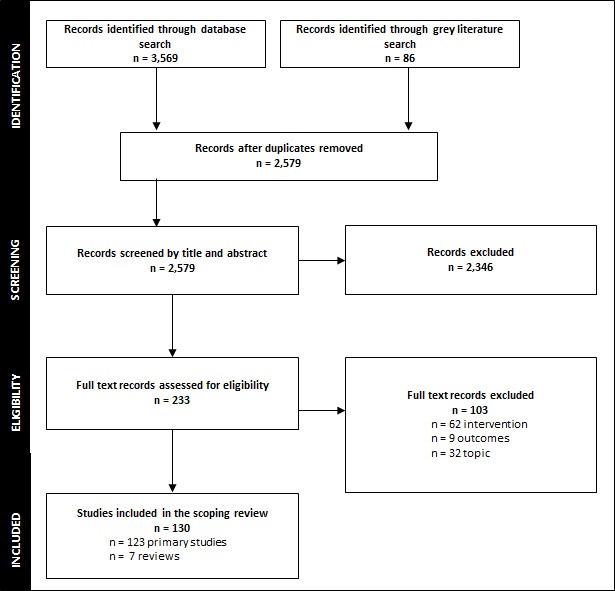
INTRODUCTION: Electronic consultation (eConsult)-provider-to-provider electronic asynchronous exchanges of patient health information at a distance-is emerging as a potential tool to improve the interface between primary care providers and specialists. Despite growing evidence that eConsult has clinical benefits, it is not widely adopted. We investigated factors influencing the adoption and implementation of eConsult services. METHODS: We applied established methods to guide the review, and the recently published Preferred Reporting Items for Systematic Reviews and Meta-Analyses extension for scoping reviews to report our findings. We searched five electronic databases and the grey literature for relevant studies. Two reviewers independently screened titles and full texts to identify studies that reported barriers to and/or facilitators of eConsult (asynchronous (store-and-forward) use of telemedicine to exchange patient health information between two providers (primary and secondary) at a distance using secure infrastructure). We extracted data on study characteristics and key barriers and facilitators were analysed thematically and classified using the Quadruple Aim framework taxonomy. No date or language restrictions were applied. RESULTS: Among the 2579 publications retrieved, 130 studies met eligibility for the review. We identified and summarised key barriers to and facilitators of eConsult adoption and implementation across four domains: provider, patient, healthcare system and cost. Key barriers were increased workload for providers, privacy concerns and insufficient reimbursement for providers. Main facilitators were remote residence location, timely responses from specialists, utilisation of referral coordinators, addressing medicolegal concerns and incentives for providers to use eConsult. CONCLUSION: There are multiple barriers to and facilitators of eConsult adoption across the domains of Quadruple Aim framework. Our findings will inform the development of practice tools to support the wider adoption and scalability of eConsult implementation.
Overview
CoChat Summary
## TL;DR
This scoping review mapped barriers and facilitators to implementing electronic consultations (eConsult) across 130 studies from eight countries and organized them into provider, patient, healthcare system, and cost domains. The most common barriers were increased provider workload, privacy concerns, and lack of reimbursement, while key facilitators included remote patient location, timely specialist responses, referral coordinators, medicolegal support, and incentives.
## Key findings
- The review retrieved 2579 publications and included 130 studies (123 primary studies and 7 reviews).
- Included primary studies covered 30 unique eConsult programmes; platforms were mainly EMR-based (n=10) or web-based (n=13).
- Key barriers identified across studies were increased workload for providers, privacy concerns, and insufficient reimbursement for providers.
- Main facilitators were remote residence location, timely responses from specialists, utilisation of referral coordinators, addressing medicolegal concerns, and incentives for providers to use eConsult.
## Methods
- The authors conducted a scoping review using Arksey and O’Malley’s approach, modified by Levac et al., and reported it using PRISMA-ScR guidance.
- They searched five bibliographic databases plus grey literature sources, with no date, language, or publication-type restrictions; searches ran through 7 December 2017.
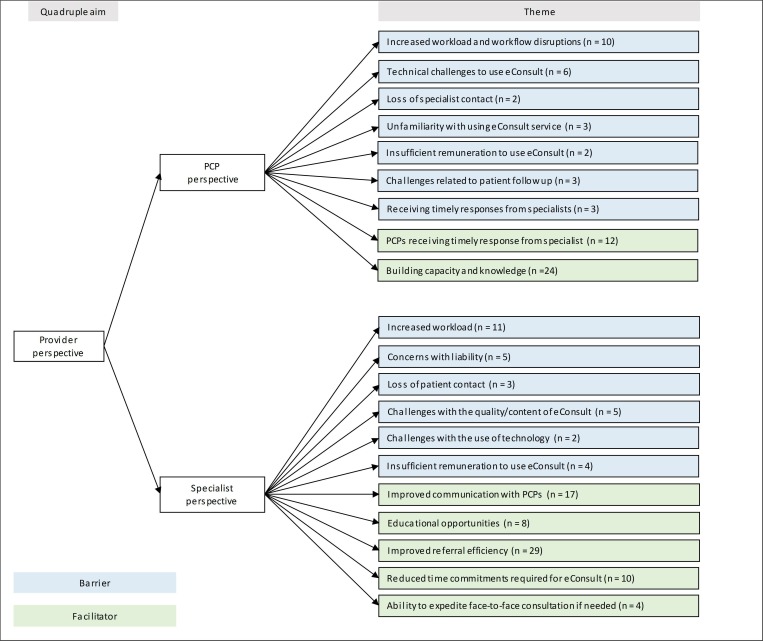
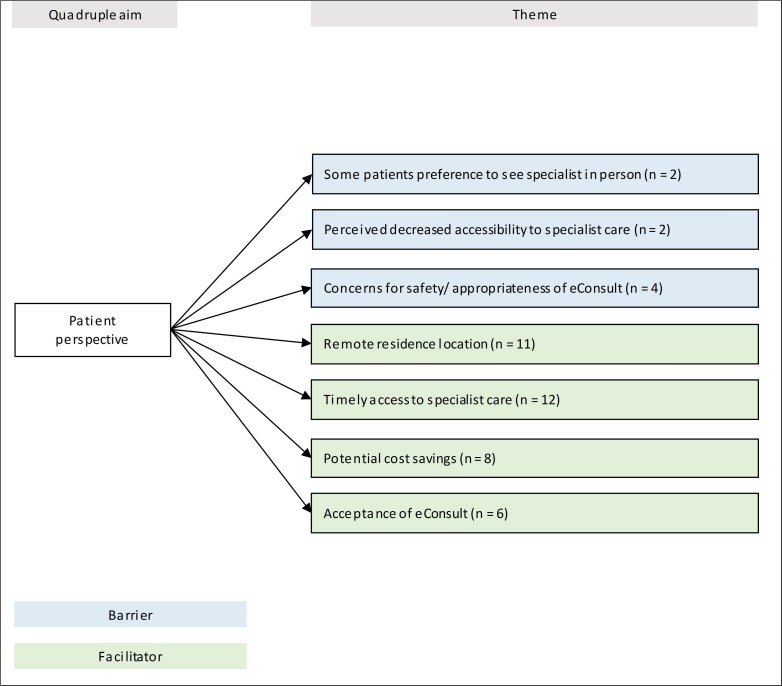
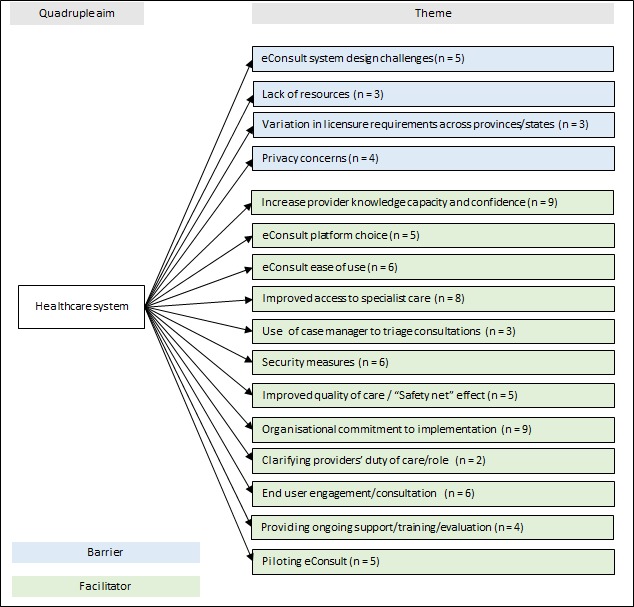
- Two reviewers independently screened studies and extracted data; barriers and facilitators were analyzed thematically and classified using a modified Quadruple Aim framework.
## Limitations
- The paper states that it could not find any study in low-income and middle-income countries that met the inclusion criteria.
- The authors note limited published work on health economic evaluations of eConsult development and implementation.
- Evident from the text: this is a scoping review, and the authors state they did not perform risk of bias assessment or quality appraisal of included studies.
Model-written summary. Check it against the paper before relying on it.
Integrity signals
Registry
Cites
Statistics
Figures
Verification
Claims the paper makes
7 Valid · 1 Not valid · 15 Not checked · 40 Own results and interpretations
The cited sources support only part of this claim — read each source’s verdict below.
In the paper
“In a systematic review investigating interventions affecting the nexus between primary and specialist care, interventions aimed at changing the process of care were found to be most effective.10”
§ Barriers and facilitators for implementation of electronic consultations (eConsult) to enhance access to specialist care: a scoping review > Introduction
What the sources say
- Partly supportedcites [10] Blank L, Baxter S, Woods HB, et al Referral interventions from primary to specialist care: a systematic review of international evidence. Br J Gen Pract 2014; 64: e765– 74. 10.3399/bjgp14X682837 25452541 PMC4240149 sourceExperimental — accuracy not yet measured
The DISCUSSION Summary of Blank et al. (2014) does contain a close analogue — 'Process changes appear to be most effective when they result in the specialist being provided with more or better quality information about the patient; either electronically or through specialist consultation prior to the formal referral being made' — so the review does single out process changes, but only conditionally and with the hedge 'appear'. The claim states unconditionally that process-of-care interventions 'were found to be most effective', dropping that qualifier; the RESULTS section instead describes the overall picture for referral-process interventions as 'mixed', with stronger evidence only for electronic referral systems and pre-referral specialist consultation, and the DISCUSSION attributes the 'strongest positive effect on referral outcomes' to certain system changes (community provision of specialist services by trained GPs, specialist outreach, return of inappropriate referrals). The review also frames the category as changes to the referral process specifically, not the process of care generally. (LLM, conf=0.78)
plainstates a cause- Asserted: passes — The authors put it forward as true.
- Checkable: passes — It can be checked against evidence.
- Load-bearing: passes — The paper’s conclusions depend on it.
- Based: passes — The paper gives a reason why it holds.
- Partly supported
Every source the paper cites for this claim was checked and supports it.
In the paper
“Within this category, two types of interventions—specialist consultation before referral and electronic referrals—demonstrated the strongest positive effects.10”
§ Barriers and facilitators for implementation of electronic consultations (eConsult) to enhance access to specialist care: a scoping review > Introduction
What the sources say
- Supportedcites [10] Blank L, Baxter S, Woods HB, et al Referral interventions from primary to specialist care: a systematic review of international evidence. Br J Gen Pract 2014; 64: e765– 74. 10.3399/bjgp14X682837 25452541 PMC4240149 source
In the process-change section (Box 1/results summary, p. e767-e772 area) our copy states that within process-of-care interventions 'the overall picture ... is mixed. Stronger evidence exists for electronic referral interventions ... and interventions including specialist consultation prior to referral', listing their positive effects — these are the only two process types identified as having stronger evidence. The DISCUSSION Summary repeats this: 'Process changes appear to be most effective when they result in the specialist being provided with more or better quality information about the patient; either electronically or through specialist consultation prior to the formal referral being made.' The claim's 'strongest positive effects' is a fair paraphrase of 'stronger evidence'/'most effective' within that category. (LLM, conf=0.88)
boostedstates a cause- Asserted: passes — The authors put it forward as true.
- Checkable: passes — It can be checked against evidence.
- Load-bearing: passes — The paper’s conclusions depend on it.
- Based: passes — The paper gives a reason why it holds.
- Supported
Every source the paper cites for this claim was checked and supports it.
In the paper
“In a systematic review, Vimalananda and colleagues identified implementation studies as one of key deficiencies in the current eConsult literature.15”
§ Barriers and facilitators for implementation of electronic consultations (eConsult) to enhance access to specialist care: a scoping review > Introduction
What the sources say
- Supportedcites [15] Vimalananda VG, Gupte G, Seraj SM, et al Electronic consultations (e-consults) to improve access to specialty care: a systematic review and narrative synthesis. J Telemed Telecare 2015; 21: 323– 30. 10.1177/1357633X15582108 25995331 PMC4561452 source
In Discussion > Future research directions, the review lists implementation studies among five major research priorities. Its Implementation studies subsection says that factors affecting e-consult use are not well described in the literature, supporting the claim that this is a gap. (LLM, conf=0.93)
plain- Asserted: passes — The authors put it forward as true.
- Checkable: passes — It can be checked against evidence.
- Load-bearing: passes — The paper’s conclusions depend on it.
- Based: passes — The paper gives a reason why it holds.
- Supported
The cited sources that could be checked couldn’t confirm or dispute this claim.
In the paper
“However, little evidence exists about these factors and how they influence eConsult adoption and implementation.16”
§ Barriers and facilitators for implementation of electronic consultations (eConsult) to enhance access to specialist care: a scoping review > Introduction
What the sources say
- Could not verifycites [16] Tuot DS, Leeds K, Murphy EJ, et al Facilitators and barriers to implementing electronic referral and/or consultation systems: a qualitative study of 16 health organizations. BMC Health Serv Res 2015; 15: 568 10.1186/s12913-015-1233-1 26687507 PMC4684927 sourceExperimental — accuracy not yet measured
The Methods (Analysis) mention previously published factors influencing eCR adoption, and the Results identify drivers and facilitators in the organizations studied. Neither passage assesses whether evidence about those factors or their influence on eConsult adoption and implementation is scarce. Searches for statements about limited evidence and few prior studies found no such assessment in our copy. (LLM, conf=0.68)
plain- Asserted: passes — The authors put it forward as true.
- Checkable: passes — It can be checked against evidence.
- Load-bearing: passes — The paper’s conclusions depend on it.
- Based: passes — The paper gives a reason why it holds.
- Could not verify
The cited sources support only part of this claim — read each source’s verdict below.
In the paper
“It also appears that the existence of a compensation model for providers time rather than a specific payment structure, such as fee-for-service or salary, is a key facilitator for eConsult adoption.83”
§ Barriers and facilitators for implementation of electronic consultations (eConsult) to enhance access to specialist care: a scoping review > Discussion
What the sources say
- Partly supportedcites [83] Uhlman M, Lakose S, Dietzler D, et al Implementation of the three E's (efficiency, education, and e-consults) to improve urology access within the Veterans health administration. Journal of Urology 2016; 1: e244. sourceExperimental — accuracy not yet measured
The Conclusions of our copy (INTRODUCTION AND OBJECTIVES section) state only that the 3-E bundle, including e-consults, 'might only be cost-effective in a non fee-for-service model such as one found in the VHA,' while adding it 'may become useful even for fee-for-service practices' — so payment model is discussed as a determinant of cost-effectiveness of the whole package, not as a facilitator of e-consult adoption specifically, and the paper never separates 'existence of compensation for provider time' from 'which payment structure.' The Methods/Results describe e-consults (65 completed, 15% requiring formal consult) without any statement on compensation as an adoption facilitator. Thus the source supports the general idea that provider compensation/payment structure bears on the viability of e-consults in a salaried system, but not the claim's assertion that the specific structure is irrelevant while mere existence of a compensation model is a key facilitator. (LLM, conf=0.65)
hedgedstates a cause- Asserted: passes — The authors put it forward as true.
- Checkable: passes — It can be checked against evidence.
- Load-bearing: passes — The paper’s conclusions depend on it.
- Based: passes — The paper gives a reason why it holds.
- Partly supported
40 more claims
Create a free account to see all 63 claims and to verify the 1 reference still open.
- Probably not a substantial claim. 17
- It may state two separate claims as one. 3
Claims other papers make about this one
Each is checked against this paper’s own text: does it say what the citing paper says it does?
The source backs part of the claim, not all of it — or backs it for a different population, condition or comparison.
In the citing paper
“Furthermore, increased clinician workload and the lack of a definitive reimbursement model cause asynchronous teledermatology to be a substantial burden or gamble for many practices [54-56].”
From Store-and-Forward Images in Teledermatology: Narrative Literature Review (2022) · cites this paper as [55]
Experimental — accuracy not yet measuredThe cited source says what the claim attributes to it.
In the citing paper
“These challenges are consistent with previous research concerning small-scale implementation and diffusion of video consulting services and the scale-up and spread of other eHealth interventions [67,68].”
From Spread, Scale-up, and Sustainability of Video Consulting in Health Care: Systematic Review and Synthesis Guided by the NASSS Framework (2021) · cites this paper as [67]
Self-check
Percentages, sums and reported differences re-computed from the paper’s own numbers.
Rated major: it would touch a result — a value a result rests on, reported and recomputed p-values on opposite sides of the significance level, two passages that conflict with no sign which is right, or a cited work retracted before this paper was published.
In the paper
“The 123 primary studies included in our review covered 30 unique eConsult programme: 18 based in the USA, 3 in the UK, and 2 in Canada, Brazil, Finland, Spain, and 1 programme in the Netherlands and Ireland (online supplementary eTable 1).”
§ Barriers and facilitators for implementation of electronic consultations (eConsult) to enhance access to specialist care: a scoping review > Results > eConsult programme
Reported 30 · recomputed 31
Citations
Cites
PRISMA Extension for Scoping Reviews (PRISMA-ScR): Checklist and Explanation
Tricco, A. C., Lillie, E., Zarin, W., O'Brien, K. K., Colquhoun, H., Levac, D., Moher, D., Peters, M. D. J., Horsley, T., Weeks, L., et al. (2018) · Annals of Internal Medicine · doi:10.7326/m18-0850 · Cited by 43,565 · cited 1×
“We followed the recently published extension to the Preferred Reporting Items for Systematic Reviews and Meta-Analyses reporting guidelines for scoping reviews developed by Tricco and colleagues.(25)”
Scoping studies: towards a methodological framework
Arksey, H., & O'Malley, L. (2005) · International Journal of Social Research Methodology · doi:10.1080/1364557032000119616 · Cited by 36,742 · cited 1×
“22 Our review was guided by the method first described by Arksey and O’Malley 23 with modifications based on Levac et al ’s recommendations.”
The qualitative content analysis process
Elo, S., & Kyngäs, H. (2008) · Journal of Advanced Nursing · doi:10.1111/j.1365-2648.2007.04569.x · Cited by 22,617 · cited 1×
“We analysed and presented the data qualitatively using both deductive (preidentified themes) and inductive (newly identified themes) approaches.(36) We coded textual data from included papers individually using a broad-based coding scheme (MO) and documented common themes across papers textually (thematic analysis) an…”
Scoping studies: advancing the methodology
Levac, D., Colquhoun, H., & O'Brien, K. K. (2010) · Implementation Science · doi:10.1186/1748-5908-5-69 · Cited by 15,268 · cited 1×
“Our review was guided by the method first described by Arksey and O’Malley(23) with modifications based on Levac et al’s recommendations.(24) We followed the recently published extension to the Preferred Reporting Items for Systematic Reviews and Meta-Analyses reporting guidelines for scoping reviews developed by Tric…”
Guidance for conducting systematic scoping reviews
Peters, M. D. J., Godfrey, C. M., Khalil, H., McInerney, P., Parker, D., & Soares, C. B. (2015) · International Journal of Evidence-Based Healthcare · doi:10.1097/xeb.0000000000000050 · Cited by 7,472 · cited 2×
“21 24 25 synthesis of results We used the four domains of the Quadruple Aim evaluation framework to synthesise and report identified barriers and facilitators into tables and figures.”
BackgroundMethodContribution of Primary Care to Health Systems and Health
STARFIELD, B., SHI, L., & MACINKO, J. (2005) · The Milbank Quarterly · doi:10.1111/j.1468-0009.2005.00409.x · Cited by 5,507 · cited 2×
“care at lower cost.(3) 4 Therefore, an effective, efficient partnership between the two levels of care would seem important(5) and has long been the focus of attention for primary care reforms.”
From Triple to Quadruple Aim: Care of the Patient Requires Care of the Provider
Bodenheimer, T., & Sinsky, C. (2014) · The Annals of Family Medicine · doi:10.1370/afm.1713 · Cited by 3,462 · cited 2×
“32 33 This framework for optimising health system performance has been used previously to evaluate eConsult; however, this is the first time it has been used to evaluate eConsult implementation.”
A scoping review of scoping reviews: advancing the approach and enhancing the consistency
Pham, M. T., Rajić, A., Greig, J. D., Sargeant, J. M., Papadopoulos, A., & McEwen, S. A. (2014) · Research Synthesis Methods · doi:10.1002/jrsm.1123 · Cited by 3,078 · cited 1×
“Scoping reviews are broad by nature, with limited or no focus on a specific research question and/or hypothesis; typically, the goal is to address broad and complex questions as our study.(104) Another common limitation with this kind of reviews is the lack of comprehensiveness in the search for relevant literature.”
Improving Primary Care for Patients With Chronic Illness
Bodenheimer, T. (2002) · JAMA · doi:10.1001/jama.288.14.1775 · Cited by 2,961
Designing and evaluating complex interventions to improve health care
Campbell, N. C., Murray, E., Darbyshire, J., Emery, J., Farmer, A., Griffiths, F., Guthrie, B., Lester, H., Wilson, P., & Kinmonth, A. L. (2007) · BMJ · doi:10.1136/bmj.39108.379965.be · Cited by 1,331 · cited 1×
“Designing new interventions that may inadvertently disrupt healthcare delivery is challenging.(12) Furthermore, there is a lack of sustained implementation of new programme, especially in health information technology.”
Conducting a meta-ethnography of qualitative literature: Lessons learnt
Atkins, S., Lewin, S., Smith, H., Engel, M., Fretheim, A., & Volmink, J. (2008) · BMC Medical Research Methodology · doi:10.1186/1471-2288-8-21 · Cited by 981
Cresswell, K., & Sheikh, A. (2013) · International Journal of Medical Informatics · doi:10.1016/j.ijmedinf.2012.10.007 · Cited by 690 · cited 1×
“Furthermore, there is a lack of sustained implementation of new programme, especially in health information technology.(13) 14 Therefore, when designing and implementing a complex health system delivery tool like eConsult, it is imperative to identify the factors that could favour and hinder its wider adoption and sca…”
Anderson, S., Allen, P., Peckham, S., & Goodwin, N. (2008) · Health Research Policy and Systems · doi:10.1186/1478-4505-6-7 · Cited by 653 · cited 1×
“This is particularly salient when studying a topic such as eConsult, which is a complex intervention in an emerging field 18 with working concepts that are just evolving.”
Canada's universal health-care system: achieving its potential
Martin, D., Miller, A. P., Quesnel-Vallée, A., Caron, N. R., Vissandjée, B., & Marchildon, G. P. (2018) · The Lancet · doi:10.1016/s0140-6736(18)30181-8 · Cited by 559
Vimalananda, V. G., Gupte, G., Seraj, S. M., Orlander, J., Berlowitz, D., Fincke, B. G., & Simon, S. R. (2015) · Journal of Telemedicine and Telecare · doi:10.1177/1357633x15582108 · Cited by 437 · cited 2×
“14 Therefore, when designing and implementing a complex health system delivery tool like eConsult, it is imperative to identify the factors that could favour and hinder its wider adoption and scale up.(15) However, little evidence exists about these factors and how they influence eConsult adoption and implementation.”
McGinn, C. A., Grenier, S., Duplantie, J., Shaw, N., Sicotte, C., Mathieu, L., Leduc, Y., Légaré, F., & Gagnon, M.-P. (2011) · BMC Medicine · doi:10.1186/1741-7015-9-46 · Cited by 393 · cited 2×
“For instance, a systematic review on EMR identified privacy and security concerns, ease of use, costs and workload as the most frequently reported factors influencing implementation of EMR.(103) This highlights the overlap across healthcare delivery technology platforms.”
Greenhalgh, T., Shaw, S., Wherton, J., Vijayaraghavan, S., Morris, J., Bhattacharya, S., Hanson, P., Campbell-Richards, D., Ramoutar, S., Collard, A., et al. (2018) · Journal of Medical Internet Research · doi:10.2196/jmir.9897 · Cited by 371
Greenhalgh, T., Shaw, S., Wherton, J., Vijayaraghavan, S., Morris, J., Bhattacharya, S., Hanson, P., Campbell-Richards, D., Ramoutar, S., Collard, A., et al. (2018) · doi:10.2196/preprints.9897 · Cited by 371
Overview of a formal scoping review on health system report cards
Brien, S. E., Lorenzetti, D. L., Lewis, S., Kennedy, J., & Ghali, W. A. (2010) · Implementation Science · doi:10.1186/1748-5908-5-2 · Cited by 290 · cited 1×
“Moreover, a scoping review is appropriate when the literature includes a variety of study designs (quantitative, qualitative and mixed methods).(20) 21 Therefore, a scoping review was determined to be the optimal methodology to address our study question.”
Jong, P., Gong, Y., Liu, P. P., Austin, P. C., Lee, D. S., & Tu, J. V. (2003) · Circulation · doi:10.1161/01.cir.0000080290.39027.48 · Cited by 240 · cited 1×
“InTroduCTIon Access to specialist care is associated with improved outcomes, reduced mortality, use of appropriate medications and greater adherence to guidelines.(1) 2 Conversely, generalist care produces greater value at the population level by achieving a similar quality of Key questions”
Knowledge, patterns of care, and outcomes of care for generalists and specialists
Harrold, L. R., Field, T. S., & Gurwitz, J. H. (1999) · Journal of General Internal Medicine · doi:10.1046/j.1525-1497.1999.08168.x · Cited by 239
Keely, E., Liddy, C., & Afkham, A. (2013) · Telemedicine and e-Health · doi:10.1089/tmj.2013.0007 · Cited by 213 · cited 2×
“In several studies, the majority of providers rated eConsult as ‘very good’ to ‘excellent’ service for their patients.(11) 39 41 43 76 92 93 The perspective of PCPs is also important, as one study of patient engagement in eConsult found that most patients expressed minimal desire to directly engage with eConsult and p…”
Self-citationRecent directions in telemedicine: Review of trends in research and practice
Wilson, L. S., & Maeder, A. J. (2015) · Healthcare Informatics Research · doi:10.4258/hir.2015.21.4.213 · Cited by 203 · cited 1×
“Furthermore, we excluded studies reporting only on image-based eConsult programme (eg, teledermatology) as they are more widely adopted in medical specialties that rely extensively on image-based data.(27) All study designs were considered including experimental (randomised controlled trials (RCTs)), observational (qu…”
Liddy, C., Drosinis, P., & Keely, E. (2016) · Family Practice · doi:10.1093/fampra/cmw024 · Cited by 195 · cited 2×
“synthesis of results We used the four domains of the Quadruple Aim evaluation framework to synthesise and report identified barriers and facilitators into tables and figures.(32) 33 This framework for optimising health system performance has been used previously to evaluate eConsult; however, this is the first time it…”
Self-citationJungers, P., Massy, Z. A., Nguyen‐Khoa, T., Choukroun, G., Robino, C., Fakhouri, F., Touam, M., Nguyen, A., & Grünfeld, J. (2001) · Nephrology Dialysis Transplantation · doi:10.1093/ndt/16.12.2357 · Cited by 186
Kim, Y., Chen, A. H., Keith, E., Yee, H. F., & Kushel, M. B. (2009) · Journal of General Internal Medicine · doi:10.1007/s11606-009-0955-3 · Cited by 151
Brain asymmetry, immunity, handedness
Stoyanov, Z., Decheva, L., Pashalieva, I., & Nikolova, P. (2012) · Open Medicine · doi:10.2478/s11536-011-0121-2 · Cited by 139 · cited 1×
“We also categorised the design of each eConsult system based on two main approaches identified in the literature: (1) standalone web-based platforms that can be accessed via the internet 30 and (2) platforms integrated with existing electronic medical record (EMR) systems.”
MethodEvaluating Electronic Referrals for Specialty Care at a Public Hospital
Kim-Hwang, J. E., Chen, A. H., Bell, D. S., Guzman, D., Yee, H. F., & Kushel, M. B. (2010) · Journal of General Internal Medicine · doi:10.1007/s11606-010-1402-1 · Cited by 135
Smetana, G. W. (2007) · Archives of Internal Medicine · doi:10.1001/archinte.167.1.10 · Cited by 131
Olayiwola, J. N., Anderson, D., Jepeal, N., Aseltine, R., Pickett, C., Yan, J., & Zlateva, I. (2016) · The Annals of Family Medicine · doi:10.1370/afm.1869 · Cited by 117
Stoves, J., Connolly, J., Cheung, C. K., Grange, A., Rhodes, P., O'Donoghue, D., & Wright, J. (2010) · BMJ Quality & Safety · doi:10.1136/qshc.2009.038984 · Cited by 103
A Safety-Net System Gains Efficiencies Through ‘eReferrals’ To Specialists
Chen, A. H., Kushel, M. B., Grumbach, K., & Yee, H. F. (2010) · Health Affairs · doi:10.1377/hlthaff.2010.0027 · Cited by 98 · cited 1×
“✓ “Its success at San Francisco General Hospital depended on…financial incentives that were not completely wedded to clinic productivity” 66 (p. 971).”
Tuot, D. S., Leeds, K., Murphy, E. J., Sarkar, U., Lyles, C. R., Mekonnen, T., & Chen, A. H. (2015) · BMC Health Services Research · doi:10.1186/s12913-015-1233-1 · Cited by 98 · cited 3×
“A previous study by Tuot and colleagues identified a number of facilitators, including engaged leadership, provider incentives, user-friendly technology and integration with EMRs, as well as barriers, including provider resistance, lack of reimbursement, liability concerns and lack of integration with EMRs.”
InfluentialChallenges in Referral Communication Between VHA Primary Care and Specialty Care
Zuchowski, J. L., Rose, D. E., Hamilton, A. B., Stockdale, S. E., Meredith, L. S., Yano, E. M., Rubenstein, L. V., & Cordasco, K. M. (2014) · Journal of General Internal Medicine · doi:10.1007/s11606-014-3100-x · Cited by 93 · cited 1×
“We also categorised the design of each eConsult system based on two main approaches identified in the literature: (1) standalone web-based platforms that can be accessed via the internet(30) and (2) platforms integrated with existing electronic medical record (EMR) systems.(31) All data were extracted into Microsoft E…”
Ten Steps to Establishing an e-Consultation Service to Improve Access to Specialist Care
Liddy, C., Maranger, J., Afkham, A., & Keely, E. (2013) · Telemedicine and e-Health · doi:10.1089/tmj.2013.0056 · Cited by 93 · cited 1×
“Using clinician champions to advocate for eConsult among their peers also is an effective way to overcome barriers to use by providers.(82) Recent studies published after the completion of our review are consistent with our findings.”
Self-citationImplementation of an electronic referral system for outpatient specialty care.
Straus, S. G., Chen, A. H., Yee, H. F., Kushel, M., & Bell, D. S. (2011) · PubMed Central · Cited by 91
Electronic consultations between primary and specialty care clinicians: early insights.
Horner, K., Wagner, E. H., & Tufano, J. (2011) · PubMed · Cited by 87
Primary Care Practitioners’ Perceptions of Electronic Consult Systems: A Qualitative Analysis
Lee, M. S., Ray, K. N., Mehrotra, A., Giboney, P., Yee, H. F., & Barnett, M. L. (2018) · JAMA Internal Medicine · doi:10.1001/jamainternmed.2018.0738 · Cited by 86
Overview on the Challenges and Benefits of Using Telehealth Tools in a Pediatric Population
Brophy, P. D. (2017) · Advances in Chronic Kidney Disease · doi:10.1053/j.ackd.2016.12.003 · Cited by 81
Blank, L., Baxter, S., Woods, H. B., Goyder, E., Lee, A., Payne, N., & Rimmer, M. (2014) · British Journal of General Practice · doi:10.3399/bjgp14x682837 · Cited by 64 · cited 2×
“Within this category, two types of interventions— specialist consultation before referral and electronic referrals—demonstrated the strongest positive effects.(10) Electronic consultation (eConsult) is defined as a provider-to-provider asynchronous exchange of patient information using a secure electronic platform.”
Gupte, G., Vimalananda, V., Simon, S. R., DeVito, K., Clark, J., & Orlander, J. D. (2016) · JMIR Medical Informatics · doi:10.2196/medinform.4801 · Cited by 63
Veteran, Primary Care Provider, and Specialist Satisfaction With Electronic Consultation
Rodriguez, K. L., Burkitt, K. H., Bayliss, N. K., Skoko, J. E., Switzer, G. E., Zickmund, S. L., Fine, M. J., & Macpherson, D. S. (2015) · JMIR Medical Informatics · doi:10.2196/medinform.3725 · Cited by 63 · cited 1×
“✗ “The preparation…what kinds of tests have to be done” 53 (p. 9).”
Initial Implementation of a Web-Based Consultation Process for Patients With Chronic Kidney Disease
Scherpbier-de Haan, N. D., van Gelder, V. A., Van Weel, C., Vervoort, G. M. M., Wetzels, J. F. M., & de Grauw, W. J. C. (2013) · The Annals of Family Medicine · doi:10.1370/afm.1494 · Cited by 62 · cited 1×
“39 42 93–96 For PCPs, the time commitment is less clear; one study reported that a consultation takes an average of 10 min to be completed by both PCPs and specialists.(97) PCPs’ involvement with eConsult includes many tasks beyond initiating and responding to consultation, such as conducting extra tests and communica…”
Athukorala, K., Hoggan, E., Lehtiö, A., Ruotsalo, T., & Jacucci, G. (2013) · Proceedings of the American Society for Information Science and Technology · doi:10.1002/meet.14505001041 · Cited by 60 · cited 1×
“Finally, through backward citation chaining 29 we reviewed the reference lists of included studies for relevant studies not identified from our initial search until saturation was achieved.”
Callahan, C. W., Malone, F., Estroff, D., & Person, D. A. (2005) · Archives of Pediatrics & Adolescent Medicine · doi:10.1001/archpedi.159.4.389 · Cited by 58
Scoping Reviews and Systematic Reviews: Is It an Either/Or Question?
Chang, S. (2018) · Annals of Internal Medicine · doi:10.7326/m18-2205 · Cited by 57 · cited 1×
“21 Therefore, a scoping review was determined to be the optimal methodology to address our study question.(22) Our review was guided by the method first described by Arksey and O’Malley(23) with modifications based on Levac et al’s recommendations.”
Delaigue, S., Bonnardot, L., Steichen, O., García, D. M., Venugopal, R., Saint-Sauveur, J.-F., & Wootton, R. (2018) · Journal of Global Health · doi:10.7189/jogh.08.020414 · Cited by 57 · cited 1×
“We recognised the efforts of philanthropic non-governmental organisations such as Médecins Sans Frontières providing telemedicine service in developing countries with several challenges such as technical (eg, internet connectivity), operational (eg, high turnover rates of field users) and cultural (eg, trust between h…”
Liddy, C. E., McKellips, F., Armstrong, C. D., Afkham, A., Fraser-Roberts, L., & Keely, E. (2017) · International Journal of Circumpolar Health · doi:10.1080/22423982.2017.1323493 · Cited by 55
Self-citationMcManus, J., Salinas, J., Morton, M., Lappan, C., & Poropatich, R. (2008) · Prehospital and Disaster Medicine · doi:10.1017/s1049023x0006489x · Cited by 54
Keely, E., Traczyk, L., & Liddy, C. E. (2015) · Canadian Journal of Diabetes · doi:10.1016/j.jcjd.2014.12.010 · Cited by 54 · cited 2×
“✗ “Concerns over privacy remain a barrier to the adoption of electronic platforms or innovations among health care providers” 59 (p. 3).”
Self-citationImproving access to otolaryngology–head and neck surgery expert advice through eConsultations
Kohlert, S., Murphy, P. G., Tse, D., Liddy, C. E., Afkham, A., & Keely, E. (2017) · The Laryngoscope · doi:10.1002/lary.26677 · Cited by 50
Self-citationProvider Satisfaction With Virtual Specialist Consultations in a Family Medicine Department
Angstman, K. B., Adamson, S. C., Furst, J. W., Houston, M. S., & Rohrer, J. E. (2009) · The Health Care Manager · doi:10.1097/hcm.0b013e318196def8 · Cited by 50 · cited 1×
“✗ “A minority of them prefer not to use VCs [virtual consults] because of…discomfort with an impersonal pro-cess” 79 (p. 17).”
Providing Specialty Consultant Expertise to Primary Care: An Expanding Spectrum of Modalities
Kirsh, S. R., Ho, P. M., & Aron, D. C. (2014) · Mayo Clinic Proceedings · doi:10.1016/j.mayocp.2014.04.016 · Cited by 49
Evaluating diverse electronic consultation programs with a common framework
Tuot, D. S., Liddy, C., Vimalananda, V. G., Pecina, J., Murphy, E. J., Keely, E., Simon, S. R., North, F., Orlander, J. D., & Chen, A. H. (2018) · BMC Health Services Research · doi:10.1186/s12913-018-3626-4 · Cited by 45 · cited 1×
“This is particularly salient when studying a topic such as eConsult, which is a complex intervention in an emerging field(18) with working concepts that are just evolving.(19) Moreover, a scoping review is appropriate when the literature includes a variety of study designs (quantitative, qualitative and mixed methods).”
Self-citationJoschko, J., Liddy, C., Moroz, I., Reiche, M., Crowe, L., Afkham, A., & Keely, E. (2018) · Family Practice · doi:10.1093/fampra/cmx073 · Cited by 42 · cited 2×
“✓ “I live in a more remote location…A lot of the specialists probably aren’t going to be here, so (eConsult can) save me a trip to Ottawa” 52 (p. 95 ).”
Self-citationBello, A. K., Molzahn, A. E., Girard, L. P., Osman, M. A., Okpechi, I. G., Glassford, J., Thompson, S., Keely, E., Liddy, C., Manns, B., et al. (2017) · BMJ Open · doi:10.1136/bmjopen-2016-014784 · Cited by 40 · cited 5×
“Prior to commencing the review, we conducted a focus group study to capture the perceived barriers to and facilitators of eConsult by patients, policy makers and PCPs. 17 We used emerging themes from the focus group study to guide the analysis of this scoping review of the literature.”
InfluentialSelf-citationE-consult implementation: lessons learned using consolidated framework for implementation research.
Haverhals, L. M., Sayre, G., Helfrich, C. D., Battaglia, C. T., Aron, D. C., Stevenson, L. D., Kirsh, S. R., Ho, P. M., & Lowery, J. C. (2015) · PubMed · Cited by 35
Liddy, C. E., Poulin, P. A., Hunter, Z., Smyth, C. E., & Keely, E. (2017) · Scandinavian Journal of Pain · doi:10.1016/j.sjpain.2017.07.015 · Cited by 35
Self-citationErin, K., Paul, D., Amir, A., & Clare, L. (2015) · Studies in Health Technology and Informatics · doi:10.3233/978-1-61499-505-0-38 · Cited by 35
Econsults to Endocrinologists Improve Access and Change Primary Care Provider Behavior
Tran, C. S., Liddy, C. E., Liu, D. M., Afkham, A., & Keely, E. J. (2016) · Endocrine Practice · doi:10.4158/e161321.or · Cited by 34 · cited 1×
“✓ “From a patient perspective, fewer office visits translates to less time taken off work and reduced transportation costs” 88”
Self-citationLiddy, C., Smyth, C., Poulin, P. A., Joschko, J., Rebelo, M., & Keely, E. (2016) · Pain Medicine · doi:10.1093/pm/pnw038 · Cited by 33
Self-citationAsynchronous vascular consultation via electronic methods: A feasibility pilot
Chittle, M. D., Rao, S. K., Jaff, M. R., Patel, V. I., Gallen, K. M., Avadhani, R., Ferris, T. G. G., & Wasfy, J. H. (2015) · Vascular Medicine · doi:10.1177/1358863x15601734 · Cited by 32 · cited 1×
“✓ “We reviewed our e-consult process with risk management lawyers and we were able to reassure providers that this system would not place them at undue legal risk” 89 (p. 554).”
van Gelder, V. A., Scherpbier-de Haan, N. D., van Berkel, S., Akkermans, R. P., de Grauw, I. S., Adang, E. M., Assendelft, P. J., de Grauw, W. J. C., Biermans, M. C. J., & Wetzels, J. F. M. (2017) · Family Practice · doi:10.1093/fampra/cmw131 · Cited by 32
Specialist Perspectives on Ontario Provincial Electronic Consultation Services
Keely, E., Williams, R., Epstein, G., Afkham, A., & Liddy, C. (2019) · Telemedicine and e-Health · doi:10.1089/tmj.2018.0012 · Cited by 32 · cited 1×
“Recent studies published after the completion of our review are consistent with our findings.(99) 100 In a qualitative study evaluating 40 PCPs’ perspectives on eConsult in the USA, the authors reported themes aligned with our findings.”
Self-citationSandgren, V., Bäck, M., Kvarnström, I., & Dahlgren, A. (2013) · The Open Medicinal Chemistry Journal · doi:10.2174/1874104501307010001 · Cited by 31
Impact of e-Consults on Return Visits of Primary Care Patients
Angstman, K. B., Rohrer, J. E., Adamson, S. C., & Chaudhry, R. (2009) · The Health Care Manager · doi:10.1097/hcm.0b013e3181b3efa3 · Cited by 29 · cited 1×
“✓ “Referral to specialty departments dramatically affects the annual cost of medical care for a group of insured patients” 75 (p. 256).”
Telemedicine in managing demand for secondary-care services
Harno, K. (1999) · Journal of Telemedicine and Telecare · doi:10.1258/1357633991933611 · Cited by 29
Golberstein, E., Kolvenbach, S., Carruthers, H., Druss, B., & Goering, P. (2018) · Healthcare · doi:10.1016/j.hjdsi.2017.01.002 · Cited by 29
Ask the eConsultant: Improving access to haematology expertise using an asynchronous eConsult system
Fogel, A., Khamisa, K., Afkham, A., Liddy, C., & Keely, E. (2017) · Journal of Telemedicine and Telecare · doi:10.1177/1357633x16644095 · Cited by 29 · cited 1×
“However, several studies showed specialists’ self-reported time spent responding to e-consult requests was less than 10 min on average, much less than a face-to-face consult which e-consult often replaces the need for.(38) 39 42 93–96 For PCPs, the time commitment is less clear; one study reported that a consultation…”
Self-citationUse of Electronic Consultation System to Improve Access to Care in Pediatric Hematology/Oncology
Johnston, D. L., Murto, K., Kurzawa, J., Liddy, C., Keely, E., & Lai, L. (2017) · Journal of Pediatric Hematology/Oncology · doi:10.1097/mph.0000000000000833 · Cited by 28
Self-citationTransforming the Endocrine Consult: Asynchronous Provider Consultations
Cruz, M. L., Gleason, N., Wang, M., Wrenn, K., & Gonzales, R. (2015) · Endocrine Practice · doi:10.4158/ep14297.or · Cited by 27 · cited 1×
“✗ “Referrals that lack a clear consultative question and relevant clinical data often render a specialist unable to make a clear diagnosis or a fully developed management plan” 80 (p. 519).”
Evaluation of an Electronic Consultation Service in Obstetrics and Gynecology in Ontario
Shehata, F., Posner, G., Afkham, A., Liddy, C., & Keely, E. (2016) · Obstetrics & Gynecology · doi:10.1097/aog.0000000000001431 · Cited by 26
Self-citationClare, L., Matthew, H., Valerie, B., & Erin, K. (2015) · Studies in Health Technology and Informatics · doi:10.3233/978-1-61499-505-0-75 · Cited by 26
Self-citationPrevention of delayed referrals through the Champlain BASE eConsult service.
Liddy, C. E., Drosinis, P., Fogel, A., & Keely, E. (2017) · PubMed · Cited by 25
Self-citationImproving Access to Specialist Care for an Aging Population
Liddy, C., Drosinis, P., Joschko, J., & Keely, E. (2016) · Gerontology and Geriatric Medicine · doi:10.1177/2333721416677195 · Cited by 24
Self-citationLiddy, C. E., Moroz, I., Afkham, A., & Keely, E. (2017) · Healthcare policy · doi:10.12927/hcpol.2017.25320 · Cited by 24
Self-citationMalone, F. J., Callahan, C. W., Chan, D. S., Sheets, S., & Person, D. A. (2004) · Telemedicine Journal and e-Health · doi:10.1089/1530562041641192 · Cited by 24
ADVANCING THE PRIMARY/SPECIALTY CARE INTERFACE THROUGH ECONSULTS AND ENHANCED REFERRALS
Davis, A., Gilchrist, V., Grumbach, K., James, P., Kallenberg, R., & Shipman, S. A. (2015) · The Annals of Family Medicine · doi:10.1370/afm.1829 · Cited by 22 · cited 1×
“✓ “Obtaining buy-in from health system leadership is essential to lay the necessary ground work” 90 (p. 387).”
Redd, T. K., Doberne, J., Lattin, D., Yackel, T. R., Eriksson, C. O., Mohan, V., Gold, J. A., Ash, J. S., & Chiang, M. F. (2015) · PubMed Central · Cited by 22
Clare, L., Catherine, D. A., Paul, D., Ferdinand, M.-Y., Amir, A., & Erin, K. (2015) · Studies in Health Technology and Informatics · doi:10.3233/978-1-61499-505-0-67 · Cited by 21
Osman, M. A., Schick‐Makaroff, K., Thompson, S., Featherstone, R. M., Bialy, L. M., Kurzawa, J., Okpechi, I. G., Habib, S., Shojai, S., Jindal, K. K., et al. (2018) · BMJ Open · doi:10.1136/bmjopen-2018-022733 · Cited by 21 · cited 2×
“…and explained any deviation from the published protocol in the following sections: eligibility criteria Using a priori developed selection criteria, 26 we included studies reporting on barriers to and facilitators of eCon-sult implementation using a common definition of eCon-sult identified during…”
Self-citationMurthy, R., Rose, G., Liddy, C., Afkham, A., & Keely, E. (2017) · Open Forum Infectious Diseases · doi:10.1093/ofid/ofx030 · Cited by 21
Self-citationSupporting Better Access to Chronic Pain Specialists: The Champlain BASE ™ eConsult Service
Liddy, C. E., Smyth, C. E., Poulin, P. A., Joschko, J., Sheppard, M., & Keely, E. (2017) · The Journal of the American Board of Family Medicine · doi:10.3122/jabfm.2017.06.170170 · Cited by 20
Self-citationElectronic Consultations in Nephrology: Pilot Implementation and Evaluation
Mendu, M. L., McMahon, G. M., Licurse, A. M., Solomon, S. R., Greenberg, J. J., & Waikar, S. S. (2016) · American Journal of Kidney Diseases · doi:10.1053/j.ajkd.2016.05.029 · Cited by 17
The use of eConsults to improve access to specialty care in thrombosis medicine
Skeith, L., Mohamed, M., Karovitch, A. J., Liddy, C. E., Afkham, A., Archibald, D., & Keely, E. (2017) · Thrombosis Research · doi:10.1016/j.thromres.2017.11.002 · Cited by 15
Self-citationOlayiwola, J. N., Knox, M. J., Dubé, K., Lu, E. C., Woldeyesus, T., James, I. E., Willard‐Grace, R., & Tuot, D. S. (2017) · Health Services Research · doi:10.1111/1475-6773.12776 · Cited by 13 · cited 1×
“39 41 43 76 92 93 The perspective of PCPs is also important, as one study of patient engagement in eConsult found that most patients expressed minimal desire to directly engage with eConsult and preferred their PCPs to take on that role.(48) Concerns about increased workload are key barriers from the perspective of ca…”
Lin, A. H., Cole, J. H., Chin, J. C., & Mahnke, C. B. (2016) · SAGE Open Medicine · doi:10.1177/2050312115626433 · Cited by 13
Fort, M. P., Namba, L. M., Dutcher, S., Copeland, T., Bermingham, N., Fellenz, C., Lantz, D., Reusch, J. J., & Bayliss, E. A. (2017) · The Permanente Journal · doi:10.7812/tpp/16-022 · Cited by 13 · cited 1×
“✓ “Use of referral case managers to improve efficiency” 51 (p. 78).”
Poulin, P. A., Romanow, H. C., Cheng, J., Liddy, C. E., Keely, E. J., & Smyth, C. E. (2017) · Journal for Healthcare Quality · doi:10.1097/jhq.0000000000000117 · Cited by 13
Self-citationLin, A., Welstead, B. L., Morey, B. L., et al. (2017) · Military Medicine · doi:10.7205/milmed-d-16-00259 · Cited by 13
Reforming primary care: innovation or destruction?
van Weel, C., Carelli, F., & Gerada, C. (2011) · British Journal of General Practice · doi:10.3399/bjgp12x616463 · Cited by 8
Improving the electronic nexus between generalists and specialists: A public health imperative?
Young, M. J., & Pham, J. (2016) · Healthcare · doi:10.1016/j.hjdsi.2016.10.002 · Cited by 7
Electronic Preconsultation as a Method of Quality Improvement for Urological Referrals
McGeady, J. B., Blaschko, S. D., Brajtbord, J. S., Sewell, J. L., Chen, A. H., & Breyer, B. N. (2014) · Urology Practice · doi:10.1016/j.urpr.2014.06.005 · Cited by 7 · cited 2×
“✗ “A key barrier to widespread adoption of preconsultation exchange is the development of reimbursement models” 77 (p. 174).”
Physician Remuneration for Remote Consults: An Overview of Approaches across Canada
Stanistreet, K., Verma, J. Y., Kirvan, K., Drimer, N., & Liddy, C. E. (2017) · Healthcare Quarterly · doi:10.12927/hcq.2017.25294 · Cited by 6
Self-citationElectronic consults for improving vancomycin use
Linsenmeyer, K. D., Strymish, J. M., Smith, D. B., BRENNAN, M. D., & Gupta, K. (2017) · Journal of Hospital Infection · doi:10.1016/j.jhin.2017.12.002 · Cited by 5
An Internet Otolaryngology Referral Center: A Preliminary Report
Baum, E. D., Becker, D. G., & Kennedy, D. W. (2003) · American Journal of Rhinology · doi:10.1177/194589240301700501 · Cited by 5
Moreea, S., Appleby, V. J., Smith, B., Southern, P. B., & Connolly, J. (2014) · Gut · doi:10.1136/gutjnl-2014-307263.513 · Cited by 4
Content, Utilization and Impact of a Hematology e-Consultation Service
Khamisa, K., Fogel, A., Liddy, C. E., Keely, E., & Afkham, A. (2015) · Blood · doi:10.1182/blood.v126.23.42.42 · Cited by 4 · cited 1×
“✓ “The service allowed a significant proportion of patients to avoid traditional consultations leading to the potential of cost savings” 85”
BackgroundSelf-citationUSING ECONSULTS TO INFORM CARDIOLOGY CONTINUING MEDICAL EDUCATION NEEDS OF PRIMARY CARE PROVIDERS
(2015) · doi:10.1016/j.cjca.2015.07.224 · Cited by 3 · cited 3×
“I had to request a new consult with my follow up question” 76 (p. 401).”
InfluentialSelf-citationUhlman, M., Lakose, S., Dietzler, D., Cullen, J., & Erickson, B. (2016) · Journal of Urology · doi:10.1016/j.juro.2016.02.2920 · Cited by 2
(2015) · PubMed
Research works printed but not linked: 6
- Liddy C, Rowan MS, Afkham A, et al Building access to specialist care through e-consultation. Open Med 2013; 7: e1– 8. 23687533 PMC3654501
- Johnston D, Murto K, Kurzawa J, et al Use of electronic consultation system to improve access to care in paediatric hematology/oncology. Pediatr Blood Cancer 2017; 64: S27. 28437292
- Ackerman SL, Shipman S, Moody D, et al Comparing patients' experiences with econsult and referral from primary to specialty care: results from a national survey. Journal of General Internal Medicine 2017; 32(2 Supplement 1): S144– S145.
- Ackerman S, Intinarelli G, Gleason N, et al "Have you thought about sending that as an econsult?": Primary care providers' experiences with electronic consultations at an academic medical center. J Gen Intern Med 2014; 29: S3.
- Haverhals LM, Sayre G, Helfrich C, et al Identification of facilitators and barriers to implementation of e-consults using the consolidated framework for implementation research. J Gen Intern Med 2013; 28: S437.
- Keely E, Liddy C Critical requirements and considerations for establishing and participating in an eConsultation service: lessons learned from the Champlain BASE team. Electronic Healthc Law Rev 2015; 5: 5– 6.
Cited by
Barriers and facilitators to utilizing digital health technologies by healthcare professionals
Borges do Nascimento, I. J., Abdulazeem, H., Vasanthan, L. T., Martinez, E. Z., Zucoloto, M. L., Østengaard, L., Azzopardi-Muscat, N., Zapata, T., & Novillo-Ortiz, D. (2023) · npj Digital Medicine · doi:10.1038/s41746-023-00899-4 · Cited by 673
Improving Access to Care: Telemedicine Across Medical Domains
Barbosa, W., Zhou, K., Waddell, E., Myers, T., & Dorsey, E. R. (2021) · Annual Review of Public Health · doi:10.1146/annurev-publhealth-090519-093711 · Cited by 299
James, H. M., Papoutsi, C., Wherton, J., Greenhalgh, T., & Shaw, S. E. (2021) · Journal of Medical Internet Research · doi:10.2196/23775 · Cited by 164
“These challenges are consistent with previous research concerning small-scale implementation and diffusion of video consulting services and the scale-up and spread of other eHealth interventions [67,68].”
Result(2020) · doi:10.2196/preprints.23775 · Cited by 164
Qi, M., Cui, J., Li, X., & Han, Y. (2021) · Journal of Medical Internet Research · doi:10.2196/21834 · Cited by 75
“Many studies have found that the key barriers of using e-consultation for patients are privacy concerns and security of their data [5,19,64].”
Metadata
- Authors
- Osman, M. A., Schick-Makaroff, K., Thompson, S., Bialy, L., Featherstone, R., Kurzawa, J., Zaidi, D., Okpechi, I., Habib, S., Shojai, S., Jindal, K., Braam, B., Keely, E., Liddy, C., Manns, B., Tonelli, M., Hemmelgarn, B., Klarenbach, S., & Bello, A. K.
- Affiliations
- University of Alberta (CA)
- Faculty of Nursing, University of Alberta, Edmonton, Alberta, Canada
- University of Cape Town (ZA)
- University of Ottawa (CA)
- University of Calgary (CA)
- Corresponding author
- Bello, Aminu K
- ORCID
- Venue
- BMJ Global Health
- Publisher
- BMJ
- Published
- 2019-09
- Volume
- 4
- Issue
- 5
- Pages
- e001629
- ISSN
- 2059-7908 (ISSN-L)
- PMC
- PMC6747903
- OpenAlex
- W2972320355
- Cited by
- 108
- References
- 115
- Citations by year
- 2026: 6 · 2025: 16 · 2024: 14 · 2023: 20 · 2022: 30 · 2021: 9 · 2020: 12
- FWCI
- 2.35
- Type
- journal article
- Language
- en
- Open access
- gold
- doi.org
- Licence
- cc-by-nc
- Locations
- BMJ Global Health (publishedVersion, cc-by-nc)
- PubMed Central (publishedVersion, cc-by-nc)
- PubMed (publishedVersion)
- DOAJ (DOAJ: Directory of Open Access Journals) (submittedVersion, cc-by-sa)
- Funders
- Interdisciplinary Chronic Disease Collaboration
- Northern Alberta Renal Program
- Topics
- Health Sciences › Medicine › Public Health, Environmental and Occupational Health › Healthcare Systems and Technology
- Health Sciences › Medicine › Public Health, Environmental and Occupational Health › Telemedicine and Telehealth Implementation
- Health Sciences › Health Professions › Health Information Management › Electronic Health Records Systems
- Keywords
- e-consultation, barriers and facilitators, access to specialist care, telemedicine, store-and-forward telemedicine, provider workload, privacy concerns, reimbursement, medicolegal issues
About these checks
Registry, retraction, Cites and statistics results are computed, not judged, with one exception: a printed reference that no index lists is read once by a model before it counts as a citation error. Claims are extracted by a model and kept only when their quote appears verbatim in the text; each cited source is then checked, with a model’s help, for whether it says what the claim relies on. Those verdicts can be wrong — read the claim’s quote and the cited source before relying on one.
The claim verdicts this report counts are experimental: their accuracy is not yet measured.
A language model drew the claims from the paper on 2026-10-10, under version 3 of the claim definition (model deepseek-v4.1-flash, prompt extract-v3).
A second model labelled each claim on 2026-10-10 (model jev-1.13-20260917, definition revision gold-guideline-v0.2).
Cited sources are checked with a language model’s help (qwen3.8-omni-flash and gpt-6-sol).
Statistics and arithmetic are recomputed, not judged.
Confidence bands are shown only for fields calibrated on our annotated test set. None is calibrated yet, so no band is shown.
What counts as a claim ›How we measure confidence ›How we check this ›
Are you an author, or do you see a problem with this page? Request a review
Data sources
Bibliographic data: Semantic Scholar, OpenAlex, Crossref.
Contains information from the Semantic Scholar Academic Graph Datasets, made available under the ODC Attribution License (ODC-BY 1.0).
Semantic Scholar’s data is described in: Kinney, R., et al. (2023). The Semantic Scholar Open Data Platform. arXiv:2301.10140.
