

What proportion of patients report long-term pain after total hip or knee replacement for osteoarthritis? A systematic review of prospective studies in unselected patients
Open accessThe DOI matches its Crossref record; 56 of the 56 references it cites were found in a registry or an index.
Abstract
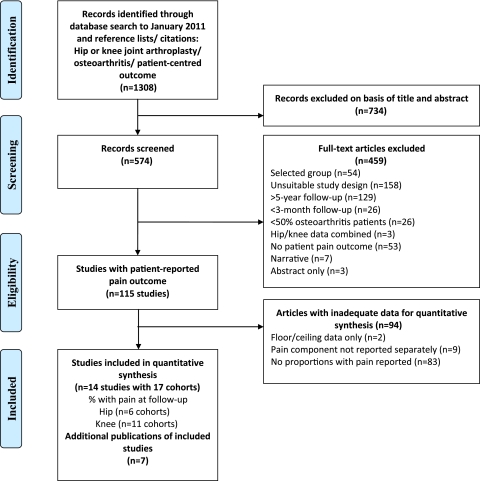
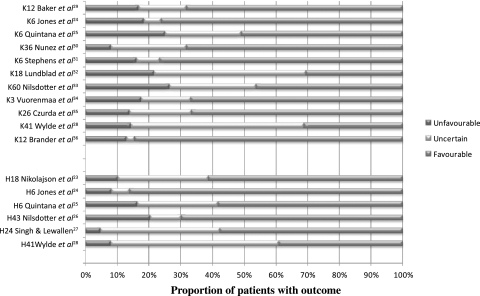
Background: Total hip or knee replacement is highly successful when judged by prosthesis-related outcomes. However, some people experience long-term pain. Objectives: To review published studies in representative populations with total hip or knee replacement for the treatment of osteoarthritis reporting proportions of people by pain intensity. Data sources: MEDLINE and EMBASE databases searched to January 2011 with no language restrictions. Citations of key articles in ISI Web of Science and reference lists were checked. Study eligibility criteria, participants and interventions: Prospective studies of consecutive, unselected osteoarthritis patients representative of the primary total hip or knee replacement population, with intensities of patient-centred pain measured after 3 months to 5-year follow-up. Study appraisal and synthesis methods: Two authors screened titles and abstracts. Data extracted by one author were checked independently against original articles by a second. For each study, the authors summarised the proportions of people with different severities of pain in the operated joint. Results: Searches identified 1308 articles of which 115 reported patient-centred pain outcomes. Fourteen articles describing 17 cohorts (6 with hip and 11 with knee replacement) presented appropriate data on pain intensity. The proportion of people with an unfavourable long-term pain outcome in studies ranged from about 7% to 23% after hip and 10% to 34% after knee replacement. In the best quality studies, an unfavourable pain outcome was reported in 9% or more of patients after hip and about 20% of patients after knee replacement. Limitations: Other studies reported mean values of pain outcomes. These and routine clinical studies are potential sources of relevant data. Conclusions and implications of key findings: After hip and knee replacement, a significant proportion of people have painful joints. There is an urgent need to improve general awareness of this possibility and to address determinants of good and bad outcomes.
Overview
The claims and statistics of this paper haven’t been checked yet.
Free: it reads the open-access text and checks the first 5 claims that cite a source we can check. Create a free account to check every claim.
Integrity signals
Registry
Cites
Statistics
Figures
Verification
Claims the paper makes
The claims and statistics of this paper haven’t been checked yet.
Free: it reads the open-access text and checks the first 5 claims that cite a source we can check. Create a free account to check every claim.
Self-check
Percentages, sums and reported differences re-computed from the paper’s own numbers.
The self-check needs the paper’s full text.
Citations
Cites
Cochrane Handbook for Systematic Reviews of Interventions: Cochrane Book Series
(2008) · doi:10.1002/9780470712184 · Cited by 25,048 · cited 1×
“Although contact with authors is a well-recognised approach in systematic reviews, 21 a survey of review authors indicated that many systematic reviewers do not do so because of poor response rates and variability in the quality of information collected this way.”
BackgroundDermyshi, E., Wang, Y., Yan, C., Hong, W., Qiu, G., Gong, X., & Zhang, T. (2017) · Neonatology · doi:10.1159/000454668 · Cited by 24,451
Meta-analysis of Observational Studies in Epidemiology<SUBTITLE>A Proposal for Reporting</SUBTITLE>
Stroup, D. F. (2000) · JAMA · doi:10.1001/jama.283.15.2008 · Cited by 20,623
Projections of Primary and Revision Hip and Knee Arthroplasty in the United States from 2005 to 2030
Kurtz, S., Ong, K., Lau, E., Mowat, F., & Halpern, M. (2007) · The Journal of Bone and Joint Surgery-American Volume · doi:10.2106/00004623-200704000-00012 · Cited by 8,698 · cited 1×
“In the USA in 2006, the estimated numbers of hospital discharges after total hip or knee replacement procedures were 231 000 and 542 000, respectively,(2) with demand predicted to increase substantially.(3) Total hip or knee replacement is highly successful when judged by prosthesis-related outcomes, such as the radio…”
BackgroundPatient Satisfaction after Total Knee Arthroplasty: Who is Satisfied and Who is Not?
Bourne, R. B., Chesworth, B. M., Davis, A. M., Mahomed, N. N., & Charron, K. D. J. (2010) · Clinical Orthopaedics & Related Research · doi:10.1007/s11999-009-1119-9 · Cited by 2,569
Ethgen, O., Bruyère, O., Richy, F., Dardennes, C., & Reginster, J.-Y. (2004) · The Journal of Bone & Joint Surgery · doi:10.2106/00004623-200405000-00012 · Cited by 1,800
National Hospital Discharge Survey, 1988: Archival Version
United States Department of Health and Human Services. National Center for Health Statistics (1991) · ICPSR Data Holdings · doi:10.3886/icpsr09521 · Cited by 1,310
Baker, P. N., van der Meulen, J. H., Lewsey, J., & Gregg, P. J. (2007) · The Journal of Bone and Joint Surgery. British volume · doi:10.1302/0301-620x.89b7.19091 · Cited by 975
Patients' Perception of Hospital Care in the United States
Jha, A. K., Orav, E. J., Zheng, J., & Epstein, A. M. (2008) · New England Journal of Medicine · doi:10.1056/nejmsa0804116 · Cited by 886 · cited 1×
“In the USA, the importance of patient-reported outcomes in assessing quality of care is recognised, 11 and in England, following the report of Lord Darzi, 12 information is routinely collected after elective surgery.”
BackgroundWylde, V., Hewlett, S., Learmonth, I. D., & Dieppe, P. (2011) · Pain · doi:10.1016/j.pain.2010.11.023 · Cited by 686 · cited 1×
“A cohort of 1394 consecutive total knee replacement patients were followed up prospectively by Wylde and colleagues 28 for a median of 41 months.”
MethodSelf-citation
Research works printed but not linked: 3
- 1. Long-term pain after total hip or knee replacement on August 11, 2021 by guest. Protected by copyright. http://bmjopen.bmj.com/ BMJ Open: first published as 10.1136/bmjopen-2011-000435 on 22 February 2012. Downloaded from REFERENCES
- 4. Long-term pain after total hip or knee replacement on August 11, 2021 by guest. Protected by copyright. http://bmjopen.bmj.com/ BMJ Open: first published as 10.1136/bmjopen-2011-000435 on 22 February 2012. Downloaded from
- 14. Darzi A. High Quality Care for All: NHS Next Stage Review Final Report. London: Department of Health, 2008.
Cited by
Items 901–1,000 of 1,001
Nicolson, P. J. A., Toyé, F., Sabah, S. A., Price, A. J., Alvand, A., & Barker, K. L. (2024) · BMC Musculoskeletal Disorders · doi:10.1186/s12891-024-07778-3 · Cited by 4
Johns, N. A., Naylor, J., McKenzie, D. P., Brady, B., Thirugnanam, B., & Olver, J. (2024) · Musculoskeletal Care · doi:10.1002/msc.1945 · Cited by 7
Graber, J., Hinrichs‐Kinney, L., Churchill, L., Matlock, D. D., Kittelson, A. J., Lutz, A. D., Bade, M., & Stevens‐Lapsley, J. E. (2025) · Journal of Evaluation in Clinical Practice · doi:10.1111/jep.70028 · Cited by 6
The Group Experience: Remodelling Outpatient Physiotherapy after Knee Replacement Surgery
Wainwright, A. V., Kennedy, D. M., & Stratford, P. W. (2015) · Physiotherapy Canada · doi:10.3138/ptc.2014-44 · Cited by 4
Chapter 35 Low-Level Laser Therapy of Pain: Clinical Applications
Chow, R. T. (2016) · Pan Stanford Publishing Pte. Ltd. eBooks · doi:10.1201/9781315364827-36 · Cited by 5
Choi, H.-S., & Shin, W.-S. (2019) · Physical therapy rehabilitation science · doi:10.14474/ptrs.2019.8.1.8 · Cited by 4
Esom, E. A., Katchy, A., Agu, A., Ikele, I., & Nto, N. J. (2019) · Nigerian Journal of Clinical Practice · doi:10.4103/njcp.njcp_93_19 · Cited by 4
Macri, E. M., Callaghan, M. J., van Middelkoop, M., Hattle, M., & Bierma‐Zeinstra, S. (2021) · BMJ Open · doi:10.1136/bmjopen-2020-043026 · Cited by 4
Neural network prediction of 30-day mortality following primary total hip arthroplasty
Fassihi, S. C., Mathur, A., Best, M. J., Chen, A. Z., Gu, A., Quan, T., Wang, K. Y., Wei, C., Campbell, J. C., & Thakkar, S. C. (2021) · Journal of Orthopaedics · doi:10.1016/j.jor.2021.11.013 · Cited by 4
Hinwood, M., Wall, L., Lang, D., Balogh, Z. J., Smith, A., Dowsey, M. M., Clarke, P., Choong, P., Bunzli, S., & Paolucci, F. (2022) · Trials · doi:10.1186/s13063-022-06277-x · Cited by 5
Occupational Therapy Using Coping Lists After Total Knee Arthroplasty: A Case Series
Hara, R., Hiraga, Y., & Hirakawa, Y. (2022) · Cureus · doi:10.7759/cureus.27374 · Cited by 4
“However, it has been reported that approximately 20% of post-TKA patients develop chronic pain, which affects activities of daily living (ADL) and participation in social activities [5,6].”
BackgroundTwiggs, J., Miles, B., Parker, D. A., Liu, D., Shimmin, A., Fritsch, B. A., Roe, J. P., Baré, J. V., Solomon, M. I., Dickison, D., et al. (2022) · Knee Surgery Sports Traumatology Arthroscopy · doi:10.1007/s00167-022-07225-7 · Cited by 4
“Following total knee arthroplasty (TKA), there remains a portion of patients who report dissatisfaction or ongoing functional impairment postoperatively (PROs) [4].”
BackgroundInfluentialJabri, A., Páez, Y. D., Brown, M., Lui, G. E., Hui, W.-K., Hernandez, N., Parks, M. L., Valle, A. G. D., Goodman, S. M., Banerjee, S., et al. (2023) · BMC Musculoskeletal Disorders · doi:10.1186/s12891-023-06460-4 · Cited by 5
Pacheco‐Brousseau, L., Poitras, S., Charette, M., Amor, S. B., Desmeules, F., & Stacey, D. (2023) · Journal of Evaluation in Clinical Practice · doi:10.1111/jep.13893 · Cited by 4
Modarresi, S., Pearson, N., Madden, K., Bennell, K. L., Fahnestock, M. L., Neogi, T., & Carlesso, L. C. (2023) · Osteoarthritis and Cartilage Open · doi:10.1016/j.ocarto.2023.100402 · Cited by 5
“Unfortunately, currently there are no disease modifying medications available, surgery is performed at the late stages with a considerable percentage of people experiencing unfavorable outcomes [47], and we”
BackgroundPublic Health Informatics and the Perioperative Physician: Looking to the Future
Mudumbai, S. C., Gabriel, R. A., Howell, S., Tan, J. M., Freundlich, R. E., O’Reilly-Shah, V. N., Kendale, S. M., Poterack, K. A., & Rothman, B. S. (2024) · Anesthesia & Analgesia · doi:10.1213/ane.0000000000006649 · Cited by 5
Postoperative Pain Management with Periarticular Cocktail Injection in Joint Replacement Surgery
Ikeuchi, M. (2013) · THE JOURNAL OF JAPAN SOCIETY FOR CLINICAL ANESTHESIA · doi:10.2199/jjsca.33.381 · Cited by 4
Pain Relief Following Genicular Nerve Radiofrequency Ablation: Does Knee Compartment Matter?
Burgos, L. A., Greenwood, A., Tarima, S. S., Baynes, K. E., Durand, M. J., Yopp, C. A., & Donohue, N. K. (2021) · Pain Management · doi:10.2217/pmt-2021-0019 · Cited by 4
Perineural Local Anesthetic Treatments for Osteoarthritic Pain
Knight, B. E., Walker, J. M., & Nair, L. S. (2021) · Regenerative Engineering and Translational Medicine · doi:10.1007/s40883-021-00223-0 · Cited by 4
“Several studies assessing post-operative pain revealed that approximately 9% and 20% of patients that underwent hip and knee surgery, respectively developed unfavorable pain within 3 months to 5 years [28].”
BackgroundKuhi, L., Tamm, A. E., Kumm, J., Järv, K., Märtson, A., Tamm, A. O., & Kisand, K. (2021) · Applied Sciences · doi:10.3390/app12010164 · Cited by 4
Wong, C., Bencke, J., & Rasmussen, J. (2022) · Clinical Biomechanics · doi:10.1016/j.clinbiomech.2022.105651 · Cited by 4
Yatagai, N., Hasegawa, T., Kyotani, K., Noda, T., Amano, R., Saito, I., Arimoto, S., Takeda, D., Kakei, Y., & Akashi, M. (2022) · Medicine · doi:10.1097/md.0000000000029511 · Cited by 4
Patient Selection in Randomized Controlled Trials of Total Knee Arthroplasty
Beiene, Z. A., Tanghe, K. K., Neitzke, C. C., Hidaka, C., Lyman, S. L., Gausden, E. B., & McLawhorn, A. S. (2024) · Journal of Bone and Joint Surgery · doi:10.2106/jbjs.23.00629 · Cited by 4
The natural history of unexplained early poor function following total hip replacement
Watson, B. S., Jenkins, P. J., & Ballantyne, J. A. (2013) · International Orthopaedics · doi:10.1007/s00264-013-2099-7 · Cited by 4
Pereira, D. L., Meleiro, H. L., Correia, I. A., & Fonseca, S. (2016) · Brazilian Journal of Anesthesiology (English Edition) · doi:10.1016/j.bjane.2015.06.002 · Cited by 8
van den Driest, J. J., Schiphof, D., Luijsterburg, P. A. J., Koffeman, A. R., Koopmanschap, M. A., Bindels, P., & Bierma‐Zeinstra, S. (2017) · BMJ Open · doi:10.1136/bmjopen-2017-018661 · Cited by 5
Holmes, M., Song, H., Tonkin, E. L., Perelló-Nieto, M., Grant, S., & Flach, P. A. (2018) · Worcester Research and Publications (University of Worcester) · Cited by 6
Nyland, J. A., Caborn, D. N. M., & Jakob, R. P. (2014) · Knee Surgery Sports Traumatology Arthroscopy · doi:10.1007/s00167-014-3224-x · Cited by 4
“However, its efficacy is considerably less robust if the patient is <70 years of age, is overweight, has less severe joint space narrowing, or displays symptoms of depression or anxiety [1, 2, 4, 10, 11].”
BackgroundLaferton, J. A. C., Oeltjen, L., Neubauer, K., Ebert, D. D., & Münder, T. (2020) · PsyArXiv (OSF Preprints) · doi:10.31234/osf.io/y39xu · Cited by 4
Khaled, M., Kuber, J., Ferber, M., Sritharan, P., Levy, Y., Becker, S., Fahnestock, M. L., Griffin, M., Madden, K., Shanthanna, H., et al. (2022) · Canadian Journal of Pain · doi:10.1080/24740527.2022.2162375 · Cited by 3
“Up to 23% of patients undergoing total hip arthroplasty (THA) and 34% of patients undergoing total knee arthroplasty (TKA) experience persistent pain many months after surgery.(8,9) Chronic pain has been associated with structural brain changes.”
BackgroundA Review of the Extent of Pain Catastrophizing in Patients Who Have Undergone Total Knee Replacement
Lin, A., Liu, Z. Q., Yao, J. P., Liu, Y. H., & Wan, H. (2024) · Pain Management Nursing · doi:10.1016/j.pmn.2023.12.014 · Cited by 3
Does commonly used femoral components of total knee arthroplasty fit well in the Indian population?
Bansal, S., Dhingra, M., Kalia, R. B., Saran, S., Barman, S., Choudhury, A. K., Regmi, A., & Niraula, B. B. (2024) · Journal of Clinical Orthopaedics and Trauma · doi:10.1016/j.jcot.2024.102436 · Cited by 3
Ushio, K., Nakanishi, K., Yoshino, A., Takamura, M., Akiyama, Y., Shimada, N., Hirata, K., Ishikawa, M., Nakamae, A., Mikami, Y., et al. (2024) · Brain Research Bulletin · doi:10.1016/j.brainresbull.2024.111073 · Cited by 5
“This is supported by the fact that postoperative pain occurs in 20 – 30 % of patients undergoing knee arthroplasty (Beswick et al., 2012; Schug and Bruce, 2018; Gungor et al., 2019; Vina et al., 2019).”
BackgroundQualitative methods: the missing link in orthopaedic research
Jones, S., & Tyson, S. F. (2025) · Bone and Joint Research · doi:10.1302/2046-3758.141.bjr-2024-0501 · Cited by 3
“11,18,19 For example, a systematic review shows that up to 20% of patients continue to suffer chronic pain after a knee arthroplasty.”
Solomito, M. J., Witmer, D. K., & Carangelo, R. J. (2025) · The Journal of Arthroplasty · doi:10.1016/j.arth.2025.01.023 · Cited by 3
Yamagata, M., Taniguchi, M., Tateuchi, H., Motomura, Y., Kobayashi, M., & Ichihashi, N. (2025) · Annals of Biomedical Engineering · doi:10.1007/s10439-024-03664-0 · Cited by 3
“However, surgical therapy is accompanied by the risk of complications such as postoperative pain and discomfort [2–4].”
Sergooris, A., Verbrugghe, J., Bonnechère, B., Matheve, T., Corten, K., Bogaerts, K., & Timmermans, A. A. A. (2025) · Clinical Rehabilitation · doi:10.1177/02692155251333537 · Cited by 3
“2 Although the literature remains inconclusive in individuals undergoing total joint arthroplasty, 3,4 acute post-operative pain is widely acknowledged as a risk factor for the development of chronic post-operative pain.”
What are the diagnoses attributed to persistent hip pain after hip arthroplasty? A systematic review
Hulin, K., Fearon, A., & Newman, P. (2025) · Journal of Clinical Orthopaedics and Trauma · doi:10.1016/j.jcot.2025.103036 · Cited by 5
“3 This treatment is one of the most common and successful major surgeries of this decade 4,5 with a 20-year revision rate less than 3.5 %.”
InfluentialPedersen, T. A., Lindberg‐Larsen, M., Jensen, C. M., Timm, S., Steffensen, K. D., & Varnum, C. (2025) · BMC Musculoskeletal Disorders · doi:10.1186/s12891-025-08856-w · Cited by 3
“These surgeries are among the most frequently performed procedures worldwide [2, 9], with proven success in terms of pain relief, increased function and enhanced health-related QoL [10, 11].”
Hofstetter, L., Schweyckart, N., Seiler, C., Brand, C., Rosella, L. C., Farshad, M., Puhan, M. A., & Hincapié, C. A. (2025) · Diagnostic and Prognostic Research · doi:10.1186/s41512-025-00200-z · Cited by 3
“Despite being highly successful with respect to pros-thesis-related outcomes, about 7% to 23% of patients report unfavorable pain outcome after THA, and 10% to 34% after TKA [6].”
Han, X., Xuequan, Z., Ge, Y., Wang, B., Shang, X., Lu, Z., Ma, Y., & Li, F. (2025) · The Journal of Arthroplasty · doi:10.1016/j.arth.2025.10.062 · Cited by 3
Pacheco‐Brousseau, L., Abdelrazeq, S. Y., Kelly, S., Pardo, J. P., Dervin, G. F., Stacey, D., & Wells, G. A. (2026) · Cochrane Database of Systematic Reviews · doi:10.1002/14651858.cd015378.pub2 · Cited by 6
Comparative evaluation of large language models for patient education after total knee arthroplasty
Yüncü, M., & Köse, Ö. (2026) · The Knee · doi:10.1016/j.knee.2026.104445 · Cited by 3
Arthritis Pain; Rheumatoid Arthritis, Osteoarthritis, and Fibromyalgia
Khan, A., Correia, J. C., & Walsh, D. A. (2020) · Springer eBooks · doi:10.1007/978-981-15-2933-7_27 · Cited by 5
Pacheco‐Brousseau, L., Abdelrazeq, S. Y., Kelly, S., Pardo, J. P., Dervin, G. F., Nahar, N., Stacey, D., & Wells, G. A. (2023) · Cochrane Database of Systematic Reviews · doi:10.1002/14651858.cd015378 · Cited by 3
Complex Approach in Examination of Function of the Knee Joint in Patients with Osteoarthritis
Fedoseyev, A. V., Александрович, Ч. А., Tishkin, R. V., Dobychin, A. N., Zenkin, G. Y., Prints, A. D., Melyokhina, M. S., Tkachik, A. V., & Zubov, A. A. (2023) · I P Pavlov Russian Medical Biological Herald · doi:10.17816/pavlovj109633 · Cited by 4
Betz, U., Clarius, M., Krieger, M., Konradi, J., Kuchen, R., Schollenberger, L., Wiltink, J., & Drees, P. (2024) · Journal of Clinical Medicine · doi:10.3390/jcm13030862 · Cited by 4
“The much more common problem is chronic postsurgical pain (CPSP), which was reported in 10–34% of patients after TKA [6].”
BackgroundQuiceno, E., Correa-Álvarez, C. D., Tamayo, J. A., & Zuleta, A. A. (2024) · Heliyon · doi:10.1016/j.heliyon.2024.e38832 · Cited by 3
“Moreover, the creation of detailed and long-term arthroplasty registries could provide the necessary data to adequately assess the impact of customized implants on patient satisfaction [37,91,92].”
BackgroundClement, N. D., Qaddoura, B., Coppola, A., Akram, N., Pendyala, S., Jones, S., Afzal, I., & Kader, D. F. (2025) · Bone & Joint Open · doi:10.1302/2633-1462.62.bjo-2024-0185.r1 · Cited by 4
Clement, N. D., Leitch, G., & Scott, C. E. H. (2025) · Musculoskeletal Care · doi:10.1002/msc.70064 · Cited by 3
Hu, H., Luo, Z., Li, B., Wang, T., Wu, T., Li, B., & Song, X. (2025) · Saudi Journal of Anaesthesia · doi:10.4103/sja.sja_398_24 · Cited by 4
“[32] We documented the presence or absence of pain and plotted the duration of postoperative pain during weekly telephone follow-up.”
Alter, B. J., Maurer, M., O'Connell, B., Sanchez, A. G., Kaynar, A. M., DiGioia, A. M., Huppert, T. J., & Wasan, A. D. (2025) · Pain · doi:10.1097/j.pain.0000000000003648 · Cited by 4
Lo, Y.-C., Chen, Y., Lin, H. E., Chang, W.-C., Ho, W., Jang, J.-P., & Kuo, Y. (2025) · Healthcare · doi:10.3390/healthcare13131597 · Cited by 3
“This result was not surprising, since numerous studies reported that the proportion of individuals experiencing unfavorable long-term pain outcomes after knee arthroplasty ranges from 10% to 34% [21].”
Does oversizing an uncemented cup increase post-operative pain in primary total hip arthroplasty?
Barrow, J. A., Divecha, H., Panchani, S., Boden, R., Porter, M., & Tim Board (2018) · European Journal of Orthopaedic Surgery & Traumatology · doi:10.1007/s00590-018-2240-9 · Cited by 3
Vorobeichik, L., Hoydonckx, Y., Kumar, P., Buzon-Tan, A., Walker, S., Kirkham, K. R., Ilangomaran, D., Venkatraghavan, L., Prabhu, A. J., & Bhatia, A. (2020) · Canadian Journal of Anesthesia/Journal canadien d anesthésie · doi:10.1007/s12630-020-01864-5 · Cited by 4
Stephens, G., Maarabouni, A., Mansell, G., & Littlewood, C. (2021) · Physiotherapy Practice and Research · doi:10.3233/ppr-210548 · Cited by 3
Prothèses totales de genou douloureuses
Boisgard, S., Érivan, R., Villatte, G., & Descamps, S. (2021) · Revue de Chirurgie Orthopédique et Traumatologique · doi:10.1016/j.rcot.2021.06.037 · Cited by 4
Hussain, S. M., Wang, Y., Heath, A. K., Giles, G. G., English, D. R., Eyles, D. W., Williamson, E., Graves, S. E., Wluka, A. E., & Cicuttini, F. (2021) · BMC Musculoskeletal Disorders · doi:10.1186/s12891-021-04779-4 · Cited by 4
“but 7 to 23% of patients experience ongoing pain despite technically successful surgery [2].”
BackgroundLondhe, S. B., Shah, R. V., Khot, R., & Desouza, C. (2022) · Indian Journal of Orthopaedics · doi:10.1007/s43465-022-00723-3 · Cited by 3
Wolff, D. T., Shah, N. V., Eldib, A. M., Shah, A. T., Panchal, A. J., Krasnyanskiy, B., Singh, V., Sastry, A., & Naziri, Q. (2022) · PubMed · Cited by 6
Pacheco‐Brousseau, L., Poitras, S., Amor, S. B., Desmeules, F., Kiss, A., & Stacey, D. (2023) · Physiotherapy Canada · doi:10.3138/ptc-2022-0028 · Cited by 3
Surgical Treatments for Osteoarthritis
Usiskin, I. M. (2023) · European Journal of Rheumatology · doi:10.5152/eurjrheum.2023.21193 · Cited by 4
“27 The overall patient dissatisfaction rates from TKA has been estimated in a similar range, with about 8% to 30% of patients reporting being dissatisfied following surgery.”
BackgroundInfluentialGrønne, D. T., Dilara Merve, S. A. R. I., Skou, S. T., Roos, E. M., Demırbüken, İ., & Thorlund, J. B. (2024) · Clinical Rheumatology · doi:10.1007/s10067-024-07195-w · Cited by 3
“Around 15 to 20% develop chronic pain after a joint replacement surgery [26] which might explain their participation in the GLA”
Blikman, T., van den Akker‐Scheek, I., van Raaij, T. M., Dijkstra, B., Bulstra, S. K., & Stevens, M. J. (2024) · BMC Musculoskeletal Disorders · doi:10.1186/s12891-024-08129-y · Cited by 3
“Reports show CPSP percentages of 20% and 7% dissatisfaction after TKA and THA, respectively [5, 6].”
Hara, R., Hiraga, Y., Hirakawa, Y., & Babazono, A. (2025) · Healthcare · doi:10.3390/healthcare13060627 · Cited by 3
“%) continues to experience moderate to severe pain for an extended period of more than three months following the procedure [3].”
InfluentialWang, J., Zhang, X., Ge, L., Xing, X., Cheng, X., Wang, J., Yin, J., Zhu, X., & Cai, G. (2025) · Menopause The Journal of The North American Menopause Society · doi:10.1097/gme.0000000000002560 · Cited by 3
LeBel, S., King, M., Semciw, A. I., & Snowdon, D. A. (2025) · Musculoskeletal Care · doi:10.1002/msc.70162 · Cited by 3
“Up to 34% of patients report persistent knee pain between 3 months and 5 years after total knee replacement (TKR; Olsen et al. 2024), while 26%–58% continue to experience hip pain 6 months after total hip replacement (THR; Erlenwein et al. 2017).”
InfluentialBurbano-Levy, X., CARDONA, D. P., Act, E. P., Rico‐Alba, I., & León Zapata, Q. F. (2014) · Value in Health Regional Issues · doi:10.1016/j.vhri.2014.06.006 · Cited by 3
“[40] Beswick AD, Wylde V, Gooberman-Hill R, et al.”
Reckziegel, D., Bailey, H., Cottam, W. J., Tench, C. R., Mahajan, R. P., Walsh, D. A., Knaggs, R., & Auer, D. P. (2017) · BMJ Open · doi:10.1136/bmjopen-2016-014013 · Cited by 3
“Despite these options, around 20% of patients do not get satisfactory pain relief, even after undergoing joint replacement surgery.(3) This strongly supports the notion that chronic osteoarthritis pain has a strong central component.”
Riddle, D. L., Slover, J. D., Ang, D. C., Bair, M. J., Kroenke, K., Perera, R. A., & Dumenci, L. (2018) · Journal of Pain Research · doi:10.2147/jpr.s168251 · Cited by 4
Valter, R., Godeau, D., Leclerc, A., Descatha, A., & Fadel, M. (2019) · BMJ Open · doi:10.1136/bmjopen-2019-031549 · Cited by 7
The Effects of Osteoarthritis on Quality of Life (QoL)
Ali, Q., Aftab, M., & Arshad, S. (2020) · National Journal of Health Sciences · doi:10.21089/njhs.52.0060 · Cited by 3
Medial abrasion syndrome: a neglected cause of persistent pain after knee arthroplasty
Lyu, S., Hsu, C.-C., & Hung, J.-P. (2021) · Journal of Orthopaedic Surgery and Research · doi:10.1186/s13018-020-02191-7 · Cited by 3
Birch, S., Hansen, T. B., Stilling, M., & Mechlenburg, I. (2021) · Journal for the Measurement of Physical Behaviour · doi:10.1123/jmpb.2020-0024 · Cited by 3
Song, Y., Liu, S.-F., Wu, Z. B., Wang, M., Cong, R., & Tao, K. (2021) · Menopause The Journal of The North American Menopause Society · doi:10.1097/gme.0000000000001789 · Cited by 3
Vetsch, T., Taeymans, J., & Lutz, N. (2023) · Swiss Medical Weekly · doi:10.57187/smw.2023.40059 · Cited by 4
Zhao, C., Yang, G., Ji, B., Jin, H., Naranmandakh, S., & Li, Y. (2023) · Journal of Pain Research · doi:10.2147/jpr.s409049 · Cited by 3
Non-surgical and Non-pharmacological Treatment of Knee Pain
Golding, D. M., & Lee, P. Y. (2016) · Journal of Arthritis · doi:10.4172/2167-7921.1000225 · Cited by 3
“Between 8-34% of patients experience chronic pain or disability follows TKR even with adequate radiographic and clinical evaluations and no evidence of infection [10,11], indicating that surgeons are currently delivering sub-optimal results for their patients.”
BackgroundKalirtahinam, D., Ismail, M. S., Singh, T. S. P., Saha, S., & Hashim, H. A. (2017) · Scientia Medica · doi:10.15448/1980-6108.2017.1.25082 · Cited by 3
“Some of the common exercises identified as the best intervention against the complications of osteopathy include mainly aerobics, proprioceptive exercises, and strength exercises [8,9].”
BackgroundCorrelation between functionality and satisfaction index after total hip or knee replacement
Gálvez, A. M., Serrano-Ardila, A., & Camacho-Galindo, J. (2020) · Journal of Musculoskeletal Surgery and Research · doi:10.4103/jmsr.jmsr_48_20 · Cited by 3
Nazemyanyazdi, N., Delavari, A., Saghafinia, M., & Meibodi, M. K. E. (2021) · Trauma Monthly · doi:10.30491/tm.2021.283199.1283 · Cited by 3
A Novel Rat Model to Study Postsurgical Pain After Joint Replacement Surgery
Aoyama, N., Izumi, M., Morimoto, T., Wada, H., Dan, J., Kasai, Y., Satake, Y., Aso, K., & Ikeuchi, M. (2022) · Journal of Pain Research · doi:10.2147/jpr.s368130 · Cited by 4
“Recently, accumulating evidence revealed that if pain management is inadequate, acute postsurgical pain can progress to chronic postsurgical pain (CPSP).(13,14) To develop a more effective treatment strategy, it is essential to clarify the basic mechanisms underlying postsurgical pain in the acute phase.”
BackgroundLower Extremity Biomechanics during Stair Ascent in Healthy and Total Knee Replacement Older Adults
Standifird, T. W. (2015) · Cited by 3
A new multivariate meta-analysis model for many variates and few studiesPreprint
Rose, C. J., Olsen, U., Lindberg, M. F., Denison, E., Aamodt, A., & Lerdal, A. (2020) · arXiv (Cornell University) · doi:10.48550/arxiv.2009.11808 · Cited by 4
“About 20% of patients who undergo TKA experience post-surgical pain and reduced function [1], and numerous factors have been studied.”
BackgroundEditorial: factors influencing the outcome of total hip and knee arthroplasty
Clement, N. D., & Scott, C. E. H. (2023) · Arthroplasty · doi:10.1186/s42836-023-00219-x · Cited by 3
“Success of hip and knee arthroplasties is not universal and approximately one in ten patients are not satisfied with their arthroplasty [2] and 10% to 34% of patients have an unfavourable long term pain outcome [3].”
BackgroundAcceptance and commitment therapy for prevention of chronic pain after total knee arthroplasty.
Giusti, E. M., Castelnuovo, G., Manna, C., Varallo, G., Cattivelli, R., Petrachi, B. V., Stramba-Badiale, M., & Spatola, C. A. M. (2026) · Pain Medicine · doi:10.1093/pm/pnaf145 · Cited by 2
Westby, M. D., Lalande, J.-F., Koehn, C. L., & Johal, N. (2023) · Physiotherapy Canada · doi:10.3138/ptc-2022-0083 · Cited by 2
Persistent Pain due to Cement Protrusion After Total Knee Arthroplasty: A Report of Three Cases
Alamiri, N., Lorange, J.-P., & Dimentberg, R. (2024) · Arthroplasty Today · doi:10.1016/j.artd.2024.101334 · Cited by 2
“However, 10%-34% of individuals experience unfavorable pain be-tween 3 months and 5 years after TKA [2].”
BackgroundPeeters, G. M. E. E., de Munck, I., Tooth, L. R., & Melis, R. J. F. (2024) · Gerontology · doi:10.1159/000540159 · Cited by 2
Elkabbani, M., Adi, M., Osman, A., Khater, A. M. E., Tarabichi, S. B., & Zaghloul, A. (2024) · Journal of Musculoskeletal Surgery and Research · doi:10.25259/jmsr_170_2024 · Cited by 2
Qin, M., Dai, X., Yang, C., & Su, W. (2024) · The Journal of Arthroplasty · doi:10.1016/j.arth.2024.09.011 · Cited by 2
Koh, H. S., Kim, Y., Park, D., Kang, M. H., & Choi, Y. (2025) · Orthopaedic Surgery · doi:10.1111/os.14342 · Cited by 2
Nishimoto, J., Deguchi, N., Tanaka, S., Inoue, Y., & Tanaka, R. (2025) · Cureus · doi:10.7759/cureus.78707 · Cited by 3
Li, Q., Aierken, A., Qin, J., Chen, D., & Jiang, Q. (2025) · Orthopaedic Surgery · doi:10.1111/os.14349 · Cited by 2
“Secondary outcomes included functional outcomes and rates of block-related adverse events [4].”
Yabroudi, M. A., Al-Adwan, A., & Nawasreh, Z. H. (2025) · International Orthopaedics · doi:10.1007/s00264-025-06489-1 · Cited by 2
“The prevalence of Chronic knee pain following TKA ranges substantially between studies, from around 10–34% [10].”
InfluentialFocused Ultrasounds in the Rehabilitation Setting: A Narrative Review
Pirri, C., Manocchio, N., Polisano, D., Sorbino, A., & Foti, C. (2025) · Applied Sciences · doi:10.3390/app15094743 · Cited by 3
Horn, M. E., George, S. Z., Giczewska, A., Alhanti, B., Tanner, I. L., & Bolognesi, M. P. (2025) · Arthroplasty · doi:10.1186/s42836-025-00309-y · Cited by 2
Barton, C. J., Dowsey, M. M., Smith, A. J., Ackerman, I. N., Ademi, Z., Bunzli, S., Choong, P., Crossley, K. M., Kemp, J. L., Wallis, J. A., et al. (2025) · Osteoarthritis and Cartilage Open · doi:10.1016/j.ocarto.2025.100622 · Cited by 2
“Yet, up to 1 in 3 patients report unfavourable pain outcomes after TKR surgery [14,15] highlighting the opportunity for improvements to health system ef fi ciency by better prioritising those who should undergo the procedure.”
Sugimura, N., Aso, K., Wada, H., Izumi, M., & Ikeuchi, M. (2025) · Journal of Joint Surgery and Research · doi:10.1016/j.jjoisr.2025.04.002 · Cited by 2
Metadata
- Authors
- Beswick, A. D., Wylde, V., Gooberman-Hill, R., Blom, A., & Dieppe, P.
- Affiliations
- University of Bristol (GB)
- Peninsula College of Medicine and Dentistry (GB)
- Corresponding author
- Beswick, Andrew David
- Venue
- BMJ Open
- Publisher
- BMJ
- Published
- 2012
- Volume
- 2
- Issue
- 1
- Pages
- e000435
- ISSN
- 2044-6055 (ISSN-L)
- PMC
- PMC3289991
- OpenAlex
- W1990076794
- Semantic Scholar
- 45725c70617c53d281ed2739cb53edc2494a7ac5
- Cited by
- 1,450
- References
- 56
- Citations by year
- 2026: 85 · 2025: 134 · 2024: 141 · 2023: 162 · 2022: 136 · 2021: 147 · 2020: 136 · 2019: 106 · 2018: 103 · 2017: 74 · 2016: 72 · 2015: 58 · 2014: 44 · 2013: 42 · 2012: 8
- FWCI
- 9.41
- Type
- journal article
- Language
- en
- Open access
- gold
- doi.org
- Licence
- cc-by-nc
- Locations
- BMJ Open (publishedVersion, cc-by-nc)
- PubMed Central (publishedVersion, cc-by-nc)
- PubMed (publishedVersion)
- Bristol Research (University of Bristol) (submittedVersion)
- Funders
- National Institute for Health and Care Research (RP-PG-0407-10070)
- Programme Grants for Applied Research
- Topics
- Health Sciences › Medicine › Surgery › Total Knee Arthroplasty Outcomes
- Health Sciences › Medicine › Surgery › Orthopaedic implants and arthroplasty
- Health Sciences › Medicine › Anesthesiology and Pain Medicine › Anesthesia and Pain Management
- Keywords
- total hip arthroplasty, total knee arthroplasty, osteoarthritis, chronic pain, postoperative pain, pain intensity, patient-centered outcomes, joint replacement outcomes, unselected patients
About these checks
Registry, retraction, Cites and statistics results are computed, not judged, with one exception: a printed reference that no index lists is read once by a model before it counts as a citation error. Claims are extracted by a model and kept only when their quote appears verbatim in the text; each cited source is then checked, with a model’s help, for whether it says what the claim relies on. Those verdicts can be wrong — read the claim’s quote and the cited source before relying on one.
Statistics and arithmetic are recomputed, not judged.
Confidence bands are shown only for fields calibrated on our annotated test set. None is calibrated yet, so no band is shown.
What counts as a claim ›How we measure confidence ›How we check this ›
Are you an author, or do you see a problem with this page? Request a review
Data sources
Bibliographic data: Semantic Scholar, OpenAlex, Crossref.
Contains information from the Semantic Scholar Academic Graph Datasets, made available under the ODC Attribution License (ODC-BY 1.0).
Semantic Scholar’s data is described in: Kinney, R., et al. (2023). The Semantic Scholar Open Data Platform. arXiv:2301.10140.
