

What proportion of patients report long-term pain after total hip or knee replacement for osteoarthritis? A systematic review of prospective studies in unselected patients
Open accessThe DOI matches its Crossref record; 56 of the 56 references it cites were found in a registry or an index.
Abstract
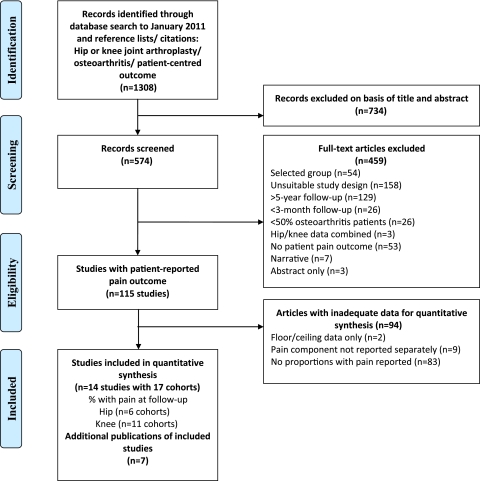
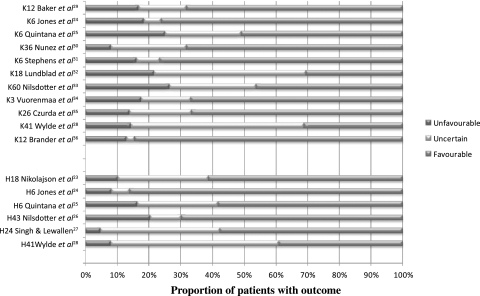
Background: Total hip or knee replacement is highly successful when judged by prosthesis-related outcomes. However, some people experience long-term pain. Objectives: To review published studies in representative populations with total hip or knee replacement for the treatment of osteoarthritis reporting proportions of people by pain intensity. Data sources: MEDLINE and EMBASE databases searched to January 2011 with no language restrictions. Citations of key articles in ISI Web of Science and reference lists were checked. Study eligibility criteria, participants and interventions: Prospective studies of consecutive, unselected osteoarthritis patients representative of the primary total hip or knee replacement population, with intensities of patient-centred pain measured after 3 months to 5-year follow-up. Study appraisal and synthesis methods: Two authors screened titles and abstracts. Data extracted by one author were checked independently against original articles by a second. For each study, the authors summarised the proportions of people with different severities of pain in the operated joint. Results: Searches identified 1308 articles of which 115 reported patient-centred pain outcomes. Fourteen articles describing 17 cohorts (6 with hip and 11 with knee replacement) presented appropriate data on pain intensity. The proportion of people with an unfavourable long-term pain outcome in studies ranged from about 7% to 23% after hip and 10% to 34% after knee replacement. In the best quality studies, an unfavourable pain outcome was reported in 9% or more of patients after hip and about 20% of patients after knee replacement. Limitations: Other studies reported mean values of pain outcomes. These and routine clinical studies are potential sources of relevant data. Conclusions and implications of key findings: After hip and knee replacement, a significant proportion of people have painful joints. There is an urgent need to improve general awareness of this possibility and to address determinants of good and bad outcomes.
Overview
The claims and statistics of this paper haven’t been checked yet.
Free: it reads the open-access text and checks the first 5 claims that cite a source we can check. Create a free account to check every claim.
Integrity signals
Registry
Cites
Statistics
Figures
Verification
Claims the paper makes
The claims and statistics of this paper haven’t been checked yet.
Free: it reads the open-access text and checks the first 5 claims that cite a source we can check. Create a free account to check every claim.
Self-check
Percentages, sums and reported differences re-computed from the paper’s own numbers.
The self-check needs the paper’s full text.
Citations
Cites
Cochrane Handbook for Systematic Reviews of Interventions: Cochrane Book Series
(2008) · doi:10.1002/9780470712184 · Cited by 25,048 · cited 1×
“Although contact with authors is a well-recognised approach in systematic reviews, 21 a survey of review authors indicated that many systematic reviewers do not do so because of poor response rates and variability in the quality of information collected this way.”
BackgroundDermyshi, E., Wang, Y., Yan, C., Hong, W., Qiu, G., Gong, X., & Zhang, T. (2017) · Neonatology · doi:10.1159/000454668 · Cited by 24,451
Meta-analysis of Observational Studies in Epidemiology<SUBTITLE>A Proposal for Reporting</SUBTITLE>
Stroup, D. F. (2000) · JAMA · doi:10.1001/jama.283.15.2008 · Cited by 20,623
Projections of Primary and Revision Hip and Knee Arthroplasty in the United States from 2005 to 2030
Kurtz, S., Ong, K., Lau, E., Mowat, F., & Halpern, M. (2007) · The Journal of Bone and Joint Surgery-American Volume · doi:10.2106/00004623-200704000-00012 · Cited by 8,698 · cited 1×
“In the USA in 2006, the estimated numbers of hospital discharges after total hip or knee replacement procedures were 231 000 and 542 000, respectively,(2) with demand predicted to increase substantially.(3) Total hip or knee replacement is highly successful when judged by prosthesis-related outcomes, such as the radio…”
BackgroundPatient Satisfaction after Total Knee Arthroplasty: Who is Satisfied and Who is Not?
Bourne, R. B., Chesworth, B. M., Davis, A. M., Mahomed, N. N., & Charron, K. D. J. (2010) · Clinical Orthopaedics & Related Research · doi:10.1007/s11999-009-1119-9 · Cited by 2,569
Ethgen, O., Bruyère, O., Richy, F., Dardennes, C., & Reginster, J.-Y. (2004) · The Journal of Bone & Joint Surgery · doi:10.2106/00004623-200405000-00012 · Cited by 1,800
National Hospital Discharge Survey, 1988: Archival Version
United States Department of Health and Human Services. National Center for Health Statistics (1991) · ICPSR Data Holdings · doi:10.3886/icpsr09521 · Cited by 1,310
Baker, P. N., van der Meulen, J. H., Lewsey, J., & Gregg, P. J. (2007) · The Journal of Bone and Joint Surgery. British volume · doi:10.1302/0301-620x.89b7.19091 · Cited by 975
Patients' Perception of Hospital Care in the United States
Jha, A. K., Orav, E. J., Zheng, J., & Epstein, A. M. (2008) · New England Journal of Medicine · doi:10.1056/nejmsa0804116 · Cited by 886 · cited 1×
“In the USA, the importance of patient-reported outcomes in assessing quality of care is recognised, 11 and in England, following the report of Lord Darzi, 12 information is routinely collected after elective surgery.”
BackgroundWylde, V., Hewlett, S., Learmonth, I. D., & Dieppe, P. (2011) · Pain · doi:10.1016/j.pain.2010.11.023 · Cited by 686 · cited 1×
“A cohort of 1394 consecutive total knee replacement patients were followed up prospectively by Wylde and colleagues 28 for a median of 41 months.”
MethodSelf-citation
Research works printed but not linked: 3
- 1. Long-term pain after total hip or knee replacement on August 11, 2021 by guest. Protected by copyright. http://bmjopen.bmj.com/ BMJ Open: first published as 10.1136/bmjopen-2011-000435 on 22 February 2012. Downloaded from REFERENCES
- 4. Long-term pain after total hip or knee replacement on August 11, 2021 by guest. Protected by copyright. http://bmjopen.bmj.com/ BMJ Open: first published as 10.1136/bmjopen-2011-000435 on 22 February 2012. Downloaded from
- 14. Darzi A. High Quality Care for All: NHS Next Stage Review Final Report. London: Department of Health, 2008.
Cited by
Items 401–500 of 1,001
Luna, I. E., Kehlet, H., Jensen, C. M., Christiansen, T. G., Lind, T., Stephensen, S. L., & Aasvang, E. K. (2017) · Journal of Pain · doi:10.1016/j.jpain.2017.07.010 · Cited by 25
Foucher, K. C., Chmell, S., & Courtney, C. A. (2018) · Journal of Orthopaedic Research® · doi:10.1002/jor.24159 · Cited by 33
“Up to 30% of TKA patients report persistent postoperative pain.(8,9) A better understanding of factors related to chronic pain is needed so that clinicians can recognize patients at risk for chronic pain—this is perhaps especially important for individuals considering TKA.”
BackgroundMoore, A. J., & Gooberman‐Hill, R. (2020) · Health Expectations · doi:10.1111/hex.13098 · Cited by 26
Self-citationGarcía‐Lopez, J., Polanco-García, M., & Montes, A. (2021) · The Journal of Arthroplasty · doi:10.1016/j.arth.2021.02.005 · Cited by 27
Standifird, T. W., Saxton, A. M., Coe, D. P., Cates, H. E., Reinbolt, J. A., & Zhang, S. (2015) · The Journal of Arthroplasty · doi:10.1016/j.arth.2015.06.052 · Cited by 25
“However, some patients still reported long-term pain following TKA [4].”
BackgroundCastro-Dominguez, F., Tibesku, C. O., McAlindon, T. E., Freitas, R., Ivanavicius, S., Kandaswamy, P., Sears, A. J., & Latourte, A. (2024) · Rheumatology and Therapy · doi:10.1007/s40744-024-00720-y · Cited by 29
Primary total hip arthroplasty: health related quality of life outcomes
Bagarić, I., Šarac, H., Borovac, J. A., Vlak, T., Bekavac, J., & Hebrang, A. (2013) · International Orthopaedics · doi:10.1007/s00264-013-2142-8 · Cited by 24
“In our study none of our patients reported severe pain intensity on VAS scale postoperatively, which is in contrast to previous findings [31] that report that up to 30% of patients use analgesics on a regular basis following the THA.”
BackgroundResultvan der Steen, M. C., Janssen, R. P. A., Reijman, M., & Tolk, J. J. (2016) · The Journal of Knee Surgery · doi:10.1055/s-0036-1593868 · Cited by 25
Duloxetine reduces pain after Total hip arthroplasty: a prospective, randomized controlled study
Li, H., Zeng, W., Ding, Z., Yuan, M., Cai, Y., & Zhou, Z. (2021) · BMC Musculoskeletal Disorders · doi:10.1186/s12891-021-04377-4 · Cited by 24
Gerber, S., & Saeed, N. (2021) · British Journal of Oral and Maxillofacial Surgery · doi:10.1016/j.bjoms.2021.11.010 · Cited by 24
Lindberg, M. F., Aamodt, A., Badawy, M., Bergvad, I. B., Borchgrevink, P. C., Furnes, O. N., Gay, C., Heir, S., Holm, I., Indrekvam, K., et al. (2021) · BMC Musculoskeletal Disorders · doi:10.1186/s12891-021-04924-z · Cited by 26
“A review of the literature [4] and our own empirical findings [5] indicate that 12–20% of TKA patients continue to experience moderate to severe pain 12 months after surgery and report dissatisfaction with their surgical outcome [6, 7].”
BackgroundBlikman, T., Rienstra, W., van Raaij, T. M., ten Hagen, A. J., Dijkstra, B., Zijlstra, W. P., Bulstra, S. K., Stevens, M. J., & van den Akker‐Scheek, I. (2022) · BMC Musculoskeletal Disorders · doi:10.1186/s12891-022-05034-0 · Cited by 25
Emara, A. K., Orr, M. N., Klika, A. K., McLaughlin, J. P., Molloy, R. M., & Piuzzi, N. S. (2022) · The Journal of Arthroplasty · doi:10.1016/j.arth.2022.02.063 · Cited by 24
Berardi, G., Frey‐Law, L., Sluka, K. A., Bayman, E. O., Coffey, C. S., Ecklund, D. J., Vance, C. G. T., Dailey, D. L., Burns, J. W., Buvanendran, A., et al. (2022) · Frontiers in Medicine · doi:10.3389/fmed.2022.849214 · Cited by 34
Umbilical Cord PRP vs. Autologous PRP for the Treatment of Hip Osteoarthritis
Mazzotta, A., Pennello, E., Stagni, C., Piccolo, N. D., Boffa, A., Cenacchi, A., Buzzi, M., Filardo, G., & Dallari, D. (2022) · Journal of Clinical Medicine · doi:10.3390/jcm11154505 · Cited by 24
“Although THA was valued as the operation of the century, considering satisfactory results obtained and durability over the years [5,6] it is associated with complications such as dislocation, infection, and the need for reoperation [7,8].”
BackgroundGriffin, J., Davis, E. T., Parsons, H. M., Mannion, E. G., Khatri, C., Ellard, D. R., Blyth, M., Clement, N. D., Deehan, D. J., Flynn, N., et al. (2023) · BMJ Open · doi:10.1136/bmjopen-2022-068255 · Cited by 33
Bordon, G., Berenbaum, F., Distler, O., & Luciani, P. (2023) · Biomedicine & Pharmacotherapy · doi:10.1016/j.biopha.2023.115819 · Cited by 26
“However, the procedure is also associated with more serious adverse events (e.g. more than 20 % of the patients report chronic pain after total knee replacement) which limits its use for some segments of the patient population [37].”
BackgroundHadad, M. J., Pasqualini, I., Klika, A. K., Jin, Y., Deren, M. E., Krebs, V. E., Murray, T. G., & Piuzzi, N. S. (2024) · Clinical Orthopaedics and Related Research · doi:10.1097/corr.0000000000003040 · Cited by 24
“With satisfaction after TKA reported to be at 80% to 88% across multiple studies, and with the large number of these procedures performed, there is value in understanding any potential associations between patient factors and patient perception of their healthcare experience [5, 20, 29].”
van der Sluis, G., Goldbohm, R. A., Bimmel, R., Garre, F. G., Elings, J., Hoogeboom, T. J., & van Meeteren, N. L. U. (2015) · BioMed Research International · doi:10.1155/2015/745864 · Cited by 24
“As with all medical interventions, steps should be taken to minimise the risk of serious adverse medical events.”
Collins, J. E., Rome, B. N., Daigle, M. E., Lerner, V., Katz, J. N., & Losina, E. (2014) · The Journal of Arthroplasty · doi:10.1016/j.arth.2014.02.023 · Cited by 24
“[2] The procedure is remarkably successful, with about 80% of TKR recipients experiencing substantial pain relief and functional improvement.[3, 4]”
Burnham, L. J., & Dickenson, A. H. (2013) · Journal of Pharmacology and Experimental Therapeutics · doi:10.1124/jpet.112.199489 · Cited by 24
“In this light, the inhibitory effect of milnacipran on the windup of dorsal horn neurons in the late phase of the model may suggest a particular efficacy when joint damage is advanced and central sensitization is present; a plausible example of a population of OA sufferers who may benefit from centrally acting agents…”
BackgroundAssessing and Managing Acute Pain: A Call to Action
Jungquist, C. R., Vallerand, A. H., Sicoutris, C. P., Kwon, K., & Polomano, R. C. (2017) · AJN American Journal of Nursing · doi:10.1097/01.naj.0000513526.33816.0e · Cited by 30
“Research suggests that 10% to 34% of patients who undergo this type of surgery develop CPSP.(28) RD, however, avoided CPSP because his surgical team, adult gerontology NP, and orthopedic nurse navigator collaborated to design a comprehensive multimodal pain treatment plan before surgery (see RD’s Perioperative Pain Ma…”
BackgroundGandhi, R., Mahomed, N. N., Cram, P. M., & Perruccio, A. V. (2017) · The Journal of Arthroplasty · doi:10.1016/j.arth.2017.11.051 · Cited by 24
Twiggs, J., Wakelin, E. A., Roe, J. P., Dickison, D., Fritsch, B. A., Miles, B., & Ruys, A. J. (2018) · The Journal of Arthroplasty · doi:10.1016/j.arth.2018.04.035 · Cited by 25
RECOVER-E – a mobile app for patients undergoing total knee or hip replacement: study protocol
Stauber, A., Schüßler, N., Palmdorf, S., Schürholz, N., Bruns, D., Osterbrink, J., & Nestler, N. (2020) · BMC Musculoskeletal Disorders · doi:10.1186/s12891-020-3090-2 · Cited by 51
Pineda, M. M. S., Vanlinthout, L. E., Santana-Ramírez, S., Vanneste, T., Zundert, J. H. M. V., & Ruiz, J. P. N. (2020) · Pain Medicine · doi:10.1093/pm/pnaa309 · Cited by 24
Moret, C. S., Schelker, B. L., & Hirschmann, M. T. (2021) · Journal of Personalized Medicine · doi:10.3390/jpm11070590 · Cited by 24
Postoperative Care Navigation for Total Knee Arthroplasty Patients: A Randomized Controlled Trial
Losina, E., Collins, J. E., Wright, J., Daigle, M. E., Donnell‐Fink, L. A., Strnad, D., Usiskin, I. M., Yang, H. Y., Lerner, V., & Katz, J. N. (2015) · Arthritis Care & Research · doi:10.1002/acr.22829 · Cited by 25
“WOMAC pain score 11 (9, 14) 11 (9, 14) – 231 (233, 228) 228 (231, 224) 23 (27, 1)”
Long-term survivorship of hip and knee arthroplasty
Chang, J. S., & Haddad, F. S. (2020) · The Bone & Joint Journal · doi:10.1302/0301-620x.102b4.bjj-2020-0183 · Cited by 23
Moore, A. J., Eccleston, C., & Gooberman‐Hill, R. (2020) · Arthritis Care & Research · doi:10.1002/acr.24534 · Cited by 23
“Decades of advancement in surgical technique and prosthesis technology have improved recovery outcomes, with fewer complications, greater pain relief and longer implant survival, but around 20% of people still report ongoing pain, and dissatisfaction after knee replacement (5-8).”
BackgroundSelf-citationVasileiadis, D., Drosos, G. I., Charitoudis, G., Dontas, I. A., & Vlamis, J. (2022) · Musculoskeletal Care · doi:10.1002/msc.1616 · Cited by 25
Koh, H. S., Choi, Y., Park, D., & Jeong, M. G. (2022) · Orthopedics · doi:10.3928/01477447-20220401-06 · Cited by 26
Osteoarthritis Year in Review 2014: clinical
HAWKER, G. A., & Stanaitis, I. (2014) · Osteoarthritis and Cartilage · doi:10.1016/j.joca.2014.06.018 · Cited by 27
van Kasteren, Y., Freyne, J., & Hussain, M. S. (2018) · Journal of Medical Internet Research · doi:10.2196/jmir.7541 · Cited by 30
“More recently, a 2012 systematic review of journal articles on postoperative outcomes for TKR indicated that as many as 10% to 34% of TKR patients continue to experience long-term pain after knee replacement [14].”
BackgroundStability of Measures of Pain Catastrophizing and Widespread Pain Following Total Knee Replacement
Lape, E. C., Selzer, F., Collins, J. E., Losina, E., & Katz, J. N. (2020) · Arthritis Care & Research · doi:10.1002/acr.24000 · Cited by 24
Petersen, K. K.-S. (2023) · Scandinavian Journal of Pain · doi:10.1515/sjpain-2022-0082 · Cited by 22
“However, it is evident that 10 – 20% of the patients experience chronic postoperative pain after TKA [23], which is a major issue since the number of TKAs is increasing world-wide [24 – 29].”
Terradas‐Monllor, M., Ruiz, M. Á., & Ochandorena‐Acha, M. (2023) · Physical Therapy · doi:10.1093/ptj/pzad141 · Cited by 23
Improving osteoarthritis management in primary healthcare: results from a quasi-experimental study
Østerås, N., Blaker, I. B., Hjortland, T., Cottrell, E., Quicke, J. G., Dziedzic, K., Blackburn, S. J., & Paulsen, A. (2021) · BMC Musculoskeletal Disorders · doi:10.1186/s12891-021-03959-6 · Cited by 28
“One in ten hip and one in five knee joint replacements have painful joints postoperatively [20].”
BackgroundPriol, R., Pasquier, G. J. M., Putman, S., Migаud, H., Dаrtus, J., & Wattier, J. (2023) · Orthopaedics & Traumatology Surgery & Research · doi:10.1016/j.otsr.2022.103543 · Cited by 25
Pain Relief After Total Knee Arthroplasty with Intravenous and Periarticular Corticosteroid
Ping Keung, C. H. A. N., Chan, T. C. W., Mak, C., Chan, T. H. M., Chan, S. H. W., Wong, S. S. C., Fu, H., Cheung, A., Chan, V. W. K., Cheung, M. H., et al. (2023) · Journal of Bone and Joint Surgery · doi:10.2106/jbjs.22.01218 · Cited by 22
Riddle, D. L., Perera, R. A., Nay, W. T., & Dumenci, L. (2015) · Clinical Orthopaedics and Related Research · doi:10.1007/s11999-015-4203-3 · Cited by 23
“Despite high surgical success rates, as many as 25% of patients report compromised postoperative functioning and persistent pain although having a stable implant [2].”
BackgroundMerle, C., Brendle, S., Wang, H., Streit, M. R., Gotterbarm, T., & Schiltenwolf, M. (2013) · The Journal of Arthroplasty · doi:10.1016/j.arth.2013.05.004 · Cited by 23
“However, it is worth noting that recent studies on clinical outcome and predictive factors for pain and disability after joint arthroplasty surgery show a similar age distribution compared to patients in the present study cohort [2,3,23].”
BackgroundResultPiva, S. R., Moore, C. G., Schneider, M., Gil, A. B., Almeida, G. J., & Irrgang, J. J. (2015) · BMC Musculoskeletal Disorders · doi:10.1186/s12891-015-0761-5 · Cited by 26
“However, long-term functional and activity limitations due to the chronic joint disease prior to surgery do not spontaneously resolve after TKR [3–9].”
BackgroundSchwartz, J., Grant, A. R., & Bhadra, A. K. (2024) · Journal of Orthopaedics · doi:10.1016/j.jor.2024.04.011 · Cited by 21
Forsyth, L., Ligeti, A., Blyth, M., Clarke, J., & Riches, P. E. (2024) · The Knee · doi:10.1016/j.knee.2024.10.006 · Cited by 21
Assessing function in patients undergoing joint replacement: a study protocol for a cohort study
Wylde, V., Blom, A. W., Bolink, S. A. A. N., Brunton, L. R., Dieppe, P. A., Gooberman‐Hill, R., Grimm, B. P., Mann, C., & Lenguerrand, E. (2012) · BMC Musculoskeletal Disorders · doi:10.1186/1471-2474-13-220 · Cited by 21
“TJR is an effective and costeffective intervention for people with advanced arthritis [3,4], although recent evidence suggests that an important minority do not improve post-operatively [5].”
BackgroundSelf-citationWhat Are the Costs of Hip Osteoarthritis in the Year Prior to a Total Hip Arthroplasty?
Malik, A. T., Alexander, J. H., Li, D., Li, M., Khan, S. N., & Scharschmidt, T. J. (2019) · The Journal of Arthroplasty · doi:10.1016/j.arth.2019.09.020 · Cited by 21
Bjurström, M. F., Bodelsson, M., Montgomery, A. K., Harsten, A., Waldén, M., Janelidze, S., Hall, S., Hansson, O., Irwin, M. R., & Mattsson, N. (2020) · Pain · doi:10.1097/j.pain.0000000000001903 · Cited by 25
Jacobs, H., Seeber, G. H., Allers, K., & Hoffmann, F. (2021) · BMC Musculoskeletal Disorders · doi:10.1186/s12891-021-04600-2 · Cited by 24
“The more complicated anatomy of the knee joint might result in a higher proportion of complications following arthroplasty [16], which is in line with numerous studies reporting inferior function and clinical outcomes for TKA patients [62–66].”
BackgroundResultInfluentialImpact of pain sensitisation on the quality of life of patients with knee osteoarthritis
Aw, M. Y. N., Yeo, S.-J., Wylde, V., Wong, S. B.-S., Chan, D. X. H., Thumboo, J., & Leung, Y. Y. (2022) · RMD Open · doi:10.1136/rmdopen-2021-001938 · Cited by 28
“12 The strongest preoperative risk factors for chronic pain after knee arthroplasty are preoperative pain severity, poor mental health, pain catastrophising and presence of patient comorbidities.”
Self-citationPei, J., Chen, H., Ma, T., Zhang, Y., Wang, X., Li, C., Ye, B., Wang, X., Zhao, J., & Dou, X. (2022) · BMC Musculoskeletal Disorders · doi:10.1186/s12891-022-05435-1 · Cited by 26
“Gender, level of education, comorbidities, body mass index, social support, or other surgical factors cannot fully explain this outcome [5, 7].”
BackgroundCandiri, B., Talu, B., Guner, E., & Ozen, M. (2023) · The Korean journal of pain · doi:10.3344/kjp.23020 · Cited by 25
Peripheral nerve stimulation for the treatment of chronic knee pain
Früh, A. M., Sargut, T. A., Hussein, A., Muskala, B., Kuckuck, A., Brüßeler, M., Vajkoczy, P., & Bayerl, S. (2023) · Scientific Reports · doi:10.1038/s41598-023-42608-x · Cited by 21
“Neuromodulation techniques like spinal cord stimulation (SCS) and/or dorsal root ganglion stimulation (DRGS) have been successfully used in the treatment of chronic knee pain 1,4,8,10,11 .”
BackgroundMethodMacKichan, F., Wylde, V., & Gooberman‐Hill, R. (2015) · Musculoskeletal Care · doi:10.1002/msc.1093 · Cited by 21
Self-citationMaderbacher, G., Keshmiri, A., Springorum, H.-R., Maderbacher, H., Grifka, J. K., & Baier, C. (2017) · The Journal of Arthroplasty · doi:10.1016/j.arth.2017.03.055 · Cited by 22
Escobar, A., García‐Pérez, L., Herrera-Espiñeira, C., Aizpuru, F., Sarasqueta, C., de Tejada, M. G. S., Quintana, J. M., & Bilbao, A. (2017) · Journal of Evaluation in Clinical Practice · doi:10.1111/jep.12765 · Cited by 21
Hsu, K., Tsai, Y., Yeh, W., Chen, D. W., Chen, C.-Y., & Wang, Y. (2018) · Journal of Clinical Nursing · doi:10.1111/jocn.14557 · Cited by 22
Christensen, J. C., Mizner, R. L., Foreman, K. B., Marcus, R. L., Pelt, C. E., & LaStayo, P. C. (2018) · Journal of Orthopaedic Research® · doi:10.1002/jor.23894 · Cited by 21
“Quadriceps femoris strength asymmetry demonstrated medium to large effects in explaining interlimb joint mechanical asymmetry during decline walking following TKA.”
BackgroundInfluentialJansson, M. M., Harjumaa, M., Puhto, A., & Pikkarainen, M. A. (2019) · Journal of Orthopaedic Surgery and Research · doi:10.1186/s13018-019-1334-3 · Cited by 26
Varrassi, G., Coaccioli, S., DeAndres, J., Hanna, M., Macheras, G., Montero, A., Perrot, S., Piras, V., & Scarpignato, C. (2019) · Advances in Therapy · doi:10.1007/s12325-019-01096-0 · Cited by 21
Rasnick, R. J., Standifird, T. W., Reinbolt, J. A., Cates, H. E., & Zhang, S. (2016) · PLoS ONE · doi:10.1371/journal.pone.0156282 · Cited by 25
“However other studies have reported disappointed patients due to post-surgery pain [5, 6] and difficulties with stair negotiation [6].”
BackgroundHladkykh, F. V., Liadova, T., Matvieienko, M. S., Komorovsky, R., Smiyan, S., & Student, V. (2026) · Journal of Pain Research · doi:10.2147/jpr.s571311 · Cited by 27
Mandl, L. A., Zhu, R., Huang, W., Zhang, M., Alexiades, M. M., Figgie, M. P., & Goodman, S. M. (2015) · Arthritis & Rheumatology · doi:10.1002/art.39431 · Cited by 20
“(%) Very satisfied 39 (93) 83 (79) 682 (84) Somewhat satisfied 2 (5) 13 (12) 84 (10) Neither satisfied nor dissatisfied 0 (0) 1 (1) 10 (1) Somewhat dissatisfied 0 (0) 5 (5) 23 (3) Very dissatisfied 1 (2) 3 (3) 11 (1) Overall between-group difference 0.”
Martina, K., Hunter, D. J., Salmon, L. J., Roe, J. P., & Dowsey, M. M. (2022) · Clinics in Geriatric Medicine · doi:10.1016/j.cger.2021.11.009 · Cited by 25
Berkani, S., Courties, A., Eymard, F., Latourte, A., Richette, P., Berenbaum, F., Sellam, J., & Louati, K. (2022) · Journal of Clinical Medicine · doi:10.3390/jcm11143985 · Cited by 21
“Moreover, about 20% of patients continue to have chronic pain despite TKA [27].”
BackgroundImaging in Hip Arthroplasty Management Part 2: Postoperative Diagnostic Imaging Strategy
Lombard, C., Gillet, P., Germain, E., Boubaker, F., Blum, A., Teixeira, P. A. G., & Gillet, R. (2022) · Journal of Clinical Medicine · doi:10.3390/jcm11154416 · Cited by 20
Platelet-Rich Plasma Injections: Pharmacological and Clinical Considerations in Pain Management
Grossen, A. A., Lee, B. J., Shi, H., Shakir, H. J., Cornett, E. M., & Kaye, A. D. (2022) · Current Pain and Headache Reports · doi:10.1007/s11916-022-01082-2 · Cited by 26
Duan, X., Zhao, Y., Zhang, J., Kong, N., Cao, R., Guan, H., Li, Y., Wang, K., Yang, P., & Tian, R. (2023) · International Journal of Surgery · doi:10.1097/js9.0000000000000563 · Cited by 20
“%) presented bene fi cial outcomes at 3 months post-operatively, which is comparable to the results of recent study [7] .”
BackgroundResultKeurentjes, J. C., Fiocco, M. F., & Nelissen, R. G. H. H. (2013) · Journal of Clinical Epidemiology · doi:10.1016/j.jclinepi.2013.04.010 · Cited by 25
“Persistent pain is reported in 9% of THR patients and 20% of TKR patients at long-term follow-up [23].”
BackgroundToward the Turkish National Registry System: A Prevalence Study of Total Knee Arthroplasty in Turkey
Ceyhan, E., Gürsoy, S., Akkaya, M., Uğurlu, M., Köksal, İ., & Bozkurt, M. (2016) · The Journal of Arthroplasty · doi:10.1016/j.arth.2016.02.033 · Cited by 20
Neuropathic pain after sarcoma surgery: Prevalence and predisposing factors
Park, J. W., Kim, H.-S., Yun, J. Y., & Han, I. (2018) · Medicine · doi:10.1097/md.0000000000010852 · Cited by 20
Barroso, J., Wakaizumi, K., Reckziegel, D., Pinto-Ramos, J., Schnitzer, T. J., Galhardo, V., & Apkarian, A. V. (2020) · PLoS ONE · doi:10.1371/journal.pone.0222370 · Cited by 23
“For hip OA (HOA), this number appears to 108 be lower (up to 10%) [4].”
BackgroundRehman, Y., Lindberg, M. F., Arnljot, K., Gay, C., Lerdal, A., & Aamodt, A. (2020) · The Journal of Arthroplasty · doi:10.1016/j.arth.2020.06.025 · Cited by 21
Wertli, M., Schlapbach, J. M., Haynes, A., Scheuter, C., Jegerlehner, S., Panczak, R., Chioléro, A., Rodondi, N., & Aujesky, D. (2020) · PLoS ONE · doi:10.1371/journal.pone.0238287 · Cited by 17
Canfield, M. J., Cremins, M. S., Vellanky, S. S., Teng, R., & Belniak, R. M. (2021) · The Journal of Arthroplasty · doi:10.1016/j.arth.2021.01.070 · Cited by 20
Using a postoperative pain trajectory to predict pain at 1 year after total knee arthroplasty
Imai, R., Nishigami, T., Kubo, T., Ishigaki, T., Yonemoto, Y., Mibu, A., Morioka, S., & Fujii, T. (2021) · The Knee · doi:10.1016/j.knee.2021.08.021 · Cited by 22
Sayers, A. E., Wylde, V., Lenguerrand, E., Gooberman‐Hill, R., Dawson, J., Beard, D. J., Price, A. J., & Blom, A. W. (2017) · BMJ Open · doi:10.1136/bmjopen-2016-014041 · Cited by 21
“IntrODuCtIOn Joint replacement is an increasingly common elective procedure worldwide and improving patient-reported outcomes after joint replacement is a key research priority due to the high prevalence of poor outcomes after joint arthroplasty.(4) Poor outcomes include continuing pain, functional limitations(5) and…”
Self-citationTotal knee replacement: pursuit of the paramount result
Losina, E., & Katz, J. N. (2012) · Rheumatology · doi:10.1093/rheumatology/kes199 · Cited by 20
Rathee, A., Chaurasia, M. K., Singh, M. K., Singh, V., & Kaushal, D. (2023) · Cureus · doi:10.7759/cureus.43782 · Cited by 26
“DOI 10.7759/cureus.43782 Although TJA helps to reduce pain in the majority of patients, a variety of postoperative complications may result in adverse outcomes, including periprosthetic joint infection (PJI), one of the most serious complications of TJA, which occurs in approximately 1%-3% of all TKAs, and moderate to…”
BackgroundInfluentialLee, J. K., Zubaidah, J. O., Fadhilah, I. S. I., Normala, I., & Jensen, M. P. (2019) · International Journal of Clinical and Experimental Hypnosis · doi:10.1080/00207144.2019.1580975 · Cited by 19
Larsen, J. B., Skou, S. T., Arendt‐Nielsen, L., Simonsen, O. H., & Madeleine, P. (2020) · Trials · doi:10.1186/s13063-020-4126-5 · Cited by 26
Riddle, D. L., & Dumenci, L. (2020) · BMC Musculoskeletal Disorders · doi:10.1186/s12891-020-03583-w · Cited by 19
Latijnhouwers, D. A. J. M., Martini, C. H., Nelissen, R. G. H. H., Verdegaal, S. H. M., Vlieland, T. P. M. V., Gademan, M. G. J., the Longitudinal Leiden Orthopaedics Outcomes of Osteoarthritis Study (LOAS) Group, van der Linden, H. M. J., Kaptein, B. L., Damen, P. J., et al. (2022) · Rheumatology International · doi:10.1007/s00296-022-05094-4 · Cited by 20
“Apart from the fact that patients often suffer from pain prior to surgery, chronic pain after total hip and knee arthroplasty (THA/TKA) is an often reported unfavorable outcome [6, 7], with chronic pain defined as recurring or being present for more than 3 months [8].”
BackgroundTerradas‐Monllor, M., Ochandorena‐Acha, M., Beltrán-Alacreu, H., García-Oltra, E., Collado-Saenz, F., & Hernández‐Hermoso, J. A. (2022) · Physiotherapy Theory and Practice · doi:10.1080/09593985.2022.2044423 · Cited by 21
“According to the literature, between 10% and 34% of the patients continue experiencing high levels of pain between 3 and 12 months after surgery (Beswick et al., 2012; Bourne et al., 2010; Brander et al., 2003; Hawker et al., 1998).”
BackgroundA Comprehensive Update of Prolotherapy in the Management of Osteoarthritis of the Knee
Zhao, A., Caballero, C. J., Nguyen, L. T., Vienne, H. C., Lee, C., & Kaye, A. D. (2022) · Orthopedic Reviews · doi:10.52965/001c.33921 · Cited by 24
Roberts, R. L., Hanley, A. W., & Garland, E. L. (2022) · The American Surgeon · doi:10.1177/00031348221114019 · Cited by 15
“6,7 Poorly managed acute postoperative pain can have physical, emotional, and behavioral consequences.”
BackgroundStuhlreyer, J., Roder, C., Krug, F., Zöllner, C., Flor, H., & Klinger, R. (2022) · BMC Medicine · doi:10.1186/s12916-022-02638-0 · Cited by 28
Mathew, J., Adhia, D. B., Hall, M. J., Ridder, D. D., & Mani, R. (2023) · Journal of Pain · doi:10.1016/j.jpain.2023.11.012 · Cited by 20
Postoperative pain trajectories in total hip arthroplasty
Omran, K., Waren, D. P., & Schwarzkopf, R. M. (2024) · Bone & Joint Open · doi:10.1302/2633-1462.53.bjo-2023-0181.r1 · Cited by 19
“1 Studies indicate that about 23% of patients may encounter postoperative hip pain, 2-5 with a subset even reporting stagnation or exacerbation of pain following the procedure.”
BackgroundBertram, W., Howells, N., White, S. P., Sanderson, E., Wylde, V., Lenguerrand, E., Gooberman‐Hill, R., & Bruce, J. (2024) · The Bone & Joint Journal · doi:10.1302/0301-620x.106b6.bjj-2023-0889.r1 · Cited by 22
Self-citationAssociation between Neuropathic Pain and Reported Disability after Total Knee Arthroplasty
Razmjou, H., Boljanovic, D., Wright, S., Murnaghan, J. J., & Holtby, R. M. (2015) · Physiotherapy Canada · doi:10.3138/ptc.2014-46 · Cited by 20
Mujica-Mota, R. E., Watson, L. K., Tarricone, R., & Jäger, M. (2017) · Orthopedic Reviews · doi:10.4081/or.2017.7161 · Cited by 19
Costello, C. A., Hu, T., Liu, M., Zhang, W., Furey, A. J., Fan, Z., Rahman, P., Randell, E. W., & Zhai, G. (2020) · Metabolomics · doi:10.1007/s11306-020-01683-1 · Cited by 20
“1 Introduction While total joint replacement (TJR) is the most effective intervention for advanced osteoarthritis (OA), up to one third of patients undergoing total knee replacement (TKR) and total hip replacement (THR) reported unfavourable longterm pain outcomes (Beswick et al. 2012).”
Божкова, С. А., Suardi, V., Sharma, H., Tsuchiya, H., Sel, H. D., Hafez, M. A., Benzakour, T., Drago, L., & Romanò, C. L. (2020) · Journal of Clinical Medicine · doi:10.3390/jcm9061965 · Cited by 19
Zhang, B., Liu, S., Liu, Z., Liu, B., Huo, J., Li, M., & Han, Y. (2022) · BMC Musculoskeletal Disorders · doi:10.1186/s12891-022-05040-2 · Cited by 19
“A metaanalysis [31] showed that the risk of chronic postsurgical pain after THA ranges from 7 to 23%, and persistent thigh pain after short stem THA might no longer be considered a simple transmission of nociception but rather a complex and multidimensional pain experience, implying that the CFP stem has a certain adv…”
BackgroundTowards an understanding of the painful total knee: what is the role of patient biology?
Preston, S., Petrera, M., Kim, C., Zywiel, M. G., & Gandhi, R. (2016) · Current Reviews in Musculoskeletal Medicine · doi:10.1007/s12178-016-9363-6 · Cited by 20
Deguchi, N., Hirakawa, Y., Izawa, S., Yokoyama, K., Muraki, K., Oshibuti, R., & Higaki, Y. (2019) · BMC Musculoskeletal Disorders · doi:10.1186/s12891-019-2913-5 · Cited by 20
Rognsvåg, T., Lindberg, M. F., Lerdal, A., Stubberud, J., Furnes, O., Holm, I., Indrekvam, K., Lau, B., Rudsengen, D., Skou, S. T., et al. (2021) · BMC Health Services Research · doi:10.1186/s12913-021-07177-7 · Cited by 18
“However, studies consistently show that 20% of patients have questionable benefit from TKA and continue to experience pain and poor function without clinical explanation [3, 4] and without any effective treatments available [5].”
BackgroundBlikman, T., Rienstra, W., van Raaij, T. M., ten Hagen, A. J., Dijkstra, B., Zijlstra, W. P., Bulstra, S. K., van den Akker‐Scheek, I., & Stevens, M. J. (2016) · BMJ Open · doi:10.1136/bmjopen-2015-010343 · Cited by 18
“Wylde et al15 17 further showed that CS-associated features such as multiple-site pain and preoperative pain sensitisation at remote sites (secondary hyperalgesia) are independent determinants of residual pain 12 and 18 months after TKA.”
BackgroundInfluentialKrysa, J. A., Ho, C., O’Connell, P., & Manhas, K. P. (2022) · Musculoskeletal Care · doi:10.1002/msc.1621 · Cited by 20
Metadata
- Authors
- Beswick, A. D., Wylde, V., Gooberman-Hill, R., Blom, A., & Dieppe, P.
- Affiliations
- University of Bristol (GB)
- Peninsula College of Medicine and Dentistry (GB)
- Corresponding author
- Beswick, Andrew David
- Venue
- BMJ Open
- Publisher
- BMJ
- Published
- 2012
- Volume
- 2
- Issue
- 1
- Pages
- e000435
- ISSN
- 2044-6055 (ISSN-L)
- PMC
- PMC3289991
- OpenAlex
- W1990076794
- Semantic Scholar
- 45725c70617c53d281ed2739cb53edc2494a7ac5
- Cited by
- 1,450
- References
- 56
- Citations by year
- 2026: 85 · 2025: 134 · 2024: 141 · 2023: 162 · 2022: 136 · 2021: 147 · 2020: 136 · 2019: 106 · 2018: 103 · 2017: 74 · 2016: 72 · 2015: 58 · 2014: 44 · 2013: 42 · 2012: 8
- FWCI
- 9.41
- Type
- journal article
- Language
- en
- Open access
- gold
- doi.org
- Licence
- cc-by-nc
- Locations
- BMJ Open (publishedVersion, cc-by-nc)
- PubMed Central (publishedVersion, cc-by-nc)
- PubMed (publishedVersion)
- Bristol Research (University of Bristol) (submittedVersion)
- Funders
- National Institute for Health and Care Research (RP-PG-0407-10070)
- Programme Grants for Applied Research
- Topics
- Health Sciences › Medicine › Surgery › Total Knee Arthroplasty Outcomes
- Health Sciences › Medicine › Surgery › Orthopaedic implants and arthroplasty
- Health Sciences › Medicine › Anesthesiology and Pain Medicine › Anesthesia and Pain Management
- Keywords
- total hip arthroplasty, total knee arthroplasty, osteoarthritis, chronic pain, postoperative pain, pain intensity, patient-centered outcomes, joint replacement outcomes, unselected patients
About these checks
Registry, retraction, Cites and statistics results are computed, not judged, with one exception: a printed reference that no index lists is read once by a model before it counts as a citation error. Claims are extracted by a model and kept only when their quote appears verbatim in the text; each cited source is then checked, with a model’s help, for whether it says what the claim relies on. Those verdicts can be wrong — read the claim’s quote and the cited source before relying on one.
Statistics and arithmetic are recomputed, not judged.
Confidence bands are shown only for fields calibrated on our annotated test set. None is calibrated yet, so no band is shown.
What counts as a claim ›How we measure confidence ›How we check this ›
Are you an author, or do you see a problem with this page? Request a review
Data sources
Bibliographic data: Semantic Scholar, OpenAlex, Crossref.
Contains information from the Semantic Scholar Academic Graph Datasets, made available under the ODC Attribution License (ODC-BY 1.0).
Semantic Scholar’s data is described in: Kinney, R., et al. (2023). The Semantic Scholar Open Data Platform. arXiv:2301.10140.
