

What proportion of patients report long-term pain after total hip or knee replacement for osteoarthritis? A systematic review of prospective studies in unselected patients
Open accessThe DOI matches its Crossref record; 56 of the 56 references it cites were found in a registry or an index.
Abstract
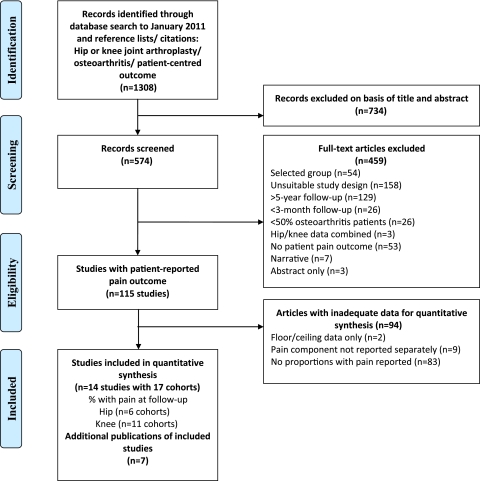
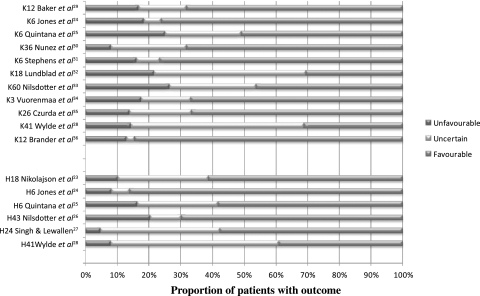
Background: Total hip or knee replacement is highly successful when judged by prosthesis-related outcomes. However, some people experience long-term pain. Objectives: To review published studies in representative populations with total hip or knee replacement for the treatment of osteoarthritis reporting proportions of people by pain intensity. Data sources: MEDLINE and EMBASE databases searched to January 2011 with no language restrictions. Citations of key articles in ISI Web of Science and reference lists were checked. Study eligibility criteria, participants and interventions: Prospective studies of consecutive, unselected osteoarthritis patients representative of the primary total hip or knee replacement population, with intensities of patient-centred pain measured after 3 months to 5-year follow-up. Study appraisal and synthesis methods: Two authors screened titles and abstracts. Data extracted by one author were checked independently against original articles by a second. For each study, the authors summarised the proportions of people with different severities of pain in the operated joint. Results: Searches identified 1308 articles of which 115 reported patient-centred pain outcomes. Fourteen articles describing 17 cohorts (6 with hip and 11 with knee replacement) presented appropriate data on pain intensity. The proportion of people with an unfavourable long-term pain outcome in studies ranged from about 7% to 23% after hip and 10% to 34% after knee replacement. In the best quality studies, an unfavourable pain outcome was reported in 9% or more of patients after hip and about 20% of patients after knee replacement. Limitations: Other studies reported mean values of pain outcomes. These and routine clinical studies are potential sources of relevant data. Conclusions and implications of key findings: After hip and knee replacement, a significant proportion of people have painful joints. There is an urgent need to improve general awareness of this possibility and to address determinants of good and bad outcomes.
Overview
The claims and statistics of this paper haven’t been checked yet.
Free: it reads the open-access text and checks the first 5 claims that cite a source we can check. Create a free account to check every claim.
Integrity signals
Registry
Cites
Statistics
Figures
Verification
Claims the paper makes
The claims and statistics of this paper haven’t been checked yet.
Free: it reads the open-access text and checks the first 5 claims that cite a source we can check. Create a free account to check every claim.
Self-check
Percentages, sums and reported differences re-computed from the paper’s own numbers.
The self-check needs the paper’s full text.
Citations
Cites
Cochrane Handbook for Systematic Reviews of Interventions: Cochrane Book Series
(2008) · doi:10.1002/9780470712184 · Cited by 25,048 · cited 1×
“Although contact with authors is a well-recognised approach in systematic reviews, 21 a survey of review authors indicated that many systematic reviewers do not do so because of poor response rates and variability in the quality of information collected this way.”
BackgroundDermyshi, E., Wang, Y., Yan, C., Hong, W., Qiu, G., Gong, X., & Zhang, T. (2017) · Neonatology · doi:10.1159/000454668 · Cited by 24,451
Meta-analysis of Observational Studies in Epidemiology<SUBTITLE>A Proposal for Reporting</SUBTITLE>
Stroup, D. F. (2000) · JAMA · doi:10.1001/jama.283.15.2008 · Cited by 20,623
Projections of Primary and Revision Hip and Knee Arthroplasty in the United States from 2005 to 2030
Kurtz, S., Ong, K., Lau, E., Mowat, F., & Halpern, M. (2007) · The Journal of Bone and Joint Surgery-American Volume · doi:10.2106/00004623-200704000-00012 · Cited by 8,698 · cited 1×
“In the USA in 2006, the estimated numbers of hospital discharges after total hip or knee replacement procedures were 231 000 and 542 000, respectively,(2) with demand predicted to increase substantially.(3) Total hip or knee replacement is highly successful when judged by prosthesis-related outcomes, such as the radio…”
BackgroundPatient Satisfaction after Total Knee Arthroplasty: Who is Satisfied and Who is Not?
Bourne, R. B., Chesworth, B. M., Davis, A. M., Mahomed, N. N., & Charron, K. D. J. (2010) · Clinical Orthopaedics & Related Research · doi:10.1007/s11999-009-1119-9 · Cited by 2,569
Ethgen, O., Bruyère, O., Richy, F., Dardennes, C., & Reginster, J.-Y. (2004) · The Journal of Bone & Joint Surgery · doi:10.2106/00004623-200405000-00012 · Cited by 1,800
National Hospital Discharge Survey, 1988: Archival Version
United States Department of Health and Human Services. National Center for Health Statistics (1991) · ICPSR Data Holdings · doi:10.3886/icpsr09521 · Cited by 1,310
Baker, P. N., van der Meulen, J. H., Lewsey, J., & Gregg, P. J. (2007) · The Journal of Bone and Joint Surgery. British volume · doi:10.1302/0301-620x.89b7.19091 · Cited by 975
Patients' Perception of Hospital Care in the United States
Jha, A. K., Orav, E. J., Zheng, J., & Epstein, A. M. (2008) · New England Journal of Medicine · doi:10.1056/nejmsa0804116 · Cited by 886 · cited 1×
“In the USA, the importance of patient-reported outcomes in assessing quality of care is recognised, 11 and in England, following the report of Lord Darzi, 12 information is routinely collected after elective surgery.”
BackgroundWylde, V., Hewlett, S., Learmonth, I. D., & Dieppe, P. (2011) · Pain · doi:10.1016/j.pain.2010.11.023 · Cited by 686 · cited 1×
“A cohort of 1394 consecutive total knee replacement patients were followed up prospectively by Wylde and colleagues 28 for a median of 41 months.”
MethodSelf-citation
Research works printed but not linked: 3
- 1. Long-term pain after total hip or knee replacement on August 11, 2021 by guest. Protected by copyright. http://bmjopen.bmj.com/ BMJ Open: first published as 10.1136/bmjopen-2011-000435 on 22 February 2012. Downloaded from REFERENCES
- 4. Long-term pain after total hip or knee replacement on August 11, 2021 by guest. Protected by copyright. http://bmjopen.bmj.com/ BMJ Open: first published as 10.1136/bmjopen-2011-000435 on 22 February 2012. Downloaded from
- 14. Darzi A. High Quality Care for All: NHS Next Stage Review Final Report. London: Department of Health, 2008.
Cited by
Items 301–400 of 1,001
Tarragó, M. D. G. L., Deitos, A., Brietzke, A. P., Torres, I. L. D. S., Stefani, L. P. C., Fregni, F., & Caumo, W. (2015) · Pain Medicine · doi:10.1111/pme.12930 · Cited by 41
Riddle, D. L., Golladay, G. J., Hayes, A., & Ghomrawi, H. (2016) · The Knee · doi:10.1016/j.knee.2016.11.009 · Cited by 34
“TKA?; and (3) Do pain and walking expectations predict TKA utilization in people who underwent TKA 1–3 years later?”
BackgroundKumar, P., Hoydonckx, Y., & Bhatia, A. (2019) · Current Pain and Headache Reports · doi:10.1007/s11916-019-0775-z · Cited by 34
Chen, W., Sun, J.-N., Hu, Z.-H., Zhang, Y., Chen, X., & Feng, S. (2021) · Aging Clinical and Experimental Research · doi:10.1007/s40520-021-01870-7 · Cited by 38
“Conservative treatment is ineffective, and TKA is sched- uled 4.”
BackgroundInfluentialPatient appropriateness for total knee arthroplasty and predicted probability of a good outcome
HAWKER, G. A., Bohm, É., Dunbar, M., Faris, P., Jones, C. A., Noseworthy, T., Ravi, B., Woodhouse, L. J., & Marshall, D. A. (2023) · RMD Open · doi:10.1136/rmdopen-2022-002808 · Cited by 38
Fontalis, A., Kayani, B., Haddad, I. C., Donovan, C., Tahmassebi, J. E., & Haddad, F. S. (2023) · The Journal of Arthroplasty · doi:10.1016/j.arth.2023.04.045 · Cited by 34
STING mediates experimental osteoarthritis and mechanical allodynia in mouse
Shin, Y., Cho, D., Kim, S. K., & Chun, J. (2023) · Arthritis Research & Therapy · doi:10.1186/s13075-023-03075-x · Cited by 36
Severe arthritis predicts greater improvements in function following total knee arthroplasty
Stone, O. D., Duckworth, A. D., Curran, D. P., Ballantyne, J. A., & Brenkel, I. J. (2015) · Knee Surgery Sports Traumatology Arthroscopy · doi:10.1007/s00167-015-3806-2 · Cited by 34
Perioperative Periprosthetic Fractures Associated With Primary Total Hip Arthroplasty
Park, K. J., Menendez, M. E., & Barnes, C. L. (2016) · The Journal of Arthroplasty · doi:10.1016/j.arth.2016.08.034 · Cited by 34
Typical Pain Patterns in Unhappy Patients After Total Knee Arthroplasty
Mathis, D. T., Hauser, A., Iordache, E., Amsler, F., & Hirschmann, M. T. (2021) · The Journal of Arthroplasty · doi:10.1016/j.arth.2021.01.040 · Cited by 37
Stair Ambulation Biomechanics Following Total Knee Arthroplasty: A Systematic Review
Standifird, T. W., Cates, H. E., & Zhang, S. (2014) · The Journal of Arthroplasty · doi:10.1016/j.arth.2014.03.040 · Cited by 33
“However, despite reports of significant reductions of knee pain and improvements in knee physical functions, some studies have shown that somepatients still have long-termpain followingTKA [6].”
BackgroundThe characterisation of unexplained pain after knee replacement
Phillips, J., Hopwood, B., Stroud, R., Dieppe, P. A., & Toms, A. D. (2017) · British Journal of Pain · doi:10.1177/2049463717719774 · Cited by 38
Self-citationWylde, V., Dennis, J. A., Gooberman‐Hill, R., & Beswick, A. D. (2018) · BMJ Open · doi:10.1136/bmjopen-2017-020368 · Cited by 33
“In representative populations, unfavourable long-term pain outcomes have been reported by 10%–34% of patients with TKR.(2) Patients with bothersome pain at ≥3 months after surgery are disappointed with their outcome.”
Self-citationFrimpong, E., McVeigh, J. A., van der Jagt, D. R., Mokete, L., Kaoje, Y. S., Tikly, M., & Meiring, R. M. (2018) · Knee Surgery Sports Traumatology Arthroscopy · doi:10.1007/s00167-018-4987-2 · Cited by 37
Prevalence of Persistent Pain after Total Knee Arthroplasty and the Impact of Neuropathic Pain
Hasegawa, M., Tone, S., Naito, Y., Wakabayashi, H., & Sudo, A. (2018) · The Journal of Knee Surgery · doi:10.1055/s-0038-1675415 · Cited by 33
Perruccio, A. V., Fitzpatrick, J., Power, J. D., Gandhi, R., Rampersaud, Y. R., Mahomed, N. N., Davey, J. R., Syed, K., Veillette, C., & Badley, E. M. (2019) · Arthritis Care & Research · doi:10.1002/acr.24002 · Cited by 36
“Despite the overall effectiveness of TKA, 20–30% of patients who undergo TKA report minimal improvement or ongoing pain postsurgery (3,4).”
BackgroundLongitudinal Trajectories of Pain and Function Improvement Following Total Knee Replacement
Yang, H. Y., Losina, E., Lange, J. K., Katz, J. N., & Collins, J. E. (2019) · ACR Open Rheumatology · doi:10.1002/acr2.1041 · Cited by 33
Larsen, J. B., Mogensen, L., Arendt‐Nielsen, L., & Madeleine, P. (2020) · BMC Sports Science Medicine and Rehabilitation · doi:10.1186/s13102-020-0157-1 · Cited by 34
Weerasekera, A., Morrissey, E. J., Kim, M., Saha, A., Lin, Y., Alshelh, Z., Torrado-Carvajal, Á., Albrecht, D., Akeju, O., Kwon, Y., et al. (2021) · Pain · doi:10.1097/j.pain.0000000000002198 · Cited by 37
“successful TKA, that is, after the pathology in the joint has presumably been resolved.(15,92) Altogether, the weak association”
BackgroundLeiß, F., Götz, J. S., Maderbacher, G., Meyer, M., Reinhard, J., Zeman, F., Grifka, J. K., & Greimel, F. (2021) · Journal of Clinical Medicine · doi:10.3390/jcm10040621 · Cited by 35
“In a systematic review, post-operative pain was reported in 9% of patients after THA in the follow-up [31].”
BackgroundWang, C., Chen, Z., & Ma, X. (2019) · International Journal of Surgery · doi:10.1016/j.ijsu.2019.10.012 · Cited by 33
Brennan, G. P., Fritz, J. M., Houck, L. T. C. K. M., & Hunter, S. J. (2014) · The Journal of Arthroplasty · doi:10.1016/j.arth.2014.12.013 · Cited by 32
“A recent systematic review reported 20% of patients continue to report persistent pain that limits function at assessments at least 6 months post-surgery [8].”
BackgroundKemp, M. A., Metcalfe, A. J., Sayers, A. E., Wylde, V., Eldridge, J. D., & Blom, A. W. (2018) · The Knee · doi:10.1016/j.knee.2018.05.007 · Cited by 35
Self-citationWeight control in older adults with knee osteoarthritis: a qualitative study
Yeh, W., Tsai, Y., Hsu, K., Chen, D. W.-C., Wang, J., & Chen, C.-Y. (2020) · BMC Musculoskeletal Disorders · doi:10.1186/s12891-020-03480-2 · Cited by 34
“Moreover, evidence indicates that receiving joint-replacement surgery may not relieve all symptoms for some OA patients [16, 17], and 18% of patients are discontented with the outcome [18].”
BackgroundPacheco‐Brousseau, L., Charette, M., Poitras, S., & Stacey, D. (2021) · Osteoarthritis and Cartilage · doi:10.1016/j.joca.2021.07.006 · Cited by 34
Cole, S., Kolovos, S., Soni, A., Delmestri, A., Sanchez-Santos, M. T., Judge, A., Arden, N., Beswick, A. D., Wylde, V., Gooberman‐Hill, R., et al. (2022) · BMJ Open · doi:10.1136/bmjopen-2021-058044 · Cited by 33
Self-citationCriteria used when deciding on eligibility for total knee arthroplasty — Between thinking and doing
Skou, S. T., Roos, E. M., Laursen, M. B., Rathleff, M. S., Arendt‐Nielsen, L., Simonsen, O. H., & Rasmussen, S. (2015) · The Knee · doi:10.1016/j.knee.2015.08.012 · Cited by 32
“However, a systematic 64 review have demonstrated that 20% undergoing TKA experience only small or no improvements in 65 pain [4], and more knee pain is known to be related to lower patient satisfaction [5].”
BackgroundPsychological Traits in Patients Waiting for Total Knee Arthroplasty. A Cross-sectional Study
Khatib, Y., Jenkin, D., Naylor, J., & Harris, I. A. (2016) · The Journal of Arthroplasty · doi:10.1016/j.arth.2016.01.053 · Cited by 36
Availability of Total Knee Arthroplasty Implants for Metal Hypersensitivity Patients
Ajwani, S. H., & Charalambous, C. P. (2016) · Knee Surgery and Related Research · doi:10.5792/ksrr.16.018 · Cited by 32
Singh, J. A., & Lewallen, D. G. (2013) · Rheumatology · doi:10.1093/rheumatology/kes416 · Cited by 32
Petersen, K. K., Kilic, K., Hertel, E., Sejersgaard‐Jacobsen, T. H., Jørgensen, M. K., Troelsen, A., Arendt‐Nielsen, L., & Larsen, D. B. (2023) · PAIN Reports · doi:10.1097/pr9.0000000000001079 · Cited by 39
“12,17,57 Methods to identify patients in risk of a poor response before these treatments could improve health care and potentially lead to personalized pain medicine.”
Mouchti, S., Whitehouse, M. R., Sayers, A. E., Hunt, L. P., MacGregor, A. J., & Blom, A. W. (2018) · Journal of Bone and Joint Surgery · doi:10.2106/jbjs.18.00120 · Cited by 31
Self-citationYoulden, D. J., Dannaway, J., & Enke, O. (2019) · ANZ Journal of Surgery · doi:10.1111/ans.15343 · Cited by 32
Laferton, J. A. C., Oeltjen, L., Neubauer, K., Ebert, D. D., & Münder, T. (2020) · Health Psychology Review · doi:10.1080/17437199.2020.1854051 · Cited by 34
“…https://doi.org/10.1080/17437199.2020.1854051 of THA and 10–34% of TKA patients do not benefit from these procedures in the way in which surgeons would predict from a medical point of view (Beswick et al., 2012; Brokelman et al., 2003; Dunbar et al., 2013; Judge et al., 2010; Wylde et al., 2007).”
BackgroundInfluentialKlasan, A., Rice, D. A., Kluger, M. T., Borotkanics, R., McNair, P. J., Lewis, G. N., & Young, S. W. (2022) · The Bone & Joint Journal · doi:10.1302/0301-620x.104b11.bjj-2022-0630.r1 · Cited by 31
Tang, S., Jin, Y., Hou, Y., Wang, W., Zhang, J., Zhu, W., Zhang, W. Y., Gu, X., & Ma, Z. (2023) · The Journal of Arthroplasty · doi:10.1016/j.arth.2023.04.055 · Cited by 36
Giordano, R., Ghafouri, B., Arendt‐Nielsen, L., & Petersen, K. K. (2023) · Pain · doi:10.1097/j.pain.0000000000003042 · Cited by 36
Martín‐Fernández, J., García‐Maroto, R., Sánchez-Jiménez, F. J., Bau-González, A., Valencia-García, H., Gutiérrez-Teira, B., Arenaza, J. C., García‐Pérez, L., Linertová, R., & Bilbao, A. (2017) · Health and Quality of Life Outcomes · doi:10.1186/s12955-017-0761-2 · Cited by 33
Costello, C. A., Hu, T., Liu, M., Zhang, W., Furey, A. J., Fan, Z., Rahman, P., Randell, E. W., & Zhai, G. (2019) · Journal of Orthopaedic Research® · doi:10.1002/jor.24529 · Cited by 34
“Estimates of the exact proportion of patients who do not meet the MCID vary; however, a systematic review including 14 studies indicates that as many as one‐third of patients who undergo TKR and one‐quarter of patients who undergo THR reported unfavorable long‐term pain outcome.(6) Developing tools to identify patient…”
BackgroundRobotic trials in arthroplasty surgery
Khatri, C., Metcalfe, A. J., Wall, P. D. H., Underwood, M. R., Haddad, F. S., & Davis, E. T. (2024) · The Bone & Joint Journal · doi:10.1302/0301-620x.106b2.bjj-2023-0711.r1 · Cited by 30
Surgical Treatment of Osteoarthritis Pain Related to Subchondral Bone Defects or Bone Marrow Lesions
Cohen, S. B., & Sharkey, P. F. (2012) · Techniques in Knee Surgery · doi:10.1097/btk.0b013e318276e1fe · Cited by 30
“Results of these techniques vary as studies have shown recurrent pain from osteotomy 5 to 7 years after surgery, and an average 20% dissatisfaction rate from total knee replacement.(10) In addition, the postoperative rehabilitation, surgical morbidity, and complication rates have rendered both osteotomy and TKA less p…”
BackgroundShim, J., McLernon, D. J., Hamilton, D. F., Simpson, H., Beasley, M., & Macfarlane, G. J. (2018) · Rheumatology Advances in Practice · doi:10.1093/rap/rky021 · Cited by 32
Nassar, I., Fahey, J., & Mitchell, D. (2020) · ANZ Journal of Surgery · doi:10.1111/ans.15663 · Cited by 30
“Similarly, in a systematic review, approximately 20% of patients reported moderate to severe knee or hip pain following joint surgery.(2) Acute postoperative pain hinders the rapid recovery and rehabilitation process, and the severity of acute postoperative pain is considered a contributing factor for chronic pain aft…”
BackgroundInfluentialIdentifying Patterns and Predictors of Prescription Opioid Use After Total Joint Arthroplasty
Chaudhary, M. A., Dalton, M. K., Koehlmoos, T. P., Schoenfeld, A. J., & Goralnick, E. (2021) · Military Medicine · doi:10.1093/milmed/usaa573 · Cited by 31
Management of Refractory Pain After Total Joint Replacement
Willinger, M. L., Heimroth, J. C., Sodhi, N., Garbarino, L. J., Gold, P. A., Rasquinha, V. J., Danoff, J. R., & Boraiah, S. (2021) · Current Pain and Headache Reports · doi:10.1007/s11916-021-00956-1 · Cited by 36
Steffens, D., Karunaratne, S., McBride, K. E., Gupta, S., Horsley, M., & Fritsch, B. A. (2021) · International Orthopaedics · doi:10.1007/s00264-021-05203-1 · Cited by 30
“1 3 to early revision, and up to 20% of patients reporting dissatisfaction with their TKA [4, 5].”
BackgroundYoshida, Y., Ikuno, K., & Shomoto, K. (2017) · Archives of Physical Medicine and Rehabilitation · doi:10.1016/j.apmr.2017.05.005 · Cited by 37
Mills, K. A. G., Falchi, B., Duckett, C., & Naylor, J. (2018) · Physiotherapy · doi:10.1016/j.physio.2018.04.003 · Cited by 31
Risk factors of chronic postoperative pain after total knee arthroplasty: a systematic review
Li, J., Guan, T., Zhai, Y., & Zhang, Y. (2024) · Journal of Orthopaedic Surgery and Research · doi:10.1186/s13018-024-04778-w · Cited by 37
“Previous studies showed that the percentage of patients with unfavorable long-term pain outcomes ranged 10% ∼ to 34% following knee replacement [3].”
BackgroundInfluentialSkou, S. T., Roos, E. M., Laursen, M. B., Rathleff, M. S., Arendt‐Nielsen, L., Simonsen, O. H., & Rasmussen, S. (2012) · BMC Musculoskeletal Disorders · doi:10.1186/1471-2474-13-67 · Cited by 34
“Around 20 % of patients who receive a TKA experience little or no improvement in pain, disability and/or quality of life; a substantial proportion even develops chronic pain following TKA [22,23].”
BackgroundEffect of Acetabular Component Positioning on Functional Outcomes in Primary Total Hip Arthroplasty
Goyal, P., Lau, A. C. K., Naudie, D. D. R., Teeter, M. G., Lanting, B. A., & Howard, J. L. (2016) · The Journal of Arthroplasty · doi:10.1016/j.arth.2016.08.024 · Cited by 32
Marino, J., Scuderi, G. R., Dowling, O., Farquhar, R., Freycinet, B., & Overdyk, F. J. (2018) · The Journal of Arthroplasty · doi:10.1016/j.arth.2018.11.025 · Cited by 29
Dennis, J. A., Wylde, V., Gooberman‐Hill, R., Blom, A. W., & Beswick, A. D. (2020) · BMJ Open · doi:10.1136/bmjopen-2019-033248 · Cited by 30
Self-citationØhrn, F., Gøthesen, Ø. J., Lygre, S. H. L., Peng, Y., Lian, Ø. B., Lewis, P. L., Furnes, O. N., & Röhrl, S. M. (2020) · Clinical Orthopaedics and Related Research · doi:10.1097/corr.0000000000001120 · Cited by 29
“Still, not all patients achieve the desired result of decreased pain and increased function, and in some studies, as many as 20% are dissatisfied [3, 4].”
BackgroundThe Impact of Depression, Personality, and Mental Health on Outcomes of Total Knee Arthroplasty
Moghtadaei, M., Yeganeh, A., Hosseinzadeh, N., Khazanchin, A., Moaiedfar, M., Jolfaei, A. G., & Nasiri, S. (2020) · Clinics in Orthopedic Surgery · doi:10.4055/cios19148 · Cited by 29
“Educational status was evaluated by asking the patients to state their highest level of educational achievement and was grouped into 3 categories: (1) illiterate, (2) primary school education, (3) high school education or higher.”
BackgroundNuclear Medicine Scans in Total Joint Replacement
Pinski, J. M., Chen, A. F., Estok, D. M., & Kavolus, J. J. (2020) · Journal of Bone and Joint Surgery · doi:10.2106/jbjs.20.00301 · Cited by 29
Goncalves, S. V., Gowler, P. R. W., Woodhams, S. G., Turnbull, J., Hathway, G. J., & Chapman, V. (2022) · Neuropharmacology · doi:10.1016/j.neuropharm.2022.109075 · Cited by 31
“and 20% of knee replacement patients (Beswick et al., 2012)], further supporting the presence of central mechanisms.”
Wylde, V., Bertram, W., Beswick, A. D., Blom, A. W., Bruce, J., Burston, A., Dennis, J. A., Garfield, K., Howells, N., Lane, J. A., et al. (2018) · Trials · doi:10.1186/s13063-018-2516-8 · Cited by 30
“Despite good outcomes for many, a systematic review found that approximately 20% of patients report chronic pain after total knee replacement [3].”
BackgroundSelf-citationGreimel, F., Maderbacher, G., Baier, C., Keshmiri, A., Schwarz, T., Zeman, F., Meißner, W., Grifka, J. K., & Benditz, A. (2018) · Scientific Reports · doi:10.1038/s41598-018-22146-7 · Cited by 29
“1038/s41598-018-22146-7 Patients were divided into five groups: (1) general, (2) spinal, and the combination of (3) spinal and peripheral, (4) general and spinal and (5) general and peripheral anesthesia.”
BackgroundDarrow, M., Shaw, B., Darrow, B., & Wisz, S. (2018) · Clinical Medicine Insights Case Reports · doi:10.1177/1179547618791574 · Cited by 30
Skou, S. T., Roos, E. M., Laursen, M. B., Arendt‐Nielsen, L., Rasmussen, S., Simonsen, O. H., Ibsen, R., Larsen, A. T., & Kjellberg, J. (2020) · BMJ Open · doi:10.1136/bmjopen-2019-033495 · Cited by 32
EZH2 inhibition reduces cartilage loss and functional impairment related to osteoarthritis
Allas, L., Brochard, S., Rochoux, Q., Ribet, J., Dujarrier, C., Veyssière, A., Aury‐Landas, J., Grard, O., Leclercq, S., Vivien, D., et al. (2020) · Scientific Reports · doi:10.1038/s41598-020-76724-9 · Cited by 32
Sorel, J. C., Overvliet, G. M., Gademan, M. G. J., den Haan, C., Honig, A., & Poolman, R. W. (2020) · Rheumatology International · doi:10.1007/s00296-020-04644-y · Cited by 28
Chau, Y., Roux, C. H., Gonzalez, J., Breuil, V., de Dompsure, R. B., Fontas, É., Rudel, A., & Sédat, J. (2023) · Journal of Vascular and Interventional Radiology · doi:10.1016/j.jvir.2023.06.026 · Cited by 28
The painful knee after total knee arthroplasty: evaluation and management.
Momoli, A., Giaretta, S., Modena, M., & Micheloni, G. M. (2017) · Acta bio-medica : Atenei Parmensis · doi:10.23750/abm.v88i2-s.6515 · Cited by 36
“Nevertheless many patients suffer for different symptoms after this procedure (3) and several studies indicate a dissatisfaction rate of 15-30% after 3 months, in particular due to lack of functional improvement and persistent pain (4,5).”
BackgroundBriones-Cantero, M., Fernández‐de‐las‐Peñas, C., Lluch‐Girbés, E., Osuna‐Pérez, M. C., Navarro‐Santana, M. J., Plaza‐Manzano, G., & Martín‐Casas, P. (2020) · Pain Medicine · doi:10.1093/pm/pnaa103 · Cited by 29
Aso, K., Ikeuchi, M., Takaya, S., Sugimura, N., Izumi, M., Wada, H., Okanoue, Y., & Dan, J. (2021) · Modern Rheumatology · doi:10.1080/14397595.2020.1859709 · Cited by 33
“This result is relatively lower than previous reports [2, 13] from western countries.”
ResultChronic hip pain in adults: Current knowledge and future prospective
Ahuja, V., Thapa, D., Patial, S., Chander, A., & Ahuja, A. (2020) · Journal of Anaesthesiology Clinical Pharmacology · doi:10.4103/joacp.joacp_170_19 · Cited by 35
“But total hip arthroplasty is also associated with concerning failure rate (5%– 15%),[41,44] significant cost, and persistent postsurgical pain (7%–28%).[45,46] Nerves supplying the hip joint like articular branches of the obturator nerve, articular branches of the femoral nerve, articular branches of the sciatic, and…”
BackgroundRienstra, W., Blikman, T., Dijkstra, B., Stewart, R. E., Zijlstra, W. P., van Raaij, T. M., ten Hagen, A., Bulstra, S. K., Stevens, M. J., & van den Akker‐Scheek, I. (2021) · BMJ Open · doi:10.1136/bmjopen-2021-052944 · Cited by 30
Li, R., Du, J., Yang, K. Y., Wang, X., & Wang, W. (2022) · Journal of Orthopaedic Surgery and Research · doi:10.1186/s13018-022-02946-4 · Cited by 28
“As a golden standard, TKA is credible; however, the dissatisfaction ratio of patients has hit approximately twenty percent [2, 3].”
BackgroundPester, B., Wilson, J. M., Yoon, J., Lazaridou, A., Schreiber, K. L., Cornelius, M. C., Campbell, C. M., Smith, M. T., Haythornthwaite, J. A., Edwards, R. R., et al. (2022) · Pain Medicine · doi:10.1093/pm/pnac183 · Cited by 28
Paterson, K. L., Sosdian, L., Hinman, R. S., Wrigley, T. V., Kasza, J., Dowsey, M. M., Choong, P., & Bennell, K. L. (2017) · Clinical Biomechanics · doi:10.1016/j.clinbiomech.2017.08.013 · Cited by 32
Wylde, V., Howells, N., Bertram, W., Moore, A. J., Bruce, J., McCabe, C., Blom, A. W., Dennis, J. A., Burston, A., & Gooberman‐Hill, R. (2018) · Trials · doi:10.1186/s13063-017-2391-8 · Cited by 30
Self-citationUusalo, P., Jätinvuori, H., Löyttyniemi, E., Kosola, J. A., & Saari, T. I. (2019) · The Journal of Arthroplasty · doi:10.1016/j.arth.2018.12.036 · Cited by 38
Cooper, G., Bayram, J. M., & Clement, N. D. (2024) · Scientific Reports · doi:10.1038/s41598-024-58050-6 · Cited by 31
“In alignment with current evidence, post-operative meta-analysis identified a decreased gain in joint specific outcomes and HRQOL at 6 to 12 months post-operatively for primary elective TKR patients, relative to THR 58 .”
BackgroundResultFalck, R. S., Best, J. R., LI, L. C., Chan, P., Feehan, L. M., & Liu-Ambrose, T. Y. L. (2018) · BMC Musculoskeletal Disorders · doi:10.1186/s12891-018-2369-z · Cited by 29
Spinal NF-kB upregulation contributes to hyperalgesia in a rat model of advanced osteoarthritis
Li, Y., Yang, Y., Guo, J., Guo, X., Feng, Z., & Zhao, X. (2020) · Molecular Pain · doi:10.1177/1744806920905691 · Cited by 29
“total knee replacement (TKR) surgery.(5) Chronic advanced OA pain causes severe physical and mental suffering.”
BackgroundGwynne-Jones, J. H., Wilson, R., Wong, J., Abbott, J. H., & Gwynne‐Jones, D. (2020) · The Journal of Arthroplasty · doi:10.1016/j.arth.2020.01.086 · Cited by 27
Nishigami, T., Tanaka, S., Mibu, A., Imai, R., & Wand, B. M. (2021) · Scientific Reports · doi:10.1038/s41598-021-85307-1 · Cited by 31
Understanding Preferences for Disease‐Modifying Drugs in Osteoarthritis
Fraenkel, L., Suter, L. G., Cunningham, C. E., & HAWKER, G. A. (2014) · Arthritis Care & Research · doi:10.1002/acr.22280 · Cited by 27
“Total knee arthroplasty is highly effective, however, recent data have shown that up to 20% of patients are dissatisfied after the procedure (5-8), and not all patients want (9), or are eligible for surgery.”
Short-Term Outcomes in Treatment of Knee Osteoarthritis With 4 Bone Marrow Concentrate Injections
Shaw, B., Darrow, M., & Derian, A. (2018) · Clinical Medicine Insights Arthritis and Musculoskeletal Disorders · doi:10.1177/1179544118781080 · Cited by 27
Lenguerrand, E., Artz, N. J., Marques, E. M. R., Sanderson, E., Lewis, K., Murray, J. R. D., Parwez, T., Bertram, W., Beswick, A. D., Burston, A., et al. (2020) · Arthritis Care & Research · doi:10.1002/acr.23909 · Cited by 33
“Any type of additional PT 3 43 (48) 47 (52) 90 (50) 6 17 (19) 15 (16) 32 (18) 12 8 (9) 8 (9) 16 (9) Any 46 (52) 53 (58) 99 (55) 1:1 hospital PT 3 33 (37) 29 (32) 62 (34) 6 9 (10) 8 (9) 17 (9) 12 5 (6) 4 (4) 9 (5) Any 36 (40) 35 (38) 71 (39) PT at general practice surgery 3 9 (10) 12 (13) 21 (12) 6 3 (3) 2 (2) 5 (3) 12…”
Self-citationTian, Y., Tang, S., Sun, S., Zhang, Y., Chen, L., Xia, D., Wang, Y., Ren, L., & Huang, Y. (2020) · Journal of Orthopaedic Surgery and Research · doi:10.1186/s13018-020-1577-z · Cited by 27
Rajamäki, T. J., Puolakka, P. A., Hietaharju, A., Moilanen, T. P. S., & Jämsen, E. (2020) · Arthritis Research & Therapy · doi:10.1186/s13075-020-02184-1 · Cited by 30
Losina, E., & Katz, J. N. (2013) · Arthritis & Rheumatism · doi:10.1002/art.37903 · Cited by 31
Development of the “Treatment beliefs in knee and hip OsteoArthritis (TOA)” questionnaire
Selten, E. M. H., Vriezekolk, J. E., Schers, H., Nijhof, M. W., van der Laan, W. H., van der Meulen‐Dilling, R. G., Geenen, R., & van den Ende, C. H. M. (2017) · BMC Musculoskeletal Disorders · doi:10.1186/s12891-017-1762-3 · Cited by 26
“good outcomes and pain reduction [9, 10] and may lead to higher health care costs.”
BackgroundNeuromodulation of the Dorsal Root Ganglion for Chronic Postsurgical Pain
Antony, A. B., Schultheis, B. C., Jolly, S. M., Bates, D., Hunter, C., & Levy, R. M. (2019) · Pain Medicine · doi:10.1093/pm/pnz072 · Cited by 27
“There are >700,000 total knee replacement (TKR) surgeries and revisions each year in the United States, and the incidence of NPP can be as high as 34% [32,34].”
BackgroundLynskey, S. J., Ling, F., Greenberg, A. M., Penny‐Dimri, J. C., & Sutherland, A. G. (2020) · The Surgeon · doi:10.1016/j.surge.2020.02.007 · Cited by 29
Cronström, A., Nero, H., Lohmander, S. L., & Dahlberg, L. (2020) · Osteoarthritis and Cartilage Open · doi:10.1016/j.ocarto.2020.100056 · Cited by 29
“Moreover, approximately one in five patients is not satisfied with the outcomes after knee replacement surgery [8,9].”
BackgroundHafkamp, F. J., Vries, J. D., Gosens, T., & Oudsten, B. L. D. (2020) · The Journal of Arthroplasty · doi:10.1016/j.arth.2020.07.071 · Cited by 29
van der Sluis, G., Jager, J., Punt, I. M., Goldbohm, R. A., Meinders, M. J., Bimmel, R., van Meeteren, N. L. U., der Sanden, M. W. G. N., & Hoogeboom, T. J. (2021) · International Journal of Environmental Research and Public Health · doi:10.3390/ijerph18020668 · Cited by 29
“, (2012) reported that up to 34% of people with TKR experienced moderate to severe chronic pain, even after full recovery should have been achieved [5].”
BackgroundKim, M. S., Koh, I. J., Sung, Y. G., Park, D. C., Na, J. W., & In, Y. (2021) · Journal of Clinical Medicine · doi:10.3390/jcm10132809 · Cited by 30
“However, about 20% of patients who undergo TKA are not satisfied with the results of the operation due to persistent pain [2,3].”
BackgroundRiddle, D. L., Macfarlane, G. J., Hamilton, D. F., Beasley, M., & Dumenci, L. (2021) · Osteoarthritis and Cartilage · doi:10.1016/j.joca.2021.09.004 · Cited by 27
Depression and anxiety after total joint replacement among older adults: a meta-analysis
Scott, J. E., Mathias, J. L., & Kneebone, A. C. (2015) · Aging & Mental Health · doi:10.1080/13607863.2015.1072801 · Cited by 30
Greimel, F., Dittrich, G., Schwarz, T., Kaiser, M., Krieg, B., Zeman, F., Grifka, J. K., & Benditz, A. (2018) · Archives of Orthopaedic and Trauma Surgery · doi:10.1007/s00402-018-3014-x · Cited by 29
Kosy, J. D., Middleton, S., Bradley, B., Stroud, R., Phillips, J., & Toms, A. D. (2018) · The Journal of Knee Surgery · doi:10.1055/s-0037-1615746 · Cited by 26
Paredes, A. C., Pinto, J. M., Almeida, A., & Pinto, P. R. (2021) · Pain · doi:10.1097/j.pain.0000000000002385 · Cited by 30
Chang, J., Fu, M., Cao, P., Ding, C., & Wang, D. (2022) · Patient Preference and Adherence · doi:10.2147/ppa.s357632 · Cited by 34
“However, several studies have reported that not all patients are satisfied with the outcome after surgery, with 15–20% of patients reporting persistent pain, poor joint function, and postoperative infection, among other complications, warranting a need for revision surgery.(17) Previous studies of TKA have focused pri…”
BackgroundCarozzo, S., Vatrano, M., Coschignano, F., Battaglia, R., Calabrò, R. S., Pignolo, L., Contrada, M., Tonin, P., Cerasa, A., & Demeco, A. (2022) · Journal of Clinical Medicine · doi:10.3390/jcm11247355 · Cited by 25
“Additionally, only 50% of patients report a significant improvement in their knee arthritis severity using the Western Ontario and McMaster Universities OA Index (WOMAC)score [6], and 10–34% claim that their post-operative pain ratings did not improve [7].”
MethodMarques, E. M. R., Blom, A. W., Lenguerrand, E., Wylde, V., & Noble, S. (2015) · BMC Medicine · doi:10.1186/s12916-015-0389-1 · Cited by 26
“Evidence suggests that around 20 % of patients with TKR and 10 % of patients with THR report an unfavourable pain outcome at between 3 months and 5 years post-operative [3].”
BackgroundSelf-citation
Metadata
- Authors
- Beswick, A. D., Wylde, V., Gooberman-Hill, R., Blom, A., & Dieppe, P.
- Affiliations
- University of Bristol (GB)
- Peninsula College of Medicine and Dentistry (GB)
- Corresponding author
- Beswick, Andrew David
- Venue
- BMJ Open
- Publisher
- BMJ
- Published
- 2012
- Volume
- 2
- Issue
- 1
- Pages
- e000435
- ISSN
- 2044-6055 (ISSN-L)
- PMC
- PMC3289991
- OpenAlex
- W1990076794
- Semantic Scholar
- 45725c70617c53d281ed2739cb53edc2494a7ac5
- Cited by
- 1,450
- References
- 56
- Citations by year
- 2026: 85 · 2025: 134 · 2024: 141 · 2023: 162 · 2022: 136 · 2021: 147 · 2020: 136 · 2019: 106 · 2018: 103 · 2017: 74 · 2016: 72 · 2015: 58 · 2014: 44 · 2013: 42 · 2012: 8
- FWCI
- 9.41
- Type
- journal article
- Language
- en
- Open access
- gold
- doi.org
- Licence
- cc-by-nc
- Locations
- BMJ Open (publishedVersion, cc-by-nc)
- PubMed Central (publishedVersion, cc-by-nc)
- PubMed (publishedVersion)
- Bristol Research (University of Bristol) (submittedVersion)
- Funders
- National Institute for Health and Care Research (RP-PG-0407-10070)
- Programme Grants for Applied Research
- Topics
- Health Sciences › Medicine › Surgery › Total Knee Arthroplasty Outcomes
- Health Sciences › Medicine › Surgery › Orthopaedic implants and arthroplasty
- Health Sciences › Medicine › Anesthesiology and Pain Medicine › Anesthesia and Pain Management
- Keywords
- total hip arthroplasty, total knee arthroplasty, osteoarthritis, chronic pain, postoperative pain, pain intensity, patient-centered outcomes, joint replacement outcomes, unselected patients
About these checks
Registry, retraction, Cites and statistics results are computed, not judged, with one exception: a printed reference that no index lists is read once by a model before it counts as a citation error. Claims are extracted by a model and kept only when their quote appears verbatim in the text; each cited source is then checked, with a model’s help, for whether it says what the claim relies on. Those verdicts can be wrong — read the claim’s quote and the cited source before relying on one.
Statistics and arithmetic are recomputed, not judged.
Confidence bands are shown only for fields calibrated on our annotated test set. None is calibrated yet, so no band is shown.
What counts as a claim ›How we measure confidence ›How we check this ›
Are you an author, or do you see a problem with this page? Request a review
Data sources
Bibliographic data: Semantic Scholar, OpenAlex, Crossref.
Contains information from the Semantic Scholar Academic Graph Datasets, made available under the ODC Attribution License (ODC-BY 1.0).
Semantic Scholar’s data is described in: Kinney, R., et al. (2023). The Semantic Scholar Open Data Platform. arXiv:2301.10140.
