

What proportion of patients report long-term pain after total hip or knee replacement for osteoarthritis? A systematic review of prospective studies in unselected patients
Open accessThe DOI matches its Crossref record; 56 of the 56 references it cites were found in a registry or an index.
Abstract
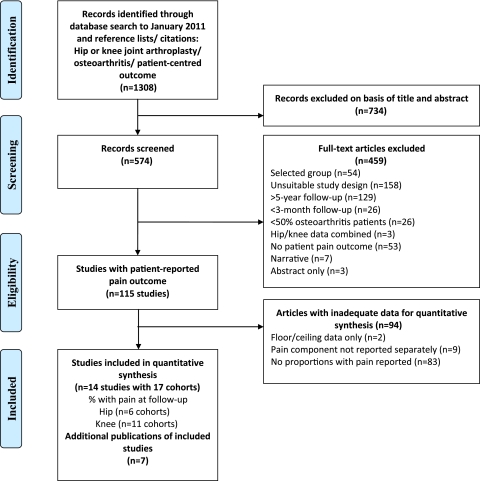
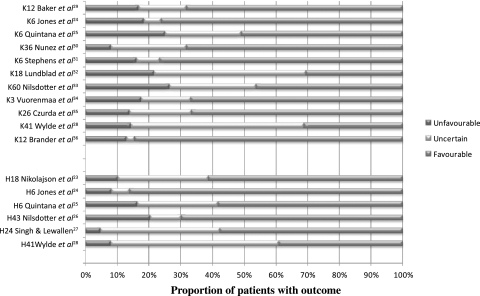
Background: Total hip or knee replacement is highly successful when judged by prosthesis-related outcomes. However, some people experience long-term pain. Objectives: To review published studies in representative populations with total hip or knee replacement for the treatment of osteoarthritis reporting proportions of people by pain intensity. Data sources: MEDLINE and EMBASE databases searched to January 2011 with no language restrictions. Citations of key articles in ISI Web of Science and reference lists were checked. Study eligibility criteria, participants and interventions: Prospective studies of consecutive, unselected osteoarthritis patients representative of the primary total hip or knee replacement population, with intensities of patient-centred pain measured after 3 months to 5-year follow-up. Study appraisal and synthesis methods: Two authors screened titles and abstracts. Data extracted by one author were checked independently against original articles by a second. For each study, the authors summarised the proportions of people with different severities of pain in the operated joint. Results: Searches identified 1308 articles of which 115 reported patient-centred pain outcomes. Fourteen articles describing 17 cohorts (6 with hip and 11 with knee replacement) presented appropriate data on pain intensity. The proportion of people with an unfavourable long-term pain outcome in studies ranged from about 7% to 23% after hip and 10% to 34% after knee replacement. In the best quality studies, an unfavourable pain outcome was reported in 9% or more of patients after hip and about 20% of patients after knee replacement. Limitations: Other studies reported mean values of pain outcomes. These and routine clinical studies are potential sources of relevant data. Conclusions and implications of key findings: After hip and knee replacement, a significant proportion of people have painful joints. There is an urgent need to improve general awareness of this possibility and to address determinants of good and bad outcomes.
Overview
The claims and statistics of this paper haven’t been checked yet.
Free: it reads the open-access text and checks the first 5 claims that cite a source we can check. Create a free account to check every claim.
Integrity signals
Registry
Cites
Statistics
Figures
Verification
Claims the paper makes
The claims and statistics of this paper haven’t been checked yet.
Free: it reads the open-access text and checks the first 5 claims that cite a source we can check. Create a free account to check every claim.
Self-check
Percentages, sums and reported differences re-computed from the paper’s own numbers.
The self-check needs the paper’s full text.
Citations
Cites
Cochrane Handbook for Systematic Reviews of Interventions: Cochrane Book Series
(2008) · doi:10.1002/9780470712184 · Cited by 25,048 · cited 1×
“Although contact with authors is a well-recognised approach in systematic reviews, 21 a survey of review authors indicated that many systematic reviewers do not do so because of poor response rates and variability in the quality of information collected this way.”
BackgroundDermyshi, E., Wang, Y., Yan, C., Hong, W., Qiu, G., Gong, X., & Zhang, T. (2017) · Neonatology · doi:10.1159/000454668 · Cited by 24,451
Meta-analysis of Observational Studies in Epidemiology<SUBTITLE>A Proposal for Reporting</SUBTITLE>
Stroup, D. F. (2000) · JAMA · doi:10.1001/jama.283.15.2008 · Cited by 20,623
Projections of Primary and Revision Hip and Knee Arthroplasty in the United States from 2005 to 2030
Kurtz, S., Ong, K., Lau, E., Mowat, F., & Halpern, M. (2007) · The Journal of Bone and Joint Surgery-American Volume · doi:10.2106/00004623-200704000-00012 · Cited by 8,698 · cited 1×
“In the USA in 2006, the estimated numbers of hospital discharges after total hip or knee replacement procedures were 231 000 and 542 000, respectively,(2) with demand predicted to increase substantially.(3) Total hip or knee replacement is highly successful when judged by prosthesis-related outcomes, such as the radio…”
BackgroundPatient Satisfaction after Total Knee Arthroplasty: Who is Satisfied and Who is Not?
Bourne, R. B., Chesworth, B. M., Davis, A. M., Mahomed, N. N., & Charron, K. D. J. (2010) · Clinical Orthopaedics & Related Research · doi:10.1007/s11999-009-1119-9 · Cited by 2,569
Ethgen, O., Bruyère, O., Richy, F., Dardennes, C., & Reginster, J.-Y. (2004) · The Journal of Bone & Joint Surgery · doi:10.2106/00004623-200405000-00012 · Cited by 1,800
National Hospital Discharge Survey, 1988: Archival Version
United States Department of Health and Human Services. National Center for Health Statistics (1991) · ICPSR Data Holdings · doi:10.3886/icpsr09521 · Cited by 1,310
Baker, P. N., van der Meulen, J. H., Lewsey, J., & Gregg, P. J. (2007) · The Journal of Bone and Joint Surgery. British volume · doi:10.1302/0301-620x.89b7.19091 · Cited by 975
Patients' Perception of Hospital Care in the United States
Jha, A. K., Orav, E. J., Zheng, J., & Epstein, A. M. (2008) · New England Journal of Medicine · doi:10.1056/nejmsa0804116 · Cited by 886 · cited 1×
“In the USA, the importance of patient-reported outcomes in assessing quality of care is recognised, 11 and in England, following the report of Lord Darzi, 12 information is routinely collected after elective surgery.”
BackgroundWylde, V., Hewlett, S., Learmonth, I. D., & Dieppe, P. (2011) · Pain · doi:10.1016/j.pain.2010.11.023 · Cited by 686 · cited 1×
“A cohort of 1394 consecutive total knee replacement patients were followed up prospectively by Wylde and colleagues 28 for a median of 41 months.”
MethodSelf-citation
Research works printed but not linked: 3
- 1. Long-term pain after total hip or knee replacement on August 11, 2021 by guest. Protected by copyright. http://bmjopen.bmj.com/ BMJ Open: first published as 10.1136/bmjopen-2011-000435 on 22 February 2012. Downloaded from REFERENCES
- 4. Long-term pain after total hip or knee replacement on August 11, 2021 by guest. Protected by copyright. http://bmjopen.bmj.com/ BMJ Open: first published as 10.1136/bmjopen-2011-000435 on 22 February 2012. Downloaded from
- 14. Darzi A. High Quality Care for All: NHS Next Stage Review Final Report. London: Department of Health, 2008.
Cited by
Items 601–700 of 1,001
Ge, L., Wang, J., Fang, H., Wang, Y., Shen, Z., & Cai, G. (2025) · Journal of Experimental Orthopaedics · doi:10.1002/jeo2.70185 · Cited by 14
“While TKA e ff ectively alleviates symptoms and enhances knee function [10, 16, 37, 50], studies have shown that the level of physical activity does not usually improve signi fi cantly after surgery [12, 33].”
Nyland, J. A., Wera, J., Henzman, C., Miller, T. W., Jakob, R., & Caborn, D. N. M. (2014) · Physical Therapy in Sport · doi:10.1016/j.ptsp.2014.07.003 · Cited by 14
Zhong, S., Huang, H. M., Xie, J., Zhao, L., Song, X., Chen, Y., & Xiao, L. (2019) · BMJ Open · doi:10.1136/bmjopen-2018-026084 · Cited by 13
“A recent study showed that 10%–34% and 7%–23% of patients reported severe pain after TKA and total hip arthroplasty, respectively, which indicates that TKA patients are more likely to develop PPSP.(2) Multimodal analgesia has been used for 20 years and it is considered to be the most effective strategy for PPSP.”
BackgroundOka, T., Ono, R., Tsuboi, Y., Wada, O., Kaga, T., Tamura, Y., Yamamoto, Y., & Mizuno, K. (2019) · Clinical Rheumatology · doi:10.1007/s10067-019-04849-y · Cited by 16
Güler, T., Sivas, F., Yurdakul, F. G., Çelen, E., Utkan, A., Başkan, B., Bodur, H., & Özkurt, B. (2019) · Turkish Journal of Physical Medicine and Rehabilitation · doi:10.5606/tftrd.2019.4695 · Cited by 14
“pain postoperatively.[5] The high rate of unfavorable”
Bhatia, S., Harikesavan, K., & Venkatesan, P. (2020) · Journal of Arthroscopy and Joint Surgery · doi:10.1016/j.jajs.2020.09.005 · Cited by 13
Wylde, V., Sanderson, E., Peters, T. J., Bertram, W., Howells, N., Bruce, J., Eccleston, C., & Gooberman‐Hill, R. (2020) · Arthritis Care & Research · doi:10.1002/acr.24516 · Cited by 13
“pain in the months and years after surgery (3).”
BackgroundSelf-citationKhalid, S., Mohammad, H. R., Gooberman‐Hill, R., Garriga, C., Pinedo‐Villanueva, R., Arden, N., Price, A. J., Wylde, V., Peters, T. J., Blom, A. W., et al. (2021) · Osteoarthritis and Cartilage Open · doi:10.1016/j.ocarto.2021.100139 · Cited by 15
“Although many patients report good outcomes after knee replacement, best quality studies indicate that around 20% of patients experience chronic post-surgical pain [5], defined as pain persisting three months or longer after surgery.”
BackgroundSelf-citationKawasaki, M., Muramatsu, S., Namba, H., Izumi, M., Ikeuchi, M., Yaogawa, S., Morio, K., & Ushida, T. (2021) · International Journal of Hyperthermia · doi:10.1080/02656736.2021.1955982 · Cited by 14
Belba, A. G., Vanneste, T., van Kuijk, S. M. J., Mesotten, D., Mestrum, R., Boxem, K. V., Lantschoot, A. V., Bellemans, J., de Velde, M. V., & Zundert, J. H. M. V. (2021) · Pain Practice · doi:10.1111/papr.13088 · Cited by 14
Desai, M. J., Bentley, A., & Keck, W. A. (2022) · BMC Musculoskeletal Disorders · doi:10.1186/s12891-022-05445-z · Cited by 13
Lee, T.-H., Liu, C.-H., Chen, P.-C., Liou, T., Escorpizo, R. S., & Chen, H. (2022) · PLoS ONE · doi:10.1371/journal.pone.0269296 · Cited by 15
Yeung, S., Kim, H. K., Carleton, A. D., Munro, J. T., Ferguson, D., Monk, A. P., Zhang, J., Besier, T. F., & Fernandez, J. (2022) · Computer Methods and Programs in Biomedicine · doi:10.1016/j.cmpb.2022.107063 · Cited by 15
Chapman, K. B., Tupper, C. J., Vissers, K. C. P., van Helmond, N., & Yousef, T. A. (2022) · Pain Practice · doi:10.1111/papr.13180 · Cited by 13
Barroso, J., Branco, P., Pinto-Ramos, J., Vigotsky, A. D., Reis, A. M., Schnitzer, T. J., Galhardo, V., & Apkarian, A. V. (2023) · Pain · doi:10.1097/j.pain.0000000000002932 · Cited by 18
Petersen, K. K., Lunn, T. H., Husted, H., Hansen, L. T., Simonsen, O. H., Laursen, M. B., Kehlet, H., & Arendt‐Nielsen, L. (2018) · Scandinavian Journal of Pain · doi:10.1515/sjpain-2018-0027 · Cited by 19
“is expected to be increased by approximately 700% in the US [2], and as the incidence of chronic postoperative pain following TKA remains at approximately 20% [3], one of the main challenges is to reduce postoperative pain.”
BackgroundInfluentialDoes intervention improve the outcomes of patients after total knee replacement surgery?
Reslan, H. A., Youssef, S. M., Saghieh, S., Sharara, E. S., & Badr, L. K. (2018) · International Journal of Orthopaedic and Trauma Nursing · doi:10.1016/j.ijotn.2018.08.001 · Cited by 13
Coronado, R. A., Patel, A., McKernan, L. C., Wegener, S. T., & Archer, K. R. (2019) · Journal of Applied Biobehavioral Research · doi:10.1111/jabr.12159 · Cited by 16
Grant, S., Blom, A. W., Craddock, I. J., Whitehouse, M. R., & Gooberman‐Hill, R. (2019) · BMJ Open · doi:10.1136/bmjopen-2019-032205 · Cited by 15
Self-citationTran, T., Castello, J., Taylor, S. E., Hardidge, A. J., Cannizzaro, S., George, J., & Elliott, R. A. (2020) · Journal of the American Academy of Orthopaedic Surgeons · doi:10.5435/jaaos-d-19-00789 · Cited by 13
Parachutes and Preferences — A Trial of Knee Replacement
Katz, J. N. (2015) · New England Journal of Medicine · doi:10.1056/nejme1510312 · Cited by 14
Searching for the rainbow: biomarkers relevant for chronic postsurgical pain
Pogatzki-Zahn, E. M., & Segelcke, D. (2023) · Pain · doi:10.1097/j.pain.0000000000003043 · Cited by 16
Gonzalez, F. F., Barone, A., Palaniappan, R., Russo, R., Gasparini, G., Metsavaht, L. F., Chahla, J. A., & Familiari, F. (2025) · Osteoarthritis and Cartilage Open · doi:10.1016/j.ocarto.2025.100674 · Cited by 12
Garval, M., Runge, C., Holm, C., Mikkelsen, L. R., Pedersen, A. R., Vestergaard, T. A. B., & Skou, S. T. (2023) · The Knee · doi:10.1016/j.knee.2023.08.013 · Cited by 12
Peptidoglycan in osteoarthritis synovial tissue is associated with joint inflammation
Holub, M., Wahhab, A., Rouse, J. R., Danner, R., Hackner, L. G., Duris, C. B., McClune, M. E., Dressler, J. M., Strle, K., Jutras, B. L., et al. (2024) · Arthritis Research & Therapy · doi:10.1186/s13075-024-03293-x · Cited by 13
“Knee replacement surgery is associated with improvements in pain and function [5], but 15–20% of patients have continued pain and dissatisfaction following surgery [6, 7].”
BackgroundInfluentialDescription of pain associated with persistent postoperative pain after total knee arthroplasty
Koga, M., Maeda, A., & Morioka, S. (2024) · Scientific Reports · doi:10.1038/s41598-024-66122-w · Cited by 18
Wang, Q., Lee, R., Hunter, S., Zhu, A., & Chan, S. W. (2024) · JMIR mhealth and uhealth · doi:10.2196/57635 · Cited by 15
Vetrone, F., Saglietti, F., Galimberti, A., Pezzi, A., Umbrello, M., Cuttone, G., Via, L. L., Vetrugno, L., Deana, C., & Girombelli, A. (2025) · Journal of Clinical Medicine · doi:10.3390/jcm14030984 · Cited by 12
“It is well-documented that the incidence of both acute and chronic postoperative pain following THA is high, which can often hinder early physical rehabilitation [7–9].”
InfluentialGranville, M., Berti, A., & Jacobson, R. E. (2017) · Cureus · doi:10.7759/cureus.1855 · Cited by 12
Skrejborg, P., Petersen, K. K., Kold, S., Kappel, A., Pedersen, C., Østgaard, S. E., Simonsen, O. H., & Arendt‐Nielsen, L. (2020) · Clinical Journal of Pain · doi:10.1097/ajp.0000000000000907 · Cited by 15
Giordano, R., Petersen, K. K., Santoro, M., Pazzaglia, C., Simonsen, O. H., Valeriani, M., & Arendt‐Nielsen, L. (2021) · Scandinavian Journal of Pain · doi:10.1515/sjpain-2021-0069 · Cited by 13
Frydendal, T., Christensen, R., Mechlenburg, I., Mikkelsen, L. R., Overgaard, S., & Ingwersen, K. G. (2021) · BMJ Open · doi:10.1136/bmjopen-2021-051392 · Cited by 16
Sellevold, V. B., Steindal, S. A., Lindberg, M. F., Småstuen, M. C., Aamodt, A., Lerdal, A., & Dihle, A. (2022) · Clinical Orthopaedics and Related Research · doi:10.1097/corr.0000000000002183 · Cited by 12
“However, approximately 20% of patients experience persistent postsurgical pain 12 months or more after TKA [2, 7, 25].”
BackgroundResultInfluentialvan Brug, H. E., Nelissen, R. G. H. H., Lijfering, W. M., van Steenbergen, L. N., Rosendaal, F. R., Dorp, E. L. A. V., Bouvy, M. L., Dahan, A., & Gademan, M. G. J. (2022) · Acta Orthopaedica · doi:10.2340/17453674.2022.3993 · Cited by 12
“Furthermore, arthroplasty patients may continue to require pain medication as 9–20% perceive persistent pain after surgery (9).”
BackgroundImagama, T., Okazaki, T., Matsuki, Y., Kaneoka, T., Kawakami, T., Yamazaki, K., & Sakai, T. (2023) · Journal of Orthopaedic Surgery and Research · doi:10.1186/s13018-023-04175-9 · Cited by 12
“However, a systematic review reported that 7–23% of patients had residual moderate or worse pain after THA [2], which is a major problem related to post-operative patient satisfaction.”
BackgroundLosina, E., Collins, J. E., Daigle, M. E., Donnell‐Fink, L. A., Prokopetz, J. J. Z., Strnad, D., Lerner, V., Rome, B. N., Ghazinouri, R., Skoniecki, D., et al. (2013) · BMC Musculoskeletal Disorders · doi:10.1186/1471-2474-14-290 · Cited by 12
“A growing body of evidence suggests that approximately 20% of TKA recipients have persistent knee pain following surgery [2].”
New possible pathways in improving outcome and patient satisfaction after TKA.
Delport, H., Sloten, J. V., & Bellemans, J. (2013) · PubMed · Cited by 12
Kuriyama, S., Ishikawa, M., Nakamura, S., Furu, M., Ito, H., & Matsuda, S. (2016) · The Journal of Arthroplasty · doi:10.1016/j.arth.2016.07.012 · Cited by 12
Physical activity levels after hip and knee joint replacement surgery: an observational study
Hawke, L. J., Shields, N., Dowsey, M. M., Choong, P., & Taylor, N. F. (2018) · Clinical Rheumatology · doi:10.1007/s10067-018-4317-6 · Cited by 19
van den Boom, L. G. H., Brouwer, R. W., van den Akker‐Scheek, I., Reininga, I. H. F., de Vries, A. J., Bierma‐Zeinstra, S., & van Raay, J. J. A. M. (2019) · The Journal of Knee Surgery · doi:10.1055/s-0039-1693023 · Cited by 12
The Effects of Continued Rehabilitation After Primary Knee Replacement
Radulović, T. N., Lazovic, M. P., Jandrić, S., Bućma, T., Dragičević-Cvjetković, D., & Manojlovic, A. (2016) · Medical Archives · doi:10.5455/medarh.2016.131-134 · Cited by 12
Ma, T., Pei, J., Shi, F., Wang, X., Li, C., Ye, B., & Zhao, J. (2022) · Psychology Health & Medicine · doi:10.1080/13548506.2022.2162934 · Cited by 12
“4–36% of patients report persistent pain within 1 year after TKA (Baker et al., 2007; Beswick et al., 2012; Puolakka et al., 2010).”
BackgroundInfluentialJoseph, G. B., McCulloch, C. E., Nevitt, M. C., Gersing, A. S., Schwaiger, B. J., Kretzschmar, M., Heilmeier, U., & Link, T. M. (2017) · Journal of Magnetic Resonance Imaging · doi:10.1002/jmri.25662 · Cited by 13
“These diagnostic markers could potentially reduce the current rising rates of total knee replacement (TKR)(1) and may be especially beneficial to the 10–34% of individuals who have unfavorable long-term pain outcomes following TKR.(2) Magnetic resonance imaging (MRI) is ideal for noninvasive assessment of early OA, as…”
BackgroundPatterns of Depressive Symptoms Before and After Surgery for Osteoarthritis: A Descriptive Study
Power, J. D., Kudesia, P., Nadeem, A., Perruccio, A. V., Sundararajan, K., Mahomed, N. N., Rampersaud, Y. R., & Gandhi, R. (2019) · ACR Open Rheumatology · doi:10.1002/acr2.1031 · Cited by 12
Pinto, P. R., McIntyre, T., Araujo-Soares, V., Ferro, R., & Almeida, A. (2014) · Pain Physician · doi:10.36076/ppj.2014/17/515 · Cited by 13
Cohen, S. P., Mishra, P., Wallace, M., Sellers, A. B., Veizi, E., & Hurley, R. W. (2023) · Regional Anesthesia & Pain Medicine · doi:10.1136/rapm-2022-104319 · Cited by 12
Wylde, V., Marques, E., Artz, N., Blom, A., & Gooberman-Hill, R. (2014) · Trials · doi:10.1186/1745-6215-15-176 · Cited by 12
“The operation is often successful at providing pain relief, most commonly caused by osteoarthritis; however, approximately 10% of patients experience chronic pain in their replaced hip [2].”
BackgroundSelf-citationEdelstein, A. I., Orsi, A. D., Plaskos, C., Coffey, S., & Suleiman, L. I. (2024) · Arthroplasty · doi:10.1186/s42836-024-00231-9 · Cited by 11
“The persistence of suboptimal satisfaction outcomes among patients following total knee arthroplasty (TKA) has led to the development of innovative surgical techniques [1–3].”
BackgroundInfluentialNúñez‐Cortés, R., López, L., López‐Bueno, R., Cuenca‐Martínez, F., Suso‐Martí, L., Silvestre, A. M., Casaña, J., Cruz‐Montecinos, C., Andersen, L. L., & Calatayud, J. (2023) · American Journal of Physical Medicine & Rehabilitation · doi:10.1097/phm.0000000000002366 · Cited by 13
The tourniquet's effects on skeletal muscle during total knee arthroplasty
Johnsen, M., Mousavizadeh, R., Scott, A., Havik, S., Husby, V. S., Winther, S. B., Husby, O. S., & Lian, Ø. B. (2024) · Journal of Orthopaedic Research® · doi:10.1002/jor.25859 · Cited by 11
“3,4 In Norway, 61% of the primary TKAs were performed using tourniquet in 2021.”
Aleksić, M., Selaković, I., Vujadinović, S. T., Kadija, M., Milovanović, D., Meißner, W., Zaslansky, R., Sreckovic, S. D., & Dubljanin-Raspopović, E. (2024) · Geriatrics · doi:10.3390/geriatrics9040103 · Cited by 11
Laigaard, J., Karlsen, A. P. H., Maagaard, M., Lunn, T. H., Mathiesen, O., & Overgaard, S. (2024) · Anesthesia & Analgesia · doi:10.1213/ane.0000000000007246 · Cited by 14
Mathieu, S., Courties, A., Mathy, C., Perrot, S., Alliot-Launois, F., Moumbe, S., Foulquier, N., Sellam, J., & Geenen, R. (2025) · Osteoarthritis and Cartilage Open · doi:10.1016/j.ocarto.2025.100590 · Cited by 11
The causal role of brain circuits in osteoarthritis pain
Barroso, J., Branco, P., & Apkarian, A. V. (2025) · Nature Reviews Rheumatology · doi:10.1038/s41584-025-01234-9 · Cited by 18
“Although TJR is seen as highly successful in alleviating pain and improving function, 7–23% of all patients with hip OA and 10–34% of patients with knee OA report moderate-to-severe pain between 3 months and 5 years after surgery 63 .”
Croppi, C., Delaigue, F., Guinebertière, V., Devriese, F., Bizot, P., Descamps, J., Nizard, R., & Bouché, P.-A. (2025) · Bone & Joint Open · doi:10.1302/2633-1462.67.bjo-2024-0270.r1 · Cited by 11
Long-term survival of the uncemented Balgrist total hip replacement cup
Gallo, J., Lošťák, J., & Langová, K. (2013) · International Orthopaedics · doi:10.1007/s00264-013-1946-x · Cited by 11
“Finally, the end-points in survival analyses were re-operation and/or radiographic failure although some patients may not be satisfied with the outcome, and suffer from pain and walking problems earlier [2].”
BackgroundPrevitali, D., Frattura, G. D. L., Filardo, G., Delcogliano, M., Deabate, L., & Candrian, C. (2019) · Knee Surgery Sports Traumatology Arthroscopy · doi:10.1007/s00167-019-05700-2 · Cited by 11
Hegarty, P., Walls, A. F., O’Brien, S., Gamble, B., Cusick, L. A., & Beverland, D. (2019) · The Journal of Arthroplasty · doi:10.1016/j.arth.2019.09.029 · Cited by 11
Azam, M. Q., Goyal, T., Paul, S., Yadav, A. K., & Govil, N. (2021) · European Journal of Orthopaedic Surgery & Traumatology · doi:10.1007/s00590-021-03031-y · Cited by 11
Rantasalo, M., Palanne, R. A., Vakkuri, A., Olkkola, K. T., Madanat, R., & Skants, N. (2021) · Journal of Bone and Joint Surgery · doi:10.2106/jbjs.20.02080 · Cited by 11
Weigl, M. B., Pietzner, J., Kisch, R., Paulus, A. C., Jansson, V., & Grill, E. (2021) · BMC Musculoskeletal Disorders · doi:10.1186/s12891-021-04465-5 · Cited by 12
“However, approximately 20% of patients still complain of pain one year after surgery [6, 7] and are not satisfied with the results.”
BackgroundA narrative review of mesenchymal stem cells effect on osteoarthritis
Shegos, C. J., & Chaudhry, A. F. (2021) · Annals of Joint · doi:10.21037/aoj-21-16 · Cited by 11
“A systemic review of prospective studies of patients undergoing total hip or TKA reported unfavorable long-term pain outcomes ranging from 7% to 23% after hip and 10% to 30% after knee replacements (9).”
Broggi, M. S., Oladeji, P. O., Whittingslow, D. C., Wilson, J. M., Bradbury, T. L., Erens, G. A., & Guild, G. N. (2021) · The Journal of Arthroplasty · doi:10.1016/j.arth.2021.11.006 · Cited by 11
Moore, A. J., Wylde, V., Bruce, J., Howells, N., Bertram, W., Eccleston, C., & Gooberman‐Hill, R. (2022) · BMC Musculoskeletal Disorders · doi:10.1186/s12891-022-05423-5 · Cited by 13
Self-citationLi, J., Zhang, Y., Gao, X., Dou, T., & Li, X. (2022) · Arthroplasty · doi:10.1186/s42836-022-00135-6 · Cited by 11
“However, approximately 20% of patients do not have satisfactory knee function following TKA [2].”
BackgroundInfluentialAnderson, A. M., Drew, B. T., Antcliff, D., Redmond, A. C., Comer, C. M., Smith, T. O., & McHugh, G. A. (2022) · Systematic Reviews · doi:10.1186/s13643-022-02019-x · Cited by 13
“Poor TKR outcomes are a frequent problem, with estimates suggesting approximately 20% of patients experience persistent pain post-TKR [12].”
BackgroundShaikh, W., Miller, S., McCormick, Z. L., Patel, P., Teramoto, M., & Walega, D. R. (2023) · Pain Medicine · doi:10.1093/pm/pnad022 · Cited by 11
Prodromidis, A. D., Chloros, G. D., Thivaios, G. C., Sutton, P. M., Pandit, H. G., Giannoudis, P. V., & Charalambous, C. P. (2023) · The Bone & Joint Journal · doi:10.1302/0301-620x.105b6.bjj-2022-0675.r1 · Cited by 11
Owens, M. A., Mun, C. J., Hamilton, K. R., Hughes, A. J., Campbell, C. M., Edwards, R. R., & Smith, M. T. (2023) · Pain Medicine · doi:10.1093/pm/pnad106 · Cited by 12
Outcomes of isolated patellofemoral arthroplasty
Cardenas, C., & Wascher, D. C. (2023) · Journal of ISAKOS Joint Disorders & Orthopaedic Sports Medicine · doi:10.1016/j.jisako.2023.11.005 · Cited by 11
“Persistent anterior knee pain is not an uncommon complication after TKA [8].”
BackgroundLondhe, S. B., Rudraraju, R. T., Shah, R. V., Desouza, C., Shetty, V. D., Khan, F. S., & Bajwa, S. (2024) · Journal of Robotic Surgery · doi:10.1007/s11701-024-01823-y · Cited by 11
Putting the baby back in the bathwater: the interpretation of randomised trials in surgery
Gandhi, R., Perruccio, A. V., Kakar, S., & Haddad, F. S. (2015) · The Bone & Joint Journal · doi:10.1302/0301-620x.97b11.36981 · Cited by 11
Wylde, V., Artz, N. J., Marques, E. M. R., Lenguerrand, E., Dixon, S., Beswick, A. D., Burston, A., Murray, J. R. D., Parwez, T., Blom, A. W., et al. (2016) · Trials · doi:10.1186/s13063-016-1418-x · Cited by 14
“Although the operation is effective for many patients, a considerable proportion of patients experience long-term pain and functional limitations after surgery [3, 4].”
BackgroundSelf-citationUrits, I., Osman, M., Orhurhu, V., Viswanath, O., Kaye, A. D., Simopoulos, T. T., & Yazdi, C. (2019) · Pain and Therapy · doi:10.1007/s40122-019-00136-5 · Cited by 11
“Though eventual mechanical failure may be anticipated with long-term activity and normal use, as many as 28% of patients who undergo an uncomplicated TKA and postoperative course may experience persistent moderate to severe knee pain [1, 2].”
BackgroundIrmola, T., Kangas, J., Eskelinen, A. P., Niemeläinen, M., Huhtala, H., Mattila, V. M., & Moilanen, T. P. S. (2019) · BMC Musculoskeletal Disorders · doi:10.1186/s12891-019-2830-7 · Cited by 12
Yin, H., Chen, B., & Xu, Z. (2022) · Journal of Healthcare Engineering · doi:10.1155/2022/4287555 · Cited by 11
“Although the rehabilitation for a remarkable number of patients remains tough and extends, many of them never experience the effectiveness post operation [2, 3].”
BackgroundPainful total hip arthroplasty
Pietrzak, J. R. T., Donaldson, M. J., Kayani, B., & Haddad, F. S. (2017) · Orthopaedics and Trauma · doi:10.1016/j.mporth.2017.11.008 · Cited by 11
Reezigt, R. R., Beetsma, A. J., Köke, A. J. A., Hobbelen, H. J. S. M., & Reneman, M. F. (2022) · Physiotherapy Theory and Practice · doi:10.1080/09593985.2022.2144562 · Cited by 10
“Given that physical therapists are frontline clinicians in pain management (Beswick et al., 2012; Edgerton et al., 2019; Kehlet, Jensen, and Woolf, 2006; Pendergast, Kliethermes, Freburger, and Duffy, 2012; Van Gorp et al., 2015; Wylde et al., 2015), preregistra-tion undergraduate courses must…”
BackgroundGoncalves, S. V., Hathway, G. J., Woodhams, S. G., Chapman, V., & Bast, T. (2023) · Journal of Pain · doi:10.1016/j.jpain.2023.04.002 · Cited by 14
Chen, R., Jin, Y., Jin, Z., Gong, Y., Chen, L., Su, H., & Liu, X. (2024) · Journal of Orthopaedic Surgery and Research · doi:10.1186/s13018-024-04798-6 · Cited by 17
“It has been shown that 10–34% of patients experience severe pain after TKA, often leading to chronic pain if not effectively treated [25, 26].”
BackgroundShakeri, M., Aminian, A., Mokhtari, K., Bahaeddini, M. R., Tabrizian, P., Farahani, N., Nabavi, N., & Hashemi, M. (2024) · Pathology - Research and Practice · doi:10.1016/j.prp.2024.155446 · Cited by 10
Terradas‐Monllor, M., Beltrán-Alacreu, H., Ochandorena‐Acha, M., García-Oltra, E., Aliaga-Orduña, F., & Hernández‐Hermoso, J. A. (2025) · Journal of Clinical Medicine · doi:10.3390/jcm14010268 · Cited by 11
Svinøy, O.-E., Nordbø, J. V., Pripp, A. H., Risberg, M. A., Bergland, A., Borgen, P. O., & Hilde, G. (2025) · BMC Musculoskeletal Disorders · doi:10.1186/s12891-025-08468-4 · Cited by 13
“Patients’ expectations for THR are high [10], and long-term expectations are often fulfilled [11–13], but not always [14].”
Vetrone, F., Marelli, S., Galimberti, A., Umbrello, M., Gotti, M., Pezzi, A., & Girombelli, A. (2025) · Journal of Personalized Medicine · doi:10.3390/jpm15060230 · Cited by 10
Burgess, L. C., Swain, I., Taylor, P. N., & Wainwright, T. W. (2019) · Current Physical Medicine and Rehabilitation Reports · doi:10.1007/s40141-019-00225-8 · Cited by 11
Holmes, M., Perelló-Nieto, M., Song, H., Tonkin, E. L., Grant, S., & Flach, P. A. (2020) · Journal of Healthcare Informatics Research · doi:10.1007/s41666-020-00072-6 · Cited by 14
Palanisami, D. R., Reddy, D. A., Huggi, V., Rajasekaran, R. B., Rajkumar, N., & Rajasekaran, S. (2020) · The Journal of Arthroplasty · doi:10.1016/j.arth.2020.07.029 · Cited by 10
Loef, M., Gademan, M. G. J., Latijnhouwers, D. A. J. M., Kroon, H. M. J. A., Kaptijn, H. H., Marijnissen, W. J. C. M., Nelissen, R. G. H. H., Vlieland, T. P. M. V., & Kloppenburg, M. (2021) · The Journal of Arthroplasty · doi:10.1016/j.arth.2021.03.050 · Cited by 10
“A systematic review has reported that 10%-34% of patients are not satisfied after knee replacement surgery [25].”
BackgroundPatellar tilt does not affect patient reported outcomes after modern total knee arthroplasty
Naveen, N. B., Deckard, E. R., Ziemba-Davis, M. M., Hanson, L. F., Warth, L. C., & Meneghini, R. M. (2021) · The Knee · doi:10.1016/j.knee.2021.11.013 · Cited by 10
Bouché, P., Aubert, T., Corsia, S., Gaujac, N., Strat, V. L., Mouton, A., & Marmor, S. (2022) · Knee Surgery Sports Traumatology Arthroscopy · doi:10.1007/s00167-022-07252-4 · Cited by 10
“Since then, the question of a neutral TKA alignment has become essential, and new alignment objectives have been defined [8, 9, 18] to improve the functional results of TKAs, which remain disappointing for nearly 20% of patients [4].”
BackgroundCesare, M., Meneghetti, E., Zambon, D., Elena, N., Agueci, A., & Melchior, C. (2022) · Journal of Clinical Orthopaedics and Trauma · doi:10.1016/j.jcot.2022.102084 · Cited by 11
Sellevold, V. B., Olsen, U., Lindberg, M. F., Steindal, S. A., Aamodt, A., Lerdal, A., & Dihle, A. (2023) · BMC Musculoskeletal Disorders · doi:10.1186/s12891-023-06423-9 · Cited by 11
Nishimoto, J., Shiraoka, T., Takiguchi, Y., Imamura, R., Hirohama, K., Tanaka, S., Inoue, Y., Obayashi, S., & Tanaka, R. (2023) · The Knee · doi:10.1016/j.knee.2023.04.015 · Cited by 10
Gooberman‐Hill, R., Wylde, V., Bertram, W., Moore, A. J., Pinedo‐Villanueva, R., Sanderson, E., Dennis, J. A., Harris, S. R. S., Judge, A., Noble, S., et al. (2023) · Programme Grants for Applied Research · doi:10.3310/watm4500 · Cited by 12
Self-citationAdipose Tissue-Derived Therapies for Osteoarthritis: Multifaceted Mechanisms and Clinical Prospects
Zhang, H., Felthaus, O., & Prantl, L. (2025) · Cells · doi:10.3390/cells14090669 · Cited by 11
“However, these treatments do not reverse the pathophysiology of OA and are often limited by drug addiction, complications (e.g., gastrointestinal or cardiovascular issues), and risks of invasive procedures [8–10].”
Are We Subluxating Knees in Total Knee Arthroplasty? A Cadaveric Investigation
Maderbacher, G., Keshmiri, A., Springorum, H.-R., Greimel, F., Grifka, J. K., & Baier, C. (2016) · The Journal of Arthroplasty · doi:10.1016/j.arth.2016.06.001 · Cited by 10
Primary Total Hip Arthroplasty: Equivalent Outcomes in Low and High Functioning Patients
Alzahrani, M. M., Smith, K. M., Tanzer, D., & Tänzer, M. (2016) · Journal of the American Academy of Orthopaedic Surgeons · doi:10.5435/jaaos-d-16-00361 · Cited by 10
Niederstrasser, N. G., & Cook, S. (2020) · Journal of Pain · doi:10.1016/j.jpain.2020.07.005 · Cited by 14
Sicras‐Mainar, A., Rejas, J., Negrín, F. V., Tornero, C., Sicras-Navarro, A., & Lizarraga, I. (2021) · Rheumatology and Therapy · doi:10.1007/s40744-020-00271-y · Cited by 12
“However, refractory pain (pain that cannot be adequately controlled despite non-pharmacological measurements and pharmacological drugs) persists in a percentage of patients after using combinations or sequential treatment with NSAIDs and opioids [20, 21].”
BackgroundTen-Year Results of the Triathlon Knee Replacement: A Cohort Study
Wylde, V., Penfold, C. M., Rose, A., BRADSHAW, E. G., Whitehouse, M. R., & Blom, A. W. (2021) · Cureus · doi:10.7759/cureus.15211 · Cited by 10
“Although many patients have good outcomes after TKR, approximately 20%-30% of patients report long-term pain, functional limitations and dissatisfaction with the outcome of their surgery [5-7].”
BackgroundSelf-citation
Metadata
- Authors
- Beswick, A. D., Wylde, V., Gooberman-Hill, R., Blom, A., & Dieppe, P.
- Affiliations
- University of Bristol (GB)
- Peninsula College of Medicine and Dentistry (GB)
- Corresponding author
- Beswick, Andrew David
- Venue
- BMJ Open
- Publisher
- BMJ
- Published
- 2012
- Volume
- 2
- Issue
- 1
- Pages
- e000435
- ISSN
- 2044-6055 (ISSN-L)
- PMC
- PMC3289991
- OpenAlex
- W1990076794
- Semantic Scholar
- 45725c70617c53d281ed2739cb53edc2494a7ac5
- Cited by
- 1,450
- References
- 56
- Citations by year
- 2026: 85 · 2025: 134 · 2024: 141 · 2023: 162 · 2022: 136 · 2021: 147 · 2020: 136 · 2019: 106 · 2018: 103 · 2017: 74 · 2016: 72 · 2015: 58 · 2014: 44 · 2013: 42 · 2012: 8
- FWCI
- 9.41
- Type
- journal article
- Language
- en
- Open access
- gold
- doi.org
- Licence
- cc-by-nc
- Locations
- BMJ Open (publishedVersion, cc-by-nc)
- PubMed Central (publishedVersion, cc-by-nc)
- PubMed (publishedVersion)
- Bristol Research (University of Bristol) (submittedVersion)
- Funders
- National Institute for Health and Care Research (RP-PG-0407-10070)
- Programme Grants for Applied Research
- Topics
- Health Sciences › Medicine › Surgery › Total Knee Arthroplasty Outcomes
- Health Sciences › Medicine › Surgery › Orthopaedic implants and arthroplasty
- Health Sciences › Medicine › Anesthesiology and Pain Medicine › Anesthesia and Pain Management
- Keywords
- total hip arthroplasty, total knee arthroplasty, osteoarthritis, chronic pain, postoperative pain, pain intensity, patient-centered outcomes, joint replacement outcomes, unselected patients
About these checks
Registry, retraction, Cites and statistics results are computed, not judged, with one exception: a printed reference that no index lists is read once by a model before it counts as a citation error. Claims are extracted by a model and kept only when their quote appears verbatim in the text; each cited source is then checked, with a model’s help, for whether it says what the claim relies on. Those verdicts can be wrong — read the claim’s quote and the cited source before relying on one.
Statistics and arithmetic are recomputed, not judged.
Confidence bands are shown only for fields calibrated on our annotated test set. None is calibrated yet, so no band is shown.
What counts as a claim ›How we measure confidence ›How we check this ›
Are you an author, or do you see a problem with this page? Request a review
Data sources
Bibliographic data: Semantic Scholar, OpenAlex, Crossref.
Contains information from the Semantic Scholar Academic Graph Datasets, made available under the ODC Attribution License (ODC-BY 1.0).
Semantic Scholar’s data is described in: Kinney, R., et al. (2023). The Semantic Scholar Open Data Platform. arXiv:2301.10140.
