

What proportion of patients report long-term pain after total hip or knee replacement for osteoarthritis? A systematic review of prospective studies in unselected patients
Open accessThe DOI matches its Crossref record; 56 of the 56 references it cites were found in a registry or an index.
Abstract
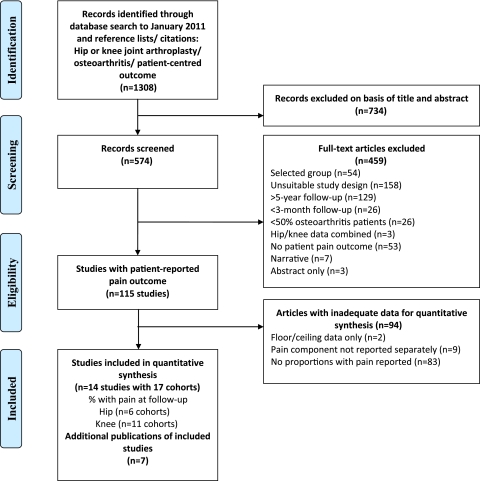
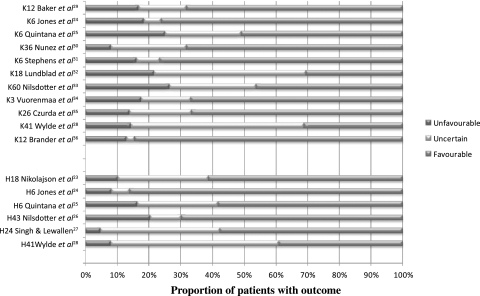
Background: Total hip or knee replacement is highly successful when judged by prosthesis-related outcomes. However, some people experience long-term pain. Objectives: To review published studies in representative populations with total hip or knee replacement for the treatment of osteoarthritis reporting proportions of people by pain intensity. Data sources: MEDLINE and EMBASE databases searched to January 2011 with no language restrictions. Citations of key articles in ISI Web of Science and reference lists were checked. Study eligibility criteria, participants and interventions: Prospective studies of consecutive, unselected osteoarthritis patients representative of the primary total hip or knee replacement population, with intensities of patient-centred pain measured after 3 months to 5-year follow-up. Study appraisal and synthesis methods: Two authors screened titles and abstracts. Data extracted by one author were checked independently against original articles by a second. For each study, the authors summarised the proportions of people with different severities of pain in the operated joint. Results: Searches identified 1308 articles of which 115 reported patient-centred pain outcomes. Fourteen articles describing 17 cohorts (6 with hip and 11 with knee replacement) presented appropriate data on pain intensity. The proportion of people with an unfavourable long-term pain outcome in studies ranged from about 7% to 23% after hip and 10% to 34% after knee replacement. In the best quality studies, an unfavourable pain outcome was reported in 9% or more of patients after hip and about 20% of patients after knee replacement. Limitations: Other studies reported mean values of pain outcomes. These and routine clinical studies are potential sources of relevant data. Conclusions and implications of key findings: After hip and knee replacement, a significant proportion of people have painful joints. There is an urgent need to improve general awareness of this possibility and to address determinants of good and bad outcomes.
Overview
The claims and statistics of this paper haven’t been checked yet.
Free: it reads the open-access text and checks the first 5 claims that cite a source we can check. Create a free account to check every claim.
Integrity signals
Registry
Cites
Statistics
Figures
Verification
Claims the paper makes
The claims and statistics of this paper haven’t been checked yet.
Free: it reads the open-access text and checks the first 5 claims that cite a source we can check. Create a free account to check every claim.
Self-check
Percentages, sums and reported differences re-computed from the paper’s own numbers.
The self-check needs the paper’s full text.
Citations
Cites
Cochrane Handbook for Systematic Reviews of Interventions: Cochrane Book Series
(2008) · doi:10.1002/9780470712184 · Cited by 25,048 · cited 1×
“Although contact with authors is a well-recognised approach in systematic reviews, 21 a survey of review authors indicated that many systematic reviewers do not do so because of poor response rates and variability in the quality of information collected this way.”
BackgroundDermyshi, E., Wang, Y., Yan, C., Hong, W., Qiu, G., Gong, X., & Zhang, T. (2017) · Neonatology · doi:10.1159/000454668 · Cited by 24,451
Meta-analysis of Observational Studies in Epidemiology<SUBTITLE>A Proposal for Reporting</SUBTITLE>
Stroup, D. F. (2000) · JAMA · doi:10.1001/jama.283.15.2008 · Cited by 20,623
Projections of Primary and Revision Hip and Knee Arthroplasty in the United States from 2005 to 2030
Kurtz, S., Ong, K., Lau, E., Mowat, F., & Halpern, M. (2007) · The Journal of Bone and Joint Surgery-American Volume · doi:10.2106/00004623-200704000-00012 · Cited by 8,698 · cited 1×
“In the USA in 2006, the estimated numbers of hospital discharges after total hip or knee replacement procedures were 231 000 and 542 000, respectively,(2) with demand predicted to increase substantially.(3) Total hip or knee replacement is highly successful when judged by prosthesis-related outcomes, such as the radio…”
BackgroundPatient Satisfaction after Total Knee Arthroplasty: Who is Satisfied and Who is Not?
Bourne, R. B., Chesworth, B. M., Davis, A. M., Mahomed, N. N., & Charron, K. D. J. (2010) · Clinical Orthopaedics & Related Research · doi:10.1007/s11999-009-1119-9 · Cited by 2,569
Ethgen, O., Bruyère, O., Richy, F., Dardennes, C., & Reginster, J.-Y. (2004) · The Journal of Bone & Joint Surgery · doi:10.2106/00004623-200405000-00012 · Cited by 1,800
National Hospital Discharge Survey, 1988: Archival Version
United States Department of Health and Human Services. National Center for Health Statistics (1991) · ICPSR Data Holdings · doi:10.3886/icpsr09521 · Cited by 1,310
Baker, P. N., van der Meulen, J. H., Lewsey, J., & Gregg, P. J. (2007) · The Journal of Bone and Joint Surgery. British volume · doi:10.1302/0301-620x.89b7.19091 · Cited by 975
Patients' Perception of Hospital Care in the United States
Jha, A. K., Orav, E. J., Zheng, J., & Epstein, A. M. (2008) · New England Journal of Medicine · doi:10.1056/nejmsa0804116 · Cited by 886 · cited 1×
“In the USA, the importance of patient-reported outcomes in assessing quality of care is recognised, 11 and in England, following the report of Lord Darzi, 12 information is routinely collected after elective surgery.”
BackgroundWylde, V., Hewlett, S., Learmonth, I. D., & Dieppe, P. (2011) · Pain · doi:10.1016/j.pain.2010.11.023 · Cited by 686 · cited 1×
“A cohort of 1394 consecutive total knee replacement patients were followed up prospectively by Wylde and colleagues 28 for a median of 41 months.”
MethodSelf-citation
Research works printed but not linked: 3
- 1. Long-term pain after total hip or knee replacement on August 11, 2021 by guest. Protected by copyright. http://bmjopen.bmj.com/ BMJ Open: first published as 10.1136/bmjopen-2011-000435 on 22 February 2012. Downloaded from REFERENCES
- 4. Long-term pain after total hip or knee replacement on August 11, 2021 by guest. Protected by copyright. http://bmjopen.bmj.com/ BMJ Open: first published as 10.1136/bmjopen-2011-000435 on 22 February 2012. Downloaded from
- 14. Darzi A. High Quality Care for All: NHS Next Stage Review Final Report. London: Department of Health, 2008.
Cited by
Items 101–200 of 1,001
The effects of kinesiophobia on outcome following total knee replacement: a systematic review
Brown, O. S., Hu, L., Demetriou, C., Smith, T. O., & Hing, C. B. (2020) · Archives of Orthopaedic and Trauma Surgery · doi:10.1007/s00402-020-03582-5 · Cited by 97
“1 3 patients report moderate to severe pain at 1 year post-operatively [7].”
BackgroundDowsey, M. M., Smith, A. J., & Choong, P. (2015) · Osteoarthritis and Cartilage · doi:10.1016/j.joca.2015.07.005 · Cited by 83
Skou, S. T., Graven‐Nielsen, T., Rasmussen, S., Simonsen, O. H., Laursen, M. B., & Arendt‐Nielsen, L. (2013) · European Journal of Pain · doi:10.1002/j.1532-2149.2013.00447.x · Cited by 83
“Moreover, around 20% of patients receiving a total knee arthroplasty (TKA) experience chronic post-operative pain (Beswick et al., 2012), even though the procedure is considered effective (Carr et al., 2012).”
BackgroundVarrassi, G., Hanna, M., Macheras, G., Montes, A., Montes, A., Meißner, W., Perrot, S., & Scarpignato, C. (2017) · Current Medical Research and Opinion · doi:10.1080/03007995.2017.1310092 · Cited by 89
Rehabilitation strategies for optimisation of functional recovery after major joint replacement
Bandholm, T., Wainwright, T. W., & Kehlet, H. (2018) · Journal of Experimental Orthopaedics · doi:10.1186/s40634-018-0156-2 · Cited by 99
Petersen, K. K., Simonsen, O., Laursen, M. B., & Arendt-Nielsen, L. (2018) · The Clinical Journal of Pain · doi:10.1097/ajp.0000000000000528 · Cited by 80
Abrecht, C. R., Cornelius, M. C., Wu, A. W., Jamison, R. N., Janfaza, D. R., Urman, R. D., Campbell, C. M., Smith, M. T., Haythornthwaite, J. A., Edwards, R. R., et al. (2018) · Pain Medicine · doi:10.1093/pm/pny020 · Cited by 89
Si, H., Yang, T.-M., Zeng, Y., Zhou, Z.-K., Pei, F.-X., Lu, Y., Cheng, J., & Shen, B. (2017) · BMC Musculoskeletal Disorders · doi:10.1186/s12891-017-1597-y · Cited by 85
Assessment of chronic post‐surgical pain after knee replacement: Development of a core outcome set
Wylde, V., MacKichan, F., Bruce, J., & Gooberman‐Hill, R. (2015) · European Journal of Pain · doi:10.1002/ejp.582 · Cited by 79
“Although a successful operation for many patients, approximately 20% of patients experience chronic post-surgical pain (CPSP) after knee replacement (Beswick et al., 2012).”
BackgroundSelf-citationAlteration of Metabolic Pathways in Osteoarthritis
Zhai, G. (2019) · Metabolites · doi:10.3390/metabo9010011 · Cited by 90
“While total joint replacement therapy (TJR) is considered by far the most effective treatment for end-stage OA patients [5] and the majority of patients achieve symptomatic improvement following TJR, a meta-analysis including 14 published studies showed that up to 23% of total hip replacement (THR) patients and 34% of…”
BackgroundInfluentialMohammadinejad, R., Ashrafizadeh, M., Pardakhty, A., Uzielienė, I., Denkovskij, J., Bernotienė, E., Janssen, L., Lorite, G. S., Saarakkala, S. S., & Mobasheri, A. (2020) · Current Rheumatology Reports · doi:10.1007/s11926-020-0884-z · Cited by 86
“replacement surgery, such as total knee or hip replacement, has been demonstrated as the most effective last-resort treatment for severe forms of OA [66, 67].”
BackgroundKittelson, A. J., Stevens‐Lapsley, J. E., & Schmiege, S. J. (2015) · Arthritis Care & Research · doi:10.1002/acr.22734 · Cited by 90
“Such heterogeneity in knee pain could explain why 10– 34% of patients continue to have pain following total knee replacement surgery (13), or why promising pain therapies”
BackgroundOsteoarthritis, part of life or a curable disease? A bird's‐eye view
Englund, M. (2023) · Journal of Internal Medicine · doi:10.1111/joim.13634 · Cited by 89
Davis, A. J., Smith, T. O., Hing, C. B., & Sofat, N. (2013) · PLoS ONE · doi:10.1371/journal.pone.0072714 · Cited by 76
“In a systematic review of outcomes, the proportion of people with unfavourable long-term pain following total hip replacement (THR) ranged from 7% to 23%, and 10% to 34% following total knee replacement (TKR) [3].”
BackgroundInfluentialSchalock, P. C., Crawford, G., Nedorost, S. T., Scheinman, P. L., Atwater, A. R., Mowad, C. M., Brod, B. A., Ehrlich, A., Watsky, K. L., Sasseville, D., et al. (2016) · Dermatitis · doi:10.1097/der.0000000000000210 · Cited by 79
“Long-term pain outcomes from all causes are common after joint replacement, more than 9% after hip and approximately 20% after knee replacement.(4) The incidence rate for stent placement is estimated at approximately 1,000,000 percutaneous coronary interventions per year in the United States and estimated approximatel…”
BackgroundRobot‐assisted total hip arthroplasty: Clinical outcomes and complication rate
Perets, I., Walsh, J. P., Close, M. R., Mu, B. H., Yuen, L. C., & Domb, B. G. (2018) · International Journal of Medical Robotics and Computer Assisted Surgery · doi:10.1002/rcs.1912 · Cited by 75
“6% unfavourable long‐term pain outcome ranged from 7% to 23%.(18) Hence, as clinicians, it is our duty to look for improvements even in a highly favourable procedure.”
BackgroundBuvanendran, A., Sremac, A. C., Merriman, P. A., Della Valle, C. J., Burns, J. W., & McCarthy, R. J. (2021) · Regional Anesthesia & Pain Medicine · doi:10.1136/rapm-2020-102258 · Cited by 70
Bensa, A., Sangiorgio, A., Deabate, L., Illuminati, A., Pompa, B., & Filardo, G. (2023) · Knee Surgery Sports Traumatology Arthroscopy · doi:10.1007/s00167-023-07458-0 · Cited by 74
Patient satisfaction after total knee arthroplasty: an Asian perspective
Thambiah, M., Nathan, S., Seow, B., Liang, S., & Lingaraj, K. (2015) · Singapore Medical Journal · doi:10.11622/smedj.2015074 · Cited by 75
“Total knee arthroplasty (TKA) is an effective way to manage end-stage knee osteoarthritis, as it has been shown to alleviate pain and improve function.(6-11) Over the years, many refinements have been made to this surgical procedure to improve patient outcomes, reduce postoperative complications and, ultimately, impro…”
BackgroundCasadaban, L. C., Mandell, J. C., & Epelboym, Y. (2020) · CardioVascular and Interventional Radiology · doi:10.1007/s00270-020-02687-z · Cited by 76
Jin, X., Gibson, A. A., Gale, J., Schneuer, F. J., Ding, D., MARCH, L. M., Sainsbury, A., & Nassar, N. (2021) · International Journal of Obesity · doi:10.1038/s41366-021-00832-3 · Cited by 75
“Besides, approximately 20% and 9% of patients experience persistent joint pain 12 months after TKR and THR, respectively [45].”
BackgroundKnee replacement for osteoarthritis
Liddle, A. D., Pegg, E. C., & Pandit, H. G. (2013) · Maturitas · doi:10.1016/j.maturitas.2013.03.005 · Cited by 96
“In national data, the OKS remains the same or deteriorates in around 9-12% of patients following knee replacement [39], whilst around 15% [40], and up to 20% of patients [41] are dissatisfied with their knee replacement and a similar number report on-going pain [42].”
BackgroundKittelson, A. J., George, S. Z., Maluf, K. S., & Stevens‐Lapsley, J. E. (2013) · Physical Therapy · doi:10.2522/ptj.20130256 · Cited by 87
Brembo, E. A., Kapstad, H., van Dulmen, S., & Eide, H. (2017) · Health and Quality of Life Outcomes · doi:10.1186/s12955-017-0649-1 · Cited by 89
“A systematic review reported that 7–23% of the patients undergoing THR experienced suboptimal outcomes 3 months to 5 years after the procedure [12].”
BackgroundPower, J. D., Perruccio, A. V., Gandhi, R. A., Veillette, C., Davey, J. R., Syed, K., Mahomed, N. N., & Rampersaud, Y. R. (2018) · Osteoarthritis and Cartilage · doi:10.1016/j.joca.2018.01.002 · Cited by 77
Bjørnholdt, K. T., Brandsborg, B., Søballé, K., & Nikolajsen, L. (2014) · Acta Orthopaedica · doi:10.3109/17453674.2014.987065 · Cited by 76
“To our knowledge, previous studies focusing on persistent postsurgical pain in orthopedic patients have concerned mainly amputation or hip or knee replacement (Nikolajsen et al. 2006, Lundblad et al. 2008, Beswick et al. 2012, Liu et al. 2012, Jansen et al. 2014).”
BackgroundWhitehouse, M. R., Stefanovich-Lawbuary, N. S., Brunton, L. R., & Blom, A. W. (2013) · The Journal of Arthroplasty · doi:10.1016/j.arth.2012.12.009 · Cited by 77
“THA is not without complications [5] and a significant number of THAs have persisting unexplained long-term pain [6].”
BackgroundSelf-citationRisk Assessment for Chronic Pain and Patient Satisfaction After Total Knee Arthroplasty
Sakellariou, V. I., Poultsides, L. A., Ma, Y., Bae, J. J., Liu, S., & Sculco, T. P. (2016) · Orthopedics · doi:10.3928/01477447-20151228-06 · Cited by 81
Postoperative Pain Management After Total Knee Arthroplasty in Elderly Patients: Treatment Options
McCartney, C. J. L., & Nelligan, K. A. (2014) · Drugs & Aging · doi:10.1007/s40266-013-0148-y · Cited by 77
Sun, E. C., Bateman, B. T., Memtsoudis, S. G., Neuman, M. D., Mariano, E. R., & Baker, L. C. (2017) · Anesthesia & Analgesia · doi:10.1213/ane.0000000000001943 · Cited by 73
Schmucker, A. M., Hupert, N., & Mandl, L. A. (2019) · Geriatric Orthopaedic Surgery & Rehabilitation · doi:10.1177/2151459319835109 · Cited by 77
“Additionally, despite advances in surgical technique, prosthesis design, and perioperative care, 7% to 23% of THA and 10% to 34% of TKA patients experience chronic postoperative pain that impairs quality of life.(8,9) Given the population burden and the associated societal costs, a better understanding of the relation…”
BackgroundDo women have poorer outcomes following total knee replacement?
Mehta, S. P., Perruccio, A. V., Palaganas, M., & Davis, A. M. (2015) · Osteoarthritis and Cartilage · doi:10.1016/j.joca.2015.05.007 · Cited by 72
Remote Patient Monitoring with Wearable Sensors Following Knee Arthroplasty
Bolam, S. M., Batinica, B., Yeung, T., Weaver, S., Cantamessa, A., Vanderboor, T. C., Yeung, S., Munro, J. T., Fernandez, J., Besier, T. F., et al. (2021) · Sensors · doi:10.3390/s21155143 · Cited by 80
Dave, A. J., Selzer, F., Losina, E., Usiskin, I. M., Collins, J. E., Lee, Y. C., Band, P. A., Dalury, D. F., Iorio, R. R., Kindsfater, K. A., et al. (2016) · Osteoarthritis and Cartilage · doi:10.1016/j.joca.2016.12.013 · Cited by 75
Ditton, E., Johnson, S. J., Hodyl, N. A., Flynn, T. S., Pollack, M. R. P., Ribbons, K., Walker, F. R., & Nilsson, M. (2020) · Frontiers in Psychology · doi:10.3389/fpsyg.2020.01061 · Cited by 75
“Furthermore, approximately 20–30% of patients report enduring pain for months to years after surgery (Beswick et al., 2012; Burns et al., 2015) and persistent functional impairments (Wylde et al.”
BackgroundSayah, S. M., Karunaratne, S., Beckenkamp, P. R., Horsley, M., Hancock, M. J., Hunter, D. J., Herbert, R., de Campos, T. F., & Steffens, D. (2021) · The Journal of Arthroplasty · doi:10.1016/j.arth.2021.06.019 · Cited by 75
Ai, M., Hotham, W. E., Pattison, L. A., Ma, Q., HENSON, F. M. D., & Smith, E. S. J. (2022) · Arthritis & Rheumatology · doi:10.1002/art.42353 · Cited by 72
“although pain persists in some patients (7).”
Katz, J. N., Wright, E. A., Polaris, J. J. Z., Harris, M. B., & Losina, E. (2014) · BMC Musculoskeletal Disorders · doi:10.1186/1471-2474-15-168 · Cited by 67
“Discussion Total hip replacement is among the most successful medical advances of the twentieth century, relieving pain and improving functional status in approximately 90% of THR recipients [13].”
BackgroundModern total hip arthroplasty: peak of perfection or room for improvement?
Scott, C. E. H., Clement, N. D., Davis, E. T., & Haddad, F. S. (2022) · The Bone & Joint Journal · doi:10.1302/0301-620x.104b2.bjj-2022-0007 · Cited by 65
Tilbury, C., Holtslag, M. J., Tordoir, R., Leichtenberg, C. S., Verdegaal, S. H. M., Kroon, H. M. J. A., Fiocco, M. F., Nelissen, R. G. H. H., & Vlieland, T. P. M. V. (2015) · Acta Orthopaedica · doi:10.3109/17453674.2015.1092369 · Cited by 66
“However, the preoperative characteristics of the patients and their change scores over time are well in line with those observed in other large cohorts (Nilsdotter et al. 2003, Dieppe et al. 2009, Beswick et al. 2012).”
ResultRest Pain and Movement‐Evoked Pain as Unique Constructs in Hip and Knee Replacements
Sayers, A. E., Wylde, V., Lenguerrand, E., Beswick, A. D., Gooberman‐Hill, R., Pyke, M., Dieppe, P. A., & Blom, A. W. (2016) · Arthritis Care & Research · doi:10.1002/acr.22656 · Cited by 74
“erate to severe pain following surgery (3).”
InfluentialSelf-citationShim, J., & Hamilton, D. F. (2019) · The Bone & Joint Journal · doi:10.1302/0301-620x.101b7.bjj-2018-1543.r1 · Cited by 66
Patient specific instrumentation in total knee arthroplasty.
Colombelli, A., Belluati, A., Rizqallah, Y., Guerra, G., & Busatto, C. (2017) · Acta bio-medica dell'Ateneo parmense/Acta biomedica · doi:10.23750/abm.v88i2-s.6511 · Cited by 68
Basic Mechanisms of Pain in Osteoarthritis
Malfait, A., Miller, R. E., & Miller, R. J. (2021) · Rheumatic Disease Clinics of North America · doi:10.1016/j.rdc.2020.12.002 · Cited by 67
Aggarwal, A., Naylor, J., Adie, S., Liu, V. K., & Harris, I. A. (2022) · The Journal of Arthroplasty · doi:10.1016/j.arth.2021.12.036 · Cited by 63
Pinto, P. R., McIntyre, T. M., Araújo‐Soares, V., Almeida, A., & Ferrero (2013) · Journal of Pain Research · doi:10.2147/jpr.s45827 · Cited by 69
Reasons for Treatment Choices in Knee and Hip Osteoarthritis: A Qualitative Study
Selten, E. M. H., Vriezekolk, J. E., Geenen, R., van der Laan, W. H., van der Meulen‐Dilling, R. G., Nijhof, M. W., Schers, H., & van den Ende, C. H. M. (2016) · Arthritis Care & Research · doi:10.1002/acr.22841 · Cited by 69
“In contrast, surgical treat-ment modalities are being used increasingly (7), despite some observations that surgery does not always lead to positive outcomes and pain reduction (8).”
Does kinesiophobia affect the early functional outcomes following total knee arthroplasty?
Güney-Deniz, H., Irem Kınıklı, G., Çağlar, Ö., Atilla, B., & Yüksel, İ. (2017) · Physiotherapy Theory and Practice · doi:10.1080/09593985.2017.1318988 · Cited by 60
“It should be kept in mind that the pain could also be the reason for worst functional performance in TKA patients (Bakirhan, Unver, and Karatosun, 2009; Bellamy et al., 1997; Beswick et al., 2012).”
BackgroundInfluentialTilbury, C., Haanstra, T. M., Verdegaal, S. H. M., Nelissen, R. G. H. H., de Vet, H. C. W., Vlieland, T. P. M. V., & Ostelo, R. (2018) · Scandinavian Journal of Pain · doi:10.1515/sjpain-2018-0022 · Cited by 69
Khatib, Y., Badge, H., Xuan, W., Naylor, J., & Harris, I. A. (2020) · Knee Surgery Sports Traumatology Arthroscopy · doi:10.1007/s00167-019-05804-9 · Cited by 62
Chronic Pain in Patients with Rheumatoid Arthritis
Mathias, K. R., Amarnani, A., Pal, N., Karri, J. V., Arkfeld, D. G., Hagedorn, J. M., & Abd-Elsayed, A. A. (2021) · Current Pain and Headache Reports · doi:10.1007/s11916-021-00973-0 · Cited by 77
Lunn, T. H., Frøkjær, V. G., Hansen, T. B., Kristensen, P. W., Lind, T., & Kehlet, H. (2015) · Anesthesiology · doi:10.1097/aln.0000000000000597 · Cited by 63
“10 Emotional indifference 0 (3) 0 (10) NS (0.”
Huber, E. O., Roos, E. M., Meichtry, A., de Bie, R. A., & Bischoff-Ferrari, H. A. (2015) · BMC Musculoskeletal Disorders · doi:10.1186/s12891-015-0556-8 · Cited by 79
“Most patients undergoing TKR experience pain-relief [6,7], but up to 30% of patients continue to have significant pain and functional problems after TKR [8-12].”
BackgroundInfluentialCentral sensitization as a determinant of patients’ benefit from total hip and knee replacement
Wylde, V., Sayers, A. E., Odutola, A. A., Gooberman‐Hill, R., Dieppe, P. A., & Blom, A. W. (2016) · European Journal of Pain · doi:10.1002/ejp.929 · Cited by 63
“…this inverse relationship between radiographic OA and pain after joint replacement may partly help to explain why 10% of patients receiving total hip replacement (THR) and 20% of patients receiving total knee replacement (TKR) report unfavourable long-term pain outcomes (Beswick et al., 2012).”
BackgroundSelf-citationLosina, E., Collins, J. E., Deshpande, B. R., Smith, S. R., Michl, G. L., Usiskin, I. M., Klara, K. M., Winter, A. R., Yang, H. Y., Selzer, F., et al. (2018) · Arthritis Care & Research · doi:10.1002/acr.23324 · Cited by 66
“6 months (crude) 6,712 (5,670, 7,755) 5,305 (4,290, 6,321) 5,923 (4,920, 6,926) 7,054 (5,967, 8,142) 0.”
BackgroundAssessment of Chronic Postsurgical Pain After Knee Replacement: A Systematic Review
Wylde, V., Bruce, J., Beswick, A. D., Elvers, K. T., & Gooberman‐Hill, R. (2013) · Arthritis Care & Research · doi:10.1002/acr.22050 · Cited by 64
“In light of the current evidence about the prevalence of chronic pain after TKR (5), this is highly problematic.”
BackgroundSelf-citationA Web-Based Platform for Patients With Osteoarthritis of the Hip and Knee: A Pilot Study
Dahlberg, L., Grahn, D., Dahlberg, J., & Thorstensson, C. A. (2016) · JMIR Research Protocols · doi:10.2196/resprot.5665 · Cited by 69
“Furthermore, 15% to 20% of the TJR population has sustained disabilities after surgery, which generates suffering, costly visits, and unnecessary diagnostics and treatments [26].”
Predicting the Outcome of Total Knee Arthroplasty Using the WOMAC Score: A Review of the Literature
Walker, L., Clement, N. D., & Deehan, D. J. (2018) · The Journal of Knee Surgery · doi:10.1055/s-0038-1666866 · Cited by 59
Pinedo‐Villanueva, R., Khalid, S., Wylde, V., Gooberman‐Hill, R., Soni, A., & Judge, A. (2018) · BMC Musculoskeletal Disorders · doi:10.1186/s12891-018-2270-9 · Cited by 60
“This result is consistent with previous findings: a systematic review [2] found that 10–34% of patients reported moderate to severe chronic pain after KR.”
BackgroundResultSelf-citationThe W.A.I.O.T. Definition of High-Grade and Low-Grade Peri-Prosthetic Joint Infection
Romanò, C. L., Al-Khawashki, H. M., Benzakour, T., Божкова, С. А., Sel, H. D., Hafez, M. A., Johari, A., Lob, G., Sharma, H., Tsuchiya, H., et al. (2019) · Journal of Clinical Medicine · doi:10.3390/jcm8050650 · Cited by 69
“[48] in a recent systematic review of prospective studies in patients undergoing total hip or knee replacement for osteoarthritis, found a proportion of people with long-term pain of unknown origin ranging from about 7% to 23% after total hip joint replacement and from 10% to 34% after knee replacement, while other st…”
BackgroundFactors correlated with pain after total knee arthroplasty: A systematic review and meta-analysis
Olsen, U., Lindberg, M. F., Rose, C. J., Denison, E., Gay, C., Aamodt, A., Brox, J. I., Skare, Ø., Furnes, O. N., Lee, K. A., et al. (2023) · PLoS ONE · doi:10.1371/journal.pone.0283446 · Cited by 66
Total Knee Arthroplasty: Diagnostic Accuracy of Patterns of Synovitis at MR Imaging
Li, A. E., Sneag, D. B., Greditzer, H. G., Johnson, C. C., Miller, T. T., & Potter, H. G. (2016) · Radiology · doi:10.1148/radiol.2016152828 · Cited by 58
Zeng, L., Zhou, G., Yang, W., & Liu, J. (2023) · Frontiers in Medicine · doi:10.3389/fmed.2023.1260943 · Cited by 69
Diabetes is associated with persistent pain after hip and knee replacement
Rajamäki, T. J., Jämsen, E., Puolakka, P. A., Nevalainen, P. I., & Moilanen, T. P. S. (2015) · Acta Orthopaedica · doi:10.3109/17453674.2015.1044389 · Cited by 61
Group education and exercise is feasible in knee and hip osteoarthritis.
Skou, S. T., Odgaard, A., Rasmussen, J. O., & Roos, E. M. (2012) · PubMed · Cited by 67
Saxer, F., Hollinger, A., Bjurström, M. F., Conaghan, P. G., Neogi, T., Schieker, M., & Berenbaum, F. (2024) · Osteoarthritis and Cartilage Open · doi:10.1016/j.ocarto.2023.100433 · Cited by 67
“…(A. Hollinger), martin. fl ores.bjurstrom@uu.se (M.F. Bjurstr € om), P.Conaghan@leeds.ac.uk (P.G. Conaghan), tneogi@bu.edu (T. Neogi), matthias.schieker@novartis.com (M. Schieker), francis.berenbaum@aphp.fr (F. Berenbaum). i These authors contributed equally. symptomatic after the procedure [5].”
Clode, N. J., Perry, M., & Wulff, L. (2018) · International Journal of Orthopaedic and Trauma Nursing · doi:10.1016/j.ijotn.2018.05.004 · Cited by 63
Hardy, A., Sandiford, M.-H., Ménigaux, C., Bauer, T., Klouche, S., & Hardy, P. P. (2022) · International Orthopaedics · doi:10.1007/s00264-022-05542-7 · Cited by 63
“However, 7‒23% of patients after THA and 10‒34% after TKA continue to report pain 12 months after surgery [1, 2].”
BackgroundWhat are the causes of failure after total knee arthroplasty?
Inui, H., Yamagami, R., Kono, K., & Kawaguchi, K. (2023) · Journal of Joint Surgery and Research · doi:10.1016/j.jjoisr.2022.12.002 · Cited by 59
Emerging Role of Quality Indicators in Physical Therapist Practice and Health Service Delivery
Westby, M. D., Klemm, A., LI, L. C., & Jones, C. A. (2015) · Physical Therapy · doi:10.2522/ptj.20150106 · Cited by 70
Lindberg, M. F., Miaskowski, C. A., Rustøen, T., Rosseland, L. A., Cooper, B. A., & Lerdal, A. (2016) · Acta Orthopaedica · doi:10.1080/17453674.2016.1237440 · Cited by 58
“■ Between 10% and 34% of patients continue to report having pain 12 months after TKA (Beswick et al. 2012) and 11% report similar or worse levels of function after surgery (Wylde et al. 2007).”
BackgroundPrice, A. J., Kang, S., Cook, J. A., Dakin, H., Blom, A. W., Arden, N., Fitzpatrick, R. M., Beard, D. J., & The ACHE Study team (2020) · The Bone & Joint Journal · doi:10.1302/0301-620x.102b7.bjj-2019-0102.r2 · Cited by 58
Self-citationJoint pain: more to it than just structural damage?
Arendt‐Nielsen, L. (2017) · Pain · doi:10.1097/j.pain.0000000000000812 · Cited by 65
“continue to experience chronic pain after joint replacement, but emerging evidence suggests that a specific facilitated central sensitization can be a predictor.(19,69,71,95,96) Therefore, it is”
BackgroundKim, M. S., Koh, I. J., Sohn, S., Kang, B. M., Kwak, D., & In, Y. (2019) · The Journal of Arthroplasty · doi:10.1016/j.arth.2019.03.042 · Cited by 59
Neuroimmune interactions in chronic pain – An interdisciplinary perspective
Hore, Z. L., & Denk, F. (2019) · Brain Behavior and Immunity · doi:10.1016/j.bbi.2019.04.033 · Cited by 61
“replacement surgery (Beswick et al., 2012), it has been reported that a disconnect between resolution of inflammation and pain can be observed in some individuals (Neogi et al.”
BackgroundMathis, D. T., Lohrer, L., Amsler, F., & Hirschmann, M. T. (2020) · Journal of Orthopaedics · doi:10.1016/j.jor.2020.12.008 · Cited by 53
Opioid use after total hip arthroplasty surgery is associated with revision surgery
Inacio, M. C. S., Pratt, N. L., Roughead, E. E., Paxton, E. W., & Graves, S. E. (2016) · BMC Musculoskeletal Disorders · doi:10.1186/s12891-016-0970-6 · Cited by 55
“Post-operative chronic pain has been estimated to occur in 7 % to 23 % of THA patients [3].”
BackgroundResultFriesgaard, K. D., Gromov, K., Knudsen, L., Brix, M., Troelsen, A., & Nikolajsen, L. (2016) · British Journal of Anaesthesia · doi:10.1093/bja/aew069 · Cited by 60
Piva, S. R., Almeida, G. J., Gil, A. B., DiGioia, A. M., Helsel, D. L., & Sowa, G. (2017) · Arthritis Care & Research · doi:10.1002/acr.23227 · Cited by 55
Arden, N., Altman, D. G., Beard, D. J., Carr, A. J., Clarke, N. M. P., Collins, P. G. S., Cooper, C. C., Culliford, D. J., Delmestri, A., Garden, S., et al. (2017) · Programme Grants for Applied Research · doi:10.3310/pgfar05120 · Cited by 54
“A further 20% of patients report unfavourable long-term pain.(87) There are many types of implants, and they are likely to be revised within the lifetime of a patient; for example, it is expected that a metal-on-polyethylene implant will need to be replaced after 20 years because of wear or prosthetic loosening.”
BackgroundVariability in long-term pain and function trajectories after total knee replacement: A cohort study
Wylde, V., Penfold, C. M., Rose, A., & Blom, A. W. (2019) · Orthopaedics & Traumatology Surgery & Research · doi:10.1016/j.otsr.2019.08.014 · Cited by 58
“The most important expectations for patients electing to undergo TKR are improvements in pain and function [4] yet research has established that 10-34% of patients experience chronic pain, 20-30% patients have long-term functional limitations after TKR [5, 6].”
BackgroundSelf-citationLarsen, D. B., Laursen, M. B., Simonsen, O. H., Arendt‐Nielsen, L., & Petersen, K. K. (2021) · British Journal of Pain · doi:10.1177/20494637211005803 · Cited by 59
“The aims of the present exploratory study were to (1) assess the association between preoperative sleep quality and preoperative clinical pain intensity, pain catastrophizing, anxiety, and depression and (2) explore the associations between preoperative sleep quality, pain intensity, pain catastrophizing, depression,…”
BackgroundDowsey, M., Castle, D., Knowles, S., Monshat, K., Salzberg, M., Nelson, E., Dunin, A., Dunin, J., Spelman, T., & Choong, P. (2019) · Complementary Therapies in Medicine · doi:10.1016/j.ctim.2019.08.010 · Cited by 52
“[2] While most people report substantial improvements in symptoms after TJA, there is a subset of patients who report ongoing pain, poor function and dissatisfaction after surgery[3], with an estimated 15% failing to achieve a clinically meaningful improvement at 12 months.”
BackgroundBeswick, A. D., Wylde, V., & Gooberman‐Hill, R. (2015) · BMJ Open · doi:10.1136/bmjopen-2014-007387 · Cited by 65
“Although many patients report a good outcome after their total knee replacement, at a time when recovery should have been achieved,(7) about 10–34% of patients report moderate to severe chronic postsurgical pain.(8) In the UK, this could mean 7500–25 500 potential new cases of chronic postsurgical pain every year, whi…”
BackgroundSelf-citationWylde, V., Trela-Larsen, L., Whitehouse, M. R., & Blom, A. W. (2017) · Acta Orthopaedica · doi:10.1080/17453674.2017.1334180 · Cited by 59
Self-citationChan, A. C. M., Jehu, D. A., & Pang, M. Y. C. (2018) · Physical Therapy · doi:10.1093/ptj/pzy071 · Cited by 53
Singh, J. A., Lemay, C. A., Nobel, L., Yang, W., Weissman, N., Saag, K. G., Allison, J. J., & Franklin, P. D. (2019) · JAMA Network Open · doi:10.1001/jamanetworkopen.2019.15105 · Cited by 54
Li, C. Y., Chung, K. J. N. C., Ali, O. M. E., Chung, N. D. H., & Li, C. H. (2020) · EFORT Open Reviews · doi:10.1302/2058-5241.5.200031 · Cited by 63
Clarke, A., Pulikottil-Jacob, R., Grove, A., Freeman, K., Mistry, H., Tsertsvadze, A., Connock, M. J., Court, R. A., Kandala, N., Costa, M. L., et al. (2015) · Health Technology Assessment · doi:10.3310/hta19100 · Cited by 67
Collins, J. E., Deshpande, B. R., Katz, J. N., & Losina, E. (2015) · Arthritis Care & Research · doi:10.1002/acr.22771 · Cited by 51
“More than 600,000 TKAs are performed annually in the US to treat OA (5), and about 80% of TKA recipients experience substantial improvement in symptoms and function (6,7).”
BackgroundVerlaan, L., Bolink, S. A. A. N., van Laarhoven, S. N., Lipperts, M., Heyligers, I. C., Grimm, B. P., & Senden, R. H. J. (2015) · The Open Biomedical Engineering Journal · doi:10.2174/1874120701509010157 · Cited by 63
“Although rehabilitation after TKR aims to improve physical activity [30], still an important minority of patients do not improve postoperatively [31].”
Lungu, E., Maftoon, S., Vendittoli, P., & Desmeules, F. (2016) · Orthopaedics & Traumatology Surgery & Research · doi:10.1016/j.otsr.2015.12.025 · Cited by 61
“[4] Beswick AD, Wylde V, Gooberman-Hill R, Blom A, Dieppe P.”
BackgroundPagé, M. G., Katz, J. D., Curtis, K., Lutzky-Cohen, N., Escobar, E. M. R., & Clarke, H. A. (2016) · Journal of Anesthesia · doi:10.1007/s00540-016-2183-4 · Cited by 53
“A recent systematic review found that between 7 and 23 % of patients undergoing THA continue to experience pain for 3 months to 5 years after surgery [3].”
BackgroundArendt‐Nielsen, L., Simonsen, O., Laursen, M. B., Roos, E. M., Rathleff, M. S., Rasmussen, S., & Skou, S. T. (2018) · European Journal of Pain · doi:10.1002/ejp.1193 · Cited by 52
Fernandes, G., Valdes, A. M., Walsh, D. A., Zhang, W., & Doherty, M. (2018) · Arthritis Research & Therapy · doi:10.1186/s13075-018-1717-6 · Cited by 58
Wylde, V., Bertram, W., Sanderson, E., Noble, S., Howells, N., Peters, T. J., Beswick, A. D., Blom, A. W., Moore, A. J., Bruce, J., et al. (2022) · The Lancet Rheumatology · doi:10.1016/s2665-9913(21)00371-4 · Cited by 55
Self-citationFontalis, A., Kayani, B., Plastow, R., Giebaly, D. E., Tahmassebi, J. E., Haddad, I. C., Chambers, A., Mancino, F., Konan, S., & Haddad, F. S. (2024) · The Bone & Joint Journal · doi:10.1302/0301-620x.106b4.bjj-2023-1045.r1 · Cited by 50
Postoperative Gait Mechanics After Total Hip Arthroplasty
Moyer, R. F., Lanting, B. A., Marsh, J. D., Aljurayyan, A. N., Churchill, L., Howard, J. L., & Somerville, L. E. (2018) · JBJS Reviews · doi:10.2106/jbjs.rvw.17.00133 · Cited by 50
Predictive Models for Clinical Outcomes in Total Knee Arthroplasty: A Systematic Analysis
Batailler, C., Lording, T. D., Massari, D. D., Witvoet, S., Bini, S. A., & Lustıg, S. (2021) · Arthroplasty Today · doi:10.1016/j.artd.2021.03.013 · Cited by 55
“However, patient dissatisfaction and sub-optimal patient reported outcomes are reported to be as high as to 20% [1,2].”
Macrophage polarization in osteoarthritis progression: a promising therapeutic target
Zhang, Y., & Ji, Q. (2023) · Frontiers in Cell and Developmental Biology · doi:10.3389/fcell.2023.1269724 · Cited by 53
Metadata
- Authors
- Beswick, A. D., Wylde, V., Gooberman-Hill, R., Blom, A., & Dieppe, P.
- Affiliations
- University of Bristol (GB)
- Peninsula College of Medicine and Dentistry (GB)
- Corresponding author
- Beswick, Andrew David
- Venue
- BMJ Open
- Publisher
- BMJ
- Published
- 2012
- Volume
- 2
- Issue
- 1
- Pages
- e000435
- ISSN
- 2044-6055 (ISSN-L)
- PMC
- PMC3289991
- OpenAlex
- W1990076794
- Semantic Scholar
- 45725c70617c53d281ed2739cb53edc2494a7ac5
- Cited by
- 1,450
- References
- 56
- Citations by year
- 2026: 85 · 2025: 134 · 2024: 141 · 2023: 162 · 2022: 136 · 2021: 147 · 2020: 136 · 2019: 106 · 2018: 103 · 2017: 74 · 2016: 72 · 2015: 58 · 2014: 44 · 2013: 42 · 2012: 8
- FWCI
- 9.41
- Type
- journal article
- Language
- en
- Open access
- gold
- doi.org
- Licence
- cc-by-nc
- Locations
- BMJ Open (publishedVersion, cc-by-nc)
- PubMed Central (publishedVersion, cc-by-nc)
- PubMed (publishedVersion)
- Bristol Research (University of Bristol) (submittedVersion)
- Funders
- National Institute for Health and Care Research (RP-PG-0407-10070)
- Programme Grants for Applied Research
- Topics
- Health Sciences › Medicine › Surgery › Total Knee Arthroplasty Outcomes
- Health Sciences › Medicine › Surgery › Orthopaedic implants and arthroplasty
- Health Sciences › Medicine › Anesthesiology and Pain Medicine › Anesthesia and Pain Management
- Keywords
- total hip arthroplasty, total knee arthroplasty, osteoarthritis, chronic pain, postoperative pain, pain intensity, patient-centered outcomes, joint replacement outcomes, unselected patients
About these checks
Registry, retraction, Cites and statistics results are computed, not judged, with one exception: a printed reference that no index lists is read once by a model before it counts as a citation error. Claims are extracted by a model and kept only when their quote appears verbatim in the text; each cited source is then checked, with a model’s help, for whether it says what the claim relies on. Those verdicts can be wrong — read the claim’s quote and the cited source before relying on one.
Statistics and arithmetic are recomputed, not judged.
Confidence bands are shown only for fields calibrated on our annotated test set. None is calibrated yet, so no band is shown.
What counts as a claim ›How we measure confidence ›How we check this ›
Are you an author, or do you see a problem with this page? Request a review
Data sources
Bibliographic data: Semantic Scholar, OpenAlex, Crossref.
Contains information from the Semantic Scholar Academic Graph Datasets, made available under the ODC Attribution License (ODC-BY 1.0).
Semantic Scholar’s data is described in: Kinney, R., et al. (2023). The Semantic Scholar Open Data Platform. arXiv:2301.10140.
