

What proportion of patients report long-term pain after total hip or knee replacement for osteoarthritis? A systematic review of prospective studies in unselected patients
Open accessThe DOI matches its Crossref record; 56 of the 56 references it cites were found in a registry or an index.
Abstract
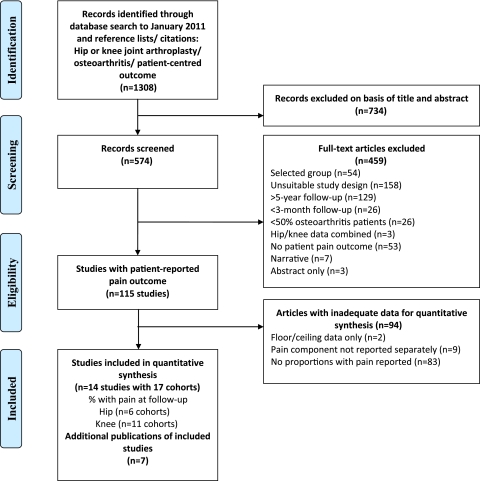
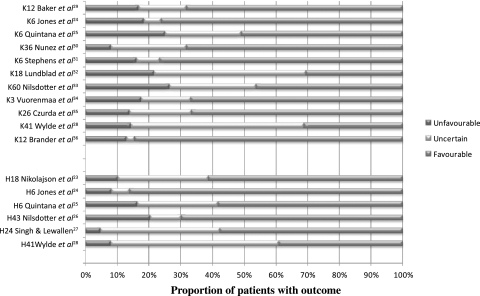
Background: Total hip or knee replacement is highly successful when judged by prosthesis-related outcomes. However, some people experience long-term pain. Objectives: To review published studies in representative populations with total hip or knee replacement for the treatment of osteoarthritis reporting proportions of people by pain intensity. Data sources: MEDLINE and EMBASE databases searched to January 2011 with no language restrictions. Citations of key articles in ISI Web of Science and reference lists were checked. Study eligibility criteria, participants and interventions: Prospective studies of consecutive, unselected osteoarthritis patients representative of the primary total hip or knee replacement population, with intensities of patient-centred pain measured after 3 months to 5-year follow-up. Study appraisal and synthesis methods: Two authors screened titles and abstracts. Data extracted by one author were checked independently against original articles by a second. For each study, the authors summarised the proportions of people with different severities of pain in the operated joint. Results: Searches identified 1308 articles of which 115 reported patient-centred pain outcomes. Fourteen articles describing 17 cohorts (6 with hip and 11 with knee replacement) presented appropriate data on pain intensity. The proportion of people with an unfavourable long-term pain outcome in studies ranged from about 7% to 23% after hip and 10% to 34% after knee replacement. In the best quality studies, an unfavourable pain outcome was reported in 9% or more of patients after hip and about 20% of patients after knee replacement. Limitations: Other studies reported mean values of pain outcomes. These and routine clinical studies are potential sources of relevant data. Conclusions and implications of key findings: After hip and knee replacement, a significant proportion of people have painful joints. There is an urgent need to improve general awareness of this possibility and to address determinants of good and bad outcomes.
Overview
The claims and statistics of this paper haven’t been checked yet.
Free: it reads the open-access text and checks the first 5 claims that cite a source we can check. Create a free account to check every claim.
Integrity signals
Registry
Cites
Statistics
Figures
Verification
Claims the paper makes
The claims and statistics of this paper haven’t been checked yet.
Free: it reads the open-access text and checks the first 5 claims that cite a source we can check. Create a free account to check every claim.
Self-check
Percentages, sums and reported differences re-computed from the paper’s own numbers.
The self-check needs the paper’s full text.
Citations
Cites
Cochrane Handbook for Systematic Reviews of Interventions: Cochrane Book Series
(2008) · doi:10.1002/9780470712184 · Cited by 25,048 · cited 1×
“Although contact with authors is a well-recognised approach in systematic reviews, 21 a survey of review authors indicated that many systematic reviewers do not do so because of poor response rates and variability in the quality of information collected this way.”
BackgroundDermyshi, E., Wang, Y., Yan, C., Hong, W., Qiu, G., Gong, X., & Zhang, T. (2017) · Neonatology · doi:10.1159/000454668 · Cited by 24,451
Meta-analysis of Observational Studies in Epidemiology<SUBTITLE>A Proposal for Reporting</SUBTITLE>
Stroup, D. F. (2000) · JAMA · doi:10.1001/jama.283.15.2008 · Cited by 20,623
Projections of Primary and Revision Hip and Knee Arthroplasty in the United States from 2005 to 2030
Kurtz, S., Ong, K., Lau, E., Mowat, F., & Halpern, M. (2007) · The Journal of Bone and Joint Surgery-American Volume · doi:10.2106/00004623-200704000-00012 · Cited by 8,698 · cited 1×
“In the USA in 2006, the estimated numbers of hospital discharges after total hip or knee replacement procedures were 231 000 and 542 000, respectively,(2) with demand predicted to increase substantially.(3) Total hip or knee replacement is highly successful when judged by prosthesis-related outcomes, such as the radio…”
BackgroundPatient Satisfaction after Total Knee Arthroplasty: Who is Satisfied and Who is Not?
Bourne, R. B., Chesworth, B. M., Davis, A. M., Mahomed, N. N., & Charron, K. D. J. (2010) · Clinical Orthopaedics & Related Research · doi:10.1007/s11999-009-1119-9 · Cited by 2,569
Ethgen, O., Bruyère, O., Richy, F., Dardennes, C., & Reginster, J.-Y. (2004) · The Journal of Bone & Joint Surgery · doi:10.2106/00004623-200405000-00012 · Cited by 1,800
National Hospital Discharge Survey, 1988: Archival Version
United States Department of Health and Human Services. National Center for Health Statistics (1991) · ICPSR Data Holdings · doi:10.3886/icpsr09521 · Cited by 1,310
Baker, P. N., van der Meulen, J. H., Lewsey, J., & Gregg, P. J. (2007) · The Journal of Bone and Joint Surgery. British volume · doi:10.1302/0301-620x.89b7.19091 · Cited by 975
Patients' Perception of Hospital Care in the United States
Jha, A. K., Orav, E. J., Zheng, J., & Epstein, A. M. (2008) · New England Journal of Medicine · doi:10.1056/nejmsa0804116 · Cited by 886 · cited 1×
“In the USA, the importance of patient-reported outcomes in assessing quality of care is recognised, 11 and in England, following the report of Lord Darzi, 12 information is routinely collected after elective surgery.”
BackgroundWylde, V., Hewlett, S., Learmonth, I. D., & Dieppe, P. (2011) · Pain · doi:10.1016/j.pain.2010.11.023 · Cited by 686 · cited 1×
“A cohort of 1394 consecutive total knee replacement patients were followed up prospectively by Wylde and colleagues 28 for a median of 41 months.”
MethodSelf-citation
Research works printed but not linked: 3
- 1. Long-term pain after total hip or knee replacement on August 11, 2021 by guest. Protected by copyright. http://bmjopen.bmj.com/ BMJ Open: first published as 10.1136/bmjopen-2011-000435 on 22 February 2012. Downloaded from REFERENCES
- 4. Long-term pain after total hip or knee replacement on August 11, 2021 by guest. Protected by copyright. http://bmjopen.bmj.com/ BMJ Open: first published as 10.1136/bmjopen-2011-000435 on 22 February 2012. Downloaded from
- 14. Darzi A. High Quality Care for All: NHS Next Stage Review Final Report. London: Department of Health, 2008.
Cited by
Items 501–600 of 1,001
Stuhlreyer, J., & Klinger, R. (2022) · Frontiers in Psychiatry · doi:10.3389/fpsyt.2022.840270 · Cited by 21
“In the long term, 20% of patients who received a TKR experience pain for 1 year after the surgery (16, 17).”
BackgroundHerbst, L., Groten, F., Murphy, M. J., Shaw, G., Nießing, B., & Schmitt, R. H. (2023) · Processes · doi:10.3390/pr11102938 · Cited by 19
Varış, O., & Peker, G. (2023) · Scientific Reports · doi:10.1038/s41598-023-48291-2 · Cited by 25
“In relation to this, several studies have shown that comorbid depression or anxiety affects not only short-term outcomes after TKA, but also long-term outcomes and may be an early precursor of pain in the postoperative period 36,37 .”
BackgroundØhrn, F., van Leeuwen, J. A. M. J., Tsukanaka, M., & Röhrl, S. M. (2018) · Acta Orthopaedica · doi:10.1080/17453674.2018.1470866 · Cited by 18
Leichtenberg, C. S., Vlieland, T. P. M. V., Kroon, H. M. J. A., Dekker, J., Marijnissen, W. J. C. M., Damen, P., Nelissen, R. G. H. H., van der Esch, M., & Studygroup, O. B. O. T. L. (2018) · Journal of Orthopaedic Research® · doi:10.1002/jor.24023 · Cited by 22
Claassen, A. A. O. M., Schers, H., Koëter, S., van der Laan, W. H., de Hei, K. K.-V., Botman, J., Busch, V., Rijnen, W. H. C., & van den Ende, C. H. M. (2018) · BMC Family Practice · doi:10.1186/s12875-018-0769-7 · Cited by 25
“However, joint replacement surgery is advised to be postponed as long as possible, as the lifespan of prostheses are limited [2] and the results can vary [4].”
BackgroundBiomechanical Changes Following Knee Arthroplasty During Sit-To-Stand Transfers: Systematic Review
Wang, J., Siddicky, S. F., Oliver, T. E., Dohm, M. P., Barnes, C. L., & Mannen, E. M. (2019) · The Journal of Arthroplasty · doi:10.1016/j.arth.2019.05.028 · Cited by 19
Matsumoto, K., Ogawa, H., Yoshioka, H., & Akiyama, H. (2020) · Journal of orthopaedic surgery · doi:10.1177/2309499019895636 · Cited by 18
Speed, T. J., Mun, C. J., Smith, M. T., Khanuja, H. S., Sterling, R. S., Letzen, J. E., Haythornthwaite, J. A., Edwards, R. R., & Campbell, C. M. (2021) · Pain Medicine · doi:10.1093/pm/pnab035 · Cited by 20
Güzel, İ., Gül, D., Akpancar, S., & Lyftogt, J. (2021) · Medical Science Monitor · doi:10.12659/msm.928759 · Cited by 20
“At least 3 to 6 months of pain that considerably decreases quality of life after major surgical procedures is referred to as CPSP and it has a frequency varying from 10 to 34% after TKA [7-9].”
Şahin, F., Beyaz, S. G., Karakuş, N., & İnanmaz, M. E. (2021) · Journal of Pain Research · doi:10.2147/jpr.s293856 · Cited by 19
“among 7%–23% of patients after a hip operation and among 10%–34% of patients after a TKA operation.(16) Hasegawa et al(17) reported that the rate of moderate and severe pain was”
BackgroundSasaki, E., Kasai, T., Araki, R., Sasaki, T., Wakai, Y., Akaishi, K., Chiba, D., Kimura, Y., Yamamoto, Y., Tsuda, E., et al. (2022) · Progress in Rehabilitation Medicine · doi:10.2490/prm.20220009 · Cited by 21
Lindberg, M. F., Rustøen, T., Miaskowski, C. A., Rosseland, L. A., & Lerdal, A. (2017) · BMC Musculoskeletal Disorders · doi:10.1186/s12891-017-1430-7 · Cited by 20
“Of note, in a recent systematic review [4], approximately 20% of patients reported little or no improvement in terms of pain relief.”
BackgroundLeung, Y. Y., Lim, Z. L., Fan, Q., Wylde, V., Xiong, S. Q., Yeo, S. J., Lo, N.-N., Chong, H., Yeo, W., Tan, M. H., et al. (2018) · Osteoarthritis and Cartilage · doi:10.1016/j.joca.2018.09.003 · Cited by 19
Self-citationMohammad, H. R., Judge, A., & Murray, D. W. (2021) · Acta Orthopaedica · doi:10.1080/17453674.2021.1956744 · Cited by 18
“This is important, given that currently 1 in 5 patients who undergo a total knee replacement are dissatisfied with their knee replacement (Beswick et al. 2012, Price et al. 2018).”
BackgroundMathew, J., Adhia, D. B., Smith, M. L., Ridder, D. D., & Mani, R. (2022) · Frontiers in Neuroscience · doi:10.3389/fnins.2022.899772 · Cited by 19
“, 2019) only achieve modest improvements in pain outcomes and associated disability (Beswick et al., 2012; Kittelson et al., 2014; Gregori et al., 2018).”
BackgroundPang, J. C. Y., Fu, S. N., Lam, K. H. S., Peng, B., & Fu, A. C. L. (2022) · PLoS ONE · doi:10.1371/journal.pone.0274990 · Cited by 19
Iliopsoas tendonitis after total hip arthroplasty
Hardwick‐Morris, M., Twiggs, J., Miles, B., Al‐Dirini, R. M. A., Taylor, M., Balakumar, J., & Walter, W. L. (2023) · Bone & Joint Open · doi:10.1302/2633-1462.41.bjo-2022-0147.r1 · Cited by 17
Gabyzon, M. E., & Nahhas, F. (2023) · BMC Geriatrics · doi:10.1186/s12877-022-03568-5 · Cited by 17
“Despite the beneficial outcomes of TKR in improving symptoms, approximately 20% of patients who undergo TKR report dissatisfaction and experience chronic pain [16, 17].”
BackgroundReinhard, J., Schindler, M., Leiß, F., Greimel, F., Grifka, J. K., & Benditz, A. (2023) · Archives of Orthopaedic and Trauma Surgery · doi:10.1007/s00402-023-04858-2 · Cited by 20
“Therefore, targeted multimodal pain management is of fundamental importance to inhibit the development of chronic pain syndromes [7, 14].”
BackgroundVigotsky, A. D., Cong, O., Pinto, C. B., Barroso, J., Perez, J., Petersen, K. K., Arendt‐Nielsen, L., Hardt, K. D., Manning, D. W., Apkarian, A. V., et al. (2024) · European Journal of Pain · doi:10.1002/ejp.2295 · Cited by 19
“Total knee replacement (TKR) is the gold-standard treatment for end-stage KOA when non-surgical therapies prove ineffective, yet up to 34% of patients experience chronic postoperative pain after TKR (Beswick et al., 2012; Wylde et al., 2011).”
Arthroplasty – current strategies for the management of knee osteoarthritis
Ahmad, S. S., Gantenbein, B., Evangelopoulos, D. S., Schär, M. O., Schwienbacher, S., Kohlhof, H., & Kohl, S. (2015) · Swiss Medical Weekly · doi:10.4414/smw.2015.14096 · Cited by 17
Kerman, H. M., Smith, S. R., Smith, K. C., Collins, J. E., Suter, L. G., Katz, J. N., & Losina, E. (2018) · Arthritis Care & Research · doi:10.1002/acr.23484 · Cited by 17
“TKR reduces pain and improves function for approximately 80% of recipients (4).”
BackgroundDevelopment of a reference chart to monitor postoperative swelling following total knee arthroplasty
Loyd, B. J., Kittelson, A. J., Forster, J. E., Stackhouse, S. K., & Stevens‐Lapsley, J. E. (2019) · Disability and Rehabilitation · doi:10.1080/09638288.2018.1534005 · Cited by 17
“Although it is widely regarded as effective at reducing pain and improving quality of life in patients with end-stage knee osteoarthritis [2,3], total knee arthroplasty results in an immediate and profound loss of knee extensor strength [4–6].”
BackgroundValenzuela, K. A., Zhang, S., Schroeder, L. E., Weinhandl, J. T., & Cates, H. E. (2019) · Clinical Biomechanics · doi:10.1016/j.clinbiomech.2019.04.020 · Cited by 17
Rian, T., Skogvoll, E., Hofstad, J. K., Høvik, L. H., Winther, S. B., Husby, V. S., Klaksvik, J., Egeberg, T., Sand, K., Klepstad, P., et al. (2020) · Pain · doi:10.1097/j.pain.0000000000002026 · Cited by 17
Burnham, R. S., Smith, A. D., & Hart, D. A. (2021) · Regenerative Medicine · doi:10.2217/rme-2021-0001 · Cited by 17
Bjurström, M. F., Blennow, K., Zetterberg, H., Bodelsson, M., Waldén, M., Dietz, N., Hall, S., Hansson, O., Irwin, M. R., & Mattsson, N. (2022) · PAIN Reports · doi:10.1097/pr9.0000000000000988 · Cited by 18
“Although many patients with OA may benefit from joint replacement surgery, up to 23% of patients with hip OA and 10% to 34% of patients with knee OA experience unfavorable long-term postoperative pain outcomes.(6)”
BackgroundThe effect of numbness on outcome from total knee replacement
Blackburn, J., Wylde, V., Greenwood, R., Blom, A. W., & Levy, A. (2017) · Annals of The Royal College of Surgeons of England · doi:10.1308/rcsann.2017.0026 · Cited by 17
“TKR is usually an effective surgical intervention for providing relief from chronic knee pain and disability although some patients report continuing pain and functional limitations after surgery.(2) Commonly assessed patient reported outcomes after TKR include pain, function, general health and overall satisfaction w…”
BackgroundSelf-citationRandomized blinded trial of standardized written patient information before total knee arthroplasty
Eschalier, B., Descamps, S., Pereira, B., Vaillant-Roussel, H., Girard, G., Boisgard, S., & Coudeyre, E. (2017) · PLoS ONE · doi:10.1371/journal.pone.0178358 · Cited by 18
“Furthermore, 32 (76%) patients expected TKA to completely eliminate their knee pain, in contradiction with studies showing limited pain relief from TKA in some patients, particularly compared to total hip arthroplasty [19].”
BackgroundOrange, G. M., Hince, D., Travers, M. J., Stanton, T. R., Jones, M. D., Sharma, S., Kim, S., Wand, B. M., & Murphy, M. (2024) · Journal of Orthopaedic and Sports Physical Therapy · doi:10.2519/jospt.2024.12570 · Cited by 20
Bjurström, M. F., Bodelsson, M., Irwin, M. R., Orbjörn, C., Hansson, O., & Mattsson, N. (2021) · Pain Practice · doi:10.1111/papr.13051 · Cited by 19
Function and employment after total hip replacement in older adults: A narrative review
Zaballa, E., Dennison, E. M., & Walker-Bone, K. E. (2022) · Maturitas · doi:10.1016/j.maturitas.2022.09.005 · Cited by 16
“Despite this, a literature review [15] estimated that the proportion of patients who continued to experience long-term pain post-THR (6 months to a median of 43 months follow-up) ranged between 7 % and 23 %.”
BackgroundFunctional recovery following hip and knee arthroplasty: subjective vs. objective assessment?
Wainwright, T. W., & Kehlet, H. (2022) · Acta Orthopaedica · doi:10.2340/17453674.2022.4567 · Cited by 16
“Around 20% of patients are reported as being socially isolated (10,11), and between 5% and 20% of all patients report persistent pain after THA and TKA, respectively (12).”
BackgroundMultisite chronic pain and the risk of autoimmune diseases: A Mendelian randomization study
Tang, Y., Liu, W., Kong, W., Zhang, S., & Zhu, T. (2023) · Frontiers in Immunology · doi:10.3389/fimmu.2023.1077088 · Cited by 24
“Some people reported chronic pain that persisted for a long time even after treatment (52).”
BackgroundPua, Y., Tan, B. Y., Low, J. K. M.-S., Woon, E.-L., Yeo, S.-J., Clark, R. A., Bettger, J. P., Pereira, M. J., Tan, C.-Y., & Thumboo, J. (2023) · The Journal of Arthroplasty · doi:10.1016/j.arth.2023.03.044 · Cited by 16
Olsen, U., Sellevold, V. B., Gay, C., Aamodt, A., Lerdal, A., Hagen, M. C., Dihle, A., & Lindberg, M. F. (2024) · BMC Musculoskeletal Disorders · doi:10.1186/s12891-023-07125-y · Cited by 16
“However, it has been estimated that one in five patients experience persistent knee pain and limited functional improvement following TKA [3, 4].”
BackgroundMooiweer, Y., Roling, L., Vugrin, M., Ansmann, L., Stevens, M. J., & Seeber, G. H. (2024) · EFORT Open Reviews · doi:10.1530/eor-23-0087 · Cited by 19
“However, 10–30% of patients are dissatisfied with their surgical outcome ( 7).”
BackgroundThe problem of residual pain in the assessment of rheumatoid arthritis activity
Motyl, G., Krupka, W. M., & Maślińska, M. (2024) · Reumatologia/Rheumatology · doi:10.5114/reum/189779 · Cited by 19
“Interestingly, a review by Bes-wick et al. [65] indicated that 9% of patients after hip replacement and 20% after knee replacement report unfavourable long-term pain outcomes.”
BackgroundSerra‐Sutton, V., Allepuz, A., Martínez, O., & Espallargues, M. (2013) · Revista Española de Cirugía Ortopédica y Traumatología · doi:10.1016/j.recote.2013.07.004 · Cited by 16
Doctor, What Does my Knee Arthroplasty Weigh?
Gibon, E., Mouton, A., Passeron, D., Strat, V. L., Graff, W., & Marmor, S. (2014) · The Journal of Arthroplasty · doi:10.1016/j.arth.2014.07.012 · Cited by 16
“When comparing TKA and THA, patients report more pain after TKA with a proportion up to 20% on long-term pain [7,8].”
BackgroundAlturki, A., Alaraifi, A. K., Badakhan, B. A., Al-Nazzawi, M. T., Alghnam, S. A., & Turki, A. S. A. (2017) · Saudi Medical Journal · doi:10.15537/smj.2017.6.17475 · Cited by 17
Hamilton, D. F., Loth, F. L. C., MacDonald, D. J., Macfarlane, G. J., Beard, D. J., Simpson, H., Patton, J. T., & HOWIE, C. R. (2019) · BMJ Open · doi:10.1136/bmjopen-2018-021614 · Cited by 16
Optimising recruitment into trials using an internal pilot
Bertram, W., Moore, A. J., Wylde, V., & Gooberman‐Hill, R. (2019) · Trials · doi:10.1186/s13063-019-3296-5 · Cited by 21
Self-citationPreston, C., Gilpin, H. R., & Newport, R. (2019) · Musculoskeletal Science and Practice · doi:10.1016/j.msksp.2019.102080 · Cited by 17
Tan, B. Y., Ding, B. T. K., Pereira, M. J., Skou, S. T., Thumboo, J., & Car, J. (2020) · BMC Musculoskeletal Disorders · doi:10.1186/s12891-020-03611-9 · Cited by 20
Rajamäki, T. J., Moilanen, T. P. S., Puolakka, P. A., Hietaharju, A., & Jämsen, E. (2021) · Clinical Orthopaedics and Related Research · doi:10.1097/corr.0000000000001793 · Cited by 19
“and other analgesics in this patient group [6, 10, 40].”
BackgroundAssociation of Physical Therapy Interventions With Long-term Opioid Use After Total Knee Replacement
Aoyagi, K., Neogi, T., Peloquin, C. E., Dubreuil, M., Marinko, L. N., Camarinos, J., Felson, D. T., & Kumar, D. (2021) · JAMA Network Open · doi:10.1001/jamanetworkopen.2021.31271 · Cited by 19
“8) Pre-TKR opioid prescriptions, median (IQR)a NA 4 (2-9) NSAID useb 18 148 (47.”
Mohammad, H. R., Gooberman‐Hill, R., Delmestri, A., Broomfield, J., Patel, R., Huber, J. F., Garriga, C., Eccleston, C., Pinedo‐Villanueva, R., Malak, T. T., et al. (2021) · PLoS ONE · doi:10.1371/journal.pone.0261850 · Cited by 16
“The percentage who experience ongoing chronic knee pain post-surgery is variable [4], with up to 20% experiencing knee pain that impacts their quality of life after 3 months post-op [5].”
BackgroundSelf-citationSoriano, Á. A. E., Perera, R. A., & Riddle, D. L. (2020) · Arthritis Care & Research · doi:10.1002/acr.24169 · Cited by 15
“Given that 20% of patients have a poor outcome following TKA (14,29), we suggest that appropri-”
BackgroundInfluentialKaynar, A. M., Lin, C., Sanchez, A. G., Lavage, D. R., Monroe, A., Zharichenko, N., Strassburger, M., Saucier, K., Groff, Y. J., Klatt, B. A., et al. (2023) · Trials · doi:10.1186/s13063-023-07634-0 · Cited by 21
“Up to 43% of post-TKA patients report persistent pain, functional limitations, and poor quality of life despite clinical and radiological indicators of surgical success [38, 39].”
BackgroundCurrent advances of photobiomodulation therapy in treating knee osteoarthritis
Zhang, Y., & Ji, Q. (2023) · Frontiers in Cell and Developmental Biology · doi:10.3389/fcell.2023.1286025 · Cited by 15
Marcos, C. R., Schiller, N. C., Braun, S. B., Knauer, D., YaDeau, J. T., Nocon, A., Jivanelli, B., Flevas, D. A., & Sculco, T. P. (2024) · HSS Journal® The Musculoskeletal Journal of Hospital for Special Surgery · doi:10.1177/15563316241260717 · Cited by 21
“However, approximately 10% to 34% of patients report long-term pain following TKA [5].”
InfluentialFoadi, N., Karst, M., Frese-Gaul, A., Rahe‐Meyer, N., Krömer, S., & Weilbach, C. (2017) · Journal of Pain Research · doi:10.2147/jpr.s135142 · Cited by 18
“to be associated with improved short- and medium-term outcomes are a reduced pain level, a better physical function, general health state, emotional and social function, motivation, and self-efficacy.(34) The postoperative physical rehabilitation was a variable that had not been standardized throughout the three patie…”
What is the Quality of Online Resources About Pain Control After Total Knee Arthroplasty?
Schairer, W. W., Kahlenberg, C. A., Sculco, P. K., & Nwachukwu, B. U. (2017) · The Journal of Arthroplasty · doi:10.1016/j.arth.2017.06.031 · Cited by 15
“Knee replacement was selected as our index procedure because it 75 is one of the most commonly performed procedures in orthopaedic surgery(16) and post76 operative analgesia after this procedure can be difficult(17).”
MethodJaczewska, J., & Stolarczyk, A. (2018) · Advances in experimental medicine and biology · doi:10.1007/5584_2018_187 · Cited by 15
Liu, Z., Hu, H., Liu, S., Huo, J., Li, M., & Han, Y. (2019) · Medicine · doi:10.1097/md.0000000000016926 · Cited by 15
Haydel, A. L., Guilbeau, S., Roubion, R. C., Leonardi, C., Bronstone, A. B., & Dasa, V. (2019) · JAAOS Global Research and Reviews · doi:10.5435/jaaosglobal-d-19-00142 · Cited by 18
“4,5 Understanding the determinants of suboptimal TKA outcomes can help inform patient selection, preparation, and education (eg, preoperative rehabilitation and setting expectations) to increase the proportion of patients with clinically meaningful improvement after TKA.”
BackgroundGetachew, M., Lerdal, A., Småstuen, M. C., Gay, C., Aamodt, A., Eshete, M. T., & Lindberg, M. F. (2020) · Musculoskeletal Care · doi:10.1002/msc.1522 · Cited by 16
“Our finding is somewhat higher than reported in a systematic review of studies (Beswick et al., 2012), which estimated a range of 10%–34% of patients experiencing the undesirable outcome of long‐term pain.”
ResultMinimally Invasive Cellular Therapies for Osteoarthritis Treatment
Shah, S., Otsuka, T., Bhattacharjee, M., & Laurencin, C. T. (2020) · Regenerative Engineering and Translational Medicine · doi:10.1007/s40883-020-00184-w · Cited by 17
“In addition, the surgical methods are invasive and cause adverse complications such as long-term pain, increased morbidity, or even death [12, 13].”
BackgroundHasegawa, M., Tone, S., Naito, Y., & Sudo, A. (2021) · Europe PMC (PubMed Central) · doi:10.2147/jpr.s330091 · Cited by 15
“The proportion of patients with persistent pain outcomes after TKA ranges from 8% to 27%.(1) Chronic pain is classified as nociceptive pain and”
BackgroundAoyagi, K., Frey‐Law, L., Carlesso, L. C., Nevitt, M. C., Lewis, C. E., Wang, N., & Neogi, T. (2023) · Osteoarthritis and Cartilage Open · doi:10.1016/j.ocarto.2023.100335 · Cited by 17
“While a majority of patients experience marked improvement in pain after KR, approximately 20–30% of patients continue to experience knee pain post-KR [6,7].”
BackgroundOsterloh, J., Knaack, F., Bader, R., Behrens, M., Peschers, J., Nawrath, L., Bergschmidt, P., & Darowski, M. (2023) · BMC Musculoskeletal Disorders · doi:10.1186/s12891-023-06270-8 · Cited by 15
“Clinical outcomes, especially after total knee arthroplasty, are not always optimal and new and effective rehabilitation approaches are required [6].”
BackgroundSerra‐Sutton, V., Allepuz, A., Martínez, O., & Espallargues, M. (2013) · Revista Española de Cirugía Ortopédica y Traumatología · doi:10.1016/j.recot.2013.04.002 · Cited by 15
Nardi, C., Buzzi, R., Molteni, R., Cossi, C., Lorini, C., Calistri, L., & Colagrande, S. (2017) · British Journal of Radiology · doi:10.1259/bjr.20160925 · Cited by 15
Childers, C. P., Siletz, A. E., Singer, E. S., Faltermeier, C. M., Hu, Q. L., Ko, C. Y., Golladay, G. J., Kates, S. L., Wick, E. C., & Maggard-Gibbons, M. A. (2018) · Geriatric Orthopaedic Surgery & Rehabilitation · doi:10.1177/2151458518754451 · Cited by 18
“In all, 7% to 23% of THA patients and 10% to 34% of TKA patients have persistent pain following surgery.(81) Understanding the relationship between preoperative opioid dependence and postoperative outcomes may assist with setting patient expectations.”
BackgroundMaier, M. W., Aschauer, S., Wolf, S. I., Dreher, T., Merle, C., & Bitsch, R. G. (2018) · International Orthopaedics · doi:10.1007/s00264-018-4118-1 · Cited by 15
Greimel, F., Maderbacher, G., Baier, C., Schwarz, T., Zeman, F., Meißner, W., Grifka, J. K., & Benditz, A. (2018) · The Journal of Knee Surgery · doi:10.1055/s-0038-1672156 · Cited by 15
Gasbjerg, K. S., Hägi‐Pedersen, D., Lunn, T. H., Jakobsen, J. C., Overgaard, S., Pedersen, N. A., Bagger, J., Lindholm, P., Brorson, S., Schrøder, H. M., et al. (2019) · Acta Anaesthesiologica Scandinavica · doi:10.1111/aas.13481 · Cited by 15
The manufacture of generic replicas of implants for arthroplasty of the hip and knee
Atrey, A., Heylen, S., Gosling, O. B., Porteous, M. J., & Haddad, F. S. (2016) · The Bone & Joint Journal · doi:10.1302/0301-620x.98b7.37016 · Cited by 15
Yao, Y., Zhang, Q., Cui, S., & Guo, X. (2025) · PLoS ONE · doi:10.1371/journal.pone.0317774 · Cited by 14
“Some studys pointed out that 20% of patients experience long-term chronic pain after knee replacement surgery [5].”
Terradas‐Monllor, M., Navarro-Fernández, G., Ruiz, M. Á., Beltrán-Alacreu, H., Fernández‐Carnero, J., Salinas-Chesa, J., & Ochandorena‐Acha, M. (2021) · Pain Medicine · doi:10.1093/pm/pnab025 · Cited by 15
Recruitment and retention for chronic pain clinical trials: a narrative review
Kennedy, N., Nelson, S. J., Jerome, R. N., Edwards, T. L., Stroud, M., Wilkins, C. H., & Harris, P. A. (2022) · PAIN Reports · doi:10.1097/pr9.0000000000001007 · Cited by 19
“8 Our literature review uncovered several strategies used by researchers to improve engagement and retention.”
BackgroundLebleu, J., Pauwels, A., Poilvache, H., Anract, P., & Belbachir, A. (2023) · Journal of Clinical Medicine · doi:10.3390/jcm12247695 · Cited by 20
“Additionally, the extended use of analgesics can precipitate adverse side effects [2], contributing to the development of chronic pain symptoms in 10 to 30% of cases [3,4].”
BackgroundHara, K., Kanda, M., Kobayashi, Y., Miyamoto, T., & Inoue, T. (2024) · European journal of medical research · doi:10.1186/s40001-024-01714-w · Cited by 14
“CPSP has been reported to occur in approximately 20% of the patients who undergo TKA [13]; pain after 2 months following TKA is often relieved by the subsequent course of therapy.”
BackgroundCai, G., Laslett, L. L., Thompson, M., Cicuttini, F., Hill, C. L., Wluka, A. E., MARCH, L. M., Wang, Y., Otáhal, P., Stoney, J. D., et al. (2024) · Arthritis & Rheumatology · doi:10.1002/art.42831 · Cited by 14
Giordano, R., Arendt‐Nielsen, L., Gerra, M. C., Kappel, A., Østgaard, S. E., Capriotti, C., Dallabona, C., & Petersen, K. K. (2024) · Pain · doi:10.1097/j.pain.0000000000003410 · Cited by 15
Karimijashni, M., Yoo, S., Barnes, K., Lessard-Dostie, H., Ramsay, T., & Poitras, S. (2024) · The Journal of Arthroplasty · doi:10.1016/j.arth.2024.10.132 · Cited by 18
MRI findings of subchondroplasty of the knee: a two-case report
Nevalainen, M. T., Sharkey, P. F., Cohen, S. A., Roedl, J. B., Zoga, A. C., & Morrison, W. B. (2015) · Clinical Imaging · doi:10.1016/j.clinimag.2015.11.015 · Cited by 14
“However, an average 20% dissatisfaction rate (range 10% to 34%) from TKA has been reported [21], and in addition, the postoperative rehabilitation, surgical morbidity and complication rates have rendered both osteotomy and TKA less popular with middle-aged or active patients [22].”
BackgroundOpioids in Arthroplasty: Mind the Gap Between North America and the Rest of the World
Agrawal, Y., Smith, R. M., Garbuz, D. S., & Masri, B. A. (2018) · Journal of Bone and Joint Surgery · doi:10.2106/jbjs.17.01422 · Cited by 14
When Has a Knee or Hip Replacement Failed? A Patient Perspective
Singh, J. A., Mehta, B. Y., Mirza, S. Z., Figgie, M. P., Sculco, P. K., Parks, M. L., & Goodman, S. M. (2019) · The Journal of Rheumatology · doi:10.3899/jrheum.191024 · Cited by 15
“The nominated responses/themes that were ranked the highest by the participants were as follows: (1) refractory index joint pain (80 votes); (2) occurrence of postoperative adverse events (54 votes); (3) unable to resume normal activities or go back to work (38 votes); (4) little or no improvement in quality of life (…”
BackgroundSvinøy, O.-E., Bergland, A., Risberg, M. A., Pripp, A. H., & Hilde, G. (2019) · BMJ Open · doi:10.1136/bmjopen-2019-031626 · Cited by 14
Roy, H. S., Singh, R., & Ghosh, D. (2021) · Nitric Oxide · doi:10.1016/j.niox.2021.01.002 · Cited by 17
Klenø, A. S., Stisen, M. B., Edwards, N. M., Mechlenburg, I., & Pedersen, A. B. (2021) · Acta Orthopaedica · doi:10.2340/17453674.2021.955 · Cited by 14
“showed that 7–23% of patients undergoing THA experienced long-term postoperative joint pain, along with other studies suggesting high consumption of analgesics 1–2 years postTHA (4,5).”
ResultMănescu, V., Antoniac, I., Antoniac, A., Păltânea, G., Miculescu, M., Biță, A.-I., Laptoiu, S. A., Niculescu, M., Stere, A., Paun, C., et al. (2022) · Materials · doi:10.3390/ma15207102 · Cited by 14
“Thus, the main failure reason in TKA is exclusively due to UHMWPE particles that appear due to wear and oxidation mechanisms [83,84].”
BackgroundInfluentialLungu, E., Vendittoli, P., & Desmeules, F. (2015) · BMC Musculoskeletal Disorders · doi:10.1186/s12891-015-0720-1 · Cited by 14
“1 % of the patients as having unsuccessful outcomes, well in line with the published proportions of what can be considered a suboptimal outcome [8].”
BackgroundResultJones, C. A., Martin, R., Westby, M. D., & Beaupré, L. A. (2016) · BMC Health Services Research · doi:10.1186/s12913-016-1873-9 · Cited by 14
“Inadequate rehabilitation is likely a major contributor to residual pain [7], muscle weakness, functional limitations and poor HRQL reported in approximately 25 % of individuals after total joint arthroplasty (TJA) [8–10].”
BackgroundRobotic surgery in hip and knee arthroplasty
Konan, S., Maden, C., & Robbins, A. J. (2017) · British Journal of Hospital Medicine · doi:10.12968/hmed.2017.78.7.378 · Cited by 14
Short stem total hip arthroplasty: Potential explanations for persistent post-surgical thigh pain
Baert, I. A. C., Lluch, E., Glabbeek, F. V., Nuyts, R., Rufai, S., Tuynman, J., Struyf, F., & Meeus, M. (2017) · Medical Hypotheses · doi:10.1016/j.mehy.2017.07.028 · Cited by 14
Sex Differences in Gait After Total Knee Arthroplasty
McClelland, J. A., Feller, J. A., & Webster, K. E. (2017) · The Journal of Arthroplasty · doi:10.1016/j.arth.2017.09.061 · Cited by 14
Rantasalo, M., Palanne, R. A., Lahtinen, K., Kairaluoma, P. M., Linko, R., Reponen, E., Helkamaa, T., Vakkuri, A., Olkkola, K. T., Madanat, R., et al. (2018) · BMJ Open · doi:10.1136/bmjopen-2018-025546 · Cited by 15
Cinnamon, C. C., Longworth, J. A., Brunner, J. H., Chau, V. K., Ryan, C. A., Dapiton, K., Chmell, S., & Foucher, K. C. (2019) · Clinical Biomechanics · doi:10.1016/j.clinbiomech.2019.05.009 · Cited by 14
Ushio, K., Nakanishi, K., Mikami, Y., Yoshino, A., Takamura, M., Hirata, K., Akiyama, Y., Kimura, H., Okamoto, Y., & Adachi, N. (2020) · PubMed Central · doi:10.2147/jpr.s268529 · Cited by 19
Götz, J. S., Leiß, F., Maderbacher, G., Meyer, M., Reinhard, J., Zeman, F., Grifka, J. K., & Greimel, F. (2021) · Zeitschrift für Rheumatologie · doi:10.1007/s00393-021-00978-5 · Cited by 23
Chaturvedi, R., Tram, J. T., & Chakravarthy, K. V. (2021) · Pain Management · doi:10.2217/pmt-2020-0107 · Cited by 13
Trajectories of Pain and Function Outcomes up to 5 to 8 Years Following Total Knee Arthroplasty
Lewis, G. N., Rice, D. A., Rashid, U., McNair, P. J., Kluger, M. T., & Somogyi, A. A. (2023) · The Journal of Arthroplasty · doi:10.1016/j.arth.2023.02.020 · Cited by 13
Laxity, Balance, and Alignment of a Simulated Kinematic Alignment Total Knee Arthroplasty
Edelstein, A. I., Wakelin, E. A., Plaskos, C., & Suleiman, L. I. (2023) · Arthroplasty Today · doi:10.1016/j.artd.2023.101204 · Cited by 15
Belba, A. G., Vanneste, T., Kallewaard, J. W., van Kuijk, S. M. J., Gelissen, M., Emans, P. J., Bellemans, J., Smeets, K., Boxem, K. V., Sommer, M., et al. (2024) · Regional Anesthesia & Pain Medicine · doi:10.1136/rapm-2023-105127 · Cited by 15
The Impact of Acute Postoperative Pain in Developing Chronic Pain after Total Knee Arthroplasty
Knežević, N. N., Syed, O., Kabir, C., Patel, A., Shuai, I. R., & Tharian, A. R. (2024) · Neurology International · doi:10.3390/neurolint16020034 · Cited by 17
“Various studies have investigated pre-and postoperative risk factors associated with CPSP, including the severity of pre-and postoperative pain, preoperative functioning, age, gender, comorbidities, pain site distribution, depression, anxiety, number of pain sites, and pain [4–10].”
BackgroundThe impact of central sensitization on perioperative pain in TKA: a retrospective cohort study
Sonobe, T., Nikaido, T., Sekiguchi, M., Kaneuchi, Y., Kikuchi, T., & Matsumoto, Y. (2025) · Knee Surgery and Related Research · doi:10.1186/s43019-025-00263-8 · Cited by 13
“A systematic review revealed that 8.0–26.5% of TKA recipients reported postoperative residual pain [5].”
Influential
Metadata
- Authors
- Beswick, A. D., Wylde, V., Gooberman-Hill, R., Blom, A., & Dieppe, P.
- Affiliations
- University of Bristol (GB)
- Peninsula College of Medicine and Dentistry (GB)
- Corresponding author
- Beswick, Andrew David
- Venue
- BMJ Open
- Publisher
- BMJ
- Published
- 2012
- Volume
- 2
- Issue
- 1
- Pages
- e000435
- ISSN
- 2044-6055 (ISSN-L)
- PMC
- PMC3289991
- OpenAlex
- W1990076794
- Semantic Scholar
- 45725c70617c53d281ed2739cb53edc2494a7ac5
- Cited by
- 1,450
- References
- 56
- Citations by year
- 2026: 85 · 2025: 134 · 2024: 141 · 2023: 162 · 2022: 136 · 2021: 147 · 2020: 136 · 2019: 106 · 2018: 103 · 2017: 74 · 2016: 72 · 2015: 58 · 2014: 44 · 2013: 42 · 2012: 8
- FWCI
- 9.41
- Type
- journal article
- Language
- en
- Open access
- gold
- doi.org
- Licence
- cc-by-nc
- Locations
- BMJ Open (publishedVersion, cc-by-nc)
- PubMed Central (publishedVersion, cc-by-nc)
- PubMed (publishedVersion)
- Bristol Research (University of Bristol) (submittedVersion)
- Funders
- National Institute for Health and Care Research (RP-PG-0407-10070)
- Programme Grants for Applied Research
- Topics
- Health Sciences › Medicine › Surgery › Total Knee Arthroplasty Outcomes
- Health Sciences › Medicine › Surgery › Orthopaedic implants and arthroplasty
- Health Sciences › Medicine › Anesthesiology and Pain Medicine › Anesthesia and Pain Management
- Keywords
- total hip arthroplasty, total knee arthroplasty, osteoarthritis, chronic pain, postoperative pain, pain intensity, patient-centered outcomes, joint replacement outcomes, unselected patients
About these checks
Registry, retraction, Cites and statistics results are computed, not judged, with one exception: a printed reference that no index lists is read once by a model before it counts as a citation error. Claims are extracted by a model and kept only when their quote appears verbatim in the text; each cited source is then checked, with a model’s help, for whether it says what the claim relies on. Those verdicts can be wrong — read the claim’s quote and the cited source before relying on one.
Statistics and arithmetic are recomputed, not judged.
Confidence bands are shown only for fields calibrated on our annotated test set. None is calibrated yet, so no band is shown.
What counts as a claim ›How we measure confidence ›How we check this ›
Are you an author, or do you see a problem with this page? Request a review
Data sources
Bibliographic data: Semantic Scholar, OpenAlex, Crossref.
Contains information from the Semantic Scholar Academic Graph Datasets, made available under the ODC Attribution License (ODC-BY 1.0).
Semantic Scholar’s data is described in: Kinney, R., et al. (2023). The Semantic Scholar Open Data Platform. arXiv:2301.10140.
