

What proportion of patients report long-term pain after total hip or knee replacement for osteoarthritis? A systematic review of prospective studies in unselected patients
Open accessThe DOI matches its Crossref record; 56 of the 56 references it cites were found in a registry or an index.
Abstract
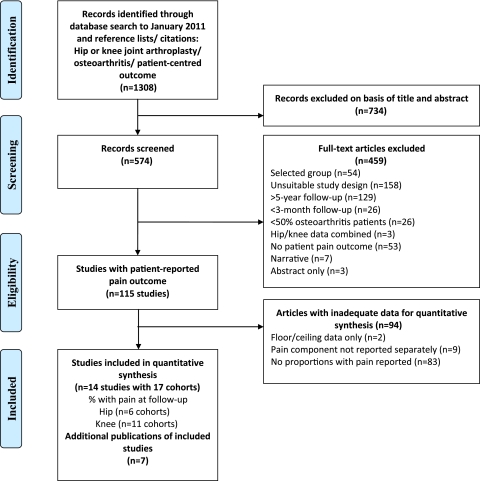
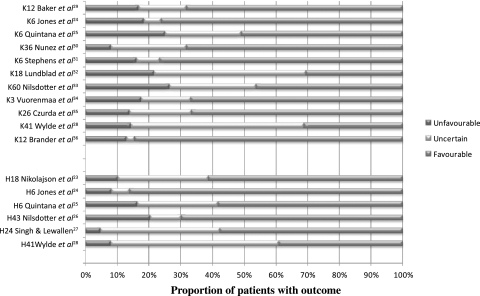
Background: Total hip or knee replacement is highly successful when judged by prosthesis-related outcomes. However, some people experience long-term pain. Objectives: To review published studies in representative populations with total hip or knee replacement for the treatment of osteoarthritis reporting proportions of people by pain intensity. Data sources: MEDLINE and EMBASE databases searched to January 2011 with no language restrictions. Citations of key articles in ISI Web of Science and reference lists were checked. Study eligibility criteria, participants and interventions: Prospective studies of consecutive, unselected osteoarthritis patients representative of the primary total hip or knee replacement population, with intensities of patient-centred pain measured after 3 months to 5-year follow-up. Study appraisal and synthesis methods: Two authors screened titles and abstracts. Data extracted by one author were checked independently against original articles by a second. For each study, the authors summarised the proportions of people with different severities of pain in the operated joint. Results: Searches identified 1308 articles of which 115 reported patient-centred pain outcomes. Fourteen articles describing 17 cohorts (6 with hip and 11 with knee replacement) presented appropriate data on pain intensity. The proportion of people with an unfavourable long-term pain outcome in studies ranged from about 7% to 23% after hip and 10% to 34% after knee replacement. In the best quality studies, an unfavourable pain outcome was reported in 9% or more of patients after hip and about 20% of patients after knee replacement. Limitations: Other studies reported mean values of pain outcomes. These and routine clinical studies are potential sources of relevant data. Conclusions and implications of key findings: After hip and knee replacement, a significant proportion of people have painful joints. There is an urgent need to improve general awareness of this possibility and to address determinants of good and bad outcomes.
Overview
The claims and statistics of this paper haven’t been checked yet.
Free: it reads the open-access text and checks the first 5 claims that cite a source we can check. Create a free account to check every claim.
Integrity signals
Registry
Cites
Statistics
Figures
Verification
Claims the paper makes
The claims and statistics of this paper haven’t been checked yet.
Free: it reads the open-access text and checks the first 5 claims that cite a source we can check. Create a free account to check every claim.
Self-check
Percentages, sums and reported differences re-computed from the paper’s own numbers.
The self-check needs the paper’s full text.
Citations
Cites
Cochrane Handbook for Systematic Reviews of Interventions: Cochrane Book Series
(2008) · doi:10.1002/9780470712184 · Cited by 25,048 · cited 1×
“Although contact with authors is a well-recognised approach in systematic reviews, 21 a survey of review authors indicated that many systematic reviewers do not do so because of poor response rates and variability in the quality of information collected this way.”
BackgroundDermyshi, E., Wang, Y., Yan, C., Hong, W., Qiu, G., Gong, X., & Zhang, T. (2017) · Neonatology · doi:10.1159/000454668 · Cited by 24,451
Meta-analysis of Observational Studies in Epidemiology<SUBTITLE>A Proposal for Reporting</SUBTITLE>
Stroup, D. F. (2000) · JAMA · doi:10.1001/jama.283.15.2008 · Cited by 20,623
Projections of Primary and Revision Hip and Knee Arthroplasty in the United States from 2005 to 2030
Kurtz, S., Ong, K., Lau, E., Mowat, F., & Halpern, M. (2007) · The Journal of Bone and Joint Surgery-American Volume · doi:10.2106/00004623-200704000-00012 · Cited by 8,698 · cited 1×
“In the USA in 2006, the estimated numbers of hospital discharges after total hip or knee replacement procedures were 231 000 and 542 000, respectively,(2) with demand predicted to increase substantially.(3) Total hip or knee replacement is highly successful when judged by prosthesis-related outcomes, such as the radio…”
BackgroundPatient Satisfaction after Total Knee Arthroplasty: Who is Satisfied and Who is Not?
Bourne, R. B., Chesworth, B. M., Davis, A. M., Mahomed, N. N., & Charron, K. D. J. (2010) · Clinical Orthopaedics & Related Research · doi:10.1007/s11999-009-1119-9 · Cited by 2,569
Ethgen, O., Bruyère, O., Richy, F., Dardennes, C., & Reginster, J.-Y. (2004) · The Journal of Bone & Joint Surgery · doi:10.2106/00004623-200405000-00012 · Cited by 1,800
National Hospital Discharge Survey, 1988: Archival Version
United States Department of Health and Human Services. National Center for Health Statistics (1991) · ICPSR Data Holdings · doi:10.3886/icpsr09521 · Cited by 1,310
Baker, P. N., van der Meulen, J. H., Lewsey, J., & Gregg, P. J. (2007) · The Journal of Bone and Joint Surgery. British volume · doi:10.1302/0301-620x.89b7.19091 · Cited by 975
Patients' Perception of Hospital Care in the United States
Jha, A. K., Orav, E. J., Zheng, J., & Epstein, A. M. (2008) · New England Journal of Medicine · doi:10.1056/nejmsa0804116 · Cited by 886 · cited 1×
“In the USA, the importance of patient-reported outcomes in assessing quality of care is recognised, 11 and in England, following the report of Lord Darzi, 12 information is routinely collected after elective surgery.”
BackgroundWylde, V., Hewlett, S., Learmonth, I. D., & Dieppe, P. (2011) · Pain · doi:10.1016/j.pain.2010.11.023 · Cited by 686 · cited 1×
“A cohort of 1394 consecutive total knee replacement patients were followed up prospectively by Wylde and colleagues 28 for a median of 41 months.”
MethodSelf-citation
Research works printed but not linked: 3
- 1. Long-term pain after total hip or knee replacement on August 11, 2021 by guest. Protected by copyright. http://bmjopen.bmj.com/ BMJ Open: first published as 10.1136/bmjopen-2011-000435 on 22 February 2012. Downloaded from REFERENCES
- 4. Long-term pain after total hip or knee replacement on August 11, 2021 by guest. Protected by copyright. http://bmjopen.bmj.com/ BMJ Open: first published as 10.1136/bmjopen-2011-000435 on 22 February 2012. Downloaded from
- 14. Darzi A. High Quality Care for All: NHS Next Stage Review Final Report. London: Department of Health, 2008.
Cited by
Items 201–300 of 1,001
Emerging drugs for the treatment of knee osteoarthritis
Yu, S. P., & Hunter, D. J. (2015) · Expert Opinion on Emerging Drugs · doi:10.1517/14728214.2015.1037275 · Cited by 58
“Therefore, it is expected that the total number of TKA procedures will likely increase to > 3 million annually in the USA by then and the need for THA is expected to grow 174% to 572,000 primary THA, based on population growth predictions [39,40].”
BackgroundPredictors of outcomes of recovery following total hip replacement surgery: A prospective study
McHugh, G. A., Campbell, M., & Luker, K. A. (2013) · Bone and Joint Research · doi:10.1302/2046-3758.211.2000206 · Cited by 64
McIsaac, D. I., McCartney, C. J. L., & van Walraven, C. (2016) · Anesthesiology · doi:10.1097/aln.0000000000001455 · Cited by 50
Hai-liang, J., Huang, S., Jiang, S., Wang, X., & Cao, Z.-S. (2017) · Medicine · doi:10.1097/md.0000000000006129 · Cited by 56
The Metabolome and Osteoarthritis: Possible Contributions to Symptoms and Pathology
Rockel, J., & Kapoor, M. (2018) · Metabolites · doi:10.3390/metabo8040092 · Cited by 43
“A large proportion of patients who undergo joint replacement surgery continue to feel pain and thus have limited improvement to quality of life and function [2].”
BackgroundSun, J.-N., Chen, W., Zhang, Y., Zhang, Y., Feng, S., & Chen, X. (2020) · International Orthopaedics · doi:10.1007/s00264-020-04767-8 · Cited by 50
Wylde, V., Lenguerrand, E., Gooberman‐Hill, R., Beswick, A. D., Marques, E. M. R., Noble, S., Horwood, J. P., Pyke, M., Dieppe, P. A., & Blom, A. W. (2015) · Pain · doi:10.1097/j.pain.0000000000000114 · Cited by 53
“Exclusion criteria were (1) medical comorbidity that precluded spinal anaesthesia, regional blocks, or strong analgesics postoperatively because inability to tolerate these pain relief strategies may have influenced the trial results; (2) severe dementia or psychiatric illness; (3) listing for simultaneous bilateral j…”
BackgroundMethodInfluentialSelf-citationWebster, F., Perruccio, A. V., Jenkinson, R., Jaglal, S. B., Schemitsch, E. H., Waddell, J. P., Venkataramanan, V., Bytautas, J., & Davis, A. M. (2015) · Osteoarthritis and Cartilage · doi:10.1016/j.joca.2015.02.013 · Cited by 57
The limited use of a tourniquet during total knee arthroplasty: A randomized controlled trial
Fan, Y., Jin, J., Sun, Z., Li, W., Lin, J., Weng, X., & Qiu, G. (2014) · The Knee · doi:10.1016/j.knee.2014.08.002 · Cited by 48
“A recent systematic review has shown that between 19% and 31% of patients had an unfavorable pain outcome after TKA [31].”
BackgroundSjøveian, A. K. H., & Leegaard, M. (2017) · International Journal of Orthopaedic and Trauma Nursing · doi:10.1016/j.ijotn.2017.07.001 · Cited by 61
Güngör, S., Fields, K. G., Aiyer, R., Valle, A. G. D., & Su, E. P. (2019) · Medicine · doi:10.1097/md.0000000000016450 · Cited by 55
“It is estimated that 10% to 44% of TKA patients develop PPP, with the highest-quality studies reporting an incidence of approximately 20%.([4]) The economic impact of long-term, moderate-to-severe, and unexplained pain after TKA is profound.”
BackgroundRisk factors for pain after total hip arthroplasty: a systematic review
Zhang, B., Rao, S. S., Mekkawy, K. L., Rahman, R., Sarfraz, A., Hollifield, L. C., Runge, N. E., & Oni, J. K. (2023) · Arthroplasty · doi:10.1186/s42836-023-00172-9 · Cited by 47
Fransen, M., Nairn, L., Bridgett, L., Crosbie, J., MARCH, L. M., Parker, D. A., Crawford, R., & Harmer, A. R. (2016) · Arthritis Care & Research · doi:10.1002/acr.23117 · Cited by 54
“pain in the operated knee for many years after surgery (2).”
BackgroundMeasures of the Appropriateness of Elective Orthopaedic Joint and Spine Procedures
Katz, J. N., Winter, A. R., & HAWKER, G. A. (2017) · Journal of Bone and Joint Surgery · doi:10.2106/jbjs.16.00473 · Cited by 47
Why do knees after total knee arthroplasty fail in different parts of the world?
Mathis, D. T., & Hirschmann, M. T. (2020) · Journal of Orthopaedics · doi:10.1016/j.jor.2020.12.007 · Cited by 46
Kurien, T., Kerslake, R. W., Graven‐Nielsen, T., Arendt‐Nielsen, L., Auer, D. P., Edwards, K., Scammell, B. E., & Petersen, K. K. (2022) · European Journal of Pain · doi:10.1002/ejp.2018 · Cited by 53
“Total knee arthroplasty (TKA) is the end- stage treatment for osteoarthritis (OA), and a subset of patients experience chronic postoperative pain after TKA (Beswick et al., 2012).”
BackgroundAdravanti, P., Nicoletti, S., Setti, S., Ampollini, A., & de Girolamo, L. (2013) · International Orthopaedics · doi:10.1007/s00264-013-2216-7 · Cited by 46
“It has been reported that even one year after surgery, a relevant percentage of patients (37 %) have not attained complete recovery [3] and indicates unfavourable long-term pain outcome (10 %–34 %) [4].”
BackgroundHaas, R., Sarkies, M., Bowles, K., O'Brien, L., & Haines, T. P. (2016) · Osteoarthritis and Cartilage · doi:10.1016/j.joca.2016.05.005 · Cited by 48
Femoral Component Revision of Total Hip Arthroplasty
Brown, J. M., Mistry, J. B., Cherian, J. J., Elmallah, R. K., Chughtai, M., Harwin, S. F., & Mont, M. A. (2016) · Orthopedics · doi:10.3928/01477447-20160819-06 · Cited by 46
Drew, S. E., Judge, A., Cohen, R., Fitzpatrick, R. M., Barker, K. L., & Gooberman‐Hill, R. (2019) · BMJ Open · doi:10.1136/bmjopen-2018-024431 · Cited by 51
“This is a major operation that has significant benefits, but also known risks and adverse outcomes.(6) 7 Research has demonstrated that ERAS orthopaedic pathways reduce the length of stay and mortality rates.”
BackgroundSelf-citationRojanasopondist, P., Galea, V. P., Connelly, J. W., Matuszak, S. J., Rolfson, O., Bragdon, C. R., & Malchau, H. (2019) · Clinical Orthopaedics and Related Research · doi:10.1097/corr.0000000000000667 · Cited by 48
Radiofrequency Procedures for the Treatment of Symptomatic Knee Osteoarthritis: A Systematic Review
Ajrawat, P., Radomski, L., Bhatia, A., Peng, P., Nath, N., & Gandhi, R. A. (2019) · Pain Medicine · doi:10.1093/pm/pnz241 · Cited by 52
Palanne, R. A., Rantasalo, M., Vakkuri, A., Madanat, R., Olkkola, K. T., Lahtinen, K., Reponen, E., Linko, R., Vahlberg, T. J., & Skants, N. (2020) · British Journal of Anaesthesia · doi:10.1016/j.bja.2020.03.036 · Cited by 50
Bunyoz, K. I., Lustıg, S., & Troelsen, A. (2018) · Knee Surgery Sports Traumatology Arthroscopy · doi:10.1007/s00167-018-5151-8 · Cited by 45
Buus, A. A. Ø., Hejlesen, O. K., Bjørnes, C. D., & Laugesen, B. (2019) · Disability and Rehabilitation · doi:10.1080/09638288.2019.1615997 · Cited by 48
Treatment recommendations for chronic knee osteoarthritis
Gress, K. L., Charipova, K., An, D., Hasoon, J. J., Kaye, A. D., Paladini, A., Varrassi, G., Viswanath, O., Abd-Elsayed, A. A., & Urits, I. (2020) · Best practice & research. Clinical anaesthesiology · doi:10.1016/j.bpa.2020.06.006 · Cited by 51
Carbon nanotube-based biomaterials for orthopaedic applications
Aoki, K., Ogihara, N., Tanaka, M., Haniu, H., & Saito, N. (2020) · Journal of Materials Chemistry B · doi:10.1039/d0tb01440k · Cited by 48
Bistolfi, A., Bettoni, E., Aprato, A., Milani, P., Berchialla, P., Graziano, E., Massazza, G., & Lee, G. (2015) · Knee Surgery Sports Traumatology Arthroscopy · doi:10.1007/s00167-015-3737-y · Cited by 47
“However, several studies have also shown that despite well-functioning knee prosthesis, up to 20 % of patients remain dissatisfied following surgery [3, 7, 8].”
BackgroundInfluentialKim, M. S., Kim, J. J., Kang, K. H., Kim, M. J., & In, Y. (2022) · Diagnostics · doi:10.3390/diagnostics12051248 · Cited by 46
“Approximately 10–34% of patients continue to complain of pain for 3 months to 5 years after TKA [13].”
BackgroundPain threshold correlates with functional scores in osteoarthritis patients
Kuni, B., Wang, H., Rickert, M., Ewerbeck, V., & Schiltenwolf, M. (2014) · Acta Orthopaedica · doi:10.3109/17453674.2014.973343 · Cited by 44
Postoperative opioid use as an early indication of total hip arthroplasty failure
Namba, R. S., Inacio, M. C. S., Pratt, N. L., Graves, S. E., Roughead, E. E., Cheetham, T. C., & Paxton, E. W. (2016) · Acta Orthopaedica · doi:10.1080/17453674.2016.1181820 · Cited by 46
“A systematic review of prospective studies identifi ed an unfavorable degree of long-term pain in 7–23% of THA patients (Beswick et al. 2012).”
BackgroundPellegrini, C. A., Ledford, G., Chang, R. W., & Cameron, K. A. (2017) · Disability and Rehabilitation · doi:10.1080/09638288.2017.1323026 · Cited by 47
“Fortunately, TKA typically results in a significant reduction in pain [28], although approximately 20% of patients still experience long-term pain following surgery [29].”
BackgroundIn vitro and in vivo models for assessing the host response to biomaterials
Saleh, L., & Bryant, S. J. (2017) · Drug Discovery Today Disease Models · doi:10.1016/j.ddmod.2018.04.002 · Cited by 49
“For example, joint arthroplasty enables patients with severe osteoarthritis to return to an active lifestyle with minimal pain [1].”
BackgroundInfection after knee replacement: a qualitative study of impact of periprosthetic knee infection
Mallon, C., Gooberman‐Hill, R., & Moore, A. J. (2018) · BMC Musculoskeletal Disorders · doi:10.1186/s12891-018-2264-7 · Cited by 52
“Although knee replacement often improves function and decreases pain, complications after knee replacement can include long-term pain [4], periprosthetic fracture [5] and prosthetic joint infection [6].”
BackgroundSelf-citationPreoperative risk factors associated with chronic pain profiles following total knee arthroplasty
Lindberg, M. F., Miaskowski, C. A., Rustøen, T., Cooper, B. A., Aamodt, A., & Lerdal, A. (2020) · European Journal of Pain · doi:10.1002/ejp.1703 · Cited by 49
Dave, A. J., Selzer, F., Losina, E., Klara, K. M., Collins, J. E., Usiskin, I. M., Band, P. A., Dalury, D. F., Iorio, R. R., Kindsfater, K. A., et al. (2015) · Clinical Orthopaedics and Related Research · doi:10.1007/s11999-015-4575-4 · Cited by 47
“Although most patients who undergo TKA experience substantial pain relief, as much as 20% with OA have persistent pain and functional limitations 6 months after surgery [5, 35, 36].”
BackgroundRiddle, D. L., Keefe, F. J., Ang, D., J, K., Dumenci, L., Jensen, M. P., Bair, M. J., Reed, S. D., & Kroenke, K. (2012) · BMC Musculoskeletal Disorders · doi:10.1186/1471-2474-13-149 · Cited by 43
“Most recently, Beswick and colleagues reported in a systematic review that 20% of patients in high quality cohort studies reported persistent function-limiting pain six months or more following TKA [22].”
BackgroundPatient-Reported Outcome Measures—What Data Do We Really Need?
Lyman, S. L., & Hidaka, C. (2016) · The Journal of Arthroplasty · doi:10.1016/j.arth.2016.01.073 · Cited by 45
Howells, N., Murray, J. R. D., Wylde, V., Dieppe, P. A., & Blom, A. W. (2016) · Osteoarthritis and Cartilage · doi:10.1016/j.joca.2016.07.012 · Cited by 49
“[2-4] TKR and UKR have 6 been widely deemed two of the most successful orthopaedic operations; 7 however there remains a significant proportion of patients who experience 8 persistent pain and functional limitations following knee replacement with 9 around 20% of patients reporting unfavourable pain outcomes.[5] Patie…”
BackgroundSelf-citationO’Connell, R. S., Constantinescu, D. S., Liechti, D. J., Mitchell, J. J., & Vap, A. R. (2018) · Arthroscopy The Journal of Arthroscopic and Related Surgery · doi:10.1016/j.arthro.2017.10.051 · Cited by 43
Jørgensen, C. C., Petersen, M. J., Kehlet, H., & Aasvang, E. K. (2018) · European Journal of Pain · doi:10.1002/ejp.1232 · Cited by 50
“Although total hip and knee arthroplasty (THA/TKA) are performed to relieve pain and regain function, treatment failure resulting in persistent pain occurs in 10–20% of patients (Braden et al., 2008; Beswick et al., 2012; Lewis et al., 2015; Lenguerrand et al., 2016).”
BackgroundSagittal Stability and Implant Design Affect Patient Reported Outcomes After Total Knee Arthroplasty
Jones, C. W., Jacobs, H., Shumborski, S. J., Talbot, S., Redgment, A., Brighton, R. W., & Walter, W. L. (2019) · The Journal of Arthroplasty · doi:10.1016/j.arth.2019.10.020 · Cited by 43
Patient-level improvements in pain and activities of daily living after total knee arthroplasty
Singh, J. A., & Lewallen, D. G. (2013) · Rheumatology · doi:10.1093/rheumatology/ket325 · Cited by 48
Ismail, A., Moore, C., Alshishani, N., Yaseen, K., & Alshehri, M. A. (2017) · Journal of Physical Therapy Science · doi:10.1589/jpts.29.2228 · Cited by 41
Maderbacher, G., Keshmiri, A., Krieg, B., Greimel, F., Grifka, J. K., & Baier, C. (2018) · Knee Surgery Sports Traumatology Arthroscopy · doi:10.1007/s00167-018-5105-1 · Cited by 44
Clinical Perspective on Pain and Pain Phenotypes in Osteoarthritis
Pan, F., & Jones, G. (2018) · Current Rheumatology Reports · doi:10.1007/s11926-018-0796-3 · Cited by 47
A systematic review and meta-analysis of the hip capsule innervation and its clinical implications
Tomlinson, J., Ondruschka, B., Prietzel, T., Zwirner, J., & Hammer, N. (2021) · Scientific Reports · doi:10.1038/s41598-021-84345-z · Cited by 50
Improving patients’ experience and outcome of total joint replacement: the RESTORE programme
Blom, A. W., Artz, N. J., Beswick, A. D., Burston, A., Dieppe, P. A., Elvers, K. T., Gooberman‐Hill, R., Horwood, J. P., Jepson, P., Johnson, E. C., et al. (2016) · Programme Grants for Applied Research · doi:10.3310/pgfar04120 · Cited by 53
“However, our work has shown that 7–23% of THR patients and 10–34% TKR patients experience chronic pain after surgery.(18) The difference in the prevalence of pain after THR and TKR is important and adds to the growing body of evidence that hip and knee osteoarthritis are different diseases.”
BackgroundMethodInfluentialSelf-citationGür, O., & Başar, S. (2023) · The Knee · doi:10.1016/j.knee.2023.09.012 · Cited by 46
Devasenapathy, N., Maddison, R., Malhotra, R., Zodepy, S., Sharma, S., & Belavý, D. L. (2018) · Physical Therapy · doi:10.1093/ptj/pzy118 · Cited by 43
Pain Management Associated with Total Joint Arthroplasty: A Primer
Lespasio, M. J., GUARINO, A. J., Sodhi, N., & Mont, M. A. (2019) · The Permanente Journal · doi:10.7812/tpp/18-169 · Cited by 43
Rajamäki, T. J., Puolakka, P. A., Hietaharju, A., Moilanen, T. P. S., & Jämsen, E. (2019) · BMC Musculoskeletal Disorders · doi:10.1186/s12891-019-2809-4 · Cited by 45
Wluka, A. E., Yan, M. K., Lim, K. Y., Hussain, S. M., & Cicuttini, F. (2020) · Osteoarthritis and Cartilage · doi:10.1016/j.joca.2020.07.010 · Cited by 45
Giordano, R., Petersen, K. K., Andersen, H. H., Lichota, J., Valeriani, M., Simonsen, O. H., & Arendt‐Nielsen, L. (2020) · Molecular Pain · doi:10.1177/1744806920962925 · Cited by 45
“However, around 20% of knee OA patients will experience chronic postoperative pain after TKR surgery.(2,3) Several studies have found that high preoperative pain intensities(4,5) and sensitization of central pain pathways(6) act as predictors for chronic postoperative pain following TKR.”
BackgroundSeagrave, K. G., Lewin, A. M., Harris, I. A., Badge, H., & Naylor, J. (2021) · Journal of orthopaedic surgery · doi:10.1177/2309499021992605 · Cited by 43
Gravius, N., Chaudhry, S. R., Muhammad, S., Boström, A., Gravius, S., Randau, T. M., Scheele, D., Westhofen, P., Kruppenbacher, J. P., Stoffel‐Wagner, B., et al. (2018) · Neuromodulation Technology at the Neural Interface · doi:10.1111/ner.12866 · Cited by 41
Birch, S., Stilling, M., Mechlenburg, I., & Hansen, T. B. (2017) · BMC Musculoskeletal Disorders · doi:10.1186/s12891-017-1476-6 · Cited by 40
“Most recently, in a systematic review Beswick and colleagues stated that 20% reported persistent functionlimiting pain 6 months or more following a TKA, despite an apparently normally functioning prosthesis [4].”
BackgroundCheng, H., Beswick, A. D., Bertram, W., Siddiqui, M. A., Gooberman‐Hill, R., Whitehouse, M. R., & Wylde, V. (2025) · BMJ Open · doi:10.1136/bmjopen-2024-088975 · Cited by 49
“21 Excepting the search strategy, we applied no language restrictions at any stage of the review, with Google Translate used to translate sections of relevant non-English articles.”
InfluentialSelf-citationTwiggs, J., Wakelin, E. A., Fritsch, B. A., Liu, D., Solomon, M. I., Parker, D. A., Klasan, A., & Miles, B. (2019) · The Journal of Arthroplasty · doi:10.1016/j.arth.2019.06.007 · Cited by 44
Gabriel, R. A., Harjai, B., Prasad, R., Simpson, S., Chu, I., Fisch, K. M., & Said, E. T. (2022) · Regional Anesthesia & Pain Medicine · doi:10.1136/rapm-2021-103299 · Cited by 42
Are Harris Hip Scores and Gait Mechanics Related Before and After THA?
Behery, O. A., & Foucher, K. C. (2014) · Clinical Orthopaedics and Related Research · doi:10.1007/s11999-014-3886-1 · Cited by 40
“By these benchmarks, between 7% and 15% of patients having primary unilateral THAs do not experience a large enough change in clinical outcome scores to be perceived as important or meaningful to the patient [5, 24, 30–32, 39].”
BackgroundRacial Disparities in Elective Total Joint Arthroplasty for Osteoarthritis
Usiskin, I. M., & Misra, D. (2022) · ACR Open Rheumatology · doi:10.1002/acr2.11399 · Cited by 39
“Although TJA generally results in long-term improvement of pain in more than 80% of patients, a substantial proportion of patients achieve suboptimal pain and functional outcomes (4).”
BackgroundAn anti-inflammatory diet intervention for knee osteoarthritis: a feasibility study
Cooper, I., Brukner, P. D., Devlin, B. L., Reddy, A. J., Fulton, M., Kemp, J. L., & Culvenor, A. G. (2022) · BMC Musculoskeletal Disorders · doi:10.1186/s12891-022-05003-7 · Cited by 44
“With no cure or regulatory approved disease-modifying drugs, treatment for OA is largely symptomatic [4].”
BackgroundRockel, J. S., Sharma, D., Espin‐Garcia, O., Hueniken, K., Sandhu, A., Pastrello, C., Sundararajan, K., Potla, P., Fine, N. A., Lively, S. S., et al. (2025) · Annals of the Rheumatic Diseases · doi:10.1016/j.ard.2025.01.012 · Cited by 41
Development of quality indicators for hip and knee arthroplasty rehabilitation
Westby, M. D., Marshall, D. A., & Jones, C. A. (2017) · Osteoarthritis and Cartilage · doi:10.1016/j.joca.2017.10.020 · Cited by 39
Leiß, F., Götz, J. S., Maderbacher, G., Zeman, F., Meißner, W., Grifka, J. K., Benditz, A., & Greimel, F. (2020) · Scientific Reports · doi:10.1038/s41598-020-74986-x · Cited by 44
Yin, W., & Lei, Y. (2018) · International Immunopharmacology · doi:10.1016/j.intimp.2018.08.035 · Cited by 39
Emerging molecular biomarkers in osteoarthritis pathology
Sandhu, A., Rockel, J. S., Lively, S. S., & Kapoor, M. (2023) · Therapeutic Advances in Musculoskeletal Disease · doi:10.1177/1759720x231177116 · Cited by 42
Keurentjes, J. C., Blane, D., Bartley, M., Keurentjes, J. J. B., Fiocco, M. F., & Nelissen, R. G. H. H. (2013) · PLoS ONE · doi:10.1371/journal.pone.0056785 · Cited by 39
“Persistent pain is reported in 9% of THR patients and 20% of TKR patients at long term follow-up.[2] Additionally, up to 30% of patients are dissatisfied after surgery, with higher reported dissatisfaction rates for TKR patients.”
Standfield, L., Comans, T. A., Raymer, M. E., O’Leary, S. P., Moretto, N., & Scuffham, P. (2016) · Applied Health Economics and Health Policy · doi:10.1007/s40258-016-0246-1 · Cited by 38
“69 Weighted average surgical success rates (Beswick [10]; Coghlan [11]; Jones [12]; Phillips [13]; Rahme [14])”
BackgroundThe Concept of Biofilm-Related Implant Malfunction and “Low-Grade Infection”
Romanò, C. L., Romanò, D., Morelli, I., & Drago, L. (2016) · Advances in experimental medicine and biology · doi:10.1007/5584_2016_158 · Cited by 50
Pinto, P. R., McIntyre, T. M., Araújo‐Soares, V., Costa, P., Ferrero, R., & Almeida, A. (2017) · Journal of Pain Research · doi:10.2147/jpr.s126467 · Cited by 42
Greimel, F., Maderbacher, G., Zeman, F., Grifka, J. K., Meißner, W., & Benditz, A. (2017) · The Journal of Arthroplasty · doi:10.1016/j.arth.2017.05.038 · Cited by 42
Personality traits predict residual pain after total hip and knee arthroplasty
Mercurio, M., Gasparini, G., Carbone, E. A., Galasso, O., & Segura-Garcia, C. (2020) · International Orthopaedics · doi:10.1007/s00264-020-04553-6 · Cited by 38
Knee osteoarthritis in midlife women: unique considerations and comprehensive management
Curry, Z. A., Beling, A. G., & Borg‐Stein, J. (2022) · Menopause The Journal of The North American Menopause Society · doi:10.1097/gme.0000000000001966 · Cited by 42
“5% of patients receiving a replacement have unfavorable outcomes such as persistent pain.(71,72) It is also important to consider a patient’s overall medical status and surgical candidacy prior to surgical referral.”
BackgroundPostoperative Anteroposterior Laxity Influences Subjective Outcome After Total Knee Arthroplasty
Matsumoto, K., Ogawa, H., Yoshioka, H., & Akiyama, H. (2016) · The Journal of Arthroplasty · doi:10.1016/j.arth.2016.12.043 · Cited by 43
Murphy, J., Pak, S., Shteynman, L., Winkeler, I. T., Jin, Z., Kaczocha, M., & Bergese, S. D. (2024) · International Journal of Molecular Sciences · doi:10.3390/ijms25094722 · Cited by 46
“The prevalence of CPSP after TKA is higher than that after THA, 0.83% and 1.52%, respectively, as of 2010 [21].”
BackgroundInfluentialLarsen, J. B., Skou, S. T., Laursen, M. B., Bruun, N. H., Arendt‐Nielsen, L., & Madeleine, P. (2024) · JAMA Network Open · doi:10.1001/jamanetworkopen.2024.12179 · Cited by 42
Ninomiya, K., Hirakawa, K., Ikeda, T., Nakura, N., & Suzuki, K. A. O. (2018) · Physical Therapy Research · doi:10.1298/ptr.e9941 · Cited by 41
van de Water, R. B., Leichtenberg, C. S., Nelissen, R. G. H. H., Kroon, H. M. J. A., Kaptijn, H. H., Onstenk, R., Verdegaal, S. H. M., Vlieland, T. P. M. V., Gademan, M. G. J., & on behalf of the Longitudinal Leiden Orthopaedics Outcomes of Osteoarthritis Study (LOAS) Group (2019) · Journal of Bone and Joint Surgery · doi:10.2106/jbjs.18.00642 · Cited by 41
Wylde, V., Kunutsor, S. K., Lenguerrand, E., Jackson, J., Blom, A. W., & Beswick, A. D. (2019) · The Lancet Rheumatology · doi:10.1016/s2665-9913(19)30050-5 · Cited by 40
Self-citationAckerman, I. N., Skou, S. T., Roos, E. M., Barton, C. J., Kemp, J. L., Crossley, K. M., Liew, D., & Ademi, Z. (2020) · Osteoarthritis and Cartilage Open · doi:10.1016/j.ocarto.2020.100070 · Cited by 40
“However, there is a downside, with potential for persistent pain [13], dissatisfaction [9], post-operative complications, and revision surgery.”
BackgroundHattori, T., Shimo, K., Niwa, Y., Tokiwa, Y., & Matsubara, T. (2021) · Journal of Pain Research · doi:10.2147/jpr.s296273 · Cited by 37
Persistent post-surgical pain and neuropathic pain after total knee replacement
Drosos, G. I., Triantafilidou, T., Ververidis, A., Agelopoulou, C., Vogiatzaki, T., & Kazakos, K. (2015) · World Journal of Orthopedics · doi:10.5312/wjo.v6.i7.528 · Cited by 45
Knee Pain During the First Three Months After Unilateral Total Knee Arthroplasty
Morze, C. J., Johnson, N. R., Williams, G. M., Moroney, M., Lamberton, T., & McAuliffe, M. J. (2013) · The Journal of Arthroplasty · doi:10.1016/j.arth.2013.02.029 · Cited by 36
“Knee arthroplasty is a successful operation but many patients are left with “unfavourable long term pain” [11].”
BackgroundMethodInfluentialManagement of neuropathic pain after knee surgery
Vergne‐Salle, P. (2016) · Joint Bone Spine · doi:10.1016/j.jbspin.2016.06.001 · Cited by 40
Cronström, A., Dahlberg, L., Nero, H., & Hammarlund, C. S. (2019) · Osteoarthritis and Cartilage · doi:10.1016/j.joca.2019.04.004 · Cited by 38
Synovial fluid as a complex molecular pool contributing to knee osteoarthritis
Peters, H., Rockel, J. S., Little, C. B., & Kapoor, M. (2025) · Nature Reviews Rheumatology · doi:10.1038/s41584-025-01271-4 · Cited by 43
“Up to 34% of patients undergoing TKA do not show improvements in pain 89 .”
Predicting the Long-Term Gains in Health-Related Quality of Life After Total Knee Arthroplasty
Schilling, C. G., Dowsey, M. M., Petrie, D., Clarke, P., & Choong, P. (2016) · The Journal of Arthroplasty · doi:10.1016/j.arth.2016.07.036 · Cited by 35
Kim, M. K., Moon, H. Y., Ryu, C., Kang, H., Lee, H. J., & Shin, H. Y. (2019) · The Korean journal of pain · doi:10.3344/kjp.2019.32.1.30 · Cited by 35
Piva, S. R., Schneider, M., Moore, C. G., Catelani, M. B., Gil, A. B., Klatt, B. A., DiGioia, A. M., Almeida, G. J., Khoja, S. S., Sowa, G., et al. (2019) · JAMA Network Open · doi:10.1001/jamanetworkopen.2019.0018 · Cited by 43
Skrejborg, P., Petersen, K. K., Kold, S., Kappel, A., Pedersen, C., Østgaard, S. E., Simonsen, O. H., & Arendt‐Nielsen, L. (2019) · Clinical Journal of Pain · doi:10.1097/ajp.0000000000000714 · Cited by 38
Wu, L., Li, M., Zeng, Y., Si, H., Liu, Y., Yang, P., & Shen, B. (2020) · Archives of Orthopaedic and Trauma Surgery · doi:10.1007/s00402-020-03486-4 · Cited by 35
van Zaanen, Y., Hoorntje, A., Koenraadt, K. L. M., van Bodegom‐Vos, L., Kerkhoffs, G. M. M. J., Witjes, S., Boymans, T. A. E. J., van Geenen, R. C. I., & Kuijer, P. (2020) · Acta Orthopaedica · doi:10.1080/17453674.2020.1813440 · Cited by 35
“…that non-surgical therapy is inferior to surgery (Hofstede et al. 2016), even though about 10% of hip OA patients and 20% of knee OA patients reported persistent pain after joint replacement, even after generic or indicated pain education (Beswick et al. 2012, Louw et al. 2019, Birch et al. 2020).”
BackgroundChan, T. C. W., Cheung, C. W., Wong, S. S. C., Chung, A. Y. F., Irwin, M. G., Ping Keung, C. H. A. N., Fu, H., Yan, C. H., & Chiu, P. (2020) · European Journal of Anaesthesiology · doi:10.1097/eja.0000000000001372 · Cited by 38
Early revisions of the Femoro-Patella Vialla joint replacement
Williams, D. P., Pandit, H. G., Athanasou, N. A., Murray, D. W., & Gibbons, C. L. M. H. (2013) · The Bone & Joint Journal · doi:10.1302/0301-620x.95b6.31355 · Cited by 35
Adductor canal blocks for postoperative pain treatment in adults undergoing knee surgery
Schnabel, A., Reichl, S. U., Weibel, S., Zahn, P. K., Kranke, P., Pogatzki-Zahn, E. M., & Meyer‐Frießem, C. H. (2019) · Cochrane Database of Systematic Reviews · doi:10.1002/14651858.cd012262.pub2 · Cited by 46
“Although chronic postsurgical pain is another clinically relevant outcome for patients following knee surgery (Beswick 2012), no included studies reported this outcome.”
BackgroundInfluentialEdwards, H. B., Smith, M. C., Herrett, E. L., MacGregor, A. J., Blom, A. W., & Ben‐Shlomo, Y. (2018) · JBJS Open Access · doi:10.2106/jbjs.oa.17.00042 · Cited by 42
Self-citationWitkowska, J., Sobiecki, J. R., & WIERZCHON, T. (2025) · International Journal of Molecular Sciences · doi:10.3390/ijms26031132 · Cited by 34
“The development of fibrous tissue at the interface between bone and implant [137].”
Akbaba, Y. A., Yeldan, İ., Güney, N., & Özdinçler, A. R. (2014) · Knee Surgery Sports Traumatology Arthroscopy · doi:10.1007/s00167-014-3179-y · Cited by 37
“Advocates of simultaneous bilateral total knee arthroplasty (SBTKA) suggest many advantages, including limiting surgery and anaesthesia to a single event, promoting symmetrical rehabilitation among both knees and a reduced length of stay at hospitals [2, 3, 9, 20].”
Background
Metadata
- Authors
- Beswick, A. D., Wylde, V., Gooberman-Hill, R., Blom, A., & Dieppe, P.
- Affiliations
- University of Bristol (GB)
- Peninsula College of Medicine and Dentistry (GB)
- Corresponding author
- Beswick, Andrew David
- Venue
- BMJ Open
- Publisher
- BMJ
- Published
- 2012
- Volume
- 2
- Issue
- 1
- Pages
- e000435
- ISSN
- 2044-6055 (ISSN-L)
- PMC
- PMC3289991
- OpenAlex
- W1990076794
- Semantic Scholar
- 45725c70617c53d281ed2739cb53edc2494a7ac5
- Cited by
- 1,450
- References
- 56
- Citations by year
- 2026: 85 · 2025: 134 · 2024: 141 · 2023: 162 · 2022: 136 · 2021: 147 · 2020: 136 · 2019: 106 · 2018: 103 · 2017: 74 · 2016: 72 · 2015: 58 · 2014: 44 · 2013: 42 · 2012: 8
- FWCI
- 9.41
- Type
- journal article
- Language
- en
- Open access
- gold
- doi.org
- Licence
- cc-by-nc
- Locations
- BMJ Open (publishedVersion, cc-by-nc)
- PubMed Central (publishedVersion, cc-by-nc)
- PubMed (publishedVersion)
- Bristol Research (University of Bristol) (submittedVersion)
- Funders
- National Institute for Health and Care Research (RP-PG-0407-10070)
- Programme Grants for Applied Research
- Topics
- Health Sciences › Medicine › Surgery › Total Knee Arthroplasty Outcomes
- Health Sciences › Medicine › Surgery › Orthopaedic implants and arthroplasty
- Health Sciences › Medicine › Anesthesiology and Pain Medicine › Anesthesia and Pain Management
- Keywords
- total hip arthroplasty, total knee arthroplasty, osteoarthritis, chronic pain, postoperative pain, pain intensity, patient-centered outcomes, joint replacement outcomes, unselected patients
About these checks
Registry, retraction, Cites and statistics results are computed, not judged, with one exception: a printed reference that no index lists is read once by a model before it counts as a citation error. Claims are extracted by a model and kept only when their quote appears verbatim in the text; each cited source is then checked, with a model’s help, for whether it says what the claim relies on. Those verdicts can be wrong — read the claim’s quote and the cited source before relying on one.
Statistics and arithmetic are recomputed, not judged.
Confidence bands are shown only for fields calibrated on our annotated test set. None is calibrated yet, so no band is shown.
What counts as a claim ›How we measure confidence ›How we check this ›
Are you an author, or do you see a problem with this page? Request a review
Data sources
Bibliographic data: Semantic Scholar, OpenAlex, Crossref.
Contains information from the Semantic Scholar Academic Graph Datasets, made available under the ODC Attribution License (ODC-BY 1.0).
Semantic Scholar’s data is described in: Kinney, R., et al. (2023). The Semantic Scholar Open Data Platform. arXiv:2301.10140.
