

What proportion of patients report long-term pain after total hip or knee replacement for osteoarthritis? A systematic review of prospective studies in unselected patients
Open accessThe DOI matches its Crossref record; 56 of the 56 references it cites were found in a registry or an index.
Abstract
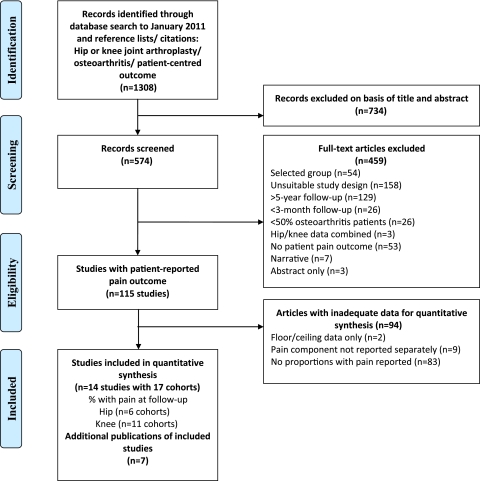
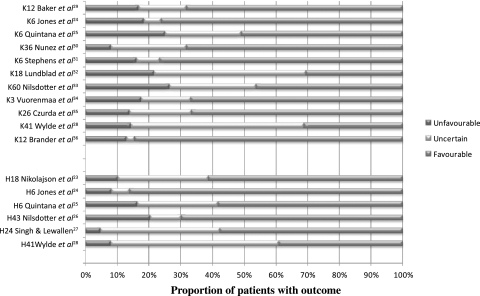
Background: Total hip or knee replacement is highly successful when judged by prosthesis-related outcomes. However, some people experience long-term pain. Objectives: To review published studies in representative populations with total hip or knee replacement for the treatment of osteoarthritis reporting proportions of people by pain intensity. Data sources: MEDLINE and EMBASE databases searched to January 2011 with no language restrictions. Citations of key articles in ISI Web of Science and reference lists were checked. Study eligibility criteria, participants and interventions: Prospective studies of consecutive, unselected osteoarthritis patients representative of the primary total hip or knee replacement population, with intensities of patient-centred pain measured after 3 months to 5-year follow-up. Study appraisal and synthesis methods: Two authors screened titles and abstracts. Data extracted by one author were checked independently against original articles by a second. For each study, the authors summarised the proportions of people with different severities of pain in the operated joint. Results: Searches identified 1308 articles of which 115 reported patient-centred pain outcomes. Fourteen articles describing 17 cohorts (6 with hip and 11 with knee replacement) presented appropriate data on pain intensity. The proportion of people with an unfavourable long-term pain outcome in studies ranged from about 7% to 23% after hip and 10% to 34% after knee replacement. In the best quality studies, an unfavourable pain outcome was reported in 9% or more of patients after hip and about 20% of patients after knee replacement. Limitations: Other studies reported mean values of pain outcomes. These and routine clinical studies are potential sources of relevant data. Conclusions and implications of key findings: After hip and knee replacement, a significant proportion of people have painful joints. There is an urgent need to improve general awareness of this possibility and to address determinants of good and bad outcomes.
Overview
The claims and statistics of this paper haven’t been checked yet.
Free: it reads the open-access text and checks the first 5 claims that cite a source we can check. Create a free account to check every claim.
Integrity signals
Registry
Cites
Statistics
Figures
Verification
Claims the paper makes
The claims and statistics of this paper haven’t been checked yet.
Free: it reads the open-access text and checks the first 5 claims that cite a source we can check. Create a free account to check every claim.
Self-check
Percentages, sums and reported differences re-computed from the paper’s own numbers.
The self-check needs the paper’s full text.
Citations
Cites
Cochrane Handbook for Systematic Reviews of Interventions: Cochrane Book Series
(2008) · doi:10.1002/9780470712184 · Cited by 25,048 · cited 1×
“Although contact with authors is a well-recognised approach in systematic reviews, 21 a survey of review authors indicated that many systematic reviewers do not do so because of poor response rates and variability in the quality of information collected this way.”
BackgroundDermyshi, E., Wang, Y., Yan, C., Hong, W., Qiu, G., Gong, X., & Zhang, T. (2017) · Neonatology · doi:10.1159/000454668 · Cited by 24,451
Meta-analysis of Observational Studies in Epidemiology<SUBTITLE>A Proposal for Reporting</SUBTITLE>
Stroup, D. F. (2000) · JAMA · doi:10.1001/jama.283.15.2008 · Cited by 20,623
Projections of Primary and Revision Hip and Knee Arthroplasty in the United States from 2005 to 2030
Kurtz, S., Ong, K., Lau, E., Mowat, F., & Halpern, M. (2007) · The Journal of Bone and Joint Surgery-American Volume · doi:10.2106/00004623-200704000-00012 · Cited by 8,698 · cited 1×
“In the USA in 2006, the estimated numbers of hospital discharges after total hip or knee replacement procedures were 231 000 and 542 000, respectively,(2) with demand predicted to increase substantially.(3) Total hip or knee replacement is highly successful when judged by prosthesis-related outcomes, such as the radio…”
BackgroundPatient Satisfaction after Total Knee Arthroplasty: Who is Satisfied and Who is Not?
Bourne, R. B., Chesworth, B. M., Davis, A. M., Mahomed, N. N., & Charron, K. D. J. (2010) · Clinical Orthopaedics & Related Research · doi:10.1007/s11999-009-1119-9 · Cited by 2,569
Ethgen, O., Bruyère, O., Richy, F., Dardennes, C., & Reginster, J.-Y. (2004) · The Journal of Bone & Joint Surgery · doi:10.2106/00004623-200405000-00012 · Cited by 1,800
National Hospital Discharge Survey, 1988: Archival Version
United States Department of Health and Human Services. National Center for Health Statistics (1991) · ICPSR Data Holdings · doi:10.3886/icpsr09521 · Cited by 1,310
Baker, P. N., van der Meulen, J. H., Lewsey, J., & Gregg, P. J. (2007) · The Journal of Bone and Joint Surgery. British volume · doi:10.1302/0301-620x.89b7.19091 · Cited by 975
Patients' Perception of Hospital Care in the United States
Jha, A. K., Orav, E. J., Zheng, J., & Epstein, A. M. (2008) · New England Journal of Medicine · doi:10.1056/nejmsa0804116 · Cited by 886 · cited 1×
“In the USA, the importance of patient-reported outcomes in assessing quality of care is recognised, 11 and in England, following the report of Lord Darzi, 12 information is routinely collected after elective surgery.”
BackgroundWylde, V., Hewlett, S., Learmonth, I. D., & Dieppe, P. (2011) · Pain · doi:10.1016/j.pain.2010.11.023 · Cited by 686 · cited 1×
“A cohort of 1394 consecutive total knee replacement patients were followed up prospectively by Wylde and colleagues 28 for a median of 41 months.”
MethodSelf-citation
Research works printed but not linked: 3
- 1. Long-term pain after total hip or knee replacement on August 11, 2021 by guest. Protected by copyright. http://bmjopen.bmj.com/ BMJ Open: first published as 10.1136/bmjopen-2011-000435 on 22 February 2012. Downloaded from REFERENCES
- 4. Long-term pain after total hip or knee replacement on August 11, 2021 by guest. Protected by copyright. http://bmjopen.bmj.com/ BMJ Open: first published as 10.1136/bmjopen-2011-000435 on 22 February 2012. Downloaded from
- 14. Darzi A. High Quality Care for All: NHS Next Stage Review Final Report. London: Department of Health, 2008.
Cited by
Items 701–800 of 1,001
Chan, B., Ward, S. E., Abdallah, F. W., Jones, C., Papachristos, A., Chin, K., Ladha, K. S., & Hare, G. M. T. (2021) · Canadian Journal of Anesthesia/Journal canadien d anesthésie · doi:10.1007/s12630-021-02145-5 · Cited by 10
“Even though the risk of chronic opioid use after surgery is relatively low (2% THA and 13% TKA at 12 weeks), it is important to consider because a large number of patients undergo surgeries.(12,13) The low incidence of long-term opioid use in this study is not dissimilar to another published study, with 4% of THA pati…”
ResultA qualitative study of pain experiences in patients requiring hip and knee arthroplasty
Leov, J., Barrett, E., Gallagher, S., & Swain, N. (2015) · Journal of Health Psychology · doi:10.1177/1359105315597054 · Cited by 10
“In a systematic review, Beswick et al. (2012) conclude from the best quality studies, unfavourable pain outcome was reported by 9 per cent or more patients who had THA and”
BackgroundSelf-Management of Hip Osteoarthritis Five Years After a Cycling and Education Treatment Pathway
Wainwright, T. W., Burgess, L. C., Immins, T., & Middleton, R. (2020) · Healthcare · doi:10.3390/healthcare8010037 · Cited by 11
Helito, C. P., Moreira, F. S., Santiago, M. A. M., Medeiros, L. D. F. B., Giglio, P. N., da Silva, A. G. M., Gobbi, R. G., & Pécora, J. R. (2023) · Clinics · doi:10.1016/j.clinsp.2023.100287 · Cited by 9
“The proportion of patients with residual pain after TKA can vary from 8 % to 27 % [18], with the neuropathic pain component possibly responsible for this postoperative outcome.”
BackgroundSu, S., Wang, R., Chen, Z., Zhou, F., & Zhang, Y. (2024) · Archives of Orthopaedic and Trauma Surgery · doi:10.1007/s00402-024-05440-0 · Cited by 9
Xin, W., Miao, Y., Yu, M., Xie, X., Xu, Y., Yan, Z., Li, D., Huang, H., Yu, Y., Wang, J., et al. (2024) · Journal of Pain · doi:10.1016/j.jpain.2024.104669 · Cited by 9
Bianco, G. L., Pugliesi, M., Misseri, G., Li, S., Day, M. R., Schatman, M. E., Abd-Elsayed, A. A., Yong, R. J., & Robinson, C. L. (2025) · Journal of Pain Research · doi:10.2147/jpr.s502453 · Cited by 9
Zajonz, D., Fakler, J., Dahse, A.-J., Zhao, F. J., Edel, M., Josten, C., & Roth, A. J. (2017) · Patient Safety in Surgery · doi:10.1186/s13037-017-0137-x · Cited by 9
Larsen, J. B., Arendt‐Nielsen, L., Simonsen, O. H., & Madeleine, P. (2020) · European Journal of Pain · doi:10.1002/ejp.1663 · Cited by 9
“However, studies have described that up to 20% of patients suffer from chronic pain following TKA (Beswick et al., 2012).”
BackgroundElectrocautery Induced Damage of Total Knee Implants
Miller, K. C., Morrow, B. R., Sorrels, J. H., Arnholt, C. M., & Mihalko, W. M. (2020) · The Journal of Arthroplasty · doi:10.1016/j.arth.2020.09.044 · Cited by 9
Prevalence and predictors of persistent pain 2 years after total shoulder arthroplasty
Puzzitiello, R. N., Menendez, M. E., Moverman, M. A., Mahendraraj, K. A., & Jawa, A. (2020) · Seminars in Arthroplasty JSES · doi:10.1053/j.sart.2020.10.002 · Cited by 9
Schild, M., Müller, U., von Schenck, U., Prieur, S., & Miller, R. E. (2021) · BMC Musculoskeletal Disorders · doi:10.1186/s12891-021-04180-1 · Cited by 11
“Yet, invasive joint surgery has inevitable risks and drawbacks, and is not appropriate for all patients, since for some, surgery involves lengthy recovery or can be associated with a risk of persistent post-surgical pain (~ 9% after hip replacement and 20% after knee replacement) [19].”
BackgroundTwiggs, J., Miles, B., Roe, J. P., Fritsch, B. A., Liu, D., Parker, D. A., Dickison, D., Shimmin, A., BarBo, J., McMahon, S. J., et al. (2021) · The Knee · doi:10.1016/j.knee.2021.08.029 · Cited by 9
Outcomes of Total Knee Arthroplasty in Patients With Rheumatoid Arthritis
Plantz, M. A., Sherman, A. E., Miller, C. H., Hardt, K. D., & Lee, Y. (2021) · Orthopedics · doi:10.3928/01477447-20210817-01 · Cited by 9
Pinedo‐Villanueva, R., Kolovos, S., Maronga, C., Delmestri, A., Howells, N., Judge, A., Gooberman‐Hill, R., & Wylde, V. (2022) · BMC Musculoskeletal Disorders · doi:10.1186/s12891-022-05492-6 · Cited by 11
“For many patients, TKR is successful at providing pain relief, however approximately 20% of patients experience chronic post-surgical pain, defined as pain that occurs or increases in intensity at three months or longer after surgery [8].”
BackgroundSelf-citationA Simple Nomogram for Predicting Osteoarthritis Severity in Patients with Knee Osteoarthritis
Zhang, Q., Yao, Y., Wang, J., Chen, Y., Ren, D., & Wang, P. (2022) · Computational and Mathematical Methods in Medicine · doi:10.1155/2022/3605369 · Cited by 9
“reported that nearly 20% of KOA patients still had persistent pain after joint replacement [13].”
Backgroundvan Brug, H. E., Nelissen, R. G. H. H., Rosendaal, F. R., van Steenbergen, L. N., van Dorp, E. L. A., Bouvy, M. L., Dahan, A., & Gademan, M. G. J. (2023) · British Journal of Anaesthesia · doi:10.1016/j.bja.2022.12.024 · Cited by 9
Hoelen, T.-C. A., Schotanus, M. G. M., van Kuijk, S. M. J., Bastiaenen, C. H. G., Boonen, B., & Most, J. (2023) · Journal of Orthopaedics · doi:10.1016/j.jor.2023.03.011 · Cited by 10
Zhong, H., Li, J., Chen, Y., Huang, Y., Wen, Z., & Zhao, J. (2023) · International Journal of Clinical Pharmacy · doi:10.1007/s11096-023-01593-x · Cited by 9
“However, despite implementing multimodal analgesia, more than half of the patients still suffer moderate to severe pain after surgery, requiring opioid consumption during the expected recovery period [3, 4].”
Griffin, J., Davis, E. T., Parsons, H. M., Stevens, S., Bradley, H., Bruce, J., Ellard, D. R., Haddad, F. S., Hutchinson, C. E., Mason, J. M., et al. (2023) · BMJ Open · doi:10.1136/bmjopen-2023-079328 · Cited by 11
Bertram, W., Wylde, V., Howells, N., Shirkey, B. A., Peters, T. J., Zhu, L., Noble, S., Johnson, E., Beswick, A. D., Moore, A. J., et al. (2023) · BMC Musculoskeletal Disorders · doi:10.1186/s12891-023-07099-x · Cited by 10
“In our systematic review of studies involving patients with TKR, 10 to 34% of patients reported moderate to severe chronic post-surgical pain [4].”
BackgroundSelf-citationSun, J., Xu, Y., Zhu, J., Zhu, B., & Gao, W. (2024) · International Journal of Nursing Sciences · doi:10.1016/j.ijnss.2024.03.013 · Cited by 18
“In a meta-analysis of 14 studies, Beswick et al. [46] found that pain levels were reduced after lower limb joint replacement compared with preoperative.”
BackgroundMethodLape, E. C., Hudak, P. L., Davis, A. M., & Katz, J. N. (2019) · ACR Open Rheumatology · doi:10.1002/acr2.1014 · Cited by 9
“These procedures are effective; over 80% of TKR recipients and 90% of THR recipients experience substantial improvements in pain and function (10).”
BackgroundGang, B.-G., Shin, J., Lee, J., Lee, Y. J., Cho, H.-W., Kim, M.-R., Kang, K., Koh, W., Kim, E., Park, Y., et al. (2020) · Frontiers in Medicine · doi:10.3389/fmed.2020.524628 · Cited by 11
“However, even after surgery, ∼20% of patients continue to experience persistent pain (10), in addition to persistent limitations in range of motion (11).”
BackgroundBetz, U., Langanki, L., Heid, F., Spielberger, J., Schollenberger, L., Kronfeld, K., Büttner, M., Büchler, B., Goldhofer, M., Eckhard, L. S., et al. (2020) · Acta Orthopaedica · doi:10.1080/17453674.2020.1853927 · Cited by 10
“A previous report has indicated that approximately 9% of patients report chronic pain after 1 year (Beswick et al. 2012).”
BackgroundMethodInfluentialMohammad, H. R., Judge, A., & Murray, D. W. (2021) · Acta Orthopaedica · doi:10.2340/17453674.2021.896 · Cited by 9
“14 2009 12,996 (5) 804 (11) 628 (9) 800 (11) 2010 21,257 (8) 951 (13) 889 (12) 949 (13) 2011 23,657 (10) 909 (13) 960 (13) 909 (13) 2012 24,117 (10) 733 (10) 866 (12) 732 (10) 2013 26,471 (11) 622 (9) 807 (11) 622 (9) 2014 28,855 (12) 747 (10) 808 (11) 747 (10) 2015 28,351 (11) 754 (10) 699 (10) 754 (11) 2016 29,222 (…”
BackgroundRockel, J. S., Layeghifard, M., Rampersaud, Y. R., Perruccio, A. V., Mahomed, N. N., Davey, J. R., Syed, K., Gandhi, R. A., & Kapoor, M. (2022) · Osteoarthritis and Cartilage Open · doi:10.1016/j.ocarto.2022.100258 · Cited by 10
“For example, despite the general effectiveness of TKA for knee OA, not all patients respond to surgery [28].”
BackgroundSmokers have increased risk of soft-tissue complications following primary elective TKA
Starzer, M., Smolle, M. A., Vielgut, I., Hauer, G., Leitner, L., Radl, R., Ehall, R., Leithner, A., & Sadoghi, P. (2023) · Archives of Orthopaedic and Trauma Surgery · doi:10.1007/s00402-023-04771-8 · Cited by 10
Riffin, C. A., Pillemer, K. A., Reid, M. C., Tung, J., & Löckenhoff, C. E. (2016) · The Journals of Gerontology Series B · doi:10.1093/geronb/gbw023 · Cited by 12
Seah, R. B., Lim, W. S. R., Lo, N. N., Yew, A. K. S., Chong, H. C., & Yeo, S. J. (2016) · The Journal of Arthroplasty · doi:10.1016/j.arth.2016.09.035 · Cited by 9
Orndahl, C. M., Perera, R. A., & Riddle, D. L. (2020) · Physical Therapy · doi:10.1093/ptj/pzaa182 · Cited by 9
Costello, C. A., Rockel, J. S., Liu, M., Gandhi, R., Perruccio, A. V., Rampersaud, Y. R., Mahomed, N. N., Rahman, P., Randell, E. W., Furey, A. J., et al. (2022) · Rheumatology · doi:10.1093/rheumatology/keac545 · Cited by 11
“A previous meta-analysis showed an average of 20% of patients reporting long-term sustained pain post-TKA [23].”
MethodHasegawa, M., Tone, S., Naito, Y., & Sudo, A. (2021) · Research Square · doi:10.21203/rs.3.rs-190757/v2 · Cited by 9
Londhe, S. B., Shetty, S., Vora, N. L., Shah, A., Nair, R., & Shetty, V. D. (2023) · Journal of Clinical Orthopaedics and Trauma · doi:10.1016/j.jcot.2023.102106 · Cited by 8
Fibromyalgia Increases Post-operative Healthcare Utilization Following total Hip Arthroplasty
Morrell, A. T., Mildren, M. E., Smith, S. J., Yoo, J. U., & Kagan, R. P. (2023) · The Journal of Arthroplasty · doi:10.1016/j.arth.2023.04.019 · Cited by 8
Turnbull, S., Walsh, N. E., & Moore, A. J. (2023) · Journal of Medical Internet Research · doi:10.2196/42551 · Cited by 8
“However, it includes risks, with approximately 20% of the patients experiencing ongoing pain or dissatisfaction after knee replacement [9].”
Karaoğlan, M., & Küçükçay, B. (2024) · Hip International · doi:10.1177/11207000241227542 · Cited by 8
Syed, I., Al-Rubaie, S., Cohen, D., Slawaska‐Eng, D., Al-Besher, M. N., & Khanna, V. (2025) · The Journal of Arthroplasty · doi:10.1016/j.arth.2025.03.027 · Cited by 8
Omar, I., Wylde, V., Fogg, J., Whitehouse, M. R., & Bertram, W. (2025) · BMC Musculoskeletal Disorders · doi:10.1186/s12891-025-08637-5 · Cited by 10
Self-citationFrézier, M., Delsart, A., Lefort-Holguin, M., Lachapelle, S., Otis, C., Lussier, B., Beaudry, H., Castel, A., & Troncy, É. (2025) · Frontiers in Pain Research · doi:10.3389/fpain.2025.1709275 · Cited by 10
Wainwright, T. W., Burgess, L. C., Immins, T., Cowan, N., & Middleton, R. (2020) · SAGE Open Medicine · doi:10.1177/2050312120946522 · Cited by 8
Vaishy, A. K., Arif, M., Aanand, R., Singh, K., Rulaniya, H. K., Kumawat, N., Choudhary, R., & Choudhary, P. (2022) · International Orthopaedics · doi:10.1007/s00264-022-05364-7 · Cited by 8
Gelderman, S. J., van Jonbergen, H., van Steenbergen, L. N., Landman, E. B. M., & Kleinlugtenbelt, Y. V. (2023) · Journal of Orthopaedics · doi:10.1016/j.jor.2023.04.020 · Cited by 8
Perrin, T., Bonnomet, F., Diemunsch, S., Drawin, L., Pottecher, J., & Noll, É. (2023) · International Orthopaedics · doi:10.1007/s00264-023-05903-w · Cited by 8
“Previous studies have focused on PROMs-based benefits associated with TKA or THA [2, 17–19].”
Anderson, A. M., McHugh, G. A., Comer, C. M., Joseph, J. A., Smith, T. O., Yardley, L., & Redmond, A. C. (2023) · Health Expectations · doi:10.1111/hex.13855 · Cited by 9
“3.”
Battista, L., & Wickline, A. (2023) · Journal of Orthopaedic Experience & Innovation · doi:10.60118/001c.89994 · Cited by 10
Sattler, L. N., Walker, A., Kan, A., Hing, W. A., & Vertullo, C. J. (2024) · The Journal of Arthroplasty · doi:10.1016/j.arth.2024.02.002 · Cited by 8
Clement, N. D., Jones, S., Afzal, I., & Kader, D. F. (2024) · European Journal of Orthopaedic Surgery & Traumatology · doi:10.1007/s00590-024-03870-5 · Cited by 8
“It is well recognised that KA is associated with unfavourable outcomes in 10% to 34% of patients and more specifically 20% have unfavourable outcomes in relation to pain relief from their KA [6].”
Molder, M. E. M. T., Dowsey, M. M., Smolders, J. M. H., van Steenbergen, L. N., van den Ende, C. H. M., & Heesterbeek, P. J. C. (2024) · The Journal of Arthroplasty · doi:10.1016/j.arth.2024.05.032 · Cited by 8
Hertel, E., de Andrade, D. C., & Petersen, K. K. (2024) · Pain · doi:10.1097/j.pain.0000000000003292 · Cited by 10
Pacheco‐Brousseau, L., Stacey, D., Desmeules, F., Amor, S. B., Dervin, G. F., Beaulé, P. E., Wai, E. K., & Poitras, S. (2024) · Musculoskeletal Care · doi:10.1002/msc.1927 · Cited by 9
Baas, D. C., Aalderen-Wichers, J. C. V., der Goot, T. H. V., & Verhagen, R. J. (2024) · Acta Orthopaedica · doi:10.2340/17453674.2024.41346 · Cited by 10
Unger, M., Murthy, N. S., Kanwar, R., Strand, K. A., Maus, T. P., & Beutler, A. S. (2018) · PLoS ONE · doi:10.1371/journal.pone.0201673 · Cited by 8
Otis, C., Guillot, M., Moreau, M., Pelletier, J., Beaudry, F., & Troncy, É. (2019) · Clinical and Experimental Pharmacology and Physiology · doi:10.1111/1440-1681.13100 · Cited by 9
Vissers, L. C. M., van Hove, R. P., & van der Zwaard, B. C. (2020) · The Knee · doi:10.1016/j.knee.2020.04.006 · Cited by 8
Understanding the Mechanisms of Pain in Rheumatoid Arthritis
Biddle, K., & Sofat, N. (2020) · IntechOpen eBooks · doi:10.5772/intechopen.93829 · Cited by 12
Arthroscopic management of unexplained pain following total knee arthroplasty
Butnaru, M., Senioris, A., Pagenstert, G., Müller, J. H., Saffarini, M., Dujardin, F. H., & Courage, O. (2021) · Archives of Orthopaedic and Trauma Surgery · doi:10.1007/s00402-021-03924-x · Cited by 8
“Finally, larger cohort studies are needed since this study only reports findings on a small cohort of 11 knees when compared to other reports on unexplained pain [4, 5].”
BackgroundTassani, S., Tío, L., Castro-Dominguez, F., Monfort, J., Monllau, J. C., Ballester, M. Á. G., & Noailly, J. (2022) · Frontiers in Bioengineering and Biotechnology · doi:10.3389/fbioe.2022.820186 · Cited by 8
“Nevertheless, the proportion of people with unfavorable long-term outcomes ranges from 10 to 34% (Beswick et al., 2012).”
BackgroundRammohan, R., Nugent, L., Kasture, S. P., & Ganapathi, M. (2022) · Archives of Orthopaedic and Trauma Surgery · doi:10.1007/s00402-022-04593-0 · Cited by 9
“Despite improved longevity, 20% of patients continue to report pain and functional limitation after TKA [3].”
BackgroundKafelov, M., Farhat, J., Servıen, E., Lustıg, S., & Batailler, C. (2023) · SICOT-J · doi:10.1051/sicotj/2023027 · Cited by 8
“A systematic review has shown that between 10 and 34% of patients have an undesirable pain outcome after a primary TKA [3].”
BackgroundImplants for Joint Replacement of the Hip and Knee
Gallo, J., Gibon, E., & Goodman, S. B. (2016) · Elsevier eBooks · doi:10.1016/b978-0-12-802792-9.00004-5 · Cited by 12
Do Knee Pain Phenotypes Have Different Risks of Total Knee Replacement?
Pan, F., Tian, J., Munugoda, I. P., Graves, S. E., Lorimer, M. F., Cicuttini, F., & Jones, G. (2020) · Journal of Clinical Medicine · doi:10.3390/jcm9030632 · Cited by 8
“Given that pain is the most important factor in making a decision for TKR [4], we hypothesized that participants in Class 1 may have a higher risk of taking a TKR than those in Class 2 and 3.”
BackgroundResultVestergaard, V., Iban, Y. C., Kappel, A., Melnic, C. M., Bedair, H. S., Huddleston, J. I., Bragdon, C. R., Malchau, H., & Troelsen, A. (2020) · The Journal of Arthroplasty · doi:10.1016/j.arth.2020.08.033 · Cited by 8
Pacheco‐Brousseau, L., Charette, M., Stacey, D., & Poitras, S. (2021) · Systematic Reviews · doi:10.1186/s13643-020-01549-6 · Cited by 8
New ultrasound-guided techniques in chronic pain management: an update
Ergönenç, T., & Stockman, J. (2021) · Current Opinion in Anaesthesiology · doi:10.1097/aco.0000000000001037 · Cited by 8
“In addition, persistent postoperative pain may occur in as many as 7–28% of patients [5].”
BackgroundSergooris, A., Verbrugghe, J., Baets, L. D., Meeus, M., Roussel, N. A., Smeets, R., Bogaerts, K., & Timmermans, A. A. A. (2023) · Annals of Physical and Rehabilitation Medicine · doi:10.1016/j.rehab.2022.101712 · Cited by 12
Moghimi, F. H., de Steiger, R. N., Schaffer, J. L., & Wickramasinghe, N. S. (2013) · Health and Technology · doi:10.1007/s12553-013-0057-4 · Cited by 8
“After hip and knee replacement interventions, a significant proportion of people have painful joints [9].”
BackgroundElman, S. A., Dong, Y., Stenquist, D. S., Ghazinouri, R., Alcantara, L., Collins, J. E., Beagan, C., Thornhill, T. S., & Katz, J. N. (2014) · BMC Musculoskeletal Disorders · doi:10.1186/1471-2474-15-207 · Cited by 9
Hansen, B. K., Pekas, D. R., Burks, G., Sandefur, E. P., Apel, P. J., & Adrados, M. (2025) · The Journal of Arthroplasty · doi:10.1016/j.arth.2024.12.027 · Cited by 10
Reisinger, L., Cozowicz, C., Poeran, J., Zhong, H., Illescas, A., Giannakis, P., Liu, J., Kim, D. H., & Memtsoudis, S. G. (2025) · British Journal of Anaesthesia · doi:10.1016/j.bja.2025.03.014 · Cited by 7
Kris, I., Kan, A., Talbot, W., Hing, W. A., & Sattler, L. N. (2025) · Musculoskeletal Science and Practice · doi:10.1016/j.msksp.2025.103371 · Cited by 9
Can recent chronic pain techniques help with acute perioperative pain?
Arboleda, M. F., Girón‐Arango, L., & Peng, P. (2019) · Current Opinion in Anaesthesiology · doi:10.1097/aco.0000000000000772 · Cited by 7
“The prevalence of CPSP is approximately 9% and 20% of patients following total hip arthroplasty (THA) and total knee arthroplasty (TKA), respectively [4].”
BackgroundInfluentialTurppo, V., Sund, R., Huopio, J., Kröger, H., & Sirola, J. P. (2022) · Acta Orthopaedica · doi:10.2340/17453674.2022.2929 · Cited by 7
“However, prior studies have shown THA and TKA patients reporting unfavorable longterm pain outcomes from 2% to even over 20% (5,6).”
BackgroundSingh, V., Tang, A., Bieganowski, T., Anil, U., Macaulay, W. B., Schwarzkopf, R. M., & Davidovitch, R. I. (2022) · World Journal of Orthopedics · doi:10.5312/wjo.v13.i8.703 · Cited by 8
Abdalla, I., Robertson, A. P., Tippett, V. C., Walsh, T. P., & Platt, S. R. (2022) · Journal of Foot and Ankle Research · doi:10.1186/s13047-022-00590-z · Cited by 7
“Sustained pain is more common than many people may appreciate, with unfavourable pain outcomes following total joint arthroplasty at the hip and knee ranging from 7 to 23% and 10–34%, respectively [4].”
BackgroundMoore, A. J., Wylde, V., Bertram, W., Beswick, A. D., Howells, N., & Gooberman‐Hill, R. (2023) · PLoS ONE · doi:10.1371/journal.pone.0284406 · Cited by 7
Self-citationKhalid, T., Ben‐Shlomo, Y., Bertram, W., Culliford, L. A., England, C. Y., Henderson, E. J., Jameson, C., Jepson, M., Palmer, S., Whitehouse, M. R., et al. (2023) · Pilot and Feasibility Studies · doi:10.1186/s40814-023-01363-6 · Cited by 8
“However, there are a proportion of patients who experience adverse post-operative outcomes, including surgical and medical complications, mortality, chronic postsurgical pain, and long-term functional limitations [4–7].”
BackgroundSelf-citationMekkawy, K. L., Rodriguez, H. C., Gösthe, R. G., Corces, A., & Roche, M. W. (2023) · The Journal of Arthroplasty · doi:10.1016/j.arth.2023.08.008 · Cited by 7
Foley, K. A., Schwarzkopf, R. M., Culp, B. M., Bradley, M. P., Muir, J. M., & McIntosh, E. I. (2023) · Computer Assisted Surgery · doi:10.1080/24699322.2023.2267749 · Cited by 7
“Typical complications include component loosening, instability, dislocation, infection, and fracture [6], with a large proportion of patients – up to 20–25% by some reports – reporting minor complications including knee pain or reduced range of motion [7–10].”
BackgroundIMU-Based Kinematics Estimation Accuracy Affects Gait Retraining Using Vibrotactile Cues
Rokhmanova, N., Pearl, O., Kuchenbecker, K. J., & Halilaj, E. (2024) · IEEE Transactions on Neural Systems and Rehabilitation Engineering · doi:10.1109/tnsre.2024.3365204 · Cited by 9
Johns, N. A., Naylor, J., McKenzie, D., Brady, B., & Olver, J. (2024) · Musculoskeletal Care · doi:10.1002/msc.1866 · Cited by 7
Bianco, G. L., D’angelo, F. P., Santos, G. F. D., Stogicza, A. R., Leoni, M. L. G., Trescot, A. M., Yong, R. J., & Robinson, C. L. (2025) · Pain and Therapy · doi:10.1007/s40122-025-00727-5 · Cited by 7
“…stiffness, and physical function related to osteoarthritis [19], the DN4 questionnaire was employed to determine the presence of neuropathic pain, with scores ≥ 4 indicating neuropathic pain [20], and the EQ-5D index measured health-related quality of life at baseline and during follow-up [21].”
Yang, R., Zhao, D., Zhang, X., Liu, R., Xu, G., & Shen, Q. (2020) · Pain Practice · doi:10.1111/papr.12931 · Cited by 7
“significantly reduced the patients’ quality of life (QoL).(3,4) Inhalation anesthesia and total intravenous anesthesia are 2 common methods of general anesthesia (GA).”
BackgroundNiazi, F., Ong, K. L., Kidd, V. D., Lau, E., Kurtz, S. M., Dysart, S. H., & Malanga, G. A. (2020) · Pain Management · doi:10.2217/pmt-2020-0057 · Cited by 7
Przkora, R., Sibille, K. T., Victor, S., Meroney, M., Leeuwenburgh, C., Gardner, A. K., Vasilopoulos, T., & Parvataneni, H. K. (2021) · European Journal of Translational Myology · doi:10.4081/ejtm.2021.9673 · Cited by 7
Evaluation of local tissue peri-implant reaction in total knee arthroplasty failure cases
Brozovich, A., Clyburn, T. A., Park, K., Harper, K. D., Sullivan, T. C., Incavo, S. J., & Taraballi, F. (2022) · Therapeutic Advances in Musculoskeletal Disease · doi:10.1177/1759720x221092263 · Cited by 7
Johns, N. A., Naylor, J., McKenzie, D. P., Brady, B., & Olver, J. (2022) · BMC Musculoskeletal Disorders · doi:10.1186/s12891-022-05800-0 · Cited by 9
“Background Moderate to severe persistent knee pain, defined as pain persisting beyond 3 post-operative months following a primary total knee replacement, has been estimated in a systematic review of observational studies to affect between 8 to 26% of people [1].”
BackgroundGustafsson, K., Kvist, J., Eriksson, M., & Rolfson, O. (2023) · Clinical Orthopaedics and Related Research · doi:10.1097/corr.0000000000002681 · Cited by 7
“proportions reported in previous research [4, 6, 33], but still”
BackgroundResultZhang, Q., Li, J., Yao, Y., Hu, J., Lin, Y., Meng, X., Zhao, Y., & Wang, Y. (2023) · Medicine · doi:10.1097/md.0000000000034481 · Cited by 8
“[30] At present, the main treatment strategies for KOA are analgesia and surgery,[31] and artificial joint replacement is an important method for treating severe pain and joint deformity in the late KOA period; however, 20% of patients with KOA still experience persistent pain after joint replacement.[32] However, owi…”
Karaoğlu, S. Ş., Sarı, S., Ekin, Y., Özkan, Y., & Aydin, O. N. (2024) · Pain Medicine · doi:10.1093/pm/pnae016 · Cited by 7
Genicular Nerve Radiofrequency Ablation: A Novel Approach to Symptomatic Knee Osteoarthritis
Kidd, V. D. (2018) · JBJS Journal of Orthopaedics for Physician Assistants · doi:10.2106/jbjs.jopa.17.00039 · Cited by 8
Chronic Postoperative Pain After Hysterectomy for Endometrial Cancer: A Metabolic Profiling Study
Lunde, S., Nguyen, H. T., Petersen, K. K., Arendt‐Nielsen, L., Krarup, H. B., & Søgaard-Andersen, E. (2020) · Molecular Pain · doi:10.1177/1744806920923885 · Cited by 9
Olsen, U., Lindberg, M. F., Denison, E., Rose, C. J., Gay, C., Aamodt, A., Brox, J. I., Skare, Ø., Furnes, O. N., Lee, K. A., et al. (2020) · BMJ Open · doi:10.1136/bmjopen-2020-037674 · Cited by 7
Stenquist, D. S., Ready, L. V., Ghazinouri, R., Beagan, C., Wisdom, A., & Katz, J. N. (2020) · JAAOS Global Research and Reviews · doi:10.5435/jaaosglobal-d-20-00074 · Cited by 8
Ammitzbøll, N., Arendt‐Nielsen, L., Bertoli, D., Brock, C., Olesen, A. E., Kappel, A., Drewes, A. M., & Petersen, K. K. (2021) · Trials · doi:10.1186/s13063-021-05941-y · Cited by 7
“However, it seems evident that a subset of patients does not gain sufficient pain relief from these treatments [13, 14, 53].”
BackgroundHAWKER, G. A. (2023) · Arthritis Care & Research · doi:10.1002/acr.25202 · Cited by 7
“…outcomes from many longitudinal observational cohort studies, which show that most TJA recipients experience substantial, sustained improvement in joint pain, mobility, and emotional status, but that about one in fi ve TJA recipients will not, resulting in dissatisfaction with their results (13,14).”
BackgroundSethi, G., Aljawadi, A., Elmajee, M., & Pillai, A. (2019) · Journal of Orthopaedics · doi:10.1016/j.jor.2019.12.006 · Cited by 7
Digital Care Programs for Chronic Hip Pain: A Prospective Longitudinal Cohort Study
Janela, D., Costa, F. M. T. A., Areias, A. C., Molinos, M., Moulder, R. G., Jr., Laíns, J., Bento, V., Scheer, J. K., Yanamadala, V., Cohen, S. P., et al. (2022) · Healthcare · doi:10.3390/healthcare10081595 · Cited by 8
“Adding to higher risks of complications [15], the small differences in hip outcomes observed between”
BackgroundMarch, M. K., & Roberts, K. E. (2024) · BMC Musculoskeletal Disorders · doi:10.1186/s12891-024-08107-4 · Cited by 7
Martinson, E. S., Clement, N. D., Leitch, G., & Scott, C. E. H. (2025) · Bone & Joint Open · doi:10.1302/2633-1462.68.bjo-2025-0105.r1 · Cited by 6
“9,10 10–12 When employing a PROM, such as the OKS, a summative score may hide benefits from KA, according to each of the questions being asked.”
Metadata
- Authors
- Beswick, A. D., Wylde, V., Gooberman-Hill, R., Blom, A., & Dieppe, P.
- Affiliations
- University of Bristol (GB)
- Peninsula College of Medicine and Dentistry (GB)
- Corresponding author
- Beswick, Andrew David
- Venue
- BMJ Open
- Publisher
- BMJ
- Published
- 2012
- Volume
- 2
- Issue
- 1
- Pages
- e000435
- ISSN
- 2044-6055 (ISSN-L)
- PMC
- PMC3289991
- OpenAlex
- W1990076794
- Semantic Scholar
- 45725c70617c53d281ed2739cb53edc2494a7ac5
- Cited by
- 1,450
- References
- 56
- Citations by year
- 2026: 85 · 2025: 134 · 2024: 141 · 2023: 162 · 2022: 136 · 2021: 147 · 2020: 136 · 2019: 106 · 2018: 103 · 2017: 74 · 2016: 72 · 2015: 58 · 2014: 44 · 2013: 42 · 2012: 8
- FWCI
- 9.41
- Type
- journal article
- Language
- en
- Open access
- gold
- doi.org
- Licence
- cc-by-nc
- Locations
- BMJ Open (publishedVersion, cc-by-nc)
- PubMed Central (publishedVersion, cc-by-nc)
- PubMed (publishedVersion)
- Bristol Research (University of Bristol) (submittedVersion)
- Funders
- National Institute for Health and Care Research (RP-PG-0407-10070)
- Programme Grants for Applied Research
- Topics
- Health Sciences › Medicine › Surgery › Total Knee Arthroplasty Outcomes
- Health Sciences › Medicine › Surgery › Orthopaedic implants and arthroplasty
- Health Sciences › Medicine › Anesthesiology and Pain Medicine › Anesthesia and Pain Management
- Keywords
- total hip arthroplasty, total knee arthroplasty, osteoarthritis, chronic pain, postoperative pain, pain intensity, patient-centered outcomes, joint replacement outcomes, unselected patients
About these checks
Registry, retraction, Cites and statistics results are computed, not judged, with one exception: a printed reference that no index lists is read once by a model before it counts as a citation error. Claims are extracted by a model and kept only when their quote appears verbatim in the text; each cited source is then checked, with a model’s help, for whether it says what the claim relies on. Those verdicts can be wrong — read the claim’s quote and the cited source before relying on one.
Statistics and arithmetic are recomputed, not judged.
Confidence bands are shown only for fields calibrated on our annotated test set. None is calibrated yet, so no band is shown.
What counts as a claim ›How we measure confidence ›How we check this ›
Are you an author, or do you see a problem with this page? Request a review
Data sources
Bibliographic data: Semantic Scholar, OpenAlex, Crossref.
Contains information from the Semantic Scholar Academic Graph Datasets, made available under the ODC Attribution License (ODC-BY 1.0).
Semantic Scholar’s data is described in: Kinney, R., et al. (2023). The Semantic Scholar Open Data Platform. arXiv:2301.10140.
