

What proportion of patients report long-term pain after total hip or knee replacement for osteoarthritis? A systematic review of prospective studies in unselected patients
Open accessThe DOI matches its Crossref record; 56 of the 56 references it cites were found in a registry or an index.
Abstract
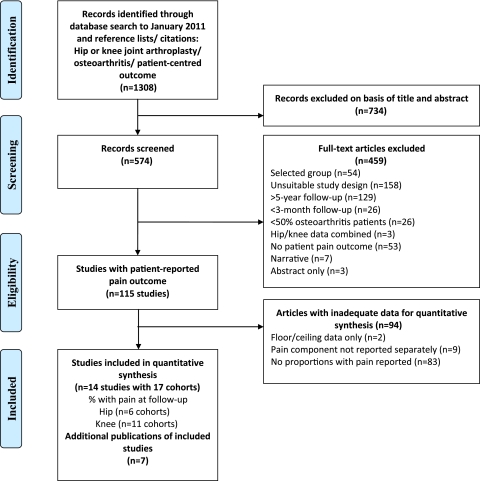
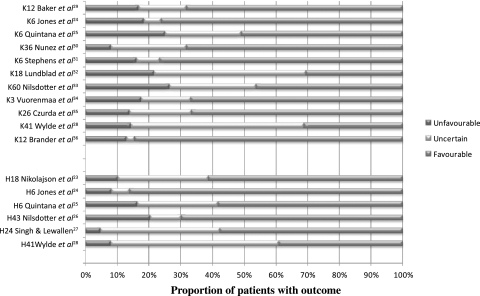
Background: Total hip or knee replacement is highly successful when judged by prosthesis-related outcomes. However, some people experience long-term pain. Objectives: To review published studies in representative populations with total hip or knee replacement for the treatment of osteoarthritis reporting proportions of people by pain intensity. Data sources: MEDLINE and EMBASE databases searched to January 2011 with no language restrictions. Citations of key articles in ISI Web of Science and reference lists were checked. Study eligibility criteria, participants and interventions: Prospective studies of consecutive, unselected osteoarthritis patients representative of the primary total hip or knee replacement population, with intensities of patient-centred pain measured after 3 months to 5-year follow-up. Study appraisal and synthesis methods: Two authors screened titles and abstracts. Data extracted by one author were checked independently against original articles by a second. For each study, the authors summarised the proportions of people with different severities of pain in the operated joint. Results: Searches identified 1308 articles of which 115 reported patient-centred pain outcomes. Fourteen articles describing 17 cohorts (6 with hip and 11 with knee replacement) presented appropriate data on pain intensity. The proportion of people with an unfavourable long-term pain outcome in studies ranged from about 7% to 23% after hip and 10% to 34% after knee replacement. In the best quality studies, an unfavourable pain outcome was reported in 9% or more of patients after hip and about 20% of patients after knee replacement. Limitations: Other studies reported mean values of pain outcomes. These and routine clinical studies are potential sources of relevant data. Conclusions and implications of key findings: After hip and knee replacement, a significant proportion of people have painful joints. There is an urgent need to improve general awareness of this possibility and to address determinants of good and bad outcomes.
Overview
The claims and statistics of this paper haven’t been checked yet.
Free: it reads the open-access text and checks the first 5 claims that cite a source we can check. Create a free account to check every claim.
Integrity signals
Registry
Cites
Statistics
Figures
Verification
Claims the paper makes
The claims and statistics of this paper haven’t been checked yet.
Free: it reads the open-access text and checks the first 5 claims that cite a source we can check. Create a free account to check every claim.
Self-check
Percentages, sums and reported differences re-computed from the paper’s own numbers.
The self-check needs the paper’s full text.
Citations
Cites
Cochrane Handbook for Systematic Reviews of Interventions: Cochrane Book Series
(2008) · doi:10.1002/9780470712184 · Cited by 25,048 · cited 1×
“Although contact with authors is a well-recognised approach in systematic reviews, 21 a survey of review authors indicated that many systematic reviewers do not do so because of poor response rates and variability in the quality of information collected this way.”
BackgroundDermyshi, E., Wang, Y., Yan, C., Hong, W., Qiu, G., Gong, X., & Zhang, T. (2017) · Neonatology · doi:10.1159/000454668 · Cited by 24,451
Meta-analysis of Observational Studies in Epidemiology<SUBTITLE>A Proposal for Reporting</SUBTITLE>
Stroup, D. F. (2000) · JAMA · doi:10.1001/jama.283.15.2008 · Cited by 20,623
Projections of Primary and Revision Hip and Knee Arthroplasty in the United States from 2005 to 2030
Kurtz, S., Ong, K., Lau, E., Mowat, F., & Halpern, M. (2007) · The Journal of Bone and Joint Surgery-American Volume · doi:10.2106/00004623-200704000-00012 · Cited by 8,698 · cited 1×
“In the USA in 2006, the estimated numbers of hospital discharges after total hip or knee replacement procedures were 231 000 and 542 000, respectively,(2) with demand predicted to increase substantially.(3) Total hip or knee replacement is highly successful when judged by prosthesis-related outcomes, such as the radio…”
BackgroundPatient Satisfaction after Total Knee Arthroplasty: Who is Satisfied and Who is Not?
Bourne, R. B., Chesworth, B. M., Davis, A. M., Mahomed, N. N., & Charron, K. D. J. (2010) · Clinical Orthopaedics & Related Research · doi:10.1007/s11999-009-1119-9 · Cited by 2,569
Ethgen, O., Bruyère, O., Richy, F., Dardennes, C., & Reginster, J.-Y. (2004) · The Journal of Bone & Joint Surgery · doi:10.2106/00004623-200405000-00012 · Cited by 1,800
National Hospital Discharge Survey, 1988: Archival Version
United States Department of Health and Human Services. National Center for Health Statistics (1991) · ICPSR Data Holdings · doi:10.3886/icpsr09521 · Cited by 1,310
Baker, P. N., van der Meulen, J. H., Lewsey, J., & Gregg, P. J. (2007) · The Journal of Bone and Joint Surgery. British volume · doi:10.1302/0301-620x.89b7.19091 · Cited by 975
Patients' Perception of Hospital Care in the United States
Jha, A. K., Orav, E. J., Zheng, J., & Epstein, A. M. (2008) · New England Journal of Medicine · doi:10.1056/nejmsa0804116 · Cited by 886 · cited 1×
“In the USA, the importance of patient-reported outcomes in assessing quality of care is recognised, 11 and in England, following the report of Lord Darzi, 12 information is routinely collected after elective surgery.”
BackgroundWylde, V., Hewlett, S., Learmonth, I. D., & Dieppe, P. (2011) · Pain · doi:10.1016/j.pain.2010.11.023 · Cited by 686 · cited 1×
“A cohort of 1394 consecutive total knee replacement patients were followed up prospectively by Wylde and colleagues 28 for a median of 41 months.”
MethodSelf-citation
Research works printed but not linked: 3
- 1. Long-term pain after total hip or knee replacement on August 11, 2021 by guest. Protected by copyright. http://bmjopen.bmj.com/ BMJ Open: first published as 10.1136/bmjopen-2011-000435 on 22 February 2012. Downloaded from REFERENCES
- 4. Long-term pain after total hip or knee replacement on August 11, 2021 by guest. Protected by copyright. http://bmjopen.bmj.com/ BMJ Open: first published as 10.1136/bmjopen-2011-000435 on 22 February 2012. Downloaded from
- 14. Darzi A. High Quality Care for All: NHS Next Stage Review Final Report. London: Department of Health, 2008.
Cited by
Items 801–900 of 1,001
Pop, A. M., & Hirschmann, M. T. (2025) · Archives of Orthopaedic and Trauma Surgery · doi:10.1007/s00402-025-06049-7 · Cited by 8
“A considerable number of patients experience persistent pain after TKA, which is in contrast to total hip arthroplasty [7–10].”
Park, S. A., & Jeong, Y. (2023) · Orthopaedic Nursing · doi:10.1097/nor.0000000000000913 · Cited by 9
Motififard, M., Hatami, S., Feizi, A., Toghyani, A., & Parhamfar, M. (2023) · Journal of Research in Medical Sciences · doi:10.4103/jrms.jrms_416_22 · Cited by 7
“[6] In fact, since the incidence of chronic postoperative pain following TKA is in approximately 20% of the patients,[7] controlling postoperative pain is one of the main challenges in this respect.”
BackgroundWilson, J. M., Madden, V. J., Pester, B., Yoon, J., Papianou, L. N., Meints, S. M., Campbell, C. M., Smith, M. T., Haythornthwaite, J. A., Edwards, R. R., et al. (2023) · Innovation in Aging · doi:10.1093/geroni/igad045 · Cited by 6
“However, a subgroup of roughly 10% to 33% of patients continues to experience persistent pain (i.e., present for ≥3 months) and difficulty performing daily activities (Beswick et al., 2012; Wylde et al., 2007).”
BackgroundZacher, S., Lauberger, J., Thiel, C., Lühnen, J., & Steckelberg, A. (2023) · BMC Health Services Research · doi:10.1186/s12913-023-09993-5 · Cited by 6
“About 20% of patients report unsat-isfactory pain reduction [13].”
BackgroundRognsvåg, T., Bergvad, I. B., Furnes, O. N., Indrekvam, K., Lerdal, A., Lindberg, M. F., Skou, S. T., Stubberud, J., & Badawy, M. (2024) · Pilot and Feasibility Studies · doi:10.1186/s40814-024-01470-y · Cited by 7
Froidefond, P., Nasso, V., Petitgenet, E., Sawasdee, N., Cavaignac, É., & Faruch, M. (2024) · Orthopaedics & Traumatology Surgery & Research · doi:10.1016/j.otsr.2024.103858 · Cited by 6
Ozcan, D., Ünver, B., & Karatosun, V. (2024) · Physiotherapy Theory and Practice · doi:10.1080/09593985.2024.2337784 · Cited by 6
“However, up to 35% of patients who underwent TKA reported chronic pain (Hofmann, Seitlinger, Djahani, and Pietsch, 2011), and up to 20% of patients stated that they were not satisfied with the postoperative outcome (Beswick et al., 2012).”
Wilson, J. M., Yoon, J., Mun, C. J., Meints, S. M., Campbell, C. M., Haythornthwaite, J. A., Smith, M. T., Edwards, R. R., & Schreiber, K. L. (2024) · Brain Behavior and Immunity · doi:10.1016/j.bbi.2024.06.001 · Cited by 9
Impieri, L., Mazzoli, G., Pezzi, A., Peretti, G. M., Mangiavini, L., & Rossi, N. (2024) · Journal of Orthopaedic Reports · doi:10.1016/j.jorep.2024.100477 · Cited by 8
Blichfeldt‐Eckhardt, M. R., Varnum, C., Lauridsen, J. T., Rasmussen, L. E., Mortensen, W. C. P., Jensen, H. I., Vægter, H. B., & Lambertsen, K. L. (2024) · Bone and Joint Research · doi:10.1302/2046-3758.1312.bjr-2024-0103.r1 · Cited by 9
Petersen, K. K., Arendt‐Nielsen, L., Vela, J., Skou, S. T., Eld, M., Al-Mashkur, N. M., Boesen, M., Riis, R., & Simonsen, O. H. (2019) · Clinical Journal of Pain · doi:10.1097/ajp.0000000000000768 · Cited by 8
“For each slice, the most severe change was noted (0 to 3) for the following 3 histopathologic qualities according to Krenn et al20: (1) hyperplasia/enlargement of the synovial lining cell layer, (2) inflammatory infiltration, and (3) activation of the synovial stroma.”
MethodЕвгеньевич, П. М., Panov, N. V., Ovechkin, A. M., & Sokologorskiy, S. V. (2020) · Annals of critical care · doi:10.21320/1818-474x-2020-1-25-32 · Cited by 6
Pietramaggiori, G., Sapino, G., Santis, G. D., Bassetto, F., & Scherer, S. S. (2020) · Journal of Reconstructive Microsurgery · doi:10.1055/s-0040-1717100 · Cited by 6
Thunnissen, F. M., Schreurs, B. W., Latenstein, C. S. S., Meinders, M. J., Adang, E., Elwyn, G. J., Boersma, D., Bosmans, B., Bosscha, K. P., Ginsel, B. L., et al. (2021) · BMC Medical Informatics and Decision Making · doi:10.1186/s12911-021-01467-0 · Cited by 6
Macri, E. M., van Middelkoop, M., Damen, J., Bos, P. K., & Bierma‐Zeinstra, S. (2022) · BMC Musculoskeletal Disorders · doi:10.1186/s12891-022-05549-6 · Cited by 7
“Arthroplasty is not a ‘cure’ for OA, and approximately 20% who undergo knee arthroplasty report being unsatisfied following surgery [30, 31].”
BackgroundHao, K., Wei, M., Ji, G., Jia, Y., & Wang, F. (2022) · Orthopaedic Surgery · doi:10.1111/os.13525 · Cited by 6
McNamara, I., Pomeroy, V. M., Clark, A., Creelman, G., Whitehouse, C. E., Wells, J., Harry, B., Smith, T. O., High, J., Swart, A. M., et al. (2023) · BMJ Open · doi:10.1136/bmjopen-2022-061648 · Cited by 6
Sergooris, A., Verbrugghe, J., Matheve, T., Houte, M. V. D., Bonnechère, B., Corten, K., Bogaerts, K., & Timmermans, A. A. A. (2023) · BMC Musculoskeletal Disorders · doi:10.1186/s12891-023-06326-9 · Cited by 7
“Although THA is considered highly successful in terms of prosthesis-related outcomes, previous studies reported that up to 23% of individuals report long-term pain following THA [10], and over 30% of individuals report limitations in activities of daily living two years after THA [11].”
ResultMølgaard, A. K., Gasbjerg, K. S., Skou, S. T., Mathiesen, O., & Hägi‐Pedersen, D. (2023) · The Journal of Arthroplasty · doi:10.1016/j.arth.2023.05.060 · Cited by 8
Skrejborg, P., Petersen, K. K., Beck, J., Ulrich, M., Simonsen, O. H., Nielsen, P. T., Arendt‐Nielsen, L., & Laursen, M. B. (2020) · Clinical Journal of Pain · doi:10.1097/ajp.0000000000000805 · Cited by 9
“0 24 h postoperativelyǁ 0 (1) 0 (3) 1.”
InfluentialLahtinen, K., Reponen, E., Vakkuri, A., Palanne, R. A., Rantasalo, M., Linko, R., Madanat, R., & Skants, N. (2020) · Scandinavian Journal of Pain · doi:10.1515/sjpain-2020-0012 · Cited by 6
Londhe, S. B., Shah, R. V., Doshi, A. P., Londhe, S. S., Subhedar, K., Iyengar, K., & Mukkannavar, P. (2021) · Arthroplasty · doi:10.1186/s42836-020-00063-3 · Cited by 6
Metal Hypersensitivity or Missed Periprosthetic Joint Infection? A Critical Review
Battaglia, A. G., Alizadeh, C., Monti, L., Al-Khawashki, H. M., Winkler, H., Sel, H. D., Mavrogenis, A. F., Benzakour, T., Drago, L., & Romanò, C. L. (2022) · Orthopedics · doi:10.3928/01477447-20211227-04 · Cited by 8
Spinal Cord Stimulation for Post Total Knee Replacement Pain: A Case Series
Gillis, J., Southerland, W. A., Kaye, A. D., Eskander, J. P., Pham, A. D., & Simopoulos, T. T. (2022) · Orthopedic Reviews · doi:10.52965/001c.33835 · Cited by 6
Lin, D., Samson, A. J., D’Mello, F., Brown, B., Cehic, M. G., Wilson, C. S., Kroon, H. M., & Jaarsma, R. L. (2023) · BMC Anesthesiology · doi:10.1186/s12871-023-02062-8 · Cited by 6
“[29] Our study describes perhaps less pain, with a majority reporting only slight pain at 6 weeks and moderate pain being the second most common response with a similar pattern of pain improvement over the 12 months of follow-up.”
BackgroundHigh pre- and postoperative symptom burden in non-responders to total knee arthroplasty
Lindberg, M. F., Schweitz, T. U., Aamodt, A., Gay, C., & Lerdal, A. (2020) · PLoS ONE · doi:10.1371/journal.pone.0233347 · Cited by 7
“While the procedure is highly successful for most patients, approximately 20% do not experience reduced pain with walking 12 months after TKA and continue to report pain [3].”
BackgroundSchwarze, J., Moellenbeck, B., Gosheger, G., Schmidt-Braekling, T., Lampe, L. P., Klingebiel, S., Ackmann, T., & Theil, C. (2021) · Scientific Reports · doi:10.1038/s41598-021-90475-1 · Cited by 6
Riddle, D. L., Hamilton, D. F., Dumenci, L., & Beard, D. J. (2021) · Physical Therapy · doi:10.1093/ptj/pzab186 · Cited by 6
Tran, A., Reiter, D. A., Prologo, J. D., Cristescu, M. M., & Gonzalez, F. M. (2021) · Seminars in Musculoskeletal Radiology · doi:10.1055/s-0041-1735474 · Cited by 6
Use of Physiotherapy Prior to Total Knee Arthroplasty—Results of the Prospective FInGK Study
Jacobs, H., Hoffmann, F., Lazovic, D., Maus, U. M., & Seeber, G. H. (2022) · Healthcare · doi:10.3390/healthcare10020407 · Cited by 7
“Notably, up to 15–20% of patients report being dissatisfied following TKA [7].”
BackgroundInfluentialSoni, A., Leyland, K. M., Kiran, A., Arden, N., Cooper, C. C., Wanigasekera, V., Tracey, I., Javaid, M. K., & Price, A. J. (2018) · bioRxiv (Cold Spring Harbor Laboratory) · doi:10.1101/360412 · Cited by 7
New persistent opioid use: definitions and opportunities
Delaney, L. D., & Waljee, J. F. (2020) · Regional Anesthesia & Pain Medicine · doi:10.1136/rapm-2020-102121 · Cited by 6
Chemical neurolysis of genicular nerves for chronic non-cancer knee pain: a scoping review
Tay, M. R. J., Mittal, N., Yao, S., & Farag, J. (2024) · Pain Medicine · doi:10.1093/pm/pnae109 · Cited by 7
Shioiri, H., Takahashi, T., Kubo, T., Iguchi, M., & Takeshita, K. (2025) · Journal of Orthopaedics · doi:10.1016/j.jor.2025.05.040 · Cited by 5
Lützner, J., Schubert, P., Beyer, F., & Lützner, C. (2025) · Journal of Experimental Orthopaedics · doi:10.1002/jeo2.70382 · Cited by 5
“In a systematic review of prospective studies on unselected osteoarthritis patients, Beswick et al. reported 10% – 34% of patients with unfavourable pain after TKA [3].”
Faber, N., Skrobot, M., Duda, G. N., & Brisson, N. M. (2025) · Osteoarthritis and Cartilage Open · doi:10.1016/j.ocarto.2025.100694 · Cited by 7
Smits, R. J. H., Poppen, R., Visser, J., Vissers, K. C. P., & van der Wal, S. E. I. (2025) · Osteoarthritis and Cartilage Open · doi:10.1016/j.ocarto.2025.100725 · Cited by 7
“Studies on other TJAs, particularly TKA, identified female sex as a risk factor for CPSP [19,42, 43].”
Gustafsson, K., Josefsson, K. A., Eriksson, M., Rolfson, O., & Kvist, J. (2023) · Physiotherapy Theory and Practice · doi:10.1080/09593985.2023.2215302 · Cited by 6
“A significant minority of patients also still have painful joints after surgery (Beswick et al., 2012).”
Riddle, D. L., & Dumenci, L. (2024) · Arthritis & Rheumatology · doi:10.1002/art.42819 · Cited by 5
“8 To estimate poor journey and destination KA outcomes, we applied methods that focus on risk of KA overuse (ie, RAND appropriateness classi fi cation) and presurgical subopti-mization or delayed use (ie, LCA applied directly to outcome measures).”
BackgroundMethodMadden, K., Pallapothu, S., Shing, D. Y., Adili, A. F., Bhandari, M., Carlesso, L. C., Khan, M., Kleinlugtenbelt, Y. V., Krsmanovic, A., Nowakowski, M. E., et al. (2024) · Pilot and Feasibility Studies · doi:10.1186/s40814-024-01457-9 · Cited by 5
“Although TKA is considered to be a successful treatment, around 20–25% of patients have lasting pain after surgery [5, 6].”
BackgroundGrady-Benson, J. C., Solomito, M. J., Kostyun, R. O., Makanji, H. S., & Carangelo, R. J. (2024) · The Journal of Arthroplasty · doi:10.1016/j.arth.2024.11.016 · Cited by 5
Kitcharanant, N., Leurcharusmee, P., Atthakomol, P., & Jingjit, W. (2024) · Journal of Orthopaedic Surgery and Research · doi:10.1186/s13018-024-05362-y · Cited by 8
Scattergood, S., Cheng, V. C., Wylde, V., Blom, A. W., Whitehouse, M. R., & Lenguerrand, E. (2025) · The Knee · doi:10.1016/j.knee.2025.02.031 · Cited by 5
Self-citationHébert, J. J., Saritas, S., Niloofar, P., Lazarova‐Molnar, S., Houlind, K. C., & Wedderkopp, N. (2025) · PLoS ONE · doi:10.1371/journal.pone.0321290 · Cited by 6
“[42 –44] Yet, despite improvements in pain, disability, and physical capacity, there is little change in health-related physical activity behaviour following joint replacement surgery.”
Larsen, J. B., Skou, S. T., Laursen, M. B., Bruun, N. H., Madeleine, P., & Arendt‐Nielsen, L. (2025) · European Journal of Pain · doi:10.1002/ejp.70064 · Cited by 5
“15%–20% will experience chronic pain after TKA (Beswick et al. 2012; Pinedo-Villanueva et al. 2018; Price et al. 2018).”
The impact of total knee arthroplasty on functional outcomes and mental health: A prospective study
Haddad, B. I., Alhosanie, T. N., Yousef, N., Kanaan, A., Mazahreh, L. A., Mohammad, K., Al‐Zurgan, A., Zghoul, L. A., Mesmar, T. M., Alabhoul, F., et al. (2025) · Journal of Experimental Orthopaedics · doi:10.1002/jeo2.70314 · Cited by 5
“However, it should be noted that up to 44% of patients reported some form of pain following surgery [5, 49].”
InfluentialLondhe, S. B., Shah, R. V., Agrawal, P. O., Pestonji, J., Londhe, S. S., & Langaliya, M. K. (2021) · Journal of Clinical Orthopaedics and Trauma · doi:10.1016/j.jcot.2021.03.011 · Cited by 5
Caus, S., Reist, H., Bernard, C. D., Blankstein, M., & Nelms, N. J. (2021) · World Journal of Orthopedics · doi:10.5312/wjo.v12.i11.850 · Cited by 5
Tütüncüler, E., Ök, N., Güngör, H. R., Bayrak, G., Şavkın, R., & Büker, N. (2022) · Journal of Back and Musculoskeletal Rehabilitation · doi:10.3233/bmr-210127 · Cited by 5
“The results of a pre-1050 vious systematic analysis suggested that 19% to 31% of patients did not have the expected pain relief after TKA [30], which may affect the quality of life.”
Paulsen, A., Djuv, A., Ludvigsen, J., & Dalen, I. (2022) · BMC Musculoskeletal Disorders · doi:10.1186/s12891-022-05276-y · Cited by 5
“Patient‐reported outcome measures (PROMs) Although joint arthroplasty is a successful intervention in terms of prosthesis survival [22], 7–34% of patients have persistent pain or otherwise do not benefit from the operation [23].”
BackgroundIndividualized multidisciplinary analgesia to prevent persistent postsurgical pain
Lukas, A., & Bühre, W. (2022) · Current Opinion in Anaesthesiology · doi:10.1097/aco.0000000000001140 · Cited by 6
Krumme, J., Kankaria, R. A., Vallem, M. M. R., Cyrus, J. W. W., Sculco, P. K., Golladay, G. J., & Kalore, N. V. (2022) · Orthopedic Reviews · doi:10.52965/001c.35502 · Cited by 5
Movement characteristics during customized exergames after total knee replacement in older adults
Janhunen, M., Löppönen, A., Walker, S., Punsár, T., Katajapuu, N., Cheng, S., Paloneva, J., Pamilo, K., Luimula, M., Korpelainen, R., et al. (2022) · Frontiers in Sports and Active Living · doi:10.3389/fspor.2022.915210 · Cited by 5
“, 2018), but in patients with TKR, it may also be related to persistent postoperative pain (Beswick et al., 2012) or asymmetry in placing weight on the operated lower limb (Christiansen et al.”
BackgroundTeixeira, P. E. P., Tavares, D. R. B., Pacheco‐Barrios, K., Castelo-Branco, L. E. C., Slawka, E., Keysor, J. J., Trevisani, V. F. M., Gross, D. K., & Fregni, F. (2022) · Biomedicines · doi:10.3390/biomedicines11010004 · Cited by 6
“Despite good functional results, approximately 20% of individuals still continue to report pain six months or more after surgery [25], probably due to remaining disturbances in the pain processing mechanisms.”
BackgroundFrydendal, T., Thomsen, K. S., Mechlenburg, I., Mikkelsen, L. R., Overgaard, S., Ingwersen, K. G., & Myburgh, C. (2023) · BMJ Open · doi:10.1136/bmjopen-2022-070866 · Cited by 5
Lorenz, A., Winter, A., Mederake, M., Freidhager, C., Hofmann, U. K., & Leichtle, U. G. (2023) · BMC Musculoskeletal Disorders · doi:10.1186/s12891-023-06430-w · Cited by 5
“Despite improving devices and surgical techniques, about 10–30% of patients still complain about knee pain even after exact positioning of the components [2, 3].”
BackgroundSmith, A. D., Sydora, D., & Burnham, R. S. (2023) · Regenerative Medicine · doi:10.2217/rme-2023-0014 · Cited by 6
Motififard, M., Zarezadeh, A., & Mohammadsharifi, G. (2023) · Journal of Research in Medical Sciences · doi:10.4103/jrms.jrms_208_19 · Cited by 5
“rate of referral to health‐care centers as well as chronic pain in up to 35% of patients.[3,4]”
BackgroundPersistent pain following total knee arthroplasty: The role of underlying diseases
Teimouri, M., Motififard, M., Lalehzar, S. S., Shahsavan, M., Khayam, T., Taravati, A. M., & Sadeghian, A. (2023) · Journal of Research in Medical Sciences · doi:10.4103/jrms.jrms_190_23 · Cited by 7
“[10] After TKA, the functional ability of the patients improves significantly.[9,11,12] Debilitating and severe postoperative complications, as well as mortality after TKA, are generally low and include about half to 1% per year, which is mostly related to the comorbidities of the patients, such as cardiovascular dise…”
BackgroundLambrey, P., Bonin, N., Thaunat, M., Gédouin, J.-E., Flécher, X., Wettstein, M., Guicherd, W., Prevot, N., & May, O. (2023) · Orthopaedics & Traumatology Surgery & Research · doi:10.1016/j.otsr.2023.103687 · Cited by 5
Womersley, A., Clement, N., Jones, S., Afzal, I., Field, R., & Kader, D. F. (2023) · Archives of Orthopaedic and Trauma Surgery · doi:10.1007/s00402-023-05050-2 · Cited by 5
“Biopsychosocial screening is an important means of identifying patients at risk of poor outcomes after hip and knee joint arthroplasty [1] and many patient factors have been identified that contribute to the outcome including patient age, comorbidities, and mental health [2–4].”
Güzelbey, T., Dablan, A., Arslan, M. F., Altun, O., Mutlu, İ. N., & Kılıçkesmez, Ö. (2024) · European Journal of Radiology · doi:10.1016/j.ejrad.2024.111582 · Cited by 5
Waheeb, A., Zywiel, M. G., Palaganas, M., Venkataramanan, V., & Davis, A. M. (2014) · Seminars in Arthritis and Rheumatism · doi:10.1016/j.semarthrit.2014.08.002 · Cited by 5
“5% of patients who have undergone total knee arthroplasty may continue to experience long-term pain [5] and that up to 20% may be dissatisfied with the outcomes of surgery [6,7].”
BackgroundBoas, R., Ensor, K. L., Qian, E. T., Hutzler, L. H., Slover, J. D., & Bosco, J. A. (2014) · American Journal of Medical Quality · doi:10.1177/1062860614525830 · Cited by 5
“Outcome studies consistently report excellent functional and clinical results, with reduced pain and increased quality of life.(1,2) In the United States, more than 440 000 total hip replacement (THR) procedures are performed annually.”
BackgroundThe analysis of the early total knee joint arthroplasty results
Balaboshka, K. B., & Khadzkou, Y. K. (2017) · Vestnik of Vitebsk State Medical University · doi:10.22263/2312-4156.2017.5.75 · Cited by 5
Hip Replacement: Its Development and Future
Rivière, C., Harman, C., Logishetty, K., & Straeten, C. V. D. (2020) · Springer eBooks · doi:10.1007/978-3-030-24243-5_3 · Cited by 5
Johnson, E. M., Yoon, D., Biswal, S., Curtin, C. M., Fox, P. M., Wilson, T. J., Carroll, I. R., Lutz, A. M., & Tawfik, V. L. (2021) · Frontiers in Pain Research · doi:10.3389/fpain.2021.689402 · Cited by 5
“Persistent limb pain after injury or surgery is common (2, 3).”
BackgroundMethodCauses of knee pain evaluated by arthroscopy after knee arthroplasty: a case series
Severino, F. R., de Oliveira, V. M., Cury, R. D. P. L., Severino, N. R., & Fucs, P. M. D. M. B. (2022) · International Orthopaedics · doi:10.1007/s00264-021-05048-8 · Cited by 5
“However, a large number of cases with pain and joint motion dysfunction present diagnostic difficulties, requiring evaluation by an experienced orthopaedic surgeon for the patients’ clinical and functional improvement [4].”
BackgroundLaigaard, J., Karlsen, A. P. H., Maagaard, M., Rosenberg, L. K., Creutzburg, A., Lunn, T. H., Mathiesen, O., & Overgaard, S. (2022) · Acta Anaesthesiologica Scandinavica · doi:10.1111/aas.14061 · Cited by 5
Tang, W., Flavell, C. A., Grant, A. L., & Doma, K. (2022) · Physical Therapy Reviews · doi:10.1080/10833196.2022.2062967 · Cited by 5
“The long-term follow-up finding for pain intensity is not surprising, considering pain generating articular structures of the pre-operative hip joint are no longer present and early post-operative pain will usually have dissipated by then [48].”
BackgroundHoggett, L., Frankland, S., Ranson, J., Nevill, C., & Hughes, P. (2022) · Bone & Joint Open · doi:10.1302/2633-1462.36.bjo-2022-0023 · Cited by 5
Reinhard, J., Schreiner, A., Dullien, S., Götz, J. S., Leiß, F., Maderbacher, G., Grifka, J. K., & Greimel, F. (2023) · Journal of Experimental Orthopaedics · doi:10.1186/s40634-023-00687-9 · Cited by 6
“Nevertheless, almost 10% of patients complain postoperative dissatisfaction [5, 12, 13].”
BackgroundMolder, M. E. M. T., Vriezekolk, J. E., Onsem, S. V., Smolders, J. M. H., Heesterbeek, P. J. C., & van den Ende, C. H. M. (2023) · Rheumatology Advances in Practice · doi:10.1093/rap/rkad111 · Cited by 5
“Knee OA patient without surgical indication, 2, 72 The surgeon said that the prosthesis could have a lifespan of 15 – 20years.”
BackgroundAkbaba, Y. A., Yeldan, İ., Özdi̇nçler, A. R., & Güney, N. (2015) · Journal of Physical Therapy Science · doi:10.1589/jpts.27.2525 · Cited by 5
Som, M. H. M., Nagamune, K., Kamiya, T., Kawaguchi, S., Takayama, K., Matsumoto, T., Kuroda, R., & Kurosaka, M. (2014) · Journal of Advanced Computational Intelligence and Intelligent Informatics · doi:10.20965/jaciii.2014.p0213 · Cited by 5
Henson, K. S., Thomley, J. E., Lowrie, L. J., & Walker, D. (2019) · PubMed · Cited by 5
Clarke, C., Pomeroy, V. M., Clark, A., Creelman, G., Hancock, N., Horton, S., Killett, A., Mann, C. J. V., Payerne, E., Toms, A. P., et al. (2020) · Trials · doi:10.1186/s13063-020-4143-4 · Cited by 5
Role of pulsed electromagnetic fields after joint replacements
Lullini, G., Cammisa, E., Setti, S., Sassoli, I., Zaffagnini, S., & Muccioli, G. M. M. (2020) · World Journal of Orthopedics · doi:10.5312/wjo.v11.i6.285 · Cited by 5
Fuller, R. M., Wicker, D. I., Getman, G. W., Christensen, K. S., & Christensen, C. P. (2021) · Arthroplasty Today · doi:10.1016/j.artd.2021.04.013 · Cited by 5
Beaupré, L. A., Kang, S. H., Jhangri, G. S., Boettcher, T., & Jones, C. A. (2021) · Southern Medical Journal · doi:10.14423/smj.0000000000001285 · Cited by 6
“Beswick et al reported, in a systematic review of >25,000 participants, that 7% to 23% of total hip arthroplasty (THA) patients and 10% to 34% of total knee arthroplasty (TKA) patients reported persistent postoperative pain.(7) These results can occur in patients in whom the surgical outcome appears satisfactory to cl…”
BackgroundÇamur, S., Bayram, S., Kara, A., Seckin, M. F., Sağlam, N., & Batıbay, S. G. (2021) · The Journal of Knee Surgery · doi:10.1055/s-0041-1740385 · Cited by 5
Barbosa, E. C., Wylde, V., Thorn, J. C., Sanderson, E., Lenguerrand, E., Artz, N. J., Blom, A. W., & Marques, E. M. R. (2022) · Arthritis Care & Research · doi:10.1002/acr.24903 · Cited by 5
“pain after knee replacement (6), which is associated with worse”
Self-citationAdductor canal blocks for postoperative pain treatment in adults undergoing knee surgery
Schnabel, A., Reichl, S. U., Weibel, S., Meyer‐Frießem, C. H., Zahn, P. K., Kranke, P., & Pogatzki-Zahn, E. M. (2016) · Cochrane Database of Systematic Reviews · doi:10.1002/14651858.cd012262 · Cited by 5
Awad, M. E., Padela, M. T., Sayeed, Z., Abaab, L., El‐Othmani, M. M., & Saleh, K. J. (2018) · JBJS Reviews · doi:10.2106/jbjs.rvw.17.00184 · Cited by 6
Binvignat, M., & Sellam, J. (2025) · Annals of the Rheumatic Diseases · doi:10.1016/j.ard.2025.03.009 · Cited by 5
Watabe, T., Sengoku, T., Sakurai, G., Yoshida, S., & Taniguchi, Y. (2025) · Journal of Clinical Medicine · doi:10.3390/jcm14010294 · Cited by 6
“However, approximately 10–33% of patients undergoing TKA continue to experience persistent pain and difficulty when performing daily activities [7].”
Predictors and Prevalence of Persistent Pain after Total Knee Arthroplasty in One-Year Follow-up
fard, M. M., Jazaiery, S. M., Ghaderi, M., Ravanbod, H., Taravati, A. M., Rostami, K., & Shahrokh, S. G. (2024) · Advanced Biomedical Research · doi:10.4103/abr.abr_339_23 · Cited by 4
“[5,6] Unexplained persistent pain after TKA is a common and difficult problem for surgeons to solve.”
BackgroundSolomito, M. J., Witmer, D. K., Lucchio, P., & Kostyun, R. O. (2024) · The Journal of Arthroplasty · doi:10.1016/j.arth.2024.09.041 · Cited by 4
Cho, C. H., Costi, K., Sharma, D., Thewlis, D., Solomon, L. B., & Callary, S. A. (2025) · Journal of Clinical Medicine · doi:10.3390/jcm14051432 · Cited by 4
Safe Activity participation Following Elective Total hip replacement: the SAFE-T investigation
Shah, A., Whyne, C. M., Kiss, A., Kreder, H. J., Gulta, D., Chen, S. R., & Chaudhry, H. (2025) · British Journal of Sports Medicine · doi:10.1136/bjsports-2024-109237 · Cited by 4
Shetty, S., Vijayan, S., Maiya, A. G., Mohandas Rao, K. G., & George, B. M. (2025) · Journal of Orthopaedics · doi:10.1016/j.jor.2025.03.011 · Cited by 8
“73 Hence, it is important to evaluate long-term pain following TKA.”
Ocokoljic, A., Stuhlreyer, J., Paschke-Dahl, L., Elsenbruch, S., Rolvien, T., Beil, F. T., Zöllner, C., & Klinger, R. (2025) · BMJ Open · doi:10.1136/bmjopen-2025-108899 · Cited by 4
Liu, J., Sun, L., Luo, L., Du, Y., Wang, Y., Feng, K., Li, Q., & Xie, X. (2026) · Nanomedicine · doi:10.1080/17435889.2026.2623975 · Cited by 4
Zhang, Y., Ma, K., He, H., Wang, J., Niu, H., Yuan, T., Li, G., Yang, L., & Chen, L. (2026) · Small · doi:10.1002/smll.202514752 · Cited by 4
Ayad, S. S., Makarova, N., Niazi, A. K., Khoshknabi, D. S., Stang, T., Raza, S., & Kim, D. D. (2022) · Clinical Journal of Pain · doi:10.1097/ajp.0000000000001024 · Cited by 4
Getachew, M., Lerdal, A., Småstuen, M. C., Gay, C., Aamodt, A., Eshete, M. T., & Lindberg, M. F. (2022) · Scandinavian Journal of Pain · doi:10.1515/sjpain-2022-0007 · Cited by 5
Do Certain Patient Cohorts Benefit From Different Surgical Approaches in Total Hip Arthroplasty?
Rhee, I., Tirosh, O., Ho, A., Griffith, A. F., Salehi, L., Jensen, A. H., Spiers, L., & Tran, P. (2023) · The Journal of Arthroplasty · doi:10.1016/j.arth.2023.02.026 · Cited by 4
Fabiano, G., Smith, T. O., Parsons, S., Ooms, A., Dutton, S., Fordham, B., Hing, C. B., Lamb, S. E., & Pinedo‐Villanueva, R. (2023) · The Knee · doi:10.1016/j.knee.2023.11.012 · Cited by 4
“Whilst successful for many patients, approximately 20% of people following primary TKR report on-going chronic pain post-operatively [3].”
InfluentialBertram, W., Penfold, C. M., Glynn, J., Johnson, E., Burston, A., Rayment, D., Howells, N., White, S. P., Wylde, V., Gooberman‐Hill, R., et al. (2024) · BMJ Open · doi:10.1136/bmjopen-2023-078785 · Cited by 4
Self-citation
Metadata
- Authors
- Beswick, A. D., Wylde, V., Gooberman-Hill, R., Blom, A., & Dieppe, P.
- Affiliations
- University of Bristol (GB)
- Peninsula College of Medicine and Dentistry (GB)
- Corresponding author
- Beswick, Andrew David
- Venue
- BMJ Open
- Publisher
- BMJ
- Published
- 2012
- Volume
- 2
- Issue
- 1
- Pages
- e000435
- ISSN
- 2044-6055 (ISSN-L)
- PMC
- PMC3289991
- OpenAlex
- W1990076794
- Semantic Scholar
- 45725c70617c53d281ed2739cb53edc2494a7ac5
- Cited by
- 1,450
- References
- 56
- Citations by year
- 2026: 85 · 2025: 134 · 2024: 141 · 2023: 162 · 2022: 136 · 2021: 147 · 2020: 136 · 2019: 106 · 2018: 103 · 2017: 74 · 2016: 72 · 2015: 58 · 2014: 44 · 2013: 42 · 2012: 8
- FWCI
- 9.41
- Type
- journal article
- Language
- en
- Open access
- gold
- doi.org
- Licence
- cc-by-nc
- Locations
- BMJ Open (publishedVersion, cc-by-nc)
- PubMed Central (publishedVersion, cc-by-nc)
- PubMed (publishedVersion)
- Bristol Research (University of Bristol) (submittedVersion)
- Funders
- National Institute for Health and Care Research (RP-PG-0407-10070)
- Programme Grants for Applied Research
- Topics
- Health Sciences › Medicine › Surgery › Total Knee Arthroplasty Outcomes
- Health Sciences › Medicine › Surgery › Orthopaedic implants and arthroplasty
- Health Sciences › Medicine › Anesthesiology and Pain Medicine › Anesthesia and Pain Management
- Keywords
- total hip arthroplasty, total knee arthroplasty, osteoarthritis, chronic pain, postoperative pain, pain intensity, patient-centered outcomes, joint replacement outcomes, unselected patients
About these checks
Registry, retraction, Cites and statistics results are computed, not judged, with one exception: a printed reference that no index lists is read once by a model before it counts as a citation error. Claims are extracted by a model and kept only when their quote appears verbatim in the text; each cited source is then checked, with a model’s help, for whether it says what the claim relies on. Those verdicts can be wrong — read the claim’s quote and the cited source before relying on one.
Statistics and arithmetic are recomputed, not judged.
Confidence bands are shown only for fields calibrated on our annotated test set. None is calibrated yet, so no band is shown.
What counts as a claim ›How we measure confidence ›How we check this ›
Are you an author, or do you see a problem with this page? Request a review
Data sources
Bibliographic data: Semantic Scholar, OpenAlex, Crossref.
Contains information from the Semantic Scholar Academic Graph Datasets, made available under the ODC Attribution License (ODC-BY 1.0).
Semantic Scholar’s data is described in: Kinney, R., et al. (2023). The Semantic Scholar Open Data Platform. arXiv:2301.10140.
