

Quality of life in adults with multiple sclerosis: a systematic review
Open accessThe DOI matches its Crossref record; 140 of the 141 references it cites were found in a registry or an index; 12 of the 214 sources its claims cite were checked for support.
Abstract
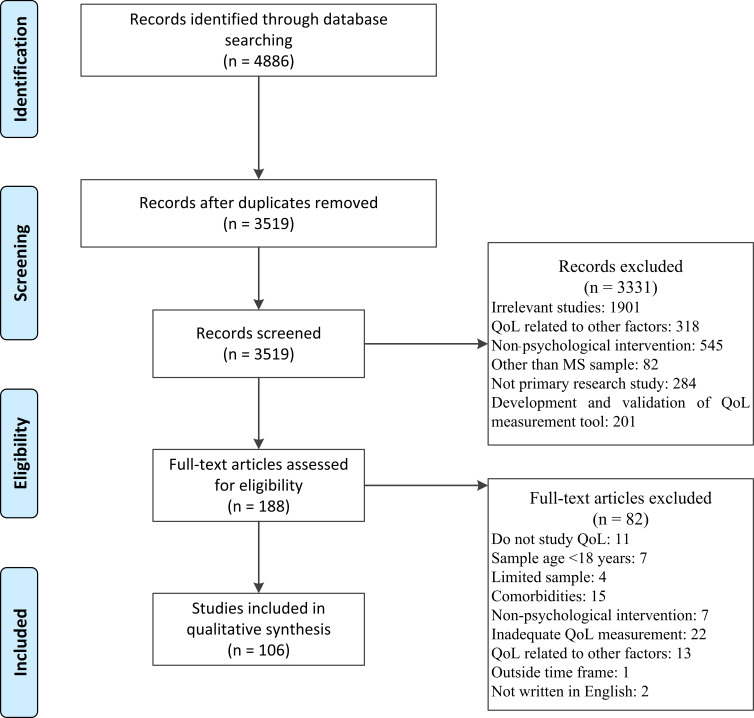
OBJECTIVE: In recent years, quality of life (QoL) in multiple sclerosis (MS) has been gaining considerable importance in clinical research and practice. Against this backdrop, this systematic review aimed to provide a broad overview of clinical, sociodemographic and psychosocial risk and protective factors for QoL in adults with MS and analyse psychological interventions for improving QoL. METHOD: The literature search was conducted in the Scopus, Web of Science and ProQuest electronic databases. Document type was limited to articles written in English, published from January 1, 2014, to January 31, 2019. Information from the selected articles was extracted using a coding sheet and then qualitatively synthesised. RESULTS: The search identified 4886 records. After duplicate removal and screening, 106 articles met the inclusion and exclusion criteria for qualitative synthesis and were assessed for study quality. Disability, fatigue, depression, cognitive impairment and unemployment were consistently identified as QoL risk factors, whereas higher self-esteem, self-efficacy, resilience and social support proved to be protective. The review analysed a wide spectrum of approaches for QoL psychological intervention, such as mindfulness, cognitive behavioural therapy, self-help groups and self-management. The majority of interventions were successful in improving various aspects of QoL. CONCLUSION: Adequate biopsychosocial assessment is of vital importance to treat risk and promote protective factors to improve QoL in patients with MS in general care practice.
Overview
CoChat Summary
## TL;DR
This systematic review synthesized 106 English-language studies on quality of life (QoL) in adults with multiple sclerosis (MS) published from January 1, 2014 to January 31, 2019. It found that disability, fatigue, depression, cognitive impairment, and unemployment were consistent QoL risk factors, while self-esteem, self-efficacy, resilience, and social support were protective.
## Key findings
- From 4,886 records, 188 articles underwent full-text review and 106 were included in the narrative synthesis; studies were mostly cross-sectional (n=74), and sample sizes ranged from 7 to 74,451.
- Among 70 studies on QoL risk/protective factors, disability/functional impairment (EDSS), fatigue, depression, cognitive impairment, and unemployment were consistently identified as QoL risk factors; social support, self-esteem, self-efficacy, resilience, and participation were protective.
- For interventions, all mindfulness-based therapy programmes improved QoL at some evaluation point, and the review reports that the majority of psychological interventions were successful in improving various aspects of QoL.
- The review found 25 intervention studies; interventions included mindfulness, cognitive behavioural therapy, self-help groups, acceptance and commitment therapy, and self-management approaches.
## Methods
- Systematic review following PRISMA guidelines, searching Scopus, Web of Science, and ProQuest in February–March 2019 for English-language journal articles published from January 1, 2014 to January 31, 2019.
- Included primary studies of adults (>18 years) with confirmed MS that focused on QoL determinants or psychological interventions to improve QoL, and used validated QoL measures; excluded non-psychological interventions and several other study types specified in the paper.
- Two researchers independently screened studies and extracted data; quality was assessed with a standardized 12-item checklist, and because of heterogeneity in designs and outcomes, the authors performed a qualitative narrative synthesis rather than a meta-analysis.
## Limitations
- The paper states that quantitative synthesis/meta-analysis was not possible because of heterogeneity in methodologies, study designs, and outcomes.
- The authors also state that the search was restricted to a 5-year period through January 2019 due to the large number of topics and limited resources.
- Evident from the text: the review was limited to English-language journal articles, which may have excluded relevant non-English evidence.
Model-written summary. Check it against the paper before relying on it.
Integrity signals
Registry
Cites
Statistics
Figures
Verification
Claims the paper makes
5 Valid · 4 Not valid · 97 Not checked · 30 Own results and interpretations
Every source the paper cites for this claim was checked and supports it.
In the paper
“Disease duration,30 31 progressive type,26 36 37 progressive MS onset38 and relapses in the last 3 months were further relevant factors negatively affecting QoL.26”
§ Quality of life in adults with multiple sclerosis: a systematic review > Results > Risk and protective MS QoL factors
What the sources say
- Supportedcites [30] Brola W, Sobolewski P, Jantarski K Multiple sclerosis: patient-reported quality of life in the Świętokrzyskie region. Med Stud Med 2017; 33: 191– 8. 10.5114/ms.2017.70345 source
The Results passage reports that longer disease duration was significantly associated with lower quality of life (p < 0.001) among patients in the Świętokrzyskie cohort. The Conclusions also identify long disease duration as a factor decreasing quality of life in that population. (LLM, conf=0.93)
- Supportedcites [31] Brola W, Sobolewski P, Fudala M, et al Self-Reported quality of life in multiple sclerosis patients: preliminary results based on the Polish MS registry. Patient Prefer Adherence 2016; 10: 1647– 56. 10.2147/PPA.S109520 27616882 PMC5008638 source
The Results report a significant association between disease duration and QoL and state that patients with long disease duration reported significantly lower QoL. The Conclusion also identifies disease duration as a main factor in reduced QoL. (LLM, conf=0.94)
plainstates an association- Asserted: passes — The authors put it forward as true.
- Checkable: passes — It can be checked against evidence.
- Load-bearing: passes — The paper’s conclusions depend on it.
- Based: passes — The paper gives a reason why it holds.
- Rests on an assumption not shown here.
- Supported
The cited sources support only part of this claim — read each source’s verdict below.
In the paper
“Functional impairment as assessed by the Expanded Disability Status Scale (EDSS) level was one of the leading causes of diminished QoL.25–35”
§ Quality of life in adults with multiple sclerosis: a systematic review > Results > Risk and protective MS QoL factors
What the sources say
- Not checked yetcites [25] Gupta S, Goren A, Phillips AL, et al Self-Reported severity among patients with multiple sclerosis in the U.S. and its association with health outcomes.. Mult Scler Relat Disord 2014; 3: 78– 88. 10.1016/j.msard.2013.06.002 25877977 source
- Partly supportedcites [26] Rezapour A, Almasian Kia A, Goodarzi S, et al The impact of disease characteristics on multiple sclerosis patients’ quality of life. Epidemiol Health 2017; 39: e2017008– 7. 10.4178/epih.e2017008 28231687 PMC5434226 sourceExperimental — accuracy not yet measured
The Results report that higher EDSS scores correlated with lower physical and mental quality of life, and the Discussion identifies disease severity as the strongest predictor of physical quality of life. The study was cross-sectional, however, so it does not establish functional impairment as a cause of diminished quality of life; nor does it identify EDSS level as a leading predictor of the mental dimension. Page numbers were not supplied in our copy. (LLM, conf=0.85)
- Not checked yetcites [27] Nakazawa K, Noda T, Ichikura K, et al Resilience and depression/anxiety symptoms in multiple sclerosis and neuromyelitis optica spectrum disorder. Mult Scler Relat Disord 2018; 25: 309– 15. 10.1016/j.msard.2018.08.023 30176401 source
- Not checked yetcites [28] Ciampi E, Uribe-San-Martin R, Vásquez M, et al Relationship between social cognition and traditional cognitive impairment in progressive multiple sclerosis and possible implicated neuroanatomical regions. Mult Scler Relat Disord 2018; 20: 122– 8. 10.1016/j.msard.2018.01.013 29414284 source
- Not checked yetcites [29] Klevan G, Jacobsen CO, Aarseth JH, et al Health related quality of life in patients recently diagnosed with multiple sclerosis. Acta Neurol Scand 2014; 129: 21– 6. 10.1111/ane.12142 23772958 source
- Supportedcites [30] Brola W, Sobolewski P, Jantarski K Multiple sclerosis: patient-reported quality of life in the Świętokrzyskie region. Med Stud Med 2017; 33: 191– 8. 10.5114/ms.2017.70345 source
The Results report that higher EDSS-measured disability was significantly associated with lower quality of life (p < 0.001). The Conclusions (pp. 191–198) identify advanced disability as one of the main factors decreasing quality of life among patients in the Świętokrzyskie cohort. (LLM, conf=0.90)
- Partly supportedcites [31] Brola W, Sobolewski P, Fudala M, et al Self-Reported quality of life in multiple sclerosis patients: preliminary results based on the Polish MS registry. Patient Prefer Adherence 2016; 10: 1647– 56. 10.2147/PPA.S109520 27616882 PMC5008638 sourceExperimental — accuracy not yet measured
The Results (page not provided) report that higher disability was significantly associated with lower quality of life, and the Discussion identifies EDSS as the disability measure. The paper does not establish functional impairment as a cause or rank it among the leading causes of diminished quality of life. (LLM, conf=0.86)
- Not checked yetcites [32] Fernández-Jiménez E, Arnett PA Impact of neurological impairment, depression, cognitive function and coping on quality of life of people with multiple sclerosis: a relative importance analysis. Mult Scler 2015; 21: 1468– 72. 10.1177/1352458514562439 25533298 source
- Not checked yetcites [33] Nickel S, von dem Knesebeck O, Kofahl C Self-assessments and determinants of HRQoL in a German MS population. Acta Neurol Scand 2018; 137: 174– 80. 10.1111/ane.12854 28975610 source
- Not checked yetcites [34] Cioncoloni D, Innocenti I, Bartalini S, et al Individual factors enhance poor health-related quality of life outcome in multiple sclerosis patients. significance of predictive determinants. J Neurol Sci 2014; 345: 213– 9. 10.1016/j.jns.2014.07.050 25130927 source
plainstates a cause- Asserted: passes — The authors put it forward as true.
- Checkable: passes — It can be checked against evidence.
- Load-bearing: passes — The paper’s conclusions depend on it.
- Based: passes — The paper gives a reason why it holds.
- Rests on an assumption not shown here.
The sources with a verdict support this claim; the rest weren’t checked yet, have no full text we could read, or their verdicts aren’t rated yet.
In the paper
“Disease duration,30 31 progressive type,26 36 37 progressive MS onset38 and relapses in the last 3 months were further relevant factors negatively affecting QoL.26”
§ Quality of life in adults with multiple sclerosis: a systematic review > Results > Risk and protective MS QoL factors
What the sources say
- Supportedcites [26] Rezapour A, Almasian Kia A, Goodarzi S, et al The impact of disease characteristics on multiple sclerosis patients’ quality of life. Epidemiol Health 2017; 39: e2017008– 7. 10.4178/epih.e2017008 28231687 PMC5434226 source
The Discussion (page not provided) reports that patients with relapsing-remitting MS had better physical and mental quality of life than patients with progressive MS. This supports progressive disease type as a factor associated with poorer quality of life. (LLM, conf=0.93)
- Not checked yetcites [36] Gross HJ, Watson C, Characteristics WC Burden of illness, and physical functioning of patients with relapsing-remitting and secondary progressive multiple sclerosis: a cross-sectional us survey. Neuropsychiatr Dis Treat 2017; 13: 1349– 57. 10.2147/NDT.S132079 28572730 PMC5441664 source
- Not checked yetcites [37] Cichy KE, Li J, Rumrill PD, et al Non-vocational health-related correlates of quality of life for older adults living with multiple sclerosis. J Rehabil 2016; 82: 36– 44.
plainstates an association- Asserted: passes — The authors put it forward as true.
- Checkable: passes — It can be checked against evidence.
- Load-bearing: passes — The paper’s conclusions depend on it.
- Based: passes — The paper gives a reason why it holds.
- Rests on an assumption not shown here.
- Supported
Every source the paper cites for this claim was checked and supports it.
In the paper
“At follow-up, the intervention groups in both studies had experienced an increase in QoL.”
§ Quality of life in adults with multiple sclerosis: a systematic review > Results > Interventions
What the sources say
- Supportedcites [114] Calandri E, Graziano F, Borghi M, et al Improving the quality of life and psychological well-being of recently diagnosed multiple sclerosis patients: preliminary evaluation of a group-based cognitive behavioral intervention. Disabil Rehabil 2017; 39: 1474– 81. 10.1080/09638288.2016.1198430 27385055 source
For the Calandri et al. study, the follow-up results (p. 11) report that the intervention group's mental-health score increased and that this trend was maintained at one year. The Discussion (p. 12) identifies mental health as the psychological component of quality of life. (LLM, conf=0.90)
- Supportedcites [115] Graziano F, Calandri E, Borghi M, et al The effects of a group-based cognitive behavioral therapy on people with multiple sclerosis: a randomized controlled trial. Clin Rehabil 2014; 28: 264– 74. 10.1177/0269215513501525 24013269 source
The Abstract (p. 3) reports that quality of life increased in Graziano et al.’s intervention group compared with the control group at six-month follow-up. This confirms the part of the sentence attributed to this source; it does not assess the separate Calandri study. (LLM, conf=0.94)
plainstates a cause- Asserted: passes — The authors put it forward as true.
- Checkable: passes — It can be checked against evidence.
- Load-bearing: unclear — It is unclear whether the paper’s conclusions depend on it.
- Based: passes — The paper gives a reason why it holds.
- Rests on an assumption not shown here.
- Supported
The cited sources that could be checked couldn’t confirm or dispute this claim.
In the paper
“Thomas et al127 reported significant positive changes in physical health assessed by the Multiple Sclerosis Impact Scale (MSIS-29) and vitality as measured by the SF-36 in the intervention group 12 months after the treatment.”
§ Quality of life in adults with multiple sclerosis: a systematic review > Results > Interventions
What the sources say
- Could not verifycites [127] matched to “A single nucleotide polymorphism in the coding region of PGC-1α is a male-specific modifier of Huntington disease age-at-onset in a large European cohort” (2014) sourceExperimental — accuracy not yet measured
Our copy of Weydt et al. (2014, BMC Neurology) is entirely a Huntington disease genetics study: it reports the effect of PPARGC1A rs3736265 on age-at-onset in 1706 symptomatic HD patients from the EHDN REGISTRY (Results and discussion, p. 1-2; Methods, p. 2-3). No passage addresses multiple sclerosis, a fatigue self-management intervention, the MSIS-29, or the SF-36, and no 'Thomas et al.' MS trial appears in its reference list (References, pp. 3-5). Searched: 'Thomas fatigue multiple sclerosis self-management', 'MSIS-29 SF-36 physical health vitality', 'Short Form Health Survey quality of life intervention' — all returned only HD/PGC-1α content, so the claim cannot be checked against this source. (LLM, conf=0.78)
plainstates a cause- Asserted: passes — The authors put it forward as true.
- Checkable: passes — It can be checked against evidence.
- Load-bearing: unclear — It is unclear whether the paper’s conclusions depend on it.
- Based: passes — The paper gives a reason why it holds.
- Rests on an assumption not shown here.
- Could not verify
79 more claims · 1 with their cited sources checked
Create a free account to see all 136 claims and to verify the 202 references still open.
- Probably not a substantial claim. 20
- It may state two separate claims as one. 35
- The quote only partly states this claim. 2
Claims other papers make about this one
Each is checked against this paper’s own text: does it say what the citing paper says it does?
The cited source says what the claim attributes to it.
In the citing paper
“persistent physical symptoms are a major determinant of quality of life”
From Persistent physical symptoms: definition, genesis, and management (2024) · cites this paper as [10]
The cited source says what the claim attributes to it.
In the citing paper
“A recent systematic review of 106 papers on MS showed that among other factors, higher self-efficacy was a protective factor for quality of life (46).”
From Key demographics and psychological skills associated with adjustment to progressive Multiple Sclerosis early in the diagnosis (2022) · cites this paper as [46]
In the citing paper
“In a narrative review on the neural mechanism of mental fatigue, Ishii, and colleagues [45] proposed a dual regulation system consisting of neural facilitation and inhibition systems to explain the mechanism behind acute mental fatigue.”
From Neural mechanisms underlying state mental fatigue: a systematic review and activation likelihood estimation meta-analysis (2022) · cites this paper as [45]
In the citing paper
“Motivational input during mental tasks stimulates this system thereby preventing decrease in task performance [45].”
From Neural mechanisms underlying state mental fatigue: a systematic review and activation likelihood estimation meta-analysis (2022) · cites this paper as [45]
In the citing paper
“The mental inhibition system was thought to involve the insula cortex and posterior cingulate cortex and stimulation of this system during mental tasks decreases cognitive performance [45].”
From Neural mechanisms underlying state mental fatigue: a systematic review and activation likelihood estimation meta-analysis (2022) · cites this paper as [45]
3 more claims about this paper
Create a free account to see every claim other papers make about this one.
Citations
Cites
PRISMA-P Group, Moher, D., Shamseer, L., Clarke, M., Ghersi, D., Liberati, A., Petticrew, M., Shekelle, P., & Stewart, L. A. (2015) · Systematic Reviews · doi:10.1186/2046-4053-4-1 · Cited by 26,223
(1995) · Social Science & Medicine · doi:10.1016/0277-9536(95)00112-k · Cited by 7,643
Handbook of Disease Burdens and Quality of Life Measures
(2010) · Springer eBooks · doi:10.1007/978-0-387-78665-0 · Cited by 644
Revicki, D. A., Osoba, D., Fairclough, D., Barofsky, I., Berzon, R., Leidy, N. K., & Rothman, M. (2000) · Quality of Life Research · doi:10.1023/a:1008996223999 · Cited by 577
Hanisch, S. E., Twomey, C. D., Szeto, A. C. H., Birner, U. W., Nowak, D., & Sabariego, C. (2016) · BMC Psychiatry · doi:10.1186/s12888-015-0706-4 · Cited by 564
Definitions of Quality of Life: What Has Happened and How to Move On
Post, M. (2014) · Topics in Spinal Cord Injury Rehabilitation · doi:10.1310/sci2003-167 · Cited by 517
Work ability and associated factors of Brazilian technical-administrative workers in education
Godinho, M. R., Greco, R. M., Teixeira, M. T. B., Teixeira, L. R., Guerra, M. R., & Chaoubah, A. (2016) · BMC Research Notes · doi:10.1186/s13104-015-1837-x · Cited by 393
A review about the impact of multiple sclerosis on health-related quality of life
Benito-León, J., Manuel Morales, J., Rivera-Navarro, J., & Mitchell, A. J. (2003) · Disability and Rehabilitation · doi:10.1080/09638280310001608591 · Cited by 348
For the European Huntington Disease Network, Weydt, P., Soyal, S. M., Landwehrmeyer, G. B., & Patsch, W. (2014) · BMC Neurology · doi:10.1186/1471-2377-14-1 · Cited by 206
Are Movement Artifacts in Magnetic Resonance Imaging a Real Problem?—A Narrative Review
Havsteen, I., Ohlhues, A., Madsen, K. H., Nybing, J. D., Christensen, H., & Christensen, A. (2017) · Frontiers in Neurology · doi:10.3389/fneur.2017.00232 · Cited by 196
Research works printed but not linked: 3
- Petrović N, Prlić N, Gašparić I, et al Quality of life among persons suffering from multiple sclerosis. Medica Jadertina 2019; 49: 217– 26 https://hrcak.srce.hr/234930
- Paziuc LC, Radu MR The influence of mixed anxiety-depressive disorder on the perceived quality of life in multiple sclerosis patients. Bulletin of the Transilvania University of Brasov, Seriels VI: Medical Sciences 2018; 11: 41– 50.
- Geiser F, Imbierowicz K, Conrad R, et al [Differences between patients classified as "recovered" or "improved" and "unchanged" or "deteriorated" in a psychotherapy outcome study]. Z Psychosom Med Psychother 2001; 47: 250– 61. 11568863
Cited by
Persistent physical symptoms: definition, genesis, and management
Löwe, B., Toussaint, A., Rosmalen, J. G. M., Huang, W.-L., Burton, C., Weigel, A., Levenson, J. L., & Henningsen, P. (2024) · The Lancet · doi:10.1016/s0140-6736(24)00623-8 · Cited by 280
Bishop, M., Rumrill, P. D., Livneh, H., & Martz, E. (2025) · The Oxford Handbook of Rehabilitation Psychology · doi:10.1093/oxfordhb/9780197525456.013.0001 · Cited by 180
Distinguishing between Fatigue and Fatigability in Multiple Sclerosis
Enoka, R. M., Almuklass, A. M., Alenazy, M. S., Álvarez, E., & Duchateau, J. (2021) · Neurorehabilitation and neural repair · doi:10.1177/15459683211046257 · Cited by 167
“The changes caused by the disease result in the emergence of several debilitating symptoms that negatively impact the ability of an individual to perform activities of daily living.(11,12) Two of the most common symptoms in MS are fatigue and difficulties with walking.”
Vitamin D Supplementation and Mental Health in Multiple Sclerosis Patients: A Systematic Review
Głąbska, D., Kołota, A., Lachowicz, K., Skolmowska, D., Stachoń, M., & Guzek, D. (2021) · Nutrients · doi:10.3390/nu13124207 · Cited by 118
“[11] revealed that MS is associated mainly with disability, fatigue, depression, cognitive impairment and unemployment.”
BackgroundÅkesson, J., Hojjati, S., Hellberg, S., Raffetseder, J., Khademi, M., Rynkowski, R., Kockum, I. S., Altafini, C., Lubovac-Pilav, Z., Mellergård, J., et al. (2023) · Nature Communications · doi:10.1038/s41467-023-42682-9 · Cited by 116
“Whereas the NEDA-3 concept re fl ects the short-term disease activity mainly by detecting relapses and MRI activity, the long-term disability progression is more relevant from the perspective of a person with MS since it directly affects the quality of life 30 .”
BackgroundTen decadal advances in fungal biology leading towards human well-being
Mapook, A., Hyde, K. D., Hassan, K., Kemkuignou, B. M., Čmoková, A., Surup, F., Kuhnert, E., Paomephan, P., Cheng, T., de Hoog, S., et al. (2022) · Fungal Diversity · doi:10.1007/s13225-022-00510-3 · Cited by 86
VoicePilot: Harnessing LLMs as Speech Interfaces for Physically Assistive Robots
Padmanabha, A., Yuan, J., Gupta, J., Karachiwalla, Z., Majidi, C., Admoni, H., & Erickson, Z. (2024) · ACM Symposium on User Interface Software and Technology (UIST) · doi:10.1145/3654777.3676401 · Cited by 71
“Videos and supporting files are located on our project website 1”
Gómez-Melero, S., Caballero‐Villarraso, J., Escribano, B. M., Galvao-Carmona, A., Túnez, I., & Agüera, E. (2024) · Journal of Clinical Medicine · doi:10.3390/jcm13113321 · Cited by 71
“This has important clinical implications, as priority should be given to the treatment of these symptoms [72].”
BackgroundInfluentialYousef, H., Tortei, B. M., & Castiglione, F. (2024) · Journal of Neurology · doi:10.1007/s00415-024-12651-3 · Cited by 70
“MS profoundly affects quality of life through disability accumulation [18] and a wide range of symptoms.”
BackgroundThe humanistic burden of myasthenia gravis: A systematic literature review
Gelinas, D. F., Parvin-Nejad, S., Phillips, G. A., Cole, C., Hughes, T., Silvestri, N. J., Govindarajan, R., Jefferson, M., Campbell, J., & Burnett, H. F. (2022) · Journal of the Neurological Sciences · doi:10.1016/j.jns.2022.120268 · Cited by 67
“, anxiety, depression) on HRQoL has similarly been described for other autoimmune disorders, such as multiple sclerosis [94,95].”
BackgroundSalihu, A. T., Hill, K. D., & Jaberzadeh, S. (2022) · Reviews in the Neurosciences · doi:10.1515/revneuro-2022-0023 · Cited by 57
Occupational outcomes of people with multiple sclerosis: a scoping review
Vitturi, B. K., Rahmani, A., Dini, G., Montecucco, A., Debarbieri, N., Sbragia, E., Bandiera, P., Ponzio, M., Battaglia, M. A., Manacorda, T., et al. (2022) · BMJ Open · doi:10.1136/bmjopen-2021-058948 · Cited by 52
Singer, B. A., Feng, J. J., & Chiong-Rivero, H. (2024) · Journal of Neurology · doi:10.1007/s00415-024-12305-4 · Cited by 51
Bergmann, C., Becker, S., Watts, A., Sullivan, C. L., Wilken, J. A., Golan, D., Zarif, M., Bumstead, B., Buhse, M., Kaczmarek, O., et al. (2023) · Multiple Sclerosis and Related Disorders · doi:10.1016/j.msard.2023.104966 · Cited by 50
Neurorehabilitation in Multiple Sclerosis—A Review of Present Approaches and Future Considerations
Sîrbu, C. A., Thompson, D. C., Pleşa, C., Vasile, M., Jianu, D. C., Mitrică, M., Anghel, D. N., & Ștefani, C. (2022) · Journal of Clinical Medicine · doi:10.3390/jcm11237003 · Cited by 47
Potticary, H., & Langdon, D. W. (2023) · Journal of Clinical Medicine · doi:10.3390/jcm12020703 · Cited by 46
“It has a negative impact on quality of life [9], including activities of daily living [12], employment [13], disease management [14,15], personality [16] and driving safety [17].”
BackgroundManaging multiple sclerosis in individuals aged 55 and above: a comprehensive review
Fernández, Ó., Sørensen, P. S., Comı, G., Vermersch, P., Hartung, H., Leocani, L., Berger, T., Wijmeersch, B. V., & Oreja‐Guevara, C. (2024) · Frontiers in Immunology · doi:10.3389/fimmu.2024.1379538 · Cited by 45
Quality of Life in Multiple Sclerosis Patients: Influence of Gender, Age and Marital Status
Šabanagić-Hajrić, S., Suljić, E., Memić-Serdarević, A., & Mahmutbegovic, G. (2022) · Materia Socio Medica · doi:10.5455/msm.2022.33.19-24 · Cited by 39
Simpson, R., Posa, S., Langer, L. K., Bruno, T. R., Simpson, S., Lawrence, M., Booth, J., Mercer, S. W., Feinstein, A., & Bayley, M. T. (2022) · Journal of Neurology · doi:10.1007/s00415-022-11451-x · Cited by 40
“Factors known to be associated with better QoL in PwMS include greater self-efficacy, self-esteem, resilience, and social support [17].”
BackgroundInfluentialKołtuniuk, A., Kazimierska-Zając, M., Cisek, K., & Chojdak-Łukasiewicz, J. (2021) · Psychology Research and Behavior Management · doi:10.2147/prbm.s310664 · Cited by 37
Gitman, V., Moss, K., & Hodgson, D. (2023) · European journal of medical research · doi:10.1186/s40001-023-01185-5 · Cited by 32
“The MSQOL-54, SF-36 or MSQLI are widely validated and utilized tools for measuring HRQoL in MS [8–10].”
InfluentialNegri, L., Cilia, S., Falautano, M., Grobberio, M., Niccolai, C., Pattini, M., Pietrolongo, E., Quartuccio, M. E., Viterbo, R. G., Allegri, B., et al. (2021) · Neurological Sciences · doi:10.1007/s10072-021-05520-8 · Cited by 30
Cognitive Behavioral Therapy: Principles, Science, and Patient Selection in Neurology
Carson, A. J., & McWhirter, L. (2022) · Seminars in Neurology · doi:10.1055/s-0042-1750851 · Cited by 28
Online psychological interventions to improve symptoms in multiple sclerosis: A systematic review
Montañés‐Masias, B., Bort‐Roig, J., Pascual, J. C., Soler, J., & Briones‐Buixassa, L. (2022) · Acta Neurologica Scandinavica · doi:10.1111/ane.13709 · Cited by 27
Saifan, A. R., AbuRuz, M. E., Assaf, E. A., Rayyan, A., Jaberi, M. A., & Masa’Deh, R. (2021) · Depression Research and Treatment · doi:10.1155/2021/8300497 · Cited by 27
Fatigue in multiple sclerosis is associated with socioeconomic factors
Broch, L., Flemmen, H. Ø., Simonsen, C. S., Berg‐Hansen, P., Ormstad, H., Brunborg, C., & Celius, E. G. (2022) · Multiple Sclerosis and Related Disorders · doi:10.1016/j.msard.2022.103955 · Cited by 26
Solsona, E. M., Tektonidis, T. G., Reece, J. C., Simpson, S., Black, L. J., Rad, E. Y., & Coe, S. (2024) · Multiple Sclerosis and Related Disorders · doi:10.1016/j.msard.2024.105636 · Cited by 26
Thompson, B., Moghaddam, N., Evangelou, N., Baufeldt, A., & das Nair, R. (2022) · Multiple Sclerosis and Related Disorders · doi:10.1016/j.msard.2022.103862 · Cited by 25
Gil-González, I., Pérez-San-Gregorio, M. Á., Conrad, R., & Rodríguez, A. M. (2021) · Multiple Sclerosis and Related Disorders · doi:10.1016/j.msard.2021.103093 · Cited by 25
Self-citationNajafi, P., Motl, R. W., & Moghadasi, M. (2024) · Multiple Sclerosis and Related Disorders · doi:10.1016/j.msard.2024.106225 · Cited by 25
Altunan, B., Ünal, A., Bingöl, A., Dilek, F., & Girgin, D. (2021) · Multiple Sclerosis and Related Disorders · doi:10.1016/j.msard.2021.103039 · Cited by 24
Petracca, M., Petsas, N., Sellitto, G., Ruotolo, I., Livi, C., Bonanno, V., Felicetti, F., Ianniello, A., Ruggieri, S., Borriello, G., et al. (2024) · Frontiers in Neurology · doi:10.3389/fneur.2024.1394867 · Cited by 24
Kim, S., Lee, E., Kim, K. W., Seo, D., Moon, S., Kim, K., & Lim, Y. (2022) · Multiple Sclerosis and Related Disorders · doi:10.1016/j.msard.2022.103500 · Cited by 23
Mrosková, S., Klímová, E., Majerníková, Ľ., & Tkáčová, Ľ. (2021) · International Journal of Environmental Research and Public Health · doi:10.3390/ijerph18168645 · Cited by 23
Mikula, P., Timková, V., Fedičová, M., Szilasiová, J., & Nagyová, I. (2021) · Multiple Sclerosis and Related Disorders · doi:10.1016/j.msard.2021.103069 · Cited by 22
Pardo, G., Pineda, E. D., Ng, C. D., Bawa, K., Sheinson, D. M., & Bonine, N. G. (2022) · Neurology and Therapy · doi:10.1007/s40120-021-00319-3 · Cited by 22
Rao, S. M., Sokolowski, M., Strober, L. B., Miller, J. B., Norman, M. A., Levitt, N., Williams, J. R., & de Moor, C. (2022) · Multiple Sclerosis and Related Disorders · doi:10.1016/j.msard.2022.103644 · Cited by 22
Fidao, A., Jelinek, G. A., Simpson, S., Neate, S. L., & Nag, N. (2023) · European Journal of Neurology · doi:10.1111/ene.15940 · Cited by 23
Claflin, S. B., Klekociuk, S. Z., Campbell, J. A., Bessing, B., Palmer, A. J., van der Mei, I. A. F., & Taylor, B. V. (2021) · Multiple Sclerosis and Related Disorders · doi:10.1016/j.msard.2021.103158 · Cited by 22
Kassie, S. A., Alia, J., & Hyland, L. (2021) · BMJ Open · doi:10.1136/bmjopen-2021-049041 · Cited by 22
Watson, C., Thirumalai, D., Barlev, A., Jones, E., Bogdanovich, S., & Kresa-Reahl, K. (2023) · Neurology and Therapy · doi:10.1007/s40120-023-00532-2 · Cited by 21
Rodgers, S., Manjaly, Z., Calabrese, P., Steinemann, N., Kaufmann, M., Salmen, A., Chan, A., Kesselring, J., Kamm, C. P., Kühle, J., et al. (2021) · Brain Sciences · doi:10.3390/brainsci11060751 · Cited by 21
The impact of menopause on multiple sclerosis
Bridge, F., Butzkueven, H., van der Walt, A., & Jokubaitis, V. (2023) · Autoimmunity Reviews · doi:10.1016/j.autrev.2023.103363 · Cited by 19
Marrie, R. A., Bernstein, C. N., Dolovich, C., Bolton, J. M., Graff, L. A., Hitchon, C. A., Lix, L. M., Marriott, J. J., & Fisk, J. D. (2023) · Multiple Sclerosis Journal · doi:10.1177/13524585231190771 · Cited by 19
Pau, M., Cocco, E. E., Arippa, F., Casu, G., Porta, M., Menascu, S., Achiron, A., & Kalron, A. (2023) · Journal of Clinical Medicine · doi:10.3390/jcm12093222 · Cited by 19
Gil-González, I., Pérez-San-Gregorio, M. Á., Conrad, R., & Rodríguez, A. M. (2022) · Frontiers in Psychology · doi:10.3389/fpsyg.2022.903508 · Cited by 18
Self-citationNag, N., Yu, M., Jelinek, G. A., Simpson, S., Neate, S. L., & Schmidt, H. K. (2021) · Journal of Personalized Medicine · doi:10.3390/jpm11111218 · Cited by 18
Li, J., Zakeri, M., Hutton, G. J., & Aparasu, R. R. (2022) · Multiple Sclerosis and Related Disorders · doi:10.1016/j.msard.2022.104019 · Cited by 18
Lubasch, J. S., Lee, S., Kowalski, C., Beckmann, M., Pfaff, H., & Ansmann, L. (2021) · International Journal of Environmental Research and Public Health · doi:10.3390/ijerph18158224 · Cited by 17
A systematic review of self-concept change in multiple sclerosis
Emery, H., Padgett, C. R., Ownsworth, T., & Honan, C. A. (2022) · Neuropsychological Rehabilitation · doi:10.1080/09602011.2022.2030367 · Cited by 17
“More recently, a narrative synthesis of 106 articles outlined the varied and complex ways in which MS impacts on quality of life (QoL) (Gil-Gonzalez et al., 2020).”
BackgroundDisabled in Society - A Scoping Review on Persons Living with Multiple Sclerosis and Disability
Ståhl, D., Bjereld, Y., & Dunér, A. (2022) · Journal of Multidisciplinary Healthcare · doi:10.2147/jmdh.s353347 · Cited by 16
Ando, H., Cousins, R., & Young, C. A. (2021) · Quality of Life Research · doi:10.1007/s11136-021-03041-7 · Cited by 16
“A recent systematic review, examining risk and protective factors for QoL, based on 106 quantitative studies between 1 January 2014 and 31 January 2019 [16] reports QoL to be associated with number and severity of MS-related symptoms.”
BackgroundTunmore, J., Kontou, E., Moghaddam, N. G., Hufton, L., & das Nair, R. (2023) · Journal of Clinical and Experimental Neuropsychology · doi:10.1080/13803395.2023.2213847 · Cited by 15
“A recent systematic review identified depression as a risk factor for lower QoL in PwMS (Gil-González et al., 2020), and individuals with greater subjective cognitive difficulties are more likely to have lower QoL; depression provides one explanation as to why that is (Crouch et al.”
BackgroundMartins, P., Vandewalle, B., Félix, J., Capela, C., Cerqueira, J., Salgado, A. V., Ferreira, D. G., & Monteiro, I. (2022) · PharmacoEconomics - Open · doi:10.1007/s41669-022-00381-z · Cited by 14
“In addition, in many individuals with MS, progression of the disease ultimately leads to severe disability with limited ability to walk and quality-oflife (QoL) impairment [4, 5].”
BackgroundGoetschalckx, M., Geel, F. V., Meesen, R., Moumdjian, L., Geraerts, M., & Feys, P. (2021) · Gait & Posture · doi:10.1016/j.gaitpost.2021.04.001 · Cited by 14
Telemedicine as a strategic intervention for cognitive rehabilitation in MS patients during COVID-19
Ghadiri, F., Moghadasi, A. N., & Sahraian, M. A. (2022) · Acta Neurologica Belgica · doi:10.1007/s13760-022-01875-7 · Cited by 14
Nezhad, N. N., Parnow, A., Khamoushian, K., Eslami, R., & Baker, J. S. (2024) · BMC Neurology · doi:10.1186/s12883-024-03964-x · Cited by 13
Hirt, J., Dembowska, K., Woelfle, T., Axfors, C., Granziera, C., Kühle, J., Kappos, L., Hemkens, L. G., & Janiaud, P. (2024) · Journal of Neurology · doi:10.1007/s00415-024-12366-5 · Cited by 13
“QoL is a subjective measure highly dependent on individual patient factors (e.g., mood) and external factors (e.g., socioeconomic status) [58].”
BackgroundRahimi, H., Pirmoradi, M., Lavasani, F. F., & Farahani, H. (2023) · Journal of Education and Health Promotion · doi:10.4103/jehp.jehp_521_22 · Cited by 12
“M sclerosis (MS) is a myelogenous disease of the central nervous system in which the myelin sheath of the central nervous system, such as the brain, optic nerve, and spinal cord, is damaged.[1] The spread of this disease is growing increasingly in the youth,[2] and in recent studies, the incidence of MS has been estim…”
BackgroundNiino, M., Fukumoto, S., Okuno, T., Sanjo, N., Fukaura, H., Mori, M., Ohashi, T., Takeuchi, H., Shimizu, Y., Fujimori, J., et al. (2021) · Multiple Sclerosis and Related Disorders · doi:10.1016/j.msard.2021.103427 · Cited by 12
Asadollahzadeh, E., Ebadi, Z., Owji, M., Rezaeimanesh, N., Sahraian, M. A., & Moghadasi, A. N. (2024) · Multiple Sclerosis and Related Disorders · doi:10.1016/j.msard.2024.105629 · Cited by 12
Chmiel, J., Kurpas, D., & Stępień–Słodkowska, M. (2025) · Journal of Clinical Medicine · doi:10.3390/jcm14020373 · Cited by 12
“Additionally, it was discovered that the main sociodemographic factor affecting QoL was employment [123].”
Zielińska-Nowak, E., Lipert, A., Kikowski, Ł., & Miller, E. D. (2025) · Journal of Personalized Medicine · doi:10.3390/jpm15020046 · Cited by 12
“Research indicates that individuals with MS report consistently lower QoL compared to the general population, with factors such as fatigue, depression, and mobility impairments playing a prominent role in this decline [6].”
Ruiz‐Sánchez, F. J., Martins, M. D. R., Losa‐Iglesias, M. E., Vallejo, R., Gómez-Salgado, J. C., Morales, C. R., Jiménez‐Cebrián, A. M., & López‐López, D. (2023) · International Journal of Public Health · doi:10.3389/ijph.2023.1605593 · Cited by 12
Juutinen, L., Ahinko, K., Tinkanen, H., Rosti-Otajärvi, E. M., & Sumelahti, M. (2022) · Multiple Sclerosis and Related Disorders · doi:10.1016/j.msard.2022.104098 · Cited by 12
Coping with multiple sclerosis: reconciling significant aspects of health-related quality of life
Gil-González, I., Rodríguez, A. M., Conrad, R., & Pérez-San-Gregorio, M. Á. (2022) · Psychology Health & Medicine · doi:10.1080/13548506.2022.2077395 · Cited by 11
“On the other hand, as previously found, our findings indicate that family social support is a longitudinal protective factor for physical HRQOL (Bassi et al., 2021; Dȩbska et al., 2020; Gil-González et al., 2020; Lex et al., 2018).”
BackgroundMethodResultInfluentialSelf-citationGiroux, C., Sogoloff, B., Bergmans, L., Bae, M., VanNostrand, M., & Kasser, S. L. (2023) · International Journal of MS Care · doi:10.7224/1537-2073.2022-042 · Cited by 11
Healthier living with MS: The key role of self-efficacy and emotion regulation
Dehghan, M., Sharifi, P., Hasani, J., Young, C. A., & Langdon, D. W. (2023) · Multiple Sclerosis and Related Disorders · doi:10.1016/j.msard.2023.104608 · Cited by 11
Payamani, F., Khatiban, M., Soltanian, A. R., Ghiasian, M., & Borzou, S. R. (2022) · Irish Journal of Medical Science (1971 -) · doi:10.1007/s11845-022-03104-9 · Cited by 11
“Over recent years, the QOL of PwMS has gained significance in research and clinical practice [13].”
BackgroundThe effect of cognitive performance on self-management behavior of multiple sclerosis patients
Efendi, H., Ünal, A., Akçalı, A., Altunan, B., Bingöl, A., Altunrende, B., Köseoğlu, M., Deringöl, D., Uzunköprü, C., Eğilmez, C. B., et al. (2022) · Multiple Sclerosis and Related Disorders · doi:10.1016/j.msard.2022.103880 · Cited by 10
Zhang, Y., Xu, P., Deng, Y., Duan, W., Cui, J., Ni, C., & Wu, M. (2022) · Frontiers in Aging Neuroscience · doi:10.3389/fnagi.2022.960328 · Cited by 10
“The quality of life is affected by multiple factors, including interpersonal relations, life environment, psychological and physical state, as well as individual life satisfaction (Gil-Gonzalez et al., 2020).”
BackgroundCognitive impairment and its treatment in patients with multiple sclerosis
Zabirova, A. K., Bakulin, I. S., Poydasheva, A. G., Zakharova, M. N., & Suponeva, N. A. (2023) · Almanac of Clinical Medicine · doi:10.18786/2072-0505-2023-51-009 · Cited by 10
Exploring self-determination and satisfaction with life and services of people with disabilities
Blaise, M., Schroeder, M., Suhrcke, M., Komenda-Schned, S., Zeilinger, E. L., & Weber, G. (2025) · International Journal of Developmental Disabilities · doi:10.1080/20473869.2025.2470168 · Cited by 10
de Oliveira, M. P. B., de Castro, A. E. F., Miri, A. L., Lima, C. R., Truax, B. D., Probst, V. S., & Smaili, S. M. (2023) · BMC Neurology · doi:10.1186/s12883-023-03176-9 · Cited by 10
“Gil-González and colleagues (2020) also identified that among various neuropsychiatric disorders, depression and anxiety were associated with lower quality of life in individuals with MS prior to the COVID-19 pandemic [62].”
BackgroundMorrow, S. A., Kruger, P., Langdon, D. W., & Alexandri, N. (2023) · Neurology and Therapy · doi:10.1007/s40120-023-00519-z · Cited by 10
“can be challenging to manage and often have a profound effect on daily living [9, 19, 20].”
BackgroundMeasuring cognitive change in secondary progressive MS: an analysis of the ASCEND cognition substudy
Leavitt, V. M., Mostert, J. P., Comtois, J., Moral, E., Brieva, L., Repovic, P., Bowen, J. D., Uitdehaag, B. M. J., Strijbis, E. M. M., Cutter, G., et al. (2025) · Journal of Neurology · doi:10.1007/s00415-025-13066-4 · Cited by 9
“Cognitive impairment affects many individuals with multiple sclerosis (MS) and reduces quality of life [1, 2].”
Beckmann, H., Heesen, C., Augustin, M., & Blome, C. (2021) · International Journal of MS Care · doi:10.7224/1537-2073.2020-088 · Cited by 9
Health-related quality of life in Japanese patients with multiple sclerosis
Niino, M., Fukumoto, S., Okuno, T., Sanjo, N., Fukaura, H., Mori, M., Ohashi, T., Takeuchi, H., Shimizu, Y., Fujimori, J., et al. (2022) · Journal of Neurology · doi:10.1007/s00415-022-11453-9 · Cited by 9
“On the other hand, it is reasonable to investigate QOL in specific populations in individual regions or countries, because ethnic and social/cultural backgrounds can significantly impact QOL [3].”
BackgroundMeza, C., Stefan, C., Staines, R. W., & Feinstein, A. (2024) · NeuroImage Clinical · doi:10.1016/j.nicl.2024.103622 · Cited by 9
“The effects of cognitive decline correlate with reduced quality of life and activities of daily living (Gil-Gonz ´ alez et al., 2020; Dehghani et al., 2019).”
BackgroundJavadi, S. K. H. S., & Nouri, A. (2025) · Patient Education and Counseling · doi:10.1016/j.pec.2025.108673 · Cited by 9
Effect of Nursing Intervention on Fatigue for Multiple Sclerosis Patients
Salime, R. A. A., Elzehiri, D. A. I., & Ibrahim, R. A. S. (2022) · Tanta Scientific Nursing Journal · doi:10.21608/tsnj.2022.221574 · Cited by 9
Alexithymia and Coping With Stress in Patients With Multiple Sclerosis: A Comparative Study
Yılmaz, F. T., Sabancıoğulları, S., & Sevimligül, G. (2022) · Journal of Neuroscience Nursing · doi:10.1097/jnn.0000000000000684 · Cited by 9
Hvid, L. G., Steenberg, J. L., Roy, F., & Skovgaard, L. (2025) · Annals of Physical and Rehabilitation Medicine · doi:10.1016/j.rehab.2025.101985 · Cited by 8
Feinstein, A., Bar‐Or, A., Benedict, R. H. B., Filippi, M., Freedman, D., Kever, A., Meza, C., & Rocca, M. A. (2025) · Brain · doi:10.1093/brain/awaf319 · Cited by 8
Colvin, M. K., Roebuck‐Spencer, T., Sperling, S. A., Acheson, S. K., Bailie, J., Espe‐Pfeifer, P., Glen, T., Bragg, T., Bott, N. T., & Hilsabeck, R. C. (2022) · Archives of Clinical Neuropsychology · doi:10.1093/arclin/acac015 · Cited by 8
Guardado, S., Mylonopoulou, V., Rivera-Romero, O., Patt, N., Bansi, J., & Giunti, G. (2023) · Methods of Information in Medicine · doi:10.1055/s-0043-1775718 · Cited by 8
“23 To address these challenges, it is crucial to provide PwMS with mHealth solutions that they can use in their daily lives to assist in self-management.”
BackgroundGÜRBÜZ, İ. Z., & Akın, S. (2023) · International Journal of Palliative Nursing · doi:10.12968/ijpn.2023.29.12.598 · Cited by 8
Le, H. H., Ken-Opurum, J., LaPrade, A., Maculaitis, M. C., & Sheehan, J. J. (2024) · BMC Neurology · doi:10.1186/s12883-023-03423-z · Cited by 8
Mulligan, K., Harris, K., Rixon, L., & Burls, A. (2024) · Disability and Rehabilitation · doi:10.1080/09638288.2024.2353855 · Cited by 8
Rakhshani, T., Afroozeh, S., Kashfi, S. M., Kamyab, A., & Jeihooni, A. K. (2024) · BMC Neurology · doi:10.1186/s12883-024-03777-y · Cited by 8
“Research indicates that MS patients suffer severe damage to their quality of life [11].”
BackgroundTowards an LLM-Based Speech Interface for Robot-Assisted Feeding
Yuan, J., Gupta, J., Padmanabha, A., Karachiwalla, Z., Majidi, C., Admoni, H., & Erickson, Z. (2024) · ACM Symposium on User Interface Software and Technology (UIST) · doi:10.1145/3672539.3686759 · Cited by 8
“This can significantly impact an individual’s independence and quality of life, requiring them to rely on a caregiver for assistance[12, 13, 15, 29].”
BackgroundCoping Strategies Furthering Post-Traumatic Growth in Multiple Sclerosis: A Longitudinal Study
Gil-González, I., Rodríguez, A. M., Conrad, R., & Pérez-San-Gregorio, M. Á. (2022) · International Journal of Environmental Research and Public Health · doi:10.3390/ijerph191912679 · Cited by 8
“Active coping, problem resolution, and planning are consistently related to positive outcomes in MS patients [3].”
BackgroundMethodInfluentialSelf-citationBriggs, F. B. S., Conway, D. S., Nadai, A. S. D., Ontaneda, D., & Gunzler, D. D. (2021) · Multiple Sclerosis and Related Disorders · doi:10.1016/j.msard.2021.102912 · Cited by 7
At home e-based physical exercise programs in patients with multiple sclerosis: a scoping review
Adnan, R., Roikjær, S. G., Samadzadeh, S., Richter, C. J., Weinshenker, B. G., Paul, F., Skou, S. T., Dalgas, U., & Asgari, N. (2024) · Frontiers in Neurology · doi:10.3389/fneur.2024.1449519 · Cited by 7
The experience of stigma and concealment in multiple sclerosis.
Maguire, R., Ahern, A., Shrivastava, S., & Maguire, P. (2026) · Stigma and Health · doi:10.1037/sah0000599 · Cited by 7
McCormack, D., O’Keeffe, F. M., Seery, C., & Eccles, F. J. R. (2024) · Multiple Sclerosis and Related Disorders · doi:10.1016/j.msard.2024.106226 · Cited by 7
Shabani, M., Ayoubi, S., Moghadasi, A. N., Najafi, M., & Eskandarieh, S. (2021) · Clinical Neurology and Neurosurgery · doi:10.1016/j.clineuro.2021.106789 · Cited by 7
Hassan, S. S., Darwish, E. S., Ahmed, G. K., Azmy, S. R., & Haridy, N. A. (2023) · The Egyptian Journal of Neurology Psychiatry and Neurosurgery · doi:10.1186/s41983-023-00702-x · Cited by 8
“Additionally, psychiatric comorbidity with MS leads to reduced QoL, increased fatigue levels, and decreased adherence to DMTs [11].”
BackgroundInfluentialRinaldo, N., Pasini, A., Straudi, S., Piva, G., Crepaldi, A., Baroni, A., Caruso, L., Manfredini, F., & Lamberti, N. (2023) · Journal of Functional Morphology and Kinesiology · doi:10.3390/jfmk8030132 · Cited by 7
Poli, S., Donisi, V., Mazzi, M. A., Gobbin, F., Giusto, G., Orlandi, R., Schena, F. F., Piccolo, L. D., das Nair, R., Gajofatto, A., et al. (2024) · Frontiers in Psychology · doi:10.3389/fpsyg.2024.1342166 · Cited by 7
Metadata
- Authors
- Gil-González, I., Martín-Rodríguez, A., Conrad, R., & Pérez-San-Gregorio, M. Á.
- Affiliations
- Universidad de Sevilla (ES)
- Personality, Assessment, and Psychological Treatment, University of Seville, Seville, Spain
- University Hospital Bonn (DE)
- Corresponding author
- Gil-González, Irene
- Venue
- BMJ Open
- Publisher
- BMJ
- Published
- 2020-11
- Volume
- 10
- Issue
- 11
- Pages
- e041249
- ISSN
- 2044-6055 (ISSN-L)
- PMC
- PMC7705559
- OpenAlex
- W3108251659
- Cited by
- 263
- References
- 141
- Citations by year
- 2026: 41 · 2025: 49 · 2024: 59 · 2023: 39 · 2022: 50 · 2021: 25
- FWCI
- 4.37
- Type
- journal article
- Language
- en
- Open access
- gold
- doi.org
- Licence
- Locations
- BMJ Open (publishedVersion, cc-by-nc)
- PubMed Central (publishedVersion, cc-by-nc)
- PubMed (publishedVersion)
- LA Referencia (Red Federada de Repositorios Institucionales de Publicaciones Científicas) (publishedVersion, cc-by-nc-nd)
- DOAJ (DOAJ: Directory of Open Access Journals) (submittedVersion, cc-by-sa)
- Deposito de Investigacion Universidad de Sevilla (University of Seville) (submittedVersion, cc-by-nc)
- HighWire Press Open Archive (submittedVersion)
- Funders
- Ministerio de Educación, Cultura y Deporte (FPU 17/04240)
- Topics
- Health Sciences › Medicine › Clinical Neurology › Multiple Sclerosis Research Studies
- Health Sciences › Medicine › Oncology › Cancer survivorship and care
- Social Sciences › Economics, Econometrics and Finance › Economics and Econometrics › Health Systems, Economic Evaluations, Quality of Life
- Keywords
- multiple sclerosis, quality of life, risk factors, protective factors, disability, fatigue, depression, cognitive impairment, unemployment, self-esteem, self-efficacy, resilience, social support, psychological intervention, mindfulness, cognitive behavioral therapy, self-help groups, self-management, biopsychosocial assessment
- MeSH terms
- Adult, Fatigue, Humans, Multiple Sclerosis, Quality of Life, Social Support, Cognitive Behavioral Therapy
About these checks
Registry, retraction, Cites and statistics results are computed, not judged, with one exception: a printed reference that no index lists is read once by a model before it counts as a citation error. Claims are extracted by a model and kept only when their quote appears verbatim in the text; each cited source is then checked, with a model’s help, for whether it says what the claim relies on. Those verdicts can be wrong — read the claim’s quote and the cited source before relying on one.
The claim verdicts this report counts are experimental: their accuracy is not yet measured.
A language model drew the claims from the paper on 2026-10-11, under version 3 of the claim definition (model deepseek-v4.1-flash, prompt extract-v3).
A second model labelled each claim on 2026-10-11 (model jev-1.13-20260917, definition revision gold-guideline-v0.2).
Cited sources are checked with a language model’s help (gpt-6-sol and qwen3.8-omni-flash).
Statistics and arithmetic are recomputed, not judged.
Confidence bands are shown only for fields calibrated on our annotated test set. None is calibrated yet, so no band is shown.
What counts as a claim ›How we measure confidence ›How we check this ›
Are you an author, or do you see a problem with this page? Request a review
Data sources
Bibliographic data: Semantic Scholar, OpenAlex, Crossref.
Contains information from the Semantic Scholar Academic Graph Datasets, made available under the ODC Attribution License (ODC-BY 1.0).
Semantic Scholar’s data is described in: Kinney, R., et al. (2023). The Semantic Scholar Open Data Platform. arXiv:2301.10140.
