

Quality of life in adults with multiple sclerosis: a systematic review
Open accessThe DOI matches its Crossref record; 140 of the 141 references it cites were found in a registry or an index; 12 of the 214 sources its claims cite were checked for support.
Abstract
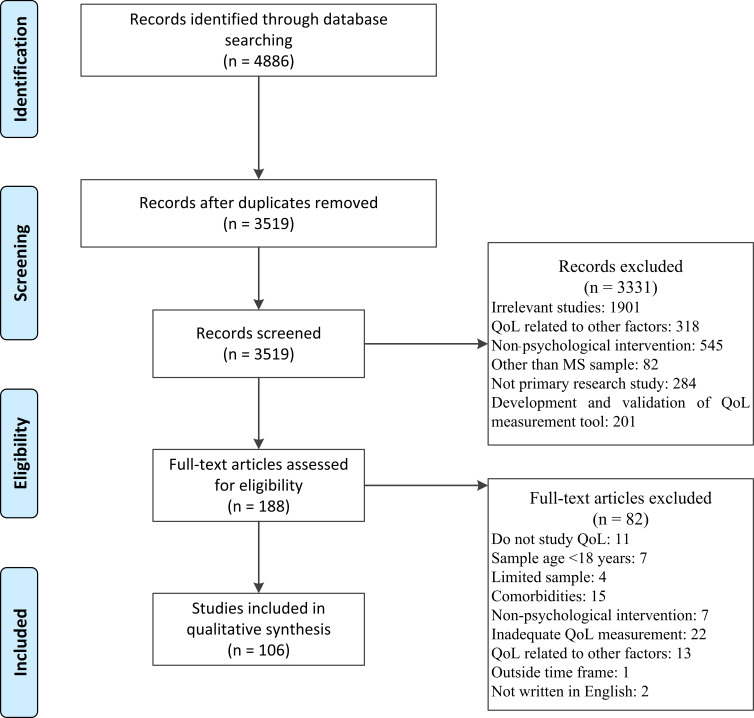
OBJECTIVE: In recent years, quality of life (QoL) in multiple sclerosis (MS) has been gaining considerable importance in clinical research and practice. Against this backdrop, this systematic review aimed to provide a broad overview of clinical, sociodemographic and psychosocial risk and protective factors for QoL in adults with MS and analyse psychological interventions for improving QoL. METHOD: The literature search was conducted in the Scopus, Web of Science and ProQuest electronic databases. Document type was limited to articles written in English, published from January 1, 2014, to January 31, 2019. Information from the selected articles was extracted using a coding sheet and then qualitatively synthesised. RESULTS: The search identified 4886 records. After duplicate removal and screening, 106 articles met the inclusion and exclusion criteria for qualitative synthesis and were assessed for study quality. Disability, fatigue, depression, cognitive impairment and unemployment were consistently identified as QoL risk factors, whereas higher self-esteem, self-efficacy, resilience and social support proved to be protective. The review analysed a wide spectrum of approaches for QoL psychological intervention, such as mindfulness, cognitive behavioural therapy, self-help groups and self-management. The majority of interventions were successful in improving various aspects of QoL. CONCLUSION: Adequate biopsychosocial assessment is of vital importance to treat risk and promote protective factors to improve QoL in patients with MS in general care practice.
Overview
CoChat Summary
## TL;DR
This systematic review synthesized 106 English-language studies on quality of life (QoL) in adults with multiple sclerosis (MS) published from January 1, 2014 to January 31, 2019. It found that disability, fatigue, depression, cognitive impairment, and unemployment were consistent QoL risk factors, while self-esteem, self-efficacy, resilience, and social support were protective.
## Key findings
- From 4,886 records, 188 articles underwent full-text review and 106 were included in the narrative synthesis; studies were mostly cross-sectional (n=74), and sample sizes ranged from 7 to 74,451.
- Among 70 studies on QoL risk/protective factors, disability/functional impairment (EDSS), fatigue, depression, cognitive impairment, and unemployment were consistently identified as QoL risk factors; social support, self-esteem, self-efficacy, resilience, and participation were protective.
- For interventions, all mindfulness-based therapy programmes improved QoL at some evaluation point, and the review reports that the majority of psychological interventions were successful in improving various aspects of QoL.
- The review found 25 intervention studies; interventions included mindfulness, cognitive behavioural therapy, self-help groups, acceptance and commitment therapy, and self-management approaches.
## Methods
- Systematic review following PRISMA guidelines, searching Scopus, Web of Science, and ProQuest in February–March 2019 for English-language journal articles published from January 1, 2014 to January 31, 2019.
- Included primary studies of adults (>18 years) with confirmed MS that focused on QoL determinants or psychological interventions to improve QoL, and used validated QoL measures; excluded non-psychological interventions and several other study types specified in the paper.
- Two researchers independently screened studies and extracted data; quality was assessed with a standardized 12-item checklist, and because of heterogeneity in designs and outcomes, the authors performed a qualitative narrative synthesis rather than a meta-analysis.
## Limitations
- The paper states that quantitative synthesis/meta-analysis was not possible because of heterogeneity in methodologies, study designs, and outcomes.
- The authors also state that the search was restricted to a 5-year period through January 2019 due to the large number of topics and limited resources.
- Evident from the text: the review was limited to English-language journal articles, which may have excluded relevant non-English evidence.
Model-written summary. Check it against the paper before relying on it.
Integrity signals
Registry
Cites
Statistics
Figures
Verification
Claims the paper makes
5 Valid · 4 Not valid · 97 Not checked · 30 Own results and interpretations
Every source the paper cites for this claim was checked and supports it.
In the paper
“Disease duration,30 31 progressive type,26 36 37 progressive MS onset38 and relapses in the last 3 months were further relevant factors negatively affecting QoL.26”
§ Quality of life in adults with multiple sclerosis: a systematic review > Results > Risk and protective MS QoL factors
What the sources say
- Supportedcites [30] Brola W, Sobolewski P, Jantarski K Multiple sclerosis: patient-reported quality of life in the Świętokrzyskie region. Med Stud Med 2017; 33: 191– 8. 10.5114/ms.2017.70345 source
The Results passage reports that longer disease duration was significantly associated with lower quality of life (p < 0.001) among patients in the Świętokrzyskie cohort. The Conclusions also identify long disease duration as a factor decreasing quality of life in that population. (LLM, conf=0.93)
- Supportedcites [31] Brola W, Sobolewski P, Fudala M, et al Self-Reported quality of life in multiple sclerosis patients: preliminary results based on the Polish MS registry. Patient Prefer Adherence 2016; 10: 1647– 56. 10.2147/PPA.S109520 27616882 PMC5008638 source
The Results report a significant association between disease duration and QoL and state that patients with long disease duration reported significantly lower QoL. The Conclusion also identifies disease duration as a main factor in reduced QoL. (LLM, conf=0.94)
plainstates an association- Asserted: passes — The authors put it forward as true.
- Checkable: passes — It can be checked against evidence.
- Load-bearing: passes — The paper’s conclusions depend on it.
- Based: passes — The paper gives a reason why it holds.
- Rests on an assumption not shown here.
- Supported
The cited sources support only part of this claim — read each source’s verdict below.
In the paper
“Functional impairment as assessed by the Expanded Disability Status Scale (EDSS) level was one of the leading causes of diminished QoL.25–35”
§ Quality of life in adults with multiple sclerosis: a systematic review > Results > Risk and protective MS QoL factors
What the sources say
- Not checked yetcites [25] Gupta S, Goren A, Phillips AL, et al Self-Reported severity among patients with multiple sclerosis in the U.S. and its association with health outcomes.. Mult Scler Relat Disord 2014; 3: 78– 88. 10.1016/j.msard.2013.06.002 25877977 source
- Partly supportedcites [26] Rezapour A, Almasian Kia A, Goodarzi S, et al The impact of disease characteristics on multiple sclerosis patients’ quality of life. Epidemiol Health 2017; 39: e2017008– 7. 10.4178/epih.e2017008 28231687 PMC5434226 sourceExperimental — accuracy not yet measured
The Results report that higher EDSS scores correlated with lower physical and mental quality of life, and the Discussion identifies disease severity as the strongest predictor of physical quality of life. The study was cross-sectional, however, so it does not establish functional impairment as a cause of diminished quality of life; nor does it identify EDSS level as a leading predictor of the mental dimension. Page numbers were not supplied in our copy. (LLM, conf=0.85)
- Not checked yetcites [27] Nakazawa K, Noda T, Ichikura K, et al Resilience and depression/anxiety symptoms in multiple sclerosis and neuromyelitis optica spectrum disorder. Mult Scler Relat Disord 2018; 25: 309– 15. 10.1016/j.msard.2018.08.023 30176401 source
- Not checked yetcites [28] Ciampi E, Uribe-San-Martin R, Vásquez M, et al Relationship between social cognition and traditional cognitive impairment in progressive multiple sclerosis and possible implicated neuroanatomical regions. Mult Scler Relat Disord 2018; 20: 122– 8. 10.1016/j.msard.2018.01.013 29414284 source
- Not checked yetcites [29] Klevan G, Jacobsen CO, Aarseth JH, et al Health related quality of life in patients recently diagnosed with multiple sclerosis. Acta Neurol Scand 2014; 129: 21– 6. 10.1111/ane.12142 23772958 source
- Supportedcites [30] Brola W, Sobolewski P, Jantarski K Multiple sclerosis: patient-reported quality of life in the Świętokrzyskie region. Med Stud Med 2017; 33: 191– 8. 10.5114/ms.2017.70345 source
The Results report that higher EDSS-measured disability was significantly associated with lower quality of life (p < 0.001). The Conclusions (pp. 191–198) identify advanced disability as one of the main factors decreasing quality of life among patients in the Świętokrzyskie cohort. (LLM, conf=0.90)
- Partly supportedcites [31] Brola W, Sobolewski P, Fudala M, et al Self-Reported quality of life in multiple sclerosis patients: preliminary results based on the Polish MS registry. Patient Prefer Adherence 2016; 10: 1647– 56. 10.2147/PPA.S109520 27616882 PMC5008638 sourceExperimental — accuracy not yet measured
The Results (page not provided) report that higher disability was significantly associated with lower quality of life, and the Discussion identifies EDSS as the disability measure. The paper does not establish functional impairment as a cause or rank it among the leading causes of diminished quality of life. (LLM, conf=0.86)
- Not checked yetcites [32] Fernández-Jiménez E, Arnett PA Impact of neurological impairment, depression, cognitive function and coping on quality of life of people with multiple sclerosis: a relative importance analysis. Mult Scler 2015; 21: 1468– 72. 10.1177/1352458514562439 25533298 source
- Not checked yetcites [33] Nickel S, von dem Knesebeck O, Kofahl C Self-assessments and determinants of HRQoL in a German MS population. Acta Neurol Scand 2018; 137: 174– 80. 10.1111/ane.12854 28975610 source
- Not checked yetcites [34] Cioncoloni D, Innocenti I, Bartalini S, et al Individual factors enhance poor health-related quality of life outcome in multiple sclerosis patients. significance of predictive determinants. J Neurol Sci 2014; 345: 213– 9. 10.1016/j.jns.2014.07.050 25130927 source
plainstates a cause- Asserted: passes — The authors put it forward as true.
- Checkable: passes — It can be checked against evidence.
- Load-bearing: passes — The paper’s conclusions depend on it.
- Based: passes — The paper gives a reason why it holds.
- Rests on an assumption not shown here.
The sources with a verdict support this claim; the rest weren’t checked yet, have no full text we could read, or their verdicts aren’t rated yet.
In the paper
“Disease duration,30 31 progressive type,26 36 37 progressive MS onset38 and relapses in the last 3 months were further relevant factors negatively affecting QoL.26”
§ Quality of life in adults with multiple sclerosis: a systematic review > Results > Risk and protective MS QoL factors
What the sources say
- Supportedcites [26] Rezapour A, Almasian Kia A, Goodarzi S, et al The impact of disease characteristics on multiple sclerosis patients’ quality of life. Epidemiol Health 2017; 39: e2017008– 7. 10.4178/epih.e2017008 28231687 PMC5434226 source
The Discussion (page not provided) reports that patients with relapsing-remitting MS had better physical and mental quality of life than patients with progressive MS. This supports progressive disease type as a factor associated with poorer quality of life. (LLM, conf=0.93)
- Not checked yetcites [36] Gross HJ, Watson C, Characteristics WC Burden of illness, and physical functioning of patients with relapsing-remitting and secondary progressive multiple sclerosis: a cross-sectional us survey. Neuropsychiatr Dis Treat 2017; 13: 1349– 57. 10.2147/NDT.S132079 28572730 PMC5441664 source
- Not checked yetcites [37] Cichy KE, Li J, Rumrill PD, et al Non-vocational health-related correlates of quality of life for older adults living with multiple sclerosis. J Rehabil 2016; 82: 36– 44.
plainstates an association- Asserted: passes — The authors put it forward as true.
- Checkable: passes — It can be checked against evidence.
- Load-bearing: passes — The paper’s conclusions depend on it.
- Based: passes — The paper gives a reason why it holds.
- Rests on an assumption not shown here.
- Supported
Every source the paper cites for this claim was checked and supports it.
In the paper
“At follow-up, the intervention groups in both studies had experienced an increase in QoL.”
§ Quality of life in adults with multiple sclerosis: a systematic review > Results > Interventions
What the sources say
- Supportedcites [114] Calandri E, Graziano F, Borghi M, et al Improving the quality of life and psychological well-being of recently diagnosed multiple sclerosis patients: preliminary evaluation of a group-based cognitive behavioral intervention. Disabil Rehabil 2017; 39: 1474– 81. 10.1080/09638288.2016.1198430 27385055 source
For the Calandri et al. study, the follow-up results (p. 11) report that the intervention group's mental-health score increased and that this trend was maintained at one year. The Discussion (p. 12) identifies mental health as the psychological component of quality of life. (LLM, conf=0.90)
- Supportedcites [115] Graziano F, Calandri E, Borghi M, et al The effects of a group-based cognitive behavioral therapy on people with multiple sclerosis: a randomized controlled trial. Clin Rehabil 2014; 28: 264– 74. 10.1177/0269215513501525 24013269 source
The Abstract (p. 3) reports that quality of life increased in Graziano et al.’s intervention group compared with the control group at six-month follow-up. This confirms the part of the sentence attributed to this source; it does not assess the separate Calandri study. (LLM, conf=0.94)
plainstates a cause- Asserted: passes — The authors put it forward as true.
- Checkable: passes — It can be checked against evidence.
- Load-bearing: unclear — It is unclear whether the paper’s conclusions depend on it.
- Based: passes — The paper gives a reason why it holds.
- Rests on an assumption not shown here.
- Supported
The cited sources that could be checked couldn’t confirm or dispute this claim.
In the paper
“Thomas et al127 reported significant positive changes in physical health assessed by the Multiple Sclerosis Impact Scale (MSIS-29) and vitality as measured by the SF-36 in the intervention group 12 months after the treatment.”
§ Quality of life in adults with multiple sclerosis: a systematic review > Results > Interventions
What the sources say
- Could not verifycites [127] matched to “A single nucleotide polymorphism in the coding region of PGC-1α is a male-specific modifier of Huntington disease age-at-onset in a large European cohort” (2014) sourceExperimental — accuracy not yet measured
Our copy of Weydt et al. (2014, BMC Neurology) is entirely a Huntington disease genetics study: it reports the effect of PPARGC1A rs3736265 on age-at-onset in 1706 symptomatic HD patients from the EHDN REGISTRY (Results and discussion, p. 1-2; Methods, p. 2-3). No passage addresses multiple sclerosis, a fatigue self-management intervention, the MSIS-29, or the SF-36, and no 'Thomas et al.' MS trial appears in its reference list (References, pp. 3-5). Searched: 'Thomas fatigue multiple sclerosis self-management', 'MSIS-29 SF-36 physical health vitality', 'Short Form Health Survey quality of life intervention' — all returned only HD/PGC-1α content, so the claim cannot be checked against this source. (LLM, conf=0.78)
plainstates a cause- Asserted: passes — The authors put it forward as true.
- Checkable: passes — It can be checked against evidence.
- Load-bearing: unclear — It is unclear whether the paper’s conclusions depend on it.
- Based: passes — The paper gives a reason why it holds.
- Rests on an assumption not shown here.
- Could not verify
79 more claims · 1 with their cited sources checked
Create a free account to see all 136 claims and to verify the 202 references still open.
- Probably not a substantial claim. 20
- It may state two separate claims as one. 35
- The quote only partly states this claim. 2
Claims other papers make about this one
Each is checked against this paper’s own text: does it say what the citing paper says it does?
The cited source says what the claim attributes to it.
In the citing paper
“persistent physical symptoms are a major determinant of quality of life”
From Persistent physical symptoms: definition, genesis, and management (2024) · cites this paper as [10]
The cited source says what the claim attributes to it.
In the citing paper
“A recent systematic review of 106 papers on MS showed that among other factors, higher self-efficacy was a protective factor for quality of life (46).”
From Key demographics and psychological skills associated with adjustment to progressive Multiple Sclerosis early in the diagnosis (2022) · cites this paper as [46]
In the citing paper
“In a narrative review on the neural mechanism of mental fatigue, Ishii, and colleagues [45] proposed a dual regulation system consisting of neural facilitation and inhibition systems to explain the mechanism behind acute mental fatigue.”
From Neural mechanisms underlying state mental fatigue: a systematic review and activation likelihood estimation meta-analysis (2022) · cites this paper as [45]
In the citing paper
“Motivational input during mental tasks stimulates this system thereby preventing decrease in task performance [45].”
From Neural mechanisms underlying state mental fatigue: a systematic review and activation likelihood estimation meta-analysis (2022) · cites this paper as [45]
In the citing paper
“The mental inhibition system was thought to involve the insula cortex and posterior cingulate cortex and stimulation of this system during mental tasks decreases cognitive performance [45].”
From Neural mechanisms underlying state mental fatigue: a systematic review and activation likelihood estimation meta-analysis (2022) · cites this paper as [45]
3 more claims about this paper
Create a free account to see every claim other papers make about this one.
Citations
Cites
PRISMA-P Group, Moher, D., Shamseer, L., Clarke, M., Ghersi, D., Liberati, A., Petticrew, M., Shekelle, P., & Stewart, L. A. (2015) · Systematic Reviews · doi:10.1186/2046-4053-4-1 · Cited by 26,223
(1995) · Social Science & Medicine · doi:10.1016/0277-9536(95)00112-k · Cited by 7,643
Handbook of Disease Burdens and Quality of Life Measures
(2010) · Springer eBooks · doi:10.1007/978-0-387-78665-0 · Cited by 644
Revicki, D. A., Osoba, D., Fairclough, D., Barofsky, I., Berzon, R., Leidy, N. K., & Rothman, M. (2000) · Quality of Life Research · doi:10.1023/a:1008996223999 · Cited by 577
Hanisch, S. E., Twomey, C. D., Szeto, A. C. H., Birner, U. W., Nowak, D., & Sabariego, C. (2016) · BMC Psychiatry · doi:10.1186/s12888-015-0706-4 · Cited by 564
Definitions of Quality of Life: What Has Happened and How to Move On
Post, M. (2014) · Topics in Spinal Cord Injury Rehabilitation · doi:10.1310/sci2003-167 · Cited by 517
Work ability and associated factors of Brazilian technical-administrative workers in education
Godinho, M. R., Greco, R. M., Teixeira, M. T. B., Teixeira, L. R., Guerra, M. R., & Chaoubah, A. (2016) · BMC Research Notes · doi:10.1186/s13104-015-1837-x · Cited by 393
A review about the impact of multiple sclerosis on health-related quality of life
Benito-León, J., Manuel Morales, J., Rivera-Navarro, J., & Mitchell, A. J. (2003) · Disability and Rehabilitation · doi:10.1080/09638280310001608591 · Cited by 348
For the European Huntington Disease Network, Weydt, P., Soyal, S. M., Landwehrmeyer, G. B., & Patsch, W. (2014) · BMC Neurology · doi:10.1186/1471-2377-14-1 · Cited by 206
Are Movement Artifacts in Magnetic Resonance Imaging a Real Problem?—A Narrative Review
Havsteen, I., Ohlhues, A., Madsen, K. H., Nybing, J. D., Christensen, H., & Christensen, A. (2017) · Frontiers in Neurology · doi:10.3389/fneur.2017.00232 · Cited by 196
Research works printed but not linked: 3
- Petrović N, Prlić N, Gašparić I, et al Quality of life among persons suffering from multiple sclerosis. Medica Jadertina 2019; 49: 217– 26 https://hrcak.srce.hr/234930
- Paziuc LC, Radu MR The influence of mixed anxiety-depressive disorder on the perceived quality of life in multiple sclerosis patients. Bulletin of the Transilvania University of Brasov, Seriels VI: Medical Sciences 2018; 11: 41– 50.
- Geiser F, Imbierowicz K, Conrad R, et al [Differences between patients classified as "recovered" or "improved" and "unchanged" or "deteriorated" in a psychotherapy outcome study]. Z Psychosom Med Psychother 2001; 47: 250– 61. 11568863
Cited by
Items 101–200 of 334
Bergien, S. O., Siersma, V., Kristiansen, M., & Skovgaard, L. (2023) · Multiple Sclerosis and Related Disorders · doi:10.1016/j.msard.2023.104878 · Cited by 7
Rossetto, F., Isernia, S., Smecca, G., Rovaris, M., & Baglio, F. (2024) · The Clinical Neuropsychologist · doi:10.1080/13854046.2024.2446026 · Cited by 6
“For this reason, MS is one of the leading causes of disease burden and poor quality of life (Gil-González et al., 2020).”
Prabahar, A., & Raja, K. (2022) · Diagnostics · doi:10.3390/diagnostics12081914 · Cited by 6
Jakimovski, D., Kavak, K. S., Zakalik, K., McGraw, C. A., Gottesman, M. H., Coyle, P. K., Zivadinov, R., & Weinstock‐Guttman, B. (2023) · Journal of the Neurological Sciences · doi:10.1016/j.jns.2023.122781 · Cited by 6
Baştürk, S., Ekici, G., Kırteke, F., Durak, Ö. F., & Ekici, B. (2024) · Arts & Health · doi:10.1080/17533015.2024.2325425 · Cited by 6
“Although there are many pharmacological and non-pharmacological approaches to managing MS symptoms, physical activity is an important tool in improving MS symptoms (Gil-González et al., 2020; Sonke et al., 2021).”
Christodoulou, V. N., Varvarousis, D., Ntritsos, G., Dimopoulos, D., Γιαννακέας, Ν., Vasileiadis, G. I., Korompilias, A. V., & Ploumis, A. (2024) · Disability and Rehabilitation · doi:10.1080/09638288.2024.2338197 · Cited by 6
“The correlation between motion and Quality of Life (QoL) seems obvious and it is established in previous research [3–6].”
Neuropsychological Manifestations of Multiple Sclerosis
Hancock, L. M., Rao, S. M., & Galioto, R. (2024) · Neurologic Clinics · doi:10.1016/j.ncl.2024.05.010 · Cited by 6
Fatigue and depression influence the prevalence of anxiety in patients with multiple sclerosis
Nyári, A., Kokas, Z., Szamosi, S., Fricska‐Nagy, Z., Kincses, Z. T., Füvesi, J., Biernacki, T., Klivènyi, P., Bencsik, K., & Sandi, D. (2024) · Neurological Sciences · doi:10.1007/s10072-024-07737-9 · Cited by 6
“Several studies have investigated the relationship between HRQoL and depression, anxiety, stress and fatigue [58].”
Celani, M. G., Nonino, F., Mahan, K., Orso, M., Ridley, B., Baldin, E., Bignamini, A. A., D’Amico, R., Cantisani, T. A., Colombo, C., et al. (2022) · Multiple Sclerosis and Related Disorders · doi:10.1016/j.msard.2022.103688 · Cited by 6
Bogosian, A., Day, F., Norton, S., Silber, E., Sakel, M., Sharrack, B., & Moss-Morris, R. (2022) · Frontiers in Rehabilitation Sciences · doi:10.3389/fresc.2022.966133 · Cited by 5
“A recent systematic review of 106 papers on MS showed that among other factors, higher self-efficacy was a protective factor for quality of life (46).”
BackgroundLi, W., Hu, N., Yang, X., Zheng, W., Tong, J., Song, J., Song, Y., Gao, X., Wang, Z., Liu, W., et al. (2025) · Neuropsychiatric Disease and Treatment · doi:10.2147/ndt.s524185 · Cited by 5
Pérez, E. R. P., López, M. L. B., Fernández, E. G., Arnés, M. D. R. M., Vázquez, M. F., Hernández, M., & García, E. G. (2025) · Neurology International · doi:10.3390/neurolint17120195 · Cited by 5
“The findings underscore the importance of considering the family context in the comprehensive care of these individuals, as stress associated with chronic diseases within the family unit can negatively affect mental health perception [53,64].”
InfluentialBuyukturkoglu, K., Dworkin, J. D., Leiva, V., Provenzano, F. A., Guevara, P., Jager, P. L. D., Leavitt, V. M., & Riley, C. (2022) · Multiple Sclerosis and Related Disorders · doi:10.1016/j.msard.2022.104247 · Cited by 5
Fragkiadaki, E., Cotterill, N., Rice, C. M., Smith, J. A., & Nizza, I. E. (2023) · PLoS ONE · doi:10.1371/journal.pone.0288295 · Cited by 5
“The role of psychological interventions and their positive effects on pwMS’ mental health and coping has been well documented [6, 9, 10].”
BackgroundAl-Qerem, W. A., Basem, D., Khdair, S. I., Jarab, A. S., & Eberhardt, J. (2024) · Archives of Clinical Neuropsychology · doi:10.1093/arclin/acae121 · Cited by 5
Kaya, G., Köse, N., Salcı, Y., Armutlu, K., Karakaya, J., Tuncer, A., & Karabudak, R. (2022) · Irish Journal of Medical Science (1971 -) · doi:10.1007/s11845-022-03237-x · Cited by 5
Quality of life of MS patients in Trinidad and Tobago: Anomaly or adaptation?
Bailey, H. H., Panday, A., Lucky-Samaroo, S., & Maharajh, A. (2023) · Multiple Sclerosis and Related Disorders · doi:10.1016/j.msard.2023.104795 · Cited by 5
Nadai, A. S. D., Zamora, R. J., Finch, A., Miller, D. M., Ontaneda, D., Gunzler, D. D., & Briggs, F. B. S. (2024) · Multiple Sclerosis Journal · doi:10.1177/13524585241282763 · Cited by 5
Sawicka, K. M., Feldman, B. M., Beyene, J., Finlayson, M. L., Guenette, M. D., Liu, K., Lynd, L. D., Patten, S. B., Toulany, A., Traboulsee, A. L., et al. (2025) · Multiple Sclerosis and Related Disorders · doi:10.1016/j.msard.2025.106561 · Cited by 6
Jacob, L., Smith, L., Koyanagi, A., Haro, J. M., Konrad, M., Tanislav, C., & Kostev, K. (2021) · Multiple Sclerosis Journal - Experimental Translational and Clinical · doi:10.1177/20552173211022784 · Cited by 5
“In this context, long-term quality of life has become one of the most important aspects of the management of people with multiple sclerosis.(4)”
BackgroundSignificance of Post-Traumatic Growth and Mental Health for Coping in Multiple Sclerosis Caregivers
Gil-González, I., Pérez-San-Gregorio, M. Á., Funuyet‐Salas, J., Conrad, R., & Rodríguez, A. M. (2023) · Healthcare · doi:10.3390/healthcare11101390 · Cited by 5
Self-citationThe value of patient-reported outcome measures for multiple sclerosis
McGinley, M. P., & Lapin, B. R. (2022) · Multiple Sclerosis Journal · doi:10.1177/13524585221111675 · Cited by 5
Storey, A., Nash, E., Dempsey, H., McIvor, K., & Zarotti, N. (2025) · Neuropsychological Rehabilitation · doi:10.1080/09602011.2025.2457666 · Cited by 4
“…impacts, such as inability to work, lack of independence, reduced perceptions of control, stigma, and social withdrawal (Eccles et al., 2023; Gil-González et al., 2020; Perepezko et al., 2019; Riechmann et al., 2019; Tombini et al., 2020; Zarotti et al., 2024), ultimately resulting in…”
Trauma Burden Affected People with Multiple Sclerosis During SARS-CoV-2 Pandemic
Heidler, F., Hecker, M., Frahm, N., Baldt, J., Streckenbach, B., Meißner, J., Burian, K., Langhorst, S. E., Mashhadiakbar, P., Richter, J., et al. (2025) · Journal of Clinical Medicine · doi:10.3390/jcm14082665 · Cited by 4
“Factors that contribute to the association between MS and depressive disorders include the psychosocial impact of disability due to MS [107], the direct effects of lesions on brain structures involved in mood regulation and maintenance [11,108], and the potential mood fluctuations associated with…”
Petrescu, S., Dumitru-Martoiu, M.-M., & Panea, C. (2025) · Neurology International · doi:10.3390/neurolint17110174 · Cited by 4
Physiotherapy management of multiple sclerosis
Learmonth, Y. C. (2025) · Journal of physiotherapy · doi:10.1016/j.jphys.2025.11.008 · Cited by 4
Uhlenbusch, N., Snijders, R. J. A. L. M., Mund, M., Janik, M. K., Milkiewicz, P., Löwe, B., Kroll, C., Raszeja‐Wyszomirska, J., Gerussi, A., Bolis, F., et al. (2026) · Liver International · doi:10.1111/liv.70526 · Cited by 4
Freedman, D., Benedict, R. H. B., Oh, J., & Feinstein, A. (2026) · Journal of Neurology · doi:10.1007/s00415-026-13743-y · Cited by 4
Helminen, J., & Jehkonen, M. (2024) · Applied Neuropsychology Adult · doi:10.1080/23279095.2024.2403764 · Cited by 4
Reliability and Validity of the L Test in Persons With Multiple Sclerosis
Bilek, F., & Demir, C. F. (2024) · Perceptual and Motor Skills · doi:10.1177/00315125241298728 · Cited by 4
“The impairment of gait and balance is one of the most disabling MS symptoms because it impacts mobility and quality of life for PwMS (Gil-Gonz´alez et al., 2020).”
Schmidt, R., Starke, A., Bednarz, N., & Bergh, F. T. (2025) · Quality of Life Research · doi:10.1007/s11136-025-03928-9 · Cited by 4
Yücekaya, B., Kemer, S. N., Asan, E., Gerdan, H., Balcı, N. Ç., Cakır, D., Kurtça, M. P., Keskin, M., & Terzi, M. (2025) · Neurological Research · doi:10.1080/01616412.2025.2490086 · Cited by 4
Patt, N., Kupjetz, M., Schlagheck, M. L., Hersche, R., Joisten, N., Kool, J., Gonzenbach, R. R., Nigg, C. R., Zimmer, P., & Bansi, J. (2024) · Multiple Sclerosis and Related Disorders · doi:10.1016/j.msard.2024.105826 · Cited by 4
Henson, G. J., van der Mei, I. A. F., Taylor, B. V., Claflin, S. B., Palmer, A. J., Campbell, J. A., & Chen, G. (2024) · Health and Quality of Life Outcomes · doi:10.1186/s12955-024-02278-3 · Cited by 4
“In support, a recent systematic review identified unemployment as a consistent contributor to reduced wellbeing for people living with MS [32], with other investigations linking MS-related disability severity to workplace redundancy [33, 34].”
BackgroundImproving Quality of Life in Polish patients with multiple sclerosis: a multicentre analysis
Tarasiuk, J., Kapica-Topczewska, K., Czarnowska, A., Chorąży, M., Snarska, K. K., Kochanowicz, J., Bartosik-Psujek, H., Rościszewska-Żukowska, I., Czarnota, J., Kalinowska, A., et al. (2025) · Neurologia i Neurochirurgia Polska · doi:10.5603/pjnns.105052 · Cited by 5
Pain Prevalence in Multiple Sclerosis in a Lisbon Tertiary Hospital: A Cross-Sectional Study
Junqueira, A. F., Farraposo, S., Cruz, A. R., Mamede, M. P., Silva, M. L., & Mesquita, G. (2022) · Cureus · doi:10.7759/cureus.22213 · Cited by 4
Duraney, E. J., Fisher, M. E., Manglani, H. R., Andridge, R. R., Nicholas, J. A., & Prakash, R. S. (2022) · Rehabilitation Psychology · doi:10.1037/rep0000456 · Cited by 4
Healthcare Cost of Multiple Sclerosis and in Relation to Disability Level in Alberta
McCombe, J. A., Smyth, P. S., Kate, M. P., So, H., Vu, K. N., Luu, H., Martins, K. J. B., Aponte-Hao, S., Nguyen, P. U., Richer, L. P., et al. (2024) · Canadian Journal of Neurological Sciences / Journal Canadien des Sciences Neurologiques · doi:10.1017/cjn.2024.288 · Cited by 3
Alaboson, J., Coffey, L., Shrivastava, S., Ade-Alao, A. O., & Maguire, R. (2025) · Digital Health · doi:10.1177/20552076251326230 · Cited by 3
“3 Variations in MS or sub-types can result in physical dysfunction and psychological distress, 4 which may impact QoL.”
Ayache, S. S., Mattar, J. G., Créange, A., Abdellaoui, M., Zedet, M., Lefaucheur, J., Megherbi, H., Khaled, H., Lahoud, G. A., & Chalah, M. A. (2025) · Multiple Sclerosis Journal - Experimental Translational and Clinical · doi:10.1177/20552173251348304 · Cited by 3
Cardini, R., Bertoni, R., Carpinella, I., Pegorini, C., Tacchino, A., Grange, E., Guidotti, V., Brichetto, G., Solaro, C. M., Budassi, T., et al. (2025) · Digital Health · doi:10.1177/20552076251346694 · Cited by 3
“This battery includes three tests assessing the cognitive domains most commonly affected in MS, the Symbol Digit Modalities Test for information processing speed, the California Verbal Learning Test-2, for verbal learning, and the Brief Visuospatial Memory Test-Revised for visuo-spatial learning.”
It’s you it’s about! Exploring existential aspects on quality of life with myasthenia gravis
Missel, M., & Witting, N. (2025) · Medicine Health Care and Philosophy · doi:10.1007/s11019-025-10320-4 · Cited by 3
“This is espe - cially true for diseases that affect energy levels, functional - ity, and daily routines (Bahall and Bailey 2022; Ge et al. 2019; Gil-González et al. 2020).”
Quality of Life and Cognitive Emotion Regulation Strategies in Multiple Sclerosis Patients
Eshaghzadeh, S., Abbaspour, S., Sarboozi-hoseinabadi, T., Eshaghzadeh, M., Tatari, M., Nezhad, M. R., Saravani, H., Hamidi, R., Aghabeigi, A., Rahimi, S., et al. (2022) · Journal of Rational-Emotive & Cognitive-Behavior Therapy · doi:10.1007/s10942-022-00474-y · Cited by 3
“1 3 the correlation between MS patients’ QoL and disease severity from psychological and socioeconomic perspectives (Fernández et al., 2011; Gil-González et al., 2020; Jaracz et al., 2010) so.”
BackgroundCraner, M. J., Malik, Y. M. A., Babtain, F. A., Alshamrani, F., Alkhawajah, M. M., Alfugham, N. B., Al-Yafeai, R. H., Aljarallah, S., Makkawi, S., Qureshi, S., et al. (2022) · Neurology and Therapy · doi:10.1007/s40120-022-00401-4 · Cited by 3
“major impact on QoL in patients with MS [17, 23, 26, 27].”
BackgroundJiang, Q., Wang, W., Chen, W., & Xu, Y. (2023) · Multiple Sclerosis and Related Disorders · doi:10.1016/j.msard.2023.104626 · Cited by 3
Esclerose múltipla e qualidade de vida: abordagens para a inclusão do bem-estar
Melo, B. Z., de Almeida, K. C., da Silva, J. L., & Amâncio, N. D. F. G. (2024) · Peer Review · doi:10.53660/prw-1751-3406 · Cited by 3
Depression is a core symptom of multiple sclerosis: Yes
Hancock, L. M. (2024) · Multiple Sclerosis Journal · doi:10.1177/13524585241249564 · Cited by 3
The evolution of multiple sclerosis in Spain over the last decade from the patient's perspective
Campos‐Lucas, F. J., Fernández-Fernández, Ó., Monge-Martín, D., Torres, E. M., Carrascal, P., & Martínez, F. C. (2021) · Multiple Sclerosis and Related Disorders · doi:10.1016/j.msard.2021.103355 · Cited by 3
Neuropsychological outcomes following HSCT in MS: A systematic review
Davenport, L., McCauley, M., Breheny, E., Smyth, L., Gaughan, M., Tubridy, N. J., McGuigan, C., & O’Keeffe, F. M. (2024) · Multiple Sclerosis and Related Disorders · doi:10.1016/j.msard.2024.105702 · Cited by 3
The Path from Personality to Anxiety and Depression Is Mediated by Cognition in Multiple Sclerosis
Schenk, A., Popa, C. O., Cojocaru, C. M., Marian, Ș., Maier, S., & Bălașa, R. (2024) · Journal of Personalized Medicine · doi:10.3390/jpm14070682 · Cited by 3
“With regard to perceived health status in the clinical sample, our outcome is in line with numerous studies emphasizing the burden of neurological, psychological, and physiological symptoms on overall quality of life [61,62].”
ResultSangster, E., Lanka, N., Acharya, P., Virani, S., Afreen, S., Perthiani, A., & Nassar, S. T. (2024) · Cureus · doi:10.7759/cureus.66432 · Cited by 3
Raji, I., Bourkhime, H., Ragala, M. E. A., Nejjar, F., & Belahsen, F. (2025) · International Journal of MS Care · doi:10.7224/1537-2073.2024-036 · Cited by 3
Fatigue and health-related quality of life in patients with multiple sclerosis
Al‐Gamal, E., Hyarat, S. Y., Jaried, L. A., Rama, E. D., Ahmad, M. M., & Long, T. (2025) · Journal of research in nursing · doi:10.1177/17449871241290435 · Cited by 4
“…individuals, it is markedly pronounced and enduring in those diagnosed with MS. Research in the United States (Cella et al., 2007) and Spain (Gil-Gonzalez et al., 2020) has found the disease to be characterised by an irresist-ible, overpowering, devastating and constant sense of tiredness…”
Ghafoor, D. D., Ahmed, D. O., & Al-Bajalan, S. J. (2025) · Journal of Molecular Neuroscience · doi:10.1007/s12031-025-02386-9 · Cited by 3
OPREA, S. (2021) · FARMACIA · doi:10.31925/farmacia.2021.5.4 · Cited by 3
“…between age and EDSS can be explained by the progressive nature of MS, while the negative correlation between female gender and the number of years of treatment could not be explained by current knowledge and was attributed to the observational, hence bias prone nature of the study [6, 13].”
Koss, J., & Bohnet-Joschko, S. (2022) · Hawaii International Conference on System Sciences (HICSS) · doi:10.24251/hicss.2022.368 · Cited by 3
Rakuša, M., Chataway, J., & Hardy, T. A. (2023) · Pharmaceuticals · doi:10.3390/ph16091244 · Cited by 3
Quality of Life and Its Predictors in Patients with Multiple Sclerosis
Sotoudeh, S., Maroufizadeh, S., Balasi, L. R., Esfandiari, A., Nouri, A., & Bakhtiari, F. (2023) · Jundishapur Journal of Chronic Disease Care · doi:10.5812/jjcdc-138840 · Cited by 3
Patrick, S. E., Knox, K. B., Evans, C. D., Levin, M. C., Linassi, G. A., Poliakov, I., Rajput, A. H., & Donkers, S. J. (2024) · Frontiers in Neurology · doi:10.3389/fneur.2024.1332859 · Cited by 3
Defining a standard set of health outcomes for patients with relapsing-remitting multiple sclerosis
González, M. L., Carrascal, P., Sánchez, O. D., Guerra, M. B., Antigüedad, A. R., Baladrón, A. M., Ríos, N. B., Rovira, À., Lallana, V. M., Benedito‐Palos, L., et al. (2024) · Multiple Sclerosis and Related Disorders · doi:10.1016/j.msard.2024.105501 · Cited by 2
Καλτσάτου, Α., Theodorou, S., & Orologas, A. (2024) · Healthcare · doi:10.3390/healthcare12090870 · Cited by 2
Rothman, I., Tennant, A., Mills, R. J., & Young, C. A. (2025) · Sclerosis · doi:10.3390/sclerosis3020010 · Cited by 2
“While there is evidence that higher self-efficacy is associated with better QoL in MS [15,16], the role of self-efficacy has not been explored in the context of beliefs about locus of control.”
Diamond, K., Ruane, R., Dawes, C., Byrne, S., Taha, M., Foo, A. C. M., Mowszowski, L., Beadnall, H. N., Garber, J., Po, K., et al. (2025) · Multiple Sclerosis and Related Disorders · doi:10.1016/j.msard.2025.106464 · Cited by 2
Shaheen, A. A. M., Alsharafi, J. A., Aldaihan, M. M., Alrushud, A. S., Alderaa, A. A., Aldera, M., Alhammad, S. A., Farrag, A., Elsayed, W. H., Almurdi, M. M., et al. (2025) · Neurorehabilitation · doi:10.1177/10538135251344929 · Cited by 2
“Additionally, clinicians receive no reimbursement for administering and interpreting HRQOL data.”
InfluentialYu, M., Coe, S., Tektonidis, T. G., Solsona, E. M., Middleton, R., Nicholas, R. S., Neate, S. L., Probst, Y., Davenport, R. A., Reece, J. C., et al. (2025) · Journal of Clinical Neuroscience · doi:10.1016/j.jocn.2025.111756 · Cited by 2
Alaboson, J., Coffey, L., & Maguire, R. (2026) · Journal of Health Psychology · doi:10.1177/13591053251392873 · Cited by 2
“PwMS may also experience a lower quality of life (QoL) linked to concurrent disabilities, fatigue and other manifestations of MS (Gil-González et al., 2020), which may in turn lead to lower psychological wellbeing (Strober, 2018).”
InfluentialBrochet, B., Langdon, D. W., Havrdová, E., Lechner‐Scott, J., Montalbán, X., Patti, F., Piehl, F., Solari, A., Hupperts, R., Alexandri, N., et al. (2026) · Neurology and Therapy · doi:10.1007/s40120-026-00897-0 · Cited by 2
“Sev‑ eral studies have linked cognitive impairment to reduced HRQoL in PwMS [3, 4, 22].”
Sellitto, G., Simonazzi, E., Panuccio, F., Padovani, A. M., Amadio, E., Simeon, R., Berardi, A., Galeoto, G., & Ruotolo, I. (2026) · Journal of Patient-Reported Outcomes · doi:10.1186/s41687-026-01077-2 · Cited by 2
“Previous studies have shown that disability severity, fatigue, and depressive symptoms are among the strongest predictors of reduced HRQoL across both generic and MS-specific instruments [5, 9, 13].”
Khedr, E. M., Karim, A. A., Ezzeldin, M. Y., Abdelwarith, A., Abdelwarith, A., & Haridy, N. A. (2026) · Frontiers in Neurology · doi:10.3389/fneur.2026.1776488 · Cited by 2
“Similarly, cognitive impairment has been consistently associated with poorer QoL outcomes across MS populations (10, 11).”
Comparative impact of mental and cardiovascular comorbidities on adverse outcomes in people with MS
France‐Ratcliffe, M., Harrison, S. L., Verma, L. A., Abdul‐Rahim, A. H., McCallum, L., McDowell, G., Young, C. A., & Buckley, B. J. R. (2026) · Journal of the Neurological Sciences · doi:10.1016/j.jns.2026.126007 · Cited by 2
Jia, Y., Qiao, X., Zhao, J., Li, H., Hu, S., & Hu, M. (2023) · Neuroscience Bulletin · doi:10.1007/s12264-023-01135-5 · Cited by 2
Filippi, M., Ferrè, L., Zanetta, C., Rizzi, C., Pessina, G., Assogna, F., & Rocca, M. A. (2024) · Frontiers in Neurology · doi:10.3389/fneur.2024.1379712 · Cited by 2
Assessment of the life quality of patients with multiple sclerosis using the SF-36 scale
Стуров, Н. В., Tardov, M. V., Popova, E. V., Boldin, A. V., Strachuk, A., & kyzy, S. T. (2024) · Сибирский научный медицинский журнал · doi:10.18699/ssmj20240402 · Cited by 2
Namvar, H., & Sahraian, M. A. (2023) · Oman Medical Journal · doi:10.5001/omj.2023.58 · Cited by 2
“Journal of the Korea Academia-Industrial cooperation Society 2017 Apr;18(4):325-333.”
BackgroundOmar, E. S., Suliman, H. M., Osman, B., Abdalla, S. A., & Abdoon, I. H. (2024) · The Egyptian Journal of Neurology Psychiatry and Neurosurgery · doi:10.1186/s41983-024-00855-3 · Cited by 2
“Implementation of psychological support programs that address the negative impact of the COVID-19 pandemic on MS patients was considered important to strengthen the therapeutic alliance and improve the QoL [42, 43].”
BackgroundUhlmann, C., Dzierzega, H., & Schmid, P. (2024) · Epilepsy & Behavior · doi:10.1016/j.yebeh.2024.110101 · Cited by 2
Baharian, E., Abolhassani, S., Najimi, A., & Ashtari, F. (2024) · Journal of Education and Health Promotion · doi:10.4103/jehp.jehp_1474_23 · Cited by 2
Martín, C. S., Beltrán, R., Pardo, L., Soto, M., Matus-Rosas, P., Quezada-Scholz, V. E., Pino, P., Osma, J., & Carlos Guevara, O. (2025) · Clinical Case Studies · doi:10.1177/15346501251324920 · Cited by 3
Ravazoula, C., Georgiopoulou, V. V., Tzenalis, A., & Koutsojannis, C. M. (2026) · Sclerosis · doi:10.3390/sclerosis4010005 · Cited by 2
Shandiz, H. A., Boogar, I. R., & Talepasand, S. (2022) · International Journal of Applied Behavioral Sciences · doi:10.22037/ijabs.v9i3.38290 · Cited by 2
Quality of life should be the primary outcome for disease-modifying therapy trials in MS—Yes
Goverover, Y., & Chiaravalloti, N. D. (2023) · Multiple Sclerosis Journal · doi:10.1177/13524585231182705 · Cited by 2
Vascular comorbidities in patients with multiple sclerosis and their impact on physical disability
Tadić, D., Grgić, S., Dominović-Kovačević, A., Nazalević-Bursać, M., Mavija, S., & Đajić, V. (2022) · Medicinski Glasnik · doi:10.17392/1499-22 · Cited by 2
Ouwerkerk, M., Rietberg, M. B., van der Linden, M. M. W., Uitdehaag, B. M. J., van Wegen, E. E. H., & de Groot, V. (2024) · International Journal of MS Care · doi:10.7224/1537-2073.2023-060 · Cited by 2
Andrade, P. S., de Cerqueira, A. C. R., Colodetti, A. C., Schmidt, F. D. R., Godoy-Barreiros, J. M., Teixeira, A. L., & de Souza, L. C. (2022) · Dementia & Neuropsychologia · doi:10.1590/1980-5764-dn-2021-0050 · Cited by 1
VALIDATION OF THE MULTIPLE SCLEROSIS QUALITY OF LIFE QUESTIONNAIRE-54 IN SLOVAKIA
Majerníková, Ľ., Obročníková, A., Hudáková, A., & Halász, B. G. (2024) · Health Problems of Civilization · doi:10.5114/hpc.2024.139095 · Cited by 1
The Role of VibraPlus on Fatigue in Multiple Sclerosis Patients: A Randomized Controlled Trial
Formica, C., Latella, D., Bonanno, L., Facciale, A. L., Paladina, G., Leo, A., Pergolizzi, L., Fonti, B., Quartarone, A., Cellini, R., et al. (2025) · Journal of Clinical Medicine · doi:10.3390/jcm14113990 · Cited by 1
Wilson, S., Leray, E., Calocer, F., Rollot, F., Fauvernier, M., Remontet, L., Launay, L., Vukusic, S., Page, E. L., Debouverie, M., et al. (2025) · BMC Neurology · doi:10.1186/s12883-025-04459-z · Cited by 1
“Multiple sclerosis (MS) is an autoimmune debilitating disease which results in varying degrees of physical disability and cognitive decline, leading to impaired quality of life and shortened life expectancy [1–3].”
Basalic, E. B., Roman, N. A., Minzatanu, D., Manaila, A. I., Baseanu, I. C. C., & Miclăuș, R. S. (2026) · Medicina · doi:10.3390/medicina62010215 · Cited by 1
Alhammad, S. A., Aldubayan, H. T., Albalawi, M. S., Mutawam, A. A., & AlAbdulwahab, S. S. (2026) · Medicina · doi:10.3390/medicina62020316 · Cited by 2
“Instead, they tend to cluster, and their co-occurrence is associated with lower QoL [11,12].”
Borriello, G., Chisari, C. G., Maimone, D., Matta, F., Mirabella, M., Paolicelli, D., Assogna, F., Caradonna, S., & Patti, F. (2026) · Frontiers in Neurology · doi:10.3389/fneur.2026.1765153 · Cited by 1
Degraeve, B., Henry, A., & Lenne, B. (2026) · Scientific Reports · doi:10.1038/s41598-026-52969-8 · Cited by 1
Meyer, B., Nelles, G., Betz, L. T., Bergmann, A., Jauch‐Chara, K., Krause, N., Riemann-Lorenz, K., von Glasenapp, B., & Heesen, C. (2026) · Multiple Sclerosis Journal - Experimental Translational and Clinical · doi:10.1177/20552173261475519 · Cited by 1
Heidari‐Soureshjani, R., Daneshvar, M., Mohammadi, T., Negarandeh, R., & Sayadi, L. (2023) · Digital Health · doi:10.1177/20552076231216562 · Cited by 1
Freedman, D., Sawicka, K. M., Oh, J., Main, E., Campbell, K., & Feinstein, A. (2024) · BMJ Open · doi:10.1136/bmjopen-2023-074929 · Cited by 1
Nutraceuticals in Inflammatory Autoimmune Diseases
Annamma, L. M., Azim, S. A., & Ashmawy, N. S. (2024) · Food bioactive ingredients · doi:10.1007/978-3-031-76481-3_9 · Cited by 1
Health-Related Quality of Life among Patients with Multiple Sclerosis
Jowair, S. A. B., Onazi, M. O. A., Hoti, W. I. A., Otaibi, R. B. A., Nasser, M. A. A., Jower, S. Z. A., Onazi, M. O. A., & Anazi, B. A. (2025) · European Journal of Medical and Health Research · doi:10.59324/ejmhr.2025.3(1).10 · Cited by 1
Rezatofighi, A., Soltani, M., Latifi, S. M., Majdinasab, N., Safari, Z., Varmazyar, M., & Moradi, N. (2025) · Dysphagia · doi:10.1007/s00455-025-10811-9 · Cited by 1
“Studies that compared the QOL of patients with MS and those with other chronic diseases, such as epilepsy, diabetes, rheumatoid arthritis, and inflammatory bowel disease revealed that patients with MS had significantly lower QOL [18–20].”
Suzuki, R., Kim, W., Parker, S., & Meade, M. A. (2025) · Disability and health journal · doi:10.1016/j.dhjo.2025.101853 · Cited by 1
Effect of Cognitive Impairments in Multiple Sclerosis on Caregivers’ Quality of Life: A Review
Kıcıklar, S. (2025) · Psikiyatride Guncel Yaklasimlar - Current Approaches in Psychiatry · doi:10.18863/pgy.1502949 · Cited by 1
San-Martín, M. C., Soto, M., Pino-Ruy-Pérez, P., Beltrán, R., Matus-Rosas, P., López, J. J. O., Pardo, L., Quezada-Scholz, V. E., & Carlos Guevara, O. (2025) · Terapia psicológica · doi:10.4067/s0718-48082025000100117 · Cited by 1
Metadata
- Authors
- Gil-González, I., Martín-Rodríguez, A., Conrad, R., & Pérez-San-Gregorio, M. Á.
- Affiliations
- Universidad de Sevilla (ES)
- Personality, Assessment, and Psychological Treatment, University of Seville, Seville, Spain
- University Hospital Bonn (DE)
- Corresponding author
- Gil-González, Irene
- Venue
- BMJ Open
- Publisher
- BMJ
- Published
- 2020-11
- Volume
- 10
- Issue
- 11
- Pages
- e041249
- ISSN
- 2044-6055 (ISSN-L)
- PMC
- PMC7705559
- OpenAlex
- W3108251659
- Cited by
- 263
- References
- 141
- Citations by year
- 2026: 41 · 2025: 49 · 2024: 59 · 2023: 39 · 2022: 50 · 2021: 25
- FWCI
- 4.37
- Type
- journal article
- Language
- en
- Open access
- gold
- doi.org
- Licence
- Locations
- BMJ Open (publishedVersion, cc-by-nc)
- PubMed Central (publishedVersion, cc-by-nc)
- PubMed (publishedVersion)
- LA Referencia (Red Federada de Repositorios Institucionales de Publicaciones Científicas) (publishedVersion, cc-by-nc-nd)
- DOAJ (DOAJ: Directory of Open Access Journals) (submittedVersion, cc-by-sa)
- Deposito de Investigacion Universidad de Sevilla (University of Seville) (submittedVersion, cc-by-nc)
- HighWire Press Open Archive (submittedVersion)
- Funders
- Ministerio de Educación, Cultura y Deporte (FPU 17/04240)
- Topics
- Health Sciences › Medicine › Clinical Neurology › Multiple Sclerosis Research Studies
- Health Sciences › Medicine › Oncology › Cancer survivorship and care
- Social Sciences › Economics, Econometrics and Finance › Economics and Econometrics › Health Systems, Economic Evaluations, Quality of Life
- Keywords
- multiple sclerosis, quality of life, risk factors, protective factors, disability, fatigue, depression, cognitive impairment, unemployment, self-esteem, self-efficacy, resilience, social support, psychological intervention, mindfulness, cognitive behavioral therapy, self-help groups, self-management, biopsychosocial assessment
- MeSH terms
- Adult, Fatigue, Humans, Multiple Sclerosis, Quality of Life, Social Support, Cognitive Behavioral Therapy
About these checks
Registry, retraction, Cites and statistics results are computed, not judged, with one exception: a printed reference that no index lists is read once by a model before it counts as a citation error. Claims are extracted by a model and kept only when their quote appears verbatim in the text; each cited source is then checked, with a model’s help, for whether it says what the claim relies on. Those verdicts can be wrong — read the claim’s quote and the cited source before relying on one.
The claim verdicts this report counts are experimental: their accuracy is not yet measured.
A language model drew the claims from the paper on 2026-10-11, under version 3 of the claim definition (model deepseek-v4.1-flash, prompt extract-v3).
A second model labelled each claim on 2026-10-11 (model jev-1.13-20260917, definition revision gold-guideline-v0.2).
Cited sources are checked with a language model’s help (gpt-6-sol and qwen3.8-omni-flash).
Statistics and arithmetic are recomputed, not judged.
Confidence bands are shown only for fields calibrated on our annotated test set. None is calibrated yet, so no band is shown.
What counts as a claim ›How we measure confidence ›How we check this ›
Are you an author, or do you see a problem with this page? Request a review
Data sources
Bibliographic data: Semantic Scholar, OpenAlex, Crossref.
Contains information from the Semantic Scholar Academic Graph Datasets, made available under the ODC Attribution License (ODC-BY 1.0).
Semantic Scholar’s data is described in: Kinney, R., et al. (2023). The Semantic Scholar Open Data Platform. arXiv:2301.10140.
