

Quality of life in adults with multiple sclerosis: a systematic review
Open accessThe DOI matches its Crossref record; 140 of the 141 references it cites were found in a registry or an index; 12 of the 214 sources its claims cite were checked for support.
Abstract
OBJECTIVE: In recent years, quality of life (QoL) in multiple sclerosis (MS) has been gaining considerable importance in clinical research and practice. Against this backdrop, this systematic review aimed to provide a broad overview of clinical, sociodemographic and psychosocial risk and protective factors for QoL in adults with MS and analyse psychological interventions for improving QoL. METHOD: The literature search was conducted in the Scopus, Web of Science and ProQuest electronic databases. Document type was limited to articles written in English, published from January 1, 2014, to January 31, 2019. Information from the selected articles was extracted using a coding sheet and then qualitatively synthesised. RESULTS: The search identified 4886 records. After duplicate removal and screening, 106 articles met the inclusion and exclusion criteria for qualitative synthesis and were assessed for study quality. Disability, fatigue, depression, cognitive impairment and unemployment were consistently identified as QoL risk factors, whereas higher self-esteem, self-efficacy, resilience and social support proved to be protective. The review analysed a wide spectrum of approaches for QoL psychological intervention, such as mindfulness, cognitive behavioural therapy, self-help groups and self-management. The majority of interventions were successful in improving various aspects of QoL. CONCLUSION: Adequate biopsychosocial assessment is of vital importance to treat risk and promote protective factors to improve QoL in patients with MS in general care practice.
Overview
CoChat Summary
## TL;DR
This systematic review synthesized 106 English-language studies on quality of life (QoL) in adults with multiple sclerosis (MS) published from January 1, 2014 to January 31, 2019. It found that disability, fatigue, depression, cognitive impairment, and unemployment were consistent QoL risk factors, while self-esteem, self-efficacy, resilience, and social support were protective.
## Key findings
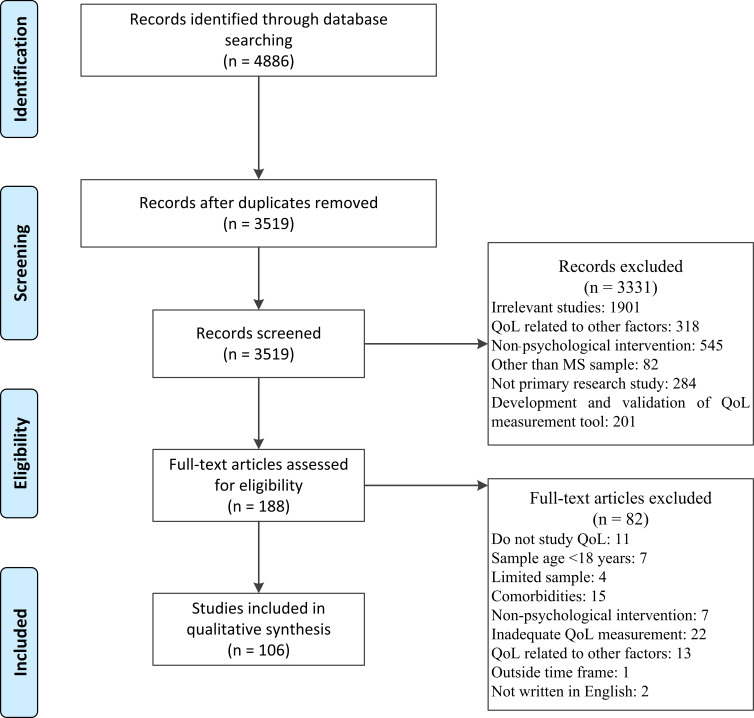
- From 4,886 records, 188 articles underwent full-text review and 106 were included in the narrative synthesis; studies were mostly cross-sectional (n=74), and sample sizes ranged from 7 to 74,451.
- Among 70 studies on QoL risk/protective factors, disability/functional impairment (EDSS), fatigue, depression, cognitive impairment, and unemployment were consistently identified as QoL risk factors; social support, self-esteem, self-efficacy, resilience, and participation were protective.
- For interventions, all mindfulness-based therapy programmes improved QoL at some evaluation point, and the review reports that the majority of psychological interventions were successful in improving various aspects of QoL.
- The review found 25 intervention studies; interventions included mindfulness, cognitive behavioural therapy, self-help groups, acceptance and commitment therapy, and self-management approaches.
## Methods
- Systematic review following PRISMA guidelines, searching Scopus, Web of Science, and ProQuest in February–March 2019 for English-language journal articles published from January 1, 2014 to January 31, 2019.
- Included primary studies of adults (>18 years) with confirmed MS that focused on QoL determinants or psychological interventions to improve QoL, and used validated QoL measures; excluded non-psychological interventions and several other study types specified in the paper.
- Two researchers independently screened studies and extracted data; quality was assessed with a standardized 12-item checklist, and because of heterogeneity in designs and outcomes, the authors performed a qualitative narrative synthesis rather than a meta-analysis.
## Limitations
- The paper states that quantitative synthesis/meta-analysis was not possible because of heterogeneity in methodologies, study designs, and outcomes.
- The authors also state that the search was restricted to a 5-year period through January 2019 due to the large number of topics and limited resources.
- Evident from the text: the review was limited to English-language journal articles, which may have excluded relevant non-English evidence.
Model-written summary. Check it against the paper before relying on it.
Integrity signals
Registry
Cites
Statistics
Figures
Verification
Claims the paper makes
5 Valid · 4 Not valid · 97 Not checked · 30 Own results and interpretations
Every source the paper cites for this claim was checked and supports it.
In the paper
“Disease duration,30 31 progressive type,26 36 37 progressive MS onset38 and relapses in the last 3 months were further relevant factors negatively affecting QoL.26”
§ Quality of life in adults with multiple sclerosis: a systematic review > Results > Risk and protective MS QoL factors
What the sources say
- Supportedcites [30] Brola W, Sobolewski P, Jantarski K Multiple sclerosis: patient-reported quality of life in the Świętokrzyskie region. Med Stud Med 2017; 33: 191– 8. 10.5114/ms.2017.70345 source
The Results passage reports that longer disease duration was significantly associated with lower quality of life (p < 0.001) among patients in the Świętokrzyskie cohort. The Conclusions also identify long disease duration as a factor decreasing quality of life in that population. (LLM, conf=0.93)
- Supportedcites [31] Brola W, Sobolewski P, Fudala M, et al Self-Reported quality of life in multiple sclerosis patients: preliminary results based on the Polish MS registry. Patient Prefer Adherence 2016; 10: 1647– 56. 10.2147/PPA.S109520 27616882 PMC5008638 source
The Results report a significant association between disease duration and QoL and state that patients with long disease duration reported significantly lower QoL. The Conclusion also identifies disease duration as a main factor in reduced QoL. (LLM, conf=0.94)
plainstates an association- Asserted: passes — The authors put it forward as true.
- Checkable: passes — It can be checked against evidence.
- Load-bearing: passes — The paper’s conclusions depend on it.
- Based: passes — The paper gives a reason why it holds.
- Rests on an assumption not shown here.
- Supported
The cited sources support only part of this claim — read each source’s verdict below.
In the paper
“Functional impairment as assessed by the Expanded Disability Status Scale (EDSS) level was one of the leading causes of diminished QoL.25–35”
§ Quality of life in adults with multiple sclerosis: a systematic review > Results > Risk and protective MS QoL factors
What the sources say
- Not checked yetcites [25] Gupta S, Goren A, Phillips AL, et al Self-Reported severity among patients with multiple sclerosis in the U.S. and its association with health outcomes.. Mult Scler Relat Disord 2014; 3: 78– 88. 10.1016/j.msard.2013.06.002 25877977 source
- Partly supportedcites [26] Rezapour A, Almasian Kia A, Goodarzi S, et al The impact of disease characteristics on multiple sclerosis patients’ quality of life. Epidemiol Health 2017; 39: e2017008– 7. 10.4178/epih.e2017008 28231687 PMC5434226 sourceExperimental — accuracy not yet measured
The Results report that higher EDSS scores correlated with lower physical and mental quality of life, and the Discussion identifies disease severity as the strongest predictor of physical quality of life. The study was cross-sectional, however, so it does not establish functional impairment as a cause of diminished quality of life; nor does it identify EDSS level as a leading predictor of the mental dimension. Page numbers were not supplied in our copy. (LLM, conf=0.85)
- Not checked yetcites [27] Nakazawa K, Noda T, Ichikura K, et al Resilience and depression/anxiety symptoms in multiple sclerosis and neuromyelitis optica spectrum disorder. Mult Scler Relat Disord 2018; 25: 309– 15. 10.1016/j.msard.2018.08.023 30176401 source
- Not checked yetcites [28] Ciampi E, Uribe-San-Martin R, Vásquez M, et al Relationship between social cognition and traditional cognitive impairment in progressive multiple sclerosis and possible implicated neuroanatomical regions. Mult Scler Relat Disord 2018; 20: 122– 8. 10.1016/j.msard.2018.01.013 29414284 source
- Not checked yetcites [29] Klevan G, Jacobsen CO, Aarseth JH, et al Health related quality of life in patients recently diagnosed with multiple sclerosis. Acta Neurol Scand 2014; 129: 21– 6. 10.1111/ane.12142 23772958 source
- Supportedcites [30] Brola W, Sobolewski P, Jantarski K Multiple sclerosis: patient-reported quality of life in the Świętokrzyskie region. Med Stud Med 2017; 33: 191– 8. 10.5114/ms.2017.70345 source
The Results report that higher EDSS-measured disability was significantly associated with lower quality of life (p < 0.001). The Conclusions (pp. 191–198) identify advanced disability as one of the main factors decreasing quality of life among patients in the Świętokrzyskie cohort. (LLM, conf=0.90)
- Partly supportedcites [31] Brola W, Sobolewski P, Fudala M, et al Self-Reported quality of life in multiple sclerosis patients: preliminary results based on the Polish MS registry. Patient Prefer Adherence 2016; 10: 1647– 56. 10.2147/PPA.S109520 27616882 PMC5008638 sourceExperimental — accuracy not yet measured
The Results (page not provided) report that higher disability was significantly associated with lower quality of life, and the Discussion identifies EDSS as the disability measure. The paper does not establish functional impairment as a cause or rank it among the leading causes of diminished quality of life. (LLM, conf=0.86)
- Not checked yetcites [32] Fernández-Jiménez E, Arnett PA Impact of neurological impairment, depression, cognitive function and coping on quality of life of people with multiple sclerosis: a relative importance analysis. Mult Scler 2015; 21: 1468– 72. 10.1177/1352458514562439 25533298 source
- Not checked yetcites [33] Nickel S, von dem Knesebeck O, Kofahl C Self-assessments and determinants of HRQoL in a German MS population. Acta Neurol Scand 2018; 137: 174– 80. 10.1111/ane.12854 28975610 source
- Not checked yetcites [34] Cioncoloni D, Innocenti I, Bartalini S, et al Individual factors enhance poor health-related quality of life outcome in multiple sclerosis patients. significance of predictive determinants. J Neurol Sci 2014; 345: 213– 9. 10.1016/j.jns.2014.07.050 25130927 source
plainstates a cause- Asserted: passes — The authors put it forward as true.
- Checkable: passes — It can be checked against evidence.
- Load-bearing: passes — The paper’s conclusions depend on it.
- Based: passes — The paper gives a reason why it holds.
- Rests on an assumption not shown here.
The sources with a verdict support this claim; the rest weren’t checked yet, have no full text we could read, or their verdicts aren’t rated yet.
In the paper
“Disease duration,30 31 progressive type,26 36 37 progressive MS onset38 and relapses in the last 3 months were further relevant factors negatively affecting QoL.26”
§ Quality of life in adults with multiple sclerosis: a systematic review > Results > Risk and protective MS QoL factors
What the sources say
- Supportedcites [26] Rezapour A, Almasian Kia A, Goodarzi S, et al The impact of disease characteristics on multiple sclerosis patients’ quality of life. Epidemiol Health 2017; 39: e2017008– 7. 10.4178/epih.e2017008 28231687 PMC5434226 source
The Discussion (page not provided) reports that patients with relapsing-remitting MS had better physical and mental quality of life than patients with progressive MS. This supports progressive disease type as a factor associated with poorer quality of life. (LLM, conf=0.93)
- Not checked yetcites [36] Gross HJ, Watson C, Characteristics WC Burden of illness, and physical functioning of patients with relapsing-remitting and secondary progressive multiple sclerosis: a cross-sectional us survey. Neuropsychiatr Dis Treat 2017; 13: 1349– 57. 10.2147/NDT.S132079 28572730 PMC5441664 source
- Not checked yetcites [37] Cichy KE, Li J, Rumrill PD, et al Non-vocational health-related correlates of quality of life for older adults living with multiple sclerosis. J Rehabil 2016; 82: 36– 44.
plainstates an association- Asserted: passes — The authors put it forward as true.
- Checkable: passes — It can be checked against evidence.
- Load-bearing: passes — The paper’s conclusions depend on it.
- Based: passes — The paper gives a reason why it holds.
- Rests on an assumption not shown here.
- Supported
Every source the paper cites for this claim was checked and supports it.
In the paper
“At follow-up, the intervention groups in both studies had experienced an increase in QoL.”
§ Quality of life in adults with multiple sclerosis: a systematic review > Results > Interventions
What the sources say
- Supportedcites [114] Calandri E, Graziano F, Borghi M, et al Improving the quality of life and psychological well-being of recently diagnosed multiple sclerosis patients: preliminary evaluation of a group-based cognitive behavioral intervention. Disabil Rehabil 2017; 39: 1474– 81. 10.1080/09638288.2016.1198430 27385055 source
For the Calandri et al. study, the follow-up results (p. 11) report that the intervention group's mental-health score increased and that this trend was maintained at one year. The Discussion (p. 12) identifies mental health as the psychological component of quality of life. (LLM, conf=0.90)
- Supportedcites [115] Graziano F, Calandri E, Borghi M, et al The effects of a group-based cognitive behavioral therapy on people with multiple sclerosis: a randomized controlled trial. Clin Rehabil 2014; 28: 264– 74. 10.1177/0269215513501525 24013269 source
The Abstract (p. 3) reports that quality of life increased in Graziano et al.’s intervention group compared with the control group at six-month follow-up. This confirms the part of the sentence attributed to this source; it does not assess the separate Calandri study. (LLM, conf=0.94)
plainstates a cause- Asserted: passes — The authors put it forward as true.
- Checkable: passes — It can be checked against evidence.
- Load-bearing: unclear — It is unclear whether the paper’s conclusions depend on it.
- Based: passes — The paper gives a reason why it holds.
- Rests on an assumption not shown here.
- Supported
The cited sources that could be checked couldn’t confirm or dispute this claim.
In the paper
“Thomas et al127 reported significant positive changes in physical health assessed by the Multiple Sclerosis Impact Scale (MSIS-29) and vitality as measured by the SF-36 in the intervention group 12 months after the treatment.”
§ Quality of life in adults with multiple sclerosis: a systematic review > Results > Interventions
What the sources say
- Could not verifycites [127] matched to “A single nucleotide polymorphism in the coding region of PGC-1α is a male-specific modifier of Huntington disease age-at-onset in a large European cohort” (2014) sourceExperimental — accuracy not yet measured
Our copy of Weydt et al. (2014, BMC Neurology) is entirely a Huntington disease genetics study: it reports the effect of PPARGC1A rs3736265 on age-at-onset in 1706 symptomatic HD patients from the EHDN REGISTRY (Results and discussion, p. 1-2; Methods, p. 2-3). No passage addresses multiple sclerosis, a fatigue self-management intervention, the MSIS-29, or the SF-36, and no 'Thomas et al.' MS trial appears in its reference list (References, pp. 3-5). Searched: 'Thomas fatigue multiple sclerosis self-management', 'MSIS-29 SF-36 physical health vitality', 'Short Form Health Survey quality of life intervention' — all returned only HD/PGC-1α content, so the claim cannot be checked against this source. (LLM, conf=0.78)
plainstates a cause- Asserted: passes — The authors put it forward as true.
- Checkable: passes — It can be checked against evidence.
- Load-bearing: unclear — It is unclear whether the paper’s conclusions depend on it.
- Based: passes — The paper gives a reason why it holds.
- Rests on an assumption not shown here.
- Could not verify
79 more claims · 1 with their cited sources checked
Create a free account to see all 136 claims and to verify the 202 references still open.
- Probably not a substantial claim. 20
- It may state two separate claims as one. 35
- The quote only partly states this claim. 2
Claims other papers make about this one
Each is checked against this paper’s own text: does it say what the citing paper says it does?
The cited source says what the claim attributes to it.
In the citing paper
“persistent physical symptoms are a major determinant of quality of life”
From Persistent physical symptoms: definition, genesis, and management (2024) · cites this paper as [10]
The cited source says what the claim attributes to it.
In the citing paper
“A recent systematic review of 106 papers on MS showed that among other factors, higher self-efficacy was a protective factor for quality of life (46).”
From Key demographics and psychological skills associated with adjustment to progressive Multiple Sclerosis early in the diagnosis (2022) · cites this paper as [46]
In the citing paper
“In a narrative review on the neural mechanism of mental fatigue, Ishii, and colleagues [45] proposed a dual regulation system consisting of neural facilitation and inhibition systems to explain the mechanism behind acute mental fatigue.”
From Neural mechanisms underlying state mental fatigue: a systematic review and activation likelihood estimation meta-analysis (2022) · cites this paper as [45]
In the citing paper
“Motivational input during mental tasks stimulates this system thereby preventing decrease in task performance [45].”
From Neural mechanisms underlying state mental fatigue: a systematic review and activation likelihood estimation meta-analysis (2022) · cites this paper as [45]
In the citing paper
“The mental inhibition system was thought to involve the insula cortex and posterior cingulate cortex and stimulation of this system during mental tasks decreases cognitive performance [45].”
From Neural mechanisms underlying state mental fatigue: a systematic review and activation likelihood estimation meta-analysis (2022) · cites this paper as [45]
3 more claims about this paper
Create a free account to see every claim other papers make about this one.
Citations
Cites
PRISMA-P Group, Moher, D., Shamseer, L., Clarke, M., Ghersi, D., Liberati, A., Petticrew, M., Shekelle, P., & Stewart, L. A. (2015) · Systematic Reviews · doi:10.1186/2046-4053-4-1 · Cited by 26,223
(1995) · Social Science & Medicine · doi:10.1016/0277-9536(95)00112-k · Cited by 7,643
Handbook of Disease Burdens and Quality of Life Measures
(2010) · Springer eBooks · doi:10.1007/978-0-387-78665-0 · Cited by 644
Revicki, D. A., Osoba, D., Fairclough, D., Barofsky, I., Berzon, R., Leidy, N. K., & Rothman, M. (2000) · Quality of Life Research · doi:10.1023/a:1008996223999 · Cited by 577
Hanisch, S. E., Twomey, C. D., Szeto, A. C. H., Birner, U. W., Nowak, D., & Sabariego, C. (2016) · BMC Psychiatry · doi:10.1186/s12888-015-0706-4 · Cited by 564
Definitions of Quality of Life: What Has Happened and How to Move On
Post, M. (2014) · Topics in Spinal Cord Injury Rehabilitation · doi:10.1310/sci2003-167 · Cited by 517
Work ability and associated factors of Brazilian technical-administrative workers in education
Godinho, M. R., Greco, R. M., Teixeira, M. T. B., Teixeira, L. R., Guerra, M. R., & Chaoubah, A. (2016) · BMC Research Notes · doi:10.1186/s13104-015-1837-x · Cited by 393
A review about the impact of multiple sclerosis on health-related quality of life
Benito-León, J., Manuel Morales, J., Rivera-Navarro, J., & Mitchell, A. J. (2003) · Disability and Rehabilitation · doi:10.1080/09638280310001608591 · Cited by 348
For the European Huntington Disease Network, Weydt, P., Soyal, S. M., Landwehrmeyer, G. B., & Patsch, W. (2014) · BMC Neurology · doi:10.1186/1471-2377-14-1 · Cited by 206
Are Movement Artifacts in Magnetic Resonance Imaging a Real Problem?—A Narrative Review
Havsteen, I., Ohlhues, A., Madsen, K. H., Nybing, J. D., Christensen, H., & Christensen, A. (2017) · Frontiers in Neurology · doi:10.3389/fneur.2017.00232 · Cited by 196
Research works printed but not linked: 3
- Petrović N, Prlić N, Gašparić I, et al Quality of life among persons suffering from multiple sclerosis. Medica Jadertina 2019; 49: 217– 26 https://hrcak.srce.hr/234930
- Paziuc LC, Radu MR The influence of mixed anxiety-depressive disorder on the perceived quality of life in multiple sclerosis patients. Bulletin of the Transilvania University of Brasov, Seriels VI: Medical Sciences 2018; 11: 41– 50.
- Geiser F, Imbierowicz K, Conrad R, et al [Differences between patients classified as "recovered" or "improved" and "unchanged" or "deteriorated" in a psychotherapy outcome study]. Z Psychosom Med Psychother 2001; 47: 250– 61. 11568863
Cited by
Items 201–300 of 334
Normann, B., Sivertsen, M., Braaten, T., Melberg, H. O., Fikke, H. K., Elvik, M., & Arntzen, E. C. (2025) · JMIR Research Protocols · doi:10.2196/74988 · Cited by 1
“Physiotherapy and physical activity interventions can reduce fatigue [8,9]; improve balance, walking [10-13], and HRQoL [9,14,15]; and enhance neuromuscular and physical functioning in pwMS [16].”
Wong, R. S.-Y. (2025) · The Egyptian Journal of Neurology Psychiatry and Neurosurgery · doi:10.1186/s41983-025-01032-w · Cited by 1
“The quality of life for patients with MS is markedly affected by physical disability, cognitive impairment, mental health problems and unemployment [8].”
How the Salutogenic Pattern of Health Reflects in Type 2 Diabetes Mellitus: A Narrative Review
Mijač, S., Vitale, K., Lončarek, K., & Slivšek, G. (2025) · Diabetology · doi:10.3390/diabetology6110124 · Cited by 2
Donzé, C., Mékiès, C., Mouzawak, C., Pau, D., Civet, A., Brechenmacher, L., Paillot, G., Cohen, M., & Vermersch, P. (2026) · Multiple Sclerosis and Related Disorders · doi:10.1016/j.msard.2026.107288 · Cited by 1
Lopez-Andaur, R., Vásquez-Carrasco, E., Burgos-Carrasco, S., Guerra-Díaz, G., & Vera, A. B. C. (2026) · Multiple Sclerosis and Related Disorders · doi:10.1016/j.msard.2026.107453 · Cited by 1
Short quality of life scale: A cross-cultural validation in Iranian patients with multiple sclerosis
Zarrabi-Ajami, S., Zamanian, H., Amini‐Tehrani, M., Farhadidanaloo, Z., Razavi, R. J., Abbasi, A., Darbandi, S., & Chenari, P. (2021) · Multiple Sclerosis and Related Disorders · doi:10.1016/j.msard.2021.103411 · Cited by 1
Mitsikostas, D. D., Bakirtzis, C., Nikolaidis, I., Tsimourtou, V., Kountra, P., Matsi, S., & Papadimitriou, A. (2022) · Neurodegenerative Disease Management · doi:10.2217/nmt-2022-0004 · Cited by 1
Screening tests for the evaluation of cognitive impairment in multiple sclerosis patients
Nacu-Florescu, A. I., Schreiner, O. D., & Schreiner, T. G. (2022) · Romanian Journal of Neurology · doi:10.37897/rjn.2022.4.1 · Cited by 1
Relationship between stigma and symptom burden in patients with multiple sclerosis
Yeni, K., Özdelikara, A., & Terzi, M. (2023) · Neurology Asia · doi:10.54029/2023ddi · Cited by 1
Balz, L. T., Uttner, I., Weishaupt, J. H., Ludolph, A. C., Taranu, D., Vardakas, I., Jung, S., Fangerau, T., Erhart, D. K., Şenel, M., et al. (2025) · Brain Sciences · doi:10.3390/brainsci15070745 · Cited by 1
“The poor model fit in the CFA suggests that the PSA model in MS may benefit from refinement, potentially by integrating resilience, social support, self-esteem, and self-efficacy to better understand patient adjustment [55–58].”
Donkers, S. J., Bayley, M. T., Bruno, T. R., Marrie, R. A., Simpson, R., Smyth, P. S., & Knox, K. B. (2025) · Neurorehabilitation · doi:10.1177/10538135251365102 · Cited by 1
“(Gil-Gonzalez et al. 2020; Karhula et al., 2019; O ’ Mahony et al., 2022) A Canadian survey study of people living with MS found that the top three healthcare providers that participants reported needing to see but did not have access where occupational therapy, physical therapy, and mental health…”
Estrella, G. M. (2023) · Neurología, Neurocirugía y Psiquiatría · doi:10.35366/113426 · Cited by 1
Assessing the Quality of Life in Individuals with Multiple Sclerosis
Arsovski, D., Rajchanovska, D., Ristevska-Dimitrovska, G., & Prodanovska-Stojčevska, V. (2023) · Archives of Public Health · doi:10.3889/aph.2023.6077 · Cited by 1
Duchenne Muscular Dystrophy: Age, Disease Stage, and Patient-Reported Quality of Life
Jagers, S. (2023) · ScholarWorks (Walden University) · Cited by 1
The role of self-regulation in managing chronic kidney disease
Farris, O. (2024) · Open Access at Essex (University of Essex) · Cited by 1
Dancing With Multiple Sclerosis: A Multidimensional and Multiple Case Study
Davis, E. (2025) · doi:10.59019/mpss9972 · Cited by 1
Shabani, M., Ayoubi, S., NaserMoghadasi, A., & Eskandarieh, S. (2021) · Research Square · doi:10.21203/rs.3.rs-150219/v1
“People living with MS and NMOSD have a lower quality of life (QoL) than those living with other chronic diseases because the effect on daily life is greater in MS [12, 13].”
BackgroundMartinez, E. S. (2022) · Gredos (University of Salamanca) · doi:10.14201/gredos.150999
Wareńczak, A., Kozłowska, M., Daroszewski, P., & Lisiński, P. (2022) · Issues of Rehabilitation Orthopaedics Neurophysiology and Sport Promotion – IRONS · doi:10.19271/irons-000168-2022-39
Cindik-Herbrüggen, E., Nazım, A. Ö., Köseoğlu, M., & Demirkol, R. (2023) · Multiple Sclerosis and Related Disorders · doi:10.1016/j.msard.2023.104604
Network-based biomarker discovery for multiple sclerosis
Åkesson, J. (2023) · Linköping studies in science and technology. Dissertations · doi:10.3384/9789180753968
Barreto, H. G. S. (2023) · Universidad Privada San Juan Bautista · doi:10.59590/upsjb/fcs.med.hum/tesis/4792
Hajian, Z., Mousavi, S., & Shahsavari, M. R. (2024) · Current Psychology · doi:10.1007/s12144-024-05629-x
Shephard, A., Kolaczkowski, L., Barker, N., Nahal, D., Oreja‐Guevara, C., Reyes, S., Gray, H., Salloukh, H., & Giovannoni, G. (2024) · Neurology and Therapy · doi:10.1007/s40120-024-00608-7
“The wide range of symptoms together with the unpredictable nature of the disease can severely impact the QoL of PwMS [12].”
Sakurai, K., Takao, N., Nakano, Y., Imai, T., Isahaya, K., & Yamano, Y. (2024) · Clinical and Experimental Neuroimmunology · doi:10.1111/cen3.12793
Bućma, T., Sladojević, I., Arambašić, L. T., Jeremić, N., & Tomić, B. (2024) · Medicina · doi:10.3390/medicina60060941
“QoL is mostly based on a subjective measurement of the subject’s perception of his or her own health condition through standardized tools and instruments offering a quantitative method for monitoring an individual’s health condition [37].”
BackgroundMethodYalçın, G. Y., Dünya, C. P., Yeni, K., Kürtüncü, M., Tülek, Z., Gündüz, T., & Eraksoy, M. (2024) · International Journal of MS Care · doi:10.7224/1537-2073.2023-056
Homayoon, M. (2022) · ASEAN Journal of Psychiatry · doi:10.54615/2231-7805.47253
“This therapy helps patients become aware of their thoughts, feelings, and body senses and accept their illness by increasing awareness through mindfulness exercises and accepting experiences without judgment [21, 22].”
BackgroundQuality of life of a sample of multiple sclerosis patient in Baghdad/2023
Jasim, L. H., & Hasan, L. A. (2024) · International Journal of Advanced Community Medicine · doi:10.33545/comed.2024.v7.i3c.338
Biopsychosocial Impact of Multiple Sclerosis in Omani Patients: A Multicenter Comparative Study
Al-Dhahri, M., Helmy, M. S., Rajeev, N., Toubi, A. A., Al-Abdali, H., Al-Asmi, A. R., Redha, I., Al-Adawi, I., Jeyaseelan, L., & Al‐Adawi, S. (2024) · Journal of Clinical Medicine · doi:10.3390/jcm13216315
Gunas, M. М., Moskovko, G. S., Rutska, I., Gаlunko, G. M., & Antoniuk, T. V. (2024) · World of Medicine and Biology · doi:10.26724/2079-8334-2024-4-90-34-38
Melhi, E., Zarani, F., Panaghi, L., & Harirchian, M. H. (2025) · Journal of Research and Health · doi:10.32598/jrh.15.2.2426.1
Asrami, N. N., Taghiloo, S., Ghodsi, P., & Mohammadhkani, P. (2025) · KMAN Counseling and Psychology Nexus · doi:10.61838/kman.hp.psynexus.3.11
Schoor, R., Bruce, J. M., Staggs, V. S., Fox, A. T., Bruce, A. S., LYNCH, S. G., & Catley, D. (2025) · Journal of Clinical Psychology · doi:10.1002/jclp.23796
Pawar, P., Xie, S. M., Varghese, A. R., Smith, A., Gao, J., Kamp, E. V., Kirklin, K., Jones, B. S., Meador, W. R., & Yuen, H. K. (2025) · Healthcare · doi:10.3390/healthcare13101104
“MS is a chronic, progressive neurodegenerative disorder that leads to a wide range of symptoms and significantly affects quality of life [17,52,53].”
N.Thompson, S. B. (2025) · ASEAN Journal of Psychiatry · doi:10.54615/2231-7805.15525
Automated Diagnosis of Multiple Sclerosis Using Transfer Learning and LightGBM on FLAIR MRI Data
Haouam, K.-D. (2025) · Ingénierie des systèmes d information · doi:10.18280/isi.300412
“MS has a significant impact on quality of life due to a variety of symptoms and the accumulation of disabilities [9].”
Bywall, K. S., Kihlbom, U., Johansson, J. V., Pasquini, G., Gerli, F., Niccolai, C., Bella, S. D., Portaccio, E., Betti, M., Amato, M. P., et al. (2025) · BMJ Open · doi:10.1136/bmjopen-2024-095552
Dehnashi, D. (2024) · Psychology and Mental Health Care · doi:10.31579/2637-8892/245
Laslett, L. L., Blizzard, C. L., Ngwa, V. F., Roydhouse, J. K., Honan, C. A., Campbell, J. A., Huglo, A., Foong, Y. C., Taylor, B. V., & van der Mei, I. A. F. (2025) · Multiple Sclerosis and Related Disorders · doi:10.1016/j.msard.2025.106632
Delsanti, R., Mercier, E. L., Briant, A. R., Derache, N., Arnaud, C., Branger, P., & Defer, G. L. (2025) · Revue Neurologique · doi:10.1016/j.neurol.2025.06.009
ESCLEROSE MÚLTIPLA: PRIMEIROS SINTOMAS À PROMOÇÃO DE QUALIDADE DE VIDA
SILVEIRA, A. C. H. D., KARPOWICZ, A. L. M., Pedrotti, G. M. D. A., MONTEIRO, G. G. S., MONTEIRO, I. G. S., ROSSATTO, I. D. S., ZIN, L., VELHO, L. B., ORTIGARA, L., SOTILLE, L. D., et al. (2025) · Editora Pasteur eBooks · doi:10.59290/978-65-6029-257-4.15
Yeşil, P., Yeşilot, S. B., & Eskimez, Z. (2025) · Sağlık Bilimleri Dergisi · doi:10.34108/eujhs.1590163
Islam, T., Pumphrey, J. D., Bowman, M., Berard, J. A., Bearnes, R. D., Pham, T. B., & Walker, L. A. S. (2025) · International Journal of MS Care · doi:10.7224/1537-2073.2024-096
(2025) · The Egyptian Journal of Hospital Medicine · doi:10.21608/ejhm.2025.443482
Oliveira, L. N. M., Miot, H. A., Saranholi, T. L., & Abbade, L. P. F. (2025) · Revista Eletrônica de Enfermagem · doi:10.5216/ree.v27.76957
Predicting suicidal ideation at subsequent clinical encounter in multiple sclerosis patients
Briggs, F. B. S., Genuario, I., Nadai, A. S. D., Gunzler, D. D., Ontaneda, D., & Miller, D. M. (2025) · Multiple Sclerosis Journal · doi:10.1177/13524585251365207
“…However, despite these items lacking granularly they were prominent predictors, and illustrates the potential for implementing a low-burden generic health-related quality of life instrument validated for use in PwMS. 23,36 Our findings also highlight population-specific nuances in SI risk in PwMS.”
Understanding the Impact of Multiple Sclerosis on Quality of Life: An Italian Pilot Study
Vitale, E., Lupo, R., Panzanaro, L., Visconti, R., Tumolo, M. R., Caldararo, P., Cucci, F., Cascio, D., Nunzio, G. D., Botti, S., et al. (2025) · Brain Sciences · doi:10.3390/brainsci15090960
“A thorough biopsychosocial assessment is therefore required to address risks and promote protective factors that can improve the quality of life in patients with MS within general medical practice [18].”
Hope, quality of life, and duration of homelessness in emerging adults
Budescu, M., Feldman, D. B., & Holbrook, N. M. (2025) · Journal of Social Distress and the Homeless · doi:10.1080/10530789.2025.2552522
“QOL is often reduced among populations experiencing medical and interpersonal stress (Gil-González et al., 2020; Guerra-Martín et al., 2023; Zhao et al., 2021), while high QOL is associated with better mental and physical health outcomes(Maisey et al., 2002; Tsai et al., 2010).”
Tiani, A. G., Thompson, N. R., Kane, A., Roth, A. J., Drerup, M. L., Bermel, R. A., & Sullivan, A. B. (2025) · International Journal of MS Care · doi:10.7224/1537-2073.2024-050
Beyazıt, U., Koç, S., Karasu, K. T. Ç., Kaya, Y. K., Ayhan, A. B., & Terzi, M. (2025) · Journal of Health Psychology · doi:10.1177/13591053251367987
“A review of 106 studies by Gil-González et al. (2020) found that while cognitive difficulties, depression, and unemployment lower well-being, social support serves as a protective factor.”
Hassan, S. S., Darwish, E. S., Ahmed, G. K., Azmy, S. R., & Haridy, N. A. (2024) · Figshare · doi:10.6084/m9.figshare.26607688
Blaney, A. (2024) · Memorial University Research Repository (Memorial University) · doi:10.48336/mtb9-ye38
Barclay, A. (2023) · Enlighten: Theses (The University of Glasgow) · doi:10.5525/gla.thesis.84010
Omar, E. S., Suliman, H. M., Osman, B. I., Abdalla, S. A., & Abdoon, I. H. (2024) · Figshare · doi:10.6084/m9.figshare.26074206
La relación entre la esclerosis múltiple y la depresión. Revisión bibliográfica.
Gracia Alcalde, I., & Larraz, L. A. H. (2023) · Zaguan (University of Zaragoza Repository)
Burge, R. (2021) · Nottingham ePrints (University of Nottingham)
Determining who benefits most from cognitive rehabilitation for multiple sclerosis
Taylor, L. (2024) · Nottingham ePrints (University of Nottingham)
Factores relacionados con la calidad de vida en pacientes con esclerosis múltiple
Ruiz-Sánchez, F. J. (2023) · RUC (Universidade Da Coruña)
Moridi, T. (2023) · Open Archive (Karolinska Institutet)
Anxiety in Multiple Sclerosis: An Exploration of Experiences and Supports.
Fahy, A. (2024) · Maynooth University ePrints and eTheses Archive (Maynooth University)
Pinillos-Rubio, J. M. (2024) · Re-Unir (International University of La Rioja)
Thompson, B., das Nair, R., Tickle, A., Nikos, E., Hall, H., & Moghaddam, N. (2023) · Nottingham ePrints (University of Nottingham)
Exploring the lived experiences of adults with neurological difficulties : a qualitative analysis
Tominey, R. (2026) · Warwick Research Archive Portal (University of Warwick) · doi:10.82444/warw.33886126
Jonckers, R., & Slegers, T. (2023) · Document Server@UHasselt (UHasselt)
González Mingorance, L. (2023) · Repositorio de Patentes de la Universidad de Almería (Universidad de Almería)
Özkan, İ., Dünya, C. P., Yalçın, G. Y., Erden, S. Ö., & KÜRTÜNCÜ, M. (2025) · Neurology Asia · doi:10.54029/2025kwp
Pumphrey, J. D. (2025) · Carleton University's Institutional Repository (MacOdrum Library, Carleton University) · doi:10.22215/etd/2025-16750
Riegler, K. E., Román, C. A. F., Guty, E. T., Thomas, G. A., Bradson, M. L., & Arnett, P. A. (2026) · Archives of Clinical Neuropsychology · doi:10.1093/arclin/acag001
Durand, R. (2024) · EUG Institutional Repository
Sadıkoğlu, B. A., Eker, T. A., & Akbaba, Y. A. (2024) · Istanbul Kent University Institutional Repository · doi:10.5152/4307
Missel, M., Donsel, P. O., Nielsen, T. F., Secher, E. L., Medeiros, E. B. Z., Rude, K., Højgaard, J. L. S., Viby, N., Birnbaum, S., Andersen, L. K., et al. (2026) · BMJ Open · doi:10.1136/bmjopen-2025-109575
“The integration of Carel’s 50 and Frank’s 51 52 theories into our analysis adds further nuance by framing these tensions as not only professional, but existential and narrative in nature.”
Chumpangern, Y., Seawsirikul, Y., Keatbundit, P., Thongtem, L., Uawithya, E., Khampang, R., Ongphichetmetha, T., Siritho, S., Prayoonwiwat, N., & Jitprapaikulsan, J. (2026) · Scientific Reports · doi:10.1038/s41598-026-43240-1
Subjective assessment of quality of life in patients with multiple sclerosis
Maciak, A., & Ścibor, M. (2026) · Medycyna Ogólna i Nauki o Zdrowiu · doi:10.26444/monz/218863
Goodwin, E., Michalowsky, B., Middleton, R., & Hawton, A. (2026) · Quality of Life Research · doi:10.1007/s11136-026-04229-5
“…psychological and cognitive symptoms of MS have been found to have a significant, nega - tive impact on the quality of life of people with MS [31] Variable description Participants are asked to report which symptoms they experience from a list of 25 symptoms, and to report the date of onset…”
The Connections between Depression, Anxiety, and Cognition in Multiple Sclerosis
Freedman, D. (2026) · TSpace (University of Toronto)
Hamelin, F. (2022) · theses.fr (ABES) · doi:10.70675/4792d127z7e19z4260z875bz89e9eadba073
Swital, M. (2024) · theses.fr (ABES) · doi:10.70675/4e5d501dzd798z4661za162z6ff333345877
Montaño, V. S., Landa, S. U., & Castro, J. L. G. (2026) · Psychology Health & Medicine · doi:10.1080/13548506.2026.2653103
ZABARA, O. V., & Melnyk, V. S. (2026) · Ukrainian Neurological Journal · doi:10.30978/unj2026-1-20
“У деяких пацієнтів мають місце повторювані короткочасні чутливі розлади (пароксизмальний біль або парестезії, невралгія трійчастого нерва) [4, 6, 11, 12, 21, 29].”
Sharifi, P., Dehghan, M., & Shahgholian, M. (2026) · Acta Psychologica · doi:10.1016/j.actpsy.2026.106549
Niino, M., Fukumoto, S., Miyazaki, Y., Okuno, T., Sanjo, N., Fukaura, H., Mori, M., Ohashi, T., Takeuchi, H., Shimizu, Y., et al. (2026) · Clinical and Experimental Neuroimmunology · doi:10.1111/cen3.70064
Exploring the impact of stress on balance and gait speed in people with multiple sclerosis
Boshareh, D., Al-Wardat, M., Almhdawi, K. A., Shawawrah, M., Etoom, M., Abedalaziz, W., Hadoush, H., Sheeha, B. H. B., Hawamdeh, Z. M., Pavese, C., et al. (2026) · Journal of Bodywork and Movement Therapies · doi:10.1016/j.jbmt.2026.04.026
Sajjadi, M. S., Sajjadi, M., Nahayati, M., Emery, H., & Nasirzadeh, A. (2026) · Discover Social Science and Health · doi:10.1007/s44155-026-00402-w
Dilek, F., Yıldırım, E., & Ünal, A. (2026) · Journal of Clinical and Experimental Neuropsychology · doi:10.1080/13803395.2026.2673080
“Although executive dysfunction is reported in approximately 15–28% of pwMS, even subtle cognitive changes can negatively impact daily life, work performance, and social participation (Benedict et al., 2020; Gil-González et al., 2020; Marchesi et al., 2022).”
Relationship Between Social Avoidance and Quality of Life Among Adults: A Systematic Review
., L., & Singh, S. (2026) · International Journal of Arts Humanities and Social Studies · doi:10.33545/26648652.2026.v8.i5a.453
Impacto da fadiga na qualidade de vida de indivíduos com Esclerose Múltipla
dos Santos, M. F. F., Alves, V., Lino, A. S. A., de Santana, E. M. F., Lucena, R. N. L. D. S., & Dantas, M. S. D. A. (2026) · Fisioterapia Brasil · doi:10.62827/fb.v27i3.1167
Influence of a Complex Rehabilitation Process on Quality of Life in Patients With Multiple Sclerosis
Bućma, T., Sladojević, I., Jeremić, N., & Tomić, B. (2024) · Спортске науке и здравље - АПЕИРОН · doi:10.7251/ssh2401036b
Relationship Between Social Avoidance and Quality of Life Among Adults: A Systematic Review
., L., & Singh, S. (2026) · International Journal of Arts Humanities and Social Studies · doi:10.33545/26648652.2026.v8.i4b.453
Assessing nonlinear gait characteristics in multiple sclerosis: Insights from a systematic review
Gavira-Seoane, J. M., Martínez-Sánchez, A., Domínguez‐Muñoz, F. J., Llamas, J. L. L., & Villafaina, S. (2026) · Clinical Biomechanics · doi:10.1016/j.clinbiomech.2026.106876
Atapour, M., Maghaminejad, F., Ghiyasvandian, S., & Rahimzadeh, M. (2026) · Neurodegenerative Disease Management · doi:10.1080/17582024.2026.2645607
Yu, M., Simpson, S., Jelinek, G. A., Neate, S. L., Reece, J. C., & Nag, N. (2026) · Quality of Life Research · doi:10.1007/s11136-026-04287-9
“These symptoms, alongside the burden of ongoing treat-ment and self-management, contribute to substantially reduced health-related quality of life (QoL) in people with MS (pwMS) [4, 5].”
yousefvand, M., & Ziyar, Z. (2025) · مجله علمی دانشگاه علوم پزشکی رفسنجان · doi:10.66224/jrums.24.8.709
Vahteristo, A., Jylhä, V., & Kuusisto, H. (2026) · Digital Health · doi:10.1177/20552076261462636
“The survey was targeted at people diagnosed with epilepsy or MS.”
Economic and social burden of multiple sclerosis in Morocco: a tertiary care center study
Otmani, H. E., Simma, K., Omari, H. E., Sikkal, A., Khattab, H., Haddouali, K., Bellakhdar, S., Moutawakil, B. E., & Rafai, M. A. (2026) · Multiple Sclerosis and Related Disorders · doi:10.1016/j.msard.2026.107337
Salazar, B., Santoso, A. D., Colbert, K., Hoffman, K. A., Lincoln, J. A., Bernard, J. A., & Khavari, R. (2026) · Continence Reports · doi:10.1016/j.contre.2026.100121
Metadata
- Authors
- Gil-González, I., Martín-Rodríguez, A., Conrad, R., & Pérez-San-Gregorio, M. Á.
- Affiliations
- Universidad de Sevilla (ES)
- Personality, Assessment, and Psychological Treatment, University of Seville, Seville, Spain
- University Hospital Bonn (DE)
- Corresponding author
- Gil-González, Irene
- Venue
- BMJ Open
- Publisher
- BMJ
- Published
- 2020-11
- Volume
- 10
- Issue
- 11
- Pages
- e041249
- ISSN
- 2044-6055 (ISSN-L)
- PMC
- PMC7705559
- OpenAlex
- W3108251659
- Cited by
- 263
- References
- 141
- Citations by year
- 2026: 41 · 2025: 49 · 2024: 59 · 2023: 39 · 2022: 50 · 2021: 25
- FWCI
- 4.37
- Type
- journal article
- Language
- en
- Open access
- gold
- doi.org
- Licence
- Locations
- BMJ Open (publishedVersion, cc-by-nc)
- PubMed Central (publishedVersion, cc-by-nc)
- PubMed (publishedVersion)
- LA Referencia (Red Federada de Repositorios Institucionales de Publicaciones Científicas) (publishedVersion, cc-by-nc-nd)
- DOAJ (DOAJ: Directory of Open Access Journals) (submittedVersion, cc-by-sa)
- Deposito de Investigacion Universidad de Sevilla (University of Seville) (submittedVersion, cc-by-nc)
- HighWire Press Open Archive (submittedVersion)
- Funders
- Ministerio de Educación, Cultura y Deporte (FPU 17/04240)
- Topics
- Health Sciences › Medicine › Clinical Neurology › Multiple Sclerosis Research Studies
- Health Sciences › Medicine › Oncology › Cancer survivorship and care
- Social Sciences › Economics, Econometrics and Finance › Economics and Econometrics › Health Systems, Economic Evaluations, Quality of Life
- Keywords
- multiple sclerosis, quality of life, risk factors, protective factors, disability, fatigue, depression, cognitive impairment, unemployment, self-esteem, self-efficacy, resilience, social support, psychological intervention, mindfulness, cognitive behavioral therapy, self-help groups, self-management, biopsychosocial assessment
- MeSH terms
- Adult, Fatigue, Humans, Multiple Sclerosis, Quality of Life, Social Support, Cognitive Behavioral Therapy
About these checks
Registry, retraction, Cites and statistics results are computed, not judged, with one exception: a printed reference that no index lists is read once by a model before it counts as a citation error. Claims are extracted by a model and kept only when their quote appears verbatim in the text; each cited source is then checked, with a model’s help, for whether it says what the claim relies on. Those verdicts can be wrong — read the claim’s quote and the cited source before relying on one.
The claim verdicts this report counts are experimental: their accuracy is not yet measured.
A language model drew the claims from the paper on 2026-10-11, under version 3 of the claim definition (model deepseek-v4.1-flash, prompt extract-v3).
A second model labelled each claim on 2026-10-11 (model jev-1.13-20260917, definition revision gold-guideline-v0.2).
Cited sources are checked with a language model’s help (gpt-6-sol and qwen3.8-omni-flash).
Statistics and arithmetic are recomputed, not judged.
Confidence bands are shown only for fields calibrated on our annotated test set. None is calibrated yet, so no band is shown.
What counts as a claim ›How we measure confidence ›How we check this ›
Are you an author, or do you see a problem with this page? Request a review
Data sources
Bibliographic data: Semantic Scholar, OpenAlex, Crossref.
Contains information from the Semantic Scholar Academic Graph Datasets, made available under the ODC Attribution License (ODC-BY 1.0).
Semantic Scholar’s data is described in: Kinney, R., et al. (2023). The Semantic Scholar Open Data Platform. arXiv:2301.10140.
