

Quality of life in adults with multiple sclerosis: a systematic review
Open accessThe DOI matches its Crossref record; 140 of the 141 references it cites were found in a registry or an index; 12 of the 214 sources its claims cite were checked for support.
Abstract
OBJECTIVE: In recent years, quality of life (QoL) in multiple sclerosis (MS) has been gaining considerable importance in clinical research and practice. Against this backdrop, this systematic review aimed to provide a broad overview of clinical, sociodemographic and psychosocial risk and protective factors for QoL in adults with MS and analyse psychological interventions for improving QoL. METHOD: The literature search was conducted in the Scopus, Web of Science and ProQuest electronic databases. Document type was limited to articles written in English, published from January 1, 2014, to January 31, 2019. Information from the selected articles was extracted using a coding sheet and then qualitatively synthesised. RESULTS: The search identified 4886 records. After duplicate removal and screening, 106 articles met the inclusion and exclusion criteria for qualitative synthesis and were assessed for study quality. Disability, fatigue, depression, cognitive impairment and unemployment were consistently identified as QoL risk factors, whereas higher self-esteem, self-efficacy, resilience and social support proved to be protective. The review analysed a wide spectrum of approaches for QoL psychological intervention, such as mindfulness, cognitive behavioural therapy, self-help groups and self-management. The majority of interventions were successful in improving various aspects of QoL. CONCLUSION: Adequate biopsychosocial assessment is of vital importance to treat risk and promote protective factors to improve QoL in patients with MS in general care practice.
Overview
CoChat Summary
## TL;DR
This systematic review synthesized 106 English-language studies on quality of life (QoL) in adults with multiple sclerosis (MS) published from January 1, 2014 to January 31, 2019. It found that disability, fatigue, depression, cognitive impairment, and unemployment were consistent QoL risk factors, while self-esteem, self-efficacy, resilience, and social support were protective.
## Key findings
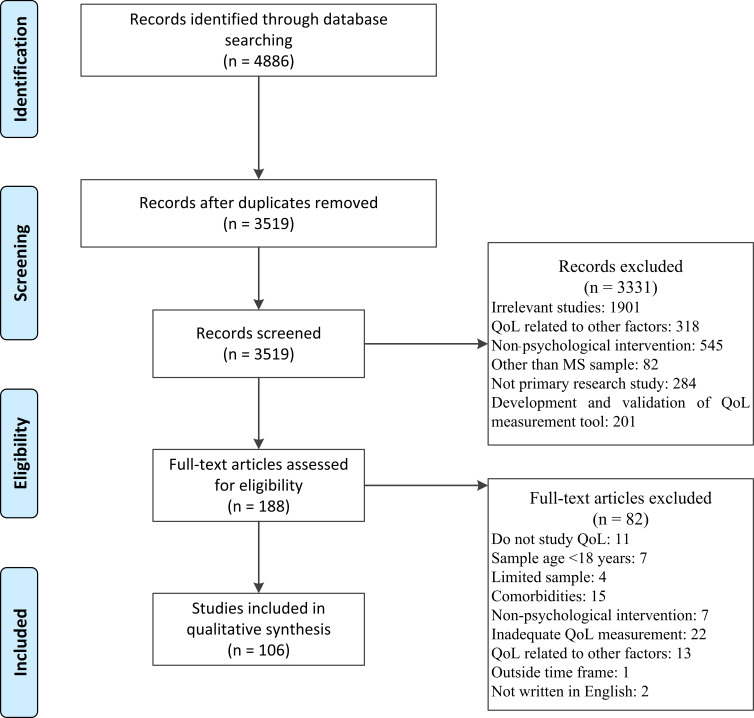
- From 4,886 records, 188 articles underwent full-text review and 106 were included in the narrative synthesis; studies were mostly cross-sectional (n=74), and sample sizes ranged from 7 to 74,451.
- Among 70 studies on QoL risk/protective factors, disability/functional impairment (EDSS), fatigue, depression, cognitive impairment, and unemployment were consistently identified as QoL risk factors; social support, self-esteem, self-efficacy, resilience, and participation were protective.
- For interventions, all mindfulness-based therapy programmes improved QoL at some evaluation point, and the review reports that the majority of psychological interventions were successful in improving various aspects of QoL.
- The review found 25 intervention studies; interventions included mindfulness, cognitive behavioural therapy, self-help groups, acceptance and commitment therapy, and self-management approaches.
## Methods
- Systematic review following PRISMA guidelines, searching Scopus, Web of Science, and ProQuest in February–March 2019 for English-language journal articles published from January 1, 2014 to January 31, 2019.
- Included primary studies of adults (>18 years) with confirmed MS that focused on QoL determinants or psychological interventions to improve QoL, and used validated QoL measures; excluded non-psychological interventions and several other study types specified in the paper.
- Two researchers independently screened studies and extracted data; quality was assessed with a standardized 12-item checklist, and because of heterogeneity in designs and outcomes, the authors performed a qualitative narrative synthesis rather than a meta-analysis.
## Limitations
- The paper states that quantitative synthesis/meta-analysis was not possible because of heterogeneity in methodologies, study designs, and outcomes.
- The authors also state that the search was restricted to a 5-year period through January 2019 due to the large number of topics and limited resources.
- Evident from the text: the review was limited to English-language journal articles, which may have excluded relevant non-English evidence.
Model-written summary. Check it against the paper before relying on it.
Integrity signals
Registry
Cites
Statistics
Figures
Verification
Claims the paper makes
5 Valid · 4 Not valid · 97 Not checked · 30 Own results and interpretations
Every source the paper cites for this claim was checked and supports it.
In the paper
“Disease duration,30 31 progressive type,26 36 37 progressive MS onset38 and relapses in the last 3 months were further relevant factors negatively affecting QoL.26”
§ Quality of life in adults with multiple sclerosis: a systematic review > Results > Risk and protective MS QoL factors
What the sources say
- Supportedcites [30] Brola W, Sobolewski P, Jantarski K Multiple sclerosis: patient-reported quality of life in the Świętokrzyskie region. Med Stud Med 2017; 33: 191– 8. 10.5114/ms.2017.70345 source
The Results passage reports that longer disease duration was significantly associated with lower quality of life (p < 0.001) among patients in the Świętokrzyskie cohort. The Conclusions also identify long disease duration as a factor decreasing quality of life in that population. (LLM, conf=0.93)
- Supportedcites [31] Brola W, Sobolewski P, Fudala M, et al Self-Reported quality of life in multiple sclerosis patients: preliminary results based on the Polish MS registry. Patient Prefer Adherence 2016; 10: 1647– 56. 10.2147/PPA.S109520 27616882 PMC5008638 source
The Results report a significant association between disease duration and QoL and state that patients with long disease duration reported significantly lower QoL. The Conclusion also identifies disease duration as a main factor in reduced QoL. (LLM, conf=0.94)
plainstates an association- Asserted: passes — The authors put it forward as true.
- Checkable: passes — It can be checked against evidence.
- Load-bearing: passes — The paper’s conclusions depend on it.
- Based: passes — The paper gives a reason why it holds.
- Rests on an assumption not shown here.
- Supported
The cited sources support only part of this claim — read each source’s verdict below.
In the paper
“Functional impairment as assessed by the Expanded Disability Status Scale (EDSS) level was one of the leading causes of diminished QoL.25–35”
§ Quality of life in adults with multiple sclerosis: a systematic review > Results > Risk and protective MS QoL factors
What the sources say
- Not checked yetcites [25] Gupta S, Goren A, Phillips AL, et al Self-Reported severity among patients with multiple sclerosis in the U.S. and its association with health outcomes.. Mult Scler Relat Disord 2014; 3: 78– 88. 10.1016/j.msard.2013.06.002 25877977 source
- Partly supportedcites [26] Rezapour A, Almasian Kia A, Goodarzi S, et al The impact of disease characteristics on multiple sclerosis patients’ quality of life. Epidemiol Health 2017; 39: e2017008– 7. 10.4178/epih.e2017008 28231687 PMC5434226 sourceExperimental — accuracy not yet measured
The Results report that higher EDSS scores correlated with lower physical and mental quality of life, and the Discussion identifies disease severity as the strongest predictor of physical quality of life. The study was cross-sectional, however, so it does not establish functional impairment as a cause of diminished quality of life; nor does it identify EDSS level as a leading predictor of the mental dimension. Page numbers were not supplied in our copy. (LLM, conf=0.85)
- Not checked yetcites [27] Nakazawa K, Noda T, Ichikura K, et al Resilience and depression/anxiety symptoms in multiple sclerosis and neuromyelitis optica spectrum disorder. Mult Scler Relat Disord 2018; 25: 309– 15. 10.1016/j.msard.2018.08.023 30176401 source
- Not checked yetcites [28] Ciampi E, Uribe-San-Martin R, Vásquez M, et al Relationship between social cognition and traditional cognitive impairment in progressive multiple sclerosis and possible implicated neuroanatomical regions. Mult Scler Relat Disord 2018; 20: 122– 8. 10.1016/j.msard.2018.01.013 29414284 source
- Not checked yetcites [29] Klevan G, Jacobsen CO, Aarseth JH, et al Health related quality of life in patients recently diagnosed with multiple sclerosis. Acta Neurol Scand 2014; 129: 21– 6. 10.1111/ane.12142 23772958 source
- Supportedcites [30] Brola W, Sobolewski P, Jantarski K Multiple sclerosis: patient-reported quality of life in the Świętokrzyskie region. Med Stud Med 2017; 33: 191– 8. 10.5114/ms.2017.70345 source
The Results report that higher EDSS-measured disability was significantly associated with lower quality of life (p < 0.001). The Conclusions (pp. 191–198) identify advanced disability as one of the main factors decreasing quality of life among patients in the Świętokrzyskie cohort. (LLM, conf=0.90)
- Partly supportedcites [31] Brola W, Sobolewski P, Fudala M, et al Self-Reported quality of life in multiple sclerosis patients: preliminary results based on the Polish MS registry. Patient Prefer Adherence 2016; 10: 1647– 56. 10.2147/PPA.S109520 27616882 PMC5008638 sourceExperimental — accuracy not yet measured
The Results (page not provided) report that higher disability was significantly associated with lower quality of life, and the Discussion identifies EDSS as the disability measure. The paper does not establish functional impairment as a cause or rank it among the leading causes of diminished quality of life. (LLM, conf=0.86)
- Not checked yetcites [32] Fernández-Jiménez E, Arnett PA Impact of neurological impairment, depression, cognitive function and coping on quality of life of people with multiple sclerosis: a relative importance analysis. Mult Scler 2015; 21: 1468– 72. 10.1177/1352458514562439 25533298 source
- Not checked yetcites [33] Nickel S, von dem Knesebeck O, Kofahl C Self-assessments and determinants of HRQoL in a German MS population. Acta Neurol Scand 2018; 137: 174– 80. 10.1111/ane.12854 28975610 source
- Not checked yetcites [34] Cioncoloni D, Innocenti I, Bartalini S, et al Individual factors enhance poor health-related quality of life outcome in multiple sclerosis patients. significance of predictive determinants. J Neurol Sci 2014; 345: 213– 9. 10.1016/j.jns.2014.07.050 25130927 source
plainstates a cause- Asserted: passes — The authors put it forward as true.
- Checkable: passes — It can be checked against evidence.
- Load-bearing: passes — The paper’s conclusions depend on it.
- Based: passes — The paper gives a reason why it holds.
- Rests on an assumption not shown here.
The sources with a verdict support this claim; the rest weren’t checked yet, have no full text we could read, or their verdicts aren’t rated yet.
In the paper
“Disease duration,30 31 progressive type,26 36 37 progressive MS onset38 and relapses in the last 3 months were further relevant factors negatively affecting QoL.26”
§ Quality of life in adults with multiple sclerosis: a systematic review > Results > Risk and protective MS QoL factors
What the sources say
- Supportedcites [26] Rezapour A, Almasian Kia A, Goodarzi S, et al The impact of disease characteristics on multiple sclerosis patients’ quality of life. Epidemiol Health 2017; 39: e2017008– 7. 10.4178/epih.e2017008 28231687 PMC5434226 source
The Discussion (page not provided) reports that patients with relapsing-remitting MS had better physical and mental quality of life than patients with progressive MS. This supports progressive disease type as a factor associated with poorer quality of life. (LLM, conf=0.93)
- Not checked yetcites [36] Gross HJ, Watson C, Characteristics WC Burden of illness, and physical functioning of patients with relapsing-remitting and secondary progressive multiple sclerosis: a cross-sectional us survey. Neuropsychiatr Dis Treat 2017; 13: 1349– 57. 10.2147/NDT.S132079 28572730 PMC5441664 source
- Not checked yetcites [37] Cichy KE, Li J, Rumrill PD, et al Non-vocational health-related correlates of quality of life for older adults living with multiple sclerosis. J Rehabil 2016; 82: 36– 44.
plainstates an association- Asserted: passes — The authors put it forward as true.
- Checkable: passes — It can be checked against evidence.
- Load-bearing: passes — The paper’s conclusions depend on it.
- Based: passes — The paper gives a reason why it holds.
- Rests on an assumption not shown here.
- Supported
Every source the paper cites for this claim was checked and supports it.
In the paper
“At follow-up, the intervention groups in both studies had experienced an increase in QoL.”
§ Quality of life in adults with multiple sclerosis: a systematic review > Results > Interventions
What the sources say
- Supportedcites [114] Calandri E, Graziano F, Borghi M, et al Improving the quality of life and psychological well-being of recently diagnosed multiple sclerosis patients: preliminary evaluation of a group-based cognitive behavioral intervention. Disabil Rehabil 2017; 39: 1474– 81. 10.1080/09638288.2016.1198430 27385055 source
For the Calandri et al. study, the follow-up results (p. 11) report that the intervention group's mental-health score increased and that this trend was maintained at one year. The Discussion (p. 12) identifies mental health as the psychological component of quality of life. (LLM, conf=0.90)
- Supportedcites [115] Graziano F, Calandri E, Borghi M, et al The effects of a group-based cognitive behavioral therapy on people with multiple sclerosis: a randomized controlled trial. Clin Rehabil 2014; 28: 264– 74. 10.1177/0269215513501525 24013269 source
The Abstract (p. 3) reports that quality of life increased in Graziano et al.’s intervention group compared with the control group at six-month follow-up. This confirms the part of the sentence attributed to this source; it does not assess the separate Calandri study. (LLM, conf=0.94)
plainstates a cause- Asserted: passes — The authors put it forward as true.
- Checkable: passes — It can be checked against evidence.
- Load-bearing: unclear — It is unclear whether the paper’s conclusions depend on it.
- Based: passes — The paper gives a reason why it holds.
- Rests on an assumption not shown here.
- Supported
The cited sources that could be checked couldn’t confirm or dispute this claim.
In the paper
“Thomas et al127 reported significant positive changes in physical health assessed by the Multiple Sclerosis Impact Scale (MSIS-29) and vitality as measured by the SF-36 in the intervention group 12 months after the treatment.”
§ Quality of life in adults with multiple sclerosis: a systematic review > Results > Interventions
What the sources say
- Could not verifycites [127] matched to “A single nucleotide polymorphism in the coding region of PGC-1α is a male-specific modifier of Huntington disease age-at-onset in a large European cohort” (2014) sourceExperimental — accuracy not yet measured
Our copy of Weydt et al. (2014, BMC Neurology) is entirely a Huntington disease genetics study: it reports the effect of PPARGC1A rs3736265 on age-at-onset in 1706 symptomatic HD patients from the EHDN REGISTRY (Results and discussion, p. 1-2; Methods, p. 2-3). No passage addresses multiple sclerosis, a fatigue self-management intervention, the MSIS-29, or the SF-36, and no 'Thomas et al.' MS trial appears in its reference list (References, pp. 3-5). Searched: 'Thomas fatigue multiple sclerosis self-management', 'MSIS-29 SF-36 physical health vitality', 'Short Form Health Survey quality of life intervention' — all returned only HD/PGC-1α content, so the claim cannot be checked against this source. (LLM, conf=0.78)
plainstates a cause- Asserted: passes — The authors put it forward as true.
- Checkable: passes — It can be checked against evidence.
- Load-bearing: unclear — It is unclear whether the paper’s conclusions depend on it.
- Based: passes — The paper gives a reason why it holds.
- Rests on an assumption not shown here.
- Could not verify
79 more claims · 1 with their cited sources checked
Create a free account to see all 136 claims and to verify the 202 references still open.
- Probably not a substantial claim. 20
- It may state two separate claims as one. 35
- The quote only partly states this claim. 2
Claims other papers make about this one
Each is checked against this paper’s own text: does it say what the citing paper says it does?
The cited source says what the claim attributes to it.
In the citing paper
“persistent physical symptoms are a major determinant of quality of life”
From Persistent physical symptoms: definition, genesis, and management (2024) · cites this paper as [10]
The cited source says what the claim attributes to it.
In the citing paper
“A recent systematic review of 106 papers on MS showed that among other factors, higher self-efficacy was a protective factor for quality of life (46).”
From Key demographics and psychological skills associated with adjustment to progressive Multiple Sclerosis early in the diagnosis (2022) · cites this paper as [46]
Citations
Cites
PRISMA-P Group, Moher, D., Shamseer, L., Clarke, M., Ghersi, D., Liberati, A., Petticrew, M., Shekelle, P., & Stewart, L. A. (2015) · Systematic Reviews · doi:10.1186/2046-4053-4-1 · Cited by 26,223
(1995) · Social Science & Medicine · doi:10.1016/0277-9536(95)00112-k · Cited by 7,643
Handbook of Disease Burdens and Quality of Life Measures
(2010) · Springer eBooks · doi:10.1007/978-0-387-78665-0 · Cited by 644
Revicki, D. A., Osoba, D., Fairclough, D., Barofsky, I., Berzon, R., Leidy, N. K., & Rothman, M. (2000) · Quality of Life Research · doi:10.1023/a:1008996223999 · Cited by 577
Hanisch, S. E., Twomey, C. D., Szeto, A. C. H., Birner, U. W., Nowak, D., & Sabariego, C. (2016) · BMC Psychiatry · doi:10.1186/s12888-015-0706-4 · Cited by 564
Definitions of Quality of Life: What Has Happened and How to Move On
Post, M. (2014) · Topics in Spinal Cord Injury Rehabilitation · doi:10.1310/sci2003-167 · Cited by 517
Work ability and associated factors of Brazilian technical-administrative workers in education
Godinho, M. R., Greco, R. M., Teixeira, M. T. B., Teixeira, L. R., Guerra, M. R., & Chaoubah, A. (2016) · BMC Research Notes · doi:10.1186/s13104-015-1837-x · Cited by 393
A review about the impact of multiple sclerosis on health-related quality of life
Benito-León, J., Manuel Morales, J., Rivera-Navarro, J., & Mitchell, A. J. (2003) · Disability and Rehabilitation · doi:10.1080/09638280310001608591 · Cited by 348
For the European Huntington Disease Network, Weydt, P., Soyal, S. M., Landwehrmeyer, G. B., & Patsch, W. (2014) · BMC Neurology · doi:10.1186/1471-2377-14-1 · Cited by 206
Are Movement Artifacts in Magnetic Resonance Imaging a Real Problem?—A Narrative Review
Havsteen, I., Ohlhues, A., Madsen, K. H., Nybing, J. D., Christensen, H., & Christensen, A. (2017) · Frontiers in Neurology · doi:10.3389/fneur.2017.00232 · Cited by 196
Are Older Adults Less Embodied? A Review of Age Effects through the Lens of Embodied Cognition
Costello, M. C., & Bloesch, E. K. (2017) · Frontiers in Psychology · doi:10.3389/fpsyg.2017.00267 · Cited by 180
Barin, L., Salmen, A., Disanto, G., Babačić, H., Calabrese, P., Chan, A., Kamm, C. P., Kesselring, J., Kühle, J., Gobbi, C., et al. (2018) · Multiple Sclerosis and Related Disorders · doi:10.1016/j.msard.2018.07.013 · Cited by 172
Schmidt, S., Vilagut, G., Garín, O., Cunillera, O., Tresserras, R., Brugulat, P., Mompart, A., Medina, A., Ferrer, M., & Alonso, J. (2012) · Medicina Clínica · doi:10.1016/j.medcli.2011.10.024 · Cited by 171
Campbell, J. L., Rashid, W., Cercignani, M., & Langdon, D. W. (2016) · Postgraduate Medical Journal · doi:10.1136/postgradmedj-2016-134071 · Cited by 168
McCabe, M. P., & McKern, S. (2002) · Journal of Clinical Psychology in Medical Settings · doi:10.1023/a:1020734901150 · Cited by 166
Koelmel, E., Hughes, A. J., Alschuler, K. N., & Ehde, D. M. (2016) · Archives of Physical Medicine and Rehabilitation · doi:10.1016/j.apmr.2016.09.127 · Cited by 158 · cited 1×
“Several mediators in this relationship were mentioned above.”
Weiland, T. J., Jelinek, G. A., Marck, C. H., Hadgkiss, E. J., van der Meer, D. M., Pereira, N. G., & Taylor, K. L. (2015) · PLoS ONE · doi:10.1371/journal.pone.0115541 · Cited by 157
Advances in Radiotherapy for Glioblastoma
Mann, J., Ramakrishna, R., Magge, R., & Wernicke, A. G. (2018) · Frontiers in Neurology · doi:10.3389/fneur.2017.00748 · Cited by 138
Pittock, S. J., Mayr, W. T., McClelland, R. L., Jorgensen, N. W., Weigand, S. D., Noseworthy, J. H., & Rodriguez, M. (2004) · Archives of Neurology · doi:10.1001/archneur.61.5.679 · Cited by 134
Ehde, D. M., Elzea, J. L., Verrall, A. M., Gibbons, L. E., Smith, A. E., & Amtmann, D. (2015) · Archives of Physical Medicine and Rehabilitation · doi:10.1016/j.apmr.2015.07.015 · Cited by 132 · cited 1×
“The results showed only a significant improvement in the SF-36 vitality subscale.”
The impact of sexual dysfunction on health-related quality of life in people with multiple sclerosis
Schairer, L. C., Foley, F. W., Zemon, V. M., Tyry, T. M., Campagnolo, D. I., Marrie, R. A., Gromisch, E. S., & Schairer, D. O. (2013) · Multiple Sclerosis Journal · doi:10.1177/1352458513503598 · Cited by 132
Amtmann, D., Bamer, A. M., Kim, J., Chung, H., & Salem, R. (2017) · Disability and health journal · doi:10.1016/j.dhjo.2017.04.008 · Cited by 131
Zalta, A. K., Held, P., Smith, D. L., Klassen, B. J., Lofgreen, A. M., Normand, P. S., Brennan, M. B., Rydberg, T. S., Boley, R. A., Pollack, M. H., et al. (2018) · BMC Psychiatry · doi:10.1186/s12888-018-1816-6 · Cited by 131
Ysrraelit, M. C., Fiol, M. P., Gaitán, M. I., & Correale, J. D. (2018) · Frontiers in Neurology · doi:10.3389/fneur.2017.00729 · Cited by 128
Nourbakhsh, B., Julian, L. J., & Waubant, E. L. (2016) · European Journal of Neurology · doi:10.1111/ene.13102 · Cited by 118 · cited 1×
“Details of the selected articles on psychological intervention are presented in table 4.”
Determinants of quality of life in relapsing-remitting and progressive multiple sclerosis
Yalachkov, Y., Soydaş, D., Bergmann, J., Frisch, S., Behrens, M., Foerch, C., & Gehrig, J. (2019) · Multiple Sclerosis and Related Disorders · doi:10.1016/j.msard.2019.01.049 · Cited by 116
Garg, H., Bush, S., & Gappmaier, E. (2015) · International Journal of MS Care · doi:10.7224/1537-2073.2015-013 · Cited by 115
Baumstarck, K., Boyer, L., Boucekine, M., Michel, P., Pelletier, J., & Auquier, P. (2013) · Multiple Sclerosis International · doi:10.1155/2013/524894 · Cited by 106 · cited 2×
“► Careful standardised risk of bias was assessed in all 106 studies included.”
Strober, L. B. (2018) · Disability and health journal · doi:10.1016/j.dhjo.2018.05.003 · Cited by 99 · cited 1×
“…88 and sense of coherence 89 correlated with higher QoL, and self-esteem mediated in the relationship of social support with MCS. 90 Ultimately, cognitive fusion, the extent to which people feel fused with or attached to their thoughts, mediated the relationship between stigma and QoL in MS. 91”
Ochoa, A., Mojica, T. G. H., Paz-Rodríguez, F., Jara‐Prado, A., Santos, Z. T.-D. L., Sánchez-Guzmán, M. A., Guerrero‐Camacho, J. L., Corona, T., Flores, J., Camacho‐Molina, A., et al. (2019) · Multiple Sclerosis and Related Disorders · doi:10.1016/j.msard.2019.101386 · Cited by 99
Employment and multiple sclerosis: A meta-analytic review of psychological correlates
Dorstyn, D., Roberts, R., Murphy, G., & Haub, R. (2017) · Journal of Health Psychology · doi:10.1177/1359105317691587 · Cited by 98
Simpson, R., Mair, F. S., & Mercer, S. W. (2017) · BMC Neurology · doi:10.1186/s12883-017-0880-8 · Cited by 95 · cited 1×
“Due to the vast number of topics and limited resources, our search was restricted to a 5-year period through January 2019.”
Gross, H. J., & Watson, C. (2017) · Neuropsychiatric Disease and Treatment · doi:10.2147/ndt.s132079 · Cited by 93
Nery-Hurwit, M. B., Yun, J., & Ebbeck, V. (2017) · Disability and health journal · doi:10.1016/j.dhjo.2017.10.010 · Cited by 92 · cited 1×
“Several mediators in this relationship were mentioned above.”
Fatigue, Sleep Quality, and Disability in Relation to Quality of Life in Multiple Sclerosis
Tabrizi, F. M., & Radfar, M. (2015) · International Journal of MS Care · doi:10.7224/1537-2073.2014-046 · Cited by 89
Graziano, F., Calandri, E., Borghi, M., & Bonino, S. (2014) · Clinical Rehabilitation · doi:10.1177/0269215513501525 · Cited by 87 · cited 2×
“Thomas et al 127 reported significant positive changes in physical health assessed by the Multiple Sclerosis Impact Scale (MSIS-29) and vitality as measured by the SF-36 in the intervention group 12 months after the treatment.”
Vitková, M., Rosenberger, J., Krokavcova, M., Szilasiová, J., Gdovinová, Z., Groothoff, J. W., & van Dijk, J. P. (2013) · Disability and Rehabilitation · doi:10.3109/09638288.2013.825332 · Cited by 83
Health related quality of life in patients recently diagnosed with multiple sclerosis
Klevan, G., Jacobsen, C. O., Aarseth, J. H., Myhr, K.-M., Nyland, H., Glad, S., Lode, K., Figved, N., Larsen, J. P., & Farbu, E. (2014) · Acta Neurologica Scandinavica · doi:10.1111/ane.12142 · Cited by 82
Effects of depression and anxiety on quality of life in five common neurological disorders
Prisnie, J. C., Sajobi, T. T., Wang, M., Patten, S. B., Fiest, K. M., Bulloch, A. G. M., Pringsheim, T., Wiebe, S., & Jette, N. (2018) · General Hospital Psychiatry · doi:10.1016/j.genhosppsych.2018.03.009 · Cited by 82
The impact of disease characteristics on multiple sclerosis patients’ quality of life
Rezapour, A., Almasian Kia, A., Goodarzi, S., Hasoumi, M., Nouraei Motlagh, S., & Vahedi, S. (2017) · Epidemiology and Health · doi:10.4178/epih.e2017008 · Cited by 80
Spasticity in multiple sclerosis: Associations with impairments and overall quality of life
Milinis, K., Tennant, A., & Young, C. A. (2015) · Multiple Sclerosis and Related Disorders · doi:10.1016/j.msard.2015.10.007 · Cited by 78
Wilski, M., Gabryelski, J., Brola, W., & Tomasz, T. (2019) · Disability and health journal · doi:10.1016/j.dhjo.2019.06.003 · Cited by 78
Marck, C. H., De Livera, A. M., Weiland, T. J., Jelinek, P. L., Neate, S. L., Brown, C. R., Taylor, K. L., Khan, F., & Jelinek, G. A. (2017) · Frontiers in Neurology · doi:10.3389/fneur.2017.00461 · Cited by 77
Contribution of symptom clusters to multiple sclerosis consequences
Shahrbanian, S., Duquette, P., Kuspinar, A., & Mayo, N. E. (2014) · Quality of Life Research · doi:10.1007/s11136-014-0804-7 · Cited by 76
Schmidt, S., & Jöstingmeyer, P. (2019) · Multiple Sclerosis and Related Disorders · doi:10.1016/j.msard.2019.07.029 · Cited by 75
Pilot evaluation of a resilience training program for people with multiple sclerosis
Pakenham, K. I., Mawdsley, M., Brown, F. L., & Burton, N. W. (2018) · Rehabilitation Psychology · doi:10.1037/rep0000167 · Cited by 71 · cited 2×
“As in Ehde et al , 128 improvements in QoL were still maintained at 6-month follow-up.”
Fatigue, Physical Activity, Quality of Life, and Fall Risk in People with Multiple Sclerosis
Vister, E., Tijsma, M., Hoang, P. D., & Lord, S. R. (2016) · International Journal of MS Care · doi:10.7224/1537-2073.2015-077 · Cited by 68
Thomas, P. W., Thomas, S., Kersten, P., Jones, R., Slingsby, V., Nock, A., Davies Smith, A., Baker, R., Galvin, K. T., & Hillier, C. (2014) · BMC Neurology · doi:10.1186/1471-2377-14-109 · Cited by 67 · cited 1×
“The results showed only a significant improvement in the SF-36 vitality subscale.”
Khalaf, K. M., Coyne, K. S., GLOBE, D. R., Malone, D. C., Armstrong, E. P., Patel, V. D., & Burks, J. (2014) · Neurourology and Urodynamics · doi:10.1002/nau.22670 · Cited by 66
Social participation and health-related quality of life in people with multiple sclerosis
Mikula, P., Nagyova, I., Krokavcova, M., Vitkova, M., Rosenberger, J., Szilasiova, J., Gdovinova, Z., Groothoff, J. W., & van Dijk, J. P. (2015) · Disability and Health Journal · doi:10.1016/j.dhjo.2014.07.002 · Cited by 66 · cited 1×
“Due to the vast number of topics and limited resources, our search was restricted to a 5-year period through January 2019.”
Calandri, E., Graziano, F., Borghi, M., & Bonino, S. (2016) · Journal of Happiness Studies · doi:10.1007/s10902-016-9818-x · Cited by 65 · cited 1×
“Several mediators in this relationship were mentioned above.”
Phillips, L. H., Henry, J. D., Nouzova, E., Cooper, C., Radlak, B., & Summers, F. (2014) · Journal of Clinical and Experimental Neuropsychology · doi:10.1080/13803395.2014.946891 · Cited by 64
Blankespoor, R. J., Schellekens, M. P. J., Vos, S. H., Speckens, A. E. M., & de Jong, B. A. (2017) · Mindfulness · doi:10.1007/s12671-017-0701-6 · Cited by 64
The prevalence of anxiety and associated factors in persons with multiple sclerosis
Pham, T., Jetté, N., Bulloch, A. G. M., Burton, J. M., Wiebe, S., & Patten, S. B. (2018) · Multiple Sclerosis and Related Disorders · doi:10.1016/j.msard.2017.11.003 · Cited by 64
Fernández-Muñóz, J. J., Cigarán‐Méndez, M., Navarro‐Pardo, E., Pérez‐de‐Heredia‐Torres, M., Parás‐Bravo, P., & Fernández‐de‐las‐Peñas, C. (2018) · BMJ Open · doi:10.1136/bmjopen-2017-016297 · Cited by 64
Ciampi, E., Uribe-San-Martín, R., Vásquez, M., Ruiz‐Tagle, A., Labbé, T., Cruz, J. P., Lillo, P., Slachevsky, A., Reyes, D., Reyes, A. P., et al. (2018) · Multiple Sclerosis and Related Disorders · doi:10.1016/j.msard.2018.01.013 · Cited by 62
Case, L. K., Jackson, P., Kinkel, R. P., & Mills, P. J. (2018) · Journal of Evidence-Based Integrative Medicine · doi:10.1177/2515690x17748744 · Cited by 62 · cited 1×
“Liu 125 detected an increase in physical and psychological QoL in women with MS after participating in a hope-based group therapy programme for 1 hour twice a week for 8 weeks.”
Coping and its importance for quality of life in patients with multiple sclerosis
Mikula, P., Nagyova, I., Krokavcova, M., Vitkova, M., Rosenberger, J., Szilasiova, J., Gdovinova, Z., Groothoff, J. W., & van Dijk, J. P. (2014) · Disability and Rehabilitation · doi:10.3109/09638288.2013.808274 · Cited by 58 · cited 2×
“…88 and sense of coherence 89 correlated with higher QoL, and self-esteem mediated in the relationship of social support with MCS. 90 Ultimately, cognitive fusion, the extent to which people feel fused with or attached to their thoughts, mediated the relationship between stigma and QoL in MS. 91”
Williams, A., Vietri, J., Isherwood, G., & Flor, A. (2014) · Multiple Sclerosis International · doi:10.1155/2014/203183 · Cited by 57
Laboratory markers of cardiac and metabolic complications after generalized tonic-clonic seizures
Nass, R. D., Meiling, S., Andrié, R. P., Elger, C. E., & Surges, R. (2017) · BMC Neurology · doi:10.1186/s12883-017-0965-4 · Cited by 57
Nakazawa, K., Noda, T., Ichikura, K., Okamoto, T., Takahashi, Y., Yamamura, T., & Nakagome, K. (2018) · Multiple Sclerosis and Related Disorders · doi:10.1016/j.msard.2018.08.023 · Cited by 57
Fernández-Muñoz, J. J., Morón-Verdasco, A., Cigarán-Méndez, M., Muñoz-Hellín, E., Pérez-de-Heredia-Torres, M., & Fernández-de-las-Peñas, C. (2015) · Acta Neurologica Scandinavica · doi:10.1111/ane.12370 · Cited by 55
Aygünoğlu, S. K., Çelebi, A., Vardar, N., & Gürsoy, E. (2015) · Nöro Psikiyatri Arşivi · doi:10.5152/npa.2015.8714 · Cited by 54
Wilski, M., & Tasiemski, T. (2015) · Quality of Life Research · doi:10.1007/s11136-015-1204-3 · Cited by 52 · cited 2×
“Several mediators in this relationship were mentioned above.”
Hyarat, S. Y., Subih, M., Rayan, A., Salami, I., & Harb, A. (2019) · Archives of Psychiatric Nursing · doi:10.1016/j.apnu.2018.08.006 · Cited by 51
Kiropoulos, L. A., Kilpatrick, T., Holmes, A., & Threader, J. (2016) · BMC Psychiatry · doi:10.1186/s12888-016-1152-7 · Cited by 50 · cited 1×
“As in Ehde et al , 128 improvements in QoL were still maintained at 6-month follow-up.”
Occupational performance in multiple sclerosis and its relationship with quality of life and fatigue
Pérez‐de‐Heredia‐Torres, M., Hoyas, E. H., Sánchez‐Camarero, C., Máximo-Bocanegra, N., Ayala, J., Sánchez-Herrera-Baeza, P., Martínez-Piédrola, R. M., García‐Bravo, C., Mayoral-Martín, A., & Serrada-Tejeda, S. (2020) · European Journal of Physical and Rehabilitation Medicine · doi:10.23736/s1973-9087.20.05914-6 · Cited by 50
Carletto, S., Tesio, V., Borghi, M., Francone, D., Scavelli, F., Bertino, G., Malucchi, S., Bertolotto, A., Oliva, F., Torta, R., et al. (2017) · Frontiers in Psychology · doi:10.3389/fpsyg.2017.02083 · Cited by 49
Calandri, E., Graziano, F., Borghi, M., & Bonino, S. (2017) · Disability and Rehabilitation · doi:10.1080/09638288.2016.1198430 · Cited by 49
Grech, L. B., Kiropoulos, L. A., Kirby, K. M., Butler, E., Paine, M., & Hester, R. (2018) · International Journal of MS Care · doi:10.7224/1537-2073.2016-008 · Cited by 49 · cited 1×
“…88 and sense of coherence 89 correlated with higher QoL, and self-esteem mediated in the relationship of social support with MCS. 90 Ultimately, cognitive fusion, the extent to which people feel fused with or attached to their thoughts, mediated the relationship between stigma and QoL in MS. 91”
Samartzis, L., Gavala, E., Zoukos, Y., Aspiotis, A., & Thomaides, T. (2014) · Rehabilitation Research and Practice · doi:10.1155/2014/128751 · Cited by 45
Fernández-Jiménez, E., & Arnett, P. A. (2015) · Multiple Sclerosis Journal · doi:10.1177/1352458514562439 · Cited by 45
Employment as a health promotion intervention for persons with multiple sclerosis
Chiu, C.-Y., Chan, F., Sharp, S. E., Dutta, A., Hartman, E. C., & Bezyak, J. (2015) · Work · doi:10.3233/wor-152202 · Cited by 45
Jongen, P. J., Ruimschotel, R. P., Heerings, M. A. P., Hussaarts, A., Duyverman, L., van der Zande, A., Valkenburg-Vissers, J., Wolper, H., van Droffelaar, M., Lemmens, W. A. J. G., et al. (2014) · Health and Quality of Life Outcomes · doi:10.1186/1477-7525-12-40 · Cited by 43 · cited 2×
“The results showed only a significant improvement in the SF-36 vitality subscale.”
Social support network and quality of life in multiple sclerosis patients
Costa, D. C., Sá, M. J., & Calheiros, J. M. (2017) · Arquivos de Neuro-Psiquiatria · doi:10.1590/0004-282x20170036 · Cited by 43 · cited 1×
“Due to the vast number of topics and limited resources, our search was restricted to a 5-year period through January 2019.”
Quality of life and coping strategies in Lebanese multiple sclerosis patients: a pilot study
Farran, N., Ammar, D., & Darwish, H. (2016) · Multiple Sclerosis and Related Disorders · doi:10.1016/j.msard.2015.12.003 · Cited by 42
Calandri, E., Graziano, F., Borghi, M., & Bonino, S. (2017) · Clinical Rehabilitation · doi:10.1177/0269215517695374 · Cited by 42 · cited 2×
“Details of the selected articles on psychological intervention are presented in table 4.”
Self-esteem, social participation, and quality of life in patients with multiple sclerosis
Mikula, P., Nagyová, I., Krokavcova, M., Vitková, M., Rosenberger, J., Szilasiová, J., Gdovinová, Z., Stewart, R. E., Groothoff, J. W., & van Dijk, J. P. (2016) · Journal of Health Psychology · doi:10.1177/1359105315621778 · Cited by 41
The Development of a Checklist to Enhance Methodological Quality in Intervention Programs
Chacón-Moscoso, S., Sanduvete-Chaves, S., & Sánchez-Martín, M. (2016) · Frontiers in Psychology · doi:10.3389/fpsyg.2016.01811 · Cited by 41
Factors Associated with Health-Related Quality of Life Among Older People with Multiple Sclerosis
Buhse, M., Banker, W. M., & Clement, L. M. (2014) · International Journal of MS Care · doi:10.7224/1537-2073.2012-046 · Cited by 37 · cited 1×
“Details of the selected articles on psychological intervention are presented in table 4.”
Grech, L., Kiropoulos, L. A., Kirby, K. M., Butler, E. G., Paine, M., & Hester, R. (2015) · Journal of Clinical and Experimental Neuropsychology · doi:10.1080/13803395.2015.1037723 · Cited by 37
Quality of life among multiple sclerosis patients in Saudi Arabia
Algahtani, H. A., Shirah, B. H., Alzahrani, F. A., Abobaker, H., Alghanaim, N., & Manlangit, J. (2017) · Neurosciences · doi:10.17712/nsj.2017.4.20170273 · Cited by 36 · cited 1×
“► A comprehensive and robust search strategy and strict inclusion criteria were employed to cover all the relevant evidence.”
Damme, S. V., Waegeneer, A. D., & Debruyne, J. (2015) · International Journal of Behavioral Medicine · doi:10.1007/s12529-015-9519-6 · Cited by 35 · cited 1×
“Social support 92 and participation 93 were positively related with QoL.”
Brola, W., Sobolewski, P., Fudala, M., Flaga, S., Jantarski, K., Ryglewicz, D., & Potemkowski, A. (2016) · Patient Preference and Adherence · doi:10.2147/ppa.s109520 · Cited by 35
The first year after diagnosis: psychological impact on people with multiple sclerosis
Possa, M. F., Minacapelli, E., Canale, S., Comi, G., Martinelli, V., & Falautano, M. (2017) · Psychology, Health & Medicine · doi:10.1080/13548506.2016.1274043 · Cited by 35 · cited 2×
“Details of the selected articles on psychological intervention are presented in table 4.”
Chronic pain in multiple sclerosis: A10-year longitudinal study
Young, J., Amatya, B., Galea, M. P., & Khan, F. (2017) · Scandinavian Journal of Pain · doi:10.1016/j.sjpain.2017.04.070 · Cited by 35
Feicke, J., Spörhase-Eichmann, U., Köhler, J., Busch, C., & Wirtz, M. A. (2014) · Patient Education and Counseling · doi:10.1016/j.pec.2014.09.005 · Cited by 34 · cited 1×
“The results showed only a significant improvement in the SF-36 vitality subscale.”
Cioncoloni, D., Innocenti, I., Bartalini, S., Santarnecchi, E., Rossi, S., Rossi, A., & Ulivelli, M. (2014) · Journal of the Neurological Sciences · doi:10.1016/j.jns.2014.07.050 · Cited by 34
Baumstarck, K., Pelletier, J., Boucékine, M., & Auquier, P. (2015) · Revue Neurologique · doi:10.1016/j.neurol.2014.09.005 · Cited by 32
Kisić-Tepavčević, D., Pekmezovic, T. D., Stojsavljević, N., Kostić, J., Dujmović, I., Mesaroš, Š., & Drulovic, J. S. (2013) · Quality of Life Research · doi:10.1007/s11136-013-0535-1 · Cited by 32
The relationship between cognitive fusion, stigma, and well-being in people with multiple sclerosis
Valvano, A., Floyd, R. M., Penwell-Waines, L., Stepleman, L., Lewis, K., & House, A. (2016) · Journal of Contextual Behavioral Science · doi:10.1016/j.jcbs.2016.07.003 · Cited by 32
Hernández-Ledesma, A. L., Rodríguez-Méndez, A. J., Gallardo-Vidal, L. S., Trejo-Cruz, G., García-Solís, P., & Dávila-Esquivel, F. D. J. (2018) · Multiple Sclerosis and Related Disorders · doi:10.1016/j.msard.2018.06.001 · Cited by 31
Zettl, U. K., Henze, T., Essner, U., & Flachenecker, P. (2013) · The European Journal of Health Economics · doi:10.1007/s10198-013-0537-5 · Cited by 29
Gupta, S., Goren, A., Phillips, A. L., Dangond, F., & Stewart, M. (2013) · Multiple Sclerosis and Related Disorders · doi:10.1016/j.msard.2013.06.002 · Cited by 29
Chruzander, C., Ytterberg, C., Gottberg, K., Einarsson, U., Holmqvist, L. W., & Johansson, S. (2014) · Journal of the Neurological Sciences · doi:10.1016/j.jns.2014.01.020 · Cited by 28
Dymecka, J., & Bidzan, M. (2018) · International Journal of Environmental Research and Public Health · doi:10.3390/ijerph15122678 · Cited by 28
Kratz, A. L., Ehde, D. M., Hanley, M. A., Jensen, M. P., Osborne, T. L., & Kraft, G. H. (2015) · Archives of Physical Medicine and Rehabilitation · doi:10.1016/j.apmr.2015.10.093 · Cited by 27
Gellert, G. A. (1993) · Quality of Life Research · doi:10.1007/bf00449431 · Cited by 27
Evaluation of a Fatigue Self-Management Program for People with Multiple Sclerosis
Mulligan, H. F., Wilkinson, A., Barclay, A., Whiting, H., Heynike, C., & Snowdon, J. (2015) · International Journal of MS Care · doi:10.7224/1537-2073.2015-019 · Cited by 27 · cited 1×
“The results showed only a significant improvement in the SF-36 vitality subscale.”
Sleep disorders in patients with multiple sclerosis in China
Ma, S., Xue, R., Qi, P., Liu, G., & Yang, J. (2016) · Sleep And Breathing · doi:10.1007/s11325-016-1416-y · Cited by 27
Alsaadi, T. M., Hammasi, K. E., Shahrour, T. M., Shakra, M., Turkawi, L., Nasreddine, W., Kassie, S. A., & Raoof, M. (2017) · Neurology International · doi:10.4081/ni.2017.7343 · Cited by 27
Quality of Life, Coping, and Social Support in Patients with Multiple Sclerosis: A Pilot Study
Zengin, O., Erbay, E., Yıldırım, B., & Altındağ, Ö. (2017) · Turkish Journal Of Neurology · doi:10.4274/tnd.37074 · Cited by 26 · cited 2×
“…88 and sense of coherence 89 correlated with higher QoL, and self-esteem mediated in the relationship of social support with MCS. 90 Ultimately, cognitive fusion, the extent to which people feel fused with or attached to their thoughts, mediated the relationship between stigma and QoL in MS. 91”
Proctor, B. J., Moghaddam, N. G., Evangelou, N., & das Nair, R. (2018) · Journal of Contextual Behavioral Science · doi:10.1016/j.jcbs.2018.07.006 · Cited by 26 · cited 1×
“As in Ehde et al , 128 improvements in QoL were still maintained at 6-month follow-up.”
Zhang, Y., Taylor, B. V., Simpson, S., Blizzard, L., & van der Mei, I. A. F. (2018) · European Journal of Neurology · doi:10.1111/ene.13786 · Cited by 26
Boogar, I. R., Talepasand, S., & Jabari, M. (2017) · Nöro Psikiyatri Arşivi · doi:10.29399/npa.16983 · Cited by 25
Sexual Problems and Quality of Life in Women with Multiple Sclerosis
Qaderi, K., & Khoei, E. M. (2013) · Sexuality and Disability · doi:10.1007/s11195-013-9318-4 · Cited by 22
Mikula, P., Nagyová, I., Krokavcova, M., Vitková, M., Rosenberger, J., Szilasiová, J., Gdovinová, Z., Groothoff, J. W., & van Dijk, J. P. (2015) · Psychology Health & Medicine · doi:10.1080/13548506.2015.1032310 · Cited by 22 · cited 1×
“…88 and sense of coherence 89 correlated with higher QoL, and self-esteem mediated in the relationship of social support with MCS. 90 Ultimately, cognitive fusion, the extent to which people feel fused with or attached to their thoughts, mediated the relationship between stigma and QoL in MS. 91”
Health-related quality of life in patients with longstanding ‘benign multiple sclerosis’
Bueno, A.-M., Sayao, A., Yousefi, M., Devonshire, V. A., Traboulsee, A. L., & Tremlett, H. L. (2014) · Multiple Sclerosis and Related Disorders · doi:10.1016/j.msard.2014.09.211 · Cited by 21 · cited 1×
“Details of the selected articles on psychological intervention are presented in table 4.”
The Effect of Type D Personality on Quality of Life in Patients with Multiple Sclerosis
Demirci, S., Demirci, K., & Demirci, S. (2016) · Nöro Psikiyatri Arşivi · doi:10.5152/npa.2016.12764 · Cited by 21
Leclaire, K. N., Cecil, A., LaRussa, A., Stuart, F., Hemond, C. C., Healy, B. C., Chitnis, T., Weiner, H. L., Huffman, J. C., & Glanz, B. I. (2017) · International Journal of MS Care · doi:10.7224/1537-2073.2017-002 · Cited by 21 · cited 1×
“First, the present systematic review was intended to identify risk and QoL protective factors in MS. 35 As expected, the number and severity of symptoms and associated impairment appeared to play a crucial role in QoL.”
Health-related quality of life in multiple sclerosis: temperament outweighs EDSS
Salhofer‐Polanyi, S., Friedrich, F., Löffler, S., Rommer, P. S., Gleiß, A., Engelmaier, R., Leutmezer, F., & Vyssoki, B. (2018) · BMC Psychiatry · doi:10.1186/s12888-018-1719-6 · Cited by 21
Sensory processing, cognitive fatigue, and quality of life in multiple sclerosis
Colbeck, M. (2018) · Canadian Journal of Occupational Therapy · doi:10.1177/0008417417727298 · Cited by 18
Quality of life among people with multiple sclerosis: Replication of a three-factor prediction model
Bishop, M. L., Rumrill, P. D., & Roessler, R. T. (2015) · Work · doi:10.3233/wor-152203 · Cited by 16
Self‐assessments and determinants of HRQ oL in a German MS population
Nickel, S., von dem Knesebeck, O., & Kofahl, C. (2018) · Acta Neurologica Scandinavica · doi:10.1111/ane.12854 · Cited by 16
Hynčicová, E., Kalina, A., Vyhnálek, M., Nikolai, T., Martinkovič, L., Lisý, J., Hort, J., Meluzínová, E., & Laczó, J. (2018) · PLoS ONE · doi:10.1371/journal.pone.0200254 · Cited by 16
Subjective well-being differs with age in multiple sclerosis: A brief report.
Stern, B. Z., Strober, L. B., DeLuca, J., & Goverover, Y. (2018) · Rehabilitation Psychology · doi:10.1037/rep0000220 · Cited by 16 · cited 2×
“Details of the selected articles on psychological intervention are presented in table 4.”
Cichy, K. E., Bishop, M. L., Roessler, R. T., Li, J., & Rumrill, P. D. (2016) · Journal of rehabilitation · Cited by 16
Impact of anger on the health-related quality of life of multiple sclerosis patients
Labiano-Fontcuberta, A., Mitchell, A. J., Moreno‐García, S., Puertas‐Martín, V., & Benito‐León, J. (2014) · Multiple Sclerosis Journal · doi:10.1177/1352458514549399 · Cited by 15
Assessing the quality of life in patients with multiple sclerosis in Kuwait: a cross sectional study
Abdullah, E. J., & Badr, H. E.-S. (2017) · Psychology Health & Medicine · doi:10.1080/13548506.2017.1366660 · Cited by 15
Geiser, F., Imbierowicz, K., Conrad, R., Schilling, G., & Liedtke, R. (2001) · Zeitschrift für psychosomatische Medizin und Psychotherapie · doi:10.13109/zptm.2001.47.3.250 · Cited by 14
Self-citationJongen, P. J., Heerings, M. A. P., Ruimschotel, R. P., Hussaarts, A., Duyverman, L., van der Zande, A., Valkenburg-Vissers, J., van Droffelaar, M., Lemmens, W. A. J. G., Donders, R. A. R. T., et al. (2016) · BMC Research Notes · doi:10.1186/s13104-016-2173-5 · Cited by 14
Spitzer, E., & Pakenham, K. I. (2018) · Clinical Psychologist · doi:10.1111/cp.12108 · Cited by 14
Ghodspour, Z., Najafi, M., & Rahimian Boogar, I. (2018) · Practice in Clinical Psychology · doi:10.32598/jpcp.6.4.215 · Cited by 14 · cited 1×
“The relapsing–remitting MS group showed an increase in PCS and MCS. 123 Eliášová et al 124 found more improvement across several QoL domains in patients with MS after self-help group sessions than in patients who did not attend the self-help groups.”
Boogar, I. R., Talepasand, S., & Jabari, M. (2017) · Nöro Psikiyatri Arşivi · doi:10.5152/npa.2017.16983 · Cited by 14
Mikula, P., Nagyová, I., Krokavcova, M., Vitková, M., Rosenberger, J., Szilasiová, J., Gdovinová, Z., Groothoff, J. W., & van Dijk, J. P. (2016) · Journal of Health Psychology · doi:10.1177/1359105316660180 · Cited by 12 · cited 1×
“…88 and sense of coherence 89 correlated with higher QoL, and self-esteem mediated in the relationship of social support with MCS. 90 Ultimately, cognitive fusion, the extent to which people feel fused with or attached to their thoughts, mediated the relationship between stigma and QoL in MS. 91”
Among multiple sclerosis and fatigue
Leonavičius, R. (2016) · Neurology Psychiatry and Brain Research · doi:10.1016/j.npbr.2016.08.002 · Cited by 12
Multiple sclerosis: patient-reported quality of life in the Świętokrzyskie region
Brola, W., Sobolewski, P., Fudala, M., Flaga, S., & Jantarski, K. (2017) · Medical Studies · doi:10.5114/ms.2017.70345 · Cited by 12 · cited 2×
“Details of the selected articles on psychological intervention are presented in table 4.”
Quality of Life in Patients Affected by Multiple Sclerosis: A Systematic Review
Patti, F., & Pappalardo, A. (2009) · Springer eBooks · doi:10.1007/978-0-387-78665-0_218 · Cited by 11
Blair, M., Ferreria, G., Gill, S., King, R. S., Hanna, J., Deluca, D., Ekblad, A. G., Bowman, D., Rau, J. C., Smolewska, K., et al. (2017) · International Journal of Group Psychotherapy · doi:10.1080/00207284.2016.1260457 · Cited by 10 · cited 2×
“Mulligan et al 126 reported positive, but not significant, changes in QoL after their treatment.”
Disease-Related Determinants of Quality of Life 10 Years After Clinically Isolated Syndrome
Kinkel, R. P., Laforet, G. A., & You, X. (2014) · International Journal of MS Care · doi:10.7224/1537-2073.2013-041 · Cited by 9 · cited 1×
“Details of the selected articles on psychological intervention are presented in table 4.”
Chruzander, C., Gottberg, K., Ytterberg, C., Backenroth, G., Fredrikson, S., Holmqvist, L. W., & Johansson, S. (2016) · Disability and Rehabilitation · doi:10.3109/09638288.2015.1130179 · Cited by 9 · cited 1×
“As in Ehde et al , 128 improvements in QoL were still maintained at 6-month follow-up.”
Self-help group and the quality of life of patients with multiple sclerosis - Pilot study
Eliášová, A., Majerníková, Ľ., Hudáková, A., & Kaščáková, M. (2015) · Central European Journal of Nursing and Midwifery · doi:10.15452/cejnm.2015.06.0025 · Cited by 8 · cited 1×
“The results showed only a significant improvement in the SF-36 vitality subscale.”
White, E. K., Sullivan, A. B., & Drerup, M. L. (2018) · International Journal of MS Care · doi:10.7224/1537-2073.2017-068 · Cited by 8
Abolghasemi, A., Taherifard, M., Farhang, S., Kiamarsi, A., & Arabani, A. S. (2016) · Archives of Psychiatry and Psychotherapy · doi:10.12740/app/64975 · Cited by 7 · cited 2×
“The results showed only a significant improvement in the SF-36 vitality subscale.”
Besharat, M., massood Nabavi, S., Geranmayepour, S., Morsali, D., & Haghani, S. (2017) · Journal of Biology and Today's World · doi:10.15412/j.jbtw.01061101 · Cited by 6 · cited 1×
“Due to the vast number of topics and limited resources, our search was restricted to a 5-year period through January 2019.”
218 Quality of Life in Patients Affected by Multiple Sclerosis: A Systematic
Pappalardo, A. (2010) · Cited by 5
A Hope-Based Group Therapy Program to Women with Multiple Sclerosis: Quality of Life
Liu, Y. (2017) · NeuroQuantology · doi:10.14704/nq.2017.15.4.1135 · Cited by 4 · cited 1×
“The results showed only a significant improvement in the SF-36 vitality subscale.”
Erratum to “Effect of Long-Term Climbing Training on Cerebellar Ataxia: A Case Series”
Stephan, M. A., Krattinger, S., Pasquier, J., Bashir, S., Fournier, T., Rüegg, D. G., & Diserens, K. (2014) · Rehabilitation Research and Practice · doi:10.1155/2014/207137 · Cited by 3
Sgaramella, T. M., Carrieri, L., Stenta, G., Bortolon, F., Perini, F., & Soresi, S. (2014) · Padua Research Archive (University of Padova) · Cited by 2
Kikuchi, H., Niino, M., Hirotani, M., Miyazaki, Y., & Kikuchi, S. (2019) · Clinical and Experimental Neuroimmunology · doi:10.1111/cen3.12529 · Cited by 2 · cited 1×
“As in Ehde et al , 128 improvements in QoL were still maintained at 6-month follow-up.”
Research works printed but not linked: 3
- Petrović N, Prlić N, Gašparić I, et al Quality of life among persons suffering from multiple sclerosis. Medica Jadertina 2019; 49: 217– 26 https://hrcak.srce.hr/234930
- Paziuc LC, Radu MR The influence of mixed anxiety-depressive disorder on the perceived quality of life in multiple sclerosis patients. Bulletin of the Transilvania University of Brasov, Seriels VI: Medical Sciences 2018; 11: 41– 50.
- Geiser F, Imbierowicz K, Conrad R, et al [Differences between patients classified as "recovered" or "improved" and "unchanged" or "deteriorated" in a psychotherapy outcome study]. Z Psychosom Med Psychother 2001; 47: 250– 61. 11568863
Cited by
Persistent physical symptoms: definition, genesis, and management
Löwe, B., Toussaint, A., Rosmalen, J. G. M., Huang, W.-L., Burton, C., Weigel, A., Levenson, J. L., & Henningsen, P. (2024) · The Lancet · doi:10.1016/s0140-6736(24)00623-8 · Cited by 280
Bishop, M., Rumrill, P. D., Livneh, H., & Martz, E. (2025) · The Oxford Handbook of Rehabilitation Psychology · doi:10.1093/oxfordhb/9780197525456.013.0001 · Cited by 180
Distinguishing between Fatigue and Fatigability in Multiple Sclerosis
Enoka, R. M., Almuklass, A. M., Alenazy, M. S., Álvarez, E., & Duchateau, J. (2021) · Neurorehabilitation and neural repair · doi:10.1177/15459683211046257 · Cited by 167
“The changes caused by the disease result in the emergence of several debilitating symptoms that negatively impact the ability of an individual to perform activities of daily living.(11,12) Two of the most common symptoms in MS are fatigue and difficulties with walking.”
Vitamin D Supplementation and Mental Health in Multiple Sclerosis Patients: A Systematic Review
Głąbska, D., Kołota, A., Lachowicz, K., Skolmowska, D., Stachoń, M., & Guzek, D. (2021) · Nutrients · doi:10.3390/nu13124207 · Cited by 117
“[11] revealed that MS is associated mainly with disability, fatigue, depression, cognitive impairment and unemployment.”
BackgroundÅkesson, J., Hojjati, S., Hellberg, S., Raffetseder, J., Khademi, M., Rynkowski, R., Kockum, I. S., Altafini, C., Lubovac-Pilav, Z., Mellergård, J., et al. (2023) · Nature Communications · doi:10.1038/s41467-023-42682-9 · Cited by 116
“Whereas the NEDA-3 concept re fl ects the short-term disease activity mainly by detecting relapses and MRI activity, the long-term disability progression is more relevant from the perspective of a person with MS since it directly affects the quality of life 30 .”
Background
Metadata
- Authors
- Gil-González, I., Martín-Rodríguez, A., Conrad, R., & Pérez-San-Gregorio, M. Á.
- Affiliations
- Universidad de Sevilla (ES)
- Personality, Assessment, and Psychological Treatment, University of Seville, Seville, Spain
- University Hospital Bonn (DE)
- Corresponding author
- Gil-González, Irene
- Venue
- BMJ Open
- Publisher
- BMJ
- Published
- 2020-11
- Volume
- 10
- Issue
- 11
- Pages
- e041249
- ISSN
- 2044-6055 (ISSN-L)
- PMC
- PMC7705559
- OpenAlex
- W3108251659
- Cited by
- 263
- References
- 141
- Citations by year
- 2026: 41 · 2025: 49 · 2024: 59 · 2023: 39 · 2022: 50 · 2021: 25
- FWCI
- 4.37
- Type
- journal article
- Language
- en
- Open access
- gold
- doi.org
- Licence
- Locations
- BMJ Open (publishedVersion, cc-by-nc)
- PubMed Central (publishedVersion, cc-by-nc)
- PubMed (publishedVersion)
- LA Referencia (Red Federada de Repositorios Institucionales de Publicaciones Científicas) (publishedVersion, cc-by-nc-nd)
- DOAJ (DOAJ: Directory of Open Access Journals) (submittedVersion, cc-by-sa)
- Deposito de Investigacion Universidad de Sevilla (University of Seville) (submittedVersion, cc-by-nc)
- HighWire Press Open Archive (submittedVersion)
- Funders
- Ministerio de Educación, Cultura y Deporte (FPU 17/04240)
- Topics
- Health Sciences › Medicine › Clinical Neurology › Multiple Sclerosis Research Studies
- Health Sciences › Medicine › Oncology › Cancer survivorship and care
- Social Sciences › Economics, Econometrics and Finance › Economics and Econometrics › Health Systems, Economic Evaluations, Quality of Life
- Keywords
- multiple sclerosis, quality of life, risk factors, protective factors, disability, fatigue, depression, cognitive impairment, unemployment, self-esteem, self-efficacy, resilience, social support, psychological intervention, mindfulness, cognitive behavioral therapy, self-help groups, self-management, biopsychosocial assessment
- MeSH terms
- Adult, Fatigue, Humans, Multiple Sclerosis, Quality of Life, Social Support, Cognitive Behavioral Therapy
About these checks
Registry, retraction, Cites and statistics results are computed, not judged, with one exception: a printed reference that no index lists is read once by a model before it counts as a citation error. Claims are extracted by a model and kept only when their quote appears verbatim in the text; each cited source is then checked, with a model’s help, for whether it says what the claim relies on. Those verdicts can be wrong — read the claim’s quote and the cited source before relying on one.
The claim verdicts this report counts are experimental: their accuracy is not yet measured.
A language model drew the claims from the paper on 2026-10-11, under version 3 of the claim definition (model deepseek-v4.1-flash, prompt extract-v3).
A second model labelled each claim on 2026-10-11 (model jev-1.13-20260917, definition revision gold-guideline-v0.2).
Cited sources are checked with a language model’s help (gpt-6-sol and qwen3.8-omni-flash).
Statistics and arithmetic are recomputed, not judged.
Confidence bands are shown only for fields calibrated on our annotated test set. None is calibrated yet, so no band is shown.
What counts as a claim ›How we measure confidence ›How we check this ›
Are you an author, or do you see a problem with this page? Request a review
Data sources
Bibliographic data: Semantic Scholar, OpenAlex, Crossref.
Contains information from the Semantic Scholar Academic Graph Datasets, made available under the ODC Attribution License (ODC-BY 1.0).
Semantic Scholar’s data is described in: Kinney, R., et al. (2023). The Semantic Scholar Open Data Platform. arXiv:2301.10140.
