

Examining the impacts of the COVID-19 pandemic on family mental health in Canada: findings from a national cross-sectional study
Open accessThe DOI matches its Crossref record; 49 of the 49 references it cites were found in a registry or an index.
Abstract
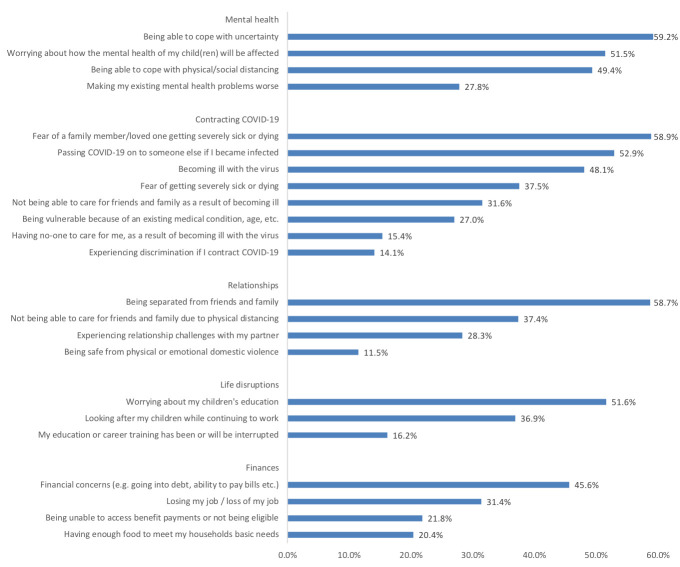
Objectives: In the first wave of the COVID-19 pandemic, social isolation, school/child care closures and employment instability have created unprecedented conditions for families raising children at home. This study describes the mental health impacts of the COVID-19 pandemic on families with children in Canada. Design, setting and participants: This descriptive study used a nationally representative, cross-sectional survey of adults living in Canada (n=3000) to examine the mental health impacts of the COVID-19 pandemic. Outcomes among parents with children <18 years old living at home (n=618) were compared with the rest of the sample. Data were collected via an online survey between 14 May to 29 May 2020. Outcome measures: Participants reported on changes to their mental health since the onset of the pandemic and sources of stress, emotional responses, substance use patterns and suicidality/self-harm. Additionally, parents identified changes in their interactions with their children, impacts on their children’s mental health and sources of support accessed. Results: 44.3% of parents with children <18 years living at home reported worse mental health as a result of the COVID-19 pandemic compared with 35.6% of respondents without children <18 living at home, χ 2 (1, n=3000)=16.2, p<0.001. More parents compared with the rest of the sample reported increased alcohol consumption (27.7% vs 16.1%, χ 2 (1, n=3000)=43.8, p<0.001), suicidal thoughts/feelings (8.3% vs 5.2%, χ 2 (1, n=3000)=8.0, p=0.005) and stress about being safe from physical/emotional domestic violence (11.5% vs 7.9%, χ 2 (1, n=3000)=8.1, p=0.005). 24.8% (95% CI 21.4 to 28.4) of parents reported their children’s mental health had worsened since the pandemic. Parents also reported more frequent negative as well as positive interactions with their children due to the pandemic (eg, more conflicts, 22.2% (95% CI 19.0 to 25.7); increased feelings of closeness, 49.7% (95% CI 45.7 to 53.7)). Conclusions: This study identifies that families with children <18 at home have experienced deteriorated mental health due to the pandemic. Population-level responses are required to adequately respond to families’ diverse needs and mitigate the potential for widening health and social inequities for parents and children.
Overview
The claims and statistics of this paper haven’t been checked yet.
Free: it reads the open-access text and checks the first 5 claims that cite a source we can check. Create a free account to check every claim.
Integrity signals
Registry
Cites
Statistics
Figures
Verification
Claims the paper makes
The claims and statistics of this paper haven’t been checked yet.
Free: it reads the open-access text and checks the first 5 claims that cite a source we can check. Create a free account to check every claim.
Claims other papers make about this one
Each is checked against this paper’s own text: does it say what the citing paper says it does?
The cited source doesn’t support the claim as written.
In the citing paper
“People without family are at a particularly high risk of health problems and deteriorated mental health due to COVID-19 [8,9].”
From Depression, anxiety, and stress in Korean general population during the COVID-19 pandemic. (2022) · cites this paper as [9]
Checked by a reasoning model — may be wrong.
Experimental — accuracy not yet measuredThe cited source says what the claim attributes to it.
In the citing paper
“Apart from the effects on the individual child or adolescent, the pandemic situation affected parents and whole family constructs [9], with a rise in parental stress, interparental and parent–child conflicts [10], child maltreatment [11, 12] and intimate partner violence [13].”
Self-check
Percentages, sums and reported differences re-computed from the paper’s own numbers.
The self-check needs the paper’s full text.
Citations
Cites
An interactive web-based dashboard to track COVID-19 in real time
Dong, E., Du, H., & Gardner, L. (2020) · The Lancet Infectious Diseases · doi:10.1016/s1473-3099(20)30120-1 · Cited by 10,048
Holmes, E. A., O'Connor, R. C., Perry, V. H., Tracey, I., Wessely, S., Arseneault, L., Ballard, C., Christensen, H., Cohen Silver, R., Everall, I., et al. (2020) · The Lancet Psychiatry · doi:10.1016/s2215-0366(20)30168-1 · Cited by 5,715
Impact of COVID-19 pandemic on mental health in the general population: a systematic review
Xiong, J., Lipsitz, O., Nasri, F., Lui, L. M. W., Gill, H., Phan, L., Chen-Li, D., Iacobucci, M., Ho, R., Majeed, A., et al. (2020) · Journal of Affective Disorders · doi:10.1016/j.jad.2020.08.001 · Cited by 5,204 · cited 1×
“Schools/child care, communities and government systems play an essential role in protecting and supporting parents and children, particularly for families without reliable access to the Internet or virtual technologies.”
BackgroundThe Lifelong Effects of Early Childhood Adversity and Toxic Stress
Shonkoff, J. P., Garner, A. S., THE COMMITTEE ON PSYCHOSOCIAL ASPECTS OF CHILD AND FAMILY HEALTH, C. O. E. C., Siegel, B. S., Dobbins, M. I., Earls, M. F., Garner, A. S., McGuinn, L., Pascoe, J., & Wood, D. L. (2012) · Pediatrics · doi:10.1542/peds.2011-2663 · Cited by 5,164
Mental health and the COVID-19 pandemic
Pfefferbaum, B., & North, C. S. (2020) · New England Journal of Medicine · doi:10.1056/nejmp2008017 · Cited by 4,378
Sick individuals and sick populations
Rose, G. (2001) · International Journal of Epidemiology · doi:10.1093/ije/30.3.427 · Cited by 3,736
The life course as developmental theory
Elder, G. H. (1998) · Child Development · doi:10.1111/j.1467-8624.1998.tb06128.x · Cited by 3,513
Sick individuals and sick populations
ROSE, G. (1985) · International Journal of Epidemiology · doi:10.1093/ije/14.1.32 · Cited by 2,701
Galea, S., Merchant, R. M., & Lurie, N. (2020) · JAMA Internal Medicine · doi:10.1001/jamainternmed.2020.1562 · Cited by 2,089
Manuscripts Accepted for Publication
(2005) · Child Development · doi:10.1111/j.1467-8624.2005.00876.x · Cited by 2,047
Fegert, J. M., Vitiello, B., Plener, P. L., & Clemens, V. (2020) · Child and Adolescent Psychiatry and Mental Health · doi:10.1186/s13034-020-00329-3 · Cited by 1,807
Suicide risk and prevention during the COVID-19 pandemic
Gunnell, D., Appleby, L., Arensman, E., Hawton, K., John, A., Kapur, N., Khan, M., O'Connor, R. C., Pirkis, J., Appleby, L., et al. (2020) · The Lancet Psychiatry · doi:10.1016/s2215-0366(20)30171-1 · Cited by 1,513
Well-being of parents and children during the COVID-19 pandemic: A national survey
Patrick, S. W., Henkhaus, L. E., Zickafoose, J. S., Lovell, K., Halvorson, A., Loch, S., Letterie, M., & Davis, M. M. (2020) · Pediatrics · doi:10.1542/peds.2020-016824 · Cited by 1,200
Objective user engagement with mental health apps: systematic search and panel-based usage analysis
Baumel, A., Muench, F., Edan, S., & Kane, J. M. (2019) · Journal of Medical Internet Research · doi:10.2196/14567 · Cited by 965
Parenting in a time of COVID-19
Cluver, L., Lachman, J. M., Sherr, L., Wessels, I., Krug, E., Rakotomalala, S., Blight, S., Hillis, S., Bachman, G., Green, O., et al. (2020) · The Lancet · doi:10.1016/s0140-6736(20)30736-4 · Cited by 883
How Experience Gets Under the Skin to Create Gradients in Developmental Health
Hertzman, C., & Boyce, T. (2010) · Annual Review of Public Health · doi:10.1146/annurev.publhealth.012809.103538 · Cited by 757
Russell, B. S., Hutchison, M., Tambling, R., Tomkunas, A. J., & Horton, A. L. (2020) · Child Psychiatry & Human Development · doi:10.1007/s10578-020-01037-x · Cited by 704
Fleming, T., Bavin, L., Lucassen, M., Stasiak, K., Hopkins, S., & Merry, S. (2018) · Journal of Medical Internet Research · doi:10.2196/jmir.9275 · Cited by 670
The Life Course as Developmental Theory
Elder, G. H. (1998) · Child Development · doi:10.2307/1132065 · Cited by 587
(2020) · doi:10.1542/peds.2020-007294 · Cited by 546
The Empirical Evidence for Telemedicine Interventions in Mental Disorders
Bashshur, R. L., Shannon, G. W., Bashshur, N., & Yellowlees, P. M. (2016) · Telemedicine and e-Health · doi:10.1089/tmj.2015.0206 · Cited by 430
Considering inequalities in the school closure response to COVID-19
Armitage, R., & Nellums, L. B. (2020) · The Lancet Global Health · doi:10.1016/s2214-109x(20)30116-9 · Cited by 311
Home is not always a haven: The domestic violence crisis amid the COVID-19 pandemic.
Kofman, Y. B., & Garfin, D. R. (2020) · Psychological Trauma: Theory, Research, Practice, and Policy · doi:10.1037/tra0000866 · Cited by 310
Palmer, R. H. C., Young, S. E., Hopfer, C. J., Corley, R. P., Stallings, M. C., Crowley, T. J., & Hewitt, J. K. (2009) · Drug and Alcohol Dependence · doi:10.1016/j.drugalcdep.2009.01.012 · Cited by 287
The Canadian Mental Health Association.
Crainford, L. (1970) · PubMed · Cited by 260
Child Development During the COVID-19 Pandemic Through a Life Course Theory Lens
Benner, A. D., & Mistry, R. S. (2020) · Child Development Perspectives · doi:10.1111/cdep.12387 · Cited by 231
Jenkins, E. K., McAuliffe, C., Hirani, S., Richardson, C., Thomson, K. C., McGuinness, L., Morris, J., Kousoulis, A., & Gadermann, A. (2021) · Preventive Medicine · doi:10.1016/j.ypmed.2020.106333 · Cited by 216
Self-citationBronte-Tinkew, J., Moore, K. A., Matthews, G., & Carrano, J. (2007) · Journal of Family Issues · doi:10.1177/0192513x06293609 · Cited by 212
Rethinking online mental health services in China during the COVID-19 epidemic
Yao, H., Chen, J.-H., & Xu, Y.-F. (2020) · Asian Journal of Psychiatry · doi:10.1016/j.ajp.2020.102015 · Cited by 208
Projected increases in suicide in Canada as a consequence of COVID-19
McIntyre, R. S., & Lee, Y. (2020) · Psychiatry Research · doi:10.1016/j.psychres.2020.113104 · Cited by 203
Risks to Bangladeshi children and young people during covid-19 outbreak
Rahman, M. S., Lassi, Z. S., & Shariful Islam, S. M. (2020) · BMJ · doi:10.1136/bmj.m2299 · Cited by 185
IBM SPSS Statistics Processes for Mac
George, D., & Mallery, P. (2019) · IBM SPSS Statistics 26 Step by Step · doi:10.4324/9780429056765-3 · Cited by 166
Melton, H. C., & Belknap, J. (2003) · Criminal Justice and Behavior · doi:10.1177/0093854803030003004 · Cited by 164
Golberstein, E., Gonzales, G., & Meara, E. (2019) · Health Economics · doi:10.1002/hec.3885 · Cited by 159
Ye, J. (2020) · JMIR Pediatrics and Parenting · doi:10.2196/19867 · Cited by 153
Addressing the indirect effects of COVID-19 on the health of children and young people
Chanchlani, N., Buchanan, F., & Gill, P. J. (2020) · Canadian Medical Association Journal · doi:10.1503/cmaj.201008 · Cited by 139
Witt, A., Ordóñez, A., Martin, A., Vitiello, B., & Fegert, J. M. (2020) · Child and Adolescent Psychiatry and Mental Health · doi:10.1186/s13034-020-00324-8 · Cited by 133
Shim, R. S., & Compton, M. T. (2020) · FOCUS The Journal of Lifelong Learning in Psychiatry · doi:10.1176/appi.focus.20190035 · Cited by 109
Protect our healthcare workers
Godlee, F. (2020) · BMJ · doi:10.1136/bmj.m1324 · Cited by 87
Children are being sidelined by covid-19
Sinha, I. P., Bennett, D. L., & Taylor-Robinson, D. C. (2020) · BMJ · doi:10.1136/bmj.m2061 · Cited by 45
COVID-19 and the Well-being of Children and Families
Coller, R. J., & Webber, S. A. (2020) · PEDIATRICS · doi:10.1542/peds.2020-022079 · Cited by 45
Winstok, Z., & Straus, M. A. (2016) · Journal of Family Violence · doi:10.1007/s10896-016-9896-x · Cited by 42 · cited 1×
“…these systems further depends on intersectoral communication, collaboration and action, and therefore seeking feedback and advice from community stakeholders will be critical for monitoring whether these systems are working for families and children during the remainder of the pandemic and beyond.”
BackgroundThe COVID-19 Pandemic, Financial Inequality and Mental Health
Kousoulis, A. A., McDaid, S., Crepaz‐Keay, D., Solomon, S., Lombardo, C., Yap, J., Weeks, L., O’Sullivan, C., Baird, R., Grange, R., et al. (2020) · Research Portal (Queen's University Belfast) · Cited by 40
Rummo, P. E., Bragg, M. A., & Yi, S. S. (2020) · JAMA Health Forum · doi:10.1001/jamahealthforum.2020.0365 · Cited by 29
Health Justice Strategies To Combat COVID-19: Protecting Vulnerable Communities During A Pandemic
(2020) · Forefront Group · doi:10.1377/forefront.20200319.757883 · Cited by 26
COVID-19 and Depressive Symptoms: A Community-based Study in Quebec, Canada
Schmitz, N., Holley, P., Meng, X., Fish, L., & Jedwab, J. (2020) · The Canadian Journal of Psychiatry · doi:10.1177/0706743720943812 · Cited by 23
Periosteum preservation in bone regeneration
Colangeli, M., Spinnato, P., & Manfrini, M. (2020) · Canadian Medical Association Journal · doi:10.1503/cmaj.200005 · Cited by 18
COVID-19 and the Impact on Children's Mental Health
Waddell-Henowitch, C. M., Schwartz, C. E., Barican, J., Ten, D. C. Y., & Gray-Grant, D. (2020) · Summit (Simon Fraser University) · Cited by 10
5 ways to keep human connections when moving learning online due to coronavirus
Smith, E. E. (2020) · doi:10.64628/aam.fvfmf9p9s · Cited by 8
Research works printed but not linked: 2
- Vogel L . COVID-19: A timeline of Canada’s first-wave response, 2020; Canadian Medical Association Journal (CMAJ) News. Available: https://cmajnews.com/2020/06/12/coronavirus-1095847/
- Kousoulis A , McDaid S , Crepaz-Keay D , et al . Smaller boats in the COVID-19 storm: how different groups are coping with the coronavirus pandemic. London, UK: Mental Health Foundation; 2020: In press.
Cited by
Review: Mental health impacts of the COVID‐19 pandemic on children and youth – a systematic review
Samji, H., Wu, J., Ladak, A., Vossen, C., Stewart, E., Dove, N., Long, D., & Snell, G. (2022) · Child and Adolescent Mental Health · doi:10.1111/camh.12501 · Cited by 953
“2020), while participants in two studies described no or positive changes among most participants (Cusinato et al., 2020; Gadermann et al., 2021; Patra et al., 2020).”
BackgroundInfluentialEffects of COVID-19-Related School Closures on Student Achievement-A Systematic Review
Hammerstein, S., König, C., Dreisörner, T., & Frey, A. (2021) · Frontiers in Psychology · doi:10.3389/fpsyg.2021.746289 · Cited by 588
Parents Are Stressed! Patterns of Parent Stress Across COVID-19
Adams, E. L., Smith, D., Caccavale, L. J., & Bean, M. K. (2021) · Frontiers in Psychiatry · doi:10.3389/fpsyt.2021.626456 · Cited by 356
Acuff, S. F., Strickland, J. C., Tucker, J. A., & Murphy, J. G. (2022) · Psychology of Addictive Behaviors · doi:10.1037/adb0000796 · Cited by 214
Agostino, H., Burstein, B., Moubayed, D., Taddeo, D., Grady, R., Vyver, E., Dimitropoulos, G., Dominic, A., & Coelho, J. S. (2021) · JAMA Network Open · doi:10.1001/jamanetworkopen.2021.37395 · Cited by 200
Metadata
- Authors
- Gadermann, A. C., Thomson, K. C., Richardson, C. G., Gagné, M., McAuliffe, C., Hirani, S., & Jenkins, E.
- Affiliations
- University of British Columbia (CA)
- Corresponding author
- Gadermann, Anne C
- ORCID
- Venue
- BMJ Open
- Publisher
- BMJ
- Published
- 2021-01
- Volume
- 11
- Issue
- 1
- Pages
- e042871
- ISSN
- 2044-6055 (ISSN-L)
- PMC
- PMC7804831
- OpenAlex
- W3119253972
- Cited by
- 479
- References
- 48
- Citations by year
- 2026: 26 · 2025: 55 · 2024: 75 · 2023: 112 · 2022: 120 · 2021: 91
- FWCI
- 67.83
- Type
- journal article
- Language
- en
- Open access
- gold
- doi.org
- Licence
- Locations
- BMJ Open (publishedVersion, cc-by-nc)
- PubMed Central (publishedVersion, cc-by-nc)
- PubMed (publishedVersion)
- cIRcle (University of British Columbia) (submittedVersion, cc-by-nc)
- DOAJ (DOAJ: Directory of Open Access Journals) (submittedVersion, cc-by-sa)
- Open Collections
- Funders
- Michael Smith Health Research BC
- National Institute for Health and Care Research (NIHR201342)
- Canadian Mental Health Association
- Canadian Institutes of Health Research
- Topics
- Social Sciences › Psychology › Clinical Psychology › COVID-19 and Mental Health
- Health Sciences › Medicine › Public Health, Environmental and Occupational Health › Maternal Mental Health During Pregnancy and Postpartum
- Social Sciences › Psychology › Clinical Psychology › Child and Adolescent Psychosocial and Emotional Development
- Keywords
- COVID-19 pandemic, family mental health, parents of children, child mental health, social isolation, school closures, employment instability, alcohol consumption, suicidal ideation, self-harm, domestic violence, parent-child conflict, parent-child closeness, substance use, sources of support, Canada, lockdown
- MeSH terms
- COVID-19, SARS-CoV-2, Adolescent, Adult, Mental Disorders, Canada, Cross-Sectional Studies, Family Health, Female, Health Surveys, Humans, Longitudinal Studies, Male, Middle Aged, Quarantine, Social Isolation, Stress, Psychological, Young Adult
About these checks
Registry, retraction, Cites and statistics results are computed, not judged, with one exception: a printed reference that no index lists is read once by a model before it counts as a citation error. Claims are extracted by a model and kept only when their quote appears verbatim in the text; each cited source is then checked, with a model’s help, for whether it says what the claim relies on. Those verdicts can be wrong — read the claim’s quote and the cited source before relying on one.
Statistics and arithmetic are recomputed, not judged.
Confidence bands are shown only for fields calibrated on our annotated test set. None is calibrated yet, so no band is shown.
What counts as a claim ›How we measure confidence ›How we check this ›
Are you an author, or do you see a problem with this page? Request a review
Data sources
Bibliographic data: Semantic Scholar, OpenAlex, Crossref.
Contains information from the Semantic Scholar Academic Graph Datasets, made available under the ODC Attribution License (ODC-BY 1.0).
Semantic Scholar’s data is described in: Kinney, R., et al. (2023). The Semantic Scholar Open Data Platform. arXiv:2301.10140.
