

Demystifying theory and its use in improvement
Open accessThe DOI matches its Crossref record; 77 of the 81 references it cites were found in a registry or an index; 18 of the 87 sources its claims cite were checked for support.
Abstract
The role and value of theory in improvement work in healthcare has been seriously underrecognised. We join others in proposing that more informed use of theory can strengthen improvement programmes and facilitate the evaluation of their effectiveness. Many professionals, including improvement practitioners, are unfortunately mystified—and alienated—by theory, which discourages them from using it in their work. In an effort to demystify theory we make the point in this paper that, far from being discretionary or superfluous, theory (‘reason-giving’), both informal and formal, is intimately woven into virtually all human endeavour. We explore the special characteristics of grand, mid-range and programme theory; consider the consequences of misusing theory or failing to use it; review the process of developing and applying programme theory; examine some emerging criteria of ‘good’ theory; and emphasise the value, as well as the challenge, of combining informal experience-based theory with formal, publicly developed theory. We conclude that although informal theory is always at work in improvement, practitioners are often not aware of it or do not make it explicit. The germane issue for improvement practitioners, therefore, is not whether they use theory but whether they make explicit the particular theory or theories, informal and formal, they actually use.
Overview
CoChat Summary
## TL;DR
The paper argues that theory is not optional in healthcare improvement: practitioners always use some theory, but it is often implicit, so the key is making it explicit and combining informal experience-based theory with formal theory. It contends that doing so strengthens intervention design, evaluation, learning, and replication.
## Key findings
- Improvement efforts often “move straight to implementation,” skipping programme theory, and are commonly launched without a good outcome measurement plan or baseline data for meaningful time-series analyses.
- A well-formulated programme theory clarifies programme components, mechanisms, intended outcomes, measurement tools, analytical approaches, and data collection standards.
- The paper reports that in one DVT prophylaxis project, the intervention increased performance to the Veterans Administration External Peer Review Programme national target; in the example of corticosteroid adoption, use rose 68% in hospitals receiving usual word-of-mouth dissemination and 113% in hospitals receiving an active dissemination intervention.
- The authors note that an updated review of audit-and-feedback interventions found they were demonstrably effective when explicit targets and action plans were included.
## Methods
- Conceptual, argumentative paper rather than an empirical study; it synthesizes and discusses theory types, theory use, and programme theory in improvement work.
- Uses illustrative examples and prior studies/reviews, including DVT prophylaxis, antenatal corticosteroid adoption, rapid response teams, audit and feedback, and behaviour change theory.
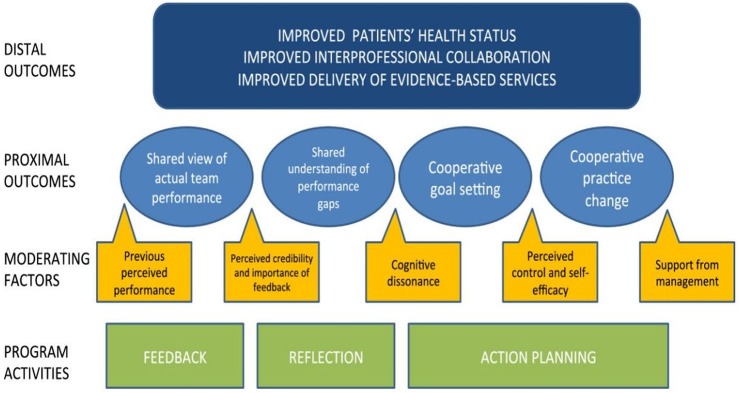
- Discusses theory development and application through narrative examples, logic models, and cited consensus criteria for theory quality.
## Limitations
- The paper itself does not report original data or a formal systematic review, so its claims are interpretive and illustrated rather than newly tested here.
- It states that criteria for “good” theory in improvement are “still very much a work in progress.”
- Evident from the text: many examples are drawn from other studies and reviews, so conclusions depend on the quality and context of those cited sources.
Model-written summary. Check it against the paper before relying on it.
Integrity signals
Registry
Cites
Statistics
Figures
Verification
Claims the paper makes
8 Valid · 1 Not valid · 41 Not checked · 16 Own results and interpretations
The sources with a verdict support this claim; the rest weren’t checked yet, have no full text we could read, or their verdicts aren’t rated yet.
In the paper
“In this article, we join others in arguing that the explicit application of theory could shorten the time needed to develop improvement interventions, optimise their design, identify conditions of context necessary for their success, and enhance learning from those efforts.4–9”
§ Demystifying theory and its use in improvement > Introduction Initiatives to improve quality and safety in healthcare all too frequently result in limited changes for the better or no meaningful changes at all, and the few that are successful are often hard to sustain or replicate in new contexts.1 Many of the difficulties of securing improvement lie in the enormous complexity of healthcare delivery systems, including their challenging technical, social, institutional and political contexts.2 But some challenges can be attributed to the persistent failure to take full advantage of informal and formal theory in planning and executing improvement efforts.3 It is of course possible to achieve high levels of quality and safety on the basis of intuition derived from experience alone, with little evident help from formal theory. The few successful examples that exist do not, however, help to build a science. In this article, we join others in arguing that the explicit application of theory could shorten the time needed to develop improvement interventions, optimise their design, identify conditions of context necessary for their success, and enhance learning from those efforts.4–9 The need for more effective use of formal theory in improvement is increasingly pressing, because personal intuition is often biased, distorted and limited in scope10 and the application of formal theory enables the maximum exploitation of learning and accumulation of knowledge, and promotes the transfer of learning from one project, one context, one challenge, to the next. We are concerned in this article with demystifying the nature of theory and making clear its many and various roles in carrying out and evaluating improvement, not with the place of theory in the vast (and often contentious) body of literature on the philosophy of science.
What the sources say
- Not checked yetcites [4] Foy R, Ovretveit J, Shekelle PG, et al The role of theory in research to develop and evaluate the implementation of patient safety practices. Qual Saf Health Care 2011; 20: 453– 9. 10.1136/bmjqs.2010.047993 21317181 source
- Supportedcites [5] Improved Clinical Effectiveness through Behavioural Research Group (ICEBeRG). Designing theoretically-informed implementation interventions. Implement Sci 2006; 1: 4 10.1186/1748-5908-1-4 16722571 PMC1436012 source
The Introduction says a theoretical approach informs the development and delivery of interventions. Its discussion of using theory to develop implementation interventions also contrasts theory-informed design with choosing interventions merely because they have been used before or seem feasible. This supports the qualified claim that explicit theory could optimise intervention design. (LLM, conf=0.91)
- Supportedcites [6] Grol RPTM, Bosch MC, Hulscher MEJL, et al Planning and studying improvement in patient care: the use of theoretical perspectives. Milbank Q 2007; 85: 93– 138. 10.1111/j.1468-0009.2007.00478.x 17319808 PMC2690312 source
In Conclusions and Discussion, the authors say that using theoretical assumptions should enable researchers and change agents to design better programs to improve patient care. This supports the claim that explicit use of theory could optimise intervention design. (LLM, conf=0.93)
- Not checked yetcites [7] Grol R, Wensing M, Eccles M, et al eds. Improving patient care: the implementation of change in health care. Hoboken, NJ: John Wiley & Sons, 2013. source
- Supportedcites [8] French SD, Green SE, O'Connor DA, et al Developing theory-informed behaviour change interventions to implement evidence into practice: a systematic approach using the theoretical domains framework. Implement Sci 2012; 7: 38 10.1186/1748-5908-7-38 22531013 PMC3443064 source
The Background recommends using theory to inform the design of implementation interventions, particularly where intervention choice lacks an explicit rationale. The Discussion says the authors’ theory-based method helps select intervention components using theory and empirical research. Together, these support the hedged claim that explicit use of theory could optimise intervention design. (LLM, conf=0.90)
- Supportedcites [9] Marshall M, Pronovost P, Dixon-Woods M Promotion of improvement as a science. Lancet 2013; 381: 419– 21. 10.1016/S0140-6736(12)61850-9 23374480 source
In “The science of improvement,” the paper says improvement efforts should be based on good theory and criticises interventions designed without prior learning or explicit assumptions about how change will occur. This supports the attributed point that applying theory could improve intervention design. (LLM, conf=0.92)
hedgedstates a possible cause- Asserted: passes — The authors put it forward as true.
- Checkable: unclear — It is unclear whether it could be checked against evidence.
- Load-bearing: passes — The paper’s conclusions depend on it.
- Based: passes — The paper gives a reason why it holds.
The sources with a verdict support this claim; the rest weren’t checked yet, have no full text we could read, or their verdicts aren’t rated yet.
In the paper
“In this article, we join others in arguing that the explicit application of theory could shorten the time needed to develop improvement interventions, optimise their design, identify conditions of context necessary for their success, and enhance learning from those efforts.4–9”
§ Demystifying theory and its use in improvement > Introduction Initiatives to improve quality and safety in healthcare all too frequently result in limited changes for the better or no meaningful changes at all, and the few that are successful are often hard to sustain or replicate in new contexts.1 Many of the difficulties of securing improvement lie in the enormous complexity of healthcare delivery systems, including their challenging technical, social, institutional and political contexts.2 But some challenges can be attributed to the persistent failure to take full advantage of informal and formal theory in planning and executing improvement efforts.3 It is of course possible to achieve high levels of quality and safety on the basis of intuition derived from experience alone, with little evident help from formal theory. The few successful examples that exist do not, however, help to build a science. In this article, we join others in arguing that the explicit application of theory could shorten the time needed to develop improvement interventions, optimise their design, identify conditions of context necessary for their success, and enhance learning from those efforts.4–9 The need for more effective use of formal theory in improvement is increasingly pressing, because personal intuition is often biased, distorted and limited in scope10 and the application of formal theory enables the maximum exploitation of learning and accumulation of knowledge, and promotes the transfer of learning from one project, one context, one challenge, to the next. We are concerned in this article with demystifying the nature of theory and making clear its many and various roles in carrying out and evaluating improvement, not with the place of theory in the vast (and often contentious) body of literature on the philosophy of science.
What the sources say
- Not checked yetcites [4] Foy R, Ovretveit J, Shekelle PG, et al The role of theory in research to develop and evaluate the implementation of patient safety practices. Qual Saf Health Care 2011; 20: 453– 9. 10.1136/bmjqs.2010.047993 21317181 source
- Supportedcites [5] Improved Clinical Effectiveness through Behavioural Research Group (ICEBeRG). Designing theoretically-informed implementation interventions. Implement Sci 2006; 1: 4 10.1186/1748-5908-1-4 16722571 PMC1436012 source
The Introduction says explicit use of theoretically informed interventions should improve evaluations of what does and does not work. The Conclusion adds that theory can help accumulate generalizable knowledge about why interventions succeed or fail, supporting the claim that it could enhance learning from improvement efforts. (LLM, conf=0.92)
- Supportedcites [6] Grol RPTM, Bosch MC, Hulscher MEJL, et al Planning and studying improvement in patient care: the use of theoretical perspectives. Milbank Q 2007; 85: 93– 138. 10.1111/j.1468-0009.2007.00478.x 17319808 PMC2690312 source
In “The Need for Theory-Informed Research” (page not specified), the paper says that making theoretical assumptions explicit offers a generalizable way to assess effectiveness and that more theory-driven research should help identify the best approaches. It also says such research should improve understanding of how change in health care works, supporting the claim that theory could enhance learning from improvement efforts. (LLM, conf=0.91)
- Not checked yetcites [7] Grol R, Wensing M, Eccles M, et al eds. Improving patient care: the implementation of change in health care. Hoboken, NJ: John Wiley & Sons, 2013. source
- Supportedcites [8] French SD, Green SE, O'Connor DA, et al Developing theory-informed behaviour change interventions to implement evidence into practice: a systematic approach using the theoretical domains framework. Implement Sci 2012; 7: 38 10.1186/1748-5908-7-38 22531013 PMC3443064 source
The Discussion says theory-informed intervention design enables further exploration of how intervention components relate to effects. The Conclusions add that making hypothesised mechanisms of change explicit allows researchers to investigate them, supporting the claim that theory could enhance learning from improvement efforts. (LLM, conf=0.88)
- Supportedcites [9] Marshall M, Pronovost P, Dixon-Woods M Promotion of improvement as a science. Lancet 2013; 381: 419– 21. 10.1016/S0140-6736(12)61850-9 23374480 source
In the section discussing theory in improvement science (page not available), the paper says improvement efforts should be based on good theory and that their hypothesised mechanisms of change should be made explicit. Box 2 (page not available) links revealing those mechanisms to theoretical development and learning, supporting the claim that explicit use of theory could enhance learning from improvement efforts. (LLM, conf=0.90)
hedgedstates a possible cause- Asserted: passes — The authors put it forward as true.
- Checkable: unclear — It is unclear whether it could be checked against evidence.
- Load-bearing: passes — The paper’s conclusions depend on it.
- Based: passes — The paper gives a reason why it holds.
The cited sources support only part of this claim — read each source’s verdict below.
In the paper
“In this article, we join others in arguing that the explicit application of theory could shorten the time needed to develop improvement interventions, optimise their design, identify conditions of context necessary for their success, and enhance learning from those efforts.4–9”
§ Demystifying theory and its use in improvement > Introduction Initiatives to improve quality and safety in healthcare all too frequently result in limited changes for the better or no meaningful changes at all, and the few that are successful are often hard to sustain or replicate in new contexts.1 Many of the difficulties of securing improvement lie in the enormous complexity of healthcare delivery systems, including their challenging technical, social, institutional and political contexts.2 But some challenges can be attributed to the persistent failure to take full advantage of informal and formal theory in planning and executing improvement efforts.3 It is of course possible to achieve high levels of quality and safety on the basis of intuition derived from experience alone, with little evident help from formal theory. The few successful examples that exist do not, however, help to build a science. In this article, we join others in arguing that the explicit application of theory could shorten the time needed to develop improvement interventions, optimise their design, identify conditions of context necessary for their success, and enhance learning from those efforts.4–9 The need for more effective use of formal theory in improvement is increasingly pressing, because personal intuition is often biased, distorted and limited in scope10 and the application of formal theory enables the maximum exploitation of learning and accumulation of knowledge, and promotes the transfer of learning from one project, one context, one challenge, to the next. We are concerned in this article with demystifying the nature of theory and making clear its many and various roles in carrying out and evaluating improvement, not with the place of theory in the vast (and often contentious) body of literature on the philosophy of science.
What the sources say
- Not checked yetcites [4] Foy R, Ovretveit J, Shekelle PG, et al The role of theory in research to develop and evaluate the implementation of patient safety practices. Qual Saf Health Care 2011; 20: 453– 9. 10.1136/bmjqs.2010.047993 21317181 source
- Supportedcites [5] Improved Clinical Effectiveness through Behavioural Research Group (ICEBeRG). Designing theoretically-informed implementation interventions. Implement Sci 2006; 1: 4 10.1186/1748-5908-1-4 16722571 PMC1436012 source
The Conclusion (page not supplied) says that applying a small number of theories and building expertise in their use could streamline intervention development. It also describes drawing on expertise from other disciplines as a way to fast-track the process, supporting the citing sentence’s qualified claim that theory could shorten development time. (LLM, conf=0.91)
- Could not verifycites [6] Grol RPTM, Bosch MC, Hulscher MEJL, et al Planning and studying improvement in patient care: the use of theoretical perspectives. Milbank Q 2007; 85: 93– 138. 10.1111/j.1468-0009.2007.00478.x 17319808 PMC2690312 sourceExperimental — accuracy not yet measured
The Need for Theory-Informed Research (page unavailable) says explicit theoretical assumptions can help researchers choose effective approaches. Conclusions and Discussion (page unavailable) says theories can help design better improvement programs. Neither section addresses whether using theory shortens the time needed to develop interventions; searches for shorter or faster development found no supporting passage. (LLM, conf=0.72)
- Not checked yetcites [7] Grol R, Wensing M, Eccles M, et al eds. Improving patient care: the implementation of change in health care. Hoboken, NJ: John Wiley & Sons, 2013. source
- Partly supportedcites [8] French SD, Green SE, O'Connor DA, et al Developing theory-informed behaviour change interventions to implement evidence into practice: a systematic approach using the theoretical domains framework. Implement Sci 2012; 7: 38 10.1186/1748-5908-7-38 22531013 PMC3443064 sourceExperimental — accuracy not yet measured
The Conclusions propose a streamlined, theory-informed approach to intervention development, which supports the general idea of simplifying the process. But the paper does not say that applying theory shortens development time; the Discussion’s “Potential limitations of this method” instead says the method requires considerable time and reports a 12-month development process. No page numbers are available in our copy. (LLM, conf=0.77)
- Partly supportedcites [9] Marshall M, Pronovost P, Dixon-Woods M Promotion of improvement as a science. Lancet 2013; 381: 419– 21. 10.1016/S0140-6736(12)61850-9 23374480 sourceExperimental — accuracy not yet measured
In the section on the science of improvement (page unavailable), the paper says interventions should be based on good theory and prior learning, supporting the value of theory in their design. It does not say that explicitly applying theory could shorten the time needed to develop them. (LLM, conf=0.78)
hedgedstates a possible cause- Asserted: passes — The authors put it forward as true.
- Checkable: passes — It can be checked against evidence.
- Load-bearing: passes — The paper’s conclusions depend on it.
- Based: passes — The paper gives a reason why it holds.
The cited sources support only part of this claim — read each source’s verdict below.
In the paper
“Improvement interventions are also commonly launched without either a good outcome measurement plan or the baseline data required for meaningful time-series analyses.34–36”
§ Demystifying theory and its use in improvement > The consequences of failing to use theory or misusing it
What the sources say
- Not checked yetcites [34] Pronovost PJ, Miller M, Wachter RM The GAAP in quality measurement and reporting. JAMA 2007; 298: 1800– 2. 10.1001/jama.298.15.1800 17940238 source
- Partly supportedcites [35] Provost LP Analytical studies: a framework for quality improvement design and analysis. BMJ Qual Saf 2011; 20 (Suppl 1): i92– 6. 10.1136/bmjqs.2011.051557 PMC3066849 21450782 sourceExperimental — accuracy not yet measured
The Discussion recommends repeated measurements over time, and Scenario 5 illustrates analysis using baseline and postintervention data. These passages support the importance of measurement and baseline data, but they do not say that interventions are commonly launched without a measurement plan or baseline data. No page numbers are available in our copy. (LLM, conf=0.78)
- Not checked yetcites [36] Provost L, Murray S The health care data guide: learning from data for improvement. San Francisco, CA: Jossey-Bass Publisher, 2011.
plain- Asserted: passes — The authors put it forward as true.
- Checkable: passes — It can be checked against evidence.
- Load-bearing: passes — The paper’s conclusions depend on it.
- Based: passes — The paper gives a reason why it holds.
None of the sources cited for this claim have been checked yet.
In the paper
“a recent consensus exercise of psychologists, sociologists, anthropologists and economists identified nine criteria for theories relevant to the area of behaviour change (box 4).69 70”
§ Demystifying theory and its use in improvement > Theory, good and bad Different disciplines sometimes have diverging views of ‘goodness’ (or quality) as it applies to theory, or indeed what constitutes theory at all. Some criteria for ‘good’ theory in improvement have begun to emerge, but their development is still very much a work in progress. Some criteria apply to virtually all theories in a given area of interest, while others are specific to the purposes for which particular theories will be used, or to their disciplinary origins. Emerging cross-disciplinary criteria might help users evaluate which theories are likely to be most useful for their purpose. For example, a recent consensus exercise of psychologists, sociologists, anthropologists and economists identified nine criteria for theories relevant to the area of behaviour change (box 4).69 70 Similarly, Grol et al7 have identified four important domains of theory related to the multiple layers of social and economic context required for success in changing the behaviour of providers and patients (actions of individual stakeholders; interpersonal interaction and social context; organisational context; and fiscal incentives, supports and constraints). Although uninhibited proliferation of theories of social change can be seen as problematical, the emergence of other such examples of ‘good’ theory is likely to be helpful as the field of improvement studies evolves. Box 4Suggested criteria for ‘good’ theory in the area of behaviour change70Clarity of theoretical concepts: ‘Has the case been made for the independence of constructs from each other?’Clarity of relationships between constructs: ‘Are the relationships between constructs clearly specified?’Measurability: ‘Is an explicit methodology for measuring the constructs given?’Testability: ‘Has the theory been specified in such a way that it can be tested?’Being explanatory: ‘Has the theory been used to explain/account for a set of observations?’ Statistically or logically?;Describing causality: ‘Has the theory been used to describe mechanisms of change?’Achieving parsimony: ‘Has the case for parsimony been made?’Generalisability: ‘Have generalisations been investigated across behaviours, populations and contexts?’Having an evidence base: ‘Is there empirical support for the propositions?’ Perhaps as important as the criteria for ‘good’ theory are the criteria for ‘bad’ theory; practitioners need to be alert to the possibility of being led astray by apparently attractive theories that may be partial, inappropriate for the context or flawed. A compelling recent example is the Stages of Change Theory, also known as the Trans-Theoretical Model. Although it has been widely used, evidence of its effectiveness is not supported by the results of careful systematic reviews. Indeed, in summarising these reviews, West notes that “…the problems with the model are so serious that it has held back advances in the field of health promotion and, despite its intuitive appeal to many practitioners, it should be discarded.”71
What the sources say
- Could not verifycites [69] matched to “Time to retire the theory of planned behaviour” (2014) sourceExperimental — accuracy not yet measured
The Concerns about validity section discusses a debate on improving theory development, but does not describe a multidisciplinary consensus exercise or identify nine criteria. Searches of our copy for those terms found no passage addressing the claim; page numbers were not available. (LLM, conf=0.72)
- Not checked yetcites [70] Michie S, West R, Campbell R, et al An ABC of behaviour change theories. London: Silverback Publishing, 2014.
plain- Asserted: passes — The authors put it forward as true.
- Checkable: passes — It can be checked against evidence.
- Load-bearing: unclear — It is unclear whether the paper’s conclusions depend on it.
- Based: passes — The paper gives a reason why it holds.
- Could not verify
28 more claims · 1 with their cited sources checked
Create a free account to see all 66 claims and to verify the 69 references still open.
- It may state two separate claims as one. 16
- Probably not a substantial claim. 22
Claims other papers make about this one
Each is checked against this paper’s own text: does it say what the citing paper says it does?
The source backs part of the claim, not all of it — or backs it for a different population, condition or comparison.
In the citing paper
“These explanations are generalizable and facilitate comparative studies.”
From Using Normalization Process Theory in feasibility studies and process evaluations of complex healthcare interventions: a systematic review (2018) · cites this paper as [1]
Experimental — accuracy not yet measuredThe cited source says what the claim attributes to it.
In the citing paper
“They provide explanations for relevant phenomena, propose important research questions and frame the collection and analysis of data [1].”
From Using Normalization Process Theory in feasibility studies and process evaluations of complex healthcare interventions: a systematic review (2018) · cites this paper as [1]
The cited source says what the claim attributes to it.
In the citing paper
“The rationale for drawing on existing theories is that they can help to identify what is important, relevant and feasible to inform the intended goals of the intervention13 and inform the content and delivery of any intervention.”
From Guidance on how to develop complex interventions to improve health and healthcare (2019) · cites this paper as [13]
In the citing paper
“Fourth, we did not assess the limitations to the different theories, models and frameworks, such as whether or not it is appropriate for a certain context or is lacking validity evidence [3].”
From Scoping review identifies significant number of knowledge translation theories, models, and frameworks with limited use (2018) · cites this paper as [3]
In the citing paper
“Yet studies have shown that researchers fail to use them or may not use them appropriately [3,4].”
From Scoping review identifies significant number of knowledge translation theories, models, and frameworks with limited use (2018) · cites this paper as [3]
Citations
Cites
Rogers, E. M., Singhal, A., & Quinlan, M. M. (2019) · An Integrated Approach to Communication Theory and Research · doi:10.4324/9780203710753-35 · Cited by 37,322
(1983) · Cited by 33,192
Governing the Commons: The Evolution of Institutions for Collective Action
Ostrom, E. (1990) · doi:10.1017/cbo9780511807763 · Cited by 20,653
Governing the Commons: The Evolution of Institutions for Collective Action
Field, B. C., & Ostrom, E. (1992) · Land Economics · doi:10.2307/3146384 · Cited by 18,859
Damschroder, L. J., Aron, D. C., Keith, R. E., Kirsh, S. R., Alexander, J. A., & Lowery, J. C. (2009) · Implementation Science · doi:10.1186/1748-5908-4-50 · Cited by 14,496
Hoffmann, T. C., Glasziou, P. P., Boutron, I., Milne, R., Perera, R., Moher, D., Altman, D. G., Barbour, V., Macdonald, H., Johnston, M., et al. (2014) · BMJ · doi:10.1136/bmj.g1687 · Cited by 10,548
Self-citationSocial Theory and Social Structure
Ross, E. J., & Merton, R. K. (1958) · The American Catholic Sociological Review · doi:10.2307/3709394 · Cited by 10,315
Michie, S., Richardson, M., Johnston, M., Abraham, C., Francis, J., Hardeman, W., Eccles, M. P., Cane, J., & Wood, C. E. (2013) · Annals of Behavioral Medicine · doi:10.1007/s12160-013-9486-6 · Cited by 7,629
Self-citationA surgical safety checklist to reduce morbidity and mortality in a global population
Haynes, A. B., Weiser, T. G., Berry, W. R., Lipsitz, S. R., Breizat, A.-H. S., Dellinger, E. P., Herbosa, T., Joseph, S., Kibatala, P. L., Lapitan, M. C. M., et al. (2009) · New England Journal of Medicine · doi:10.1056/nejmsa0810119 · Cited by 5,688
From best evidence to best practice: effective implementation of change in patients' care
Grol, R., & Grimshaw, J. (2003) · The Lancet · doi:10.1016/s0140-6736(03)14546-1 · Cited by 4,531
Research works printed but not linked: 4
- Tilly C Why? Princeton, NJ: Princeton University Press, 2006.
- Rogers EM Diffusion of innovations. 5th edn New York, NY: Free Press, 2003.
- Walsh J, McDonald KM, Shojania KG, et al Closing the quality gap: a critical analysis of quality improvement strategies. Tech Rev 2005; 3: Hypertension Care(9.3). 20734527
- Feynman R Cargo cult science: some remarks on science, pseudoscience, and learning how to not fool yourself. In: Feynman RP, Robbins J eds. The pleasure of finding things out. Cambridge, MA: Perseus Books, 1999: 205– 16.
Cited by
Items 401–500 of 714
Friedrich, B., Forbes, G., Jhass, A., Lorencatto, F., Shallcross, L. J., & Antonopoulou, V. (2023) · BMC Health Services Research · doi:10.1186/s12913-023-10031-7 · Cited by 8
“The benefits of drawing on theory to investigate influences on behaviour and inform intervention development are widely recognised and emphasised in best practice intervention development and evaluation frameworks, such as the MRC Complex Interventions Guidance [39, 40].”
BackgroundEmerging hybridity: comparing UK healthcare regulatory arrangements
Furnival, J., Walshe, K., & Boaden, R. (2017) · Journal of Health Organization and Management · doi:10.1108/jhom-06-2016-0109 · Cited by 8
“For example, do all organisations require improvement support or only those who have poor performance or high risk levels, or is proactive improvement support offered to all organisations regardless of performance to prevent future poor performance? How should this be prioritised? It might be argued that regulatory ag…”
BackgroundKatwyk, S. R. V., Grimshaw, J., Nkangu, M., Mendelson, M., Taljaard, M., & Hoffman, S. J. (2020) · Journal of Antimicrobial Chemotherapy · doi:10.1093/jac/dkz540 · Cited by 11
de Ridder, D. T. D., Gillebaart, M., & Friese, M. (2020) · Cambridge University Press eBooks · doi:10.1017/9781108677318.040 · Cited by 11
Epton, T., & Armitage, C. J. (2020) · Cambridge University Press eBooks · doi:10.1017/9781108677318.038 · Cited by 8
Bion, J., Brookes, O., Brown, C., Tarrant, C., Archer, J. C., Buckley, D., Buckley, L. M., Clement', I., Evison, F., Smith, F. G., et al. (2020) · Health Services and Delivery Research · doi:10.3310/hsdr08320 · Cited by 9
Leedham-Green, K. E., Knight, A., & Reedy, G. B. (2021) · BMJ Open · doi:10.1136/bmjopen-2020-047943 · Cited by 14
Tran, K. L., Webster, F., Ivers, N. M., Laupacis, A., & Dhalla, I. A. (2021) · Canadian Family Physician · doi:10.46747/cfp.6710759 · Cited by 9
May, C. R., Albers, B., Desveaux, L., Finch, T. L., Gilbert, A. W., Hillis, A., Girling, M., Kislov, R., MacFarlane, A. E., Mair, F. S., et al. (2022) · NIHR Open Research · doi:10.3310/nihropenres.13269.1 · Cited by 13
“Interest in understanding ‘mechanisms of change’ in implementation is growing 14–16 , and at the same time, the value of continuous theory development has been recognised 17–19 .”
BackgroundMoore, J. E., Uka, S., Vogel, J. P., Timmings, C., Rashid, S., Gülmezoglu, A. M., & Straus, S. E. (2016) · BMC Public Health · doi:10.1186/s12889-016-3641-5 · Cited by 10
“strengthens the quality of the initiative [13, 14].”
Downey, C. L., Brown, J. M., Jayne, D. G., & Randell, R. (2022) · Journal of Evaluation in Clinical Practice · doi:10.1111/jep.13678 · Cited by 7
“This type of ‘informal theory’ is always at work in improvement work, although practitioners are often not aware of it or do not make it explicit.(10) Staff are the users of the monitoring system from a realist perspective, and we were interested in their response to the system as this will determine the impact of the…”
BackgroundPost hoc evaluation of a common-sense intervention for asthma management in community pharmacy
Watkins, K., Seubert, L., Schneider, C. R., & Clifford, R. M. (2016) · BMJ Open · doi:10.1136/bmjopen-2016-012897 · Cited by 10
“Furthermore, even when interventions are successful, they can be difficult to document, sustain, reproduce in new settings and implement on a larger scale.(10) 13 There are concerns that common-sense interventions have poorly developed rationales for achieving outcomes.”
BackgroundHealthcare Quality and Safety: A Review of Policy, Practice and Research
Waring, J. J., Allen, D. A., Braithwaite, J., & Sandall, J. (2016) · Wiley eBooks · doi:10.1002/9781119276371.ch2 · Cited by 9
Promoting planting in front gardens: a systematic approach to intervention development
Allison, A. L., Frost, R., & Murtagh, N. (2024) · UCL Open Environment · doi:10.14324/111.444/ucloe.3147 · Cited by 11
“Evidence shows that application of behaviour change theory can improve the development of behaviour change interventions [26,27].”
BackgroundWeight, C., Laritz, R., Collins, S. E., Mooney, M., Vinette, B., Castiglione, S. A., Straiton, N., Chicoine, G., Liang, S., Presseau, J., et al. (2025) · Translational Behavioral Medicine · doi:10.1093/tbm/ibaf043 · Cited by 9
Improving the efficiency and effectiveness of ward rounds
Jensen, B. E., Found, P. A., Williams, S., & Walley, P. (2016) · International Journal of Quality and Service Sciences · doi:10.1108/ijqss-05-2016-0039 · Cited by 8
“This finding is supported by Davidoff et al. (2015) who found that initiatives to improve quality often are difficult to sustain due to what they have found to be an enormous complexity of the healthcare delivery system, which includes the social, institutional and political context that are…”
BackgroundEvaluation of Behavior Change Interventions
Matthews, L., & Simpson, S. A. (2020) · Cambridge University Press eBooks · doi:10.1017/9781108677318.022 · Cited by 10
Zibrowski, E. M., McDonald, S., Thiessen, H., VanDusen, R., Boden, C., Carr, T., Goodridge, D. M., Haver, C., Marciniuk, D. D., Stobart, C., et al. (2020) · CMAJ Open · doi:10.9778/cmajo.20190181 · Cited by 8
Maurer, C., Gattinger, H., & Mayer, H. (2020) · Pflege · doi:10.1024/1012-5302/a000780 · Cited by 7
Monohan, K., Purvis, R., Sexton, A., Kentwell, M., Thet, M., Stafford, L., & Forrest, L. E. (2021) · Journal of Genetic Counseling · doi:10.1002/jgc4.1532 · Cited by 9
“…makes it difficult to contextualize this subgroup finding and reinforces the need for more theory- or framework- driven research to better understand how interventions impact different patients and what determinants influence patient, service, and implementation outcomes (Davidoff et al., 2015).”
BackgroundBell, Z., Porcellato, L. A., Holland, P., Morris, A. S., Smith, C. W., Haines, C., & Graves, L. (2024) · PLoS ONE · doi:10.1371/journal.pone.0298150 · Cited by 7
“Theory can be a valuable resource, but it does not always ensure the effectiveness of interventions; theory may be inconsistently oper-ationalised (put into practice), inappropriate for specific contexts or flawed [53, 54].”
The challenges of safety improvement in New Zealand public hospitals
Beaver, P. (2019) · Kōtuitui New Zealand Journal of Social Sciences Online · doi:10.1080/1177083x.2018.1561476 · Cited by 7
“As a grand theory of change (Davidoff et al. 2015), the OQ model offers an outline, rather than a detailed perspective on how to do improvement.”
MethodChambers, D., Cantrell, A. J., & Booth, A. (2020) · Health Services and Delivery Research · doi:10.3310/hsdr08020 · Cited by 12
Motivational Interviewing Interventions
Berman, A. H., Beckman, M., & Lindqvist, H. (2020) · Cambridge University Press eBooks · doi:10.1017/9781108677318.045 · Cited by 14
Exposing the impact of Citizens Advice Bureau services on health: a realist evaluation protocol
Forster, N., Dalkin, S. M., Lhussier, M., Hodgson, P., & Carr, S. M. (2016) · BMJ Open · doi:10.1136/bmjopen-2015-009887 · Cited by 10
“thereby clarifying the causal pathways between advice service components and health outcomes, depending on particular contexts.(21) For example, theories may be drawn on which suggest that increased income may improve health through material, psychosocial or behavioural mechanisms.”
BackgroundRezel‐Potts, E., Free, C., Syred, J., & Baraitser, P. (2019) · BMJ Sexual & Reproductive Health · doi:10.1136/bmjsrh-2018-200297 · Cited by 10
Candelaria, D., Redfern, J., O'Neil, A. E., Brieger, D. B., Clark, R. A., Briffa, T. G., Bauman, A. E., Hyun, K. K., Cunich, M. M., Figtree, G. A., et al. (2024) · BMC Cardiovascular Disorders · doi:10.1186/s12872-024-03971-3 · Cited by 8
“We will develop a logic model [43] to evaluate the implementation of the QUICR trial in terms of fidelity [44], processes and mechanisms, contexts [45], and theory [46] that contribute to causal pathways to intended/observed impacts.”
MethodEffects of an Experiential Learning Curriculum on Systems-Thinking
Kovaric, K., & Gingell, G. (2024) · Journal of Medical Education and Curricular Development · doi:10.1177/23821205241262210 · Cited by 6
Development of the Guide to Disseminating Research (GuiDiR): A consolidated framework
Scott, S., Atkins, B., D'Costa, T., Rendle, C., Murphy, K., Taylor, D., Smith, C. A., Kellar, I., Briggs, A. M., Griffiths, A. W., et al. (2024) · Research in Social and Administrative Pharmacy · doi:10.1016/j.sapharm.2024.08.001 · Cited by 11
Zhang, L. M., Schenk, P. M., Santilli, M., Wright, A. J., Marques, M. M., Johnston, M., West, R., & Michie, S. (2025) · Wellcome Open Research · doi:10.12688/wellcomeopenres.23879.1 · Cited by 11
“…state of knowledge, providing a framework to falsify incorrect assumptions and facilitate accumulation of evidence, and guiding future research (Davidoff et al ., 2015; Gardner et al ., 2010; Lippke & Ziegelmann, 2008) Specifically, by supporting intervention designers to select, target and…”
Self-citationWright, D. J., Holland, R., Alldred, D. P., Bond, C. M., Hughes, C. M., Barton, G., Poland, F. M., Shepstone, L., Arthur, A. J., Birt, L., et al. (2023) · Programme Grants for Applied Research · doi:10.3310/jbpt2117 · Cited by 8
Economic and Behavioral Economic Approaches to Behavior Change
Brown, P. M., Cameron, L. D., Wilkinson, M., & Taylor, D. (2020) · Cambridge University Press eBooks · doi:10.1017/9781108677318.042 · Cited by 10
Hasan, G., Jasfar, F., & Kristaung, R. (2020) · International Conference on Management, Accounting, and Economy (ICMAE) · doi:10.2991/aebmr.k.200915.018 · Cited by 6
Lobban, F. A., Appelbe, D., Appleton, V., Aref-Adib, G., Barraclough, J., Billsborough, J., Fisher, N. R., Foster, S., Gill, B., Glentworth, D., et al. (2020) · Health Services and Delivery Research · doi:10.3310/hsdr08370 · Cited by 7
What works for vulnerable families? Interpretations of effective health promotion
Hogeling, L., Lammers, C., Vaandrager, L., & Koelen, M. A. (2021) · Health Promotion International · doi:10.1093/heapro/daab108 · Cited by 6
VanScoy, A., Julien, H., & Harding, A. (2022) · Journal of Education for Library and Information Science · doi:10.3138/jelis-2021-0022 · Cited by 6
Sachidanandan, G., Bechard, L., Hodgson, K. J., & Sud, A. (2022) · International Journal of Drug Policy · doi:10.1016/j.drugpo.2022.103807 · Cited by 9
Ridgeway, J. L., Cheville, A. L., Fischer, K. J., Tesch, N. K., Austin, J. D., Minteer, S. A., Pachman, D. R., Chlan, L. L., Ruddy, K. J., & Griffin, J. M. (2024) · Contemporary Clinical Trials Communications · doi:10.1016/j.conctc.2024.101269 · Cited by 7
“By explicating how a program works, they can be used to identify its core components [12,13].”
BackgroundWilkinson, J. E., & Frost, H. (2015) · International Journal of Health Policy and Management · doi:10.15171/ijhpm.2015.127 · Cited by 7
Cadilhac, D. A.-M., Fisher, R. J., & Bernhardt, J. A. (2018) · International Journal of Stroke · doi:10.1177/1747493017750924 · Cited by 7
Yuan, S., Mukherjee, S., Vyas, R., & Burdick, W. P. (2019) · MedEdPublish · doi:10.15694/mep.2019.000050.1 · Cited by 7
“The need for more effective use of theory in program evaluation is increasingly pressing (Davidoff et al. , 2015).”
Backgroundde Wet, C., Bowie, P., & O’Donnell, C. A. (2019) · BMJ Open · doi:10.1136/bmjopen-2019-029914 · Cited by 6
Changing Behavior Using Integrative Self-Control Theory
Hofmann, W., Dohle, S., & Diel, K. (2020) · Cambridge University Press eBooks · doi:10.1017/9781108677318.011 · Cited by 8
Balayah, Z., Khadjesari, Z., Keohane, A., To, W., Green, J. S. A., & Sevdalis, N. (2020) · The American Journal of Surgery · doi:10.1016/j.amjsurg.2020.12.007 · Cited by 6
Thude, B. R., Brink, A., Hansen, M. S., & Morsø, L. (2021) · International Journal of Integrated Care · doi:10.5334/ijic.5502 · Cited by 6
Issen, L., Woodcock, T., McNicholas, C., Lennox, L., & Reed, J. E. (2018) · International Journal for Quality in Health Care · doi:10.1093/intqhc/mzy063 · Cited by 9
“In addition to these plans being clear to all stakeholders, it is important for the measure concepts to be aligned with proposed cause–effect relationships [5, 12, 21, 27, 30] and involve both process and outcome measures [7, 28].”
BackgroundFrith, L., Hepworth, L. R., Lowers, V., Joseph, F., Davies, E., & Gabbay, M. (2019) · BMJ Open · doi:10.1136/bmjopen-2018-027680 · Cited by 6
“The lack of theoretical consideration of how PPI might contribute to service change and create the conditions for patient-centred care can make evaluation challenging, and the paucity of underpinning theory in this area has been noted in the literature.(29) 30 In order to design, carry out and continuously evaluate PP…”
BackgroundConner, M. T., Williams, D. M., & Rhodes, R. E. (2020) · Cambridge University Press eBooks · doi:10.1017/9781108677318.034 · Cited by 8
McGovern, R., Balogun-Katung, A., Artis, B., Alderson, H., Brown, E. H., Diggle, T. T. J., Lingam, R., McArdle, P., Rankin, J. M., Thomason, P., et al. (2024) · BMC Public Health · doi:10.1186/s12889-024-19770-6 · Cited by 8
“Attachment-focused interventions such as the Solihull Parenting Approach [63] and Dyadic Developmental Psy-chotherapy (DPP) [64] where highlighted as important mid-range theories [55] with explanatory potential relating to the change mechanism.”
BackgroundLeitch, S. V., Smith, A. J., Crengle, S. M., & Stokes, T. (2021) · Implementation Science Communications · doi:10.1186/s43058-021-00120-1 · Cited by 6
Nutritional Interventions on Physical Functioning for Critically Ill Patients: An Integrative Review
Zhou, W., Ruksakulpiwat, S., Fan, Y., & Ji, L. (2021) · Journal of Multidisciplinary Healthcare · doi:10.2147/jmdh.s314132 · Cited by 6
Thulesius, H. O., Sandén, U., Petek, D., Hoffman, R., Koskela, T., Oliva-Fanlo, B., Neves, A. L., Hajdarević, S., Harrysson, L., Toftegaard, B. S., et al. (2021) · Scandinavian Journal of Primary Health Care · doi:10.1080/02813432.2021.2004751 · Cited by 6
“‘The role and value of theory in improvement work in healthcare has been seriously underrecognized’ [9].”
Yardley, S. J., Williams, H., Bowie, P., Edwards, A., Noble, S., Donaldson, L., & Carson‐Stevens, A. (2022) · BMJ Open · doi:10.1136/bmjopen-2020-048045 · Cited by 9
“34 Human agency inherently risks unintended and unanticipated consequences of actions as people seek to adapt to changing circum-stances.”
BackgroundMethodInfluentialSarteau, A. C., Peerzada, A., Goyal, A., Praveen, P. A., & Tandon, N. (2022) · PLOS Global Public Health · doi:10.1371/journal.pgph.0000665 · Cited by 5
Sidhu, M. S., Litchfield, I. J., Miller, R. J., Fulop, N., Janta, B., Tanner, J.-R., Maistrello, G., Bousfield, J., Vindrola‐Padros, C., & Sussex, J. (2022) · Health and Social Care Delivery Research · doi:10.3310/pqwc3425 · Cited by 6
McCleary, N., Laur, C. V., Presseau, J., Dobell, G., Lam, J. M. C., Gushue, S., Hagel, K., Bevan, L., Salach, L., Desveaux, L., et al. (2023) · Implementation Research and Practice · doi:10.1177/26334895231206569 · Cited by 5
“…is anticipated to lead to desired changes (i.e., the underlying causal assumptions) and fully describing intervention components can help to make implicit assumptions explicit and identify any weaknesses or inconsistencies in the causal logic (Davidoff et al., 2015; Moore et al., 2015).”
Bennett, R. J., Bucks, R. S., Saulsman, L. M., Pachana, N. A., Eikelboom, R. H., & Meyer, C. (2023) · Ear and Hearing · doi:10.1097/aud.0000000000001452 · Cited by 7
“…broader health research as they summarize the current state of scientific knowledge, help structure thinking about the factors affecting implementation success and failure, and facilitate the accumulation of evidence (Tabak et al. 2012; Davidoff et al. 2015; Theobald et al. 2018; Damschroder 2020).”
BackgroundPétein, C., Dujardin, N., de Montigny, M., Dewez, E., Spinewine, A., & Henrard, S. (2024) · BMJ Open · doi:10.1136/bmjopen-2024-085396 · Cited by 6
“29 We searched, therefore, for any element related to core functions or programme theory.”
BackgroundCampbell, F., Whear, R., Rogers, M., Sutton, A., Barlow, J., Booth, A., Tattersall, A. J., Wolstenholme, L., & Coon, J. T. (2024) · Campbell Systematic Reviews · doi:10.1002/cl2.1429 · Cited by 14
Addressing Underserved Populations and Disparities in Behavior Change
Schüz, B., & Hooper, M. W. (2020) · Cambridge University Press eBooks · doi:10.1017/9781108677318.027 · Cited by 8
Ehsani, S. (2020) · Future of business and finance · doi:10.1007/978-3-030-41309-5_13 · Cited by 10
“, in Hans Jonas’s 1966 publication on bioethics in “The Phenomenon of Life: Toward a Philosophical Biology”), philosophical psychology, philosophy of chemistry, philosophical chemistry (tracing its roots at least back to the work of Joseph Black in the eighteenth century), physical oncology [67], healthcare improvemen…”
BackgroundRamly, E., Lauver, D., Gilmore‐Bykovskyi, A. L., & Bartels, C. M. (2021) · Implementation Science Communications · doi:10.1186/s43058-021-00155-4 · Cited by 7
“We chose to use middle-range theories because they do offer testable relationships and are readily applied in practice [19].”
Stevens, J., Deliëns, L., Pype, P. F., Vleminck, A. D., & Pardon, K. (2021) · BMJ Supportive & Palliative Care · doi:10.1136/bmjspcare-2021-003310 · Cited by 5
Research to improve diagnosis: time to study the real world
Ranji, S. R., & Thomas, E. J. (2022) · BMJ Quality & Safety · doi:10.1136/bmjqs-2021-014071 · Cited by 5
Zulauf-McCurdy, C. A., Johansson, M., Hashimoto, J. R., & Meza, R. D. (2024) · Prevention Science · doi:10.1007/s11121-024-01742-2 · Cited by 5
“Making explicit the theory of change, or the logic of how strategies will work, can push implementers toward more promising strategies (Davidoff et al., 2015).”
Gunn, C. J., Fruytier, S. E., Finlay, T. M. D., Vat, L. E., Zuiderent‐Jerak, T., & Schuitmaker‐Warnaar, T. J. (2023) · Science and Public Policy · doi:10.1093/scipol/scad040 · Cited by 4
Usability testing of a conceptual model through retrospective cross-case analysis
Mynott, J. P., & Kager, K. (2024) · MethodsX · doi:10.1016/j.mex.2024.102950 · Cited by 10
“By their very nature, conceptual models are incomplete [ 16 ] and should be iteratively applied, tested, and improved [ 6 ].”
BackgroundSharif, L., Cocroft, S., Smith, S. N., Benincasa, C., Peahl, A. F., Low, L. K., Waljee, J. F., Miller, C., Simpson, C., & Moniz, M. H. (2025) · Implementation Science Communications · doi:10.1186/s43058-024-00687-5 · Cited by 4
“Implementation science determinant frameworks provide a systematic approach to identify key barriers and facilitators to changing individual and organizational behavior and increase the probability of replicable improvements in practice [48, 49].”
Hawe, P., Conte, K. P., Grøn, S., Loblay, V., Green, A. S., Innes‐Hughes, C., Milat, A., Persson, L., Mitchell, J., Thackway, S. V., et al. (2019) · Evidence & Policy · doi:10.1332/174426419x15679623018185 · Cited by 4
Changing Behavior in the Digital Age
Kavanagh, D. J. (2020) · Cambridge University Press eBooks · doi:10.1017/9781108677318.029 · Cited by 20
Harris, J., Carins, J., Rundle-Thiele, S. R., & David, P. (2022) · Journal of Social Marketing · doi:10.1108/jsocm-09-2021-0214 · Cited by 6
Cancer as a death sentence: developing an initial program theory for an IVR intervention
Ilozumba, O., Kabukye, J. K., de Keizer, N. F., Cornet, R., & Broerse, J. E. W. (2022) · Health Promotion International · doi:10.1093/heapro/daac070 · Cited by 6
“In this study, we adopt a narrow definition of program theory which hypothe-sizes the pathway by which a specific intervention leads to a goal (Davidoff et al. , 2015).”
Hyland, S. J., & Musch, K. L. E. (2022) · JACCP JOURNAL OF THE AMERICAN COLLEGE OF CLINICAL PHARMACY · doi:10.1002/jac5.1738 · Cited by 4
“Program theory as applied to health-system quality improvement was utilized to guide institutional efforts.(15,16) The aims of this quality improvement study report include: (a) describe a feasible structure that community hospitals could use to provide high-value research programming to pharmacy residents, (b) discus…”
BackgroundMethodEnhancing the appropriateness of eyecare delivery: the iCaretrack approach
Gyawali, R., Toomey, M., Stapleton, F. J., Keay, L. J., & Jalbert, I. (2023) · Clinical and Experimental Optometry · doi:10.1080/08164622.2023.2178286 · Cited by 4
“…Reviews of implementation frameworks, 14,23 tools, such as Theory Comparison and Selection Tool (T-CaST), 60 websites (such as https://dissemina tion-implementation.org/index.aspx) and published guidance 58,59 can be valuable resources in identifying and selecting suitable theories and frameworks.”
BackgroundWallin, P., Petersson, C., Josefsson, K. A., & Nordin, A. M. M. (2023) · Journal of Policy and Practice in Intellectual Disabilities · doi:10.1111/jppi.12453 · Cited by 4
Hickey, G., McGilloway, S., Leckey, Y., Bywater, T. J., & Donnelly, M. (2023) · Evaluation · doi:10.1177/13563890231165814 · Cited by 6
“Innovation in healthcare delivery systems, including children’s service settings, has frequently failed to pay attention to the theory underlying service improvement efforts (Davidoff et al., 2015; Olofsson et al., 2016).”
BackgroundAlghamdi, S. S., Dixon, N., Al-Senani, F., Aseri, Z. A. A., Saif, S. A., & Altahan, T. (2023) · International Journal for Quality in Health Care · doi:10.1093/intqhc/mzad107 · Cited by 11
O’Malley, R., O'Connor, P. E., & Lydon, S. (2024) · BMC Family Practice · doi:10.1186/s12875-024-02352-1 · Cited by 7
“Collating and abstracting these strategies into the IDEAL framework compliments the previous study’s analysis and further enhances the framework’s capacity for informing improvement [27].”
BackgroundMethodInfluentialSheringham, J., Solmi, F., Ariti, C. A., Baim‐Lance, A. M., Stephen Morris, A., & Fulop, N. (2017) · PLoS ONE · doi:10.1371/journal.pone.0174086 · Cited by 7
Towards a Grand Unified Theory of sports performance: A response to the commentaries
Glazier, P. S. (2017) · Human Movement Science · doi:10.1016/j.humov.2017.04.016 · Cited by 4
Nordin, A. M. M., Gäre, B. A., & Andersson, A. (2017) · Journal of Evaluation in Clinical Practice · doi:10.1111/jep.12782 · Cited by 3
“Thus, knowledge of PTs is an essential condition for improvement initiatives.(7,15)”
BackgroundClibbens, N., Baker, J. A., Booth, A., Berzins, K. M., Ashman, M., Sharda, L., Thompson, J., Kendal, S., & Weich, S. (2023) · Health and Social Care Delivery Research · doi:10.3310/twkk5110 · Cited by 11
Comment intégrer un patient partenaire dans une équipe de soins ?
Tourniaire, N., Leseur, J., Roy, A., Rouge, A. D. L. M., & Bertrand, D. P. (2023) · Santé Publique · doi:10.3917/spub.233.0285 · Cited by 6
Feather, J., Kaehne, A., & Kiernan, J. (2023) · Journal of Health Organization and Management · doi:10.1108/jhom-03-2023-0095 · Cited by 5
Effectiveness of back-stretch exercise on back pain among pregnant women
Chandrasekharan, B., Vincent, S. C., & Arulappan, J. (2020) · International Egyptian Journal of Nursing Sciences and Research · doi:10.21608/ejnsr.2020.30590.1000 · Cited by 10
Investigação em serviços de saúde: alguns apontamentos históricos, conceituais e empíricos
Martins, M. S., Portela, M. C., & de Noronha, M. F. (2020) · Cadernos de Saúde Pública · doi:10.1590/0102-311x00006720 · Cited by 6
Patient safety and rocket science
McCulloch, P. G. (2016) · BMJ Quality & Safety · doi:10.1136/bmjqs-2015-004863 · Cited by 4
Between the guidelines: SQUIRE 2.0 and advances in healthcare improvement practice and reporting
Mosher, H. J., & Ogrinc, G. S. (2016) · BMJ Quality & Safety · doi:10.1136/bmjqs-2015-005039 · Cited by 5
Mortality alerts, actions taken and declining mortality: true effect or regression to the mean?
de Mheen, P. J. M., Abel, G., & Shojania, K. G. (2018) · BMJ Quality & Safety · doi:10.1136/bmjqs-2018-007984 · Cited by 4
Ten years’ of Healthy Life Centers – research and directions for future work
Samdal, G. B., & Meland, E. (2022) · Scandinavian Journal of Public Health · doi:10.1177/14034948221081640 · Cited by 6
“Such a description can optimize counselling and identify elements with both short-term and longterm efficacy [31,39].”
BackgroundInfluentialVackerberg, N., & Andersson, A. (2022) · Frontiers in Health Services · doi:10.3389/frhs.2022.964489 · Cited by 4
“Improvement Science attempts to develop and test program theories that can improve the understanding of assumptions and increasing awareness of what is done and why (4).”
BackgroundLearning how and why complex improvement interventions work: insights from implementation science
Wilson, P. M., & Kislov, R. (2023) · BMJ Quality & Safety · doi:10.1136/bmjqs-2023-016008 · Cited by 4
Delivering on the 10 year health plan for England
Klaber, B., Dixon‐Woods, M., Augst, C., Salisbury, H., Patel, K., Nagpaul, C., & Crisp, N. (2025) · BMJ · doi:10.1136/bmj.r1980 · Cited by 3
Self-citationImplementation Science: Strategies to Improve Adoption and Adherence to Clinical Practice Guidelines
Jones, L. K., Sarkies, M., Gionfriddo, M. R., Gidding, S. S., & Watts, G. F. (2024) · Contemporary cardiology · doi:10.1007/978-3-031-54960-1_6 · Cited by 5
Kemp, C. G. (2025) · Current Opinion in HIV and AIDS · doi:10.1097/coh.0000000000000978 · Cited by 3
Morrow, A., Parkinson, B., Kang, Y., Hogden, E., Canfell, K., & Taylor, N. J. (2020) · Implementation Science Communications · doi:10.1186/s43058-020-00058-w · Cited by 3
Accelerating the Growth of Antibiotic Stewardship in Nursing Homes
Taylor, L. N., & Crnich, C. J. (2022) · JAMA Network Open · doi:10.1001/jamanetworkopen.2022.0211 · Cited by 3
Wilkinson, A., Higgs, C., Stokes, T., Dummer, J. F., & Hale, L. A. (2022) · Frontiers in Rehabilitation Sciences · doi:10.3389/fresc.2022.904007 · Cited by 4
“Use of what is termed a “small theory” or “programme theory” provides a framework for outlining programme components, expected outcomes and their assessment methods (87).”
BackgroundInfluentialHuepenbecker, S. P., Lewis, S., Valentine, M. C., Palisoul, M. L., Thaker, P. H., Hagemann, A. R., McCourt, C. K., Fuh, K. C., Powell, M. A., Mutch, D. G., et al. (2022) · Gynecologic Oncology Reports · doi:10.1016/j.gore.2022.101060 · Cited by 4
“, 2012), our QI project may serve as an example of how to design and test an ACP intervention that is tailored to patients’ needs and implemented within their cancer care team (Davidoff et al., 2015).”
Marszalek, M., Hawking, M. K. D., Gutiérrez, A., Dostal, I., Ahmed, Z., Firman, N., Robson, J. P., Bedford, H. E., Billington, A., Moss, N., et al. (2023) · BMJ Open · doi:10.1136/bmjopen-2022-064364 · Cited by 3
Metadata
- Authors
- Davidoff, F., Dixon-Woods, M., Leviton, L., & Michie, S.
- Affiliations
- Dartmouth College (US)
- University of Leicester, Leicester, UK
- Robert Wood Johnson Foundation (US)
- University College London (GB)
- Corresponding author
- Davidoff, Frank
- Venue
- BMJ Quality & Safety
- Publisher
- BMJ
- Published
- 2015-01-23
- Volume
- 24
- Issue
- 3
- Pages
- 228-238
- ISSN
- 1475-3898 (ISSN-L)
- 2044-5415
- 2044-5423
- PMC
- PMC4345989
- OpenAlex
- W2168880999
- Cited by
- 714
- References
- 81
- Citations by year
- 2026: 18 · 2025: 38 · 2024: 53 · 2023: 71 · 2022: 76 · 2021: 77 · 2020: 126 · 2019: 67 · 2018: 49 · 2017: 44 · 2016: 50 · 2015: 44
- FWCI
- 112.80
- Type
- journal article
- Language
- en
- Open access
- hybrid
- doi.org
- Licence
- cc-by-nc
- Locations
- BMJ Quality & Safety (publishedVersion, cc-by-nc)
- PubMed Central (publishedVersion, cc-by-nc)
- PubMed (publishedVersion)
- UCL Discovery (University College London) (submittedVersion)
- Figshare (submittedVersion, cc-by)
- Leicester Research Archive (University of Leicester) (submittedVersion, cc-by-nc)
- Funders
- Wellcome Trust (097899, /WT097899, 097899/A/11/Z)
- National Institute for Health and Care Research (NF-SI-0512-10002)
- Medical Research Council (MR/K023195/1)
- Topics
- Health Sciences › Health Professions › General Health Professions › Health Policy Implementation Science
- Health Sciences › Medicine › Public Health, Environmental and Occupational Health › Healthcare Quality and Management
- Social Sciences › Public Administration › Evaluation and Performance Assessment
- Keywords
- grand theory, middle-range theory, program theory, reason-giving
- MeSH terms
- Health Services Research, Humans, Models, Theoretical, Quality Improvement
About these checks
Registry, retraction, Cites and statistics results are computed, not judged, with one exception: a printed reference that no index lists is read once by a model before it counts as a citation error. Claims are extracted by a model and kept only when their quote appears verbatim in the text; each cited source is then checked, with a model’s help, for whether it says what the claim relies on. Those verdicts can be wrong — read the claim’s quote and the cited source before relying on one.
The claim verdicts this report counts are experimental: their accuracy is not yet measured.
A language model drew the claims from the paper on 2026-10-11, under version 3 of the claim definition (model deepseek-v4.1-flash, prompt extract-v3).
A second model labelled each claim on 2026-10-11 (model jev-1.13-20260917, definition revision gold-guideline-v0.2).
Cited sources are checked with a language model’s help (gpt-6-sol).
Statistics and arithmetic are recomputed, not judged.
Confidence bands are shown only for fields calibrated on our annotated test set. None is calibrated yet, so no band is shown.
What counts as a claim ›How we measure confidence ›How we check this ›
Are you an author, or do you see a problem with this page? Request a review
Data sources
Bibliographic data: Semantic Scholar, OpenAlex, Crossref.
Contains information from the Semantic Scholar Academic Graph Datasets, made available under the ODC Attribution License (ODC-BY 1.0).
Semantic Scholar’s data is described in: Kinney, R., et al. (2023). The Semantic Scholar Open Data Platform. arXiv:2301.10140.
