

Demystifying theory and its use in improvement
Open accessThe DOI matches its Crossref record; 77 of the 81 references it cites were found in a registry or an index; 18 of the 87 sources its claims cite were checked for support.
Abstract
The role and value of theory in improvement work in healthcare has been seriously underrecognised. We join others in proposing that more informed use of theory can strengthen improvement programmes and facilitate the evaluation of their effectiveness. Many professionals, including improvement practitioners, are unfortunately mystified—and alienated—by theory, which discourages them from using it in their work. In an effort to demystify theory we make the point in this paper that, far from being discretionary or superfluous, theory (‘reason-giving’), both informal and formal, is intimately woven into virtually all human endeavour. We explore the special characteristics of grand, mid-range and programme theory; consider the consequences of misusing theory or failing to use it; review the process of developing and applying programme theory; examine some emerging criteria of ‘good’ theory; and emphasise the value, as well as the challenge, of combining informal experience-based theory with formal, publicly developed theory. We conclude that although informal theory is always at work in improvement, practitioners are often not aware of it or do not make it explicit. The germane issue for improvement practitioners, therefore, is not whether they use theory but whether they make explicit the particular theory or theories, informal and formal, they actually use.
Overview
CoChat Summary
## TL;DR
The paper argues that theory is not optional in healthcare improvement: practitioners always use some theory, but it is often implicit, so the key is making it explicit and combining informal experience-based theory with formal theory. It contends that doing so strengthens intervention design, evaluation, learning, and replication.
## Key findings
- Improvement efforts often “move straight to implementation,” skipping programme theory, and are commonly launched without a good outcome measurement plan or baseline data for meaningful time-series analyses.
- A well-formulated programme theory clarifies programme components, mechanisms, intended outcomes, measurement tools, analytical approaches, and data collection standards.
- The paper reports that in one DVT prophylaxis project, the intervention increased performance to the Veterans Administration External Peer Review Programme national target; in the example of corticosteroid adoption, use rose 68% in hospitals receiving usual word-of-mouth dissemination and 113% in hospitals receiving an active dissemination intervention.
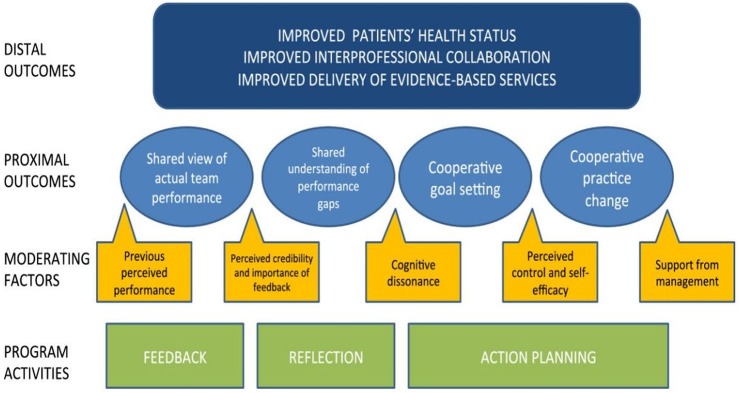
- The authors note that an updated review of audit-and-feedback interventions found they were demonstrably effective when explicit targets and action plans were included.
## Methods
- Conceptual, argumentative paper rather than an empirical study; it synthesizes and discusses theory types, theory use, and programme theory in improvement work.
- Uses illustrative examples and prior studies/reviews, including DVT prophylaxis, antenatal corticosteroid adoption, rapid response teams, audit and feedback, and behaviour change theory.
- Discusses theory development and application through narrative examples, logic models, and cited consensus criteria for theory quality.
## Limitations
- The paper itself does not report original data or a formal systematic review, so its claims are interpretive and illustrated rather than newly tested here.
- It states that criteria for “good” theory in improvement are “still very much a work in progress.”
- Evident from the text: many examples are drawn from other studies and reviews, so conclusions depend on the quality and context of those cited sources.
Model-written summary. Check it against the paper before relying on it.
Integrity signals
Registry
Cites
Statistics
Figures
Verification
Claims the paper makes
8 Valid · 1 Not valid · 41 Not checked · 16 Own results and interpretations
The sources with a verdict support this claim; the rest weren’t checked yet, have no full text we could read, or their verdicts aren’t rated yet.
In the paper
“In this article, we join others in arguing that the explicit application of theory could shorten the time needed to develop improvement interventions, optimise their design, identify conditions of context necessary for their success, and enhance learning from those efforts.4–9”
§ Demystifying theory and its use in improvement > Introduction Initiatives to improve quality and safety in healthcare all too frequently result in limited changes for the better or no meaningful changes at all, and the few that are successful are often hard to sustain or replicate in new contexts.1 Many of the difficulties of securing improvement lie in the enormous complexity of healthcare delivery systems, including their challenging technical, social, institutional and political contexts.2 But some challenges can be attributed to the persistent failure to take full advantage of informal and formal theory in planning and executing improvement efforts.3 It is of course possible to achieve high levels of quality and safety on the basis of intuition derived from experience alone, with little evident help from formal theory. The few successful examples that exist do not, however, help to build a science. In this article, we join others in arguing that the explicit application of theory could shorten the time needed to develop improvement interventions, optimise their design, identify conditions of context necessary for their success, and enhance learning from those efforts.4–9 The need for more effective use of formal theory in improvement is increasingly pressing, because personal intuition is often biased, distorted and limited in scope10 and the application of formal theory enables the maximum exploitation of learning and accumulation of knowledge, and promotes the transfer of learning from one project, one context, one challenge, to the next. We are concerned in this article with demystifying the nature of theory and making clear its many and various roles in carrying out and evaluating improvement, not with the place of theory in the vast (and often contentious) body of literature on the philosophy of science.
What the sources say
- Not checked yetcites [4] matched to “The role of theory in research to develop and evaluate the implementation of patient safety practices: Figure 1” (2011) source
- Supportedcites [5] matched to “Designing theoretically-informed implementation interventions” (2006) source
The Introduction says a theoretical approach informs the development and delivery of interventions. Its discussion of using theory to develop implementation interventions also contrasts theory-informed design with choosing interventions merely because they have been used before or seem feasible. This supports the qualified claim that explicit theory could optimise intervention design. (LLM, conf=0.91)
- Supportedcites [6] matched to “Planning and Studying Improvement in Patient Care: The Use of Theoretical Perspectives” (2007) source
In Conclusions and Discussion, the authors say that using theoretical assumptions should enable researchers and change agents to design better programs to improve patient care. This supports the claim that explicit use of theory could optimise intervention design. (LLM, conf=0.93)
- Not checked yetcites [7] Grol R , Wensing M , Eccles M , et al eds. Improving patient care: the implementation of change in health care. Hoboken, NJ: John Wiley & Sons, 2013. source
- Supportedcites [8] matched to “Developing theory-informed behaviour change interventions to implement evidence into practice: a systematic approach using the Theoretical Domains Framework” (2012) source
The Background recommends using theory to inform the design of implementation interventions, particularly where intervention choice lacks an explicit rationale. The Discussion says the authors’ theory-based method helps select intervention components using theory and empirical research. Together, these support the hedged claim that explicit use of theory could optimise intervention design. (LLM, conf=0.90)
- Supportedcites [9] matched to “Promotion of improvement as a science” (2013) source
In “The science of improvement,” the paper says improvement efforts should be based on good theory and criticises interventions designed without prior learning or explicit assumptions about how change will occur. This supports the attributed point that applying theory could improve intervention design. (LLM, conf=0.92)
hedgedstates a possible cause- Asserted: passes — The authors put it forward as true.
- Checkable: unclear — It is unclear whether it could be checked against evidence.
- Load-bearing: passes — The paper’s conclusions depend on it.
- Based: passes — The paper gives a reason why it holds.
The sources with a verdict support this claim; the rest weren’t checked yet, have no full text we could read, or their verdicts aren’t rated yet.
In the paper
“In this article, we join others in arguing that the explicit application of theory could shorten the time needed to develop improvement interventions, optimise their design, identify conditions of context necessary for their success, and enhance learning from those efforts.4–9”
§ Demystifying theory and its use in improvement > Introduction Initiatives to improve quality and safety in healthcare all too frequently result in limited changes for the better or no meaningful changes at all, and the few that are successful are often hard to sustain or replicate in new contexts.1 Many of the difficulties of securing improvement lie in the enormous complexity of healthcare delivery systems, including their challenging technical, social, institutional and political contexts.2 But some challenges can be attributed to the persistent failure to take full advantage of informal and formal theory in planning and executing improvement efforts.3 It is of course possible to achieve high levels of quality and safety on the basis of intuition derived from experience alone, with little evident help from formal theory. The few successful examples that exist do not, however, help to build a science. In this article, we join others in arguing that the explicit application of theory could shorten the time needed to develop improvement interventions, optimise their design, identify conditions of context necessary for their success, and enhance learning from those efforts.4–9 The need for more effective use of formal theory in improvement is increasingly pressing, because personal intuition is often biased, distorted and limited in scope10 and the application of formal theory enables the maximum exploitation of learning and accumulation of knowledge, and promotes the transfer of learning from one project, one context, one challenge, to the next. We are concerned in this article with demystifying the nature of theory and making clear its many and various roles in carrying out and evaluating improvement, not with the place of theory in the vast (and often contentious) body of literature on the philosophy of science.
What the sources say
- Not checked yetcites [4] matched to “The role of theory in research to develop and evaluate the implementation of patient safety practices: Figure 1” (2011) source
- Supportedcites [5] matched to “Designing theoretically-informed implementation interventions” (2006) source
The Introduction says explicit use of theoretically informed interventions should improve evaluations of what does and does not work. The Conclusion adds that theory can help accumulate generalizable knowledge about why interventions succeed or fail, supporting the claim that it could enhance learning from improvement efforts. (LLM, conf=0.92)
- Supportedcites [6] matched to “Planning and Studying Improvement in Patient Care: The Use of Theoretical Perspectives” (2007) source
In “The Need for Theory-Informed Research” (page not specified), the paper says that making theoretical assumptions explicit offers a generalizable way to assess effectiveness and that more theory-driven research should help identify the best approaches. It also says such research should improve understanding of how change in health care works, supporting the claim that theory could enhance learning from improvement efforts. (LLM, conf=0.91)
- Not checked yetcites [7] Grol R , Wensing M , Eccles M , et al eds. Improving patient care: the implementation of change in health care. Hoboken, NJ: John Wiley & Sons, 2013. source
- Supportedcites [8] matched to “Developing theory-informed behaviour change interventions to implement evidence into practice: a systematic approach using the Theoretical Domains Framework” (2012) source
The Discussion says theory-informed intervention design enables further exploration of how intervention components relate to effects. The Conclusions add that making hypothesised mechanisms of change explicit allows researchers to investigate them, supporting the claim that theory could enhance learning from improvement efforts. (LLM, conf=0.88)
- Supportedcites [9] matched to “Promotion of improvement as a science” (2013) source
In the section discussing theory in improvement science (page not available), the paper says improvement efforts should be based on good theory and that their hypothesised mechanisms of change should be made explicit. Box 2 (page not available) links revealing those mechanisms to theoretical development and learning, supporting the claim that explicit use of theory could enhance learning from improvement efforts. (LLM, conf=0.90)
hedgedstates a possible cause- Asserted: passes — The authors put it forward as true.
- Checkable: unclear — It is unclear whether it could be checked against evidence.
- Load-bearing: passes — The paper’s conclusions depend on it.
- Based: passes — The paper gives a reason why it holds.
The cited sources support only part of this claim — read each source’s verdict below.
In the paper
“In this article, we join others in arguing that the explicit application of theory could shorten the time needed to develop improvement interventions, optimise their design, identify conditions of context necessary for their success, and enhance learning from those efforts.4–9”
§ Demystifying theory and its use in improvement > Introduction Initiatives to improve quality and safety in healthcare all too frequently result in limited changes for the better or no meaningful changes at all, and the few that are successful are often hard to sustain or replicate in new contexts.1 Many of the difficulties of securing improvement lie in the enormous complexity of healthcare delivery systems, including their challenging technical, social, institutional and political contexts.2 But some challenges can be attributed to the persistent failure to take full advantage of informal and formal theory in planning and executing improvement efforts.3 It is of course possible to achieve high levels of quality and safety on the basis of intuition derived from experience alone, with little evident help from formal theory. The few successful examples that exist do not, however, help to build a science. In this article, we join others in arguing that the explicit application of theory could shorten the time needed to develop improvement interventions, optimise their design, identify conditions of context necessary for their success, and enhance learning from those efforts.4–9 The need for more effective use of formal theory in improvement is increasingly pressing, because personal intuition is often biased, distorted and limited in scope10 and the application of formal theory enables the maximum exploitation of learning and accumulation of knowledge, and promotes the transfer of learning from one project, one context, one challenge, to the next. We are concerned in this article with demystifying the nature of theory and making clear its many and various roles in carrying out and evaluating improvement, not with the place of theory in the vast (and often contentious) body of literature on the philosophy of science.
What the sources say
- Not checked yetcites [4] matched to “The role of theory in research to develop and evaluate the implementation of patient safety practices: Figure 1” (2011) source
- Supportedcites [5] matched to “Designing theoretically-informed implementation interventions” (2006) source
The Conclusion (page not supplied) says that applying a small number of theories and building expertise in their use could streamline intervention development. It also describes drawing on expertise from other disciplines as a way to fast-track the process, supporting the citing sentence’s qualified claim that theory could shorten development time. (LLM, conf=0.91)
- Could not verifycites [6] matched to “Planning and Studying Improvement in Patient Care: The Use of Theoretical Perspectives” (2007) sourceExperimental — accuracy not yet measured
The Need for Theory-Informed Research (page unavailable) says explicit theoretical assumptions can help researchers choose effective approaches. Conclusions and Discussion (page unavailable) says theories can help design better improvement programs. Neither section addresses whether using theory shortens the time needed to develop interventions; searches for shorter or faster development found no supporting passage. (LLM, conf=0.72)
- Not checked yetcites [7] Grol R , Wensing M , Eccles M , et al eds. Improving patient care: the implementation of change in health care. Hoboken, NJ: John Wiley & Sons, 2013. source
- Partly supportedcites [8] matched to “Developing theory-informed behaviour change interventions to implement evidence into practice: a systematic approach using the Theoretical Domains Framework” (2012) sourceExperimental — accuracy not yet measured
The Conclusions propose a streamlined, theory-informed approach to intervention development, which supports the general idea of simplifying the process. But the paper does not say that applying theory shortens development time; the Discussion’s “Potential limitations of this method” instead says the method requires considerable time and reports a 12-month development process. No page numbers are available in our copy. (LLM, conf=0.77)
- Partly supportedcites [9] matched to “Promotion of improvement as a science” (2013) sourceExperimental — accuracy not yet measured
In the section on the science of improvement (page unavailable), the paper says interventions should be based on good theory and prior learning, supporting the value of theory in their design. It does not say that explicitly applying theory could shorten the time needed to develop them. (LLM, conf=0.78)
hedgedstates a possible cause- Asserted: passes — The authors put it forward as true.
- Checkable: passes — It can be checked against evidence.
- Load-bearing: passes — The paper’s conclusions depend on it.
- Based: passes — The paper gives a reason why it holds.
The cited sources support only part of this claim — read each source’s verdict below.
In the paper
“Improvement interventions are also commonly launched without either a good outcome measurement plan or the baseline data required for meaningful time-series analyses.34–36”
§ Demystifying theory and its use in improvement > The consequences of failing to use theory or misusing it
What the sources say
- Not checked yetcites [34] matched to “The GAAP in Quality Measurement and Reporting” (2007) source
- Partly supportedcites [35] matched to “Analytical studies: a framework for quality improvement design and analysis: Figure 1” (2011) sourceExperimental — accuracy not yet measured
The Discussion recommends repeated measurements over time, and Scenario 5 illustrates analysis using baseline and postintervention data. These passages support the importance of measurement and baseline data, but they do not say that interventions are commonly launched without a measurement plan or baseline data. No page numbers are available in our copy. (LLM, conf=0.78)
- Not checked yetcites [36] Provost L , Murray S . The health care data guide: learning from data for improvement. San Francisco, CA: Jossey-Bass Publisher, 2011.
plain- Asserted: passes — The authors put it forward as true.
- Checkable: passes — It can be checked against evidence.
- Load-bearing: passes — The paper’s conclusions depend on it.
- Based: passes — The paper gives a reason why it holds.
None of the sources cited for this claim have been checked yet.
In the paper
“a recent consensus exercise of psychologists, sociologists, anthropologists and economists identified nine criteria for theories relevant to the area of behaviour change (box 4).69 70”
§ Demystifying theory and its use in improvement > Theory, good and bad Different disciplines sometimes have diverging views of ‘goodness’ (or quality) as it applies to theory, or indeed what constitutes theory at all. Some criteria for ‘good’ theory in improvement have begun to emerge, but their development is still very much a work in progress. Some criteria apply to virtually all theories in a given area of interest, while others are specific to the purposes for which particular theories will be used, or to their disciplinary origins. Emerging cross-disciplinary criteria might help users evaluate which theories are likely to be most useful for their purpose. For example, a recent consensus exercise of psychologists, sociologists, anthropologists and economists identified nine criteria for theories relevant to the area of behaviour change (box 4).69 70 Similarly, Grol et al7 have identified four important domains of theory related to the multiple layers of social and economic context required for success in changing the behaviour of providers and patients (actions of individual stakeholders; interpersonal interaction and social context; organisational context; and fiscal incentives, supports and constraints). Although uninhibited proliferation of theories of social change can be seen as problematical, the emergence of other such examples of ‘good’ theory is likely to be helpful as the field of improvement studies evolves. Box 4Suggested criteria for ‘good’ theory in the area of behaviour change70Clarity of theoretical concepts: ‘Has the case been made for the independence of constructs from each other?’Clarity of relationships between constructs: ‘Are the relationships between constructs clearly specified?’Measurability: ‘Is an explicit methodology for measuring the constructs given?’Testability: ‘Has the theory been specified in such a way that it can be tested?’Being explanatory: ‘Has the theory been used to explain/account for a set of observations?’ Statistically or logically?;Describing causality: ‘Has the theory been used to describe mechanisms of change?’Achieving parsimony: ‘Has the case for parsimony been made?’Generalisability: ‘Have generalisations been investigated across behaviours, populations and contexts?’Having an evidence base: ‘Is there empirical support for the propositions?’ Perhaps as important as the criteria for ‘good’ theory are the criteria for ‘bad’ theory; practitioners need to be alert to the possibility of being led astray by apparently attractive theories that may be partial, inappropriate for the context or flawed. A compelling recent example is the Stages of Change Theory, also known as the Trans-Theoretical Model. Although it has been widely used, evidence of its effectiveness is not supported by the results of careful systematic reviews. Indeed, in summarising these reviews, West notes that “…the problems with the model are so serious that it has held back advances in the field of health promotion and, despite its intuitive appeal to many practitioners, it should be discarded.”71
What the sources say
- Could not verifycites [69] matched to “Time to retire the theory of planned behaviour” (2014) sourceExperimental — accuracy not yet measured
The Concerns about validity section discusses a debate on improving theory development, but does not describe a multidisciplinary consensus exercise or identify nine criteria. Searches of our copy for those terms found no passage addressing the claim; page numbers were not available. (LLM, conf=0.72)
- Not checked yetcites [70] Michie S , West R , Campbell R , et al . An ABC of behaviour change theories. London: Silverback Publishing, 2014.
plain- Asserted: passes — The authors put it forward as true.
- Checkable: passes — It can be checked against evidence.
- Load-bearing: unclear — It is unclear whether the paper’s conclusions depend on it.
- Based: passes — The paper gives a reason why it holds.
- Could not verify
28 more claims · 1 with their cited sources checked
Create a free account to see all 66 claims and to verify the 69 references still open.
- It may state two separate claims as one. 16
- Probably not a substantial claim. 22
Claims other papers make about this one
Each is checked against this paper’s own text: does it say what the citing paper says it does?
The source backs part of the claim, not all of it — or backs it for a different population, condition or comparison.
In the citing paper
“These explanations are generalizable and facilitate comparative studies.”
From Using Normalization Process Theory in feasibility studies and process evaluations of complex healthcare interventions: a systematic review (2018) · cites this paper as [1]
Experimental — accuracy not yet measuredThe cited source says what the claim attributes to it.
In the citing paper
“They provide explanations for relevant phenomena, propose important research questions and frame the collection and analysis of data [1].”
From Using Normalization Process Theory in feasibility studies and process evaluations of complex healthcare interventions: a systematic review (2018) · cites this paper as [1]
The cited source says what the claim attributes to it.
In the citing paper
“The rationale for drawing on existing theories is that they can help to identify what is important, relevant and feasible to inform the intended goals of the intervention13 and inform the content and delivery of any intervention.”
From Guidance on how to develop complex interventions to improve health and healthcare (2019) · cites this paper as [13]
In the citing paper
“Fourth, we did not assess the limitations to the different theories, models and frameworks, such as whether or not it is appropriate for a certain context or is lacking validity evidence [3].”
From Scoping review identifies significant number of knowledge translation theories, models, and frameworks with limited use (2018) · cites this paper as [3]
In the citing paper
“Yet studies have shown that researchers fail to use them or may not use them appropriately [3,4].”
From Scoping review identifies significant number of knowledge translation theories, models, and frameworks with limited use (2018) · cites this paper as [3]
Citations
Cites
Rogers, E. M., Singhal, A., & Quinlan, M. M. (2019) · An Integrated Approach to Communication Theory and Research · doi:10.4324/9780203710753-35 · Cited by 37,322
(1983) · Cited by 33,192
Governing the Commons: The Evolution of Institutions for Collective Action
Ostrom, E. (1990) · doi:10.1017/cbo9780511807763 · Cited by 20,653
Governing the Commons: The Evolution of Institutions for Collective Action
Field, B. C., & Ostrom, E. (1992) · Land Economics · doi:10.2307/3146384 · Cited by 18,859
Damschroder, L. J., Aron, D. C., Keith, R. E., Kirsh, S. R., Alexander, J. A., & Lowery, J. C. (2009) · Implementation Science · doi:10.1186/1748-5908-4-50 · Cited by 14,496
Hoffmann, T. C., Glasziou, P. P., Boutron, I., Milne, R., Perera, R., Moher, D., Altman, D. G., Barbour, V., Macdonald, H., Johnston, M., et al. (2014) · BMJ · doi:10.1136/bmj.g1687 · Cited by 10,548
Self-citationSocial Theory and Social Structure
Ross, E. J., & Merton, R. K. (1958) · The American Catholic Sociological Review · doi:10.2307/3709394 · Cited by 10,315
Michie, S., Richardson, M., Johnston, M., Abraham, C., Francis, J., Hardeman, W., Eccles, M. P., Cane, J., & Wood, C. E. (2013) · Annals of Behavioral Medicine · doi:10.1007/s12160-013-9486-6 · Cited by 7,629
Self-citationA surgical safety checklist to reduce morbidity and mortality in a global population
Haynes, A. B., Weiser, T. G., Berry, W. R., Lipsitz, S. R., Breizat, A.-H. S., Dellinger, E. P., Herbosa, T., Joseph, S., Kibatala, P. L., Lapitan, M. C. M., et al. (2009) · New England Journal of Medicine · doi:10.1056/nejmsa0810119 · Cited by 5,688
Audit and feedback: effects on professional practice and healthcare outcomes
Ivers, N., Jamtvedt, G., Flottorp, S., Young, J. M., Odgaard-Jensen, J., French, S. D., O'Brien, M. A., Johansen, M., Grimshaw, J., & Oxman, A. D. (2012) · Cochrane Database of Systematic Reviews · doi:10.1002/14651858.cd000259.pub3 · Cited by 5,485 · cited 1×
“An updated review 41 using a method 42 that drew on formal theory 43 demonstrated that audit and feedback interventions were demonstrably effective when improvers using those methods included explicit targets and action plans in their interventions — exactly the kind of finding that is most helpful…”
MethodFrom best evidence to best practice: effective implementation of change in patients' care
Grol, R., & Grimshaw, J. (2003) · The Lancet · doi:10.1016/s0140-6736(03)14546-1 · Cited by 4,531
Evaluation: A Systematic Approach
Rossi, P. H., Lipsey, M. W., & Freeman, H. E. (1979) · Cited by 2,943
Carver, C. S., & Scheier, M. F. (1982) · Psychological Bulletin · doi:10.1037//0033-2909.92.1.111 · Cited by 2,650 · cited 1×
“An updated review 41 using a method 42 that drew on formal theory 43 demonstrated that audit and feedback interventions were demonstrably effective when improvers using those methods included explicit targets and action plans in their interventions — exactly the kind of finding that is most helpful…”
MethodTaylor, M. J., McNicholas, C., Nicolay, C., Darzi, A., Bell, D., & Reed, J. E. (2014) · BMJ Quality & Safety · doi:10.1136/bmjqs-2013-001862 · Cited by 1,871 · cited 1×
“46 49 A well-founded theoretical account can also help to explain findings that otherwise appear baffling.”
BackgroundDavis, R., Campbell, R., Hildon, Z., Hobbs, L., & Michie, S. (2015) · Health Psychology Review · doi:10.1080/17437199.2014.941722 · Cited by 1,411
Self-citationTime to retire the theory of planned behaviour
Sniehotta, F. F., Presseau, J., & Araújo-Soares, V. (2014) · Health Psychology Review · doi:10.1080/17437199.2013.869710 · Cited by 1,406
Medical Problem Solving: An Analysis of Clinical Reasoning
Elstein, A. S., Shulman, L. S., & Sprafka, S. A. (1978) · doi:10.4159/harvard.9780674189089 · Cited by 1,377
French, S. D., Green, S. E., O’Connor, D. A., McKenzie, J. E., Francis, J. J., Michie, S., Buchbinder, R., Schattner, P., Spike, N., & Grimshaw, J. M. (2012) · Implementation Science · doi:10.1186/1748-5908-7-38 · Cited by 1,338
Self-citationPlanning and Studying Improvement in Patient Care: The Use of Theoretical Perspectives
GROL, R. P. T. M., BOSCH, M. C., HULSCHER, M. E. J. L., ECCLES, M. P., & WENSING, M. (2007) · The Milbank Quarterly · doi:10.1111/j.1468-0009.2007.00478.x · Cited by 943
Audit and feedback: effects on professional practice and health care outcomes
Jamtvedt, G., Young, J. M., Kristoffersen, D. T., O'Brien, M. A., & Oxman, A. D. (2006) · Cochrane Database of Systematic Reviews · doi:10.1002/14651858.cd000259.pub2 · Cited by 912 · cited 1×
“38 39 Failure to use the various elements of formal theory adequately has frustrated the efficacy and 40 was able to offer few useful recommendations on making this technique effective because of weaknesses in the theoretical underpinning of this review ’ s analysis.”
BackgroundMobile Health Technology Evaluation
Kumar, S., Nilsen, W. J., Abernethy, A., Atienza, A., Patrick, K., Pavel, M., Riley, W. T., Shar, A., Spring, B., Spruijt-Metz, D., et al. (2013) · American Journal of Preventive Medicine · doi:10.1016/j.amepre.2013.03.017 · Cited by 900 · cited 1×
“13 It is in part these differences in the interests and practices of improvers and researchers that explain the underlying distinctions between improvement projects and research studies.”
BackgroundCROWLEY, P., CHALMERS, I., & KE1RSE, M. J. N. C. (1990) · BJOG: An International Journal of Obstetrics & Gynaecology · doi:10.1111/j.1471-0528.1990.tb01711.x · Cited by 828 · cited 1×
“…of antenatal corticosteroid therapy to prevent respiratory distress and mortality in premature infants offers some of the strongest and most compelling evidence of benefit to be found in the meta-analytic literature, 62 practicing obstetricians were slow to adopt the therapy throughout the 1990s.”
BackgroundThe Health Care Data Guide: Learning from Data for Improvement
Provost, L., & Murray, S. K. (2011) · CERN Document Server (European Organization for Nuclear Research) · Cited by 759
KAPLAN, H. C., BRADY, P. W., DRITZ, M. C., HOOPER, D. K., LINAM, W. M., FROEHLE, C. M., & MARGOLIS, P. (2010) · Milbank Quarterly · doi:10.1111/j.1468-0009.2010.00611.x · Cited by 714
Time for a change: putting the transtheoretical (stages of change) model to rest
WEST, R. (2005) · Addiction · doi:10.1111/j.1360-0443.2005.01139.x · Cited by 700
The Reflective Practitioner: How Professionals Think in Action.
Schwartz, H. S., & Schon, D. A. (1987) · Administrative Science Quarterly · doi:10.2307/2392894 · Cited by 672
Towards a general theory of implementation
May, C. (2013) · Implementation Science · doi:10.1186/1748-5908-8-18 · Cited by 656 · cited 1×
“Similarly, Normalisation Process Theory, 23 Programme theories, on the other hand, provide what Lipsey 24 terms a ‘ small theory ’ for each intervention.”
BackgroundIntroduction of surgical safety checklists in Ontario, Canada
Urbach, D. R., Govindarajan, A., Saskin, R., Wilton, A. S., & Baxter, N. N. (2014) · New England Journal of Medicine · doi:10.1056/nejmsa1308261 · Cited by 627 · cited 1×
“46 49 A well-founded theoretical account can also help to explain findings that otherwise appear baffling.”
BackgroundDavies, P., Walker, A. E., & Grimshaw, J. M. (2010) · Implementation Science · doi:10.1186/1748-5908-5-14 · Cited by 619
Explaining Michigan: Developing an Ex Post Theory of a Quality Improvement Program
DIXON-WOODS, M., BOSK, C. L., AVELING, E. L., GOESCHEL, C. A., & PRONOVOST, P. J. (2011) · Milbank Quarterly · doi:10.1111/j.1468-0009.2011.00625.x · Cited by 603 · cited 2×
“45 An improvement team is well-advised therefore to start by sketching out an intervention, then identifying its components and the relationships that link their application with the desired outcomes.”
BackgroundSelf-citationAudit and feedback: Effects on professional practice and healthcare outcomes
Jamtvedt, G., Young, J., Kristoffersen, D., Thomson O'Brien, M., & Oxman, A. (2003) · Physiotherapy · doi:10.1016/s0031-9406(05)60176-9 · Cited by 582
Tolstoy, L. N. (1865) · Cited by 569
Improving Patient Care: The Implementation of Change in Health Care
(2013) · doi:10.1002/9781118525975 · Cited by 506 · cited 2×
“69 70 Similarly, Grol et al 7 have identified four important domains of theory related to the multiple layers of social and economic context required for success in changing the behaviour of providers and patients (actions of individual stakeholders; interpersonal interaction and social context; organisational context…”
BackgroundAmmenwerth, E., Iller, C., & Mahler, C. (2006) · BMC Medical Informatics and Decision Making · doi:10.1186/1472-6947-6-3 · Cited by 459
Rapid-Response Systems as a Patient Safety Strategy: A Systematic Review
Winters, B. D., Weaver, S. J., Pfoh, E. R., Yang, T., Pham, J. C., & Dy, S. M. (2013) · Annals of Internal Medicine · doi:10.7326/0003-4819-158-5-201303051-00009 · Cited by 438
Observational research, randomised trials, and two views of medical science
Vandenbroucke, J. P. (2008) · PLoS Medicine · doi:10.1371/journal.pmed.0050067 · Cited by 416
Paul Ehrlich (1854-1915) and His Contributions to the Foundation and Birth of Translational Medicine
Valent, P., Groner, B., Schumacher, U., Superti-Furga, G., Busslinger, M., Kralovics, R., Zielinski, C., Penninger, J. M., Kerjaschki, D., Stingl, G., et al. (2016) · Journal of Innate Immunity · doi:10.1159/000443526 · Cited by 409
Practical program evaluation : assessing and improving planning, implementation, and effectiveness
Chen, H.-T. (2005) · Cited by 381
Designing theoretically-informed implementation interventions
The Improved Clinical Effectiveness through Behavioural Research Group (ICEBeRG) (2006) · Implementation Science · doi:10.1186/1748-5908-1-4 · Cited by 380
Chen, H.-T. (2005) · doi:10.4135/9781412985444 · Cited by 365
ABC of Behaviour Change Theories
Michie, S., West, R., Campbell, R., Brown, J., & Gainforth, H. L. (2014) · Cited by 359
Self-citation1 Complicated and Complex Systems: What Would Successful Reform of Medicare Look Like?
Glouberman, S., & Zimmerman, B. (2004) · Changing Health Care in Canada · doi:10.3138/9781442672833-004 · Cited by 358
Theory as method: small theories of treatments
Lipsey, M. W. (1993) · New Directions for Program Evaluation · doi:10.1002/ev.1637 · Cited by 322
Explaining Matching Michigan: an ethnographic study of a patient safety program
Dixon-Woods, M., Leslie, M., Tarrant, C., & Bion, J. (2013) · Implementation Science · doi:10.1186/1748-5908-8-70 · Cited by 291
Self-citationProgram theory evaluation: Practice, promise, and problems
Rogers, P. J., Petrosino, A., Huebner, T. A., & Hacsi, T. A. (2000) · New Directions for Evaluation · doi:10.1002/ev.1177 · Cited by 274
Understanding what works—and why—in quality improvement: the need for theory-driven evaluation
Walshe, K. (2007) · International Journal for Quality in Health Care · doi:10.1093/intqhc/mzm004 · Cited by 237 · cited 1×
“31 Improvers need to pay careful attention to at least the following elements of evaluation: their choice of particular outcomes of interest (eg, changes in processes of care delivery; changes in patients ’ clinical status; costs); the type of evaluation (quantitative; qualitative; mixed); the…”
BackgroundCiardi, J. (1975) · Cited by 226
Gardner, B., Whittington, C., McAteer, J., Eccles, M. P., & Michie, S. (2010) · Social Science & Medicine · doi:10.1016/j.socscimed.2010.01.039 · Cited by 225 · cited 1×
“An updated review 41 using a method 42 that drew on formal theory 43 demonstrated that audit and feedback interventions were demonstrably effective when improvers using those methods included explicit targets and action plans in their interventions — exactly the kind of finding that is most helpful…”
MethodSelf-citationPromotion of improvement as a science
Marshall, M., Pronovost, P., & Dixon-Woods, M. (2013) · The Lancet · doi:10.1016/s0140-6736(12)61850-9 · Cited by 189
Self-citationContext Is Everything: Measuring Institutional Change in Transition Economies
Campos, N. F. (2000) · World Bank, Washington, DC eBooks · doi:10.1596/1813-9450-2269 · Cited by 164
Davidoff, F., Batalden, P., Stevens, D., Ogrinc, G., Mooney, S. E., & for the SQUIRE development group (2009) · BMJ · doi:10.1136/bmj.a3152 · Cited by 154 · cited 1×
“53 Three points are important in this connection.”
BackgroundSelf-citationWhat are the most effective strategies for improving quality and safety of health care?
Scott, I. (2009) · Internal Medicine Journal · doi:10.1111/j.1445-5994.2008.01798.x · Cited by 153 · cited 1×
“37 Moreover, published descriptions of what the intervention consists of are often, and unfortunately, remarkably poor.”
BackgroundAveling, E.-L., McCulloch, P., & Dixon-Woods, M. (2013) · BMJ Open · doi:10.1136/bmjopen-2013-003039 · Cited by 152
Self-citationFoy, R., Ovretveit, J., Shekelle, P. G., Pronovost, P. J., Taylor, S. L., Dy, S., Hempel, S., McDonald, K. M., Rubenstein, L. V., & Wachter, R. M. (2011) · BMJ Quality & Safety · doi:10.1136/bmjqs.2010.047993 · Cited by 148
Clarke, K. A., & Primo, D. M. (2012) · A Model DisciplinePolitical Science and the Logic of Representations · doi:10.1093/acprof:oso/9780195382198.003.0001 · Cited by 148
Redefining in-hospital resuscitation: the concept of the medical emergency team
Hillman, K., Parr, M. J., Flabouris, A., Bishop, G., & Stewart, A. (2001) · Resuscitation · doi:10.1016/s0300-9572(00)00334-8 · Cited by 147
Leviton, L. C., Goldenberg, R. L., Baker, C. S., Schwartz, R. M., Freda, M. C., Fish, L. J., Cliver, S. P., Rouse, D. J., Chazotte, C., Merkatz, I. R., et al. (1999) · JAMA · doi:10.1001/jama.281.1.46 · Cited by 128 · cited 1×
“63 Leviton and colleagues 64 responded to this frustration by moving away from the prior approach and searching for one that might encourage steroid use more directly.”
BackgroundSelf-citation(2008) · International Journal of Health Care Quality Assurance · doi:10.1108/ijhcqa.2008.06221eae.003 · Cited by 127
Recommendations for Evaluation of Health Care Improvement Initiatives
Parry, G. J., Carson-Stevens, A., Luff, D. F., McPherson, M. E., & Goldmann, D. A. (2013) · Academic Pediatrics · doi:10.1016/j.acap.2013.04.007 · Cited by 124
Heterogeneity Is Not Always Noise: Lessons From Improvement
Davidoff, F. (2009) · JAMA · doi:10.1001/jama.2009.1845 · Cited by 114
Self-citationDavidoff, F., Batalden, P. B., Stevens, D., Ogrinc, G. S., Mooney, S. E., & for the SQUIRE development group (2008) · Journal of General Internal Medicine · doi:10.1007/s11606-008-0797-4 · Cited by 109
Self-citationSeven Propositions of the Science of Improvement: Exploring Foundations
Perla, R. J., Provost, L. P., & Parry, G. J. (2013) · Quality Management in Health Care · doi:10.1097/qmh.0b013e31829a6a15 · Cited by 107
A Model DisciplinePolitical Science and the Logic of Representations
Clarke, K. A., & Primo, D. M. (2012) · Oxford University Press eBooks · doi:10.1093/acprof:oso/9780195382198.001.0001 · Cited by 99
The GAAP in Quality Measurement and Reporting
Pronovost, P. J., Miller, M., & Wachter, R. M. (2007) · JAMA · doi:10.1001/jama.298.15.1800 · Cited by 92 · cited 1×
“34 THE CONSEQUENCES OF FAILING TO USE THEORY OR MISUSING IT Despite the potential value of theory, a striking feature of many improvement efforts is the tendency of its practitioners to move straight to implementation, 33 skipping the critical working out of the programme theory; for example,…”
BackgroundBate, P., Mendel, P., & Robert, G. (2007) · CRC Press eBooks · doi:10.1201/b20730 · Cited by 85
Cognitive Science in Medicine: Biomedical Modeling
(1989) · doi:10.7551/mitpress/1878.001.0001 · Cited by 77
Analytical studies: a framework for quality improvement design and analysis: Figure 1
Provost, L. P. (2011) · BMJ Quality & Safety · doi:10.1136/bmjqs.2011.051557 · Cited by 72
Vachon, B., Désorcy, B., Camirand, M., Rodrigue, J., Quesnel, L., Guimond, C., Labelle, M., Fournier, J., & Grimshaw, J. (2013) · BMC Health Services Research · doi:10.1186/1472-6963-13-106 · Cited by 62 · cited 1×
“29 A programme theory-driven evaluation approach was used to describe the processes that might lead to the programme outcomes, and the conditions under which these processes were believed to operate.”
MethodUsing a logic model to design and evaluate quality and patient safety improvement programs
Goeschel, C. A., Weiss, W. M., & Pronovost, P. J. (2012) · International Journal for Quality in Health Care · doi:10.1093/intqhc/mzs029 · Cited by 58 · cited 2×
“28 Second, they offer what the evaluation scientist Carol Weiss 27 describes as a programme ’ s ‘ theory of change ’ , by which she means the rationale and assumptions about mechanisms that link a programme ’ s processes and inputs to outcomes — both intended and unintended, as well as specifying…”
BackgroundCase histories, magic bullets and the state of drug discovery
Drews, J. (2006) · Nature Reviews Drug Discovery · doi:10.1038/nrd2084 · Cited by 57 · cited 1×
“” 66 Established pre-existing theory (eg, mid-range theory) is therefore best considered a resource, not a shackle.”
BackgroundRedesigning Primary Care Practice to Incorporate Health Behavior Change
Green, L. A., Cifuentes, M., Glasgow, R. E., & Stange, K. C. (2008) · American Journal of Preventive Medicine · doi:10.1016/j.amepre.2008.08.013 · Cited by 52
Lesselroth, B. J., Yang, J., McConnachie, J., Brenk, T., & Winterbottom, L. (2011) · BMJ Quality & Safety · doi:10.1136/bmjqs.2010.042689 · Cited by 37
Designing adaptive intensive interventions using methods from engineering.
Lagoa, C. M., Bekiroglu, K., Lanza, S. T., & Murphy, S. A. (2014) · Journal of Consulting and Clinical Psychology · doi:10.1037/a0037736 · Cited by 30
Improvement Interventions Are Social Treatments, Not Pills
Davidoff, F. (2014) · Annals of Internal Medicine · doi:10.7326/m14-1789 · Cited by 21 · cited 1×
“14 Yet it is possible and often very productive, to reconcile and combine them: Understanding how individuals solve particular problems in field settings requires a strategy of moving back and forth from the world of theory to the world of action.”
BackgroundSelf-citationEdmundson, H. (2008) · doi:10.5040/9781784600778.00000003 · Cited by 17
Methods to Encourage the Use of Antenatal Corticosteroid Therapy for Fetal Maturation
Leviton, L. C., Goldenberg, R. L., Baker, C. S., Schwartz, R. M., Freda, M. C., Fish, L. J., Cliver, S. P., Rouse, D. J., Chazotte, C., Merkatz, I. R., et al. (1999) · Obstetrical & Gynecological Survey · doi:10.1097/00006254-199907000-00010 · Cited by 12
Self-citationChanging Medical Practice Through Technology Assessment
Kanouse, D. E., Brook, R. H., Winkler, J. D., Kosecoff, J., Berry, S. H., Carter, G. M., Kahan, J. P., McCloskey, L., Rogers, W. H., Winslow, C. M., et al. (1989) · Cited by 11
Research works printed but not linked: 3
- Tilly C . Why? Princeton, NJ: Princeton University Press, 2006.
- Rogers EM . Diffusion of innovations. 5th edn. New York, NY: Free Press, 2003.
- Feynman R . Cargo cult science: some remarks on science, pseudoscience, and learning how to not fool yourself. In: Feynman RP , Robbins J . eds. The pleasure of finding things out. Cambridge, MA: Perseus Books, 1999:205–16.
Cited by
Sekhon, M., Cartwright, M., & Francis, J. J. (2017) · BMC Health Services Research · doi:10.1186/s12913-017-2031-8 · Cited by 3,938
Ogrinc, G., Davies, L., Goodman, D., Batalden, P., Davidoff, F., & Stevens, D. (2016) · BMJ Quality & Safety · doi:10.1136/bmjqs-2015-004411 · Cited by 2,996
Self-citationAn introduction to implementation science for the non-specialist
Bauer, M. S., Damschroder, L., Hagedorn, H., Smith, J., & Kilbourne, A. M. (2015) · BMC Psychology · doi:10.1186/s40359-015-0089-9 · Cited by 1,611
“Use of the term theory in this paper refers to any proposal about meaningful relationships between constructs (variables) or how a mechanism or construct may change the behavior of another construct or outcome [41, 42].”
BackgroundGuidance on how to develop complex interventions to improve health and healthcare
O"Cathain, A., Croot, L., Duncan, E., Rousseau, N., Sworn, K., Turner, K. M., Yardley, L., & Hoddinott, P. (2019) · BMJ Open · doi:10.1136/bmjopen-2019-029954 · Cited by 1,591
A systematic review of the use of the Consolidated Framework for Implementation Research
Kirk, M. A., Kelley, C., Yankey, N., Birken, S. A., Abadie, B., & Damschroder, L. (2015) · Implementation Science · doi:10.1186/s13012-016-0437-z · Cited by 1,496
“Better integration of the CFIR (or other theoretical framework) into empirical studies would help to address gaps in use of theory and advance implementation science [4, 31, 32].”
Background
Metadata
- Authors
- Davidoff, F., Dixon-Woods, M., Leviton, L., & Michie, S.
- Affiliations
- Dartmouth College (US)
- University of Leicester, Leicester, UK
- Robert Wood Johnson Foundation (US)
- University College London (GB)
- Corresponding author
- Davidoff, Frank
- Venue
- BMJ Quality & Safety
- Publisher
- BMJ
- Published
- 2015-01-23
- Volume
- 24
- Issue
- 3
- Pages
- 228-238
- ISSN
- 1475-3898 (ISSN-L)
- 2044-5415
- 2044-5423
- PMC
- PMC4345989
- OpenAlex
- W2168880999
- Cited by
- 714
- References
- 81
- Citations by year
- 2026: 18 · 2025: 38 · 2024: 53 · 2023: 71 · 2022: 76 · 2021: 77 · 2020: 126 · 2019: 67 · 2018: 49 · 2017: 44 · 2016: 50 · 2015: 44
- FWCI
- 112.80
- Type
- journal article
- Language
- en
- Open access
- hybrid
- doi.org
- Licence
- cc-by-nc
- Locations
- BMJ Quality & Safety (publishedVersion, cc-by-nc)
- PubMed Central (publishedVersion, cc-by-nc)
- PubMed (publishedVersion)
- UCL Discovery (University College London) (submittedVersion)
- Figshare (submittedVersion, cc-by)
- Leicester Research Archive (University of Leicester) (submittedVersion, cc-by-nc)
- Funders
- Wellcome Trust (097899, /WT097899, 097899/A/11/Z)
- National Institute for Health and Care Research (NF-SI-0512-10002)
- Medical Research Council (MR/K023195/1)
- Topics
- Health Sciences › Health Professions › General Health Professions › Health Policy Implementation Science
- Health Sciences › Medicine › Public Health, Environmental and Occupational Health › Healthcare Quality and Management
- Social Sciences › Public Administration › Evaluation and Performance Assessment
- Keywords
- grand theory, middle-range theory, program theory, reason-giving
- MeSH terms
- Health Services Research, Humans, Models, Theoretical, Quality Improvement
About these checks
Registry, retraction, Cites and statistics results are computed, not judged, with one exception: a printed reference that no index lists is read once by a model before it counts as a citation error. Claims are extracted by a model and kept only when their quote appears verbatim in the text; each cited source is then checked, with a model’s help, for whether it says what the claim relies on. Those verdicts can be wrong — read the claim’s quote and the cited source before relying on one.
The claim verdicts this report counts are experimental: their accuracy is not yet measured.
A language model drew the claims from the paper on 2026-10-11, under version 3 of the claim definition (model deepseek-v4.1-flash, prompt extract-v3).
A second model labelled each claim on 2026-10-11 (model jev-1.13-20260917, definition revision gold-guideline-v0.2).
Cited sources are checked with a language model’s help (gpt-6-sol).
Statistics and arithmetic are recomputed, not judged.
Confidence bands are shown only for fields calibrated on our annotated test set. None is calibrated yet, so no band is shown.
What counts as a claim ›How we measure confidence ›How we check this ›
Are you an author, or do you see a problem with this page? Request a review
Data sources
Bibliographic data: Semantic Scholar, OpenAlex, Crossref.
Contains information from the Semantic Scholar Academic Graph Datasets, made available under the ODC Attribution License (ODC-BY 1.0).
Semantic Scholar’s data is described in: Kinney, R., et al. (2023). The Semantic Scholar Open Data Platform. arXiv:2301.10140.
