

Effectiveness of universal school-based mindfulness training compared with normal school provision on teacher mental health and school climate: results of the MYRIAD cluster randomised controlled trial
Open accessThe DOI matches its Crossref record; 25 of the 26 references it cites were found in a registry or an index.
Abstract
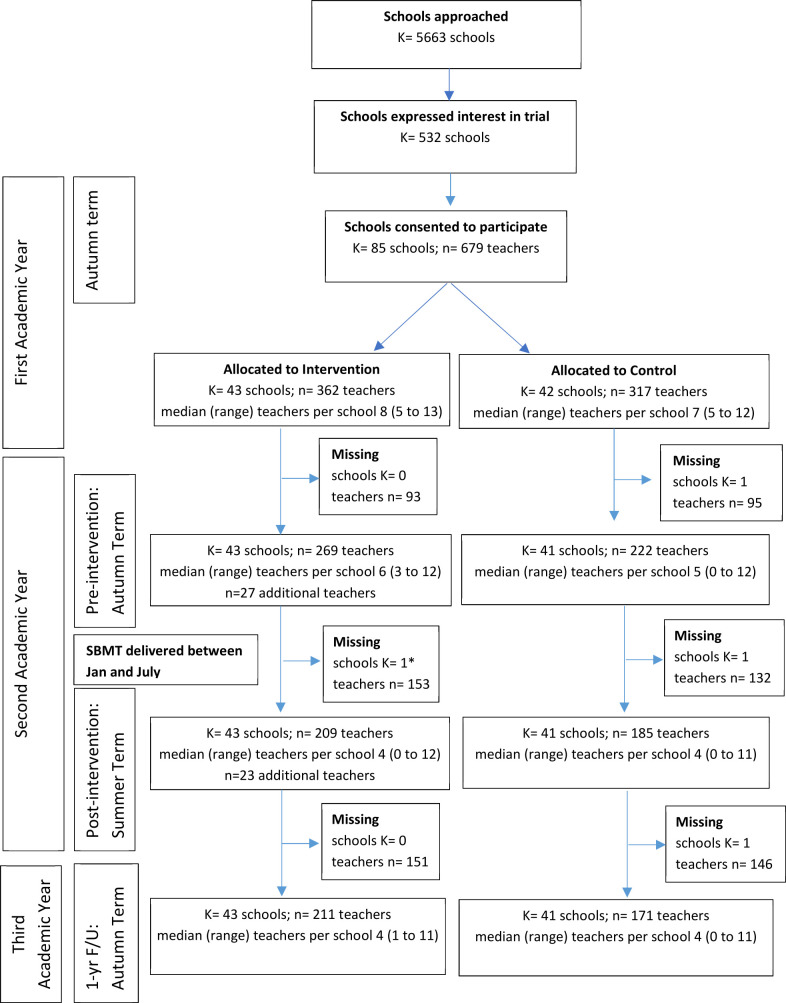
Background: Education is broader than academic teaching. It includes teaching students social–emotional skills both directly and indirectly through a positive school climate. Objective: To evaluate if a universal school-based mindfulness training (SBMT) enhances teacher mental health and school climate. Methods: The My Resilience in Adolescence parallel group, cluster randomised controlled trial (registration: ISRCTN86619085; funding: Wellcome Trust (WT104908/Z/14/Z, WT107496/Z/15/Z)) recruited 85 schools (679 teachers) delivering social and emotional teaching across the UK. Schools (clusters) were randomised 1:1 to either continue this provision (teaching as usual (TAU)) or include universal SBMT. Data on teacher mental health and school climate were collected at prerandomisation, postpersonal mindfulness and SBMT teacher training, after delivering SBMT to students, and at 1-year follow-up. Finding: Schools were recruited in academic years 2016/2017 and 2017/2018. Primary analysis (SBMT: 43 schools/362 teachers; TAU: 41 schools/310 teachers) showed that after delivering SBMT to students, SBMT versus TAU enhanced teachers’ mental health (burnout) and school climate. Adjusted standardised mean differences (SBMT minus TAU) were: exhaustion (−0.22; 95% CI −0.38 to −0.05); personal accomplishment (−0.21; −0.41, −0.02); school leadership (0.24; 0.04, 0.44); and respectful climate (0.26; 0.06, 0.47). Effects on burnout were not significant at 1-year follow-up. Effects on school climate were maintained only for respectful climate. No SBMT-related serious adverse events were reported. Conclusions: SBMT supports short-term changes in teacher burnout and school climate. Further work is required to explore how best to sustain improvements. Clinical implications: SBMT has limited effects on teachers’ mental and school climate. Innovative approaches to support and preserve teachers’ mental health and school climate are needed.
Overview
The claims and statistics of this paper haven’t been checked yet.
Free: it reads the open-access text and checks the first 5 claims that cite a source we can check. Create a free account to check every claim.
Integrity signals
Registry
Cites
Statistics
Figures
Verification
Claims the paper makes
The claims and statistics of this paper haven’t been checked yet.
Free: it reads the open-access text and checks the first 5 claims that cite a source we can check. Create a free account to check every claim.
Claims other papers make about this one
Each is checked against this paper’s own text: does it say what the citing paper says it does?
The cited source says what the claim attributes to it.
In the citing paper
“Importantly, universal prevention programs have potential to improve not only student mental health but also school climate and culture more broadly (Bradshaw et al., 2009; Kuyken et al., 2022) for instance, by increasing prosocial interactions.”
From Positive impacts of a universal trauma-informed intervention on student mental health: The Project POWER trial (2025) · cites this paper as Kuyken et al., 2022
Self-check
Percentages, sums and reported differences re-computed from the paper’s own numbers.
The self-check needs the paper’s full text.
Citations
Cites
Durlak, J. A., Weissberg, R. P., Dymnicki, A. B., Taylor, R. D., & Schellinger, K. B. (2011) · Child Development · doi:10.1111/j.1467-8624.2010.01564.x · Cited by 10,854
Jennings, P. A., & Greenberg, M. T. (2009) · Review of Educational Research · doi:10.3102/0034654308325693 · Cited by 3,686 · cited 2×
“13 This is a report of secondary outcomes of the MYRIAD trial and as such the findings are exploratory and subject to several limitations (eg, the multiple analyses may lead to statistical significance through chance alone).”
BackgroundSelf-citationConsort 2010 statement: extension to cluster randomised trials
Campbell, M. K., Piaggio, G., Elbourne, D. R., Altman, D. G., & for the CONSORT Group (2012) · BMJ · doi:10.1136/bmj.e5661 · Cited by 3,510
Burnout and work engagement among teachers
Hakanen, J. J., Bakker, A. B., & Schaufeli, W. B. (2006) · Journal of School Psychology · doi:10.1016/j.jsp.2005.11.001 · Cited by 3,067
CONSORT statement: extension to cluster randomised trials
Campbell, M. K., Elbourne, D. R., & Altman, D. G. (2004) · BMJ · doi:10.1136/bmj.328.7441.702 · Cited by 2,557 · cited 1×
“20 The study design and procedures are presented in full in the published trial protocol 17 and update describing study enhancements and adaptations.”
MethodA Review of School Climate Research
Thapa, A., Cohen, J., Guffey, S., & Higgins-D’Alessandro, A. (2013) · Review of Educational Research · doi:10.3102/0034654313483907 · Cited by 2,335
School Climate: Research, Policy, Practice, and Teacher Education
Cohen, J., Mccabe, E. M., Michelli, N. M., & Pickeral, T. (2009) · Teachers College Record The Voice of Scholarship in Education · doi:10.1177/016146810911100108 · Cited by 2,049
School Climate: a Review of the Construct, Measurement, and Impact on Student Outcomes
Wang, M.-T., & Degol, J. L. (2016) · Educational Psychology Review · doi:10.1007/s10648-015-9319-1 · Cited by 1,461
Dunning, D. L., Griffiths, K., Kuyken, W., Crane, C., Foulkes, L., Parker, J., & Dalgleish, T. (2019) · Journal of Child Psychology and Psychiatry · doi:10.1111/jcpp.12980 · Cited by 610
Self-citationIntegrated models of school-based prevention: Logic and theory
Domitrovich, C. E., Bradshaw, C. P., Greenberg, M. T., Embry, D., Poduska, J. M., & Ialongo, N. S. (2010) · Psychology in the Schools · doi:10.1002/pits.20452 · Cited by 352
Self-citation
Research works printed but not linked: 3
- Zins J, Elias M, Greenberg M. Facilitating success in school and in life through social and emotional learning. Perspectives in Education 2003; 21: 55– 67.
- Kuyken W, Ball S, Crane C. Effectiveness and cost-effectiveness of a universal school-based mindfulness training programme compared with normal school provision in preventing mental health problems and promoting well-being: results of the Myriad cluster randomised controlled trial. manuscript under review, 2021.
- Segal ZV, Williams JMG, Teasdale JD. Mindfulness-based cognitive therapy for depression. Second edition. New York: Guilford Press, 2013.
Cited by
Kuyken, W., Ball, S., Crane, C., Ganguli, P., Jones, B., Montero-Marin, J., Nuthall, E., Raja, A., Taylor, L., Tudor, K., et al. (2022) · Evidence Based Mental Health · doi:10.1136/ebmental-2021-300396 · Cited by 285
Self-citationMontero-Marin, J., Allwood, M., Ball, S., Crane, C., De Wilde, K., Hinze, V., Jones, B., Lord, L., Nuthall, E., Raja, A., et al. (2022) · Evidence Based Mental Health · doi:10.1136/ebmental-2022-300439 · Cited by 184
Self-citationInterventions to Reduce Stress and Burnout among Teachers: A Scoping Review
Agyapong, B., Brett-MacLean, P., Burback, L., Agyapong, V. I. O., & Wei, Y. (2023) · International Journal of Environmental Research and Public Health · doi:10.3390/ijerph20095625 · Cited by 286
“, 2022 [33] England (UK) (Europe) Cluster RCT Focus: Stress, Burnout”
Montero‐Marín, J., Hinze, V., Crane, C., Dalrymple, N., Kempnich, M., Lord, L., Slaghekke, Y., Tudor, K., Ahmed, S. P., Allwood, M., et al. (2023) · Journal of the American Academy of Child & Adolescent Psychiatry · doi:10.1016/j.jaac.2023.02.016 · Cited by 59
Self-citationWhere Have We Been and Where Are We Going with Mindfulness in Schools?
Weare, K. (2023) · Mindfulness · doi:10.1007/s12671-023-02086-8 · Cited by 37
Tackling the mental-health crisis in young people
Sohn, E. (2022) · Nature · doi:10.1038/d41586-022-02206-9 · Cited by 27
Wang, Q., Abidin, N. E. Z., Aman, M. S., Wang, N., Ma, L., & Liu, P. (2024) · BMC Psychology · doi:10.1186/s40359-024-01584-1 · Cited by 58
Braun, S. S., Greenberg, M. T., Roeser, R. W., Taylor, L. J., Montero‐Marín, J., Crane, C., Williams, J. M. G., Sonley, A., Lord, L., Ford, T. J., et al. (2024) · Journal of School Psychology · doi:10.1016/j.jsp.2024.101288 · Cited by 33
Self-citationStrohmaier, S., & Bailey, N. W. (2023) · Mindfulness · doi:10.1007/s12671-023-02249-7 · Cited by 19
“Indeed, an approach that requires participation should not be implemented, as doing so may worsen students’ mental health (Kuyken et al., 2022a).”
InfluentialMindfulness in education: Critical debates and pragmatic considerations
Lee, W. W. K., McCaw, C. T., & Dam, N. T. V. (2024) · British Educational Research Journal · doi:10.1002/berj.3998 · Cited by 32
Konrad, A. C., Engert, V., Albrecht, R., Dobel, C., Döring, N. M., Haueisen, J., Klimecki, O., Sandbothe, M., & Kanske, P. (2023) · Scientific Reports · doi:10.1038/s41598-023-34737-0 · Cited by 23
Kirby, J. N., Sherwell, C. S., Lynn, S., & Moloney-Gibb, D. (2023) · Journal of Psychologists and Counsellors in Schools · doi:10.1017/jgc.2023.5 · Cited by 14
“The MYRIAD program was conducted in over 100 different schools, with more than 28,000 students, and taught by 650 teachers (Kuyken et al., 2022), and compared to traditional social-emotional learning programs already embedded within the school.”
BackgroundMental health in adolescence: the role of schools-based social emotional teaching
Kuyken, W., Blakemore, S., Byford, S., Dalgleish, T., Ford, T. J., Hinze, V., Mansfield, K. L., Montero‐Marín, J., Ukoumunne, O. C., & Viner, R. (2023) · Journal of Mental Health · doi:10.1080/09638237.2023.2210668 · Cited by 23
Self-citationSumner, A. L., Cartwright, T., Ballieux, H., & Edginton, T. L. (2025) · British Journal of Health Psychology · doi:10.1111/bjhp.12793 · Cited by 17
“The recent MYRIAD trial found some evidence of poorer outcomes in adolescents' well-being and emotional affect in the mindfulness group (Kuyken et al., 2022), consistent with the adult literature (Dobkin et al., 2012; Kerr et al., 2011; Lomas et al., 2015).”
Ormel, J., & VonKorff, M. (2024) · Mental Health & Prevention · doi:10.1016/j.mhp.2024.200320 · Cited by 13
Editorial: Suicide prevention in youth
Berk, M. S. (2022) · Child and Adolescent Mental Health · doi:10.1111/camh.12604 · Cited by 11
Kim, J., Kim, S., Kim, M. W. D., Park, Y.-H., Lee, K., Chung, D. S., Kim, Y. H., Kweon, Y., Moon, D.-S., Lee, H.-Y., et al. (2025) · Behavioral Sciences · doi:10.3390/bs15030315 · Cited by 13
“Kuyken et al. (2022) found that teachers participating in school-based mindfulness training experienced reduced burnout.”
Lin, L.-J., Yu, S.-P., Lin, Y., & Chen, Y. (2024) · Behavioral Sciences · doi:10.3390/bs14110980 · Cited by 7
Nizri, H., Hemi, A., & Levy‐Gigi, E. (2024) · Scientific Reports · doi:10.1038/s41598-024-62150-8 · Cited by 12
“For instance, it was found that using mindfulness has effectively enhanced teacher well-being, improved the school climate, and supported short-term reductions in teacher burnout 62 .”
BackgroundHeredia, L., Ventura, D., Torrente, M., & Vicens, P. (2024) · Mind Brain and Education · doi:10.1111/mbe.12419 · Cited by 9
Matiz, A., Pascut, S., Fabbro, F., & Crescentini, C. (2025) · Mindfulness · doi:10.1007/s12671-025-02573-0 · Cited by 7
“This result supports the findings of that part of the literature which found a significant impact of MBIs on teachers’ self-efficacy (de Carvalho et al., 2021; Jennings et al., 2013; Kuyken et al., 2022; Poulin et al., 2008).”
Abbott, P., D’Ambruoso, L., Yared, M., McNamee, P., Hailu, T., & Nzabalirwa, W. (2023) · medRxiv · doi:10.1101/2023.05.10.23289769 · Cited by 9
“…more evidence on the efficacy of SBMIs in LICs in SSA, the project will investigate the impact of a culturally-appropriate SBMI on the mental wellbeing of CAs in Ethiopia and Rwanda using a CR approach to determine what makes the programmes work, how, where, with whom and to what extent (69–71).”
Mendelson, T., Clary, L. K., Musci, R. J., Sheridan, S., Webb, L., Sibinga, E., Mmari, K., Welna, A., & Ialongo, N. (2025) · Journal of School Psychology · doi:10.1016/j.jsp.2025.101469 · Cited by 3
Игоревна, К. О. (2024) · Человеческий капитал. · doi:10.25629/hc.2024.01.14 · Cited by 3
Lori, Á., Padilla-Muñoz, E. M., Cano‐García, F. J., & Raffone, A. (2025) · Journal of Research in Childhood Education · doi:10.1080/02568543.2025.2470803 · Cited by 2
“…healthier habits and a more livable classroom climate, mindfulness practice interventions described in the literature in recent years have generally yielded positive results among non-clinical populations of young people (Dicarlo et al., 2020; Kuyken et al., 2022; Monsillion et al., 2023).”
Volanen, S., Holopainen, M., Lahti, J. M. T., Vahlberg, T., & Hintsanen, M. (2025) · Psychology in the Schools · doi:10.1002/pits.70112 · Cited by 2
“…RCT to date — the My Resilience in Adolescence (MYRIAD) project — observed no significant effects of MBIs on several mental health and well ‐ being outcomes, including depressive symptoms, socio ‐ emotional and behavioural functioning, well ‐ being, anxiety, and mindfulness (Kuyken et al. 2022a).”
InfluentialKhanal, M. K., Saunders, P., Nguyen, K., Hatmi, M. A., Asiri, H. M. A., Shahin, W., Millar, R., Karimi, L., & de Courten, B. V. (2026) · Health Psychology Review · doi:10.1080/17437199.2026.2652892 · Cited by 4
The Toolbox Approach: Towards a Novel Flexible Way of Implementing and Testing Positive Education
Lucciarini, E., & Boniwell, I. (2023) · Springer eBooks · doi:10.1007/978-981-99-5609-8_8 · Cited by 2
Weghaupt, D. (2024) · Verlag Julius Klinkhardt eBooks · doi:10.35468/6073-08 · Cited by 1
El rol de las emociones en el proceso de aprendizaje: una mirada desde la educación socioemocional
Palma, M. M. D., Delgado, K. M. P., Posligua-Burgos, K. J., & Holguín, S. T. P. (2025) · Pedagogical Constellation · doi:10.69821/constellations.v4i1.93 · Cited by 8
Mindfulness for the Mental Health of Working Women: How Effective Is It and What Are the Challenges?
Hapsari, R. K. M. (2025) · Indigenous Jurnal Ilmiah Psikologi · doi:10.23917/indigenous.v10i1.11733 · Cited by 3
Delavari, H., Talebi, M. E., & Delavari, H. (2023) · English Education Journal · doi:10.24815/eej.v14i2.31992 · Cited by 10
“can provide ongoing professional development opportunities for current teachers, such as workshops and seminars, to help them learn about, implement mindfulness, and practice meditation in their classrooms (Juul et al., 2021; Kuyken et al., 2022).”
Magalhães, S., Carvalheiras, C., Ribeiro, C., Francisco, C., Mourisco, C., Leal, T., & Limpo, T. (2024) · Education Sciences · doi:10.3390/educsci14111155 · Cited by 2
Arnaud, N., Fritsch, N., & Thomasius, R. (2024) · Praxis der Kinderpsychologie und Kinderpsychiatrie · doi:10.13109/prkk.2024.73.7.627 · Cited by 1
Anderson, D., Chapman, J., Domingues, J., Bobadilla, G., Corcoran, M., & Koplewicz, H. S. (2025) · PLoS ONE · doi:10.1371/journal.pone.0305450 · Cited by 2
“More narrowly focused studies of mental health prevention programs teaching a specific skill such as mindfulness have demonstrated promise [53], but findings are mixed [54].”
Dolev, N., & Levi, Y. (2025) · Frontiers in Education · doi:10.3389/feduc.2025.1591987 · Cited by 4
Yan, Z., Wang, L., Chen, B., & Guo, J. (2026) · Work · doi:10.1177/10519815261435990 · Cited by 1
Mindfulness training in schools does not improve children’s mental health
Wilkinson, E. (2022) · BMJ · doi:10.1136/bmj.o1819 · Cited by 1
Persönlichkeitsbildung in Zeiten von Digitalisierung
:null (2024) · Verlag Julius Klinkhardt eBooks · doi:10.35468/6073 · Cited by 1
SEYREK, Ö. D., Genç, A., & Ersanlı, E. (2025) · Psychology in the Schools · doi:10.1002/pits.23440 · Cited by 2
“…levels of mindfulness among educators mitigate fatigue, anxiety, stress, and burnout, thereby positively affecting self ‐ efficacy (Regehr et al. 2013; Harnett et al. 2016; Dave et al. 2020; Emerson et al. 2017; Carroll et al. 2022; Hidajat et al. 2023; Kuyken et al. 2022; Moyano et al. 2023).”
Layard, R., & Neve, J.-E. D. (2023) · Cambridge University Press eBooks · doi:10.1017/9781009298957.026
Group acceptance and commitment therapy for promoting mental health in schools: a feasibility study.
Tang, J. Y. M., Xu, J.-Q., & Wang, Q. (2025) · East Asian Archives of Psychiatry · doi:10.12809/eaap2546
Nejad, A. M., & Mahfoodh, O. H. A. (2024) · Psychology in the Schools · doi:10.1002/pits.23151 · Cited by 1
Mindfulness in Teaching and Education
Lo, H. H. M. (2024) · Mindfulness in behavioral health · doi:10.1007/978-3-031-51943-7_8
Anderson, D., Chapman, J., Domingues, J., Bobadilla, G., Corcoran, M., & Koplewicz, H. S. (2024) · medRxiv · doi:10.1101/2024.06.01.24308320
Williamson, V., Larkin, M., Reardon, T. C., Stallard, P. N., Spence, S. H., Macdonald, I., Ukoumunne, O. C., Ford, T. J., Violato, M., Sniehotta, F. F., et al. (2025) · BMJ Open · doi:10.1136/bmjopen-2023-082691
“…show promise for some child outcomes, 8 there are indicators that when those interventions are intended to improve mental health specifically 9 —rather than to improve indirect factors, such as health literacy, 10 help-seeking 11 or resilience 12 —a more targeted approach is likely to be…”
Self-citationGilligan, T. D., & Kielty, M. L. (2025) · Frontiers The Interdisciplinary Journal of Study Abroad · doi:10.36366/frontiers.v37i2.912
Achtsamkeit in Lehre und Bildung
Lo, H. H. M. (2025) · Springer eBooks · doi:10.1007/978-3-031-83285-7_8
Tran, D. M. (2025) · Innovations in Pedagogy and Technology · doi:10.63385/ipt.v1i2.97 · Cited by 1
Barratt, C. C. (2025) · Frontiers in Education · doi:10.3389/feduc.2025.1613780 · Cited by 2
Axelsen, H. L., Müller, A. G., Fjorback, L. O., Gøtzsche, K., Nielsen, H. B., & Juul, L. (2025) · Social Science & Medicine · doi:10.1016/j.socscimed.2025.118814 · Cited by 1
The impact of social-emotional learning interventions on teacher well-being: a meta-analysis
Dou, D., Chen, Y., Zhu, X., Wu, X., Lei, L. S. M., & Shi, J. (2026) · BMC Psychology · doi:10.1186/s40359-026-05053-9
Duc, T. M. (2026) · London Journal of Research In Humanities and Social Sciences · doi:10.34257/ljrhss228434uk
Mindfulness and Educators’ Mental Health and Well-Being: Outcomes of a Two-Year Study
Jónsdóttir, B. J., Stefánsson, K. K., Kaldalóns, I. V., Frostadottir, A. D., & Jónsson, Ó. P. (2026) · School Mental Health · doi:10.1007/s12310-026-09914-x
Frederiksen, M. R., Støy, K., & Matarić, M. J. (2026) · Frontiers in Robotics and AI · doi:10.3389/frobt.2026.1810778 · Cited by 1
“Building upon these somatic foundations, recent adaptations of Mindfulness-Based Cognitive Therapy (MBCT) have pivoted toward targeting emotional regulation directly Chambers et al. (2009), Gross (1998), Kuyken et al. (2022).”
Uçuş, Ş. (2026) · Learning and Instruction · doi:10.1016/j.learninstruc.2026.102481
Metadata
- Authors
- Kuyken, W., Ball, S., Crane, C., Ganguli, P., Jones, B., Montero-Marin, J., Nuthall, E., Raja, A., Taylor, L., Tudor, K., Viner, R. M., Allwood, M., Aukland, L., Dunning, D., Casey, T., Dalrymple, N., De Wilde, K., Farley, E.-R., Harper, J., Hinze, V., Kappelmann, N., Kempnich, M., Lord, L., Medlicott, E., Palmer, L., Petit, A., Philips, A., Pryor-Nitsch, I., Radley, L., Sonley, A., Shackleford, J., Tickell, A., Team, M., Blakemore, S.-J., Ukoumunne, O. C., Greenberg, M. T., Ford, T., Dalgleish, T., Byford, S., & Williams, J. M. G.
- Affiliations
- Warneford Hospital (GB)
- University of Exeter (GB)
- King's College London (GB)
- NIHR Applied Research Collaboration Southwest Peninsula (PenARC), University of Exeter, Exeter, Devon, UK
- Department of Psychiatry, Warneford Hospital, University of Oxford, Oxford, UK
- University College London (GB)
- MRC Cognition and Brain Sciences Unit (GB)
- University of Cambridge (GB)
- Pennsylvania State University (US)
- Corresponding author
- Kuyken, Willem
- ORCID
- Kuyken, Willem
- Ball, Susan
- Crane, Catherine
- Ganguli, Poushali
- Montero-Marin, Jesus
- Nuthall, Elizabeth
- Raja, Anam
- Taylor, Laura
- Tudor, Kate
- Viner, Russell M
- Aukland, Louise
- Dunning, Darren
- Casey, Tríona
- Dalrymple, Nicola
- Farley, Eleanor-Rose
- Hinze, Verena
- Kappelmann, Nils
- Kempnich, Maria
- Lord, Liz
- Medlicott, Emma
- Palmer, Lucy
- Pryor-Nitsch, Isobel
- Radley, Lucy
- Sonley, Anna
- Tickell, Alice
- Blakemore, Sarah-Jayne
- Ukoumunne, Obioha C
- Greenberg, Mark T
- Ford, Tamsin
- Dalgleish, Tim
- Byford, Sarah
- Williams, J Mark G
- Venue
- Evidence Based Mental Health
- Publisher
- BMJ
- Published
- 2022-07-12
- Volume
- 25
- Issue
- 3
- Pages
- 125-134
- ISSN
- 1362-0347 (ISSN-L)
- 1468-960X
- PMC
- PMC9340006
- OpenAlex
- W4285091877
- Cited by
- 56
- References
- 26
- Citations by year
- 2026: 7 · 2025: 18 · 2024: 15 · 2023: 11 · 2022: 5
- FWCI
- 11.17
- Type
- journal article
- Language
- en
- Open access
- hybrid
- doi.org
- Locations
- Evidence-Based Mental Health (publishedVersion, cc-by)
- PubMed Central (publishedVersion, cc-by)
- PubMed (publishedVersion)
- White Rose Research Online (University of Leeds, The University of Sheffield, University of York) (acceptedVersion, cc-by)
- UCL Discovery (University College London) (submittedVersion)
- Figshare (submittedVersion, cc-by)
- Minerva Access (University of Melbourne) (submittedVersion, cc-by)
- Open Research Exeter (University of Exeter) (submittedVersion, cc-by)
- Apollo (University of Cambridge) (submittedVersion, cc-by)
- Apollo
- Funders
- Wellcome Trust (WT104908/Z/14/Z, WT107496/Z/15/Z)
- Topics
- Social Sciences › Psychology › Clinical Psychology › Mindfulness and Compassion Interventions
- Health Sciences › Medicine › Public Health, Environmental and Occupational Health › Occupational Health and Burnout
- Health Sciences › Medicine › Public Health, Environmental and Occupational Health › School Health and Nursing Education
- Keywords
- teacher mental health, teacher burnout, school climate, socioemotional skills, teacher professional development, school leadership
About these checks
Registry, retraction, Cites and statistics results are computed, not judged, with one exception: a printed reference that no index lists is read once by a model before it counts as a citation error. Claims are extracted by a model and kept only when their quote appears verbatim in the text; each cited source is then checked, with a model’s help, for whether it says what the claim relies on. Those verdicts can be wrong — read the claim’s quote and the cited source before relying on one.
Statistics and arithmetic are recomputed, not judged.
Confidence bands are shown only for fields calibrated on our annotated test set. None is calibrated yet, so no band is shown.
What counts as a claim ›How we measure confidence ›How we check this ›
Are you an author, or do you see a problem with this page? Request a review
Data sources
Bibliographic data: Semantic Scholar, OpenAlex, Crossref.
Contains information from the Semantic Scholar Academic Graph Datasets, made available under the ODC Attribution License (ODC-BY 1.0).
Semantic Scholar’s data is described in: Kinney, R., et al. (2023). The Semantic Scholar Open Data Platform. arXiv:2301.10140.
