

The British Society of Gastroenterology/UK-PBC primary biliary cholangitis treatment and management guidelines
Open accessThe DOI matches its Crossref record; 306 of the 314 references it cites were found in a registry or an index; 93 of the 282 sources its claims cite were checked for support.
Abstract
BSG/UK-PBC treatment and management guidelines for PBC.
Overview
CoChat Summary
TL;DR
This BSG/UK-PBC guideline provides 40 recommendations for diagnosing and managing primary biliary cholangitis, centred on UDCA 13–15 mg/kg/day first-line, OCA for inadequate response or intolerance, and life-long risk-stratified follow-up. It also covers symptom control, complications of advanced liver disease, special populations, and audit standards.
Key findings
- UDCA is recommended for all patients with PBC at 13–15 mg/kg/day, usually life-long if tolerated; a combined analysis of three trials (548 patients) showed a one-third reduction in risk of death or transplant for moderate to severe PBC, with survival free of liver transplantation improved in medium- and high-risk bilirubin groups and histological stage IV.
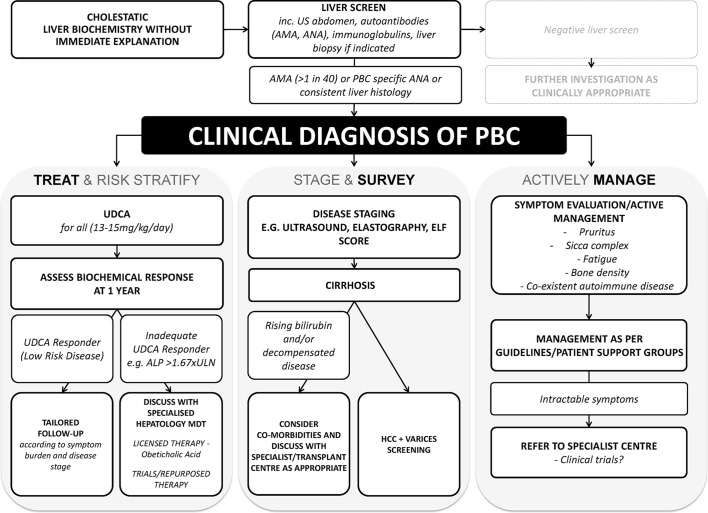
- In patients with inadequate response to UDCA or UDCA intolerance, defined as ALP >1.67 × ULN and/or elevated bilirubin <2 × ULN, OCA addition is recommended for consideration; in the phase III trial, biochemical response was 10% with placebo vs 47% with 10 mg OCA and 46% with 5–10 mg titrated OCA, and mean ALP decrease was 39% and 33% vs 5%, respectively.
- Risk stratification after 1 year of UDCA should use biochemical response indices; high-risk patients are those with ALP >1.67 × ULN and/or elevated bilirubin <2 × ULN, while low-risk patients are those without cirrhosis with ALP <1.67 × ULN and normal bilirubin.
- Symptom burden is common and does not correlate with disease stage: pruritus affects approximately 80% of patients at some time, fatigue is reported by over 50% and severe in 20%, osteoporosis affects 20–44%, and approximately one-third of patients with advanced disease develop oesophageal varices over a median of 5.6 years.
Methods
- This is a clinical practice guideline developed as a consensus document by the British Society of Gastroenterology Liver Section and UK-PBC, with a broad Guidelines Development Group including gastroenterologists, hepatologists, transplant physicians, liver pathologists, and patient representatives.
- Development used a systematic review of publications identified via PubMed, Medline, and Cochrane database searches completed in June 2017, in line with the AGREE II instrument; recommendations use the GRADE system (Strong/Weak; quality High/Moderate/Low/Very low).
- The guideline provides 40 recommendations and service standards/audit recommendations, covering diagnosis, drug therapy, symptom management, advanced liver disease, transplantation, pregnancy, overlap syndromes, familial screening, and patient support.
Limitations
- The paper states that there is no consensus on the optimal non-invasive strategy to stage and monitor disease progression, and insufficient evidence to recommend one risk score over another on the basis of head-to-head data.
- The paper states that OCA survival benefit has not yet been demonstrated, longer-term efficacy and generalisability need confirmation, and more experience is needed in patients with advanced liver disease; the pivotal trial included patients with cirrhosis but no patients with decompensation.
- The paper states that evidence for UDCA in pregnancy is limited, off-label therapies such as budesonide and fibrates are not recommended pending phase III trials, and many recommendations are graded Weak or based on Low/Very low quality evidence.
- Evident from the text: several recommendations rely on expert opinion or limited case-series data, and patients with PBC were not well represented in some cited studies, such as the Baveno VI varices studies.
Model-written summary. Check it against the paper before relying on it.
Integrity signals
Registry
Cites
Statistics
Figures
Verification
Claims the paper makes
58 Valid · 6 Not valid · 89 Not checked · 33 Own results and interpretations
At least one cited source doesn’t support this claim or points to a different paper, and none confirmed it — see the verdicts below.
In the paper
“Data from the UK-PBC patient cohort have shown that there is significant variation in management between centres and individual clinicians.12”
§ The British Society of Gastroenterology/UK-PBC primary biliary cholangitis treatment and management guidelines > Recommendation 19 > Symptom management
What the sources say
- Disputedcites [12] Carbone M, Mells GF, Pells G, et al Sex and age are determinants of the clinical phenotype of primary biliary cirrhosis and response to ursodeoxycholic acid. Gastroenterology 2013; 144: 560– 9. 10.1053/j.gastro.2012.12.005 23246637 sourceExperimental — accuracy not yet measured
The Results (page unavailable) report no significant difference in UDCA use between specialist and nonspecialist centres (81% versus 80%) and similar response rates. The Discussion likewise says patients in the two settings were equally likely to receive UDCA. The paper does not assess variation between individual clinicians. (LLM, conf=0.88)
Checked by a reasoning model — may be wrong.
plain- Asserted: passes — The authors put it forward as true.
- Checkable: passes — It can be checked against evidence.
- Load-bearing: passes — The paper’s conclusions depend on it.
- Based: passes — The paper gives a reason why it holds.
- Disputed
At least one cited source doesn’t support this claim or points to a different paper, and none confirmed it — see the verdicts below.
In the paper
“The majority of these patients will be positive for the PBC-specific nuclear antibodies.265”
§ The British Society of Gastroenterology/UK-PBC primary biliary cholangitis treatment and management guidelines > Recommendation 32 > Management of special populations
What the sources say
- Disputedcites [265] Bizzaro N, Covini G, Rosina F, et al Overcoming a "probable" diagnosis in antimitochondrial antibody negative primary biliary cirrhosis: study of 100 sera and review of the literature. Clin Rev Allergy Immunol 2012; 42: 288– 97. 10.1007/s12016-010-8234-y 21188646 sourceExperimental — accuracy not yet measured
The indexed study summary (no page supplied) reports that 43 of 100 AMA-negative PBC sera reacted to a screening test that included both nuclear and mitochondrial antigens. Its antigen-specific results show PBC-specific nuclear-antibody reactivity in 32 of 100 sera, not a majority. (LLM, conf=0.88)
Checked by a reasoning model — may be wrong.
plainstates an association- Asserted: passes — The authors put it forward as true.
- Checkable: passes — It can be checked against evidence.
- Load-bearing: passes — The paper’s conclusions depend on it.
- Based: passes — The paper gives a reason why it holds.
- Disputed
The cited sources support only part of this claim — read each source’s verdict below.
In the paper
“PBC is characterised serologically by autoantibodies specific for mitochondrial, nuclear and centromere antigens, some of which are unique to PBC.66–78”
§ The British Society of Gastroenterology/UK-PBC primary biliary cholangitis treatment and management guidelines > How is PBC diagnosed? > Blood tests
What the sources say
- Not checked — no full text of the sourcecites [66] Marzorati S, Invernizzi P, Lleo A Making sense of autoantibodies in cholestatic liver diseases. Clin Liver Dis 2016; 20: 33– 46. 10.1016/j.cld.2015.08.003 26593289 source
- Not checked — no full text of the sourcecites [67] Walker JG, Doniach D, Roitt IM, et al Serological tests in diagnosis of primary biliary cirrhosis. Lancet 1965; 1: 827– 31. 10.1016/S0140-6736(65)91372-3 14263538 source
- Not checked — no full text of the sourcecites [68] Doniach D, Roitt IM, Walker JG, et al Tissue antibodies in primary biliary cirrhosis, active chronic (lupoid) hepatitis, cryptogenic cirrhosis and other liver diseases and their clinical implications. Clin Exp Immunol 1966; 1: 237– 62. 5330183 PMC1579190
- Partly supportedcites [69] Berg PA, Doniach D, Roitt IM Mitochondrial antibodies in primary biliary cirrhosis. I. Localization of the antigen to mitochondrial membranes. J Exp Med 1967; 126: 277– 90. 10.1084/jem.126.2.277 4165742 PMC2138313 sourceExperimental — accuracy not yet measured
The introduction (p. 277) reports that PBC sera contain antibodies directed against mitochondrial membranes, supporting the mitochondrial part of the sentence. This paper does not establish antibodies to nuclear or centromere antigens or identify any antibodies as unique to PBC; its Methods (p. 277) say the studied sera were selected for absence of antinuclear reactions. (LLM, conf=0.88)
- Not checked — no full text of the sourcecites [70] Ruffatti A, Arslan P, Floreani A, et al Nuclear membrane-staining antinuclear antibody in patients with primary biliary cirrhosis. J Clin Immunol 1985; 5: 357– 61. 10.1007/BF00918255 2414313 source
- Not checked — no full text of the sourcecites [71] Lozano F, Parés A, Borche L, et al Autoantibodies against nuclear envelope-associated proteins in primary biliary cirrhosis. Hepatology 1988; 8: 930– 8. 10.1002/hep.1840080438 3292364 source
- Supportedcites [72] Lassoued K, Brenard R, Degos F, et al Antinuclear antibodies directed to a 200-kilodalton polypeptide of the nuclear envelope in primary biliary cirrhosis. A clinical and immunological study of a series of 150 patients with primary biliary cirrhosis. Gastroenterology 1990; 99: 181– 6. 2188869 source
The Introduction/Abstract (p.1) states the serological background the claim summarises: antimitochondrial antibodies in 83%-99% of patients with the M2 type 'closely associated with PBC', ANA in 24%-31% (38%-58% on Hep2), with five recognised patterns including centromere; the Immunological Results section reports anticentromere antibodies in their series (Table 4, Discussion: 7%). The 'unique to PBC' part is supported by the Discussion, which says antibodies to the 200-kDa nuclear-envelope polypeptide 'could be considered specific for PBC' and concludes on 'this specific marker of PBC'. This is a broad background sentence carried by a citation range (66-78), and our copy treats the topic accordingly. (LLM, conf=0.85)
- Not checked — no full text of the sourcecites [73] Nickowitz RE, Wozniak RW, Schaffner F, et al Autoantibodies against integral membrane proteins of the nuclear envelope in patients with primary biliary cirrhosis. Gastroenterology 1994; 106: 193– 9. 10.1016/S0016-5085(94)95333-3 8276182 source
- Not checked — no full text of the sourcecites [74] Fussey SP, Guest JR, James OF, et al Identification and analysis of the major M2 autoantigens in primary biliary cirrhosis. Proc Natl Acad Sci U S A 1988; 85: 8654– 8. 10.1073/pnas.85.22.8654 3186751 PMC282518 source
- Partly supportedcites [75] Moteki S, Leung PS, Coppel RL, et al Use of a designer triple expression hybrid clone for three different lipoyl domain for the detection of antimitochondrial autoantibodies. Hepatology 1996; 24: 97– 103. 10.1002/hep.510240117 8707289 sourceExperimental — accuracy not yet measured
Our copy of Moteki et al. (1996) supports only the mitochondrial half of the sentence: the Abstract states that 'a characteristic serological feature observed in sera from patients with PBC is the presence of high titers of autoantibodies directed against mitochondrial antigens (AMAs),' targeting the E2 components of PDC, BCOADC and OGDC, and Table 1 plus the Results show this reactivity is specific to PBC (0/135 controls across PSC, CAH, SLE and healthy volunteers), which covers 'some of which are unique to PBC.' Nothing in our copy addresses nuclear or centromere autoantibodies — searches for 'centromere', 'antinuclear/nuclear autoantibodies', 'sp100/gp210' returned only mitochondrial antigen material, and the Introduction explicitly notes 'two other PBC autoantigens are not contained in the construct' (protein X, E1a), not nuclear targets. The nuclear and centromere components of the citing sentence therefore rest on the other references in the 66–78 range, not on this source. (LLM, conf=0.80)
plainstates an association- Asserted: passes — The authors put it forward as true.
- Checkable: passes — It can be checked against evidence.
- Load-bearing: passes — The paper’s conclusions depend on it.
- Based: passes — The paper gives a reason why it holds.
The cited sources support only part of this claim — read each source’s verdict below.
In the paper
“Patients with PBC typically have an increased incidence, in both themselves and their families, of other autoimmune diseases (over half of patients with PBC have another autoimmune condition), reflecting shared genetic predisposition (most notably but not exclusively celiac disease, scleroderma, thyroid disease and Sjögren’s).37–43”
§ The British Society of Gastroenterology/UK-PBC primary biliary cholangitis treatment and management guidelines > Background > Epidemiology
What the sources say
- Not checked — no full text of the sourcecites [37] Jones DE, Watt FE, Metcalf JV, et al Familial primary biliary cirrhosis reassessed: a geographically-based population study. J Hepatol 1999; 30: 402– 7. 10.1016/S0168-8278(99)80097-X 10190721 source
- Not checked — no full text of the sourcecites [38] Watt FE, James OFW, Jones DEJ Patterns of autoimmunity in PBC patients and their families. QJM 2004; 97: 397– 406. 15208427 source
- Not checked — no full text of the sourcecites [39] Parikh-Patel A, Gold EB, Worman H, et al Risk factors for primary biliary cirrhosis in a cohort of patients from the United States. Hepatology 2001; 33: 16– 21. 10.1053/jhep.2001.21165 11124815 source
- Partly supportedcites [40] Gershwin ME, Selmi C, Worman HJ, et al Risk factors and comorbidities in primary biliary cirrhosis: a controlled interview-based study of 1032 patients. Hepatology 2005; 42: 1194– 202. 10.1002/hep.20907 16250040 PMC3150736 sourceExperimental — accuracy not yet measured
The Discussion reports more autoimmune comorbidity in patients with PBC than in controls, and the Family History section reports increased rates of several autoimmune diseases among relatives. But the Discussion gives the rate in patients as 32%, not over half. It treats genetic predisposition as a hypothesis and does not establish the sentence’s reference to celiac disease. (LLM, conf=0.91)
- Could not verifycites [41] Lazaridis KN, Juran BD, Boe GM, et al Increased prevalence of antimitochondrial antibodies in first-degree relatives of patients with primary biliary cirrhosis. Hepatology 2007; 46: 785– 92. 10.1002/hep.21749 17680647 sourceExperimental — accuracy not yet measured
The Abstract discusses genetic susceptibility to PBC and says about 50% of patients have no symptoms—not that they have another autoimmune condition. The Discussion and familial-history section address PBC risk and antimitochondrial antibodies in relatives, but do not establish increased rates of other autoimmune diseases in patients or their families. Searches for the named autoimmune diseases and the claimed proportion found no supporting passage. (LLM, conf=0.76)
- Not checked — no full text of the sourcecites [42] Prince MI, Ducker SJ, James OF Case-control studies of risk factors for primary biliary cirrhosis in two United Kingdom populations. Gut 2010; 59: 508– 512. 10.1136/gut.2009.184218 20332522 source
- Not checked — no full text of the sourcecites [43] Corpechot C, Chrétien Y, Chazouillères O, et al Demographic, lifestyle, medical and familial factors associated with primary biliary cirrhosis. J Hepatol 2010; 53: 162– 9. 10.1016/j.jhep.2010.02.019 20471130 source
plainstates an association- Asserted: passes — The authors put it forward as true.
- Checkable: passes — It can be checked against evidence.
- Load-bearing: unclear — It is unclear whether the paper’s conclusions depend on it.
- Based: passes — The paper gives a reason why it holds.
Every source the paper cites for this claim was checked and supports it.
In the paper
“Both enhanced liver fibrosis (ELF)105 and transient elastography (TE)106 107 (eg, FibroScan) have, in cross-sectional studies, shown accuracy in determining disease stage as confirmed by biopsy.”
§ The British Society of Gastroenterology/UK-PBC primary biliary cholangitis treatment and management guidelines > Recommendation 3 > Role of liver biopsy and other staging investigations
What the sources say
- Supportedcites [105] Mayo MJ, Parkes J, Adams-Huet B, et al Prediction of clinical outcomes in primary biliary cirrhosis by serum enhanced liver fibrosis assay. Hepatology 2008; 48: 1549– 57. 10.1002/hep.22517 18846542 PMC2597274 source
This source is cited for the ELF portion of the sentence; separate citations accompany transient elastography. In the Results (‘Correlation of ELF with histology’), ELF scores correlated with biopsy staging, and the authors report that ELF was an accurate non-invasive marker of histological fibrosis. They also note overlap in scores at intermediate stages. (LLM, conf=0.92)
- Supportedcites [106] Corpechot C, El Naggar A, Poujol-Robert A, et al Assessment of biliary fibrosis by transient elastography in patients with PBC and PSC. Hepatology 2006; 43: 1118– 24. 10.1002/hep.21151 16628644 source
The citation to this paper supports the transient elastography (TE) portion of the sentence; ELF has a separate citation. The Discussion reports accurate prediction of biopsy-assessed fibrosis stage in patients with PBC or PSC, and the Liver Histology section describes how biopsy stages were determined. Page numbers were not supplied in our copy. (LLM, conf=0.93)
- Supportedcites [107] Corpechot C, Carrat F, Poujol-Robert A, et al Noninvasive elastography-based assessment of liver fibrosis progression and prognosis in primary biliary cirrhosis. Hepatology 2012; 56: 198– 208. 10.1002/hep.25599 22271046 source
The citation to this paper is attached to transient elastography (TE), not ELF. In Patient Populations and Liver Histological Assessment (page unavailable), the diagnostic cohort underwent both TE and liver biopsy; Diagnostic Performance reports that TE correctly classified 74% of patients by histological fibrosis stage, with strongest performance for severe fibrosis and cirrhosis. (LLM, conf=0.92)
plainstates an association- Asserted: passes — The authors put it forward as true.
- Checkable: passes — It can be checked against evidence.
- Load-bearing: passes — The paper’s conclusions depend on it.
- Based: passes — The paper gives a reason why it holds.
- Supported
70 more claims · 19 with their cited sources checked
Create a free account to see all 186 claims and to verify the 36 references still open.
- It may state two separate claims as one. 80
- Probably not a substantial claim. 44
Claims other papers make about this one
Each is checked against this paper’s own text: does it say what the citing paper says it does?
The source backs part of the claim, not all of it — or backs it for a different population, condition or comparison.
In the citing paper
“Gene variants in HLA or IL-12 signaling have been associated with PBC, and most patients display autoreactive antibodies against mitochondrial antigens and subsequent failure of biliary transporters, e.g., anion exchange protein 2 (AE2) [177–179].”
From Inflammation and immunity in liver homeostasis and disease: a nexus of hepatocytes, nonparenchymal cells and immune cells (2025) · doi:10.1038/s41423-025-01313-7 · cites this paper as [177]
Experimental — accuracy not yet measuredIn the citing paper
“PBC is an autoimmune disease that primarily involves the targeting of intrahepatic BECs and results in chronic liver inflammation and fibrosis, in which hepatocyte injury is secondary and only manifests in later stages due to increased inflammation and cholestasis leading to oxidative stress [177].”
From Inflammation and immunity in liver homeostasis and disease: a nexus of hepatocytes, nonparenchymal cells and immune cells (2025) · doi:10.1038/s41423-025-01313-7 · cites this paper as [177]
In the citing paper
“Instead, ursodeoxycholic acid (UDCA), a hydrophilic bile acid, is used as a first-line therapy for PBC to reduce bile acid toxicity and, thus, liver inflammation and hepatocyte injury [177].”
From Inflammation and immunity in liver homeostasis and disease: a nexus of hepatocytes, nonparenchymal cells and immune cells (2025) · doi:10.1038/s41423-025-01313-7 · cites this paper as [177]
In the citing paper
“The available treatments for PBC patients are limited to ursodeoxycholic acid (UDCA) and the recently licenced obeticholic acid (OCA) as a second-line approach17,18.”
From Cholestasis induced by bile duct ligation promotes changes in the intestinal microbiome in mice (2019) · cites this paper as [17]
Citations
Cites
EASL Clinical Practice Guidelines: Management of hepatocellular carcinoma
Galle, P. R., Forner, A., Llovet, J. M., Mazzaferro, V., Piscaglia, F., Raoul, J.-L., Schirmacher, P., & Vilgrain, V. (2018) · Journal of Hepatology · doi:10.1016/j.jhep.2018.03.019 · Cited by 11,406
Management of Hepatocellular Carcinoma: An Update Δσ
Bruix, J., & Sherman, M. (2011) · Hepatology · doi:10.1002/hep.24199 · Cited by 8,103
EASL–EORTC Clinical Practice Guidelines: Management of hepatocellular carcinoma
European Association for the Study of the Liver, & European Organisation for Research and Treatment of Cancer (2012) · Journal of Hepatology · doi:10.1016/j.jhep.2011.12.001 · Cited by 5,218
A Model to Predict Survival in Patients With End–Stage Liver Disease
Kamath, P. S., Wiesner, R. H., Malinchoc, M., Kremers, W., Therneau, T. M., Kosberg, C. L., D'Amico, G., Dickson, R. E., & Kim, R. W. (2001) · Hepatology · doi:10.1053/jhep.2001.22172 · Cited by 4,975
Hematological Problems in Pediatric Intensive Care
Revel-Vilk, S., Cox, P., Robitaille, N., & Blanchette, V. (2014) · Pediatric and Adolescent Medicine · doi:10.1159/000350346 · Cited by 3,508
Expanding consensus in portal hypertension
de Franchis, R. (2015) · Journal of Hepatology · doi:10.1016/j.jhep.2015.05.022 · Cited by 3,078
Malinchoc, M., Kamath, P. S., Gordon, F. D., Peine, C. J., Rank, J., & ter Borg, P. C. J. (2000) · Hepatology · doi:10.1053/he.2000.5852 · Cited by 2,893
Rockey, D. C., Caldwell, S. H., Goodman, Z. D., Nelson, R. C., & Smith, A. D. (2009) · Hepatology · doi:10.1002/hep.22742 · Cited by 1,997
(2015) · Journal of Hepatology · doi:10.1016/j.jhep.2015.04.006 · Cited by 1,875
EASL Clinical Practice Guidelines: management of cholestatic liver diseases
European Association for the Study of the Liver (2009) · Journal of Hepatology · doi:10.1016/j.jhep.2009.04.009 · Cited by 1,729
Research works printed but not linked: 4
- National Institute for Health and Care Excellence (NICE). Cirrhosis in over 16s: assessment and management. London, 2016. 27441331
- de Franchis R, Baveno VIF; Baveno VI Faculty. Expanding consensus in portal hypertension. Report of the Baveno VI Consensus Workshop: Stratifying risk and individualizing care for portal hypertension. J Hepatol 2015; 63: 743– 52. 10.1016/j.jhep.2015.05.022 26047908 · DOI · Paper page
- National Institute for Health and Care Excellence (NICE). Oesteoporosis: fragility fracture risk: osteoporosis: assessing the risk of fragility fracture. London, 2012. 32186835
- Metcalf JV, Mitchison HC, Palmer JM, et al Natural history of early primary biliary cirrhosis. Lancet 1996; 348: 1399– 402. 10.1016/S0140-6736(96)04410-8 8937278 · DOI · Paper page
Cited by
Items 101–200 of 348
Vitamin D and acute and severe illness – a mechanistic and pharmacokinetic perspective
Schoenmakers, I., Fraser, W. D., & Forbes, A. (2021) · Nutrition Research Reviews · doi:10.1017/s0954422421000251 · Cited by 19
Epigenetics of Primary Biliary Cholangitis
Li, Y., Tang, R., & Ma, X. (2020) · Advances in experimental medicine and biology · doi:10.1007/978-981-15-3449-2_10 · Cited by 14
Gao, W., Peng, C., Wang, Z., Li, Y., & Liu, M. (2024) · Journal of Translational Medicine · doi:10.1186/s12967-024-05247-y · Cited by 14
Freer, A., Williams, F. R., Durman, S., Hayden, J., Trivedi, P. J., & Armstrong, M. J. (2021) · BMJ Open Gastroenterology · doi:10.1136/bmjgast-2020-000579 · Cited by 14
Arvaniti, P., Zachou, K., Lyberopoulou, A., Gatselis, N., Brooks, W. H., Dalekos, G. N., & Renaudineau, Y. (2019) · Epigenomes · doi:10.3390/epigenomes3030015 · Cited by 18
Carbone, M., Gerussi, A., Cardinale, V., Cazzagon, N., Cossiga, V., Lleò, A., Marrone, G., Marzioni, M., Moschetta, A., Muratori, L., et al. (2024) · Digestive and Liver Disease · doi:10.1016/j.dld.2024.05.002 · Cited by 18
Wetten, A., Ogle, L. F., Mells, G. F., Hegade, V. S., Jopson, L., Corrigan, M., Palmer, J. M., Johansson, M., Bäckström, T. C., Doverskog, M., et al. (2022) · Canadian Journal of Gastroenterology and Hepatology · doi:10.1155/2022/3618090 · Cited by 13
Self-citationWetten, A., Jones, D. E. J., & Dyson, J. K. (2022) · Expert Opinion on Investigational Drugs · doi:10.1080/13543784.2022.2130750 · Cited by 17
“The current licensed first-line treatment is with ursodeoxycholic acid (UDCA), a hydrophilic, noncytotoxic bile acid [6].”
BackgroundInfluentialSelf-citationWang, R., Lin, Q., Lu, Z., Wen, H., Hu, F., You, J., He, Y., Fang, Y., Bian, Z., Hou, Q., et al. (2024) · Journal of Autoimmunity · doi:10.1016/j.jaut.2023.103163 · Cited by 15
Jang, H.-J., Han, N., Staatz, C. E., Kwak, J., & Baek, I. (2023) · Clinics and Research in Hepatology and Gastroenterology · doi:10.1016/j.clinre.2023.102227 · Cited by 17
Kimura, M., Ogawa, E., Harada, K., Imamura, J., Saio, M., Ikura, Y., Yatsuhashi, H., Murata, K., Miura, K., Ieiri, I., et al. (2022) · BMJ Open Gastroenterology · doi:10.1136/bmjgast-2022-001001 · Cited by 15
“Blood samples were drawn before dosing; at 30 min, 1 hour, 2 hours and 4 hours after dosing; and at 1 hour, 5 hours and 20 hours after administration.”
Manesis, E. K., Schina, M., Vafiadis, I., Gatos, I., Theotokas, J., Zoumpoulis, P. S., Drazinos, P., Ketikoglou, J., Delladetsima, I. K., & TINIAKOS, D. G. (2021) · Scandinavian Journal of Gastroenterology · doi:10.1080/00365521.2021.1928277 · Cited by 16
“A liver biopsy (LB) is not necessary for diagnosis of PBC, unless the biochemical and/or serological data of a particular patient are equivocal [1,4].”
BackgroundSelf-citationEfficiency of Double Plasma Molecular Absorption System on the Acute Severe Cholestatic Hepatitis
Wu, M., Zhang, H., Huang, Y., Wu, W., Huang, J., & Yan, D. (2021) · Blood Purification · doi:10.1159/000513161 · Cited by 19
Understanding fatigue and pruritus in primary biliary cholangitis
Faisal, A. (2024) · Clinical Liver Disease · doi:10.1097/cld.0000000000000216 · Cited by 21
Li, H., Liu, S., Wang, X., Feng, X., Wang, S., Zhang, Y., Zhang, F., Wang, L., Xu, T., & Li, Y. (2024) · Clinical and Molecular Hepatology · doi:10.3350/cmh.2024.0416 · Cited by 15
Barriers to implementation of stratified care in primary biliary cholangitis: a scoping exercise
Corrigan, M., Hirschfield, G. M., Greenfield, S., & Parry, J. M. (2019) · BMJ Open Gastroenterology · doi:10.1136/bmjgast-2018-000226 · Cited by 12
“…the natural history of PBC and the availability of second line therapy, recently published guidelines from the British Society of Gastroenterology 10 highlight the importance of formal risk stratification for all patients at 1-year postdiagnosis with management of treatment non-response or…”
Self-citationLiang, Y., Li, J., Zhang, Z., Jiang, T., & Yang, Z. (2024) · Clinics and Research in Hepatology and Gastroenterology · doi:10.1016/j.clinre.2024.102321 · Cited by 20
CT and MR imaging of primary biliary cholangitis: a pictorial review
Zhang, Y., Zheng, T., Huang, Z., & Song, B. (2023) · Insights into Imaging · doi:10.1186/s13244-023-01517-3 · Cited by 17
“PBC is a disease in which female involvement is over-whelmingly dominant (the female-to-male incidence ratio is approximately 3.9–10:1) [1, 18–20]; however, the incidence in male patients has been gradually increasing (female-to-male ratio (3.9–6.2:1) in recent years [21–25].”
BackgroundInfluentialTang, D., Hu, W., Fu, B., Zhao, X., You, G., Xie, C., Wang, H. Y., Guo, X., Zhang, Q., Liu, Z., et al. (2024) · Gut Microbes · doi:10.1080/19490976.2024.2387402 · Cited by 15
IgG4-related inflammatory pseudotumor of the brain parenchyma: a case report and literature review
Zhang, Z.-Q., Fu, W., Wang, M., et al. (2018) · Acta Neurologica Belgica · doi:10.1007/s13760-018-1027-4 · Cited by 12
Naz, I., Khan, M. R., Zai, J. A., Batool, R., Zahra, Z., & Tahir, A. (2020) · Environmental Health and Preventive Medicine · doi:10.1186/s12199-020-00893-2 · Cited by 12
The extrahepatic events of Asian patients with primary biliary cholangitis: A 30-year cohort study
Lin, C.-Y., Cheng, Y., Chang, M., & Chien, R. (2019) · Scientific Reports · doi:10.1038/s41598-019-44081-x · Cited by 13
Li, X., Liao, M., Pan, Q., Xie, Q., Yang, H., Peng, Y. H., Li, Q., Qu, J., & Chai, J. (2020) · European Journal of Gastroenterology & Hepatology · doi:10.1097/meg.0000000000001785 · Cited by 13
The Inconvenient Truth of Primary Biliary Cholangitis/Autoimmune Hepatitis Overlap Syndrome
Hussain, N., & Trivedi, P. J. (2022) · Clinics in Liver Disease · doi:10.1016/j.cld.2022.06.007 · Cited by 16
Lin, H., Zhou, C., Hou, Y., Li, Q., Qiao, G., Wang, Y., Huang, Z., & Niu, J. (2019) · Frontiers in Pharmacology · doi:10.3389/fphar.2019.01515 · Cited by 11
Gao, Y., Li, L., Li, B., & Zhan, Y. (2021) · Canadian Journal of Gastroenterology and Hepatology · doi:10.1155/2021/8829510 · Cited by 11
Kremer, A. E., Cleach, A. L., Lemoinne, S., Wolf, K., de Chaisemartin, L., Chollet‐Martin, S., Humbert, L., Rainteau, D. P., Poupon, R. Y., Rousseau, A., et al. (2018) · Gut · doi:10.1136/gutjnl-2018-317426 · Cited by 13
Wang, W., Lian, H., Liang, Y., Ye, Y., Tam, P. K. H., & Chen, Y. (2024) · Cells · doi:10.3390/cells13231997 · Cited by 13
“When the response to UDCA is inadequate, the FXR agonist obeticholic acid (OCA) can be used as a second-line treatment to further reduce bile acid toxicity and inflammatory responses [68,69,71].”
Wang, Z., Li, Y., Ren, L., Li, Y., Xu, T., Li, W., Gao, W., Sun, G., & Liu, M. (2024) · Immunity Inflammation and Disease · doi:10.1002/iid3.1161 · Cited by 12
Bezafibrate for the Treatment of Cholestatic Pruritus: Time for a Change in Management?
Dyson, J. K., & Jones, D. E. J. (2020) · Gastroenterology · doi:10.1053/j.gastro.2020.12.019 · Cited by 10
Self-citationZhou, X., Kailemia, M. J., Sun, Y. H., Shuai, Z., Yang, G., Dhaliwal, S., Cristoferi, L., Leung, P. S. C., Invernizzi, P., Bowlus, C. L., et al. (2020) · Journal of Autoimmunity · doi:10.1016/j.jaut.2020.102503 · Cited by 10
Wang, M.-N., Yu, H., Li, Y., Zeng, Y., Yang, S. C., Yang, G., Pei, Q., & Huang, J. (2021) · Drug Design Development and Therapy · doi:10.2147/dddt.s289016 · Cited by 11
Precision medicine in primary sclerosing cholangitis
Maurice, J. B., & Thorburn, D. (2019) · Journal of Digestive Diseases · doi:10.1111/1751-2980.12788 · Cited by 11
“where it has an established position of first-line management; and treatment response is associated with increased survival.(50) It is more hydro-”
BackgroundSelf-citationEpidemiology of autoimmune liver disease in Korea: evidence from a nationwide real-world database
Lim, J., & Kim, H. J. (2024) · Orphanet Journal of Rare Diseases · doi:10.1186/s13023-024-03086-0 · Cited by 12
“The AILD diagnosis and care is challenging [1, 3, 4, 6].”
BackgroundKowdley, K. V., Victor, D. W., MacEwan, J. P., Nair, R., Levine, A., Hernandez, J., Bessonova, L., Li, J., Wheeler, D., & Hirschfield, G. M. (2025) · Alimentary Pharmacology & Therapeutics · doi:10.1111/apt.70120 · Cited by 19
Self-citationThe latest research trends in primary biliary cholangitis: a bibliometric analysis
Zhao, Y., Yin, Z., Du, H., Huang, K., Zhang, F., & Chen, H. (2022) · Clinical and Experimental Medicine · doi:10.1007/s10238-022-00825-0 · Cited by 10
“Fatigue and/or pruritus at onset identify a subset of patients who preferentially are women, younger, with particularly active illness, a suboptimal response to UDCA therapy [43].”
BackgroundInfluentialGuatibonza-García, V., Gaete, P. V., Pérez-Londoño, A., Puerto-Baracaldo, D. K., Gutiérrez-Romero, S. A., Mendivil, C. O., & Tapias, M. (2021) · World Journal of Gastroenterology · doi:10.3748/wjg.v27.i29.4890 · Cited by 11
Qu, J., Li, J., Wang, L., Li, Y., Zhang, Y.-Q., Li, J., Huo, Z., Han, J., Liu, R., Fan, G., et al. (2025) · Theranostics · doi:10.7150/thno.108869 · Cited by 14
“As UDCA is the first-line treatment for primary biliary cholangitis (PBC) [22], we applied UDCA as the positive control drug.”
Predictors of survival in autoimmune liver disease overlap syndromes
Jayabalan, D., Huang, Y., Bertot, L. C., Janjua, M., de Boer, B., Joseph, J., Cheng, W., Hazeldine, S., Smith, B. W., MacQuillan, G. C., et al. (2024) · World Journal of Hepatology · doi:10.4254/wjh.v16.i9.1269 · Cited by 10
Chang, M., Chen, W., Chan, T., Lin, C.-Y., Chang, M.-Y., Chen, S.-C., & Chien, R. (2022) · Frontiers in Immunology · doi:10.3389/fimmu.2022.869018 · Cited by 11
“Furthermore, the serum titer of AMAs is significantly higher in younger patients with PBC than in older patients with PBC (12), and young age at onset indicates poor prognosis for PBC, as mentioned above (21).”
BackgroundResultInfluentialNovel noninvasive indices for the assessment of liver fibrosis in primary biliary cholangitis
Li, Y., Zhang, M., Wang, X., & Li, S. (2023) · Biomedical Reports · doi:10.3892/br.2023.1689 · Cited by 9
Sclerosing cholangitis in a patient treated with nivolumab
Talbot, S., MacLaren, V., & Lafferty, H. D. (2021) · BMJ Case Reports · doi:10.1136/bcr-2021-241700 · Cited by 8
Plasma lipidomics of primary biliary cholangitis and its comparison with Sjögren’s syndrome
Li, H., Zhan, H., Cheng, L., Huang, Y., Li, X., Yan, S., Liu, Y., Wang, L., & Li, Y. (2023) · Frontiers in Immunology · doi:10.3389/fimmu.2023.1124443 · Cited by 10
“ALP and TBIL are prognostic markers of PBC, and are associated with treatment efficacy, liver transplantation, and death in PBC (6, 40).”
BackgroundRomeo, M., Dallio, M., Cipullo, M., Coppola, A., Mazzarella, C., Mammone, S., Iadanza, G., Napolitano, C., Vaia, P., Ventriglia, L., et al. (2025) · Nutrition Reviews · doi:10.1093/nutrit/nuaf001 · Cited by 13
Li, Y., Xu, T., Zhao, Y., Zhang, H., Liu, Z., Wang, H., Huang, C.-Y., Shu, Z., Gao, L., Xie, R., et al. (2024) · Journal of Medicinal Chemistry · doi:10.1021/acs.jmedchem.3c02304 · Cited by 9
Ye, K., Yao, X., Lu, D., Tan, C., & Wang, X. (2025) · Frontiers in Immunology · doi:10.3389/fimmu.2025.1620073 · Cited by 7
Prognostic scores in primary biliary cholangitis patients with advanced disease
Feng, J., Xu, J., Fu, H., Xie, N., Bao, W.-M., & Tang, Y. (2023) · World Journal of Gastrointestinal Surgery · doi:10.4240/wjgs.v15.i8.1774 · Cited by 9
Shahrani, S., Gill, S., Sooi, C., Skantha, R., Kumar, C., Limun, M. F., Affendi, N. A. N. M., Chuah, K.-H., Khoo, S., Rajaram, R., et al. (2023) · Journal of Gastroenterology and Hepatology · doi:10.1111/jgh.16313 · Cited by 5
Wang, Q., Wang, Y., Xu, B., Liu, Y., Zhang, X., 李文娟, Zhao, J., Liu, M., Zhang, Y., Qiao, W., et al. (2022) · Frontiers in Immunology · doi:10.3389/fimmu.2022.995223 · Cited by 8
“Currently, UDCA is the first-line therapeutic drug for patients with PBC (16).”
BackgroundThe methylimidazolium ionic liquid M8OI is a substrate for OCT1 and p-glycoprotein-1 in rat
Hedya, S. A., Charlton, A., Leitch, A. C., Aljehani, F. A., Pinker, B., Wright, M. C., & Abdelghany, T. M. (2023) · Toxicology in Vitro · doi:10.1016/j.tiv.2022.105550 · Cited by 7
Abbas, N., Smith, R. A., Lytvyak, E., Scraravaglio, M., Halliday, N., Almahroos, A., Eden, N., Lloyd‐Madden, D., Sharma, S., Ferguson, J., et al. (2025) · Alimentary Pharmacology & Therapeutics · doi:10.1111/apt.70378 · Cited by 9
Self-citationPathogenesis and management of fatigue in primary biliary cholangitis
Shamshtein, D., & Liwinski, T. (2022) · Fatigue Biomedicine Health & Behavior · doi:10.1080/21641846.2022.2034473 · Cited by 10
“LT is reserved for PBC patients with end-stage liver disease and selected patients with severe, intractable pruritus [91, 135].”
BackgroundNguyen, H. H., Fritzler, M. J., & Swain, M. G. (2022) · Frontiers in Molecular Medicine · doi:10.3389/fmmed.2022.914505 · Cited by 9
“, 2000) and has a predilection for females in the age range of 40–70 years with extrahepatic features that include fatigue, pruritus, and sicca symptoms (dry eyes and mouth) (Kim et al., 2000; Kaplan and Gershwin, 2005; Hirschfield et al., 2018).”
BackgroundNoninvasive Evaluation of Fibrosis and Portal Hypertension in Primary Biliary Cholangitis
Corpechot, C. (2022) · Clinics in Liver Disease · doi:10.1016/j.cld.2022.06.010 · Cited by 6
Gazda, J., Janicko, M., Drazilova, S., Grgurevic, I., Kanizaj, T. F., Koller, T., Bodorovska, B., Mijic, M., Mikolasevic, I., Stromar, I. K., et al. (2021) · Canadian Journal of Gastroenterology and Hepatology · doi:10.1155/2021/9928065 · Cited by 6
Liu, Y., Tian, S., Jia, G., Han, Z., Guo, C., Shang, Y., & Han, Y. (2021) · Journal of Clinical and Translational Hepatology · doi:10.14218/jcth.2020.00119 · Cited by 14
Fatima, M., & Khan, M. R. (2023) · Inflammopharmacology · doi:10.1007/s10787-023-01230-z · Cited by 7
Influence of Sex in the Development of Liver Diseases
Zhang, J., Zhang, N., Lyu, Y., & Zhang, X. (2025) · Seminars in Liver Disease · doi:10.1055/a-2516-0261 · Cited by 7
“218 Regarding AIH, prednisolone alone or in combination with azathioprine is an effective treatment.”
Sim, K. K., Fernando, T., Tarquinio, L., & Navadgi, S. (2023) · BMJ Case Reports · doi:10.1136/bcr-2023-254963 · Cited by 6
Phoolchund, A. G. S., Rahim, M. N., & Heneghan, M. A. (2022) · In clinical practice · doi:10.1007/978-3-030-98808-1_20 · Cited by 7
Hic-5 antisense oligonucleotide inhibits advanced hepatic fibrosis and steatosis in vivo
Noguchi, M., Miyauchi, A., MASAKI, Y., Sakaki, M., Lei, X., Kobayashi, M., Miyazaki, A., Aoki, T., Yoshida, H., Seio, K., et al. (2024) · JHEP Reports · doi:10.1016/j.jhepr.2024.101195 · Cited by 6
The role of bile acid subtypes in the diagnosis of cholangiocarcinoma
Wang, W., Tian, S., Jin, D., Liu, B., Wang, W., Chang, H., Chen, C., Yu, Z., Wang, Y., & Li, Y. (2021) · Asia-Pacific Journal of Clinical Oncology · doi:10.1111/ajco.13588 · Cited by 8
Zhao, M., Zhang, M., Zhou, S., Shi, B., Wei, Y., Huang, F., Wang, J., Huang, J., & Qiao, L. (2020) · International Journal of Neuroscience · doi:10.1080/00207454.2020.1815735 · Cited by 6
“PBC was diagnosed clinically according to the British Society of Gastroenterology/UK-PBC primary biliary cholangitis treatment and management guidelines [7].”
MethodFuture potential therapeutics to treat MASH
Mahajan, S., Malladi, N., & Banerjee, S. K. (2025) · Drug Discovery Today · doi:10.1016/j.drudis.2025.104451 · Cited by 10
Primary Biliary Cholangitis Overlap With Autoimmune Hepatitis? A Case Report
Costa, V., Moreira, M., Costa, R., & Fontes, J. (2021) · Journal of Medical Cases · doi:10.14740/jmc3623 · Cited by 6
Advancing care in primary biliary cholangitis: emerging insights and novel therapies
Vögelin, M., & Kremer, A. E. (2025) · Expert Opinion on Pharmacotherapy · doi:10.1080/14656566.2025.2516622 · Cited by 5
“Particularly, those patients with moderate-to-severe interface hepatitis benefit from a combination of UDCA plus immuno-suppression with prednisolone or budesonide followed by the addition of antimetabolites such as mycophenolic acid or azathioprine [77–81].”
Terracciani, F., Vincentis, A. D., D’Amato, D., Cristoferi, L., Gerussi, A., Invernizzi, P., Scaravaglio, M., Vanni, E., Campion, D., Morgando, A., et al. (2025) · JHEP Reports · doi:10.1016/j.jhepr.2025.101448 · Cited by 13
“Since normalisation of liver biochemistry is becoming the new treatment target in PBC, 28 response rates according to NR criteria were also evaluated.”
InfluentialPrimary biliary cirrhosis and psoriasis: a two-sample Mendelian randomization study
Zhao, D., Zhao, Q., Xu, F., Zhang, F., & Bai, W. (2024) · Frontiers in Immunology · doi:10.3389/fimmu.2023.1264554 · Cited by 6
“PBC predominantly affects women and individuals over 50 years of age (4).”
BackgroundIljinsky, I. M., & Tsirulniкova, O. M. (2021) · Russian Journal of Transplantology and Artificial Organs · doi:10.15825/1995-1191-2021-1-162-170 · Cited by 7
Primary biliary cholangitis: advances in understanding and management
Smith, A., Giles, B., & Aspinall, R. (2022) · British Journal of Hospital Medicine · doi:10.12968/hmed.2021.0450 · Cited by 6
Total astragalus saponins attenuate primary sclerosing cholangitis in mice by upregulation of TGR5
Zhou, Q. Y., Gao, S., Yu, X., Zhang, L., Zhang, Z., Fu, Y., Liu, W., Mu, Y., Zhang, H., Liu, P., et al. (2024) · Phytotherapy Research · doi:10.1002/ptr.8297 · Cited by 6
“Particularly, treatment with 56 mg/kg TAS achieved the best therapeutic effect and its therapeutic effects were similar to that of treatment with OCA, one of the licensed therapies recommended by PSC treatment in the guidelines (Hirschfield et al., 2018).”
Olveira, A., Carmona, J. Y., Amaral, C., Tejedor, M., Eirás, P., Hernández-Pérez, M., Cabredo, C. G. S., Spigarelli, I. M., Ferrer, C. S., Morales-Arráez, D. E., et al. (2021) · Revista Española de Enfermedades Digestivas · doi:10.17235/reed.2021.8174/2021 · Cited by 5
Gairola, A., Wetten, A., & Dyson, J. K. (2024) · Expert Opinion on Investigational Drugs · doi:10.1080/13543784.2024.2343789 · Cited by 5
“It remains first-line for treatment of pruritus in PBC [49].”
BackgroundSelf-citationSelected Aspects of the Intricate Background of Immune-Related Cholangiopathies—A Critical Overview
Kasztelan‐Szczerbińska, B., Rycyk, A., Szczerbińska, A., & Cichoż‐Lach, H. (2023) · Nutrients · doi:10.3390/nu15030760 · Cited by 6
“but are related to its duration, About 40% of PBC patients suffer from skin complaints that include not only dry skin but also jaundice, hyperpigmentation, xanthelasma, xanthomas, and dermatographism [9,10].”
BackgroundInfluentialMalakar, S., Pande, G., Mishra, P., Kumar, S. R., Kumar, P., Mohindra, S., Rai, P., & Ghoshal, U. C. (2024) · Indian Journal of Gastroenterology · doi:10.1007/s12664-024-01610-5 · Cited by 5
Gaiani, F., Minerba, R., Picanza, A., Russo, A., Melegari, A., Santis, E. D., Trenti, T., Belloni, L., Peveri, S., Aloe, R., et al. (2022) · Journal of Clinical Medicine · doi:10.3390/jcm11175238 · Cited by 6
“Because of their high sensitivity and specificity, AMA targeting the PDC-E2 are currently considered as a diagnostic hallmark of PBC [19], although their positivity and titer are poor predictors of outcome [9].”
BackgroundMethodResultInfluentialComparing animal well-being between bile duct ligation models
Tang, G., Nierath, W., Leitner, E., Xie, W., Revskij, D., Seume, N., Zhang, X., Ehlers, L., Vollmar, B., & Zechner, D. (2024) · PLoS ONE · doi:10.1371/journal.pone.0303786 · Cited by 9
The phenotypic landscape of primary biliary cholangitis and autoimmune hepatitis variants
Bolis, F., Cazzaniga, G., Pagni, F., Invernizzi, P., Carbone, M., & Gerussi, A. (2024) · Gastroenterología y Hepatología (English Edition) · doi:10.1016/j.gastrohep.2024.502225 · Cited by 9
Yan, Y., Xing, X., Lu, Q., Wang, X., Men, R., Luo, X., & Yang, L. J. (2021) · Expert Review of Gastroenterology & Hepatology · doi:10.1080/17474124.2021.1884071 · Cited by 4
“Patients with definite cirrhosis are required to perform esophagogastroduodenoscopy (EGD) screening[3,4].”
BackgroundClinical Trials in PBC Going Forward
Corpechot, C. (2019) · Seminars in Liver Disease · doi:10.1055/s-0039-1687852 · Cited by 4
Dai, L., Ye, Y., Mugaanyi, J., Hu, Z., Huang, J. L., & Lu, C. (2024) · Aging · doi:10.18632/aging.205867 · Cited by 4
“PBC leads to progressive destruction of small bile ducts, impairing bile flow, [1] while PSC inflames and scars the bile ducts, resulting in narrowing and obstruction [6].”
BackgroundWetten, A., Jones, D. E. J., & Dyson, J. K. (2021) · Expert Opinion on Pharmacotherapy · doi:10.1080/14656566.2021.1940135 · Cited by 4
“Colesevelam is a tablet alternative but with less evidence [1].”
BackgroundInfluentialSelf-citationContreras-Omaña, R., Velasco, J. A. V.-R., Castro‐Narro, G., Trujillo-Benavides, O. E., Zamarripa-Dorsey, F., Dorantes, Á. A. R., Muñoz-Espinosa, L. E., Aiza-Haddad, I., Castillo-Barradas, M., Reyes, E. C., et al. (2021) · Revista de Gastroenterología de México (English Edition) · doi:10.1016/j.rgmxen.2021.04.003 · Cited by 6
Lin, L., Lin, B., Lan, Q., et al. (2022) · Canadian Journal of Gastroenterology and Hepatology · doi:10.1155/2022/7981338 · Cited by 4
Histological evaluation in biliary diseases
Saffioti, F., Motta, R. V., & Quaglia, A. (2023) · Current Opinion in Gastroenterology · doi:10.1097/mog.0000000000000908 · Cited by 5
Abdelghany, T. M., Hedya, S. A., Charlton, A., Aljehani, F. A., Al-Anazi, K. A., Budastour, A. A., Marin, L., & Wright, M. C. (2024) · Food and Chemical Toxicology · doi:10.1016/j.fct.2024.114681 · Cited by 4
The impact of undiagnosed primary biliary cholangitis
Garrido, I., Liberal, R., Cardoso, M. J., & Macedo, G. (2021) · European Journal of Gastroenterology & Hepatology · doi:10.1097/meg.0000000000002268 · Cited by 5
Iffah’da, A. N., & Desiani, A. (2022) · Jurnal Ilmiah Informatika · doi:10.35316/jimi.v7i1.65-74 · Cited by 4
“PBC rentan menyerang pada wanita usia 50 tahun ke atas, tetapi spektrum penyakitnya diakui secara global pada pasien dewasa [4] .”
BackgroundPrimary Biliary Cholangitis and Ursodeoxycholic Acid: Therapy Progress and Challenges
Vinnitskaya, E. V., Absandze, K. G., Архипова, Е. В., Ivanov, A. N., Сергеевна, С. Е., & Sandler, Y. G. (2019) · Doctor Ru · doi:10.31550/1727-2378-2019-158-3-33-39 · Cited by 4
“гистологические признаки невоспалительного деструктивного холангита и разрушения междольковых желчных протоков (уровень доказательства III, сила рекомендаций 1) [14, 34, 35].”
Zaidi, M. H., Haider, Z., Sadia, F., Tayyab, M., Tariq, M., Ans, H., Javaid, M. B., Khan, A., Ahmad, M. H., Rasheed, R., et al. (2025) · JGH Open · doi:10.1002/jgh3.70196 · Cited by 4
Lynch, K., Mega, A., Piccin, A., Daves, M., & Fogarty, H. (2023) · Mediterranean Journal of Hematology and Infectious Diseases · doi:10.4084/mjhid.2023.060 · Cited by 8
“, 35 Overlap syndromes of both AIH and either PBC or PSC (”
BackgroundMethodBonaguri, C., Melegari, A., Picanza, A., Russo, A., Santis, E. D., Trenti, T., Parmeggiani, M., Belloni, L., Savi, E., de’Angelis, G. L., et al. (2019) · Autoimmunity Reviews · doi:10.1016/j.autrev.2019.102389 · Cited by 3
Díaz‐González, Á., Molera, C., Gómez-Domínguez, E., Muñoz‐Bartolo, G., Ampuero, J., Fernández‐Rodríguez, C., Quintero, J., Molina, E., Salcedo, M., Olveira, A., et al. (2025) · Gastroenterología y Hepatología (English Edition) · doi:10.1016/j.gastre.2026.502629 · Cited by 3
Liu, Y. S., Jia, G., Ding, D. W., Zheng, L. H., Sun, R. Q., Wang, X. F., Deng, J., Yang, C. M., Cui, L. N., Guo, C. C., et al. (2024) · Journal of Digestive Diseases · doi:10.1111/1751-2980.13254 · Cited by 4
“8 The lack of knowledge among physicians may result in inefficient cooperation within the medical team and inadvertently affect the management of patients.”
BackgroundInterplay of autophagy, apoptosis, and senescence in primary biliary cholangitis
Kouroumalis, E., Tsomidis, I., & Voumvouraki, A. (2023) · Exploration of Digestive Diseases · doi:10.37349/edd.2023.00028 · Cited by 3
Setting Up a Local Registry to Improve the Care of Patients With Primary Biliary Cholangitis
Alrubaiy, L., & Oztumer, C. A. (2022) · Cureus · doi:10.7759/cureus.25247 · Cited by 3
“In light of the importance of symptoms and their impact on patients’ quality of life, all current guidelines, including those from the British Society of Gastroenterology (BSG) and the European Association for the Study of the Liver (EASL), recommend routine screening for the presence of symptoms in PBC [1,3].”
BackgroundAbdelghany, T. M., Bosak, J., Leitch, A. C., et al. (2025) · Chemosphere · doi:10.1016/j.chemosphere.2025.144213 · Cited by 3
Primary biliary cholangitis: assessment and management strategies
Abbas, S. N., Jones, D. E., Kallis, Y. N., Maher, L., & Patanwala, I. (2021) · Gastrointestinal Nursing · doi:10.12968/gasn.2021.19.sup4.s1 · Cited by 3
Self-citationGerussi, A., Sebode, M., Nofit, E., Stoelinga, A., Bernasconi, D. P., Leburgue, A., Invernizzi, P., Schramm, C., van Hoek, B., TINIAKOS, D. G., et al. (2026) · Hepatology · doi:10.1097/hep.0000000000001793 · Cited by 4
Self-citationAutoantibodies in Primary Biliary Cholangitis: From Classical Markers to Emerging Targets
Mimura, S., Morishita, A., Oura, K., Yano, R., Nakahara, M., Tadokoro, T., Fujita, K., Tani, J., Tatsuta, M., Himoto, T., et al. (2025) · Journal of Clinical Medicine · doi:10.3390/jcm14238503 · Cited by 4
“Since its discovery, IIFL has been regarded as the “gold standard” for AMA detection, with titers above 1:40 considered positive [19].”
Metadata
- Authors
- Hirschfield, G. M., Dyson, J. K., Alexander, G. J. M., Chapman, M. H., Collier, J., Hübscher, S., Patanwala, I., Pereira, S. P., Thain, C., Thorburn, D., Tiniakos, D., Walmsley, M., Webster, G., & Jones, D. E. J.
- Affiliations
- University Hospitals Birmingham NHS Foundation Trust (GB)
- Newcastle upon Tyne Hospitals NHS Foundation Trust (GB)
- Royal Free London NHS Foundation Trust (GB)
- University College Hospital (GB)
- University of Oxford (GB)
- University of Liverpool (GB)
- PBC Foundation (GB)
- Newcastle University (GB)
- PSC Support (GB)
- Corresponding author
- Hirschfield, Gideon M
- ORCID
- Venue
- Gut
- Publisher
- BMJ
- Published
- 2018-03-28
- Volume
- 67
- Issue
- 9
- Pages
- 1568-1594
- ISSN
- 0017-5749 (ISSN-L)
- 1468-3288
- PMC
- PMC6109281
- OpenAlex
- W2794998501
- Cited by
- 362
- References
- 314
- Citations by year
- 2026: 44 · 2025: 49 · 2024: 50 · 2023: 49 · 2022: 46 · 2021: 49 · 2020: 35 · 2019: 36 · 2018: 4
- FWCI
- 17.64
- Type
- journal article
- Language
- en
- Open access
- bronze
- doi.org
- Locations
- Gut (publishedVersion)
- Europe PMC (PubMed Central) (publishedVersion, cc-by)
- PubMed Central (publishedVersion, cc-by)
- PubMed (publishedVersion)
- UCL Discovery (University College London) (submittedVersion)
- HighWire Press Open Archive (submittedVersion)
- University of Birmingham Research Portal (University of Birmingham) (submittedVersion, cc-by)
- University of Birmingham Research Portal (University of Birmingham) (submittedVersion, other-oa)
- Newcastle University ePrints (Newcastle Univesity) (cc-by)
- Funders
- University Hospitals Birmingham NHS Foundation Trust
- National Institute for Health and Care Research (NF-SI-0513-10091)
- University of Birmingham
- Medical Research Council (MR/L001489/1)
- Birmingham Biomedical Research Centre
- Topics
- Health Sciences › Medicine › Hepatology › Liver Diseases and Immunity
- Health Sciences › Medicine › Surgery › Pediatric Hepatobiliary Diseases and Treatments
- Health Sciences › Medicine › Oncology › Drug Transport and Resistance Mechanisms
- Keywords
- primary biliary cirrhosis, autoimmune liver disease, ursodeoxycholic acid, obeticholic acid, second-line therapy, risk stratification, treatment response, antimitochondrial antibodies, cholestasis, symptom burden, disease progression, patient follow-up
- MeSH terms
- Alanine Transaminase, Alkaline Phosphatase, Autoantibodies, Bilirubin, Chenodeoxycholic Acid, Cholagogues and Choleretics, Cholangitis, Gastroenterology, United Kingdom, Humans, Liver Cirrhosis, Biliary, Mitochondria, Predictive Value of Tests, Risk Factors, Sensitivity and Specificity, Societies, Medical, Ursodeoxycholic Acid, Biomarkers, Treatment Outcome, Disease Progression, Risk Assessment
About these checks
Registry, retraction, Cites and statistics results are computed, not judged, with one exception: a printed reference that no index lists is read once by a model before it counts as a citation error. Claims are extracted by a model and kept only when their quote appears verbatim in the text; each cited source is then checked, with a model’s help, for whether it says what the claim relies on. Those verdicts can be wrong — read the claim’s quote and the cited source before relying on one.
The claim verdicts this report counts are experimental: their accuracy is not yet measured.
A language model drew the claims from the paper on 2026-10-10, under version 3 of the claim definition (model deepseek-v4.1-flash, prompt extract-v3).
A second model labelled each claim on 2026-10-10 (model jev-1.13-20260917, definition revision gold-guideline-v0.2).
Cited sources are checked with a language model’s help (gpt-6-sol and qwen3.8-omni-flash).
Statistics and arithmetic are recomputed, not judged.
Confidence bands are shown only for fields calibrated on our annotated test set. None is calibrated yet, so no band is shown.
What counts as a claim ›How we measure confidence ›How we check this ›
Are you an author, or do you see a problem with this page? Request a review
Data sources
Bibliographic data: Semantic Scholar, OpenAlex, Crossref.
Contains information from the Semantic Scholar Academic Graph Datasets, made available under the ODC Attribution License (ODC-BY 1.0).
Semantic Scholar’s data is described in: Kinney, R., et al. (2023). The Semantic Scholar Open Data Platform. arXiv:2301.10140.
