

The British Society of Gastroenterology/UK-PBC primary biliary cholangitis treatment and management guidelines
Open accessThe DOI matches its Crossref record; 306 of the 314 references it cites were found in a registry or an index; 93 of the 282 sources its claims cite were checked for support.
Abstract
BSG/UK-PBC treatment and management guidelines for PBC.
Overview
CoChat Summary
TL;DR
This BSG/UK-PBC guideline provides 40 recommendations for diagnosing and managing primary biliary cholangitis, centred on UDCA 13–15 mg/kg/day first-line, OCA for inadequate response or intolerance, and life-long risk-stratified follow-up. It also covers symptom control, complications of advanced liver disease, special populations, and audit standards.
Key findings
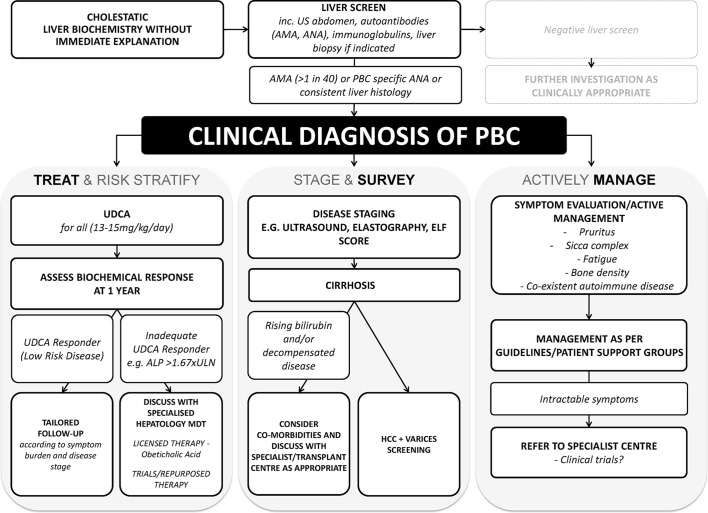
- UDCA is recommended for all patients with PBC at 13–15 mg/kg/day, usually life-long if tolerated; a combined analysis of three trials (548 patients) showed a one-third reduction in risk of death or transplant for moderate to severe PBC, with survival free of liver transplantation improved in medium- and high-risk bilirubin groups and histological stage IV.
- In patients with inadequate response to UDCA or UDCA intolerance, defined as ALP >1.67 × ULN and/or elevated bilirubin <2 × ULN, OCA addition is recommended for consideration; in the phase III trial, biochemical response was 10% with placebo vs 47% with 10 mg OCA and 46% with 5–10 mg titrated OCA, and mean ALP decrease was 39% and 33% vs 5%, respectively.
- Risk stratification after 1 year of UDCA should use biochemical response indices; high-risk patients are those with ALP >1.67 × ULN and/or elevated bilirubin <2 × ULN, while low-risk patients are those without cirrhosis with ALP <1.67 × ULN and normal bilirubin.
- Symptom burden is common and does not correlate with disease stage: pruritus affects approximately 80% of patients at some time, fatigue is reported by over 50% and severe in 20%, osteoporosis affects 20–44%, and approximately one-third of patients with advanced disease develop oesophageal varices over a median of 5.6 years.
Methods
- This is a clinical practice guideline developed as a consensus document by the British Society of Gastroenterology Liver Section and UK-PBC, with a broad Guidelines Development Group including gastroenterologists, hepatologists, transplant physicians, liver pathologists, and patient representatives.
- Development used a systematic review of publications identified via PubMed, Medline, and Cochrane database searches completed in June 2017, in line with the AGREE II instrument; recommendations use the GRADE system (Strong/Weak; quality High/Moderate/Low/Very low).
- The guideline provides 40 recommendations and service standards/audit recommendations, covering diagnosis, drug therapy, symptom management, advanced liver disease, transplantation, pregnancy, overlap syndromes, familial screening, and patient support.
Limitations
- The paper states that there is no consensus on the optimal non-invasive strategy to stage and monitor disease progression, and insufficient evidence to recommend one risk score over another on the basis of head-to-head data.
- The paper states that OCA survival benefit has not yet been demonstrated, longer-term efficacy and generalisability need confirmation, and more experience is needed in patients with advanced liver disease; the pivotal trial included patients with cirrhosis but no patients with decompensation.
- The paper states that evidence for UDCA in pregnancy is limited, off-label therapies such as budesonide and fibrates are not recommended pending phase III trials, and many recommendations are graded Weak or based on Low/Very low quality evidence.
- Evident from the text: several recommendations rely on expert opinion or limited case-series data, and patients with PBC were not well represented in some cited studies, such as the Baveno VI varices studies.
Model-written summary. Check it against the paper before relying on it.
Integrity signals
Registry
Cites
Statistics
Figures
Verification
Claims the paper makes
58 Valid · 6 Not valid · 89 Not checked · 33 Own results and interpretations
At least one cited source doesn’t support this claim or points to a different paper, and none confirmed it — see the verdicts below.
In the paper
“Data from the UK-PBC patient cohort have shown that there is significant variation in management between centres and individual clinicians.12”
§ The British Society of Gastroenterology/UK-PBC primary biliary cholangitis treatment and management guidelines > Recommendation 19 > Symptom management
What the sources say
- Disputedcites [12] Carbone M, Mells GF, Pells G, et al Sex and age are determinants of the clinical phenotype of primary biliary cirrhosis and response to ursodeoxycholic acid. Gastroenterology 2013; 144: 560– 9. 10.1053/j.gastro.2012.12.005 23246637 sourceExperimental — accuracy not yet measured
The Results (page unavailable) report no significant difference in UDCA use between specialist and nonspecialist centres (81% versus 80%) and similar response rates. The Discussion likewise says patients in the two settings were equally likely to receive UDCA. The paper does not assess variation between individual clinicians. (LLM, conf=0.88)
Checked by a reasoning model — may be wrong.
plain- Asserted: passes — The authors put it forward as true.
- Checkable: passes — It can be checked against evidence.
- Load-bearing: passes — The paper’s conclusions depend on it.
- Based: passes — The paper gives a reason why it holds.
- Disputed
At least one cited source doesn’t support this claim or points to a different paper, and none confirmed it — see the verdicts below.
In the paper
“The majority of these patients will be positive for the PBC-specific nuclear antibodies.265”
§ The British Society of Gastroenterology/UK-PBC primary biliary cholangitis treatment and management guidelines > Recommendation 32 > Management of special populations
What the sources say
- Disputedcites [265] Bizzaro N, Covini G, Rosina F, et al Overcoming a "probable" diagnosis in antimitochondrial antibody negative primary biliary cirrhosis: study of 100 sera and review of the literature. Clin Rev Allergy Immunol 2012; 42: 288– 97. 10.1007/s12016-010-8234-y 21188646 sourceExperimental — accuracy not yet measured
The indexed study summary (no page supplied) reports that 43 of 100 AMA-negative PBC sera reacted to a screening test that included both nuclear and mitochondrial antigens. Its antigen-specific results show PBC-specific nuclear-antibody reactivity in 32 of 100 sera, not a majority. (LLM, conf=0.88)
Checked by a reasoning model — may be wrong.
plainstates an association- Asserted: passes — The authors put it forward as true.
- Checkable: passes — It can be checked against evidence.
- Load-bearing: passes — The paper’s conclusions depend on it.
- Based: passes — The paper gives a reason why it holds.
- Disputed
The cited sources support only part of this claim — read each source’s verdict below.
In the paper
“PBC is characterised serologically by autoantibodies specific for mitochondrial, nuclear and centromere antigens, some of which are unique to PBC.66–78”
§ The British Society of Gastroenterology/UK-PBC primary biliary cholangitis treatment and management guidelines > How is PBC diagnosed? > Blood tests
What the sources say
- Not checked — no full text of the sourcecites [66] Marzorati S, Invernizzi P, Lleo A Making sense of autoantibodies in cholestatic liver diseases. Clin Liver Dis 2016; 20: 33– 46. 10.1016/j.cld.2015.08.003 26593289 source
- Not checked — no full text of the sourcecites [67] Walker JG, Doniach D, Roitt IM, et al Serological tests in diagnosis of primary biliary cirrhosis. Lancet 1965; 1: 827– 31. 10.1016/S0140-6736(65)91372-3 14263538 source
- Not checked — no full text of the sourcecites [68] Doniach D, Roitt IM, Walker JG, et al Tissue antibodies in primary biliary cirrhosis, active chronic (lupoid) hepatitis, cryptogenic cirrhosis and other liver diseases and their clinical implications. Clin Exp Immunol 1966; 1: 237– 62. 5330183 PMC1579190
- Partly supportedcites [69] Berg PA, Doniach D, Roitt IM Mitochondrial antibodies in primary biliary cirrhosis. I. Localization of the antigen to mitochondrial membranes. J Exp Med 1967; 126: 277– 90. 10.1084/jem.126.2.277 4165742 PMC2138313 sourceExperimental — accuracy not yet measured
The introduction (p. 277) reports that PBC sera contain antibodies directed against mitochondrial membranes, supporting the mitochondrial part of the sentence. This paper does not establish antibodies to nuclear or centromere antigens or identify any antibodies as unique to PBC; its Methods (p. 277) say the studied sera were selected for absence of antinuclear reactions. (LLM, conf=0.88)
- Not checked — no full text of the sourcecites [70] Ruffatti A, Arslan P, Floreani A, et al Nuclear membrane-staining antinuclear antibody in patients with primary biliary cirrhosis. J Clin Immunol 1985; 5: 357– 61. 10.1007/BF00918255 2414313 source
- Not checked — no full text of the sourcecites [71] Lozano F, Parés A, Borche L, et al Autoantibodies against nuclear envelope-associated proteins in primary biliary cirrhosis. Hepatology 1988; 8: 930– 8. 10.1002/hep.1840080438 3292364 source
- Supportedcites [72] Lassoued K, Brenard R, Degos F, et al Antinuclear antibodies directed to a 200-kilodalton polypeptide of the nuclear envelope in primary biliary cirrhosis. A clinical and immunological study of a series of 150 patients with primary biliary cirrhosis. Gastroenterology 1990; 99: 181– 6. 2188869 source
The Introduction/Abstract (p.1) states the serological background the claim summarises: antimitochondrial antibodies in 83%-99% of patients with the M2 type 'closely associated with PBC', ANA in 24%-31% (38%-58% on Hep2), with five recognised patterns including centromere; the Immunological Results section reports anticentromere antibodies in their series (Table 4, Discussion: 7%). The 'unique to PBC' part is supported by the Discussion, which says antibodies to the 200-kDa nuclear-envelope polypeptide 'could be considered specific for PBC' and concludes on 'this specific marker of PBC'. This is a broad background sentence carried by a citation range (66-78), and our copy treats the topic accordingly. (LLM, conf=0.85)
- Not checked — no full text of the sourcecites [73] Nickowitz RE, Wozniak RW, Schaffner F, et al Autoantibodies against integral membrane proteins of the nuclear envelope in patients with primary biliary cirrhosis. Gastroenterology 1994; 106: 193– 9. 10.1016/S0016-5085(94)95333-3 8276182 source
- Not checked — no full text of the sourcecites [74] Fussey SP, Guest JR, James OF, et al Identification and analysis of the major M2 autoantigens in primary biliary cirrhosis. Proc Natl Acad Sci U S A 1988; 85: 8654– 8. 10.1073/pnas.85.22.8654 3186751 PMC282518 source
- Partly supportedcites [75] Moteki S, Leung PS, Coppel RL, et al Use of a designer triple expression hybrid clone for three different lipoyl domain for the detection of antimitochondrial autoantibodies. Hepatology 1996; 24: 97– 103. 10.1002/hep.510240117 8707289 sourceExperimental — accuracy not yet measured
Our copy of Moteki et al. (1996) supports only the mitochondrial half of the sentence: the Abstract states that 'a characteristic serological feature observed in sera from patients with PBC is the presence of high titers of autoantibodies directed against mitochondrial antigens (AMAs),' targeting the E2 components of PDC, BCOADC and OGDC, and Table 1 plus the Results show this reactivity is specific to PBC (0/135 controls across PSC, CAH, SLE and healthy volunteers), which covers 'some of which are unique to PBC.' Nothing in our copy addresses nuclear or centromere autoantibodies — searches for 'centromere', 'antinuclear/nuclear autoantibodies', 'sp100/gp210' returned only mitochondrial antigen material, and the Introduction explicitly notes 'two other PBC autoantigens are not contained in the construct' (protein X, E1a), not nuclear targets. The nuclear and centromere components of the citing sentence therefore rest on the other references in the 66–78 range, not on this source. (LLM, conf=0.80)
plainstates an association- Asserted: passes — The authors put it forward as true.
- Checkable: passes — It can be checked against evidence.
- Load-bearing: passes — The paper’s conclusions depend on it.
- Based: passes — The paper gives a reason why it holds.
The cited sources support only part of this claim — read each source’s verdict below.
In the paper
“Patients with PBC typically have an increased incidence, in both themselves and their families, of other autoimmune diseases (over half of patients with PBC have another autoimmune condition), reflecting shared genetic predisposition (most notably but not exclusively celiac disease, scleroderma, thyroid disease and Sjögren’s).37–43”
§ The British Society of Gastroenterology/UK-PBC primary biliary cholangitis treatment and management guidelines > Background > Epidemiology
What the sources say
- Not checked — no full text of the sourcecites [37] Jones DE, Watt FE, Metcalf JV, et al Familial primary biliary cirrhosis reassessed: a geographically-based population study. J Hepatol 1999; 30: 402– 7. 10.1016/S0168-8278(99)80097-X 10190721 source
- Not checked — no full text of the sourcecites [38] Watt FE, James OFW, Jones DEJ Patterns of autoimmunity in PBC patients and their families. QJM 2004; 97: 397– 406. 15208427 source
- Not checked — no full text of the sourcecites [39] Parikh-Patel A, Gold EB, Worman H, et al Risk factors for primary biliary cirrhosis in a cohort of patients from the United States. Hepatology 2001; 33: 16– 21. 10.1053/jhep.2001.21165 11124815 source
- Partly supportedcites [40] Gershwin ME, Selmi C, Worman HJ, et al Risk factors and comorbidities in primary biliary cirrhosis: a controlled interview-based study of 1032 patients. Hepatology 2005; 42: 1194– 202. 10.1002/hep.20907 16250040 PMC3150736 sourceExperimental — accuracy not yet measured
The Discussion reports more autoimmune comorbidity in patients with PBC than in controls, and the Family History section reports increased rates of several autoimmune diseases among relatives. But the Discussion gives the rate in patients as 32%, not over half. It treats genetic predisposition as a hypothesis and does not establish the sentence’s reference to celiac disease. (LLM, conf=0.91)
- Could not verifycites [41] Lazaridis KN, Juran BD, Boe GM, et al Increased prevalence of antimitochondrial antibodies in first-degree relatives of patients with primary biliary cirrhosis. Hepatology 2007; 46: 785– 92. 10.1002/hep.21749 17680647 sourceExperimental — accuracy not yet measured
The Abstract discusses genetic susceptibility to PBC and says about 50% of patients have no symptoms—not that they have another autoimmune condition. The Discussion and familial-history section address PBC risk and antimitochondrial antibodies in relatives, but do not establish increased rates of other autoimmune diseases in patients or their families. Searches for the named autoimmune diseases and the claimed proportion found no supporting passage. (LLM, conf=0.76)
- Not checked — no full text of the sourcecites [42] Prince MI, Ducker SJ, James OF Case-control studies of risk factors for primary biliary cirrhosis in two United Kingdom populations. Gut 2010; 59: 508– 512. 10.1136/gut.2009.184218 20332522 source
- Not checked — no full text of the sourcecites [43] Corpechot C, Chrétien Y, Chazouillères O, et al Demographic, lifestyle, medical and familial factors associated with primary biliary cirrhosis. J Hepatol 2010; 53: 162– 9. 10.1016/j.jhep.2010.02.019 20471130 source
plainstates an association- Asserted: passes — The authors put it forward as true.
- Checkable: passes — It can be checked against evidence.
- Load-bearing: unclear — It is unclear whether the paper’s conclusions depend on it.
- Based: passes — The paper gives a reason why it holds.
Every source the paper cites for this claim was checked and supports it.
In the paper
“Both enhanced liver fibrosis (ELF)105 and transient elastography (TE)106 107 (eg, FibroScan) have, in cross-sectional studies, shown accuracy in determining disease stage as confirmed by biopsy.”
§ The British Society of Gastroenterology/UK-PBC primary biliary cholangitis treatment and management guidelines > Recommendation 3 > Role of liver biopsy and other staging investigations
What the sources say
- Supportedcites [105] Mayo MJ, Parkes J, Adams-Huet B, et al Prediction of clinical outcomes in primary biliary cirrhosis by serum enhanced liver fibrosis assay. Hepatology 2008; 48: 1549– 57. 10.1002/hep.22517 18846542 PMC2597274 source
This source is cited for the ELF portion of the sentence; separate citations accompany transient elastography. In the Results (‘Correlation of ELF with histology’), ELF scores correlated with biopsy staging, and the authors report that ELF was an accurate non-invasive marker of histological fibrosis. They also note overlap in scores at intermediate stages. (LLM, conf=0.92)
- Supportedcites [106] Corpechot C, El Naggar A, Poujol-Robert A, et al Assessment of biliary fibrosis by transient elastography in patients with PBC and PSC. Hepatology 2006; 43: 1118– 24. 10.1002/hep.21151 16628644 source
The citation to this paper supports the transient elastography (TE) portion of the sentence; ELF has a separate citation. The Discussion reports accurate prediction of biopsy-assessed fibrosis stage in patients with PBC or PSC, and the Liver Histology section describes how biopsy stages were determined. Page numbers were not supplied in our copy. (LLM, conf=0.93)
- Supportedcites [107] Corpechot C, Carrat F, Poujol-Robert A, et al Noninvasive elastography-based assessment of liver fibrosis progression and prognosis in primary biliary cirrhosis. Hepatology 2012; 56: 198– 208. 10.1002/hep.25599 22271046 source
The citation to this paper is attached to transient elastography (TE), not ELF. In Patient Populations and Liver Histological Assessment (page unavailable), the diagnostic cohort underwent both TE and liver biopsy; Diagnostic Performance reports that TE correctly classified 74% of patients by histological fibrosis stage, with strongest performance for severe fibrosis and cirrhosis. (LLM, conf=0.92)
plainstates an association- Asserted: passes — The authors put it forward as true.
- Checkable: passes — It can be checked against evidence.
- Load-bearing: passes — The paper’s conclusions depend on it.
- Based: passes — The paper gives a reason why it holds.
- Supported
70 more claims · 19 with their cited sources checked
Create a free account to see all 186 claims and to verify the 34 references still open.
- It may state two separate claims as one. 80
- Probably not a substantial claim. 44
Claims other papers make about this one
Each is checked against this paper’s own text: does it say what the citing paper says it does?
The source backs part of the claim, not all of it — or backs it for a different population, condition or comparison.
In the citing paper
“Gene variants in HLA or IL-12 signaling have been associated with PBC, and most patients display autoreactive antibodies against mitochondrial antigens and subsequent failure of biliary transporters, e.g., anion exchange protein 2 (AE2) [177–179].”
From Inflammation and immunity in liver homeostasis and disease: a nexus of hepatocytes, nonparenchymal cells and immune cells (2025) · doi:10.1038/s41423-025-01313-7 · cites this paper as [177]
Experimental — accuracy not yet measuredIn the citing paper
“PBC is an autoimmune disease that primarily involves the targeting of intrahepatic BECs and results in chronic liver inflammation and fibrosis, in which hepatocyte injury is secondary and only manifests in later stages due to increased inflammation and cholestasis leading to oxidative stress [177].”
From Inflammation and immunity in liver homeostasis and disease: a nexus of hepatocytes, nonparenchymal cells and immune cells (2025) · doi:10.1038/s41423-025-01313-7 · cites this paper as [177]
In the citing paper
“Instead, ursodeoxycholic acid (UDCA), a hydrophilic bile acid, is used as a first-line therapy for PBC to reduce bile acid toxicity and, thus, liver inflammation and hepatocyte injury [177].”
From Inflammation and immunity in liver homeostasis and disease: a nexus of hepatocytes, nonparenchymal cells and immune cells (2025) · doi:10.1038/s41423-025-01313-7 · cites this paper as [177]
In the citing paper
“The available treatments for PBC patients are limited to ursodeoxycholic acid (UDCA) and the recently licenced obeticholic acid (OCA) as a second-line approach17,18.”
From Cholestasis induced by bile duct ligation promotes changes in the intestinal microbiome in mice (2019) · cites this paper as [17]
Citations
Cites
EASL Clinical Practice Guidelines: Management of hepatocellular carcinoma
Galle, P. R., Forner, A., Llovet, J. M., Mazzaferro, V., Piscaglia, F., Raoul, J.-L., Schirmacher, P., & Vilgrain, V. (2018) · Journal of Hepatology · doi:10.1016/j.jhep.2018.03.019 · Cited by 11,406
Management of Hepatocellular Carcinoma: An Update Δσ
Bruix, J., & Sherman, M. (2011) · Hepatology · doi:10.1002/hep.24199 · Cited by 8,103
EASL–EORTC Clinical Practice Guidelines: Management of hepatocellular carcinoma
European Association for the Study of the Liver, & European Organisation for Research and Treatment of Cancer (2012) · Journal of Hepatology · doi:10.1016/j.jhep.2011.12.001 · Cited by 5,218
A Model to Predict Survival in Patients With End–Stage Liver Disease
Kamath, P. S., Wiesner, R. H., Malinchoc, M., Kremers, W., Therneau, T. M., Kosberg, C. L., D'Amico, G., Dickson, R. E., & Kim, R. W. (2001) · Hepatology · doi:10.1053/jhep.2001.22172 · Cited by 4,975
Hematological Problems in Pediatric Intensive Care
Revel-Vilk, S., Cox, P., Robitaille, N., & Blanchette, V. (2014) · Pediatric and Adolescent Medicine · doi:10.1159/000350346 · Cited by 3,508
Expanding consensus in portal hypertension
de Franchis, R. (2015) · Journal of Hepatology · doi:10.1016/j.jhep.2015.05.022 · Cited by 3,078
Malinchoc, M., Kamath, P. S., Gordon, F. D., Peine, C. J., Rank, J., & ter Borg, P. C. J. (2000) · Hepatology · doi:10.1053/he.2000.5852 · Cited by 2,893
Rockey, D. C., Caldwell, S. H., Goodman, Z. D., Nelson, R. C., & Smith, A. D. (2009) · Hepatology · doi:10.1002/hep.22742 · Cited by 1,997
(2015) · Journal of Hepatology · doi:10.1016/j.jhep.2015.04.006 · Cited by 1,875
EASL Clinical Practice Guidelines: management of cholestatic liver diseases
European Association for the Study of the Liver (2009) · Journal of Hepatology · doi:10.1016/j.jhep.2009.04.009 · Cited by 1,729
Research works printed but not linked: 4
- National Institute for Health and Care Excellence (NICE). Cirrhosis in over 16s: assessment and management. London, 2016. 27441331
- de Franchis R, Baveno VIF; Baveno VI Faculty. Expanding consensus in portal hypertension. Report of the Baveno VI Consensus Workshop: Stratifying risk and individualizing care for portal hypertension. J Hepatol 2015; 63: 743– 52. 10.1016/j.jhep.2015.05.022 26047908 · DOI · Paper page
- National Institute for Health and Care Excellence (NICE). Oesteoporosis: fragility fracture risk: osteoporosis: assessing the risk of fragility fracture. London, 2012. 32186835
- Metcalf JV, Mitchison HC, Palmer JM, et al Natural history of early primary biliary cirrhosis. Lancet 1996; 348: 1399– 402. 10.1016/S0140-6736(96)04410-8 8937278 · DOI · Paper page
Cited by
FXR agonists in NASH treatment
Adorini, L., & Trauner, M. (2023) · Journal of Hepatology · doi:10.1016/j.jhep.2023.07.034 · Cited by 184
Activation of mTOR Signaling Pathway in Hepatocellular Carcinoma
Ferrín, G., Guerrero, M., Amado, V., Rodríguez-Perálvarez, M., & De la Mata, M. (2020) · International Journal of Molecular Sciences · doi:10.3390/ijms21041266 · Cited by 135
“UDCA therapy improves liver biochemistry parameters and delays the progression of the disease to liver cirrhosis [68].”
BackgroundThe Pathogenesis of Primary Biliary Cholangitis: A Comprehensive Review
Lleo, A., Leung, P. S. C., Hirschfield, G. M., & Gershwin, E. M. (2020) · Seminars in Liver Disease · doi:10.1055/s-0039-1697617 · Cited by 136
Self-citationYou, H., Ma, X., Efe, C., Wang, G., Jeong, S.-H., Abe, K., Duan, W., Chen, S., Kong, Y., Zhang, D., et al. (2022) · Hepatology International · doi:10.1007/s12072-021-10276-6 · Cited by 133
Corpechot, C., Carrat, F., Gaouar, F., Chau, F., Hirschfield, G., Gulamhusein, A., Montano-Loza, A. J., Lytvyak, E., Schramm, C., Pares, A., et al. (2022) · Journal of Hepatology · doi:10.1016/j.jhep.2022.06.017 · Cited by 128
Self-citationHirschfield, G. M., Shiffman, M. L., Gulamhusein, A., Kowdley, K. V., Vierling, J. M., Levy, C., Kremer, A. E., Zigmond, E., Andreone, P., Gordon, S. C., et al. (2023) · Hepatology · doi:10.1097/hep.0000000000000395 · Cited by 127
“[4,6–8] Independent of disease stage, many people living with PBC experience significant impairment to quality of life, particularly from fatigue and pruritus.[2,3,7] Histologic damage characterized by a granulomatous lymphocytic cholangitis is associated with abnormal serum liver tests, including elevated serum alkal…”
BackgroundSelf-citationAutoimmune biliary diseases: primary biliary cholangitis and primary sclerosing cholangitis
Sarcognato, S., Sacchi, D., Grillo, F., Cazzagon, N., Fabris, L., Cadamuro, M., Cataldo, I., Covelli, C., Mangia, A., & Guido, M. (2021) · Pathologica · doi:10.32074/1591-951x-245 · Cited by 141
Obeticholic acid-a new therapy in PBC and NASH
Chapman, R. W., & Lynch, K. D. (2020) · British Medical Bulletin · doi:10.1093/bmb/ldaa006 · Cited by 116
Current and potential treatments for primary biliary cholangitis
Shah, R. A., & Kowdley, K. V. (2020) · The Lancet Gastroenterology & Hepatology · doi:10.1016/s2468-1253(19)30343-7 · Cited by 115
The challenges of primary biliary cholangitis: What is new and what needs to be done
Terziroli Beretta-Piccoli, B., Mieli-Vergani, G., Vergani, D., Vierling, J. M., Adams, D., Alpini, G., Banales, J. M., Beuers, U., Björnsson, E., Bowlus, C., et al. (2019) · Journal of Autoimmunity · doi:10.1016/j.jaut.2019.102328 · Cited by 114
Self-citationKeitel, V., Dröge, C., & Häussinger, D. (2019) · Handbook of experimental pharmacology · doi:10.1007/164_2019_231 · Cited by 121
Corpechot, C., Lemoinne, S., Soret, P.-A., Hansen, B., Hirschfield, G., Gulamhusein, A., Montano-Loza, A. J., Lytvyak, E., Pares, A., Olivas, I., et al. (2024) · Hepatology · doi:10.1097/hep.0000000000000529 · Cited by 94
Self-citationChen, Y.-S., Liu, H.-M., & Lee, T.-Y. (2019) · Cells · doi:10.3390/cells8030253 · Cited by 98
“Ursodeoxycholic acid (UDCA) is a hydrophilic bile acid (BA) and has been administered occasionally as a hepatoprotective drug for cholestasis and chronic hepatitis; it is also the drug approved by the United States Food and Drug Administration for the treatment of primary biliary cholangitis (PBC) [10,11].”
Background(2025) · doi:10.1038/s41423-025-01313-7 · Cited by 97
“…is an autoimmune disease that primarily involves the targeting of intrahepatic BECs and results in chronic liver in fl ammation and fi brosis, in which hepatocyte injury is secondary and only manifests in later stages due to increased in fl ammation and cholestasis leading to oxidative stress [177].”
The toxicity of the methylimidazolium ionic liquids, with a focus on M8OI and hepatic effects
Leitch, A. C., Abdelghany, T. M., Probert, P. M. E., Dunn, M. P., Meyer, S. K., Palmer, J. M., Cooke, M. P., Blake, L. I., Morse, K., Rosenmai, A. K., et al. (2019) · Food and Chemical Toxicology · doi:10.1016/j.fct.2019.111069 · Cited by 94
Self-citationThe Role of Gut Microbiota in Some Liver Diseases: From an Immunological Perspective
Wang, L., Cao, Z.-M., Zhang, L., Li, J.-M., & Lv, W. (2022) · Frontiers in Immunology · doi:10.3389/fimmu.2022.923599 · Cited by 106
“Primary Biliary Cholangitis Primary biliary cholangitis(PBC) is a chronic intrahepatic cholestasis with the most common clinical manifestations of fatigue and itchy skin, which can lead to liver failure or even death (67).”
BackgroundInvernizzi, P., Carbone, M., Jones, D., Levy, C., Little, N., Wiesel, P., Nevens, F., & the study investigators (2023) · Liver International · doi:10.1111/liv.15596 · Cited by 79
Self-citationMayo, M. J., Carey, E., Smith, H. T., Mospan, A. R., McLaughlin, M., Thompson, A., Morris, H. L., Sandefur, R., Kim, W. R., Bowlus, C., et al. (2023) · Digestive Diseases and Sciences · doi:10.1007/s10620-022-07581-x · Cited by 78
“Ethnic diversity, while still limited, was increased compared to other PBC studies [17].”
ResultCristoferi, L., Calvaruso, V., Overi, D., Viganò, M., Rigamonti, C., Degasperi, E., Cardinale, V., Labanca, S., Zucchini, N., Fichera, A., et al. (2021) · Hepatology · doi:10.1002/hep.31810 · Cited by 69
Ciaula, A. D., Bonfrate, L., Baj, J., Khalil, M., Garruti, G., Stellaard, F., Wang, H. H., Wang, D. Q. ‐., & Portincasa, P. (2022) · Nutrients · doi:10.3390/nu14234950 · Cited by 83
Sun, C., Xiao, X., Yan, L., Sheng, L., Wang, Q., Jiang, P., Lian, M., Li, Y., Wei, Y., Zhang, J., et al. (2019) · Journal of Autoimmunity · doi:10.1016/j.jaut.2019.01.005 · Cited by 66
Cholestasis induced by bile duct ligation promotes changes in the intestinal microbiome in mice
Cabrera-Rubio, R., Patterson, A. M., Cotter, P. D., & Beraza, N. (2019) · Scientific Reports · doi:10.1038/s41598-019-48784-z · Cited by 61
Dyson, J. K., Blain, A., Foster Shirley, M. D., Hudson, M., Rushton, S., & Jeffreys Jones, D. E. (2021) · JHEP Reports · doi:10.1016/j.jhepr.2020.100202 · Cited by 55
“Patients with ‘definite’ or ‘probable’ PBC, based on the conventional diagnostic criteria, were included.(12,13) The standard diagnostic criteria for PSC were used; cholestatic liver biochemistry with typical cholangiographic features in the absence of other identifiable causes or other extrahepatic disease (except in…”
MethodSelf-citationLiu, Y., Guo, G., Zheng, L., Sun, R., Wang, X., Deng, J., Jia, G., Yang, C., Cui, L., Guo, C., et al. (2023) · American Journal of Gastroenterology · doi:10.14309/ajg.0000000000002238 · Cited by 55
“Obeticholic acid (OCA), a selective agonist of the farnesoid X receptor, has been approved as a second-line therapy for UDCA in patients with incomplete responses (3,4).”
MethodRobles-Díaz, M., Nezic, L., Vujic-Aleksic, V., & Björnsson, E. S. (2021) · Frontiers in Pharmacology · doi:10.3389/fphar.2021.744488 · Cited by 49
“12:744488. doi: 10.3389/fphar.2021.744488 Abbreviations: AAS, androgenic anabolic steroid; ALP, alkaline phosphatase; ALT, alanine aminotransferase; AST, aspartate aminotransferase; CLD, chronic liver disease; DILI, drug-induced liver injury; DILIN, Drug-Induced Liver Injury Network; ERCP, endoscopic retrograde cholan…”
BackgroundInfluentialYang, Y., Liu, S., Gao, H., Wang, P., Zhang, Y., Zhang, A., Jia, Z., & Huang, S. (2020) · Free Radical Biology and Medicine · doi:10.1016/j.freeradbiomed.2020.01.182 · Cited by 54
Binda, C., Gibiino, G., Coluccio, C., Sbrancia, M., Dajti, E., Sinagra, E., Capurso, G., Sambri, V., Cucchetti, A., Ercolani, G., et al. (2022) · Microorganisms · doi:10.3390/microorganisms10020312 · Cited by 60
“Its pathogenesis is multifaceted and occurs through the interaction between the immune and biliary pathways, where genetic and environmental factors play a substantial role [85].”
BackgroundNevens, F., Trauner, M., & Manns, M. P. (2022) · Journal of Hepatology · doi:10.1016/j.jhep.2022.10.007 · Cited by 55
Primary biliary cholangitis: pathogenic mechanisms
Prìeto, J., Bañales, J. M., & Medina, J. F. (2021) · Current Opinion in Gastroenterology · doi:10.1097/mog.0000000000000703 · Cited by 55
Schramm, C., Wedemeyer, H. H., Mason, A. L., Hirschfield, G. M., Levy, C., Kowdley, K. V., Milkiewicz, P., Janczewska, E., Malova, E. S., Sanni, J., et al. (2022) · JHEP Reports · doi:10.1016/j.jhepr.2022.100544 · Cited by 61
Self-citationThe Serum Proteome and Ursodeoxycholic Acid Response in Primary Biliary Cholangitis
Barron‐Millar, B., Ogle, L., Mells, G., Flack, S., Badrock, J., Sandford, R., Kirby, J., Palmer, J., Jopson, L., Brain, J., et al. (2021) · Hepatology · doi:10.1002/hep.32011 · Cited by 45
“Standard therapy in PBC now uses a stratified approach.(2) Cholestatic injury, with damage to the biliary epithelial cells (BECs) lining the small intrahepatic bile ducts and eventual ductopenia, are the hallmarks of PBC and are thought to be mediated, at least in part, by hydrophobic bile acids.”
BackgroundMethodSelf-citationGlobal, regional, and national burden of gallbladder and biliary diseases from 1990 to 2019
Li, Z.-Z., Guan, L., Ouyang, R., Chen, Z., Ouyang, G., & Jiang, H. (2023) · World Journal of Gastrointestinal Surgery · doi:10.4240/wjgs.v15.i11.2564 · Cited by 54
Sleep disorder in patients with chronic liver disease: a narrative review
Shah, N. M., Malhotra, A. M., & Kaltsakas, G. (2020) · Journal of Thoracic Disease · doi:10.21037/jtd-cus-2020-012 · Cited by 51
“Prevalence of PBC is 35 per 100,000 population (63).”
BackgroundA Practical Review of Primary Biliary Cholangitis for the Gastroenterologist.
Onofrio, F. Q., Hirschfield, G. M., & Gulamhusein, A. F. (2019) · Europe PMC (PubMed Central) · Cited by 59
Self-citationGomez, E., Garcia Buey, L., Molina, E., Casado, M., Conde, I., Berenguer, M., Jorquera, F., Simón, M., Olveira, A., Hernández‐Guerra, M., et al. (2021) · Alimentary Pharmacology & Therapeutics · doi:10.1111/apt.16181 · Cited by 41
“834 AST (U/L) Median (IQR) 36 (31-60) 44 (32-65) 0.”
Murillo Perez, C. F., Ioannou, S., Hassanally, I., Trivedi, P. J., Corpechot, C., van der Meer, A. J., Lammers, W. J., Battezzati, P. M., Lindor, K. D., Nevens, F., et al. (2023) · Liver International · doi:10.1111/liv.15592 · Cited by 39
Self-citationClinical Management of Primary Biliary Cholangitis—Strategies and Evolving Trends
Gao, L., Wang, L., Woo, E., He, X., Yang, G., Bowlus, C., Leung, P. S. C., & Gershwin, M. E. (2020) · Clinical Reviews in Allergy & Immunology · doi:10.1007/s12016-019-08772-7 · Cited by 39
UK-Wide Multicenter Evaluation of Second-line Therapies in Primary Biliary Cholangitis
Abbas, N., Culver, E. L., Thorburn, D., Halliday, N., Crothers, H., Dyson, J. K., Phaw, A., Aspinall, R., Khakoo, S. I., Kallis, Y., et al. (2023) · Clinical Gastroenterology and Hepatology · doi:10.1016/j.cgh.2022.07.038 · Cited by 39
Self-citationLi, J., Jin, X., Ren, J., Li, R., Du, L., Gao, Y., Zhang, J., Liu, X., Wang, X., & Wang, G. (2022) · Journal of Gastroenterology and Hepatology · doi:10.1111/jgh.15859 · Cited by 45
Zhao, Y., Wei, S., Chen, L., Zhou, X., & Ma, X. (2023) · Frontiers in Immunology · doi:10.3389/fimmu.2023.1164202 · Cited by 45
Review article: pathophysiology and management of primary biliary cholangitis
Leung, K. K., Deeb, M., & Hirschfield, G. M. (2020) · Alimentary Pharmacology & Therapeutics · doi:10.1111/apt.16023 · Cited by 40
Self-citationPrimary biliary cholangitis drug evaluation and regulatory approval: Where do we go from here?
Jones, D. E. J., Beuers, U., Bonder, A., Carbone, M., Culver, E., Dyson, J., Gish, R. G., Hansen, B. E., Hirschfield, G., Jones, R., et al. (2024) · Hepatology · doi:10.1097/hep.0000000000000864 · Cited by 38
“[1,5,37] The reasons for variability in the use of optimal therapy regimes in PBC have not been formally studied.”
BackgroundSelf-citationJones, D., Carbone, M., Invernizzi, P., Little, N., Nevens, F., Swain, M. G., Wiesel, P., & Levy, C. (2023) · Hepatology Communications · doi:10.1097/hc9.0000000000000057 · Cited by 37
Self-citationSVIP alleviates CCl4-induced liver fibrosis via activating autophagy and protecting hepatocytes
Jia, D. T., Wang, Y. Y., Wang, P., Huang, Y., Wang, D., Wang, D., Zhang, C., Zhang, C., Guo, L., Liang, P., et al. (2019) · Cell Death and Disease · doi:10.1038/s41419-019-1311-0 · Cited by 36
Abdelghany, T. M., Leitch, A. C., Nevjestić, I., Ibrahim, I., Miwa, S., Wilson, C. H., Heutz, S. E. M., & Wright, M. C. (2020) · Food and Chemical Toxicology · doi:10.1016/j.fct.2020.111593 · Cited by 37
Hirschfield, G. M., Chazouillères, O., Cortez‐Pinto, H., Macedo, G., de Lédinghen, V., Adekunle, F., & Carbone, M. (2021) · Expert Review of Gastroenterology & Hepatology · doi:10.1080/17474124.2021.1945919 · Cited by 42
Self-citationWahlang, B., Gao, H., Rai, S. N., Keith, R. J., McClain, C. J., Srivastava, S., Cave, M. C., & Bhatnagar, A. (2023) · Environmental Research · doi:10.1016/j.envres.2023.115228 · Cited by 36
Understanding fatigue in primary biliary cholangitis: From pathophysiology to treatment perspectives
Lynch, E. N., Campani, C., Innocenti, T., Dragoni, G., Biagini, M. R., Forte, P., & Galli, A. (2022) · World Journal of Hepatology · doi:10.4254/wjh.v14.i6.1111 · Cited by 39
Zhang, H., Chen, L., Fan, Z., & Lv, G. (2023) · Liver International · doi:10.1111/liv.15616 · Cited by 46
Martinez-Gili, L., Pechlivanis, A., McDonald, J. A. K., Begum, S., Badrock, J., Dyson, J. K., Jones, R., Hirschfield, G., Ryder, S. D., Sandford, R., et al. (2023) · Gut Microbes · doi:10.1080/19490976.2023.2208501 · Cited by 32
Self-citationAbbas, N., Smith, R., Flack, S., Bains, V., Aspinall, R. J., Jones, R. L., Burke, L., Thorburn, D., Heneghan, M., Yeoman, A., et al. (2024) · JHEP Reports · doi:10.1016/j.jhepr.2023.100931 · Cited by 31
Self-citationLeitch, A. C., Ibrahim, I., Abdelghany, T. M., Charlton, A., Roper, C., Vidler, D., Palmer, J. M., Wilson, C. H., Jones, D. E., Blain, P. G., et al. (2021) · Toxicology · doi:10.1016/j.tox.2021.152854 · Cited by 29
Self-citationNew treatments/targets for primary biliary cholangitis
Corpechot, C., Poupon, R. Y., & Chazouillères, O. (2019) · JHEP Reports · doi:10.1016/j.jhepr.2019.05.005 · Cited by 33
Xu, F., Zhang, H., Chen, J., Zhan, J., Liu, P., Liu, W., Qi, S., & Mu, Y. (2023) · Journal of Ethnopharmacology · doi:10.1016/j.jep.2023.117514 · Cited by 36
Role of autoantibodies in the clinical management of primary biliary cholangitis
Rigopoulou, E. I., & Bogdanos, D. P. (2023) · World Journal of Gastroenterology · doi:10.3748/wjg.v29.i12.1795 · Cited by 30
Lin, W., Li, S., Meng, Y., Huang, G., Liang, S., Du, J., Liu, Q., & Cheng, B. (2021) · Frontiers in Pharmacology · doi:10.3389/fphar.2021.755394 · Cited by 30
“Ursodeoxycholic acid (UDCA), a licensed first-line therapeutic agent for primary biliary cholangitis (Hirschfield et al., 2018), may decrease cholesterol saturation in the bile, solubilize cholesterol gallstones, and improve liver functions in case of cholestatic diseases (Tonin and Arends, 2018).”
BackgroundZhang, Q., Liu, Z., Wu, S., Duan, W., Chen, S., Ou, X., You, H., Kong, Y., & Jia, J. (2019) · Gastroenterology Research and Practice · doi:10.1155/2019/8959103 · Cited by 28
The Management of Cholestatic Liver Diseases: Current Therapies and Emerging New Possibilities
Mazzetti, M., Marconi, G., Mancinelli, M., Benedetti, A., Marzioni, M., & Maroni, L. (2021) · Journal of Clinical Medicine · doi:10.3390/jcm10081763 · Cited by 34
“Guidelines recommend starting OCA at a dose of 5 mg weekly (with a maximum dose of 10 mg twice weekly) in Child Pugh B or C cirrhotic patients, and to use caution in Child Pugh A patients [1,19,20].”
BackgroundThe Microbiome in Autoimmune Liver Diseases: Metagenomic and Metabolomic Changes
Zheng, Y., Ran, Y., Zhang, H., Wang, B., & Zhou, L. (2021) · Frontiers in Physiology · doi:10.3389/fphys.2021.715852 · Cited by 32
Burghart, L., Halilbasic, E., Schwabl, P., Simbrunner, B., Stättermayer, A. F., Petrenko, O., Scheiner, B., Bauer, D. J. M., Pinter, M., Boztuǧ, K., et al. (2021) · Journal of Gastroenterology · doi:10.1007/s00535-021-01839-3 · Cited by 34
“8% of all patients suffered from pruritus which is experienced as a significant reduction in Quality of Life [37].”
BackgroundResultInfluentialBritish Society of Gastroenterology guidelines for diagnosis and management of autoimmune hepatitis
Gleeson, D. C., Bornand, R., Brownlee, A., Dhaliwal, H., Dyson, J. K., Hails, J., Henderson, P., Kelly, D. A., Mells, G. F., Miquel, R., et al. (2025) · Gut · doi:10.1136/gutjnl-2024-333171 · Cited by 53
Self-citationOveri, D., Carpino, G., Cristoferi, L., Onori, P., Kennedy, L. L., Francis, H., Zucchini, N., Rigamonti, C., Viganò, M., Floreani, A., et al. (2022) · JHEP Reports · doi:10.1016/j.jhepr.2022.100556 · Cited by 32
“improvement after UDCA treatment, which might translate to a worse long-term outcome.(2) These people are candidates for second-line therapies, such as obeticholic acid and fibrates, which are themselves effective only in a proportion of these people, leaving an area of unmet needs.”
BackgroundRISING STARS: Sex differences in toxicant-associated fatty liver disease
Wahlang, B. (2023) · Journal of Endocrinology · doi:10.1530/joe-22-0247 · Cited by 29
Alvaro, D., Carpino, G., Craxì, A., Floreani, A., Moschetta, A., & Invernizzi, P. (2020) · Liver International · doi:10.1111/liv.14627 · Cited by 26
Diagnosis and Management of Autoimmune Hemolytic Anemia in Patients with Liver and Bowel Disorders
Bianco, C., Coluccio, E. B., Prati, D., & Valenti, L. V. C. (2021) · Journal of Clinical Medicine · doi:10.3390/jcm10030423 · Cited by 27
“Immune-mediated or autoimmune anemia, including AIHA as well as pernicious anemia and celiac disease, should therefore be ruled out in patients with PBC and fatigue [49].”
BackgroundPruritus in primary biliary cholangitis is under-recorded in patient medical records
Gungabissoon, U., Smith, H. T., von Maltzahn, R., Logie, J., Fairburn-Beech, J., Ma, L., Dhirishiya, P., McGirr, A. A., Hunnicutt, J. N., Rowe, C. L., et al. (2024) · BMJ Open Gastroenterology · doi:10.1136/bmjgast-2023-001287 · Cited by 27
PBC‐10: a short quality of life measure for clinical screening in primary biliary cholangitis
Alrubaiy, L., Mells, G. F., Flack, S., Bosomworth, H. J., Hutchings, H. A., Williams, J. G., & Jones, D. E. (2019) · Alimentary Pharmacology & Therapeutics · doi:10.1111/apt.15554 · Cited by 23
Self-citationHernández‐Pérez, M., Riado, D., Pena, E., Méndez, C., Pinedo, F., Ramos, P., Castillo, P., Romero, M., Fernández‐Rodríguez, C., & Olveira, A. (2024) · Alimentary Pharmacology & Therapeutics · doi:10.1111/apt.18134 · Cited by 31
“26 Meanwhile, liver biopsy might play a more significant role in diagnosing PBC-associated steatosis in at-risk MASLD patients.”
Jones, D. E. J., Wetten, A., Barron-Millar, B., Ogle, L., Mells, G., Flack, S., Sandford, R., Kirby, J., Palmer, J., Brotherston, S., et al. (2022) · eBioMedicine · doi:10.1016/j.ebiom.2022.104068 · Cited by 22
Self-citationAn Updated Review on the Epidemiology, Pathophysiology, Etiology and Diagnosis of Liver CirrhosisPreprint
Geong, G. Y., Kang, S. H., & Lee, C. M. (2019) · Preprints.org · doi:10.20944/preprints201903.0128.v1 · Cited by 33
“The acid ursodeoxycholic is the main drug used to delay the progression of the disease and delay the need for transplantation [66].”
BackgroundWidespread gaps in the quality of care for primary biliary cholangitis in UK
Sivakumar, M., Gandhi, A., Shakweh, E., Li, Y. M., Safinia, N., Smith, B. C., Marshall, A., Turner, L., Mukhopadhya, A., Haboubi, H., et al. (2021) · Frontline Gastroenterology · doi:10.1136/flgastro-2020-101713 · Cited by 21
Self-citationBiodegradable, bile salt microparticles for localized fat dissolution
Safari, H., Kaczorowski, N., Felder, M. L., Brannon, E. R., Varghese, M., Singer, K., & Eniola‐Adefeso, O. (2020) · Science Advances · doi:10.1126/sciadv.abd8019 · Cited by 21
“Bile acids and their salts have been proposed as therapeutic agents for the treatment of different conditions, including bile synthesis and peroxisomal disorders (3, 4), primary biliary cirrhosis (5), gallstones and bile duct stones (1, 6), nonalcoholic fatty liver disease (7), type 2 diabetes (7), cancer (8, 9), and…”
Kumar, A., Al-Hassi, H. O., Steed, H., Phipps, O., & Brookes, M. (2022) · Canadian Journal of Gastroenterology and Hepatology · doi:10.1155/2022/8416578 · Cited by 24
Zou, M., Wang, A., Wei, J., Cai, H., Yu, Z., Zhang, L., & Wang, X. (2021) · International Immunopharmacology · doi:10.1016/j.intimp.2020.107328 · Cited by 25
Gerussi, A., D’Amato, D., Cristoferi, L., O’Donnell, S. E., Carbone, M., & Invernizzi, P. (2019) · Annals of Hepatology · doi:10.1016/j.aohep.2019.09.009 · Cited by 22
“[7] Hirschfield GM, Dyson JK, Alexander GJM, Chapman MH, Collier J, Hübscher S, et al.”
BackgroundGungabissoon, U., Gibbons, D. C., Requena, G., Ribeiro de Souza, A., & Smith, H. (2022) · BMJ Open Gastroenterology · doi:10.1136/bmjgast-2021-000857 · Cited by 20
Xu, Q., Zhu, W., & Yin, Y. (2023) · Medicine · doi:10.1097/md.0000000000036039 · Cited by 23
“[69] Future guidelines would benefit from head-to-head comparisons of testing modalities to standardize protocols and reference ranges.”
BackgroundAn update on the management of cholestatic liver diseases
Appanna, G., & Kallis, Y. N. (2020) · Clinical Medicine · doi:10.7861/clinmed.2020-0697 · Cited by 23
Variant and Specific Forms of Autoimmune Cholestatic Liver Diseases
Dalekos, G. Ν., & Gatselis, N. (2019) · Archivum Immunologiae et Therapiae Experimentalis · doi:10.1007/s00005-019-00550-9 · Cited by 23
Fujita, K., Nomura, T., Morishita, A., Shi, T., Oura, K., Tani, J., Kobara, H., Tsutsui, K., Himoto, T., & Masaki, T. (2019) · Journal of Clinical Medicine · doi:10.3390/jcm8081258 · Cited by 25
“Primary biliary cholangitis (PBC) is a chronic, progressive, and cholestatic disease of the liver [1,2].”
BackgroundDiagnostic criteria and long-term outcomes in AIH-PBC variant syndrome under combination therapy
Stoelinga, A., Biewenga, M., Drenth, J. P. H., Verhelst, X., van der Meer, A. J. P., de Boer, Y. S., Bouma, G., de Vries, E. S., Verdonk, R. C., van den Berg, A. P., et al. (2024) · JHEP Reports · doi:10.1016/j.jhepr.2024.101088 · Cited by 28
“37 In patients with PBC who exhibit signs of hepatic in fl am-mation, exempli fi ed by elevated aminotransferases, a liver biopsy should initially be contemplated (as also recommended in the British PBC guidelines 38 ).”
Parés, A. R., Shiffman, M. L., Vargas, V., Invernizzi, P., Malecha, E. S., Liberman, A., MacConell, L., & Hirschfield, G. M. (2020) · Liver International · doi:10.1111/liv.14429 · Cited by 21
Self-citationMartin, M. L., Stassek, L., Blum, S. I., Joshi, A. V., & Jones, D. E. (2019) · Journal of Patient-Reported Outcomes · doi:10.1186/s41687-018-0090-1 · Cited by 22
“Introduction Primary biliary cholangitis (PBC), previously known as primary biliary cirrhosis, is a chronic autoimmune disease of the liver in which intrahepatic small bile ducts are selectively destroyed by inflammatory cells [1, 2].”
BackgroundSelf-citationLuo, X., & Lu, L. (2024) · Journal of Clinical and Translational Hepatology · doi:10.14218/jcth.2023.00519 · Cited by 26
“5,6 It can occur at any stage of the disease process, but it is important to note that as liver disease worsens, pruritus improves.”
BackgroundInfluentialSerum vitamin D level is related to disease progression in primary biliary cholangitis
Wang, Z., Peng, C., Wang, P., Sui, J., Wang, Y., Sun, G., & Liu, M. (2020) · Scandinavian Journal of Gastroenterology · doi:10.1080/00365521.2020.1829030 · Cited by 26
Sex differences in clinical presentation and prognosis in patients with primary biliary cholangitis
Abdulkarim, M., Zenouzi, R., Sebode, M., Schulz, L., Quaas, A., Lohse, A. W., Schramm, C., & Weiler‐Normann, C. (2019) · Scandinavian Journal of Gastroenterology · doi:10.1080/00365521.2019.1683226 · Cited by 22
“Male sex, advanced disease, and young age at diagnosis have been identified as independent risk factors for poor outcome [14,15].”
BackgroundLakić, B., Škrbić, R., Uletilović, S., Mandić-Kovačević, N., Grabež, M., Šarić, M. P., Stojiljković, M. P., Soldatović, I., Janjetović, Z., Stokanović, A., et al. (2024) · Journal of Diabetes Research · doi:10.1155/2024/4187796 · Cited by 27
“UDCA is used as a medicine in the prevention of chronic hepatitis or cholestasis and in treatment of the primary biliary cholangitis [18, 19].”
BackgroundLi, Y., Li, Z., Chen, R., Lian, M., Wang, H., Wei, Y., You, Z., Zhang, J., Li, B., Li, Y., et al. (2023) · Nature Communications · doi:10.1038/s41467-023-37213-5 · Cited by 18
Yu, K., Li, P., Xu, T., Xu, J., Wang, K., Chai, J., Zhao, D., Liu, Y., Wang, Y., Ma, J., et al. (2020) · Pathology - Research and Practice · doi:10.1016/j.prp.2020.153291 · Cited by 19
Wang, L., Sun, K., Ai, T. I. A. N., Yansheng, L. I. U., Zhang, M., Zhou, X., & Han, Y. (2022) · Minerva Medica · doi:10.23736/s0026-4806.21.07316-x · Cited by 22
A Review of Herbal Treatment for Functional Gastrointestinal Disorders and Infection
Krupavaram, B., Babu, A. K., Pillay, S. M., Siang, T. C., Menon, B. V. V., Paneerselvam, G. S., Ming, L. C., Al‐Worafi, Y. M., & Chooi, W. H. (2023) · Progress In Microbes & Molecular Biology · doi:10.36877/pmmb.a0000346 · Cited by 25
“Patient education and the management of expectations play crucial roles in the comprehensive management of FD([19]).”
BackgroundAmpuero, J., Lucena, A., Berenguer, M., Hernández-Guerra, M., Molina, E., Gómez-Camarero, J., Valdivia, C., Gómez, E., Casado, M., Álvarez-Navascuez, C., et al. (2024) · Hepatology · doi:10.1097/hep.0000000000000826 · Cited by 17
Couto, C. A., Terrabuio, D. R. B., Cançado, E. L. R., Porta, G., Levy, C., Silva, A. E. B., Bittencourt, P. L., de Carvalho‐Filho, R. J., CHAVES, D. M., Miura, I. K., et al. (2019) · Arquivos de Gastroenterologia · doi:10.1590/s0004-2803.201900000-43 · Cited by 17
“The influence of UDCA on the natural history of recurrent PBC still needs to be determined (41,42) .”
BackgroundGoet, J. C., & Hirschfield, G. M. (2019) · Frontline Gastroenterology · doi:10.1136/flgastro-2018-101109 · Cited by 16
Self-citationLee, J., Hong, E. M., Kim, J. H., Kim, J. H., Jung, J. H., Park, S. W., Koh, D. H., & Jang, H. J. (2021) · Molecular Biology Reports · doi:10.1007/s11033-021-06331-y · Cited by 16
Liver biopsy in primary biliary cholangitis: is sinusoidal fibrosis the missing key?
Warnes, T. W., Roberts, S. A., Smith, A., Haboubi, N. Y., & McMahon, R. F. (2019) · Journal of Clinical Pathology · doi:10.1136/jclinpath-2019-205958 · Cited by 18
Kempińska‐Podhorodecka, A., Adamowicz, M., Chmielarz, M., Janik, M. K., Milkiewicz, P., & Milkiewicz, M. (2020) · Nutrients · doi:10.3390/nu12082244 · Cited by 18
Emerging drugs for the treatment of primary sclerosing cholangitis
Abbas, N., Quraishi, M. N., & Trivedi, P. J. (2021) · Current Opinion in Pharmacology · doi:10.1016/j.coph.2021.11.003 · Cited by 17
von Maltzahn, R., Mayo, M. J., Smith, H. T., Thompson, A. H., Das, S., de Souza, A. R., Lisi, E., Levy, C., McLaughlin, M., & Jones, D. E. (2024) · Journal of Patient-Reported Outcomes · doi:10.1186/s41687-024-00722-y · Cited by 21
Self-citationAutoantibodies in Primary Biliary Cholangitis
Leung, K. K., & Hirschfield, G. M. (2022) · Clinics in Liver Disease · doi:10.1016/j.cld.2022.06.004 · Cited by 18
“The diagnosis of PBC is generally based on 2 of 3 criteria being met: (1) an elevated alkaline phosphatase (ALP) as a marker of elevated cholestasis parameters, (2) positive autoantibodies for antimitochondrial antibody (AMA) with a minimum titer of 1:40, or specific antinuclear antibodies (ANAs) relating to PBC, and/…”
BackgroundInfluentialSelf-citation
Metadata
- Authors
- Hirschfield, G. M., Dyson, J. K., Alexander, G. J. M., Chapman, M. H., Collier, J., Hübscher, S., Patanwala, I., Pereira, S. P., Thain, C., Thorburn, D., Tiniakos, D., Walmsley, M., Webster, G., & Jones, D. E. J.
- Affiliations
- University Hospitals Birmingham NHS Foundation Trust (GB)
- Newcastle upon Tyne Hospitals NHS Foundation Trust (GB)
- Royal Free London NHS Foundation Trust (GB)
- University College Hospital (GB)
- University of Oxford (GB)
- University of Liverpool (GB)
- PBC Foundation (GB)
- Newcastle University (GB)
- PSC Support (GB)
- Corresponding author
- Hirschfield, Gideon M
- ORCID
- Venue
- Gut
- Publisher
- BMJ
- Published
- 2018-03-28
- Volume
- 67
- Issue
- 9
- Pages
- 1568-1594
- ISSN
- 0017-5749 (ISSN-L)
- 1468-3288
- PMC
- PMC6109281
- OpenAlex
- W2794998501
- Cited by
- 362
- References
- 314
- Citations by year
- 2026: 44 · 2025: 49 · 2024: 50 · 2023: 49 · 2022: 46 · 2021: 49 · 2020: 35 · 2019: 36 · 2018: 4
- FWCI
- 17.64
- Type
- journal article
- Language
- en
- Open access
- bronze
- doi.org
- Locations
- Gut (publishedVersion)
- Europe PMC (PubMed Central) (publishedVersion, cc-by)
- PubMed Central (publishedVersion, cc-by)
- PubMed (publishedVersion)
- UCL Discovery (University College London) (submittedVersion)
- HighWire Press Open Archive (submittedVersion)
- University of Birmingham Research Portal (University of Birmingham) (submittedVersion, cc-by)
- University of Birmingham Research Portal (University of Birmingham) (submittedVersion, other-oa)
- Newcastle University ePrints (Newcastle Univesity) (cc-by)
- Funders
- University Hospitals Birmingham NHS Foundation Trust
- National Institute for Health and Care Research (NF-SI-0513-10091)
- University of Birmingham
- Medical Research Council (MR/L001489/1)
- Birmingham Biomedical Research Centre
- Topics
- Health Sciences › Medicine › Hepatology › Liver Diseases and Immunity
- Health Sciences › Medicine › Surgery › Pediatric Hepatobiliary Diseases and Treatments
- Health Sciences › Medicine › Oncology › Drug Transport and Resistance Mechanisms
- Keywords
- primary biliary cirrhosis, autoimmune liver disease, ursodeoxycholic acid, obeticholic acid, second-line therapy, risk stratification, treatment response, antimitochondrial antibodies, cholestasis, symptom burden, disease progression, patient follow-up
- MeSH terms
- Alanine Transaminase, Alkaline Phosphatase, Autoantibodies, Bilirubin, Chenodeoxycholic Acid, Cholagogues and Choleretics, Cholangitis, Gastroenterology, United Kingdom, Humans, Liver Cirrhosis, Biliary, Mitochondria, Predictive Value of Tests, Risk Factors, Sensitivity and Specificity, Societies, Medical, Ursodeoxycholic Acid, Biomarkers, Treatment Outcome, Disease Progression, Risk Assessment
About these checks
Registry, retraction, Cites and statistics results are computed, not judged, with one exception: a printed reference that no index lists is read once by a model before it counts as a citation error. Claims are extracted by a model and kept only when their quote appears verbatim in the text; each cited source is then checked, with a model’s help, for whether it says what the claim relies on. Those verdicts can be wrong — read the claim’s quote and the cited source before relying on one.
The claim verdicts this report counts are experimental: their accuracy is not yet measured.
A language model drew the claims from the paper on 2026-10-10, under version 3 of the claim definition (model deepseek-v4.1-flash, prompt extract-v3).
A second model labelled each claim on 2026-10-10 (model jev-1.13-20260917, definition revision gold-guideline-v0.2).
Cited sources are checked with a language model’s help (gpt-6-sol and qwen3.8-omni-flash).
Statistics and arithmetic are recomputed, not judged.
Confidence bands are shown only for fields calibrated on our annotated test set. None is calibrated yet, so no band is shown.
What counts as a claim ›How we measure confidence ›How we check this ›
Are you an author, or do you see a problem with this page? Request a review
Data sources
Bibliographic data: Semantic Scholar, OpenAlex, Crossref.
Contains information from the Semantic Scholar Academic Graph Datasets, made available under the ODC Attribution License (ODC-BY 1.0).
Semantic Scholar’s data is described in: Kinney, R., et al. (2023). The Semantic Scholar Open Data Platform. arXiv:2301.10140.
