

The Long Arm and the Iron Fist: Authoritarian Crackdowns and Transnational Repression
Open accessThe DOI matches its Crossref record; 93 of the 94 references it cites were found in a registry or an index; 5 of the 47 sources its claims cite were checked for support.
Abstract
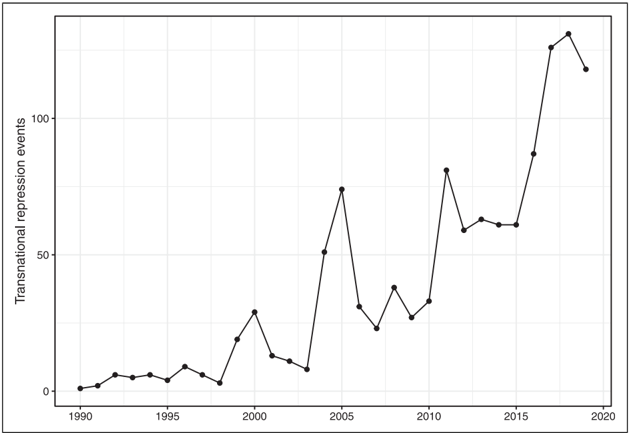
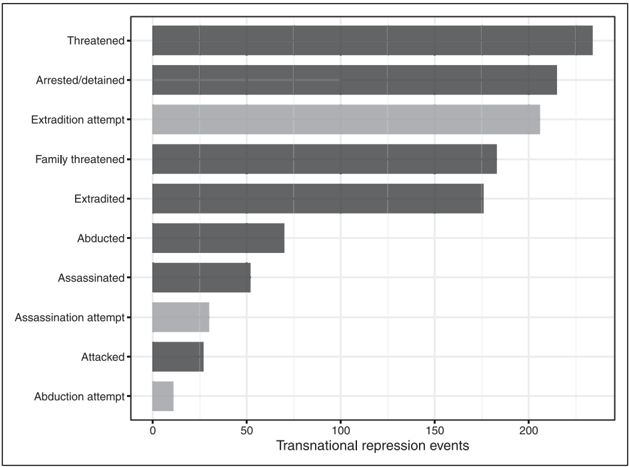
The emerging literature dealing with transnational repression has identified several strategies used by authoritarian states to control and coerce their populations abroad. This article builds on existing research by investigating the domestic determinants of transnational repression. It argues that an increase in domestic repression is likely to lead to a subsequent increase in transnational repression because crackdowns at home drive dissent abroad and incentivize the state to extend its repressive gaze beyond its borders. To evaluate its arguments, the article draws on a database of approximately 1200 cases in which authoritarian states around the world threatened, attacked, extradited, abducted, or assassinated their own citizens abroad between 1991 and 2019. Offering a first quantitative test of domestic drivers of transnational repression, using multivariate regression analysis, the paper finds that as repression intensifies domestically, the likelihood of that state subsequently escalating its transnational repression also increases substantively.
Overview
CoChat Summary
TL;DR
Using the Authoritarian Actions Abroad Database of 1,205 transnational repression events from 1991–2019, the paper argues and finds that domestic crackdowns in authoritarian states are followed by increased transnational repression. The relationship is strongest when states have diplomatic representation abroad.
Key findings
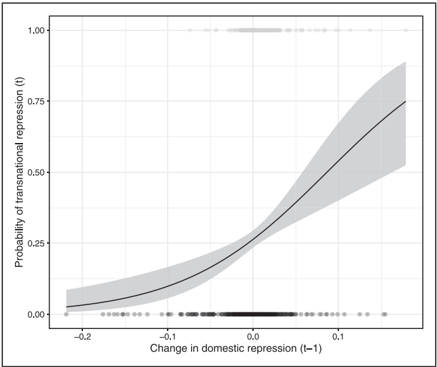
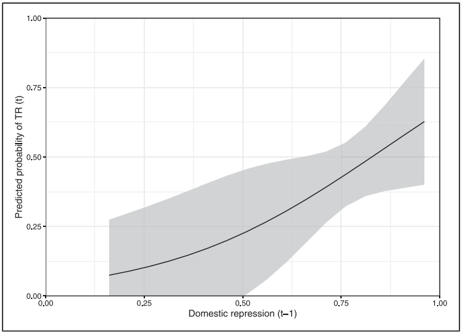
- Domestic repression is positively associated with subsequent transnational repression: Model 1 coefficient 1.09* (0.20); with controls, Model 2 coefficient 0.83 (0.26). The predicted probability of transnational repression rises from less than 20% at low domestic repression to more than 50% when domestic repression is widespread.
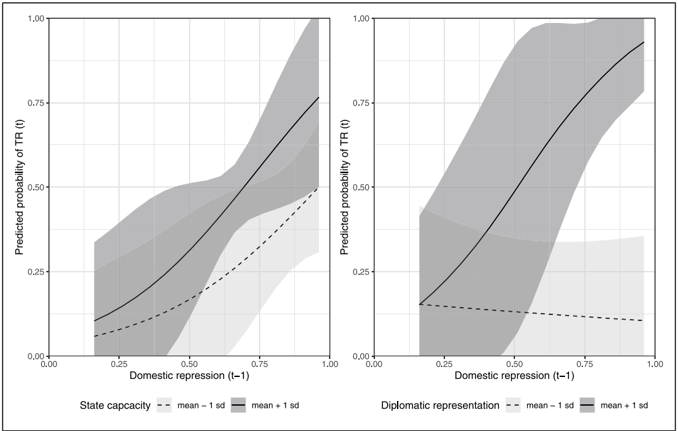
- Diplomatic representation moderates the relationship: Model 4’s interaction between domestic repression and diplomatic representation is positive and statistically significant. For states with few diplomatic ties, domestic repression does not increase transnational repression; for states with high diplomatic representation, the probability increases drastically. The state-capacity interaction is not statistically significant (0.01, SE 0.03).
- Robustness checks show a significant relationship in 13 of 21 V-Dem Civil Liberties Index component indicators, including physical violence (torture, killings), civil society repression, and freedom of foreign movement; there is no effect for forced labor and restrictions on domestic movement.
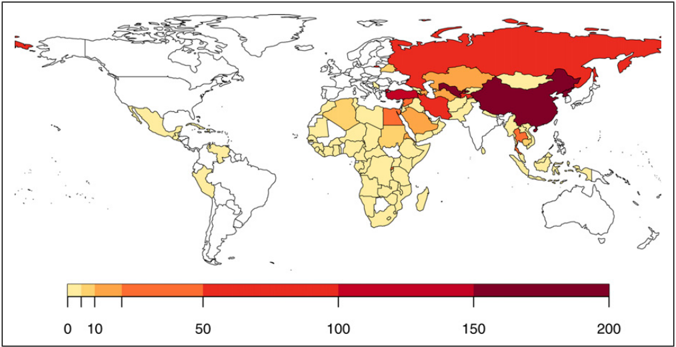
- The AAAD records 1,205 events from 1991–2019 involving 35 perpetrating source states. Frequently active source states include Uzbekistan (199), Turkey (163), China (162), North Korea (151), and Russia (74); yearly count highs include Uzbekistan 2005 (61), Syria 2011 (41), and North Korea 2004 (40).
Methods
- Panel country-year analysis of authoritarian regimes. The main dependent variable is a binary indicator for one or more transnational repression events by a source state in a year; additional models use the yearly count of repression events. The estimation sample is 857 country-year observations from 35 states (1991–2019).
- Main models use logistic regression with country and year fixed effects and mixed bias-reducing score adjustments; count models use Poisson and negative binomial specifications. Standard errors are clustered by country and year using Newey and West (1986).
- The independent variable is an inverted V-Dem Civil Liberties Index, lagged by one year. Controls include Polity score, elections, leader tenure, party and military dimension indices, population, GDP per capita, state capacity, and diplomatic representation abroad. Data come from the Authoritarian Actions Abroad Database (AAAD), initially covering 88 authoritarian regimes, though countries without at least one recorded transnational repression event are removed in the fixed-effects estimation.
Limitations
- The paper states that reliable data on transnational repression are difficult to obtain and verify because such actions are often secretive and deniable, and patterns in which cases come to light may bias results. It also notes that close dyadic relationships between autocratic states may cloak events in “friendly” states, so the analysis may underestimate the relationship between domestic and transnational repression.
- The paper states that future research should investigate variation by autocratic regime subtype rather than treating democracy and authoritarianism as binary, examine democratic states as sources or host sites of transnational repression, and trace the timing and sequencing of the two proposed pathways.
- Evident from the text: the fixed-effects estimation drops countries with no recorded transnational repression event, leaving 35 states, so findings may not generalize to all authoritarian regimes. The observational design with lagged variables and fixed effects cannot fully rule out reverse causality or unobserved confounding.
Model-written summary. Check it against the paper before relying on it.
Integrity signals
Registry
Cites
Statistics
Figures


Verification
Claims the paper makes
5 Valid · 2 Not valid · 29 Not checked · 71 Own results and interpretations
The cited sources support only part of this claim — read each source’s verdict below.
In the paper
“They can play the role of ' enablers ' by facilitating the transfer of social and political norms, including democratic values, which can, in turn, threaten authoritarian rule (Koinova 2009).”
What the sources say
- Partly supportedcites Koinova 2009 matched to “Diasporas and democratization in the post-communist world” (2009) sourceExperimental — accuracy not yet measured
The Major theoretical accounts section describes diasporas supporting democratic campaigns, civic organizations, and opposition to authoritarian regimes; the Conclusions section says they can act as agents of democratization (page numbers unavailable). These passages support the potential to challenge authoritarian rule, but do not establish that diasporas do so by transferring social and political norms, including democratic values. (LLM, conf=0.82)
plainstates a cause- Asserted: passes — The authors put it forward as true.
- Checkable: passes — It can be checked against evidence.
- Load-bearing: passes — The paper’s conclusions depend on it.
- Based: passes — The paper gives a reason why it holds.
- Partly supported
Every source the paper cites for this claim was checked and supports it.
In the paper
“Latin America stands out as a notable exception, although in the 1970s, prior to the time period of the AAAD, Operation Condor saw dictatorships in the region cooperate to neutralize one another ' s exiles (Lessa 2019).”
What the sources say
- Supportedcites Lessa 2019 matched to “Operation Condor on Trial: Justice for Transnational Human Rights Crimes in South America” (2019) source
The Introduction (p. 1) states that in late 1975 Argentina, Bolivia, Chile, Paraguay and Uruguay established a secret transnational system to share intelligence and conduct joint operations to track down left-wing activists across South America, through which 'hundreds of exiles were firstly closely monitored, and later kidnapped, tortured, and often forcibly returned to their country of origin.' Section 2 (p. 7) adds that 'Operation Condor specifically targeted exiles who had fled from their country of origin,' and The Verdict (p. 20) that the Condor states 'breached the internationally recognised right to asylum, with each state permitting persecution on political grounds against both nationals and foreign citizens.' This matches the cited clause (1970s regional dictatorships cooperating to neutralise one another's exiles); the wider 'notable exception to the AAAD' framing is the citing authors' own claim, not attributed here. (LLM, conf=0.92)
plain- Asserted: passes — The authors put it forward as true.
- Checkable: passes — It can be checked against evidence.
- Load-bearing: unclear — It is unclear whether the paper’s conclusions depend on it.
- Based: passes — The paper gives a reason why it holds.
- Supported
The sources with a verdict support this claim; the rest weren’t checked yet, have no full text we could read, or their verdicts aren’t rated yet.
In the paper
“Recent research shows the truly global dimension of TR, with dozens of states around the world involved as perpetrators of TR incidents (Dukalskis 2021; Dukalskis et al., 2022; Lemon et al., 2022; Schenkkan and Linzer 2021).”
What the sources say
- Not checked — no full text of the sourcecites Dukalskis 2021 matched to “Making the World Safe for Dictatorship” (2021) source
- Supportedcites Dukalskis et al., 2022 matched to “Transnational repression: data advances, comparisons, and challenges” (2022) source
The passage describing the TRD database in our copy states it 'includes 735 incidents of transnational repression committed by 36 origin states in 84 host states', naming China, Turkey, Egypt, Tajikistan and Russia as the most active perpetrators — i.e. several dozen origin (perpetrator) states spread across many host states, exactly what the citing sentence attributes. The surrounding framing reinforces the global scope: 'several research teams have attempted to create broader databases of TR... across varying geographic and temporal spaces', and the other datasets reported (AAAD: 1,177 incidents 1991-2019 with a top-5 of Uzbekistan, China, North Korea, Turkey, Russia; CTRU: 7,106 cases in 44 countries) are cross-national. Note the paper is a research note synthesising datasets rather than an original study, and it scopes TR to (mostly) authoritarian states, but it does itself report the perpetrator-state counts, so the attribution holds. (LLM, conf=0.88)
- Not checked — no full text of the sourcecites Lemon et al., 2022 matched to “Globalizing minority persecution: China's transnational repression of the Uyghurs” (2023) source
plain- Asserted: passes — The authors put it forward as true.
- Checkable: passes — It can be checked against evidence.
- Load-bearing: unclear — It is unclear whether the paper’s conclusions depend on it.
- Based: passes — The paper gives a reason why it holds.
The cited sources support only part of this claim — read each source’s verdict below.
In the paper
“As demonstrated during the Arab Spring, diasporic activism can be detrimental to authoritarian regime survival and stability (Beaugrand and Geisser 2016; Moss 2016).”
What the sources say
- Partly supportedcites Beaugrand and Geisser 2016 matched to “Social Mobilization and Political Participation in the Diaspora During the “Arab Spring”” (2016) sourceExperimental — accuracy not yet measured
In “The diasporic resonance of the Arab Spring” (page unavailable), the paper describes Algerian dissidents campaigning abroad against Bouteflika’s fourth mandate and Arab diaspora movements participating in the uprisings. It does not establish that those activities harmed authoritarian regimes’ survival or stability; that consequence goes beyond the passages in our copy. (LLM, conf=0.78)
- Not checked — no full text of the sourcecites Moss 2016 matched to “Transnational Repression, Diaspora Mobilization, and the Case of The Arab Spring” (2016) source
boostedstates a cause- Asserted: passes — The authors put it forward as true.
- Checkable: passes — It can be checked against evidence.
- Load-bearing: passes — The paper’s conclusions depend on it.
- Based: passes — The paper gives a reason why it holds.
- Partly supported
Every source the paper cites for this claim was checked and supports it.
In the paper
“Gathering reliable data on TR is difficult (see Dukalskis et al. 2022).”
What the sources say
- Supportedcites Dukalskis et al. 2022 matched to “Transnational repression: data advances, comparisons, and challenges” (2022) source
The paper states that researchers face a challenge in gathering reliable data because much transnational repression is intended to be unseen or deniable. It also describes hidden incidents and incomplete reporting as empirical obstacles to collecting data. (LLM, conf=0.95)
plain- Asserted: passes — The authors put it forward as true.
- Checkable: unclear — It is unclear whether it could be checked against evidence.
- Load-bearing: passes — The paper’s conclusions depend on it.
- Based: passes — The paper gives a reason why it holds.
- Supported
52 more claims
Create a free account to see all 107 claims and to verify the 4 references still open.
- It may state two separate claims as one. 29
- Probably not a substantial claim. 24
Self-check
Percentages, sums and reported differences re-computed from the paper’s own numbers.
Each contradiction between two passages listed here was confirmed by an independent check.
Rated minor: it would not touch a result — a value no result rests on, a p-value that stays on the same side of the significance level, or a conflict that is clerical, resolved elsewhere in the paper, or outside its own findings.
In the paper
§ Corresponding Author:
“Jamal Khashoggi was murdered in a Saudi consulate in Turkey in October 2018.”
§ TR Data: The Authoritarian Actions Abroad Database (AAAD)
“The example of Jamal Khashoggi referenced at the outset of this article, for example, is recorded as case ID (673), source country (Saudi Arabia), target country (Turkey), action (assassinated), target (journalist), target name (Khashoggi), year (2018), month (11)”
Citations
Cites
The Politics of Authoritarian Rule
Svolik, M. W. (2012) · doi:10.1017/cbo9781139176040 · Cited by 2,611
The New Transnational Activism
Tarrow, S. (2005) · Cambridge University Press eBooks · doi:10.1017/cbo9780511791055 · Cited by 2,383
Seeing Like a StateHow Certain Schemes to Improve the Human Condition Have Failed
West, H. G. (1998) · PoLAR: Political and Legal Anthropology Review · doi:10.1525/pol.1998.21.2.127 · Cited by 1,786
Activists beyond borders: advocacy networks in international politics
(1998) · Choice Reviews Online · doi:10.5860/choice.36-2418 · Cited by 1,741
State Repression and Political Order
Davenport, C. (2007) · Annual Review of Political Science · doi:10.1146/annurev.polisci.10.101405.143216 · Cited by 1,564 · cited 5×
“Given that there is some evidence for variation in domestic repression by autocratic regime subtype (Davenport 2007b), it is worth investigating in more detail whether and if so, how, the same logic holds for TR.”
BackgroundInfluentialAutocratic Breakdown and Regime Transitions: A New Data Set
Geddes, B., Wright, J., & Frantz, E. (2014) · Perspectives on Politics · doi:10.1017/s1537592714000851 · Cited by 1,537 · cited 1×
“The sample of states under consideration consists of 88 authoritarian regimes in line with the typologies of Geddes, Wright, and Frantz (2014) and Wahman, Teorell, and Hadenius (2013).”
MethodThe three pillars of stability: Legitimation, repression, and co-optation in autocratic regimes
Gerschewski, J. (2013) · Democratization · doi:10.1080/13510347.2013.738860 · Cited by 1,053 · cited 1×
“Yet like the domestic analog of Gerschewski ’ s Three Pillars of Authoritarian Stability model (Gerschewski 2013), repression is often deployed when persuasion or co-optation measures fall short.”
BackgroundThe Robustness of Authoritarianism in the Middle East: Exceptionalism in Comparative Perspective
Bellin, E. (2004) · Comparative Politics · doi:10.2307/4150140 · Cited by 1,020
Sticks and Stones: Naming and Shaming the Human Rights Enforcement Problem
Hafner-Burton, E. M. (2008) · International Organization · doi:10.1017/s0020818308080247 · Cited by 926 · cited 1×
“…naming and shaming ” , and fi nd that incentives to change repressive behavior when facing international condemnation vary across regime type, source of the criticism, the types of rights violations in question and their severity (Esarey and deMeritt 2017; Hafner-Burton 2008; Hendrix and Wong 2013).”
BackgroundWaldinger, R., & Fitzgerald, D. (2004) · American Journal of Sociology · doi:10.1086/381916 · Cited by 798 · cited 1×
“Research on social mobilization and diaspora advocacy (Adamson 2002; Sheffer 2003; Shain 2005; Tarrow 2005; Waldinger and Fitzgerald 2004) has long highlighted that once people leave their country of origin and settle in another, they can still have a ‘ voice ’ and opportunity to raise their…”
BackgroundDavenport, C. (1995) · American Journal of Political Science · doi:10.2307/2111650 · Cited by 623 · cited 1×
“As noted long ago by Davenport (1995), the intensity of repressive actions employed by governments is often dependent on the level of threat perception.”
BackgroundAfrica's World War: Congo, the Rwandan Genocide, and the Making of a Continental Catastrophe
Prunier, G. (2008) · Cited by 611
Diaspora Politics: At Home Abroad
Sheffer, G. (2003) · doi:10.1017/cbo9780511499432 · Cited by 540
An Empirical Evaluation of Explanations for State Repression
HILL, D. W., & JONES, Z. M. (2014) · American Political Science Review · doi:10.1017/s0003055414000306 · Cited by 450 · cited 1×
“Studies have shown that factors like lower levels of income and population density can shape patterns of resistance and therefore the level of domestic repression at home (Hill and Jones 2014).”
BackgroundNew Approaches to Migration: Transnational Communities and the Transformation of Home
Al-Ali, N. (1999) · Leiden Repository (Leiden University) · Cited by 442
Leviathan’s Latent Dimensions: Measuring State Capacity for Comparative Political Research
Hanson, J. K., & Sigman, R. (2021) · The Journal of Politics · doi:10.1086/715066 · Cited by 414 · cited 2×
“We use the Hanson and Sigman (2021) measure of state capacity, which aggregates 21 variables within three conceptual pillars of state capacity (extractive, coercive, and administrative) to arrive at a latent measure.”
BackgroundMethodState Repression and the Tyrannical Peace
Davenport, C. (2007) · Journal of Peace Research · doi:10.1177/0022343307078940 · Cited by 370 · cited 5×
“Given that there is some evidence for variation in domestic repression by autocratic regime subtype (Davenport 2007b), it is worth investigating in more detail whether and if so, how, the same logic holds for TR.”
BackgroundInfluentialAuthoritarian regime types revisited: updated data in comparative perspective
Wahman, M., Teorell, J., & Hadenius, A. (2013) · Contemporary Politics · doi:10.1080/13569775.2013.773200 · Cited by 360 · cited 1×
“The sample of states under consideration consists of 88 authoritarian regimes in line with the typologies of Geddes, Wright, and Frantz (2014) and Wahman, Teorell, and Hadenius (2013).”
MethodTo Repress or to Co‐opt? Authoritarian Control in the Age of Digital Surveillance
Xu, X. (2021) · American Journal of Political Science · doi:10.1111/ajps.12514 · Cited by 316 · cited 1×
“The forms of repression and tools available for authoritarian governments to carry out or substitute other methods of political control evolve (Frantz, Kendall-Taylor, and Wright 2020a; Guriev and Treisman 2022; Morgenbesser 2020; Olar 2019; Xu 2021).”
MethodRITTER, E. H., & CONRAD, C. R. (2016) · American Political Science Review · doi:10.1017/s0003055415000623 · Cited by 314
Hendrix, C. S., & Wong, W. H. (2013) · British Journal of Political Science · doi:10.1017/s0007123412000488 · Cited by 305 · cited 2×
“Researchers debate the effectiveness of “ naming and shaming ” , and fi nd that incentives to change repressive behavior when facing international condemnation vary across regime type, source of the criticism, the types of rights violations in question and their severity (Esarey and deMeritt 2017; Hafner-Burton 2008; H…”
BackgroundFrantz, E., & Kendall-Taylor, A. (2014) · Journal of Peace Research · doi:10.1177/0022343313519808 · Cited by 266
Transnational Repression, Diaspora Mobilization, and the Case of The Arab Spring
Moss, D. M. (2016) · Social Problems · doi:10.1093/socpro/spw019 · Cited by 261 · cited 3×
“As demonstrated during the Arab Spring, diasporic activism can be detrimental to authoritarian regime survival and stability (Beaugrand and Geisser 2016; Moss 2016).”
BackgroundThreat and Repression: The Non-Linear Relationship between Government and Opposition Violence
GARTNER, S. S., & REGAN, P. M. (1996) · Journal of Peace Research · doi:10.1177/0022343396033003003 · Cited by 251
Tsourapas, G. (2021) · International Studies Review · doi:10.1093/isr/viaa061 · Cited by 220 · cited 5×
“…domestic and transnational repression by building on the existing scholarship that examines the politics of transnational repression (e.g. Lewis 2015; Moss 2016; Cooley and Heathershaw 2018; Michaelsen 2018; Glasius 2018; Conduit 2020; Tsourapas 2021; Dukalskis 2021; Moss 2021; Glasius 2023).”
BackgroundInfluentialThe Use of Repression as a Response to Domestic Dissent
Carey, S. C. (2010) · Political Studies · doi:10.1111/j.1467-9248.2008.00771.x · Cited by 212
The New Transnational Activism
(2005) · The New Transnational Activism · doi:10.1017/cbo9780511791055.002 · Cited by 203
Extraterritorial authoritarian practices: a framework
Glasius, M. (2018) · Globalizations · doi:10.1080/14747731.2017.1403781 · Cited by 202 · cited 6×
“They have sought to meet the challenge of a networked, globalized world, in which “ a national public sphere need not be co-terminus with territorial boundaries, and hence physical exit no longer necessarily implies exit from the national public sphere ” (Glasius 2018, 181).”
BackgroundMethodInfluentialMoss, D. M. (2018) · Globalizations · doi:10.1080/14747731.2016.1263079 · Cited by 181 · cited 7×
“To be sure, TR is not an entirely new phenomenon (Adamson 2019; Lessa 2019), but the tools of globalization allow au-thoritarian states to pursue it with a broader scope and deeper reach than previously (see Moss 2018).”
BackgroundInfluentialMean and median bias reduction in generalized linear models
Kosmidis, I., Kenne Pagui, E. C., & Sartori, N. (2020) · Statistics and Computing · doi:10.1007/s11222-019-09860-6 · Cited by 167 · cited 1×
“For our main models, where the occurrence of one or more TR event is the dependent variable, we use logistic regression models with mixed bias-reducing score adjustments (Kosmidis et al. 2020).”
MethodSurveillance in China’s Xinjiang Region: Ethnic Sorting, Coercion, and Inducement
Leibold, J. (2020) · Journal of Contemporary China · doi:10.1080/10670564.2019.1621529 · Cited by 167 · cited 1×
“…intensity of repression of the group between 2014 and 2017, building a massive technological and human intelligence surveillance system to monitor the population for possible signs of disloyalty and re-education camps on a massive scale (Byler 2021; Leibold 2020; Roberts 2020; Smith Finley 2019).”
BackgroundPemstein, D., Marquardt, K. L., Tzelgov, E., Wang, Y.-T., Medzihorsky, J., Krusell, J., Miri, F., & von Römer, J. (2021) · SSRN Electronic Journal · doi:10.2139/ssrn.3799967 · Cited by 166
Michael Coppedge, J. G. (2022) · Varieties of Democracy · doi:10.23696/vdemds22 · Cited by 164
The menu of autocratic innovation
Morgenbesser, L. (2020) · Democratization · doi:10.1080/13510347.2020.1746275 · Cited by 157 · cited 3×
“Authoritarian states learn and adapt their methods of control over time (Guriev and Treisman 2022; Morgenbesser 2020), including when it comes to modes of repression (Olar 2019).”
BackgroundMethodExit and voice in a digital age: Iran’s exiled activists and the authoritarian state
Michaelsen, M. (2018) · Globalizations · doi:10.1080/14747731.2016.1263078 · Cited by 156 · cited 3×
“For these reasons, authoritarian states strive to destroy the links between domestic opponents of the regime and international activists (Cooley and Heathershaw 2018; Michaelsen 2018; Moss 2018; Tsourapas 2021).”
BackgroundCounterterrorism and Preventive Repression: China's Changing Strategy in Xinjiang
Greitens, S. C., Lee, M., & Yazici, E. (2020) · International Security · doi:10.1162/isec_a_00368 · Cited by 152 · cited 1×
“…Uyghurs are “ to persuade citizens to return to China for re-education; to create mistrust among diaspora members and thereby limit collective mobilization; and to discourage Uyghurs from making appeals for host-country support or engaging in public advocacy ” (Greitens, Lee, and Yazici 2020, 20).”
BackgroundCollyer, M., & King, R. (2015) · Progress in Human Geography · doi:10.1177/0309132514521479 · Cited by 151
Making the World Safe for Dictatorship
Dukalskis, A. (2021) · doi:10.1093/oso/9780197520130.001.0001 · Cited by 151 · cited 5×
“It requires spatial reach and different personnel and tactics to repress in another sovereign jurisdiction (Dukalskis 2021, 71).”
BackgroundMethodInfluentialSelf-citationPolitical Repression in Modern America: FROM 1870 TO 1976
Goldstein, R. J. (2001) · Medical Entomology and Zoology · Cited by 138
The Ideological Shadow of Authoritarianism
Dinas, E., & Northmore-Ball, K. (2020) · Comparative Political Studies · doi:10.1177/0010414019852699 · Cited by 138
Smith Finley, J. (2019) · Central Asian Survey · doi:10.1080/02634937.2019.1586348 · Cited by 133 · cited 1×
“…intensity of repression of the group between 2014 and 2017, building a massive technological and human intelligence surveillance system to monitor the population for possible signs of disloyalty and re-education camps on a massive scale (Byler 2021; Leibold 2020; Roberts 2020; Smith Finley 2019).”
BackgroundMobilising the Diaspora: How Refugees Challenge Authoritarianism
Betts, A., & Jones, W. (2016) · Cambridge University Press eBooks · doi:10.1017/9781316672020 · Cited by 122 · cited 1×
“While abroad, he organized a non-violent opposition political party in cooperation with other prominent exiles (Betts and Jones 2016, 128).”
BackgroundPersonalization of Power and Repression in Dictatorships
Frantz, E., Kendall-Taylor, A., Wright, J., & Xu, X. (2019) · The Journal of Politics · doi:10.1086/706049 · Cited by 120 · cited 1×
“This accords with other research that shows how mass mobilization is a frequent and destabilizing threat faced by contemporary dic-tatorships (Frantz et al. 2020b, 1).”
ResultNon‐state authoritarianism and diaspora politics
ADAMSON, F. B. (2020) · Global Networks · doi:10.1111/glob.12246 · Cited by 116 · cited 3×
“This literature (see among others, Lewis 2015; Collyer and King 2015; Dalmasso et al. 2018; Glasius 2018; Adamson 2019; 2020; Tsourapas 2021; Dukalskis 2021; Moss 2021; Glasius 2023) highlights the lengths to which states go to control and coerce their populations abroad.”
BackgroundHassan, M., Mattingly, D., & Nugent, E. R. (2022) · Annual Review of Political Science · doi:10.1146/annurev-polisci-051120-013321 · Cited by 113
Autocracies, democracies, and the violation of civil liberties
Møller, J. Ø., & Skaaning, S. (2013) · Democratization · doi:10.1080/13510347.2013.738863 · Cited by 109 · cited 1×
“Democracies in general protect civil liberties better than do au-tocracies (Møller and Skaaning 2013) and typically have institutional channels through which dissenting voices can advocate for their causes with less fear of repression (deMeritt 2016).”
BackgroundRwanda: from genocide to precarious peace
Salton, H. T. (2019) · International Affairs · doi:10.1093/ia/iiy270 · Cited by 105 · cited 1×
“He was also potentially privy to details about a massacre in April 1995 of displaced persons in Kibeho in southern Rwanda, having arrived at the scene shortly after the violence (Prunier 2009, 37 – 41; Thomson 2018, 90 – 91).”
BackgroundDiasporas and democratization in the post-communist world
Koinova, M. (2009) · Communist and Post-Communist Studies · doi:10.1016/j.postcomstud.2009.02.001 · Cited by 104 · cited 1×
“They can play the role of ‘ enablers ’ by facilitating the transfer of social and political norms, including democratic values, which can, in turn, threaten authoritarian rule (Koinova 2009).”
BackgroundDictators without borders: power and money in central Asia
Gould-Davies, N. (2017) · International Affairs · doi:10.1093/ia/iix172 · Cited by 99
The war on the Uyghurs: China’s internal campaign against a Muslim minority
Khalid, A. (2021) · Central Asian Survey · doi:10.1080/02634937.2021.1893463 · Cited by 99
Edel, M., & Josua, M. (2018) · Democratization · doi:10.1080/13510347.2018.1439021 · Cited by 94
Intervention: Extraterritorial authoritarian power
Dalmasso, E., Del Sordi, A., Glasius, M., Hirt, N., Michaelsen, M., Mohammad, A. S., & Moss, D. (2018) · Political Geography · doi:10.1016/j.polgeo.2017.07.003 · Cited by 93 · cited 2×
“They also try to legitimate their rule, co-opt potential challengers, and otherwise bind their diaspora populations to the homeland controlled by the government (Baser and Ozturk 2020; Dalmasso et al., 2018; Glasius 2018; Needham and Grubb 2022; Tsourapas 2021).”
BackgroundPolitical Context and the Consequences of Naming and Shaming for Human Rights Abuse
Esarey, J., & DeMeritt, J. H. R. (2016) · International Interactions · doi:10.1080/03050629.2016.1223656 · Cited by 84
Authoritarian States and Voting From Abroad: North African Experiences
Brand, L. A. (2010) · Comparative Politics · doi:10.5129/001041510x12911363510439 · Cited by 81 · cited 1×
“In this sense, the use of TR practices can be linked back to the traditional sovereign concerns regarding political control (Brand 2010, 86).”
BackgroundLewis, D. (2015) · Nationalities Papers · doi:10.1080/00905992.2014.980796 · Cited by 79 · cited 3×
“…between domestic and transnational repression by building on the existing scholarship that examines the politics of transnational repression (e.g. Lewis 2015; Moss 2016; Cooley and Heathershaw 2018; Michaelsen 2018; Glasius 2018; Conduit 2020; Tsourapas 2021; Dukalskis 2021; Moss 2021; Glasius…”
BackgroundThe Strategic Use of State Repression and Political Violence
deMeritt, J. H. R. (2016) · Oxford Research Encyclopedia of Politics · doi:10.1093/acrefore/9780190228637.013.32 · Cited by 79 · cited 1×
“Democracies in general protect civil liberties better than do au-tocracies (Møller and Skaaning 2013) and typically have institutional channels through which dissenting voices can advocate for their causes with less fear of repression (deMeritt 2016).”
BackgroundBaser, B., & Ozturk, A. E. (2020) · Middle East Critique · doi:10.1080/19436149.2020.1770449 · Cited by 70 · cited 2×
“They also try to legitimate their rule, co-opt potential challengers, and otherwise bind their diaspora populations to the homeland controlled by the government (Baser and Ozturk 2020; Dalmasso et al., 2018; Glasius 2018; Needham and Grubb 2022; Tsourapas 2021).”
BackgroundThe Frontier of Loyalty: Political Exiles in the Age of the Nation-State
Shain, Y. (2005) · doi:10.3998/mpub.93349 · Cited by 64
Authoritarian Practices in a Global Age
Glasius, M. (2023) · doi:10.1093/oso/9780192862655.001.0001 · Cited by 60
Measuring Mutual Dependence between State Repressive Actions
Fariss, C. J., & Schnakenberg, K. E. (2014) · Journal of Conflict Resolution · doi:10.1177/0022002713487314 · Cited by 57 · cited 1×
“In this sense, TR is like domestic repression in which governments aim to counter or eliminate behaviors that threaten the political system or the status quo (Davenport 2007b; on the complementarity of different forms of state repression, see Fariss and Schnakenberg 2014).”
BackgroundMoss, D. M., Michaelsen, M., & Kennedy, G. (2022) · Global Networks · doi:10.1111/glob.12372 · Cited by 57 · cited 1×
“Nonetheless, autocracies adapt to such challenges and innovate tactics like digital methods mentioned above, or punishment of exiled dis-sidents ’ families at home to pressure the dissident abroad (Moss et al., 2022).”
BackgroundThin-skinned leaders: regime legitimation, protest issues, and repression in autocracies
Keremoğlu, E., Hellmeier, S., & Weidmann, N. B. (2021) · Political Science Research and Methods · doi:10.1017/psrm.2021.19 · Cited by 56
Self-citationElite Survival Strategies and Authoritarian Reversal in Turkey
Bayulgen, O., Arbatli, E., & Canbolat, S. (2018) · Polity · doi:10.1086/698203 · Cited by 54 · cited 1×
“The government launched a campaign against Gülenists in all corners of society, detaining or arresting tens of thousands of people, and closing more than 100 media outlets and hundreds of civil society organizations (Bayulgen, Arbatli, and Canbolat 2018, 357).”
BackgroundTransnational repression: data advances, comparisons, and challenges
Dukalskis, A., Furstenberg, S., Gorokhovskaia, Y., Heathershaw, J., Lemon, E., & Schenkkan, N. (2022) · Political Research Exchange · doi:10.1080/2474736x.2022.2104651 · Cited by 54 · cited 3×
“Recent research shows the truly global dimension of TR, with dozens of states around the world involved as perpe-trators of TR incidents (Dukalskis 2021; Dukalskis et al., 2022; Lemon et al., 2022; Schenkkan and Linzer 2021).”
BackgroundMethodSelf-citationInternational Sports Events and Repression in Autocracies: Evidence from the 1978 FIFA World Cup
Scharpf, A., Gläßel, C., & Edwards, P. (2022) · American Political Science Review · doi:10.1017/s0003055422000958 · Cited by 54 · cited 1×
“Recent trends in the sub fi eld have moved toward ever more fi ne-grained and local analysis of repression using spatial mapping tools (for an excellent recent example, see Scharpf, Gl¨aßel, and Edwards 2022).”
MethodGlobalizing minority persecution: China's transnational repression of the Uyghurs
Lemon, E., Jardine, B., & Hall, N. (2023) · Globalizations · doi:10.1080/14747731.2022.2135944 · Cited by 52 · cited 5×
“It can further include wings of the ruling political party (Needham and Grubb 2022), educational associations of the host state (Lemon et al. 2022, 11), intelligence of fi cers sent abroad clandestinely for short periods of time (Hubbard 2021), sub-contracting to criminal gangs (Glasius 2023), or…”
BackgroundMethodInfluentialDo they know something we don’t? Diffusion of repression in authoritarian regimes
Olar, R.-G. (2019) · Journal of Peace Research · doi:10.1177/0022343318822718 · Cited by 50 · cited 2×
“Authoritarian states learn and adapt their methods of control over time (Guriev and Treisman 2022; Morgenbesser 2020), including when it comes to modes of repression (Olar 2019).”
MethodTeorell, J., & Lindberg, S. I. (2019) · Perspectives on Politics · doi:10.1017/s1537592718002098 · Cited by 49 · cited 1×
“To gauge the importance of different actors in authoritarian regimes we use continuous estimates of the executive ’ s sources of power contained in the V-Dem data set: the military and party dimension index (Teorell and Lindberg 2019).”
MethodWhat One Sees and How One Files Seeing: Human Rights Reporting, Representation and Action 1
Moon, C. (2012) · Sociology · doi:10.1177/0038038512451530 · Cited by 48 · cited 1×
“Individuals fl eeing authoritarian rule and domestic crackdowns can have a particularly outsized role as they can testify fi rst-hand to the human experience of repression, which can be used in human rights reporting as a powerful spur to action (Moon 2012).”
BackgroundState Capacity, Democracy, and the Violation of Personal Integrity Rights
Young, J. K. (2009) · Journal of Human Rights · doi:10.1080/14754830903324712 · Cited by 48 · cited 1×
“While some work has found that higher levels of state capacity are associated with lower levels of repression domestically because leaders in stronger states feel more secure (Young 2009), our theory begins from the premise of a domestic crackdown.”
BackgroundLemon, E. (2019) · Journal of Democracy · doi:10.1353/jod.2019.0019 · Cited by 48 · cited 3×
“…Grubb 2022), educational associations of the host state (Lemon et al. 2022, 11), intelligence of fi cers sent abroad clandestinely for short periods of time (Hubbard 2021), sub-contracting to criminal gangs (Glasius 2023), or through cooperation with host state personnel (Lemon 2019), among others.”
BackgroundThe Arab Spring Abroad: Diaspora Activism against Authoritarian Regimes
Moss, D. M. (2021) · doi:10.1017/9781108980036 · Cited by 44 · cited 4×
“This literature (see among others, Lewis 2015; Collyer and King 2015; Dalmasso et al. 2018; Glasius 2018; Adamson 2019; 2020; Tsourapas 2021; Dukalskis 2021; Moss 2021; Glasius 2023) highlights the lengths to which states go to control and coerce their populations abroad.”
BackgroundInfluentialSpatialising state practices through transnational repression
Furstenberg, S., Lemon, E., & Heathershaw, J. (2021) · European Journal of International Security · doi:10.1017/eis.2021.10 · Cited by 41 · cited 2×
“As argued by Furstenberg, Lemon, and Heathershaw (2021, 361), “ for authoritarian governments, extraterritorial security practices form an extension of their domestic pursuit of regime security.”
BackgroundMethodSelf-citationDrawing a line: Digital transnational repression against political exiles and host state sovereignty
Michaelsen, M., & Thumfart, J. (2022) · European Journal of International Security · doi:10.1017/eis.2022.27 · Cited by 40 · cited 1×
“Digital tools, for example, facilitate activism but also instantaneous surveillance and intimidation of exiles thousands of miles away (Moss 2018; Michaelsen 2018; Michaelsen and Thumfart 2022).”
BackgroundHow Authoritarians Use International Law
Ginsburg, T. (2020) · Journal of Democracy · doi:10.1353/jod.2020.0054 · Cited by 39 · cited 1×
“Authoritarian states learn to exploit contextual changes in technology, the international legal environment, and foreign relations to pursue their objectives and mitigate challenges and vulnerabilities introduced by globalization (Frantz, Kendall-Taylor, and Wright 2020a; Ginsburg 2020).”
BackgroundDying for Rights: Putting North Korea’s Human Rights Abuses on the Record
Fahy, S. (2019) · Columbia University Press eBooks · doi:10.7312/fahy17634 · Cited by 33 · cited 1×
“(e.g. Uyghurs abroad in the case of China, see Lemon et al. 2022) or simply due to the fact that they are abroad (e.g. North Korean defectors, see Fahy 2019, 131) are the most frequent targets of TR. Activists and journalists constitute the second and third most frequently targeted groups,…”
BackgroundIn the camps: China’s high-tech penal colony
Bhadauriya, V. S. (2024) · Asian Ethnicity · doi:10.1080/14631369.2024.2420631 · Cited by 31
MBS: The Rise to Power of Mohammed bin Salman
Juul, P. M. (2020) · Middle East Policy · doi:10.1111/mepo.12506 · Cited by 30 · cited 2×
“…Grubb 2022), educational associations of the host state (Lemon et al. 2022, 11), intelligence of fi cers sent abroad clandestinely for short periods of time (Hubbard 2021), sub-contracting to criminal gangs (Glasius 2023), or through cooperation with host state personnel (Lemon 2019), among others.”
BackgroundInformation control by public punishment: The logic of signalling repression in China
Ruan, L., Knockel, J., & Crete‐Nishihata, M. (2020) · China Information · doi:10.1177/0920203x20963010 · Cited by 30 · cited 1×
“Threats often come via transnational technological platforms, such as when Chinese security agents use the messaging app WeChat to threaten political dissidents and activists (Ruan, Knockel, and Crete-Nishihata 2021), but they may also be in-person and organized through embassies in the host state.”
BackgroundOperation Condor on Trial: Justice for Transnational Human Rights Crimes in South America
Lessa, F. (2019) · Journal of Latin American Studies · doi:10.1017/s0022216x18000767 · Cited by 29 · cited 3×
“While TR is not in itself new (e.g. Lessa 2019), in the context of globalization and migration, today ’ s authoritarian states have turned to TR as a newly salient tool to neutralize political threats.”
BackgroundAuthoritarian power in space, time and exile
Conduit, D. (2020) · Political Geography · doi:10.1016/j.polgeo.2020.102239 · Cited by 28 · cited 2×
“As further argued by Conduit (2020, 2): “ actors (be they regimes or exiled oppositions) may therefore seek to stretch space to make power more diffuse or shorten that distance to make their presence felt somewhere where they are not.”
BackgroundMoyer, J. D., Turner, S., & Meisel, C. J. (2020) · Journal of Peace Research · doi:10.1177/0022343320929740 · Cited by 23 · cited 2×
“The results look different for the interaction between domestic repression and a state ’ s diplomatic representation abroad using the data by Moyer et al. 2021.”
MethodExploring Disagreement in Indicators of State Repression
Cope, K. L., Crabtree, C. D., & Fariss, C. J. (2017) · Political Science Research and Methods · doi:10.1017/psrm.2018.62 · Cited by 21
Social Mobilization and Political Participation in the Diaspora During the “Arab Spring”
Beaugrand, C., & Geisser, V. (2016) · Journal of Immigrant & Refugee Studies · doi:10.1080/15562948.2016.1212133 · Cited by 20 · cited 2×
“As demonstrated during the Arab Spring, diasporic activism can be detrimental to authoritarian regime survival and stability (Beaugrand and Geisser 2016; Moss 2016).”
BackgroundLicht, A. A., & Allen, S. H. (2018) · Journal of Peace Research · doi:10.1177/0022343317750215 · Cited by 18 · cited 1×
“Therefore, we account for the possibility that clampdowns around election time would drive the results (see Freyburg and Garbe 2018), that repression inside and outside the country spikes during regime transitions (Licht and Allen 2018), and that regime consolidation is a confounding factor.”
BackgroundNowhere to Hide? Global Policing and the Politics of Extradition
Krcmaric, D. (2022) · International Security · doi:10.1162/isec_a_00444 · Cited by 18 · cited 1×
“Arrest/detention and extradition often require the complicity of the host state and/or the abuse of international agreements (on the politics of ex-tradition see Krcmaric 2022).”
BackgroundLINKAGES AND STRATEGIES IN FILIPINO DIASPORA MOBILIZATION FOR REGIME CHANGE*
Quinsaat, S. M. (2019) · Mobilization An International Quarterly · doi:10.17813/1086-671x-24-2-221 · Cited by 16 · cited 1×
“A country ’ s diaspora can play a key role in naming and shaming as they have insider knowledge, linguistic skills, connections, and motivation to work for change from abroad (e.g. Quinsaat 2019).”
BackgroundSchlumberger, O. (2017) · Oxford University Press eBooks · doi:10.1093/oxfordhb/9780199935307.013.18 · Cited by 16
The Politics of Repression Under Authoritarian Rule: How Steadfast is the Iron Throne?
Tanneberg, D. (2020) · Contributions to Political Science · doi:10.1007/978-3-030-35477-0 · Cited by 13 · cited 1×
“Scholars contend that the index provides “ [ … ] reliable and valid information on restrictions and violence under authoritarian rule ” (Tanneberg 2020, 57), and it has been used as a measure of repression in prior quantitative work (e.g. Dinas and Northmore-Ball 2020).”
MethodTerrorism and the Varieties of Civil Liberties
Rubin, M. A., & Morgan, R. K. (2021) · Journal of Global Security Studies · doi:10.1093/jogss/ogaa032 · Cited by 9
The Political Costs of Abusing Human Rights: International Cooperation in Extraordinary Rendition
Cordell, R. (2020) · Journal of Conflict Resolution · doi:10.1177/0022002720967434 · Cited by 6 · cited 1×
“The extraordinary rendition of foreign citizens (Cordell 2021), for example, is not included as TR. Reliable information about TR is dif fi cult to obtain and verify.”
BackgroundControlling the Opposition Abroad: Cambodia’s Extraterritorial Activities in Long Beach, California
Needham, S., & Grubb, S. (2022) · Pacific Affairs · doi:10.5509/952205 · Cited by 2 · cited 2×
“They also try to legitimate their rule, co-opt potential challengers, and otherwise bind their diaspora populations to the homeland controlled by the government (Baser and Ozturk 2020; Dalmasso et al., 2018; Glasius 2018; Needham and Grubb 2022; Tsourapas 2021).”
BackgroundConclusion: Looking Backward, Forward, and Inward
Dukalskis, A. (2021) · Oxford University Press eBooks · doi:10.1093/oso/9780197520130.003.0009
Self-citation
Research works printed but not linked: 15
- Adamson, Fiona. 2019. ' No Escape: Long-Distance Repression, Extraterritorial States and the Underworld of IR. ' In European Consortium of Political Research Joint Sessions of Workshops . ECPR.
- Bell Curtis, 2021, The Rulers, Elections, and Irregular Governance (REIGN) Dataset
- Berg´ e, Laurent. 2018. ' Efficient Estimation of Maximum Likelihood Models with Multiple Fixed-Effects: The R Package FENmlm. ' In 13. DEM Discussion Paper Series . Department of Economics at the University of Luxembourg. https://EconPapers.repec.org/RePEc:luc: wpaper:18-13
- 10.1177/0022002720967434 · DOI
- Frantz Erica, 2020, Digital Repression in Autocracies
- Freyburg, Tina, and Lisa Garbe. 2018. ' Authoritarian Practices in the Digital Age| Blocking the Bottleneck: Internet Shutdowns and Ownership at Election Times in Sub-Saharan Africa. ' International Journal of Communication 12 (0): 21. https://ijoc.org/index.php/ijoc/article/ view/8546
- Front Line Defenders. 2022. Location . In Front Line Defenders. https://www.frontlinedefenders. org/en/location
- Furstenberg, Saipira, John Heathershaw, Edward Lemon, David Lewis, and Cooley Alexander. 2020. Central Asian Political Exiles Codebook . https://excas.net/wp-content/uploads/2020/ 09/CAPE\_Codebook.pdf
- Guriev Sergei, 2022, Spin Dictators
- Human Rights Watch. 2014. ' Rwanda: Repression Across Borders. ' Human Rights Watch 28, 2014. https://www.hrw.org/news/2014/01/28/rwanda-repression-across-borders# - Keck, Margaret E., and Kathryn Sikkink. 1998. Activists beyond Borders: Advocacy Networks in International Politics . Ithaca, NY: Cornell University Press.
- Marshall, Monty G., and Ted Gurr. 2020. POLITY5. Political Regime Characteristics and Transitions, 1800-2018. Dataset Users ' Manual . Center for Systemic Peace. http://www. systemicpeace.org/inscr/p5manualv2018.pdf
- Niekerk, Brett van, Kiru Pillay, and Manoj Maharaj. 2011. ' The Arab Spring| Analyzing the Role of ICTs in the Tunisian and Egyptian Unrest from an Information Warfare Perspective. ' International Journal of Communication 5: 1406-16. https://ijoc.org/index.php/ijoc/article/ view/1168
- Russell, Jago. 2018. Turkey ' s War on Dissent Goes Global . Foreign Policy. https://foreignpolicy. com/2018/05/01/turkeys-war-on-dissent-goes-global/
- Schenkkan, Nate, and Isabel Linzer. 2021. Out of Sight, Not Out of Reach: The Global Scale and Scope of Transnational Repression . Freedom House.
- Xinjiang Victims Database. 2019. Xinjiang Victims Database . https://shahit.biz/eng/
Cited by
Autocracy's long reach: explaining host country influences on transnational repression
Michaelsen, M., & Ruijgrok, K. (2023) · Democratization · doi:10.1080/13510347.2023.2267448 · Cited by 34
Transnational Repression: International Cooperation in Silencing Dissent
Cordell, R., & Medhi, K. (2024) · International Studies Quarterly · doi:10.1093/isq/sqae108 · Cited by 20
Challenges and Opportunities for Transnational Advocacy
Hall, N., Reiners, N., Basu, S., Chaudhry, S., Henry, L. A., Medie, P. A., Sundstrom, L. M., Vilán, A., & Zvobgo, K. (2025) · International Studies Review · doi:10.1093/isr/viaf015 · Cited by 19
Authoritarian states and their new generation(s) diasporas: an introduction
Orjuela, C., Wackenhut, A. F., & Hirt, N. (2024) · Globalizations · doi:10.1080/14747731.2024.2432755 · Cited by 11
Why do autocracies enfranchise their citizens abroad? A large-N event history analysis, 1990–2010
Fliess, N., Kiani, A., & Østergaard‐Nielsen, E. (2024) · Democratization · doi:10.1080/13510347.2024.2383795 · Cited by 10
Metadata
- Authors
- Dukalskis, A., Furstenberg, S., Hellmeier, S., & Scales, R.
- Affiliations
- University College Dublin (IE)
- Ca' Foscari University of Venice (IT)
- University of Konstanz (DE)
- Corresponding author
- Hellmeier, Sebastian
- Venue
- Journal of Conflict Resolution
- Publisher
- SAGE Publications
- Published
- 2023-07-13
- Volume
- 68
- Issue
- 6
- Pages
- 1051-1079
- ISSN
- 0022-0027 (ISSN-L)
- 1552-8766
- OpenAlex
- W4384153613
- Cited by
- 31
- References
- 94
- Citations by year
- 2026: 15 · 2025: 6 · 2024: 9 · 2023: 1
- FWCI
- 13.29
- Type
- journal article
- Language
- en
- Open access
- hybrid
- doi.org
- Licence
- Locations
- Journal of Conflict Resolution (publishedVersion, cc-by-nc)
- RePEc: Research Papers in Economics (submittedVersion)
- Econstor (Econstor) (submittedVersion, cc-by-nc)
- Social Science Open Access Repository (GESIS – Leibniz Institute for the Social Sciences) (submittedVersion, cc-by-nc)
- Topics
- Social Sciences › Sociology and Political Science › Political Conflict and Governance
- Social Sciences › Political Science and International Relations › International Relations and Foreign Policy
- Social Sciences › Sociology and Political Science › Crime, Illicit Activities, and Governance
- Keywords
- transnational repression, authoritarianism, domestic repression, crackdown, extradition, abduction, assassination
About these checks
Registry, retraction, Cites and statistics results are computed, not judged, with one exception: a printed reference that no index lists is read once by a model before it counts as a citation error. Claims are extracted by a model and kept only when their quote appears verbatim in the text; each cited source is then checked, with a model’s help, for whether it says what the claim relies on. Those verdicts can be wrong — read the claim’s quote and the cited source before relying on one.
The claim verdicts this report counts are experimental: their accuracy is not yet measured.
A language model drew the claims from the paper on 2026-10-11, under version 3 of the claim definition (model deepseek-v4.1-flash, prompt extract-v3).
A second model labelled each claim on 2026-10-11 (model jev-1.13-20260917, definition revision gold-guideline-v0.2).
Cited sources are checked with a language model’s help (gpt-6-sol and qwen3.8-omni-flash).
Statistics and arithmetic are recomputed, not judged.
Confidence bands are shown only for fields calibrated on our annotated test set. None is calibrated yet, so no band is shown.
What counts as a claim ›How we measure confidence ›How we check this ›
Are you an author, or do you see a problem with this page? Request a review
Data sources
Bibliographic data: Semantic Scholar, OpenAlex, Crossref.
Contains information from the Semantic Scholar Academic Graph Datasets, made available under the ODC Attribution License (ODC-BY 1.0).
Semantic Scholar’s data is described in: Kinney, R., et al. (2023). The Semantic Scholar Open Data Platform. arXiv:2301.10140.
