

Assessment of the acute subjective psychedelic experience: A review of patient-reported outcome measures in clinical research on classical psychedelics
Open accessThe DOI matches its Crossref record; 68 of the 68 references it cites were found in a registry or an index; 30 of the 58 sources its claims cite were checked for support.
Abstract
The classical psychedelics psilocybin, peyote, ayahuasca/ N, N-dimethyltryptamine, and lysergic acid diethylamide can temporarily produce altered states of consciousness, characterized by changes in sensory perception, thought, mood, and the sense of self-reality and meaning. It is important to have reliable instruments for quantifying these altered states in trials, due to a plausible link between the acute subjective experience and treatment outcome. Methods: We conducted a review of outcome measures applied in research on classical psychedelics to assess one or more dimensions of the acute subjective psychedelic experience. Three relevant databases were searched electronically. Two reviewers independently conducted article selection and data extraction regarding the instruments, dimensions, geography, population, and psychedelic substance investigated in the included studies. We identified the five most utilized instruments for the most recent 6 years, as well as the five most utilized instruments for each psychedelic. Results: We included 93 papers, which reported on 93 unique trials and utilized 17 different rating scales. Of these, the most utilized were the Five-Dimensional Altered States of Consciousness Questionnaire, visual analog or Likert scales specially developed for the trials, the Hallucinogen Rating Scale, the States of Consciousness Questionnaire, and the Abnormer Psychischer Zustand. Discussion: Considerable variability was found in the instruments utilized in clinical trials on classical psychedelics.
Overview
CoChat Summary
TL;DR
This review mapped patient-reported outcome measures used to assess the acute subjective psychedelic experience in clinical research on classical psychedelics. Across 93 papers/trials, the authors found 17 instruments and substantial heterogeneity, with the 5D-ASC and HRS used most often.
Key findings
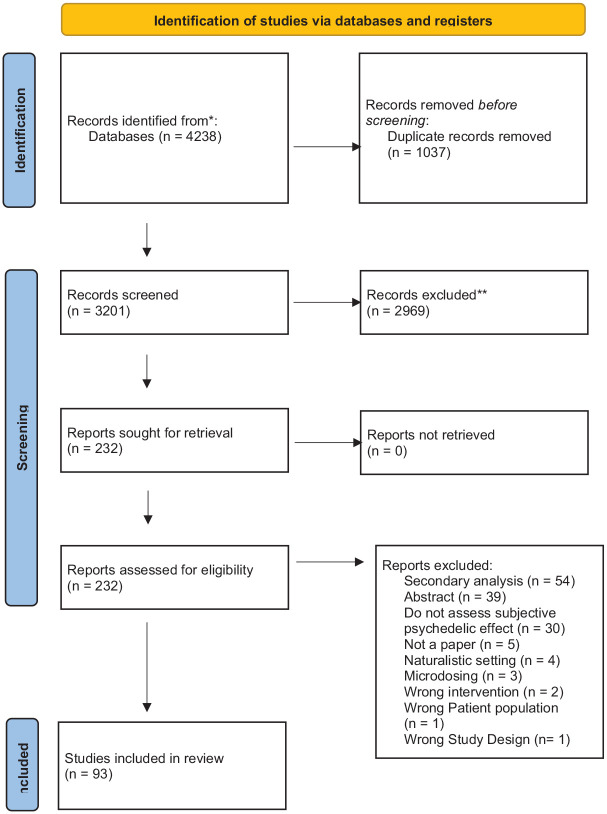
- The review included 93 papers, representing 93 unique trials, and identified 17 different rating scales; it also identified 4 emerging instruments.
- The most used instruments across all trials were the 5D-ASC (54 trials, 58%), purpose-made VAS/Likert instruments (27 trials, 29%), the HRS (23 trials, 25%), the MEQ30 (15 trials, 16%), and the SOCQ (14 trials, 15%).
- In the most recent 8 years (2016–2023), 62% of the 93 trials were published; the most used instruments in that subset were the 5D-ASC (40 trials, 69%), PurposeM (20 trials, 34%), the MEQ30 (15 trials, 26%), and the HRS and SOCQ (9 trials each, 16%).
- By substance, psilocybin accounted for 56% of included studies, LSD for 25%, and ayahuasca/DMT for 17%; the 5D-ASC dominated psilocybin and LSD studies, while the HRS was most used in DMT/ayahuasca studies (81% of that subsample).
Methods
- The authors conducted a review of outcome measures used to assess one or more dimensions of the acute subjective psychedelic experience in clinical research on classical psychedelics.
- They searched PubMed, Embase, and APA PsycNet from January 1, 1990 to May 22, 2023, and included peer-reviewed English or Danish human clinical studies using psilocybin, DMT/ayahuasca, LSD, or mescaline.
- Two reviewers independently screened and extracted data on instruments, dimensions, geography, population, and substance; they also grouped instrument content into seven domains and summarized frequencies of use.
Limitations
- The paper states that it did not systematically search protocols or trial registers, so it may have underestimated instrument use because some measures could have been used but not reported in the primary papers.
- The authors note that their description of instrument validity is possibly incomplete because it was based on hand-searching included trials only.
- The grouping of items into domains is limited by the authors’ interpretation and not by other stakeholders; this is an explicit limitation stated in the paper.
- Evident from the text: the review excluded microdosing studies and some more generic psychiatric scales, so its findings do not cover all possible subjective-effect measures used in psychedelic research.
Model-written summary. Check it against the paper before relying on it.
Integrity signals
Registry
Cites
Statistics
Figures
Verification
Claims the paper makes
26 Valid · 2 Not valid · 16 Not checked · 29 Own results and interpretations
The cited sources support only part of this claim — read each source’s verdict below.
In the paper
“Validation studies have found three oblique primary dimensions (Dittrich, 1996; Dittrich et al., 1985; Studerus et al., 2010): Oceanic Boundlessness (OBN), measuring positively experienced depersonalization and derealization, deeply felt positive mood, and experiences of unity, similar to spontaneous mystical experiences as described in the scientific literature on the psychology of religion (St”
§ Assessment of the acute subjective psychedelic experience: A review of patient-reported outcome measures in clinical research on classical psychedelics > Results > Study selection
What the sources say
- Not matchedcites Dittrich, 1996
An author–year citation the paper’s reference list doesn’t settle. We don’t search these by name.
- Not matchedcites Dittrich et al., 1985
An author–year citation the paper’s reference list doesn’t settle. We don’t search these by name.
- Supportedcites Studerus et al., 2010 matched to “Psychometric evaluation of the altered states of consciousness rating scale (OAV)” (2010) source
The Introduction reports that analyses of APZ items identified three oblique primary dimensions: OBN, DED, and VRS. The Discussion cautions that this paper's OAV analysis did not independently validate a parsimonious three-factor structure, but that does not contradict the claim about what the earlier APZ studies found. (LLM, conf=0.91)
plain- Asserted: passes — The authors put it forward as true.
- Checkable: passes — It can be checked against evidence.
- Load-bearing: unclear — It is unclear whether the paper’s conclusions depend on it.
- Based: passes — The paper gives a reason why it holds.
- Not matched
The cited sources support only part of this claim — read each source’s verdict below.
In the paper
“Assessing the subjective effects of psychedelics is essential since much research has indicated an association between the characteristic psychedelic experience and a positive effect on the symptomatology of several psychiatric illnesses.”
§ Assessment of the acute subjective psychedelic experience: A review of patient-reported outcome measures in clinical research on classical psychedelics > Introduction
What the sources say
- Not checked — no full text of the sourcecites Bogenschutz et al., 2015 matched to “Psilocybin-assisted treatment for alcohol dependence: A proof-of-concept study” (2015) source
- Not checked — no full text of the sourcecites Garcia-Romeu et al., 2019 matched to “Cessation and reduction in alcohol consumption and misuse after psychedelic use” (2019) source
- Partly supportedcites Davis et al., 2020 matched to “Psychological flexibility mediates the relations between acute psychedelic effects and subjective decreases in depression and anxiety” (2020) sourceExperimental — accuracy not yet measured
The Introduction reports that studies found decreases in anxiety and depression symptoms and says beneficial effects appear associated with the intensity of acute experiences such as mystical phenomena and psychological insight. It does not establish that this association holds across several psychiatric illnesses beyond anxiety and depression. (LLM, conf=0.84)
hedgedstates an association- Asserted: passes — The authors put it forward as true.
- Checkable: passes — It can be checked against evidence.
- Load-bearing: passes — The paper’s conclusions depend on it.
- Based: passes — The paper gives a reason why it holds.
Every source the paper cites for this claim was checked and supports it.
In the paper
“Barrett et al. (2016) created the Challenging Experience Questionnaire (CEQ), which is designed to quantify challenging experiences under the influence of psychedelics (Barrett et al., 2016).”
§ Assessment of the acute subjective psychedelic experience: A review of patient-reported outcome measures in clinical research on classical psychedelics > Results > Study selection
What the sources say
- Supportedcites Barrett et al., 2016 matched to “The Challenging Experience Questionnaire: Characterization of challenging experiences with psilocybin mushrooms” (2016) source
The Introduction (‘Aim of the current studies’) says the authors constructed the CEQ, and the Conclusion describes it as a tool for assessing psychologically difficult experiences with psilocybin. The paper also anticipates its use with other classic hallucinogens, subject to further validation; the citing sentence does not claim that broader validation has occurred. (LLM, conf=0.91)
plain- Asserted: passes — The authors put it forward as true.
- Checkable: passes — It can be checked against evidence.
- Load-bearing: unclear — It is unclear whether the paper’s conclusions depend on it.
- Based: passes — The paper gives a reason why it holds.
- Supported
Every source the paper cites for this claim was checked and supports it.
In the paper
“It has been found to have good psychometric properties (Davis et al., 2021).”
§ Assessment of the acute subjective psychedelic experience: A review of patient-reported outcome measures in clinical research on classical psychedelics > Results > Study selection
What the sources say
- Supportedcites Davis et al., 2021 matched to “Development of the Psychological Insight Questionnaire among a sample of people who have consumed psilocybin or LSD” (2021) source
The Discussion describes the PIQ’s initial psychometric examination and reports high internal consistency for the overall scale and both subscales, along with evidence of construct, predictive, and incremental validity. This supports the broad description of good psychometric properties. (LLM, conf=0.94)
plain- Asserted: passes — The authors put it forward as true.
- Checkable: passes — It can be checked against evidence.
- Load-bearing: unclear — It is unclear whether the paper’s conclusions depend on it.
- Based: passes — The paper gives a reason why it holds.
- Supported
Every source the paper cites for this claim was checked and supports it.
In the paper
“The Psychological Insight Scale (Peill et al., 2022) was developed to quantify psychological insight gained in the time following a psychedelic experience, rather than during a psychedelic experience, as the PIQ does.”
§ Assessment of the acute subjective psychedelic experience: A review of patient-reported outcome measures in clinical research on classical psychedelics > Results > Study selection
What the sources say
- Supportedcites Peill et al., 2022 matched to “Validation of the Psychological Insight Scale: A new scale to assess psychological insight following a psychedelic experience” (2022) source
The Introduction (Insight) explicitly contrasts the PIQ, which samples insights experienced during a psychedelic session, with the PIS, developed to assess insights crystallising afterward. The Methods (Construction of the PIS) likewise says the PIS can assess insights at any timepoint following an experience. (LLM, conf=0.95)
plain- Asserted: passes — The authors put it forward as true.
- Checkable: passes — It can be checked against evidence.
- Load-bearing: unclear — It is unclear whether the paper’s conclusions depend on it.
- Based: passes — The paper gives a reason why it holds.
- Supported
19 more claims · 3 with their cited sources checked
Create a free account to see all 73 claims and every source verdict.
- It may state two separate claims as one. 39
- Probably not a substantial claim. 21
Claims other papers make about this one
Each is checked against this paper’s own text: does it say what the citing paper says it does?
The cited source says what the claim attributes to it.
In the citing paper
“The intensity of acute subjective effects of psilocybin during PAT has been associated with subsequent treatment efficacy [42,56].”
From Psilocybin‐assisted psychotherapy for methamphetamine use disorder: A pilot open‐label safety and feasibility study. (2025) · cites this paper as [56]
Citations
Cites
Griffiths, R. R., Johnson, M. W., Carducci, M. A., Umbricht, A., Richards, W. A., Richards, B. D., Cosimano, M. P., & Klinedinst, M. A. (2016) · Journal of Psychopharmacology · doi:10.1177/0269881116675513 · Cited by 2,201 · cited 1×
“…treatment of people with alcohol use disorder (Bogenschutz et al., 2015; Garcia-Romeu et al., 2019) and depression and anxiety (Davis et al., 2020; Griffiths et al., 2016; Roseman et al., 2018; Ross et al., 2016), as well as for success with smoking cessation (Garcia-Romeu et al., 2014), done…”
BackgroundThe COMET Handbook: version 1.0
Williamson, P. R., Altman, D. G., Bagley, H., Barnes, K. L., Blazeby, J. M., Brookes, S. T., Clarke, M., Gargon, E., Gorst, S., Harman, N., et al. (2017) · Trials · doi:10.1186/s13063-017-1978-4 · Cited by 2,011 · cited 1×
“This review serves as the first step in the process suggested by the COMET Handbook (Williamson et al., 2017).”
MethodNichols, D. E. (2016) · Pharmacological Reviews · doi:10.1124/pr.115.011478 · Cited by 1,762 · cited 2×
“…psychoactive ingredient in ayahuasca), and mescaline are serotonin (5-HT) receptor agonists, which dose dependently induce an altered state of consciousness (ASC) characterized by changes in sensory perception, thought, mood, and the sense of self-reality and meaning (Nichols, 2004; Nichols, 2016).”
BackgroundRoss, S., Bossis, A., Guss, J., Agin-Liebes, G., Malone, T., Cohen, B., Mennenga, S. E., Belser, A., Kalliontzi, K., Babb, J., et al. (2016) · Journal of Psychopharmacology · doi:10.1177/0269881116675512 · Cited by 1,698 · cited 1×
“…(Bogenschutz et al., 2015; Garcia-Romeu et al., 2019) and depression and anxiety (Davis et al., 2020; Griffiths et al., 2016; Roseman et al., 2018; Ross et al., 2016), as well as for success with smoking cessation (Garcia-Romeu et al., 2014), done with primarily psilocybin (Bogenschutz et al.,…”
BackgroundGriffiths, R. R., Richards, W. A., McCann, U., & Jesse, R. (2006) · Psychopharmacology · doi:10.1007/s00213-006-0457-5 · Cited by 1,684 · cited 7×
“The After the Spiritual Experience Questionnaire (ASEQ), developed by Harris and Gurel (2012) (Harris and Gurel, 2012), is partly based on the Persisting Effects Questionnaire (Griffiths et al., 2006).”
BackgroundMethodInfluentialDeveloping core outcome sets for clinical trials: issues to consider
Williamson, P. R., Altman, D. G., Blazeby, J. M., Clarke, M., Devane, D., Gargon, E., & Tugwell, P. (2012) · Trials · doi:10.1186/1745-6215-13-132 · Cited by 1,661 · cited 1×
“One way to reduce the variation is by developing a core outcome set (COS), which represents a minimum required data set for randomized controlled trials—usually a data set using certain conditions, but in this case, using certain medicines (Williamson et al., 2012).”
BackgroundNichols, D. E. (2004) · Pharmacology & Therapeutics · doi:10.1016/j.pharmthera.2003.11.002 · Cited by 1,211
Psilocybin-assisted treatment for alcohol dependence: A proof-of-concept study
Bogenschutz, M. P., Forcehimes, A. A., Pommy, J. A., Wilcox, C. E., Barbosa, P., & Strassman, R. J. (2015) · Journal of Psychopharmacology · doi:10.1177/0269881114565144 · Cited by 1,151 · cited 2×
“This is true in the treatment of people with alcohol use disorder (Bogenschutz et al., 2015; Garcia-Romeu et al., 2019) and depression and anxiety (Davis et al., 2020; Griffiths et al., 2016; Roseman et al., 2018; Ross et al., 2016), as well as for success with smoking cessation (Garcia-Romeu et…”
BackgroundMartin, W. R., Sloan, J. W., Sapira, J. D., & Jasinski, D. R. (1971) · Clinical Pharmacology & Therapeutics · doi:10.1002/cpt1971122part1245 · Cited by 943 · cited 1×
“…and the short form load on the following five scales: LSD, (a psychedelic-sen-sitive scale); pentobarbital, chlorpromazine, and alcohol group (a sedative-sensitive scale); benzedrine group; amphetamine; and morphine-benzedrine group (Griffiths et al., 2006; Jasinski, 1977; Martin et al., 1971).”
BackgroundPsilocybin occasioned mystical-type experiences: immediate and persisting dose-related effects
Griffiths, R. R., Johnson, M. W., Richards, W. A., Richards, B. D., McCann, U., & Jesse, R. (2011) · Psychopharmacology · doi:10.1007/s00213-011-2358-5 · Cited by 932 · cited 1×
“High MEQ-30 scores have also been found to predict changes in personality-trait openness (MacLean et al., 2012) and positive changes in attitudes, mood, and behavior (Griffiths et al., 2011).”
BackgroundEASE: Examination of Anomalous Self-Experience
Parnas, J., Møller, P., Kircher, T., Thalbitzer, J., Jansson, L., Handest, P., & Zahavi, D. (2005) · Psychopathology · doi:10.1159/000088441 · Cited by 905 · cited 1×
“As opposed to changes in the self and perception from self-disorders and psychotic symptoms seen in psychiatric diseases (Parnas et al., 2005), ASCs are short-lasting and self-limiting.”
Griffiths, R., Richards, W., Johnson, M., McCann, U., & Jesse, R. (2008) · Journal of Psychopharmacology · doi:10.1177/0269881108094300 · Cited by 905 · cited 1×
“…for success with smoking cessation (Garcia-Romeu et al., 2014), done with primarily psilocybin (Bogenschutz et al., 2015; Garcia-Romeu et al., 2014; Griffiths et al., 2008; Roseman et al., 2018) but also a variety of psychedelic sub-stances including DMT (Barsuglia et al., 2018; Bouso et al.,…”
BackgroundBremner, J. D., Krystal, J. H., Putnam, F. W., Southwick, S. M., Marmar, C., Charney, D. S., & Mazure, C. M. (1998) · Journal of Traumatic Stress · doi:10.1023/a:1024465317902 · Cited by 817 · cited 2×
“Two included instruments, the Near-Death Experience Questionnaire (NDE) (Greyson, 1983) and the Clinician-Administered Dissociative States Scale (CADSS; Bremner et al., 1998), were initially designed for other purposes.”
BackgroundMethodRoseman, L., Nutt, D. J., & Carhart-Harris, R. L. (2018) · Frontiers in Pharmacology · doi:10.3389/fphar.2017.00974 · Cited by 808 · cited 3×
“…of a challenging psychedelic experience is influential in determining long-term responses to the experience (Barrett et al., 2016), and is inversely correlated with a negative outcome in psychiatric symptoms (Barrett et al., 2016; Carbonaro et al., 2016; Haijen et al., 2018; Roseman et al., 2018).”
BackgroundThe Construction and Preliminary Validation of a Measure of Reported Mystical Experience
Hood, R. W. (1975) · Journal for the Scientific Study of Religion · doi:10.2307/1384454 · Cited by 703 · cited 1×
“The Hood Mysticism Scale (M-scale) was developed by psychologist Hood in 1975 (Hood, 1975) and is based on the work by Stace (Ai et al., 2021).”
MethodPsychometric evaluation of the altered states of consciousness rating scale (OAV)
Studerus, E., Gamma, A., & Vollenweider, F. X. (2010) · PLoS ONE · doi:10.1371/journal.pone.0012412 · Cited by 683 · cited 7×
“Furthermore, we considered the Five-Dimensional Altered States of Consciousness Questionnaire (5D-ASC) as a single instrument, irrespective of whether it was analyzed with the five dimensions (Bodmer, 1989) dimensions (Studerus et al., 2010) subscale.”
BackgroundMethodInfluentialValidation of the revised Mystical Experience Questionnaire in experimental sessions with psilocybin
Barrett, F. S., Johnson, M. W., & Griffiths, R. R. (2015) · Journal of Psychopharmacology · doi:10.1177/0269881115609019 · Cited by 637 · cited 3×
“One such is the Revised MEQ30, developed by MacLean et al. (2012) (MacLean et al., 2012) from analyses of retrospective online surveys of mystical experiences occasioned by recreative use of psychedel-ics, assessed with the original MEQ-43 (Barrett et al., 2015; MacLean et al., 2012).”
MethodWatts, R., Day, C., Krzanowski, J., Nutt, D., & Carhart-Harris, R. (2017) · Journal of Humanistic Psychology · doi:10.1177/0022167817709585 · Cited by 589 · cited 1×
“Therefore, it cannot assess the potential value of overcoming any emotional challenges experienced under the influence of psychedelics (Watts et al., 2017).”
BackgroundThe Standardized Psychometric Assessment of Altered States of Consciousness (ASCs) in Humans
Dittrich, A. (1998) · Pharmacopsychiatry · doi:10.1055/s-2007-979351 · Cited by 577 · cited 2×
“Another pre-prohibition questionnaire is the Abnormer Psychischer Zustand (APZ, Eng: abnormal mental state) developed by Dittrich (1975) (Dittrich, 1975, 1998).”
BackgroundMethodCarbonaro, T. M., Bradstreet, M. P., Barrett, F. S., MacLean, K. A., Jesse, R., Johnson, M. W., & Griffiths, R. R. (2016) · Journal of Psychopharmacology · doi:10.1177/0269881116662634 · Cited by 553 · cited 1×
“…of a challenging psychedelic experience is influential in determining long-term responses to the experience (Barrett et al., 2016), and is inversely correlated with a negative outcome in psychiatric symptoms (Barrett et al., 2016; Carbonaro et al., 2016; Haijen et al., 2018; Roseman et al., 2018).”
BackgroundHartogsohn, I. (2016) · Journal of Psychopharmacology · doi:10.1177/0269881116677852 · Cited by 483 · cited 2×
“The “setting” refers to the culture, place, and situation in which the consumption occurs, including other individuals (therapist, guides, peers), decor, what activities are being performed, and the beliefs shared among the group (Hartogsohn, 2016; Leary, 1962; Zinberg, 1984).”
BackgroundPsilocybin-Occasioned mystical experiences in the treatment of tobacco addiction.
Garcia-Romeu, A., Griffiths, R., & Johnson, M. (2015) · Current Drug Abuse Reviews · doi:10.2174/1874473708666150107121331 · Cited by 476
Ego-dissolution and psychedelics: validation of the ego-dissolution inventory (EDI).
Nour, M. M., Evans, L., Nutt, D., & Carhart-Harris, R. L. (2016) · Frontiers in Human Neuroscience · doi:10.3389/fnhum.2016.00269 · Cited by 470 · cited 2×
“Nour et al. (2016) (EDI), an eight-item questionnaire that is scored on a VAS scale from 0 to 100.”
BackgroundStrassman, R. J. (1994) · Archives of General Psychiatry · doi:10.1001/archpsyc.1994.03950020022002 · Cited by 453
Predicting responses to psychedelics: a prospective study
Haijen, E. C. H. M., Kaelen, M., Roseman, L., Timmermann, C., Kettner, H., Russ, S., Nutt, D., Daws, R. E., Hampshire, A. D. G., Lorenz, R., et al. (2018) · Frontiers in Pharmacology · doi:10.3389/fphar.2018.00897 · Cited by 417 · cited 2×
“…of a challenging psychedelic experience is influential in determining long-term responses to the experience (Barrett et al., 2016), and is inversely correlated with a negative outcome in psychiatric symptoms (Barrett et al., 2016; Carbonaro et al., 2016; Haijen et al., 2018; Roseman et al., 2018).”
BackgroundThe Near-Death Experience Scale: Construction, Reliability, and Validity
GREYSON, B. (1983) · The Journal of Nervous and Mental Disease · doi:10.1097/00005053-198306000-00007 · Cited by 416 · cited 2×
“Two included instruments, the Near-Death Experience Questionnaire (NDE) (Greyson, 1983) and the Clinician-Administered Dissociative States Scale (CADSS; Bremner et al., 1998), were initially designed for other purposes.”
BackgroundMethodEmotional breakthrough and psychedelics: Validation of the Emotional Breakthrough Inventory
Roseman, L., Haijen, E., Idialu-Ikato, K., Kaelen, M., Watts, R., & Carhart-Harris, R. (2019) · Journal of Psychopharmacology · doi:10.1177/0269881119855974 · Cited by 413 · cited 2×
“The EBI is scored on a VAS scale from 0 to 100 and has demonstrated good internal consistency (Roseman et al., 2019).”
BackgroundMacLean, K. A., Leoutsakos, J. S., Johnson, M. W., & Griffiths, R. R. (2012) · Journal for the Scientific Study of Religion · doi:10.1111/j.1468-5906.2012.01685.x · Cited by 405 · cited 4×
“One such is the Revised MEQ30, developed by MacLean et al. (2012) (MacLean et al., 2012) from analyses of retrospective online surveys of mystical experiences occasioned by recreative use of psychedel-ics, assessed with the original MEQ-43 (Barrett et al., 2015; MacLean et al., 2012).”
BackgroundMethodInfluentialDavis, A. K., Barrett, F. S., & Griffiths, R. R. (2020) · Journal of Contextual Behavioral Science · doi:10.1016/j.jcbs.2019.11.004 · Cited by 375 · cited 1×
“This is true in the treatment of people with alcohol use disorder (Bogenschutz et al., 2015; Garcia-Romeu et al., 2019) and depression and anxiety (Davis et al., 2020; Griffiths et al., 2016; Roseman et al., 2018; Ross et al., 2016), as well as for success with smoking cessation (Garcia-Romeu et…”
BackgroundBarrett, F. S., Bradstreet, M. P., Leoutsakos, J.-M. S., Johnson, M. W., & Griffiths, R. R. (2016) · Journal of Psychopharmacology · doi:10.1177/0269881116678781 · Cited by 366 · cited 3×
“Barrett et al. (2016) created the Challenging Experience Questionnaire (CEQ), which is designed to quantify challenging experiences under the influence of psychedelics (Barrett et al., 2016).”
BackgroundGale, R. M. (1960) · The Journal of Philosophy · doi:10.2307/2023665 · Cited by 352
Weil, A. T. (1984) · Journal of Psychoactive Drugs · doi:10.1080/02791072.1984.10524320 · Cited by 339 · cited 1×
“The “setting” refers to the culture, place, and situation in which the consumption occurs, including other individuals (therapist, guides, peers), decor, what activities are being performed, and the beliefs shared among the group (Hartogsohn, 2016; Leary, 1962; Zinberg, 1984).”
BackgroundPrinsen, C. A. C., Vohra, S., Rose, M. R., King-Jones, S., Ishaque, S., Bhaloo, Z., Adams, D., & Terwee, C. B. (2014) · Trials · doi:10.1186/1745-6215-15-247 · Cited by 332 · cited 1×
“The Core Outcome Measures in Effectiveness Trials (COMET) initiative aims to facilitate the development and application of COSs to overcome outcome reporting variation (Prinsen et al., 2014).”
The drug effects questionnaire: psychometric support across three drug types
Morean, M. E., de Wit, H., King, A. C., Sofuoglu, M., Rueger, S. Y., & O’Malley, S. S. (2013) · Psychopharmacology · doi:10.1007/s00213-012-2954-z · Cited by 252 · cited 1×
“We found no data on the internal consistency of the DEQ; in addition, its format varies so widely across studies that it can hardly be regarded as a standardized instrument (Morean et al., 2013).”
BackgroundLong-lasting subjective effects of LSD in normal subjects.
Schmid, Y., & Liechti, M. E. (2018) · Psychopharmacology · doi:10.1007/s00213-017-4733-3 · Cited by 232 · cited 1×
“…psilocybin (Bogenschutz et al., 2015; Garcia-Romeu et al., 2014; Griffiths et al., 2008; Roseman et al., 2018) but also a variety of psychedelic sub-stances including DMT (Barsuglia et al., 2018; Bouso et al., 2016; Davis et al., 2019) and LSD (Liechti et al., 2017; Schmid and Liechti, 2018).”
BackgroundHood, Jr., Ghorbani, N., Watson, P. J., Ghramaleki, A. F., Bing, M. N., Davison, H. K., Morris, R. J., & Williamson, W. P. (2001) · Journal for the Scientific Study of Religion · doi:10.1111/0021-8294.00085 · Cited by 225
Cessation and reduction in alcohol consumption and misuse after psychedelic use
Garcia-Romeu, A., Davis, A. K., Erowid, F., Erowid, E., Griffiths, R. R., & Johnson, M. W. (2019) · Journal of Psychopharmacology · doi:10.1177/0269881119845793 · Cited by 225 · cited 1×
“This is true in the treatment of people with alcohol use disorder (Bogenschutz et al., 2015; Garcia-Romeu et al., 2019) and depression and anxiety (Davis et al., 2020; Griffiths et al., 2016; Roseman et al., 2018; Ross et al., 2016), as well as for success with smoking cessation (Garcia-Romeu et…”
BackgroundHaertzen, C. A. (1966) · Psychological Reports · doi:10.2466/pr0.1966.18.1.163 · Cited by 223 · cited 1×
“The items regarding LSD do, however, mainly focus on somatic effects (Haertzen, 1966).”
BackgroundAssessment of the Abuse Potentiality of Morphinelike Drugs (Methods Used in Man)
Jasinski, D. R. (1977) · Drug Addiction I · doi:10.1007/978-3-642-66612-4_4 · Cited by 200 · cited 1×
“…and the short form load on the following five scales: LSD, (a psychedelic-sen-sitive scale); pentobarbital, chlorpromazine, and alcohol group (a sedative-sensitive scale); benzedrine group; amphetamine; and morphine-benzedrine group (Griffiths et al., 2006; Jasinski, 1977; Martin et al., 1971).”
BackgroundAlterations of consciousness and mystical-type experiences after acute LSD in humans
Liechti, M. E., Dolder, P. C., & Schmid, Y. (2017) · Psychopharmacology · doi:10.1007/s00213-016-4453-0 · Cited by 198 · cited 12×
“%) of the included studies investigated psilocybin, while 25% investigated LSD and 17% investigated ayahuasca/ DMT.”
BackgroundInfluentialPsychedelic drugs and mystical experience.
Pahnke, W. N. (1969) · PubMed · Cited by 173
(1963) · North-Eastern Hill University Library (North Eastern Hill University) · Cited by 171
Davis, A. K., Barrett, F. S., So, S., Gukasyan, N., Swift, T. C., & Griffiths, R. R. (2021) · Journal of Psychopharmacology · doi:10.1177/0269881120967878 · Cited by 169 · cited 3×
“It consists of 23 items and is rated on a six-point Likert scale, which loads onto the following two subscales: (a) Avoid-ance and Maladaptive Patterns Insights and (b) Goals and (Continued) Adaptive Patterns Insights (Davis et al., 2021).”
BackgroundInfluentialHill, H. E., Haertzen, C. A., Wolbach, A. B., & Miner, E. J. (1963) · Psychopharmacologia · doi:10.1007/bf02584089 · Cited by 159 · cited 1×
“The long version of the ARCI has demonstrated good internal and external validity (Hill et al., 1963).”
BackgroundDavis, A. K., So, S., Lancelotta, R., Barsuglia, J. P., & Griffiths, R. R. (2019) · The American Journal of Drug and Alcohol Abuse · doi:10.1080/00952990.2018.1545024 · Cited by 142 · cited 1×
“…psilocybin (Bogenschutz et al., 2015; Garcia-Romeu et al., 2014; Griffiths et al., 2008; Roseman et al., 2018) but also a variety of psychedelic sub-stances including DMT (Barsuglia et al., 2018; Bouso et al., 2016; Davis et al., 2019) and LSD (Liechti et al., 2017; Schmid and Liechti, 2018).”
BackgroundPeill, J. M., Trinci, K. E., Kettner, H., Mertens, L. J., Roseman, L., Timmermann, C., Rosas, F. E., Lyons, T., & Carhart-Harris, R. L. (2022) · Journal of Psychopharmacology · doi:10.1177/02698811211066709 · Cited by 141 · cited 2×
“The instrument has been found to have good psychometric properties (Peill et al., 2022).”
MethodMason, O. J., Morgan, C. J. M., Stefanovic, A., & Curran, H. V. (2008) · Schizophrenia Research · doi:10.1016/j.schres.2008.02.020 · Cited by 135 · cited 3×
“It has been found to have good psychometric properties (Mason et al., 2008).”
BackgroundInfluentialTherapeutic effect of psilocybin in addiction: A systematic review
van der Meer, P. B., Fuentes, J. J., Kaptein, A. A., Schoones, J. W., de Waal, M. M., Goudriaan, A. E., Kramers, K., Schellekens, A., Somers, M., Bossong, M. G., et al. (2023) · Frontiers in Psychiatry · doi:10.3389/fpsyt.2023.1134454 · Cited by 127 · cited 1×
“…new instruments have been designed to assess the acute subjective psyche-delic experience, and the treatment outcomes have been discussed in multiple systematic reviews and meta-analyses (Castro Santos and Gama Marques, 2021; Hovmand et al., 2023; Kisely et al., 2023; van der Meer et al., 2023).”
BackgroundHutten, N. R. P. W., Mason, N. L., Dolder, P. C., Theunissen, E. L., Holze, F., Liechti, M. E., Feilding, A., Ramaekers, J. G., & Kuypers, K. P. C. (2020) · European Neuropsychopharmacology · doi:10.1016/j.euroneuro.2020.10.002 · Cited by 123 · cited 1×
“However, by chance, we came across one study on psychedelic microdosing that applied the 5D-ASC and the EDI as in research on standard doses (Hutten et al., 2020).”
BackgroundPsychometric assessment of the Hallucinogen Rating Scale☆
Riba, J., Rodrı́guez-Fornells, A., Strassman, R. J., & Barbanoj, M. J. (2001) · Drug and Alcohol Dependence · doi:10.1016/s0376-8716(00)00175-7 · Cited by 88 · cited 2×
“…to willfully interact with his/her “self” and/or the environment), cognition (concerning alterations in thought processes or content), perception (measuring visual, auditory, gustatory and olfactory experiences) and intensity (measuring the strength of the overall experience) (Riba et al., 2001).”
BackgroundGuss, J., Krause, R., & Sloshower, J. (2020) · doi:10.31234/osf.io/u6v9y · Cited by 86 · cited 1×
“The concept of psychedelic integration could also be beneficial to assess, as it is considered an important part of the specialized psychotherapy surrounding clinical trials with classical psychedelics (Guss et al., 2020).”
BackgroundMuro-Culebras, A., Escriche-Escuder, A., Martin-Martin, J., Roldán-Jiménez, C., De-Torres, I., Ruiz-Muñoz, M., Gonzalez-Sanchez, M., Mayoral-Cleries, F., Biró, A., Tang, W., et al. (2021) · JMIR mHealth and uHealth · doi:10.2196/15433 · Cited by 84 · cited 1×
“Future research could assess the quality of the instruments included in this review in more depth, according to the guidelines set forth by the Consensus-Based Standards for the Selection of Health Measurement Instruments (COSMIN) initiative (Muro-Culebras et al., 2021).”
MethodBarsuglia, J., Davis, A. K., Palmer, R., Lancelotta, R., Windham-Herman, A.-M., Peterson, K., Polanco, M., Grant, R., & Griffiths, R. R. (2018) · Frontiers in Psychology · doi:10.3389/fpsyg.2018.02459 · Cited by 79 · cited 12×
“The first was the Hallucinogen Rating Scale (HRS), a 75-item questionnaire which was designed by Strassman et al. (1994) specifically to evaluate the effects of DMT and ayahuasca (Strassman et al., 1994).”
BackgroundInfluentialA Study of Ayahuasca Use in North America
Harris, R., & Gurel, L. (2012) · Journal of Psychoactive Drugs · doi:10.1080/02791072.2012.703100 · Cited by 73 · cited 1×
“The After the Spiritual Experience Questionnaire (ASEQ), developed by Harris and Gurel (2012) (Harris and Gurel, 2012), is partly based on the Persisting Effects Questionnaire (Griffiths et al., 2006).”
MethodMarschall, J., Fejer, G., Lempe, P., Prochazkova, L., Kuchar, M., Hajkova, K., & van Elk, M. (2022) · Journal of Psychopharmacology · doi:10.1177/02698811211050556 · Cited by 72
Risk of bias in randomized clinical trials on psychedelic medicine: A systematic review
Hovmand, O. R., Poulsen, E. D., Arnfred, S., & Storebø, O. J. (2023) · Journal of Psychopharmacology · doi:10.1177/02698811231180276 · Cited by 72 · cited 1×
“…new instruments have been designed to assess the acute subjective psyche-delic experience, and the treatment outcomes have been discussed in multiple systematic reviews and meta-analyses (Castro Santos and Gama Marques, 2021; Hovmand et al., 2023; Kisely et al., 2023; van der Meer et al., 2023).”
BackgroundSelf-citationWolff, M., Mertens, L. J., Walter, M., Enge, S., & Evens, R. (2022) · Journal of Psychopharmacology · doi:10.1177/02698811211073758 · Cited by 58 · cited 2×
“…Questionnaire quantifies experiential acceptance (the ability to tolerate, allow, and engage with aversive feelings, emotions, or memories) and avoidance (the tendency to avoid said feelings and thoughts despite negative consequences) in the context of psychedelic use (Wolff et al., 2022).”
BackgroundBouso, J. C., Pedrero-Pérez, E. J., Gandy, S., & Alcázar-Córcoles, M. Á. (2016) · Human Psychopharmacology: Clinical and Experimental · doi:10.1002/hup.2545 · Cited by 48 · cited 2×
“The HRS has been validated in English, Brazilian-and Spanish-speaking samples, where it has been shown to have good psychometric properties (Bouso et al., 2016; Riba et al., 2001; Suely et al., 2011).”
BackgroundKisely, S., Connor, M., Somogyi, A. A., & Siskind, D. (2023) · Australian & New Zealand Journal of Psychiatry · doi:10.1177/00048674221083868 · Cited by 38
Castro Santos, H., & Gama Marques, J. (2021) · Porto Biomedical Journal · doi:10.1097/j.pbj.0000000000000128 · Cited by 37 · cited 1×
“…new instruments have been designed to assess the acute subjective psyche-delic experience, and the treatment outcomes have been discussed in multiple systematic reviews and meta-analyses (Castro Santos and Gama Marques, 2021; Hovmand et al., 2023; Kisely et al., 2023; van der Meer et al., 2023).”
BackgroundFauvel, B., Kangaslampi, S., Strika-Bruneau, L., Roméo, B., & Piolino, P. (2023) · Journal of Psychoactive Drugs · doi:10.1080/02791072.2022.2059796 · Cited by 36
A Short Index of Mystical Orientation (SIMO): A Study Among Roman Catholic Priests
Francis, L. J., & Louden, S. H. (2004) · Pastoral Psychology · doi:10.1023/b:pasp.0000039325.40451.65 · Cited by 34 · cited 4×
“But instead of relying on Stace’s (1960) theoretical definition of mysticism, the MOS and SIMO rely on definitions by Happold (1963).”
MethodInfluentialMystical Experiences in Retrospective Reports of First Times Using a Psychedelic in Finland
Kangaslampi, S., Hausen, A., & Rauteenmaa, T. (2020) · Journal of Psychoactive Drugs · doi:10.1080/02791072.2020.1767321 · Cited by 31 · cited 1×
“It has further been translated into French and Finnish and validated among French-and Finnish-speaking recreative psychedelic users (Fauvel et al., 2022; Kangaslampi et al., 2020).”
BackgroundFrymann, T., Whitney, S., Yaden, D. B., & Lipson, J. (2022) · Frontiers in Psychology · doi:10.3389/fpsyg.2022.863247 · Cited by 30 · cited 1×
“The Integration Engagement Scale and the Experienced Integration Scale have been proposed as instruments to assess psychedelic integration (Frymann et al., 2022).”
MethodAssessing Spirituality in a Diverse World
(2020) · Springer eBooks · doi:10.1007/978-3-030-52140-0 · Cited by 23
Hallucinogen Rating Scale (HRS) - Versão brasileira: tradução e adaptação transcultural
Mizumoto, S., da Silveira, D. X., Barbosa, P. C. R., & Strassman, R. J. (2011) · Archives of Clinical Psychiatry (São Paulo) · doi:10.1590/s0101-60832011000600004 · Cited by 20 · cited 1×
“The HRS has been validated in English, Brazilian-and Spanish-speaking samples, where it has been shown to have good psychometric properties (Bouso et al., 2016; Riba et al., 2001; Suely et al., 2011).”
Pontual, A. A. D. D., Tófoli, L. F., Collares, C. F., Ramaekers, J. G., & Corradi-Webster, C. M. (2021) · Frontiers in Psychology · doi:10.3389/fpsyg.2021.679016 · Cited by 16 · cited 1×
“We know that such an instrument has been developed specifically for ayahuasca sessions (de Deus Pontual et al., 2021), and we advise that a similar instrument be developed to more broadly assess the “setting” of a psychedelic experience.”
BackgroundTolerability, assessment, and prediction of psilocybin-induced altered states of consciousness
Studerus, E. (2012) · University of Zurich · doi:10.5167/uzh-164092 · Cited by 6 · cited 1×
“Both the 5D-ASC (Studerus, 2012) and the 11 sub-scales (Studerus et al., 2010) interpretation have been found to have good psychometric properties.”
Research works printed but not linked: 14
- Bodmer I (1989) Konstruktion des Fragebogens OAV zut quantitativen Erfassung auβergewöhnlicher Bewuβtseinszustände (ABZ). Zurich: University of Zurich.
- Dittrich A (1975) Zusammenstellung eines Fragebogens (APZ) zur Erfassung abnormer psychischer Zustände [Construction of a questionnaire (APZ) for assessing abnormal mental states]. Z Klin Psychol Psychiatr Psychother 23: 12– 20.
- Dittrich A (1996) Ätiologie-unabhängige Strukturen veränderter Wachbewusstseinszustände.Ergebnisse empirischer Untersuchungen über Halluzinogene I. und II. Ordnung, sensorische Deprivation, hypnagoge Zustände, hypnotische Verfahren sowie Reizüberflutung [Etiology-independent structures of altered states of consciousness. Results of empirical studies on hallucinogens of the first and second order, sensory deprivation, hypnagogic states, hypnotic procedures, and sensory overload]. Berlin, Germany: VWB.
- Dittrich A Lamparter D Maurer M (2006) 5D-ABZ: Fragebogen zur Erfassung Aussergewöhnlicher Bewusstseinszustände. Eine kurze Einführung [5D-ASC: Questionnaire for the assessment of altered states of consciousness. A short introduction]. Zürich, Switzerland.
- Dittrich A Lamparter D Maurer M (2010) 5D-ASC: Questionnaire for the Assessment of Altered States of Consciousness. A Short Introduction. Zurich, Switzerland: Psin Plus.
- Dittrich A von Arx S Staub S (1985) International study on altered states of consciousness (ISASC): Summary of the results. Ger J Psychol 9: 319– 339.
- Francis LJ Louden SH (2001) The Francis-Louden Mystical Orientation Scale (MOS): A study among Roman Catholic priests. Res Social Sci Study Relig 11: 99– 116.
- Janke W Debus G (1978) Die Eigenschaftswrterliste (EWL-K)— Ein Verfahren zur Erfassung der Befindlichkeit. Gttingen: Hogrefe.
- Leary T Alpert R (1962) Foreword. Joyous Cosmol. Advent. Chem. Consciousn 1– 3.
- Luna LE (2011) Indigenous and mestizo use of ayahuasca: An overview. Ethnopharmacol Ayahuasca 2: 1– 21.
- Overall JE Gorham DR (1988) The Brief Psychiatric Rating Scale (BPRS): Recent developments in ascertainment and scaling. Psychopharmacology Bulletin 22: 97– 99.
- Pahnke WN (1963) Drugs and Mysticism: An Analysis of the Relationship Between Psychedelic Drugs and the Mystical Consciousness. Boston: MIA Harvard University, Press.
- Richards WA (1975) Counseling, peak experiences and the human encounter with death: An empirical study of the efficacy of DPT-assistance counseling in enhancing quality of life of persons with terminal cancer and their closest family members. PhD Thesis, Catholic University of America, Washington, DC.
- Zinberg NE (1984) Drug, Set, and Setting: The Basis for Controlled Intoxicant Use. New Haven, CT: Yale University Press.
Cited by
Roméo, B., Kervadec, E., Fauvel, B., Strika-Bruneau, L., Amirouche, A., Bezo, A., Piolino, P., & Benyamina, A. (2025) · Neuroscience & Biobehavioral Reviews · doi:10.1016/j.neubiorev.2025.106086 · Cited by 68
Wolves Among Sheep: Sexual Violations in Psychedelic-Assisted Therapy
Harrison, T. R., Faber, S. C., Zare, M., Fontaine, M., & Williams, M. T. (2025) · The American Journal of Bioethics · doi:10.1080/15265161.2024.2433423 · Cited by 29
Psychedelic risks and benefits: A cross-sectional survey study
Goldy, S. P., Du, B. A., Rohde, J. S., Nayak, S. M., Strickland, J. C., Ehrenkranz, R. C., Levine, M., Barrett, F. S., & Yaden, D. B. (2024) · Journal of Psychopharmacology · doi:10.1177/02698811241292951 · Cited by 19
Psychedelics and the treatment of eating disorders: considerations for future research and practice
Lacroix, E., Fatur, K., Hay, P., Touyz, S. W., & Keshen, A. R. (2024) · Journal of Eating Disorders · doi:10.1186/s40337-024-01125-6 · Cited by 16
“Examining the impact of specific interventions [126], subjective psychedelic experiences [121], as well as of the general factors of psychotherapy (e.g., the therapeutic alliance) [127], will also help identify potential mechanisms and critical components of effective PAT for eating disorders.”
BackgroundHovmand, O. R., Madsen, M. K., Fisher, P. M., & Stenbæk, D. S. (2024) · Journal of Psychopharmacology · doi:10.1177/02698811241269669 · Cited by 10
“…obsessive-compulsive disorder (Moreno et al., 2006), anxiety, and depression (Carhart-Harris et al., 2016, 2021; Davis et al., 2021; Goodwin et al., 2022; Grob et al., 2011; Raison et al., 2023; Ross et al., 2016; von Rotz et al., 2023), albeit with considerable risk of bias (Hovmand et al., 2023).”
Self-citation
Metadata
- Authors
- Hovmand, O. R., Poulsen, E. D., & Arnfred, S.
- Affiliations
- University of Copenhagen (DK)
- Copenhagen University Hospital (DK)
- Corresponding author
- Hovmand, Oliver Rumle
- Venue
- Journal of Psychopharmacology
- Publisher
- SAGE Publications
- Published
- 2023-11-16
- Volume
- 38
- Issue
- 1
- Pages
- 19-32
- ISSN
- 0269-8811 (ISSN-L)
- 1461-7285
- PMC
- PMC10851631
- OpenAlex
- W4388731626
- Cited by
- 33
- References
- 68
- Citations by year
- 2026: 11 · 2025: 15 · 2024: 7
- FWCI
- 1.67
- Type
- journal article
- Language
- en
- Open access
- hybrid
- doi.org
- Licence
- Locations
- Journal of Psychopharmacology (publishedVersion, cc-by-nc)
- PubMed Central (publishedVersion, cc-by-nc)
- PubMed (publishedVersion)
- Research at the University of Copenhagen (University of Copenhagen) (publishedVersion, cc-by-nc)
- Topics
- Social Sciences › Psychology › Clinical Psychology › Psychedelics and Drug Studies
- Social Sciences › Psychology › Social Psychology › Paranormal Experiences and Beliefs
- Social Sciences › Health › Religion, Spirituality, and Psychology
- Keywords
- classical psychedelics, patient-reported outcome measures, altered states of consciousness, psilocybin, peyote, ayahuasca, N,N-dimethyltryptamine, lysergic acid diethylamide, rating scales, core outcome set
- MeSH terms
- Patient Reported Outcome Measures, N,N-Dimethyltryptamine, Hallucinogens, Humans, Lysergic Acid Diethylamide, Psilocybin
About these checks
Registry, retraction, Cites and statistics results are computed, not judged, with one exception: a printed reference that no index lists is read once by a model before it counts as a citation error. Claims are extracted by a model and kept only when their quote appears verbatim in the text; each cited source is then checked, with a model’s help, for whether it says what the claim relies on. Those verdicts can be wrong — read the claim’s quote and the cited source before relying on one.
The claim verdicts this report counts are experimental: their accuracy is not yet measured.
A language model drew the claims from the paper on 2026-10-09, under version 3 of the claim definition (model deepseek-v4.1-flash, prompt extract-v3).
A second model labelled each claim on 2026-10-09 (model jev-1.13-20260917, definition revision gold-guideline-v0.2).
Cited sources are checked with a language model’s help (gpt-6-sol).
Statistics and arithmetic are recomputed, not judged.
Confidence bands are shown only for fields calibrated on our annotated test set. None is calibrated yet, so no band is shown.
What counts as a claim ›How we measure confidence ›How we check this ›
Are you an author, or do you see a problem with this page? Request a review
Data sources
Bibliographic data: Semantic Scholar, OpenAlex, Crossref.
Contains information from the Semantic Scholar Academic Graph Datasets, made available under the ODC Attribution License (ODC-BY 1.0).
Semantic Scholar’s data is described in: Kinney, R., et al. (2023). The Semantic Scholar Open Data Platform. arXiv:2301.10140.
