

Social Isolation and Acceptance of the Learning Management System (LMS) in the time of COVID-19 Pandemic: An Expansion of the UTAUT Model
Open accessThe DOI matches its Crossref record; 65 of the 67 references it cites were found in a registry or an index, and 2 are not checked yet.
Abstract
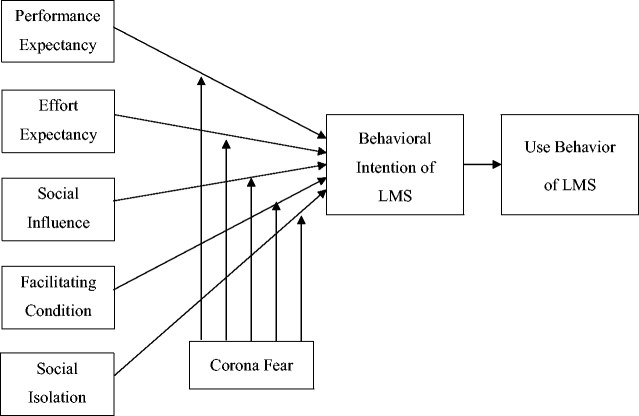
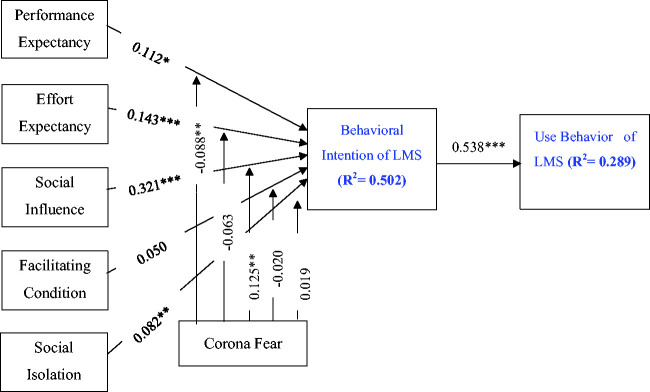
The COVID-19 Pandemic has led to social isolation; however, with the help of technology, education can continue through this tough time. Therefore, this research attempts to explore the Unified Theory of Acceptance and Use of Technology (UTAUT) through the expansion of the model. Also, make it relevant to investigate the influence of social isolation, and the moderating role of Corona fear on Behavioral Intention of the Learning Management System and its Use Behavior of Learning Management System among students. The data was analyzed using Partial Least Square (PLS) and Structural Equation Modelling (SEM). The findings show a positive link of Performance Expectancy (PE), Effort Expectancy (EE), Social Influence (SI), and Social Isolation on Behavioral Intention of LMS and, also between Behavioral Intention of LMS and its Use behavior. Moreover, the results of the moderation analysis show that Corona fears only moderates the link of Performance Expectancy and Social influence with Behavioral Intention of LMS. The findings imply the need for improving the LMS experience to increase its Behavioral Intention among students. Finally, the author's recommendation for future researchers is to examine the extended model in other countries and territories to analyze Coronavirus's influence on e-learning acceptance.
Overview
The claims and statistics of this paper haven’t been checked yet.
Free: it reads the open-access text and checks the first 5 claims that cite a source we can check. Create a free account to check every claim.
Integrity signals
Registry
Cites
Statistics
Figures
Verification
Claims the paper makes
The claims and statistics of this paper haven’t been checked yet.
Free: it reads the open-access text and checks the first 5 claims that cite a source we can check. Create a free account to check every claim.
Claims other papers make about this one
Each is checked against this paper’s own text: does it say what the citing paper says it does?
The cited source says what the claim attributes to it.
In the citing paper
“Several studies confirmed that in many cases individuals are urged by others to conduct specific activities including adopting new technologies (Kamal et al., 2020; Patil et al., 2020; Raza et al., 2021; Zhao and Bacao, 2020).”
From Factors affecting performance expectancy and intentions to use ChatGPT: Using SmartPLS to advance an information technology acceptance framework (2024) · cites this paper as Raza et al., 2021
Self-check
Percentages, sums and reported differences re-computed from the paper’s own numbers.
The self-check needs the paper’s full text.
Citations
Cites
Evaluating Structural Equation Models with Unobservable Variables and Measurement Error
Fornell, C., & Larcker, D. F. (1981) · Journal of Marketing Research · doi:10.2307/3151312 · Cited by 109,314
Evaluating structural equation models with unobservable variables and measurement error
Fornell, C., & Larcker, D. F. (1981) · Journal of Marketing Research · doi:10.1177/002224378101800104 · Cited by 109,190
Perceived usefulness, perceived ease of use, and user acceptance of information technology
Davis, F. D. (1989) · MIS Quarterly · doi:10.2307/249008 · Cited by 68,483 · cited 7×
“This finding is consistent with the studies of Davis (1989), Wang and Wang (2009), Motaghian et al.”
BackgroundResultInfluentialUser Acceptance of Information Technology: Toward A Unified View1
Venkatesh, V., Morris, M. G., Davis, G. B., & Davis, F. D. (2003) · MIS Quarterly · doi:10.2307/30036540 · Cited by 45,035 · cited 16×
“The items for measuring variables were adapted from Venkatesh et al. (2003), Zwain (2019), and Garone et al. (2019).”
BackgroundMethodResultInfluentialA new criterion for assessing discriminant validity in variance-based structural equation modeling
Henseler, J., Ringle, C. M., & Sarstedt, M. (2015) · Journal of the Academy of Marketing Science · doi:10.1007/s11747-014-0403-8 · Cited by 38,459 · cited 1×
“85, confirming the validity, as per the criteria given (Henseler et al., 2015; Raza et al., 2018, 2020).”
MethodA Paradigm for Developing Better Measures of Marketing Constructs
Churchill, G. A. (1979) · Journal of Marketing Research · doi:10.1177/002224377901600110 · Cited by 16,549 · cited 1×
“Moreover, the benchmark for individual reliability is that it should be greater than 0.7 (Churchill, 1979), which can be seen in Table 2.”
BackgroundInfluentialStructural equation models with unobservable variables and measurement error: Algebra and statistics
Fornell, C., & Larcker, D. F. (1981) · Journal of Marketing Research · doi:10.1177/002224378101800313 · Cited by 13,287
The use of partial least squares path modeling in international marketing
Henseler, J., Ringle, C. M., & Sinkovics, R. R. (2009) · Advances in International Marketing · doi:10.1108/s1474-7979(2009)0000020014 · Cited by 10,926
Venkatesh, V. (2000) · Information Systems Research · doi:10.1287/isre.11.4.342.11872 · Cited by 6,664 · cited 3×
“Since the original UTAUT model by Venkatesh et al. (2003) offered relevant factors for determining student’s behavioral intention towards LMS and its Use behavior, they were used for fulfilling the purpose of this research.”
BackgroundMethodModern Methods for Business Research
(1998) · doi:10.4324/9781410604385 · Cited by 6,534
Research works printed but not linked: 7
- Al-Busaidi K. A. Al-Shihi H. (2010). Instructors’ acceptance of learning management systems: A theoretical framework. Communications of the IBIMA, 2010(2010), 1– 10.
- Alias N. A. Zainuddin A. M. (2005). Innovation for better teaching and learning: Adopting the learning management system. Malaysian Online Journal of Instructional Technology, 2(2), 27– 40.
- Al-Shafi S. Weerakkody V. Janssen M. (2009). Investigating the adoption of eGovernment services in Qatar using the UTAUT model. AMCIS 2009 Proceedings, 260, 1--11.
- Fidani A. Idrizi F. (2012). Investigating students’ acceptance of a learning management system in university education: A structural equation modeling approach. ICT Innovations 2012 Web Proceedings, 2(23), 311– 320.
- Nanayakkara C. (2007). A model of user acceptance of learning management systems: A study within tertiary institutions in New Zealand. The International Journal of Learning, 13(12), 223– 232.
- Pakpour A. H. Griffiths M. D. (2020). The fear of CoVId-19 and its role in preventive behaviors. Journal of Concurrent Disorders. Advance online publication.
- Taiwo A. A. Downe A. G. (2013). The theory of user acceptance and use of technology (UTAUT): A meta-analytic review of empirical findings. Journal of Theoretical & Applied Information Technology, 49(1), 48--58.
Cited by
Items 101–200 of 626
Hussein, S., & Zakhem, N. B. (2024) · Sustainability · doi:10.3390/su16156528 · Cited by 34
Mokhtar, R., & Karim, M. H. A. (2021) · International Journal of Modern Education · doi:10.35631/ijmoe.380015 · Cited by 33
Digitalizing skills development using simulation-based mobile (SiM) learning application
Juera, L. C. (2022) · Journal of Computers in Education · doi:10.1007/s40692-022-00246-8 · Cited by 33
“Students can access the prepared course materials anytime and anywhere (Rabiman et al., 2020; Raza et al., 2021; Saroia & Gao, 2019).”
BackgroundHikmawati, H., Sutrio, Wahyudi, W., & Syahidi, K. (2022) · Jurnal Penelitian Pendidikan IPA · doi:10.29303/jppipa.v8i6.2388 · Cited by 28
“This can develop various online learning innovations that will have a good impact in the future, especially due to the development of an all-digital era (Raza et al., 2021).”
BackgroundAllam, H., Dempere, J. M., Kalota, F., & Hua, D. (2024) · Frontiers in Education · doi:10.3389/feduc.2024.1382021 · Cited by 32
Hakimi, T. I., Jaafar, J. A., Mohamad, M. A., & Omar, M. (2024) · Multidisciplinary Reviews · doi:10.31893/multirev.2024303 · Cited by 35
“However, several past studies reported insignificant results related to the influence of facilitating conditions on users’ intention to use various technologies (e.g., Alshehri, Rutter and Smith, 2019; Israel and Velu, 2019; Raza et al. , 2021).”
BackgroundNavigating the Adoption of Artificial Intelligence in Higher Education
Mohsin, F. H., Isa, N. M., Ishak, K., & Salleh, H. M. (2024) · International Journal of Business and Technopreneurship (IJBT) · doi:10.58915/ijbt.v14i1.433 · Cited by 40
“Raza et al. (2021) disclosed that students' behavioural intention concerning the adoption of the e-learning system is positively associated with their usage behaviour, leading to improved academic performance.”
BackgroundYu-peng, L., & Yu, Z. (2025) · Humanities and Social Sciences Communications · doi:10.1057/s41599-024-03861-1 · Cited by 30
“Previous studies widely suggested a sample of over 300 as a good one and over 500 as a very good one for structural equation modeling (Raza et al. 2020).”
Corona fear and e-commerce adoption in an emerging economy: paradigm shift of consumer intention
Raza, S. A., & Khan, K. A. (2021) · foresight · doi:10.1108/fs-02-2021-0034 · Cited by 32
Self-citationYu, X. (2022) · Frontiers in Psychology · doi:10.3389/fpsyg.2022.1023280 · Cited by 26
Khatatbeh, I. N., Alshurafat, H., Shbail, M. O. A., & Jamaani, F. (2023) · SAGE Open · doi:10.1177/21582440231181390 · Cited by 28
“TRA is a social psychological theory that explains how attitudes and norms influence behavior (Alshurafat, Al Shbail, & Almuiet, 2021; Awadallah & Elgharbawy, 2021; Fishbein & Ajzen, 1977; Raza & Khan, 2021; Raza et al., 2021).”
BackgroundNdibalema, P. M. (2025) · Social Sciences & Humanities Open · doi:10.1016/j.ssaho.2025.101463 · Cited by 24
Bhatti, M. A., Saat, S. A. M., Aleidan, M., Murshidi, G. H. A., Alyahya, M. A., & Juhari, A. S. (2022) · Sustainability · doi:10.3390/su14053069 · Cited by 24
“[6] explained that teacher ability to implement learning management systems effectively influence educational sustainability.”
BackgroundWaris, I., & Hameed, I. (2022) · Journal of Public Affairs · doi:10.1002/pa.2821 · Cited by 31
“The COVID-19 pandemic first emerged at the end of 2019, in the Wuhan province of China, and World Health Organization (WHO) has declared it a deadly disease (Raza et al., 2020).”
BackgroundMethodResultInfluentialMalik, M. F. (2023) · Business Process Management Journal · doi:10.1108/bpmj-10-2022-0534 · Cited by 24
Narayan, J. J., & Naidu, S. (2023) · Higher Education Quarterly · doi:10.1111/hequ.12441 · Cited by 25
Stimuli to adopt e-government services during Covid-19: Evidence from Vietnam
Nguyen, H. N., & Trần, M. D. (2022) · Innovative Marketing · doi:10.21511/im.18(1).2022.02 · Cited by 27
“This conclusion is similar to Raza et al. (2021) who found that social separation by the Covid-19 pandemic had the most meaningful influence on students’ LMS acceptance.”
ResultBlended Learning Approach in Graduate Studies: A Bibliometric Analysis from 1997-2021
Omar, R., Kaliappen, N., Khamis, K. A., & Sulisworo, D. (2021) · International Journal of Information and Education Technology · doi:10.18178/ijiet.2021.11.11.1563 · Cited by 25
Qin, R., & Yu, Z. (2023) · International Journal of Human-Computer Interaction · doi:10.1080/10447318.2023.2233129 · Cited by 26
“The actual usage behavior is contingent on a strong willingness to use it, with the intention being the primary determinant of actual usage behavior, as reported by Raza et al. (2021).”
InfluentialZheng, X., Wang, Y., Wei, W., Zhang, L., & Huo, D. (2023) · Psychology and Marketing · doi:10.1002/mar.21878 · Cited by 24
Pasha, S. A., Youssef, E., & Sharif, H. (2021) · International Conference of Modern Trends in Information and Communication Technology Industry (MTICTI) · doi:10.1109/mticti53925.2021.9664769 · Cited by 24
Student-Centeredness by Knowledge Sharing: An Effective Learning in Madrasah
Munif, M., Baharun, H., Zamroni, Z., & Ummah, A. H. F. (2022) · AL-ISHLAH Jurnal Pendidikan · doi:10.35445/alishlah.v14i1.1313 · Cited by 22
“The development of science and technology is an essential factor that requires students to improve their ability to keep pace with the times (Raza et al., 2021; Syahril et al., 2021).”
BackgroundUniversity Virtual Learning in Covid Times
Díaz, V. M., Urbano, E. R., & Martín, J. (2021) · Technology Knowledge and Learning · doi:10.1007/s10758-021-09533-2 · Cited by 24
Yu, H., Wang, S., Li, J., Shi, G., & Yang, J. (2022) · Frontiers in Psychology · doi:10.3389/fpsyg.2022.842322 · Cited by 25
“Raza et al. (2021) pointed out that social isolation is a key factor affecting Pakistani students’ use of learning management systems.”
BackgroundBeyond COVID Chaos: What Postsecondary Educators Learned from the Online Pivot
Day, T., Chung, C. K. L., Doolittle, W. E., Housel, J. A., & McDaniel, P. N. (2022) · The Professional Geographer · doi:10.1080/00330124.2022.2081225 · Cited by 23
Evaluation of Learning Management Systems: A Comparative Study Between Blackboard and Brightspace
Yamani, H. A., Alharthi, A. D., & Smirani, L. K. (2022) · International Journal of Emerging Technologies in Learning (iJET) · doi:10.3991/ijet.v17i07.28881 · Cited by 27
Chaudhry, N. I., Rehman, S. U., Elrehail, H., Masaeid, T. F. A., Al-Adaileh, R., & Alzoubi, H. M. (2023) · International Journal of Information Management Data Insights · doi:10.1016/j.jjimei.2023.100197 · Cited by 28
Automated Threat Modelling and Risk Analysis in E-Government Using Bpmn
Granata, D., Rak, M., Salzillo, G., Guida, G. D., & petrillo, S. (2022) · Connection Science · doi:10.1080/09540091.2023.2284645 · Cited by 22
“As shown in some works (Raza et al., 2020; Sharfuddin, 2020), due to social isolation, the citizens began to use e-Government systems to pay bills, rates and taxes or to obtain official documents (e.g. Certificates).”
ResultChasubuta, A. R., Ndibalema, P. M., & Loisulie, P. (2024) · Educational Technology Quarterly · doi:10.55056/etq.695 · Cited by 23
Mahara, T., Iyer, L. S., Matta, V., & Alagarsamy, S. (2021) · Journal of Information Technology Case and Application Research · doi:10.1080/15228053.2021.1965818 · Cited by 25
“An extension of the UTAUT model with social isolation as a construct was introduced to understand the behavioral intention (BI) of students to use a Learning Management System (Raza et al., 2021).”
MethodCloud-Based Learning Management: An Effective Learning during Social Distancing
Musyaffi, A. M., Rosnidah, I., & Muna, A. (2021) · Journal of Educational and Social Research · doi:10.36941/jesr-2021-0115 · Cited by 20
“The adoption of LMS has mushroomed in various parts of the world (Aldiab et al., 2019; Alsharida et al., 2021; Altalhi, 2021; Asamoah, 2021; Fadil Persada et al., 2019; Kite et al., 2020; Nguyen, 2021; Pavlenko et al., 2020; Raza et al., 2021; Sk et al., 2021; Washington, 2019).”
BackgroundResultLin, W., Zaman, S. I., Jamil, S., & Khan, S. A. (2023) · Psychology in the Schools · doi:10.1002/pits.22858 · Cited by 26
Qazi, W., Qazi, Z., Raza, S. A., Hakim, F., & Khan, K. A. (2023) · Journal of Applied Research in Higher Education · doi:10.1108/jarhe-02-2022-0072 · Cited by 22
Self-citationStudent Perceptions about HyFlex/Hybrid Delivery of Courses during the COVID-19 Pandemic
Eduljee, N. B., Murphy, L., Emigh-Guy, M., & Croteau, K. A. (2023) · College Teaching · doi:10.1080/87567555.2023.2208815 · Cited by 21
“According to Raza et al. (2021), students had positive perceptions and were more inclined to utilize their college’s LMS during the COVID-19 pandemic.”
Drivers of e-government use during the COVID-19 pandemic: the case of Vietnam
Nguyen, H. T., & Borazon, E. Q. (2022) · Online Information Review · doi:10.1108/oir-08-2021-0440 · Cited by 20
Blockchain Teaching Simulation Using Gamification
Latifah, H., & Fauziah, Z. (2022) · Aptisi Transactions On Technopreneurship (ATT) · doi:10.34306/att.v4i2.236 · Cited by 19
“Examination preparation through Moodle [28]”
InfluentialHigh school science teachers’ acceptance of using distance education in the light of UTAUT
Tolba, E. G. A., & Youssef, N. H. (2022) · Eurasia Journal of Mathematics Science and Technology Education · doi:10.29333/ejmste/12365 · Cited by 20
Shahriar, S. H. B., Alam, M. S., Arafat, S., Khan, M. M. R., Nur, J. M. E. H., & Khan, S. I. (2022) · Vision The Journal of Business Perspective · doi:10.1177/09722629221115234 · Cited by 26
South African rural students’ adoption and use of learning management systems
Afolabi, O. S., & Ajani, O. A. (2023) · International Journal of Research in Business and Social Science (2147-4478) · doi:10.20525/ijrbs.v12i4.2521 · Cited by 23
Suliman, M. A. E., Zhang, W., & Sleiman, K. A. A. (2023) · Innovations in Education and Teaching International · doi:10.1080/14703297.2023.2239203 · Cited by 20
Linkage between Students’ Skills and Employability: Moderating Influence of University Reputation
Zhang, H., Khaskheli, A., Raza, S. A., & Masood, A. (2023) · Corporate Reputation Review · doi:10.1057/s41299-023-00169-9 · Cited by 25
Self-citationQazi, Z., Qazi, W., Raza, S. A., & Khan, K. A. (2021) · Journal of Applied Research in Higher Education · doi:10.1108/jarhe-02-2021-0069 · Cited by 19
Self-citationSilva, J. H. O., Favoretto, C., Amancio, I. R., Ganga, G. M. D., Lizarelli, F. L., & Mendes, G. H. D. S. (2022) · International Journal of Quality and Service Sciences · doi:10.1108/ijqss-04-2021-0056 · Cited by 24
Aziz, F., Rasdi, R. M., Rami, A. A. M., Razali, F. B., & Ahrari, S. (2022) · International Journal of Emerging Technologies in Learning (iJET) · doi:10.3991/ijet.v17i09.30481 · Cited by 25
Sheikh, R. A., Masmali, F. H., Alhazemi, A. A., Onn, C. W., & Khan, S. M. F. A. (2025) · Education and Information Technologies · doi:10.1007/s10639-025-13647-w · Cited by 18
“These researchers have established that FC, EE, PE, and SI are all crucial factors that impact technology adoption behavior (Alshehri et al., 2019; Buabeng-Andoh & Baah, 2020; Raza et al., 2021; Yi et al., 2022).”
Adoption of artificial intelligence applications in higher education
Reyes, G., Tolozano-Benites, R., George-Reyes, C. E., Rumbaut-Rangel, D., & Monteses, J. J. B. (2025) · Frontiers in Education · doi:10.3389/feduc.2025.1680401 · Cited by 21
Student Acceptance of E-Learning during the COVID-19 Outbreak at Engineering Universities in Spain
Garrido-Gutiérrez, P., Chaparro, T. S., & Sánchez-Naranjo, M. J. (2023) · Education Sciences · doi:10.3390/educsci13010077 · Cited by 18
PENGEMBANGAN APLIKASI PLATFORM OPEN COURSE BERORIENTASI PjBL DAN CASE STUDY BERBASIS GAMIFIKASI
Sanova, A., Afrida, A., & Ekaputra, F. (2022) · Jurnal Penelitian Pendidikan Kimia: Kajian Hasil Penelitian Pendidikan Kimia · doi:10.36706/jppk.v9i2.19009 · Cited by 18
Learning Management Systems as a platform for information sharing during the COVID-19
Ndou, K., Mashau, N. L., & Chigada, J. (2023) · South African journal of information management · doi:10.4102/sajim.v25i1.1618 · Cited by 18
“However, the emergence of the global COVID-19 forced a paradigm shift and reconfiguration of teaching and learning through online learning management systems (LMS) (Raza et al. 2021).”
BackgroundNa, M., Lee, S. S. J., Md Noor, H., Fu, J. Q., & Ying, W. (2024) · Asian Journal of University Education · doi:10.24191/ajue.v20i2.27007 · Cited by 27
“It also highlighted the convenience and efficiency of online education (Raza et al., 2021; Alejandro et al.,2023).”
McIntyre, M. M., Medina, P. S., Zhang, J., & Ni, A. Y. (2023) · Education and Information Technologies · doi:10.1007/s10639-023-11823-4 · Cited by 17
“Performance expectancy also predicts intentions to use e-learning tools and services (Ain et al., 2016; Jak-kaew & Hemrungrote, 2017; Raza et al., 2021; Robinson, 2006; Tarhini et al., 2017; Yakubu & Dasuki, 2019).”
BackgroundMethodResultInfluentialAlquhaif, A., & Al‐Mamary, Y. H. (2024) · Human Systems Management · doi:10.1177/01672533241297453 · Cited by 19
“…H1 and aligns with past studies, such as Alghamdi et al. 61 ; Catherine et al. 62 ; Almaiah et al. 63 ; Sair and Danish 64 ; Alshehri et al. 42 ; Raza et al. 65 ; Bervell et al. 66 ; Alharbi et al. 67 ; Abbad 68 ; Adnan et al. 68 ; Alsaaid & Abdrazak 68 ; and Alshehri et al., 2020, which also…”
InfluentialEvaluation of Learning Management System (LMS) Canvas amidst Pandemic: Students' Perspectives
Haryani, F., & Poniam, B. (2021) · Tarbawi Jurnal Ilmu Pendidikan · doi:10.32939/tarbawi.v17i2.935 · Cited by 16
Dmello, V. J., Santekellur, V. J., Rajendran, A., Bidi, S. B., Ghosh, T., Kaur, J., & Haldorai, K. (2023) · Cogent Education · doi:10.1080/2331186x.2023.2226456 · Cited by 18
“…expectancy have a significant and direct effect on e-learner intention to use behavior and e-learner engagement behavior; the finding concurred with McLean and Wilson (2019); S. A. Raza et al. (2020); Bajaj et al. (2021); Qiao et al. (2021); Arkorful et al. (2022); Yeboah and Nyagorme (2022).”
ResultEffectiveness of online training on digital pedagogical skills of remote area teachers in Nepal
Joshi, D. R., Adhikari, K. P., Chapai, K. P. S., & Bhattarai, A. R. (2023) · International Journal of Professional Development Learners and Learning · doi:10.30935/ijpdll/13666 · Cited by 18
“As a consequence, the adaptability of digital learning management systems has recently become a requirement, affecting the behaviors of educational institutions, educators, and students (Aristovnik, 2014; Raza et al., 2021).”
BackgroundPredicting the Use Behavior of Higher Education Students on ChatGPT: Evidence from the Philippines
Hernandez, A. A., Abisado, M., Rodriguez, R. L., & Imperial, J. M. (2023) · IEEE International Conference on Teaching, Assessment, and Learning for Engineering · doi:10.1109/tale56641.2023.10398324 · Cited by 18
“Previous studies found that effort expectancy affects intention in learning systems [13].”
ResultAnalysis Of Examination Process During Covid And Post Covid In Indian Context
Rawat, B., Bist, A. S., Riza, B. S., Oktariyani, A., & Rahardja, U. (2021) · International Conference on Cyber and IT Service Management (CITSM) · doi:10.1109/citsm52892.2021.9588821 · Cited by 16
Adoption of E-learning System in Higher Education Environments: Evidence from Modified UTAUT Model
Qazi, W., Raza, S. A., Khan, K. A., & Salam, J. (2021) · ASR Chiang Mai University Journal of Social Sciences and Humanities · doi:10.12982/cmujasr.2020.003 · Cited by 15
Self-citationSustainable Future: Trends, Strategies and Development
Noviaristanti, S., & Boon, O. H. (2022) · Routledge eBooks · doi:10.1201/9781003335832 · Cited by 15
Ismail, M., Ahmad, F. S., & Ma’ruf, M. A. (2023) · Al-Ta rib Jurnal Ilmiah Program Studi Pendidikan Bahasa Arab IAIN Palangka Raya · doi:10.23971/altarib.v11i2.6591 · Cited by 15
Usama, M., Alam, S., Tarai, S., & Banu, S. (2024) · Theory and Practice in Language Studies · doi:10.17507/tpls.1402.01 · Cited by 15
Capturing students’ LMS experience: measurement invariance across Chinese and English versions
Jiang, J., Simon, P. D., & Fryer, L. K. (2024) · Journal of Computing in Higher Education · doi:10.1007/s12528-024-09402-8 · Cited by 15
“…factors that are likely to be associated with perceived ease of use and usefulness stems from a strong literature base that supports how these two variables lead to behavioral intention and actual use of a system (Cigdem & Topcu, 2015; Raza et al., 2021; Teo et al., 2019; Watty et al., 2016).”
Nguyen, M., Sari, N. P. W. P., Li, D., & Vuong, Q. (2024) · Teaching and learning in nursing · doi:10.1016/j.teln.2024.08.014 · Cited by 15
Beg, B., Amir, A., Alam, S., Králik, R., & Warda, W. U. (2024) · World Journal of English Language · doi:10.5430/wjel.v15n2p357 · Cited by 15
Zhao, J., Li, X., & Liao, H. (2025) · Education and Information Technologies · doi:10.1007/s10639-025-13454-3 · Cited by 15
“This result is consistent with UTAUT2 (Venkatesh et al., 2012) and supported by studies in various contexts, such as DingTalk (Hou & Yu, 2023), ChatGPT in academic work (Strzelecki, 2023), mobile learning (Sitar-Taut & Mican, 2021), and LMS (Yakubu et al., 2020).”
InfluentialInfluence of demographics variables on students subjective well‐being
Mewafarosh, R., & Agarwal, S. (2021) · Journal of Public Affairs · doi:10.1002/pa.2749 · Cited by 18
Khechine, H., Raymond, B., & Lakhal, S. (2022) · Behaviour and Information Technology · doi:10.1080/0144929x.2022.2099297 · Cited by 18
“…has the advantages of providing higher statistical power and minimizing restrictive assumptions related to sample size, number of variables, model complexity (Raza et al. 2020), normality of the distribution (Hair et al. 2019), and residual distributions (Ahmed et al. 2021; Qureshi et al. 2021).”
BackgroundMethodInfluentialKim, J., Moon, K., Lee, J., Jeong, Y., Lee, S., & Young-gun, K. (2022) · Frontiers in Psychology · doi:10.3389/fpsyg.2022.932777 · Cited by 16
“The virus has unprecedentedly disrupted the educational system at all levels, affecting the lives of students of all ages because of preventive policies, such as on social distancing and lockdown (Raza et al., 2020).”
BackgroundEffectiveness of Online Learning at Universities: Do Sociocultural Differences Matter?
Nuryatin, A., Mukhibad, H., & Tusyanah, T. (2022) · European Journal of Educational Research · doi:10.12973/eu-jer.11.4.2153 · Cited by 18
Tuğtekin, E. B. (2023) · The International Review of Research in Open and Distributed Learning · doi:10.19173/irrodl.v24i2.6905 · Cited by 18
“The use of online learning environments for education and training has triggered and significantly enhanced the importance of LMS, particularly amid the COVID-19 pandemic (Huang et al., 2020; Kwon et al., 2021; Raza et al., 2020; Turnbull, 2021).”
Chetioui, H., Lebdaoui, H., Adelli, O., Bendriouch, F. Z., Chetioui, Y., & Lebdaoui, K. (2024) · Journal of Applied Research in Higher Education · doi:10.1108/jarhe-05-2023-0207 · Cited by 17
Determinants affecting the medical students adoption of mobile learning: extended UTAUT
Suliman, M. A. E., Zhang, W., Sleiman, K. A. A., Suliman, R. A., & Xiaoni, Z. (2024) · BMC Medical Education · doi:10.1186/s12909-024-06129-z · Cited by 14
“In their studies [27, 28] found SIS to have significant important role on BI, while [16, 29] found fear of COVID-19 to play significant important role to adopt mobile learning during pandemic.”
BackgroundInfluentialAn Evaluation of the Localization Quality of the Arabic Versions of Learning Management Systems
Omar, A. (2021) · International Journal of Advanced Computer Science and Applications · doi:10.14569/ijacsa.2021.0120256 · Cited by 15
“Furthermore, the emergence of the pandemic COVID-19 has posed strong pressures on the developers of elearning technologies to develop reliable and effective LMSs that can help students and institutions cope up with this dilemma that has changed our lives in drastic ways and represents unique challenges to all institut…”
BackgroundInfluentialThe Process of Digital Transformation in Education During the COVID-19 Pandemic
Barreto, I. B., Sanchez, R. M. S., Sanchez, W. S., Jordan, O. H., & Escalante, J. D. B. (2023) · International Journal of Professional Business Review · doi:10.26668/businessreview/2023.v8i9.3770 · Cited by 16
Xia, L., An, X., Li, X., & Dong, Y. (2026) · Journal of Educational Computing Research · doi:10.1177/07356331251382853 · Cited by 13
“Additionally, all items exhibited higher loaded on their relevant construct compared to other constructs, with cross-loading differences exceeding the recommended 0.1 threshold (Raza et al., 2021).”
InfluentialPasha, S. A., Sharif, H., Ali, S., Al-Misfari, A., Elareshi, M., Ziani, A., & Habes, M. (2023) · Lecture notes in networks and systems · doi:10.1007/978-3-031-26956-1_82 · Cited by 13
Phạm, M., Nguyen, P. X. T., & Trinh, N. N. (2025) · Discover Education · doi:10.1007/s44217-025-00800-3 · Cited by 14
“Most studies evaluate e-learning continuance intention in an extension of the TAM [30, 65, 91, 102, 109], and a few studies address students’ psychological distress during the COVID-19 pandemic when adopting e-learning [29, 56, 68].”
Lima, D. A., & Isotani, S. (2022) · Revista Brasileira de Informática na Educação · doi:10.5753/rbie.2022.2204 · Cited by 16
The UTAUT Model for Measuring Acceptance of the Application of the Patient Registration System
Tugiman, T., Herman, H., & Yudhana, A. (2023) · Matrik Jurnal Manajemen Teknik Informatika dan Rekayasa Komputer · doi:10.30812/matrik.v22i2.2844 · Cited by 13
“Based on this research and the basic model from Raza [10], a hypothesis was developed like following: The UTAUT Model . . . (Tugiman) H1: Performance expectancy has a large impact and influence on Behavioral intention H2: Effort expectancy has a major impact and influence on Behavioral intention H3: Social influence h…”
MethodLearning Continuity during COVID-19: An Analysis of the Higher Education Sector of Bangladesh
Mukherjee, D., & Hasan, K. K. (2023) · Journal of Education Culture and Society · doi:10.15503/jecs2023.1.650.671 · Cited by 14
“SI and BI (Koçak et al., 2021; Raza et al., 2021) can be moderated by PF to adopt online learning.”
BackgroundMethodInfluentialMohammed, Y. B., Çavuş, N., Gital, A. Y., Bulama, M., & Hassan, A. (2024) · International Journal of Human-Computer Interaction · doi:10.1080/10447318.2023.2301264 · Cited by 12
“Raza et al. (2021) and Duin and Tham (2020) emphasized in their studies that convenience and flexibility were the two most important features of LMS.”
Tawfik, H. (2024) · Technological Sustainability · doi:10.1108/techs-12-2023-0057 · Cited by 16
Puertas, E., Mariscal, G., & Requejo, S. M. (2023) · International Conference on Education and E-Learning (ICEEL) · doi:10.1145/3637989.3637998 · Cited by 15
Hii, I. S. H., Ho, J. M., Zhong, Y., & Li, X. (2024) · Managerial Finance · doi:10.1108/mf-03-2024-0231 · Cited by 17
Faktor Penerimaan Pengguna pada E-Learning dari Perspektif Siswa Sekolah Dasar Berbasis UTAUT Model
Sekarini, D. (2021) · JATISI (Jurnal Teknik Informatika dan Sistem Informasi) · doi:10.35957/jatisi.v8i4.1257 · Cited by 16
Ruiz, J. F., & Panadero, E. (2022) · Assessment & Evaluation in Higher Education · doi:10.1080/02602938.2022.2099811 · Cited by 14
Saqr, M., Raspopović, M., Pancheva, K., Jovic, J., Peltekova, E., & Conde, M. Á. (2023) · Universal Access in the Information Society · doi:10.1007/s10209-023-00989-w · Cited by 12
“The problems were addressed from a local perspective [41, 56, 63, 67, 90], to a global point of view [5], passing through regional or local approaches [31, 33, 47, 49, 54, 55, 58–59, 61, 65–66, 68].”
Tren Manajemen Pendidikan: Analisis Bibliometrik Menggunakan Aplikasi Vosviewer
Iriyani, S. A., Patty, E. N. S., Rahim, A. R., Awaliyah, M., & Ria, R. R. P. (2023) · Edu Cendikia Jurnal Ilmiah Kependidikan · doi:10.47709/educendikia.v3i01.2281 · Cited by 12
Ciberseguridad en los sistemas de gestión de aprendizaje (LMS)
Broncano, M. P. E., & Pesantez, D. F. Á. (2021) · Ecuadorian Science Journal · doi:10.46480/esj.5.1.98 · Cited by 12
WORKPLACE ISOLATION IN THE GROWTH TREND OF REMOTE WORKING: A LITERATURE REVIEW
HA, N. T. T. (2021) · Review of Economic and Business Studies · doi:10.47743/rebs-2021-1-0005 · Cited by 12
Qureshi, M. A., Raza, S. A., Kolachi, I. A., Sarwar, A., & Khan, K. A. (2022) · Asian Academy of Management Journal · doi:10.21315/aamj2022.27.1.2 · Cited by 14
Self-citationEducational technology research during the COVID-19 pandemic
Xue, S., & Crompton, H. (2022) · Interactive Technology and Smart Education · doi:10.1108/itse-05-2022-0067 · Cited by 13
Huda, O. (2023) · E-Learning Innovations Journal. · doi:10.57125/elij.2023.06.25.01 · Cited by 14
Chandio, A. R. (2021) · Journal of Research in Instructional · doi:10.30862/jri.v1i2.15 · Cited by 11
“Information Communication Technology (ICT) can play a significant role in encouraging quality education and administrative service delivery, which proceeds from storage of data to knowledge management and decision making (Chandio, 2020; Ghavifekr, et al., 2013; Raza et al., 2021).”
BackgroundFactors affecting social network use by students in Tunisia
Khanchel, H. (2022) · Human Systems Management · doi:10.3233/hsm-220017 · Cited by 11
“…COVID-19 (FOC) had a cogent impact between adjusted unified theory of acceptance and use of technology (UTAUT) model PE (Performance Expectancy), EE (Effort Expectancy), SI (Social Influence), FC (Facil-itating Conditions), and MSE (Mobile Self-Efficacy), the user behavior in learning (UBL) [49, 50].”
Optimum Use of LMS for Dynamic Mathematics Classrooms in Blended Mode
Desai, R., Rai, N., & Karekar, J. (2023) · Journal of Engineering Education/Journal of engineering education transformations/Journal of engineering education transformation · doi:10.16920/jeet/2023/v36is2/23075 · Cited by 11
“As suggested by (Raza et al., 2021) & inspired by the recent research about the need for blended learning and technology integration in mathematical courses, authors strategically implemented LMS to enhance the day-to-day learning experiences of students.”
A Model Predicting Student Engagement and Intention with Mobile Learning Management Systems
Imlawi, J. M., Al-Shatnawi, A., AlFawwaz, B. M., Al-Shatnawi, H. M., & Al-masaeed, S. (2023) · Interdisciplinary Journal of Information Knowledge and Management · doi:10.28945/5099 · Cited by 12
“The study is motivated by the fact that, while past research has demonstrated that students’ intention to continue using m-LMS can improve educational achievement (Han & Shin, 2016), adopting and investing in these tools require large resources and infrastructure (Raza et al., 2021) and thus it is important to gain kn…”
BackgroundMethodResultInfluentialKey determinants of intention to use virtual reality in medical training
Urbistondo, P. A., Pérez-Aranda, J., & Molina, A. M. C. (2024) · Virtual Reality · doi:10.1007/s10055-024-00990-5 · Cited by 12
“Prior research has also found a positive relationship between effort expectancy and behavioural intention (Chao 2019; Dajani and Hegleh 2019; Raza et al. 2021).”
Moodle Innovation Learning Technology for Medical Education: From Theory to Practice
Лобач, Н. В., Isychko, L., Dymar, N., Vakaliuk, I., Olha, Y., & Бокова, С. І. (2021) · Journal of Pharmaceutical Research International · doi:10.9734/jpri/2021/v33i59a34269 · Cited by 11
“One of LMSs mostly used in educational institutions worldwide is Moodle [16,17].”
BackgroundMarczuk, A., & Lörz, M. (2023) · Journal of Studies in International Education · doi:10.1177/10283153221150116 · Cited by 14
“The rapid introduction of digital teaching has led to new learning challenges (Aguilera-Hermida, 2020; Gamage et al., 2020; Mseleku, 2020) and has also increased social isolation among university students (Debowska et al., 2020; Hamza et al., 2021; Raza et al., 2021).”
Background
Metadata
- Authors
- Raza, S. A., Qazi, W., Khan, K. A., & Salam, J.
- Affiliations
- Iqra University (PK)
- Corresponding author
- Raza, Syed A.
- Venue
- Journal of Educational Computing Research
- Publisher
- SAGE Publications
- Published
- 2020-09-22
- Volume
- 59
- Issue
- 2
- Pages
- 183-208
- ISSN
- 0735-6331 (ISSN-L)
- 1541-4140
- PMC
- PMC7509242
- OpenAlex
- W3087094992
- Semantic Scholar
- 140945470c3df734fcc31547b10e28baef9b99b6
- Cited by
- 510
- References
- 61
- Citations by year
- 2026: 24 · 2025: 54 · 2024: 104 · 2023: 116 · 2022: 134 · 2021: 78
- FWCI
- 81.30
- Type
- journal article
- Language
- en
- Open access
- hybrid
- doi.org
- Locations
- Journal of Educational Computing Research (publishedVersion, cc-by)
- PubMed Central (publishedVersion, cc-by)
- Topics
- Social Sciences › Decision Sciences › Information Systems and Management › Technology Adoption and User Behaviour
- Social Sciences › Education › Education during COVID-19 pandemic
- Physical Sciences › Computer Science › Information Systems › Educational Technology and E-Learning
- Keywords
- social isolation, virtual learning environments, technology acceptance, UTAUT, COVID-19 pandemic, e-learning acceptance, behavioral intention, use behavior, performance expectancy, effort expectancy, social influence, moderating effect
About these checks
Registry, retraction, Cites and statistics results are computed, not judged, with one exception: a printed reference that no index lists is read once by a model before it counts as a citation error. Claims are extracted by a model and kept only when their quote appears verbatim in the text; each cited source is then checked, with a model’s help, for whether it says what the claim relies on. Those verdicts can be wrong — read the claim’s quote and the cited source before relying on one.
Statistics and arithmetic are recomputed, not judged.
Confidence bands are shown only for fields calibrated on our annotated test set. None is calibrated yet, so no band is shown.
What counts as a claim ›How we measure confidence ›How we check this ›
Are you an author, or do you see a problem with this page? Request a review
Data sources
Bibliographic data: Semantic Scholar, OpenAlex, Crossref.
Contains information from the Semantic Scholar Academic Graph Datasets, made available under the ODC Attribution License (ODC-BY 1.0).
Semantic Scholar’s data is described in: Kinney, R., et al. (2023). The Semantic Scholar Open Data Platform. arXiv:2301.10140.
