

Social Isolation and Acceptance of the Learning Management System (LMS) in the time of COVID-19 Pandemic: An Expansion of the UTAUT Model
Open accessThe DOI matches its Crossref record; 65 of the 67 references it cites were found in a registry or an index, and 2 are not checked yet.
Abstract
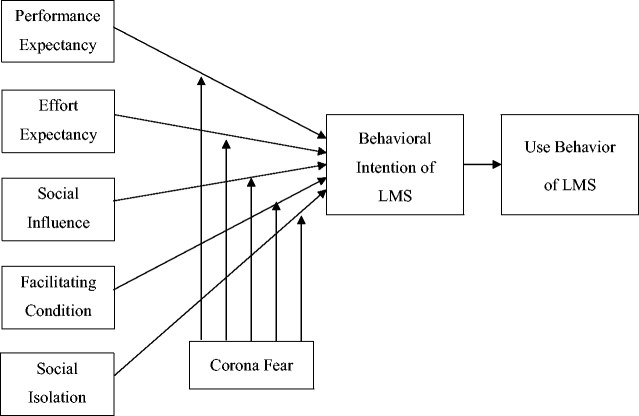
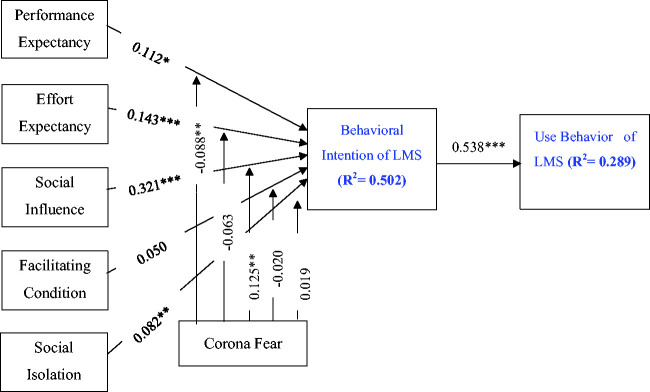
The COVID-19 Pandemic has led to social isolation; however, with the help of technology, education can continue through this tough time. Therefore, this research attempts to explore the Unified Theory of Acceptance and Use of Technology (UTAUT) through the expansion of the model. Also, make it relevant to investigate the influence of social isolation, and the moderating role of Corona fear on Behavioral Intention of the Learning Management System and its Use Behavior of Learning Management System among students. The data was analyzed using Partial Least Square (PLS) and Structural Equation Modelling (SEM). The findings show a positive link of Performance Expectancy (PE), Effort Expectancy (EE), Social Influence (SI), and Social Isolation on Behavioral Intention of LMS and, also between Behavioral Intention of LMS and its Use behavior. Moreover, the results of the moderation analysis show that Corona fears only moderates the link of Performance Expectancy and Social influence with Behavioral Intention of LMS. The findings imply the need for improving the LMS experience to increase its Behavioral Intention among students. Finally, the author's recommendation for future researchers is to examine the extended model in other countries and territories to analyze Coronavirus's influence on e-learning acceptance.
Overview
The claims and statistics of this paper haven’t been checked yet.
Free: it reads the open-access text and checks the first 5 claims that cite a source we can check. Create a free account to check every claim.
Integrity signals
Registry
Cites
Statistics
Figures
Verification
Claims the paper makes
The claims and statistics of this paper haven’t been checked yet.
Free: it reads the open-access text and checks the first 5 claims that cite a source we can check. Create a free account to check every claim.
Claims other papers make about this one
Each is checked against this paper’s own text: does it say what the citing paper says it does?
The cited source says what the claim attributes to it.
In the citing paper
“Several studies confirmed that in many cases individuals are urged by others to conduct specific activities including adopting new technologies (Kamal et al., 2020; Patil et al., 2020; Raza et al., 2021; Zhao and Bacao, 2020).”
From Factors affecting performance expectancy and intentions to use ChatGPT: Using SmartPLS to advance an information technology acceptance framework (2024) · cites this paper as Raza et al., 2021
Self-check
Percentages, sums and reported differences re-computed from the paper’s own numbers.
The self-check needs the paper’s full text.
Citations
Cites
Evaluating Structural Equation Models with Unobservable Variables and Measurement Error
Fornell, C., & Larcker, D. F. (1981) · Journal of Marketing Research · doi:10.2307/3151312 · Cited by 109,314
Evaluating structural equation models with unobservable variables and measurement error
Fornell, C., & Larcker, D. F. (1981) · Journal of Marketing Research · doi:10.1177/002224378101800104 · Cited by 109,190
Perceived usefulness, perceived ease of use, and user acceptance of information technology
Davis, F. D. (1989) · MIS Quarterly · doi:10.2307/249008 · Cited by 68,483 · cited 7×
“This finding is consistent with the studies of Davis (1989), Wang and Wang (2009), Motaghian et al.”
BackgroundResultInfluentialUser Acceptance of Information Technology: Toward A Unified View1
Venkatesh, V., Morris, M. G., Davis, G. B., & Davis, F. D. (2003) · MIS Quarterly · doi:10.2307/30036540 · Cited by 45,035 · cited 16×
“The items for measuring variables were adapted from Venkatesh et al. (2003), Zwain (2019), and Garone et al. (2019).”
BackgroundMethodResultInfluentialA new criterion for assessing discriminant validity in variance-based structural equation modeling
Henseler, J., Ringle, C. M., & Sarstedt, M. (2015) · Journal of the Academy of Marketing Science · doi:10.1007/s11747-014-0403-8 · Cited by 38,459 · cited 1×
“85, confirming the validity, as per the criteria given (Henseler et al., 2015; Raza et al., 2018, 2020).”
MethodA Paradigm for Developing Better Measures of Marketing Constructs
Churchill, G. A. (1979) · Journal of Marketing Research · doi:10.1177/002224377901600110 · Cited by 16,549 · cited 1×
“Moreover, the benchmark for individual reliability is that it should be greater than 0.7 (Churchill, 1979), which can be seen in Table 2.”
BackgroundInfluentialStructural equation models with unobservable variables and measurement error: Algebra and statistics
Fornell, C., & Larcker, D. F. (1981) · Journal of Marketing Research · doi:10.1177/002224378101800313 · Cited by 13,287
The use of partial least squares path modeling in international marketing
Henseler, J., Ringle, C. M., & Sinkovics, R. R. (2009) · Advances in International Marketing · doi:10.1108/s1474-7979(2009)0000020014 · Cited by 10,926
Venkatesh, V. (2000) · Information Systems Research · doi:10.1287/isre.11.4.342.11872 · Cited by 6,664 · cited 3×
“Since the original UTAUT model by Venkatesh et al. (2003) offered relevant factors for determining student’s behavioral intention towards LMS and its Use behavior, they were used for fulfilling the purpose of this research.”
BackgroundMethodModern Methods for Business Research
(1998) · doi:10.4324/9781410604385 · Cited by 6,534
Research works printed but not linked: 7
- Al-Busaidi K. A. Al-Shihi H. (2010). Instructors’ acceptance of learning management systems: A theoretical framework. Communications of the IBIMA, 2010(2010), 1– 10.
- Alias N. A. Zainuddin A. M. (2005). Innovation for better teaching and learning: Adopting the learning management system. Malaysian Online Journal of Instructional Technology, 2(2), 27– 40.
- Al-Shafi S. Weerakkody V. Janssen M. (2009). Investigating the adoption of eGovernment services in Qatar using the UTAUT model. AMCIS 2009 Proceedings, 260, 1--11.
- Fidani A. Idrizi F. (2012). Investigating students’ acceptance of a learning management system in university education: A structural equation modeling approach. ICT Innovations 2012 Web Proceedings, 2(23), 311– 320.
- Nanayakkara C. (2007). A model of user acceptance of learning management systems: A study within tertiary institutions in New Zealand. The International Journal of Learning, 13(12), 223– 232.
- Pakpour A. H. Griffiths M. D. (2020). The fear of CoVId-19 and its role in preventive behaviors. Journal of Concurrent Disorders. Advance online publication.
- Taiwo A. A. Downe A. G. (2013). The theory of user acceptance and use of technology (UTAUT): A meta-analytic review of empirical findings. Journal of Theoretical & Applied Information Technology, 49(1), 48--58.
Cited by
Alalwan, A. A., Dwivedi, Y. K., & Rana, N. P. (2017) · International Journal of Information Management · doi:10.1016/j.ijinfomgt.2017.01.002 · Cited by 1,581
Xue, L., Rashid, A. M., & Ouyang, S. (2024) · Sage Open · doi:10.1177/21582440241229570 · Cited by 247
A systematic review on trends in using Moodle for teaching and learning
Gamage, S. H. P. W., Ayres, J. R., & Behrend, M. B. (2022) · International Journal of STEM Education · doi:10.1186/s40594-021-00323-x · Cited by 360
“E-learning is an area that has seen considerable growth, particularly since 2020 with the onset of the COVID-19 pandemic, which has limited face-to-face teaching possibilities for many educational institutions globally (Dias et al., 2020; Raza et al., 2021).”
BackgroundErjavec, J., & Manfreda, A. (2022) · Journal of Retailing and Consumer Services · doi:10.1016/j.jretconser.2021.102867 · Cited by 256
Raza, S. A., & Khan, K. A. (2022) · International Journal of Contemporary Hospitality Management · doi:10.1108/ijchm-05-2021-0553 · Cited by 215
Self-citationCamilleri, M. A. (2024) · Technological Forecasting and Social Change · doi:10.1016/j.techfore.2024.123247 · Cited by 261
“Several studies confirmed that in many cases individuals are urged by others to conduct specific activities including adopting new technologies (Kamal et al., 2020; Patil et al., 2020; Raza et al., 2021; Zhao and Bacao, 2020).”
BackgroundResultAhmed, M., Guo, Q., Qureshi, M. A., Raza, S. A., Khan, K. A., & Salam, J. (2021) · International Journal of Hospitality Management · doi:10.1016/j.ijhm.2020.102852 · Cited by 205
Self-citationYu-peng, L., & Yu, Z. (2023) · International Journal of Educational Technology in Higher Education · doi:10.1186/s41239-023-00403-8 · Cited by 250
“The sample size could be considered nearly excellent since researchers viewed 500 as a very good population and 1,000 as excellent for factor analysis (Raza et al., 2020).”
BackgroundUsing chatbots for English language learning in higher education
Annamalai, N., Rashid, R. A., Munir Hashmi, U., Mohamed, M., Harb Alqaryouti, M., & Eddin Sadeq, A. (2023) · Computers and Education: Artificial Intelligence · doi:10.1016/j.caeai.2023.100153 · Cited by 97
Al‐Mamary, Y. H. (2022) · International Journal of Information Management Data Insights · doi:10.1016/j.jjimei.2022.100092 · Cited by 212
Jain, R., Garg, N., & Khera, S. N. (2022) · Frontiers in Psychology · doi:10.3389/fpsyg.2022.893691 · Cited by 114
“Many studies have investigated the use of technology as an outcome (Raza et al., 2020; Chatterjee et al., 2021).”
BackgroundZacharis, G., & Nikolopoulou, K. (2022) · Education and Information Technologies · doi:10.1007/s10639-022-11116-2 · Cited by 165
“This finding is in agreement with many studies worldwide; Prasetyo et al. (2021) in the Philippines; Muangmee et al. (2021) in Thailand; Raza et al. (2021) in Pakistan; Fouad Altameemi and Abdula Fatah Al-Slehat (2021), Abbad (2021), Dajani and Abu Hegleh (2019), in Jordan; Hassan (2021) in Egypt; Akbar (2021) in Bahr…”
BackgroundMethodResultInfluentialDu, L., & Lv, B. (2024) · Education and Information Technologies · doi:10.1007/s10639-024-12835-4 · Cited by 171
“This differs from previous views (Lou, 2023), potentially reflecting Raza et al.‘s ( 2021) speculation that with the development and popularization of internet technology, social influence extends beyond physical spaces, with digital natives being more susceptible to online interactions and media…”
Al‐Adwan, A. S., Yaseen, H., Alsoud, A. R., Abousweilem, F., & Al-Rahmi, W. M. (2021) · Education and Information Technologies · doi:10.1007/s10639-021-10758-y · Cited by 172
Batucan, G., Gonzales, G. G., Balbuena, M. G., Pasaol, K. R. B., Seno, D. N., & Gonzales, R. R. (2022) · Frontiers in Artificial Intelligence · doi:10.3389/frai.2022.768831 · Cited by 160
“Like Raza et al. (2021), the study concluded a significantly positive link between behavioral intention and use behavior .”
BackgroundA comparative analysis of multivariate approaches for data analysis in management sciences
Ahmed, R. R., Štreimikienė, D., Štreimikis, J., & Šikšnelytė-Butkienė, I. (2024) · E+M Ekonomie a Management · doi:10.15240/tul/001/2024-5-001 · Cited by 157
Jena, R. K. (2022) · International Journal of Financial Studies · doi:10.3390/ijfs10040090 · Cited by 161
“Like other studies (Ahmed et al. 2022a; Almisad and Alsalim 2020; Dwivedi et al. 2019; Jevsikova et al. 2021; Raza et al. 2021), this study left out some constructs from the original or extended UTAUT models that were not important or were used extensively in the past.”
BackgroundResultAl-Maroof, R. S., Alnazzawi, N., Akour, I. A., Ayoubi, K., Alhumaid, K. F., AlAhbabi, N. M. N., Alnnaimi, M., Thabit, S., Alfaisal, R., Aburayya, A., et al. (2021) · Informatics · doi:10.3390/informatics8040083 · Cited by 157
“In a study by [7], the results illustrated that the best predictor for student motivation is enjoyment, which is followed by self-efficacy.”
BackgroundSitar‐Tăut, D. (2021) · Human Behavior and Emerging Technologies · doi:10.1002/hbe2.261 · Cited by 140
“Is the existing degree of m-learning adoption in students before the lockdown caused by the COVID-19 outbreak at a level that supports the online learning shift in higher education?”
BackgroundInfluentialAn analysis of students' perspectives on e-learning participation – the case of COVID-19 pandemic
Nikou, S., & Maslov, I. (2021) · International Journal of Information and Learning Technology · doi:10.1108/ijilt-12-2020-0220 · Cited by 142
“These finding are similar to Raza et al. (2020) who also stated that there is need for improving the e-learning experience among students and escalating their intention to use such learning systems.”
Qiao, P., Zhu, X., Guo, Y., Sun, Y., & Qin, C. (2021) · Journal of Risk and Financial Management · doi:10.3390/jrfm14040162 · Cited by 110
“Effort Expectancy (EE) refers to the amount of effort that an individual receives from using e-learning (Raza et al. 2020).”
BackgroundMethodInfluentialAl-Tahitah, A. N., Al-Momani, A. M., Al-Sharafi, M. A., Abdulrab, M., & Hajar, M. A. (2024) · Studies in computational intelligence · doi:10.1007/978-3-031-61463-7_13 · Cited by 117
Finnish university students' satisfaction with e-learning outcomes during the COVID-19 pandemic
Nikou, S., & Maslov, I. (2022) · International Journal of Educational Management · doi:10.1108/ijem-04-2022-0166 · Cited by 118
Al‐Okaily, M. (2022) · EuroMed Journal of Business · doi:10.1108/emjb-05-2022-0100 · Cited by 109
Acceptance of new agricultural technology among small rural farmers
Zhang, X. Y., Yang, Q. Y., Mamun, A. A., Masukujjaman, M., & Masud, M. M. (2024) · Humanities and Social Sciences Communications · doi:10.1057/s41599-024-04163-2 · Cited by 104
“This fi nding aligns with Raza et al. (2021) and Boontarig et al. (2012) and the expectation that supportive conditions play a crucial role not only in shaping users ’ intentions but also in translating those intentions into actual usage.”
Yousaf, Z., Rãdulescu, M., Sinisi, C. I., Şerbănescu, L., & Pãunescu, L. M. (2021) · Sustainability · doi:10.3390/su13126592 · Cited by 108
Factors That Affect E-Learning Platforms after the Spread of COVID-19: Post Acceptance Study
Al-Maroof, R. S., Alhumaid, K. F., Akour, I. A., & Salloum, S. A. (2021) · Data · doi:10.3390/data6050049 · Cited by 117
“[92,93] POV2 I am not afraid of COVID-19 when I use EP in my study.”
Al‐Okaily, M., Al-Fraihat, D., Al‐Debei, M. M., & Al-Okaily, A. (2022) · International Journal of Electronic Government Research · doi:10.4018/ijegr.313635 · Cited by 106
Yu-peng, L., & Yu, Z. (2024) · International Journal of Human-Computer Interaction · doi:10.1080/10447318.2024.2359222 · Cited by 102
“When the sample size reached an ideal level ( N > 1000, Raza et al., 2020), the responses were exported and filtered by participants’ identities to exclude teachers and workers.”
Li, X., & Zhu, W. (2022) · Frontiers in Psychology · doi:10.3389/fpsyg.2022.1054691 · Cited by 96
“During the non-COVID-19 epidemic period, the author carried out blended learning method relying on the Chaoxing Fanya platform.”
InfluentialAhmed, R. R., Štreimikienė, D., & Štreimikis, J. (2021) · Journal of Business Economics and Management · doi:10.3846/jbem.2021.15664 · Cited by 95
“” The facilitating conditions range from procedural to human support and technical support to organizational support; in the perspective of the e-learning atmosphere, facilitating conditions emphasize the availability of technical structure to accept and use the LMS (Lai, 2020; Raza et al., 2021).”
BackgroundMethodResultInfluentialThe Evaluation of User Experience on Learning Management Systems Using UEQ
Saleh, A. M., Abuaddous, H. Y., Alansari, I. S., & Enaizan, O. (2022) · International Journal of Emerging Technologies in Learning (iJET) · doi:10.3991/ijet.v17i07.29525 · Cited by 96
“The score of stimulation (exciting, interesting and motivating) is not promising, so infusing Moodle’s user experience with some fun will yield fruitful results in improving the stimulation score[39].”
BackgroundXu, S., Chen, P., & Zhang, G. (2024) · SAGE Open · doi:10.1177/21582440241290013 · Cited by 94
“UTAUT2 has been widely used in research in different fields and industries, including education, healthcare, finance, etc. (Raza et al., 2021; Tseng et al., 2022).”
E-learning in higher education during COVID-19: evidence from blackboard learning system
Raza, S. A., Qazi, Z., Qazi, W., & Ahmed, M. (2022) · Journal of Applied Research in Higher Education · doi:10.1108/jarhe-02-2021-0054 · Cited by 69
Self-citationZheng, H., Han, F., Huang, Y., Wu, Y., & Wu, X. (2025) · Education and Information Technologies · doi:10.1007/s10639-024-13299-2 · Cited by 94
“Contradicts this claim, other research didn’t find significant impact from Facilitating Conditions to acceptance and adoption (Esawe et al., 2023; Raza et al., 2021; Xu et al., 2022).”
Learning management systems for higher education: a brief comparison
Sanchez, L., Penarreta, J., & Poma, X. S. (2024) · Discover Education · doi:10.1007/s44217-024-00143-5 · Cited by 95
Sarfraz, M., Khawaja, K. F., & Ivaşcu, L. (2022) · The International Journal of Management Education · doi:10.1016/j.ijme.2022.100630 · Cited by 93
Al-Sharafi, M. A., Al‐Emran, M., Arpacı, İ., Marques, G., Namoun, A., & Iahad, N. A. (2022) · International Journal of Human-Computer Interaction · doi:10.1080/10447318.2022.2084036 · Cited by 83
“However, the complexities of predicting human behavior encouraged researchers to develop several models and theories that explain the use and adoption of novel technologies (Raza et al., 2021; Tamilmani et al., 2021).”
BackgroundJiang, M. Y., Jong, M. S., Lau, W. W. F., Meng, Y.-L., Chai, C. S., & Chen, M. (2021) · Frontiers in Psychology · doi:10.3389/fpsyg.2021.671615 · Cited by 85
“Even though there is research pointing out that the direction of this relation is not deterministic as positive user experience may also predict future BI (Straub, 2009; Raza et al., 2021), yet in most cases, users’ BI predicts their AU.”
BackgroundSıngh, A., Singh, H. P., Alam, F., & Agrawal, V. (2022) · Sustainability · doi:10.3390/su14148822 · Cited by 89
Al‐Mamary, Y. H., Siddiqui, M. A., Abdalraheem, S. G., Jazim, F., Abdulrab, M., Rashed, R. Q. G., Alquhaif, A., & Alhaji, A. A. (2023) · Journal of Science and Technology Policy Management · doi:10.1108/jstpm-04-2022-0068 · Cited by 87
Taghizadeh, S. K., Rahman, S. A., Nikbin, D., Alam, M. M. D., Alexa, L., Choo, L. S., & Taghizadeh, S. (2021) · Behaviour and Information Technology · doi:10.1080/0144929x.2021.1912181 · Cited by 75
“According to the recent literature, self-quarantine and fear of COVID-19 have been associated with mental health and behavioural intentions of individuals in using the learning management system (Lu, Nie, and Qian 2020; Raza et al. 2020).”
MethodGuoyan, S., Khaskheli, A., Raza, S. A., Khan, K. A., & Hakim, F. (2023) · Interactive Learning Environments · doi:10.1080/10494820.2021.1978503 · Cited by 69
Self-citationYang, Q., & Lee, Y. (2023) · Behaviour and Information Technology · doi:10.1080/0144929x.2023.2196355 · Cited by 77
“Normally, CR values between 0.6 and 0.7 are considered acceptable, and values between 0.7 and 0.9 are considered satisfactory to good (Raza et al. 2021).”
BackgroundInfluentialSyahruddin, S., Yaakob, M. F. M., Rasyad, A., Widodo, A. W., Sukendro, S., Suwardi, S., Lani, A., Sari, L. P., Mansur, M., Razali, R., et al. (2021) · Heliyon · doi:10.1016/j.heliyon.2021.e08043 · Cited by 73
“Learning management systems, such as Edmodo, Moodle, Atutor, and Olat, have also been options for lecturers in teaching their students (Cavus et al., 2021; Raza et al., 2021).”
BackgroundLuo, C. (2021) · Information Processing & Management · doi:10.1016/j.ipm.2021.102667 · Cited by 64
Al-Nuaimi, M. N., Sawafi, O. S. A., Malik, S. I., & Al-Maroof, R. S. (2022) · Interactive Learning Environments · doi:10.1080/10494820.2022.2127777 · Cited by 67
“The pandemic containment measure has provoked novel emotional states that have aroused scholars ’ curiosity toward examining novel psychological variables, such as social isolation (e.g. Raza et al., 2020; Raza et al., 2021; Vladova et al., 2021).”
InfluentialYang, Q., & Lee, Y. (2024) · Big Data and Cognitive Computing · doi:10.3390/bdcc8090105 · Cited by 63
Knowledge and innovative factors: how cloud computing improves students’ academic performance
Raza, S. A., & Khan, K. A. (2021) · Interactive Technology and Smart Education · doi:10.1108/itse-04-2020-0047 · Cited by 59
Self-citationAlmashhadani, I. S., Abuhashesh, M., Mohammad, A. B., Masa’deh, R. M. T., & Khasawneh, M. H. A. (2023) · Cogent Social Sciences · doi:10.1080/23311886.2023.2256536 · Cited by 64
“Hence, digitalization became a vital and viable option in times of lockdowns leading to an explosion in the usage of digital technologies changing consumer behavior (Boot et al., 2021; Raza et al., 2020).”
BackgroundThe Accuracy of AI-Based Automatic Proctoring in Online Exams
Tweissi, A., Etaiwi, W., & Al-Eisawi, D. (2022) · The Electronic Journal of e-Learning · doi:10.34190/ejel.20.4.2600 · Cited by 53
Al-Dokhny, A., Alismaiel, O., Youssif, S., Nasr, N., Drwish, A., & Samir, A. (2024) · Sustainability · doi:10.3390/su162310780 · Cited by 38
“This aligns with the UTAUT, which posits that social influence directly affects both behavioral intentions and usage behavior [42].”
Kosiba, J. P., Odoom, R., Boateng, H., Twum, K. K., & Abdul-Hamid, I. K. (2022) · Journal of Further and Higher Education · doi:10.1080/0309877x.2022.2030687 · Cited by 57
“Based on the UTAUT, studies have found that social influence affects e-learning adoption intentions (Raza et al. 2021; Samsudeen and Mohamed 2019).”
BackgroundTheerthaana, P., & Manohar, H. L. (2021) · Journal of Research in Interactive Marketing · doi:10.1108/jrim-06-2019-0097 · Cited by 61
Ahmadi, G., Mohammadi, A., Asadzandi, S., Shah, M., & Mojtahedzadeh, R. (2023) · The International Review of Research in Open and Distributed Learning · doi:10.19173/irrodl.v24i1.6453 · Cited by 70
“LMSs are Web-based software used mainly for asynchronous interaction between instructors and students by delivering a course’s information, materials, and activities (Raza et al., 2021).”
BackgroundAn extended CCtalk technology acceptance model in EFL education
Wang, Y., Yu, L., & Yu, Z. (2022) · Education and Information Technologies · doi:10.1007/s10639-022-10909-9 · Cited by 55
“Raza et al. (Raza et al., 2020) added the social factor of social isolation to extend TAM in the case of the Learning Management System.”
BackgroundUnderstanding Teachers’ Perspective toward ChatGPT Acceptance in English Language Teaching
Mutammimah, H., Rejeki, S., Kustini, S., & Amelia, R. (2024) · International Journal of Technology in Education · doi:10.46328/ijte.656 · Cited by 54
Amin, M. A., Arefin, M. S., Alam, M. S., & Rasul, T. (2022) · Journal of Global Marketing · doi:10.1080/08911762.2021.2018750 · Cited by 54
Li, N., Zhang, X., & Limniou, M. (2021) · Interactive Learning Environments · doi:10.1080/10494820.2021.1967408 · Cited by 56
Raza, S. A., Khan, K. A., & Salam, J. (2021) · Current Psychology · doi:10.1007/s12144-021-02405-z · Cited by 53
“7, the criteria for composite reliability has also been met (Raza et al., 2021).”
BackgroundSelf-citationYang, Q., & Lee, Y. (2024) · Journal of risk and financial management · doi:10.3390/jrfm17100470 · Cited by 57
The Use of Case Study Design in Learning Management System Research: A Label of Convenience?
Turnbull, D., Chugh, R., & Luck, J. (2021) · International Journal of Qualitative Methods · doi:10.1177/16094069211004148 · Cited by 54
“In this COVID-19 environment, interest in LMSs has increased significantly as universities and schools continue to adapt their course offerings to online delivery (Huang et al., 2020; Moorhouse, 2020; Raza et al., 2020).”
BackgroundAmin, M. A. (2022) · Journal of Global Marketing · doi:10.1080/08911762.2022.2051157 · Cited by 48
Employing the TAM in predicting the use of online learning during and beyond the COVID-19 pandemic
Zobeidi, T., Homayoon, S. B., Yazdanpanah, M., Komendantova, N., & Warner, L. A. S. (2023) · Frontiers in Psychology · doi:10.3389/fpsyg.2023.1104653 · Cited by 52
“In these circumstances, universities have turned to advances in information technology as a possible means of overcoming the difficulties being encountered (Raza et al., 2021).”
BackgroundJiang, S., Li, H., & Gan, D. (2025) · Social Sciences & Humanities Open · doi:10.1016/j.ssaho.2025.101831 · Cited by 57
Balaman, F., & Baş, M. (2021) · Interactive Learning Environments · doi:10.1080/10494820.2021.2007136 · Cited by 49
“In their study, Raza et al. (2021) examined the elements that in fl uence higher-educational institutions ’ acceptance of e-learning technologies and their use during the present COVID-19 epidemic.”
BackgroundReyes-Mercado, P., Barajas-Portas, K., Kasuma, J., Almonacid-Durán, M., & Aboumrad, G. A. Z. (2022) · Journal of International Education in Business · doi:10.1108/jieb-10-2021-0097 · Cited by 51
Amin, M. A., Arefin, M. S., Hossain, I., Islam, M. R., Sultana, N., & Hossain, M. N. (2021) · Journal of Global Marketing · doi:10.1080/08911762.2021.1980640 · Cited by 49
“Previous research suggested to use this scale in explaining behavioral intention during COVID-19 pandemic (Al Amin et al., 2021b; Raza et al., 2021).”
BackgroundMethodEsawe, A. T., Esawe, K. T., & Esawe, N. T. (2022) · E-Learning and Digital Media · doi:10.1177/20427530221107788 · Cited by 45
“(Raza et al., 2021) investigated the in fl uence of social isolation and the moderating role of coronavirus fear on the BI of the LMSs.”
BackgroundMethodResultInfluentialAntecedents of students’ e-learning continuance intention during COVID-19: An empirical study
Amin, M. A., Alam, M. R., & Alam, M. Z. (2022) · E-Learning and Digital Media · doi:10.1177/20427530221103915 · Cited by 44
“Few recent studies have examined the impact of the COVID-19 pandemic on students ’ attitudes and technology adoption behavior (Alqudah et al., 2020; Raza et al., 2020; Shahzad et al., 2020; Sukendro et al., 2020).”
BackgroundMethodInfluentialHelsa, Y., Turmudi, T., & Juandi, D. (2023) · Journal on Mathematics Education · doi:10.22342/jme.v14i2.pp225-252 · Cited by 55
“…learning, such as assisting e-learning in providing teaching materials or educational content regardless of time and place, facilitating discussions, planning online activities, and setting learning expectations (Bradley, 2021; Raza et al., 2021) LMS is flexible to use in various learning models.”
BackgroundUnveiling the Drivers of AI Integration Among Language Teachers: Integrating UTAUT and AI-TPACK
Tram, N. H. M. (2024) · Computers in the Schools · doi:10.1080/07380569.2024.2441155 · Cited by 43
“For instance, UTAUT has been applied in investigating mobile learning acceptance (Fagan, 2019), students’ use of learning management systems (Raza et al., 2021), social-media-based learning (Rahman et al., 2021).”
Almogren, A. S. (2022) · Frontiers in Psychology · doi:10.3389/fpsyg.2022.944335 · Cited by 45
Factors that impacted mobile-payment adoption in China during the COVID-19 pandemic
Sleiman, K. A. A., Lan, J., Lei, H. Z., Rong, W., Yubo, W., Li, S., Cheng, J., & Amin, F. (2023) · Heliyon · doi:10.1016/j.heliyon.2023.e16197 · Cited by 44
“Researchers have studied the model over time by incorporating various factors to enable a better understanding of technology uptake in relation to situational aspects of the research area [10].”
An Exhaustive Analysis of Stress on Faculty Members Engaged in Higher Education
Bist, A. S., Rawat, B., Rahardja, U., Aini, Q., & Prawiyogi, A. G. (2022) · IAIC Transactions on Sustainable Digital Innovation (ITSDI) · doi:10.34306/itsdi.v3i2.533 · Cited by 38
“Many times, a faculty load of 28 hours a week, including theory and practical, demands more commitment and time [35].”
BackgroundToring, H., Legaspi, G., Omolon, J., Amadeo, R., Amadeo, E., Opolentisima, Q., Barina, V., Cacho, T., Illustrimo, F., & Cortes, S. T. (2022) · Asia Pacific Management Review · doi:10.1016/j.apmrv.2022.12.002 · Cited by 49
Al‐Mamary, Y. H., Abubakar, A. A., & Abdulrab, M. (2023) · Interactive Learning Environments · doi:10.1080/10494820.2023.2191272 · Cited by 41
“However, the LMS has made a positive contribution to educational advancements (Changwong et al., 2018; Turnbull et al., 2020; Almaiah et al., 2020; Raza et al., 2021).”
Yu-peng, L., Niu, R., & Yu, Z. (2023) · Language Teaching Research · doi:10.1177/13621688231216201 · Cited by 39
“In contrast, a widely accepted principle could be practicable that 1,000 would be an excellent sample size for conducting reliable structural equation modeling techniques (Raza et al., 2020).”
Asiedu, E., Alhassan, S., Majeed, M., & Malcalm, E. (2025) · Discover Sustainability · doi:10.1007/s43621-025-01445-w · Cited by 43
Zenda, R., & Dlamini, R. S. (2022) · Education and Information Technologies · doi:10.1007/s10639-022-11198-y · Cited by 43
“…(DES), 2008; Huh & Reigeluth, 2018), enable learners to build their knowledge through communication, critical thinking and problem solving (Mathevula, 2014; Voogt & Roblin 2012), and help enhance the simplest tasks, such as the advancement of the traditional learning process (Raza et al., (2021 ) .”
BackgroundJain, M., Soni, G., Verma, D., Baraiya, R., & Ramtiyal, B. (2023) · Sustainability · doi:10.3390/su15064821 · Cited by 43
Cross-national differences in mobile learning adoption during COVID-19
Alzaidi, M. S., & Shehawy, Y. M. (2022) · Education + Training · doi:10.1108/et-05-2021-0179 · Cited by 39
Lu, M.-P., & Kosim, Z. B. (2022) · Journal of Financial Services Marketing · doi:10.1057/s41264-022-00182-9 · Cited by 43
“…the studies that examined users’ intention to use technology during the COVID-19 crisis are dominant in the fields of learning (Maphosa et al. 2020; Raza et al. 2021; Qiao et al. 2021), tourism (Pinto et al. 2022; Chang et al. 2022; Godovykh et al. 2022), and online purchase (Erjavec and Manfreda…”
Disrupting the Disruption: A Digital Learning HeXie Ecology Model
Li, N., Huijser, H., Xi, Y., Limniou, M., Zhang, X., & Kek, M. Y. C. A. (2022) · Education Sciences · doi:10.3390/educsci12020063 · Cited by 40
“Formal and centralised technologies may take time to catch up to disruptive situations [94], but in the learning ecology that we discuss in this paper, teachers and students as key stakeholders can use alternative solutions in an agile manner, which creates considerable resilience in the overall learning environment.”
BackgroundExploring the behavioral adoption of automated parcel locker systems under COVID-19
Jang, S., Hong, D., & Lee, C. (2024) · Transport Policy · doi:10.1016/j.tranpol.2024.03.016 · Cited by 34
Sebastián, M. G. D. B., Guede, J. R. S., Grande, A. A., & Filipe, A. (2024) · Education and Information Technologies · doi:10.1007/s10639-024-12927-1 · Cited by 33
“(Almisad & Alsalim, 2020; Raza et al., 2021).”
Sabiteka, M., Yu, X., & Sun, C. (2025) · Sustainability · doi:10.3390/su17083592 · Cited by 42
Santos-Jaén, J. M., León-Gómez, A., Valls Martínez, M. D. C., & Llorente Muñoz, V. (2025) · Education and Information Technologies · doi:10.1007/s10639-025-13712-4 · Cited by 21
“These theories suggest that fear of AI motivates people to seek AI education to cope with uncertainty and feel safer (Raza et al., 2021).”
Galura, J. C., Reyes, E. G. D., & Leon-Pineda, J. L. D. (2022) · Interactive Learning Environments · doi:10.1080/10494820.2022.2028852 · Cited by 33
“As a result, educational institutions save money (Raza et.al, 2021).”
BackgroundNegm, E. M. (2023) · Management & Sustainability An Arab Review · doi:10.1108/msar-04-2023-0022 · Cited by 43
Sudan, T., Hans, A., & Taggar, R. (2024) · Interactive Technology and Smart Education · doi:10.1108/itse-10-2023-0202 · Cited by 34
Bailey, D., & Almusharraf, N. (2022) · Education and Information Technologies · doi:10.1007/s10639-022-11045-0 · Cited by 36
“Continuously evaluating and developing the LMS experience is critical to learners’ behavioral intention to utilize similar platforms for learning purposes in the future (Raza et al., 2021).”
BackgroundRidesharing and Digital Resilience for Urban Anomalies: Evidence from the New York City Taxi Market
Zhang, Y., Li, B., & Qian, S. (2023) · Information Systems Research · doi:10.1287/isre.2023.1212 · Cited by 34
Investigating the behavioral differences in the acceptance of MOOCs and E-learning technology
Harnadi, B., Widiantoro, A. D., & Prasetya, F. H. (2024) · Computers in Human Behavior Reports · doi:10.1016/j.chbr.2024.100403 · Cited by 30
Switching to Fully Online EFL Learning Environments: An Exploratory Study on Learners’ Perceptions
Cancino, M., & Avila, D. (2021) · Journal of language and Education · doi:10.17323/jle.2021.12101 · Cited by 33
“Recent studies report that students acknowledge the benefits of LMSs and are willing to enrol in courses that promote them (Raza et al., 2021).”
BackgroundAntoniadis, K., Zafiropoulos, K., & Mitsiou, D. (2022) · Education Sciences · doi:10.3390/educsci12090625 · Cited by 31
“The questionnaire was developed using scales for the UTAUT model [23,32,83,84] and the Fear of Coronavirus scale [32].”
BackgroundMethodInfluentialAnálisis de los factores predictivos del abandono escolar temprano
Ovejas, I. S. (2021) · Vivat Academia · doi:10.15178/va.2021.154.e1373 · Cited by 37
“, 2003) constitutes a good basis for the multidimensional analysis of the ESD since it is an explanatory theory of behavior, oriented towards a certain action that has been widely contrasted and used as an explanatory model of certain human conducts and behaviors (Bing, 2013; Oye, et al., 2014; Raza et al., 2020; Sall…”
MethodWu, R., & Yu, Z. (2022) · International Journal of Human-Computer Interaction · doi:10.1080/10447318.2022.2097779 · Cited by 30
“It is in contrast to the finding of Raza et al. (2021) who found the positive influence of social isolation on behavioral intention.”
BackgroundMethodResultInfluentialHuy, P. Q., & Phuc, V. K. (2022) · Sustainability · doi:10.3390/su142013198 · Cited by 33
Basdekidou, V., & Papapanagos, H. (2024) · Digital · doi:10.3390/digital4030039 · Cited by 37
Metadata
- Authors
- Raza, S. A., Qazi, W., Khan, K. A., & Salam, J.
- Affiliations
- Iqra University (PK)
- Corresponding author
- Raza, Syed A.
- Venue
- Journal of Educational Computing Research
- Publisher
- SAGE Publications
- Published
- 2020-09-22
- Volume
- 59
- Issue
- 2
- Pages
- 183-208
- ISSN
- 0735-6331 (ISSN-L)
- 1541-4140
- PMC
- PMC7509242
- OpenAlex
- W3087094992
- Semantic Scholar
- 140945470c3df734fcc31547b10e28baef9b99b6
- Cited by
- 510
- References
- 61
- Citations by year
- 2026: 24 · 2025: 54 · 2024: 104 · 2023: 116 · 2022: 134 · 2021: 78
- FWCI
- 81.30
- Type
- journal article
- Language
- en
- Open access
- hybrid
- doi.org
- Locations
- Journal of Educational Computing Research (publishedVersion, cc-by)
- PubMed Central (publishedVersion, cc-by)
- Topics
- Social Sciences › Decision Sciences › Information Systems and Management › Technology Adoption and User Behaviour
- Social Sciences › Education › Education during COVID-19 pandemic
- Physical Sciences › Computer Science › Information Systems › Educational Technology and E-Learning
- Keywords
- social isolation, virtual learning environments, technology acceptance, UTAUT, COVID-19 pandemic, e-learning acceptance, behavioral intention, use behavior, performance expectancy, effort expectancy, social influence, moderating effect
About these checks
Registry, retraction, Cites and statistics results are computed, not judged, with one exception: a printed reference that no index lists is read once by a model before it counts as a citation error. Claims are extracted by a model and kept only when their quote appears verbatim in the text; each cited source is then checked, with a model’s help, for whether it says what the claim relies on. Those verdicts can be wrong — read the claim’s quote and the cited source before relying on one.
Statistics and arithmetic are recomputed, not judged.
Confidence bands are shown only for fields calibrated on our annotated test set. None is calibrated yet, so no band is shown.
What counts as a claim ›How we measure confidence ›How we check this ›
Are you an author, or do you see a problem with this page? Request a review
Data sources
Bibliographic data: Semantic Scholar, OpenAlex, Crossref.
Contains information from the Semantic Scholar Academic Graph Datasets, made available under the ODC Attribution License (ODC-BY 1.0).
Semantic Scholar’s data is described in: Kinney, R., et al. (2023). The Semantic Scholar Open Data Platform. arXiv:2301.10140.
