

Social Isolation and Acceptance of the Learning Management System (LMS) in the time of COVID-19 Pandemic: An Expansion of the UTAUT Model
Open accessThe DOI matches its Crossref record; 65 of the 67 references it cites were found in a registry or an index, and 2 are not checked yet.
Abstract
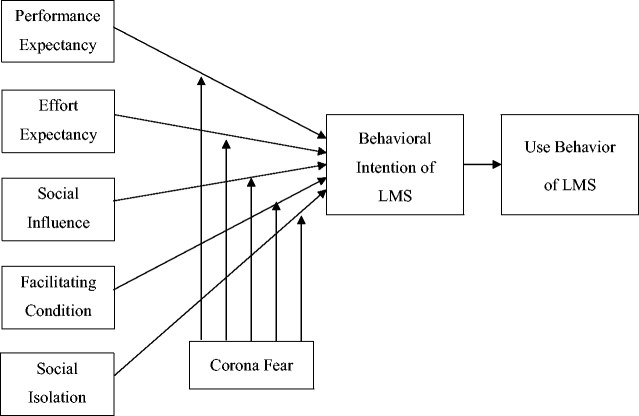
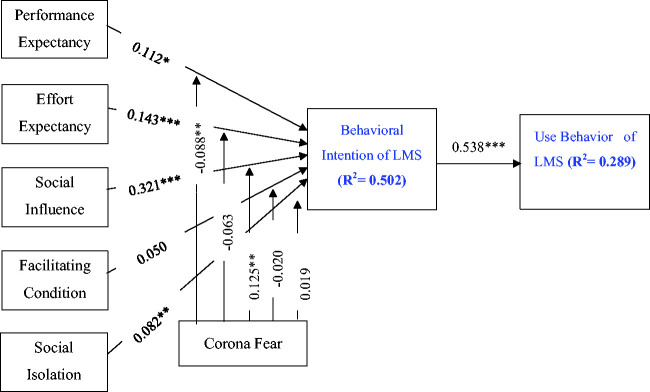
The COVID-19 Pandemic has led to social isolation; however, with the help of technology, education can continue through this tough time. Therefore, this research attempts to explore the Unified Theory of Acceptance and Use of Technology (UTAUT) through the expansion of the model. Also, make it relevant to investigate the influence of social isolation, and the moderating role of Corona fear on Behavioral Intention of the Learning Management System and its Use Behavior of Learning Management System among students. The data was analyzed using Partial Least Square (PLS) and Structural Equation Modelling (SEM). The findings show a positive link of Performance Expectancy (PE), Effort Expectancy (EE), Social Influence (SI), and Social Isolation on Behavioral Intention of LMS and, also between Behavioral Intention of LMS and its Use behavior. Moreover, the results of the moderation analysis show that Corona fears only moderates the link of Performance Expectancy and Social influence with Behavioral Intention of LMS. The findings imply the need for improving the LMS experience to increase its Behavioral Intention among students. Finally, the author's recommendation for future researchers is to examine the extended model in other countries and territories to analyze Coronavirus's influence on e-learning acceptance.
Overview
The claims and statistics of this paper haven’t been checked yet.
Free: it reads the open-access text and checks the first 5 claims that cite a source we can check. Create a free account to check every claim.
Integrity signals
Registry
Cites
Statistics
Figures
Verification
Claims the paper makes
The claims and statistics of this paper haven’t been checked yet.
Free: it reads the open-access text and checks the first 5 claims that cite a source we can check. Create a free account to check every claim.
Claims other papers make about this one
Each is checked against this paper’s own text: does it say what the citing paper says it does?
The cited source says what the claim attributes to it.
In the citing paper
“Several studies confirmed that in many cases individuals are urged by others to conduct specific activities including adopting new technologies (Kamal et al., 2020; Patil et al., 2020; Raza et al., 2021; Zhao and Bacao, 2020).”
From Factors affecting performance expectancy and intentions to use ChatGPT: Using SmartPLS to advance an information technology acceptance framework (2024) · cites this paper as Raza et al., 2021
Self-check
Percentages, sums and reported differences re-computed from the paper’s own numbers.
The self-check needs the paper’s full text.
Citations
Cites
Evaluating Structural Equation Models with Unobservable Variables and Measurement Error
Fornell, C., & Larcker, D. F. (1981) · Journal of Marketing Research · doi:10.2307/3151312 · Cited by 109,314
Evaluating structural equation models with unobservable variables and measurement error
Fornell, C., & Larcker, D. F. (1981) · Journal of Marketing Research · doi:10.1177/002224378101800104 · Cited by 109,190
Perceived usefulness, perceived ease of use, and user acceptance of information technology
Davis, F. D. (1989) · MIS Quarterly · doi:10.2307/249008 · Cited by 68,483 · cited 7×
“This finding is consistent with the studies of Davis (1989), Wang and Wang (2009), Motaghian et al.”
BackgroundResultInfluentialUser Acceptance of Information Technology: Toward A Unified View1
Venkatesh, V., Morris, M. G., Davis, G. B., & Davis, F. D. (2003) · MIS Quarterly · doi:10.2307/30036540 · Cited by 45,035 · cited 16×
“The items for measuring variables were adapted from Venkatesh et al. (2003), Zwain (2019), and Garone et al. (2019).”
BackgroundMethodResultInfluentialA new criterion for assessing discriminant validity in variance-based structural equation modeling
Henseler, J., Ringle, C. M., & Sarstedt, M. (2015) · Journal of the Academy of Marketing Science · doi:10.1007/s11747-014-0403-8 · Cited by 38,459 · cited 1×
“85, confirming the validity, as per the criteria given (Henseler et al., 2015; Raza et al., 2018, 2020).”
MethodA Paradigm for Developing Better Measures of Marketing Constructs
Churchill, G. A. (1979) · Journal of Marketing Research · doi:10.1177/002224377901600110 · Cited by 16,549 · cited 1×
“Moreover, the benchmark for individual reliability is that it should be greater than 0.7 (Churchill, 1979), which can be seen in Table 2.”
BackgroundInfluentialStructural equation models with unobservable variables and measurement error: Algebra and statistics
Fornell, C., & Larcker, D. F. (1981) · Journal of Marketing Research · doi:10.1177/002224378101800313 · Cited by 13,287
The use of partial least squares path modeling in international marketing
Henseler, J., Ringle, C. M., & Sinkovics, R. R. (2009) · Advances in International Marketing · doi:10.1108/s1474-7979(2009)0000020014 · Cited by 10,926
Venkatesh, V. (2000) · Information Systems Research · doi:10.1287/isre.11.4.342.11872 · Cited by 6,664 · cited 3×
“Since the original UTAUT model by Venkatesh et al. (2003) offered relevant factors for determining student’s behavioral intention towards LMS and its Use behavior, they were used for fulfilling the purpose of this research.”
BackgroundMethodModern Methods for Business Research
(1998) · doi:10.4324/9781410604385 · Cited by 6,534
Research works printed but not linked: 7
- Al-Busaidi K. A. Al-Shihi H. (2010). Instructors’ acceptance of learning management systems: A theoretical framework. Communications of the IBIMA, 2010(2010), 1– 10.
- Alias N. A. Zainuddin A. M. (2005). Innovation for better teaching and learning: Adopting the learning management system. Malaysian Online Journal of Instructional Technology, 2(2), 27– 40.
- Al-Shafi S. Weerakkody V. Janssen M. (2009). Investigating the adoption of eGovernment services in Qatar using the UTAUT model. AMCIS 2009 Proceedings, 260, 1--11.
- Fidani A. Idrizi F. (2012). Investigating students’ acceptance of a learning management system in university education: A structural equation modeling approach. ICT Innovations 2012 Web Proceedings, 2(23), 311– 320.
- Nanayakkara C. (2007). A model of user acceptance of learning management systems: A study within tertiary institutions in New Zealand. The International Journal of Learning, 13(12), 223– 232.
- Pakpour A. H. Griffiths M. D. (2020). The fear of CoVId-19 and its role in preventive behaviors. Journal of Concurrent Disorders. Advance online publication.
- Taiwo A. A. Downe A. G. (2013). The theory of user acceptance and use of technology (UTAUT): A meta-analytic review of empirical findings. Journal of Theoretical & Applied Information Technology, 49(1), 48--58.
Cited by
Items 501–600 of 626
Improving Educational Performance through Effective Performance Management Systems
Banu, P. T. D. S. B., & Aurangabadkar, R. R. D. H. (2024) · Journal of Informatics Education and Research · doi:10.52783/jier.v4i1.677
Educational Administration: Theory and Practice
Zhang, P., & Sukpasjaroen, K. (2024) · doi:10.53555//kuey.v30i3.1399
Andersen, E. O. (2024) · VBN Forskningsportal (Aalborg Universitet) · doi:10.54337/aau700624484
Perceptions of the use of IsiZulu Termbank Technology at University of KwaZulu-Natal.
Hadebe, N. (2023) · ResearchSpace (University of KwaZulu-Natal) · doi:10.29086/10413/22991
Factors Influencing Adoption of Mobile Banking Services in Bangladesh in Post-COVID-19 Context
Rakib, M. R. H. K. (2024) · Khulna University Business Review · doi:10.35649/kubr.2023.18.1.4
“Social distancing refers to physically separating people from one another, living alone both physically and emotionally, or maintaining a complete or nearly complete lack of communication out of necessity (Alam et al., 2021; Raza et al., 2021).”
Krcmery, S. (2024) · FEB International Scientific Conference · doi:10.18690/um.epf.5.2024.28
Food safety and online food delivery apps post-COVID-19 in Greater Jakarta—Indonesia
Candra, S., & Nurazizah, A. S. (2024) · Elsevier eBooks · doi:10.1016/b978-0-443-23637-2.00018-7
Profiling University Students’ Technology Acceptance Through UTAUT
Karakoyun, F., & Başaran, B. (2024) · Malaysian Online Journal of Educational Technology · doi:10.52380/mojet.2024.12.2.550 · Cited by 2
“In assessing acceptance of the LMS, social influence is the degree to which a student's social environment influences his/her LMS use intention (Raza et al., 2021).”
BackgroundInfluentialAllam, H., Dempere, J. M., Kalota, F., & Hua, D. (2024) · SSRN Electronic Journal · doi:10.2139/ssrn.4877184
Influancing Factors To Adopt M-LearningDuring Covid-19 For Schools In Pakistan
Bilal, S. M., Yuhaniz, S. S., & Hassan, N. H. (2023) · Open International Journal of Informatics · doi:10.11113/oiji2023.11n2.284
Quirit, R. J. A., & Himang, C. M. (2024) · Advances in educational technologies and instructional design book series · doi:10.4018/979-8-3693-2885-9.ch007
An Empirical Analysis of Blockchain Adoption Intention in Vietnamese SMEs
Le, H.-Y.-N., & Nguyen, M.-T. (2024) · Springer eBooks · doi:10.1007/978-981-97-3409-2_5
Mathur, S., Traisa, R., Homavazir, Z., Srivastava, G., & Mahajan, S. (2024) · Multidisciplinary Science Journal · doi:10.31893/multiscience.2024ss0422
Academic Misconduct After the Rapid Transition to Remote Learning
Andayani, S., Susilowati, E., Suryaningrum, D. H., Indrawati, A., Aini, E. D. N., Aliyyah, W. N., Alfiyahya, S., Tasri, N. R., & Idris, M. (2024) · Communications in computer and information science · doi:10.1007/978-3-031-72284-4_2
Octavianto, S. N., Santoso, J. T. B., Arief, S., & Baswara, S. Y. (2024) · Assets Jurnal Akuntansi dan Pendidikan · doi:10.25273/jap.v13i2.20425
Exploring Enterprise Resource Planning Gamification and Student Performance: A UTAUT Perspective
Musyaffi, A. M., Adha, M. A., Khairunnisa, H., Zairin, G. M., Ramadhani, N. A., & Yanti, N. Y. A. (2024) · International Conference on Electrical, Computer and Energy Technologies (ICECET) · doi:10.1109/icecet61485.2024.10698478 · Cited by 2
Stoenoiu, C. E., & Jäntschi, L. (2024) · Journal of Infrastructure Policy and Development · doi:10.24294/jipd.v8i11.8839
“…measure the evaluation of student and teacher satisfaction, which focus on the level of acceptance (Balkaya and Akkucuk, 2021; Garcia et al., 2020; Raza et al., 2020), on the determining factors (Alzahrani and Seth, 2021; Cavus, 2021), but also on the effect generated among the academic community…”
BackgroundAnalisa faktor penentu penerimaan dan penggunaan aktual mahasiswa terhadap sistem e-Learning
Rahmadani, S., Salim, A., Panggabean, S., & Riana, D. (2022) · Jurnal Inovasi Teknologi Pendidikan · doi:10.21831/jitp.v8i2.38886 · Cited by 4
The Effects of Learning Attributes on Students’ Writing Performance
Techadisai, K., Worawongpongsa, W., & Nanya, P. (2024) · rEFLections · doi:10.61508/refl.v31i3.276987 · Cited by 1
Models of Technology Acceptance in Education: A Bibliometric Analysis
Hernández, P., Pinilla-Rodríguez, D. E., Torres, G. R., & Paublini-Hernández, M. (2024) · IEEE Revista Iberoamericana de Tecnologias del Aprendizaje · doi:10.1109/rita.2024.3486999 · Cited by 1
“With 147 citations, following the publication of [1], is [34] who examine the adoption of online education in times of pandemic, in an environment of social isolation and fear, using the UTAUT model, through structural equation estimation.”
InfluentialHidayat, R. T., Hadi, M., & Johantri, B. (2024) · Jutisi Jurnal Ilmiah Teknik Informatika dan Sistem Informasi · doi:10.35889/jutisi.v13i2.2220
“Pemanfaatan teknologi informasi pada sektor ini dapat dilihat dengan munculnya berbagai sistem informasi (aplikasi web base) dalam bentuk learning management system (LMS) [4], [5] yang digunakan untuk melakukan transfer pengetahuan melalui sebuah proses pembelajaran, terlebih dalam masa pandemi.”
Pratama, A., Mukaromah, S., Idhom, M., Ningtyas, S. A., Parlika, R., & Suryantari, P. A. (2024) · IEEE Information Technology International Seminar (ITIS) · doi:10.1109/itis64716.2024.10845573
“Social influence is a significant predictor of behavioral intentions toward technology acceptance [13].”
Folosirea ChatGPT în medicină | [Using ChatGPT in medicine]
Dallago, C.-S. (2025) · Jurnal Medical Brasovean · doi:10.31926/jmb.2024.1.8
Immersive Wisdom in Teaching English Proverbs through Virtual Reality Game-Based Learning
Almusawi, M., Hussein, A. H. A., Al-Ani, M., Sabir, A. H., & Tabaan, N. K. (2024) · International Conference on Emerging Research in Computational Science (ICERCS) · doi:10.1109/icercs63125.2024.10895801
“It enables conditions that cannot be investigated in the actual world to be recognized [7].”
Sun, X., & Zhou, S. (2025) · International Journal of Interactive Mobile Technologies (iJIM) · doi:10.3991/ijim.v19i07.53873
Talib, Z. A., & Vathemuralee, N. (2025) · International Journal of Law Government and Communication · doi:10.35631/ijlgc.1039002
Motshegwa, B., Agolla, J. E., Monametsi, G. L., Phera, P., & Baagi, G. (2025) · Journal of Strategic Innovation and Sustainability · doi:10.33423/jsis.v20i2.7661
E-learning and its impact on university education outcomes in light of the Corona pandemic
AL-Momani, M. O. (2025) · Sociología y Tecnociencia · doi:10.24197/st.2.2025.48-69
Literature Study: Project-Based Learning "Sekolah Perempuan" for Education Students
Irwan, M., Rosdiana, R., Hasibuan, J., & Batubara, K. (2025) · International Conference on Educational Science in Industry Era (ICONSEIR) · doi:10.4108/eai.28-11-2024.2355372
Factors influencing adoption of electronic point of sales (E-POS) by shoppers in Nigeria
Okoli, M. N., Odigbo, B. E., & Nzekwu, D. N. (2025) · Vestnik of North-Eastern Federal University Series Economics Sociology Culturology · doi:10.25587/2587-8778-2025-2-25-43
(2025) · Trends in Finance and Economics · doi:10.46632/tfe/1/1/8
Application of AI in Enhancing Speaking Performance of Students in Hanoi
Lan, P. T. (2024) · Vietnam Academy of Social Sciences s VSSR · doi:10.56794/vssr.1(218).105-128
Auliyah, N., Usman, O., & Lutfia, A. (2025) · Jurnal Rimba Riset Ilmu manajemen Bisnis dan Akuntansi · doi:10.61132/rimba.v3i3.2060
Satriani, E., Nofitri, S., Oktadela, R., & Kadar, D. P. (2025) · KREATIF Jurnal Pengabdian Masyarakat Nusantara · doi:10.55606/kreatif.v5i1.8170
Online learning platform – a bibliometric review of the literature & research frontier
Feh, I. K. Y., Kheng, Y. K., & Jaganathan, M. (2025) · Edelweiss Applied Science and Technology · doi:10.55214/2576-8484.v9i9.10014
Fernández-Pascual, R., Pinto, M., & Mariscal, D. C. (2025) · Metrics · doi:10.3390/metrics2040020
“Other studies have been based on the forced adaptation to online learning due to the health crisis, revealing the shortcomings and differences among teachers and students in the processes of implementing and adopting these technologies [29,30].”
THE IMPORTANCE OF LMS TO IMPROVE DATA SCIENCE LEARNING PERFORMANCE
Humamy, R. F. (2025) · EDUTECH · doi:10.17509/e.v24i3.86518
Elementos determinantes da efetividade do sistema eletrônico de informações no setor público
da Cunha, D. D. O., Gomes, J. S., & Cruz, S. A. D. M. (2025) · Navus - Revista de Gestão e Tecnologia · doi:10.22279/navus.v16.1903
DETERMINANTS OF TECHNOLOGY-ASSISTED LEARNING METHODS IN HIGHER EDUCATION ESTABLISHMENTS
Anyinyo, N. O. (2025) · Armenian Folia Anglistika · doi:10.46991/afa/2025.21.2.88
“Studies indicate that a user’s perceived usefulness of technology influences its adoption (Raza et al., 2021; Haron et al., 2021; Abbad, 2021).”
Bokhari, A. (2025) · International Journal of Financial Administrative and Economic Sciences · doi:10.59992/ijfaes.2025.v4n12p13
Geração automática de exercícios de trigonometria
Martins, A. M. F. D. S. (2022) · Portuguese National Funding Agency for Science, Research and Technology (RCAAP Project by FCT) · doi:10.34626/dpz6-k792
The Effect of Learning Management System on Reading Comprehension Across 3 Types of Readers
Amali, S. (2024) · LEARN Journal : Language Education and Acquisition Research Network · doi:10.14456/learnjournal.2024.5 · Cited by 6
Julcarima, V. A. L., Montes, I. F. E., Mamani, S. L. M., Cahuata, L. D. M., León, W. F. C., Pérez, R. C., Alemán, L. V. M., Cabello, A., Vilcarano, E. I. F., Marroquín, R. D. P., et al. (2023) · Zenodo (CERN European Organization for Nuclear Research) · doi:10.5281/zenodo.8139300
Análisis de los factores determinantes del abandono escolar temprano en La Rioja
Ovejas, I. S. (2022) · RIUR (Universidad de La Rioja) · Cited by 2
Habilidades directivas y gestión escolar en la red 09, Ugel 01, San Juan de Miraflores
Mimbela-Mallqui, R. I. (2021) · LA Referencia (Red Federada de Repositorios Institucionales de Publicaciones Científicas)
Corvacho Valderrama, P. A. (2021) · LA Referencia (Red Federada de Repositorios Institucionales de Publicaciones Científicas)
When you are kindly asked to stay at home
Corell, R., & Mössler Färdig, T. (2021) · Lund University Publications Student Papers (Lund University)
Abdul Muin, N. (2021) · UiTM Institutional Repositories (Universiti Teknologi MARA)
Miller, G. (2023) · ScholarWorks (Walden University)
A Quantative Study of Heol Students' Perceptions of Communication within the LMS
Walker, H. (2021) · Digital Commons (Liberty University) · Cited by 2
DETERMINAN NIAT KONSUMEN DALAM MENGGUNAKAN PEMBAYARAN LINKAJA SYARIAH PADA E-COMMERCE
Madinatul Munawwarah, N. :. 2. (2023) · Digital Library UIN Sunan Kalijaga (Sunan Kalijaga State Islamic University)
Metodología para la implantación de Entornos Virtuales de Aprendizaje en Instituciones de Educación
León, D., & Reascos, I. (2021) · Journal of the Association for Information Systems
Moodle in German Language Learning: Advantages and Disadvantages
Saskara, N. F. S., Permana, P., & Permatawati, I. (2025) · Didaktika Jurnal Kependidikan · doi:10.58230/27454312.2306 · Cited by 1
Chitrao, P. V., Bhoyar, P. K., & Divekar, R. (2025) · Lecture notes in networks and systems · doi:10.1007/978-981-96-8750-3_42
Jaafar, J. A., Hakimi, T. I., Mohamad, M. A., Samad, R. A., & Mustapen, R. N. (2025) · Multidisciplinary Reviews · doi:10.31893/multirev.2026292
Alhumaid, K. F., & Alhammadi, M. M. (2025) · Indian Journal of Information Sources and Services · doi:10.51983/ijiss-2026.16.1.08
“Pandemic studies, more than others, have explained the rapid adoption of remote teaching, its ease of use, and the emergence of questions about face-to-face options, which have sustained concerns about usage as the most significant issue (Kim et al., 2021; Raza et al., 2021; Singh & Thurman, 2019).”
García‐Martín, J. (2025) · REDU Revista de Docencia Universitaria · doi:10.4995/redu.2025.23530
Jaber, J. J., Alhjahja, S. N. M., Shatnawi, Y., Al-Gasaymeh, A., & Ghulam, Y. A. (2026) · Advances in Science, Technology & Innovation/Advances in science, technology & innovation · doi:10.1007/978-3-032-00590-8_22
Hardy, G. M., Jr. (2025) · Digital Commons - ACU (Abilene Christian University) · Cited by 1
Al-Dhahab, I. S. A., Al-Balushi, M. A. M., & Al-Maashani, M. M. I. (2026) · Sohar University Journal of Sustainable Business · doi:10.69983/sujsb/0201/27
Jaber, J. J., Alzwi, A. S., Alhjahja, S. N. M., & Omari, R. A. (2026) · Emerald Group Publishing Limited eBooks · doi:10.1108/978-1-80592-551-420261003
Integrating digital tools in a co-regulated teaching and learning approach to ear training pedagogy
Grâce, N. D. (2024) · Bibliothèque et Archives nationales du Québec (Québec government)
Catapang, R. C., Repollo, N. A. M., Redondo, J. R., & Buenafe, M. L. (2025) · International Conference on Educational Technology (ICET) · doi:10.1109/icet67421.2025.11380768
“V. DISCUSSION study shows that performance expectation (PE) is an important factor influencing SAM for using LMS, as evidenced by previous studies[9][11][22].”
InfluentialTimurtaş, M. (2024) · Dspace Repository (Marmara Üniversitesi) · Cited by 2
Would students accept virtual agents for academic advising? A fit, viability, and risk perspective
Ibrahim, S., Bilquise, G., & Salhieh, S. M. I. (2026) · Interactive Technology and Smart Education · doi:10.1108/itse-10-2025-0293
Liu, W., & Zhang, Y. (2026) · Acta Psychologica · doi:10.1016/j.actpsy.2026.106626
Zhang, S. (2026) · Scholar: Human Sciences · doi:10.14456/shserj.2026.19
Saona, S., Alifah, N., & Zuhriyah, N. F. (2026) · Jurnal Pendidikan Indonesia · doi:10.59141/japendi.v7i2.9661
“Recent evidence shows that interface aspects can be a source of cognitive load (extraneous cognitive load), and cognitive load-based interface adaptations have been reported to optimize the learning experience on LMS (Raza et al., 2021).”
Alfat, C., Saluky, & Winarso, W. (2025) · Journal of Advanced Learning Media Development · doi:10.37396/jalmd.v1i2.11
“The implementation of the use of this learning media needs to pay attention to the needs of students, school and parent support, and continuous evaluation to ensure its effectiveness in improving students' mathematical problem-solving skills [41], [43].”
Approche de l’action instrumentée dans un cours de veille, depuis l’interface graphique d’un EIAH
Zeller, A. (2023) · theses.fr (ABES) · doi:10.70675/559d4810zb3baz45cazbf15z0b4b6438b3ad
Understanding GAI user addiction from an I-PACE perspective
Xu, Z., Meng, Z., & Pei, L. (2026) · Information Technology and People · doi:10.1108/itp-07-2025-1047
Ahamed, S. S., Raihana Parveen, R., Shaik, G., Bindu, T., Babu, R. V., Giriasree, P., Reddy, D. H., & Sugumaran, V. (2026) · BENTHAM SCIENCE PUBLISHERS eBooks · doi:10.2174/9789815324488126040014
The Learning Technology Adoption Model (LTAM)
Rea, N. (2026) · Lancaster EPrints (Lancaster University) · doi:10.17635/lancaster/thesis/3230
Dewi, K. T. M., Musmini, L. S., & Diatmika, I. P. G. (2026) · e-Journal Ekonomi Bisnis dan Akuntansi · doi:10.19184/e-jeba.v13i1.60009
Using UTAUT2 to Study the Impact of Chatbot on the Development of M-Commerce in Jordan
Shdaifat, A. M., Obeidallah, R. A., & Abu-Srhan, A. (2026) · Studies in computational intelligence · doi:10.1007/978-3-032-23897-9_5 · Cited by 1
Enhancing Early Childhood Learning Quality through Adaptive Management
Chodijah, S., Laili, N., Fauziyah, A., Ravellina, P. N., Safitri, D., Rerka, A. E., & Azminah, S. N. (2026) · At-tahsin Jurnal Manajemen Pendidikan · doi:10.59106/attahsin.v6i1.453 · Cited by 1
“This dynamic approach is essential for addressing the ever-changing needs of children, particularly in early childhood settings where developmental milestones vary significantly from one child to another(Raza et al., 2021).”
Siraj, M. A. M. M. (2024) · Universiti Putra Malaysia Institutional Repository (Universiti Putra Malaysia)
Jayasuriya, D., Amaratunge, S., & Silva, O. (2026) · Sri Lankan Journal of Business Economics · doi:10.31357/sljbe.v15.9143
Sahani, C., Rawat, N., C, K. G., Bijalwan, P., Gupta, A., & Johri, A. (2026) · EDPACS · doi:10.1080/07366981.2026.2671374
Jumiati, Sulaeman, N. F., & Nadajaran, P. (2026) · Journal of Learning Education and Technology · doi:10.70152/leotech.v3i1.337
“Recent research confirms the role of access as an important external factor in the adoption of educational technology (Raza et al., 2021).”
Rama, A., & Lofandri, W. (2025) · SCHOULID Indonesian Journal of School Counseling · doi:10.23916/086819011
“Raza et al. (2021) menggunakan Technology Acceptance Model (TAM) untuk menunjukkan bahwa persepsi kegunaan (perceived usefulness) dan kemudahan penggunaan (perceived ease of use) diprediksi oleh kualitas kontenbukan sekadar kemudahan teknikalnya.”
Adoption of digital government platforms in Chile: Evidence from a mandatory adoption context
Bueno-Broterson, Y., Toledo, E. G., & Araya, S. (2026) · International Review of Administrative Sciences · doi:10.1177/00208523261457031
Santos, C., Martinez, R. A., & Farias, A. A. C. (2026) · Brazilian Geographical Journal · doi:10.14393/bgj-v17n1-a2026-79098
Azzahra, C. S., Beng, J. T., Tiatri, S., Nagm, F., Nurkholiza, R., & Dinatha, V. O. D. (2026) · Journal of Information Systems and Informatics · doi:10.63158/journalisi.v8i3.1697
“Although much research on the acceptance of digital learning technologies based on the UTAUT model has been conducted, most studies have focused on general e-learning platforms such as Blackboard and LMS [15], [16].”
A Didactic Model for Legal Training of Technosphere Safety Students in LMS Moodle
Анатольевна, Д. Н., Eliseev, D. V., Ponomarenko, A. V., Mokhorova, A., & Turgunovna, K. B. (2026) · International Conference on Technology Enhanced Learning in Higher Education (TELE) · doi:10.1109/tele71748.2026.11591416
“…training for technical students: learning analytics (LA) – the use of digital traces to predict student performance and provide early intervention [5]; adaptive learning systems – content and assessment that adjust in real time based on students’ answers [6]; and AI‑augmented feedback – large…”
Hassnain, V., Munawar, U., & Kamran, M. (2026) · Research Journal for Social Affairs · doi:10.71317/rjsa.004.03(s2).1029
“In Pakistan, where access to high-quality academic databases is limited, the value of AI tools in literature synthesis is even more critical, as their highest recorded individual correlation (r = .72) highlights (Iqbal & Bhatti, 2020).”
InfluentialDeterminants of LMS Continuance Intention: An Extended UTAUT Approach
Krisnawijaya, N. N. K., Yulianti, N. M. D. R., Ni Putu Dhanan Kumaradewi, M., & Putra, A. A. A. W. (2026) · International Journal of Management Science and Information Technology · doi:10.35870/ijmsit.v6i2.7403
Bashir, F., & Khanum, A. (2026) · Communications in computer and information science · doi:10.1007/978-981-92-3734-0_15
Olaya, S. A. B. (2026) · Institutional Repository of the National University Open and Distance UNAD (Universidad Nacional Abierta y a Distancia)
Halimah, N., Yusrawati, Y., & Saputra, A. M. (2026) · JEMSI (Jurnal Ekonomi Manajemen dan Akuntansi) · doi:10.35870/jemsi.v12i4.6819
Thamariska, R., Hatta, P., & Wihidayat, E. S. (2026) · Pedagogy Review · doi:10.61436/pedrev/v5i3.pp378-390
Data Mining for Smarter Administration of TVET Institutes
Sheeraz, A., Rasheed, Y. A., Azim, N., Khan, A., & Ahmed, S. (2025) · International Journal of Innovations in Science and Technology · doi:10.33411/ijist/1622
Exploring the acceptance of science teachers toward simulator-based technology
Kusuma, N. A., Yamtinah, S., & Sukmawati, F. (2026) · Multidisciplinary Science Journal · doi:10.31893/multiscience.2027060
“…is consistent with that of Dhewandrie & Yuniawan (2023), who stated that hedonic motivation plays an important role in technology use behavior, and that of Raza et al. (2020), who highlighted that enjoyment while using technology supports its sustained adoption, especially among accustomed users.”
Fuzi, S. F., Zahidi, N. E., Halim, B. A., Zainudin, S. N., Jama, S. R., Jusoh, N., & Hassan, W. H. W. (2026) · International Journal of Research and Innovation in Social Science · doi:10.47772/ijriss.2026.100700545
NGUYỄN, M. T. (2026) · Journal of Education and Society · doi:10.64410/idkf1459
Beyond Individual Determinants: Integrating Group-Level Mechanisms into LMS Acceptance ResearchPreprint
Khechine, H., Bringas, T. C. F., Bardales-Mendoza, O., & Raymond, B. (2026) · SSRN Electronic Journal · doi:10.2139/ssrn.7351052
Piersiala, L. (2026) · European Conference on Knowledge Management · doi:10.34190/eckm.27.1.5059
“Although digital transformation was already underway, e - learning experienced exponential growth following the 2020 COVID - 19 outbreak, which abruptly restricted traditional face - to - face instruction globally (Dias et al., 2020; Omar, 2021; Raza et al., 2021; Gamage et al., 2022).”
Putra, H., Zainil, Y., Hendriani, S., & Afif, Z. (2026) · English Learning Innovation · doi:10.22219/englie.v7i2.44606
“…the concept of technological affordances proposed by Treem et al., (2020), particularly immediacy, visibility, persistence, and editability as well as principles of interaction and engagement in digital learning environments (Martin & Bolliger, 2018; Raza, et al., 2020; Yulianawati et al., 2021).”
Metadata
- Authors
- Raza, S. A., Qazi, W., Khan, K. A., & Salam, J.
- Affiliations
- Iqra University (PK)
- Corresponding author
- Raza, Syed A.
- Venue
- Journal of Educational Computing Research
- Publisher
- SAGE Publications
- Published
- 2020-09-22
- Volume
- 59
- Issue
- 2
- Pages
- 183-208
- ISSN
- 0735-6331 (ISSN-L)
- 1541-4140
- PMC
- PMC7509242
- OpenAlex
- W3087094992
- Semantic Scholar
- 140945470c3df734fcc31547b10e28baef9b99b6
- Cited by
- 510
- References
- 61
- Citations by year
- 2026: 24 · 2025: 54 · 2024: 104 · 2023: 116 · 2022: 134 · 2021: 78
- FWCI
- 81.30
- Type
- journal article
- Language
- en
- Open access
- hybrid
- doi.org
- Locations
- Journal of Educational Computing Research (publishedVersion, cc-by)
- PubMed Central (publishedVersion, cc-by)
- Topics
- Social Sciences › Decision Sciences › Information Systems and Management › Technology Adoption and User Behaviour
- Social Sciences › Education › Education during COVID-19 pandemic
- Physical Sciences › Computer Science › Information Systems › Educational Technology and E-Learning
- Keywords
- social isolation, virtual learning environments, technology acceptance, UTAUT, COVID-19 pandemic, e-learning acceptance, behavioral intention, use behavior, performance expectancy, effort expectancy, social influence, moderating effect
About these checks
Registry, retraction, Cites and statistics results are computed, not judged, with one exception: a printed reference that no index lists is read once by a model before it counts as a citation error. Claims are extracted by a model and kept only when their quote appears verbatim in the text; each cited source is then checked, with a model’s help, for whether it says what the claim relies on. Those verdicts can be wrong — read the claim’s quote and the cited source before relying on one.
Statistics and arithmetic are recomputed, not judged.
Confidence bands are shown only for fields calibrated on our annotated test set. None is calibrated yet, so no band is shown.
What counts as a claim ›How we measure confidence ›How we check this ›
Are you an author, or do you see a problem with this page? Request a review
Data sources
Bibliographic data: Semantic Scholar, OpenAlex, Crossref.
Contains information from the Semantic Scholar Academic Graph Datasets, made available under the ODC Attribution License (ODC-BY 1.0).
Semantic Scholar’s data is described in: Kinney, R., et al. (2023). The Semantic Scholar Open Data Platform. arXiv:2301.10140.
