

Social Isolation and Acceptance of the Learning Management System (LMS) in the time of COVID-19 Pandemic: An Expansion of the UTAUT Model
Open accessThe DOI matches its Crossref record; 65 of the 67 references it cites were found in a registry or an index, and 2 are not checked yet.
Abstract
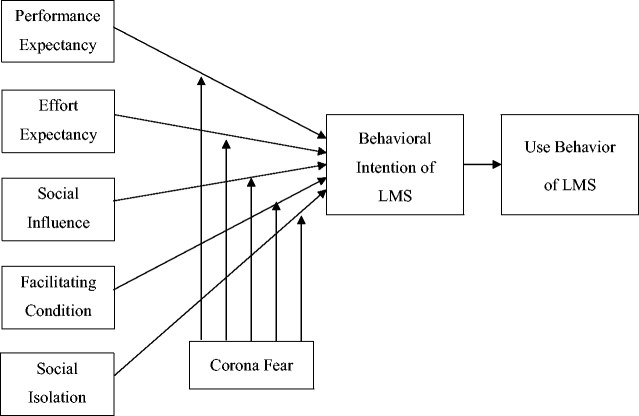
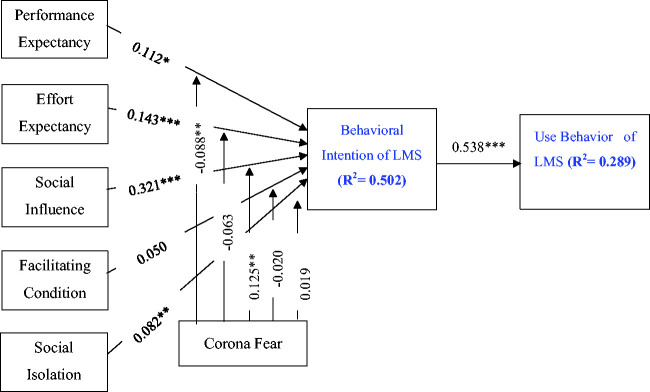
The COVID-19 Pandemic has led to social isolation; however, with the help of technology, education can continue through this tough time. Therefore, this research attempts to explore the Unified Theory of Acceptance and Use of Technology (UTAUT) through the expansion of the model. Also, make it relevant to investigate the influence of social isolation, and the moderating role of Corona fear on Behavioral Intention of the Learning Management System and its Use Behavior of Learning Management System among students. The data was analyzed using Partial Least Square (PLS) and Structural Equation Modelling (SEM). The findings show a positive link of Performance Expectancy (PE), Effort Expectancy (EE), Social Influence (SI), and Social Isolation on Behavioral Intention of LMS and, also between Behavioral Intention of LMS and its Use behavior. Moreover, the results of the moderation analysis show that Corona fears only moderates the link of Performance Expectancy and Social influence with Behavioral Intention of LMS. The findings imply the need for improving the LMS experience to increase its Behavioral Intention among students. Finally, the author's recommendation for future researchers is to examine the extended model in other countries and territories to analyze Coronavirus's influence on e-learning acceptance.
Overview
The claims and statistics of this paper haven’t been checked yet.
Free: it reads the open-access text and checks the first 5 claims that cite a source we can check. Create a free account to check every claim.
Integrity signals
Registry
Cites
Statistics
Figures
Verification
Claims the paper makes
The claims and statistics of this paper haven’t been checked yet.
Free: it reads the open-access text and checks the first 5 claims that cite a source we can check. Create a free account to check every claim.
Claims other papers make about this one
Each is checked against this paper’s own text: does it say what the citing paper says it does?
The cited source says what the claim attributes to it.
In the citing paper
“Several studies confirmed that in many cases individuals are urged by others to conduct specific activities including adopting new technologies (Kamal et al., 2020; Patil et al., 2020; Raza et al., 2021; Zhao and Bacao, 2020).”
From Factors affecting performance expectancy and intentions to use ChatGPT: Using SmartPLS to advance an information technology acceptance framework (2024) · cites this paper as Raza et al., 2021
Self-check
Percentages, sums and reported differences re-computed from the paper’s own numbers.
The self-check needs the paper’s full text.
Citations
Cites
Evaluating Structural Equation Models with Unobservable Variables and Measurement Error
Fornell, C., & Larcker, D. F. (1981) · Journal of Marketing Research · doi:10.2307/3151312 · Cited by 109,314
Evaluating structural equation models with unobservable variables and measurement error
Fornell, C., & Larcker, D. F. (1981) · Journal of Marketing Research · doi:10.1177/002224378101800104 · Cited by 109,190
Perceived usefulness, perceived ease of use, and user acceptance of information technology
Davis, F. D. (1989) · MIS Quarterly · doi:10.2307/249008 · Cited by 68,483 · cited 7×
“This finding is consistent with the studies of Davis (1989), Wang and Wang (2009), Motaghian et al.”
BackgroundResultInfluentialUser Acceptance of Information Technology: Toward A Unified View1
Venkatesh, V., Morris, M. G., Davis, G. B., & Davis, F. D. (2003) · MIS Quarterly · doi:10.2307/30036540 · Cited by 45,035 · cited 16×
“The items for measuring variables were adapted from Venkatesh et al. (2003), Zwain (2019), and Garone et al. (2019).”
BackgroundMethodResultInfluentialA new criterion for assessing discriminant validity in variance-based structural equation modeling
Henseler, J., Ringle, C. M., & Sarstedt, M. (2015) · Journal of the Academy of Marketing Science · doi:10.1007/s11747-014-0403-8 · Cited by 38,459 · cited 1×
“85, confirming the validity, as per the criteria given (Henseler et al., 2015; Raza et al., 2018, 2020).”
MethodA Paradigm for Developing Better Measures of Marketing Constructs
Churchill, G. A. (1979) · Journal of Marketing Research · doi:10.1177/002224377901600110 · Cited by 16,549 · cited 1×
“Moreover, the benchmark for individual reliability is that it should be greater than 0.7 (Churchill, 1979), which can be seen in Table 2.”
BackgroundInfluentialStructural equation models with unobservable variables and measurement error: Algebra and statistics
Fornell, C., & Larcker, D. F. (1981) · Journal of Marketing Research · doi:10.1177/002224378101800313 · Cited by 13,287
The use of partial least squares path modeling in international marketing
Henseler, J., Ringle, C. M., & Sinkovics, R. R. (2009) · Advances in International Marketing · doi:10.1108/s1474-7979(2009)0000020014 · Cited by 10,926
Venkatesh, V. (2000) · Information Systems Research · doi:10.1287/isre.11.4.342.11872 · Cited by 6,664 · cited 3×
“Since the original UTAUT model by Venkatesh et al. (2003) offered relevant factors for determining student’s behavioral intention towards LMS and its Use behavior, they were used for fulfilling the purpose of this research.”
BackgroundMethodModern Methods for Business Research
(1998) · doi:10.4324/9781410604385 · Cited by 6,534
Research works printed but not linked: 7
- Al-Busaidi K. A. Al-Shihi H. (2010). Instructors’ acceptance of learning management systems: A theoretical framework. Communications of the IBIMA, 2010(2010), 1– 10.
- Alias N. A. Zainuddin A. M. (2005). Innovation for better teaching and learning: Adopting the learning management system. Malaysian Online Journal of Instructional Technology, 2(2), 27– 40.
- Al-Shafi S. Weerakkody V. Janssen M. (2009). Investigating the adoption of eGovernment services in Qatar using the UTAUT model. AMCIS 2009 Proceedings, 260, 1--11.
- Fidani A. Idrizi F. (2012). Investigating students’ acceptance of a learning management system in university education: A structural equation modeling approach. ICT Innovations 2012 Web Proceedings, 2(23), 311– 320.
- Nanayakkara C. (2007). A model of user acceptance of learning management systems: A study within tertiary institutions in New Zealand. The International Journal of Learning, 13(12), 223– 232.
- Pakpour A. H. Griffiths M. D. (2020). The fear of CoVId-19 and its role in preventive behaviors. Journal of Concurrent Disorders. Advance online publication.
- Taiwo A. A. Downe A. G. (2013). The theory of user acceptance and use of technology (UTAUT): A meta-analytic review of empirical findings. Journal of Theoretical & Applied Information Technology, 49(1), 48--58.
Cited by
Items 401–500 of 626
Handri, S., Nevriansyah, E., & Mathriul, A. Q. (2022) · INTERNATIONAL JOURNAL OF HIGH INFORMATION COMPUTERIZATION ENGINEERING AND APPLIED SCIENCE (JHICE) · doi:10.24036/jhice/vol2-iss02/63 · Cited by 1
“LMS involves the interaction between traditional teaching techniques and digital learning resources [5][6][7].”
BackgroundRamos, Y. I., Jovita, H., Tomaro, Q. P. V., & Batara, E. B. (2023) · E3S Web of Conferences · doi:10.1051/e3sconf/202344003017 · Cited by 1
“Some studies show that the fear of COVID plays a direct moderating role with other constructs in research [25], [6].”
BackgroundThe Future of Deliveries: Parcel Locker Intentions
Yusoff, F. A. M., Mohamad, F. B., Tamyez, P. F. M., & Panatik, S. A. (2023) · The European Proceedings of Social & Behavioural Sciences · doi:10.15405/epsbs.2023.11.02.6 · Cited by 1
“Apart from that, Raza et al (2021) proved this relationship to be significant on learning management systems, and Tarhini et al. (2016) on mobile technologies.”
BackgroundMarfuah, S., Nugroho, J. A., & Setyowibowo, F. (2023) · Jurnal DinamikA · doi:10.18326/dinamika.v4i2.96-113 · Cited by 1
Analysis Factors Affecting Student Intention to Use Generative Artificial Intelligence in E-Learning
Meilani, M., Aryuni, M., & Candra, S. (2024) · International Conference on Information Management and Technology (ICIMTech) · doi:10.1109/icimtech63123.2024.10780796 · Cited by 1
“Behavioral Intention has a significant influence on user behavior, this result is in accordance with research [52-54].”
Çiftçi, Ş. K., Karadağ, E., & Ergin-Kocaturk, H. (2025) · Technology Pedagogy and Education · doi:10.1080/1475939x.2024.2436408 · Cited by 1
“Raza et al. (2020) evaluated the effect of social isolation and fear of the pandemic by developing the UTAUT model during the COVID-19 pandemic.”
Predicting personalized mathematics learning among pre-university students in the Maldives
Mohamed, M., Ayub, A. F. M., Yasin, M., & Nawi, N. R. C. (2025) · International Journal of Evaluation and Research in Education (IJERE) · doi:10.11591/ijere.v14i2.31174 · Cited by 1
Boullous, L., Hain, M., Chergui, A., & Bhiri, B. E. (2025) · Advances in Science, Technology & Innovation/Advances in science, technology & innovation · doi:10.1007/978-3-031-74474-7_2 · Cited by 1
Cardozo, É. A. A., & Christino, J. M. M. (2024) · Revista de Ciências da Administração · doi:10.5007/2175-8077.2024.e73310 · Cited by 1
E-Exam Cheating Detection System for Moodle LMS
Shatnawi, A. S., Awad, F. H., Mustafa, D., Al-Falaky, A.-W., Shatarah, M., & Mohaidat, M. (2025) · Information · doi:10.3390/info16050388 · Cited by 1
Srivastava, K., Kumar, M., Verma, R., Singh, S., & Maurya, P. (2025) · Advances in web technologies and engineering book series · doi:10.4018/979-8-3693-2973-3.ch003 · Cited by 1
Khalid, N., & Rahman, N. F. A. (2025) · International Journal of Modern Education · doi:10.35631/ijmoe.724068 · Cited by 1
Sidharta, I., Marjito, M., Riswaya, A. R., Resawati, R., Dwiyanisa, A., & Herawati, O. (2025) · International Journal of Accounting and Economics Studies · doi:10.14419/6b8j9a50 · Cited by 1
Ilham, I., & Apriliyanti, M. (2025) · SCAFFOLDING Jurnal Pendidikan Islam dan Multikulturalisme · doi:10.37680/scaffolding.v7i1.7351 · Cited by 2
Measuring what matters: a study on leadership training among middle managers
Yusoff, A. (2025) · Evidence-based HRM a Global Forum for Empirical Scholarship · doi:10.1108/ebhrm-02-2025-0059 · Cited by 1
Bharathi, S. K. S., & Sujatha, S. (2025) · Problems and Perspectives in Management · doi:10.21511/ppm.23(3).2025.45 · Cited by 1
“Allen and Meyer (1990) and Raza et al. (2021) found that employees who have a strong sense of belonging at work are more likely to persevere through tough times, contribute significantly, and regard their organization as a community rather than just a workspace.”
Fajri, R., & Muskhir, M. (2025) · Saturnus · doi:10.61132/saturnus.v3i3.944 · Cited by 1
Do LMS Analytics Predict Student Success? A Quantitative Study of Engagement and Course Performance
Cook-Chennault, K. A., & Farooq, A. G. (2025) · IEEE Frontiers in Education Conference (FIE) · doi:10.1109/fie63693.2025.11328598 · Cited by 1
“Due to the proliferation of additional knowledge in delivering curriculum remotely and using LMSs[36], understanding how to critically examine student analytics towards assessing student learning is needed.”
Korsah, D. P., Wireko-Ampem, J. K., & Forson, I. (2026) · Interdisciplinary Educational Technology · doi:10.71176/interedtech/17900 · Cited by 1
Author), N. A. S. Y. (., Rosman, M. R. M., & Bahry, F. D. S. (2025) · Malaysian Journal of Library & Information Science · doi:10.22452/mjlis.vol30no3.2 · Cited by 2
ธนมัยมาศ, ว., & McKell, B. (2026) · Journal of English Language and Linguistics · doi:10.62819/jel.2026.2169 · Cited by 1
Tan, P. S. I. (2025) · Jurnal Imiah Pendidikan dan Pembelajaran · doi:10.23887/jipp.v9i3.94109 · Cited by 2
Merangkul Revolusi Digital: Peran Kepemimpinan Transformasional dalam Membangun Smart Campus
Bernadus, M. E., & Rugaiyah, R. (2025) · Jurnal Ilmu Manajemen dan Pendidikan · doi:10.30872/jimpian.v5i2.5763 · Cited by 1
Determinants of online learning application effectiveness: Evidence from Vietnam
Hien, D. T. T., & Nhung, T. T. (2026) · International Journal of Data and Network Science · doi:10.5267/j.ijdns.2026.4.017 · Cited by 1
Liu, W. (2026) · Social Sciences & Humanities Open · doi:10.1016/j.ssaho.2026.103340 · Cited by 1
DESIGN-BASED LEARNING IN TEXTILES FOR HIGHER EDUCATION
Malengier, B., Rădulescu, I. R., Blaga, M., & Stjepanovi?, R. P. A. Z. (2021) · doi:10.33965/el2021_202104c015 · Cited by 2
Yunita, N., Suryadi, K., & Anggraeni, L. (2021) · PAEDAGOGIA · doi:10.20961/paedagogia.v24i1.53964 · Cited by 1
Chahkandi, F. (2021) · International Journal of English Language Studies · doi:10.32996/ijels.2021.3.11.5 · Cited by 1
Cloud secured mobile e-learning system solutions using machine learning approach
Begum, K. J., & Nirmala, K. (2022) · International Journal of Health Sciences · doi:10.53730/ijhs.v6ns2.6085 · Cited by 1
Use of Technology With Problem-Based Learning in Higher Education
(2022) · Advances in educational technologies and instructional design book series · doi:10.4018/978-1-7998-8177-3.ch002 · Cited by 1
Üniversite Öğrencilerinin Uzaktan Eğitimi Kullanım Niyetlerinin UTAUT Bağlamında İncelenmesi
ÖZKARA, B. Ö., Çivril, H., & Aruğaslan, E. (2022) · Mersin Üniversitesi Eğitim Fakültesi Dergisi · doi:10.17860/mersinefd.991686 · Cited by 2
STUDENT PERCEPTIONS OF LMS AT THE FACULTY OF ENGINEERING TRUNOJOYO UNIVERSITY MADURA
Permana, K. E., Sophan, M. K., & Muntasa, A. (2022) · Jurnal Simantec · doi:10.21107/simantec.v10i2.14652 · Cited by 1
“Sehingga tingkat penerimaan LMS bisa setinggi di negara barat [6][7] mempelajari isolasi sosial pada niat perilaku LMS di kalangan siswa.”
BackgroundAcceptance analysis of e-HRM for employees using UTAUT-1 model
Permatasari, Y., Tricahyono, D., & Indiyati, D. (2022) · Routledge eBooks · doi:10.1201/9781003335832-28 · Cited by 1
Garbutt, M., Tsibolane, P., & Pillay, T. (2022) · Communications in computer and information science · doi:10.1007/978-3-031-21076-1_10 · Cited by 1
Bekar, F., & Çam, H. (2022) · Hitit Sosyal Bilimler Dergisi · doi:10.17218/hititsbd.1166639 · Cited by 1
Al-rasheed, A. S. (2022) · Journal of Umm Al-Qura University for Educational and Psychological Sciences · doi:10.54940/ep65336589 · Cited by 1
Owu, A. R., Pratiknjo, M. H., & Tampi, J. R. E. (2023) · LEGAL BRIEF · doi:10.35335/legal.v11i6.701 · Cited by 1
Hariyanto, S., Rohani, S., & Lestari, P. Y. (2023) · Journal of Language Teaching and Research · doi:10.17507/jltr.1403.26 · Cited by 1
Lei, H. (2023) · International Journal of New Developments in Education · doi:10.25236/ijnde.2023.050819 · Cited by 1
Gao, Y. (2023) · Journal of Combinatorial Optimization · doi:10.1007/s10878-023-01059-w · Cited by 1
RetractedDistance Digital Learning for Adult Learners: Self-paced e-Learning on Business Information Systems
Schüll, A., & Brocksieper, L. (2023) · Lecture notes in business information processing · doi:10.1007/978-3-031-39386-0_15 · Cited by 2
Ruixui, W., Wu, Y., Zainordin, N. A., Aziyatul, I. N., Universiti Teknologi MARA, C. S., Nursyamilah, A., & Universiti Teknologi MARA, C. P. (2023) · Jurnal Intelek · doi:10.24191/ji.v18i2.22189 · Cited by 1
Kamalasena, B. D. T. M., & Sirisena, A. B. (2023) · South Asian Journal of Business Insights · doi:10.4038/sajbi.v3i1.53 · Cited by 1
Chawla, U., Sondhi, S. S., Jabbar, M. A., Mishra, V., & Singh, H. V. (2023) · International Social Science Journal · doi:10.1111/issj.12457 · Cited by 1
Hidayat, W., Sugandini, D., & Istanto, Y. (2022) · Journal of International Conference Proceedings · doi:10.32535/jicp.v5i5.2124 · Cited by 1
Fazal, N., Rafiq, N., & Tajammul, M. (2022) · Pakistan Journal of Social Research · doi:10.52567/pjsr.v4i03.1281 · Cited by 3
Bisma, R., Arbaningrum, M. P., Putra, R. E., & Suartana, I. M. (2023) · International Conference on Vocational Education and Electrical Engineering (ICVEE) · doi:10.1109/icvee59738.2023.10348361 · Cited by 1
“Users' decisions to use the system are sometimes influenced by their external environment or the people around them, such as friends and family, even during times of social distancing [25].”
BackgroundPranata, S., Putra, D. G. S., Purwadi, H., Pratiwi, A., & Wulandari, H. (2022) · PENA NURSING · doi:10.31941/pn.v1i01.2029 · Cited by 1
Education Collaborative Management System Based on Intelligent Multimedia Technology
Xiuling, L. (2024) · International Conference on Science, Engineering and Technology Practices for Sustainable Development (ICSETPSD) · doi:10.4108/eai.17-11-2023.2342791 · Cited by 1
Faculty Use of a Learning Management System During and After the COVID-19 Pandemic
Miller, G. (2024) · Journal of Education and Development · doi:10.20849/jed.v8i1.1409 · Cited by 1
“Raza et al. (2021), found that social isolation and Corona fear affected students’ use of LMS.”
BackgroundWiryawan, D., Akbar, Z. R., Hiererra, S. E., Luhukay, D., Richard, R., & Pitchay, A. A. (2023) · International Conference on Information and Communications Technology (ICOIACT) · doi:10.1109/icoiact59844.2023.10455936 · Cited by 2
“The LMS enables students to access learning resources and participate in course content at their own pace and convenience, regardless of location [3].”
BackgroundAsrori, A., & Amal, M. I. (2023) · Jurnal Dinamika Akuntansi · doi:10.15294/jda.v15i1.43184 · Cited by 1
“Based on the social influence construct of UTAUT, which suggests that individuals’ behavioral intentions to use technology are influenced by the social factors surrounding them (Gharrah & Aljaafreh, 2021; Raza et al., 2021).”
Background(2024) · Journal of System and Management Sciences · doi:10.33168/jsms.2024.0915 · Cited by 1
Leveraging Web-Based Learning to Mitigate Adult Literacy Levels: Perspectives from Kenya
Ng’ang’a, M. M., Kimani, S., Kimwele, M. W., & Hawuory, J. P. (2024) · IST-Africa Conference (IST-Africa) · doi:10.23919/ist-africa63983.2024.10569702 · Cited by 1
“This consistency with the findings of [32] and [33] underscores that learner behavior in online learning systems is strongly influenced by their behavioral intention.”
BackgroundHidayat, U. S. (2024) · CAKRAWALA · doi:10.32781/cakrawala.v18i1.679 · Cited by 1
Xu, X. (2024) · Applied Mathematics and Nonlinear Sciences · doi:10.2478/amns-2024-2237 · Cited by 1
Bantoto, F. M. O., Flores, B. I., & Jindal, M. (2024) · Lecture notes in networks and systems · doi:10.1007/978-3-031-68653-5_6 · Cited by 1
COVID-19 Crisis and the Transition of Universities to Education 4.0
Milić, S., Simeunović, V., & Cenić, D. (2023) · Pedagoška obzorja · doi:10.55707/ds-po.v38i3-4.115 · Cited by 1
A Bibliometric Analysis of Visualizing Knowledge Mapping for Learning Management System
Ye, X., Wang, J., Liu, D., & Qin, Q. (2025) · International Conference on Educational and Information Technology · doi:10.1109/iceit64364.2025.10976091 · Cited by 1
“Some scholars have proposed that for higher education, factors such as social isolation and fears of the corona-virus propel students towards accepting, using, and relying on LMS for learning activities, which can promote students to change their traditional learning motivations and outcomes [22].”
Osman, Z., Serrano, J. V., Nguyen, H.-A. T., Intaratat, K., & Suhandoko, A. D. J. (2025) · International Journal of Academic Research in Accounting Finance and Management Sciences · doi:10.6007/ijarafms/v15-i2/25141 · Cited by 1
“For example, Raza et al. (2021) found that performance expectations affect employees' willingness to use technology, which affects their acceptance and user behavior.”
Harrasi, Z. A. A., & Ali, M. H. (2025) · Advances in Social Sciences Research Journal · doi:10.14738/assrj.1207.19139 · Cited by 1
Beyond the chalkboard: exploring the dynamics of technology use in business schools
Walia, J. S., & Singh, G. (2025) · International Journal of Quality & Reliability Management · doi:10.1108/ijqrm-12-2024-0429 · Cited by 3
Measuring Student Satisfaction In Using Learning Management System At ED-TECH Company
Anugerah, S., & Retnowardhani, A. (2022) · Jurnal Mantik · doi:10.35335/jurnalmantik.v6i1.2187 · Cited by 3
LIPIcs, Volume 256, FORC 2023, Complete Volume
Talwar, K. (2023) · DROPS (Schloss Dagstuhl – Leibniz Center for Informatics) · doi:10.4230/lipics.forc.2023 · Cited by 1
Simple Student Grades Analytics Dashboards In Higher Education In Vietnam
Thanh, T. B., Td, D., Le, D. H., & Aquino, P. G. (2021)
Facilidad y utilidad del uso de Internet: implicaciones para la innovación educativa
Lirios, C. G., Morales, F. E., Esquer, L. A. Z., Velásquez, L. M. G., & Ruíz, G. B. (2021) · Revista de innovación y buenas prácticas docentes · doi:10.21071/ripadoc.v10i1.13267
A Sudden Screen Learning Student Acceptance Model (SSL)
Yusof, H., Munir, M. F. M. B., Zolkaply, Z., & Anuar, M. A. (2021) · International Journal of Engineering and Management Research · doi:10.31033/ijemr.11.5.2
Examining the Effect of Tablets to Enhance Essay Writing Competencies of Primary School Students
Lhendup, T., & Jimba, U. (2021) · Journal of Humanities and Education Development · doi:10.22161/jhed.3.5.7
Pitfalls in the Assessment in Distance LearningPreprint
Thalia, N. (2021) · Thesis Commons (OSF Preprints) · doi:10.31237/osf.io/e3z2u
Pitfalls in the Assessment in Distance LearningPreprint
Thalia, N. (2021) · EdArXiv (OSF Preprints) · doi:10.35542/osf.io/zjh78
Having Distance Learning Means Getting Distance Knowledge for Higher Education Students in Indonesia
Agust, S., Subroto, G. H., Utami, C. A. C., Ramadhanti, S. F., Pratiwi, N. A., & Wahyuni, T. (2022) · International Conference on Maritime Education (ICOME) · doi:10.4108/eai.3-11-2021.2314835
“The distance learning [10-11] or distance education or remote learning [12] as a method to teach which is used at the moment, as an alternative method in this pandemic, may help instructors and students.”
MethodThe Move From Face-to-Face to Online Teacher Preparation
DeHart, J. D. (2022) · Advances in early childhood and K-12 education · doi:10.4018/978-1-7998-8405-7.ch036
Topol, P. (2021) · Kultura i Edukacja · doi:10.15804/kie.2021.02.07
“Raza et al. (2020) studied social isolation and the fear of the coronavirus in parallel.”
BackgroundAs, E., Aliyudin, M., & Sarbini, S. (2022) · Khazanah Sosial · doi:10.15575/ks.v4i2.17600
“Raza et al (2021) stated that social isolation made distance learning accepted by many parties, and Ahmed and Ganapathy (2021), the use of LMS requires teachers to increase innovation and high creativity.”
Backgroundعیداروس, أ. ن. ا., & الله, و. ع. ا. س. ع. (2022) · مجلة شباب الباحثين في العلوم التربوية لكلية التربية جامعة سوهاج · doi:10.21608/jyse.2022.245209
کیلانی, أ. ع. ا. ع., عطیو, م. ن. م., & محمود, إ. ی. م. (2022) · التربية (الأزهر) مجلة علمية محکمة للبحوث التربوية والنفسية والاجتماعية) · doi:10.21608/jsrep.2022.240363
Udang, L. N. (2022) · Research Square · doi:10.21203/rs.3.rs-2124853/v1
Reliability of the E-zakat Acceptance Scale: An Evidence from Malaysian Context
Azalan, N. S., Mokhtar, M. M., & Karim, A. H. A. (2022) · International Journal of Academic Research in Business and Social Sciences · doi:10.6007/ijarbss/v12-i12/15959
Khair, S. M. A. S. A., Mohd, T., & Rahim, P. R. M. A. (2022) · International Journal of Academic Research in Progressive Education and Development · doi:10.6007/ijarped/v11-i3/14807 · Cited by 1
AlHojailan, M. I. (2022) · Scientific Journal of King Faisal University Humanities and Management Sciences · doi:10.37575/h/edu/220019
Blok Zinciri Tabanlı Akademik Tavsiye Mektubu Sistemi Modeli
DEMİR, C., & ÖZDEMİR, D. D. S. (2023) · Bilişim Teknolojileri Dergisi · doi:10.17671/gazibtd.1161180
Martins, A. S. R., Frare, A. B., Quintana, A. C., & Quintana, C. G. (2022) · Revista de Administração IMED · doi:10.18256/2237-7956.2022.v12i2.4663
UM ESTUDO CIENTOMETRICO SOBRE A ADOCAO DE SISTEMAS DE INFORMACOES
Barbosa, E. V., & Freitag, V. D. C. (2023) · CONTECSI - International Conference on Information Systems and Technology Management · doi:10.5748/19contecsi/pse/ais/7046
Fair Grading Algorithms for Randomized ExamsPreprint
Chen, J., Hartline, J. D., & Zoeter, O. R. (2023) · arXiv (Cornell University) · doi:10.4230/lipics.forc.2023.7
Sya’diyah, H., Alfina, E. M., Mutyah, D., & Mahmudah, M. (2023) · Advances in health sciences research/Advances in Health Sciences Research · doi:10.2991/978-94-6463-132-6_11
Benjamin, C. D. P., Canda, M. L. P. P., Castro, R. Y. A., Dolojo, N. M. G., Guadalupe, M. J. V. E., Libed, A. J. S., & Lisa, M. (2023) · International Journal of Research Publication and Reviews · doi:10.55248/gengpi.4.623.45180
Faria, L. H. L., Medeiros, R. L., & Francischeto, B. T. (2023) · Cuadernos de Educación y Desarrollo · doi:10.55905/cuadv15n4-022
Technology Acceptance Model in E-Learning; A Systematic Literature Review
Kuriakose, C. M., & Mathew, A. (2023) · Quing International Journal of Commerce and Management · doi:10.54368/qijcm.3.2.0006
فرحات, ط. ع. ا., سوريال, ز. ع. ا., & الغول, ر. م. أ. (2022) · مجلة کلية التربية جامعة طنطا · doi:10.21608/mkmgt.2023.185986.1449
Accelerators and Restrictors of Made-in-China COVID-19 vaccine acceptancy
Fatima, T., Kamran, M., Awan, T. M., & Khan, R. (2023) · Journal of Modern Science · doi:10.13166/jms/166446 · Cited by 1
“(Raza et al., 2021) suggested corona fear as a potential moderator, whilst determining that the fear can bumper LMS and online studying acceptance among Pakistani students.”
BackgroundInfluentialProbowulan, D., & Martiana, N. (2023) · Journal of Pedagogy and Education Science · doi:10.56741/jpes.v2i02.279
“Previous research has shown that any technology's ease of use directly affects its eventual and sustainable use [26], [27].”
BackgroundAttitudes of SDCA physical therapy students towards distance learning amidst the COVID-19 pandemic
Tingson, M. Q., & Mapanao, V. M. (2021) · Zenodo (CERN European Organization for Nuclear Research) · doi:10.5281/zenodo.8254301
Putra, I., Soerjanto, B. P., Widjaja, K. G., & Sundjaja, A. M. (2023) · International Conference on Information Management and Technology (ICIMTech) · doi:10.1109/icimtech59029.2023.10277923
E-LEARNING COVID AND POST-COVID RESEARCH TRENDS: A BIBLIOMETRIC ANALYSIS APPROACH
Slavić, D., Simeunović, N., Marjanović, U., & Rakić, S. (2023) · International Scientific Conference on Industrial Systems (IS) · doi:10.24867/is-2023-t6.2-7_07641
THE RESILIENCE LEVEL OF MANUFACTURING FIRMS IN THE REPUBLIC OF SERBIA
Lаlić, B., Marjanović, U., Rakić, S., Slavić, D., & Miloradov, M. (2023) · International Scientific Conference on Industrial Systems (IS) · doi:10.24867/is-2023-t1.1-6_03241
Salah, O. H., Yusof, Z. M., Mohamed, H. B., & Elias, N. F. (2023) · SpringerBriefs in business · doi:10.1007/978-981-99-8321-6_2
Supramono, M. D. B., Handoko, Y., & Ruspitasari, W. D. (2023) · Jurnal Ekonomi Manajemen dan Bisnis · doi:10.32815/jubis.v4i2.1987
Qader, K. S., & Hamad, H. A. (2024) · Qalaai Zanist Scientific Journal · doi:10.25212/lfu.qzj.8.5.51
Safitri, E. M., Amalia, I. S., Mukaromah, S., & Faroqi, A. (2024) · Jurnal Sisfokom (Sistem Informasi dan Komputer) · doi:10.32736/sisfokom.v13i1.1972 · Cited by 2
A FRAMEWORK OF E-LEARNING CHALLENGES DURING COVID-19 IN HIGHER EDUCATION INSINUATIONS OF PAKISTAN
Keerio, I. K., Shah, A., Shah, M. H. A., Ibrahim, N. M., Mohadis, H. M., & Qureshi, I. A. (2023) · Journal of Information Systems and Digital Technologies · doi:10.31436/jisdt.v5i2.427
“…instructors to use cloud base learning in covid-19 TAM Social Influence (Nikou, et al., 2021) Perception of Student eLearning in covid TAM Covid-19 (Raza, et al., 2021) Social isolation and covid fear influenced eLearning in Pakistan UTAUT Covid-19 Fear (Younas, et al., 2021) Effect of design…”
Method
Metadata
- Authors
- Raza, S. A., Qazi, W., Khan, K. A., & Salam, J.
- Affiliations
- Iqra University (PK)
- Corresponding author
- Raza, Syed A.
- Venue
- Journal of Educational Computing Research
- Publisher
- SAGE Publications
- Published
- 2020-09-22
- Volume
- 59
- Issue
- 2
- Pages
- 183-208
- ISSN
- 0735-6331 (ISSN-L)
- 1541-4140
- PMC
- PMC7509242
- OpenAlex
- W3087094992
- Semantic Scholar
- 140945470c3df734fcc31547b10e28baef9b99b6
- Cited by
- 510
- References
- 61
- Citations by year
- 2026: 24 · 2025: 54 · 2024: 104 · 2023: 116 · 2022: 134 · 2021: 78
- FWCI
- 81.30
- Type
- journal article
- Language
- en
- Open access
- hybrid
- doi.org
- Locations
- Journal of Educational Computing Research (publishedVersion, cc-by)
- PubMed Central (publishedVersion, cc-by)
- Topics
- Social Sciences › Decision Sciences › Information Systems and Management › Technology Adoption and User Behaviour
- Social Sciences › Education › Education during COVID-19 pandemic
- Physical Sciences › Computer Science › Information Systems › Educational Technology and E-Learning
- Keywords
- social isolation, virtual learning environments, technology acceptance, UTAUT, COVID-19 pandemic, e-learning acceptance, behavioral intention, use behavior, performance expectancy, effort expectancy, social influence, moderating effect
About these checks
Registry, retraction, Cites and statistics results are computed, not judged, with one exception: a printed reference that no index lists is read once by a model before it counts as a citation error. Claims are extracted by a model and kept only when their quote appears verbatim in the text; each cited source is then checked, with a model’s help, for whether it says what the claim relies on. Those verdicts can be wrong — read the claim’s quote and the cited source before relying on one.
Statistics and arithmetic are recomputed, not judged.
Confidence bands are shown only for fields calibrated on our annotated test set. None is calibrated yet, so no band is shown.
What counts as a claim ›How we measure confidence ›How we check this ›
Are you an author, or do you see a problem with this page? Request a review
Data sources
Bibliographic data: Semantic Scholar, OpenAlex, Crossref.
Contains information from the Semantic Scholar Academic Graph Datasets, made available under the ODC Attribution License (ODC-BY 1.0).
Semantic Scholar’s data is described in: Kinney, R., et al. (2023). The Semantic Scholar Open Data Platform. arXiv:2301.10140.
