

Social Isolation and Acceptance of the Learning Management System (LMS) in the time of COVID-19 Pandemic: An Expansion of the UTAUT Model
Open accessThe DOI matches its Crossref record; 65 of the 67 references it cites were found in a registry or an index, and 2 are not checked yet.
Abstract
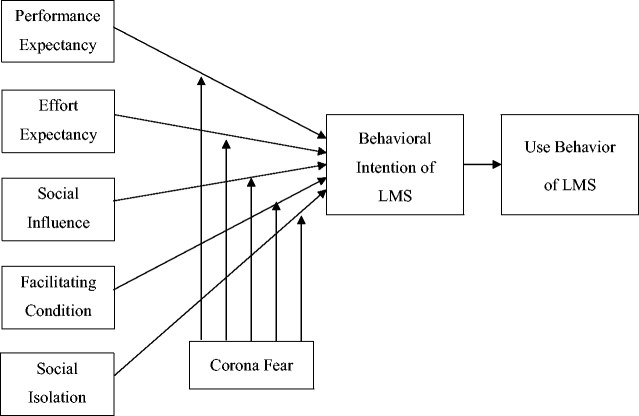
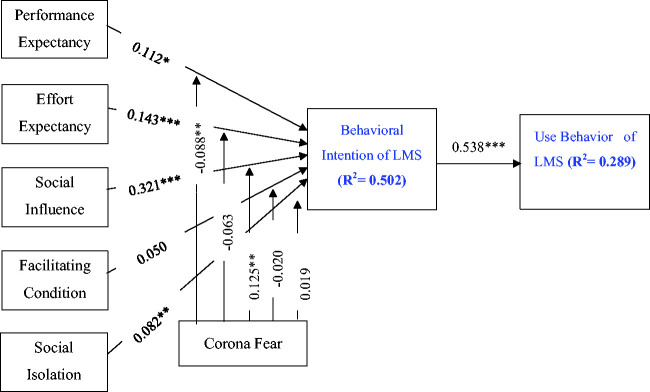
The COVID-19 Pandemic has led to social isolation; however, with the help of technology, education can continue through this tough time. Therefore, this research attempts to explore the Unified Theory of Acceptance and Use of Technology (UTAUT) through the expansion of the model. Also, make it relevant to investigate the influence of social isolation, and the moderating role of Corona fear on Behavioral Intention of the Learning Management System and its Use Behavior of Learning Management System among students. The data was analyzed using Partial Least Square (PLS) and Structural Equation Modelling (SEM). The findings show a positive link of Performance Expectancy (PE), Effort Expectancy (EE), Social Influence (SI), and Social Isolation on Behavioral Intention of LMS and, also between Behavioral Intention of LMS and its Use behavior. Moreover, the results of the moderation analysis show that Corona fears only moderates the link of Performance Expectancy and Social influence with Behavioral Intention of LMS. The findings imply the need for improving the LMS experience to increase its Behavioral Intention among students. Finally, the author's recommendation for future researchers is to examine the extended model in other countries and territories to analyze Coronavirus's influence on e-learning acceptance.
Overview
The claims and statistics of this paper haven’t been checked yet.
Free: it reads the open-access text and checks the first 5 claims that cite a source we can check. Create a free account to check every claim.
Integrity signals
Registry
Cites
Statistics
Figures
Verification
Claims the paper makes
The claims and statistics of this paper haven’t been checked yet.
Free: it reads the open-access text and checks the first 5 claims that cite a source we can check. Create a free account to check every claim.
Claims other papers make about this one
Each is checked against this paper’s own text: does it say what the citing paper says it does?
The cited source says what the claim attributes to it.
In the citing paper
“Several studies confirmed that in many cases individuals are urged by others to conduct specific activities including adopting new technologies (Kamal et al., 2020; Patil et al., 2020; Raza et al., 2021; Zhao and Bacao, 2020).”
From Factors affecting performance expectancy and intentions to use ChatGPT: Using SmartPLS to advance an information technology acceptance framework (2024) · cites this paper as Raza et al., 2021
Self-check
Percentages, sums and reported differences re-computed from the paper’s own numbers.
The self-check needs the paper’s full text.
Citations
Cites
Evaluating Structural Equation Models with Unobservable Variables and Measurement Error
Fornell, C., & Larcker, D. F. (1981) · Journal of Marketing Research · doi:10.2307/3151312 · Cited by 109,314
Evaluating structural equation models with unobservable variables and measurement error
Fornell, C., & Larcker, D. F. (1981) · Journal of Marketing Research · doi:10.1177/002224378101800104 · Cited by 109,190
Perceived usefulness, perceived ease of use, and user acceptance of information technology
Davis, F. D. (1989) · MIS Quarterly · doi:10.2307/249008 · Cited by 68,483 · cited 7×
“This finding is consistent with the studies of Davis (1989), Wang and Wang (2009), Motaghian et al.”
BackgroundResultInfluentialUser Acceptance of Information Technology: Toward A Unified View1
Venkatesh, V., Morris, M. G., Davis, G. B., & Davis, F. D. (2003) · MIS Quarterly · doi:10.2307/30036540 · Cited by 45,035 · cited 16×
“The items for measuring variables were adapted from Venkatesh et al. (2003), Zwain (2019), and Garone et al. (2019).”
BackgroundMethodResultInfluentialA new criterion for assessing discriminant validity in variance-based structural equation modeling
Henseler, J., Ringle, C. M., & Sarstedt, M. (2015) · Journal of the Academy of Marketing Science · doi:10.1007/s11747-014-0403-8 · Cited by 38,459 · cited 1×
“85, confirming the validity, as per the criteria given (Henseler et al., 2015; Raza et al., 2018, 2020).”
MethodA Paradigm for Developing Better Measures of Marketing Constructs
Churchill, G. A. (1979) · Journal of Marketing Research · doi:10.1177/002224377901600110 · Cited by 16,549 · cited 1×
“Moreover, the benchmark for individual reliability is that it should be greater than 0.7 (Churchill, 1979), which can be seen in Table 2.”
BackgroundInfluentialStructural equation models with unobservable variables and measurement error: Algebra and statistics
Fornell, C., & Larcker, D. F. (1981) · Journal of Marketing Research · doi:10.1177/002224378101800313 · Cited by 13,287
The use of partial least squares path modeling in international marketing
Henseler, J., Ringle, C. M., & Sinkovics, R. R. (2009) · Advances in International Marketing · doi:10.1108/s1474-7979(2009)0000020014 · Cited by 10,926
Venkatesh, V. (2000) · Information Systems Research · doi:10.1287/isre.11.4.342.11872 · Cited by 6,664 · cited 3×
“Since the original UTAUT model by Venkatesh et al. (2003) offered relevant factors for determining student’s behavioral intention towards LMS and its Use behavior, they were used for fulfilling the purpose of this research.”
BackgroundMethodModern Methods for Business Research
(1998) · doi:10.4324/9781410604385 · Cited by 6,534
Research works printed but not linked: 7
- Al-Busaidi K. A. Al-Shihi H. (2010). Instructors’ acceptance of learning management systems: A theoretical framework. Communications of the IBIMA, 2010(2010), 1– 10.
- Alias N. A. Zainuddin A. M. (2005). Innovation for better teaching and learning: Adopting the learning management system. Malaysian Online Journal of Instructional Technology, 2(2), 27– 40.
- Al-Shafi S. Weerakkody V. Janssen M. (2009). Investigating the adoption of eGovernment services in Qatar using the UTAUT model. AMCIS 2009 Proceedings, 260, 1--11.
- Fidani A. Idrizi F. (2012). Investigating students’ acceptance of a learning management system in university education: A structural equation modeling approach. ICT Innovations 2012 Web Proceedings, 2(23), 311– 320.
- Nanayakkara C. (2007). A model of user acceptance of learning management systems: A study within tertiary institutions in New Zealand. The International Journal of Learning, 13(12), 223– 232.
- Pakpour A. H. Griffiths M. D. (2020). The fear of CoVId-19 and its role in preventive behaviors. Journal of Concurrent Disorders. Advance online publication.
- Taiwo A. A. Downe A. G. (2013). The theory of user acceptance and use of technology (UTAUT): A meta-analytic review of empirical findings. Journal of Theoretical & Applied Information Technology, 49(1), 48--58.
Cited by
Items 301–400 of 626
Cross-cohort analysis of how COVID has changed the online learning experience of business students
Halász, Á., & Kenesei, Z. (2024) · The International Journal of Management Education · doi:10.1016/j.ijme.2024.101121 · Cited by 5
Tehupuring, P., & Gundo, A. J. (2021) · Prima Magistra Jurnal Ilmiah Kependidikan · doi:10.37478/jpm.v3i1.1403 · Cited by 4
“Raza et al (2021) serta Paais & Andreas (2021) juga menyatakan bahwa untuk menunjang dan meningkatkan pembelajaran yang efektif dan efisien dalam perencanaan, pelaksanaan sangat dibutuhkan evaluasi atau tindak lanjut selama masa pandemi.”
BackgroundChotijah, U., Rosyid, H., Retrialisca, F., & Ichsan, M. (2022) · Jurnal Sistem Informasi · doi:10.21609/jsi.v18i1.1096 · Cited by 4
“Since the original UTAUT model by Venkatesh et al. (2003) offer relevant factors to determine students' behavioral intentions towards LMS and their use behavior, then Raza et al. (2020) expand the UTAUT model by adding moderating variables.”
BackgroundMethodInfluentialYahya, U., Anwar, R. H., & Zaki, S. (2022) · Advances in educational marketing, administration, and leadership book series · doi:10.4018/978-1-6684-3600-4.ch006 · Cited by 4
Technology Acceptance Before and After Covid Pandemic
Chaw, L. Y., Chu, A., Thong, C. L., & Tee, M. (2022) · Lecture notes in computer science · doi:10.1007/978-3-031-05014-5_10 · Cited by 6
Learning Management System Acceptance Rate Among Vocational School Physics’ Student
Dwiastuti, E., Sukarelawan, M. I., & Sriyanto, S. (2022) · JIPFRI (Jurnal Inovasi Pendidikan Fisika dan Riset Ilmiah) · doi:10.30599/jipfri.v6i1.1183 · Cited by 4
Hikmawati, H. (2022) · Jurnal Ilmiah Profesi Pendidikan · doi:10.29303/jipp.v7i4b.997 · Cited by 4
Naceanceno, K. D., & Akpanudo, U. M. (2023) · International journal of technology in education and science · doi:10.46328/ijtes.445 · Cited by 1
“For instance, although many students readily adjusted to the use of online learning management systems during the pandemic (Raza et al., 2021), shifting to new modes of teaching can be difficult for students who have never engaged in online learning in the past.”
BackgroundA Study on the Assessment of the Proposed Alitaptap Learning Management System Using SWOT Analysis
Intal, G. L., Gonzales, A. L. S., Pono, L. A. R., & Pastrana, J. R. A. M. (2023) · International Journal of Information and Education Technology · doi:10.18178/ijiet.2023.13.5.1870 · Cited by 4
“The main advantage of using a learning management system (LMS) is that it can help facilitate the learning of a student conducted through the online environment without the constraint of time or place, which can enable a professor and a student to interact with each other via the internet [1].”
BackgroundDeLMS: A decentralized learning management system using Ethereum smart contracts and IPFS
Xavier, M., Sobha, P., Patil, S., & Vyatkin, V. V. (2023) · IEEE International Conference on Industrial Informatics (INDIN) · doi:10.1109/indin51400.2023.10217957 · Cited by 4
“Most importantly, LMS has faced extensive growth due to the shift to remote learning during the COVID-19 pandemic [4].”
BackgroundChen, J., Huang, M., Чэн, Б., & Sun, Z. (2025) · Scientific Reports · doi:10.1038/s41598-025-13728-3 · Cited by 3
Vasu, S. D., Taddese, E. T., Gebresilase, B. M., Berhanu, K. Z., Elka, Z. Z., & Shorouk, A. (2026) · Discover Education · doi:10.1007/s44217-026-01647-y · Cited by 3
“In the context of Malaysian higher education, the adoption of LMS mirrors the global trend [24].”
Eren, B. A. (2021) · Kafkas Üniversitesi İktisadi ve İdari Bilimler Fakültesi Dergisi · doi:10.36543/kauiibfd.2021.028 · Cited by 3
Factors Affecting on IoT-Based Business Management in the Post-Pandemic Period
Miraz, M. H., Saleheen, F., Almunawar, M. N., Sumi, F. R., Sarkar, S., & Hasan, M. T. (2022) · Advances in finance, accounting, and economics book series · doi:10.4018/978-1-7998-9664-7.ch004 · Cited by 3
IMPLEMENTASI LEARNING MANAGEMENT SYSTEM SELAMA PANDEMI COVID-19: SEBUAH TINJAUAN LITERATUR
Wulandari, W. M., Fahmy, R., & Lukito, H. (2022) · Journal Publicuho · doi:10.35817/publicuho.v5i3.19 · Cited by 3
e-HRM Adoption with Job Tenure, Gender, and Corona Fear as Moderating Variables Using UTAUT-1
Permatasari, Y., Tricahyono, D., & Indiyati, D. (2023) · International Conference on Industrial Engineering and Operations Management (IEOM) · doi:10.46254/ap03.20220736 · Cited by 3
Jung, K. S. (2024) · High Ability Studies · doi:10.1080/13598139.2023.2300415 · Cited by 3
“Gifted students will achieve excellent accomplishments by not only increasing knowledge but also positively transforming themselves and their societies through behavioral intention and using behaviors (Raza et al., 2021).”
InfluentialEssiam, J. O., Gyamfi, G. D., Odame, J., & Ayisi-Addo, A. K. (2024) · E-Learning and Digital Media · doi:10.1177/20427530241239426 · Cited by 3
“The effects of COVID-19 on higher education include social isolation leading to the closing down of many higher education institutions worldwide (Raza et al., 2021).”
Student Acceptance of LMS in Indonesian High Schools: The SOR and Extended GETAMEL Frameworks
Nofita, M., Handarkho, Y. D., & Mudjihartono, P. (2024) · Interdisciplinary Journal of Information Knowledge and Management · doi:10.28945/5367 · Cited by 3
Sumpena, A., Pratiwi, G. I., Arum, I. N. T., Farodiyah, N. N., & Apriliyanti, N. A. (2024) · Da watuna Journal of Communication and Islamic Broadcasting · doi:10.47467/dawatuna.v4i6.5619 · Cited by 4
Aprilia, D. E., Triputra, S., Agustiningsih, R. D., & Safitri, A. G. (2024) · JTP - Jurnal Teknologi Pendidikan · doi:10.21009/jtp.v26i3.51055 · Cited by 3
Análisis AHP de Aulas Virtuales (LMS) para Organizaciones de Educación Superior en el Ecuador
Bermúdez, M. V., Hidalgo, J., Avilés-Vera, M. D. P., Villacís, M. M., & Jaramillo, A. S. (2025) · Ecuadorian Science Journal · doi:10.46480/esj.8.2.201 · Cited by 3
Riani, N. P. D., & Nurabiah (2025) · Jurnal Riset Mahasiswa Akuntansi · doi:10.29303/risma.v5i1.1747 · Cited by 6
“…(2011), Sedana (2012), Bendi (2013), Abu (2013), Kirana (2016), Handayani (2017), Nugraha (2018), Muttaqin (2018), Rahi (2018), Indah (2019), Piarna (2019), Naranjo (2019) dan Raza (2021) yang menyimpulkan bahwa ekspektasi kinerja berpengaruh positif dan signifikan terhadap minat penggunaan.”
InfluentialEffect of Cultural Values on Students' Adoption of Social Media for Collaborative Learning
Alvi, I., & Khechine, H. (2025) · Journal of Computer Assisted Learning · doi:10.1111/jcal.70051 · Cited by 3
Chaveesuk, S., & Suaysukvicha, K. (2021) · Transnational Corporation Review · doi:10.1080/19186444.2021.1993678 · Cited by 3
Sumarsono, R. B., Triwiyanto, T., Hariyati, N., Sholeh, M., & Bhayangkara, A. N. (2021) · doi:10.1109/icet53279.2021.9575097 · Cited by 3
Steenkamp, H. (2021) · Communitas · doi:10.38140/com.v26i.5319 · Cited by 3
Rodolfo, J. F. D. (2022) · American Journal of Agricultural Science Engineering and Technology · doi:10.54536/ajaset.v6i1.199 · Cited by 3
“Raza et al. (2021) indicated that the use of LMS during the COVID-19 pandemic was the need of the hour to continue the learning process.”
MethodAdapting to Learning Services During Covid-19: A Risk Mitigation Review
Aziz, R. A., & Nurannisa, A. (2022) · AL-TANZIM JURNAL MANAJEMEN PENDIDIKAN ISLAM · doi:10.33650/al-tanzim.v6i1.3280 · Cited by 3
“Various kinds of obstacles must be passed by the Indonesian people and the whole world (Rifqi, 2021; Raza et al., 2021).”
BackgroundEMO-Learning: Towards an intelligent tutoring system to assess online students’ emotions
Lopez, B., Arcas-Túnez, F., Cantabella, M., Terroso-Sáenz, F., Curado, M., & Muñoz, A. (2022) · International Conference on Intelligent Environments (IE) · doi:10.1109/ie54923.2022.9826770 · Cited by 3
Estuningrum, L. E., & Dharma, I. G. B. B. (2022) · PERFORMA Media Ilmiah Teknik Industri · doi:10.20961/performa.21.2.59228 · Cited by 3
Feldvari, K., Mičunović, M., & Gašo, G. (2022) · Vjesnik bibliotekara Hrvatske · doi:10.30754/vbh.65.3.1020 · Cited by 3
Sarasmitha, C., Sugiarto, E., Rohmah, W., & Hutagaol, K. A. (2022) · Jurnal Sisfokom (Sistem Informasi dan Komputer) · doi:10.32736/sisfokom.v11i3.1361 · Cited by 5
“Hal ini sejalan dengan permodelan UTAUT 1 dan hasil penelitian oleh [7]; [17]; [8].”
BackgroundInfluentialAlfante, J. D. J., Castro, E. T., Romano, N. P., & Odchigue, R. F. R. J. C. (2023) · IEEE International Colloquium on Signal Processing & Its Applications (CSPA) · doi:10.1109/cspa57446.2023.10087859 · Cited by 3
“The LMS has recently seen a sharp increase in use because of the 2020 pandemic's emphasis on remote learning [1].”
BackgroundSemlambo, A. A., Sengati, F., & Nakembetwa, A. M. (2023) · European Journal of Theoretical and Applied Sciences · doi:10.59324/ejtas.2023.1(2).16 · Cited by 4
Huzooree, G., & Doargajudhur, M. S. (2023) · Advances in mobile and distance learning book series · doi:10.4018/978-1-6684-4533-4.ch008 · Cited by 3
Distance Education: Is It Any Longer a Paradigm of Choice? The University of Jordan; A Case Study
Obeidat, N. M., Shibli, R. A., Khasawneh, M. A., & Thaher, N. (2023) · Springer eBooks · doi:10.1007/978-3-031-33568-6_5 · Cited by 3
Feldvari, K., Rako, S., & Mičunović, M. (2024) · Vjesnik bibliotekara Hrvatske · doi:10.30754/vbh.67.1.1087 · Cited by 3
Songhori, M. H., Badiozaman, I. F. A., & Ahmadi, R. (2024) · Journal of Further and Higher Education · doi:10.1080/0309877x.2024.2348757 · Cited by 3
“For the second section, we adapted the UTAUT2 questionnaire (see Kosiba et al. 2022; Raza et al. 2021; Tamilmani et al. 2021; Venkatesh 2021) to reflect hybrid acceptance and intentions items.”
MethodResultOnline learning acceptance in higher education – Do we know everything?
Halász, Á., & Kenesei, Z. (2024) · Vezetéstudomány / Budapest Management Review · doi:10.14267/veztud.2024.05.01 · Cited by 3
Evangelista, R. C. B., Maligmat, R. R., Marcelo, D. N. B., Pablo, B. J. P., Santillan, L. S., & Serrano, E. A. (2024) · International Conference on e-Education, e-Business, e-Management and e-Learning · doi:10.1145/3670013.3670069 · Cited by 4
“The rapid transition to online education, accelerated by the COVID-19 pandemic, has made Learning Management Systems (LMS) indispensable in higher education [1, 2].”
Devisakti, A., & Rohayati, M. I. (2024) · TechTrends · doi:10.1007/s11528-024-01018-0 · Cited by 3
“The results are consistent with past literature including by Acharjya and Das (2022); Raza et al. (2020), Alshehri et al. (2020), Alshehri et al. (2019), and Bouznif (2018).”
Tebourbi, S., Abid, H. S., Bouzidi, H., & Khemakhem, R. (2024) · Lecture notes in business information processing · doi:10.1007/978-3-031-76365-6_11 · Cited by 4
Zhou, Y., & Johar, M. G. M. (2024) · Journal of Infrastructure Policy and Development · doi:10.24294/jipd9633 · Cited by 4
Mohammed, M. O. A., Hag, M. E., Ibrahim, M. A. E. M., & Khan, J. (2025) · Knowledge Management & E-Learning An International Journal · doi:10.34105/j.kmel.2025.17.006 · Cited by 5
The Impact of Open-Ended Learning on 21st-Century Skill Acquisition in Early Learners
Puji, C., & Hakobyan, A. (2025) · Journal of Early Childhood Education and Teaching (JECET) · doi:10.64840/jecet.v1i2.42 · Cited by 3
“Teachers must carefully craft challenges that are neither too complex nor too simple for students to engage with meaningfully (Raza et al., 2021).”
Preferences for Study Modalities Based on the Experience of E-Learning in Pandemics
Hernández, P., & Díaz-Muñoz, D. (2024) · Institutional Repositories DataBase (IRDB) · doi:10.15027/55008 · Cited by 3
Behavioral Changes of Lecturers in using Learning Management System (LMS) During Covid-19 Pandemic
Roslinawati, R., & Utama, R. R. (2021) · AL-ISHLAH Jurnal Pendidikan · doi:10.35445/alishlah.v13i1.378 · Cited by 3
“LMS is media to deliver and distribute teaching materials, including definition and evaluation of individual learning and educational targets, the process to realize the targets, data collection, and presentation to control the learning organization process as a whole (Soykan & Şimşek, 2017).”
BackgroundOnline Learning During a Pandemic: A Web Based Survey from Student Perspective
Puspandari, D. A., Zulaiha, R., & Hafidz, F. (2021) · Advances in Social Science, Education and Humanities Research/Advances in social science, education and humanities research · doi:10.2991/assehr.k.210423.087 · Cited by 3
“Technology acceptance of an individual to adopt the use of technology for facilitating task performance should be taking into consideration [17].”
Background郑, 银. (2021) · Advances in Education · doi:10.12677/ae.2021.114176 · Cited by 3
Martins, A. S. R., Frare, A. B., Quintana, A. C., & Quintana, C. G. (2021) · Revista Pensamento Contemporâneo em Administração · doi:10.12712/rpca.v15i3.49727 · Cited by 6
“Primeiramente, acrescenta novas evidências sobre determinantes da aceitação de tecnologias no ensino superior em tempos de pandemia (Rizum & Strzelecki, 2020; Raza et al., 2021; Shamir-Inbal & Blau, 2021), no qual são necessárias transições e adaptações repentinas no ensino.”
BackgroundInfluentialDELONE AND MCLEAN ON THE SUCCESS OF LEARNING MANAGEMENT SYSTEMS IN DISTANCE LEARNING
Susano, A., & Khasanah (2022) · International Journal of Social Science · doi:10.53625/ijss.v2i1.2309 · Cited by 3
“(Raza et al., 2021).”
Asmiyunda, A., Sanova, A., & Ekaputra, F. (2023) · Jurnal Pengabdian UNDIKMA · doi:10.33394/jpu.v4i2.7216 · Cited by 3
The Utilization and Obstacles of Online Learning Applications
Marmoah, S., & Wardani, D. K. (2023) · Jurnal Pendidikan dan Pengajaran · doi:10.23887/jpp.v56i2.48310 · Cited by 2
Miao, R., Yu, R., Zhou, H., Liu, L., Peng, T., & Wang, J. (2023) · BMJ Open · doi:10.1136/bmjopen-2023-073357 · Cited by 3
“In conclusion, these present results revealed the network of direct and indirect associations among life-style behavioural (diet, physical activity and sleep) and cardiometabolic risk factors with RH- PAT-measured ED among middle-aged men underwent health-checkup.”
BackgroundAlromaihi, A. A. A., Hamdan, A., & Bakır, A. (2023) · FIIB Business Review · doi:10.1177/23197145231204112 · Cited by 4
PERSEPSI INSTRUKTUR INDUSTRI TERHADAP PELATIHAN JARAK JAUH MENGGUNAKAN LEARNING MANAGEMENT SYSTEM
Dewi, A. S., Siswanto, I., Tafakur, T., & Haryana, K. (2023) · Jurnal Pendidikan Vokasi Otomotif · doi:10.21831/jpvo.v6i1.66174 · Cited by 2
“Perilaku penggunaan LMS dapat dilihat berdasarkan niat pengguna dalam mengoperasikan LMS (Raza et al., 2021).”
BackgroundAn Evaluation of Accounting Software Implementation through the UTAUT and DeLone & McLean Models
Dewi, A. A. S. A. S., & Ariyanto, D. (2025) · Research Journal of Finance and Accounting · doi:10.7176/rjfa/16-9-01 · Cited by 2
Lipowski, M., & Lipowska, I. (2025) · Central European Management Journal · doi:10.1108/cemj-07-2024-0212 · Cited by 2
Rosman, M. R. M., Arshad, I. H., Alias, N. R., Idris, Z., & Hamid, H. A. (2022) · Lecture notes in networks and systems · doi:10.1007/978-3-030-91738-8_31 · Cited by 3
Learning Online During a Pandemic: Student Perspectives
Haupt, T. C., & Mall, A. (2022) · Lecture notes in civil engineering · doi:10.1007/978-3-030-97748-1_14 · Cited by 2
Wastewater-Based Epidemiology (WBE): An Emerging Nexus Between Environment and Human Health
Kalra, A., Mathur, A., Pamnani, T., & Arora, S. (2022) · Springer eBooks · doi:10.1007/978-981-16-9001-3_29 · Cited by 2
Irvin, C., & Park, S. M. (2022) · STEM Journal · doi:10.16875/stem.2022.23.4.65 · Cited by 2
Abdi, M., Naghiloo, M. J., & Dinmohammadi, M. (2022) · Journal of Medical Education Development · doi:10.52547/edcj.15.46.22 · Cited by 2
“The results of this study revealed a higher level of education as a negative factor in time management among students since it is usually accompanied by many social actions for adult students (16), which appear in people by accepting roles in society (17).”
ResultAgrawal, S., & Ting, H. (2023) · Aquademia · doi:10.30935/aquademia/13081 · Cited by 2
“Taiwanese higher educational institutions have changed physical classrooms to virtual ones on digital learning management systems (LMS) and provide synchronous or asynchronous education through online classes in accordance with CECC’s regulations on social distancing.”
BackgroundInfluentialMaschudah, A., Ilham, R., & Murdiawati, D. (2023) · International Journal of Research and Review · doi:10.52403/ijrr.20230433 · Cited by 2
Whither the LMS: Is the LMS Still Fit for Purpose?
Willems, J., Huijser, H., Doherty, I., & Soong, A. (2023) · Journal of University Teaching and Learning Practice · doi:10.53761/1.20.6.13 · Cited by 2
USE OF THE MOODLE LEARNING PLATFORM BY STUYDENTS-VETERINARIANS STUDYING OPERATIVE SURGERY
Stepanov, O. (2023) · Podilian Bulletin Agriculture Engineering Economics · doi:10.37406/2706-9052-2023-2.12 · Cited by 2
“Other authors have reported the primary use of presentations from the Moodle platform by veterinary students [9].”
BackgroundFactors Determining the Need for LMS in Saudi Arabia: Assessing Teacher Behaviour and Dependence
Almashyakhi, A. M., & Abozandah, T. A. (2023) · International Journal of Web-Based Learning and Teaching Technologies · doi:10.4018/ijwltt.330989 · Cited by 2
“Similarly, in many other countries, studies examined factors affecting teachers’ use of learning management systems (LMS) (Ahmed et al., 2022; Raza et al., 2021).”
BackgroundResultInfluentialA Study on Improving Continuing Education in Scientific Organizations through Information Technology
Zhao, Y., Liu, Y., & Wang, R. (2023) · International Journal for Infonomics · doi:10.20533/iji.1742.4712.2023.0226 · Cited by 3
Sinungan, N. P., & Darma, G. S. (2023) · E-Jurnal Ekonomi dan Bisnis Universitas Udayana · doi:10.24843/eeb.2023.v12.i11.p13 · Cited by 5
“Hasil penelitian ini tidak sejalan dengan hasil penelitian Latifah et al., (2021), Raza et al., (2021) dan (Lee & Kim, 2022) yang menyatakan bahwa Facilitating Conditions tidak memberikan pengaruh signifikan terhadap Behavioral intention .”
BackgroundInfluentialImproving Moodle Performance Using HAProxy and MariaDB Galera Cluster
Prakasa, J. E. W., Hanani, A., Hariri, F. R., & Utama, S. N. (2024) · Applied Information System and Management (AISM) · doi:10.15408/aism.v7i1.34871 · Cited by 2
Tonga, M., & Kara, M. (2024) · Advances in educational technologies and instructional design book series · doi:10.4018/979-8-3693-6030-9.ch009 · Cited by 2
Faculty Acceptance of Blended Learning in Private Universities in China
Dai, X., Sukor, N. S., Said, N. B., & Sun, H. (2025) · International Journal of Academic Research in Progressive Education and Development · doi:10.6007/ijarped/v14-i1/24357 · Cited by 2
“During the COVID-19 pandemic, Raza et al. (2020) used the UTAUT model to study the acceptance of learning management systems (LMS), discovering that facilitating conditions and effort expectancy significantly influenced the acceptance of LMS under social isolation.”
Joudeh, J. M. M. (2025) · International Journal of Information and Education Technology · doi:10.18178/ijiet.2025.15.2.2252 · Cited by 2
A Tool Landscape for Adaptive Learning
Staufer, S., Bugert, F., Nadimpalli, V. K., Röhrl, S., Altweck, R., Ezer, T., Grabinger, L., Häuser, F., & Mottok, J. (2025) · European Conference on Software Engineering Education (ECSEE) · doi:10.1145/3723010.3723028 · Cited by 2
Darmansah, F. Z., Septian, M. Y., Salsabila, A. P., & Kuntari, W. (2024) · SABER Jurnal Teknik Informatika Sains dan Ilmu Komunikasi · doi:10.59841/saber.v3i1.2014 · Cited by 2
Khazalah, F. (2025) · Journal of Applied Data Sciences · doi:10.47738/jads.v6i4.888 · Cited by 2
Hettige, S., Solangaarahchi, I., & Ediriweera, D. S. (2025) · Discover Education · doi:10.1007/s44217-025-00857-0 · Cited by 2
“Furthermore, these findings coincide with previous studies involving university students and different technology use for education [25, 90, 91].”
Validación de un instrumento para diagnosticar la integración de las TIC en la educación superior
Castillo Chávez, R. J. (2025) · Revista InveCom · doi:10.5281/zenodo.15330752 · Cited by 2
Dias, S. B., Hadjileontiadou, S. J., Diniz, J. A., & Hadjileontiadis, L. J. (2021) · Communications in computer and information science · doi:10.1007/978-3-030-73988-1_19 · Cited by 2
Penerimaan dan Intensi Penggunaan E-Learning Mahasiswa Akuntansi pada Kondisi Sumber Daya Terbatas
Ismanto, I., & Chairunnas, A. (2021) · Neraca Keuangan Jurnal Ilmiah Akuntansi dan Keuangan · doi:10.32832/neraca.v16i2.5493 · Cited by 3
Onyefulu, C. (2021) · Springer eBooks · doi:10.1007/978-3-030-76591-0_9 · Cited by 2
Mumen, K. N. A. (2022) · Malaysian Journal of Social Sciences and Humanities (MJSSH) · doi:10.47405/mjssh.v7i1.1254 · Cited by 4
Kagoya, S. M., Tinali, G. Z. P., & Caine, J. (2022) · University of Dar es Salaam Library Journal · doi:10.4314/udslj.v16i2.9 · Cited by 5
“Additionally, UTAUT theory was applied by Venkatesh (2021) in the adoption and usage of Artificial tools, whereas Raza et al. (2021) applied UTAUT in Covid-19 pandemic for acceptance and social isolation via learning management system.”
MethodThe Use of Management Information Systems in Learning
Alfahl, H. (2022) · International Journal of Innovation in the Digital Economy · doi:10.4018/ijide.303610 · Cited by 2
Haldolaarachchige, N., & Hettiarachchilage, K. (2022) · Physics Education · doi:10.1088/1361-6552/ac840a · Cited by 2
Behavioral Intention to Use as a Factor in a Learning Management System in Kuwait
Abbas, H. A. (2022) · International Journal of Virtual and Personal Learning Environments · doi:10.4018/ijvple.307018 · Cited by 3
Antecedents of instructors' self-efficacy and satisfaction while using LMS in new normal
Enriquez, L., Gonzales, G. G., Gonzales, R. R., Costan, E., Almacen, R. M., & Costan, F. C. (2022) · Cypriot Journal of Educational Sciences · doi:10.18844/cjes.v17i9.7960 · Cited by 2
“There are various LMSs utilised worldwide, like Google Classroom, Moodle, Blackboard, WebCT and Schoology (Raza et al., 2021; Waheed et al., 2016).”
BackgroundMethodRELATION BETWEEN CONSUMPTION AND FEAR OF COVID-19: A BRAZILIAN POST-VACCINE PERSPECTIVE
Merlo, E. M., Giraldi, J. D. M. E., & Berto, M. (2023) · Journal of Globalization Competitiveness and Governability · doi:10.58416/gcg.2023.v17.n1.05 · Cited by 2
Budiantara, A., Mustaji, M., & Setyowati, R. N. (2023) · Edunesia Jurnal Ilmiah Pendidikan · doi:10.51276/edu.v4i1.346 · Cited by 2
Hermawan, S., Fediyanto, N., & Hariyanto, W. (2022) · International Journal of Social Science and Business · doi:10.23887/ijssb.v7i1.41074 · Cited by 2
Auliannisa, S., & Kusuma, W. A. (2022) · Equivalent Jurnal Ilmiah Sosial Teknik · doi:10.59261/jequi.v4i1.66 · Cited by 2
Research on Using Educational Technology in Primary School Teaching and Learning
Wang, M. (2023) · Lecture Notes in Education Psychology and Public Media · doi:10.54254/2753-7048/8/20230085 · Cited by 2
Gauging lecturer LMS training video engagement with YouTube analytics
van Heerden, L. (2023) · IEEE International Conference on Teaching, Assessment, and Learning for Engineering · doi:10.1109/tale56641.2023.10398375 · Cited by 2
“Raza, Qazi, Khan, and Salam [18] found that to avoid students feeling isolated during the COVID-19 restrictions, regular interaction with the lecturer is crucial.”
BackgroundAshoumi, H., & Hidayatulloh, M. K. Y. (2024) · AIP conference proceedings · doi:10.1063/5.0214419 · Cited by 2
COVID-19: Challenges and Opportunities in the Online University Education
Valova, I., & Mladenova, T. (2022) · International Journal of Advanced Computer Science and Applications · doi:10.14569/ijacsa.2022.0130631 · Cited by 1
“It was no longer enough for students to have access to structured materials - lectures, exercises, homework, as the LMS had to allow direct communication in real time and the opportunity for direct conversations and meetings [14, 15].”
BackgroundUTAUT Model in Teaching Biology: Structural Equation Modeling
Sofwan, M. (2023) · BIODIK · doi:10.22437/bio.v9i1.24788 · Cited by 2
Damanik, I. H., Irwan, M., Rosdiana, R., & Nainggolan, E. (2023) · International Conference of Science Education in Industrial Revolution 4.0 (ICONSEIR) · doi:10.4108/eai.24-11-2022.2332696 · Cited by 1
Metadata
- Authors
- Raza, S. A., Qazi, W., Khan, K. A., & Salam, J.
- Affiliations
- Iqra University (PK)
- Corresponding author
- Raza, Syed A.
- Venue
- Journal of Educational Computing Research
- Publisher
- SAGE Publications
- Published
- 2020-09-22
- Volume
- 59
- Issue
- 2
- Pages
- 183-208
- ISSN
- 0735-6331 (ISSN-L)
- 1541-4140
- PMC
- PMC7509242
- OpenAlex
- W3087094992
- Semantic Scholar
- 140945470c3df734fcc31547b10e28baef9b99b6
- Cited by
- 510
- References
- 61
- Citations by year
- 2026: 24 · 2025: 54 · 2024: 104 · 2023: 116 · 2022: 134 · 2021: 78
- FWCI
- 81.30
- Type
- journal article
- Language
- en
- Open access
- hybrid
- doi.org
- Locations
- Journal of Educational Computing Research (publishedVersion, cc-by)
- PubMed Central (publishedVersion, cc-by)
- Topics
- Social Sciences › Decision Sciences › Information Systems and Management › Technology Adoption and User Behaviour
- Social Sciences › Education › Education during COVID-19 pandemic
- Physical Sciences › Computer Science › Information Systems › Educational Technology and E-Learning
- Keywords
- social isolation, virtual learning environments, technology acceptance, UTAUT, COVID-19 pandemic, e-learning acceptance, behavioral intention, use behavior, performance expectancy, effort expectancy, social influence, moderating effect
About these checks
Registry, retraction, Cites and statistics results are computed, not judged, with one exception: a printed reference that no index lists is read once by a model before it counts as a citation error. Claims are extracted by a model and kept only when their quote appears verbatim in the text; each cited source is then checked, with a model’s help, for whether it says what the claim relies on. Those verdicts can be wrong — read the claim’s quote and the cited source before relying on one.
Statistics and arithmetic are recomputed, not judged.
Confidence bands are shown only for fields calibrated on our annotated test set. None is calibrated yet, so no band is shown.
What counts as a claim ›How we measure confidence ›How we check this ›
Are you an author, or do you see a problem with this page? Request a review
Data sources
Bibliographic data: Semantic Scholar, OpenAlex, Crossref.
Contains information from the Semantic Scholar Academic Graph Datasets, made available under the ODC Attribution License (ODC-BY 1.0).
Semantic Scholar’s data is described in: Kinney, R., et al. (2023). The Semantic Scholar Open Data Platform. arXiv:2301.10140.
