

Social Isolation and Acceptance of the Learning Management System (LMS) in the time of COVID-19 Pandemic: An Expansion of the UTAUT Model
Open accessThe DOI matches its Crossref record; 65 of the 67 references it cites were found in a registry or an index, and 2 are not checked yet.
Abstract
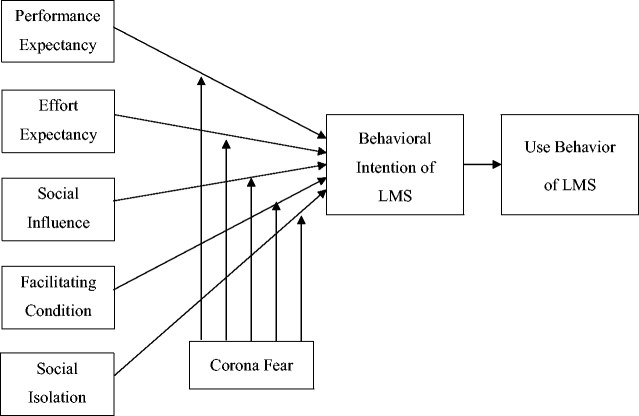
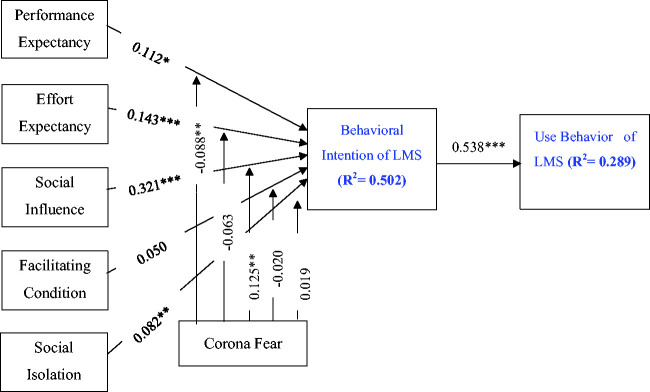
The COVID-19 Pandemic has led to social isolation; however, with the help of technology, education can continue through this tough time. Therefore, this research attempts to explore the Unified Theory of Acceptance and Use of Technology (UTAUT) through the expansion of the model. Also, make it relevant to investigate the influence of social isolation, and the moderating role of Corona fear on Behavioral Intention of the Learning Management System and its Use Behavior of Learning Management System among students. The data was analyzed using Partial Least Square (PLS) and Structural Equation Modelling (SEM). The findings show a positive link of Performance Expectancy (PE), Effort Expectancy (EE), Social Influence (SI), and Social Isolation on Behavioral Intention of LMS and, also between Behavioral Intention of LMS and its Use behavior. Moreover, the results of the moderation analysis show that Corona fears only moderates the link of Performance Expectancy and Social influence with Behavioral Intention of LMS. The findings imply the need for improving the LMS experience to increase its Behavioral Intention among students. Finally, the author's recommendation for future researchers is to examine the extended model in other countries and territories to analyze Coronavirus's influence on e-learning acceptance.
Overview
The claims and statistics of this paper haven’t been checked yet.
Free: it reads the open-access text and checks the first 5 claims that cite a source we can check. Create a free account to check every claim.
Integrity signals
Registry
Cites
Statistics
Figures
Verification
Claims the paper makes
The claims and statistics of this paper haven’t been checked yet.
Free: it reads the open-access text and checks the first 5 claims that cite a source we can check. Create a free account to check every claim.
Claims other papers make about this one
Each is checked against this paper’s own text: does it say what the citing paper says it does?
The cited source says what the claim attributes to it.
In the citing paper
“Several studies confirmed that in many cases individuals are urged by others to conduct specific activities including adopting new technologies (Kamal et al., 2020; Patil et al., 2020; Raza et al., 2021; Zhao and Bacao, 2020).”
From Factors affecting performance expectancy and intentions to use ChatGPT: Using SmartPLS to advance an information technology acceptance framework (2024) · cites this paper as Raza et al., 2021
Self-check
Percentages, sums and reported differences re-computed from the paper’s own numbers.
The self-check needs the paper’s full text.
Citations
Cites
Evaluating Structural Equation Models with Unobservable Variables and Measurement Error
Fornell, C., & Larcker, D. F. (1981) · Journal of Marketing Research · doi:10.2307/3151312 · Cited by 109,314
Evaluating structural equation models with unobservable variables and measurement error
Fornell, C., & Larcker, D. F. (1981) · Journal of Marketing Research · doi:10.1177/002224378101800104 · Cited by 109,190
Perceived usefulness, perceived ease of use, and user acceptance of information technology
Davis, F. D. (1989) · MIS Quarterly · doi:10.2307/249008 · Cited by 68,483 · cited 7×
“This finding is consistent with the studies of Davis (1989), Wang and Wang (2009), Motaghian et al.”
BackgroundResultInfluentialUser Acceptance of Information Technology: Toward A Unified View1
Venkatesh, V., Morris, M. G., Davis, G. B., & Davis, F. D. (2003) · MIS Quarterly · doi:10.2307/30036540 · Cited by 45,035 · cited 16×
“The items for measuring variables were adapted from Venkatesh et al. (2003), Zwain (2019), and Garone et al. (2019).”
BackgroundMethodResultInfluentialA new criterion for assessing discriminant validity in variance-based structural equation modeling
Henseler, J., Ringle, C. M., & Sarstedt, M. (2015) · Journal of the Academy of Marketing Science · doi:10.1007/s11747-014-0403-8 · Cited by 38,459 · cited 1×
“85, confirming the validity, as per the criteria given (Henseler et al., 2015; Raza et al., 2018, 2020).”
MethodA Paradigm for Developing Better Measures of Marketing Constructs
Churchill, G. A. (1979) · Journal of Marketing Research · doi:10.1177/002224377901600110 · Cited by 16,549 · cited 1×
“Moreover, the benchmark for individual reliability is that it should be greater than 0.7 (Churchill, 1979), which can be seen in Table 2.”
BackgroundInfluentialStructural equation models with unobservable variables and measurement error: Algebra and statistics
Fornell, C., & Larcker, D. F. (1981) · Journal of Marketing Research · doi:10.1177/002224378101800313 · Cited by 13,287
The use of partial least squares path modeling in international marketing
Henseler, J., Ringle, C. M., & Sinkovics, R. R. (2009) · Advances in International Marketing · doi:10.1108/s1474-7979(2009)0000020014 · Cited by 10,926
Venkatesh, V. (2000) · Information Systems Research · doi:10.1287/isre.11.4.342.11872 · Cited by 6,664 · cited 3×
“Since the original UTAUT model by Venkatesh et al. (2003) offered relevant factors for determining student’s behavioral intention towards LMS and its Use behavior, they were used for fulfilling the purpose of this research.”
BackgroundMethodModern Methods for Business Research
(1998) · doi:10.4324/9781410604385 · Cited by 6,534
Research works printed but not linked: 7
- Al-Busaidi K. A. Al-Shihi H. (2010). Instructors’ acceptance of learning management systems: A theoretical framework. Communications of the IBIMA, 2010(2010), 1– 10.
- Alias N. A. Zainuddin A. M. (2005). Innovation for better teaching and learning: Adopting the learning management system. Malaysian Online Journal of Instructional Technology, 2(2), 27– 40.
- Al-Shafi S. Weerakkody V. Janssen M. (2009). Investigating the adoption of eGovernment services in Qatar using the UTAUT model. AMCIS 2009 Proceedings, 260, 1--11.
- Fidani A. Idrizi F. (2012). Investigating students’ acceptance of a learning management system in university education: A structural equation modeling approach. ICT Innovations 2012 Web Proceedings, 2(23), 311– 320.
- Nanayakkara C. (2007). A model of user acceptance of learning management systems: A study within tertiary institutions in New Zealand. The International Journal of Learning, 13(12), 223– 232.
- Pakpour A. H. Griffiths M. D. (2020). The fear of CoVId-19 and its role in preventive behaviors. Journal of Concurrent Disorders. Advance online publication.
- Taiwo A. A. Downe A. G. (2013). The theory of user acceptance and use of technology (UTAUT): A meta-analytic review of empirical findings. Journal of Theoretical & Applied Information Technology, 49(1), 48--58.
Cited by
Items 201–300 of 626
The Used of UTAUT-2 in Examining The Usage of Mobile-LMS Binus Online Learning
Ikhsan, R. B., Prabowo, H., Yuniarty, Y., & Simamora, B. H. (2021) · International Conference on Information Management and Technology (ICIMTech) · doi:10.1109/icimtech53080.2021.9535053 · Cited by 12
Khoa, B. T., Kien, D. T., & Oanh, L. T. K. (2021) · doi:10.1109/icet53279.2021.9575102 · Cited by 11
Alwahaishi, S. (2021) · International Journal of Distance Education Technologies · doi:10.4018/ijdet.286742 · Cited by 12
Zhao, J., Li, X., & Gao, Z. (2025) · Humanities and Social Sciences Communications · doi:10.1057/s41599-025-04777-0 · Cited by 12
“This detailed fi nding differs from previous studies of web-based education technologies (Raza et al., 2021), social network sites (Liu et al., 2016), and online labs (Bazelais et al., 2024), which typically reported more uniform relationships.”
Rosli, M. S., Saleh, N. S., Ali, A. M., & Bakar, S. A. (2026) · Journal for STEM Education Research · doi:10.1007/s41979-025-00171-2 · Cited by 14
Kurniawan, B., SHRESTHA, R. P., Astina, I. K., Hadi, N., Irawan, L. Y., Kurniawati, E., & Wiradimadja, A. (2022) · International Journal of Interactive Mobile Technologies (iJIM) · doi:10.3991/ijim.v16i07.28481 · Cited by 11
Technology and Transformation: Redefining Higher Education for Generations Z and Alpha
O'Farrell, J., & Weaver, C. (2026) · Journal of Multidisciplinary Research and Practice · doi:10.2139/ssrn.4833043 · Cited by 10
Song, R., & Zheng, Y. (2024) · SAGE Open · doi:10.1177/21582440241271319 · Cited by 10
“Early research on LMS primarily focused on adoption (Kim et al., 2021; Navarro et al., 2021; Raza et al., 2021; Ustun et al., 2021).”
Factors affecting readiness to diffuse blended learning in Pakistani higher education institutions
Chen, X., Khaskheli, A., Raza, S. A., Hakim, F., & Khan, K. A. (2022) · International Journal of Educational Management · doi:10.1108/ijem-10-2021-0406 · Cited by 10
Self-citationOrtiz-López, A., Migueláñéz, S. O., & Sánchez‐Prieto, J. C. (2023) · Education and Information Technologies · doi:10.1007/s10639-023-12117-5 · Cited by 12
“This indicates the importance and widespread use of LMSs in education, which is also consistent with their key role during the pandemic as the main method of continuity and assurance of education (Dascalu et al., 2021; Grigoryeva et al., 2021; Raza et al., 2021).”
Students’ Relative Attitudes and Relative Intentions to Use E-Learning Systems
Cao, G., Shaya, N., Enyinda, C. I., Abukhait, R., & Naboush, E. (2022) · Journal of Information Technology Education Research · doi:10.28945/4928 · Cited by 15
“Such factors include for example students perceived usefulness of e-learning systems to help them achieve their learning objectives (Chao, 2019) and developing encouraging facilitating conditions such as training, technical, and IT support to enable students to use e-learning systems (Raza et al., 2021), thus students…”
BackgroundMethodInfluentialRETRACTED: The utility of smart government services apps solutions in the post-pandemic era
Rehman, S. U., Qatawneh, N. A., Al-Okaily, A., Al‐Okaily, M., Shiyyab, F. S., Alsharairi, M. A., Masa’deh, R. M. T., & Mohammed, A. B. (2024) · Global Knowledge, Memory and Communication · doi:10.1108/gkmc-03-2024-0185 · Cited by 9
RetractedWu, H., Que, X., & Pan, L. (2025) · Humanities and Social Sciences Communications · doi:10.1057/s41599-025-04717-y · Cited by 10
“…1, UTAUT2 has been extensively applied to various educational scenarios, especially mobile learning systems (Adel Bessadok, 2022; Humida et al., 2022), fl ipped classrooms (Agyei & Razi, 2021), learning management systems (Raza et al., 2020), and blended learning (Azizi et al., 2020), among others.”
InfluentialSmartphones, media multitasking and cognitive overload
Krumsvik, R. J. (2025) · Nordic Journal of Digital Literacy · doi:10.18261/njdl.20.1.1 · Cited by 10
Singh, S., Singh, P. K., & Kaur, V. (2025) · Innoeduca International Journal of Technology and Educational Innovation · doi:10.24310/ijtei.111.2025.20219 · Cited by 12
“Also, previous literature (Mot-aghian et al., 2013; Habibi et al., 2023; Raza et al., 2020a, 2022; Wang & Wang, 2009) highlights the strong relationship between BI and actual use in technology-assisted learning.”
Khaskheli, A., Jiang, Y., Raza, S. A., & Yousufi, S. Q. (2022) · Interactive Learning Environments · doi:10.1080/10494820.2022.2133145 · Cited by 12
“The world has been experiencing an extensive health crisis since last December 2019, when “ Coro-navirus Disease (COVID-19) ” emerged as a menacing pandemic around the globe.”
InfluentialSelf-citationAssessment of qualities of pandemic-driven e-content developed for higher education in India
Bhattacharya, S., Tripathi, K. K., & Kumar, A. (2023) · Cogent Education · doi:10.1080/2331186x.2023.2167315 · Cited by 9
“Educational institutions also witnessed extended closure for the safety of parents, teachers, and learners (Almaiah et al., 2020; Maatuk et al., 2021; Putri et al., 2020; Raza et al., 2021).”
BackgroundDewi, E. A. S., Sanofi, Z., Pratamawaty, B. B., & Arifin, H. S. (2023) · Jurnal Komunikasi Malaysian Journal of Communication · doi:10.17576/jkmjc-2023-3903-17 · Cited by 12
Biju, S., Pallath, V., More, B., Valsaraj, B. P., & Ng, K. H. (2023) · Springer eBooks · doi:10.1007/978-981-99-5076-8_13 · Cited by 9
Adli, M. R. S. C. D. (2023) · Advanced International Journal of Business Entrepreneurship and SMEs · doi:10.35631/aijbes.518003 · Cited by 9
Student’s acceptance of the Nearpod application: an investigation in elementary school
Amelia, R., Zamzani, Z., Mustadi, A., Suriansyah, A., & Aslamiah, A. (2024) · International Journal of Evaluation and Research in Education (IJERE) · doi:10.11591/ijere.v13i2.26619 · Cited by 10
“One of Venkatesh's most recent technology acceptance model is UTAUT [39].”
BackgroundEmbedding AI into LMS and eLearning Platforms
Ioannou-Sougleridi, E., Kopsidas, S., Vavougios, D., Avramopoulos, A., & Kanapitsas, A. (2024) · Lecture notes in networks and systems · doi:10.1007/978-3-031-51979-6_38 · Cited by 11
Mobile learning using extended UTAUT model during COVID-19: evidence from developed countries
Ahmed, R. R., Štreimikienė, D., Štreimikis, J., & Khouri, S. (2024) · Economic Research-Ekonomska Istraživanja · doi:10.1080/1331677x.2023.2300389 · Cited by 9
“Previous literature has shown that social influence strongly correlates with the behavioral intent to adopt mobile-based learning in an online education environment (Yang, 2013; Kang et al., 2015; Raza et al., 2021).”
InfluentialA hybridized approach of PLS-SEM and fuzzy Z-AHP to evaluate the UTAUT2 model for an LMS
Qendraj, D. H., Xhafaj, E., & Thanasi, T. (2022) · Journal of Intelligent & Fuzzy Systems · doi:10.3233/jifs-212396 · Cited by 12
“Web-based Learning Management System is a platform designed to assist in the management scheme of the teaching and learning process [1] facilitating interactive interaction between students and instructors [2].”
Hybrid Learning Management as a Strategy to Improve Learning Motivation in Higher Education
Hasanah, M. (2022) · AL-TANZIM JURNAL MANAJEMEN PENDIDIKAN ISLAM · doi:10.33650/al-tanzim.v6i2.3415 · Cited by 9
“Innovative learning models themselves appear as alternative solutions to overcome various obstacles in learning methods (Raza et al., 2021).”
BackgroundLai, C. Y., Cheung, K. Y., & Pang, L. L. L. (2024) · Frontiers in Education · doi:10.3389/feduc.2024.1365258 · Cited by 8
The effectiveness of MOOCs in Technical Education: an Indian perspective
Jarial, P., Aggarwal, H., & Singla, B. S. (2025) · Scientific Reports · doi:10.1038/s41598-025-09405-0 · Cited by 11
Challenge Accepted: Experiences of Turkish Faculty Members at the Time of Emergency Remote Teaching
Karataş, F. Ö., Akaygün, S., Çelik, S., Kokoç, M., & Yılmaz, S. N. (2021) · Center for Educational Policy Studies Journal · doi:10.26529/cepsj.1136 · Cited by 8
Factors Influencing Satisfaction and Future Intention to Use E-Learning at the University Level
Ejdys, J. (2022) · Foresight-Russia · doi:10.17323/2500-2597.2022.2.52.64 · Cited by 9
Mahajan, A. I., & Taggar, R. (2024) · International Social Science Journal · doi:10.1111/issj.12548 · Cited by 9
Luo, X., & Adelopo, I. A. (2024) · Journal of International Education in Business · doi:10.1108/jieb-05-2024-0060 · Cited by 8
Dzogbewu, T. C., Whitehead, T., de Beer, D. J., & Torrens, G. (2024) · Designs · doi:10.3390/designs9010003 · Cited by 8
Understanding Higher Education Students Continuance Intention Towards e-Learning
Rahmania, A., Jesslyn, K., Gui, A., Suryanto, Nelly, N., & Sari, S. A. (2022) · International Conference on Information Technology and Education (ICITE) · doi:10.1109/icite54466.2022.9759858 · Cited by 8
STUDENTS' ATTITUDES TOWARD LEARNING MANAGEMENT SYSTEM (LMS) DURING COVID-19 PANDEMIC: A CASE STUDY
Mundir, M., & Umiarso, U. (2022) · Lentera Pendidikan Jurnal Ilmu Tarbiyah dan Keguruan · doi:10.24252/lp.2022v25n1i6 · Cited by 8
Interactive learning in economic education: integrating LearningApps.org tasks into Moodle
Михайлович, Г. Р., Дудка, У., Кабак, В., & Ребуха, Л. (2024) · CTE Workshop Proceedings · doi:10.55056/cte.691 · Cited by 8
“In recent times, the acceptance of e-learning systems and technologies has been investigated by researchers in different educational environments around the world, using different models based on distinct criteria [12, 26].”
BackgroundBehavior Intention to Use dan Use Behavior Mahasiswa dalam Menggunakan E-Learning dimasa Covid-19
Ikhlash, M., & Tama, H. F. (2021) · JURNAL AKUNTANSI EKONOMI dan MANAJEMEN BISNIS · doi:10.30871/jaemb.v9i2.3395 · Cited by 8
Joshi, S., Pandey, K., & Maheta, D. (2025) · Cogent Education · doi:10.1080/2331186x.2025.2597051 · Cited by 8
“The perceived utility and the ability to adopt AI tools in HEIs that implement the latter can be facilitated by institutional support, access rights, and professional advice (Raza et al., 2021).”
Social isolation in COVID-19: a comparative study between Korea and Vietnam
Jo, H., & Baek, E.-M. (2023) · BMC Public Health · doi:10.1186/s12889-023-16491-0 · Cited by 8
“They should anticipate and prepare for the potential increase in feelings of loneliness and isolation due to extended periods of social distancing [51].”
BackgroundMethodMouakket, S., & Aboelmaged, M. G. S. (2023) · Information Development · doi:10.1177/02666669231213940 · Cited by 7
“The items of COVID-19 anxiety and social isolation were derived from Raza et al. (2021).”
Determinants of adoption and usage of the online examination portal (OEP) in Indian universities
Shirolkar, S. D., & Kadam, R. (2023) · Education + Training · doi:10.1108/et-09-2022-0360 · Cited by 7
Alquhaif, A., Abdulrab, M., Rashed, R. Q. G., Al‐Mamary, Y. H., Jazim, F., Abdalraheem, S. G., Siddiqui, M. A., & Abubakar, A. A. (2023) · International Journal of ADVANCED AND APPLIED SCIENCES · doi:10.21833/ijaas.2023.06.017 · Cited by 8
Effect of institute and LMS service quality on HEI Brand Equity: an empirical investigation
Mishra, R., Mishra, A., Tiwari, V., & Jain, R. K. (2024) · Quality Assurance in Education · doi:10.1108/qae-01-2024-0022 · Cited by 7
Muhamad, W., Suhardi, & Bandung, Y. (2025) · Journal of Computers in Education · doi:10.1007/s40692-024-00351-w · Cited by 7
“Because high user effort indicating system challenges can lead to poor system utilization, the EE element is an intrinsic aspect for system acceptance (Dečman, 2015; Persada et al., 2019; Raza et al., 2021).”
InfluentialDigital Platforms in the Emergency Remote Education: the Students’ Preferences
Shammari, M. H. A. (2021) · Arab World English Journal · doi:10.24093/awej/vol12no4.2 · Cited by 7
“Raza et al (2021) believed that as student's competence in learning improved, they would be inspired to attain their study objectives by employing the LMS technology, particularly as the pandemic had socially isolated them.”
BackgroundEnvisioning Online English Teaching in Indonesia: A Digital Autoethnographic Account
Muhalim, M. (2022) · The Qualitative Report · doi:10.46743/2160-3715/2023.5117 · Cited by 10
The effect of convenience and self-efficacy on the satisfaction of learning management system usage
Zulherman, Z., Mansor, A. B. A., & Kulgemeyer, C. (2025) · International Journal of Evaluation and Research in Education (IJERE) · doi:10.11591/ijere.v14i2.32065 · Cited by 6
“According to the individual's assessment of their proficiency with computers and information technology, the initial definition of SE was established [23].”
Cahyasari, D., Hamidah, H., & Widyastuti, U. (2025) · ABAC Journal · doi:10.59865/abacj.2025.18 · Cited by 7
Chen, J., Huang, M., & Bin, C. (2025) · Automatika · doi:10.1080/00051144.2025.2565023 · Cited by 6
Akwene, G. C. (2024) · International Journal of Scientific Research and Management (IJSRM) · doi:10.18535/ijsrm/v12i02.el09 · Cited by 6
“Raza, et al. (2021) claim that the COVID-19 pandemic which forced countries to go into a lockdown, and drastically reducing social gatherings, by encouraging social distancing stimulated the integration of LMS in schools to ensure continuity.”
BackgroundInfluentialVirtual avoidance: Examining STEM students' lower interest in online courses
McIntyre, M. M., Cui, G., & Hou, Y. (2025) · The Internet and Higher Education · doi:10.1016/j.iheduc.2025.100995 · Cited by 7
Akbari, E. (2025) · Frontiers in Education · doi:10.3389/feduc.2025.1564905 · Cited by 6
Pranata, S., Wu, S. V., Purwadi, H., Putra, D. G. S., Wulandari, H., & Soesanto, E. (2021) · Open Access Macedonian Journal of Medical Sciences · doi:10.3889/oamjms.2021.6443 · Cited by 6
“Learning from seeing the success of other people in managing health will inspire someone to get well soon [31].”
BackgroundTaufik, T., & Alam, F. A. (2022) · JELITA · doi:10.56185/jelita.v3i1.94 · Cited by 9
E-Learning Acceptance in Higher Education in Response to Outbreak of COVID-19: TAM2 Based Approach
Virdi, A. S., & Mer, A. (2023) · Lecture notes in networks and systems · doi:10.1007/978-981-19-6631-6_49 · Cited by 7
Rabbianty, E. N., Utami, D. N., Humairoh, M. F. N., & Suryati, N. (2024) · Studies in English Language and Education · doi:10.24815/siele.v11i1.30978 · Cited by 8
Mensah, I. K., & Zhao, T. (2024) · Heliyon · doi:10.1016/j.heliyon.2024.e39086 · Cited by 6
Rimsha, S., Moosa, F. A., Zaheer, F., Kamal, M. T., & Majid, A. (2021) · Cureus · doi:10.7759/cureus.16690 · Cited by 6
“Few examples of LMS used in educational institutions include Moodle, Blackboard, and Desire2Learn [6,7].”
BackgroundNeeds Analysis of Nursing Students in English Online Learning
Majalengka, S. Y., Sofyan, W. F., Wati, E., & Majalengka, S. Y. (2022) · Voices of English Language Education Society · doi:10.29408/veles.v6i1.5142 · Cited by 6
Adnan, F., Agustiningsih, M. D., & Ariefianto, L. (2022) · Proceeding of the Electrical Engineering Computer Science and Informatics · doi:10.23919/eecsi56542.2022.9946579 · Cited by 6
“Learning Management System (LMS) is the primary key to education [17].”
BackgroundContent Retrieval dengan Fasttext Word Embedding pada Learning Management System Olimpiade
Hastuti, R. P., Riona, V., & Hardiyanti, M. (2023) · Journal of Internet and Software Engineering · doi:10.22146/jise.v4i1.6766 · Cited by 6
“Misalnya [1] dan [2] keduanya menganalisis bagaimana pengaruh penggunaan LMS dan bagaimana tantangan yang harus dipecahkan untuk membuat LMS yang lebih baik.”
BackgroundThe Pitfalls in Assessment Practices in Distance Learning
Douali, L., Selmaoui, S., & Bouab, W. (2022) · International Journal of Technology in Education · doi:10.46328/ijte.238 · Cited by 6
“More significant challenges, in the whole learning/teaching process, were experienced by teachers, students and parents during the COVID-19 outbreak circumstances (Kara, 2021; Kibici, 2021; Kilincer, 2021; Maksum & Purwanto, 2022; Mishra et al., 2020; Raza et al., 2021).”
BackgroundAlsagoor, M. H., Daud, Z. B. M., & Osman, M. N. H. (2024) · Advances in Social Sciences Research Journal · doi:10.14738/assrj.117.17271 · Cited by 7
Effect of Moodle LMS on Distance Learning Undergraduates’ Performance in Environmental Education
Mohammed, I. A., Ekpo, C. G., Olatunde-Aiyedun, T. G., Zakari, A. Y., & Ogar, S. I. (2025) · International Journal of Education and Teaching Zone · doi:10.57092/ijetz.v4i1.330 · Cited by 6
Jiang, J., & Xiang-ming, Z. (2025) · PLoS ONE · doi:10.1371/journal.pone.0334186 · Cited by 6
“This model has been successfully applied in various educational contexts using different technologies, including e-learning websites [22], learning management software [23], and ICT tools [24].”
Ali, A., Ghafoor, A., Hussain, B., Naveed, M., Ali, S., & Magazzino, C. (2026) · Land Degradation and Development · doi:10.1002/ldr.70405 · Cited by 5
“In the same manner, Raza et al. (2021) performed a multi-temporal study investigating LULC in the state of Punjab and showed that built-up spaces augmented significantly and that the forest cover decreased, which was associated with the increase in land surface temperatures and the environmental…”
Information and Communication Technology (ICT) Adoption in Higher Education
Attuquayefio, S. N. B. (2022) · International Journal of Virtual and Personal Learning Environments · doi:10.4018/ijvple.295309 · Cited by 6
Kautsar, H. F. A., & Ilham, R. (2022) · JURNAL AKUNTANSI UNESA · doi:10.26740/akunesa.v10n3.p84-100 · Cited by 7
Ali, M., Yousaf, M., & Behlol, G. (2023) · Voyage Journal of Educational Studies · doi:10.58622/vjes.v3i2.52 · Cited by 7
Exploring Factors Influencing Technology Adoption among Generation Y: A Study of MOOC Users
Dhewandrie, G. S. A., & Yuniawan, A. (2023) · JURNAL MANAJEMEN DAN KEWIRAUSAHAAN · doi:10.26905/jmdk.v11i1.10202 · Cited by 5
“Covid-19 pandemic has made e-learning modes even more popular as a consequence of advances in information technology (Raza et al., 2021) not only for students, but also for professionals (Altalhi, 2020; Anand Shankar Raja & Kallarakal, 2021). e-Learning can be indicated as technology-based learning…”
InfluentialНеакадемічний студентський досвід в умовах постмодернізму
Павлов, Р., & Павлова, Т. (2024) · European Journal of Management Issues · doi:10.15421/192405 · Cited by 5
Exploring the human consequences of crisis in the hospitality sector: a study from India
Abas, B., Srikanth, V., Bukhari, S., & Fayaz, I. (2024) · IIMT Journal of Management · doi:10.1108/iimtjm-08-2023-0003 · Cited by 5
Students’ Perceptions of Its Usefulness and Ease of Use on Learning Management System
Sui, L. K. M., Abdullah, N. L., Balakrishnan, S., & Osman, W. S. M. (2024) · International Journal of Advanced Computer Science and Applications · doi:10.14569/ijacsa.2024.0150739 · Cited by 5
“According to a study, an LMS can create a favorable correlation between intentional and behavioral usage [21].”
BackgroundPsycho-social drivers influencing the adoption of asynchronous EdTech tools: a gendered perspective
Lexman, R. R., Baral, R., & Aboobaker, N. (2024) · International Journal of Educational Management · doi:10.1108/ijem-12-2023-0594 · Cited by 7
Halász, Á., & Kenesei, Z. (2022) · Vezetéstudomány / Budapest Management Review · doi:10.14267/veztud.2022.07.02 · Cited by 7
Impact of COVID-19 on Mobile Banking Adoption: Evidence from Bangladesh
Zeya, F. (2022) · Journal of Governance and Social Policy · doi:10.24815/gaspol.v3i2.29054 · Cited by 6
Investigating Student and Teacher Perceptions in e-Learning with Learning Analytics and Ontologies
Costa, L., da Silveira, A. C., Souza, M., Salvador, L. N., & Santos, C. A. S. (2023) · International Journal of Emerging Technologies in Learning (iJET) · doi:10.3991/ijet.v18i08.32411 · Cited by 5
OPTIMALISASI LEARNING MANAGEMENT SYSTEM DI PUSAT KEGIATAN BELAJAR MASYARAKAT
Kadafi, A., Asri, D. N., Ardi, P., Afifah, D. R., & Andria, A. (2022) · JMM (Jurnal Masyarakat Mandiri) · doi:10.31764/jmm.v6i4.9547 · Cited by 5
“Pandemi COVID-19 telah menyebabkan permasalahann di dunia pendidikan, namun, dengan bantuan teknologi, pendidikan dapat terus berlanjut melalui masa sulit ini (Abazi-Bexheti et al., 2018; Alturki & Aldraiweesh, 2021; Raza et al., 2021).”
BackgroundSharma, A. K., & Patwardhan, S. (2024) · Journal of Engineering Education/Journal of engineering education transformations/Journal of engineering education transformation · doi:10.16920/jeet/2024/v37is2/24048 · Cited by 5
Zubair, R., Zafar, Q., Rasul, F., & Shabeer, M. G. (2024) · Journal of Education and Social Studies · doi:10.52223/jess.2024.5214 · Cited by 13
Amir, M., Javed, S., & Hisam, M. W. (2025) · International Journal of Educational Management · doi:10.1108/ijem-06-2023-0306 · Cited by 5
Students Utilization on Quipper LMS: A Mixed Method
Tacadena, J. E., Laurel, M. A., Chico, A. L., & Frim (2021) · International Journal of Research and Innovation in Social Science · doi:10.47772/ijriss.2021.5819 · Cited by 5
Tuğtekin, E. B. (2021) · Journal of Educational Technology and Online Learning · doi:10.31681/jetol.943335 · Cited by 5
Diržytė, A., Sederevičiūtė-Pačiauskienė, Ž., Šliogerienė, J., Vijaikis, A., Perminas, A., Kaminskis, L., Žebrauskas, G., & Mačiulaitis, K. (2021) · Sustainability · doi:10.3390/su132111832 · Cited by 5
Almezeini, A. B. A. N. (2021) · doi:10.33965/el2021_202104l003 · Cited by 5
“Furthermore, Raza et al. (2020) used the extended UTAUT model to examine the factors that influence students' acceptance of e-learning during the difficult time of social isolation due to the COVID-19 pandemic.”
MethodAnalisis Determinasi Pemanfaatan Accurate Online dengan Menggunakan Model UTAUT
Widiyawati, S. F., & Wahjudi, E. (2021) · Kompak Jurnal Ilmiah Komputerisasi Akuntansi · doi:10.51903/kompak.v14i2.429 · Cited by 7
“Hasil penelitian ini juga selaras dengan penelitian terdahulu dalam domain teknologi yang berbeda, yakni penelitian dari [8], [23]–[25] yang membuktikan bahwa perilaku penggunaan teknologi informasi dipengaruhi secara pofitif dan signifikan oleh behavioral intention.”
BackgroundAli, N. S. M., Fauzi, M. A., Saidin, N., Nor, N. Q. Z. M., Ismail, N. F. S., & Aling, N. A. (2024) · International Review of Education · doi:10.1007/s11159-023-10046-6 · Cited by 5
“All the UTAUT variables (PE, EE, SI, FC) were adapted from Syed Raza et al. (2020).”
Lessons from business education's online transition: A Saudi Arabian case study
Madani, H. H., Adhikari, A., & Hodgdon, C. (2024) · The International Journal of Management Education · doi:10.1016/j.ijme.2024.101026 · Cited by 5
Chandra, A., Sengupta, S., & Vaish, A. (2024) · Education and Information Technologies · doi:10.1007/s10639-024-12997-1 · Cited by 4
“In the span of the COVID-19 pandemic situation, the model was explored with social isolation and fear of Coronavirus as external variables to predict the user behavior of learning management systems by people during the pandemic (Raza et al., 2021 ).”
UTAUT model: Intent to use Mangusada app with technophobia as moderator
Novitasari, I., & Widayani, N. L. U. M. (2025) · Annals of Management and Organization Research · doi:10.35912/amor.v7i2.2660 · Cited by 4
“This assertion is further corroborated by the findings of Raza, Qazi, Khan, and Salam (2021).”
Sultana, N., Sultana, R., & Akter, M. S. (2026) · Journal of Financial Services Marketing · doi:10.1057/s41264-026-00347-w · Cited by 4
Kottmann, S., & Seitz, J. (2026) · Journal of theoretical and applied electronic commerce research · doi:10.3390/jtaer21040113 · Cited by 4
Sinlapaninman, U., Yonwilad, W., & Pattanachai, N. (2023) · International Journal of Interactive Mobile Technologies (iJIM) · doi:10.3991/ijim.v17i21.41933 · Cited by 6
How LMS Shapes Inclusive Education
(2024) · American Research Journal of Humanities and Social Sciences · doi:10.21694/2378-7031.24003 · Cited by 5
Hikmawati, H., Kosim, K., & Ayub, S. (2024) · Journal of Science and Science Education · doi:10.29303/jossed.v5i1.7414 · Cited by 4
Monitoring Collaborative Interactions in Online Learning: Insights from Moodle Log Records
Peramunugamage, A., Ratnayake, U. W., Karunanayaka, S. P., Barbosa, E. F., de Deus, W. S., Jayawardena, C. L., & Silva, R. K. J. D. (2025) · Journal of Learning for Development · doi:10.56059/jl4d.v12i2.1554 · Cited by 4
DEVELOPMENT OF WORDPRESS AND LEARN PRESS-BASED LEARNING MANAGEMENT SYSTEM (E-LEARNING)
Nasution, N., & Raharjo, T. (2023) · Akademika · doi:10.34005/akademika.v12i01.2660 · Cited by 4
Tian, M. (2024) · Journal of Electrical Systems · doi:10.52783/jes.672 · Cited by 4
“An optimization-based learning management system (LMS) represents a cutting-edge approach to modern education [10].”
Dhendup, S. (2024) · Educational innovation and practice · doi:10.17102/eip.7.2024.09 · Cited by 5
Too, M. S. M., Lau, S. H., & Tan, C.-K. (2024) · International Journal on Robotics Automation and Sciences · doi:10.33093/ijoras.2024.6.1.8 · Cited by 4
Exploring the Intersection of Technology and EAP in the Digital Age
Uzun, L. (2024) · Springer eBooks · doi:10.1007/978-3-031-72545-6_15 · Cited by 4
Metadata
- Authors
- Raza, S. A., Qazi, W., Khan, K. A., & Salam, J.
- Affiliations
- Iqra University (PK)
- Corresponding author
- Raza, Syed A.
- Venue
- Journal of Educational Computing Research
- Publisher
- SAGE Publications
- Published
- 2020-09-22
- Volume
- 59
- Issue
- 2
- Pages
- 183-208
- ISSN
- 0735-6331 (ISSN-L)
- 1541-4140
- PMC
- PMC7509242
- OpenAlex
- W3087094992
- Semantic Scholar
- 140945470c3df734fcc31547b10e28baef9b99b6
- Cited by
- 510
- References
- 61
- Citations by year
- 2026: 24 · 2025: 54 · 2024: 104 · 2023: 116 · 2022: 134 · 2021: 78
- FWCI
- 81.30
- Type
- journal article
- Language
- en
- Open access
- hybrid
- doi.org
- Locations
- Journal of Educational Computing Research (publishedVersion, cc-by)
- PubMed Central (publishedVersion, cc-by)
- Topics
- Social Sciences › Decision Sciences › Information Systems and Management › Technology Adoption and User Behaviour
- Social Sciences › Education › Education during COVID-19 pandemic
- Physical Sciences › Computer Science › Information Systems › Educational Technology and E-Learning
- Keywords
- social isolation, virtual learning environments, technology acceptance, UTAUT, COVID-19 pandemic, e-learning acceptance, behavioral intention, use behavior, performance expectancy, effort expectancy, social influence, moderating effect
About these checks
Registry, retraction, Cites and statistics results are computed, not judged, with one exception: a printed reference that no index lists is read once by a model before it counts as a citation error. Claims are extracted by a model and kept only when their quote appears verbatim in the text; each cited source is then checked, with a model’s help, for whether it says what the claim relies on. Those verdicts can be wrong — read the claim’s quote and the cited source before relying on one.
Statistics and arithmetic are recomputed, not judged.
Confidence bands are shown only for fields calibrated on our annotated test set. None is calibrated yet, so no band is shown.
What counts as a claim ›How we measure confidence ›How we check this ›
Are you an author, or do you see a problem with this page? Request a review
Data sources
Bibliographic data: Semantic Scholar, OpenAlex, Crossref.
Contains information from the Semantic Scholar Academic Graph Datasets, made available under the ODC Attribution License (ODC-BY 1.0).
Semantic Scholar’s data is described in: Kinney, R., et al. (2023). The Semantic Scholar Open Data Platform. arXiv:2301.10140.
