

Social Isolation and Acceptance of the Learning Management System (LMS) in the time of COVID-19 Pandemic: An Expansion of the UTAUT Model
Open accessThe DOI matches its Crossref record; 65 of the 67 references it cites were found in a registry or an index, and 2 are not checked yet.
Abstract
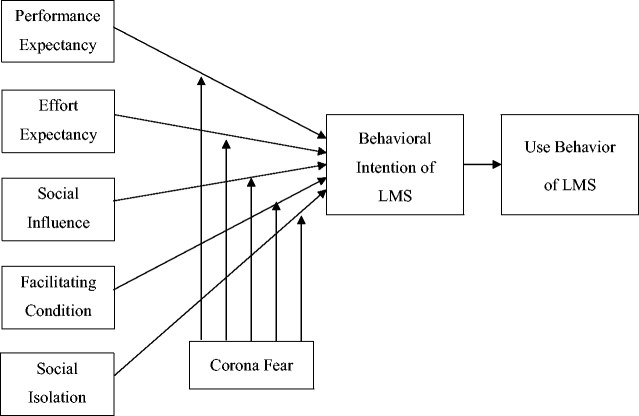
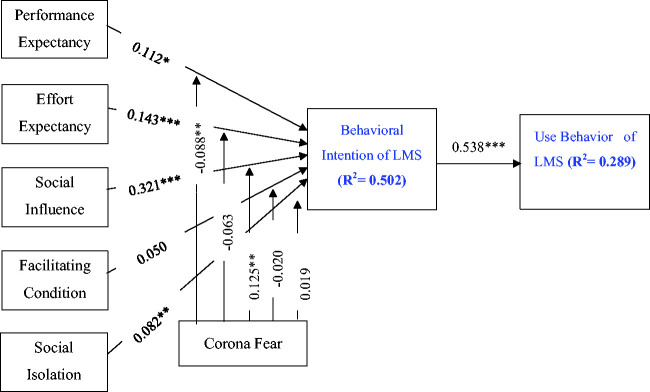
The COVID-19 Pandemic has led to social isolation; however, with the help of technology, education can continue through this tough time. Therefore, this research attempts to explore the Unified Theory of Acceptance and Use of Technology (UTAUT) through the expansion of the model. Also, make it relevant to investigate the influence of social isolation, and the moderating role of Corona fear on Behavioral Intention of the Learning Management System and its Use Behavior of Learning Management System among students. The data was analyzed using Partial Least Square (PLS) and Structural Equation Modelling (SEM). The findings show a positive link of Performance Expectancy (PE), Effort Expectancy (EE), Social Influence (SI), and Social Isolation on Behavioral Intention of LMS and, also between Behavioral Intention of LMS and its Use behavior. Moreover, the results of the moderation analysis show that Corona fears only moderates the link of Performance Expectancy and Social influence with Behavioral Intention of LMS. The findings imply the need for improving the LMS experience to increase its Behavioral Intention among students. Finally, the author's recommendation for future researchers is to examine the extended model in other countries and territories to analyze Coronavirus's influence on e-learning acceptance.
Overview
The claims and statistics of this paper haven’t been checked yet.
Free: it reads the open-access text and checks the first 5 claims that cite a source we can check. Create a free account to check every claim.
Integrity signals
Registry
Cites
Statistics
Figures
Verification
Claims the paper makes
The claims and statistics of this paper haven’t been checked yet.
Free: it reads the open-access text and checks the first 5 claims that cite a source we can check. Create a free account to check every claim.
Claims other papers make about this one
Each is checked against this paper’s own text: does it say what the citing paper says it does?
The cited source says what the claim attributes to it.
In the citing paper
“Several studies confirmed that in many cases individuals are urged by others to conduct specific activities including adopting new technologies (Kamal et al., 2020; Patil et al., 2020; Raza et al., 2021; Zhao and Bacao, 2020).”
From Factors affecting performance expectancy and intentions to use ChatGPT: Using SmartPLS to advance an information technology acceptance framework (2024) · cites this paper as Raza et al., 2021
Self-check
Percentages, sums and reported differences re-computed from the paper’s own numbers.
The self-check needs the paper’s full text.
Citations
Cites
Evaluating Structural Equation Models with Unobservable Variables and Measurement Error
Fornell, C., & Larcker, D. F. (1981) · Journal of Marketing Research · doi:10.2307/3151312 · Cited by 109,314
Evaluating structural equation models with unobservable variables and measurement error
Fornell, C., & Larcker, D. F. (1981) · Journal of Marketing Research · doi:10.1177/002224378101800104 · Cited by 109,190
Perceived usefulness, perceived ease of use, and user acceptance of information technology
Davis, F. D. (1989) · MIS Quarterly · doi:10.2307/249008 · Cited by 68,483 · cited 7×
“This finding is consistent with the studies of Davis (1989), Wang and Wang (2009), Motaghian et al.”
BackgroundResultInfluentialUser Acceptance of Information Technology: Toward A Unified View1
Venkatesh, V., Morris, M. G., Davis, G. B., & Davis, F. D. (2003) · MIS Quarterly · doi:10.2307/30036540 · Cited by 45,035 · cited 16×
“The items for measuring variables were adapted from Venkatesh et al. (2003), Zwain (2019), and Garone et al. (2019).”
BackgroundMethodResultInfluentialA new criterion for assessing discriminant validity in variance-based structural equation modeling
Henseler, J., Ringle, C. M., & Sarstedt, M. (2015) · Journal of the Academy of Marketing Science · doi:10.1007/s11747-014-0403-8 · Cited by 38,459 · cited 1×
“85, confirming the validity, as per the criteria given (Henseler et al., 2015; Raza et al., 2018, 2020).”
MethodA Paradigm for Developing Better Measures of Marketing Constructs
Churchill, G. A. (1979) · Journal of Marketing Research · doi:10.1177/002224377901600110 · Cited by 16,549 · cited 1×
“Moreover, the benchmark for individual reliability is that it should be greater than 0.7 (Churchill, 1979), which can be seen in Table 2.”
BackgroundInfluentialStructural equation models with unobservable variables and measurement error: Algebra and statistics
Fornell, C., & Larcker, D. F. (1981) · Journal of Marketing Research · doi:10.1177/002224378101800313 · Cited by 13,287
The use of partial least squares path modeling in international marketing
Henseler, J., Ringle, C. M., & Sinkovics, R. R. (2009) · Advances in International Marketing · doi:10.1108/s1474-7979(2009)0000020014 · Cited by 10,926
Venkatesh, V. (2000) · Information Systems Research · doi:10.1287/isre.11.4.342.11872 · Cited by 6,664 · cited 3×
“Since the original UTAUT model by Venkatesh et al. (2003) offered relevant factors for determining student’s behavioral intention towards LMS and its Use behavior, they were used for fulfilling the purpose of this research.”
BackgroundMethodModern Methods for Business Research
(1998) · doi:10.4324/9781410604385 · Cited by 6,534
Research works printed but not linked: 7
- Al-Busaidi K. A. Al-Shihi H. (2010). Instructors’ acceptance of learning management systems: A theoretical framework. Communications of the IBIMA, 2010(2010), 1– 10.
- Alias N. A. Zainuddin A. M. (2005). Innovation for better teaching and learning: Adopting the learning management system. Malaysian Online Journal of Instructional Technology, 2(2), 27– 40.
- Al-Shafi S. Weerakkody V. Janssen M. (2009). Investigating the adoption of eGovernment services in Qatar using the UTAUT model. AMCIS 2009 Proceedings, 260, 1--11.
- Fidani A. Idrizi F. (2012). Investigating students’ acceptance of a learning management system in university education: A structural equation modeling approach. ICT Innovations 2012 Web Proceedings, 2(23), 311– 320.
- Nanayakkara C. (2007). A model of user acceptance of learning management systems: A study within tertiary institutions in New Zealand. The International Journal of Learning, 13(12), 223– 232.
- Pakpour A. H. Griffiths M. D. (2020). The fear of CoVId-19 and its role in preventive behaviors. Journal of Concurrent Disorders. Advance online publication.
- Taiwo A. A. Downe A. G. (2013). The theory of user acceptance and use of technology (UTAUT): A meta-analytic review of empirical findings. Journal of Theoretical & Applied Information Technology, 49(1), 48--58.
Cited by
Items 601–626 of 626
Psychological readiness and expectancy-based evaluations in IoT-adoption smart music classrooms
Huawei, Z., Cheong, L. S., Azizan, S. A., & Jenatabadi, H. S. (2026) · Frontiers in Psychology · doi:10.3389/fpsyg.2026.1783925
Kania, R., Solihati, T. I., Asrori, K., Rakhmat, E., & Hidayanti, N. (2026) · Journal of Innovation And Future Technology (IFTECH) · doi:10.47080/iftech.v8i2.4902
Uzaktan Eğitim Platformu Seçiminin Çok Kriterli Karar Verme Yöntemleri ile Değerlendirilmesi
Eren, A. (2026) · Yaşadıkça Eğitim · doi:10.33308/26674874.20264031156
Alsolami, T. (2026) · Journal of Education Pedagogy and Teacher Training
The Factors That Influence the Adoption of E-Learning Among UTHM Students
Kepar, N., & Nasuredin, J. (2023) · Research in Management of Technology and Business · Cited by 1
Wang, C.-J. (2026) · Current Psychology · doi:10.1007/s12144-026-10142-4
“Based on 516 students enrolled in the universities, Raza et al. (2021 ) exhibited a positive linkage from performance expectancy and effort expectancy to behavioral intention of using learning man - agement system.”
Studi Literatur: Model Konseptual Penerimaan Pengguna pada Aplikasi PeduliLindungi
Arbaningrum, M. P., & Bisma, R. (2023) · Journal of Emerging Information System and Business Intelligence (JEISBI) · doi:10.26740/jeisbi.v4i1.51382 · Cited by 3
Dewi, L. S. (2026) · UMM Institutional Repository (University of Maine at Machias)
Chen, B., & Sun, X. (2024) · NIDA Development Journal
Adoption of Online Learning in Indonesian Higher Education during the COVID-19 Pandemic
Yudiatmaja, W. E., Yoserizal, Y., Edison, E., Kristanti, D., Tovalini, K., Samnuzulsari, T., & Malek, J. A. (2022) · The Journal of Behavioral Science · Cited by 20
ปัจจัยที่มีอิทธิพลต่อความตั้งใจในการใช้สื่อสังคมออนไลน์เพื่อการเรียนรู้ของวัยรุ่นในเขตกรุงเทพมหานคร
Tadawattanawit, S. (2024) · Journal of Education and Innovative Learning
Phakamach, P., Wachirawongpaisarn, S., & Panjarattanakorn, D. (2021) · Journal of Education and Innovative Learning
Improving P5 Awareness by Integrating Learning Management Systems (LMS) in English Language Learning
Wirantaka, A. (2024) · Proceeding International Conference of Community Service
Panjarattanakorn, D., Phakamach, P., Senarith, P., Dolprasit, S., Brahmawong, C., & Wachirawongpaisarn, S. (2022) · Journal of Education and Innovative Learning
Afzal, A., Kanwal, F., Amjad, A., Arshed, M. A., & Dewi, C. (2023) · Journal of Computing & Biomedical Informatics · Cited by 1
Faktor-Faktor yang Memengaruhi Niat Menggunakan Teknologi Virtual Try-On Produk Make-Up pada Gen Z
Pratiwi, V., Parlyna, R., & Usman, O. (2026) · Jurnal Ilmu Sosial dan Humaniora · doi:10.63822/6qyxd923
Julianti, I., Suhardi, S., & Astuti, N. (2026) · Economic Journal Economic and Business · doi:10.56495/ejeb.v5i2.1590
Oktavianto, R., & Sirait, T. (2026) · Journal of Innovation Research and Knowledge
Astudillo, E. F. C., Robalino, G. F. C., & Castañeda, N. P. A. (2026) · Polo del Conocimiento · doi:10.23857/pc.v11i9.12614
Lubis, M., & Ramadhani, R. (2025) · Research in Engineering Education Symposium (REES) · doi:10.52202/086293-0017
Ni, Y., Sun, Z., Li, Z., Piao, E., & Zhang, J. (2026) · Frontiers in Psychiatry · doi:10.3389/fpsyt.2026.1917295
Begum, A. (2026) · American Journal of Interdisciplinary Studies · doi:10.63125/gzg2gz02
Factors affecting the adoption of online learning in South Africa using a systematic review
Mdutyana, L. (2025) · UWC Research Repository (University of the Western Cape) · Cited by 1
Ncube, M. M. (2026) · Open Learning The Journal of Open Distance and e-Learning · doi:10.1080/02680513.2026.2760345
Bentulan, M. R. F. K., Cabatan, M. C. C., Genoguin, R. K., & Manansala, R. J. R. G. (2026) · Acta Medica Philippina · doi:10.47895/amp.v60i20.13765
Mazón, J. F. C., Guashpa, W. F. T., Gavilanes, T. P. S., Yunda, W. A. C., Vaca, C. S. R., & Estrella, T. L. A. (2026) · Tesla Revista Científica · doi:10.55204/trc.v6i2.e754
Metadata
- Authors
- Raza, S. A., Qazi, W., Khan, K. A., & Salam, J.
- Affiliations
- Iqra University (PK)
- Corresponding author
- Raza, Syed A.
- Venue
- Journal of Educational Computing Research
- Publisher
- SAGE Publications
- Published
- 2020-09-22
- Volume
- 59
- Issue
- 2
- Pages
- 183-208
- ISSN
- 0735-6331 (ISSN-L)
- 1541-4140
- PMC
- PMC7509242
- OpenAlex
- W3087094992
- Semantic Scholar
- 140945470c3df734fcc31547b10e28baef9b99b6
- Cited by
- 510
- References
- 61
- Citations by year
- 2026: 24 · 2025: 54 · 2024: 104 · 2023: 116 · 2022: 134 · 2021: 78
- FWCI
- 81.30
- Type
- journal article
- Language
- en
- Open access
- hybrid
- doi.org
- Locations
- Journal of Educational Computing Research (publishedVersion, cc-by)
- PubMed Central (publishedVersion, cc-by)
- Topics
- Social Sciences › Decision Sciences › Information Systems and Management › Technology Adoption and User Behaviour
- Social Sciences › Education › Education during COVID-19 pandemic
- Physical Sciences › Computer Science › Information Systems › Educational Technology and E-Learning
- Keywords
- social isolation, virtual learning environments, technology acceptance, UTAUT, COVID-19 pandemic, e-learning acceptance, behavioral intention, use behavior, performance expectancy, effort expectancy, social influence, moderating effect
About these checks
Registry, retraction, Cites and statistics results are computed, not judged, with one exception: a printed reference that no index lists is read once by a model before it counts as a citation error. Claims are extracted by a model and kept only when their quote appears verbatim in the text; each cited source is then checked, with a model’s help, for whether it says what the claim relies on. Those verdicts can be wrong — read the claim’s quote and the cited source before relying on one.
Statistics and arithmetic are recomputed, not judged.
Confidence bands are shown only for fields calibrated on our annotated test set. None is calibrated yet, so no band is shown.
What counts as a claim ›How we measure confidence ›How we check this ›
Are you an author, or do you see a problem with this page? Request a review
Data sources
Bibliographic data: Semantic Scholar, OpenAlex, Crossref.
Contains information from the Semantic Scholar Academic Graph Datasets, made available under the ODC Attribution License (ODC-BY 1.0).
Semantic Scholar’s data is described in: Kinney, R., et al. (2023). The Semantic Scholar Open Data Platform. arXiv:2301.10140.
