

Toward an Entrepreneurial Ecosystem Research Program
Open accessThe DOI matches its Crossref record; 251 of the 251 references it cites were found in a registry or an index; 36 of the 199 sources its claims cite were checked for support.
Abstract
Entrepreneurial ecosystems have become a prominent concept, yet in its current state, the concept itself represents a paradox. While it draws on a rich intellectual history and provides an opportunity to synthesize different strands of research, it is also under-theorized and the mechanisms that govern ecosystem evolution are not well understood. This paper takes stock of recent advancements in ecosystem scholarship and synthesizes the empirical reality of the causal mechanisms. We use these dynamics to position ecosystems in a broader context, within and beyond the domain of entrepreneurship research, and propose a transdisciplinary research program for ecosystem research and practice.
Overview
CoChat Summary
TL;DR
This paper reviews entrepreneurial ecosystem scholarship and argues the concept remains under-theorized, with the mechanisms governing ecosystem evolution not well understood. It synthesizes empirical causal mechanisms and proposes a transdisciplinary research program organized around context, structure, microfoundations, and complex systems.
Key findings
- The systematic review’s final sample contains 62 empirical articles; the initial search yielded 724 articles, reduced to an intermediate sample of 183, with 44 papers studying ecosystems at the city or regional level and 18 at the national level.
- The review identifies causal mechanisms linking ecosystem elements to outputs and outcomes: intra-layer interdependence among elements, upward causation from elements to outputs/outcomes, downward causation and path dependency/feedback, and inter-ecosystem links.
- Country-level studies link entrepreneurial ecosystems to economic growth and find mature ecosystems enable knowledge spillovers and more efficient resource allocation; regional evidence on whether ecosystems moderate the entrepreneurship–economic growth relationship is mixed, with Bruns et al. (2017) finding no moderating effect and Szerb et al. (2019) finding a positive moderating effect.
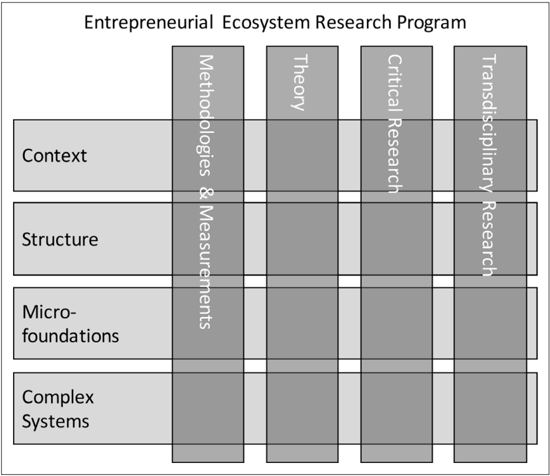
- The paper proposes a transdisciplinary entrepreneurial ecosystem research program with four research streams (context, structure, microfoundations, complex systems) and four cross-sectional themes (methodologies and measurements, theory, critical research, transdisciplinary research).
Methods
- Systematic literature review using Web of Science and Scopus, with topic searches for terms such as “entrep* ecosys*,” “startup ecosys*,” and “sys* of entrep*,” yielding an initial 724 articles.
- The review restricted sources to the top 25% Scimago-ranked journals in relevant business, management, economics, geography, and urban studies subareas, producing an intermediate sample of 183 articles; after in-depth reading and exclusions, 62 empirical articles remained.
- Analysis was guided by the Stam (2015) and Stam and Van de Ven (2019) framework to identify causal mechanisms: intra-layer causation, upward causation, downward causation/feedback, and inter-ecosystem links.
Limitations
- The paper states that ecosystem research is fragmented and heterogeneous, under-theorized, and that mechanisms governing ecosystem evolution are not well understood; much literature uses the ecosystem concept metaphorically without taking interdependence seriously.
- The paper states there is a lack of empirical evidence on path dependency and ecosystem boundaries, and that research is dominated by observational and case-study methods, making causality difficult to infer; it also warns of the ecological fallacy and notes that non-Gaussian distributions are often ignored.
- Evident from the methods: the review is limited to journal articles in top 25% journals, excluding book chapters, conference papers, and non-empirical work, and the final sample of 62 articles may narrow the evidence base.
Model-written summary of a shortened version of the paper’s full text (it is longer than we read). Check it against the paper before relying on it.
Integrity signals
Registry
Cites
Statistics
Figures

Verification
Claims the paper makes
31 Valid · 16 Not valid · 116 Not checked · 37 Own results and interpretations
The cited sources support only part of this claim — read each source’s verdict below.
In the paper
“There is also a subset of studies that focus on a singular innovation project within in a spatial setting, not looking at the aggregate preva -lence of entrepreneurship, nor at the interdependencies in the ecosystem at large (e.g., DiVito & Ingen- Housz, 2019).”
What the sources say
- Partly supportedcites DiVito & Ingen-Housz, 2019 matched to “From individual sustainability orientations to collective sustainability innovation and sustainable entrepreneurial ecosystems” (2021) sourceExperimental — accuracy not yet measured
The Methods section describes a single collaborative innovation project in Amsterdam and says the study does not aim to reveal relationships between variables, supporting the project-level and spatial characterization. But it names the broader ecosystem as a unit of analysis, and the Introduction explicitly says the study examines interdependencies among ecosystem actors. The claim that it does not look at those interdependencies is therefore unsupported. Page numbers are not available in our copy. (LLM, conf=0.88)
plain- Asserted: passes — The authors put it forward as true.
- Checkable: passes — It can be checked against evidence.
- Load-bearing: unclear — It is unclear whether the paper’s conclusions depend on it.
- Based: passes — The paper gives a reason why it holds.
- Partly supported
The cited sources support only part of this claim — read each source’s verdict below.
In the paper
“which are responsible for the bulk of new job creation in devel -oped economies, making it a crucial target for economic development policy ( Brown & Mason, 2017).”
What the sources say
- Partly supportedcites Brown & Mason, 2017 matched to “Looking inside the spiky bits: a critical review and conceptualisation of entrepreneurial ecosystems” (2017) sourceExperimental — accuracy not yet measured
Section 4.1.2, “Blockbuster entrepreneurship” (page unavailable), says that a tiny number of UK firms contribute disproportionately to job creation by high-growth firms. That supports their importance as job creators, but it does not establish that high-growth firms account for the bulk of all new jobs across developed economies. (LLM, conf=0.85)
plainstates a cause- Asserted: passes — The authors put it forward as true.
- Checkable: passes — It can be checked against evidence.
- Load-bearing: unclear — It is unclear whether the paper’s conclusions depend on it.
- Based: passes — The paper gives a reason why it holds.
- Rests on an assumption not shown here.
- Partly supported
Every source the paper cites for this claim was checked and supports it.
In the paper
“An example is the investment in physical infrastructure without supporting the underlying cultural and social support, which turned planned innovation hotspots into empty real estate (Pugh et al., 2018).”
What the sources say
- Supportedcites Pugh et al., 2018 matched to “From ‘Techniums’ to ‘emptiums’: the failure of a flagship innovation policy in Wales” (2018) source
The Discussion and Conclusion says Technium buildings had low occupancy and that firms received little on-site support beyond physical space. The passage labelled Table 4 about here describes a lack of softer support and local networks, with empty space ultimately leased out as the government became a landlord. Together, these support the citing sentence’s paraphrase. (LLM, conf=0.89)
plainstates a cause- Asserted: passes — The authors put it forward as true.
- Checkable: passes — It can be checked against evidence.
- Load-bearing: passes — The paper’s conclusions depend on it.
- Based: passes — The paper gives a reason why it holds.
- Supported
The cited sources support only part of this claim — read each source’s verdict below.
In the paper
“These co- evolutionary dynamics are the result of the interactions of individuals within eco -systems ( Johnson et al., 2019 ; Thompson et al., 2018).”
What the sources say
- Partly supportedcites Johnson et al., 2019 matched to “Entrepreneurial dynamism and the built environment in the evolution of university entrepreneurial ecosystems” (2019) sourceExperimental — accuracy not yet measured
Section 5.1 links the evolution of university-centered entrepreneurial ecosystems to agents’ behavior and their interconnected responses. The Conclusion adds that evolution depends on both those responses and the built environment; the claim broadens this finding to ecosystems generally and leaves out that additional factor. Page numbers are unavailable in our copy. (LLM, conf=0.83)
- Supportedcites Thompson et al., 2018 matched to “How entrepreneurial ecosystems take form: Evidence from social impact initiatives in Seattle” (2018) source
The Discussion (p. 27) states that a field-theory approach considers 'how individuals doing things together contributes to the particular features and dynamics of an ecosystem,' and the Introduction (p. 4) credits endogenous, bottom-up, time-patterned processes driven by micro social interaction, with interactions and shared meanings becoming 'common and mutually reinforcing' across the phase transition (pp. 4, 26). Our copy does not use the term 'co-evolutionary' (searches for it returned only semantic matches), but it substantively treats ecosystem dynamics as the product of actor interactions within the ecosystem, so the paraphrase is carried. The one narrowing worth noting is that the paper bounds this to the early moments of ecosystem formation in its Seattle social-impact setting and pairs interactions with shared meanings rather than interactions alone. (LLM, conf=0.82)
plainstates a cause- Asserted: passes — The authors put it forward as true.
- Checkable: passes — It can be checked against evidence.
- Load-bearing: unclear — It is unclear whether the paper’s conclusions depend on it.
- Based: passes — The paper gives a reason why it holds.
- Partly supported
Every source the paper cites for this claim was checked and supports it.
In the paper
“Ecosystem configurations can vary significantly and new policies/investments should develop support among underlying social and cultural attributes [53] Spigel (2017)”
What the sources say
- Supportedcites Spigel (2017) matched to “The Relational Organization of Entrepreneurial Ecosystems” (2017) source
Section 2.4 states that entrepreneurial ecosystems can have multiple possible configurations. Section 3.1 likewise describes different configurations and relationships among ecosystem attributes, supporting the claim that configurations vary. (LLM, conf=0.92)
plain- Asserted: passes — The authors put it forward as true.
- Checkable: passes — It can be checked against evidence.
- Load-bearing: unclear — It is unclear whether the paper’s conclusions depend on it.
- Based: passes — The paper gives a reason why it holds.
- Supported
81 more claims · 12 with their cited sources checked
Create a free account to see all 200 claims and to verify the 39 references still open.
- Probably not a substantial claim. 82
- It may state two separate claims as one. 52
Self-check
Percentages, sums and reported differences re-computed from the paper’s own numbers.
Each contradiction between two passages listed here was confirmed by an independent check.
Rated minor: it would not touch a result — a value no result rests on, a p-value that stays on the same side of the significance level, or a conflict that is clerical, resolved elsewhere in the paper, or outside its own findings.
In the paper
§ Microfoundations · p. 24
“We must be aware of the ecological fallacy (Robinson, 2009 )”
§ References · p. 47
“- Robinson, W. S. (1950). Ecological correlations and the behavior of individuals.”
Citations
Cites
The Theory of Economic Development
Schumpeter, J., & Backhaus, U. (2006) · The European Heritage in Economics and the Social Sciences · doi:10.1007/0-306-48082-4_3 · Cited by 22,506
Introductory Econometrics: A Modern Approach
Wooldridge, J. M. (1999) · Cited by 14,452
(1993) · Journal of the American Dietetic Association · doi:10.1016/0002-8223(93)92196-5 · Cited by 11,976
Teece, D. J. (1986) · Research Policy · doi:10.1016/0048-7333(86)90027-2 · Cited by 7,842 · cited 1×
“Untraded interdependencies include the complementarities between actors and resources, and information flows which do not entirely correspond to the flows of commodities (Richardson, 1972 ; Teece, 1986 , 1998; Tripsas, 1997).”
Competing Technologies, Increasing Returns, and Lock-In by Historical Events
Arthur, W. B. (1989) · The Economic Journal · doi:10.2307/2234208 · Cited by 7,489 · cited 1×
“The concept of path dependency goes back to the work by David (1988) and Arthur (1989) and “can be used to offer an understanding of why some optional developments are followed, or intention - ally chosen, over others […] path dependence conditions, but does not determine, a specific outcome”…”
Analyzing the Past to Prepare for the Future: Writing a Literature Review
Webster, J., & Watson, R. T. (2002) · MIS Quarterly · doi:10.2307/4132319 · Cited by 7,449 · cited 2×
“In the initial stage, we searched all databases from Web of Science and Scopus for a comprehensive overview of the literature (Frank & Hatak, 2014 ; Martín-Martín et al., 2018 ; Webster & Watson, 2002).”
Teece, D. (1993) · Research Policy · doi:10.1016/0048-7333(93)90063-n · Cited by 7,242
Clusters and the new economics of competition.
Porter, M. E. (1998) · PubMed · Cited by 5,679
Clusters and the New Economics of Competition
Milošević, D. (2014) · Harvard business review · Cited by 4,853
Beyond Markets and States: Polycentric Governance of Complex Economic Systems
Ostrom, E. (2010) · American Economic Review · doi:10.1257/aer.100.3.641 · Cited by 4,529 · cited 2×
“In combination with insights from polynuclear governance (Ostrom, 2010) and multilevel governance (Bache et al.”
Location, Competition, and Economic Development: Local Clusters in a Global Economy
Porter, M. E. (2000) · Economic Development Quarterly · doi:10.1177/089124240001400105 · Cited by 4,460
National Systems of Innovation: Towards a Theory of Innovation and Interactive Learning
Johnson, B. (1992) · Cited by 4,108
Explaining Development and Change in Organizations
van de Ven, A. H., & Poole, M. S. (1995) · The Academy of Management Review · doi:10.5465/amr.1995.9508080329 · Cited by 3,762 · cited 1×
“These hypotheses can be derived from or organized through theories, which are different ways to talk about causal mechanisms explaining development and change (cf. Van De Ven & Poole, 1995, at the organizational level).”
Entrepreneurship: Productive, Unproductive, and Destructive
Baumol, W. J. (1990) · Journal of Political Economy · doi:10.1086/261712 · Cited by 3,649 · cited 1×
“Productive entrepreneurship has been defined as “any entrepreneurial activity that contributes directly or indirectly to net output of the economy or to the capacity to pro - duce additional output” (Baumol, 1990, p. 30).”
(1993) · PubMed · Cited by 3,302
The ‘National System of Innovation’ in historical perspective
(1995) · Cambridge Journal of Economics · doi:10.1093/oxfordjournals.cje.a035309 · Cited by 3,036 · cited 1×
“…the notion of Marshallian industrial districts (cf. Krugman, 1991 ; Markusen, 1996 ), first with the early work on national systems of innovation ( Freeman, 1995; Lundvall, 1992 ), learning regions ( Keeble et al., 1999 ; Malmberg & Maskell, 2002 ) the Triple Helix ( Leydesdorff & Etzkowitz, 1996…”
Contextualizing Entrepreneurship—Conceptual Challenges and Ways Forward
Welter, F. (2011) · Entrepreneurship Theory and Practice · doi:10.1111/j.1540-6520.2010.00427.x · Cited by 2,703 · cited 1×
“…entrepreneurial ecosystems can be seen as the result of developments in several related literatures: entrepreneurship context ( Autio et al., 2014 ; Welter, 2011), high-growth entrepreneurship ( Autio & Rannikko, 2016 ; Henrekson & Johansson, 2008 ), clusters ( Delgado et al., 2010 ; Rocha &…”
Capturing Value from Knowledge Assets: The New Economy, Markets for Know-How, and Intangible Assets
Teece, D. J. (1998) · California Management Review · doi:10.2307/41165943 · Cited by 2,617 · cited 1×
“Untraded interdependencies include the complementarities between actors and resources, and information flows which do not entirely correspond to the flows of commodities (Richardson, 1972 ; Teece, 1986 , 1998; Tripsas, 1997).”
Method in Social Science: A Realist Approach.
Harp, J., & Sayer, A. (1986) · Contemporary Sociology · doi:10.2307/2070081 · Cited by 2,603
Ecosystem as Structure: An Actionable Construct for Strategy
Adner, R. (2017) · Journal of Management · doi:10.1177/0149206316678451 · Cited by 2,600 · cited 2×
“, 2010; Rocha & Sternberg, 2005; Rocha, 2004), regional innovation systems (Cooke, 2007; Sternberg, 2007; Ylinenpää, 2009), entrepreneurial environments (Gnyawali & Fogel, 1994; Van De Ven, 1993), and business ecosystems (Adner, 2017; Moore, 1993).”
Tödtling, F., & Trippl, M. (2005) · Research Policy · doi:10.1016/j.respol.2005.01.018 · Cited by 2,571 · cited 1×
“Especially ‘organizationally thin‘ ecosystems often need outside investments for path renewal (cf. Isaksen, 2015 ; Tödtling & Trippl, 2005 ).”
Sticky Places in Slippery Space: A Typology of Industrial Districts
Markusen, A. (1996) · Economic Geography · doi:10.2307/144402 · Cited by 2,446 · cited 2×
“Subsequent work has built on the notion of Marshallian industrial districts (cf. Krugman, 1991 ; Markusen, 1996 ), first with the early work on national systems of innovation ( Freeman, 1995; Lundvall, 1992 ), learning regions ( Keeble et al., 1999 ; Malmberg & Maskell, 2002 ) the Triple Helix (…”
Path dependence and regional economic evolution
Martin, R., & Sunley, P. (2006) · Journal of Economic Geography · doi:10.1093/jeg/lbl012 · Cited by 2,422 · cited 1×
“Both are place - dependent mechanisms that need to be studied in their geographical context (Martin & Sunley, 2006).”
Entrepreneurial Ecosystems and Regional Policy: A Sympathetic Critique
Stam, E. (2015) · European Planning Studies · doi:10.1080/09654313.2015.1061484 · Cited by 2,406 · cited 13×
“But this is not the only empirical measure of productive entrepreneurship (cf. Davidsson, 2004; Stam, 2015), and there is a considerable amount of entrepreneurial ecosystem studies that focus on types of entrepreneurship that do not necessarily belong to the category of productive entrepreneurs, narrowly defined as co…”
InfluentialSelf-citationRegional innovation systems: Institutional and organisational dimensions
Cooke, P., Gomez Uranga, M., & Etxebarria, G. (1997) · Research Policy · doi:10.1016/s0048-7333(97)00025-5 · Cited by 2,398 · cited 2×
“…1992 ), learning regions ( Keeble et al., 1999 ; Malmberg & Maskell, 2002 ) the Triple Helix ( Leydesdorff & Etzkowitz, 1996 ) and then with the larger literatures on regional clusters ( Delgado et al., 2016 ; Porter, 1998, 2000 ) and regional innovation systems (Cooke, 2001 ; Cooke et al., 1997).”
Network-based research in entrepreneurship
Hoang, H., & Antoncic, B. (2003) · Journal of Business Venturing · doi:10.1016/s0883-9026(02)00081-2 · Cited by 2,302 · cited 1×
“This requires both qualitative and quantitative research designs and longitudinal stud - ies that combine processes and mechanisms with outputs and outcomes (cf. Hoang & Antoncic, 2003 ).”
The Relational Organization of Entrepreneurial Ecosystems
Spigel, B. (2017) · Entrepreneurship Theory and Practice · doi:10.1111/etap.12167 · Cited by 2,257 · cited 4×
“The implica - tion of this idea of the entrepreneur-led ecosystem is that the causal mechanisms that drive the evolution of regional entrepreneurial ecosystems might not be the same as for other territorial models of innovation (Spigel, 2017).”
InfluentialSelf-citationRichardson, G. B. (1972) · The Economic Journal · doi:10.2307/2230256 · Cited by 2,200 · cited 1×
“Untraded interdependencies include the complementarities between actors and resources, and information flows which do not entirely correspond to the flows of commodities (Richardson, 1972 ; Teece, 1986 , 1998; Tripsas, 1997).”
Martín-Martín, A., Orduna-Malea, E., Thelwall, M., & Delgado López-Cózar, E. (2018) · Journal of Informetrics · doi:10.1016/j.joi.2018.09.002 · Cited by 1,990
Martín-Martín, A., Orduna-Malea, E., Thelwall, M., & López-Cózar, E. D. (2018) · doi:10.31235/osf.io/42nkm · Cited by 1,990
Regional Innovation Systems, Clusters, and the Knowledge Economy
Cooke, P. (2001) · Industrial and Corporate Change · doi:10.1093/icc/10.4.945 · Cited by 1,927 · cited 1×
“…1992 ), learning regions ( Keeble et al., 1999 ; Malmberg & Maskell, 2002 ) the Triple Helix ( Leydesdorff & Etzkowitz, 1996 ) and then with the larger literatures on regional clusters ( Delgado et al., 2016 ; Porter, 1998, 2000 ) and regional innovation systems (Cooke, 2001 ; Cooke et al., 1997).”
Engaged Scholarship: A Guide for Organizational and Social Research
Van de Ven, A. H. (2007) · doi:10.1093/oso/9780199226290.001.0001 · Cited by 1,851
The knowledge spillover theory of entrepreneurship
Acs, Z. J., Braunerhjelm, P., Audretsch, D. B., & Carlsson, B. (2009) · Small Business Economics · doi:10.1007/s11187-008-9157-3 · Cited by 1,834
Digital affordances, spatial affordances, and the genesis of entrepreneurial ecosystems
Autio, E., Nambisan, S., Thomas, L. D. W., & Wright, M. (2018) · Strategic Entrepreneurship Journal · doi:10.1002/sej.1266 · Cited by 1,738 · cited 6×
“Entrepreneurial ecosystems, however, are seen to be unique by enabling cross- fertilization between industries and the sharing of business model innovation and structural knowledge, particularly in the digital context (Autio et al., 2018).”
InfluentialStorper, M. (1995) · European Urban and Regional Studies · doi:10.1177/096977649500200301 · Cited by 1,595 · cited 2×
“However, to understand economic development we need to look beyond these traded interdependencies and also examine the untraded interdependencies between actors that explain the differential performance of economic systems (Dosi, 1988; Lawson, 1999; Storper, 1995).”
The Art and science of entrepreneurship
Sexton, D. L., & Smilor, R. W. (1986) · Medical Entomology and Zoology · Cited by 1,530
Neffke, F., Henning, M., & Boschma, R. (2011) · Economic Geography · doi:10.1111/j.1944-8287.2011.01121.x · Cited by 1,463 · cited 2×
“The path-dependency in ecosystems is also affected by the industries that are present in a particular territory ( Neffke et al., 2011).”
Entrepreneurial innovation: The importance of context
Autio, E., Kenney, M., Mustar, P., Siegel, D., & Wright, M. (2014) · Research Policy · doi:10.1016/j.respol.2014.01.015 · Cited by 1,456 · cited 2×
“…thinking about entrepreneurial ecosystems can be seen as the result of developments in several related literatures: entrepreneurship context ( Autio et al., 2014 ; Welter, 2011), high-growth entrepreneurship ( Autio & Rannikko, 2016 ; Henrekson & Johansson, 2008 ), clusters ( Delgado et al.,…”
Malmberg, A., & Maskell, P. (2002) · Environment and Planning A: Economy and Space · doi:10.1068/a3457 · Cited by 1,417 · cited 1×
“…1996 ), first with the early work on national systems of innovation ( Freeman, 1995; Lundvall, 1992 ), learning regions ( Keeble et al., 1999 ; Malmberg & Maskell, 2002 ) the Triple Helix ( Leydesdorff & Etzkowitz, 1996 ) and then with the larger literatures on regional clusters ( Delgado et…”
National systems of entrepreneurship: measurement issues and policy implications
Ács, Z. J., Autio, E., & Szerb, L. (2014) · Research Policy · doi:10.1016/j.respol.2013.08.016 · Cited by 1,301 · cited 3×
“Policy makers should always con - sider prioritizing the bottlenecks in their ecosystem (Acs et al., 2014 ; Autio & Levie, 2017 ) and, particularly at the national level, try to create favorable conditions in which regions with differ - ent strengths and weaknesses can flourish.”
Entrepreneurial ecosystem elements
Stam, E., & van de Ven, A. (2021) · Small Business Economics · doi:10.1007/s11187-019-00270-6 · Cited by 1,276
Self-citationThe Sicilian Mafia: The Business of Private Protection.
Shapiro, S. P., & Gambetta, D. (1994) · Contemporary Sociology · doi:10.2307/2074312 · Cited by 1,245
Toward a process theory of entrepreneurial ecosystems
Spigel, B., & Harrison, R. (2018) · Strategic Entrepreneurship Journal · doi:10.1002/sej.1268 · Cited by 1,163 · cited 2×
“While these approaches have divergent goals, methodologies and epistemological views of how the economy works, they are united by the central idea that there are factors outside an organization but within a region that contribute to firm-level competitive advantage ( Spigel & Harrison, 2018 ).”
Self-citationTechnological forecasting and social change
(1988) · Technological Forecasting and Social Change · doi:10.1016/0040-1625(88)90012-1 · Cited by 1,140
Nascent Entrepreneurship and the Level of Economic Development
Wennekers, S., van Wennekers, A., Thurik, R., & Reynolds, P. (2005) · Small Business Economics · doi:10.1007/s11187-005-1994-8 · Cited by 1,123
Properties of Emerging Organizations
Katz, J., & Gartner, W. B. (1988) · The Academy of Management Review · doi:10.5465/amr.1988.4306967 · Cited by 1,105 · cited 1×
“This emergence may include new products, new organizations (Katz & Gartner, 1988 ) as well new industries ( Garnsey et al., 2010 ; Yamamura & Lassalle, 2020 ).”
The Origin Of Wealth: Evolution, Complexity, and the Radical Remaking of Economics
Beinhocker, E. D. (2007) · Cited by 1,084
TRIPSAS, M. (1997) · Strategic Management Journal · doi:10.1002/(sici)1097-0266(199707)18:1+<119::aid-smj921>3.0.co;2-0 · Cited by 1,061
Co-opetition between giants: Collaboration with competitors for technological innovation
Gnyawali, D. R., & Park, B.-J. (. (2011) · Research Policy · doi:10.1016/j.respol.2011.01.009 · Cited by 1,044 · cited 1×
“, 2018) or ‘coopetive’ relationships are formed (Gnyawali et al., 2011).”
The lineages of the entrepreneurial ecosystem approach
Acs, Z. J., Stam, E., Audretsch, D. B., & O’Connor, A. (2017) · Small Business Economics · doi:10.1007/s11187-017-9864-8 · Cited by 1,020 · cited 2×
“Origins of the Entrepreneurial Ecosystem Concept While the recent interest in entrepreneurial ecosystems makes it appear novel, it builds on intellectual traditions ranging from clusters, to innovation systems and urban economics (Acs et al., 2017; Brown & Mason, 2017; Brown & Mawson, 2019; Malecki, 2018).”
Self-citationEnvironments for Entrepreneurship Development: Key Dimensions and Research Implications
Gnyawali, D. R., & Fogel, D. S. (1994) · Entrepreneurship Theory and Practice · doi:10.1177/104225879401800403 · Cited by 1,003 · cited 2×
“…2008 ), clusters ( Delgado et al., 2010 ; Rocha & Sternberg, 2005 ; Rocha, 2004 ), regional innovation systems (Cooke, 2007 ; Sternberg, 2007 ; Ylinenpää, 2009), entrepreneurial environments ( Gnyawali & Fogel, 1994 ; Van De Ven, 1993), and business ecosystems ( Adner, 2017 ; Moore, 1993 ).”
What's New about the New Economy? Sources of Growth in the Managed and Entrepreneurial Economies
Audretsch, D. B. (2001) · Industrial and Corporate Change · doi:10.1093/icc/10.1.267 · Cited by 986 · cited 1×
“In an entrepreneurial economy, overall performance does not depend on economies of scale but is more widely distributed among a variety of innovative firms and start-ups ( Audretsch & Thurik, 2001 ; Thurik et al., 2013).”
Delgado, M., Porter, M. E., & Stern, S. (2010) · Journal of Economic Geography · doi:10.1093/jeg/lbq010 · Cited by 983
Entrepreneurial ecosystems in cities: establishing the framework conditions
Audretsch, D. B., & Belitski, M. (2017) · The Journal of Technology Transfer · doi:10.1007/s10961-016-9473-8 · Cited by 977 · cited 2×
“Audretsch and Belitski (2017) showed that the ecosystem at the city-level with the addition of internet access and the integration of immigrants into the ecosystem fosters entrepreneurial activity.”
(2014) · Cited by 950
Emergence of a Triple Helix of university—industry—government relations
(1996) · Science and Public Policy · doi:10.1093/spp/23.5.279 · Cited by 944 · cited 1×
“…systems of innovation ( Freeman, 1995; Lundvall, 1992 ), learning regions ( Keeble et al., 1999 ; Malmberg & Maskell, 2002 ) the Triple Helix ( Leydesdorff & Etzkowitz, 1996 ) and then with the larger literatures on regional clusters ( Delgado et al., 2016 ; Porter, 1998, 2000 ) and regional…”
David, P. A. (1994) · Structural Change and Economic Dynamics · doi:10.1016/0954-349x(94)90002-7 · Cited by 929 · cited 2×
“Path dependency manifests itself in regional institutions, which can be characterized as ‘the carriers of history’ ( David, 1994), and a spiky resource landscape.”
Bache, I., Bartle, I., & Flinders, M. (2016) · Handbook on Theories of Governance · doi:10.4337/9781782548508.00052 · Cited by 900 · cited 1×
“In combination with insights from polynuclear governance ( Ostrom, 2010 ) and multilevel governance (Bache et al., 2016 ), this line of research promises both scientific advancements in our understanding of ecosystems and frameworks that can be operationalized for policy and entrepreneurial…”
Brock, W. A., & Evans, D. S. (1989) · Small Business Economics · doi:10.1007/bf00389913 · Cited by 894
Dimov, D., & Forster, W. (2011) · In Search of Research Excellence · doi:10.4337/9781849807630.00021 · Cited by 893
Balland, P.-A., Boschma, R., Crespo, J., & Rigby, D. L. (2019) · Regional Studies · doi:10.1080/00343404.2018.1437900 · Cited by 856 · cited 1×
“From a policy perspec - tive, the smart specialization approach aims to capitalize on path dependencies by building on the existing strengths in a region (cf. Balland et al., 2018).”
Looking inside the spiky bits: a critical review and conceptualisation of entrepreneurial ecosystems
Brown, R., & Mason, C. (2017) · Small Business Economics · doi:10.1007/s11187-017-9865-7 · Cited by 852 · cited 4×
“It is often proxied with high-growth firms (e.g., Stam & Bosma, 2015 ), which are responsible for the bulk of new job creation in devel - oped economies, making it a crucial target for economic development policy ( Brown & Mason, 2017).”
InfluentialThe development of an infrastructure for entrepreneurship
Van De Ven, H. (1993) · Journal of Business Venturing · doi:10.1016/0883-9026(93)90028-4 · Cited by 822 · cited 3×
“…2008 ), clusters ( Delgado et al., 2010 ; Rocha & Sternberg, 2005 ; Rocha, 2004 ), regional innovation systems (Cooke, 2007 ; Sternberg, 2007 ; Ylinenpää, 2009), entrepreneurial environments ( Gnyawali & Fogel, 1994 ; Van De Ven, 1993), and business ecosystems ( Adner, 2017 ; Moore, 1993 ).”
Everyday Entrepreneurship—A Call for Entrepreneurship Research to Embrace Entrepreneurial Diversity
Welter, F., Baker, T., Audretsch, D. B., & Gartner, W. B. (2017) · Entrepreneurship Theory and Practice · doi:10.1111/etap.12258 · Cited by 807 · cited 2×
“…literature has always focused on how entrepreneurs are affected by their broader context ( Gnyawali & Fogel, 1994; Van de Ven, 1993 ), it has generally focused on all entrepreneurial activity, which is mostly low-growth entrepreneurship that has few broader economic impacts ( Welter et al., 2017).”
Entrepreneurship Research in Emergence: Past Trends and Future Directions
Busenitz, L. (2003) · Journal of Management · doi:10.1016/s0149-2063(03)00013-8 · Cited by 794
Testing Baumol: Institutional quality and the productivity of entrepreneurship
Sobel, R. S. (2008) · Journal of Business Venturing · doi:10.1016/j.jbusvent.2008.01.004 · Cited by 784 · cited 2×
“or Brussels (Sobel, 2008) or the mafia (Gambetta, 1993).”
Entrepreneurship and entrepreneurial ecosystems
Malecki, E. J. (2018) · Geography Compass · doi:10.1111/gec3.12359 · Cited by 784 · cited 2×
“While the recent interest in entrepreneurial ecosystems makes it appear novel, it builds on intel - lectual traditions ranging from clusters, to innovation systems and urban economics (Acs et al., 2017 ; Brown & Mason, 2017 ; Brown & Mawson, 2019; Malecki, 2018).”
A critical review of entrepreneurial ecosystems research: towards a future research agenda
Alvedalen, J., & Boschma, R. (2017) · European Planning Studies · doi:10.1080/09654313.2017.1299694 · Cited by 755 · cited 1×
“The entrepreneurial ecosystem literature is dominated by a focus on the endogenous dynamics within specific ecosystems rather than multiscalar studies (Alvedalen & Boschma, 2017).”
Markusen, A. (2003) · Regional Studies · doi:10.1080/0034340032000108796 · Cited by 729 · cited 1×
“We must ask: what is actually new about this concept or is it just a “fad” like many others (Martin, 2015)? The majority of other systemic approaches remain fuzzy due to a lack of empirical evidence of how they work and contribute to innovative and entrepreneurial activity (Markusen, 2003).”
Colombo, M. G., & Grilli, L. (2010) · Journal of Business Venturing · doi:10.1016/j.jbusvent.2009.01.005 · Cited by 686 · cited 1×
“This is in line with other empirical findings such as the ‘coach’ function (as opposed to pure ‘scouting’) of venture capital firms and how they compensate for a lack of human capital in high potential technology-based firms (Colombo & Grilli, 2010).”
Ecological Correlations and the Behavior of Individuals*
Robinson, W. (2009) · International Journal of Epidemiology · doi:10.1093/ije/dyn357 · Cited by 685 · cited 1×
“We must be aware of the ecological fallacy (Robinson, 2009 ), wherein researchers errone-ously interpret and deduce inferences about individuals based on the group data (Terjesen et al., 2016).”
The emergence of entrepreneurial ecosystems: A complex adaptive systems approach
Roundy, P. T., Bradshaw, M., & Brockman, B. K. (2018) · Journal of Business Research · doi:10.1016/j.jbusres.2018.01.032 · Cited by 681 · cited 1×
“The ontological view talks about entrepreneurial ecosystems emerging (Roundy et al., 2018 ) and particular entrepreneurial communities (e.g., concerned with particular technologies, sec - tors, or societal challenges) arising in countries, regions or cities.”
Contextualization and the advancement of entrepreneurship research
Zahra, S. A., Wright, M., & Abdelgawad, S. G. (2014) · International Small Business Journal: Researching Entrepreneurship · doi:10.1177/0266242613519807 · Cited by 675 · cited 2×
“Both the research streams and themes are relevant for entrepreneurship scholars in general beyond the study of ecosystems (Busenitz et al., 2003 ; Wiklund et al., 2011 ; Zahra et al., 2014).”
The evolutionary dynamics of entrepreneurial ecosystems
Mack, E., & Mayer, H. (2016) · Urban Studies · doi:10.1177/0042098015586547 · Cited by 657 · cited 3×
“C o n t i nu e d importance of ecosystem elements varies depending on the overall state of the ecosystem (Mack & Mayer, 2016).”
Architectural Leverage: Putting Platforms in Context
Thomas, L. D. W., Autio, E., & Gann, D. M. (2014) · Academy of Management Perspectives · doi:10.5465/amp.2011.0105 · Cited by 639
Many are Called, but Few are Chosen: An Evolutionary Perspective for the Study of Entrepreneurship
Aldrich, H. E., & Martinez, M. A. (2007) · Entrepreneurship · doi:10.1007/978-3-540-48543-8_14 · Cited by 633
Many are Called, but Few are Chosen: An Evolutionary Perspective for the Study of Entrepreneurship
Aldrich, H. E., & Martinez, M. A. (2001) · Entrepreneurship Theory and Practice · doi:10.1177/104225870102500404 · Cited by 596 · cited 1×
“It is this “recursive continuous process” of interaction between ecosystems (context), processes, and outputs/outcomes that shape the ecosystem and the conditions for entrepreneurs ( Aldrich & Martinez, 2001).”
Introduction to economic growth
Acemoglu, D. (2012) · Journal of Economic Theory · doi:10.1016/j.jet.2012.01.023 · Cited by 595 · cited 1×
“We define entrepreneurship-driven economic development as structural changes to the economy and its ‘social and institutional fabric’ ( Acemoglu, 2012 ) that goes beyond GDP and productivity growth or higher employment rates and also includes other dimensions of well-being, and inequality.”
Entrepreneurship, institutional economics, and economic growth: an ecosystem perspective
Acs, Z. J., Estrin, S., Mickiewicz, T., & Szerb, L. (2018) · Small Business Economics · doi:10.1007/s11187-018-0013-9 · Cited by 582 · cited 2×
“The three countrylevel studies that are included in this review have shown a link between entrepreneurial ecosystems and economic growth (Acs et al., 2018; Lafuente et al., 2016; Lafuente et al., 2019).”
A systematic literature review of entrepreneurial ecosystems in advanced and emerging economies
Cao, Z., & Shi, X. (2021) · Small Business Economics · doi:10.1007/s11187-020-00326-y · Cited by 581
Nambisan, S., & Baron, R. A. (2013) · Entrepreneurship Theory and Practice · doi:10.1111/j.1540-6520.2012.00519.x · Cited by 580 · cited 1×
“Predominantly in tech and ICT sectors, many scale-ups either provide a platform themselves or are based on other platform or innovation ecosystems (Nambisan & Baron, 2013).”
Networks, Propinquity, and Innovation in Knowledge-intensive Industries
Whittington, K. B., Owen-Smith, J., & Powell, W. W. (2009) · Administrative Science Quarterly · doi:10.2189/asqu.2009.54.1.90 · Cited by 576
Comparative International Entrepreneurship: A Review and Research Agenda
Terjesen, S., Hessels, J., & Li, D. (2016) · Journal of Management · doi:10.1177/0149206313486259 · Cited by 523 · cited 2×
“We must be aware of the ecological fallacy (Robinson, 2009 ), wherein researchers errone-ously interpret and deduce inferences about individuals based on the group data (Terjesen et al., 2016).”
Six tips for your (systematic) literature review in business and management research
Fisch, C., & Block, J. (2018) · Management Review Quarterly · doi:10.1007/s11301-018-0142-x · Cited by 516 · cited 1×
“Building on the insights from these reviews, we take a concept-centered approach to our review ( Fisch & Block, 2018) and focus on two issues.”
Startup communities: Building an Entrepreneurial Ecosystem in Your City
(2012) · doi:10.1002/9781119204459 · Cited by 505
Bronzini, R., & Piselli, P. (2009) · Regional Science and Urban Economics · doi:10.1016/j.regsciurbeco.2008.07.002 · Cited by 496 · cited 2×
“…both at the regional and national level and is further sup - ported by studies in economics that empirically show long term equilibria between productivity and human capital, R&D, and public infrastructure (which represent a combination of different ecosystem elements; Bronzini & Piselli, 2009).”
Defining clusters of related industries
Delgado, M., Porter, M. E., & Stern, S. (2016) · Journal of Economic Geography · doi:10.1093/jeg/lbv017 · Cited by 493
Complexity thinking and evolutionary economic geography
Martin, R., & Sunley, P. (2007) · Journal of Economic Geography · doi:10.1093/jeg/lbm019 · Cited by 490 · cited 2×
“Because of this inherent connectivity, non-linearity and openness, a complex system affords limited functional decomposability ( Martin & Sunley, 2007), which suggests that the overall functioning of the entrepreneurial ecosystem can - not be deduced from knowledge of its elements but instead…”
An Entrepreneurial System View of New Venture Creation
Neck, H. M., Meyer, G. D., Cohen, B., & Corbett, A. C. (2004) · Journal of Small Business Management · doi:10.1111/j.1540-627x.2004.00105.x · Cited by 488 · cited 2×
“Individual actors can increase connectivity and provide required resources by acting beyond their expected realm (Neck et al., 2004 ), including accelerators ( Goswami et al., 2018 ; Pustovrh et al., 2020), government initiatives and policy interventions ( Motoyama & Knowlton, 2016 ; Radinger-Peer…”
Silicon Valley’s New Immigrant High-Growth Entrepreneurs
Saxenian, A. (2002) · Economic Development Quarterly · doi:10.1177/0891242402016001003 · Cited by 480 · cited 2×
“In Silicon Valley, for example, it was highly educated and skilled Asian immigrants who actively supported the growth of the ecosystem by becoming entrepreneurs and helping facilitate interactions with their home countries (Saxenian, 2002 ).”
Collective Learning Processes, Networking and ‘Institutional Thickness' in the Cambridge Region
Keeble, D., Lawson, C., Moore, B., & Wilkinson, F. (1999) · Regional Studies · doi:10.1080/713693557 · Cited by 480 · cited 2×
“Krugman, 1991; Markusen, 1996), first with the early work on national systems of innovation (Freeman, 1995; Lundvall, 1992), learning regions (Keeble et al., 1999; Malmberg & Maskell, 2002) the Triple Helix (Leydesdorff & Etzkowitz, 1996) and then with the larger literatures on regional clusters (Delgado et al.”
The Future of Entrepreneurship Research
Wiklund, J., Davidsson, P., Audretsch, D. B., & Karlsson, C. (2011) · Entrepreneurship Theory and Practice · doi:10.1111/j.1540-6520.2010.00420.x · Cited by 439 · cited 1×
“Both the research streams and themes are relevant for entrepreneurship scholars in general beyond the study of ecosystems (Busenitz et al., 2003 ; Wiklund et al., 2011 ; Zahra et al., 2014).”
Knowing “What” to do is not Enough: Turning Knowledge into Action
Pfeffer, J., & Sutton, R. I. (1999) · California Management Review · doi:10.1177/000812569904200101 · Cited by 438 · cited 1×
“The principles, despite being context-dependent, would improve the implementation of ecosystem research and address the knowledge-practice gap (cf. Pfeffer & Sutton, 1999).”
The resilience of entrepreneurial ecosystems
Roundy, P. T., Brockman, B. K., & Bradshaw, M. (2017) · Journal of Business Venturing Insights · doi:10.1016/j.jbvi.2017.08.002 · Cited by 426 · cited 2×
“Conceptualizing entrepreneurship as emergence and ‘order creating’ (McKelvey, 2004 ) as well as a source of resilience ( Roundy et al., 2017) helps to improve our understanding of the context that enables entrepreneurship, emergence and resilience of the system in the first place (cf. Arthur, 2015;…”
Innovation, entrepreneurial, knowledge, and business ecosystems: Old wine in new bottles?
Scaringella, L., & Radziwon, A. (2018) · Technological Forecasting and Social Change · doi:10.1016/j.techfore.2017.09.023 · Cited by 394 · cited 2×
“…other applications of ecosystems in the management literature in terms of (1) the focus on specific types of entrepre - neurship, and (2) the specific territorial boundaries that are placed on the entrepreneurial ecosys - tem, usually a city, a region, or a nation ( Scaringella & Radziwon, 2018).”
Turning Lead into Gold: How Do Entrepreneurs Mobilize Resources to Exploit Opportunities?
Clough, D. R., Fang, T. P., Vissa, B., & Wu, A. (2019) · Academy of Management Annals · doi:10.5465/annals.2016.0132 · Cited by 393
Regional systems of entrepreneurship: the nexus of human capital, knowledge and new firm formation
Qian, H., Acs, Z. J., & Stough, R. R. (2013) · Journal of Economic Geography · doi:10.1093/jeg/lbs009 · Cited by 390 · cited 2×
“…the university spin-offs ( Harrison & Leitch, 2010; Johnson et al., 2019 ) as well as the interplay of government initiatives (Jung et al., 2017 ), institutions ( Öner & Kunday, 2016 ), and human capital ( Qian et al., 2013) with other ecosystem elements enables the formation of new ventures.”
Regulatory Burden, Rule of Law, and Entry of Strategic Entrepreneurs: An International Panel Study
Levie, J., & Autio, E. (2011) · Journal of Management Studies · doi:10.1111/j.1467-6486.2010.01006.x · Cited by 382 · cited 1×
“These interdependencies have been discussed in other streams of the literature and at the city-level ( Fritsch & Wyrwich, 2014; Levie & Autio, 2011 ) and are a crucial assumption in many other ecosystem studies that focus on other causal mechanism (e.g., Audretsch & Belitski, 2017, who link…”
Toward a complexity science of entrepreneurship
McKelvey, B. (2004) · Journal of Business Venturing · doi:10.1016/s0883-9026(03)00034-x · Cited by 374 · cited 2×
“Conceptualizing entrepreneurship as emergence and ‘order creating’ (McKelvey, 2004 ) as well as a source of resilience ( Roundy et al., 2017) helps to improve our understanding of the context that enables entrepreneurship, emergence and resilience of the system in the first place (cf. Arthur, 2015;…”
Agrawal, A., & Cockburn, I. (2003) · International Journal of Industrial Organization · doi:10.1016/s0167-7187(03)00081-x · Cited by 366 · cited 1×
“Particularly in the early stages of ecosystem development, anchor orga - nizations (universities, firms: see Agrawal & Cockburn, 2003 ; Feldman, 2003) are a crucial actor ( Colombelli et al., 2019).”
(2015) · Choice Reviews Online · doi:10.5860/choice.188793 · Cited by 364
Nicotra, M., Romano, M., Del Giudice, M., & Schillaci, C. E. (2018) · The Journal of Technology Transfer · doi:10.1007/s10961-017-9628-2 · Cited by 342 · cited 6×
“While recent reviews of the entrepreneurial ecosystem literature (e.g., Cao & Shi, 2020; Garavan et al., 2019 ; Hakala et al., 2020 ; Maroufkhani et al., 2018 ; Nicotra et al., 2018) have sought to bring together this rapidly shifting field, we advance on these works in three key ways.”
InfluentialTowards a competence theory of the region
Lawson, C. (1999) · Cambridge Journal of Economics · doi:10.1093/cje/23.2.151 · Cited by 339 · cited 2×
“However, to understand economic development we need to look beyond these traded interdependencies and also examine the untraded interdependencies between actors that explain the differential performance of economic systems (Dosi, 1988; Lawson, 1999; Storper, 1995).”
The character of innovative places: entrepreneurial strategy, economic development, and prosperity
Feldman, M. P. (2014) · Small Business Economics · doi:10.1007/s11187-014-9574-4 · Cited by 338 · cited 2×
“Entrepreneurs might structurally change the economy and society, as exemplified with new sets of technologies, institutions, and organizational arrangements (Arthur, 2013; Feldman, 2014).”
Hidalgo, C. A., Balland, P.-A., Boschma, R., Delgado, M., Feldman, M., Frenken, K., Glaeser, E., He, C., Kogler, D. F., Morrison, A., et al. (2018) · Springer Proceedings in Complexity · doi:10.1007/978-3-319-96661-8_46 · Cited by 335 · cited 2×
“This requires both methodological innovation using models of heterogeneous agents in contrast to the use of the homogeneous agents of physics and mathematics (McKelvey, 2004) and for linking ecosystems to other emerging theories such as ‘relatedness‘ (Hidalgo et al., 2018).”
The Long Persistence of Regional Levels of Entrepreneurship: Germany, 1925–2005
Fritsch, M., & Wyrwich, M. (2014) · Regional Studies · doi:10.1080/00343404.2013.816414 · Cited by 330 · cited 1×
“These interdependencies have been discussed in other streams of the literature and at the city-level ( Fritsch & Wyrwich, 2014; Levie & Autio, 2011 ) and are a crucial assumption in many other ecosystem studies that focus on other causal mechanism (e.g., Audretsch & Belitski, 2017, who link…”
Coming back home after the sun rises: Returnee entrepreneurs and growth of high tech industries
Kenney, M., Breznitz, D., & Murphree, M. (2013) · Research Policy · doi:10.1016/j.respol.2012.08.001 · Cited by 329 · cited 3×
“, 2002; Schäfer & Henn, 2018) and ‘returnee entrepreneurs‘ (Kenney et al., 2013) form one of the largest groups in some of the most vibrant ecosystems.”
Bhidé, A. (2010) · Harvard business review · Cited by 326
Stam, E., & Spigel, B. (2018) · The SAGE Handbook of Small Business and Entrepreneurship · doi:10.4135/9781473984080.n21 · Cited by 315
Self-citationGoswami, K., Mitchell, J. R., & Bhagavatula, S. (2018) · Strategic Entrepreneurship Journal · doi:10.1002/sej.1281 · Cited by 314 · cited 2×
“…actors can increase connectivity and provide required resources by acting beyond their expected realm (Neck et al., 2004 ), including accelerators ( Goswami et al., 2018 ; Pustovrh et al., 2020), government initiatives and policy interventions ( Motoyama & Knowlton, 2016 ; Radinger-Peer et al.,…”
Aldrich, H. E., & Ruef, M. (2018) · Academy of Management Perspectives · doi:10.5465/amp.2017.0123 · Cited by 309 · cited 1×
“Entrepreneurship research has in recent years overly concentrated on “gazelles” or “uni - corns” and those companies with venture capital investments, despite these being extremely rare outcomes (Aldrich & Ruef, 2018; Welter et al., 2017).”
Industrial development in thin regions: trapped in path extension?
Isaksen, A. (2015) · Journal of Economic Geography · doi:10.1093/jeg/lbu026 · Cited by 308 · cited 1×
“Especially ‘organizationally thin‘ ecosystems often need outside investments for path renewal (cf. Isaksen, 2015 ; Tödtling & Trippl, 2005 ).”
How entrepreneurial ecosystems take form: Evidence from social impact initiatives in Seattle
Thompson, T. A., Purdy, J. M., & Ventresca, M. J. (2018) · Strategic Entrepreneurship Journal · doi:10.1002/sej.1285 · Cited by 306 · cited 6×
“These co- evolutionary dynamics are the result of the interactions of individuals within ecosystems (Johnson et al., 2019; Thompson et al., 2018).”
InfluentialEntrepreneurship and Development: The Role of Clusters
Rocha, H. O. (2004) · Small Business Economics · doi:10.1007/s11187-004-3991-8 · Cited by 301 · cited 2×
“…high-growth entrepreneurship ( Autio & Rannikko, 2016 ; Henrekson & Johansson, 2008 ), clusters ( Delgado et al., 2010 ; Rocha & Sternberg, 2005 ; Rocha, 2004 ), regional innovation systems (Cooke, 2007 ; Sternberg, 2007 ; Ylinenpää, 2009), entrepreneurial environments ( Gnyawali & Fogel, 1994 ;…”
Transnational Entrepreneurs: An Alternative Form of Immigrant Economic Adaptation
Portes, A., Haller, W. J., & Guarnizo, L. E. (2002) · American Sociological Review · doi:10.1177/000312240206700206 · Cited by 300 · cited 1×
“‘Transnational entrepreneurs‘ (Portes et al., 2002 ; Schäfer & Henn, 2018 ) and ‘returnee entrepreneurs‘ (Kenney et al., 2013 ) form one of the largest groups in some of the most vibrant ecosystems.”
Neumeyer, X., & Santos, S. C. (2018) · Journal of Cleaner Production · doi:10.1016/j.jclepro.2017.08.216 · Cited by 299 · cited 1×
“…emerging regarding how different ecosystem configurations lead to different entrepreneurship outputs, and even how different clusters within one ecosystem can produce different entrepreneurship outputs (Civera et al., 2019 ; Dilli et al., 2018 ; Neumeyer & Santos, 2018; Neumeyer et al., 2019).”
Retaining winners: Can policy boost high-growth entrepreneurship?
Autio, E., & Rannikko, H. (2016) · Research Policy · doi:10.1016/j.respol.2015.06.002 · Cited by 293
Measure Twice, Cut Once: Entrepreneurial Ecosystem Metrics
Leendertse, J., Schrijvers, M., & Stam, E. (2022) · Research Policy · doi:10.1016/j.respol.2021.104336 · Cited by 282 · cited 2×
“This is required for capturing the diversity and richness of entrepreneurial ecosystems and finding new measures and data-driven approaches to modeling entrepreneurial ecosystems ( Leendertse et al., 2020).”
Self-citationHechavarría, D. M., & Ingram, A. E. (2019) · Small Business Economics · doi:10.1007/s11187-018-9994-7 · Cited by 277 · cited 5×
“These studies do, however, not account for the system - ness of the ecosystem by looking at elements individually (Hechavarría & Ingram, 2019 ) or study a very specific type of output (Civera et al., 2019).”
InfluentialTransnational Entrepreneurs‘ Venture Internationalization Strategies: A Practice Theory Approach
Terjesen, S., & Elam, A. (2009) · Entrepreneurship Theory and Practice · doi:10.1111/j.1540-6520.2009.00336.x · Cited by 258 · cited 1×
“In this way, they take on the role of ‘modern middlemen’ who “transcend the multiple institutional environments in which they are embedded” (Terjesen & Elam, 2009, p. 1093).”
Entrepreneurship: The Role of Clusters Theoretical Perspectives and Empirical Evidence from Germany
Rocha, H. O., & Sternberg, R. (2005) · Small Business Economics · doi:10.1007/s11187-005-1993-9 · Cited by 257 · cited 1×
“…al., 2014 ; Welter, 2011), high-growth entrepreneurship ( Autio & Rannikko, 2016 ; Henrekson & Johansson, 2008 ), clusters ( Delgado et al., 2010 ; Rocha & Sternberg, 2005 ; Rocha, 2004 ), regional innovation systems (Cooke, 2007 ; Sternberg, 2007 ; Ylinenpää, 2009), entrepreneurial environments…”
Hierarchical and relational governance and the life cycle of entrepreneurial ecosystems
Colombelli, A., Paolucci, E., & Ughetto, E. (2019) · Small Business Economics · doi:10.1007/s11187-017-9957-4 · Cited by 257 · cited 2×
“Particularly in the early stages of ecosystem development, anchor orga - nizations (universities, firms: see Agrawal & Cockburn, 2003 ; Feldman, 2003) are a crucial actor ( Colombelli et al., 2019).”
Welter, F., Baker, T., Audretsch, D. B., & Gartner, W. B. (2019) · Entrepreneurship and Context · doi:10.4337/9781788119474.00025 · Cited by 252
Feldman, M. (2005) · Research and Technological Innovation · doi:10.1007/3-7908-1658-2_9 · Cited by 247
New, technology-based firms in innovation networks symplectic and generative impacts
Autio, E. (1997) · Research Policy · doi:10.1016/s0048-7333(96)00906-7 · Cited by 242 · cited 1×
“The combination of upward and downward causality is evidence for how entrepreneurship (as a phenomenon) and entrepreneurial behavior (at the individual level) are subject to systemic influences but also shape this systemic context ( Autio, 1997).”
Stories from the field: women’s networking as gender capital in entrepreneurial ecosystems
McAdam, M., Harrison, R. T., & Leitch, C. M. (2019) · Small Business Economics · doi:10.1007/s11187-018-9995-6 · Cited by 242 · cited 2×
“Interventions must address the interdependence of the elements and actors beyond symptomatic solutions that target them individually (McAdam et al., 2019; van Weele et al., 2018).”
Feldman, M. (2003) · Industry and Innovation · doi:10.1080/1366271032000141661 · Cited by 240
Oinas, P., & Malecki, E. J. (2002) · International Regional Science Review · doi:10.1177/016001702762039402 · Cited by 237 · cited 1×
“Complex products and platform technologies rely on the division of labor across regional ecosystems and often coun - tries, and both the interactions within and outside the entrepreneurial ecosystem are vital for technological progress ( Oinas & Malecki, 2002).”
After the exit: Acquisitions, entrepreneurial recycling and regional economic development
Mason, C. M., & Harrison, R. T. (2006) · Regional Studies · doi:10.1080/00343400500450059 · Cited by 237 · cited 1×
“…entrepreneurs “use their newly acquired wealth, allied to the experience they have accumulated, to engage in other entre - preneurial activities, notably starting new business ventures and investing in other businesses as business angels or venture capitalists” (Mason & Harrison, 2006, p. 55).”
Harrison, R. T., & Leitch, C. (2010) · Regional Studies · doi:10.1080/00343400903167912 · Cited by 232 · cited 1×
“These include how ecosystems support the university spin-offs ( Harrison & Leitch, 2010; Johnson et al., 2019 ) as well as the interplay of government initiatives (Jung et al., 2017 ), institutions ( Öner & Kunday, 2016 ), and human capital ( Qian et al., 2013) with other ecosystem elements enables…”
Davidsson, P. (2016) · International Studies in Entrepreneurship · doi:10.1007/978-3-319-26692-3 · Cited by 228
Measuring an Entrepreneurial Ecosystem
Bell-Masterson, J., & Stangler, D. (2015) · SSRN Electronic Journal · doi:10.2139/ssrn.2580336 · Cited by 223
Autio, E., & Thomas, L. D. W. (2014) · Oxford Handbooks Online · doi:10.1093/oxfordhb/9780199694945.013.012 · Cited by 222
The Sicilian Mafia: the business of private protection
(1994) · Choice Reviews Online · doi:10.5860/choice.31-4086 · Cited by 212
Szerb, L., Lafuente, E., Horváth, K., & Páger, B. (2019) · Regional Studies · doi:10.1080/00343404.2018.1510481 · Cited by 198 · cited 1×
“The three country-level studies that are included in this review have shown a link between entrepreneurial ecosystems and economic growth ( Acs et al., 2018 ; Lafuente et al., 2016 ; Lafuente et al., 2019).”
Power law distributions in entrepreneurship: Implications for theory and research
Crawford, G. C., Aguinis, H., Lichtenstein, B., Davidsson, P., & McKelvey, B. (2015) · Journal of Business Venturing · doi:10.1016/j.jbusvent.2015.01.001 · Cited by 195 · cited 2×
“Furthermore, complex systems approaches are more equipped to deal with nonGaussian distributions that dominate ecosystem characteristics, despite the widespread use of Gaussian approaches (Crawford et al., 2015).”
Path Dependence Research in Regional Economic Development: Cacophony or Knowledge Accumulation?
Henning, M., Stam, E., & Wenting, R. (2013) · Regional Studies · doi:10.1080/00343404.2012.750422 · Cited by 194 · cited 1×
“…goes back to the work by David (1988) and Arthur (1989) and “can be used to offer an understanding of why some optional developments are followed, or intention - ally chosen, over others […] path dependence conditions, but does not determine, a specific outcome” (Henning et al., 2013, p. 1350).”
Self-citationThe Globalization of Angel Investments: Evidence across Countries
Lerner, J., Schoar, A., Sokolinski, S., & Wilson, K. (2015) · Journal of Financial Economics · doi:10.1016/j.jfineco.2017.05.012 · Cited by 192
Who is left out: exploring social boundaries in entrepreneurial ecosystems
Neumeyer, X., Santos, S. C., & Morris, M. H. (2019) · The Journal of Technology Transfer · doi:10.1007/s10961-018-9694-0 · Cited by 191 · cited 1×
“…emerging regarding how different ecosystem configurations lead to different entrepreneurship outputs, and even how different clusters within one ecosystem can produce different entrepreneurship outputs (Civera et al., 2019 ; Dilli et al., 2018 ; Neumeyer & Santos, 2018; Neumeyer et al., 2019).”
Designing Entrepreneurship Experiments: A Review, Typology, and Research Agenda
Hsu, D. K., Simmons, S. A., & Wieland, A. M. (2017) · Organizational Research Methods · doi:10.1177/1094428116685613 · Cited by 191 · cited 1×
“Entrepreneurial ecosystem research is dominated by methods that emphasize observation and case studies as opposed to experiments as a research design, making it difficult to infer causality (cf. Hsu et al., 2017).”
Hakala, H., O’Shea, G., Farny, S., & Luoto, S. (2019) · International Journal of Management Reviews · doi:10.1111/ijmr.12212 · Cited by 184 · cited 2×
“While recent reviews of the entrepreneurial ecosystem literature (e.g., Cao & Shi, 2020; Garavan et al., 2019 ; Hakala et al., 2020 ; Maroufkhani et al., 2018 ; Nicotra et al., 2018) have sought to bring together this rapidly shifting field, we advance on these works in three key ways.”
The rise of the entrepreneurial economy and the future of dynamic capitalism
Thurik, A. R., Stam, E., & Audretsch, D. B. (2013) · Technovation · doi:10.1016/j.technovation.2013.07.003 · Cited by 182 · cited 6×
“In an entrepreneurial economy, overall performance does not depend on economies of scale but is more widely distributed among a variety of innovative firms and start-ups ( Audretsch & Thurik, 2001 ; Thurik et al., 2013).”
InfluentialSelf-citation(1954) · Physics Today · doi:10.1063/1.3061575 · Cited by 182
Creating the Future Together: Toward a Framework for Research Synthesis in Entrepreneurship
van Burg, E., & Romme, A. G. L. (2014) · Entrepreneurship Theory and Practice · doi:10.1111/etap.12092 · Cited by 178 · cited 1×
“This paper aims to address this issue by structuring and synthesizing the field of entrepreneurial ecosystem studies with a focus on the empirical evidence of the underlying causal mechanisms (cf. Van Burg & Romme, 2014 ).”
The adaptive life cycle of entrepreneurial ecosystems: the biotechnology cluster
Auerswald, P. E., & Dani, L. (2017) · Small Business Economics · doi:10.1007/s11187-017-9869-3 · Cited by 178 · cited 4×
“Entrepreneurial ecosys - tems represent the “higher-order complex of social, cultural, political, and economic feedback mechanisms within which the adaptive life cycle of any particular industrial cluster is embed - ded” (Auerswald & Dani, 2017, pp. 98–99).”
InfluentialBruns, K., Bosma, N., Sanders, M., & Schramm, M. (2017) · Small Business Economics · doi:10.1007/s11187-017-9866-6 · Cited by 173 · cited 1×
“An example is the role of ecosystems as moderators for economic development, where evidence is currently mixed ( Bruns et al., 2017 ; Content et al., 2020).”
Malecki, E. J. (2011) · International Journal of Entrepreneurship and Innovation Management · doi:10.1504/ijeim.2011.040821 · Cited by 171 · cited 2×
“, 2014) and innovation ecosystems (Autio & Thomas, 2014; Scaringella & Radziwon, 2018) and therefore require global links beyond the dense localized networks within the regional entrepreneurial ecosystem (Malecki, 2011).”
Rebalancing the Spatial Economy: The Challenge for Regional Theory
Martin, R. (2015) · Territory Politics Governance · doi:10.1080/21622671.2015.1064825 · Cited by 168 · cited 1×
“We must ask: what is actually new about this concept or is it just a “fad” like many others ( Martin, 2015)?”
Entrepreneurial ecosystems: a systematic review
Maroufkhani, P., Wagner, R., & Wan Ismail, W. K. (2018) · Journal of Enterprising Communities: People and Places in the Global Economy · doi:10.1108/jec-03-2017-0025 · Cited by 167 · cited 5×
“While recent reviews of the entrepreneurial ecosystem literature (e.g., Cao & Shi, 2020; Garavan et al., 2019 ; Hakala et al., 2020 ; Maroufkhani et al., 2018 ; Nicotra et al., 2018) have sought to bring together this rapidly shifting field, we advance on these works in three key ways.”
InfluentialApplying the Ecosystem Metaphor to Entrepreneurship: Uses and Abuses
Isenberg, D. J. (2016) · The Antitrust Bulletin · doi:10.1177/0003603x16676162 · Cited by 166 · cited 1×
“Research on entrepreneurial ecosystems entails a shift in the unit of analysis away from a region’s total new venture population or its socio-economy to a more specific type of entrepre - neurial activity—productive entrepreneurship—and the actors and factors affecting this (cf. Isenberg, 2016).”
Wagner, M., Schaltegger, S., Hansen, E. G., & Fichter, K. (2021) · Small Business Economics · doi:10.1007/s11187-019-00280-4 · Cited by 160
INSTITUTIONS AND MARKETS IN A DYNAMIC WORLD
DOSI, G. (1988) · The Manchester School · doi:10.1111/j.1467-9957.1988.tb01323.x · Cited by 159 · cited 2×
“However, to understand economic development we need to look beyond these traded interdependencies and also examine the untraded interdependencies between actors that explain the differential performance of economic systems (Dosi, 1988; Lawson, 1999; Storper, 1995).”
Grégoire, D. A., Binder, J. K., & Rauch, A. (2018) · Journal of Business Venturing · doi:10.1016/j.jbusvent.2018.10.002 · Cited by 157 · cited 1×
“These observational methods often lead to “pale copies of both the realities they attempt to model and the theoretical constructs they aim to study” (Grégoire et al., 2019, p. 284 ).”
Governing a city of unicorns: technology capital and the urban politics of San Francisco
McNeill, D. (2016) · Urban Geography · doi:10.1080/02723638.2016.1139868 · Cited by 156 · cited 2×
“Entrepreneurial ecosystem policies often ignore the increased risk and precarity entrepreneurship places on both founders and workers and the other negative side effects of entrepreneurship (McNeill, 2016).”
The role of open innovation in developing an entrepreneurial support ecosystem
Pustovrh, A., Rangus, K., & Drnovšek, M. (2020) · Technological Forecasting and Social Change · doi:10.1016/j.techfore.2019.119892 · Cited by 156 · cited 2×
“, 2004), including accelerators (Goswami et al., 2018; Pustovrh et al., 2020), government initiatives and policy interventions (Motoyama & Knowlton, 2016; Radinger- Peer et al.”
Conceptualizing 20 years of engaged scholarship: A scoping review
Beaulieu, M., Breton, M., & Brousselle, A. (2018) · PLOS ONE · doi:10.1371/journal.pone.0193201 · Cited by 152 · cited 1×
“…research on entre - preneurial ecosystems, based on the “functional-dynamic collaboration of discipline and societal actors to investigate and handle [entrepreneurial] issues” (Pohl et al., 2017, p. 44 ; see also Beaulieu et al., 2018) and the principles of ‘engaged scholarship’ (Van de Ven, 2007).”
Dilli, S., Elert, N., & Herrmann, A. M. (2018) · Small Business Economics · doi:10.1007/s11187-018-0002-z · Cited by 149 · cited 1×
“…emerging regarding how different ecosystem configurations lead to different entrepreneurship outputs, and even how different clusters within one ecosystem can produce different entrepreneurship outputs (Civera et al., 2019 ; Dilli et al., 2018 ; Neumeyer & Santos, 2018; Neumeyer et al., 2019).”
Management of Entrepreneurial Ecosystems
Autio, E., & Levie, J. (2017) · The Wiley Handbook of Entrepreneurship · doi:10.1002/9781118970812.ch19 · Cited by 148 · cited 3×
“Policy makers should always con - sider prioritizing the bottlenecks in their ecosystem (Acs et al., 2014 ; Autio & Levie, 2017 ) and, particularly at the national level, try to create favorable conditions in which regions with differ - ent strengths and weaknesses can flourish.”
Abraham, M. (2019) · Administrative Science Quarterly · doi:10.1177/0001839219832813 · Cited by 148 · cited 1×
“…the role of networks to the importance of gatekeepers such as investors and mentors, create the potential for discrimination against entrepreneurs who are women, minority, older, or otherwise outside of the white, male, mainstream of entrepreneurship (e.g., Abraham, 2020 ; Huang et al., 2020 ).”
Entrepreneurial Ecosystems: The Foundations of Place-based Renewal
O'Connor, A. J., Stam, E., Sussan, F., & Audretsch, D. B. (2017) · International studies in entrepreneurship · doi:10.1007/978-3-319-63531-6_1 · Cited by 146
Self-citationA Call for Research on the Scaling of Organizations and the Scaling of Social Impact
Shepherd, D. A., & Patzelt, H. (2022) · Entrepreneurship Theory and Practice · doi:10.1177/1042258720950599 · Cited by 145 · cited 1×
“More recently, there has been a further shift from productive entrepreneurship to so-called social entrepreneurship ( Harms & Groen, 2017 ; Thompson et al., 2018 ), explicitly recognizing the wider effects of entrepreneurship beyond narrow economic terms (cf. Shepherd & Patzelt, 2020).”
Vedula, S., & Kim, P. H. (2019) · Industrial and Corporate Change · doi:10.1093/icc/dtz032 · Cited by 144
Entrepreneurial readiness in the context of national systems of entrepreneurship
Schillo, R. S., Persaud, A., & Jin, M. (2016) · Small Business Economics · doi:10.1007/s11187-016-9709-x · Cited by 143 · cited 1×
“…(Brown et al., 2016 ; Mack & Mayer, 2016 ) and that the state of the ecosystem and previous outputs/outcomes shape individual entrepreneurial behavior and ecosystem development (Auerswald & Dani, 2017 ; Lerner et al., 2018 ; Radinger-Peer et al., 2018; Schillo et al., 2016 ; Stephens et al., 2019).”
Lee, N., & Clarke, S. (2019) · Research Policy · doi:10.1016/j.respol.2019.05.012 · Cited by 141 · cited 1×
“But the empirical reality is less clear, with some research finding little to no connection between, for example, high-growth entrepreneurship and overall regional prosperity (Lee & Rodríguez-Pose, 2021 ; Lee & Clarke, 2019).”
Audretsch, D. B. (2015) · Oxford University Press eBooks · doi:10.1093/acprof:oso/9780199351251.001.0001 · Cited by 140 · cited 1×
“Furthermore, entrepreneurial ecosystems emphasize the role of ‘place’ and provide a lens for understanding regional transformation through entrepre - neurial action (Audretsch, 2015; Feldman & Lowe, 2018; O’Connor et al., 2018).”
Ten Reflective Steps for Rendering Research Societally Relevant
Pohl, C., Krütli, P., & Stauffacher, M. (2017) · GAIA - Ecological Perspectives for Science and Society · doi:10.14512/gaia.26.1.10 · Cited by 140 · cited 2×
“This involves multiple academic disciplines and explicit interaction with practice (“engaged scholarship,” Van de Ven, 2007 ); in short: a transdisciplinary entrepreneurial ecosystem research program (cf. Pohl et al., 2017).”
Entrepreneurship and New Value Creation: The Dynamic of the Entrepreneurial Process
Fayolle, A. (2007) · doi:10.1017/cbo9780511488689 · Cited by 140
Bischoff, K. (2021) · Small Business Economics · doi:10.1007/s11187-019-00257-3 · Cited by 138
The Oxford Handbook of Local Competitiveness
(2015) · Oxford University Press eBooks · doi:10.1093/oxfordhb/9780199993307.001.0001 · Cited by 134 · cited 1×
“It is often proxied with high-growth firms (e.g., Stam & Bosma, 2015 ), which are responsible for the bulk of new job creation in devel - oped economies, making it a crucial target for economic development policy ( Brown & Mason, 2017).”
Brown, R., & Mawson, S. (2019) · Cambridge Journal of Regions, Economy and Society · doi:10.1093/cjres/rsz011 · Cited by 133 · cited 1×
“While the recent interest in entrepreneurial ecosystems makes it appear novel, it builds on intel - lectual traditions ranging from clusters, to innovation systems and urban economics (Acs et al., 2017 ; Brown & Mason, 2017 ; Brown & Mawson, 2019; Malecki, 2018).”
Williams, D. W., Wood, M. S., Mitchell, J., & Urbig, D. (2018) · Journal of Business Venturing · doi:10.1016/j.jbusvent.2018.12.003 · Cited by 130 · cited 1×
“…about what causes changes in entrepreneurs’ affect, cognitions, behaviors, and performance, about what may lead to the emergence and disappearance of entrepreneurship, and about the relationship between entrepre - neurship and economic and social development” (Williams et al., 2019, p. 216).”
Gender-specifics in start-up strategies and the role of the entrepreneurial ecosystem
Sperber, S., & Linder, C. (2018) · Small Business Economics · doi:10.1007/s11187-018-9999-2 · Cited by 130 · cited 2×
“…issues and how women and men benefit in different ways from ecosystems and their elements (Hechavarría & Ingram, 2019 ; Simmons et al., 2019 ; Sperber & Linder, 2019 ) and social entrepreneurship (Harms & Groen, 2017) have demonstrated how ecosystem enable particular types of entrepreneurial…”
Content, J., Bosma, N., Jordaan, J., & Sanders, M. (2020) · Regional Studies · doi:10.1080/00343404.2019.1680827 · Cited by 124 · cited 1×
“An example is the role of ecosystems as moderators for economic development, where evidence is currently mixed ( Bruns et al., 2017 ; Content et al., 2020).”
Schaeffer, V., & Matt, M. (2016) · Entrepreneurship & Regional Development · doi:10.1080/08985626.2016.1247915 · Cited by 122 · cited 1×
“…beyond their expected realm (Neck et al., 2004 ), including accelerators ( Goswami et al., 2018 ; Pustovrh et al., 2020), government initiatives and policy interventions ( Motoyama & Knowlton, 2016 ; Radinger-Peer et al., 2018), and universities (Civera et al., 2019 ; Schaeffer & Matt, 2016).”
The Dutch Entrepreneurial Ecosystem
Stam, E. (2014) · SSRN Electronic Journal · doi:10.2139/ssrn.2473475 · Cited by 122 · cited 2×
“The links between ecosystems have been largely neglected in the literature (Schäfer & Henn, 2018; Stam, 2014), which is partially due to the ambiguity around the spatial boundary of ecosystems.”
Self-citationThe buzz before business: a design science study of a sustainable entrepreneurial ecosystem
O’Shea, G., Farny, S., & Hakala, H. (2021) · Small Business Economics · doi:10.1007/s11187-019-00256-4 · Cited by 120 · cited 2×
“This strongly resonates with the entrepreneurship and sociological approaches, emphasizing how leaders co-create entrepreneur - ial communities (Van De Ven, 1993 ), and with design science approaches that conceptualize entrepreneurial ecosystems as an artefact ( O’Shea et al., 2019).”
Tödtling, F., & Trippl, M. (2004) · RePEc: Research Papers in Economics · doi:10.57938/d2f21721-2100-4b58-888d-6b4db37b1d97 · Cited by 118
Evaluating and comparing entrepreneurial ecosystems using SMAA and SMAA-S
Corrente, S., Greco, S., Nicotra, M., Romano, M., & Schillaci, C. E. (2018) · The Journal of Technology Transfer · doi:10.1007/s10961-018-9684-2 · Cited by 117
Huang, L., Joshi, P., Wakslak, C., & Wu, A. (2021) · Academy of Management Journal · doi:10.5465/amj.2018.1417 · Cited by 116 · cited 2×
“Beyond this, numerous aspects of how entrepreneurial ecosystems work, from the role of networks to the importance of gatekeepers such as investors and mentors, create the potential for discrimination against entrepreneurs who are women, minority, older, or otherwise outside of the white, male, mainstream of entreprene…”
Gazelles and industry growth: a study of young high-growth firms in The Netherlands
Bos, J. W. B., & Stam, E. (2013) · Industrial and Corporate Change · doi:10.1093/icc/dtt050 · Cited by 115 · cited 1×
“It is often measured as high-growth entrepreneurship: young, owner-managed firms that have been able to grow beyond a certain performance thresh - old (Bos & Stam, 2014 ).”
Self-citationSchäfer, S., & Henn, S. (2018) · Cambridge Journal of Regions, Economy and Society · doi:10.1093/cjres/rsy013 · Cited by 114 · cited 4×
“The links between ecosystems have been largely neglected in the literature (Schäfer & Henn, 2018; Stam, 2014), which is partially due to the ambiguity around the spatial boundary of ecosystems.”
InfluentialStart-Up Nation: Studying Transnational Entrepreneurial Practices in Israel’s Start-Up Ecosystem
Fraiberg, S. (2017) · Journal of Business and Technical Communication · doi:10.1177/1050651917695541 · Cited by 114 · cited 2×
“The papers included in this review highlight how entrepreneurs, other ecosystem actors, and, by extension, ideas, practices, and norms move between ecosystems and across spatial, cultural, and language barriers (Fraiberg, 2017 ; Schäfer & Henn, 2018 ).”
Stam, E., Audretsch, D., & Meijaard, J. (2008) · Journal of Evolutionary Economics · doi:10.1007/s00191-008-0095-7 · Cited by 114 · cited 2×
“In this way, entrepreneurs and employees of new ventures who successful exit can reinforce the norms they created by returning to the ecosystem as investors, mentors, or serial entrepreneurs (Spigel & Vinodrai, 2020; Stam et al., 2008).”
Self-citationGender gaps and reentry into entrepreneurial ecosystems after business failure
Simmons, S. A., Wiklund, J., Levie, J., Bradley, S. W., & Sunny, S. A. (2019) · Small Business Economics · doi:10.1007/s11187-018-9998-3 · Cited by 112 · cited 1×
“More recently, gender issues and how women and men benefit in different ways from ecosystems and their elements (Hechavarría & Ingram, 2019 ; Simmons et al., 2019 ; Sperber & Linder, 2019 ) and social entrepreneurship (Harms & Groen, 2017) have demonstrated how ecosystem enable particular types of…”
From resource munificence to ecosystem integration: the case of government sponsorship in St. Louis
Motoyama, Y., & Knowlton, K. (2016) · Entrepreneurship & Regional Development · doi:10.1080/08985626.2016.1186749 · Cited by 111 · cited 2×
“While some work on ecosystems has involved structural network analysis to identify key players ( Motoyama & Knowlton, 2016 ; Pittz et al., 2019 ), there is room for further research on the cognitive and relational aspects of these networks.”
Lafuente, E., Szerb, L., & Ács, Z. J. (2015) · The Journal of Technology Transfer · doi:10.1007/s10961-015-9440-9 · Cited by 111 · cited 2×
“The three countrylevel studies that are included in this review have shown a link between entrepreneurial ecosystems and economic growth (Acs et al., 2018; Lafuente et al., 2016; Lafuente et al., 2019).”
Lafuente, E., Acs, Z. J., Sanders, M., & Szerb, L. (2020) · Small Business Economics · doi:10.1007/s11187-019-00140-1 · Cited by 109 · cited 1×
“The three countrylevel studies that are included in this review have shown a link between entrepreneurial ecosystems and economic growth (Acs et al., 2018; Lafuente et al., 2016; Lafuente et al., 2019).”
The Knowledge Spillover Theory of Entrepreneurship
Ács, Z. J. (2010) · Edward Elgar Publishing eBooks · doi:10.4337/9781785362200 · Cited by 108
Local economic freedom and creative destruction in America
Bennett, D. (2019) · Small Business Economics · doi:10.1007/s11187-019-00222-0 · Cited by 107
Competencies and Institutions Fostering High-growth Firms
Henrekson, M., & Johansson, D. (2007) · Foundations and Trends® in Entrepreneurship · doi:10.1561/0300000026 · Cited by 106
Smart cities as a source for entrepreneurial opportunities: Evidence for Spain
Barba‐Sánchez, V., Arias, E., & Orozco–Barbosa, L. (2019) · Technological Forecasting and Social Change · doi:10.1016/j.techfore.2019.119713 · Cited by 106
Meeting its Waterloo? Recycling in entrepreneurial ecosystems after anchor firm collapse
Spigel, B., & Vinodrai, T. (2021) · Entrepreneurship & Regional Development · doi:10.1080/08985626.2020.1734262 · Cited by 104 · cited 1×
“In this way, entrepre - neurs and employees of new ventures who successful exit can reinforce the norms they created by returning to the ecosystem as investors, mentors, or serial entrepreneurs ( Spigel & Vinodrai, 2020; Stam et al., 2008).”
Self-citationA New Methodological Frontier in Entrepreneurship Research: Big Data Studies
Schwab, A., & Zhang, Z. (2018) · Entrepreneurship Theory and Practice · doi:10.1177/1042258718760841 · Cited by 104 · cited 1×
“…as ‘big data’ approaches and innovative data sources, researchers can advance our understanding of what constitutes entrepreneurial ecosystems and their impact on entrepreneurial behavior and economic development and vice versa (Credit et al., 2018 ; Schwab & Zhang, 2019 ; von Bloh et al., 2020).”
ENTREPRENEURSHIP, PROXIMITY AND REGIONAL INNOVATION SYSTEMS
STERNBERG, R. (2007) · Tijdschrift voor Economische en Sociale Geografie · doi:10.1111/j.1467-9663.2007.00431.x · Cited by 102 · cited 5×
“…Henrekson & Johansson, 2008 ), clusters ( Delgado et al., 2010 ; Rocha & Sternberg, 2005 ; Rocha, 2004 ), regional innovation systems (Cooke, 2007 ; Sternberg, 2007 ; Ylinenpää, 2009), entrepreneurial environments ( Gnyawali & Fogel, 1994 ; Van De Ven, 1993), and business ecosystems ( Adner, 2017…”
InfluentialSocial networks and the geography of entrepreneurship
Sorenson, O. (2018) · Small Business Economics · doi:10.1007/s11187-018-0076-7 · Cited by 98 · cited 2×
“In addition, personal relationships and networks also play a role, as entrepreneurs base decisions such as where to start or grow their business not solely on economic factors but also social factors such as the amount of encouragement they get from family and friends (Sorenson, 2018 ).”
Horváth, K., & Rabetino, R. (2018) · Regional Studies · doi:10.1080/00343404.2018.1469741 · Cited by 97
van Weele, M., van Rijnsoever, F. J., Eveleens, C. P., Steinz, H., van Stijn, N., & Groen, M. (2018) · The Journal of Technology Transfer · doi:10.1007/s10961-016-9538-8 · Cited by 95 · cited 1×
“Interventions must address the interdependence of the elements and actors beyond symp - tomatic solutions that target them individually (McAdam et al., 2019 ; van Weele et al., 2018).”
Architectural leverage: putting platforms in context
Thomas, L. D. W., Autio, E., & Gann, D. M. (2014) · IEEE Engineering Management Review · doi:10.1109/emr.2014.6966944 · Cited by 95
New(s) data for entrepreneurship research? An innovative approach to use Big Data on media coverage
von Bloh, J., Broekel, T., Özgun, B., & Sternberg, R. (2019) · Small Business Economics · doi:10.1007/s11187-019-00209-x · Cited by 93 · cited 1×
“…as ‘big data’ approaches and innovative data sources, researchers can advance our understanding of what constitutes entrepreneurial ecosystems and their impact on entrepreneurial behavior and economic development and vice versa (Credit et al., 2018 ; Schwab & Zhang, 2019 ; von Bloh et al., 2020).”
Entrepreneurship and the fight against poverty in US cities
Lee, N., & Rodríguez‐Pose, A. (2020) · Environment and Planning A Economy and Space · doi:10.1177/0308518x20924422 · Cited by 91 · cited 1×
“But the empirical reality is less clear, with some research finding little to no connection between, for example, high-growth entrepreneurship and overall regional prosperity (Lee & Rodríguez-Pose, 2021 ; Lee & Clarke, 2019).”
Research works printed but not linked: 5
- David, P. A. (1988). Path- dependence: Putting the past into the future of economics . Institute for Mathematical Studies in the Social Sciences Technical Report No. 533: Stanford University Press.
- World Economic Forum. (2014). Entrepreneurial ecosystems around the globe and early- stage company growth dynamics . World Economic Forum.
- Krugman, P. (1991). Geography and trade . MIT Press.
- Marshall, A. (1920). Principles of Economics . (Rev ed.). Macmillan.
- Startup Genome. (2020). The Global Startup Ecosystem Report GSER 2020: The New Normal for the Global Startup Economy and the Impact of COVID-19 . Startup Genome.
Cited by
Building sustainable entrepreneurial ecosystems: A holistic approach
Theodoraki, C., Dana, L.-P., & Caputo, A. (2022) · Journal of Business Research · doi:10.1016/j.jbusres.2021.11.005 · Cited by 297
Measure Twice, Cut Once: Entrepreneurial Ecosystem Metrics
Leendertse, J., Schrijvers, M., & Stam, E. (2022) · Research Policy · doi:10.1016/j.respol.2021.104336 · Cited by 282
Self-citationFocusing the ecosystem lens on innovation studies
Baldwin, C. Y., Bogers, M. L. A. M., Kapoor, R., & West, J. (2024) · Research Policy · doi:10.1016/j.respol.2023.104949 · Cited by 170
Digital infrastructure and entrepreneurial action-formation: A multilevel study
Schade, P., & Schuhmacher, M. C. (2022) · Journal of Business Venturing · doi:10.1016/j.jbusvent.2022.106232 · Cited by 155
Unpacking the process of resource allocation within an entrepreneurial ecosystem
Shi, X., & Shi, Y. (2021) · Research Policy · doi:10.1016/j.respol.2021.104378 · Cited by 141
Metadata
- Authors
- Wurth, B., Stam, E., & Spigel, B.
- Affiliations
- University of Strathclyde (GB)
- Utrecht University (NL)
- University of Edinburgh (GB)
- Corresponding author
- Wurth, Bernd
- Venue
- Entrepreneurship Theory and Practice
- Publisher
- SAGE Publications
- Published
- 2021-03-22
- Volume
- 46
- Issue
- 3
- Pages
- 729-778
- ISSN
- 1042-2587 (ISSN-L)
- 1540-6520
- OpenAlex
- W3128170268
- Cited by
- 789
- References
- 238
- Citations by year
- 2026: 181 · 2025: 190 · 2024: 159 · 2023: 132 · 2022: 92 · 2021: 35
- FWCI
- 89.59
- Type
- journal article
- Language
- en
- Open access
- hybrid
- doi.org
- Locations
- Entrepreneurship Theory and Practice (publishedVersion, cc-by)
- ENLIGHTEN (Jurnal Bimbingan dan Konseling Islam) (acceptedVersion, cc-by-sa)
- Strathprints: The University of Strathclyde institutional repository (University of Strathclyde) (submittedVersion)
- RePEc: Research Papers in Economics (submittedVersion)
- Utrecht University Repository (Utrecht University) (submittedVersion, other-oa)
- Edinburgh Research Explorer (University of Edinburgh) (submittedVersion, cc-by)
- Funders
- Universiteit Utrecht
- Topics
- Social Sciences › Business, Management and Accounting › Management of Technology and Innovation › Entrepreneurship Studies and Influences
- Social Sciences › Business, Management and Accounting › Management of Technology and Innovation › University-Industry-Government Innovation Models
- Social Sciences › Business, Management and Accounting › Strategy and Management › Innovation and Knowledge Management
- Keywords
- entrepreneurial ecosystems, ecosystem evolution, causal mechanisms, transdisciplinary research, entrepreneurship research agenda, ecosystem theory
About these checks
Registry, retraction, Cites and statistics results are computed, not judged, with one exception: a printed reference that no index lists is read once by a model before it counts as a citation error. Claims are extracted by a model and kept only when their quote appears verbatim in the text; each cited source is then checked, with a model’s help, for whether it says what the claim relies on. Those verdicts can be wrong — read the claim’s quote and the cited source before relying on one.
The claim verdicts this report counts are experimental: their accuracy is not yet measured.
A language model drew the claims from the paper on 2026-10-29, under version 3 of the claim definition (model deepseek-v4.1-flash, prompt extract-v3).
A second model labelled each claim on 2026-10-29 (model jev-1.13-20260917, definition revision gold-guideline-v0.2).
Cited sources are checked with a language model’s help (gpt-6-sol and qwen3.8-omni-flash).
Statistics and arithmetic are recomputed, not judged.
Confidence bands are shown only for fields calibrated on our annotated test set. None is calibrated yet, so no band is shown.
What counts as a claim ›How we measure confidence ›How we check this ›
Are you an author, or do you see a problem with this page? Request a review
Data sources
Bibliographic data: Semantic Scholar, OpenAlex, Crossref.
Contains information from the Semantic Scholar Academic Graph Datasets, made available under the ODC Attribution License (ODC-BY 1.0).
Semantic Scholar’s data is described in: Kinney, R., et al. (2023). The Semantic Scholar Open Data Platform. arXiv:2301.10140.
