

Toward an Entrepreneurial Ecosystem Research Program
Open accessThe DOI matches its Crossref record; 252 of the 252 references it cites were found in a registry or an index; 36 of the 199 sources its claims cite were checked for support.
Abstract
Entrepreneurial ecosystems have become a prominent concept, yet in its current state, the concept itself represents a paradox. While it draws on a rich intellectual history and provides an opportunity to synthesize different strands of research, it is also under-theorized and the mechanisms that govern ecosystem evolution are not well understood. This paper takes stock of recent advancements in ecosystem scholarship and synthesizes the empirical reality of the causal mechanisms. We use these dynamics to position ecosystems in a broader context, within and beyond the domain of entrepreneurship research, and propose a transdisciplinary research program for ecosystem research and practice.
Overview
CoChat Summary
TL;DR
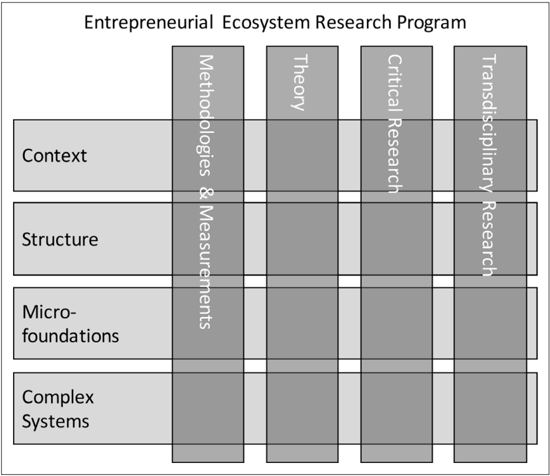
This paper reviews entrepreneurial ecosystem scholarship and argues the concept remains under-theorized, with the mechanisms governing ecosystem evolution not well understood. It synthesizes empirical causal mechanisms and proposes a transdisciplinary research program organized around context, structure, microfoundations, and complex systems.
Key findings
- The systematic review’s final sample contains 62 empirical articles; the initial search yielded 724 articles, reduced to an intermediate sample of 183, with 44 papers studying ecosystems at the city or regional level and 18 at the national level.
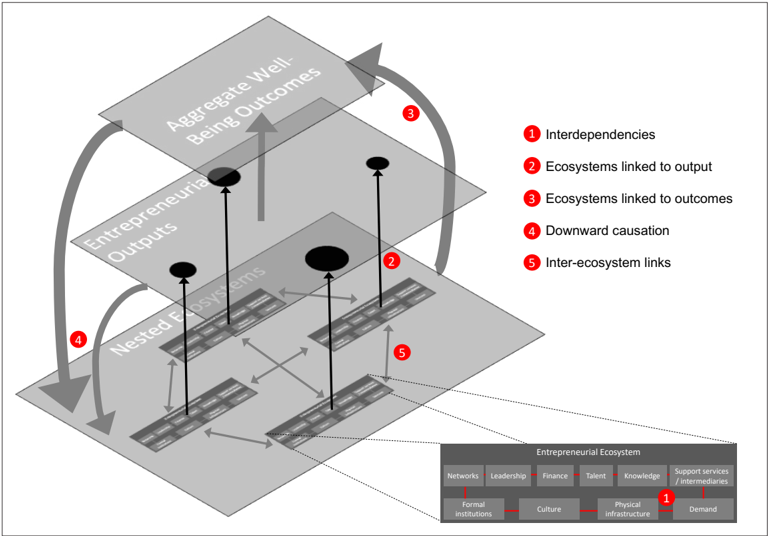
- The review identifies causal mechanisms linking ecosystem elements to outputs and outcomes: intra-layer interdependence among elements, upward causation from elements to outputs/outcomes, downward causation and path dependency/feedback, and inter-ecosystem links.
- Country-level studies link entrepreneurial ecosystems to economic growth and find mature ecosystems enable knowledge spillovers and more efficient resource allocation; regional evidence on whether ecosystems moderate the entrepreneurship–economic growth relationship is mixed, with Bruns et al. (2017) finding no moderating effect and Szerb et al. (2019) finding a positive moderating effect.
- The paper proposes a transdisciplinary entrepreneurial ecosystem research program with four research streams (context, structure, microfoundations, complex systems) and four cross-sectional themes (methodologies and measurements, theory, critical research, transdisciplinary research).
Methods
- Systematic literature review using Web of Science and Scopus, with topic searches for terms such as “entrep* ecosys*,” “startup ecosys*,” and “sys* of entrep*,” yielding an initial 724 articles.
- The review restricted sources to the top 25% Scimago-ranked journals in relevant business, management, economics, geography, and urban studies subareas, producing an intermediate sample of 183 articles; after in-depth reading and exclusions, 62 empirical articles remained.
- Analysis was guided by the Stam (2015) and Stam and Van de Ven (2019) framework to identify causal mechanisms: intra-layer causation, upward causation, downward causation/feedback, and inter-ecosystem links.
Limitations
- The paper states that ecosystem research is fragmented and heterogeneous, under-theorized, and that mechanisms governing ecosystem evolution are not well understood; much literature uses the ecosystem concept metaphorically without taking interdependence seriously.
- The paper states there is a lack of empirical evidence on path dependency and ecosystem boundaries, and that research is dominated by observational and case-study methods, making causality difficult to infer; it also warns of the ecological fallacy and notes that non-Gaussian distributions are often ignored.
- Evident from the methods: the review is limited to journal articles in top 25% journals, excluding book chapters, conference papers, and non-empirical work, and the final sample of 62 articles may narrow the evidence base.
Model-written summary of a shortened version of the paper’s full text (it is longer than we read). Check it against the paper before relying on it.
Integrity signals
Registry
Cites
Statistics
Figures
Verification
Claims the paper makes
31 Valid · 16 Not valid · 116 Not checked · 37 Own results and interpretations
The cited sources support only part of this claim — read each source’s verdict below.
In the paper
“There is also a subset of studies that focus on a singular innovation project within in a spatial setting, not looking at the aggregate preva -lence of entrepreneurship, nor at the interdependencies in the ecosystem at large (e.g., DiVito & Ingen- Housz, 2019).”
What the sources say
- Partly supportedcites DiVito & Ingen-Housz, 2019 matched to “From individual sustainability orientations to collective sustainability innovation and sustainable entrepreneurial ecosystems” (2021) sourceExperimental — accuracy not yet measured
The Methods section describes a single collaborative innovation project in Amsterdam and says the study does not aim to reveal relationships between variables, supporting the project-level and spatial characterization. But it names the broader ecosystem as a unit of analysis, and the Introduction explicitly says the study examines interdependencies among ecosystem actors. The claim that it does not look at those interdependencies is therefore unsupported. Page numbers are not available in our copy. (LLM, conf=0.88)
plain- Asserted: passes — The authors put it forward as true.
- Checkable: passes — It can be checked against evidence.
- Load-bearing: unclear — It is unclear whether the paper’s conclusions depend on it.
- Based: passes — The paper gives a reason why it holds.
- Partly supported
The cited sources support only part of this claim — read each source’s verdict below.
In the paper
“which are responsible for the bulk of new job creation in devel -oped economies, making it a crucial target for economic development policy ( Brown & Mason, 2017).”
What the sources say
- Partly supportedcites Brown & Mason, 2017 matched to “Looking inside the spiky bits: a critical review and conceptualisation of entrepreneurial ecosystems” (2017) sourceExperimental — accuracy not yet measured
Section 4.1.2, “Blockbuster entrepreneurship” (page unavailable), says that a tiny number of UK firms contribute disproportionately to job creation by high-growth firms. That supports their importance as job creators, but it does not establish that high-growth firms account for the bulk of all new jobs across developed economies. (LLM, conf=0.85)
plainstates a cause- Asserted: passes — The authors put it forward as true.
- Checkable: passes — It can be checked against evidence.
- Load-bearing: unclear — It is unclear whether the paper’s conclusions depend on it.
- Based: passes — The paper gives a reason why it holds.
- Rests on an assumption not shown here.
- Partly supported
Every source the paper cites for this claim was checked and supports it.
In the paper
“An example is the investment in physical infrastructure without supporting the underlying cultural and social support, which turned planned innovation hotspots into empty real estate (Pugh et al., 2018).”
What the sources say
- Supportedcites Pugh et al., 2018 matched to “From ‘Techniums’ to ‘emptiums’: the failure of a flagship innovation policy in Wales” (2018) source
The Discussion and Conclusion says Technium buildings had low occupancy and that firms received little on-site support beyond physical space. The passage labelled Table 4 about here describes a lack of softer support and local networks, with empty space ultimately leased out as the government became a landlord. Together, these support the citing sentence’s paraphrase. (LLM, conf=0.89)
plainstates a cause- Asserted: passes — The authors put it forward as true.
- Checkable: passes — It can be checked against evidence.
- Load-bearing: passes — The paper’s conclusions depend on it.
- Based: passes — The paper gives a reason why it holds.
- Supported
The cited sources support only part of this claim — read each source’s verdict below.
In the paper
“These co- evolutionary dynamics are the result of the interactions of individuals within eco -systems ( Johnson et al., 2019 ; Thompson et al., 2018).”
What the sources say
- Partly supportedcites Johnson et al., 2019 matched to “Entrepreneurial dynamism and the built environment in the evolution of university entrepreneurial ecosystems” (2019) sourceExperimental — accuracy not yet measured
Section 5.1 links the evolution of university-centered entrepreneurial ecosystems to agents’ behavior and their interconnected responses. The Conclusion adds that evolution depends on both those responses and the built environment; the claim broadens this finding to ecosystems generally and leaves out that additional factor. Page numbers are unavailable in our copy. (LLM, conf=0.83)
- Supportedcites Thompson et al., 2018 matched to “How entrepreneurial ecosystems take form: Evidence from social impact initiatives in Seattle” (2018) source
The Discussion (p. 27) states that a field-theory approach considers 'how individuals doing things together contributes to the particular features and dynamics of an ecosystem,' and the Introduction (p. 4) credits endogenous, bottom-up, time-patterned processes driven by micro social interaction, with interactions and shared meanings becoming 'common and mutually reinforcing' across the phase transition (pp. 4, 26). Our copy does not use the term 'co-evolutionary' (searches for it returned only semantic matches), but it substantively treats ecosystem dynamics as the product of actor interactions within the ecosystem, so the paraphrase is carried. The one narrowing worth noting is that the paper bounds this to the early moments of ecosystem formation in its Seattle social-impact setting and pairs interactions with shared meanings rather than interactions alone. (LLM, conf=0.82)
plainstates a cause- Asserted: passes — The authors put it forward as true.
- Checkable: passes — It can be checked against evidence.
- Load-bearing: unclear — It is unclear whether the paper’s conclusions depend on it.
- Based: passes — The paper gives a reason why it holds.
- Partly supported
Every source the paper cites for this claim was checked and supports it.
In the paper
“Ecosystem configurations can vary significantly and new policies/investments should develop support among underlying social and cultural attributes [53] Spigel (2017)”
What the sources say
- Supportedcites Spigel (2017) matched to “The Relational Organization of Entrepreneurial Ecosystems” (2017) source
Section 2.4 states that entrepreneurial ecosystems can have multiple possible configurations. Section 3.1 likewise describes different configurations and relationships among ecosystem attributes, supporting the claim that configurations vary. (LLM, conf=0.92)
plain- Asserted: passes — The authors put it forward as true.
- Checkable: passes — It can be checked against evidence.
- Load-bearing: unclear — It is unclear whether the paper’s conclusions depend on it.
- Based: passes — The paper gives a reason why it holds.
- Supported
81 more claims · 12 with their cited sources checked
Create a free account to see all 200 claims and to verify the 44 references still open.
- Probably not a substantial claim. 82
- It may state two separate claims as one. 52
Self-check
Percentages, sums and reported differences re-computed from the paper’s own numbers.
Each contradiction between two passages listed here was confirmed by an independent check.
Rated minor: it would not touch a result — a value no result rests on, a p-value that stays on the same side of the significance level, or a conflict that is clerical, resolved elsewhere in the paper, or outside its own findings.
In the paper
§ Microfoundations · p. 24
“We must be aware of the ecological fallacy (Robinson, 2009 )”
§ References · p. 47
“- Robinson, W. S. (1950). Ecological correlations and the behavior of individuals.”
Citations
Cites
The Theory of Economic Development
Schumpeter, J., & Backhaus, U. (2006) · The European Heritage in Economics and the Social Sciences · doi:10.1007/0-306-48082-4_3 · Cited by 22,506
Introductory Econometrics: A Modern Approach
Wooldridge, J. M. (1999) · Cited by 14,466
(1993) · Journal of the American Dietetic Association · doi:10.1016/0002-8223(93)92196-5 · Cited by 11,976
Teece, D. J. (1986) · Research Policy · doi:10.1016/0048-7333(86)90027-2 · Cited by 7,842 · cited 1×
“Untraded interdependencies include the complementarities between actors and resources, and information flows which do not entirely correspond to the flows of commodities (Richardson, 1972 ; Teece, 1986 , 1998; Tripsas, 1997).”
Competing Technologies, Increasing Returns, and Lock-In by Historical Events
Arthur, W. B. (1989) · The Economic Journal · doi:10.2307/2234208 · Cited by 7,489 · cited 1×
“The concept of path dependency goes back to the work by David (1988) and Arthur (1989) and “can be used to offer an understanding of why some optional developments are followed, or intention - ally chosen, over others […] path dependence conditions, but does not determine, a specific outcome”…”
Analyzing the Past to Prepare for the Future: Writing a Literature Review
Webster, J., & Watson, R. T. (2002) · MIS Quarterly · doi:10.2307/4132319 · Cited by 7,449 · cited 2×
“In the initial stage, we searched all databases from Web of Science and Scopus for a comprehensive overview of the literature (Frank & Hatak, 2014 ; Martín-Martín et al., 2018 ; Webster & Watson, 2002).”
Teece, D. (1993) · Research Policy · doi:10.1016/0048-7333(93)90063-n · Cited by 7,242
Clusters and the new economics of competition.
Porter, M. E. (1998) · PubMed · Cited by 5,679
Clusters and the New Economics of Competition
Milošević, D. (2014) · Harvard business review · Cited by 4,854
Beyond Markets and States: Polycentric Governance of Complex Economic Systems
Ostrom, E. (2010) · American Economic Review · doi:10.1257/aer.100.3.641 · Cited by 4,529 · cited 2×
“In combination with insights from polynuclear governance (Ostrom, 2010) and multilevel governance (Bache et al.”
Research works printed but not linked: 5
- David, P. A. (1988). Path- dependence: Putting the past into the future of economics . Institute for Mathematical Studies in the Social Sciences Technical Report No. 533: Stanford University Press.
- World Economic Forum. (2014). Entrepreneurial ecosystems around the globe and early- stage company growth dynamics . World Economic Forum.
- Krugman, P. (1991). Geography and trade . MIT Press.
- Marshall, A. (1920). Principles of Economics . (Rev ed.). Macmillan.
- Startup Genome. (2020). The Global Startup Ecosystem Report GSER 2020: The New Normal for the Global Startup Economy and the Impact of COVID-19 . Startup Genome.
Cited by
Building sustainable entrepreneurial ecosystems: A holistic approach
Theodoraki, C., Dana, L.-P., & Caputo, A. (2022) · Journal of Business Research · doi:10.1016/j.jbusres.2021.11.005 · Cited by 297
Measure Twice, Cut Once: Entrepreneurial Ecosystem Metrics
Leendertse, J., Schrijvers, M., & Stam, E. (2022) · Research Policy · doi:10.1016/j.respol.2021.104336 · Cited by 282
Self-citationFocusing the ecosystem lens on innovation studies
Baldwin, C. Y., Bogers, M. L. A. M., Kapoor, R., & West, J. (2024) · Research Policy · doi:10.1016/j.respol.2023.104949 · Cited by 170
Digital infrastructure and entrepreneurial action-formation: A multilevel study
Schade, P., & Schuhmacher, M. C. (2022) · Journal of Business Venturing · doi:10.1016/j.jbusvent.2022.106232 · Cited by 160
Unpacking the process of resource allocation within an entrepreneurial ecosystem
Shi, X., & Shi, Y. (2021) · Research Policy · doi:10.1016/j.respol.2021.104378 · Cited by 142
Spatial features of entrepreneurial ecosystems
Fischer, B., Meissner, D., Vonortas, N., & Guerrero, M. (2022) · Journal of Business Research · doi:10.1016/j.jbusres.2022.04.018 · Cited by 106
Hernández-Chea, R., Mahdad, M., Minh, T. T., & Hjortsø, C. N. (2021) · Technovation · doi:10.1016/j.technovation.2021.102332 · Cited by 104
Entrepreneurial Ecosystem Mechanisms
Wurth, B., Stam, E., & Spigel, B. (2023) · Foundations and Trends® in Entrepreneurship · doi:10.1561/0300000089 · Cited by 168
Self-citationChaudhuri, R., Chatterjee, S., Vrontis, D., & Vicentini, F. (2022) · Journal of Intellectual Capital · doi:10.1108/jic-07-2021-0177 · Cited by 130
Crafting and Assessing Design Science Research for Entrepreneurship
Dimov, D. P., MAULA, M. V. J., & Romme, A. G. L. (2022) · Entrepreneurship Theory and Practice · doi:10.1177/10422587221128271 · Cited by 119
“…et al., 2020; Jääskeläinen et al., 2007), corporate venture capital programs (Burgelman et al., 2021; Hill et al., 2009), accelerator programs (Cohen, Fehder et al., 2019; Cohen, Bingham et al., 2019), and entrepreneurial ecosystems (O’Shea et al., 2021; Talmar et al., 2020; Wurth et al., 2021).”
BackgroundHannigan, T. R., Briggs, A. R., Valadao, R., Seidel, M.-D. L., & Jennings, P. D. (2022) · Research Policy · doi:10.1016/j.respol.2021.104315 · Cited by 95
Chaudhary, S., Kaur, P., Alofaysan, H., Halberstadt, J., & Dhir, A. (2023) · Business Strategy and the Environment · doi:10.1002/bse.3466 · Cited by 86
“Similarly, the entrepreneurial ecosystem-specific focus is on entrepreneurs and productive entrepreneurship (Alvedalen & Boschma, 2017; Theodoraki et al., 2022; Wurth et al., 2021).”
BackgroundRegional entrepreneurial ecosystems: learning from forest ecosystems
O'Connor, A. J., & Audretsch, D. B. (2022) · Small Business Economics · doi:10.1007/s11187-022-00623-8 · Cited by 127
“For instance, the models of an EE have prioritised the new valueadding ventures and productive entrepreneurship as the objective of an EE (see Stam, 2015; Wurth et al., 2021) or have incorporated performance measures that consider the intensity and density of entrepreneurial activity (Spigel & Harrison, 2018; Stangler…”
BackgroundDigital technology and national entrepreneurship: An ecosystem perspective
Zhang, J., van Gorp, D. M., & Kievit, H. (2022) · The Journal of Technology Transfer · doi:10.1007/s10961-022-09934-0 · Cited by 118
“Besides, most studies on this topic have been largely theoretical or case-based because of the novelty of the concept of entrepreneurial ecosystems (Wurth et al. 2021 ).”
BackgroundResultInfluentialFiguring it out: configurations of high-performing entrepreneurial ecosystems in Europe
Schrijvers, M., Stam, E., & Bosma, N. (2024) · Regional Studies · doi:10.1080/00343404.2023.2226727 · Cited by 81
“This framework integrates prior studies on the geography of entrepreneurship and economic growth and provides a complex systems approach to understanding the entrepreneurial economy (Stam & Van de Ven, 2021; Wurth et al., 2022).”
BackgroundSelf-citationKnowledge Spillovers, Entrepreneurial Ecosystems and the Geography of High Growth Firms
Fotopoulos, G. (2022) · Entrepreneurship Theory and Practice · doi:10.1177/10422587221111732 · Cited by 98
“Even more importantly, it has been recently argued that emerging empirical evidence suggests that different EE configurations lead to different entrepreneurial outcomes (Wurth et al., 2022).”
BackgroundExamining the cohesiveness and nestedness entrepreneurial ecosystems: evidence from British FinTechs
Spigel, B. (2022) · Small Business Economics · doi:10.1007/s11187-021-00589-z · Cited by 80
“Building strong entrepreneurial ecosystems — the localized actors and factors that support highgrowth entrepreneurship — has emerged as a popular regional economic development strategy (Spigel, 2020; Wurth et al., 2021).”
BackgroundSelf-citationWhat is going on in entrepreneurship research? A bibliometric and SNA analysis
Lillo, F. G., Seva‐Larrosa, P., & Sánchez‐García, E. (2023) · Journal of Business Research · doi:10.1016/j.jbusres.2022.113624 · Cited by 106
Entrepreneurship and geography—some thoughts about a complex relationship
Sternberg, R. (2022) · The Annals of Regional Science · doi:10.1007/s00168-021-01091-w · Cited by 69
“) However, there are still many theoretical deficits (and even more empirical ones) regarding the EES concept (Alvedalen and Boschma 2017; Spigel 2018; Stam 2015; Wurth et al. 2021).”
BackgroundDaniel, L. J., Scheepers, M. D. V., Miles, M. P., & de Klerk, S. (2022) · Entrepreneurship and Regional Development · doi:10.1080/08985626.2022.2083691 · Cited by 91
Molla, A., & Biru, A. G. (2022) · Technological Forecasting and Social Change · doi:10.1016/j.techfore.2022.122123 · Cited by 85
Effective policy mixes in entrepreneurial ecosystems: a configurational analysis in China
Wang, H., Zhao, T., Cooper, S. Y., Wang, S., Harrison, R., & Yang, Z. (2022) · Small Business Economics · doi:10.1007/s11187-022-00658-x · Cited by 84
“Second, by introducing a new concept of EE policy mixes and developing this both theoretically and empirically, this study brings fine-grained insights to the current debate on the role of policy in EEs (Colombo et al., 2019; Jolley & Pittaway, 2019; Spigel & Harrison, 2018; Wurth et al., 2021).”
BackgroundMethodInfluentialLongva, K. K. (2021) · International Journal of Entrepreneurial Behaviour & Research · doi:10.1108/ijebr-09-2020-0661 · Cited by 83
Harima, A., Harima, J., & Freiling, J. (2024) · Entrepreneurship Theory and Practice · doi:10.1177/10422587241241824 · Cited by 100
“First, this study responds to the recent call for empirical studies on spillover effects between regional entrepreneurial ecosystems (Wurth et al., 2022).”
InfluentialZhao, X., Xu, Y., Vasa, L., & Shahzad, U. (2023) · Technological Forecasting and Social Change · doi:10.1016/j.techfore.2023.122526 · Cited by 70
The role of finance in the literature of entrepreneurial ecosystems
Frimanslund, T., Kwiatkowski, G., & Oklevik, O. (2022) · European Planning Studies · doi:10.1080/09654313.2022.2055962 · Cited by 79
“Wurth, Stam, and Spigel (2021) recommend seeing ecosystems as their context, structure, micro-foundations or as complex systems.”
BackgroundMethodRegulating entrepreneurship quality and quantity
Audretsch, D. B., Belitski, M., Chowdhury, F., & Desai, S. (2023) · Research Policy · doi:10.1016/j.respol.2023.104942 · Cited by 84
The impact of entrepreneurship research on other academic fields
Thurik, R., Audretsch, D. B., Block, J., Burke, A., Carree, M., Dejardin, M., Rietveld, C. A., Sanders, M. W. J. L., Stephan, U., & Wiklund, J. (2023) · Small Business Economics · doi:10.1007/s11187-023-00781-3 · Cited by 99
“The influential entrepreneurial ecosystem literature is one of the best examples of the crucial role of entrepreneurship in policy thinking both from a policy and scholarly perspective (Wurth et al., 2022).”
Advancing a Contextualized, Community-Centric Understanding of Social Entrepreneurial Ecosystems
de Bruin, A., Roy, M. J., Grant, S., & Lewis, K. V. (2022) · Business & Society · doi:10.1177/00076503221121820 · Cited by 76
Thai, Q. H., Khương, M. N., & Do, T. T. (2023) · SAGE Open · doi:10.1177/21582440231153060 · Cited by 90
“(continued) Authors Journal Research approach Country of study Industries Level of analysis Research method Time-frame Iacobucci and Perugini (2021) Entrepreneurship & Regional Development Italy NS Local/Regional/ Sub-national OLS Regression Crosssectional Lafuente et al. (2021) International Journal of Entrepreneuria…”
BackgroundMethodResultInfluentialJuma, N., Olabisi, J., & Griffin‐EL, E. (2023) · Strategic Entrepreneurship Journal · doi:10.1002/sej.1462 · Cited by 56
Kaushik, V., Tewari, S., Sahasranamam, S., & Hota, P. K. (2023) · Technological Forecasting and Social Change · doi:10.1016/j.techfore.2023.122516 · Cited by 76
Entrepreneurial Ecosystems and Economic Development Policy
Qian, H., & Ács, Z. J. (2022) · Economic Development Quarterly · doi:10.1177/08912424221142853 · Cited by 77
Connecting entrepreneurial ecosystem and innovation. Grasping at straws or hitting a home run?
Chaudhary, S., Kaur, P., Ferraris, A., Bresciani, S., & Dhir, A. (2024) · Technovation · doi:10.1016/j.technovation.2023.102942 · Cited by 52
Xu, L., Yang, S., Liu, Y., Newbert, S. L., & Boal, K. B. (2023) · Academy of Management Journal · doi:10.5465/amj.2021.0791 · Cited by 58
Defining networks in entrepreneurial ecosystems: the openness of ecosystems
Prokop, D., & Thompson, P. (2022) · Small Business Economics · doi:10.1007/s11187-022-00710-w · Cited by 73
“It is proposed here that a university entrepreneurial ecosystem is a subsystem of a wider entrepreneurial ecosystem which embraces a diverse set of firms (Spigel & Harrison, 2018), pointing to a nested character of eco-systems (Lô & Theodoraki, 2021; Wurth et al., 2021).”
BackgroundRoundy, P. T. (2022) · Journal of Ethics in Entrepreneurship and Technology · doi:10.1108/jeet-07-2022-0011 · Cited by 89
Determinants of returnees’ entrepreneurship in rural marginal China
Wang, Y. J., Jiang, Y., Geng, B., Wu, B., & Liao, L. (2022) · Journal of Rural Studies · doi:10.1016/j.jrurstud.2022.07.014 · Cited by 69
Do entrepreneurial ecosystems foster sustainable development?
Audretsch, D. B., Rocha, H., Aggarwal, S., & Bramanti, A. (2024) · International Entrepreneurship and Management Journal · doi:10.1007/s11365-023-00916-8 · Cited by 48
“The next section discusses these results within an integrated framework based on the suggestions for future research of the most recent review articles (Wurth et al., 2022; Volkmann et al., 2021; Theodoraki et al., 2022).”
InfluentialGuerrero, M., & Siegel, D. S. (2024) · Research Policy · doi:10.1016/j.respol.2024.104984 · Cited by 66
The dynamics of entrepreneurial ecosystems: an empirical investigation
Buratti, M., Cantner, U., Cunningham, J. A., Lehmann, E. E., & Menter, M. (2022) · R and D Management · doi:10.1111/radm.12565 · Cited by 64
Verma, P., Kumar, V., Yalçın, H., & Daim, T. U. (2023) · Technology in Society · doi:10.1016/j.techsoc.2023.102355 · Cited by 55
Narratives in entrepreneurial ecosystems: drivers of effectuation versus causation
Hubner, S., Most, F., Wirtz, J., & Auer, C. (2021) · Small Business Economics · doi:10.1007/s11187-021-00531-3 · Cited by 62
“This stream of research on ecosystems, however, focused on analyzing the characteristics, development, economic output, and regional outcomes of ecosystems (Wurth et al., 2021).”
BackgroundEntrepreneurial Ecosystems Policy Formulation: A Conceptual Framework
Candeias, J. C., & Sarkar, S. (2023) · Academy of Management Perspectives · doi:10.5465/amp.2022.0047 · Cited by 56
OR for entrepreneurial ecosystems: A problem-oriented review and agenda
Carayannis, E. G., Grigoroudis, E., & Wurth, B. (2021) · European Journal of Operational Research · doi:10.1016/j.ejor.2021.10.030 · Cited by 52
Self-citationThe dawn of geographically unbounded entrepreneurial ecosystems
Audretsch, D. B., Fiedler, A., Fath, B. P., & Verreynne, M. (2024) · Journal of Business Venturing Insights · doi:10.1016/j.jbvi.2024.e00487 · Cited by 67
Rocha, H. O., & Audretsch, D. B. (2022) · The Journal of Technology Transfer · doi:10.1007/s10961-022-09920-6 · Cited by 62
“This section defines the concepts of E.E., R.C., and I.D. based on their historical evolution systematically analyzed in the literature (Wurth et al., 2021; Cao & Shi, 2020; Stam & Van de Ven, 2019; Audretsch et al., 2019; Rocha et al., 2013, 2013a).”
InfluentialStudent entrepreneurship ecosystems at Australian higher education institutions
Maritz, A., Nguyen, Q. A., & Ivanov, S. (2022) · Journal of Small Business and Enterprise Development · doi:10.1108/jsbed-11-2021-0466 · Cited by 75
Unpacking the intellectual structure of ecosystem research in innovation studies
Shi, X., Liang, X., & Luo, Y. (2023) · Research Policy · doi:10.1016/j.respol.2023.104783 · Cited by 64
Entrepreneurial ecosystems: Multiple domains, dimensions and relationships
Stephens, S., McLaughlin, C., Ryan, L., Catena, M., & Bonner, A. (2022) · Journal of Business Venturing Insights · doi:10.1016/j.jbvi.2022.e00344 · Cited by 64
Entrepreneurial ecosystems and regional persistence of high growth firms: A ‘broken clock’ critique
Coad, A., & Srhoj, S. (2023) · Research Policy · doi:10.1016/j.respol.2023.104762 · Cited by 68
Network-based principles of entrepreneurial ecosystems: a case study of a start-up network
Ancona, A., Cinelli, M., Ferraro, G., & Iovanella, A. (2023) · Small Business Economics · doi:10.1007/s11187-023-00738-6 · Cited by 49
“Nevertheless, the investigation of the structure of entrepreneurial ecosystems is an open issue in the current literature, as highlighted by Wurth et al. (2022) in their proposal for an “Entrepreneurial Ecosystem Research Program.””
Siqueira, E. H. S., Fischer, B. B., Bin, A., & Kickul, J. (2023) · Technovation · doi:10.1016/j.technovation.2023.102820 · Cited by 40
Spatialities of entrepreneurial ecosystems
Schäfer, S. (2021) · Geography Compass · doi:10.1111/gec3.12591 · Cited by 72
How to erase gender differences in entrepreneurial success? Look at the ecosystem
Welsh, D. H. B., Kaciak, E., Fadairo, M., Doshi, V., & Lanchimba, C. (2022) · Journal of Business Research · doi:10.1016/j.jbusres.2022.113320 · Cited by 50
Circular entrepreneurial ecosystems: a Quintuple Helix Model approach
Borrero, J. D., & Yousafzai, S. (2024) · Management Decision · doi:10.1108/md-08-2023-1361 · Cited by 54
Morris, A. K., Fiedler, A., & Audretsch, D. B. (2023) · The Journal of Technology Transfer · doi:10.1007/s10961-023-10056-4 · Cited by 47
“Despite the lack of consensus in what defines an EE, there is strong consensus in the EE literature regarding what distinguishes an EE from other forms of clusters or stake-holder groupings (Stam & Spigel, 2017; Wurth et al., 2022).”
Ecosystem pipelines: Collective action in entrepreneurial ecosystems
Hruskova, M. (2024) · International Small Business Journal Researching Entrepreneurship · doi:10.1177/02662426231178381 · Cited by 49
“Entrepreneurial ecosystems are complex and dynamic socioeconomic structures that comprise heterogeneous agents who are embedded in the broader institutional environment (Han et al., 2021; Neumeyer et al., 2019; Wurth et al., 2022).”
BackgroundInfluentialAgainst all odds – migrant entrepreneurs in entrepreneurial ecosystems with constraints
David, A., & Terstriep, J. (2024) · Journal of Enterprising Communities People and Places in the Global Economy · doi:10.1108/jec-03-2024-0052 · Cited by 64
Zhang, M., & Li, X. (2025) · Journal of Business and Industrial Marketing · doi:10.1108/jbim-04-2024-0226 · Cited by 46
Towards the regional aspects of institutional trust and entrepreneurial ecosystems
Khlystova, O., Kalyuzhnova, Y., & Belitski, M. (2022) · International Journal of Entrepreneurial Behaviour & Research · doi:10.1108/ijebr-02-2022-0108 · Cited by 54
Entrepreneurial Ecosystems and Entrepreneurial Initiative: Building a Multi-Country Taxonomy
Pita, M., Costa, J., & Moreira, A. C. (2021) · Sustainability · doi:10.3390/su13074065 · Cited by 46
“Inspired by the academic gap, this paper empirically tests a taxonomy aiming to provide an overview of EEs differences and similarities between countries [8,16] following context-specificities [17].”
MethodInfluentialTo Be or Not to Be: The Entrepreneur in Neo-Schumpeterian Growth Theory
Henrekson, M., Johansson, D., & Karlsson, J. (2023) · Entrepreneurship Theory and Practice · doi:10.1177/10422587221141679 · Cited by 56
Beyond local boundaries: Unraveling the spatiality of entrepreneurial ecosystems
Schäfer, S., Fischer, B. B., Schaeffer, P. R., & Balestrin, A. (2024) · Journal of Business Venturing Insights · doi:10.1016/j.jbvi.2024.e00478 · Cited by 59
A meta-analysis of entrepreneurial ecosystem elements and entrepreneurial activity
Queissner, M., Stolz, L., & Weiß, M. (2024) · Small Business Economics · doi:10.1007/s11187-024-00953-9 · Cited by 67
“…a new lens for explaining how entrepreneurial activity (EA) differs across regions (Autio et al., 2014; Audretsch, 2015; O’Connor et al., 2018; Wurth et al., 2021; Fischer et al., 2022), a question that has long been investigated by researchers from multiple disciplines (Fer-nandes &…”
InfluentialSpace–time analysis of entrepreneurial ecosystems
Perugini, F. (2022) · The Journal of Technology Transfer · doi:10.1007/s10961-021-09906-w · Cited by 53
Corporate accelerators: design and startup performance
Seitz, N., Lehmann, E. E., & Haslanger, P. (2023) · Small Business Economics · doi:10.1007/s11187-023-00817-8 · Cited by 56
“Previous research has stressed the importance of geography and the institutional context for explaining entrepreneurship growth (e.g., Wright & Westhead, 2019; Rice & Noyes, 2021; Wurth et al., 2022).”
The future of entrepreneurial ecosystems research: Toward a policy-oriented research agenda
Hess, S., Wurth, B., Stam, E., Giones, F., Fini, R., Cavallo, A., Wahl, A., Bosma, N. S., Theodoraki, C., Chabaud, D., et al. (2025) · Journal of Business Venturing Insights · doi:10.1016/j.jbvi.2025.e00538 · Cited by 59
Self-citationStart-ups in entrepreneurial ecosystems: the role of relational capacity
Gueguen, G., Delanoë‐Gueguen, S., & Lechner, C. (2021) · Management Decision · doi:10.1108/md-06-2020-0692 · Cited by 44
“Analysis of hyperlinks and digital methods Ecosystem research, including entrepreneurial ecosystems research, presents particular challenges that might require scholars to go beyond traditional methods of empirical data collection (Adner, 2017; Brown and Mason, 2017; Wurth et al., 2021).”
BackgroundResultInfluentialHamid, H. A., Pidduck, R. J., Newman, A., Ayob, A. H., & Sidek, F. (2023) · Journal of Business Research · doi:10.1016/j.jbusres.2023.114007 · Cited by 36
Foundations of entrepreneurial ecosystems configurations
Fischer, B. B., Alves, A. C., Vonortas, N. S., & Brown, R. (2026) · The Journal of Technology Transfer · doi:10.1007/s10961-024-10147-w · Cited by 32
“Although early work on entrepreneurial ecosystems has presented an agnostic attitude towards industries (Stam & Spigel, 2018), recent contributions have increasingly recognized the relevant role of economic specializations in EEs (Spigel, 2022; Wurth et al., 2021).”
Aman, R., Elo, M., Ahokangas, P., & Zhang, X. (2024) · International Journal of Entrepreneurial Behaviour & Research · doi:10.1108/ijebr-04-2023-0425 · Cited by 51
“Thus, extant research on EE focuses on its economic and technological impacts, with limited research on its societal dimensions and impacts (Audretsch et al. , 2019; Wurth et al. , 2022) beyond monetary outcomes (i.e. social boundaries between ecosystem actors).”
BackgroundRoundy, P. T., & Asllani, A. A. (2024) · Industrial Management & Data Systems · doi:10.1108/imds-08-2023-0551 · Cited by 50
Blockchain and vulnerable entrepreneurial ecosystems
Rawhouser, H. N., Vismara, S., & Kshetri, N. (2023) · Entrepreneurship and Regional Development · doi:10.1080/08985626.2022.2162979 · Cited by 40
“(Wurth, Stam, and Spigel 2021).”
Khlystova, O., & Kalyuzhnova, Y. (2023) · The Journal of Technology Transfer · doi:10.1007/s10961-023-10020-2 · Cited by 59
“In recent studies, productive entrepreneurship is also proxied and examined through the high-growth firms available in a region (Bos & Stam, 2014; Stam & Bosma, 2015; Wurth et al., 2022).”
BackgroundSottini, A., Ciambotti, G., & Littlewood, D. (2022) · International Small Business Journal · doi:10.1177/02662426211059778 · Cited by 27
“It also contrasts with existing work in this area which has focussed more on the one-to-one collaborations of those venturing in the BoP (Amoako and Lyon, 2014; De Bruin et al., 2017; Wurth et al., 2021).”
BackgroundMethodResultInfluentialMarquardt, L., & Harima, A. (2024) · Journal of Business Research · doi:10.1016/j.jbusres.2024.114762 · Cited by 48
Johnson, D. A., Gianiodis, P. T., Harrison, R., & Bock, A. J. (2022) · R and D Management · doi:10.1111/radm.12535 · Cited by 50
Infrastructure required, skill needed: Digital entrepreneurship in rural and urban areas
Bergholz, C., Füner, L., Lubczyk, M., Sternberg, R., & Bersch, J. (2024) · Journal of Business Venturing Insights · doi:10.1016/j.jbvi.2024.e00488 · Cited by 51
Multiple entrepreneurial ecosystems? Worker cooperative development in Toronto and Montréal
Spicer, J. S., & Zhong, M. (2022) · Environment and Planning A Economy and Space · doi:10.1177/0308518x211063216 · Cited by 35
“Despite the recent application of the EE concept to social entrepreneurial initiatives (Harms and Groen, 2017; Thompson et al., 2018; Wurth et al., 2021), such activities are often treated as involving something other than productive enterprise; these studies also still typically presume that speci…”
Williams, T. A., & Fathallah, R. (2023) · Journal of Business Venturing · doi:10.1016/j.jbusvent.2023.106369 · Cited by 32
Fuentes, J. N., Schmutzler, J., & Vargas, A. M. (2024) · International Journal of Innovation Studies · doi:10.1016/j.ijis.2024.08.001 · Cited by 46
Roundy, P. T., & Evans, W. R. (2023) · Journal of Business Venturing Insights · doi:10.1016/j.jbvi.2023.e00445 · Cited by 37
Comprehensive and multifaceted perspectives on sustainability, urban studies, and entrepreneurship
Berger, E. S. C., & Blanka, C. (2023) · Small Business Economics · doi:10.1007/s11187-023-00762-6 · Cited by 34
“Entrepreneurial ecosystems can help explain the support activities of interconnected actors that foster entrepreneurial activity in a region (Kuckertz et al., 2020; Wurth et al., 2022).”
Entrepreneurship in the Long-Run: Empirical Evidence and Historical Mechanisms
Fritsch, M. J., & Wyrwich, M. (2023) · Foundations and Trends® in Entrepreneurship · doi:10.1561/0300000100 · Cited by 36
Vicentin, D. C., de Moraes, G. H. S. M., Fischer, B. B., Campello, B. S. C., do Prado, N. B., & Anholon, R. (2024) · Journal of Cleaner Production · doi:10.1016/j.jclepro.2024.142821 · Cited by 38
Poček, J. (2022) · European Planning Studies · doi:10.1080/09654313.2022.2043831 · Cited by 42
“The concept of interactions is crucial also to understand whether there is something that distinguishes the entrepreneurship ecosystem concept from more established theories coming from entrepreneurship and innovation studies (Wurth, Stam, and Spigel 2021).”
BackgroundJha, V. K., & Pande, A. S. (2024) · Journal of Cleaner Production · doi:10.1016/j.jclepro.2024.140849 · Cited by 43
Opening entrepreneurial ecosystem black boxes
Stam, E., Theodoraki, C., Bosma, N. S., Chabaud, D., & Guéneau, G. (2025) · Small Business Economics · doi:10.1007/s11187-025-01037-y · Cited by 40
“…our understanding and policies for the development of entrepreneurial ecosystems, we need both quantitative and qualitative research and research at macro, meso, and micro levels including their nested nature (Audretsch et al., 2019; Brown & Mason 2017; Cavallo et al., 2019; Wurth et al., 2022).”
InfluentialSelf-citationNylund, P. A., Ferràs, X., Pareras, L., & Brem, A. (2022) · Journal of Business Research · doi:10.1016/j.jbusres.2022.05.071 · Cited by 36
Digital entrepreneurship ecosystems: Then vs. now-a future perspectives
Miah, M. T., Aiupova, N. B., Erdei-Gally, S., & Fekete‐Farkas, M. (2025) · Digital Business · doi:10.1016/j.digbus.2025.100110 · Cited by 56
Inside out: The interplay between institutions and digital technologies for SMEs performance
Urbano, D., Aparicio, S., Scott, S. A., & Martinez-Moya, D. (2023) · Entrepreneurship and Regional Development · doi:10.1080/08985626.2023.2208555 · Cited by 37
Owen, R., & Vedanthachari, L. N. (2022) · IEEE Transactions on Engineering Management · doi:10.1109/tem.2022.3153319 · Cited by 38
“Recent studies demonstrate the need to understand the operation of entrepreneurial ecosystems [6] and the catalytic roles of universities within these [7], [8].”
BackgroundMoonshots and the New Industrial Policy: Questioning the Mission Economy
Henrekson, M., Sandström, C. G., & Stenkula, M. (2024) · International studies in entrepreneurship · doi:10.1007/978-3-031-49196-2 · Cited by 49
Audretsch, D. B., Khurana, I., Dutta, D. K., & Tamvada, J. P. (2024) · The Journal of Technology Transfer · doi:10.1007/s10961-024-10090-w · Cited by 43
“By definition, an Entrepreneurial Ecosystem (EE), as a complex adaptive system (Haarhaus et al., 2020; Roundy et al., 2018; Wurth et al., 2022), accords primacy to the relationship between the entrepreneur and ecosystem stakeholders (Brown & Mason, 2017) and is therefore committed to its…”
Industrial ecosystems: A systematic review, framework and research agenda
Burström, T., Lahti, T., Parida, V., & Wincent, J. (2024) · Technological Forecasting and Social Change · doi:10.1016/j.techfore.2024.123656 · Cited by 39
“Consistent with prior research (e.g., Burstr ¨ om et al., 2022; Wurth et al., 2022; Madanaguli et al., 2023), we employed a narrative approach in content analysis.”
MethodHumility in social entrepreneurs and its implications for social impact entrepreneurial ecosystems
Roundy, P. T., & Lyons, T. S. (2021) · Journal of Business Venturing Insights · doi:10.1016/j.jbvi.2021.e00296 · Cited by 33
Guerrero, M., Siegel, D. S., Terjesen, S. A., Feldman, M. P., & Lockett, A. (2024) · Academy of Management Perspectives · doi:10.5465/amp.2024.0282 · Cited by 34
Towards an Ecosystem of Hospitality: The Dynamic Future of Destinations
Philipp, J., Thees, H., Olbrich, N., & Pechlaner, H. (2022) · Sustainability · doi:10.3390/su14020821 · Cited by 40
“[59], for ecosystem governance, or Cavallo et al.”
BackgroundLafuente, E., Ubieta, S. A., Leiva, J. C., & Mora-Esquivel, R. (2021) · International Journal of Entrepreneurial Behaviour & Research · doi:10.1108/ijebr-06-2020-0425 · Cited by 35
Metadata
- Authors
- Wurth, B., Stam, E., & Spigel, B.
- Affiliations
- University of Strathclyde (GB)
- Utrecht University (NL)
- University of Edinburgh (GB)
- Corresponding author
- Wurth, Bernd
- Venue
- Entrepreneurship Theory and Practice
- Publisher
- SAGE Publications
- Published
- 2021-03-22
- Volume
- 46
- Issue
- 3
- Pages
- 729-778
- ISSN
- 1042-2587 (ISSN-L)
- 1540-6520
- OpenAlex
- W3128170268
- Cited by
- 789
- References
- 238
- Citations by year
- 2026: 181 · 2025: 190 · 2024: 159 · 2023: 132 · 2022: 92 · 2021: 35
- FWCI
- 89.59
- Type
- journal article
- Language
- en
- Open access
- hybrid
- doi.org
- Locations
- Entrepreneurship Theory and Practice (publishedVersion, cc-by)
- ENLIGHTEN (Jurnal Bimbingan dan Konseling Islam) (acceptedVersion, cc-by-sa)
- Strathprints: The University of Strathclyde institutional repository (University of Strathclyde) (submittedVersion)
- RePEc: Research Papers in Economics (submittedVersion)
- Utrecht University Repository (Utrecht University) (submittedVersion, other-oa)
- Edinburgh Research Explorer (University of Edinburgh) (submittedVersion, cc-by)
- Funders
- Universiteit Utrecht
- Topics
- Social Sciences › Business, Management and Accounting › Management of Technology and Innovation › Entrepreneurship Studies and Influences
- Social Sciences › Business, Management and Accounting › Management of Technology and Innovation › University-Industry-Government Innovation Models
- Social Sciences › Business, Management and Accounting › Strategy and Management › Innovation and Knowledge Management
- Keywords
- entrepreneurial ecosystems, ecosystem evolution, causal mechanisms, transdisciplinary research, entrepreneurship research agenda, ecosystem theory
About these checks
Registry, retraction, Cites and statistics results are computed, not judged, with one exception: a printed reference that no index lists is read once by a model before it counts as a citation error. Claims are extracted by a model and kept only when their quote appears verbatim in the text; each cited source is then checked, with a model’s help, for whether it says what the claim relies on. Those verdicts can be wrong — read the claim’s quote and the cited source before relying on one.
The claim verdicts this report counts are experimental: their accuracy is not yet measured.
A language model drew the claims from the paper on 2026-10-29, under version 3 of the claim definition (model deepseek-v4.1-flash, prompt extract-v3).
A second model labelled each claim on 2026-10-29 (model jev-1.13-20260917, definition revision gold-guideline-v0.2).
Cited sources are checked with a language model’s help (gpt-6-sol and qwen3.8-omni-flash).
Statistics and arithmetic are recomputed, not judged.
Confidence bands are shown only for fields calibrated on our annotated test set. None is calibrated yet, so no band is shown.
What counts as a claim ›How we measure confidence ›How we check this ›
Are you an author, or do you see a problem with this page? Request a review
Data sources
Bibliographic data: Semantic Scholar, OpenAlex, Crossref.
Contains information from the Semantic Scholar Academic Graph Datasets, made available under the ODC Attribution License (ODC-BY 1.0).
Semantic Scholar’s data is described in: Kinney, R., et al. (2023). The Semantic Scholar Open Data Platform. arXiv:2301.10140.
