

Do ASD and ADHD Have Distinct Executive Function Deficits? A Systematic Review and Meta-Analysis of Direct Comparison Studies
Open accessThe DOI matches its Crossref record; 46 of the 46 references it cites were found in a registry or an index; 7 of the 14 sources its claims cite were checked for support.
Abstract
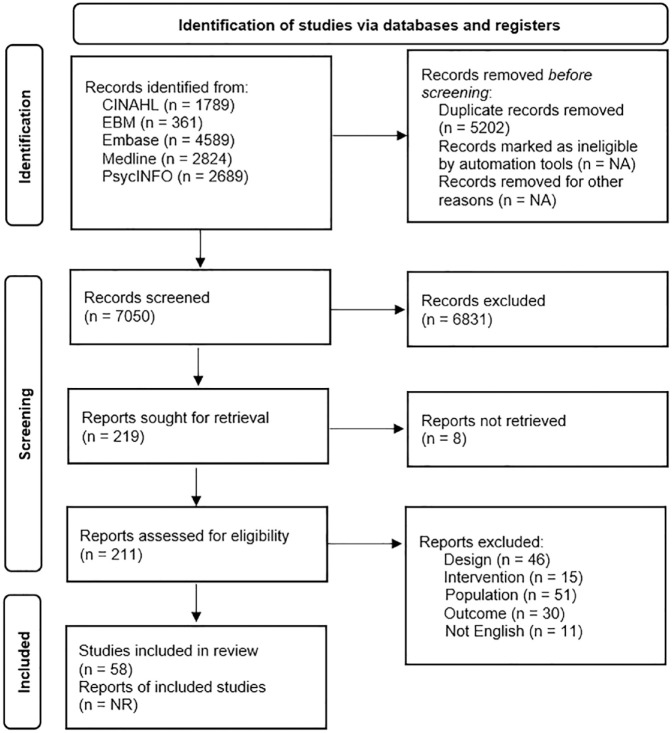
OBJECTIVE: To evaluate if children and adolescents with a diagnosis of ASD or ADHD have distinct executive function (EF) profiles. METHODS: Peer-reviewed articles comparing ASD, ADHD, and typically developing individuals under 19 years of age were identified. The domains evaluated were: working memory, response inhibition, planning, cognitive flexibility, attention, processing speed, and visuospatial abilities. RESULTS: Fifty-eight articles met inclusion criteria. Analyses were performed on 45 performance metrics from 24 individual tasks. No differences in EF were found between individuals diagnosed with ASD and ADHD. Individuals diagnosed with ASD and ADHD exhibited worse performance in attention, flexibility, visuospatial abilities, working memory, processing speed, and response inhibition than typically developing individuals. Groups did not differ in planning abilities. CONCLUSION: Children and adolescents with ASD and ADHD have similar EF profiles. Further research is needed to determine if comorbidity accounts for the commonality in executive dysfunction between each disorder.
Overview
CoChat Summary
TL;DR
This systematic review and meta-analysis directly compared executive function (EF) in children and adolescents with ASD versus ADHD and found no evidence for distinct EF profiles between the two diagnoses. Both groups showed worse EF than typically developing peers across several domains, but not planning.
Key findings
- Fifty-eight articles met inclusion criteria; analyses used 45 performance metrics from 24 individual tasks. No differences in EF were found between ASD and ADHD overall, and the authors conclude the groups have similar EF profiles.
- Both ASD and ADHD groups performed worse than typically developing individuals in attention, cognitive flexibility, visuospatial abilities, working memory, processing speed, and response inhibition; neither group showed planning deficits.
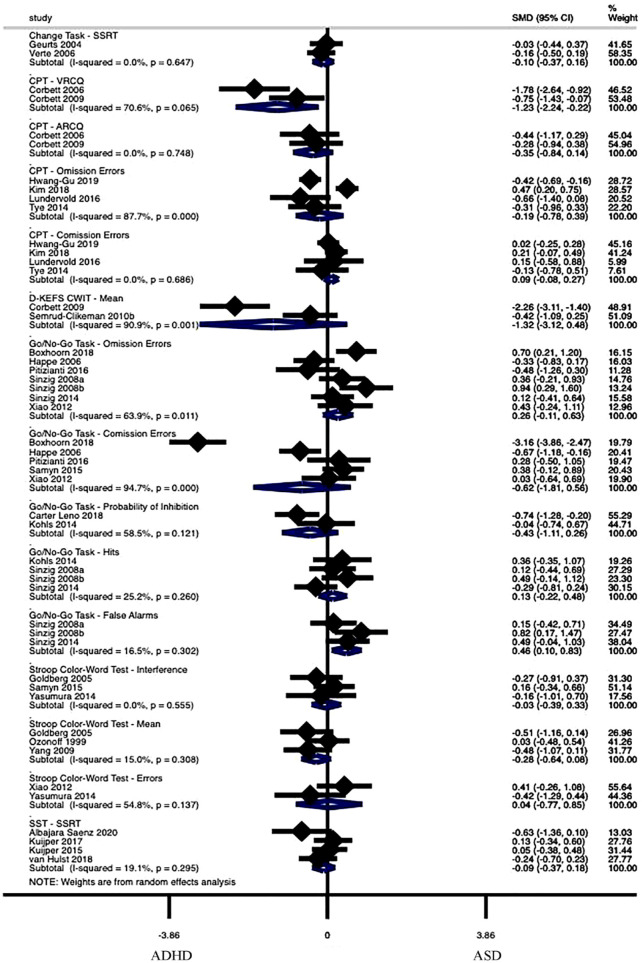
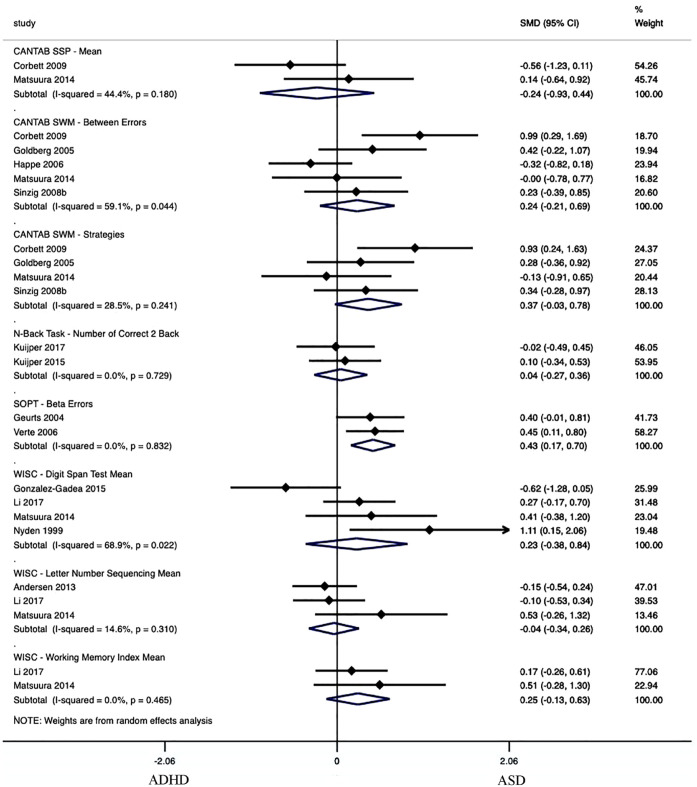
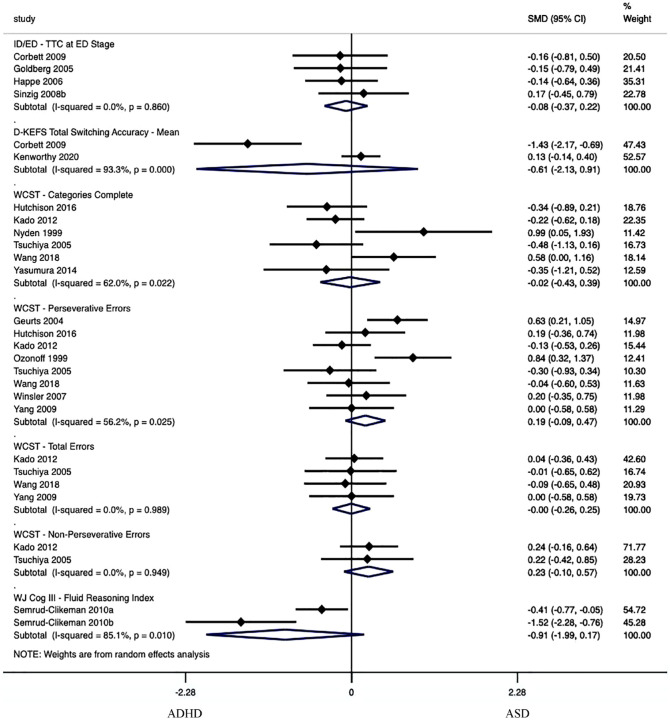
- Isolated performance metrics did differ: ASD scored worse than ADHD on CPT Visual Response Control Quotient (Hedge’s g = −1.23, p = .02), Go/No-Go False Alarms (g = 0.46, p = .01), and Self-Ordered Pointing Beta Errors (g = 0.43, p < .01). ADHD scored higher than ASD on WISC Processing Speed Index (g = −0.43, p < .001) and CANTAB SOC Initial Thinking Time (g = −0.69, p < .01), while ASD scored higher than ADHD on WISC Block Design (g = 0.34, p = .01).
- Risk of bias was moderate-high: average Downs and Black score was 11.22 out of 14, with included articles receiving 662/826 possible points (80.15%).
Methods
- Pre-registered systematic review and meta-analysis (PROSPERO RecordID = 262654), following Cochrane and PRISMA guidelines. Searches from inception to May 2021 in CINAHL, EBM, Embase, Medline, and PsycINFO, plus hand-searching.
- Included peer-reviewed primary empirical studies with an ASD group, ADHD group, and typically developing group; participants under 19 years, matched in age and sex; English full text; quantitative neuropsychological EF measures only, excluding rating scales such as BRIEF.
- Three separate random-effects meta-analyses were run per performance metric: ASD vs ADHD, ASD vs typically developing, and ADHD vs typically developing, using DerSimonian-Laird estimator and Hedge’s g. Pooled effect sizes were not computed within each EF domain because performance metrics measured different aspects of domains.
Limitations
- Stated: the literature covered many EF processes and tests; theoretical limitations prevented pooled estimates across all performance metrics for each EF domain. Many analyses had small numbers of articles and participants, precluding evaluation of moderators such as age, and many had large between-study variation. External validity categories were low; only English articles were included; few studies included a comorbid group, controlled for ASD/ADHD traits, or distinguished ADHD subtypes.
- Evident from the text: several meta-analytic results were based on only k = 2 or k = 3 studies, and heterogeneity was sometimes substantial (e.g., τ² up to 1.73), limiting confidence in isolated significant findings.
Model-written summary. Check it against the paper before relying on it.
Integrity signals
Registry
Cites
Statistics
Figures
Verification
Claims the paper makes
6 Valid · 2 Not valid · 2 Not checked · 29 Own results and interpretations
At least one cited source doesn’t support this claim or points to a different paper, and none confirmed it — see the verdicts below.
In the paper
“Studies in which ADHD and ASD traits were controlled indicate that, at least response inhibition and response variability, may be more strongly associated with ADHD than with ASD traits (Karalunas et al., 2018; Schachar et al., 2022).”
§ Do ASD and ADHD Have Distinct Executive Function Deficits? A Systematic Review and Meta-Analysis of Direct Comparison Studies > Discussion
What the sources say
- Disputedcites Karalunas et al., 2018 matched to “Overlapping and Distinct Cognitive Impairments in Attention-Deficit/Hyperactivity and Autism Spectrum Disorder without Intellectual Disability” (2018) sourceExperimental — accuracy not yet measured
The Results (Executive Functioning; page unavailable) report that response-inhibition impairment in children with ASD remained after controlling for ADHD symptoms, with no reliable difference from children with ADHD. The Results (Reaction time parameters; page unavailable) likewise report elevated response variability in both groups after symptom controls. The paper therefore does not find these impairments more strongly associated with ADHD than with ASD. (LLM, conf=0.88)
Checked by a reasoning model — may be wrong.
- Not matchedcites Schachar et al., 2022
An author–year citation the paper’s reference list doesn’t settle. We don’t search these by name.
hedgedstates an association- Asserted: passes — The authors put it forward as true.
- Checkable: passes — It can be checked against evidence.
- Load-bearing: passes — The paper’s conclusions depend on it.
- Based: passes — The paper gives a reason why it holds.
- Disputed
The cited sources support only part of this claim — read each source’s verdict below.
In the paper
“This meta-analysis was not able to determine if the similarity in EF deficits in ASD and ADHD were due to the high rate of comorbidity of these disorders (Hours et al., 2022).”
§ Do ASD and ADHD Have Distinct Executive Function Deficits? A Systematic Review and Meta-Analysis of Direct Comparison Studies > Discussion
What the sources say
- Partly supportedcites Hours et al., 2022 matched to “ASD and ADHD Comorbidity: What Are We Talking About?” (2022) sourceExperimental — accuracy not yet measured
The Discussion reports shared executive-function impairments in ASD and ADHD and questions whether executive-function findings alone can establish comorbidity. The paper does not present itself as a meta-analysis or report a meta-analytic determination of whether comorbidity causes those similarities. Our copy provides no page numbers for these passages. (LLM, conf=0.84)
plain- Asserted: passes — The authors put it forward as true.
- Checkable: passes — It can be checked against evidence.
- Load-bearing: passes — The paper’s conclusions depend on it.
- Based: passes — The paper gives a reason why it holds.
- Partly supported
The sources with a verdict support this claim; the rest weren’t checked yet, have no full text we could read, or their verdicts aren’t rated yet.
In the paper
“The results of this meta-analysis of direct comparisons using a meta-analytical approach of ASD and ADHD differ from the conclusions reached by previous reviews (Antshel & Russo, 2019; Banaschewski et al., 2005; Craig et al., 2016).”
§ Do ASD and ADHD Have Distinct Executive Function Deficits? A Systematic Review and Meta-Analysis of Direct Comparison Studies > Discussion
What the sources say
- Not checked — no full text of the sourcecites Antshel & Russo, 2019 matched to “Autism Spectrum Disorders and ADHD: Overlapping Phenomenology, Diagnostic Issues, and Treatment Considerations” (2019) source
- Supportedcites Banaschewski et al., 2005 matched to “Towards an understanding of unique and shared pathways in the psychopathophysiology of ADHD” (2005) source
The Abstract identifies this paper as a selective review comparing ADHD with other disorders, and the Autism section discusses direct ADHD–autism comparisons and draws conclusions from them. The citation identifies it as a previous review; it does not attribute the citing authors’ meta-analysis results to this source. (LLM, conf=0.86)
- Not matchedcites Craig et al., 2016
An author–year citation the paper’s reference list doesn’t settle. We don’t search these by name.
plain- Asserted: passes — The authors put it forward as true.
- Checkable: passes — It can be checked against evidence.
- Load-bearing: passes — The paper’s conclusions depend on it.
- Based: passes — The paper gives a reason why it holds.
A result the paper reports from its own data — it cites no other source for it, so there is none to check. The quote shows it is in the paper.
In the paper
“The group with ASD (n = 33) scored significantly worse than the group with ADHD (n = 33) in studies (k = 2) on the Visual Response Control Quotient from the Continuous Performance Test (CPT) (Hedge’s g = −1.23, p = .02, 95% CI [−2.24, −0.22], τ2 = .38).”
- Also stated in: § Attention · plain
“The Visual Response Control Quotient from the (CPT) found a significant result in studies (k = 2) where the group with ADHD (n = 33) scored higher than the group with ASD (n = 33; Hedge’s g = −1.23, p = .02, 95% CI [−2.24, −0.22], τ2 = .38).”
§ Do ASD and ADHD Have Distinct Executive Function Deficits? A Systematic Review and Meta-Analysis of Direct Comparison Studies > Results > Response Inhibition
plainstates an associationn = 33 ·- Asserted: passes — The authors put it forward as true.
- Checkable: passes — It can be checked against evidence.
- Load-bearing: passes — The paper’s conclusions depend on it.
- Based: passes — The paper gives a reason why it holds.
- Rests on an assumption not shown here.
- Also stated in: § Attention · plain
A result the paper reports from its own data — it cites no other source for it, so there is none to check. The quote shows it is in the paper.
In the paper
“Individuals diagnosed with ASD and ADHD exhibited worse performance in attention, flexibility, visuospatial abilities, working memory, processing speed, and response inhibition than typically developing individuals.”
- Also stated in: § Discussion · hedged
“Less consistent deficits were also found in processing speed and working memory.”
§ Do ASD and ADHD Have Distinct Executive Function Deficits? A Systematic Review and Meta-Analysis of Direct Comparison Studies > Abstract > Results:
plainstates an association- Asserted: passes — The authors put it forward as true.
- Checkable: passes — It can be checked against evidence.
- Load-bearing: passes — The paper’s conclusions depend on it.
- Based: passes — The paper gives a reason why it holds.
- Rests on an assumption not shown here.
- Also stated in: § Discussion · hedged
17 more claims
Create a free account to see all 39 claims and to verify the 1 reference still open.
- Probably not a substantial claim. 11
- It may state two separate claims as one. 11
Claims other papers make about this one
Each is checked against this paper’s own text: does it say what the citing paper says it does?
The cited source doesn’t support the claim as written.
In the citing paper
“No distinction between the types of assessment (i.e., neuropsychological tests vs. questionnaires) was taken into account.”
From Comparing Executive Functions in Children and Adolescents with Autism and ADHD—A Systematic Review and Meta-Analysis (2024) · cites this paper as [27]
Checked by a reasoning model — may be wrong.
Experimental — accuracy not yet measuredThe source backs part of the claim, not all of it — or backs it for a different population, condition or comparison.
In the citing paper
“The same conclusion was drawn by Townes and colleagues (2023): as shown by neuropsychological tests and questionnaires, children and adolescents with ASD and ADHD have similar EF profiles [27].”
From Comparing Executive Functions in Children and Adolescents with Autism and ADHD—A Systematic Review and Meta-Analysis (2024) · cites this paper as [27]
Experimental — accuracy not yet measuredThe cited source says what the claim attributes to it.
In the citing paper
“First, the comparison between the clinical and control groups revealed clear differences in cognitive indices linked to executive functioning, consistent with previous research [35, 44, 45, 46].”
From ADHD, Subtypes and Cognitive Performance: WISC-V as a Support Tool for Diagnostic Assessment (2026) · cites this paper as [46]
The cited source says what the claim attributes to it.
In the citing paper
“This meta-analysis confirmed that both ADHD and ASD showed EF impairments compared to the TD group.”
From Comparing Executive Functions in Children and Adolescents with Autism and ADHD—A Systematic Review and Meta-Analysis (2024) · cites this paper as [27]
The cited source says what the claim attributes to it.
In the citing paper
“Townes et al. found no differences in EF profiles between individuals diagnosed with ASD and ADHD, stating that although they are two distinct clinical disorders, they share some underlying mechanisms.”
From Comparing Executive Functions in Children and Adolescents with Autism and ADHD—A Systematic Review and Meta-Analysis (2024) · cites this paper as [27]
Self-check
Percentages, sums and reported differences re-computed from the paper’s own numbers.
Each contradiction between two passages listed here was confirmed by an independent check.
Rated minor: it would not touch a result — a value no result rests on, a p-value that stays on the same side of the significance level, or a conflict that is clerical, resolved elsewhere in the paper, or outside its own findings.
In the paper
“The average score of articles on the Downs and Black risk of bias assessment was 11.22 out of 14 total points that could be awarded, revealing moderate-high validity.”
§ Do ASD and ADHD Have Distinct Executive Function Deficits? A Systematic Review and Meta-Analysis of Direct Comparison Studies > Results > Risk of Bias
Reported 11.22 · recomputed 11.413793
Rated minor: it would not touch a result — a value no result rests on, a p-value that stays on the same side of the significance level, or a conflict that is clerical, resolved elsewhere in the paper, or outside its own findings.
In the paper
§ Do ASD and ADHD Have Distinct Executive Function Deficits? A Systematic Review and Meta-Analysis of Direct Comparison Studies > Results > Planning
“The group with ASD performed significantly worse than the typically developing group on one performance metric (see Supplemental Table 2b).”
§ Do ASD and ADHD Have Distinct Executive Function Deficits? A Systematic Review and Meta-Analysis of Direct Comparison Studies > Discussion
“No deficits in planning were found in ASD or ADHD.”
Rated minor: it would not touch a result — a value no result rests on, a p-value that stays on the same side of the significance level, or a conflict that is clerical, resolved elsewhere in the paper, or outside its own findings.
In the paper
“Visuospatial Abilities were evaluated in four performance metrics as part of four tasks, where one performance metric showed significantly worse performance in ADHD compared to ASD (see Supplemental Figure and Supplemental Table 2a).”
§ Do ASD and ADHD Have Distinct Executive Function Deficits? A Systematic Review and Meta-Analysis of Direct Comparison Studies > Results > Visuospatial Abilities
Reported 9 · recomputed 3
Citations
Cites
Diagnostic and Statistical Manual of Mental Disorders
American Psychiatric Association (2013) · doi:10.1176/appi.books.9780890425596 · Cited by 116,369
Meta-analysis in clinical trials
DerSimonian, R., & Laird, N. (1986) · Controlled Clinical Trials · doi:10.1016/0197-2456(86)90046-2 · Cited by 39,552
Quantifying heterogeneity in a meta‐analysis
Higgins, J. P. T., & Thompson, S. G. (2002) · Statistics in Medicine · doi:10.1002/sim.1186 · Cited by 36,763
Liberati, A., Altman, D. G., Tetzlaff, J., Mulrow, C., Gotzsche, P. C., Ioannidis, J. P. A., Clarke, M., Devereaux, P. J., Kleijnen, J., & Moher, D. (2009) · BMJ · doi:10.1136/bmj.b2700 · Cited by 17,648
Diamond, A. (2013) · Annual Review of Psychology · doi:10.1146/annurev-psych-113011-143750 · Cited by 13,268 · cited 1×
“Most models of EF include working memory, response inhibition, planning, cognitive flexibility, and attention (Diamond, 2013; Miyake et al., 2000; Stuss & Benson, 1987).”
Downs, S. H., & Black, N. (1998) · Journal of Epidemiology and Community Health · doi:10.1136/jech.52.6.377 · Cited by 8,252
Insel, T., Cuthbert, B., Garvey, M., Heinssen, R., Pine, D. S., Quinn, K., Sanislow, C., & Wang, P. (2010) · American Journal of Psychiatry · doi:10.1176/appi.ajp.2010.09091379 · Cited by 7,067 · cited 1×
“One method to accomplish this goal would be to adopt the NIMH Research Domain Criteria (RDoC) approach (Insel et al., 2010) and standardized measures of each EF such as in the NIH ToolKit (Hodes et al., 2013).”
MethodAssessing heterogeneity in meta-analysis: Q statistic or I² index?
Huedo-Medina, T. B., Sánchez-Meca, J., Marín-Martínez, F., & Botella, J. (2006) · Psychological Methods · doi:10.1037/1082-989x.11.2.193 · Cited by 4,256 · cited 1×
“I 2 resulting percentages of 75%, 50%, and 25% indicate a high, medium, and low heterogeneity, respectively (Huedo-Medina et al., 2006).”
BackgroundMaenner, M. J., Shaw, K. A., Baio, J., EdS1, Washington, A., Patrick, M., DiRienzo, M., Christensen, D. L., Wiggins, L. D., Pettygrove, S., et al. (2020) · MMWR. Surveillance Summaries · doi:10.15585/mmwr.ss6904a1 · Cited by 3,780 · cited 1×
“About 2% of school-aged children are diagnosed with ASD (Maenner et al., 2020).”
BackgroundPolanczyk, G. V., Willcutt, E. G., Salum, G. A., Kieling, C., & Rohde, L. A. (2014) · International Journal of Epidemiology · doi:10.1093/ije/dyt261 · Cited by 1,822 · cited 1×
“ADHD is characterized by developmentally inappropriate inattention, hyperactivity, and impulsivity (American Psychiatric Association [APA], 2013) and affects 5% to 7% of school-aged children (Polanczyk et al., 2014).”
BackgroundMiyake, A., Friedman, N. P., Rettinger, D. A., Shah, P., & Hegarty, M. (2001) · Journal of Experimental Psychology: General · doi:10.1037/0096-3445.130.4.621 · Cited by 1,139
Comorbidity in Child Psychopathology: Concepts, Issues and Research Strategies
Caron, C., & Rutter, M. (1991) · Journal of Child Psychology and Psychiatry · doi:10.1111/j.1469-7610.1991.tb00350.x · Cited by 1,051 · cited 1×
“These studies do not clarify whether EFs are associated with ASD or ADHD or whether the comorbid group represents a distinct diagnostic entity (Caron & Rutter, 1991; Krakowski et al., 2021).”
BackgroundVerbruggen, F., Aron, A. R., Band, G. P., Beste, C., Bissett, P. G., Brockett, A. T., Brown, J. W., Chamberlain, S. R., Chambers, C. D., Colonius, H., et al. (2019) · eLife · doi:10.7554/elife.46323 · Cited by 990 · cited 1×
“In the future, standardization of EF tests and performance metrics would greatly increase the consistency of reporting and reliability of results improving data integration across studies et al., 2019).”
BackgroundSelf-citationThe Problem of Assessing Executive Functions
Lezak, M. D. (1982) · International Journal of Psychology · doi:10.1080/00207598208247445 · Cited by 822
Brief Report: Specific Executive Function Profiles in Three Neurodevelopmental Disorders
Ozonoff, S., & Jensen, J. (1999) · Journal of Autism and Developmental Disorders · doi:10.1023/a:1023052913110 · Cited by 724 · cited 1×
“EF deficits are present during childhood in various neurodevelopmental disorders including both ASD and ADHD (Barkley, 1997; Ozonoff & Jensen, 1999; Russell, 1997).”
BackgroundMeta‐Analysis in Medical Research: The Handbook for the Understanding and Practice of Meta‐Analysis
(2005) · Wiley eBooks · doi:10.1002/9780470994894 · Cited by 687
Autism as an executive disorder
Jarrold, C. (1997) · Oxford University Press eBooks · Cited by 662
Barkley, R. A. (1997) · Psychological Bulletin · doi:10.1037//0033-2909.121.1.65 · Cited by 580 · cited 1×
“EF deficits are present during childhood in various neurodevelopmental disorders including both ASD and ADHD (Barkley, 1997; Ozonoff & Jensen, 1999; Russell, 1997).”
BackgroundMargari, L., Craig, F., Margari, F., Legrottaglie, A., Palumbi, R., & De Giambattista, C. (2016) · Neuropsychiatric Disease and Treatment · doi:10.2147/ndt.s104620 · Cited by 557
Antshel, K. M., & Russo, N. (2019) · Current Psychiatry Reports · doi:10.1007/s11920-019-1020-5 · Cited by 450 · cited 8×
“The results of this meta-analysis of direct comparisons using a meta-analytical approach of ASD and ADHD differ from the conclusions reached by previous reviews (Antshel & Russo, 2019; Banaschewski et al., 2005; Craig et al., 2016).”
BackgroundResultInfluentialLong-term Prognosis in Attention-Deficit/Hyperactivity Disorder
Mannuzza, S., & Klein, R. G. (2000) · Child and Adolescent Psychiatric Clinics of North America · doi:10.1016/s1056-4993(18)30114-7 · Cited by 399
(2019) · Psychology Press eBooks · doi:10.4324/9781315788975 · Cited by 389
MCAULEY, T., CHEN, S., GOOS, L., SCHACHAR, R., & CROSBIE, J. (2010) · Journal of the International Neuropsychological Society · doi:10.1017/s1355617710000093 · Cited by 345 · cited 5×
“Processing speed, reaction time variability and visuospatial abilities were included in the review even though they are not always considered EFs (Dias et al., 2018).”
MethodInfluentialSelf-citationRestraint and cancellation: multiple inhibition deficits in attention deficit hyperactivity disorder
Schachar, R., Logan, G. D., Robaey, P., Chen, S., Ickowicz, A., & Barr, C. (2007) · Journal of Abnormal Child Psychology · doi:10.1007/s10802-006-9075-2 · Cited by 293 · cited 2×
“Current conclusions about EF profiles in ASD and ADHD are based on the results of comparisons of ASD and typically developing controls and studies of ADHD and typically developing controls (Antshel & Russo, 2019; Hosenbocus & Chahal, 2012; Schachar et al., 2007).”
ResultSelf-citationMRC AIMS consortium, Christakou, A., Murphy, C. M., Chantiluke, K., Cubillo, A. I., Smith, A. B., Giampietro, V, Daly, E., Ecker, C., Robertson, D., et al. (2013) · Molecular Psychiatry · doi:10.1038/mp.2011.185 · Cited by 293 · cited 1×
“The minimum score for an article was 8 points (Unterrainer et al., 2020), and the maximum points awarded to an article was 13 (Christakou et al., 2013; Hutchison et al., 2016).”
BackgroundASD and ADHD Comorbidity: What Are We Talking About?
Hours, C., Recasens, C., & Baleyte, J.-M. (2022) · Frontiers in Psychiatry · doi:10.3389/fpsyt.2022.837424 · Cited by 269
Hutchison, L., Feder, M., Abar, B., & Winsler, A. (2016) · Journal of Child and Family Studies · doi:10.1007/s10826-016-0518-2 · Cited by 212
Yang, Y., Shields, G. S., Zhang, Y., Wu, H., Chen, H., & Romer, A. L. (2022) · Clinical Psychology Review · doi:10.1016/j.cpr.2022.102194 · Cited by 201 · cited 1×
“…because EF are thought to link underlying genetic, neural, or environmental mechanisms to the behavioral manifestations of psychopathology and to predict current and future functional impairment such as quality of life and educational attainment (Mannuzza & Klein, 2000; Yang et al., 2022).”
BackgroundUddin, L. Q., Dajani, D. R., Voorhies, W., Bednarz, H., & Kana, R. K. (2017) · Translational Psychiatry · doi:10.1038/tp.2017.164 · Cited by 173 · cited 1×
“Identifying distinct EF deficits in either group could clarify etiology, advance early detection, and improve screening and diagnosis (Uddin et al., 2017).”
BackgroundToplak, M. E., West, R. F., & Stanovich, K. E. (2014) · Developmental Psychology · doi:10.1037/a0034910 · Cited by 170 · cited 1×
“Quantitative and qualitative EF data have little correlation and the former are more empirical (Toplak et al., 2014).”
BackgroundThe NIH Toolbox: Setting a standard for biomedical research
Hodes, R. J., Insel, T. R., Landis, S. C., & Research, O. B. O. T. N. B. F. N. (2013) · Neurology · doi:10.1212/wnl.0b013e3182872e90 · Cited by 167
Semrud-Clikeman, M., Walkowiak, J., Wilkinson, A., & Butcher, B. (2010) · Journal of Autism and Developmental Disorders · doi:10.1007/s10803-010-0951-9 · Cited by 159 · cited 1×
“We found few studies that included a comorbid group, controlled for traits of ASD and ADHD, or distinguished between ADHD subtypes precluding adequate consideration of the effect of comorbidity and subtype on EF performance (Schachar et al., 2022; Semrud-Clikeman et al., 2010).”
BackgroundTowards an understanding of unique and shared pathways in the psychopathophysiology of ADHD
Banaschewski, T., Hollis, C., Oosterlaan, J., Roeyers, H., Rubia, K., Willcutt, E., & Taylor, E. (2005) · Developmental Science · doi:10.1111/j.1467-7687.2005.00400.x · Cited by 152
Nydén, A., Gillberg, C., Hjelmquist, E., & Heiman, M. (1999) · Autism · doi:10.1177/1362361399003003002 · Cited by 151 · cited 1×
“Two articles stratified their outcomes into visual and auditory performance during the Continuous Performance Test (Kim et al., 2018) and the Go/ No-Go task (Nydén et al., 1999).”
MethodKaralunas, S. L., Hawkey, E., Gustafsson, H., Miller, M., Langhorst, M., Cordova, M., Fair, D., & Nigg, J. T. (2018) · Journal of Abnormal Child Psychology · doi:10.1007/s10802-017-0394-2 · Cited by 148 · cited 1×
“Studies in which ADHD and ASD traits were controlled indicate that, at least response inhibition and response variability, may be more strongly associated with ADHD than with ASD traits (Karalunas et al., 2018; Schachar et al., 2022).”
BackgroundCepeda, N. J., Blackwell, K. A., & Munakata, Y. (2013) · Developmental Science · doi:10.1111/desc.12024 · Cited by 147
A review of executive function deficits and pharmacological management in children and adolescents.
Hosenbocus, S., & Chahal, R. (2012) · Europe PMC (PubMed Central) · Cited by 141
Hartman, C. A., Geurts, H. M., Franke, B., Buitelaar, J. K., & Rommelse, N. N. J. (2016) · Neuroscience & Biobehavioral Reviews · doi:10.1016/j.neubiorev.2016.09.003 · Cited by 111 · cited 2×
“The overlap of symptoms in individuals with ASD and ADHD peaks during adolescence, where the majority of research has been focused (Hartman et al., 2016).”
BackgroundSchachar, R. J., Dupuis, A., Arnold, P. D., Anagnostou, E., Kelley, E., Georgiades, S., Nicolson, R., Townes, P., Burton, C. L., & Crosbie, J. (2023) · Research on Child and Adolescent Psychopathology · doi:10.1007/s10802-022-00958-6 · Cited by 30 · cited 2×
“Studies in which ADHD and ASD traits were controlled indicate that, at least response inhibition and response variability, may be more strongly associated with ADHD than with ASD traits (Karalunas et al., 2018; Schachar et al., 2022).”
BackgroundSelf-citationUnterrainer, J. M., Rahm, B., Loosli, S. V., Rauh, R., Schumacher, L. V., Biscaldi, M., & Kaller, C. P. (2019) · Child Neuropsychology · doi:10.1080/09297049.2019.1642317 · Cited by 25
Kim, K. M., Lim, M. H., Kwon, H., Yoo, S.-J., Kim, E.-J., Kim, J. W., Ha, M., & Paik, K. C. (2018) · Environmental Research · doi:10.1016/j.envres.2018.06.018 · Cited by 23
Hwang-Gu, S.-L., Lin, H.-Y., Chen, Y.-C., Tseng, Y.-H., Hsu, W.-Y., Chou, M.-C., Chou, W.-J., Wu, Y.-Y., & Gau, S. S.-F. (2019) · Journal of Clinical Child & Adolescent Psychology · doi:10.1080/15374416.2018.1452151 · Cited by 22
Savitz, D. A., & Forastiere, F. (2021) · Occupational and Environmental Medicine · doi:10.1136/oemed-2021-107702 · Cited by 21 · cited 1×
“Pooling each performance metric would lack meaningful interpretations of results and undermine the underlying substantive and methodological issues present in the highly heterogeneous EF literature (Savitz & Forastiere, 2021).”
BackgroundDias, B. F., Rezende, L. O., Malloy-Diniz, L. F., & Paula, J. J. D. (2018) · Arquivos de Neuro-Psiquiatria · doi:10.1590/0004-282x20170186 · Cited by 19
Buczyłowska, D., & Petermann, F. (2018) · Frontiers in Psychology · doi:10.3389/fpsyg.2018.00329 · Cited by 17
Krakowski, A. D., Szatmári, P., Crosbie, J., Schachar, R. J., Duku, E., Georgiades, S., & Anagnostou, E. A. (2021) · Frontiers in Psychiatry · doi:10.3389/fpsyt.2021.654120 · Cited by 13
Self-citation
Research works printed but not linked: 3
- Higgins J. P. T. Altman D. G. Sterne J. A. C. (2011). Chapter 8: Assessing risk of bias in a randomized trial. In Higgins J. P. T. Green S. (Eds.), Cochrane handbook for systematic reviews of interventions (version 5.1.0). The Cochrane Collaboration. https://www.training.cochrane.org/handbook
- Higgins J. P. T. Thomas J. Chandler J. Cumpston M. Li T. Page M. J. Welch V. A. (Eds.). (2022). Cochrane handbook for systematic reviews of interventions version 6.3 (updated February 2022). Cochrane. https://www.training.cochrane.org/handbook
- StataCorp. (2021) Stata statistical software (Release 17). StataCorp LLC. Covidence systematic review software, Veritas Health Innovation, Melbourne. https://www.covidence.org
Cited by
Executive function deficits in attention-deficit/hyperactivity disorder and autism spectrum disorder
Kofler, M. J., Soto, E. F., Singh, L. J., Harmon, S. L., Jaisle, E. M., Smith, J. N., Feeney, K. E., & Musser, E. D. (2024) · Nature Reviews Psychology · doi:10.1038/s44159-024-00350-9 · Cited by 51
“When ADHD symptoms were controlled for among those with ASD, effect sizes remained medium for verbal ( d = 0.53) and spatial tests ( d = 0.50) 49,63 .”
InfluentialCeruti, C., Mingozzi, A., Scionti, N., & Marzocchi, G. M. (2024) · Children · doi:10.3390/children11040473 · Cited by 35
“The same conclusion was drawn by Townes and colleagues (2023): as shown by neuropsychological tests and questionnaires, children and adolescents with ASD and ADHD have similar EF profiles [27].”
BackgroundUnraveling the spectrum: overlap, distinctions, and nuances of ADHD and ASD in children
Martinez, S., Stoyanov, K., & Carcache, L. (2024) · Frontiers in Psychiatry · doi:10.3389/fpsyt.2024.1387179 · Cited by 33
Schachar, R. J. (2023) · Neuroscience & Biobehavioral Reviews · doi:10.1016/j.neubiorev.2023.105461 · Cited by 34
Self-citationExecutive Functioning Profiles in Neurodevelopmental Disorders: Parent–Child Outcomes
Pardo‐Salamanca, A., Paoletti, D., Cerezuela, G. P., STASIO, S. D., & Berenguer, C. (2024) · Children · doi:10.3390/children11080909 · Cited by 28
“Despite differences in the manifestations of these disorders, recent meta-analyses have found no differences in EF domains between children and adolescents with ADHD and those with ASD [5,16].”
BackgroundResult
Metadata
- Authors
- Townes, P., Liu, C., Panesar, P., Devoe, D., Lee, S. Y., Taylor, G., Arnold, P. D., Crosbie, J., & Schachar, R.
- Affiliations
- University of Calgary (CA)
- University of Toronto (CA)
- Mount Royal University (CA)
- Corresponding author
- Schachar, Russell
- ORCID
- Townes, Parker
- Venue
- Journal of Attention Disorders
- Publisher
- SAGE Publications
- Published
- 2023-08-11
- Volume
- 27
- Issue
- 14
- Pages
- 1571-1582
- ISSN
- 1087-0547 (ISSN-L)
- 1557-1246
- PMC
- PMC10637091
- OpenAlex
- W4385751400
- Semantic Scholar
- 8417643503b95e5709ebcbda1cdc131624618424
- Cited by
- 75
- References
- 46
- Citations by year
- 2026: 30 · 2025: 27 · 2024: 16 · 2023: 1
- FWCI
- 4.48
- Type
- journal article
- Language
- en
- Open access
- hybrid
- doi.org
- Licence
- Locations
- Journal of Attention Disorders (publishedVersion, cc-by-nc)
- PubMed (publishedVersion)
- PubMed Central (submittedVersion, cc-by-nc)
- Funders
- Canadian Institutes of Health Research (MOP-93696, MOP-106573)
- Alberta Innovates Translational Health Chair in Child and Youth Mental Health
- TD Bank Financial Group Chair in Child and Adolescent Psychiatry
- Topics
- Health Sciences › Medicine › Psychiatry and Mental health › Attention Deficit Hyperactivity Disorder
- Life Sciences › Neuroscience › Cognitive Neuroscience › Autism Spectrum Disorder Research
- Life Sciences › Biochemistry, Genetics and Molecular Biology › Genetics › Genetics and Neurodevelopmental Disorders
- Keywords
- autism spectrum disorder, attention deficit hyperactivity disorder, executive dysfunction, working memory, response inhibition, cognitive flexibility, planning, processing speed
- MeSH terms
- Autism Spectrum Disorder, Adolescent, Attention Deficit Disorder with Hyperactivity
About these checks
Registry, retraction, Cites and statistics results are computed, not judged, with one exception: a printed reference that no index lists is read once by a model before it counts as a citation error. Claims are extracted by a model and kept only when their quote appears verbatim in the text; each cited source is then checked, with a model’s help, for whether it says what the claim relies on. Those verdicts can be wrong — read the claim’s quote and the cited source before relying on one.
The claim verdicts this report counts are experimental: their accuracy is not yet measured.
A language model drew the claims from the paper on 2026-09-30, under version 3 of the claim definition (model deepseek-v4.1-flash, prompt extract-v3).
A second model labelled each claim on 2026-09-30 (model jev-1.13-20260917, definition revision gold-guideline-v0.2).
Cited sources are checked with a language model’s help (gpt-6-sol).
Statistics and arithmetic are recomputed, not judged.
Confidence bands are shown only for fields calibrated on our annotated test set. None is calibrated yet, so no band is shown.
What counts as a claim ›How we measure confidence ›How we check this ›
Are you an author, or do you see a problem with this page? Request a review
Data sources
Bibliographic data: Semantic Scholar, OpenAlex, Crossref.
Contains information from the Semantic Scholar Academic Graph Datasets, made available under the ODC Attribution License (ODC-BY 1.0).
Semantic Scholar’s data is described in: Kinney, R., et al. (2023). The Semantic Scholar Open Data Platform. arXiv:2301.10140.
