

A Randomized Controlled Trial of mHealth Mindfulness Intervention for Cancer Patients and Informal Cancer Caregivers: A Feasibility Study Within an Integrated Health Care Delivery System
Open accessThe DOI matches its Crossref record; 68 of the 68 references it cites were found in a registry or an index.
Abstract
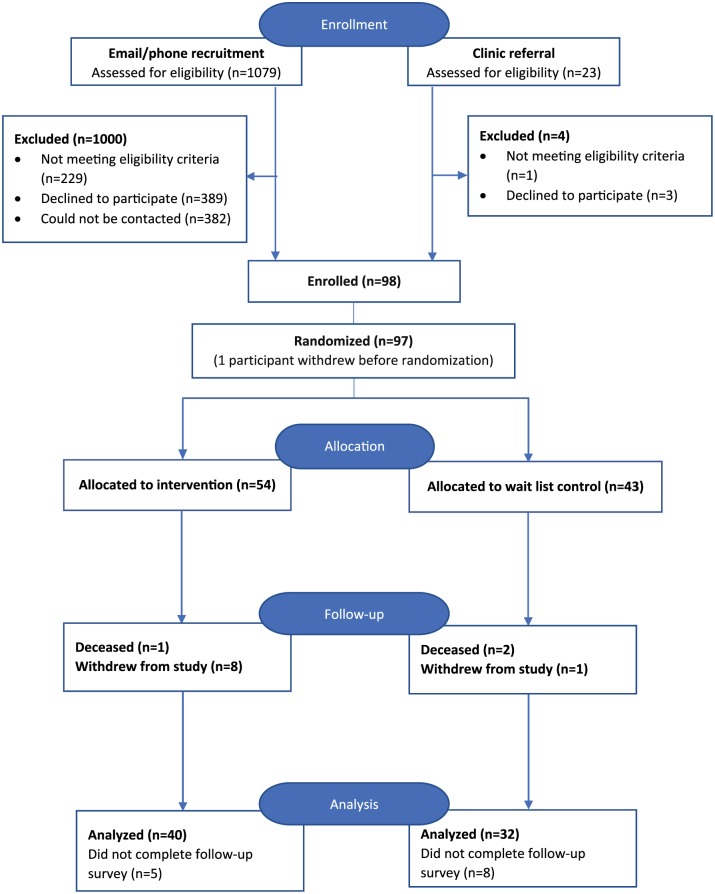
Purpose: To assess feasibility and preliminary efficacy of a mobile/online-based (mHealth) mindfulness intervention for cancer patients and their caregivers to reduce distress and improve quality of life (QoL). Material and Methods: Two-arm randomized controlled trial within Kaiser Permanente Northern California targeting cancer patients who received chemotherapy and their informal caregivers. The intervention group received a commercially available mindfulness program for 8 weeks. The wait-list control group received usual care. We assessed feasibility using retention and adherence rates and obtained participant-reported data on distress, QoL, sleep, mindfulness, and posttraumatic growth before and immediately after the intervention. Results: Ninety-seven patients (median age 59 years; female 69%; 65% whites) and 31 caregivers (median age 63 years; female 58%; 77% whites) were randomized. Among randomized participants, 74% of the patients and 84% of the caregivers completed the study. Among those in the intervention arm who initiated the mindfulness program, 65% practiced at least 50% of the days during the intervention period. We observed significantly greater improvement in QoL among patients in the intervention arm compared with controls. Caregivers in the intervention group experienced increased mindfulness compared with controls. Participants appreciated the convenience of the intervention and the mindfulness skills they obtained from the program. Conclusion: We demonstrated the feasibility of conducting a randomized trial of an mHealth mindfulness intervention for cancer patients and their informal caregivers. Results from fully powered efficacy trials would inform the potential for clinicians to use this scalable intervention to help improve QoL of those affected by cancer and their caregivers.
Overview
The claims and statistics of this paper haven’t been checked yet.
Free: it reads the open-access text and checks the first 5 claims that cite a source we can check. Create a free account to check every claim.
Integrity signals
Registry
Cites
Statistics
Figures
Verification
Claims the paper makes
The claims and statistics of this paper haven’t been checked yet.
Free: it reads the open-access text and checks the first 5 claims that cite a source we can check. Create a free account to check every claim.
Claims other papers make about this one
Each is checked against this paper’s own text: does it say what the citing paper says it does?
The source backs part of the claim, not all of it — or backs it for a different population, condition or comparison.
In the citing paper
“The most common method was a weekly session for a total of 6 weeks [19, 20, 24, 27] or 8 weeks [25, 28, 29] with a length of approximately 60 min per session [21, 22, 27, 29, 30].”
From Third-wave cognitive behavioral therapies for caregivers of cancer patients: a scoping review. (2023) · cites this paper as [25]
Experimental — accuracy not yet measuredThe cited source says what the claim attributes to it.
In the citing paper
“Eight studies were pilot studies [19–26].”
From Third-wave cognitive behavioral therapies for caregivers of cancer patients: a scoping review. (2023) · cites this paper as [25]
The cited source says what the claim attributes to it.
In the citing paper
“Two interventions using the web page and the mobile app without interactions with the therapist failed to demonstrate effectiveness on caregivers [20, 25], except for a positive effect in the domain of mindfulness [25].”
From Third-wave cognitive behavioral therapies for caregivers of cancer patients: a scoping review. (2023) · cites this paper as [25]
The cited source says what the claim attributes to it.
In the citing paper
“In our review, the participants of two studies using mobile applications positively evaluated the intervention based on its ease of access [20, 25].”
From Third-wave cognitive behavioral therapies for caregivers of cancer patients: a scoping review. (2023) · cites this paper as [25]
Self-check
Percentages, sums and reported differences re-computed from the paper’s own numbers.
The self-check needs the paper’s full text.
Citations
Cites
Statistical Power Analysis for the Behavioral Sciences
Muller, K. (1989) · Technometrics · doi:10.1080/00401706.1989.10488618 · Cited by 99,167
The National Comprehensive Cancer Network: Present and future directions
McGivney, W. T. (1998) · Cancer · doi:10.1002/(sici)1097-0142(19980515)82:10+<2057::aid-cncr14>3.0.co;2-a · Cited by 16,766
The validity of the Hospital Anxiety and Depression Scale
Bjelland, I., Dahl, A. A., Haug, T. T., & Neckelmann, D. (2002) · Journal of Psychosomatic Research · doi:10.1016/s0022-3999(01)00296-3 · Cited by 9,779 · cited 1×
“We used the 14-item Hospital Anxiety and Depression Scale (HADS) to assess anxiety and depression.(46) Higher scores indicate greater anxiety and depression.”
MethodUsing Self-Report Assessment Methods to Explore Facets of Mindfulness
Baer, R. A., Smith, G. T., Hopkins, J., Krietemeyer, J., & Toney, L. (2006) · Assessment · doi:10.1177/1073191105283504 · Cited by 7,511 · cited 1×
“Higher scores indicate greater mindfulness.(54)”
(2008) · Medical Entomology and Zoology · Cited by 7,477
The posttraumatic growth inventory: measuring the positive legacy of trauma
Tedeschi, R. G., & Calhoun, L. G. (1996) · Journal of Traumatic Stress · doi:10.1002/jts.2490090305 · Cited by 7,061 · cited 1×
“We modified the wording to ask about changes as a result of their (patients) or their loved one’s (caregivers) cancer diagnosis.(53) Higher scores indicate greater post-traumatic growth.”
MethodThe functional assessment of cancer therapy scale: development and validation of the general measure
Cella, D. F., Tulsky, D. S., Gray, G., Sarafian, B., Linn, E., Bonomi, A., Silberman, M., Yellen, S. B., Winicour, P., & Brannon, J. (1993) · Journal of Clinical Oncology · doi:10.1200/jco.1993.11.3.570 · Cited by 6,020 · cited 1×
“FACT-G asks respondents to rate their QoL in 4 domains (physical, social/family, emotional, and functional well-being).(49,50) Caregiver QoL was determined using the Caregiver Quality of Life Index–Cancer (CQOLC) scale.”
MethodPinquart, M., & Sörensen, S. (2003) · Psychology and Aging · doi:10.1037/0882-7974.18.2.250 · Cited by 2,857 · cited 1×
“Higher distress may lead to poorer health among caregivers, reducing their ability to effectively provide care for the patients.(65,66) Given the significant reciprocal emotional relationship between caregivers and patients, it is imperative to offer caregivers psychosocial and educational support to improve their own…”
BackgroundCreswell, J. D. (2017) · Annual Review of Psychology · doi:10.1146/annurev-psych-042716-051139 · Cited by 1,702
Cancer-related fatigue—mechanisms, risk factors, and treatments
Bower, J. E. (2014) · Nature Reviews Clinical Oncology · doi:10.1038/nrclinonc.2014.127 · Cited by 1,666
Mindfulness-based stress reduction for healthy individuals: A meta-analysis
Khoury, B., Sharma, M., Rush, S. E., & Fournier, C. (2015) · Journal of Psychosomatic Research · doi:10.1016/j.jpsychores.2015.03.009 · Cited by 1,617
Physical and mental health effects of family caregiving
Schulz, R., & Sherwood, P. R. (2008) · AJN, American Journal of Nursing · doi:10.1097/01.naj.0000336406.45248.4c · Cited by 1,375 · cited 1×
“Higher distress may lead to poorer health among caregivers, reducing their ability to effectively provide care for the patients.(65,66) Given the significant reciprocal emotional relationship between caregivers and patients, it is imperative to offer caregivers psychosocial and educational support to improve their own…”
BackgroundYu, L., Buysse, D. J., Germain, A., Moul, D. E., Stover, A., Dodds, N. E., Johnston, K. L., & Pilkonis, P. A. (2012) · Behavioral Sleep Medicine · doi:10.1080/15402002.2012.636266 · Cited by 1,241 · cited 1×
“The 8-item PROMIS Sleep Disturbance scale assesses sleep disturbance during the past 7 days.(48) A higher summary score indicates worse sleep disturbance.”
BackgroundDevelopment of a PROMIS item bank to measure pain interference
Amtmann, D., Cook, K. F., Jensen, M. P., Chen, W.-H., Choi, S., Revicki, D., Cella, D., Rothrock, N., Keefe, F., Callahan, L., et al. (2010) · Pain · doi:10.1016/j.pain.2010.04.025 · Cited by 1,199
Mindfulness Meditation for Chronic Pain: Systematic Review and Meta-analysis
Hilton, L., Hempel, S., Ewing, B. A., Apaydin, E., Xenakis, L., Newberry, S., Colaiaco, B., Maher, A. R., Shanman, R. M., Sorbero, M. E., et al. (2017) · Annals of Behavioral Medicine · doi:10.1007/s12160-016-9844-2 · Cited by 977 · cited 1×
“Ongoing treatment and concerns about the disease course itself cause substantial distress for both patients of advanced cancer and their loved ones, and these populations have been comparatively understudied.(1-3,68) Because previous in-person mindfulness studies primarily included white females with early-stage breas…”
BackgroundLudwig, D. S. (2008) · JAMA · doi:10.1001/jama.300.11.1350 · Cited by 957
Caregiving and risk of coronary heart disease in U.S. women
Lee, S., Colditz, G. A., Berkman, L. F., & Kawachi, I. (2003) · American Journal of Preventive Medicine · doi:10.1016/s0749-3797(02)00582-2 · Cited by 596 · cited 1×
“Caregivers, often overburdened with caregiving duties, may lack the time or energy to attend these in-person classes.(28,29) In addition to physical challenges, logistical barriers such as distance, lack of transportation, and scheduling conflicts have been reported as reasons for nonadherence or refusal to participat…”
BackgroundScreening for Distress and Unmet Needs in Patients With Cancer: Review and Recommendations
Carlson, L. E., Waller, A., & Mitchell, A. J. (2012) · Journal of Clinical Oncology · doi:10.1200/jco.2011.39.5509 · Cited by 550 · cited 1×
“The NCCN Distress Thermometer was used to assess current distress level.(44,45) Respondents were asked to rate their level of distress during the past week by choosing a number, with 0 indicating no distress and 10 extreme distress.”
MethodHidden morbidity in cancer: spouse caregivers
Braun, M., Mikulincer, M., Rydall, A., Walsh, A., & Rodin, G. (2007) · Journal of Clinical Oncology · doi:10.1200/jco.2006.10.0909 · Cited by 526
Family Support in Advanced Cancer
Given, B. A., Given, C. W., & Kozachik, S. (2001) · CA: A Cancer Journal for Clinicians · doi:10.3322/canjclin.51.4.213 · Cited by 524
Review and evaluation of mindfulness-based iPhone apps
Mani, M., Kavanagh, D. J., Hides, L., & Stoyanov, S. R. (2015) · JMIR mHealth and uHealth · doi:10.2196/mhealth.4328 · Cited by 495 · cited 1×
“A recent review identified Headspace as the most user-friendly commercial mindfulness mobile application.(39) Recent studies in various populations have found use of the Headspace app improved mood(40,41) and positive affect,(40) decreased stress,(41,42) improved general well-being,(42) and increased mindfulness.”
BackgroundWeitzner, M. A., Jacobsen, P. B., Wagner, H., Friedland, J., & Cox, C. (1999) · Quality of Life Research · doi:10.1023/a:1026407010614 · Cited by 481 · cited 1×
“Caregiver QoL was determined using the Caregiver Quality of Life Index–Cancer (CQOLC) scale.(51) The CQOLC gauges the daily and overall impact caregiving has on respondents’ QoL.”
MethodGiese-Davis, J., Collie, K., Rancourt, K. M. S., Neri, E., Kraemer, H. C., & Spiegel, D. (2011) · Journal of Clinical Oncology · doi:10.1200/jco.2010.28.4455 · Cited by 458 · cited 1×
“Research indicates that cancer patients’ levels of psychosocial stress and depression not only affect QoL but also survival and prognosis.(6) Distress extends along a continuum, and although an estimated 35% of cancer patients experience such psychological distress,(7) clinicians are often at a loss as to how to addre…”
BackgroundHolland, J. C., Andersen, B., Breitbart, W. S., Buchmann, L. O., Compas, B., Deshields, T. L., Dudley, M. M., Fleishman, S., Fulcher, C. D., Greenberg, D. B., et al. (2013) · Journal of the National Comprehensive Cancer Network · doi:10.6004/jnccn.2013.0027 · Cited by 423
Howells, A., Ivtzan, I., & Eiroa-Orosa, F. J. (2016) · Journal of Happiness Studies · doi:10.1007/s10902-014-9589-1 · Cited by 407
Vieten, C., & Astin, J. (2008) · Archives of Women's Mental Health · doi:10.1007/s00737-008-0214-3 · Cited by 369
Prevalence of complementary and alternative medicine use in cancer patients during treatment
Yates, J. S., Mustian, K. M., Morrow, G. R., Gillies, L. J., Padmanaban, D., Atkins, J. N., Issell, B., Kirshner, J. J., & Colman, L. K. (2005) · Supportive Care in Cancer · doi:10.1007/s00520-004-0770-7 · Cited by 309
Lever Taylor, B., Cavanagh, K., & Strauss, C. (2016) · PLOS ONE · doi:10.1371/journal.pone.0155720 · Cited by 284
Carlson, L. E., Doll, R., Stephen, J., Faris, P., Tamagawa, R., Drysdale, E., & Speca, M. (2013) · Journal of Clinical Oncology · doi:10.1200/jco.2012.47.5210 · Cited by 282
Zainal, N. Z., Booth, S., & Huppert, F. A. (2013) · Psycho-Oncology · doi:10.1002/pon.3171 · Cited by 279
Economides, M., Martman, J., Bell, M. J., & Sanderson, B. (2018) · Mindfulness · doi:10.1007/s12671-018-0905-4 · Cited by 250
Advances in Patient Reported Outcomes: The NIH PROMIS Measures
Broderick, J., DeWit, E. M., Rothrock, N., Crane, P., & Forrest, C. B. (2013) · eGEMs (Generating Evidence & Methods to improve patient outcomes) · doi:10.13063/2327-9214.1015 · Cited by 244 · cited 1×
“FACT-G asks respondents to rate their QoL in 4 domains (physical, social/family, emotional, and functional well-being).(49,50) Caregiver QoL was determined using the Caregiver Quality of Life Index–Cancer (CQOLC) scale.”
MethodPirl, W. F., Fann, J. R., Greer, J. A., Braun, I., Deshields, T., Fulcher, C., Harvey, E., Holland, J., Kennedy, V., Lazenby, M., et al. (2014) · Cancer · doi:10.1002/cncr.28750 · Cited by 238
Dimidjian, S., Goodman, S. H., Felder, J. N., Gallop, R., Brown, A. P., & Beck, A. (2016) · Journal of Consulting and Clinical Psychology · doi:10.1037/ccp0000068 · Cited by 223
Randomised controlled pilot trial of mindfulness training for stress reduction during pregnancy
Guardino, C. M., Dunkel Schetter, C., Bower, J. E., Lu, M. C., & Smalley, S. L. (2014) · Psychology & Health · doi:10.1080/08870446.2013.852670 · Cited by 218
Happier Healers: Randomized Controlled Trial of Mobile Mindfulness for Stress Management
Yang, E., Schamber, E., Meyer, R. M. L., & Gold, J. I. (2018) · The Journal of Alternative and Complementary Medicine · doi:10.1089/acm.2015.0301 · Cited by 194
Mindfulness training for coping with hot flashes: results of a randomized trial
Carmody, J. F., Crawford, S., Salmoirago-Blotcher, E., Leung, K., Churchill, L., & Olendzki, N. (2011) · Menopause · doi:10.1097/gme.0b013e318204a05c · Cited by 188
Lengacher, C. A., Kip, K. E., Barta, M., Post-White, J., Jacobsen, P. B., Groer, M., Lehman, B., Moscoso, M. S., Kadel, R., Le, N., et al. (2012) · Journal of Holistic Nursing · doi:10.1177/0898010111435949 · Cited by 163
Control Group Design: Enhancing Rigor in Research of Mind-Body Therapies for Depression
Kinser, P. A., & Robins, J. L. (2013) · Evidence-based Complementary and Alternative Medicine · doi:10.1155/2013/140467 · Cited by 155
Birnie, K., Garland, S. N., & Carlson, L. E. (2010) · Psycho-Oncology · doi:10.1002/pon.1651 · Cited by 151
Integrating Psychosocial Care Into Cancer Services
Fann, J. R., Ell, K., & Sharpe, M. (2012) · Journal of Clinical Oncology · doi:10.1200/jco.2011.39.7398 · Cited by 146
Schellekens, M. P. J., van den Hurk, D. G. M., Prins, J. B., Donders, A. R. T., Molema, J., Dekhuijzen, R., van der Drift, M. A., & Speckens, A. E. M. (2017) · Psycho-Oncology · doi:10.1002/pon.4430 · Cited by 138
Zhang, J., Xu, R., Wang, B., & Wang, J. (2016) · Complementary Therapies in Medicine · doi:10.1016/j.ctim.2016.02.012 · Cited by 130
Mindfulness for Novice Pediatric Nurses: Smartphone Application Versus Traditional Intervention
Morrison Wylde, C., Mahrer, N. E., Meyer, R. M. L., & Gold, J. I. (2017) · Journal of Pediatric Nursing · doi:10.1016/j.pedn.2017.06.008 · Cited by 124
Greenlee, H., Kwan, M. L., Ergas, I. J., Sherman, K. J., Krathwohl, S. E., Bonnell, C., Lee, M. M., & Kushi, L. H. (2009) · Breast Cancer Research and Treatment · doi:10.1007/s10549-009-0315-3 · Cited by 117
Determinants of the degree of complementary and alternative medicine use among patients with cancer
Shumay, D. M., Maskarinec, G., Gotay, C. C., Heiby, E. M., & Kakai, H. (2002) · The Journal of Alternative and Complementary Medicine · doi:10.1089/107555302320825183 · Cited by 99
Popp, L., & Schneider, S. (2015) · Trials · doi:10.1186/s13063-015-0679-0 · Cited by 96
Eyles, C., Leydon, G. M., Hoffman, C. J., Copson, E. R., Prescott, P., Chorozoglou, M., & Lewith, G. (2015) · Integrative Cancer Therapies · doi:10.1177/1534735414546567 · Cited by 96
van den Hurk, D. G. M., Schellekens, M. P. J., Molema, J., Speckens, A. E. M., & van der Drift, M. A. (2015) · Palliative Medicine · doi:10.1177/0269216315572720 · Cited by 95
Artherholt, S. B., & Fann, J. R. (2011) · Current Psychiatry Reports · doi:10.1007/s11920-011-0246-7 · Cited by 89
Online Survey of Patients with Breast Cancer on Complementary and Alternative Medicine
Hübner, J., Muenstedt, K., Prott, F. J., Stoll, C., Micke, O., Büntzel, J., Mücke, R., & Senf, B. (2014) · Breast Care · doi:10.1159/000360381 · Cited by 85
A pilot study of mindfulness-based stress reduction for hot flashes
Carmody, J., Crawford, S., & Churchill, L. (2006) · Menopause · doi:10.1097/01.gme.0000227402.98933.d0 · Cited by 77
Physical Well-Being of Oncology Caregivers: An Important Quality-of-Life Domain
Glajchen, M. (2012) · Seminars in Oncology Nursing · doi:10.1016/j.soncn.2012.09.005 · Cited by 76 · cited 1×
“Given the significant reciprocal emotional relationship between caregivers and patients, it is imperative to offer caregivers psychosocial and educational support to improve their own QoL and physical and mental health.(67) Table 3.”
BackgroundOnline survey of cancer patients on complementary and alternative medicine
Huebner, J., Prott, F. J., Micke, O., Muecke, R., Senf, B., Dennert, G., Muenstedt, K., & on behalf of PRIO (Working Group Prevention and Integrative Oncology - German Cancer Society) (2014) · Oncology Research and Treatment · doi:10.1159/000362616 · Cited by 75
A Pilot Mobile-Based Mindfulness Intervention for Cancer Patients and Their Informal Caregivers
Kubo, A., Altschuler, A., Kurtovich, E., Hendlish, S., Laurent, C. A., Kolevska, T., Li, Y., & Avins, A. (2018) · Mindfulness · doi:10.1007/s12671-018-0931-2 · Cited by 73 · cited 1×
“feasibility of offering an mHealth mindfulness intervention for cancer patients actively undergoing chemotherapy and their primary caregivers.(36) Based on the promising results from the pilot study, we conducted a pilot randomized controlled trial of an mHealth mindfulness program using a commercially available mindf…”
BackgroundSelf-citationThe Role of Mindfulness in Healthcare Reform: A Policy Paper
Ruff, K. M., & Mackenzie, E. R. (2009) · EXPLORE · doi:10.1016/j.explore.2009.10.002 · Cited by 70
Being mindful about mindfulness
Pagnini, F., & Philips, D. (2015) · The Lancet Psychiatry · doi:10.1016/s2215-0366(15)00041-3 · Cited by 66
Ringdal, G. I., Ringdal, K., Jordhøy, M. S., Ahlner-Elmqvist, M., Jannert, M., & Kaasa, S. (2004) · Palliative Medicine · doi:10.1191/0269216304pm878oa · Cited by 52
One-on-One Mindfulness Meditation Trainings in a Research Setting
Wahbeh, H., Lane, J. B., Goodrich, E., Miller, M., & Oken, B. S. (2014) · Mindfulness · doi:10.1007/s12671-012-0155-9 · Cited by 46
Atreya, C. E., Kubo, A., Borno, H. T., Rosenthal, B., Campanella, M., Rettger, J. P., Joseph, G., Allen, I. E., Venook, A. P., Altschuler, A., et al. (2018) · PLoS ONE · doi:10.1371/journal.pone.0199423 · Cited by 44 · cited 1×
“Mobile applications are also more interactive and easier to use than CDs or MP3s, which previous self-paced mindfulness studies used.(57) Last, although this study was not powered to examine dose-effect or mediation, our data suggested that those who adhered to the mindfulness intervention experienced greater benefits…”
ResultSelf-citationShould we reconsider the routine use of placebo controls in clinical research?
Avins, A. L., Cherkin, D. C., Sherman, K. J., Goldberg, H., & Pressman, A. (2012) · Trials · doi:10.1186/1745-6215-13-44 · Cited by 43
Self-citationWahbeh, H., & Oken, B. S. (2016) · JMIR Mental Health · doi:10.2196/mental.5900 · Cited by 40
Schellekens, M. P., van den Hurk, D. G., Prins, J. B., Molema, J., Donders, A. R. T., Woertman, W. H., van der Drift, M. A., & Speckens, A. E. (2014) · BMC Cancer · doi:10.1186/1471-2407-14-3 · Cited by 38
Gotsis, M., Wang, H., Spruijt-Metz, D., Jordan-Marsh, M., & Valente, T. W. (2013) · JMIR Research Protocols · doi:10.2196/resprot.2132 · Cited by 38
Schapira, M. M., Mackenzie, E. R., Lam, R. W., Casarett, D., Seluzicki, C. M., Barg, F. K., & Mao, J. J. J. (2013) · Supportive Care in Cancer · doi:10.1007/s00520-013-2073-3 · Cited by 34
Are caregivers adherent to their own medications?
Shrank, W. H., Liberman, J. N., Fischer, M. A., Kilabuk, E., Girdish, C., Cutrona, S. L., Brennan, T. A., & Choudhry, N. K. (2011) · Journal of the American Pharmacists Association · doi:10.1331/japha.2011.10006 · Cited by 23
The rapid assessment of fatigue severity in cancer patients
Mendoza, T. R., Wang, X. S., Cleeland, C. S., Morrissey, M., Johnson, B. A., Wendt, J. K., & Huber, S. L. (1999) · Cancer · doi:10.1002/(sici)1097-0142(19990301)85:5 · Cited by 1
The prevalence of psychological distress by cancer site
Zabora, J., BrintzenhofeSzoc, K., Curbow, B., Hooker, C., & Piantadosi, S. (2001) · Psycho-Oncology · doi:10.1002/1099-1611(200101/02)10:1<19::aid-pon501>3.0.co;2-6
Research works printed but not linked: 1
- Gordon N. A Comparison of Sociodemographic and Health Characteristics of the Kaiser Permanente Northern California Membership Derived from Two Data Sources: The 2008 Member Health Survey and the 2007 California Health Interview Survey. Oakland, CA: Kaiser Permanente Division of Research; 2012.
Cited by
Gál, É., Ștefan, S., & Cristea, I. A. (2021) · Journal of Affective Disorders · doi:10.1016/j.jad.2020.09.134 · Cited by 289
Sommers-Spijkerman, M., Austin, J., Bohlmeijer, E., & Pots, W. (2021) · JMIR Mental Health · doi:10.2196/28168 · Cited by 179
“Population, intervention, and methodological characteristics (Multimedia Appendix 1; Gao et al, unpublished data, 2021; [32-125]) as well as effect size data were extracted from the full-text papers by 3 raters (ie, MSS, JA, and WP) independently.”
BackgroundMethodStrohmaier, S. (2020) · Mindfulness · doi:10.1007/s12671-020-01319-4 · Cited by 163
Li, Y., Li, J., Zhang, Y., Ding, Y., & Hu, X. (2022) · International Journal of Nursing Studies · doi:10.1016/j.ijnurstu.2022.104179 · Cited by 130
Bunevičienė, I., Mekary, R. A., Smith, T. R., Onnela, J.-P. “., & Bunevičius, A. (2020) · Critical Reviews in Oncology/Hematology · doi:10.1016/j.critrevonc.2020.103123 · Cited by 123
Metadata
- Authors
- Kubo, A., Kurtovich, E., McGinnis, M., Aghaee, S., Altschuler, A., Quesenberry, C., Kolevska, T., & Avins, A. L.
- Affiliations
- Kaiser Permanente (US)
- Corresponding author
- Kubo, Ai
- ORCID
- Venue
- Integrative Cancer Therapies
- Publisher
- SAGE Publications
- Published
- 2019-01
- Volume
- 18
- Pages
- 1534735419850634-1534735419850634
- ISSN
- 1534-7354 (ISSN-L)
- 1552-695X
- PMC
- PMC6537293
- OpenAlex
- W2945923824
- Cited by
- 167
- References
- 68
- Citations by year
- 2026: 11 · 2025: 31 · 2024: 23 · 2023: 30 · 2022: 27 · 2021: 23 · 2020: 16 · 2019: 5
- FWCI
- 20.72
- Type
- journal article
- Language
- en
- Open access
- gold
- doi.org
- Licence
- cc-by-nc
- journals.sagepub.com/page/policies/text-and-data-mining-license (tdm)
- Locations
- Integrative Cancer Therapies (publishedVersion, cc-by-nc)
- PubMed Central (publishedVersion, cc-by-nc)
- PubMed (publishedVersion)
- DOAJ (DOAJ: Directory of Open Access Journals) (submittedVersion, cc-by-sa)
- Funders
- American Cancer Society (128952-PEP-16-056-01-PCSM)
- Topics
- Social Sciences › Psychology › Clinical Psychology › Mindfulness and Compassion Interventions
- Health Sciences › Medicine › Oncology › Cancer survivorship and care
- Social Sciences › Psychology › Applied Psychology › Digital Mental Health Interventions
- Keywords
- mindfulness-based interventions, mobile health, cancer patients, informal caregivers, quality of life, distress, chemotherapy, posttraumatic growth, sleep, intervention feasibility, integrated care delivery
- MeSH terms
- Adaptation, Psychological, Delivery of Health Care, Feasibility Studies, Female, Humans, Male, Middle Aged, Neoplasms, Quality of Life, Surveys and Questionnaires, Stress, Psychological, Treatment Outcome, Caregivers, Telemedicine, Meditation, Mindfulness
About these checks
Registry, retraction, Cites and statistics results are computed, not judged, with one exception: a printed reference that no index lists is read once by a model before it counts as a citation error. Claims are extracted by a model and kept only when their quote appears verbatim in the text; each cited source is then checked, with a model’s help, for whether it says what the claim relies on. Those verdicts can be wrong — read the claim’s quote and the cited source before relying on one.
Statistics and arithmetic are recomputed, not judged.
Confidence bands are shown only for fields calibrated on our annotated test set. None is calibrated yet, so no band is shown.
What counts as a claim ›How we measure confidence ›How we check this ›
Are you an author, or do you see a problem with this page? Request a review
Data sources
Bibliographic data: Semantic Scholar, OpenAlex, Crossref.
Contains information from the Semantic Scholar Academic Graph Datasets, made available under the ODC Attribution License (ODC-BY 1.0).
Semantic Scholar’s data is described in: Kinney, R., et al. (2023). The Semantic Scholar Open Data Platform. arXiv:2301.10140.
