

A Step-by-Step Process of Thematic Analysis to Develop a Conceptual Model in Qualitative Research
Open accessThe DOI matches its Crossref record; 77 of the 78 references it cites were found in a registry or an index, and 1 are not checked yet; 2 of the 57 sources its claims cite were checked for support.
Abstract
Thematic analysis is a highly popular technique among qualitative researchers for analyzing qualitative data, which usually comprises thick descriptive data. However, the application and use of thematic analysis has also involved complications due to confusion regarding the final outcome’s presentation as a conceptual model. This paper develops a systematic thematic analysis process for creating a conceptual model from qualitative research findings. It explores the adaptability of the proposed process across various research methodologies, including constructivist methodologies, positivist methodologies, grounded theory, and interpretive phenomenology, and justifies their application. The paper distinguishes between inductive and deductive coding approaches and emphasizes the merits of each. It suggests that the derived systematic thematic analysis model is valuable across multiple disciplines, particularly in grounded theory, ethnographic approaches, and narrative approaches, while also being adaptable to more descriptive, positivist-based methodologies. By providing a methodological roadmap, this study enhances the rigor and replicability of thematic analysis and offers a comprehensive strategy for theoretical conceptualization in qualitative research. The contribution of this paper is a systematic six-step thematic analysis process that leads to the development of a conceptual model; each step is described in detail and examples are given.
Verified 2026-11-22 · 1 reference not checked yet
Overview
CoChat Summary
TL;DR
This methodological paper presents a six-step systematic thematic analysis process for developing a conceptual model from qualitative data, illustrated with Naeem and Ozuem’s (2022a) panic-buying study. It introduces 6Rs for keyword selection, 6Rs for coding, and 4Rs for theming to enhance rigor and trustworthiness.
Key findings
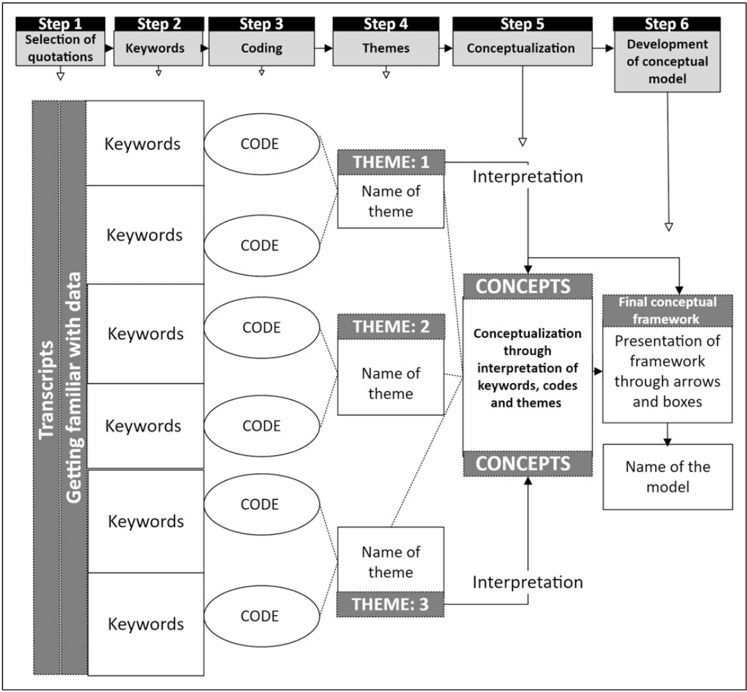
- The paper proposes six steps: transcription/familiarization and quotation selection; keyword selection; coding; theme development; conceptualization through interpretation of keywords, codes, and themes; and development of a conceptual model.
- It introduces 6Rs for keyword selection (realness, richness, repetition, rationale, repartee, regal), 6Rs for coding (robust, reflective, resplendent, relevant, radical, righteous), and 4Rs for theming (reciprocal, recognizable, responsive, resourceful).
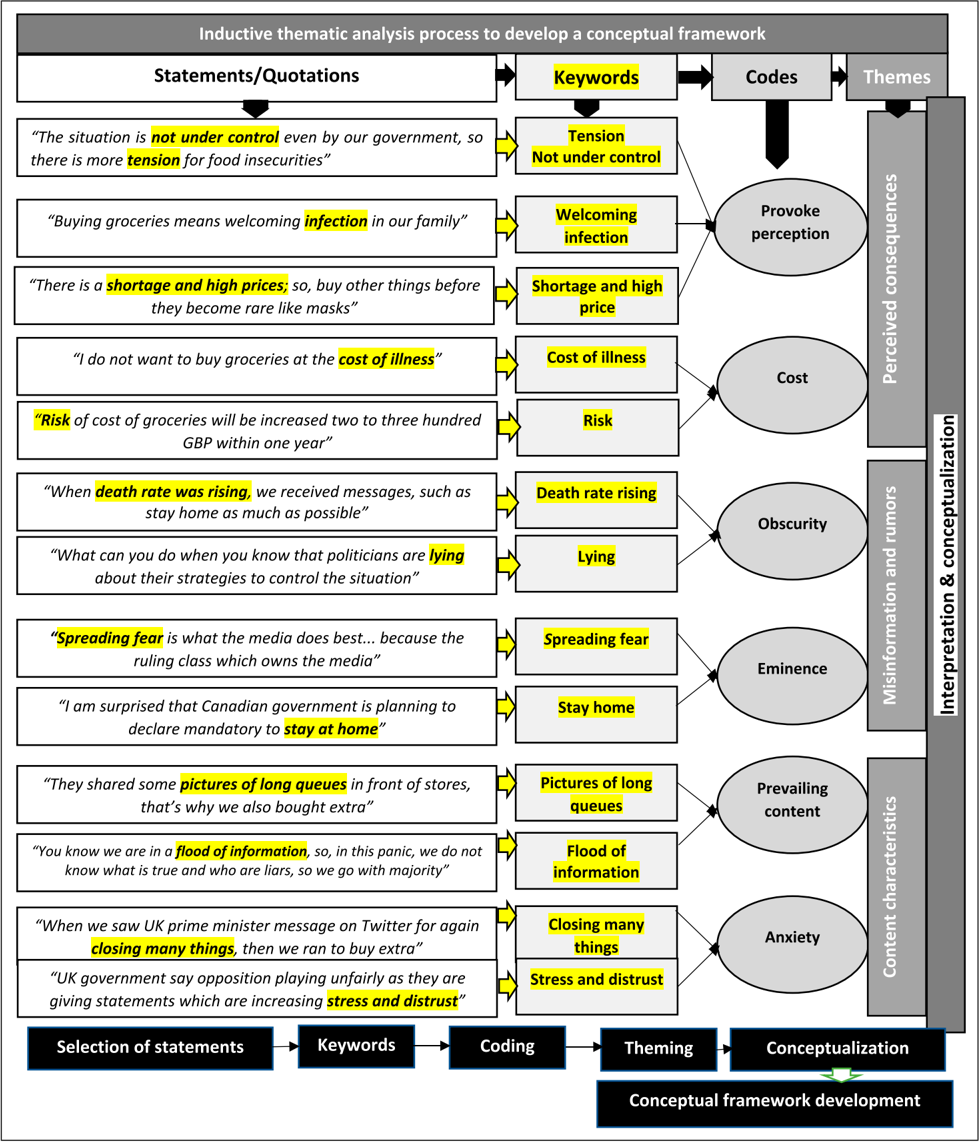
- In the exemplar study, three main themes emerged: “Perceived consequences” from codes “Provoke perception” and “Cost”; “Misinformation and rumors” from codes “Obscurity” and “Eminence”; and “Content Characteristics” from codes “Prevailing content” and “Anxiety.”
- The exemplar’s final model, “Panic buying as social practice,” was based on Protection Motivation Theory (PMT) and the Theory of Rumor Transmission (TORT).
Methods
- Design: a methodological/conceptual paper that presents a comprehensive systematic model for thematic analysis culminating in a conceptual model, using Naeem and Ozuem (2022a) as an exemplar.
- Exemplar data: qualitative data gathered from Twitter, YouTube, and interviews; the exemplar used a six-stage thematic analysis and a social constructionist perspective with PMT and TORT as theoretical foundations.
- Main analysis: the paper describes each of the six steps in detail, provides practical examples from the exemplar, and compares the proposed process with Braun and Clarke’s (2006) six steps of thematic analysis.
Limitations
- The paper states that the potential of the process to address other research contexts or quantitative methods may require further exploration, and that the efficiency of the method compared with other model-building approaches has not been empirically tested.
- Evident from the text: the proposed six-step process and the 6Rs/4Rs are illustrated through a single exemplar study and are not independently validated or empirically compared with alternative thematic analysis approaches.
Model-written summary. Check it against the paper before relying on it.
Integrity signals
Registry
Cites
Statistics
Figures

Verification
Claims the paper makes
0 Valid · 4 Not valid · 56 Not checked · 89 Own results and interpretations
The cited sources that could be checked couldn’t confirm or dispute this claim.
In the paper
“For narrative approaches, conceptual model development focuses on personal experiences, emotions, and life histories (Eldh et al., 2020).”
§ A Step-by-Step Process of Thematic Analysis to Develop a Conceptual Model in Qualitative Research > Step 6: Development of Conceptual Model.
What the sources say
- Could not verifycites Eldh et al., 2020 matched to “Quotations in Qualitative Studies: Reflections on Constituents, Custom, and Purpose” (2020) sourceExperimental — accuracy not yet measured
The Discussion and Conclusions (page numbers unavailable) address how quotations can illustrate qualitative analysis and findings. A search for narrative approaches, conceptual model development, emotions, and life histories found no passage addressing the attributed claim. (LLM, conf=0.72)
plainstates an association- Asserted: passes — The authors put it forward as true.
- Checkable: passes — It can be checked against evidence.
- Load-bearing: unclear — It is unclear whether the paper’s conclusions depend on it.
- Based: passes — The paper gives a reason why it holds.
- Could not verify
In the paper
“The analytical process balances between descriptive analysis, which outlines patterns or trends, and interpretive analysis, which offers subjective perspectives (Miles & Huberman, 1994, p. 56).”
§ A Step-by-Step Process of Thematic Analysis to Develop a Conceptual Model in Qualitative Research > Step 2: Selection of Keywords.
What the sources say
- Not matchedcites Miles & Huberman, 1994, p. 56
An author–year citation the paper’s reference list doesn’t settle. We don’t search these by name.
plain- Asserted: passes — The authors put it forward as true.
- Checkable: passes — It can be checked against evidence.
- Load-bearing: passes — The paper’s conclusions depend on it.
- Based: passes — The paper gives a reason why it holds.
- Not matched
In the paper
“However, the thematic analysis approach could also fit a post-positivist paradigm (Howell, 2012, p. 30).”
§ A Step-by-Step Process of Thematic Analysis to Develop a Conceptual Model in Qualitative Research > Step 2: Selection of Keywords.
What the sources say
- Not matchedcites Howell, 2012, p. 30
An author–year citation the paper’s reference list doesn’t settle. We don’t search these by name.
hedgedstates an association- Asserted: passes — The authors put it forward as true.
- Checkable: passes — It can be checked against evidence.
- Load-bearing: unclear — It is unclear whether the paper’s conclusions depend on it.
- Based: passes — The paper gives a reason why it holds.
- Not matched
In the paper
“Hence, quotation selection is not simply a mechanical task but is influenced by the researcher's philosophical and theoretical approach (Jackson & Mazzei, 2012).”
§ A Step-by-Step Process of Thematic Analysis to Develop a Conceptual Model in Qualitative Research > Step 1: Transcription, Familiarization With the Data, and Selection of Quotations.
What the sources say
- Not matchedcites Jackson & Mazzei, 2012
An author–year citation the paper’s reference list doesn’t settle. We don’t search these by name.
plainstates a cause- Asserted: passes — The authors put it forward as true.
- Checkable: passes — It can be checked against evidence.
- Load-bearing: passes — The paper’s conclusions depend on it.
- Based: passes — The paper gives a reason why it holds.
- Not matched
A conclusion the paper draws from its own results — it cites no other source for it, so there is none to check. The quote shows it is in the paper.
In the paper
“Thus, keywords serve as a critical bridge between data and themes in different methodologies.”
§ A Step-by-Step Process of Thematic Analysis to Develop a Conceptual Model in Qualitative Research > Step 4: Theme Development.
boostedstates an association- Asserted: passes — The authors put it forward as true.
- Checkable: passes — It can be checked against evidence.
- Load-bearing: unclear — It is unclear whether the paper’s conclusions depend on it.
- Based: passes — The paper gives a reason why it holds.
10 more claims
Create a free account to see all 149 claims and every source verdict.
- It may state two separate claims as one. 54
- Probably not a substantial claim. 128
Claims other papers make about this one
Each is checked against this paper’s own text: does it say what the citing paper says it does?
The source backs part of the claim, not all of it — or backs it for a different population, condition or comparison.
In the citing paper
“With the identified keywords, initial coding was further informed by and cross-referenced to the literature on AI ethics and governance, particularly addressing public concerns in government AI, alongside the author team's collective expertise in AI-driven digital transformation in public administration.”
From Accountability in Government Use of AI : Citizen Concerns and Preferences (2025) · cites this paper as Naeem et al. 2023
Experimental — accuracy not yet measuredThe source backs part of the claim, not all of it — or backs it for a different population, condition or comparison.
In the citing paper
“Thematic analysis is a highly popular technique among qualitative researchers for analyzing qualitative data, which usually comprises thick descriptive data (Naeem et al., 2023).”
From The Psycho-Emotive Effects of AI-Generated Fake News on Social Media Users (2026) · cites this paper as Naeem et al., 2023
Experimental — accuracy not yet measuredThe cited source says what the claim attributes to it.
In the citing paper
“The selection of keywords was guided by the 6Rs framework-Realness, Richness, Repetition, Rationale, Repartee, and Regal-to ensure they accurately represented the essence of the data (Naeem et al. 2023).”
From Accountability in Government Use of AI : Citizen Concerns and Preferences (2025) · cites this paper as Naeem et al. 2023
The cited source says what the claim attributes to it.
In the citing paper
“The data were analyzed through Naeem et al.'s (2023) six-step thematic analysis process to develop a conceptual framework (Naeem & Ozuem, 2022).”
From “It’s Not Just About Competition – It’s Ceremony”: Introducing the Embedded Indigeneity Framework for Understanding Identity, Mission, and Practice in TCU and NASNTI Athletics (2026) · cites this paper as Naeem et al. (2023)
The cited source says what the claim attributes to it.
In the citing paper
“The selected methodology was implemented due to the end results that 1) presented a novel conceptual framework and 2) serves as a contextually specific extension of existing theory/theories (Naeem et al., 2023).”
From “It’s Not Just About Competition – It’s Ceremony”: Introducing the Embedded Indigeneity Framework for Understanding Identity, Mission, and Practice in TCU and NASNTI Athletics (2026) · cites this paper as Naeem et al., 2023
Self-check
Percentages, sums and reported differences re-computed from the paper’s own numbers.
Each contradiction between two passages listed here was confirmed by an independent check.
Rated minor: it would not touch a result — a value no result rests on, a p-value that stays on the same side of the significance level, or a conflict that is clerical, resolved elsewhere in the paper, or outside its own findings.
In the paper
§ A Step-by-Step Process of Thematic Analysis to Develop a Conceptual Model in Qualitative Research > Step 6: Development of Conceptual Model.
“Positivism, which favours inductive methods, builds its model on top of previously established theories and conducts its experiments in an unbiased manner.”
§ A Step-by-Step Process of Thematic Analysis to Develop a Conceptual Model in Qualitative Research > Step 6: Development of Conceptual Model.
“An inductive approach is primarily data-driven, whereby themes are derived from the data itself without the influence of pre-existing theories (Braun & Clarke, 2006).”
Citations
Cites
Using thematic analysis in psychology
Braun, V., & Clarke, V. (2006) · Qualitative Research in Psychology · doi:10.1191/1478088706qp063oa · Cited by 194,414
Qualitative Data Analysis: An Expanded Sourcebook
(1994) · Journal of Environmental Psychology · doi:10.1016/s0272-4944(05)80231-2 · Cited by 48,420 · cited 2×
“In the coding process, consideration of keywords helps in multiple ways: The analytical process balances between descriptive analysis, which outlines patterns or trends, and interpretive analysis, which offers subjective perspectives (Miles & Huberman, 1994, p. 56).”
Lincoln, Y. S., Guba, E. G., & Pilotta, J. J. (1985) · International Journal of Intercultural Relations · doi:10.1016/0147-1767(85)90062-8 · Cited by 45,787 · cited 1×
“…degrees of subjectivity and objectivity has underscored the fl exibility intrinsic to research methodologies and highlighted that these tools of analysis are intimately intertwined with, and, indeed, emerge from the distinctive nature of speci fi c disciplines and perspectives (Lincoln & Guba, 1985).”
BackgroundThe Discovery of Grounded Theory: Strategies for Qualitative Research
Glaser, B. G., & Strauss, A. L. (2017) · Aldine (Routledge reprint) · doi:10.4324/9780203793206 · Cited by 25,789
The qualitative content analysis process
Elo, S., & Kyngäs, H. (2008) · Journal of Advanced Nursing · doi:10.1111/j.1365-2648.2007.04569.x · Cited by 22,617 · cited 1×
“Deductive coding, linked with descriptive analysis, is a top-down approach where pre-existing theories, models, or codes guide the data analysis (Elo & Kyng¨as, 2008).”
Method(2009) · Cited by 21,330
Reflecting on reflexive thematic analysis
Braun, V., & Clarke, V. (2019) · Qualitative Research in Sport, Exercise and Health · doi:10.1080/2159676x.2019.1628806 · Cited by 19,677
(1998) · Medical Entomology and Zoology · Cited by 18,397
(2014) · Cited by 15,747
S., N. L. (2017) · doi:10.1177/1609406917733847 · Cited by 14,051 · cited 3×
“· Robust: Coding should convey the true essence of data in a theoretical manner (Nowell et al., 2017).”
Background(1998) · Cited by 13,501
Fereday, J., & Muir-Cochrane, E. (2006) · International Journal of Qualitative Methods · doi:10.1177/160940690600500107 · Cited by 11,829 · cited 6×
“The data is interpreted via the lens of an existing theory or conceptual model (Fereday & Muir-Cochrane, 2006).”
BackgroundMethodInfluentialA General Inductive Approach for Analyzing Qualitative Evaluation Data
Thomas, D. R. (2006) · American Journal of Evaluation · doi:10.1177/1098214005283748 · Cited by 10,858 · cited 5×
“…and, with some adaptation, more descriptive positivist-based methodologies would bene fi t. Thematic analysis is a research method used to identify and interpret patterns or themes in a data set; it often leads to new insights and understanding (Boyatzis, 1998; Elliott, 2018; Thomas, 2006).”
BackgroundMethodInfluentialBasics of Qualitative Research: Techniques and Procedures for Developing Grounded Theory
Wuetherick, B. (2010) · Canadian Journal of University Continuing Education · doi:10.21225/d5g01t · Cited by 8,311
Handbook of Qualitative Research.
DeVault, M. L., Denzin, N., & Lincoln, Y. (1995) · Contemporary Sociology · doi:10.2307/2076551 · Cited by 6,282
Thematic networks: an analytic tool for qualitative research
Attride-Stirling, J. (2001) · Qualitative Research · doi:10.1177/146879410100100307 · Cited by 5,506 · cited 2×
“As stated by Attride-Stirling (2001), the process of coding involves breaking down real data into smaller, more manageable pieces that can then be categorized and analyzed for patterns and themes.”
BackgroundWhat's in a name? Qualitative description revisited
Sandelowski, M. (2010) · Research in Nursing & Health · doi:10.1002/nur.20362 · Cited by 4,975 · cited 1×
“· Radical: Codes should avoid overlap and offer unique insights, even when contradicting the main narrative (Boyatzis, 1998; Braun & Clarke, 2006; Creswell, 2015; Sandelowski, 2010).”
Background(1998) · UWA Profiles and Research Repository (UWA) · Cited by 4,686
Theory Construction in Qualitative Research: From Grounded Theory to Abductive Analysis
Timmermans, S., & Tavory, I. (2012) · Sociological Theory · doi:10.1177/0735275112457914 · Cited by 4,349 · cited 2×
“Critical realists seek causal explanations of reality and employ approaches like critical thematic analysis (Timmermans & Tavory, 2012).”
MethodQualitative Research Methods: Collecting Evidence, Crafting Analysis, Communicating Impact
Tracy, S. J. (2012) · Cited by 4,135
(1999) · Practitioner Research in Counselling · doi:10.4135/9781849209588.n8 · Cited by 3,958
The problem of rigor in qualitative research
Sandelowski, M. (1986) · Advances in Nursing Science · doi:10.1097/00012272-198604000-00005 · Cited by 2,772 · cited 1×
“· Re fl ective: Codes should symbolize a relationship be-tween facts and theories to create a lens through which facts can be interpreted (Guba & Lincoln, 1994; Sandelowski, 1986; Savage, 2000).”
BackgroundProtection motivation and self-efficacy: A revised theory of fear appeals and attitude change
Maddux, J. E., & Rogers, R. W. (1983) · Journal of Experimental Social Psychology · doi:10.1016/0022-1031(83)90023-9 · Cited by 2,342 · cited 1×
“The notion of protection motivation suggests that people take precautions in response to two considerations: the perceived severity of the threat and the con fi dence that they can successfully deal with it (Maddux & Rogers, 1983).”
BackgroundIssues of validity and reliability in qualitative research
Noble, H., & Smith, J. (2015) · Evidence Based Nursing · doi:10.1136/eb-2015-102054 · Cited by 1,758 · cited 1×
“Many scholars argue that credibility provides a better alignment with a qualitative worldview (Noble & Smith, 2015).”
BackgroundHandling Qualitative Data: A Practical Guide
Pearson, M. (2005) · Sociological Research Online · doi:10.1177/136078040501000407 · Cited by 1,512
Thinking with Theory in Qualitative Research
Jackson, A. Y., & Mazzei, L. A. (2011) · Routledge eBooks · doi:10.4324/9780203148037 · Cited by 1,459
The Coding Process and Its Challenges
Holton, J. A. (2007) · The SAGE Handbook of Grounded Theory · doi:10.4135/9781848607941.n13 · Cited by 1,001
Qualitative Research in Education: A User’s Guide
Papamichael, E. (2007) · Educate~/Educate · Cited by 967
Crabtree, B. F., Miller, W. L., & Swenson, M. M. (1995) · Nursing Research · doi:10.1097/00006199-199507000-00011 · Cited by 956
Conceptualization: On Theory and Theorizing Using Grounded Theory
Glaser, B. G. (2002) · International Journal of Qualitative Methods · doi:10.1177/160940690200100203 · Cited by 932 · cited 1×
“A concept is de fi ned as “ the naming of an emergent social pattern grounded in research da ta ” (Glaser, 2002, p. 24).”
Oliver, D. G., Serovich, J. M., & Mason, T. L. (2005) · Social Forces · doi:10.1353/sof.2006.0023 · Cited by 897 · cited 1×
““ Within speech are meanings and perceptions that construct our reality ” (Oliver et al., 2005, p. 1274), which can be taken to mean that keywords (sets of words) have meaning or are meaningful for research.”
BackgroundClassifying the Findings in Qualitative Studies
Sandelowski, M., & Barroso, J. (2003) · Qualitative Health Research · doi:10.1177/1049732303253488 · Cited by 851 · cited 1×
“· Relevant: Codes should symbolize inferential and descriptive data gathered during research; they should represent the data using the most suitable phrases (Corbin & Strauss, 2015; Cunningham, 2004; Saldana, 2016; Sandelowski & Barroso, 2003).”
BackgroundApplying thematic analysis theory to practice: A researcher’s experience
Tuckett, A. G. (2005) · Contemporary Nurse · doi:10.5172/conu.19.1-2.75 · Cited by 840 · cited 1×
“To properly document an interview, a high-quality audio recording and, preferably, a word-for-word transcription are required; the researcher could also manually highlight patterns in the data (Tuckett, 2005) with the intention to fi nd the most relevant statements.”
MethodThe Concept of Theme as Used in Qualitative Nursing Research
DeSantis, L., & Ugarriza, D. N. (2000) · Western Journal of Nursing Research · doi:10.1177/01939450022044467 · Cited by 782 · cited 1×
“· Resourceful: Theming involves examining codes and the extracts they come from and then grouping the codes into broader themes that display patterns (Braun & Clarke, 2006; DeSantis & Ugarriza, 2000).”
BackgroundThinking about the Coding Process in Qualitative Data Analysis
Elliott, V. (2018) · The Qualitative Report · doi:10.46743/2160-3715/2018.3560 · Cited by 746 · cited 2×
“…and, with some adaptation, more descriptive positivist-based methodologies would bene fi t. Thematic analysis is a research method used to identify and interpret patterns or themes in a data set; it often leads to new insights and understanding (Boyatzis, 1998; Elliott, 2018; Thomas, 2006).”
The Distinctions Between Theory, Theoretical Framework, and Conceptual Framework
Varpio, L., Paradis, E., Uijtdehaage, S., & Young, M. (2020) · Academic Medicine · doi:10.1097/acm.0000000000003075 · Cited by 681
Achieving Rigor in Qualitative Analysis: The Role of Active Categorization in Theory Building
Grodal, S., Anteby, M., & Holm, A. L. (2021) · Academy of Management Review · doi:10.5465/amr.2018.0482 · Cited by 646 · cited 1×
“Grodal et al. (2021) stated that in order to apply theoretical frameworks to develop a conceptual model, it is the researcher ’ s job to develop a novel application of the chosen theory (or theories) in a speci fi c context to answer the research questions.”
MethodXu, W., & Zammit, K. (2020) · International Journal of Qualitative Methods · doi:10.1177/1609406920918810 · Cited by 634 · cited 1×
“It involves the identi fi cation and reporting of patterns in a data set, which are then interpreted for their inherent meaning (Braun & Clarke, 2006; Liebenberg et al., 2020; Xu & Zammit, 2020); these patterns can be found on the basis of understanding the meaning of keywords used by participants.”
Background(2013) · Lincoln (University of Nebraska) · Cited by 599
Shatz, M., Ochs, E., & Schieffelin, B. B. (1981) · Language · doi:10.2307/413708 · Cited by 586
(2015) · Cited by 568
The Sage handbook of grounded theory
(2008) · Choice Reviews Online · doi:10.5860/choice.45-6250 · Cited by 561
Utilizing and Adapting the Delphi Method for Use in Qualitative Research
Brady, S. R. (2015) · International Journal of Qualitative Methods · doi:10.1177/1609406915621381 · Cited by 478 · cited 1×
“In other words, the process of selecting certain parts of an interview and leaving out others is important because it makes the transcript more concise and easier to analyze (Brady, 2015; Lamba et al., 2022).”
BackgroundQualitative Data Analysis: From Start to Finish
Harding, J. (2018) · Cited by 416
Bridging Positivist and Interpretivist Approaches to Qualitative Methods
Lin, A. C. (1998) · Policy Studies Journal · doi:10.1111/j.1541-0072.1998.tb01931.x · Cited by 400 · cited 2×
“As Braun and Clarke (2019) posited, understanding the theoretical and philosophical underpinnings of thematic analysis enables researchers to adopt an appropriate methodological approach, thereby assuring the validity and trustworthiness of the fi ndings (Lin, 1998).”
BackgroundAn Introduction to the Philosophy of Methodology
Howell, K. (2013) · SAGE Publications Ltd eBooks · doi:10.4135/9781473957633 · Cited by 396
Self-citationWiltshire, G., & Ronkainen, N. (2021) · Journal of Critical Realism · doi:10.1080/14767430.2021.1894909 · Cited by 370 · cited 1×
“Studies such as those conducted by Wiltshire and Ronkainen (2021) and Fryer (2022) provide insights into how critical realism is applied in thematic analysis and demonstrate its unique contribution in making sense of qualitative data through experiential, inferential, and dispo-sitional themes.”
MethodQuotations in Qualitative Studies: Reflections on Constituents, Custom, and Purpose
Eldh, A. C., Årestedt, L., & Berterö, C. (2020) · International Journal of Qualitative Methods · doi:10.1177/1609406920969268 · Cited by 362 · cited 6×
“It is essential, however, to refrain from choosing quo-tations that merely incite controversy; instead, researchers should focus on those that genuinely illustrate the fi ndings (Eldh et al., 2020).”
BackgroundInfluentialThe Coding Manual for Qualitative Researchers (3rd edition)
Wicks, D. (2017) · Qualitative Research in Organizations and Management: An International Journal · doi:10.1108/qrom-08-2016-1408 · Cited by 351 · cited 1×
“Thematic analysis aims to identify and report the most repeated patterns in the data (Braun & Clarke, 2006; Saldana, 2021; Wicks, 2017).”
BackgroundAppraising qualitative research articles in medicine and medical education
Côté, L., & Turgeon, J. (2005) · Medical Teacher · doi:10.1080/01421590400016308 · Cited by 312 · cited 1×
“Transparent representation of diverse participants ’ quotations augments the credibility of fi ndings and contributes to the trustworthiness of the research (C ˆ ot´e & Turgeon, 2005).”
BackgroundCompleting a Qualitative Project: Details and Dialogue
Copp, M., & Morse, J. M. (1998) · Contemporary Sociology · doi:10.2307/2654306 · Cited by 297
Representing Discourse: The Rhetoric of Transcription
Mishler, E. G. (1991) · Journal of Narrative and Life History · doi:10.1075/jnlh.1.4.01rep · Cited by 280 · cited 1×
“Choosing keywords that have a solid basis in the data and are pertinent to the research issue can improve the reliability of the study as a whole (Mischler, 1991).”
BackgroundThe SAGE Handbook of Qualitative Research Design
Flick, U. (2022) · doi:10.4135/9781529770278 · Cited by 267 · cited 1×
“The principles of the thematic analysis technique, such as coding of data, searching for themes, re fi ning the themes, and reporting the fi ndings, are relatable to other qualitative methods, such as discourse analysis (Flick, 2022).”
MethodProse and Cons about Goal-Free Evaluation
Scriven, M. (1991) · Evaluation Practice · doi:10.1177/109821409101200108 · Cited by 259 · cited 1×
“According to Scriven (1991), a “ goal-free ” evaluation aligns well with inductive research where theories are developed from the data.”
BackgroundMorse, J. M. (2016) · doi:10.4324/9781315421650 · Cited by 253
Rogers, R. (2018) · The Qualitative Report · doi:10.46743/2160-3715/2018.3459 · Cited by 238
Beyond the default colon: Effective use of quotes in qualitative research
Lingard, L. (2019) · Perspectives on Medical Education · doi:10.1007/s40037-019-00550-7 · Cited by 226 · cited 5×
“Indeed, quotations may serve various purposes, including evidence, explanation, illustration, impression (Lingard, 2019), representation (Eldh et al., 2020), and readability enhancement.”
BackgroundInfluentialA critical realist approach to thematic analysis: producing causal explanations
Fryer, T. (2022) · Journal of Critical Realism · doi:10.1080/14767430.2022.2076776 · Cited by 197 · cited 1×
“Studies such as those conducted by Wiltshire and Ronkainen (2021) and Fryer (2022) provide insights into how critical realism is applied in thematic analysis and demonstrate its unique contribution in making sense of qualitative data through experiential, inferential, and dispo-sitional themes.”
MethodFormulating and Evaluating Theoretical Frameworks for Career and Technical Education Research
Camp, W. G. (2001) · Journal of Vocational Education Research · doi:10.5328/jver26.1.4 · Cited by 194 · cited 1×
“To clarify the difference between a theoretical and conceptual model, Camp (2001) pointed out that a theoretical framework is based on an already established theory (or theories) in the literature, which has been subjected to rigorous testing and validation by other researchers and is widely…”
BackgroundA Theory of Rumor Transmission
Buckner, H. T. (1965) · Public Opinion Quarterly · doi:10.1086/267297 · Cited by 153 · cited 1×
“According to TORT, spreading rumors serves mostly to allay people ’ s unaddressed worries (Buckner, 1965).”
BackgroundNaeem, M. (2020) · Qualitative Market Research An International Journal · doi:10.1108/qmr-04-2020-0050 · Cited by 139 · cited 1×
“The resulting themes provide understanding for constructing a coherent narrative that connects the quotations, keywords and themes together; this enables a thorough understanding of the data and helps to answer the research question (Naeem, 2021).”
BackgroundSelf-citationExtending Youth Voices in a Participatory Thematic Analysis Approach
Liebenberg, L., Jamal, A., & Ikeda, J. (2020) · International Journal of Qualitative Methods · doi:10.1177/1609406920934614 · Cited by 134 · cited 1×
“It involves the identi fi cation and reporting of patterns in a data set, which are then interpreted for their inherent meaning (Braun & Clarke, 2006; Liebenberg et al., 2020; Xu & Zammit, 2020); these patterns can be found on the basis of understanding the meaning of keywords used by participants.”
BackgroundExploring qualitatively-derived concepts: inductive—deductive pitfalls
Morse, J. M., & Mitcham, C. (2002) · International Journal of Qualitative Methods · doi:10.1177/160940690200100404 · Cited by 118 · cited 1×
“However, it is critical that researchers avoid letting their own preconceptions interfere with the identi fi - cation of key themes (Morse & Mitcham, 2002; Patton, 2015).”
BackgroundBurgess, A. R., Bauer, E., Gallagher, S., Karstens, B., Lavoie, L., Ahrens, K. A., & O’Connor, A. B. (2021) · Journal of Substance Abuse Treatment · doi:10.1016/j.jsat.2021.108488 · Cited by 109 · cited 1×
“Community-based participatory research approaches prioritize collaboration with community members throughout the research process to ensure that the outcomes are representative of the community ’ s needs and perspectives (Burgess et al., 2021; Kyoon-Achan et al., 2018).”
BackgroundReview and Theory Symbiosis: An Introspective Retrospective
Baylor University and Lund University, & Leidner, D. (2018) · Journal of the Association for Information Systems · doi:10.17705/1jais.00501 · Cited by 102 · cited 1×
“Inter-pretation indicates how the concept was developed from the data (Leidner et al., 2018) and the interpretation requires: (1) de fi ning the range of possible interpretations (i.e., dimensions) of a concept (Gupta & Awasthy, 2021), and (2) fi g-uring out the kinds of evidence (i.e., indicators)…”
MethodNaeem, M., & Ozuem, W. (2022) · Information Technology & People · doi:10.1108/itp-01-2021-0061 · Cited by 94 · cited 18×
“During data collection, researchers might take note of participants ’ most frequently used keywords, as suggested by Naeem and Ozuem (2022a).”
BackgroundMethodInfluentialSelf-citationOne voice, different tunes: issues raised by dual analysis of a segment of qualitative data
Savage, J. (2000) · Journal of Advanced Nursing · doi:10.1046/j.1365-2648.2000.01432.x · Cited by 91 · cited 1×
“· Re fl ective: Codes should symbolize a relationship be-tween facts and theories to create a lens through which facts can be interpreted (Guba & Lincoln, 1994; Sandelowski, 1986; Savage, 2000).”
BackgroundInnovating for Transformation in First Nations Health Using Community-Based Participatory Research
Kyoon-Achan, G., Lavoie, J., Avery Kinew, K., Phillips-Beck, W., Ibrahim, N., Sinclair, S., & Katz, A. (2018) · Qualitative Health Research · doi:10.1177/1049732318756056 · Cited by 69 · cited 1×
“Community-based participatory research approaches prioritize collaboration with community members throughout the research process to ensure that the outcomes are representative of the community ’ s needs and perspectives (Burgess et al., 2021; Kyoon-Achan et al., 2018).”
BackgroundQualitative Research Skills for Social Work
Carey, M. (2017) · doi:10.4324/9781315245546 · Cited by 44
Naeem, M., & Ozuem, W. (2022) · Qualitative Market Research An International Journal · doi:10.1108/qmr-02-2021-0028 · Cited by 42 · cited 18×
“During data collection, researchers might take note of participants ’ most frequently used keywords, as suggested by Naeem and Ozuem (2022a).”
BackgroundMethodInfluentialSelf-citationQualitative Research in Management: Methods and Experiences
Gupta, R. K., & Awasthy, R. (2015) · SAGE Publications Pvt. Ltd eBooks · doi:10.4135/9789354798948 · Cited by 41 · cited 2×
“…data (Leidner et al., 2018) and the interpretation requires: (1) de fi ning the range of possible interpretations (i.e., dimensions) of a concept (Gupta & Awasthy, 2021), and (2) fi g-uring out the kinds of evidence (i.e., indicators) that might be seen (directly or indirectly) to demonstrate the…”
BackgroundQualitative Analysis Using R: A Free Analytic Tool
Estrada, S. (2017) · The Qualitative Report · doi:10.46743/2160-3715/2017.2659 · Cited by 41
Grundy, A. L., Pollon, D. E., & McGinn, M. K. (2003) · International Journal of Qualitative Methods · doi:10.1177/160940690300200203 · Cited by 40 · cited 2×
“Reading a transcript repeatedly can help researchers select appropriate statements from the data (Grundy et al., 2003; Tracy, 2019), but this suggestion is too subjective.”
BackgroundMethodLamba, N., Tonder, A. V., & Raghavan, A. (2022) · International Journal of Qualitative Methods · doi:10.1177/16094069221110295 · Cited by 27 · cited 1×
“In other words, the process of selecting certain parts of an interview and leaving out others is important because it makes the transcript more concise and easier to analyze (Brady, 2015; Lamba et al., 2022).”
BackgroundBook Review: The Coding Manual for Qualitative Researchers , 3rd ed.
Simula, B. L. (2018) · Teaching Sociology · doi:10.1177/0092055x18760362 · Cited by 25 · cited 1×
“To analyze interview or focus group data, as per current understanding of thematic analysis, quotations or statements are selected from the data and grouped together under a code (Saldana, 2021; Simula, 2018; Tracy, 2019).”
MethodUncovering the role of social motivational factors as a tool for enhancing brand-related content
Naeem, M. (2020) · Qualitative Market Research An International Journal · doi:10.1108/qmr-10-2019-0121 · Cited by 22 · cited 1×
“In the process of developing themes, a researcher engages in a deeper level of interpretation; they move beyond the more concrete categories derived from the initial coding process to uncover abstract patterns, trends, or relationships that shed light on the research questions (Naeem, 2020).”
BackgroundSelf-citationProfessional practice and perspectives in the teaching of historical empathy
Cunningham, D. L. (2004) · OpenGrey (Institut de l'Information Scientifique et Technique) · doi:10.5287/ora-gar6omrg9 · Cited by 13
Tavares, A., Crespo, C., Ferreira, L. C., & Ribeiro, M. T. (2021) · Journal of Marital and Family Therapy · doi:10.1111/jmft.12478 · Cited by 6
Research works printed but not linked: 9
- 1. Arar, K. (2017). The what's and why's of the how to of qualitative research. Qualitative Report, 22(11), 2956-2958.
- 16. Creswell, J. W. (2012). Educational research. Pearson.
- 19. Denzin, N. K., & Salvo, J. (2020). New directions in theorizing qualitative research: Theory as resistance. Myers Education Press.
- 62. Oliver, P. (2021). Using qualitative methods to answer your research question (First). Open University Press.
- 63. Patton, M. Q. (2015). Qualitative research & evaluation methods: Integrating theory and practice (fourth). Sage Publications, Inc. Qualitative research (pp. 273-290). Sage.
- 67. Saldana, J. (2021). The coding manual for qualitative researchers (Fourth). Sage.
- 68. Saldana, J. M. (2016). The coding manual for qualitative researchers (4rd ed.). Sage Publications.
- 74. Seale, C. (2013). Qualitative research practice. In C. Seale, G. Gobo, J. Gubrium, & D. Silverman (Eds.), Concise paperback. Sage.
- 80. Tracy, S. J. (2019). Qualitative research methods: Collecting evi- dence, crafting analysis, communicating impact (2nd ed.). Wiley Blackwell.
Cited by
Naeem, M., Ozuem, W., Howell, K., & Ranfagni, S. (2024) · International Journal of Qualitative Methods · doi:10.1177/16094069241229777 · Cited by 294
“This means that the researcher has discovered all signi fi cant themes, codes and patterns within the data set, and that all of these are fully interpreted so as to add new knowledge (Naeem, et al., 2023).”
InfluentialSelf-citationVlachopoulos, D., & Makri, A. (2024) · Studies in Educational Evaluation · doi:10.1016/j.stueduc.2024.101425 · Cited by 144
Rony, M. K. K., Numan, S. M., Akter, K., Tushar, H., Debnath, M., Johra, F. T., Akter, F., Mondal, S., Das, M., Uddin, M. J., et al. (2024) · Heliyon · doi:10.1016/j.heliyon.2024.e36702 · Cited by 93
“Employing Van Manen ’ s hermeneutic phenomenology within thematic analysis allowed for a nuanced exploration of the interplay between individual experiences and broader contextual factors, ensuring a holistic understanding of nurses ’ viewpoints [39 – 41].”
MethodNaeem, M., Smith, T., & Thomas, L. (2025) · International Journal of Qualitative Methods · doi:10.1177/16094069251333886 · Cited by 195
“(Naeem et al., 2023).”
InfluentialSelf-citationWang, F., Li, N., Cheung, A. C. K., & Wong, G. K. W. (2025) · International Journal of Educational Technology in Higher Education · doi:10.1186/s41239-025-00547-9 · Cited by 69
“The analysis adheres to the guidelines proposed by Naeem et al. (2023) for conducting a thematic analysis to develop a conceptual model, including six steps: (1) transcribing, familiarizing with data, and selecting quotations, (2) selecting keywords, (3) coding, (4) constructing themes, (5)…”
Metadata
- Authors
- Naeem, M., Ozuem, W., Howell, K., & Ranfagni, S.
- Affiliations
- University of Gloucestershire (GB)
- University of Cumbria (GB)
- Northumbria University (GB)
- University of Florence (IT)
- Corresponding author
- Naeem, Muhammad
- Venue
- International Journal of Qualitative Methods
- Publisher
- SAGE Publications
- Published
- 2023-10
- Volume
- 22
- ISSN
- 1609-4069 (ISSN-L)
- OpenAlex
- W4388503650
- Cited by
- 2,243
- References
- 71
- Citations by year
- 2026: 1000 · 2025: 981 · 2024: 258 · 2023: 4
- FWCI
- 1654.78
- Type
- journal article
- Language
- en
- Open access
- gold
- doi.org
- Licence
- Locations
- International Journal of Qualitative Methods (publishedVersion, cc-by-nc)
- Insight (University of Cumbria) (acceptedVersion)
- DOAJ (DOAJ: Directory of Open Access Journals) (submittedVersion, cc-by-sa)
- Florence Research (University of Florence) (submittedVersion)
- Topics
- Social Sciences › Education › Qualitative Research Methods and Applications
- Social Sciences › Sociology and Political Science › Qualitative Research Methods and Ethics
- Social Sciences › General Social Sciences › Computational and Text Analysis Methods
- Keywords
- thematic analysis, conceptual modeling, qualitative data analysis, inductive coding, deductive coding, grounded theory, interpretive phenomenology, constructivist research, positivist research, theoretical conceptualization, replicability
About these checks
Registry, retraction, Cites and statistics results are computed, not judged, with one exception: a printed reference that no index lists is read once by a model before it counts as a citation error. Claims are extracted by a model and kept only when their quote appears verbatim in the text; each cited source is then checked, with a model’s help, for whether it says what the claim relies on. Those verdicts can be wrong — read the claim’s quote and the cited source before relying on one.
The claim verdicts this report counts are experimental: their accuracy is not yet measured.
A language model drew the claims from the paper on 2026-10-10, under version 3 of the claim definition (model deepseek-v4.1-flash, prompt extract-v3).
A second model labelled each claim on 2026-10-10 (model jev-1.13-20260917, definition revision gold-guideline-v0.2).
Cited sources are checked with a language model’s help (gpt-6-sol).
Statistics and arithmetic are recomputed, not judged.
Confidence bands are shown only for fields calibrated on our annotated test set. None is calibrated yet, so no band is shown.
What counts as a claim ›How we measure confidence ›How we check this ›
Are you an author, or do you see a problem with this page? Request a review
Data sources
Bibliographic data: Semantic Scholar, OpenAlex, Crossref.
Contains information from the Semantic Scholar Academic Graph Datasets, made available under the ODC Attribution License (ODC-BY 1.0).
Semantic Scholar’s data is described in: Kinney, R., et al. (2023). The Semantic Scholar Open Data Platform. arXiv:2301.10140.
