

Virtual Reality and Symptoms Management of Anxiety, Depression, Fatigue, and Pain: A Systematic Review
Open accessThe DOI matches its Crossref record; 53 of the 55 references it cites were found in a registry or an index.
Abstract
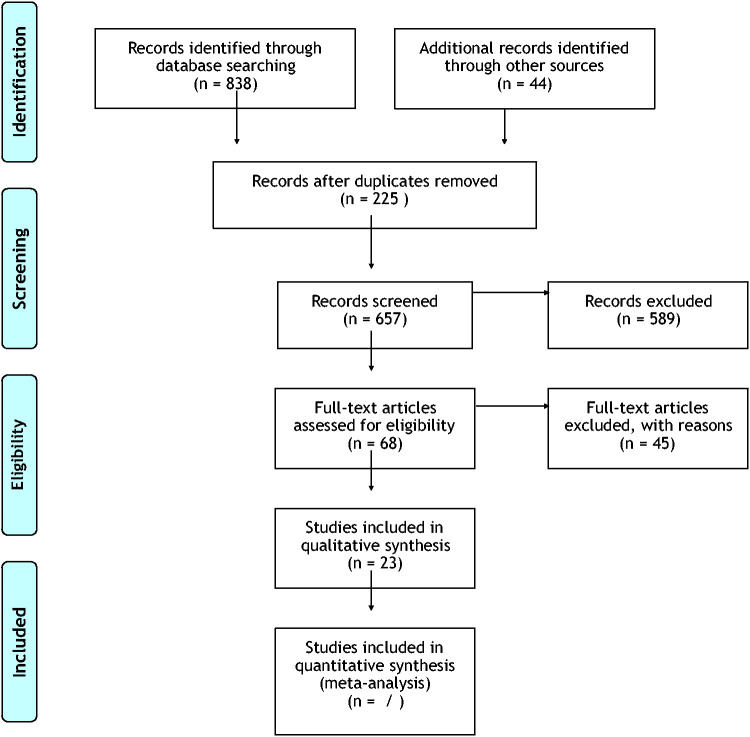
In recent years, virtual reality (VR) has become an interesting alternative to traditional exposure-based therapies for many symptoms. VR involves immersion in a computer-generated virtual environment that minimizes avoidance and facilitates emotional processing. The objective of this systematic review is to evaluate evidence on the intervention effect of VR on anxiety, depression, fatigue, and pain. The research strategy of this systematic review included three electronic databases (MEDLINE/PubMed, Cochrane Library, and ScienceDirect) based on predetermined inclusion and exclusion criteria. Published quantitative studies from 2000 to 2020 were identified, which examined the effect of VR intervention on four different symptoms related to symptoms experienced by cancer patients. Quality assessments, data extractions, and analysis were completed on all included studies. A total of 882 titles and abstracts were screened, and 23 studies were included in the review. The studies were grouped according to the symptoms: anxiety and depression, fatigue, and pain. The review showed that VR intervention is more effective compared with the control (i.e., standard care) for anxiety, depression, fatigue, and pain. VR can reduce effectively these symptoms in different contexts and diseases, including cancer. The evidence suggests that there is value in exploring this intervention as a potential crossover treatment for these symptoms in patients. This study contributes to evidence that distraction is an effective symptom management mechanism. The findings are congruent with the theoretical framework, supporting the premise that VR, as an emotion-focused distraction intervention, decreases the severity of these symptoms.
Overview
The claims and statistics of this paper haven’t been checked yet.
Free: it reads the open-access text and checks the first 5 claims that cite a source we can check. Create a free account to check every claim.
Integrity signals
Registry
Cites
Statistics
Figures
Verification
Claims the paper makes
The claims and statistics of this paper haven’t been checked yet.
Free: it reads the open-access text and checks the first 5 claims that cite a source we can check. Create a free account to check every claim.
Claims other papers make about this one
Each is checked against this paper’s own text: does it say what the citing paper says it does?
The source backs part of the claim, not all of it — or backs it for a different population, condition or comparison.
In the citing paper
“Although VR software and protocols have been developed mainly following a disorder-specific approach [6,7]”
From Protocol for a Randomized Controlled Trial Testing the Efficacy of a Transdiagnostic Virtual Reality-Based Intervention for the Reduction of Unhealthy Lifestyles and Behaviors in the General Population (2023) · cites this paper as [7]
Experimental — accuracy not yet measured
Self-check
Percentages, sums and reported differences re-computed from the paper’s own numbers.
The self-check needs the paper’s full text.
Citations
Cites
Parsons, T. D., & Rizzo, A. A. (2008) · Journal of Behavior Therapy and Experimental Psychiatry · doi:10.1016/j.jbtep.2007.07.007 · Cited by 994
Virtual reality exposure therapy for anxiety disorders: A meta-analysis
Powers, M. B., & Emmelkamp, P. M. G. (2008) · Journal of Anxiety Disorders · doi:10.1016/j.janxdis.2007.04.006 · Cited by 904 · cited 2×
“The results of four independent meta-analyses enhance the conclusion that such interventions lead to significant decreases in anxiety-and depression-related symptoms (Morina et al., 2015; Opris¸ et al., 2012; Parsons & Rizzo, 2008; Powers & Emmelkamp, 2008).”
BackgroundResultThe effectiveness of virtual reality distraction for pain reduction: A systematic review
Malloy, K. M., & Milling, L. S. (2010) · Clinical Psychology Review · doi:10.1016/j.cpr.2010.07.001 · Cited by 653 · cited 1×
“These interventions are thought to affect symptoms by changing symptom-related thoughts, diminishing those beliefs that exacerbate symptoms, and increasing personal perceptions of control over symptoms (Anderson et al., 2006; Kwekkeboom et al., 2003, 2010; Malloy & Milling, 2010).”
BackgroundVirtual reality exposure therapy in anxiety disorders: a quantitative meta-analysis
Opriş, D., Pintea, S., García-Palacios, A., Botella, C., Szamosközi, Ş., & David, D. (2012) · Depression and Anxiety · doi:10.1002/da.20910 · Cited by 636 · cited 2×
“The results of four independent meta-analyses enhance the conclusion that such interventions lead to significant decreases in anxiety-and depression-related symptoms (Morina et al., 2015; Opris¸ et al., 2012; Parsons & Rizzo, 2008; Powers & Emmelkamp, 2008).”
BackgroundResultAnnual review of cybertherapy and telemedicine 2009
Wiederhold, B. K., & Riva, G. (2009) · Cited by 457
Morina, N., Ijntema, H., Meyerbröker, K., & Emmelkamp, P. M. G. (2015) · Behaviour Research and Therapy · doi:10.1016/j.brat.2015.08.010 · Cited by 439
Hoffman, H. G., Patterson, D. R., & Carrougher, G. J. (2000) · The Clinical Journal of Pain · doi:10.1097/00002508-200009000-00010 · Cited by 431
Das, D. A., Grimmer, K. A., Sparnon, A. L., McRae, S. E., & Thomas, B. H. (2005) · BMC Pediatrics · doi:10.1186/1471-2431-5-1 · Cited by 391
Effectiveness of Virtual Reality for Pediatric Pain Distraction during IV Placement
Gold, J. I., Kim, S. H., Kant, A. J., Joseph, M. H., & Rizzo, A. ". (2006) · CyberPsychology & Behavior · doi:10.1089/cpb.2006.9.207 · Cited by 391
Motl, R. W., McAuley, E., Snook, E. M., & Gliottoni, R. C. (2009) · Psychology, Health & Medicine · doi:10.1080/13548500802241902 · Cited by 391
Indovina, P., Barone, D., Gallo, L., Chirico, A., De Pietro, G., & Giordano, A. (2018) · The Clinical Journal of Pain · doi:10.1097/ajp.0000000000000599 · Cited by 388
Cancer-Related Fatigue and Its Associations With Depression and Anxiety: A Systematic Review
Brown, L. F., & Kroenke, K. (2009) · Psychosomatics · doi:10.1016/s0033-3182(09)70835-7 · Cited by 374
Chirico, A., Lucidi, F., De Laurentiis, M., Milanese, C., Napoli, A., & Giordano, A. (2016) · Journal of Cellular Physiology · doi:10.1002/jcp.25117 · Cited by 342
A Pilot and Feasibility Study of Virtual Reality as a Distraction for Children With Cancer
GERSHON, J., ZIMAND, E., PICKERING, M., ROTHBAUM, B. O., & HODGES, L. (2004) · Journal of the American Academy of Child & Adolescent Psychiatry · doi:10.1097/01.chi.0000135621.23145.05 · Cited by 342
Virtual Reality and Medical Inpatients: A Systematic Review of Randomized, Controlled Trials.
(2017) · PubMed Central · Cited by 341
Treatment of acrophobia in virtual reality: The role of immersion and presence
Krijn, M., Emmelkamp, P. M. G., Biemond, R., de Wilde de Ligny, C., Schuemie, M. J., & van der Mast, C. A. P. G. (2004) · Behaviour Research and Therapy · doi:10.1016/s0005-7967(03)00139-6 · Cited by 320 · cited 6×
“Last, but not least, Indovina et al. (2018) Although the use of VR in the majority of the studies included in this review showed a very positive effect on the specific symptoms of interest, it is possible that some confounding factors might have affected the effectiveness of VR.”
BackgroundInfluentialYu, C.-P., Lee, H.-Y., & Luo, X.-Y. (2018) · Urban Forestry & Urban Greening · doi:10.1016/j.ufug.2018.08.013 · Cited by 313
Schmitt, Y. S., Hoffman, H. G., Blough, D. K., Patterson, D. R., Jensen, M. P., Soltani, M., Carrougher, G. J., Nakamura, D., & Sharar, S. R. (2011) · Burns · doi:10.1016/j.burns.2010.07.007 · Cited by 282
Kipping, B., Rodger, S., Miller, K., & Kimble, R. M. (2012) · Burns · doi:10.1016/j.burns.2011.11.010 · Cited by 260
So, W. K. W., Marsh, G., Ling, W. M., Leung, F. Y., Lo, J. C. K., Yeung, M., & Li, G. K. H. (2009) · Oncology Nursing Forum · doi:10.1188/09.onf.e205-e214 · Cited by 252
Wint, S. S., Eshelman, D., Steele, J., & Guzzetta, C. E. (2002) · Oncology Nursing Forum · doi:10.1188/02.onf.e8-e15 · Cited by 234
Kampmann, I. L., Emmelkamp, P. M. G., Hartanto, D., Brinkman, W.-P., Zijlstra, B. J. H., & Morina, N. (2016) · Behaviour Research and Therapy · doi:10.1016/j.brat.2015.12.016 · Cited by 226 · cited 1×
“Fourteen studies in total (Aminabadi et al., 2012; Dehghan et al., 2019; Gold et al., 2006; Kampmann et al., 2016; Krijn et al., 2004; Lee et al., 2015; Riva et al., 2003; Ryu et al., 2018; Schneider et al., 2003, 2004; Schneider & Hood, 2007; Shah et al., 2015 Ioannou et al. ( 28 .”
BackgroundMorris, L. D., Louw, Q. A., & Grimmer-Somers, K. (2009) · The Clinical Journal of Pain · doi:10.1097/ajp.0b013e3181aaa909 · Cited by 222
Virtual Reality as a Distraction Intervention for Women Receiving Chemotherapy
Schneider, S. M., Prince-Paul, M., JoAllen, M., Silverman, P., & Talaba, D. (2004) · Oncology Nursing Forum · doi:10.1188/04.onf.81-88 · Cited by 204
Maani, C. V., Hoffman, H. G., Morrow, M., Maiers, A., Gaylord, K., McGhee, L. L., & DeSocio, P. A. (2011) · Journal of Trauma: Injury, Infection & Critical Care · doi:10.1097/ta.0b013e31822192e2 · Cited by 202 · cited 6×
“…et al., 2012; Carrougher et al., 2009; Das et al., 2005; Gerc¸eker et al., 2018; Gold et al., 2006; JahaniShoorab et al., 2015; Kipping et al., 2012; Maani et al., 2011; Schmitt et al., 2011; van Twillert et al., 2007; Wint et al., 2002) that evaluated efficacy of VR on painful procedures.”
BackgroundMethodInfluentialVirtual reality in paediatric rehabilitation: a review
Parsons, T. D., Rizzo, A. A., Rogers, S., & York, P. (2009) · Developmental Neurorehabilitation · doi:10.1080/17518420902991719 · Cited by 192 · cited 3×
“According to the theory of pain management, decreased pain can be achieved by blocking the information of pain via analgesics drugs or by creating some sort of distraction that deviates the focus of the brain on pain (Gershon et al., 2004; Parsons et al., 2009).”
BackgroundVirtual Reality: A Distraction Intervention for Chemotherapy
Schneider, S. M., & Hood, L. E. (2007) · Oncology Nursing Forum · doi:10.1188/07.onf.39-46 · Cited by 189
Virtual Reality Technology: A Tutorial
Biocca, F. (1992) · Journal of Communication · doi:10.1111/j.1460-2466.1992.tb00811.x · Cited by 180
Lee, N.-Y., Lee, D.-K., & Song, H.-S. (2015) · Journal of Physical Therapy Science · doi:10.1589/jpts.27.145 · Cited by 179
Ferrer-García, M., & Gutiérrez-Maldonado, J. (2012) · Body Image · doi:10.1016/j.bodyim.2011.10.001 · Cited by 178
The Effect of Virtual Reality on Pain and Range of Motion in Adults With Burn Injuries
Carrougher, G. J., Hoffman, H. G., Nakamura, D., Lezotte, D., Soltani, M., Leahy, L., Engrav, L. H., & Patterson, D. R. (2009) · Journal of Burn Care & Research · doi:10.1097/bcr.0b013e3181b485d3 · Cited by 178
Aminabadi, N. A., Erfanparast, L., Sohrabi, A., Oskouei, S. G., & Naghili, A. (2012) · PubMed · doi:10.5681/joddd.2012.025 · Cited by 162
van Twillert, B., Bremer, M., & Faber, A. W. (2007) · Journal of Burn Care & Research · doi:10.1097/bcr.0b013e318148c96f · Cited by 159
Riener, R., & Harders, M. (2012) · Springer eBooks · doi:10.1007/978-1-4471-4011-5 · Cited by 144
Virtual reality intervention for older women with breast cancer
Schneider, S. M., Ellis, M., Coombs, W. T., Shonkwiler, E. L., & Folsom, L. C. (2003) · CyberPsychology & Behavior · doi:10.1089/109493103322011605 · Cited by 135 · cited 6×
“Of the 23 studies selected for this overview, 4 studies (Cho & Sohng, 2014; Schneider et al., 2003, 2004; Schneider & Hood, 2007) evaluated the efficiency of VR on fatigue.”
BackgroundMethodResultInfluentialRyu, J.-H., Park, J.-W., Nahm, F. S., Jeon, Y.-T., Oh, A.-Y., Lee, H. J., Kim, J.-H., & Han, S.-H. (2018) · Journal of Clinical Medicine · doi:10.3390/jcm7090284 · Cited by 135
McCann, R. A., Armstrong, C. M., Skopp, N. A., Edwards-Stewart, A., Smolenski, D. J., June, J. D., Metzger-Abamukong, M., & Reger, G. M. (2014) · Journal of Anxiety Disorders · doi:10.1016/j.janxdis.2014.05.010 · Cited by 134
Shah, L. B. I., Torres, S., Kannusamy, P., Chng, C. M. L., He, H. G., & Klainin‐Yobas, P. (2014) · Archives of Psychiatric Nursing · doi:10.1016/j.apnu.2014.09.003 · Cited by 126
Gerçeker, G. Ö., Binay, Ş., Bilsin, E., Kahraman, A., & Yılmaz, H. B. (2018) · Journal of PeriAnesthesia Nursing · doi:10.1016/j.jopan.2017.12.010 · Cited by 125
Song, G. B., & Park, E. C. (2015) · Journal of Physical Therapy Science · doi:10.1589/jpts.27.2057 · Cited by 122
Jahanishoorab, N., Zagami, S. E., Nahvi, A., Mazluom, S. R., Golmakani, N., Talebi, M., & Pabarja, F. (2015) · PubMed Central · Cited by 118
Charalambous, A., & Kouta, C. (2016) · BioMed Research International · doi:10.1155/2016/3989286 · Cited by 112
Self-citationDehghan, F., Jalali, R., & Bashiri, H. (2019) · Perioperative Medicine · doi:10.1186/s13741-019-0116-0 · Cited by 93 · cited 3×
“Fourteen studies in total (Aminabadi et al., 2012; Dehghan et al., 2019; Gold et al., 2006; Kampmann et al., 2016; Krijn et al., 2004; Lee et al., 2015; Riva et al., 2003; Ryu et al., 2018; Schneider et al., 2003, 2004; Schneider & Hood, 2007; Shah et al., 2015 Ioannou et al. ( 28 .”
BackgroundMethodSix-Month Follow-Up of In-Patient Experiential Cognitive Therapy for Binge Eating Disorders
Riva, G., Bacchetta, M., Cesa, G., Conti, S., & Molinari, E. (2003) · CyberPsychology & Behavior · doi:10.1089/109493103322011533 · Cited by 90
Cho, H., & Sohng, K.-Y. (2014) · Journal of Physical Therapy Science · doi:10.1589/jpts.26.1661 · Cited by 85
Virtual Reality and Interactive Simulation for Pain Distraction: Table 1
Wiederhold, M. D., & Wiederhold, B. K. (2007) · Pain Medicine · doi:10.1111/j.1526-4637.2007.00381.x · Cited by 83
Kwekkeboom, K. L., Abbott-Anderson, K., & Wanta, B. (2010) · Oncology Nursing Forum · doi:10.1188/10.onf.e151-e159 · Cited by 79
Riva, G., Gaggioli, A., Villani, D., Preziosa, A., Morganti, F., Corsi, R., Faletti, G., & Vezzadini, L. (2007) · PubMed · Cited by 78
Anderson, K. O., Cohen, M. Z., Mendoza, T. R., Guo, H., Harle, M. T., & Cleeland, C. S. (2006) · Cancer · doi:10.1002/cncr.21964 · Cited by 58
Virtual reality for assessment of patients suffering chronic pain: a case study
Llobera, J., González-Franco, M., Pérez-Marcos, D., Valls‐Solé, J., Slater, M., & Sanchez-Vives, M. V. (2012) · Experimental Brain Research · doi:10.1007/s00221-012-3352-9 · Cited by 54
A pilot study to predict success with guided imagery for cancer pain
Kwekkeboom, K. L., Kneip, J., & Pearson, L. (2003) · Pain Management Nursing · doi:10.1016/s1524-9042(02)54213-2 · Cited by 50
Virtual Reality Hypnosis Pain Control in the Treatment of Multiple Fractures: A Case Series1
Teeley, A. M., Soltani, M., Wiechman, S. A., Jensen, M. P., Sharar, S. R., & Patterson, D. R. (2012) · American Journal of Clinical Hypnosis · doi:10.1080/00029157.2011.619593 · Cited by 28
Virtual reality utilization in health care: it's virtually done.
Medling, B. (2005) · PubMed · Cited by 3
Research works printed but not linked: 1
- Humphreys J. Janson S. Donesky D. A. Dracup K. Lee K. A. Puntillo K., Faucett, J. A., Aouizerat, B., Miaskowski, C., Baggott, C., Carrieri-Kohlman, V., Barger, M., Franck, L., Kennedy, C., & University of California, San Francisco, School of Nursing, Symptom Management Faculty Group. (2014). Theory of symptom management. In M. J. Smith & P. R. Liehr (Eds.), Middle range theory for nursing (pp. 141–164). Springer Publishing Company.
Cited by
Future of Mental Health in the Metaverse
Usmani, S. S., Sharath, M., & Mehendale, M. (2022) · General Psychiatry · doi:10.1136/gpsych-2022-100825 · Cited by 262
Li, H., Dong, W., Wang, Z., Chen, N., Wu, J., Wang, G., & Jiang, T. (2021) · International Journal of Environmental Research and Public Health · doi:10.3390/ijerph18179053 · Cited by 119
Kalantari, S., Xu, T. B., Mostafavi, A., Lee, A., Barankevich, R., Boot, W. R., & Czaja, S. J. (2022) · Innovation in Aging · doi:10.1093/geroni/igac015 · Cited by 107
Wang, S., Sun, J., Yin, X. H., & Li, H. (2022) · Journal of Clinical Nursing · doi:10.1111/jocn.16397 · Cited by 73
Virtual Reality in Clinical Practice and Research: Viewpoint on Novel Applications for Nursing
Son, H., Ross, A. C., Mendoza-Tirado, E., & Lee, L. J. (2022) · JMIR Nursing · doi:10.2196/34036 · Cited by 72
Metadata
- Authors
- Ioannou, A., Papastavrou, E., Avraamides, M. N., & Charalambous, A.
- Affiliations
- Cyprus University of Technology (CY)
- University of Cyprus (CY)
- University of Turku (FI)
- Corresponding author
- Ioannou, Androniki
- Venue
- SAGE Open Nursing
- Publisher
- SAGE Publications
- Published
- 2020-01
- Volume
- 6
- Pages
- 2377960820936163-2377960820936163
- ISSN
- 2377-9608 (ISSN-L)
- PMC
- PMC7774450
- OpenAlex
- W3082815613
- Cited by
- 241
- References
- 55
- Citations by year
- 2026: 28 · 2025: 50 · 2024: 62 · 2023: 45 · 2022: 41 · 2021: 13 · 2020: 2
- FWCI
- 2.71
- Type
- journal article
- Language
- en
- Open access
- gold
- doi.org
- Licence
- Locations
- SAGE Open Nursing (publishedVersion, cc-by-nc)
- PubMed Central (publishedVersion, cc-by-nc)
- PubMed (publishedVersion)
- Ktisis at Cyprus University of Technology (Cyprus University of Technology) (submittedVersion, cc-by-nc-nd)
- UTUPub (University of Turku) (submittedVersion)
- DOAJ (DOAJ: Directory of Open Access Journals) (submittedVersion, cc-by-sa)
- Topics
- Health Sciences › Medicine › Oncology › Cancer survivorship and care
- Physical Sciences › Computer Science › Human-Computer Interaction › Virtual Reality Applications and Impacts
- Health Sciences › Medicine › Pediatrics, Perinatology and Child Health › Pediatric Pain Management Techniques
- Keywords
- virtual reality, anxiety, depression, fatigue, pain, symptom management, cancer patients, distraction therapy, virtual reality exposure therapy
About these checks
Registry, retraction, Cites and statistics results are computed, not judged, with one exception: a printed reference that no index lists is read once by a model before it counts as a citation error. Claims are extracted by a model and kept only when their quote appears verbatim in the text; each cited source is then checked, with a model’s help, for whether it says what the claim relies on. Those verdicts can be wrong — read the claim’s quote and the cited source before relying on one.
Statistics and arithmetic are recomputed, not judged.
Confidence bands are shown only for fields calibrated on our annotated test set. None is calibrated yet, so no band is shown.
What counts as a claim ›How we measure confidence ›How we check this ›
Are you an author, or do you see a problem with this page? Request a review
Data sources
Bibliographic data: Semantic Scholar, OpenAlex, Crossref.
Contains information from the Semantic Scholar Academic Graph Datasets, made available under the ODC Attribution License (ODC-BY 1.0).
Semantic Scholar’s data is described in: Kinney, R., et al. (2023). The Semantic Scholar Open Data Platform. arXiv:2301.10140.
