

Implementation Readiness and Initial Effects of a Brief Mindfulness Audio Intervention Compared With a Brief Music Control During Daily Radiation Therapy for Prostate Cancer: A Randomized Pilot Study.
Open accessThe DOI matches its Crossref record; 46 of the 47 references it cites were found in a registry or an index; 13 of the 27 sources its claims cite were checked for support.
Abstract
Background: The most common and debilitating side effects of radiation therapy (RT) for prostate cancer (PC) are fatigue, sleep disturbance, anxiety, and depression. Previous research has reported palliative benefits from certain self-management approaches, such as mindfulness meditation. Objective: To develop, pre-test, and evaluate the feasibility, acceptability and initial benefit of brief, audio-based mindfulness delivered during daily RT for PC compared to a relaxing music control. Methods: Following intervention development, participants were randomized to either brief guided mindfulness audio recordings or a relaxing music control during daily RT. A pre-testing phase was first conducted to determine optimal program start time, length, and content most associated with retention. A final program (n = 26) was delivered daily, starting on day one of week 2 of RT and lasting 4 consecutive weeks. Feasibility was defined as ≥70% on enrollment rate, retention, and audio program adherence. Acceptability was measured with a 12-item post-study survey. A secondary focus compared between group changes on patient reported outcomes of fatigue, anxiety, depression, sleep disturbance, and related outcomes at baseline and follow up assessments. Descriptive statistics and general linear models were used. Results: Overall, 76% (n = 38) of approached men enrolled. Pre-testing retention rates were <70% while the final program's retention rate was 89%. The majority of acceptability criteria were met in both conditions, with relatively higher ratings in the mindfulness arm. Compared to music controls, mindfulness participants demonstrated significantly less uncertainty intolerance at 4-weeks (P =.046, d =.95); and significantly lower fatigue scores (P =.049, d = 1.3) and lower sleep disturbance scores (P =.035, d = 1.1) at the 3 months follow up. Conclusion: The final intervention met feasibility and acceptability criteria. Pre-testing refinements played a key role for optimal program delivery and retention. Audio-based mindfulness delivered during RT for PC hold potential to help decrease RT-related physical and emotional side effects.
Overview
CoChat Summary
## TL;DR
This randomized pilot study tested a brief guided mindfulness audio program versus a relaxing music control delivered during daily radiation therapy for prostate cancer. The final intervention met feasibility and acceptability criteria, and mindfulness showed initial benefits for uncertainty intolerance, fatigue, and sleep disturbance.
## Key findings
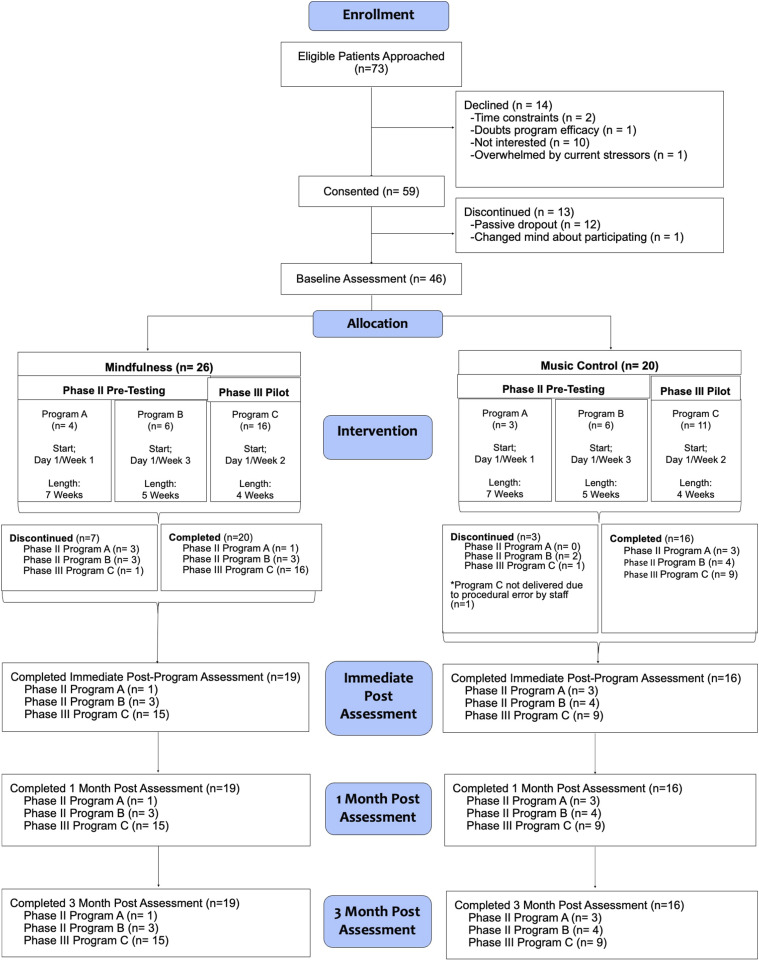
- In Phase II pre-testing, 19 participants were randomized across two programs; 8 dropped out, with retention rates of 57%–58%, and mindfulness participants dropped out more often than music participants (6 vs 2).
- In the final Phase III program, feasibility metrics exceeded the 70% benchmark: enrollment rate was 83%, retention was 89%, and audio adherence was 92.5% for mindfulness and 88.5% for music.
- Acceptability was generally good, with mindfulness participants reporting higher enjoyment-related ratings than music controls: 93% vs 67% enjoyed participation, 93% vs 78% looked forward to listening, 93% vs 89% found listening helpful, 87% vs 78% reported enough variety, and 93% vs 78% felt positively affected.
- Compared with music controls, mindfulness participants had significantly lower uncertainty intolerance at 4 weeks (P = .046; d = .95), lower fatigue at 3 months (P = .049; d = 1.3), and lower sleep disturbance at 3 months (P = .035; d = 1.1).
## Methods
- Three-phase study design: Phase I intervention development, Phase II implementation pre-testing, and Phase III pilot randomized controlled trial.
- Participants were men with clinically localized prostate cancer receiving daily radiation therapy at Northwestern Memorial Hospital; final pilot sample was 27 men (16 mindfulness, 11 music).
- Participants were randomized 1:1 to guided mindfulness audio or relaxing music, delivered during RT starting on day 1 of week 2 for 4 consecutive weeks in the final program; analysis used descriptive statistics and general linear models with intention-to-treat, adjusting for age and number of audio sessions listened to.
## Limitations
- The paper states the study used a small, mostly Caucasian sample from a single treatment center, limiting generalizability.
- The paper states the trial was not powered as an efficacy trial, so preliminary results should be interpreted cautiously.
- Evident from the text: most outcomes were non-significant, and it is unclear which specific elements of the audio interventions drove the observed effects.
Model-written summary. Check it against the paper before relying on it.
Integrity signals
Registry
Cites
Statistics
Figures
Verification
Claims the paper makes
6 Valid · 2 Not valid · 3 Not checked · 55 Own results and interpretations
The sources with a verdict support this claim; the rest weren’t checked yet, have no full text we could read, or their verdicts aren’t rated yet.
In the paper
“however only 2 studies using guided audios have been conducted with cancer patient groups.29,30”
§ Implementation Readiness and Initial Effects of a Brief Mindfulness Audio Intervention Compared With a Brief Music Control During Daily Radiation Therapy for Prostate Cancer: A Randomized Pilot Study > Introduction
What the sources say
- Supportedcites [29] Atreya CE Kubo A Borno HT, et al. Being present: a single-arm feasibility study of audio-based mindfulness meditation for colorectal cancer patients and caregivers. PLoS One. 2018; 13(7): e0199423. doi: 10.1371/journal.pone.0199423 30036361 PMC6056029 source
The Methods section identifies Being Present as an eight-week audio-based mindfulness meditation study for patients with metastatic intestinal cancer and their caregivers. It therefore supports this citation’s role in identifying one of the guided-audio studies cited in the sentence. (LLM, conf=0.90)
- Not checked — no full text of the sourcecites [30] Altschuler A Rosenbaum E Gordon P Canales S Avins AL. Audio recordings of mindfulness-based stress reduction training to improve cancer patients’ mood and quality of life—a pilot feasibility study. Support Care Cancer. 2012; 20(6): 1291- 1297. doi: 10.1007/s00520-011-1216-7 21688161 source
plain- Asserted: passes — The authors put it forward as true.
- Checkable: passes — It can be checked against evidence.
- Load-bearing: passes — The paper’s conclusions depend on it.
- Based: passes — The paper gives a reason why it holds.
- Supported
The cited sources support only part of this claim — read each source’s verdict below.
In the paper
“Previous studies have reported the negative side effects of fatigue, sleep disturbance, anxiety and depression among men diagnosed with PC during and following RT.3,8-11”
§ Implementation Readiness and Initial Effects of a Brief Mindfulness Audio Intervention Compared With a Brief Music Control During Daily Radiation Therapy for Prostate Cancer: A Randomized Pilot Study > Introduction
What the sources say
- Partly supportedcites [3] Feng LR Espina A Saligan LN. Association of fatigue intensification with cognitive impairment during radiation therapy for prostate cancer. Oncology. 2018; 94(6): 363- 372. doi: 10.1159/000487081 29514170 PMC6067654 sourceExperimental — accuracy not yet measured
The Introduction (page unavailable) describes fatigue as a troublesome side effect that can worsen during radiation therapy and persist after treatment. Subject Demographics reports mild anxiety and depressive symptoms before and during treatment, while Instruments says sleep disturbance was measured. The paper does not establish sleep disturbance, anxiety, and depression as negative side effects during and following radiation therapy in these men; its participants were followed only through treatment completion. (LLM, conf=0.86)
- Partly supportedcites [8] Garrett K Dhruva A Koetters T, et al. Differences in sleep disturbance and fatigue between patients with breast and prostate cancer at the initiation of radiation therapy. J Pain Symptom Manage. 2011; 42(2): 239- 250. doi: 10.1016/j.jpainsymman.2010.11.010 21454042 PMC3145041 sourceExperimental — accuracy not yet measured
The Introduction reports sleep disturbance and fatigue in patients with prostate cancer and cites research on sleep disturbance during and after RT. The Discussion finds both symptoms in prostate cancer patients, but measurements were taken before RT; it does not report anxiety and depression as side effects during or following RT in these men. (LLM, conf=0.88)
- Partly supportedcites [9] Knapp K Cooper B Koetters T, et al. Trajectories and predictors of symptom occurrence, severity, and distress in prostate cancer patients undergoing radiation therapy. J Pain Symptom Manage. 2012; 44(4): 486- 507. doi: 10.1016/j.jpainsymman.2011.10.020 22771128 PMC3463773 sourceExperimental — accuracy not yet measured
The Discussion reports fatigue and difficulty sleeping as significant symptoms in men with prostate cancer during and after radiotherapy. The Introduction also mentions pretreatment depression as a predictor of fatigue during and after radiotherapy. The passages do not establish anxiety as a reported symptom, or depression as a side effect of radiotherapy, so they support only part of the attributed list. (LLM, conf=0.86)
- Not checked — no full text of the sourcecites [10] Miaskowski C Paul SM Cooper BA, et al. Predictors of the trajectories of self-reported sleep disturbance in men with prostate cancer during and following radiation therapy. Sleep. 2011; 34(2): 171- 179. 21286498 PMC3022937 source
- Partly supportedcites [11] Mohamed NE Bovbjerg DH Montgomery GH Hall SJ Diefenbach MA. Pretreatment depressive symptoms and treatment modality predict post-treatment disease-specific quality of life among patients with localized prostate cancer. Urol Oncol. 2012; 30(6): 804- 812. doi: 10.1016/j.urolonc.2011.02.002 21795078 PMC4112499 sourceExperimental — accuracy not yet measured
The Introduction reports depression and psychological distress after prostate cancer diagnosis and notes that depressive symptoms may persist after treatment. The Results include patients treated with external-beam radiation, but the paper does not report fatigue, sleep disturbance, or anxiety as effects during or following radiation therapy, nor establish that depression is a side effect of that treatment. (LLM, conf=0.84)
plainstates an association- Asserted: passes — The authors put it forward as true.
- Checkable: passes — It can be checked against evidence.
- Load-bearing: passes — The paper’s conclusions depend on it.
- Based: passes — The paper gives a reason why it holds.
- Partly supported
The cited sources support only part of this claim — read each source’s verdict below.
In the paper
“Patient reported outcomes measures have all demonstrated adequate psychometric properties and were administered at all time points.”
§ Implementation Readiness and Initial Effects of a Brief Mindfulness Audio Intervention Compared With a Brief Music Control During Daily Radiation Therapy for Prostate Cancer: A Randomized Pilot Study > Methods > Phase II: Implementation Pre-testing
What the sources say
- Not checked — no full text of the sourcecites [36] Cella D Yount S Rothrock N, et al. The patient-reported outcomes measurement information system (PROMIS): progress of an NIH Roadmap cooperative group during its first two years. Med Care. 2007; 45(5 Suppl 1): S3- S11. doi: 10.1097/01.mlr.0000258615.42478.55 PMC2829758 17443116 source
- Partly supportedcites [37] Roth AJ Rosenfeld B Kornblith AB, et al. The memorial anxiety scale for prostate cancer: validation of a new scale to measure anxiety in men with with prostate cancer. Cancer. 2003; 97(11): 2910- 2918. doi: 10.1002/cncr.11386 12767107 sourceExperimental — accuracy not yet measured
The Discussion (page not available) reports high reliability and concurrent and discriminant validity for the MAX-PC, supporting the claim for that measure. The paper does not establish that all patient-reported outcome measures had adequate psychometric properties. (LLM, conf=0.86)
- Not checked — no full text of the sourcecites [38] Carleton RN Norton MA Asmundson GJ. Fearing the unknown: a short version of the intolerance of uncertainty scale. J Anxiety Disord. 2007; 21(1): 105- 117. Not in File. 16647833 source
boosted- Asserted: passes — The authors put it forward as true.
- Checkable: passes — It can be checked against evidence.
- Load-bearing: unclear — It is unclear whether the paper’s conclusions depend on it.
- Based: passes — The paper gives a reason why it holds.
A result the paper reports from its own data — it cites no other source for it, so there is none to check. The quote shows it is in the paper.
In the paper
“including looking forward to listening (93% vs 78%, respectively)”
§ Implementation Readiness and Initial Effects of a Brief Mindfulness Audio Intervention Compared With a Brief Music Control During Daily Radiation Therapy for Prostate Cancer: A Randomized Pilot Study > Results > Evaluation of Feasibility and Acceptability
plainstates an association- Asserted: passes — The authors put it forward as true.
- Checkable: passes — It can be checked against evidence.
- Load-bearing: unclear — It is unclear whether the paper’s conclusions depend on it.
- Based: passes — The paper gives a reason why it holds.
A result the paper reports from its own data — it cites no other source for it, so there is none to check. The quote shows it is in the paper.
In the paper
“there were no statistically significant differences on baseline sociodemographic, clinical, treatment (e.g., on hormone therapy), or self-reported outcomes measures except for self-reported hypertension (Mindfulness n = 6, Music n = 4) and arthritis (Mindfulness n = 1, Music n = 2).”
§ Implementation Readiness and Initial Effects of a Brief Mindfulness Audio Intervention Compared With a Brief Music Control During Daily Radiation Therapy for Prostate Cancer: A Randomized Pilot Study > Results > Phase III: Randomized Controlled Trial with Optimal Intervention
plainn = 27- Asserted: passes — The authors put it forward as true.
- Checkable: passes — It can be checked against evidence.
- Load-bearing: unclear — It is unclear whether the paper’s conclusions depend on it.
- Based: passes — The paper gives a reason why it holds.
28 more claims
Create a free account to see all 66 claims and every source verdict.
- Probably not a substantial claim. 16
- It may state two separate claims as one. 23
Citations
Cites
The benefits of being present: Mindfulness and its role in psychological well-being
Brown, K. W., & Ryan, R. M. (2003) · Journal of Personality and Social Psychology · doi:10.1037/0022-3514.84.4.822 · Cited by 13,448
(2008) · Medical Entomology and Zoology · Cited by 7,477
Mindfulness: A proposed operational definition.
Bishop, S. R., Lau, M., Shapiro, S., Carlson, L., Anderson, N. D., Carmody, J., Segal, Z. V., Abbey, S., Speca, M., Velting, D., et al. (2004) · Clinical Psychology: Science and Practice · doi:10.1093/clipsy.bph077 · Cited by 7,234 · cited 1×
“21,22 Mindfulness has been described as regulating emotions through embodied “ bottom-up ” and “ top-down ” neural processes.”
BackgroundCella, D., Yount, S., Rothrock, N., Gershon, R., Cook, K., Reeve, B., Ader, D., Fries, J. F., Bruce, B., & Rose, M. (2007) · Medical Care · doi:10.1097/01.mlr.0000258615.42478.55 · Cited by 3,118
Psychometric properties of the credibility/expectancy questionnaire
Devilly, G. J., & Borkovec, T. D. (2000) · Journal of Behavior Therapy and Experimental Psychiatry · doi:10.1016/s0005-7916(00)00012-4 · Cited by 2,295 · cited 1×
“35 Implementation feasibility metrics included documenting the number of participants approached, enrolled, and retained throughout the study and tallying the total number possible listening opportunities during the audio program.”
BackgroundFearing the unknown: A short version of the Intolerance of Uncertainty Scale
Carleton, R. N., Norton, M. A. P. J., & Asmundson, G. J. G. (2007) · Journal of Anxiety Disorders · doi:10.1016/j.janxdis.2006.03.014 · Cited by 2,288 · cited 1×
“…Anxiety ( α = .91), Depression ( α = .95), and Sleep Disturbance( α = .92) 36 ; the three-item Fear of Recurrence sub-scale of the Memorial Anxiety Scale ( α = .73) 37 ; the 12-item Intolerance of Uncertainty Scale ( α = .63), 38 and the 15-item Mindfulness Attention Awareness Scale ( α = .86).”
BackgroundEstimating effect sizes from pretest-posttest-control group designs
Morris, S. B. (2008) · Organizational Research Methods · doi:10.1177/1094428106291059 · Cited by 2,133
Hülsheger, U. R., Alberts, H. J. E. M., Feinholdt, A., & Lang, J. W. B. (2013) · Journal of Applied Psychology · doi:10.1037/a0031313 · Cited by 1,433
Bernardi, L., Porta, C., & Sleight, P. (2006) · Heart · doi:10.1136/hrt.2005.064600 · Cited by 579 · cited 1×
“34 To stan-dardize what participants listened to we compiled a small library of selections from the genres of relaxing classical music, sounds of nature, and ambient/instrumental pieces (e.g., “ spa music ” ) to offer a diverse yet standardized selection of recordings.”
BackgroundGuendelman, S., Medeiros, S., & Rampes, H. (2017) · Frontiers in Psychology · doi:10.3389/fpsyg.2017.00220 · Cited by 577 · cited 1×
“23 Bottom-up regulation decreases emotional reactivity through lower brain region activation without recruitment of higher brain regions in the prefrontal cortex.”
BackgroundLengacher, C. A., Johnson‐Mallard, V., Post‐White, J., Moscoso, M. S., Jacobsen, P. B., Klein, T. W., Widen, R. H., Fitzgerald, S. G., Shelton, M. M., Barta, M., et al. (2009) · Psycho-Oncology · doi:10.1002/pon.1529 · Cited by 518
Mindfulness: Top–down or bottom–up emotion regulation strategy?
Chiesa, A., Serretti, A., & Jakobsen, J. C. (2013) · Clinical Psychology Review · doi:10.1016/j.cpr.2012.10.006 · Cited by 470 · cited 1×
“24 It is understood that mindfulness may enact similar top-down and bottom-up regulatory processes for physical symptoms such as fatigue 25 and sleep.”
BackgroundGroenvold, M., Petersen, M. A., Idler, E., Bjorner, J. B., Fayers, P. M., & Mouridsen, H. T. (2007) · Breast Cancer Research and Treatment · doi:10.1007/s10549-006-9447-x · Cited by 355
Gross, C. R., Kreitzer, M. J., Reilly-Spong, M., Wall, M., Winbush, N. Y., Patterson, R., Mahowald, M., & Cramer-Bornemann, M. (2011) · EXPLORE · doi:10.1016/j.explore.2010.12.003 · Cited by 249
Jereczek-Fossa, B. A., Marsiglia, H. R., & Orecchia, R. (2002) · Critical Reviews in Oncology/Hematology · doi:10.1016/s1040-8428(01)00143-3 · Cited by 240
Men’s discourses of help‐seeking in the context of depression
Johnson, J. L., Oliffe, J. L., Kelly, M. T., Galdas, P., & Ogrodniczuk, J. S. (2012) · Sociology of Health & Illness · doi:10.1111/j.1467-9566.2011.01372.x · Cited by 238
Roth, A. J., Rosenfeld, B., Kornblith, A. B., Gibson, C., Scher, H. I., Curley‐Smart, T., Holland, J. C., & Breitbart, W. (2003) · Cancer · doi:10.1002/cncr.11386 · Cited by 229 · cited 1×
“…Anxiety ( α = .91), Depression ( α = .95), and Sleep Disturbance( α = .92) 36 ; the three-item Fear of Recurrence sub-scale of the Memorial Anxiety Scale ( α = .73) 37 ; the 12-item Intolerance of Uncertainty Scale ( α = .63), 38 and the 15-item Mindfulness Attention Awareness Scale ( α = .86).”
BackgroundManaging the adverse effects of radiation therapy.
Berkey, F. J. (2010) · PubMed · Cited by 217
Johns, S. A., Brown, L. F., Beck‐Coon, K., Monahan, P. O., Tong, Y., & Kroenke, K. (2015) · Psycho-Oncology · doi:10.1002/pon.3648 · Cited by 161 · cited 2×
“7 12-19 Mindfulness is de fi ned as a quality of present moment awareness and attentional control characterized by curiosity, openness and acceptance 20 that can engender greater cognitive, affective, and physiological fl exibility and self-regulation.”
BackgroundKumar, P., Casarett, D., Corcoran, A., Desai, K., Li, Q., Chen, J., Langer, C., & Mao, J. J. (2012) · Journal of Palliative Medicine · doi:10.1089/jpm.2011.0217 · Cited by 141 · cited 1×
“28 Audio-based mindfulness programs may be a reasonable alternative, however only 2 studies using guided audios have been conducted with cancer patient groups.”
BackgroundThe Interplay of Preference, Familiarity and Psychophysical Properties in Defining Relaxation Music
Tan, X., Yowler, C. J., Super, D. M., & Fratianne, R. B. (2012) · Journal of Music Therapy · doi:10.1093/jmt/49.2.150 · Cited by 133
Li, J., Li, C., Puts, M., Wu, Y.-C., Lyu, M.-M., Yuan, B., & Zhang, J.-P. (2023) · International Journal of Nursing Studies · doi:10.1016/j.ijnurstu.2023.104447 · Cited by 127
Lengacher, C. A., Reich, R. R., Paterson, C. L., Jim, H. S., Ramesar, S., Alinat, C. B., Budhrani, P. H., Farias, J. R., Shelton, M. M., Moscoso, M. S., et al. (2015) · Psycho-Oncology · doi:10.1002/pon.3603 · Cited by 119 · cited 1×
“Mindfulness practice has demonstrated improvements in these areas in other cancer patient samples, 19,42,43 however, to our knowledge, this is the fi rst study to demonstrate improvements from brief, daily audio exposure during the delivery of RT.”
BackgroundThaut, M. H., & Davis, W. B. (1993) · Journal of Music Therapy · doi:10.1093/jmt/30.4.210 · Cited by 101 · cited 1×
“While “ relaxing ” music is associated with highly subjective musical preferences and familiarity, 31-33 universal elements often associated with cardiovascular and respiratory indicators of relaxation include slower tempo, melody, and rhythmic complexity.”
BackgroundFeasibility of a Mindfulness-Based Stress Reduction Program for Early-Stage Breast Cancer Survivors
Lengacher, C. A., Johnson-Mallard, V., Barta, M., Fitzgerald, S., Moscoso, M. S., Post-White, J., Jacobsen, P. B., Molinari Shelton, M., Le, N., Budhrani, P., et al. (2011) · Journal of Holistic Nursing · doi:10.1177/0898010110385938 · Cited by 101
Men managing cancer: a gender analysis
Wenger, L. M., & Oliffe, J. L. (2014) · Sociology of Health & Illness · doi:10.1111/1467-9566.12045 · Cited by 89
Mindfulness-based stress reduction can alleviate cancer- related fatigue: A meta-analysis
Xie, C., Dong, B., Wang, L., Jing, X., Wu, Y., Lin, L., & Tian, L. (2020) · Journal of Psychosomatic Research · doi:10.1016/j.jpsychores.2019.109916 · Cited by 84
Fatigue During Head-And-Neck Radiotherapy: Prospective Study on 117 Consecutive Patients
Jereczek-Fossa, B. A., Santoro, L., Alterio, D., Franchi, B., Fiore, M. R., Fossati, P., Kowalczyk, A., Canino, P., Ansarin, M., & Orecchia, R. (2007) · International Journal of Radiation Oncology*Biology*Physics · doi:10.1016/j.ijrobp.2007.01.024 · Cited by 77
Potential Mechanisms of Mindfulness in Improving Sleep and Distress
Lau, W. K. W., Leung, M.-K., Wing, Y.-K., & Lee, T. M. C. (2018) · Mindfulness · doi:10.1007/s12671-017-0796-9 · Cited by 73 · cited 1×
“26 For example, mindfulness might assist bottom-up activation by aiding in the reorientation of attentional processes to be open, curious, and accepting of present moment experiences of fatigue or sleep disturbance without judgement of embellishment.”
BackgroundVictorson, D., Kentor, M., Maletich, C., Lawton, R. C., Kaufman, V. H., Borrero, M., Languido, L., Lewett, K., Pancoe, H., & Berkowitz, C. (2015) · American Journal of Lifestyle Medicine · doi:10.1177/1559827614537789 · Cited by 68 · cited 1×
“27 This format can present logistical and potential fi nancial barriers for cancer patients with competing demands.”
Self-citationMiaskowski, C., Paul, S. M., Cooper, B. A., Lee, K., Dodd, M., West, C., Aouizerat, B. E., Dunn, L., Swift, P. S., & Wara, W. (2011) · Sleep · doi:10.1093/sleep/34.2.171 · Cited by 64
Garrett, K., Dhruva, A., Koetters, T., West, C., Paul, S. M., Dunn, L. B., Aouizerat, B. E., Cooper, B. A., Dodd, M., Lee, K., et al. (2011) · Journal of Pain and Symptom Management · doi:10.1016/j.jpainsymman.2010.11.010 · Cited by 63
Victorson, D., Hankin, V., Burns, J., Weiland, R., Maletich, C., Sufrin, N., Schuette, S., Gutierrez, B., & Brendler, C. (2017) · Psycho-Oncology · doi:10.1002/pon.4135 · Cited by 56
Self-citationJohns, S. A., Tarver, W. L., Secinti, E., Mosher, C. E., Stutz, P. V., Carnahan, J. L., Talib, T. L., Shanahan, M. L., Faidley, M. T., Kidwell, K. M., et al. (2021) · Critical Reviews in Oncology/Hematology · doi:10.1016/j.critrevonc.2021.103290 · Cited by 48
Katz, P., Pedro, S., Alemao, E., Yazdany, J., Dall’Era, M., Trupin, L. S., Rush, S., & Michaud, K. D. (2019) · ACR Open Rheumatology · doi:10.1002/acr2.11100 · Cited by 47
Atreya, C. E., Kubo, A., Borno, H. T., Rosenthal, B., Campanella, M., Rettger, J. P., Joseph, G., Allen, I. E., Venook, A. P., Altschuler, A., et al. (2018) · PLoS ONE · doi:10.1371/journal.pone.0199423 · Cited by 44 · cited 1×
“29,30 Further, no studies have implemented audio support during the cancer treatment encounter itself.”
BackgroundMcCloy, K., Hughes, C., Dunwoody, L., Marley, J., & Gracey, J. (2022) · Psycho-Oncology · doi:10.1002/pon.6046 · Cited by 44
Altschuler, A., Rosenbaum, E., Gordon, P., Canales, S., & Avins, A. L. (2012) · Supportive Care in Cancer · doi:10.1007/s00520-011-1216-7 · Cited by 42 · cited 1×
“29,30 Further, no studies have implemented audio support during the cancer treatment encounter itself.”
BackgroundStrauser, J. M. (1997) · Journal of Music Therapy · doi:10.1093/jmt/34.2.88 · Cited by 39 · cited 1×
“While “ relaxing ” music is associated with highly subjective musical preferences and familiarity, 31-33 universal elements often associated with cardiovascular and respiratory indicators of relaxation include slower tempo, melody, and rhythmic complexity.”
BackgroundKawase, E., Karasawa, K., Shimotsu, S., Izawa, H., Hirowatari, H., Saito, A. I., Ito, K., & Horikawa, N. (2012) · Breast Cancer · doi:10.1007/s12282-010-0220-y · Cited by 36
Mohamed, N. E., Bovbjerg, D. H., Montgomery, G. H., Hall, S. J., & Diefenbach, M. A. (2012) · Urologic Oncology: Seminars and Original Investigations · doi:10.1016/j.urolonc.2011.02.002 · Cited by 33
Effects of mindfulness and fatigue on emotional processing: an event-related potentials study
Fan, J., Li, W., Lin, M., Li, X., & Deng, X. (2023) · Frontiers in Behavioral Neuroscience · doi:10.3389/fnbeh.2023.1175067 · Cited by 29 · cited 1×
“24 It is understood that mindfulness may enact similar top-down and bottom-up regulatory processes for physical symptoms such as fatigue 25 and sleep.”
BackgroundFeng, L. R., Espina, A., & Saligan, L. N. (2018) · Oncology · doi:10.1159/000487081 · Cited by 24
indicated, N. A. (1992) · Contemporary Psychology: A Journal of Reviews · doi:10.1037/032287 · Cited by 19 · cited 1×
“7 12-19 Mindfulness is de fi ned as a quality of present moment awareness and attentional control characterized by curiosity, openness and acceptance 20 that can engender greater cognitive, affective, and physiological fl exibility and self-regulation.”
Knapp, K., Cooper, B., Koetters, T., Cataldo, J., Dhruva, A., Paul, S. M., West, C., Aouizerat, B. E., & Miaskowski, C. (2012) · Journal of Pain and Symptom Management · doi:10.1016/j.jpainsymman.2011.10.020 · Cited by 15
Martopullo, C., Oberoi, D. V., Levin, G., Qureshi, M., Morgan-Maver, E., Korzeniewski, O., Pelletier, G., Carlson, L. E., & Bultz, B. D. (2019) · Journal of Cancer Survivorship · doi:10.1007/s11764-019-00838-x · Cited by 15 · cited 1×
“44-46 While this was not explicitly queried in this study, there may be a preference by some men to receive support individually, and in ways that do not require verbal expression amongst others.”
BackgroundRising Prostate Cancer Incidence Rates: What Can We Do About It?
Carr, E. R. (2023) · Clinical journal of oncology nursing · doi:10.1188/23.cjon.109-110 · Cited by 3
Cited by
Lifestyle medicine and prostate cancer: Time to look at the bigger picture?
Gautam, G. (2024) · Indian Journal of Urology · doi:10.4103/iju.iju_226_24
Zhang, B., Li, B., Liang, Z., Zhang, Y., Lau, L. Y., Chen, Y., & Zeng, X. (2025) · Psycho-Oncologie · doi:10.18282/po4522
Healing Beams: Radiation and Radiotherapy in Novels, Poems, Music, Film, Painting
Kaptein, A. A., Schoones, J. W., van der Linden, Y. M., & Hughes, B. M. (2025) · Journal of Medical Radiation Sciences · doi:10.1002/jmrs.70026
Majumdar, J. R., Zakhari, R., Caramore, A., O’Leary, J., Campbell, J., & O’Connor, M. (2026) · doi:10.2196/preprints.108477
Metadata
- Authors
- Victorson, D., Mishra, K. K., Sauer, J., Langford, G., Maletich, C., Horowitz, B., Sauer, C., Sejpal, S. V., & Kalapurakal, J.
- Affiliations
- Northwestern University (US)
- University of California, San Francisco (US)
- Texas Oncology (US)
- Corresponding author
- Victorson, David
- Venue
- Global Advances in Integrative Medicine and Health
- Publisher
- SAGE Publications
- Published
- 2024-01
- Volume
- 13
- Pages
- 27536130241249140-27536130241249140
- ISSN
- 2753-6130 (ISSN-L)
- PMC
- PMC11062214
- OpenAlex
- W4396528936
- Cited by
- 5
- References
- 46
- Citations by year
- 2026: 1 · 2025: 3 · 2024: 1
- FWCI
- 2.50
- Type
- journal article
- Language
- en
- Open access
- hybrid
- doi.org
- Licence
- Locations
- Global Advances in Integrative Medicine and Health (publishedVersion, cc-by-nc)
- PubMed Central (publishedVersion, cc-by-nc)
- PubMed (publishedVersion)
- eScholarship (California Digital Library) (submittedVersion, cc-by-nc)
- Funders
- Fagen Family Foundation
- Topics
- Social Sciences › Psychology › Clinical Psychology › Mindfulness and Compassion Interventions
- Health Sciences › Medicine › Oncology › Cancer survivorship and care
- Social Sciences › Psychology › Social Psychology › Music Therapy and Health
- Keywords
- mindfulness meditation, prostate cancer, radiotherapy, fatigue, sleep disorders, anxiety, depression, intolerance of uncertainty, intervention feasibility, acceptability, intervention retention, radiation side effects, self-management
About these checks
Registry, retraction, Cites and statistics results are computed, not judged, with one exception: a printed reference that no index lists is read once by a model before it counts as a citation error. Claims are extracted by a model and kept only when their quote appears verbatim in the text; each cited source is then checked, with a model’s help, for whether it says what the claim relies on. Those verdicts can be wrong — read the claim’s quote and the cited source before relying on one.
The claim verdicts this report counts are experimental: their accuracy is not yet measured.
A language model drew the claims from the paper on 2026-10-11, under version 3 of the claim definition (model deepseek-v4.1-flash, prompt extract-v3).
A second model labelled each claim on 2026-10-11 (model jev-1.13-20260917, definition revision gold-guideline-v0.2).
Cited sources are checked with a language model’s help (gpt-6-sol).
Statistics and arithmetic are recomputed, not judged.
Confidence bands are shown only for fields calibrated on our annotated test set. None is calibrated yet, so no band is shown.
What counts as a claim ›How we measure confidence ›How we check this ›
Are you an author, or do you see a problem with this page? Request a review
Data sources
Bibliographic data: Semantic Scholar, OpenAlex, Crossref.
Contains information from the Semantic Scholar Academic Graph Datasets, made available under the ODC Attribution License (ODC-BY 1.0).
Semantic Scholar’s data is described in: Kinney, R., et al. (2023). The Semantic Scholar Open Data Platform. arXiv:2301.10140.
