

The Firmicutes/Bacteroidetes ratio of the human microbiota changes with age
Open accessThe DOI matches its Crossref record; 33 of the 33 references it cites were found in a registry or an index.
Abstract
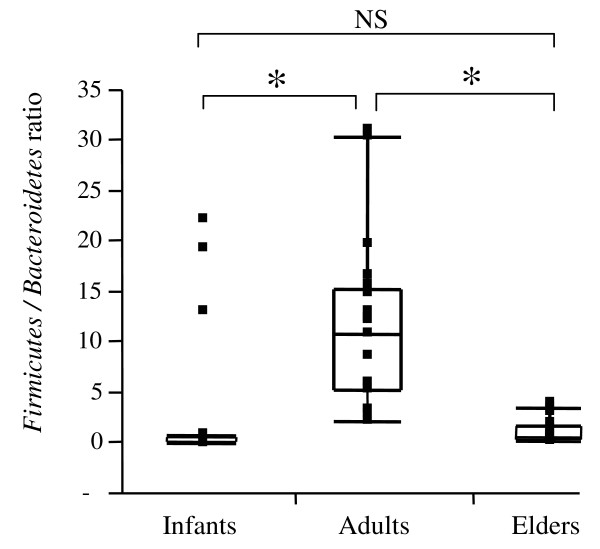
BACKGROUND: In humans, the intestinal microbiota plays an important role in the maintenance of host health by providing energy, nutrients, and immunological protection. Applying current molecular methods is necessary to surmount the limitations of classical culturing techniques in order to obtain an accurate description of the microbiota composition. RESULTS: Here we report on the comparative assessment of human fecal microbiota from three age-groups: infants, adults and the elderly. We demonstrate that the human intestinal microbiota undergoes maturation from birth to adulthood and is further altered with ageing. The counts of major bacterial groups Clostridium leptum, Clostridium coccoides, Bacteroidetes, Bifidobacterium, Lactobacillus and Escherichia coli were assessed by quantitative PCR (qPCR). By comparing species diversity profiles, we observed age-related changes in the human fecal microbiota. The microbiota of infants was generally characterized by low levels of total bacteria. C. leptum and C. coccoides species were highly represented in the microbiota of infants, while elderly subjects exhibited high levels of E. coli and Bacteroidetes. We observed that the ratio of Firmicutes to Bacteroidetes evolves during different life stages. For infants, adults and elderly individuals we measured ratios of 0.4, 10.9 and 0.6, respectively. CONCLUSION: In this work we have confirmed that qPCR is a powerful technique in studying the diverse and complex fecal microbiota. Our work demonstrates that the fecal microbiota composition evolves throughout life, from early childhood to old age.
Overview
The claims and statistics of this paper haven’t been checked yet.
Free: it reads the open-access text and checks the first 5 claims that cite a source we can check. Create a free account to check every claim.
Integrity signals
Registry
Cites
Statistics
Figures
Verification
Claims the paper makes
The claims and statistics of this paper haven’t been checked yet.
Free: it reads the open-access text and checks the first 5 claims that cite a source we can check. Create a free account to check every claim.
Claims other papers make about this one
Each is checked against this paper’s own text: does it say what the citing paper says it does?
The source backs part of the claim, not all of it — or backs it for a different population, condition or comparison.
In the citing paper
“A reduced Firmicutes:Bacteroidetes ratio has been reported in Irish and French elderly compared to young adults”
From The Microbiota-Gut-Brain Axis (2019) · cites this paper as Mariat et al., 2009
Experimental — accuracy not yet measuredIn the citing paper
“The disappearance of these microorganisms is important because they normally counteract the expansion of pathogenic microbial communities, while also maintaining intestinal barrier integrity by fermenting starches and dietary fibres and producing mucus and lipid metabolites, such as short-chain fatty acids (primarily acetate, propionate, and butyrate)66–68.”
From Inflammageing: chronic inflammation in ageing, cardiovascular disease, and frailty (2018) · cites this paper as [66]
In the citing paper
“Despite large variability in the gut microbiota found in different populations, geographic regions, and settings, evidence suggests that ageing is associated with a reduction in beneficial commensal microorganisms — such as Coprococcus, Faecalibacterium, and Lactobacillus — as well as a decrease in the Firmicutes: Bacteroidetes ratio66–68.”
From Inflammageing: chronic inflammation in ageing, cardiovascular disease, and frailty (2018) · cites this paper as [66]
In the citing paper
“In fact it has been reported that breast-fed infants generally harbor a more complex and numerous Bifidobacterium microbiota than formula-fed infants (19, 20).”
From Bifidobacteria and Their Health-Promoting Effects (2017) · cites this paper as [19]
In the citing paper
“An increased F/B ratio, caused by an expansion of Firmicutes and/or a contraction of Bacteroidetes, has been widely considered a signature of gut dysbiosis and has been associated with obesity, diabetes, and CVD8, 13, 16.”
From Gut Dysbiosis Is Linked to Hypertension (2015) · cites this paper as [8]
1 more claim about this paper
Create a free account to see every claim other papers make about this one.
Self-check
Percentages, sums and reported differences re-computed from the paper’s own numbers.
The self-check needs the paper’s full text.
Citations
Cites
Human gut microbes associated with obesity
Ley, R. E., Turnbaugh, P. J., Klein, S., & Gordon, J. I. (2006) · Nature · doi:10.1038/4441022a · Cited by 8,785 · cited 4×
“[7] when a correlation between body weight and gut microbial ecology was analysed.”
BackgroundInfluentialDiversity of the Human Intestinal Microbial Flora
Eckburg, P. B., Bik, E. M., Bernstein, C. N., Purdom, E., Dethlefsen, L., Sargent, M., Gill, S. R., Nelson, K. E., & Relman, D. A. (2005) · Science · doi:10.1126/science.1110591 · Cited by 7,913 · cited 1×
“This has markedly increased the information available concerning the complexity of the human bowel microbiota, from which over 1250 Operational Taxonomic Units have been identified corresponding to several dominant phyla [4,5].”
BackgroundHost-Bacterial Mutualism in the Human Intestine
Bäckhed, F., Ley, R. E., Sonnenburg, J. L., Peterson, D. A., & Gordon, J. I. (2005) · Science · doi:10.1126/science.1104816 · Cited by 5,277 · cited 1×
“The major functions attributed to the microbiota present in the gut begin to manifest at the end of the second year of life and comprise: i) nutrients absorption and food fermentation [10], ii) stimulation of the host immune system [11] and iii) barrier effects against pathogens [12].”
BackgroundDevelopment of the Human Infant Intestinal Microbiota
Palmer, C., Bik, E. M., DiGiulio, D. B., Relman, D. A., & Brown, P. O. (2007) · PLoS Biology · doi:10.1371/journal.pbio.0050177 · Cited by 2,877 · cited 1×
“Establishment of the intestinal microbiota has been shown to be a progressive process [9].”
BackgroundMICROBIAL ECOLOGY OF THE GASTROINTESTINAL TRACT
Savage, D. C. (1977) · Annual Review of Microbiology · doi:10.1146/annurev.mi.31.100177.000543 · Cited by 2,436 · cited 1×
“methods for more accurately assessing its composition and diversity, formerly thought to contain a mere 400– 500 bacterial species [2].”
MethodReduced diversity of faecal microbiota in Crohn’s disease revealed by a metagenomic approach
Manichanh, C., Rigottier-Gois, L., Bonnaud, E., Gloux, K., Pelletier, E., Frangeul, L., Nalin, R., Jarrin, C., Chardon, P., Marteau, P., et al. (2006) · Gut · doi:10.1136/gut.2005.073817 · Cited by 2,277 · cited 1×
“This has markedly increased the information available concerning the complexity of the human bowel microbiota, from which over 1250 Operational Taxonomic Units have been identified corresponding to several dominant phyla [4,5].”
BackgroundSelf-citationInteractions between commensal intestinal bacteria and the immune system
Macpherson, A. J., & Harris, N. L. (2004) · Nature Reviews Immunology · doi:10.1038/nri1373 · Cited by 1,610
Anatomical basis of tolerance and immunity to intestinal antigens
Mowat, A. M. (2003) · Nature Reviews Immunology · doi:10.1038/nri1057 · Cited by 1,415 · cited 1×
“The major functions attributed to the microbiota present in the gut begin to manifest at the end of the second year of life and comprise: i) nutrients absorption and food fermentation [10], ii) stimulation of the host immune system [11] and iii) barrier effects against pathogens [12].”
BackgroundHarmsen, H. J. M., Wildeboer–Veloo, A. C. M., Raangs, G. C., Wagendorp, A. A., Klijn, N., Bindels, J. G., & Welling, G. W. (2000) · Journal of Pediatric Gastroenterology and Nutrition · doi:10.1002/j.1536-4801.2000.tb02655.x · Cited by 1,337
Franks, A. H., Harmsen, H. J. M., Raangs, G. C., Jansen, G. J., Schut, F., & Welling, G. W. (1998) · Applied and Environmental Microbiology · doi:10.1128/aem.64.9.3336-3345.1998 · Cited by 1,056 · cited 1×
“Once climax composition is achieved near the end of adolescence, this ecosystem displays a high stability in healthy adults [13].”
BackgroundGodon, J. J., Zumstein, E., Dabert, P., Habouzit, F., & Moletta, R. (1997) · Applied and Environmental Microbiology · doi:10.1128/aem.63.7.2802-2813.1997 · Cited by 924 · cited 1×
“DNA was extracted from the 200 mg aliquots of feces as described previously [29,30].”
MethodBartosch, S., Fite, A., Macfarlane, G. T., & McMurdo, M. E. T. (2004) · Applied and Environmental Microbiology · doi:10.1128/aem.70.6.3575-3581.2004 · Cited by 762
Hopkins, M. J., Sharp, R., & Macfarlane, G. T. (2001) · Gut · doi:10.1136/gut.48.2.198 · Cited by 577 · cited 2×
“Discussion The microbiota of the large intestine plays an important role in host metabolism and maintenance of host health [19].”
BackgroundResultMolecular Ecological Analysis of the Gastrointestinal Microbiota: A Review
Zoetendal, E. G., Collier, C. T., Koike, S., Mackie, R. I., & Gaskins, H. R. (2004) · The Journal of Nutrition · doi:10.1093/jn/134.2.465 · Cited by 480 · cited 1×
“Bacterial strains which are not cultivable under conventional methods have thus been identified [3].”
BackgroundHOPKINS, M. J., & MACFARLANE, G. T. (2002) · Journal of Medical Microbiology · doi:10.1099/0022-1317-51-5-448 · Cited by 472 · cited 1×
“A commensurate increase in the number of facultative anaerobes also highlights the variation between adults and elderly individuals [14-17].”
BackgroundHayashi, H., Sakamoto, M., & Benno, Y. (2002) · Microbiology and Immunology · doi:10.1111/j.1348-0421.2002.tb02731.x · Cited by 455 · cited 1×
“Subdominant groups are Lactobacilli Enterobacteriaceae, Desulfovibrio, Sporomusa, Atopobium as well as other bacterial groups including Clostridium clusters XI, XIVb, and XVIII [21,22].”
BackgroundIntestinal bacteria and ageing
Woodmansey, E. J. (2007) · Journal of Applied Microbiology · doi:10.1111/j.1365-2672.2007.03400.x · Cited by 445 · cited 2×
“These reports also suggest a shift in the dominant bacterial species [17,19].”
BackgroundResultComparative assessment of human and farm animal faecal microbiota using real-time quantitative PCR
Furet, J.-P., Firmesse, O., Gourmelon, M., Bridonneau, C., Tap, J., Mondot, S., Doré, J., & Corthier, G. (2009) · FEMS Microbiology Ecology · doi:10.1111/j.1574-6941.2009.00671.x · Cited by 431 · cited 4×
“Normalization was done by subtracting the value obtained for the "all bacteria" group from the values for the other bacterial groups in our study [20].”
BackgroundMethodSelf-citationExtensive Set of 16S rRNA-Based Probes for Detection of Bacteria in Human Feces
Harmsen, H. J. M., Raangs, G. C., He, T., Degener, J. E., & Welling, G. W. (2002) · Applied and Environmental Microbiology · doi:10.1128/aem.68.6.2982-2990.2002 · Cited by 401 · cited 3×
“Within this ecosystems exists a hierarchy of dominant (> 109 Colony Forming Units (CFU)/g)) anaerobic bacteria, represented by the genera Bacteroides, Eubacterium, Bifidobacterium, Peptostreptococcus, Ruminococcus, Clostridium and Propionibacterium, and sub-dominant ( 109 CFU/ g), bacteria of the Enterobacteriaceae fa…”
BackgroundFecal Microbiota Composition and Frailty
van Tongeren, S. P., Slaets, J. P. J., Harmsen, H. J. M., & Welling, G. W. (2005) · Applied and Environmental Microbiology · doi:10.1128/aem.71.10.6438-6442.2005 · Cited by 333 · cited 1×
“A commensurate increase in the number of facultative anaerobes also highlights the variation between adults and elderly individuals [14-17].”
BackgroundHaarman, M., & Knol, J. (2006) · Applied and Environmental Microbiology · doi:10.1128/aem.72.4.2359-2365.2006 · Cited by 321 · cited 1×
“Moreover, this observation is strongly related to diet, being enhanced by breast feeding [24,25].”
BackgroundColonic Microbiota Signatures across Five Northern European Countries
Lay, C., Rigottier-Gois, L., Holmstrøm, K., Rajilic, M., Vaughan, E. E., de Vos, W. M., Collins, M. D., Thiel, R., Namsolleck, P., Blaut, M., et al. (2005) · Applied and Environmental Microbiology · doi:10.1128/aem.71.7.4153-4155.2005 · Cited by 295 · cited 1×
“DNA was extracted from the 200 mg aliquots of feces as described previously [29,30].”
MethodQuantitative Real-Time PCR for Porphyromonas gingivalis and Total Bacteria
Lyons, S. R., Griffen, A. L., & Leys, E. J. (2000) · Journal of Clinical Microbiology · doi:10.1128/jcm.38.6.2362-2365.2000 · Cited by 289
Molecular Analysis of Fecal Microbiota in Elderly Individuals Using 16S rDNA Library and T‐RFLP
Hayashi, H., Sakamoto, M., Kitahara, M., & Benno, Y. (2003) · Microbiology and Immunology · doi:10.1111/j.1348-0421.2003.tb03418.x · Cited by 188
Molecular biological methods for studying the gut microbiota: the EU human gut flora project
Blaut, M., Collins, M. D., Welling, G. W., Doré, J., van Loo, J., & de Vos, W. (2002) · British Journal of Nutrition · doi:10.1079/bjn/2002539 · Cited by 176 · cited 1×
“Background The composition of the intestinal microbiota plays a significant role in human immunology, nutrition and pathological processes [1].”
BackgroundLay, C., Sutren, M., Rochet, V., Saunier, K., Doré, J., & Rigottier‐Gois, L. (2005) · Environmental Microbiology · doi:10.1111/j.1462-2920.2005.00763.x · Cited by 166 · cited 1×
“In healthy adults, 80% of the identified fecal microbiota can be classified into three dominant phyla: Bacteroidetes, Firmicutes and Actinobacteria [6].”
BackgroundRigottier-Gois, L. (2003) · FEMS Microbiology Ecology · doi:10.1016/s0168-6496(02)00416-6 · Cited by 163 · cited 2×
“Subdominant groups are Lactobacilli Enterobacteriaceae, Desulfovibrio, Sporomusa, Atopobium as well as other bacterial groups including Clostridium clusters XI, XIVb, and XVIII [21,22].”
BackgroundHe, F., Ouwehand, A. C., Isolauri, E., Hosoda, M., Benno, Y., & Salminen, S. (2001) · Current Microbiology · doi:10.1007/s002840010315 · Cited by 150
Intestinal colonization, microbiota, and probiotics
Salminen, S., & Isolauri, E. (2006) · The Journal of Pediatrics · doi:10.1016/j.jpeds.2006.06.062 · Cited by 149 · cited 1×
“This population dominance has been documented as a conserved feature during early gastrointestinal tract colonization [23].”
BackgroundGut changes attributed to ageing: effects on intestinal microflora
Hébuterne, X. (2003) · Current Opinion in Clinical Nutrition and Metabolic Care · doi:10.1097/00075197-200301000-00008 · Cited by 119 · cited 1×
“A commensurate increase in the number of facultative anaerobes also highlights the variation between adults and elderly individuals [14-17].”
BackgroundGastrointestinal tract and the elderly: functional foods, gut microflora and healthy ageing
Saunier, K., & Dore, J. M. (2002) · Digestive and Liver Disease · doi:10.1016/s1590-8658(02)80158-x · Cited by 79 · cited 1×
“This work is part of the few culture-independent studies [18] which use adapted molecular approaches to analyze modulations of fecal microbiota related to ageing.”
BackgroundFirmesse, O., Mogenet, A., Bresson, J.-L., Corthier, G., & Furet, J.-P. (2008) · Microbial Physiology · doi:10.1159/000106087 · Cited by 43 · cited 1×
“A detailed description can be found in Furet et al [20] and Firmesse et al [31].”
BackgroundSelf-citationMolecular biological methods for studying the gut microbiota: the EU human gut flora project
M.*, B., Collins, M. D., Welling, G. W., Doré, J., van Loo, J., & de Vos, W. (2002) · British Journal of Nutrition · doi:10.1079/bjnbjn/2002539 · Cited by 38
Cited by
De Filippo, C., Cavalieri, D., Di Paola, M., Ramazzotti, M., Poullet, J. B., Massart, S., Collini, S., Pieraccini, G., & Lionetti, P. (2010) · Proceedings of the National Academy of Sciences · doi:10.1073/pnas.1005963107 · Cited by 5,579
“In western populations, the human intestinal microbiota undergoes maturation from birth to adulthood and aging, with particular emphasis on the F/B ratio, that evolves during different life stages (16).”
BackgroundCryan, J. F., O'Riordan, K. J., Cowan, C. S. M., Sandhu, K. V., Bastiaanssen, T. F. S., Boehme, M., Codagnone, M. G., Cussotto, S., Fulling, C., Golubeva, A. V., et al. (2019) · Physiological Reviews · doi:10.1152/physrev.00018.2018 · Cited by 5,286
Host-gut microbiota metabolic interactions
Nicholson, J. K., Holmes, E., Kinross, J., Burcelin, R., Gibson, G., Jia, W., & Pettersson, S. (2012) · Science · doi:10.1126/science.1223813 · Cited by 4,760
Inflammageing: chronic inflammation in ageing, cardiovascular disease, and frailty
Ferrucci, L., & Fabbri, E. (2018) · Nature Reviews Cardiology · doi:10.1038/s41569-018-0064-2 · Cited by 3,690
The human microbiome: at the interface of health and disease
Cho, I., & Blaser, M. J. (2012) · Nature Reviews Genetics · doi:10.1038/nrg3182 · Cited by 3,449
Metadata
- Authors
- Mariat, D., Firmesse, O., Levenez, F., Guimarăes, V., Sokol, H., Doré, J., Corthier, G., & Furet, J.-P.
- Affiliations
- Institut National de Recherche pour l'Agriculture, l'Alimentation et l'Environnement (FR)
- Institut National de la Recherche Agronomique (FR)
- Assistance Publique – Hôpitaux de Paris (FR)
- Corresponding author
- Mariat, D
- ORCID
- Venue
- BMC Microbiology
- Published
- 2009
- Volume
- 9
- Issue
- 1
- Pages
- 123
- ISSN
- 1471-2180 (ISSN-L)
- PMC
- PMC2702274
- OpenAlex
- W2142536690
- Cited by
- 1,755
- References
- 33
- Citations by year
- 2026: 63 · 2025: 123 · 2024: 150 · 2023: 162 · 2022: 187 · 2021: 179 · 2020: 195 · 2019: 130 · 2018: 115 · 2017: 92 · 2016: 79 · 2015: 54 · 2014: 55 · 2013: 54 · 2012: 48
- FWCI
- 15.42
- Type
- journal article
- Language
- en
- Open access
- gold
- doi.org
- Licence
- cc-by
- Locations
- BMC Microbiology (publishedVersion, cc-by)
- PubMed Central (publishedVersion, cc-by)
- PubMed (publishedVersion)
- HAL (submittedVersion, other-oa)
- DOAJ (DOAJ: Directory of Open Access Journals) (submittedVersion)
- Topics
- Life Sciences › Biochemistry, Genetics and Molecular Biology › Molecular Biology › Gut microbiota and health
- Health Sciences › Nursing › Nutrition and Dietetics › Infant Nutrition and Health
- Health Sciences › Dentistry › Periodontics › Oral microbiology and periodontitis research
- Keywords
- Firmicutes/Bacteroidetes ratio, human gut microbiome, fecal microbiota, age-related changes, microbiota maturation, infants, older adults, Clostridium leptum, Clostridium coccoides, Bacteroidetes, Bifidobacterium, Lactobacillus, Escherichia coli, bacterial diversity, real-time PCR
- MeSH terms
- Adult, Aged, Aged, 80 and over, Aging, Bifidobacterium, Clostridium, DNA, Bacterial, Escherichia coli, Feces, Humans, Infant, Infant, Newborn, Intestines, Lactobacillus, Middle Aged, Colony Count, Microbial, Bacteroidetes
About these checks
Registry, retraction, Cites and statistics results are computed, not judged, with one exception: a printed reference that no index lists is read once by a model before it counts as a citation error. Claims are extracted by a model and kept only when their quote appears verbatim in the text; each cited source is then checked, with a model’s help, for whether it says what the claim relies on. Those verdicts can be wrong — read the claim’s quote and the cited source before relying on one.
Statistics and arithmetic are recomputed, not judged.
Confidence bands are shown only for fields calibrated on our annotated test set. None is calibrated yet, so no band is shown.
What counts as a claim ›How we measure confidence ›How we check this ›
Are you an author, or do you see a problem with this page? Request a review
Data sources
Bibliographic data: Semantic Scholar, OpenAlex, Crossref.
Contains information from the Semantic Scholar Academic Graph Datasets, made available under the ODC Attribution License (ODC-BY 1.0).
Semantic Scholar’s data is described in: Kinney, R., et al. (2023). The Semantic Scholar Open Data Platform. arXiv:2301.10140.
