

Brains swinging in concert: cortical phase synchronization while playing guitar.
Open accessThe DOI matches its Crossref record; 47 of the 47 references it cites were found in a registry or an index.
Abstract
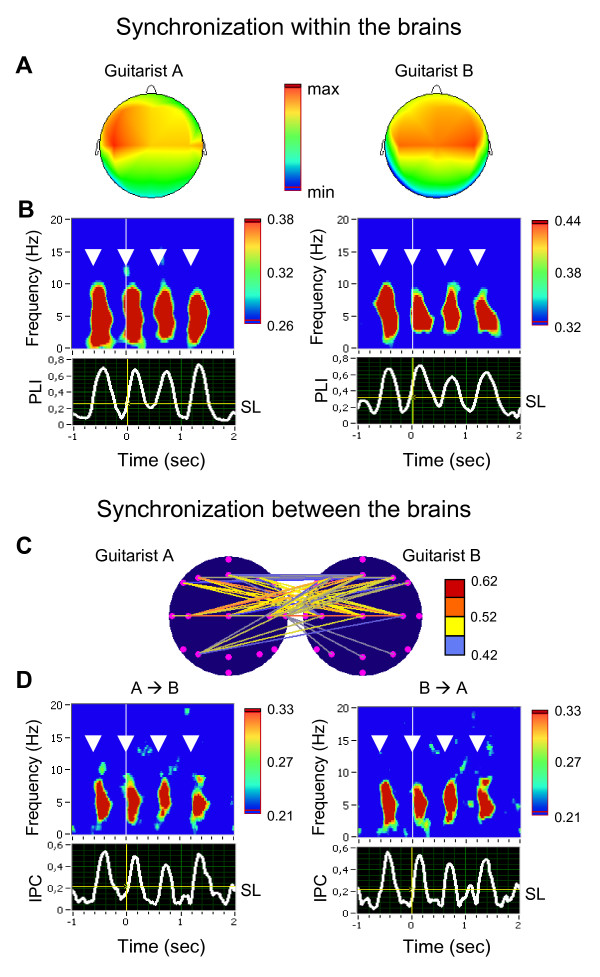
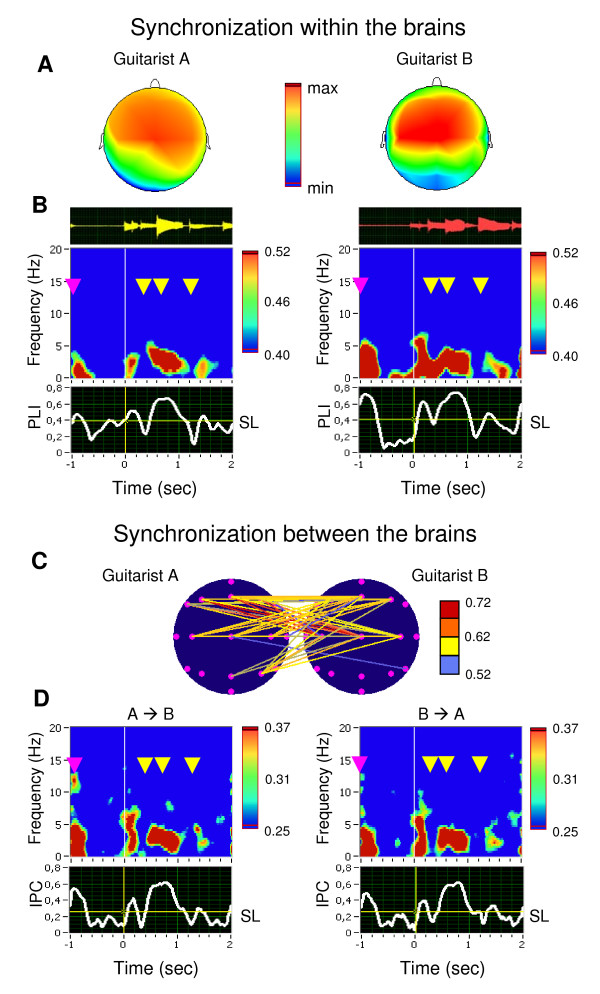
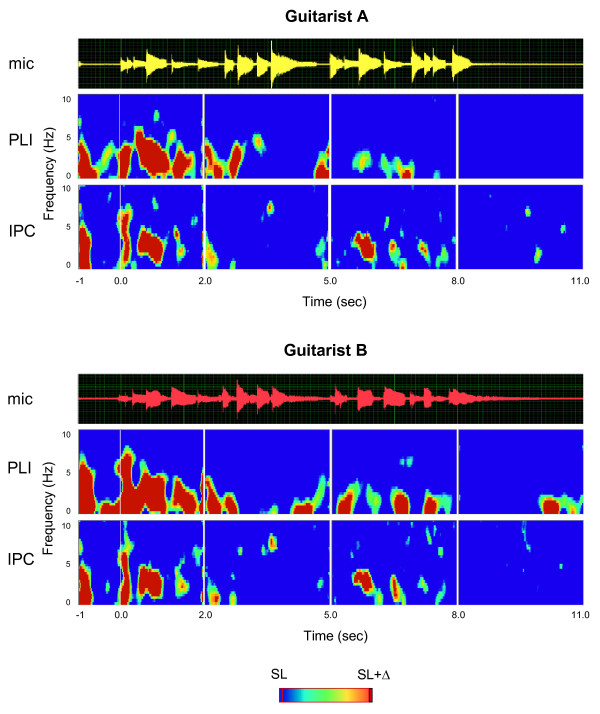
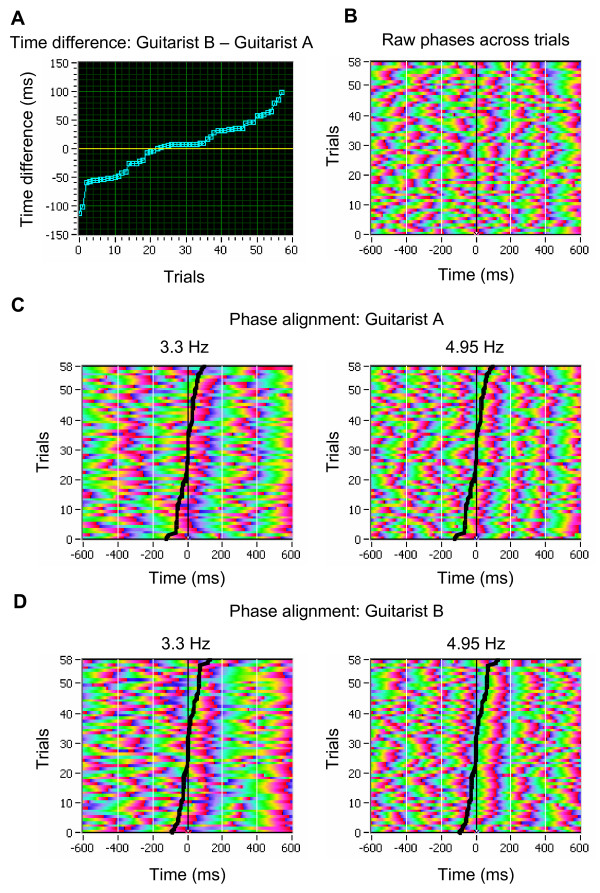
BACKGROUND: Brains interact with the world through actions that are implemented by sensory and motor processes. A substantial part of these interactions consists in synchronized goal-directed actions involving two or more individuals. Hyperscanning techniques for assessing fMRI simultaneously from two individuals have been developed. However, EEG recordings that permit the assessment of synchronized neuronal activities at much higher levels of temporal resolution have not yet been simultaneously assessed in multiple individuals and analyzed in the time-frequency domain. In this study, we simultaneously recorded EEG from the brains of each of eight pairs of guitarists playing a short melody together to explore the extent and the functional significance of synchronized cortical activity in the course of interpersonally coordinated actions. RESULTS: By applying synchronization algorithms to intra- and interbrain analyses, we found that phase synchronization both within and between brains increased significantly during the periods of (i) preparatory metronome tempo setting and (ii) coordinated play onset. Phase alignment extracted from within-brain dynamics was related to behavioral play onset asynchrony between guitarists. CONCLUSION: Our findings show that interpersonally coordinated actions are preceded and accompanied by between-brain oscillatory couplings. Presumably, these couplings reflect similarities in the temporal properties of the individuals' percepts and actions. Whether between-brain oscillatory couplings play a causal role in initiating and maintaining interpersonal action coordination needs to be clarified by further research.
Overview
The claims and statistics of this paper haven’t been checked yet.
Free: it reads the open-access text and checks the first 5 claims that cite a source we can check. Create a free account to check every claim.
Integrity signals
Registry
Cites
Statistics
Figures
Verification
Claims the paper makes
The claims and statistics of this paper haven’t been checked yet.
Free: it reads the open-access text and checks the first 5 claims that cite a source we can check. Create a free account to check every claim.
Claims other papers make about this one
Each is checked against this paper’s own text: does it say what the citing paper says it does?
The source backs part of the claim, not all of it — or backs it for a different population, condition or comparison.
In the citing paper
“The results showed that interpersonally coordinated actions (i.e., behavioral synchrony) are preceded and accompanied by interbrain oscillatory couplings in the prefrontal cortices.”
From Synchrony in Psychotherapy: A Review and an Integrative Framework for the Therapeutic Alliance (2016) · cites this paper as Lindenberger et al., 2009
Experimental — accuracy not yet measuredThe cited source says what the claim attributes to it.
In the citing paper
“Nevertheless, the link between movement synchrony and inter-brain coupling has been confirmed in motor tasks (Lindenberger et al., 2009).”
From Synchrony in Psychotherapy: A Review and an Integrative Framework for the Therapeutic Alliance (2016) · cites this paper as Lindenberger et al., 2009
Self-check
Percentages, sums and reported differences re-computed from the paper’s own numbers.
The self-check needs the paper’s full text.
Citations
Cites
Neuronal Oscillations in Cortical Networks
Buzsáki, G., & Draguhn, A. (2004) · Science · doi:10.1126/science.1099745 · Cited by 6,576 · cited 1×
“Network oscillations may functionally bias stimulus selection, form transient binding of neuronal assemblies, and facilitate synaptic plasticity [37].”
BackgroundA new method for off-line removal of ocular artifact
Gratton, G., Coles, M. G. H., & Donchin, E. (1983) · Electroencephalography and Clinical Neurophysiology · doi:10.1016/0013-4694(83)90135-9 · Cited by 5,055 · cited 1×
“5 to 70 Hz, and corrected for eye movements using the Gratton and Coles algorithm [43].”
MethodUnderstanding and sharing intentions: The origins of cultural cognition
Tomasello, M., Carpenter, M., Call, J., Behne, T., & Moll, H. (2005) · Behavioral and Brain Sciences · doi:10.1017/s0140525x05000129 · Cited by 4,882 · cited 2×
“Considerable research indicates that synchronized neuronal activity in perception and action [7-10] and oscillatory couplings between cortical and muscle activities during voluntary movement [11,12] are among the mechanisms supporting brain-body-world interactions [6,13-15].”
BackgroundThe brainweb: phase synchronization and large-scale integration
Varela, F., Lachaux, J.-P., Rodriguez, E., & Martinerie, J. (2001) · Nature Reviews Neuroscience · doi:10.1038/35067550 · Cited by 4,761 · cited 2×
“First, brain oscillations bind spatially distributed but functionally related information at the level of individual neurons, cell assemblies, and cortical areas [6-10].”
BackgroundNeurophysiological mechanisms underlying the understanding and imitation of action
Rizzolatti, G., Fogassi, L., & Gallese, V. (2001) · Nature Reviews Neuroscience · doi:10.1038/35090060 · Cited by 3,302 · cited 2×
“Neural activity in medial prefrontal cortex is selectively enhanced during theory of mind tasks [27,28].”
BackgroundModulation of Oscillatory Neuronal Synchronization by Selective Visual Attention
Fries, P., Reynolds, J. H., Rorie, A. E., & Desimone, R. (2001) · Science · doi:10.1126/science.1055465 · Cited by 2,786 · cited 2×
“First, brain oscillations bind spatially distributed but functionally related information at the level of individual neurons, cell assemblies, and cortical areas [6-10].”
BackgroundNeuronal Synchrony: A Versatile Code for the Definition of Relations?
Singer, W. (1999) · Neuron · doi:10.1016/s0896-6273(00)80821-1 · Cited by 2,581 · cited 1×
“Considerable research indicates that synchronized neuronal activity in perception and action [7-10] and oscillatory couplings between cortical and muscle activities during voluntary movement [11,12] are among the mechanisms supporting brain– body–world interactions [6,13-15].”
BackgroundExcitatory actions of gaba during development: the nature of the nurture
Ben-Ari, Y. (2002) · Nature Reviews Neuroscience · doi:10.1038/nrn920 · Cited by 2,448 · cited 1×
“In two interacting individuals adjusting their activity patterns through reciprocal sensory and motor pathways, synchronous brain activity can arise through temporally adjusted activity modulation [22-24] and does not need a substrate in form of connected neurons.”
BackgroundDevelopment and neurophysiology of mentalizing
Frith, U., & Frith, C. D. (2003) · Philosophical Transactions of the Royal Society of London. Series B: Biological Sciences · doi:10.1098/rstb.2002.1218 · Cited by 2,306 · cited 1×
“Considerable research indicates that synchronized neuronal activity in perception and action [7-10] and oscillatory couplings between cortical and muscle activities during voluntary movement [11,12] are among the mechanisms supporting brain-body-world interactions [6,13-15].”
BackgroundFunctional imaging of ‘theory of mind’
Gallagher, H. L., & Frith, C. D. (2003) · Trends in Cognitive Sciences · doi:10.1016/s1364-6613(02)00025-6 · Cited by 2,092 · cited 2×
“Neural activity in medial prefrontal cortex is selectively enhanced during theory of mind tasks [27,28].”
Background
Cited by
Items 101–200 of 444
Clarifying the interaction types in two-person neuroscience research
Liu, T., & Pelowski, M. J. (2014) · Frontiers in Human Neuroscience · doi:10.3389/fnhum.2014.00276 · Cited by 71
“This has involved key-press (Funane et al., 2011; Cui et al., 2012), finger-movement tasks (Tognoli et al., 2007; Holper et al., 2012; Naeem et al., 2012; Yun et al., 2012) and music-playing tasks (Lindenberger et al., 2009; Sänger et al., 2012).”
When do we fall in neural synchrony with others?
Lu, K., & Hao, N. (2019) · Social Cognitive and Affective Neuroscience · doi:10.1093/scan/nsz012 · Cited by 73
Vanzella, P., Balardin, J. B., Furucho, R. A., Morais, G. A. Z., Janzen, T. B., Sammler, D., & Sato, J. R. (2019) · Frontiers in Psychology · doi:10.3389/fpsyg.2019.00164 · Cited by 77
Cortical Patterns of Pleasurable Musical Chills Revealed by High-Density EEG
Chabin, T., Gabriel, D., Chansophonkul, T., Michelant, L., Joucla, C., Haffen, É., Moulin, T., Comte, A., & Pazart, L. (2020) · Frontiers in Neuroscience · doi:10.3389/fnins.2020.565815 · Cited by 80
Amplitude envelope correlations measure synchronous cortical oscillations in performing musicians
Zamm, A., Debener, S., Bauer, A. R., Bleichner, M. G., Demos, A. P., & Palmėr, C. (2018) · Annals of the New York Academy of Sciences · doi:10.1111/nyas.13738 · Cited by 68
Gansel, K. S. (2022) · Frontiers in Integrative Neuroscience · doi:10.3389/fnint.2022.900715 · Cited by 74
“, 2010), possibly even across subjects when they engage in coordinated actions (Lindenberger et al., 2009).”
BackgroundCoordination dynamics in a socially situated nervous system
Coey, C. A., Varlet, M., & Richardson, M. J. (2012) · Frontiers in Human Neuroscience · doi:10.3389/fnhum.2012.00164 · Cited by 62
Hyper-Brain Networks Support Romantic Kissing in Humans
Müller, V., & Lindenberger, U. (2014) · PLoS ONE · doi:10.1371/journal.pone.0112080 · Cited by 62
“To investigate these phenomena, various synchronization or coupling measures have been proposed and used [7,8,11,20].”
Self-citationConnecting Brains and Bodies: Applying Physiological Computing to Support Social Interaction
Chanel, G., & Mühl, C. (2015) · Interacting with Computers · doi:10.1093/iwc/iwv013 · Cited by 60
“Two research directions are proposed to use physiological signals for social signal processing: o the display of new physiological and social cues; o the use of multi-person physiological activity as a measure of social interactions.”
BackgroundNeural mechanisms underlying interpersonal coordination: A review of hyperscanning research
Mu, Y., Cerritos, C., & Khan, F. (2018) · Social and Personality Psychology Compass · doi:10.1111/spc3.12421 · Cited by 68
Inter-brain synchronization during a cooperative task reflects the sense of joint agency
Shiraishi, M., & Shimada, S. (2021) · Neuropsychologia · doi:10.1016/j.neuropsychologia.2021.107770 · Cited by 68
Parent-to-Child Anxiety Transmission Through Dyadic Social Dynamics: A Dynamic Developmental Model
Perlman, S. B., Lunkenheimer, E. S., Panlilio, C. C., & Pérez‐Edgar, K. E. (2022) · Clinical Child and Family Psychology Review · doi:10.1007/s10567-022-00391-7 · Cited by 73
“, 2017), musical collaboration (Lindenberger et al., 2009; Müller, Sänger, & Lindenberger, 2013) (i.”
Przyrembel, M., Smallwood, J., Pauen, M., & Singer, T. (2012) · Frontiers in Human Neuroscience · doi:10.3389/fnhum.2012.00190 · Cited by 76
“Lindenberger et al. (2009) investigated interbrain Frontiers in Human Neuroscience www.frontiersin.org June 2012 | Volume 6 | Article 190 | 9 synchronization when eight pairs of guitar players performed a short piece together.”
BackgroundHyperbrain network properties of guitarists playing in quartet
Müller, V., Sänger, J., & Lindenberger, U. (2018) · Annals of the New York Academy of Sciences · doi:10.1111/nyas.13656 · Cited by 70
Self-citationSteady Beat Sound Facilitates both Coordinated Group Walking and Inter-Subject Neural Synchrony
Ikeda, S., Nozawa, T., Yokoyama, R., Miyazaki, A., Sasaki, Y., Sakaki, K., & Kawashima, R. (2017) · Frontiers in Human Neuroscience · doi:10.3389/fnhum.2017.00147 · Cited by 64
“Most previous studies on social interactions have focused on interactive tasks wherein the subjects had some constraints on their motions (NIRS: Cui et al., 2012; Jiang et al., 2012; Cheng et al., 2015; Duan et al., 2015; EEG: Lindenberger et al., 2009; Astolfi et al., 2010; Dumas et al., 2010; Yun et al., 2012) becau…”
BackgroundInfluentialPraising or keeping silent on partner’s ideas: Leading brainstorming in particular ways
Lu, K., Qiao, X., & Hao, N. (2019) · Neuropsychologia · doi:10.1016/j.neuropsychologia.2019.01.004 · Cited by 55
Dynamic interpersonal neural synchronization underlying pain‐induced cooperation in females
Wang, C., Zhang, T., Shan, Z., Liu, J., Yuan, D., & Li, X. (2019) · Human Brain Mapping · doi:10.1002/hbm.24592 · Cited by 55
Georgieva, S., Lester, S., Noreika, V., Yilmaz, M. N., Wass, S. V., & Leong, V. (2020) · Frontiers in Neuroscience · doi:10.3389/fnins.2020.00352 · Cited by 60
Müller, V., Ohström, K.-R. P., & Lindenberger, U. (2021) · Neuroscience & Biobehavioral Reviews · doi:10.1016/j.neubiorev.2021.07.017 · Cited by 62
“…concluded that these findings imply either that the reported similarities are caused by shared sensory input and sensorimotor output of interaction partners or that there is something more that cannot entirely be explained on the level of the behavior investigated (cf. Lindenberger et al., 2009).”
BackgroundSelf-citationLi, L., Wang, H., Luo, H., Zhang, X., Zhang, R., & Li, X. (2020) · Frontiers in Human Neuroscience · doi:10.3389/fnhum.2020.00169 · Cited by 56
Brain to brain musical interaction: A systematic review of neural synchrony in musical activities
Cheng, S., Wang, J., Luo, R., & Hao, N. (2024) · Neuroscience & Biobehavioral Reviews · doi:10.1016/j.neubiorev.2024.105812 · Cited by 61
Human Computer Confluence: Transforming Human Experience Through Symbiotic Technologies
Gaggioli, A., Ferscha, A., Riva, G., Dunne, S., & Viaud-Delmon, I. (2015) · doi:10.1515/9783110471137 · Cited by 50
Froese, T., Gershenson, C., & Rosenblueth, D. A. (2013) · IEEE Congress on Evolutionary Computation (CEC) · doi:10.1109/cec.2013.6557730 · Cited by 53
“Moreover, acoustic social interactions can evoke profound changes in a person’s brain and body: guitar duets are preceded and accompanied by inter-brain oscillatory couplings [60], and choir singing is related to inter-personal cardiac and respiratory phase synchronization [61].”
BackgroundModeling the neurodynamic complexity of submarine navigation teams
Stevens, R. H., Galloway, T. L., Wang, P., Berka, C., Tan, V., Wohlgemuth, T., Lamb, J., & Buckles, R. (2012) · Computational and Mathematical Organization Theory · doi:10.1007/s10588-012-9135-9 · Cited by 51
Shehata, M. H., Cheng, M., Leung, A., Tsuchiya, N., Wu, D.-A. J., Tseng, C., Nakauchi, S., & Shimojo, S. (2021) · eNeuro · doi:10.1523/eneuro.0133-21.2021 · Cited by 62
“Group activities can enhance this synchrony during intense social states, body or speech coordination, music production, dancing, student-teacher interactions in classrooms, touch-mediated pain reduction, creativity in cooperative tasks, and even in socially interacting bats (Lindenberger et al., 2009; Dumas et al., 2…”
BackgroundAn Internet-Based Real-Time Audiovisual Link for Dual MEG Recordings
Zhdanov, A., Nurminen, J., Baess, P., Hirvenkari, L., Jousmäki, V., Mäkelä, J. P., Mandel, A., Meronen, L., Hari, R., & Parkkonen, L. (2015) · PLOS ONE · doi:10.1371/journal.pone.0128485 · Cited by 47
“To remediate this shortcoming, several research groups have started to employ hyperscanning—simultaneous neuroimaging of two or more interacting subjects, using functional magnetic resonance imaging (fMRI) [4], near-infrared spectroscopy (NIRS) [5], and electroencephalography (EEG) [6–12].”
MethodZhao, H., Li, Y., Wang, X., Kan, Y., Xu, S., & Duan, H. (2022) · Social Cognitive and Affective Neuroscience · doi:10.1093/scan/nsac005 · Cited by 49
“Due to the higher signal-to-noise rate and greater sensitivity of HbO concentration in the cerebral blood flow, the present research only focused on HbO concentration (Hoshi, 2003; Lindenberger et al., 2009; Cui et al., 2012; Mahmoudzadeh et al., 2013).”
MethodTrust Measurement in Human-Autonomy Teams: Development of a Conceptual Toolkit
Krausman, A., Neubauer, C. E., Forster, D. E., Lakhmani, S. G., Baker, A. L., Fitzhugh, S. M., Gremillion, G. M., Wright, J. L., Metcalfe, J. S., & Schaefer, K. E. (2022) · ACM Transactions on Human-Robot Interaction · doi:10.1145/3530874 · Cited by 57
“…during cooperative tasks [Levenson et al. 1983; Henning et al. 2001; Henning et al. 2005; Elkins et al. 2009; Henning, Armstead & Ferris 2009; Konvalinka et al. 2011], respiratory responses [Henning et al. 2001], brain activity [Tognoli et al. 2007; Lindenberger et al. 2009; Astolfi et al. 2010;]”
BackgroundSinger, T., & Tusche, A. (2013) · Elsevier eBooks · doi:10.1016/b978-0-12-416008-8.00027-9 · Cited by 54
Li, Y., Chen, M., Zhang, R., & Li, X. (2021) · Social Cognitive and Affective Neuroscience · doi:10.1093/scan/nsab114 · Cited by 49
“…time-series data were analyzed in the present study, given Hbo signal wasmore sensitive to the changes in cerebral blood flow than∆deoxy-Hb signal (Lindenberger et al., 2009) as well as provided a robust correlation with the bloodoxygen-level dependent (BOLD) signalmeasured by fMRI (Huppert et…”
MethodSearching for the Metaverse: Neuroscience of Physical and Digital Communities
Riva, G., Wiederhold, B. K., & Mantovani, F. (2024) · Cyberpsychology Behavior and Social Networking · doi:10.1089/cyber.2023.0040 · Cited by 53
“38 It is also important to note, that interbrain synchrony is also the basis for what Colombetti and Krueger define as an ‘‘extended affectivity,’’ the ability of emotions to extend beyond the individual’s brain and body.”
BackgroundDuan, H., Yang, T., Wang, X., Kan, Y., Zhao, H., Li, Y., & Hu, W. (2020) · Current Psychology · doi:10.1007/s12144-020-01093-5 · Cited by 52
The psychology of rituals: An integrative review and process-based frameworkPreprint
Hobson, N. M., Schroeder, J., Risen, J. L., Xygalatas, D., & Inzlicht, M. (2017) · PsyArXiv (OSF Preprints) · doi:10.31234/osf.io/98v3f · Cited by 49
Non-local mind from the perspective of social cognition
Chatel-Goldman, J., Schwartz, J., Jutten, C., & Congedo, M. (2013) · Frontiers in Human Neuroscience · doi:10.3389/fnhum.2013.00107 · Cited by 50
Keep Your Opponents Close: Social Context Affects EEG and fEMG Linkage in a Turn-Based Computer Game
Spapé, M., Kivikangas, J. M., Järvelä, S., Kosunen, I., Jacucci, G., & Ravaja, N. (2013) · PLoS ONE · doi:10.1371/journal.pone.0078795 · Cited by 48
“In the study [2], for instance, phase synchronisation effects between the pairs of guitarists seem to mainly occur at theta (peaking at 4.”
BackgroundFunctional EEG connectivity during competition
Balconi, M., & Vanutelli, M. E. (2018) · BMC Neuroscience · doi:10.1186/s12868-018-0464-6 · Cited by 53
Music as a window into real-world communication
Izen, S. C., Cassano‐Coleman, R. Y., & Piazza, E. A. (2023) · Frontiers in Psychology · doi:10.3389/fpsyg.2023.1012839 · Cited by 55
Toward Interactive Social Neuroscience: Neuroimaging Real‐World Interactions in Various Populations
Minagawa‐Kawai, Y., Xu, M., & Morimoto, S. (2018) · Japanese Psychological Research · doi:10.1111/jpr.12207 · Cited by 45
Raising the bar: Can dual scanning improve our understanding of joint action?
Astolfi, L., Toppi, J., Ciaramidaro, A., Vogel, P., Freitag, C. M., & Siniatchkin, M. (2020) · NeuroImage · doi:10.1016/j.neuroimage.2020.116813 · Cited by 44
Liu, H., Zhao, C., Wang, F., & Zhang, D. (2021) · Social Cognitive and Affective Neuroscience · doi:10.1093/scan/nsab031 · Cited by 50
“In the aforementioned data analysis, the EEG signals from the two interacting players were analyzed in a ‘synchronous’ way by temporally aligning the two EEG signals with a zero lag, as done in many previous studies on cooperation and competition (Lindenberger et al., 2009; Sänger et al., 2012; Müller et al., 2013; Si…”
BackgroundMethodZamm, A., Palmėr, C., Bauer, A. R., Bleichner, M. G., Demos, A. P., & Debener, S. (2021) · Frontiers in Human Neuroscience · doi:10.3389/fnhum.2021.717810 · Cited by 51
Dai, R., Liu, R., Liu, T., Zong, Z., Xiao, X. N., Sun, P., Yu, X., Wang, D., & Zhu, C. (2018) · Social Cognitive and Affective Neuroscience · doi:10.1093/scan/nsy090 · Cited by 49
“When people coordinated with others, their brain oscillated more synchronously than during non-coordination period (Lindenberger et al., 2009), especially in alpha-mu band (Dumas et al.”
BackgroundChabin, T., Gabriel, D., Comte, A., Haffen, É., Moulin, T., & Pazart, L. (2021) · Annals of the New York Academy of Sciences · doi:10.1111/nyas.14711 · Cited by 53
Filho, E. (2018) · Sport Sciences for Health · doi:10.1007/s11332-018-0519-1 · Cited by 52
Marzoratti, A., & Evans, T. M. (2022) · Cognitive Affective & Behavioral Neuroscience · doi:10.3758/s13415-022-01011-1 · Cited by 52
Hyperscanning literature after two decades of neuroscientific research: A scientometric review
Carollo, A., & Esposito, G. (2024) · Neuroscience · doi:10.1016/j.neuroscience.2024.05.045 · Cited by 54
Teaching as a Dynamic Phenomenon with Interpersonal Interactions
Watanabe, K. (2013) · Mind Brain and Education · doi:10.1111/mbe.12011 · Cited by 41
Szymanski, C., Müller, V., Brick, T. R., von Oertzen, T., & Lindenberger, U. (2017) · Frontiers in Human Neuroscience · doi:10.3389/fnhum.2017.00539 · Cited by 44
“Studies in our own lab showed strongest inter-brain synchronization at frontocentral and centroparietal regions predominantly in the delta and theta ranges during joint guitar play (Lindenberger et al., 2009; Sänger et al., 2012; Müller and Lindenberger, 2014).”
BackgroundSelf-citationBalconi, M., & Fronda, G. (2020) · Brain Sciences · doi:10.3390/brainsci10010029 · Cited by 43
“Indeed, as demonstrated by different studies [29,58], during joint action, such as non-verbal communication, an increase of coordination and behavioral responses occurs between inter-agents’ individuals, creating implicit coupling mechanisms [59].”
BackgroundZhang, M., Jia, H., Zheng, M., & Liu, T. (2020) · Personality and Individual Differences · doi:10.1016/j.paid.2020.110315 · Cited by 44
Cues for self-recognition in point-light displays of actions performed in synchrony with music
Sevdalis, V., & Keller, P. E. (2010) · Consciousness and Cognition · doi:10.1016/j.concog.2010.03.017 · Cited by 39
Donate or receive? Social hyperscanning application with fNIRS
Balconi, M., Fronda, G., & Vanutelli, M. E. (2019) · Current Psychology · doi:10.1007/s12144-019-00247-4 · Cited by 39
“For example, a study by Lindenberger et al. (2009) observed an inter-cerebral oscillatory coherence between pairs of guitarists who played a short melody together, reporting an increased individuals brain responses synchronization in the frontal regions, emphasizing the role of this brain area in…”
BackgroundDyadic drumming across the lifespan reveals a zone of proximal development in children.
Kleinspehn-Ammerlahn, A., Riediger, M., Schmiedek, F., von Oertzen, T., Li, S., & Lindenberger, U. (2011) · Developmental Psychology · doi:10.1037/a0021818 · Cited by 49
Self-citationThe boundaries of cooperation: sharing and coupling from ethology to neuroscience
Vanutelli, M. E., Nandrino, J., & Balconi, M. (2016) · Neuropsychological Trends · doi:10.7358/neur-2016-019-vanu · Cited by 39
“An interesting study conducted by Lindenberger and colleagues (Lindenberger et al., 2009) found phase synchronized theta and delta oscillations in pairs of guitarists playing a short melody together.”
BackgroundDynamic Orchestration of Brains and Instruments During Free Guitar Improvisation
Müller, V., & Lindenberger, U. (2019) · Frontiers in Integrative Neuroscience · doi:10.3389/fnint.2019.00050 · Cited by 42
“, 2017), but that it requires strong inter-brain synchronization and specific hyper-brain network activity supporting interpersonal action coordination (Lindenberger et al., 2009; Sänger et al., 2011, 2012, 2013; Müller et al., 2013, 2018b).”
BackgroundSelf-citationHierarchical nonlinear dynamics of human attention
Rabinovich, M. I., Tristan, I., & Varona, P. (2015) · Neuroscience & Biobehavioral Reviews · doi:10.1016/j.neubiorev.2015.04.001 · Cited by 44
Moran, N. (2014) · Frontiers in Psychology · doi:10.3389/fpsyg.2014.00676 · Cited by 52
“Other work has begun to explore the neural bases of musical interaction; focusing on the behavior of ensemble performers, Lindenberger et al. (2009) used dual EEG to study within-brain synchronization by duetting guitarists; and Keller and his collaborators have continued to develop the “adaptive…”
BackgroundEEG hyperscanning and behavioral synchronization during a joint actions
Balconi, M., & Vanutelli, M. E. (2018) · Neuropsychological Trends · doi:10.7358/neur-2018-024-balc · Cited by 40
Interacting brains coming in sync through their minds: an interbrain neurofeedback study
Müller, V., Perdikis, D., Jeglinski-Mende, M. A., & Lindenberger, U. (2021) · Annals of the New York Academy of Sciences · doi:10.1111/nyas.14605 · Cited by 38
Self-citationHyperbrain features of team mental models within a juggling paradigm: a proof of concept
Filho, E., Bertollo, M., Tamburro, G., Schinaia, L., Chatel-Goldman, J., di Fronso, S., Robazza, C., & Comani, S. (2016) · PeerJ · doi:10.7717/peerj.2457 · Cited by 39
“To this extent, previous research on real-time cooperative motor tasks has shown that interpersonal spatio-temporal coordination tends to rely on synchronized individual neurophysiological responses, such as cardiac, respiratory and cortical signals (Filho et al., 2016; Lindenberger et al., 2009; McFarland, 2001; Müll…”
BackgroundKawasaki, M., Kitajo, K., & Yamaguchi, Y. (2018) · Neuropsychologia · doi:10.1016/j.neuropsychologia.2018.07.026 · Cited by 38
“band phase synchronizations in the other brain regions have also been observed in previous hyperscanning studies (Fallani et al., 2010; Dumas et al., 2010, 2012; Astolfi, 2011; Pecenka and Keller, 2011; Konvalinka and Roepstorff, 2012; Toppi et al., 2016; Jahng et al., 2017; Holper et al., 2012; Kawasaki et al., 2013;…”
Interpersonal synchrony when singing in a choir
Delius, J. A. M., & Müller, V. (2023) · Frontiers in Psychology · doi:10.3389/fpsyg.2022.1087517 · Cited by 45
Self-citationA framework for joint music making: Behavioral findings, neural processes, and computational models
Abalde, S. F., Rigby, A. M., Keller, P. E., & Novembre, G. (2024) · Neuroscience & Biobehavioral Reviews · doi:10.1016/j.neubiorev.2024.105816 · Cited by 46
“Lindenberger et al. (2009) conducted a pioneering study of this type by simultaneously recording EEG from pairs of guitarists playing together.”
Near-Infrared Spectroscopy Applied to Complex Systems and Human Hyperscanning Networking
Crivelli, D., & Balconi, M. (2017) · Applied Sciences · doi:10.3390/app7090922 · Cited by 33
“The hyperscanning approach has been applied via functional Magnetic Resonance Imaging (fMRI) [22–24], electroencephalography (EEG) [18,20,25], magnetoencephalography (MEG) [26–28], and functional Near-Infrared Spectroscopy (fNIRS) [4,19,29–33].”
BackgroundMethodGroups and Emotional Arousal Mediate Neural Synchrony and Perceived Ritual Efficacy
Cho, P. S., Escoffier, N., Mao, Y., Ching, A. S. M., Green, C., Jong, J., & Whitehouse, H. (2018) · Frontiers in Psychology · doi:10.3389/fpsyg.2018.02071 · Cited by 31
“These functions include cognitive control over action monitoring, prestimulus expectation, and memory in social settings (Mizuhara and Yamaguchi, 2007; Cavanagh et al., 2009; Lindenberger et al., 2009; Slagter et al., 2009; Min and Park, 2010; Yun et al., 2012).”
BackgroundLadda, A. M., Wallwork, S. B., & Lotze, M. (2020) · Frontiers in Psychology · doi:10.3389/fpsyg.2020.576120 · Cited by 34
Interbrain Synchrony of Team Collaborative Decision-Making: An fNIRS Hyperscanning Study
Zhang, M., Jia, H., & Wang, G. (2021) · Frontiers in Human Neuroscience · doi:10.3389/fnhum.2021.702959 · Cited by 34
“We primarily focused on the oxy-Hb data, since the oxygenated signal was more sensitive to changes in cerebral blood flow (Hoshi, 2003; Lindenberger et al., 2009).”
MethodIt Takes Two: Interpersonal Neural Synchrony Is Increased after Musical Interaction
Khalil, A. K., Musacchia, G., & Iversen, J. R. (2022) · Brain Sciences · doi:10.3390/brainsci12030409 · Cited by 35
Konrad, K., Gerloff, C., Kohl, S. H., Mehler, D. M. A., Mehlem, L., Volbert, E. L., Komorek, M., Henn, A. T., Boecker, M., Weiß, E. O., et al. (2024) · Frontiers in Neuroscience · doi:10.3389/fnins.2024.1286130 · Cited by 37
Balconi, M., & Fronda, G. (2020) · Scientific Reports · doi:10.1038/s41598-020-62421-0 · Cited by 31
The motor-related brain activity that supports joint action: A review
Bolt, N. K., & Loehr, J. D. (2020) · Acta Psychologica · doi:10.1016/j.actpsy.2020.103218 · Cited by 36
Špiláková, B., Shaw, D. J., Czekóová, K., & Brázdil, M. (2019) · Social Cognitive and Affective Neuroscience · doi:10.1093/scan/nsz004 · Cited by 33
“, 2007) or concurrent (e.g. Tognoli et al., 2007; Lindenberger et al., 2009; Cui et al., 2012) exchanges, but our modified PG enabled us to compare these two types of interaction structure directly.”
MethodAssociations of Empathy with Teacher–Student Interactions: A Potential Ternary Model
Sun, B., Wang, Y., Ye, Q., & Pan, Y. (2023) · Brain Sciences · doi:10.3390/brainsci13050767 · Cited by 37
Zheng, Q., Chi, A., Shi, B., Wang, Y., Ma, Q., Zhou, F., Guo, X., Zhou, M., Lin, B., & Ning, K. (2023) · Frontiers in Behavioral Neuroscience · doi:10.3389/fnbeh.2023.1279648 · Cited by 28
“Oxy-Hb has a higher signalto-noise ratio and greater sensitivity to changes in brain oxygenation (Strangman et al., 2002; Lindenberger et al., 2009).”
BackgroundEEG functional connectivity and brain-to-brain coupling in failing cognitive strategies
Balconi, M., Gatti, L., & Vanutelli, M. E. (2018) · Consciousness and Cognition · doi:10.1016/j.concog.2018.03.001 · Cited by 34
Müller, V., & Lindenberger, U. (2021) · Annals of the New York Academy of Sciences · doi:10.1111/nyas.14689 · Cited by 33
“The main findings are that when playing guitar in a duet, (1) a synchronization between guitars and brains can be observed at the low delta-theta frequencies below 7Hz, which is strongly related to the notes played; (2) the phase angles of both guitarists in the pair were strongly aligned with regard to the behavioral…”
BackgroundSelf-citationWei, Y., Liu, J., Zhang, T., Su, W., Tang, X., Tang, Y., Xu, L., Qian, Z., Zhang, T., Li, X., et al. (2022) · Progress in Neuro-Psychopharmacology and Biological Psychiatry · doi:10.1016/j.pnpbp.2022.110634 · Cited by 31
Neural Synchrony and Network Dynamics in Social Interaction: A Hyper-Brain Cell Assembly Hypothesis
Müller, V. (2022) · Frontiers in Human Neuroscience · doi:10.3389/fnhum.2022.848026 · Cited by 31
Self-citationMüller, V., & Lindenberger, U. (2023) · Annals of the New York Academy of Sciences · doi:10.1111/nyas.14987 · Cited by 34
Self-citationDistinct social behavior and inter-brain connectivity in Dyads with autistic individuals
Moreau, Q., Brun, F., Ayrolles, A., Nadel, J., & Dumas, G. (2024) · Social Neuroscience · doi:10.1080/17470919.2024.2379917 · Cited by 32
“We defined 4 frequency-bands-of-interest, whose ranges have been previously associated with increased synchrony in previous studies: Theta [4–8 Hz; (Lindenberger et al., 2009)], Alpha Low [8–10 Hz, (Kawasaki et al., 2013)], Alpha High [11–13 Hz, (Tognoli et al., 2007)], Beta [14–31 Hz, (Astolfi et al., 2010)].”
The Causal Inference of Cortical Neural Networks during Music Improvisations
Wan, X., Crüts, B., & Jensen, H. J. (2014) · PLoS ONE · doi:10.1371/journal.pone.0112776 · Cited by 34
Fachner, J. C. (2014) · Psychology of Music · doi:10.1177/0305735614547665 · Cited by 35
Balconi, M., Fronda, G., & Bartolo, A. (2020) · Journal of Motor Behavior · doi:10.1080/00222895.2020.1774490 · Cited by 29
“…that require them to develop a joint mental model including representations of the self and of the other inter-agents (Balconi et al., 2018b; Lindenberger et al., 2009) or even when two individuals are simply asked to produce the same gestures and the same mimic expressions (Dumas et al.,…”
BackgroundDynamics in interbrain synchronization while playing a piano duet
Lender, A., Perdikis, D., Gruber, W. R., Lindenberger, U., & Müller, V. (2023) · Annals of the New York Academy of Sciences · doi:10.1111/nyas.15072 · Cited by 32
Self-citationEEG hyperscanning in motor rehabilitation: a position paper
Short, M. R., Hernandez-Pavon, J. C., Jones, A., & Pons, J. L. (2021) · Journal of NeuroEngineering and Rehabilitation · doi:10.1186/s12984-021-00892-6 · Cited by 27
Lin, J.-F. L., Imada, T., Meltzoff, A. N., Hiraishi, H., Ikeda, T., Takahashi, T., Hasegawa, C., Yoshimura, Y., Kikuchi, M., Hirata, M., et al. (2022) · Cerebral Cortex · doi:10.1093/cercor/bhac330 · Cited by 30
“When a pair of guitarists played short melodies in unison, interbrain synchronization in the theta band increased at the central and frontal electrode sites when preparatory metronome beats were providedand when pairs of guitarists coordinated their play onsets (Lindenberger et al.2009).”
InfluentialDerix, J., Iljina, O., Schulze‐Bonhage, A., Aertsen, A., & Ball, T. (2012) · Frontiers in Human Neuroscience · doi:10.3389/fnhum.2012.00251 · Cited by 30
“In this way, various kinds of interactive behaviors can be investigated, e.g., in spontaneous communication of subjects while playing games (Montague et al., 2002; Babiloni et al., 2006), imitating others’ movements (Dumas et al., 2010), or collectively making music (Lindenberger et al., 2009).”
BackgroundSynchronizing MIDI and wireless EEG measurements during natural piano performance
Zamm, A., Palmėr, C., Bauer, A. R., Bleichner, M. G., Demos, A. P., & Debener, S. (2017) · Brain Research · doi:10.1016/j.brainres.2017.07.001 · Cited by 29
EEG-based approach for recognizing human social emotion perception
Zhu, L., Su, C., Zhang, J., Cui, G., Cichocki, A. S., Zhou, C., & Li, J. (2020) · Advanced Engineering Informatics · doi:10.1016/j.aei.2020.101191 · Cited by 28
Angioletti, L., & Balconi, M. (2022) · Frontiers in Neuroanatomy · doi:10.3389/fnana.2022.991522 · Cited by 26
“Regarding the manifestation of delta in the temporo-central regions, a previous study observed delta oscillations in frontal and central electrode sites as a marker of coordinated and controlled motor activity (Lindenberger et al., 2009).”
BackgroundInfluentialFilho, E., & Tenenbaum, G. (2020) · Wiley eBooks · doi:10.1002/9781119568124.ch29 · Cited by 32
Ayaz, H., & Dehais, F. (2021) · Wiley eBooks · doi:10.1002/9781119636113.ch31 · Cited by 27
In touch: Cardiac and respiratory patterns synchronize during ensemble singing with physical contact
Lange, E. B., Omigie, D., Trenado, C., Müller, V., Wald-Fuhrmann, M., & Merrill, J. (2022) · Frontiers in Human Neuroscience · doi:10.3389/fnhum.2022.928563 · Cited by 24
“, 2018a, 2019), and brain responses (Lindenberger et al., 2009; Babiloni et al., 2011, 2012; Sänger et al., 2012; Müller et al., 2013, 2018b, 2019; Osaka et al., 2015), suggesting that coordination extends to implicit processes.”
BackgroundSelf-citationZimmermann, M., Schultz-Nielsen, K., Dumas, G., & Konvalinka, I. (2024) · Imaging Neuroscience · doi:10.1162/imag_a_00350 · Cited by 34
“This observation is particularly concerning as it can be assumed ( Dumas et al., 2010; Lindenberger et al., 2009) that at least some inter-brain processes occur and manifest at shorter timescales than those recommended by previous research on intra-brain functional connectivity ( Lachaux et al.,…”
BackgroundMethodZhang, M., Jia, H., & Zheng, M. (2020) · Frontiers in Psychology · doi:10.3389/fpsyg.2020.542093 · Cited by 27
“Note that we primarily focused on the oxy-Hb data since the oxygenated signal was more sensitive to changes in cerebral blood flow (Hoshi, 2003; Lindenberger et al., 2009).”
MethodInteractive social neuroscience to study autism spectrum disorder.
Rolison, M. J., Naples, A. J., & McPartland, J. C. (2015) · PubMed Central · Cited by 31
Inter-brain Synchronization in the Practice of Tibetan Monastic Debate
van Vugt, M. K., Pollock, J., Johnson, B., Gyatso, K., Norbu, N., Lodroe, T., Gyaltsen, T., Phuntsok, L., Thakchoe, J., Khechok, J., et al. (2020) · Mindfulness · doi:10.1007/s12671-020-01338-1 · Cited by 32
The effect of interbrain synchronization in gesture observation: A fNIRS study
Fronda, G., & Balconi, M. (2020) · Brain and Behavior · doi:10.1002/brb3.1663 · Cited by 26
Are the new mobile wireless EEG headsets reliable for the evaluation of musical pleasure?
Chabin, T., Gabriel, D., Haffen, É., Moulin, T., & Pazart, L. (2020) · PLoS ONE · doi:10.1371/journal.pone.0244820 · Cited by 27
“Several studies have already investigated neural synchronization during social engagement tasks [20] or during interpersonal coordination of musicians [22,24,27].”
BackgroundLéné, P., Karran, A. J., Labonté-LeMoyne, É., Sénécal, S., Frédette, M., Johnson, K., & Léger, P. (2021) · Brain and Behavior · doi:10.1002/brb3.2270 · Cited by 27
Metadata
- Authors
- Lindenberger, U., Li, S.-C., Gruber, W., & Müller, V.
- Affiliations
- Max Planck Institute for Human Development (DE)
- University of Salzburg (AT)
- Corresponding author
- Lindenberger, Ulman
- Müller, Viktor
- Venue
- BMC Neuroscience
- Published
- 2009-03-17
- Volume
- 10
- Issue
- 1
- Pages
- 22-22
- ISSN
- 1471-2202 (ISSN-L)
- PMC
- PMC2662862
- OpenAlex
- W2056689588
- Cited by
- 444
- References
- 47
- Citations by year
- 2026: 35 · 2025: 26 · 2024: 31 · 2023: 30 · 2022: 26 · 2021: 36 · 2020: 52 · 2019: 18 · 2018: 29 · 2017: 31 · 2016: 21 · 2015: 21 · 2014: 23 · 2013: 22 · 2012: 19
- FWCI
- 15.65
- Type
- journal article
- Language
- en
- Open access
- gold
- doi.org
- Licence
- cc-by
- creativecommons.org/licenses/by/2.0 (tdm)
- Locations
- BMC Neuroscience (publishedVersion, cc-by)
- PubMed Central (publishedVersion, cc-by)
- PubMed (publishedVersion)
- DOAJ (DOAJ: Directory of Open Access Journals) (submittedVersion, cc-by-sa)
- Max Planck Institute for Plasma Physics (submittedVersion)
- Max Planck Digital Library (submittedVersion, other-oa)
- MPG.PuRe (Max Planck Society) (submittedVersion, other-oa)
- Funders
- Deutsche Forschungsgemeinschaft
- Max-Planck-Gesellschaft
- Topics
- Social Sciences › Psychology › Social Psychology › Action Observation and Synchronization
- Life Sciences › Neuroscience › Cognitive Neuroscience › Neural dynamics and brain function
- Life Sciences › Neuroscience › Cognitive Neuroscience › Neuroscience and Music Perception
- Keywords
- inter-brain synchrony, phase synchronization, interpersonal coordination, joint action, guitar performance, time-frequency analysis, oscillatory coupling, music performance
- MeSH terms
- Adult, Attention, Brain, Brain Mapping, Cerebral Cortex, Cortical Synchronization, Electroencephalography, Female, Humans, Magnetic Resonance Imaging, Male, Young Adult
About these checks
Registry, retraction, Cites and statistics results are computed, not judged, with one exception: a printed reference that no index lists is read once by a model before it counts as a citation error. Claims are extracted by a model and kept only when their quote appears verbatim in the text; each cited source is then checked, with a model’s help, for whether it says what the claim relies on. Those verdicts can be wrong — read the claim’s quote and the cited source before relying on one.
Statistics and arithmetic are recomputed, not judged.
Confidence bands are shown only for fields calibrated on our annotated test set. None is calibrated yet, so no band is shown.
What counts as a claim ›How we measure confidence ›How we check this ›
Are you an author, or do you see a problem with this page? Request a review
Data sources
Bibliographic data: Semantic Scholar, OpenAlex, Crossref.
Contains information from the Semantic Scholar Academic Graph Datasets, made available under the ODC Attribution License (ODC-BY 1.0).
Semantic Scholar’s data is described in: Kinney, R., et al. (2023). The Semantic Scholar Open Data Platform. arXiv:2301.10140.
